Introduction
The parathyroid glands were the last endocrine organ to be discovered (in 1849–1850) because they are small and have a similar appearance to the surrounding tissue.Reference Modarai, Sawyer and Ellis1 The parathyroid glands secrete parathyroid hormone which, along with vitamin D and calcitonin, regulates calcium homeostasis.Reference Udelsman and Donovan2 Their similarity to the surrounding tissues makes identifying and protecting these structures a challenge during thyroid surgery. There are typically four parathyroid glands: the inferior glands develop from the third pharyngeal pouch, while the superior two glands develop from the fourth pharyngeal pouch.Reference Mohebati and Shaha3 The superior glands have a short migration distance; their anatomical location is within the upper two-thirds of the thyroid gland in around 80 per cent of cases.Reference Akerstrom, Malmaeus and Bergstrom4 The inferior parathyroid glands migrate inferiorly with the thymus, resulting in a more variable location: they can be found anywhere from the inferior thyroid to the lower neck or mediastinum,Reference Wang5 but are located symmetrically in most cases.Reference Akerstrom, Malmaeus and Bergstrom4 They are typically yellow to reddish-brown in colour, measure only 3–8 mm in diameterReference Fancy, Gallagher and Hornig6 and, in most cases, receive their blood supply from the inferior thyroid artery.Reference Alveryd7
Injury to the parathyroid glands is likely to be an important predictor of post-operative hypocalcaemia. As an increasing number of thyroidectomies are being performed and patients are becoming interested in reading their pathology reports, it is increasingly important to determine the inadvertent (or incidental) parathyroidectomy rate and the factors which contribute to this.
A number of studies have focused on the issue of inadvertent parathyroidectomy. Most authors agree that identifying parathyroid glands intra-operatively does reduce the incidence of parathyroidectomy.Reference Abboud, Sleilaty, Braidy, Zeineddine, Ghorra and Abadjian8 Although several studies have identified factors associated with inadvertent parathyroidectomy, none have included a multivariate analysis to identify statistically significant independent predictors.
This study aimed to identify the inadvertent parathyroidectomy rate in East Kent Hospitals University NHS Foundation Trust, UK, and to provide analysis of potential variables using multivariate analysis.
Materials and methods
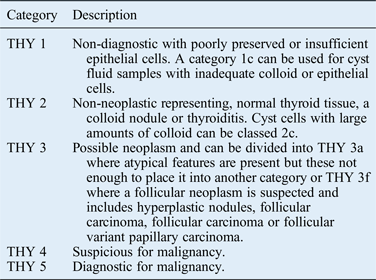
This study is a retrospective case series. Electronic records were used to identify all patients who underwent thyroid surgery in the Department of Otolaryngology Head and Neck Surgery from January 2010 to October 2013. Hospital approval was granted for the project. Data collected included age, sex, surgical time, type of procedure (hemithyroidectomy or total thyroidectomy) and whether neck dissection (central or lateral, unilateral or bilateral) was performed. The individual histopathology reports of these patients were then reviewed to determine whether parathyroid tissue was found within the specimen. Other data collected included the highest pre-operative fine needle aspiration cytology (FNAC) result (using the THY classification as recommended by the British Association of Thyroid SurgeonsReference Perros, Boelaert, Colley, Evans, Evans and Gerrard Ba9; shown in Table I), whether cancerous tissue was found within the specimen and the specimen weight. In addition, post-operative corrected serum calcium levels for total and completion thyroidectomy patients were measured to establish the incidence of post-operative and permanent hypocalcaemia.
THY classification*

* Modified from Perros et al., 2014.Reference Perros, Boelaert, Colley, Evans, Evans and Gerrard Ba9
The histopathology protocol required that every thyroid specimen was weighed and measured. Specimens suspicious for malignancy (i.e. THY4) were marked to identify the right and left lobes. For each sample, a macroscopic description was recorded, and laterality was established; 3–5 mm parallel slices were then made through the specimen. The cut surfaces were then carefully inspected. Routine goitre specimens were sliced in a different way: six slices were made per lobe and further blocks cut in varying sizes depending on nodule size and whether suspicious pathology was present. If a solid, well-circumscribed lesion was present, the whole capsule and its surrounding interface were processed to identify any minimally invasive carcinoma. If poorly encapsulated lesions showed infiltrative features, the interface between the lesion and surrounding tissue was extensively sampled. Satellite nodules outside the specimens were processed macroscopically as unknown tissue (lymph node, parathyroid gland or thyroid tissue); inadvertently removed extra-capsular parathyroid glands were detected at this stage.
A total of 383 patients were identified. Patients with missing pathology reports (6), incorrect coding of the operation (16), missing operation times (4) or missing specimen weights (11) were excluded, leaving datasets from 346 patients to be included in the univariate analysis. As no pre-operative FNAC was available for 80 of these patients, they were later excluded from the multivariate analysis (leaving 266 patient datasets for analysis).
Thyroidectomies were performed through a central skin crease incision and any identified excised parathyroid glands were re-implanted into the sternocleidomastoid muscle during the procedure. Patients for whom parathyroid tissue was identified intra-operatively and sent for histological confirmation were excluded from the study.
Data were analysed first with Microsoft Office Excel 2010 (Microsoft, Redmond, Washington, USA) and then with IBM SPSS Statistics software version 21.0 (Armonk, New York, USA) to investigate potential associations between inadvertent parathyroidectomy and categorical variables. Multivariate analysis using binary logistic regression was performed to determine the effect of patient age, sex and weight, highest FNAC result, thyroidectomy type, presence of neck dissection, operation time, and identification of cancer within the specimen on the probability of inadvertent parathyroidectomy. The Kruskal–Wallis test was also performed to assess the effect of FNAC score (1–5) on inadvertent parathyroidectomy. A p value of less than 0.05 was used to indicate statistical significance of the probability of the parathyroid variable being positive.
Results
Patient age ranged from 15 to 86 years (median, 54 years). Forty-eight patients (14 per cent) underwent neck dissection, while 296 (86 per cent) had thyroid surgery alone. A total of 269 hemithyroidectomies (of which 53 were completion hemithyroidectomies and 77 were total thyroidectomies) were performed. Histological analysis revealed 252 benign specimens (73 per cent) and 96 specimens containing malignancy (28 per cent). The median specimen weight was 23 g (range, 2–610 g). Operation times varied from 47 to 489 minutes (median, 120 minutes). Fifty-six specimens (16 per cent) contained parathyroid tissue and 290 did not (84 per cent), resulting in an inadvertent parathyroidectomy rate of 16 per cent per procedure or 13 per cent for each lobectomy performed. All patients except one had a single parathyroid gland removed, but data from all patients were included in the analysis.
Of the 130 patients who underwent completion and total thyroidectomies, 12 (9 per cent; 7 total thyroidectomies and 5 hemithyroidectomies) had immediate post-operative hypocalcaemia. Of these, 3 patients remained on calcium supplementation after 3 months (2 per cent) and all except one were normocalcaemic within 12 months of surgery (1 per cent). Only 2 of the 12 patients who developed hypocalcaemia had a parathyroid gland removed during surgery (1 hemithyroidectomy and 1 total thyroidectomy), and the hypocalcaemia rate was 4 per cent (2 out of 56) in patients who had inadvertent parathyroidectomy. The hemithyroidectomy patient had immediate hypocalcaemia only, while the total thyroidectomy patient developed immediate hypocalcaemia that resolved within 12 months.
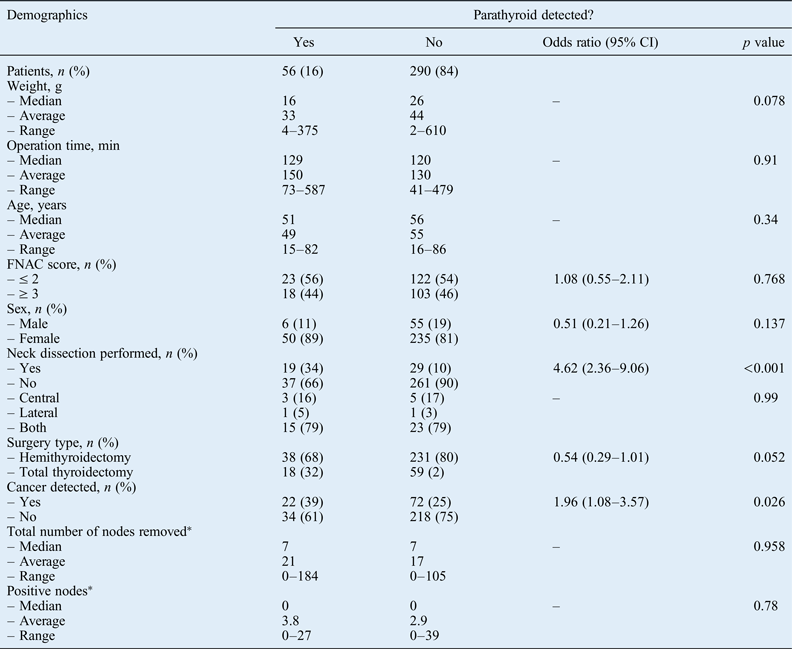
Results of a univariate analysis of factors potentially associated with inadvertent parathyroidectomy including odds ratios, confidence intervals and cohort demographics are shown in Table II. Neck dissection (no vs yes, 13 per cent vs 60 per cent; p < 0.01) and the presence of malignancy within the specimen (no vs yes, 14 per cent vs 23 per cent; p = 0.026) were associated with inadvertent parathyroidectomy. Extent of surgery was not a significant predictor of inadvertent parathyroidectomy rate (23 per cent for total thyroidectomy vs 14 per cent for hemithyroidectomy; p = 0.052). The FNAC score (1–5) had no significant effect on the inadvertent parathyroidectomy risk (p = 0.98).
Univariate analysis: patient demographics
*n = 48 patients. CI = confidence interval; min = minutes; FNAC = fine needle aspiration cytology; pts = patients
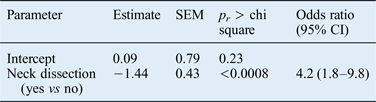
In the multivariate analysis, variables were excluded in a step-wise backward elimination process to identify factors significantly associated with inadvertent parathyroidectomy. The only variable that had a significant effect on inadvertent parathyroid removal was neck dissection (hazard ratio, 4.2, 95 per cent confidence interval (CI), 1.82 to 9.79; p = 0.0008; shown in Table III). The presence of cancer within the specimen lost significance on multivariate modelling (p = 0.0697).
Multivariate analysis: significant risk factors
SEM = standard error of the mean; CI = confidence interval
Discussion
The inadvertent parathyroidectomy rate has been widely reported but is under-investigated. Previous studies have investigated associations between hypocalcaemia risk factors and parathyroid gland removal, or factors directly linked to inadvertent parathyroid gland removal. No studies have performed multivariate statistical analysis to identify risk factors for inadvertent parathyroidectomy. As patients may review their operation notes, it is important that they should be warned during the consent process of the possibility of inadvertent parathyroid gland removal.
The association between inadvertent parathyroidectomy and hypocalcaemia is controversial. Most investigators have found that inadvertent parathyroidectomy is not associated with hypocalcaemia.Reference Yazici, Bozkurt, Citgez, Kaya, Mihmanli and Uludag10–Reference Gourgiotis, Moustafellos, Dimopoulos, Papaxoinis, Baratsis and Hadjiyannakis13 However, some authors have reported an association.Reference Khairy and Al-Saif14, Reference Sippel, Ozgul, Hartig, Mack and Chen15 Calcium levels have been shown to fall after total thyroidectomy,Reference Wingert, Friesen, Iliopoulos, Pierce, Thomas and Hermreck16–Reference Demeester-Mirkine, Hooghe, Van Geertruyden and De Maertelaer18 and this is thought to be caused by multiple factors.Reference Demeester-Mirkine, Hooghe, Van Geertruyden and De Maertelaer18 Most authors agree that inadvertent parathyroidectomy, parathyroid injury or parathyroid devascularisation are likely to be major contributing factors,Reference Asari, Passler, Kaczirek, Scheuba and Niederle17–Reference Falk, Birken and Baran19 while concomitant neck dissection has been shown to increase the hypocalcaemia risk.Reference Edafe, Prasad, Harrison and Balasubramanian20 Although this study did not aim to establish a link between parathyroidectomy and hypocalcaemia, the immediate and long-term hypocalcaemia rates of 9 per cent and 1 per cent, respectively, are similar to those reported by other groups. A recent review and meta-analysis found immediate post-operative and permanent hypocalcaemia rates of 19–38 per cent and 0–3 per cent, respectively.Reference Edafe, Antakia, Laskar, Uttley and Balasubramanian21
Previous studies of a comparative size have demonstrated inadvertent parathyroidectomy rates of 5.2–21.6 per cent.Reference Abboud, Sleilaty, Braidy, Zeineddine, Ghorra and Abadjian8, Reference Yazici, Bozkurt, Citgez, Kaya, Mihmanli and Uludag10–Reference Khairy and Al-Saif14, Reference Edafe, Prasad, Harrison and Balasubramanian20, Reference Rajinikanth, Paul, Abraham, Ben Selvan and Nair22–Reference Rix and Sinha26 All previous studies used univariate analyses to identify factors associated with inadvertent parathyroidectomy. However, they clearly indicate that multiple factors could be associated with the inadvertent removal of parathyroid glands. Identified but debated risk factors include malignancy,Reference Lin, Patel, Shaha, Singh and Shah11, Reference Sasson, Pingpank, Wetherington, Hanlon and Ridge12 extra-capsular spread,Reference Bourrel, Uzzan, Tison, Despreaux, Frachet and Modigliani27 completion thyroidectomy,Reference Lin, Patel, Shaha, Singh and Shah11, Reference Rix and Sinha26 thyroiditisReference Abboud, Sleilaty, Braidy, Zeineddine, Ghorra and Abadjian8, Reference Lin, Patel, Shaha, Singh and Shah11, Reference Khairy and Al-Saif14 and parathyroid location.Reference Abboud, Sleilaty, Braidy, Zeineddine, Ghorra and Abadjian8 Multivariate analysis can combine several factors that may influence outcome into a single model including binary, dichotomous and continuous data.Reference Altman, Machin, Bryant and Gardner28 The model balances variables and gives each a predictive value by adjusting them depending on the effects of the other co-variables to improve predictive accuracy over univariate analysis. Thus, multivariate analysis provides a better indication of which factors affect outcome.Reference Altman, Machin, Bryant and Gardner28
The inadvertent parathyroidectomy rate in this study (16 per cent) is similar to those reported elsewhere.
The location of the parathyroid gland relative to the thyroid capsule is likely to contribute to the inadvertent parathyroidectomy rate: parathyroid glands that abut the thyroid capsule or are intra-capsular are at a higher risk of removal during surgery.Reference Abboud, Sleilaty, Braidy, Zeineddine, Ghorra and Abadjian8, Reference Lin, Patel, Shaha, Singh and Shah11, Reference Sasson, Pingpank, Wetherington, Hanlon and Ridge12, Reference Khairy and Al-Saif14, Reference Lee, Blakey, Bhuta and Calcaterra24 Unfortunately, histopathology reports routinely fail to mention whether the excised parathyroid gland was intra- or extra-capsular; so this variable was excluded from analysis.
Previous studies found no association of sex, pre-operative diagnosis, retrosternal thyroid extension, extent of surgery, pathological diagnosis,Reference Abboud, Sleilaty, Braidy, Zeineddine, Ghorra and Abadjian8 intra- or extra-capsular parathyroid location, surgical extent (total thyroidectomy or hemithyroidectomy),Reference Gourgiotis, Moustafellos, Dimopoulos, Papaxoinis, Baratsis and Hadjiyannakis13 endoscopic vs open surgery,Reference Gagner and Inabnet29 and parathyroid locationReference Abboud, Sleilaty, Braidy, Zeineddine, Ghorra and Abadjian8 with inadvertent parathyroidectomy rates. This study supports the findings related to sex and type of thyroid operation.
In previous studies, the association of inadvertent parathyroidectomy with malignancy was very unclear: associations between inadvertent parathyroidectomy and level VI neck dissection, lateral neck dissection and extra-capsular extension have been reported.Reference Lin, Patel, Shaha, Singh and Shah11, Reference Sasson, Pingpank, Wetherington, Hanlon and Ridge12, Reference Bourrel, Uzzan, Tison, Despreaux, Frachet and Modigliani27 Gourgiotis et al. suggested that malignancy may actually help to preserve the parathyroid glands,Reference Gourgiotis, Moustafellos, Dimopoulos, Papaxoinis, Baratsis and Hadjiyannakis13 while Khairy and Al-Saif failed to demonstrate a significant increase in parathyroid gland removal for any form of neck dissection.Reference Khairy and Al-Saif14
• The inadvertent parathyroidectomy rate and associated risk factors were determined in thyroidectomy patients
• Previous studies suggested that patients with intra-capsular parathyroid glands have an increased inadvertent parathyroidectomy risk
• Univariate analysis identified the presence of thyroid cancer and concurrent neck dissection as inadvertent parathyroidectomy risk factors
• Multivariate analysis found only concurrent neck dissection to be an independent predictor of inadvertent parathyroidectomy
• The inadvertent parathyroidectomy rate was not associated with hypocalcaemia
This study identified a potential link between inadvertent parathyroidectomy and both malignancy and neck dissection on univariate analysis. However, after multivariate analysis, only neck dissection was found to be an independent predictor of inadvertent parathyroidectomy, conferring a fourfold increased risk. This may be due to the close association of malignant thyroid disease and concomitant neck dissection or level VI neck explorations. The inadvertent parathyroidectomy rate in neck dissection was very high in this study (60 per cent). A potential reason is that central neck dissections were performed with therapeutic intent to address a clinical suspicion of nodal metastases. These were not elective central neck dissections, which are often restricted to the pre- and peri-tracheal lymph node basins.
These findings support the need for vigilance during thyroid surgery and a thorough understanding of parathyroid gland anatomy. In addition, the need for elective neck dissection should be considered, particularly in the prophylactic setting of well-differentiated thyroid cancer, where the benefit is controversial. Given the increased complication rate associated with concurrent neck dissection, this procedure should be reserved for those patients most likely to benefit from it.
These results suggest that research into techniques aimed to identify parathyroid glands intra-operatively may reduce the prevalence of this complication.
Limitations
The limitations of this study were that it was a retrospective review of a relatively few patients who had undergone inadvertent parathyroidectomy. The inadvertent parathyroidectomy rate is likely to be linked to the degree of rigour with which surgical specimens are analysed. Specimens analysed with a pre-operative suspicion of malignancy are subjected to higher levels of scrutiny in our department, which may partly explain the association of malignancy with higher rates of inadvertent parathyroidectomy. The retrospective nature of this study also led to the exclusion of some histological variables that were not uniformly reported throughout the cohort (for example, the presence of thyroiditis and the location of the parathyroid gland relative to the thyroid capsule).
Conclusion
This is the first study to use multivariate analysis to identify independent predictive factors for inadvertent parathyroidectomy. The inadvertent parathyroidectomy rate of 16 per cent found in this study is comparable to previously reported rates. Concurrent neck dissection was independently associated with a fourfold increased inadvertent parathyroidectomy risk.