Introduction
Population growth and development in coastal regions of the highly vulnerable U.S. Atlantic and Gulf Coasts have increased the likelihood of substantial damages from disasters like tropical storms and hurricanes. The number of deaths associated with hurricanes and tropical storms has declined dramatically over the last century due in part to improved forecasting and advanced warning systems that alert residents to evacuate to prevent catastrophic consequences. Therefore, factors that predict hurricane evacuation have been studied extensively. Reference Huang, Lindell and Prater1-Reference Dow and Cutter4 Individuals typically make evacuation decisions in the context of actual and perceived risks as well as social and economic constraints. While some predictors of evacuation are consistent across studies, many predictors have had mixed associations with evacuation.
In the first major review of evacuation studies Quarantelli, Reference Quarantelli5 developed a model of evacuation decision-making that included community context, threat conditions, social processes, patterns of behavior, and community preparedness based on a dozen large scale, random-sample population surveys of communities impacted by floods, tropical storms, hurricanes, tornados, and manmade accidents. In the next review, Reference Baker2 Baker demonstrated through analysis of a large database constructed from surveys conducted following 12 hurricanes that made landfall in the U.S. between 1961 and 1989 that there were no consistent associations between demographic factors and evacuation. Peacock, Marrow, and Gladwin, Reference Peacock, Morrow and Gladwin3 used data from Hurricane Andrew, a major Category 5 hurricane that made landfall near Miami, Florida in 1992, and found mixed results when assessing the association between race and evacuation. When demographic and household variables were included in their models and indicators of ‘risk’ excluded, African-Americans and Hispanics were less likely to evacuate than whites. However, when risk indicators were included, no statistically significant differences in evacuation were observed by race. In addition, household size and the presence of children or elderly in the household were negatively associated with evacuation. The inconsistencies in the association between demographic factors and evacuation were explored by Horney et al., Reference Horney, MacDonald, Willigen and Kaufman6 who found that social factors could act as modifiers of the relationship between demographic variables and evacuation.
Mobile home residence has been consistently positively associated with evacuation across multiple studies. Dow and Cutter found that the most significant determinant of hurricane evacuation behavior is a personal perception of risk, which may be the mechanism by which the association between mobile home residents and evacuation operates. Reference Dow and Cutter4 Individuals who live in mobile homes likely know their homes are not sturdy enough to withstand hurricane impacts. Families that reside in multi-unit buildings were more likely to evacuate than those who lived in single-family homes, who may remain to protect their homes from flooding or looting. Reference Dow and Cutter4 In contrast, Horney, et al. found no association between individual actual or perceived flood risk and evacuation from Hurricane Isabel in 2003 or Hurricane Irene in 2011. Reference Horney, Macdonald, Van Willigen, Berke and Kaufman7
The assessment of the association between income and evacuation has also yielded mixed results in the observed literature, with some authors reporting a positive relationship, Reference Peacock, Morrow and Gladwin3-Reference Noltenius9,Reference van Houwelingen, Arends and Stijnen21 and others an inverse association. Reference Ng, Diaz and Behr10-Reference Smith and McCarty14 The justification for the latter finding has been that residents with higher incomes may perceive their homes to be of higher quality and able to withstand a strong storm or that they may be more likely to remain in their homes to protect valuables. A positive association between income and evacuation may be because wealthier residents may own higher risk coastal properties subject to waves and storm surges and may also evacuate relatively more easily due to their ability to finance expenses associated with evacuation.
Baker’s review demonstrated that dissemination of information could predict evacuation. Reference Baker2 Residents of high-risk coastal areas may be more likely to evacuate when they receive evacuation information from non-media sources like governmental or other public officials or family and friends. They may also be more likely to evacuate when public officials are proactive about issuing evacuation orders. Peacock, Marrow, and Gladwin, Reference Peacock, Morrow and Gladwin3 made similar observations following Hurricane Andrew. On the other hand, other studies have reported that media sources exerted a significant influence on hurricane evacuation decision. Reference Stein, Dueñas-Osorio and Subramanian15 Stein, et al. studied the determinants of evacuation following Hurricane Rita, which made landfall in Galveston, Texas, in 2008 and observed that heterogeneity in evacuation was explained by the evacuation designation of their area of residence. Another study in Florida found that residents who live in officially designated evacuation areas responded differently to a set of information cues, incentives, and risk factors than evacuees who live outside of these areas. Reference Peacock, Brody and Highfield16
It has been hypothesized that racial and ethnic minorities are less likely to evacuate because of differences in social and family networks, risk perceptions, language and communication difficulties, and inadequate access to the resources required for evacuation. Reference Fothergill, Maestas and Darlington17 However, some prior studies have reported lower evacuation rates in minorities Reference Peacock, Morrow and Gladwin3 ; Some have found lower rates among some minority groups but not others Reference Riad, Norris and Ruback18 ; While others have found no significant differences. Reference Bateman and Edwards19
Findings related to the association between length of residence in an area at-risk of hurricanes and evacuations are also mixed. While some authors found a positive association, Reference Baker2,Reference Horney, Macdonald, Van Willigen, Berke and Kaufman7 (e.g., longer-term residents were less likely to evacuate), others found a negative or no association with evacuation behavior. Reference Peacock, Morrow and Gladwin3 Length of residence could impact evacuation decision in various ways. Newer residents could decide to evacuate because of their heightened perceived risk, but they could also choose not to evacuate because of their inexperience with risk in the area. On the other hand, long-term residents could decide to evacuate because of prior experience with hurricane landfalls in the area, or choose not to, because of their perception that the area is safe (e.g., false expectations paradox). Reference Baker2
Overall, numerous studies across different fields have been published assessing associations between demographic and other factors and evacuation in response to approaching hurricanes. Reference Peacock, Morrow and Gladwin3,Reference Stein, Dueñas-Osorio and Subramanian15,Reference DeYoung, Wachtendorf, Farmer and Penta20 Except for a few of these factors, associations with evacuation reported in the literature are highly variable, with studies reporting positive, negative, or null associations. Reference Horney, Macdonald, Van Willigen, Berke and Kaufman7,Reference Huang, Lindell, Prater, Wu and Siebeneck8,Reference Ng, Diaz and Behr10,Reference van Houwelingen, Arends and Stijnen21 Previous summary studies conducted on this subject were predominantly narrative reviews, which often yielded invalid estimates by not weighting average effect sizes. Reference Huang, Lindell and Prater1 Hence, this study aims at enumerating factors that predict evacuation to increase the efficiency and effectiveness of evacuation in hurricane emergencies. It may also be reasonable to assert that determinants of hurricane evacuation differ across different disaster events of dissimilar intensity or location. Primary study results may vary by region impacted (e.g., Atlantic or Gulf Coast), the severity of the hurricane (e.g., Category on the Saffir-Simpson scale), evacuation zone, Reference Stein, Dueñas-Osorio and Subramanian15 or year of publication. Reference Greenland22 For instance, the year of publication may impact study results if research methods, hurricane severity, or study participants changed over time. In order to identify factors that explain heterogeneity of evacuation decision in hurricane conditions, this study aimed at investigating the moderators of evacuation across studies. The isolation of moderators may enhance disaster planning by emphasizing specific at-risk groups that could be targeted for evacuation communications. Reference Blair, Burg and Foran23 Information on sources of heterogeneity may also inform the meta-researcher on the combinability of primary studies, whether summary statistics should be reported in a meta-analysis, and if so, how they should be produced (e.g. by reporting stratified estimates across levels of the moderator). Reference Field and Gillett24
Research Questions
In order to address gaps in understanding factors that consistently predict hurricane evacuation decision, this paper explores the following 2 research questions:
Research Question 1 (RQ1): What factors significantly predict household hurricane evacuation decision?
Research Question 2 (RQ2): What are the moderators of household hurricane evacuation decision? Do determinants of hurricane evacuation decision differ by geographic region of residence, the severity of hurricane or tropical storm, or publication year of primary studies?
Methods
Search Strategy
We conducted a systematic literature search based on the Preferred Reporting Items for Systematic Reviews and Meta-analyses (PRISMA) guidelines (see Figure s1). English language articles published from 1999 to 2018 were identified from Google Scholar (Google Inc, Mountain View, CA), Web of Science (Thomson Reuters, New York, NY), and SCOPUS (Elsevier, Amsterdam, Netherlands) databases. The keywords searched for were “Hurricane” and “Evacuation factors.” In order to be included in the study, a paper had to be from a primary study and report either a regression coefficient or adjusted odds ratio on the association between evacuation decision and predictor variables. Articles that reported only correlation coefficients were excluded from the study as they provided crude associations rather than adjusted estimates. References cited in original and review papers were also examined until no further articles were identified. The variables included in the study were mobile home residence, perception of risk, child(ren) in home, marital status, home ownership, peer or neighbor evacuation, social cues, mandatory (official) evacuation orders, previous hurricane exposure, media, education, length of time in residence, race/ethnicity (African-American, white, and Hispanic), and female sex. The total sample size was 33858 (Range: 97 to 3390).
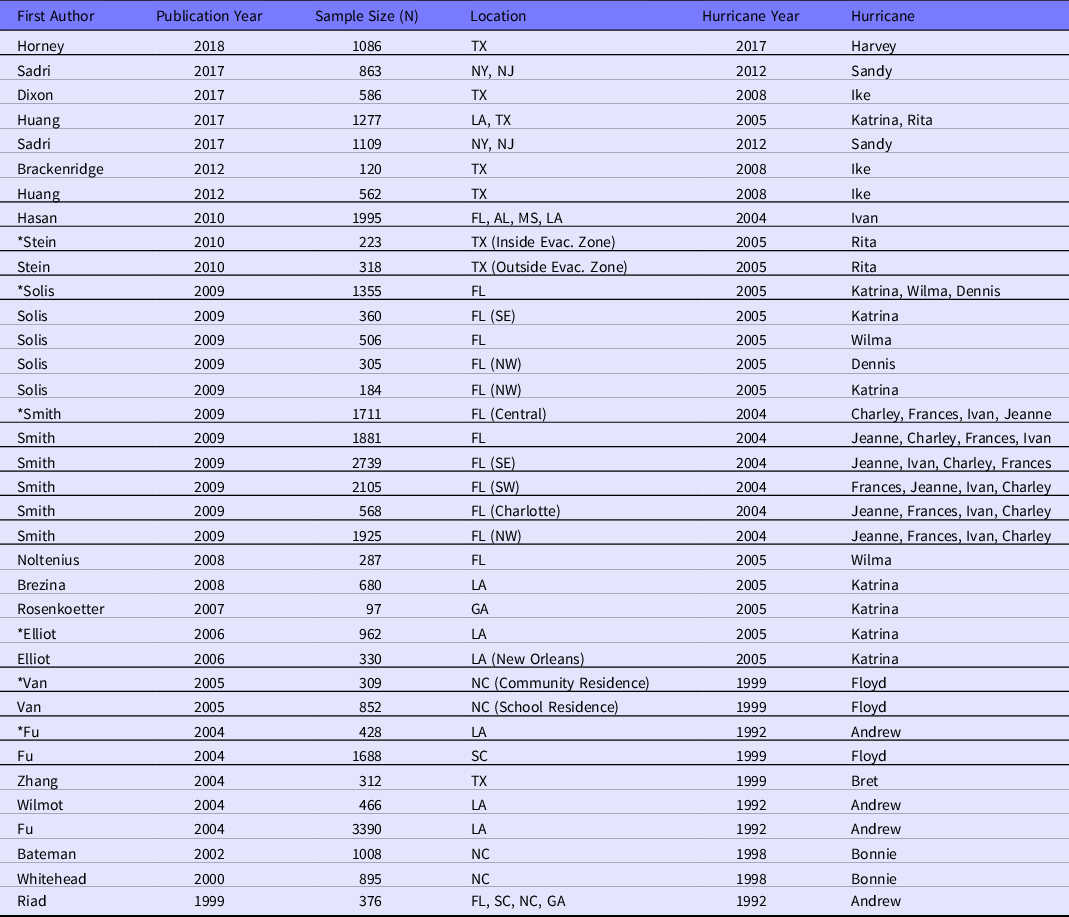
In compiling the database, a distinction was drawn between an article and a study. An article comprises all the analyses of research subjects, which may be reported in 1 or more studies. An article may, therefore, be composed of 1 or several studies. A total of 36 studies were included for analyses, which were derived from 19 published journal articles, 1 conference paper, 2 doctoral dissertations, and 1 unpublished manuscript (Table 1; Supplemental File 1).
Sources of data included in the statistical meta-analysis

Quantitative and Qualitative Data Extraction
Data were extracted on article title, publication year, article characteristic (1 = Journal article; 2 = Doctoral dissertation; 3 = Conference Paper 4 = Unpublished manuscript), type of effect estimate (1 = Regression coefficient; 2 = Odds ratio), and adjusted effect size (regression coefficient or odds ratio) (see codebook in Supplemental File 2).
Effect Size Conversions
In order to permit the estimation of a common index of effect size for use in the meta-analysis, the adjusted regression coefficients/odds ratios earlier extracted were converted to correlation coefficients using the formula proposed by Field and Gillet. Reference Cohen25 To our knowledge, this is the sole evidence-based approach for the conversion of effect size from odds ratio to correlation coefficient. The method was also adopted by Huang, et al. in their conversion of effect size. Reference Huang, Lindell and Prater1
In order to account for differential precision of effect sizes associated with sample size variation between studies, the correlation coefficients were subsequently weighted by sample size using Fisher’s transformation:
 $$Z_r= \surd [Ln (1 + r) - (Ln (1 - r)]$$
 $$SE_{Zr} =1/ (\surd (n-3))$$
 $$\eqalign{ & Where\ r - correlation\ coefficient;\ {Z_r} - Fishers\ transformed\ r;\cr & \qquad S{E_{Zr}} - Std.\ Error\ of\ {Z_r};\ n - sample\ size}$$
The data were then uploaded onto Stata 14 (College Station, Texas), and the pooled Fisher’s estimate reconverted to correlation coefficients (Figure s2). Similar to the interpretation employed by Field and Gillet, Reference Cohen25 and Cohen, Reference Mileti and Peek26 the strength of the pooled effect size for a variable in this study was described as small if r ≈ 0.1, medium if r ≈ 0.3, and large if r ≈ 0.5.
Statistical Analysis
Due to potential heterogeneity in populations impacted, study designs, hurricane category, and hurricane region, the true effect likely varies between studies in addition to the usual sampling variation within studies. In order to account for both sources of variation, a random-effects meta-analytic model that provided more conservative estimates and larger standard errors was fitted. Heterogeneity across studies was checked using the Q and I2 statistics. To identify potential causes of heterogeneity, moderator analysis was conducted using meta-regression to test if any of the study characteristics modified the relationship between evacuation and any of the predictor variables. The potential effect modifiers tested were the year of publication, analytic method, the severity of the hurricane, and the hurricane region. Stratum-specific estimates were presented for every effect modifier identified. Finally, publication bias was investigated in 2 ways. First, by observing visual asymmetry in funnel plots (i.e., plots of effect estimates against their estimated precision (reciprocal of the variance) and second, by determining the degree of asymmetry using Egger’s unweighted regression asymmetry test. Whenever publication bias was identified, a sensitivity analysis using the Trim-and-Fill Method was conducted to compare adjusted and unadjusted results.
Results
Characteristics of the Articles
The search strategy revealed a total of 19 published journal articles, 1 conference paper, 2 doctoral dissertations, and 1 unpublished manuscript, which reported data from 36 studies conducted between 1999 and 2018 (Table 2).
Characteristics of published studies on factors that predict hurricane evacuation

* Study conducted on multiple sub-populations
Research Question 1 (RQ1): What Factors Significantly Predict Household Hurricane Evacuation Decision?
Risk Factor Estimates
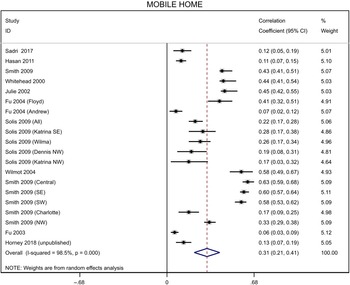
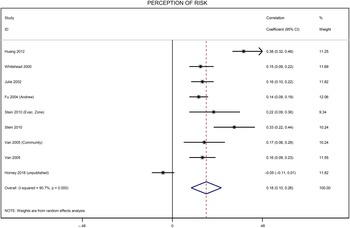
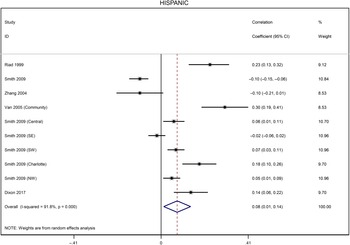
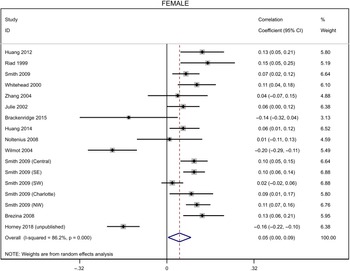
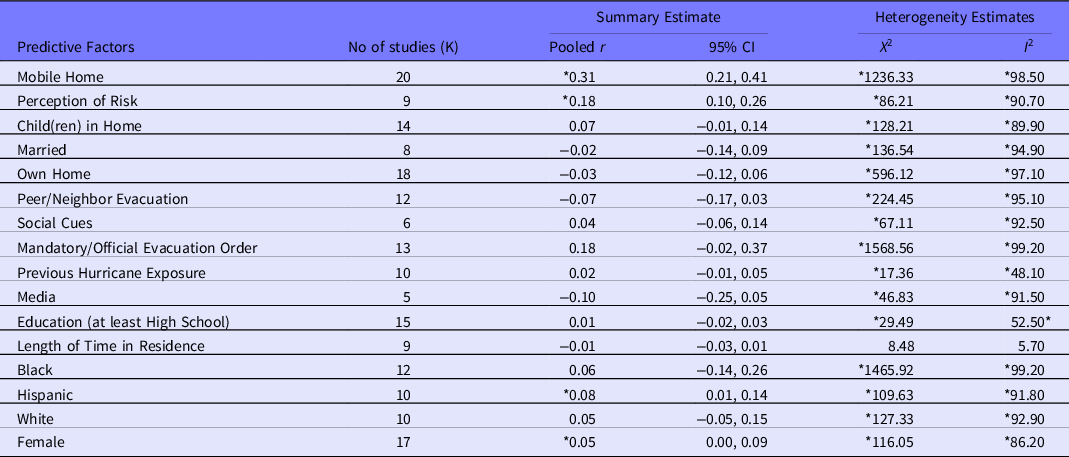
The predictors of household hurricane evacuations were mobile home residence (r = 0.31; 95% CI: 0.21, 0.41) (Figure 1, Table 3), perception of risk (r = 0.18; 95% CI: 0.10, 0.26) (Figure 2, Table 3), Hispanic race (r = 0.08; 95% CI: 0.01, 0.14) (Figure 3, Table 3), and female sex (r = 0.05; 95% CI: 0.00, 0.09) (Figure 4, Table 3). Results also showed heterogeneity between studies for all the pooled effect estimates except length of time in residence (X 2 = 8.48, P-value > 0.05; I2 = 5.70). In other words, a majority of the effect sizes were not uniform but varied considerably across studies. Since such variability may be random or systematic, we investigated if study characteristics explained the variability between studies.
A Forest Plot for the Association of Mobile Home Residence and Hurricane Evacuation.

A Forest Plot for the Association of Risk Perception and Hurricane Evacuation.

A Forest Plot for the Association of Hispanic Ethnicity and Hurricane Evacuation.

A Forest Plot for the Association of Female Sex and Hurricane Evacuation.

Pooled (summary) and heterogeneity estimates of factors that predict hurricane evacuation

* P-value < 0.05
Research Question 2 (RQ2): What are the Moderators Of Household Hurricane Evacuation Decision? Do Determinants of Hurricane Evacuation Decision Differ by Geographic Region of Residence, Severity of Hurricane or Tropical Storm, or Publication Year of Primary Studies?
Moderator Analysis
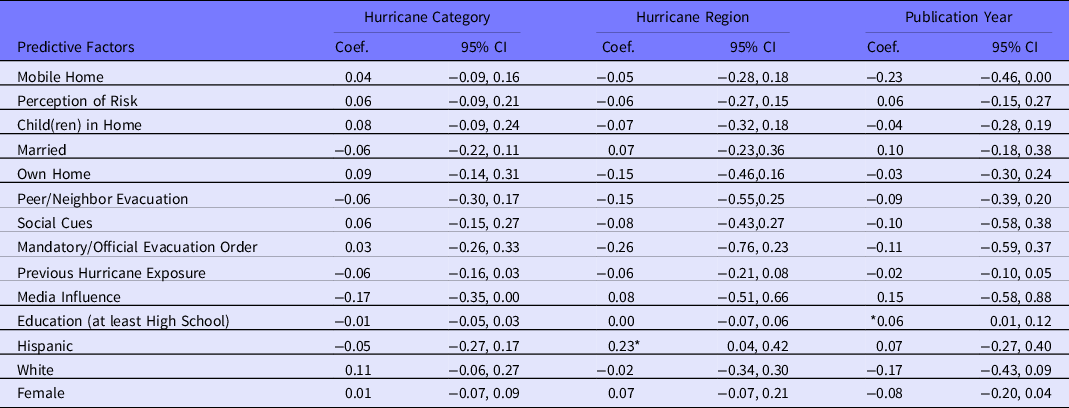
We examined (by meta-regression analysis) the relationship between evacuation and predictor variables according to hurricane severity, hurricane region, and the publication year (Table 4), in order to explore reasons for the observed heterogeneity between studies. Geographic region modified the relationship between Hispanic race and evacuation (Coef. = 0.23; 95% CI: 0.04, 0.42) and publication year modified the relationship between educational level and evacuation (Coef. = 0.06; 95% CI: 0.01, 0.12). Out of the remaining variables (13 of 16), no specific reason for the heterogeneity could be found (Table 4).
Meta-regression analysis of potential moderators on predictive factors

* P-value < 0.05
When ‘Hispanic race’ was stratified by the hurricane region (Table s1), we observed that Hispanics in the Atlantic Coast were more likely to evacuate compared to their counterparts in the Gulf Coast (where there was no association between Hispanic race and evacuation).
Publication Bias
Both visual control (Figure s3) and statistical significance (Table s2) identified the presence of publication bias in peer/neighbor evacuation (Bias = −6.50; 95% CI: −12.57, −0.44), length of time in residence (Bias = −2.63; 95% CI: −4.65, −0.60), and media (Bias = −6.83; 95% CI: −13.30, −0.35) (Table s2). Correcting for these biases with Trim and Fill did not change the results (not shown). The authors of this study did not identify publication bias in studies of other predictor variables (Table s2).
Discussion
Across 36 studies, hurricane evacuation was positively correlated with mobile home residence, perception of risk, Hispanic race, and female sex. The effect size for the perception of risk (r = 0.18), Hispanic ethnicity (r = 0.08), and female sex (r = 0.05) are small and thus require additional studies to substantiate the predictability of these variables for evacuation decision-making. The statistical meta-analysis conducted by Huang et al. reported that mobile home residence and perception of risk positively predicted hurricane evacuation decision, Reference Huang, Lindell and Prater1 but demographic variables like sex and Hispanic ethnicity did not significantly predict such decision. Baker, Reference Baker2 in his systematic review, found that mobile home residence was predictive of hurricane evacuation decisions but not sex (the author did not study the perception of risk and Hispanic ethnicity). The inconsistency between our findings and Huang’s and Baker’s, Reference Huang, Lindell and Prater1,Reference Baker2 may be attributable to the differences in statistical methods employed in the studies. Unlike the previous 2 studies, which estimated average effect size, our study fitted a random-effects meta-analysis and estimated a pooled effect size by inverse variance weighting.
The positive correlation between mobile home residence and evacuation may be explained by the increased perception of the structural vulnerability of residents, which contributes to the decision to evacuate. Reference Huang, Lindell and Prater1,Reference Baker2 Evacuation orders are essential because residents perceive officials as having a high knowledge of hazards as well as the duty to warn and protect households by disseminating accurate information on impending risks. Reference Huang, Lindell and Prater1 Since perception of risk estimates the self-rated threat of a hurricane to individuals, their families, and properties, it is reasonable to anticipate a positive relationship between this variable and the decision to evacuate. Reference Mileti and Sorensen27-Reference Davidson and Freudenburg29 Finally, the positive correlation between female sex and evacuation may be due to the women’s actual or perceived social vulnerabilities and caregiving roles in households, which heighten risk perception. Reference Bateman and Edwards19,30 Fothergill, et al., Reference Fothergill, Maestas and Darlington17 also asserted that women have a higher likelihood of perceiving disaster as severe and risky. The meta-analytic study conducted by Huang, et al. also reported a positive correlation between female sex and evacuation (r = 0.08; 95% CI: 0.02, 0.14) for actual hurricane studies. Reference Huang, Lindell and Prater1
Moderator Analysis
Highly vulnerable regions of the U.S., such as the Atlantic and Gulf Coasts have a high and growing proportion of Hispanic residents. As the Hispanic population in the U.S. increases, more research is needed on the relationship between Hispanic ethnicity and evacuation behavior. Reference Passel31-Reference Bustamante, Fang, Rizzo and Ortega33 Hispanics in the Atlantic and Gulf Coasts differ in terms of reported health and well-being, education, English language comprehension, size of a social network, risk perception, and access to economic resources to finance evacuation. Reference Fothergill, Maestas and Darlington17,Reference Zsembik and Fennell34,Reference Borrell and Crawford35 Hispanics are also a heterogeneous group of individuals from at least 25 countries in Central and South America and the Caribbean. The Hispanic population along the U.S. Atlantic coast is comprised predominantly of Puerto Ricans, while the population of Hispanics living along the U.S Gulf-coast is primarily from Mexico. Factors such as country of origin and nativity status may have implications for Hispanic residents faced with making a decision to evacuate from an oncoming hurricane. Reference Sánchez-Meca and Marín-Martínez36
This study has several strengths. First, it has improved on a previous meta-analysis conducted by Huang, et al., Reference Huang, Lindell and Prater1 by including more recent articles, analyzing only actual (rather than hypothetical) hurricane studies, and estimating pooled effect sizes using random-effects models. Second, the study employed moderator analyses, including meta-regression, to explore the possible sources of heterogeneity across studies, allowing for the isolation of moderators within which predictor variables were stratified. Third, publication bias was assessed using visual (funnel plots) and statistical (Egger’s regression) methods. Sensitivity analysis was also conducted to investigate any difference between biased and adjusted results. Given that publication bias was found among 3 of the 16 variables studied (peer/neighbor evacuation, length of time in residence, and reliance on media), published studies were more likely to report statistically significant findings for these variables compared to the grey literature. However, sensitivity analysis results showed that similar effect sizes would be obtained even in the absence of publication bias. The lack of publication bias among 13 of the 16 variables studied might be attributed to the systematic literature search conducted and the inclusion of both published and grey literature.
Although we have made a comprehensive summary of the factors that predict hurricane evacuation in the literature, there are still limitations that merit discussion. First, pooled estimates were presented in the form of correlation coefficients rather than odds ratios. Since the latter adjust for potential confounding factors, their results are preferred. However, we could not present summary odds ratios because most of the primary studies did not provide sufficient sample size information to calculate pooled odds ratio estimates. Second, some stratified estimates (on moderators) were associated with few studies (K < 6) across sub-sets of the predictor variables. Although a meta-analysis could be conducted on a minimum of 2 published studies, Sanchez-Meca and Marin-Martinez’s Monte Carlo simulation recommended that only tentative conclusions be drawn on meta-analysis for which the number of studies is less than 6.37 This may have accounted for statistically non-significant findings in some strata (e.g., Hispanics in the Gulf-Coast). Third, this study analyzed only hurricane evacuation factors but neglected the possibility that other disasters may lead to similar decision-making processes (such as tornado warnings that were not considered). Fourth, as this study is a meta-analysis, predictors of evacuation decision were explored if they had been sufficiently reported in past primary studies. Thus, our study is not exhaustive of all the predictors of hurricane evacuation decision. For example, we did not assess the impact of potential predictors like fear of traffic congestion and lack of transportation as they were either under-reported in primary studies or did not provide sufficient statistical information to permit estimation of effect size. For similar reasons, the evacuation behavior of other racial/ethnic minorities like Asian-Americans and Pacific Islanders was not assessed in this study. To overcome potential meta-analytic limitations, future primary studies should explore additional predictors of hurricane evacuation decision and report sufficient data to permit meta-analytic effect size estimation. Finally, this study identified heterogeneity in nearly all predictor variables (except length of residence), but only explained the possible causes of this phenomenon in 12.5% (2 of 16) of the randomly defined effect sizes. As isolation of effect modifiers may enable the targeting of specific at-risk groups during hazard planning, future primary studies should explore potential heterogeneity of factors that moderate evacuation decision.
Conclusion
The identification and research translation of factors associated with hurricane evacuation decision enables emergency managers and other officials to develop interventions targeted to specific population sub-groups. However, factors associated with hurricane evacuation decision have been inconsistent. Through a statistical meta-analysis, factors that predict evacuation across studies, as well as moderators of these associations, were identified. Mobile home residence, perception of risk, female sex, and Hispanic ethnicity were associated with hurricane evacuation, while geographic region modified the relationship between Hispanic ethnicity and hurricane evacuation. Future studies should explore statistical interactions to identify additional moderators of hurricane evacuation decisions and work with practitioners to ensure that data are applied to the development and implementation of interventions.
Supplementary material
To view supplementary material for this article, please visit https://doi.org/10.1017/dmp.2021.24
Acknowledgments
The authors would like to thank Alan Hernandez Cortes from Texas A&M University for a comprehensive review of the statistical methods used in the study.
Funding
This research did not receive any specific grant from funding agencies in the public, commercial, or not-for-profit sectors.