Introduction
Schizophrenia is a leading cause of disability (Roessler et al. Reference Roessler, Joachim Salize, van Os and Riecher-Rossler2005) and places a significant burden of caring and costs on relatives and society (Mangalore & Knapp, Reference Mangalore and Knapp2007). It is thought to arise primarily from dysfunction in brain dopaminergic systems (Howes & Kapur, Reference Howes and Kapur2009). Despite advances in pharmacotherapy and non-biological treatments, current therapies are suboptimal and no disease-modifying treatments exist (Swartz, Reference Swartz2008). Identification of children at risk for schizophrenia offers the possibility of intervening to prevent or minimize the abnormal neurodevelopment and disability that is already present in the prodromal stage of the illness (Yung et al. Reference Yung, Killachey, Hetrick, Parker, Schultze-Lutter, Klosterkoetter, Purcell and McGorry2007).
Given the brain abnormalities and cognitive impairments present during the prodrome and at illness onset, it is not surprising that evidence indicates abnormal neural development from conception onwards. Individuals who subsequently develop schizophrenia experience complications during the intra-uterine period and at birth, most specifically hypoxia, and present minor physical anomalies indicative of trauma in the early stages of pregnancy (Cannon et al. Reference Cannon, Caspi, Moffitt, Harrington, Taylor, Murray and Poulton2002). Prospective, longitudinal studies of population cohorts (Poulton et al. Reference Poulton, Caspi, Moffitt, Cannon, Murray and Harrington2000; Welham et al. Reference Welham, Scott, Williams, Najman, Bor, O'Callaghan and McGrath2009b) and of individuals at elevated genetic risk by virtue of having a relative with schizophrenia (Asnarow, Reference Asnarow1988) have consistently shown that, by middle childhood, approximately a decade prior to the prodrome, individuals who subsequently develop schizophrenia display an array of symptoms and deficits across multiple domains of functioning that distinguishes them from their peers who do not develop schizophrenia. These include delays in motor and language development, cognitive impairments including lower than average IQ, and internalizing or externalizing problems.
In addition, a prospective study of a New Zealand birth cohort observed that child-reported psychotic-like experiences (PLEs) at age 11 years were associated with a 5- to 16-fold increased rate of schizophreniform disorder in early adulthood (Poulton et al. Reference Poulton, Caspi, Moffitt, Cannon, Murray and Harrington2000). Similarly, in a large Australian cohort, hallucinations at age 14 years were found to be associated with non-affective psychosis at age 21 years (Welham et al. Reference Welham, Isohanni, Jones and McGrath2009a). A recent meta-analysis estimated that between 5% and 8% of adults in the general population reported PLEs (van Os et al. Reference van Os, Linscott, Myin-Germeys, Delespaul and Krabbendam2009), while even higher proportions of children and adolescents report such experiences (Poulton et al. Reference Poulton, Caspi, Moffitt, Cannon, Murray and Harrington2000; Laurens et al. Reference Laurens, Hodgins, Maughan, Murray, Rutter and Taylor2007; Kelleher et al. Reference Kelleher, Harley, Lynch, Arseneault, Fitzpatrick and Cannon2008). A study of a general population sample of 18- to 64-year-olds showed that individuals who reported PLEs were greater than 60 times more likely than those without PLEs to transition to a psychotic disorder in the subsequent 2 years (Hanssen et al. Reference Hanssen, Bak, Bijl, Vollebergh and van Os2005). Child-reported PLEs at age 12 years have been found to be heritable (Polancyk et al. Reference Polanczyk, Moffitt, Arseneault, Cannon, Ambler, Keefe, Houts, Odgers and Caspi2010). Thus, PLEs are increasingly considered to be a marker of risk for psychosis (Kelleher & Cannon, Reference Kelleher and Cannon2011).
Neuromotor dysfunction has been consistently reported to distinguish children who later develop schizophrenia. The term, however, has been used to refer to a variety of motor deficits ranging from motor developmental delay, gross or fine motor coordination problems, to abnormal movements and posturing. Findings from prospective, longitudinal studies of birth cohorts (Jones et al. Reference Jones, Murray, Jones, Rodgers and Marmot1994; Crow et al. Reference Crow, Done and Sacker1995; Rosso et al. Reference Rosso, Bearden, Hollister, Gasperoni, Sanchez, Hadley and Cannon2000; Isohanni et al. Reference Isohanni, Jones, Moilanen, Rantakallio, Veijola, Oja, Koiranen, Jokelainen, Croudace and Järvelin2001, Reference Isohanni, Murray, Jokelain, Croudace and Jones2004; Cannon et al. Reference Cannon, Caspi, Moffitt, Harrington, Taylor, Murray and Poulton2002) and of individuals with affected relatives (Marcus et al. Reference Marcus, Hans, Lewow, Wilinson and Burack1985, Reference Marcus, Hans and Auerback1993; Fish et al. Reference Fish, Marcus, Hans, Auerbach and Perdue1992; Hans et al. Reference Hans, Auerbach, Auerbach and Marcus2005) have identified motor delays and impairments as key antecedents of schizophrenia in adulthood. Other archival (Walker et al. Reference Walker, Savoie and Davis1994), birth cohort (Rosso et al. Reference Rosso, Bearden, Hollister, Gasperoni, Sanchez, Hadley and Cannon2000) and prospective studies (Schiffman et al. Reference Schiffman, Walker, Morten, Schulsinger, Sorensen and Mednick2004; Mittal et al. Reference Mittal, Neumann, Saczawa and Walker2008) have observed that abnormal dyskinetic involuntary movements are antecedents of adult schizophrenia. Such movement abnormalities (dyskinesias) include writhing or jerky movements of the limbs, torso and face, dystonic posturing of the upper limbs (Walker et al. Reference Walker, Lewis, Loewy and Palyo1999), and unusual movements such as athetoid movements or tics or spasms (Rosso et al. Reference Rosso, Bearden, Hollister, Gasperoni, Sanchez, Hadley and Cannon2000). Dyskinesias, particularly in the oral-facial and upper-body regions, have been observed among medication-naive adults with schizophrenia spectrum disorders (Owens et al. Reference Owens and Johnstone1982; Waddington & Crowe, Reference Waddington, Crow, Wolf and Mosnaim1988; Woods et al. Reference Woods, Kinnery and Yurgelun-Todd1986; Boks et al. Reference Boks, Liddle, Burgerhof, Knegtering and Van Den Bosch2004). Prospective, longitudinal investigations have reported increased movement abnormalities among infants (Walker et al. Reference Walker, Savoie and Davis1994) and children (Schiffman et al. Reference Schiffman, Walker, Morten, Schulsinger, Sorensen and Mednick2004) who subsequently developed schizophrenia. Elevated dyskinetic movement abnormalities have also been observed among adolescents with schizotypal personality disorder (SPD) (Mittal et al. Reference Mittal, Neumann, Saczawa and Walker2008), who are at elevated risk of developing schizophrenia (Siever et al. Reference Siever, Kalus and Keefe1990a, Reference Siever, Kalus and Keefeb; Walker et al. Reference Walker, Lewis, Loewy and Palyo1999). Among these adolescents with SPD, dyskinetic movement abnormalities predicted the severity of prodromal psychotic symptoms 1 year later as well as conversion to an Axis I psychotic disorder 3–4 years later (Mittal et al. Reference Mittal, Neumann, Saczawa and Walker2008). Further, the movement abnormalities increased over time in the prodromal phase, as did the magnitude of the association between movement abnormalities and psychotic symptoms (Mittal et al. Reference Mittal, Neumann, Saczawa and Walker2008).
Based on this evidence, Walker and colleagues proposed that the association between movement abnormalities and psychotic symptoms reflects dysfunction within the striatal dopamine system (Walker et al. Reference Walker, Savoie and Davis1994; Mittal et al. Reference Mittal, Neumann, Saczawa and Walker2008). This hypothesis is supported by evidence that a variety of drugs which increase striatal dopamine function (e.g. anti-Parkinsonian medication and amphetamines) can give rise to both dyskinetic movement abnormalities and psychotic symptoms (Alexander et al. Reference Alexander, Crutcher and DeLong1990; Smith et al. Reference Smith, Bevan, Shink and Bolam1998). Recently, a study indicated that dopamine dysfunction in the striatum may be present prior to illness onset and be specifically associated with psychotic symptoms (Howes et al. Reference Howes, Montgomery, Asselin, Murray, Valli, Tabraham, Bramon-Bosch, Valmaggia, Johns, Broome, McGuire and Grasby2009). If this dysfunction develops earlier than the prodrome, it might explain the presence of PLEs (Poulton et al. Reference Poulton, Caspi, Moffitt, Cannon, Murray and Harrington2000; Welham et al. 2009 a, b) and movement abnormalities (Walker et al. Reference Walker, Savoie and Davis1994; Schiffman et al. Reference Schiffman, Walker, Morten, Schulsinger, Sorensen and Mednick2004; Mittal et al. Reference Mittal, Neumann, Saczawa and Walker2008) observed among children who subsequently developed schizophrenia.
Until recently, there has been no practical method for identifying children at risk for schizophrenia. Despite the high heritability of schizophrenia, less than 40% of adults with the disorder have an affected relative (Gottesman & Erlenmeyer-Kimling, Reference Gottesman and Erlenmeyer-Kimling2001). Consequently, a positive family history identifies only a subset of children developing the illness (Gottesman & Erlenmeyer-Kimling, Reference Gottesman and Erlenmeyer-Kimling2001). Prospective investigations of birth cohorts have consistently shown that cohort members who later developed schizophrenia presented delays in motor and language development, disturbances in social, emotional and behavioural functioning, intellectual and cognitive impairments, and PLEs in middle childhood (Welham et al. Reference Welham, Isohanni, Jones and McGrath2009a, Reference Welham, Scott, Williams, Najman, Bor, O'Callaghan and McGrathb). These findings are consistent with those derived from prospective, longitudinal investigations comparing the development of children of parents with schizophrenia to that of children of healthy parents (Asnarow, Reference Asnarow1988), as well as prospective studies of adults with schizophrenia that used self-reports, reports from family members and objective information to characterize patients in middle childhood (Welham et al. Reference Welham, Isohanni, Jones and McGrath2009a).
Based on this robust evidence, we developed questionnaires to be completed by children aged 9–12 years old and their primary caregiver in order to identify children who present the putative antecedents of schizophrenia (ASz) (Laurens et al. Reference Laurens, Hodgins, Maughan, Murray, Rutter and Taylor2007). We reasoned that children who presented a combination of antecedents, each of which had been previously shown to be among the strongest predictors of schizophrenia in adulthood, would be at elevated risk for developing the disorder. We therefore defined ASz to include: (1) caregiver-reported speech and/or motor developmental lags or problems; (2) child-reported internalising problems, and/or caregiver-reported externalising and/or peer-relationship problems in the clinical range; and (3) child-reported PLEs (Laurens et al. Reference Laurens, Hodgins, Maughan, Murray, Rutter and Taylor2007, Reference Laurens, West, Murray and Hodgins2008, Reference Laurens, Hodgins, Taylor, Murray, David, McGuffin and Kapur2011). We have reported that ASz children, as compared with children with no antecedents (noASz), are characterized by several features observed among adults with schizophrenia: (1) ASz children, like adults with schizophrenia, exhibit a reduction in the amplitude of the error-related negativity event-related potential component generated in the anterior cingulate that indexes internal monitoring of behaviour (Laurens et al. Reference Laurens, Hodgins, Mould, West, Schoenberg, Murray and Taylor2010); (2) ASz children present impaired working memory (Cullen et al. Reference Cullen, Dickson, West, Morris, Mould, Hodgins, Murray and Laurens2010), a core feature of schizophrenia; and (3) ASz children display deficits in performance on other standardized intelligence and neuropsychological tests similar to those exhibited by adults with schizophrenia (Cullen et al. Reference Cullen, Dickson, West, Morris, Mould, Hodgins, Murray and Laurens2010) and similar to individuals in the prospective studies who subsequently developed schizophrenia (H. Dickson et al. unpublished observations).
The present study compared dyskinetic movement abnormalities displayed by ASz and noASz children aged 9–12 years. The presence of elevated movement abnormalities would add to the evidence that ASz children are at increased risk to develop schizophrenia and would further suggest that striatal dopaminergic functioning may be dysregulated by middle childhood. We hypothesized that dyskinetic movement abnormality scores would be higher among the ASz children, who all reported at least one PLE, than among the noASz children who reported no PLEs. To test this hypothesis, we screened a large community sample of children aged 9–12 years old and their caregivers using brief questionnaires. A sample of 21 children meeting the criteria for ASz, and 31 noASz children, were studied in the laboratory. Movement abnormalities were rated from videotapes recorded during a diagnostic interview with the child.
Method
Participants
Children aged 9–12 years old and their primary caregiver were recruited through elementary schools in four socio-economically deprived areas of a large urban centre in the United Kingdom. Both caregiver and child completed questionnaires (for further details, see Laurens et al. Reference Laurens, Hodgins, Maughan, Murray, Rutter and Taylor2007, Reference Laurens, West, Murray and Hodgins2008, Reference Laurens, Hodgins, Taylor, Murray, David, McGuffin and Kapur2011). ASz children were defined as children presenting: (1) caregiver-reported speech and/or motor lags or problems; (2) child-reported emotional symptoms in the clinical range and/or parent-reported conduct problems and/or hyperactivity–inattention and/or peer-relationship problems in the clinical range; and (3) at least one child-reported ‘certainly true’ PLE (Laurens et al. Reference Laurens, Hodgins, Maughan, Murray, Rutter and Taylor2007). Previous studies have shown increased validity of child reports for internalising symptoms and parent reports for externalising problems (Edelbrock et al. Reference Edelbrock, Costello, Dulcan, Conover and Kala1986; Angold et al. Reference Angold, Weissman, John, Merikancas, Prusoff, Wickramaratne, Gammon and Warner1987). NoASz children were defined as those presenting none of the antecedents. Exclusion criteria for both groups included: a first- or second-degree relative with schizophrenia or a spectrum disorder; current or past use of antipsychotic medication or other medication known to affect neural development; presence of a neurological disorder; IQ of <70; head injury resulting in loss of consciousness for 1 h or more; insufficient English ability (in child or caregiver) to enable unassisted completion of diagnostic interviewing and/or neuropsychological testing.
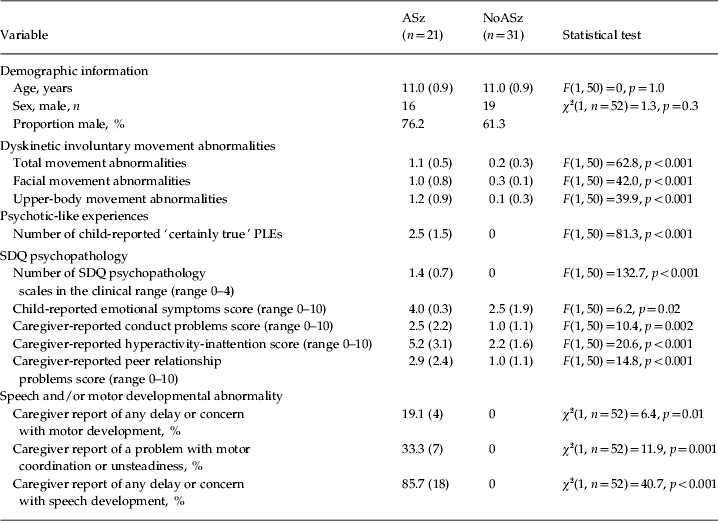
A total of 509 child–caregiver dyads completed questionnaires and indicated willingness to be contacted for further research. Of these, 53 (10.4%) children met criteria for ASz and 90 (17.7%) met criteria for noASz. Among these 143 children and caregivers, 10 (6%) could not be contacted, 51 (30%) declined participation, and 12 (5%) met exclusion criteria. Of the children, 70 (49%) participated in laboratory assessments that included a videotaped diagnostic interview (21 ASz, 49 noASz). The final sample included the 21 ASz, and 31 noASz children who were matched by group to the ASz group on age and sex. Table 1 displays the sample characteristics.
Descriptive and inferential statistics comparing children presenting putative antecedents of schizophrenia and children without antecedents [data are given as mean (standard deviation)].

ASz, Antecedents of schizophrenia; noASz, no antecedents of schizophrenia; PLEs, psychotic-like experiences; SDQ, Strengths and Difficulties Questionnaire.
Measures
Putative antecedents of schizophrenia
The child questionnaire included the Strengths and Difficulties Questionnaire (SDQ) (Goodman, Reference Goodman1997, Reference Goodman2001) that assesses emotional symptoms, conduct problems, hyperactivity–inattention, peer relationship problems and prosocial behaviours. The scores on each subscale derive from the sum of five items, each rated 0 ‘not true’, 1 ‘somewhat true’, or 2 ‘certainly true’, with the total scores for each subscale therefore ranging from 0 to 10. The SDQ has been studied with large samples of UK children and three normative bandings (normal, borderline, and abnormal) have been determined for each subscale, with those scoring in the top 10th percentile qualifying as abnormal, or within the clinical range (Goodman, Reference Goodman2001). In addition, there were nine questions on PLEs, including five items adapted from the psychosis section of the Diagnostic Interview Schedule for Children (Costello, Reference Costello, Edelbrock, Kalas, Kessler and Klaric1982) and four additional questions designed to capture a broader range of experiences. For example, children were asked if they heard voices that others did not hear, believed that their thoughts were read by others, were able to read minds, or felt they were being followed or spied upon. All nine items were scored 0 ‘not true’, 1 ‘somewhat true’, or 2 ‘certainly true’. The items most frequently endorsed as ‘certainly true’ by the ASz children were hearing voices others could not hear (43%), feeling they were being spied upon (30%) and seeing things others could not see (30%). A recent study of young adolescents showed that endorsement of auditory or visual hallucinations or paranoid thoughts on questionnaires was predictive of psychotic symptom endorsement during diagnostic interviews (Kelleher et al. Reference Kelleher and Cannon2011). The caregiver questionnaire included four parts: (1) sociodemographic information on the family; (2) caregiver version of the SDQ; (3) caregiver version of the questions on the child's PLEs; and (4) nine questions assessing delays or concerns regarding the development of motor and speech skills and the presence of a current motor problem (i.e. lack of coordination or unsteadiness). Further information is provided in Laurens et al. (Reference Laurens, Hodgins, Maughan, Murray, Rutter and Taylor2007, Reference Laurens, West, Murray and Hodgins2008, Reference Laurens, Hodgins, Taylor, Murray, David, McGuffin and Kapur2011).
Movement abnormalities
Involuntary movement abnormalities were coded from video recordings taken during diagnostic interviewing, during which the child was seated in a chair facing a camera positioned behind the interviewer. A total of 30 min of each videotape was coded, with 10 min samples taken from the beginning, middle and end of the interview. The recordings were muted and the rater was blind to group status and clinical ratings. The Dyskinesia Identification System Condensed User Scale (DISCUS) was used to code involuntary movement abnormalities (Kalachnik et al. Reference Kalachnik, Young and Offerman1989). The DISCUS was developed empirically and incorporates 15 items. Each item was rated from absent (0) to severe (4) and assessed both frequency and severity of dyskinetic movement abnormalities (Sprague et al. Reference Sprague, White, Ullman and Kalachnik1984). Movements were coded as involuntary if they occurred with no apparent intent or goal. The DISCUS has been shown to yield high inter-rater reliability (>0.90) with both mentally ill and healthy participants (Sprague et al. Reference Sprague, White, Ullman and Kalachnik1984; Kalachnik & Sprague, Reference Kalachnik and Sprague1993). The DISCUS allows the endorsement of ratings of dyskinetic movements while filtering out general movements that often occur during an interview (e.g. twirling hair, and adjusting/readjusting clothes). Additionally, a rating of stereotypical movements made during the recording aided the rater to differentiate between the quality and intent of the movements observed, that is, to distinguish repetitive voluntary versus involuntary dyskinetic movements.
The DISCUS provides four dyskinetic movement abnormality scores: (1) total; (2) abnormalities in the face (i.e. tics, grimacing, blinking, chewing/lip smacking, puckering/sucking/thrusting lower lip, tongue thrusts, tonic tongue, tongue tremor, and athetoid/myokymic/lateral tongue); (3) abnormalities of the upper body (i.e. shoulder/hip torsion, writhing and extensions of fingers or wrist); and (4) lower limb abnormalities (i.e. foot tapping, ankle flexion). Lower-body abnormalities could not be rated due to the position of the camera having occluded the view of these extremities. One psychiatrist (D.M.) was trained in the laboratory of E.F.W. to rate movement abnormalities according to the DISCUS using a set of training videos with standardized ratings (Kalachnik et al. Reference Kalachnik, Young and Offerman1989). Following training, inter-rater reliability was assessed on 30 cases, with an intra-class correlation coefficient of 0.84 obtained for the total movement abnormalities scores.
Statistical analyses
Group differences in demographic data were examined using χ2 analyses for categorical variables (sex) and independent t tests for continuous variables. In order to take account of missing values on the movement abnormality items (e.g. when hands were not visible on the videotape), movement abnormality scores (total, facial, upper body) were adjusted by dividing the sum of the ratings by the number of items that had been successfully coded. Kolmogorov–Smirnov tests revealed that the movement abnormalities scores were not normally distributed (ASz children, 0.272, p<0.001; noASz children, 0.308, p<0.001) within the two groups. The distributions of scores in the groups were not, however, driven by outliers. Consequently, preliminary group comparisons of ASz and noASz children's scores for total, facial and upper-body movement abnormalities were carried out using parametric analyses of variance. Subsequently, non-parametric univariate analyses with a bootstrap method were performed to verify the results. Next, regression analyses with the bootstrap method were performed to control for the effects of age and sex, as both of these variables were associated with the number of child-reported PLEs among the large sample of children screened. Since we hypothesized that PLEs were positively associated with movement abnormalities, it was prudent to control for these two factors in comparing group differences in movement abnormality scores. To investigate the accuracy with which the dyskinetic movement abnormality scores distinguished ASz from noASz children, receiver operator characteristic (ROC) curve analyses were conducted.
Results
Group differences in movement abnormalities scores
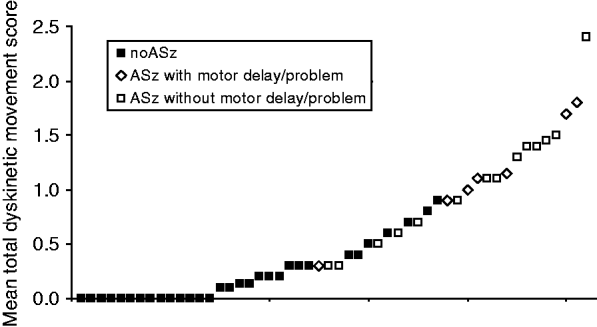
Table 1 presents the average total, facial and upper-body dyskinetic movement abnormality scores for ASz and noASz children, and the statistical results of between-group comparisons of these scores. The ASz group, as compared with noASz children, obtained significantly higher total movement abnormality scores, and higher scores for abnormalities in the face and the upper body. Fig. 1 illustrates the distribution of mean total dyskinetic movement scores for each child in the sample. As can be seen in Fig. 1, the majority of noASz children exhibited no dyskinetic movement abnormalities, while most of the ASz children presented one or more abnormalities. The distributions of the three dyskinetic movement abnormality scores (total, facial and upper-body scores) were not normal. Consequently, bootstrap multiple regression analyses were conducted to estimate the association of group with the total, facial and upper-body scores. These results confirmed the results of the parametric tests in showing that ASz children obtained significantly higher dyskinetic movement abnormality scores than noASz children in total (z=7.06, p<0.001) and in the facial (z=5.98, p<0.001) and upper-body (z=5.40, p<0.001) regions. Each of the three bootstrap multiple regression analyses were repeated while controlling for age and sex. Neither age nor sex were associated with the total dyskinetic movement abnormalities score nor the score for upper-body abnormalities.
Mean total scores for dyskinetic movements of children presenting no antecedents of schizophrenia (▪) and of children presenting putative antecedents of schizophrenia with (◊) and without (□) caregiver reports of a motor delay and/or abnormality.

Of the 21 ASz children, seven had a caregiver report of a motor delay and/or problem, while 18 had a caregiver-reported speech delay only (Table 1). Of the seven with a reported motor delay/problem, four also had a speech delay. Among the ASz children, the dyskinetic movement abnormality scores ranged from 0.3 to 2.4, with a median score of 1.1. There was no significant difference between distributions of the movement abnormality scores of the ASz children with and without caregiver-reported motor delays and/or abnormalities (Mann–Whitney U=44.5, n 1=14, n 2=7, mean ranks=10.68 v. 11.64, p=0.736 two-tailed). Thus, the caregiver-reported motor delays/problems did not explain the difference in movement abnormality scores between the ASz and noASz children. Of the 13 ASz children scoring above the upper limit of the distribution of total dyskinetic movement scores in the noASz children (i.e. a score of ⩾1.0), only five had a motor delay/problem (see Fig. 1).
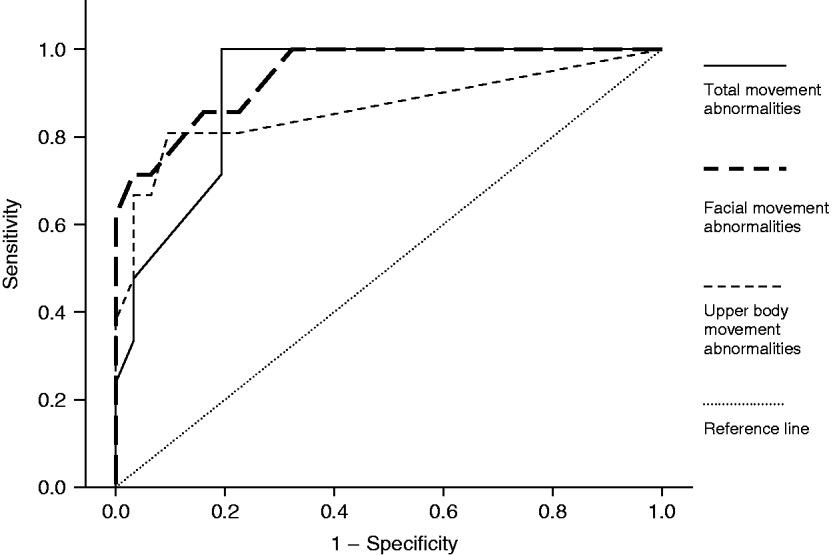
To estimate the accuracy with which the dyskinetic movement scores distinguished ASz from noASz children, ROC curve analyses were conducted. The results are illustrated in Fig. 2. An area under the curve (AUC) score of 1 would indicate perfect differentiation of the ASz and noASz children and an AUC score greater than 0.75 indicates excellent differentiation. The AUCs were highly significant: total movement abnormalities 0.94 (excellent discrimination), facial abnormalities 0.91 (excellent discrimination) and upper-body abnormalities 0.86 (excellent discrimination). These values indicate that the dyskinetic movement scores distinguished the ASz from the noASz children with great accuracy (Pencina et al. Reference Pencina, D'Agostino Sr and D'Agostino2007).
Receiver operator curves for movement abnormality scores (total, facial and upper body) comparing children presenting putative antecedents of schizophrenia and children without antecedents.

Discussion
This is the first study of involuntary dyskinetic movement abnormalities among 9- to 12-year-old children who present putative antecedents of schizophrenia. The children characterized by a triad of antecedents of schizophrenia displayed significantly more dyskinetic movement abnormalities in total, and in both the face and the upper-body regions, than children with none of the antecedents, after taking account of sex and age. Neither sex nor age was associated with the dyskinetic movement abnormality scores. Similar involuntary movement abnormalities have been found to characterize infants, children and adolescents who later developed schizophrenia (Walker et al. Reference Walker, Savoie and Davis1994; Rosso et al. Reference Rosso, Bearden, Hollister, Gasperoni, Sanchez, Hadley and Cannon2000; Schiffman et al. Reference Schiffman, Walker, Morten, Schulsinger, Sorensen and Mednick2004; Mittal et al. Reference Mittal, Neumann, Saczawa and Walker2008).
The ASz children reported, on average, certain experience of 2.5 PLEs, suggesting an elevated risk for a psychotic disorder (Poulton et al. Reference Poulton, Caspi, Moffitt, Cannon, Murray and Harrington2000; Welham et al. Reference Welham, Scott, Williams, Najman, Bor, O'Callaghan and McGrath2009b; Kelleher & Cannon, Reference Kelleher and Cannon2011). A recent study indicated that PLEs at this age may be preceded by cognitive, behavioural and emotional problems assessed as early as age 5 years (Polancyk et al. Reference Polanczyk, Moffitt, Arseneault, Cannon, Ambler, Keefe, Houts, Odgers and Caspi2010). Despite ongoing debate regarding the neurobiological basis of psychotic symptoms and the role of the dopamine system as well as other neurotransmitter systems (Owen et al. Reference Owen, Crow, Poulter, Cross, Longden and Riley1978; Reynolds, Reference Reynolds1983; Deakin et al. Reference Deakin, Slater, Simpson, Gilchrist, Skan, Royston, Reynolds and Cross1989; Seeman, Reference Seeman1992; Hsaio et al. Reference Hsaio, Lin, Liu, Tzen and Yen2003), there is now robust evidence that patients with schizophrenia present elevated presynaptic striatal dopamine synthesis (for a recent review, see Howes & Kapur, Reference Howes and Kapur2009). Dopamine dysregulation in the pathways that link the striatum with the limbic cortex is hypothesized to contribute to the production of positive psychotic symptoms (Seeman & Kapur, Reference Seeman and Kapur2000; Kestler et al. Reference Kestler, Walker and Vega2001), while negative symptoms and cognitive impairments have been linked to abnormalities in other brain regions (Howes & Kapur, Reference Howes and Kapur2009). Further, increased striatal dopamine function has been observed among individuals presenting prodromal psychotic symptoms (Howes et al. Reference Howes, Montgomery, Asselin, Murray, Valli, Tabraham, Bramon-Bosch, Valmaggia, Johns, Broome, McGuire and Grasby2009). This abnormality in striatal dopamine may emerge even earlier and may underlie the PLEs that we have observed among the ASz children in early adolescence.
Dyskinetic movement abnormalities in childhood may also reflect dopamine dysfunction in the striatum. Hyperkinesias have been linked to abnormalities in the striatum that, in interaction with dopamine overactivity, disrupt motor circuitry (Mink, Reference Mink2003), especially the striatal pathway mediated by the dopamine D2 receptor (Alexander et al. Reference Alexander, Crutcher and DeLong1991; Smith et al. Reference Smith, Bevan, Shink and Bolam1998). The association between movement abnormalities and psychosis is presumed to result from the underlying striatal dopamine dysfunction, which can influence both motor functions and vulnerability to psychotic symptoms (Walker et al. Reference Walker, Savoie and Davis1994; Cassady et al. Reference Cassady, Adami and Moran1998). Indeed, Walker and colleagues demonstrated a strong positive association between increasing dyskinetic movement abnormalities and increasing positive and negative symptoms among adolescents with SPD. Further, the movement abnormalities predicted transition to a psychotic disorder (Mittal et al. Reference Mittal, Neumann, Saczawa and Walker2008).
The relationship between striatal dopamine, movement abnormalities and psychotic symptoms is supported by evidence that levodopa-induced elevated striatal dopamine leads to hyperkinesias (Hoff et al. Reference Hoff, Van den Plas, Wagemans and Van Hilten2001) and in extreme cases, psychotic symptoms (Papapetropoulos & Mash, Reference Papapetropoulos and Mash2005), and that amphetamines, such as cocaine, increase dopamine activity and can cause both hyperkinesias and psychotic symptoms (Weiner et al. Reference Weiner, Rabinstein, Levin, Weiner and Shulman2001). This may, however, be too simple an interpretation given the functional interconnections between the motor, limbic and prefrontal circuits that integrate sensory, motor and motivational processes (Cohen et al. Reference Cohen and Grafman2002). There is growing evidence suggesting that neuromotor dysfunction is associated with cognitive (Dreher et al. Reference Dreher, Trapp, Banquet, Keil, Gunther and Burnod1999; D'Reaux et al. Reference D'Reaux, Neumann and Rhymer2000), biochemical (Walker et al. Reference Walker, Lewis, Loewy and Palyo1999; Mittal et al. Reference Mittal, Dhruv, Tessner, Walder and Walker2007), social and emotional disturbances (Fish et al. Reference Fish, Marcus, Hans, Auerbach and Perdue1992; Neumann et al. Reference Neumann, Grimes, Walker and Baum1995), as well as psychotic symptoms in schizophrenia spectrum disorders (Mittal et al. Reference Mittal, Neumann, Saczawa and Walker2008). Several studies have shown a positive association between childhood neuromotor dysfunction (defined as a combination of dyskinetic movement abnormalities and neurological soft signs) in children who subsequently develop schizophrenia, and concurrent and subsequent emotional, social and behavioural problems (Neumann et al. Reference Neumann, Grimes, Walker and Baum1995; Walker & Neumann, Reference Walker and Neumann1996; Welham et al. Reference Welham, Isohanni, Jones and McGrath2009a). One recent study observed that young adolescents reporting PLEs differed from healthy adolescents by displaying functional hypofrontality and temporal-frontal disconnectivity (as do adults with schizophrenia) and structural abnormalities of both white and grey matter (Jacobson et al. Reference Jacobson, Kelleher, Harley, Murtagh, Clarke, Blanchard, Connolly, O'Hanlon, Garavan and Cannon2010). These findings further suggest that the brain abnormalities underlying schizophrenia may be reflected by motor abnormalities and PLEs in early adolescence. Dysfunction in dopamine neurotransmission could influence multiple behavioural and cognitive domains and account for the relationship between movement abnormalities and schizophrenia and/or a spectrum disorder.
In the present study, ASz children, defined as presenting multiple antecedents of schizophrenia including PLEs, also demonstrated increased dyskinetic movement abnormalities compared with children without the antecedents. This adds to our previous findings that ASz children present with similar neurocognitive and electrophysiological profiles to those seen in adults with schizophrenia (Cullen et al. Reference Cullen, Dickson, West, Morris, Mould, Hodgins, Murray and Laurens2010; Laurens et al. Reference Laurens, Hodgins, Mould, West, Schoenberg, Murray and Taylor2010)
A strength of this study was the method used to rate the movement abnormalities. An empirically derived, psychometrically validated instrument, the DISCUS, was employed. The rater was trained to a high level of inter-rater reliability, and was blind to group status and to the verbal content of the videotapes. The children had no family history of schizophrenia, similar to two-thirds of adults with the illness, had never taken psychotropic medication, were attending neighbourhood schools and were not receiving mental health care. The study is also characterized by limitations, principally the small sample size and the failure to capture movement abnormalities in the lower limbs. Previous studies, however, have not observed dyskinetic movement abnormalities in the lower limb region among psychotic patients (Puri et al. Reference Puri, Barnes, Chapman, Hutton and Joyce1999). Scores for movement abnormalities were averaged for each participant in order to account for missing items, thereby making the assumption that all the items in the facial region and upper body region contribute equally to the total score. Given that few data were missing, this presumption is unlikely to have affected the results. The small sample precluded us from examining covariates such as ethnicity and social factors.
Motor problems, including delays or abnormalities in early motor development, have been shown to be one of the strongest and earliest markers of risk for schizophrenia (Torrey et al. Reference Torrey, Taylor, Bracha, Bowler, Thomas, McNell, Rawlings, Quinn, Bigelow, Sjostrom, Higgins and Gottesman1994). Nevertheless, a potential limitation of the study is the use of caregiver-reported motor delay/problem as an inclusion criterion for the ASz group. That is, the presence of a motor delay/problem might have confounded the association between group and dyskinetic movement abnormalities. Yet, consistent with previous evidence that dyskinetic movement abnormalities are distinct from motor developmental delays or gross abnormalities of motor function (Rosso et al. Reference Rosso, Bearden, Hollister, Gasperoni, Sanchez, Hadley and Cannon2000), the results of the present study found that dyskinetic movement scores were not associated with caregiver reports of motor delays and/or abnormalities.
The results of the present study suggest that the brief screening questionnaires completed by caregivers and children and the criteria used to define ASz may be identifying children with an elevated risk of developing schizophrenia. ASz children were found to present significantly more movement abnormalities than children without the antecedents. This result adds to the findings that ASz children present abnormalities similar to adults with schizophrenia (Laurens et al. Reference Laurens, West, Murray and Hodgins2008, Reference Laurens, Hodgins, Mould, West, Schoenberg, Murray and Taylor2010; Cullen et al. Reference Cullen, Dickson, West, Morris, Mould, Hodgins, Murray and Laurens2010). The availability of a practical procedure for identifying children at increased risk for the disorder offers opportunities to further investigate the processes leading to schizophrenia and to intervene to reduce current clinical problems and possibly to prevent illness onset. The results also suggest that the presence of dyskinetic movement abnormalities and PLEs may form a strong early risk marker of schizophrenia and reflect dysfunction within the striatal dopamine circuits.
Acknowledgements
The authors thank the children and caregivers who participated in the research, and the staff and students who contributed to data collection and management. Funding sources for this research included a National Institute for Health Research (NIHR) Career Development Fellowship to K.R.L. (no. CDF/08/01/015); a Bial Foundation Research Grant to K.R.L. (no. 36/06); a 2005 NARSAD Young Investigator Award to K.R.L. (NARSAD is now known as the Brain and Behavior Research Foundation and formerly the National Alliance for Research on Schizophrenia and Depression); the British Medical Association Margaret Temple Award for schizophrenia research to K.R.L. (2006); and funding from the NIHR Specialist Biomedical Research Centre for Mental Health at the South London and Maudsley NHS Foundation Trust and Institute of Psychiatry, King's College London, UK. D.M. is supported by a Medical Research Council Clinical Research Training Fellowship (no. G0901999); K.R.L. is supported by a NIHR Career Development Fellowship (no. CDF/08/01/015).
Declaration of Interest
None.