Introduction
Mindfulness-based interventions have been the subject of considerable interest and research in recent years. They are being applied to an increasing number of physical and mental health conditions. Mindfulness-based stress reduction (MBSR) was originally developed as an intervention to modify stress and pain in chronic illness (Kabat-Zinn, Reference Kabat-Zinn1990). Mindfulness-based cognitive therapy (MBCT) is an elaboration of this intervention, which combines the mindfulness meditation techniques used in MBSR with a cognitive therapy approach. It was originally developed to reduce relapse rates in people suffering from major depression (Teasdale et al. Reference Teasdale, Segal, Williams, Ridgeway, Soulsby and Lau2000). The evidence for the benefits of MBSR in cancer is well established, with a meta-analysis finding it to be useful in the management of problems with mental health and psycho-social adjustment in cancer (Ledesma & Kumano, Reference Ledesma and Kumano2008; Cramer et al. Reference Cramer, Lauche and Dobos2012). However, in recent years, there has been interest in the potential of MBCT to alleviate distress, anxiety and depressive symptoms in cancer. Two books now describe its application in the oncology setting (Bartley, Reference Bartley2011; Speca & Carlson, Reference Speca and Carlson2011) and there is a nascent evidence base supporting its use (Foley et al. Reference Foley, Baillie, Huxter, Price and Sinclair2010; Sharplin et al. Reference Sharplin, Jones, Hancock, Knott, Bowden and Whitford2010; van der Lee, 2012). This study adds to the small number of existing studies examining the usefulness of application of MBCT to mental health problems in cancer.
To understand how MBCT might be useful in promoting adjustment to cancer, it is useful to consider how cancer affects mental health. It has been shown that a diagnosis of cancer impacts on important aspects of psychological and social functioning (Meyer et al. Reference Meyer, Ehrlich and Peteet2009). A spectrum of reactions emerges in those coping with this significant life event. This ranges from ‘normal’ coping, where mood disturbance may be present, but the illness and its related challenges are integrated into the course of a life, to those who develop psychopathology of a severity requiring treatment (Massie & Holland, Reference Massie and Holland1989). Many people find themselves somewhere in the middle of this spectrum, experiencing change in their normal functioning that is distressing, and being keen for help, but not being sufficiently unwell to require referral to psychiatry or specialised psycho-oncology services. This population may approximately map onto those in diagnostic categories such as adjustment disorder and depressive episode of mild severity. Estimates of adjustment disorder in the general hospital population referred for psychiatric consultation range from 11.5% (Snyder et al. Reference Snyder, Strain and Wolf1989) to 21.5% (Popkin et al. Reference Popkin, Callies, Colόn and Stiebel1990). However, numbers appear higher in studies of cancer patients. Studies of patients with cancer referred for psychiatric consultation range in estimates of prevalence of adjustment disorder from 45.9% (Razavi et al. Reference Razavi, Delvaux, Farvacques and Robaye1990) to 54% (Massie & Holland, Reference Massie and Holland1989). Studies of specific malignancies may yield different results; for example, studies of rates in inpatients with haematological malignancies found a prevalence rates between 23% (Prieto, Reference Prieto2002) and 25% (Derogatis et al. Reference Derogatis, Morrow and Fetting1983).
Estimates of the prevalence of depression spectrum disorders range from 0% to 59% (Massie, Reference Massie2004). Anxiety disorder prevalence rates in cancer patients range from 7% to 29% (Alexander et al. Reference Alexander, Dinesh and Vidyasagar1993). Despite high rates of sub-clinical symptomatology, there is little evidence indicating, which interventions may be of use in adjustment spectrum disorders (Holland, Reference Holland1989).
MBCT was developed by Segal et al. (Reference Segal, Williams and Teasdale2002) as a group intervention to be delivered over 8 weeks to the recovered depressed individual to reduce rate of recurrence. The programme trains participants in mindfulness skills, based on meditation techniques, combined with techniques from cognitive therapy. Its efficacy in preventing depressive relapse has been established (Ma & Teasdale, Reference Ma and Teasdale2004). Adaptations of the programme have been used in a variety of disorders, including suicidal behaviour (Williams et al. Reference Williams, Duggan, Crane and Fennell2006), bipolar disorder (Williams et al. Reference Williams, Alatiq, Crane, Barnhofer, Fennell, Duggan, Hepburn and Goodwin2008), co-morbid mood disorder and addiction (Hoppes, Reference Hoppes2006), insomnia (Heidenreich et al. Reference Heidenreich, Tuin, Pflug, Michal and Michalak2006; Yook et al. Reference Yook, Lee, Ryu, Kim, Choi, Suh, Kim, Kim, Kim and Kim2008), cardio-vascular disease (Griffiths et al. Reference Griffiths, Camic and Hutton2009) and tinnitus (Sadlier et al. Reference Sadlier, Stephens and Kennedy2008).
To date, only a small number of studies of the efficacy of MBCT in cancer patients have been published. Foley et al. (Reference Foley, Baillie, Huxter, Price and Sinclair2010) found that, compared with a wait-list control group, people with cancer randomised to treatment with MBCT showed improvements in anxiety, depression and distress. These improvements were maintained at 3-month follow-up. In another randomised controlled trial (van der Lee & Garssen, Reference Van der Lee and Garssen2012) MBCT resulted in a reduction in cancer-related fatigue during treatment, and this was maintained at 6-month follow-up, with a concomitant improvement in well-being. A pre- and post-treatment study (Sharplin et al. Reference Sharplin, Jones, Hancock, Knott, Bowden and Whitford2010) found that symptoms of depression and anxiety in cancer patients reduced during treatment with MBCT, with gains being sustained at 3-month follow-up.
Several studies of MBSR have been carried out with cancer patients, including a number of randomised studies. Benefits have been found in the areas of psychological functioning, reduction of stress symptoms, enhanced coping, well-being, mood, sleep quality and spiritual well-being (Smith et al. Reference Smith, Richardson, Hoffman and Pilkington2005; Lamanque & Daneault, Reference Lamanque and Daneault2006; Ledesma & Kumano, Reference Ledesma and Kumano2008; Ott et al. Reference Ott, Norris and Bauer-Wu2008). Speca et al. (Reference Speca, Carlson, Goodey and Angen2000) and Carlson et al. (Reference Carlson, Ursuliak, Goodey, Angen and Speca2001) found improvements in mood and stress symptoms in patients with various cancers following MBSR, which are sustained at 6-month follow-up. The same group found improvements in immunological and hormonal markers of disease in patients with breast and prostate cancer (Carlson et al. Reference Carlson, Speca, Patel and Goodey2003, Reference Carlson, Speca, Patel and Goodey2004). A randomised study of MBSR in survivors of breast cancer found significantly lower rates of depression, anxiety and fear of recurrence at 6 weeks, along with improved energy levels, better physical functioning and physical role functioning (Lengacher et al. Reference Lengacher, Johnson-Mallard, Post-White, Moscoso, Jacobsen, Klein, Widen, Fitzgerald, Shelton, Barta, Goodman, Cox and Kip2009). A non-randomised controlled study of MBSR in women with newly diagnosed breast cancer reported that the intervention was associated with improvements in markers of immune functioning as well as improved quality of life (QOL) and coping (Witek-Janusek et al. Reference Witek-Janusek, Albutquerque, Chroniak, Chroniak, Durazo-Arvizu and Mathews2008). One year after MBSR, decreases in depression and anger and improvements in vigour were reported for cancer patients (Kieviet-Stijnen et al. Reference Kieviet-Stijnen, Visser, Garssen and Hudig2008). Smaller, non-randomised studies have shown improvements in stress, anxiety, adjustment and health locus of control in women with breast cancer (Tacon et al. Reference Tacon, Caldera and Ronaghan2004) and also improvements in prostate-specific antigen levels when delivered in conjunction with a dietary intervention in men with prostate cancer (Saxe et al. Reference Saxe, Hebert, Carmody, Kabat-Zinn, Rosenzweig, Jarzobski, Reed and Blute2001).
It has been hypothesised that the effects of MBCT/MBSR on depression are mediated by a number of different constructs, including mindfulness and self-compassion (Keng et al. Reference Keng, Smoski, Robins, Ekblad and Brantley2012). Mindfulness has been shown to be inversely related to relapse in depression 12 months after an MBCT intervention in previously depressed patients (Michalak et al. Reference Michalak, Heidenreich, Meibert and Schulte2008). Self-compassion has been defined by Neff & Rude (Reference Neff and Rude2007) as being kind toward oneself in instances of pain or failure; perceiving one’s experiences as part of the larger human experience; and holding painful thoughts and feelings in balanced awareness. Neff suggested that self-compassion, by reducing rumination, isolation and self-judgment, should also reduce depression (2003). While there have been no studies to date, to our knowledge, examining whether self-compassion mediates the effect of mindfulness-based interventions on depression, it has been shown to partially mediate the relationship between these interventions and increases in emotional acceptance (Kyrimis, Reference Kyrimis2007).
Aims
The aim of the study was to evaluate the effectiveness of MBCT in reducing symptoms of depression, anxiety and stress/distress and in improving QOL, mindfulness and self-compassion. A secondary aim was to evaluate whether mindfulness and self-compassion mediated improvement in depressive and anxiety symptoms.
Methods
Participants
Following acceptance of the study by the St James’s Hospital Research Ethics Committee, referrals of patients to the programme were taken from the multidisciplinary oncology teams in this large urban teaching hospital, as well as from the psycho-oncology team (patients who had been referred for assessment but were assessed as not currently requiring pharmacotherapy/individual psychotherapy). Inclusion and exclusion criteria were as follows.
Inclusion criteria
Age>17 years; diagnosis of cancer in stable phase (in remission or on oral chemotherapy); mild to moderate symptoms of anxiety or depression [Hospital Anxiety and Depression Scale (HADS) score of 8 to 14].
Exclusion criteria
Disease currently in unstable phase requiring intensive treatment that would interfere with ability to attend sessions and do homework; current mental health symptoms present of a severity requiring ongoing specialist psycho-oncology service.
Treatment with antidepressant medication was not among the exclusion criteria, as many patients with relatively mild depressive/anxiety symptoms may be treated with antidepressants in the primary care setting. Patients referred to the programme were assessed by a senior member of the psycho-oncology team to establish that they did not currently require specialist psycho-oncology treatment.
Cancer diagnoses of patients included in the study were breast cancer (n=6), chronic myelogenous leukaemia (n=3), acute lymphocytic leukaemia (n=1), Hodgkin’s lymphoma (n=3), multiple myeloma (n=1), ovarian cancer (n=1) and mycosis fungoides (n=1). Patients included in the study were either in remission (n=9) or on oral chemotherapy (n=7).
Figure 1 presents the number of people participating at the various stages of the trial.
Numbers of participants referred, included in randomisation, completing programme, and contributing data.

Procedure
Each of the participants was given a study ID number (1–16). Restricted randomistaion was used to ensure groups of equal sizes and patients were randomised to one of two groups by the study statistician using a random number table (Schultz & Grimes, Reference Schultz and Grimes2002). An arbitrary starting point in the list of numbers was selected, and the numbers were read from left to right in blocks of eight numbers such that each block contained four even (assigned to MBCT) and four odd (assigned to the control group) numbers. Allocation was based on moving sequentially down the list of participant ID numbers and assigning participants to the MBCT or control group based on the sequence of even and odd numbers in each of the two blocks of eight numbers. In phase 1 of the study, one group (MBCT) was randomised to active treatment and received an 8-week programme of MBCT (described below), while the other was randomised to treatment as usual (TAU) consisting of their usual treatment within the oncology service while being waitlisted form MBCT. TAU included medical management of their cancer, supportive counselling from within (Clinical Nurse Specialist/Social Worker) or outside the hospital (not including CBT/psychodynamic modalities of therapy) and psychopharmacological management of mild depressive/anxiety symptoms. Both groups completed an assessment battery at the beginning of the treatment phase and at 8 weeks.
In phase 2 of the study, the TAU group received the MBCT intervention, completing the assessment battery again at the end of treatment. Both MBCT and TAU groups also completed a follow-up assessment battery 3 months after completion of MBCT.
The MBCT programme was an adapted version of that described by Segal et al. (Reference Segal, Williams and Teasdale2002) consisting of eight weekly sessions lasting ∼90 minutes each. The sessions were carried out by two experienced therapists, one a Senior Registrar in Psychological Medicine, the other a Senior Clinical Psychologist. Both are accredited by the British Association of Behavioural and Cognitive Therapists and have received formal training in MBCT. Standard MBCT focuses on instruction in mindfulness meditation techniques, body scanning and mindful movement, and differs from MBSR in the inclusion of CBT-based psycho-education regarding depression and exercises targeted to relieve depressive symptoms. Participants are requested to carry out practice of mindfulness techniques between sessions, as well as completion of cognitive therapy exercises. Cancer-specific adjustments were made to the MBCT programme in the cognitive sections of the sessions, with particular attention to cancer-specific rumination and physical problems such as cancer-related fatigue. The mindful movement exercises contained in the programme were modified in consultation with the hospital physiotherapy department to be safe in individuals who might have had recent surgery, or who had ongoing physical problems secondary to their cancer.
Measures
HADS (Zigmond & Snaith, Reference Zigmond and Snaith1983)
The self-administered HADS consists of anxiety (seven items) and depression (seven items) subscales. The anxiety and depression scores are categorised as normal (0–7), mild (8–10), moderate (11–14) and severe (15–21). The HADS has been found to be both reliable (Mykletun et al. Reference Mykletun, Stordal and Dahl2001) and valid in cancer patients (Razavi et al. Reference Razavi, Delvaux, Farvacques and Robaye1990).
Profile of mood states (POMS; McNair et al. Reference McNair, Lorr and Droppleman1971)
This 65-item self-report inventory requires respondents to rate a series of mood states (e.g. ‘worn out’, ‘listless’, ‘relaxed’) on a scale ranging from 1 (‘not at all’) to 5 (‘extremely’). Five subscales are assessed: fatigue/inertia, confusion/bewilderment, tension/anxiety, depression/dejection and anger/hostility. Total mood disturbance scores range from 0 (lowest level of disturbance) to 200 (highest level of disturbance). The depression/dejection subscale scores range is 0 to 60 and the tension/anxiety subscale score is from 0 to 36. It has been found to be valid and reliable (McNair et al. Reference McNair, Heuchert and Shilony2003) and has been widely used in cancer research.
Brief Symptom Inventory 18 (BSI 18; Zabora et al. Reference Zabora, BrintzenfhofeSzoc, Jacobsen, Curbow, Piantadosi, Hooker, Owens and Derogatis2000)
The BSI-18 is an 18-item version of the BSI (Derogatis, Reference Derogatis1993) covering three symptom dimensions: somatisation, depression and anxiety. Each item is rated on a scale of 0 (‘not at all distressed by this symptom’) to 4 (‘extremely distressed by this symptom’) giving a full scale range from 0 (lowest distress) to 72 (highest distress). It has been found to be a valid and reliable instrument in cancer patients (Zabora et al. Reference Zabora, BrintzenfhofeSzoc, Jacobsen, Curbow, Piantadosi, Hooker, Owens and Derogatis2000).
WHO-5 wellbeing scale (WHO-5; Bech, Reference Bech1998)
The WHO-5 is a five-item self-report instrument measuring psychological QOL. Each positively worded item is scored on a scale from 0 (‘at no time’) to 5 (‘all of the time’) for items such as ‘I have felt cheerful and in good spirits’, giving a score range from 0 (worst wellbeing) to 25 (best wellbeing). It has been found to be reliable and valid across a wide range of medical and psychiatric patient care settings (McDowell, Reference McDowell2010).
Kentucky Inventory of Mindfulness Skills (KIMS; Baer et al. Reference Baer, Smith and Allen2004)
The KIMS is a 39-item self-report instrument measuring mindfulness skills. It includes four subscales: observing, describing, acting with awareness and accepting without judgement. Each positively or negatively worded item is rated on a scale from 1 (‘never or rarely true’) to 5 (‘very often or always true’) giving a total score range from 39 to 195, where high scores reflect well-developed mindfulness skills. It has been shown to be reliable and valid in normal and personality disordered populations (Baer et al. Reference Baer, Smith and Allen2004).
Self-compassion scale (SCS; Neff, Reference Neff2003)
The 26-item self-report SCS measures aspects of self-compassion such as a kind and non-judgemental attitude to the suffering self; recognition of the universality of experience; and the non-judgemental holding in awareness of painful experience. Each positively or negatively worded item is scored from 1 (‘almost never’) to 5 (‘almost always’) and total score is calculated as the mean of all 26 items, giving a score ranging from 1 (low self-compassion) to 5 (high self-compassion). Six subscales are calculated (self-kindness, self-judgement, common humanity, isolation, mindfulness and over-identification) with higher scores reflecting greater self-compassion. It has been shown to be both reliable and valid in a healthy population (Neff, Reference Neff2003).
Statistical analysis
For phase 1, descriptive analyses and χ 2-tests of association assessed equivalence of sample characteristics in MBCT and TAU groups. Mixed factorial Analysis of variances (ANOVAs) were conducted to compare changes in the psychological variables targeted by the intervention (depression, anxiety, QOL, mindfulness, self-compassion) over time between the MBCT and TAU group. Significant interactions were further analysed using post-hoc tests of simple effects. The relationship between changes in mindfulness and self-compassion variables and subsequent changes in psychological distress, stress and QOL was examined using correlations between change scores. In phase 2, a series of repeated measures ANOVA evaluated whether the treatment effects differed across the three time points (pre-MBCT, post-MBCT and 3-month follow-up). Multiple testing correction was not performed due to the small sample size. Where appropriate, effect sizes are reported in terms of Cohen’s d. Statistical significance was set at 0.05.
Results
Clinical and demographic profile
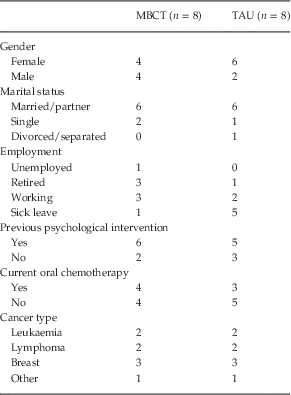
Clinical and demographic details of the sample are provided in Table 1.
Clinical and demographic profile of participants
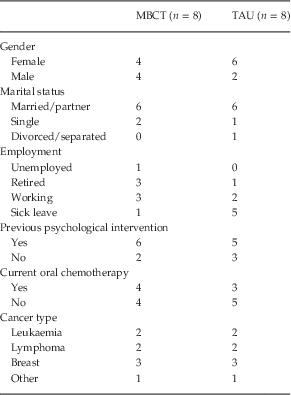
MBCT, mindfulness-based cognitive therapy; TAU, treatment as usual.
There were no significant differences between the groups in relation to gender, marital status, employment and previous psychological intervention. Ethnicity was not tested for as all participants were Caucasian-Irish. In addition, there was no significant difference between the groups in relation to age: MBCT M=49.75 years (S.D.=10.89), TAU M=50.38 years (S.D.=13.17).
Comparison of changes in psychological variables over time by group
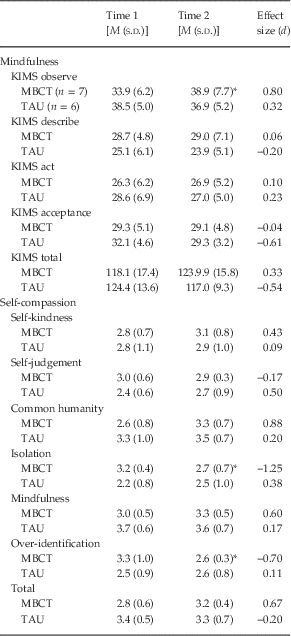
The initial examination of group differences examined whether the intervention was associated with changes in mindfulness and self-compassion, which are hypothesised to mediate the effect of mindfulness-based interventions (see Table 2).
Changes in mindfulness and self-compassion over time by group
KIMS, Kentucky Inventory of Mindfulness Skills; MBCT, mindfulness-based cognitive therapy; TAU, treatment as usual.
*p<0.05.
ANOVA identified significant interaction effects for the KIMS Observe subscale [F(1,13)=8.88, p<0.05], SCS Isolation subscale [F(1,13)=5.00, p<0.05] and SCS Over-identification subscale [F(1,13)=5.93, p<0.05]. Post-hoc analyses revealed that in comparison with TAU, the MBCT group had a significant increase on the KIMS Observe subscale, reflecting improved mindfulness skills in this area (p<0.05), and significant decreases in both SCS isolation (p<0.05) and SCS over-identification subscales, again reflecting reductions in isolation and over-identification (p<0.05). These findings support the hypothesis that mindfulness-based interventions improve mindfulness skills.
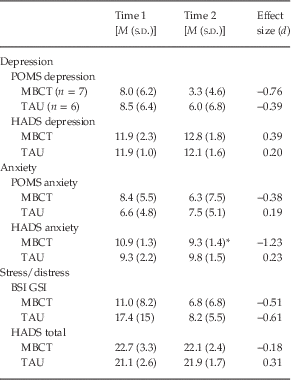
The effects of the intervention on depression, anxiety and stress/distress are presented in Table 3.
Changes in depression, anxiety and stress/distress over time by group
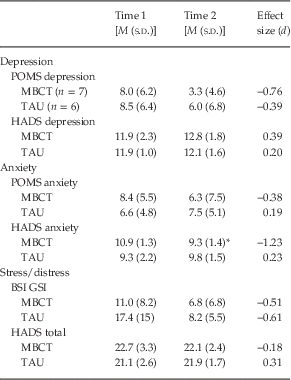
POMS, Profile of Mood States; MBCT, mindfulness-based cognitive therapy; TAU, treatment as usual; HADS, Hospital Anxiety and Depression Scale; BSI, Brief Symptom Inventory; GSI, Global Severity Index.
*p<0.05.
There was a significant interaction between group and time in relation to HADS Anxiety subscale, F(1,13)=6.18, p<0.05, with the MBCT group showing a significant decrease in anxiety over time (see Fig. 2). No other differences between the groups were significant.
Changes in HADS Anxiety by group over time.
Changes in mindfulness and self-compassion
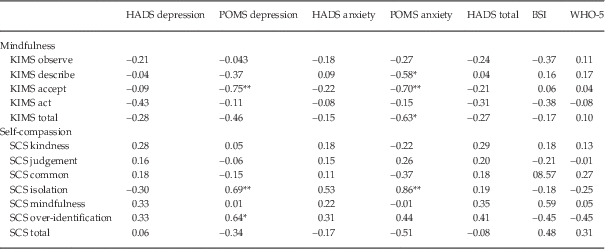
The relationship between changes in mindfulness and self-compassion are presented in Table 4.
Correlations between changes in mindfulness, self-compassion and outcomes
KIMS, Kentucky Inventory of Mindfulness Skills; SCS, Self-Compassion Scale.
*p<0.05; **p<0.01.
Significant interactions were further analysed using post-hoc tests of simple effects.
Changes in some aspects of mindfulness were associated with decreases in anxiety and depression. Increases in the KIMS Describe subscale were significantly related (r=−0.58, p=0.037) to decreases in anxiety (POMS). Similarly, increases in the KIMS Accept subscale were significantly related (r=−0.70, p=0.008) to decreases in anxiety (POMS). Increases in the KIMS Accept subscale were significantly associated with decreases (r=−0.75, p=0.003) in depression (POMS), and increases in the KIMS Total scale were significantly related (r=−0.63, p=0.02) to decreases in anxiety (POMS).
Decreases in the SCS isolation scale were significantly related to decreases (r=0.69 p=0.009) in depression (POMS) and also to decreases (r=0.86, p=0.001) in anxiety (POMS). Decreases in the SCS Over-identification subscale significantly related to decreases (r=0.64, p=0.009) in depression (POMS).
Changes in psychological variables over time
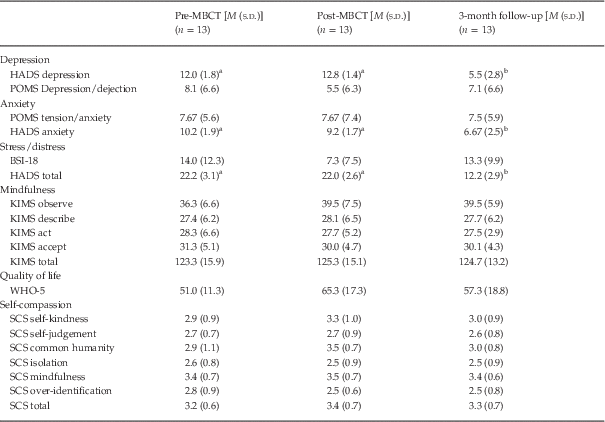
All members of the initial TAU group crossed over to receive MBCT and the following analyses examined the changes associated with the intervention for both MBCT groups combined (see Table 5). There was a statistically significant change in HADS Depression subscale [F(2,22)=13.69, p<0.001], with the 3-month follow-up score significantly (p<0.01) lower than the pre- and the post-MBCT ratings. The same pattern was found for HADS Anxiety subscale, F(2,22)=39.98, p<0.001, and the HADS total score, F(2,22)=57.28, p<0.001. There were no other significant differences.
Changes in psychological characteristics over time
MBCT, mindfulness-based cognitive therapy; HADS, Hospital Anxiety and Depression Scale; POMS, Profile of Mood States; BSI, Brief Symptom Inventory; KIMS, Kentucky Inventory of Mindfulness Skills; SCS, Self-Compassion Scale.
Different superscripts indicate significant (p<0.05) mean differences.
Discussion
This study indicates that statistically significant improvements in measures of depression and anxiety occurred following the MBCT intervention. Positive changes in stress, QOL, mindfulness and compassion, while not reaching statistical significance, were also seen.
In phase 1 (comparison of the pre- and post-MBCT measures between MBCT and TAU groups) the changes in mindfulness and self-compassion, while not reaching significance, had moderate to large effect sizes (KIMS total d=0.33; SCS total d=0.67).
In phase 2 (comparison of the pre-, post- and follow-up MBCT measures for the two groups), there were changes in a positive direction in measures of depression, anxiety, stress, QOL, mindfulness and self-compassion scores, with some of these changes reaching significance (anxiety and depression on HADS).
MBCT has been found to reduce depressive recurrence in the large studies carried out in major depressive disorder (Ma & Teasdale, Reference Ma and Teasdale2004). The present population differs from the populations investigated in those studies in that participants were experiencing acute symptoms relating to adjustment to serious physical illness rather being in a remitted phase of chronic depressive illness. However, MBCT has been found to be of benefit in physical conditions where mood and anxiety play an important role in heightening distress (Sadlier et al. Reference Sadlier, Stephens and Kennedy2008; Griffiths et al. Reference Griffiths, Camic and Hutton2009), as is the case in cancer. MBSR is the best-established mindfulness-based intervention in cancer. The present findings are congruent with those of past studies of MBSR in cancer showing improvements in mood, stress, anxiety and adjustment (Carlson et al. Reference Carlson, Ursuliak, Goodey, Angen and Speca2001, Reference Carlson, Speca, Patel and Goodey2003, Reference Carlson, Speca, Patel and Goodey2004; Shapiro et al. Reference Shapiro, Bootzin, Figueredo, Lopez and Schwartz2004; Tacon et al. Reference Tacon, Caldera and Ronaghan2004; Carlson & Garland, Reference Carlson and Garland2005). Although this study’s population was heterogeneous for cancer diagnosis and the above studies examined populations with either breast or prostate cancer, the fact that both MBCT and MBSR appear to have a positive effect on similar variables points to a general effectiveness of mindfulness-based interventions on psychological symptoms in individuals with cancer.
Mindfulness-based interventions are designed to provide participants with tools for managing distress, which require practice over time in order that their full benefit may be experienced. The present study found improvements in measures of depression and anxiety at 3 months, which exceeded the gains, which are present immediately after the end of the intervention. Given the absence of a control group at 3 months, it cannot be ruled out that observed changes may represent regression to the mean as symptoms improve with time. However, there is evidence to suggest that the majority of patients (>50%) with a diagnosis of cancer who are found to be depressed at baseline are also depressed at follow-up. In addition, of those with normal or sub-clinical scores, up to 17% may develop clinical depression by follow-up (Carr et al. Reference Carr, Goudas, Lawrence, Pirl, Lau, DeVine, Kupelnick and Miller2002). Therefore, it is theoretically plausible that gains in depressive and anxiety symptoms continue to be consolidated following completion of MBCT. Hayes et al. (Reference Hayes, Luoma, Bond, Masuda and Lillis2004) describes a process whereby gains during treatment may be small, but more significant gains are seen if participants are followed up after a number of months, having given the intervention time to ‘bed down’ in conjunction with ongoing practice of mindfulness.
It is hypothesised that a decrease in rumination or an increase in self-compassion or mindfulness may mediate improvements following MBCT in depression (Raes et al. Reference Raes, Dewulf, Van Heeringen and Williams2009; McIntosh et al. Reference McIntosh, Gillanders and Rodgers2010; Pauley & McPherson, Reference Pauley and McPherson2010). In this study, significant associations were found between increases in self-compassion and mindfulness and decreases in measures of depression and anxiety, in line with the above hypothesis. It may be, therefore, that the mechanism effecting MBCT-related improvement in psychological distress in cancer is similar to that effecting MBCT-related improvement in depression, despite the differences between the populations.
Limitations
The small sample size means the sample may not be adequately representative of the population. As a convenience sample was recruited, selection biases may have affected the referral practices, which may also reduce generalisability. The large standard deviations seen on many measures, in addition to the small sample sizes, prevent many of the changes from reaching significance, despite some large effect sizes being found. In addition, the low to moderate levels of distress in the sample may have produced a floor-effect in the measures, which would further compromise the potential to find significant changes over time. It is also worth commenting on the fact that during the course of both groups and follow-up period, several individuals in each group received bad news about progression of their cancer, or suffered distressing physical symptoms. Despite this, the results suggest that the intervention may have had a positive impact on aspects of psychological function often adversely affected in cancer. Another limitation is the absence of an active placebo intervention as a control. The absence of a control group at 3-month follow-up means that conclusions about findings at follow-up are limited. Future studies with larger numbers of participants will provide more substantive evidence for the efficacy of this intervention, and might have sufficient power to inform about predictors of response to MBCT. Similarly, randomised studies comparing MBCT to other interventions, such as MBSR, will inform conclusions regarding how useful MBCT is in comparison with other available treatments. Other directions that future research might usefully take are the examination of which of the components of MBCT contribute to efficacy.
Conclusion
Mindfulness interventions have been found to be useful in several areas where physical illness and psychological distress overlap. This pilot study indicates that cancer-specific adjustments to the MBCT programme resulted in an intervention that was suitable to the needs of a group in need of less specialised psycho-oncology support. Specifically, improvements in depression, anxiety, stress, QOL, mindfulness and self-compassion were found when the intervention was compared with TAU, and gains were sustained or improved upon at 3-month follow-up.