




No CrossRef data available.
Article contents
The interplay of dialect and the standard in anonymous street dialogues: Patterns of variation in northern Italy
Published online by Cambridge University Press: 27 April 2006
Abstract
In this article we provide a quantitative view on the relationship between standard and dialect in Italy. In Italian sociolinguistics, the concept of dilalìa has been used to account for this kind of linguistic repertoire. This notion will be addressed as the main theoretical frame to our investigation on code choice. Italian sociolinguistics and dialectology so far have come to apparently contradictory results about the standard–dialect relationship and the vitality of dialects. On one side, the main post-war trend shows a fall in the number of dialect speakers (especially the young and the less educated); on the other, we are witnessing a change from above in attitudes and beliefs regarding dialects. We carried out an empirical study in the northwest of the country employing the method of rapid and anonymous street interactions. Our focus being on code choice, we wanted to know what factors affect the presence of dialect, making use of multivariate analysis.This research was part of a larger national project (Cofin 2002–2003) directed by Gaetano Berruto (University of Turin) with the title “Lingua e dialetto in Italia all'inizio del Terzo Millennio” (National language and dialect in Italy at the beginning of the Third Millennium) and involving the universities of Neaples, Lecce, and Rome. Both authors took part in the research unit of Turin. Although the research and the analysis of the data have been conceived and undertaken by both authors, Alessandro Vietti wrote “The results” and “Gender-based-variation” sections while all other parts were written by Silvia Dal Negro.
Information
- Type
- Research Article
- Information
- Copyright
- © 2006 Cambridge University Press
Italy's most common sociolinguistic landscape is characterized by the coexistence of Italian and an Italo-Romance dialect, both of which vary along social, geographical, and stylistic dimensions. Differently from other sociolinguistic contexts in Europe and America, but somewhat more similarly to German-speaking areas, in Italy dialects are autonomous language systems, different from the national language on all (phonological, morphosyntactical, and lexical) levels, and cannot be regarded as substandard varieties of the national language (cf. Maiden & Parry, 1997:2).1
For historical reasons, some areas diverge from this most typical picture. We have on one side, Tuscany and Rome, where local dialects are actual varieties of Italian, and on the other side, enclaves where minority languages are spoken (e.g., German, Slovene, Albanian).
Major morphosyntactic differences between Italian and Italo-Romance dialects (in this case Piedmontese, cf. Parry, 1997), can be seen in the following examples that are taken from our corpus of anonymous street request dialogues. Here follows a selection of syntactic features that are typical of northwestern dialects: postverbal negation opposed to preverbal negation in Italian, shown in example (1); a complex system of obligatory subject clitics vs. a typical pro-drop syntax in Italian, shown in examples (1–3); postverbal object clitics vs. preverbal object clitics in Italian, shown in example (1); and double complementizers, also present in substandard varieties of Italian but not in the standard, as shown in example (3).

Italo-Romance dialects are thus independent codes characterized by a relatively reduced geographical scope. By definition they are either not elaborated or they present a very low level of elaboration (in the sense of Kloss's Ausbau, Kloss, 1987). However, urban dialects with regional prestige and diffusion might have a long-lived tradition of literacy (such as the Turinese, on which the Piedmontese dialect koinè is based).
Because of the hierarchical structure of the repertoire, the relationship between Italian and dialects could be defined in terms of diglossia. Italian shares most of the features of a H[igh]-language, whereas the various Italo-Romance dialects are typical examples of L[ow]-languages. However, in the Italian context the H-language can be, and is actually, used in all formal and informal situations, besides being learned as a first language by most children. Therefore, a different label has been devised to define Italy's most typical linguistic repertoire: “dilalìa” (see Berruto, 1989). Differently from diglossia, in a dilalic repertoire the overlapping of codes is possible in informal domains. As a result, both codes can coexist in conversation, juxtaposed in a variety of code-switching patterns, possibly with various degrees of conversational and/or social meaning. Both codes remain basically distinct from each other and can be easily detected in discourse.
See the following two examples from our corpus as an illustration of bilingual conversational practices:2
In all examples, italics is used for Italian and normal type for Piedmontese.

Since its formation in 1861, the Italian State has grown from a country in which a very small part of the population (De Mauro, 1991:43 estimates a value of 2.5% in 1861) could master a mainly written, literary code, into a modern state with widespread literacy and knowledge of the standard language, both as a written and as a spoken code. Thus, from diglossia with little bilingualism, the repertoire shared by most of the population has turned into a “dilalic” one in which the national language ranges from formal to colloquial and popular varieties.
One of the consequences of this massive and relatively rapid3
The most important transformations have in fact occurred within three or four decades in the middle of the 20th century.
A survey carried out in 2000 by the National Institute of Statistics (ISTAT, 2003:103–106) on a sample of 22,000 families (about 55,000 individuals) has revealed that 52% of the population claims to use dialect, or dialect in combination with Italian, in family interactions. This value sinks to 37.6% in northwestern Italy, to 35.8% in large urban centers, to 30.3% for young children, and to 20.8% for people with college education. Interactions with friends score a somewhat lower value of dialect use for the entire population (48.7%). This value sinks to 33.3% in the northwest and to 32.5% in large urban centers. Finally, a quarter of the population (25.4%) claims to use a dialect, or dialect in combination with Italian, with unknown interlocutors, and also in this domain the value sinks considerably in the northwest (11.8%) and moderately less in large urban centers (17.7%).
The resulting picture is that of a decline of dialect monolingualism, a decline that is especially relevant in Piedmont, the area in which the present research has been conducted. At the same time, however, dialects have not collapsed under the weight of a diffused italianization and are still largely used, albeit in combination with the national language. In addition, they seem to be enjoying a new status and to be playing new roles especially in those geographical, cultural, and social areas and domains in which italianization processes have been more radical and pervasive, such as the internet, pop culture, commercials, political and ideological discourse. Dialects are being used also by the young and middle-aged generations among peers in social contexts, such as bars and sport meetings, even more than in households. It is in fact rather common that the local dialect is not used by children in their primary socialization; nonetheless children acquire passive dialect competence within their families, thus they can use dialect later on to speak with older relatives and friends. Besides, dialects are enjoying a new vitality and gaining higher status in some middle-class groups in the north of the country, also on the spur of localist-oriented political and cultural movements (see Berruto, 2005, for a discussion and a large amount of examples). The knowledge of the local dialect, far from representing a sign of language deprivation, is now regarded by most as a pragmatic resource and as such it is used in conversation (in the sense of Auer, 1998).
The aim of this research is to assess the presence of dialect in a context that is supposed to disfavor it most: short and anonymous interactions in an area (Piedmont) that ranks very low as regards daily dialect use (11.3% of respondents claim to use dialect and Italian in family domains in Piedmont, against a national value of 32.9%, ISTAT, 2003:105). Confident that a certain amount of dialect within Italian interactions can be elicited at least in some of the recordings, we want to estimate which sociolinguistic factors and combinations of factors correlate most with the appearance of dialect in spontaneous speech forms.
THE CORPUS
The main bulk of this research consists of a corpus of 400 short and anonymous recordings elicited by asking street directions to passers-by in towns and villages in Northeastern Piedmont. This is an area of cultural transition between one pole of influence in the East (Milan) and one in the West (Turin), and of strong contrasts between a rural traditional culture and intensive industrial and tertiary development. Similarly to other researches (Labov, 1972, and especially Gardner-Chloros, 1985 and Sobrero, 1992), this eliciting technique has been chosen as an economical way to gain spontaneous data from a large number of individuals, though, regrettably, no social-economic-educational information on informants could be gathered and the corresponding sociolinguistic variables could not be explored. Besides, we are interested in investigating unmarked casual encounters from the point of view of code selection. The idea of using highly conventional interactions allows us to control potentially significant independent variables, such as topic of conversation, familiarity between interlocutors, and length of interaction.
Various fieldworkers, both males and females, have alternated in the elicitation of the corpus, all sharing a relatively young age (between 20 and 35) and a northern Italian accent. Most of the recordings, however, have been undertaken by students born in the region and competent in the local dialect. Their deep knowledge of the neighborhood and of the dialect made their requests sound much more local than those formulated by the two researchers. Such differences, however, will not be considered in the quantitative analysis presented here.
Requests were formulated either in monolingual Italian or in dialect, or with code-switching between the two. All requests in dialect or in Italian-dialect code-switching will be simply classified as “dialect” due to the constraints of the quantitative analysis. Thus, when we use the term “dialect” we mean either monolingual dialect or a switching behavior. What counts here is the fact that the fieldworker presents him- or herself as a local and (potentially) dialect-speaking interlocutor.
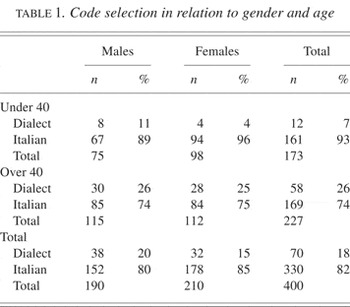
Informants have been chosen randomly, trying to select an almost equal number of women and men and a good representation of two main age groups. On the basis of fieldworkers' subjective evaluations, informants were divided into two groups: younger or older than 40 years old. In today's Italy, the age of 40–45 years old divides the population according to some meaningful societal events, such as (a minimum of) 8-year-compulsory education, massive spread of television, and greater mobility chances. Our hypothesis is that this important generation gap proves to be meaningful in the use of dialect in street encounters with unknown interlocutors.
As regards gender, the ambiguous role of women in language change, both conservative and innovative, has been noted by most researchers in Italian traditional dialectology (and sociolinguistics) at least since Terracini's side comments on women's linguistic behavior (Terracini, 1918/1922:167; Tagliavini, 1938; and more recently Marcato, 1988). However, as the concepts of “standard” and “nonstandard” should not be taken for granted in the social stratification of language (Cheshire, 2002:427), the extension of such categories to a bilingual context (as is the Italian speech community where dialects and Italian coexist) is even more problematic. In the present research we try to correlate gender with code-selection (and not with standard or nonstandard variants of the same code), and it will be interesting to see how this variable interacts with the others in the emergence of different patterns of sociolinguistic behavior.
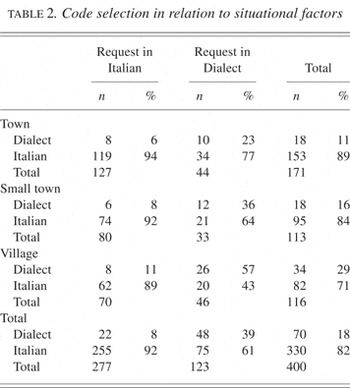
As already mentioned, the area in which the research has been undertaken varies greatly according to the environment, rural versus urban, though generally is not distinguished by the presence of large towns. Places in which recordings have been made can be divided into towns (more than 10,000 inhabitants), small towns (5,000–10,000 inhabitants) and villages (less than 5,000 inhabitants). What discriminates a town (small as it may be) from a village is the presence of administrative and social services, as well as its role as a commercial center.4
For instance, the presence of a large weekly market regularly attracts people from neighboring villages.
Finally, the focus of the research is the analysis of the dependent variable, that is, the language used by respondents in their answers to our requests for street directions. Similarly to the request coding, we decided to classify as “dialect” any recording that contained segments (phrases or morphemes) in dialect. Where no such segments were present, the answer was labeled as “Italian.” As we were interested in evaluating the presence of traditional dialects in neutral and anonymous interactions and the sociolinguistic factors that would favor or disfavor it, we decided to regard the use of dialect in the answers as the application of the rule.
Tables 1 and 2 account for data distribution within the corpus according to factors relative to informants and to factors relative to the geographic and linguistic context.
Code selection in relation to gender and age

Code selection in relation to situational factors

RESULTS
To examine the effect of the different variables on the use of dialect in our corpus of street directions, we have performed a logistic regression analysis using goldvarb 2001 (Robinson, Lawrence, & Tagliamonte, 2001). The application value of the dependent variable “dialect” and the independent variables tested for significance are: (1) the code used in the request (dialect-Italian), (2) respondents' age (under 40, over 40), (3) the size of the place where the request was made (town, small town, village), and (4) respondents' gender.
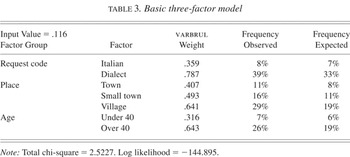
After a preliminary step-up/step-down analysis, we have rejected the variable “Gender” as being nonsignificant (p = .214), and have licensed, in the following order of significance, the variables “Code,” “Age,” and “Place.” Results for this three-factor model are reported in Table 3.
Basic three-factor model

Although we have no other empirical ground with which to compare our data, it is quite interesting to note that the alpha-value of probability is .116. Thus, our working hypothesis, that in the area under study the presence of dialect is strongly disfavored in the domain of interactions with anonymous interlocutors, is partially falsified by the analysis. More than one tenth of the speakers' answers contain some dialect, regardless of other factors.
Looking at the results of regression analysis, we can conclude that a respondent is more likely to give street directions in dialect if: (a) the question is posed in dialect (.787), (b) he/she is over 40 years old (.643), or (c) the interaction takes place in a village (.641). On the side of negative effects, young age has the heaviest influence on the occurrence of dialect (.316), followed by a request in Italian (.359), and the urban context (.407).
According to this hierarchy, a request in dialect seems to be the most important factor in predicting the presence of dialect. However, though the role of this factor is not unexpected, it is possible that further investigation will reveal more complex patterns of variation.
Before collecting and analyzing the corpus, our hypothesis was that a stranger asking for street directions in dialect would be seen as a sociolinguistic paradox by any passer-by. As a matter of fact, the use of dialect outside one's personal social network is generally regarded as a marked speech behavior, especially in Northwestern Italy (whereas it seems much more common in the South and in Northeastern Italy, according to ISTAT, 2003:105). On the contrary, the empirical data suggest that the sociolinguistic equations, “unknown interlocutor” = “use of Italian” and “known interlocutor” = “use of dialect” might be revised, at least in this (still mainly) rural area. Most informants were not particularly surprised or upset about hearing a stranger using dialect and many of them replied in the same code, as can be observed by the strong weight of this factor on the application value.
We have, now, two possible interpretations of such behavior: either dialect is a code that can be used in interactions with strangers, or speaking dialect turns the interlocutor into an insider, because only a person that has grown up in the region can be a dialect speaker. If the first interpretation were true, we have a feature that contrasts sharply with the overall sociolinguistic pattern of this region. The second hypothesis seems more feasible and deserves future attention, thus, the supposed contrast implicit in the proportion “in-group : out-group = dialect : Italian” is resolved in a more context-sensitive norm. Dialect is accepted by the informants as a communicative resource, a social gateway to in-groupness that can be activated in order to construct the speech event as a less anonymous verbal interaction. According to the model presented in Table 3, if you address a stranger in dialect the probabilities of being answered in the same code are very high, one third of the time, other factors being equal.
The second and third factors affecting the presence of dialect have nearly the same weight, .643 = “over 40” and .641 = “village,” confirming a commonplace of traditional (English and American) dialectology according to which the old male villager is the prototypical dialect speaker (cf. Chambers & Trudgill, 1998:29). Against this stereotype, however, we must note that in our data gender appears nonsignificant and that, above all, “old” stands here for adults above 40 years of age (and therefore better defined as non-young). Nonetheless, just for exploratory purposes, we have decided to include the interaction factor “over 40 villager” to our basic model,5
We have added to “Request code” a reduced cross-product “Age × Place,” the factors and values of which are: “Under 40” .313, “Over 40 × Town” .535, “Over 40 × Small Town” .616, “Over 40 × Village” .778. As the log-likelihood value (−144.503) is slightly smaller than that in Table 3, this interaction is not statistically significant.
However, this group is a special case of two intersecting categories, and we must firstly account for age and place as independent variables (see Table 3). If you speak to a non-young adult in a town, small town, or village, the predicted probability to elicit an answer in dialect is nearly .20. This value suggests the existence of two separate age groups, with partly differing norms and attitudes as regards the use of dialect and Italian.
For the elder group, dialect is still a communicative resource even in unexpected social contexts. As street directions are supposed to be mainly formal, transactional, reference-oriented interactions, such an extensive presence of dialect seems to be partially inconsistent with the broad concept of dilalìa. A dilalic repertoire limits the copresence of standard and dialect only to ordinary conversation, all other domains pertain exclusively to the standard language.
Actually, the over-40 speaker seems to relate to a slightly different sociolinguistic norm from the rest of the sample, by displaying an enhanced spectrum of social situations in which the use of dialect is the unmarked behavior. This social group extends the use of dialect from more prototypical everyday speech to less prototypical contexts. On the other hand, the younger age group encodes this interaction as a typical nondialect communication, making street directions (together with other ambiguous domains) a sort of unstable boundary in speakers' sociolinguistic maps. As we can see from the analysis, the fact of being under forty years old is the most disfavoring factor (.316)—more powerful than request code—correlated to the presence of dialect: only 7% of observed applications and 6% of expected applications.
The shift of this sociolinguistic line could be interpreted as free variation, a pure option in speakers' implicit knowledge, but, as age groups are involved, it may also be interpreted as a change in progress, a withdrawal of dialect from contexts that were once socially productive. However, it is still possible that sociolinguistic norms and attitudes are age-based and do not reveal any ongoing change.
The same general pattern of code selection is reflected even for “Place.” The data suggest a separation between villages with less than 5000 inhabitants which favor the presence of dialect, and bigger centers, the effect of which is negative. Although it is difficult to make statements about diachronic changes on the grounds of this explorative snapshot, the distribution of relative weights for this variable shows a process of erosion of traditional dialect speech communities. The role of small towns is particularly interesting because this factor has nearly a null effect. A tentative explanation is that small towns are shifting towards town models as regards communicative patterns, whereas towns are probably shifting towards urban models. Looking at this process from the opposite perspective, we can observe the more and more pervasive influence of urban patterns of code choice, disfavoring the use of dialect and restricting its use to speech situations marked as [+ rural] (on the difference between urban and rural language patterns, see Sobrero, 1992). Underlying the variable “Place,” geographic (and then social) mobility plays a strong role. The speakers of towns and small towns are seemingly city-workers whereas villagers have a more local-oriented lifestyle. Thus, mobile speakers do not share the same set of roles, situations, and norms of people living in smaller centers (see Milroy, 2002).
As a result, speakers in villages and larger agglomerates do not seem to share the same social definition for this kind of verbal interaction. Requests for street direction are perhaps linked to urban models of communication by nature. Following Hannerz's classification of social relations, street directions fall into the broader category of traffic roles and relationships (Hannerz, 1980:102–114). These are a typical product of urban settings, ranging from mere physical copresence in an elevator to minimal verbal routines. Each of these social relations are based on the fact that in urban centers people do not know each other.
Besides, as villages are close-knit social structures, anonymous interactions fall outside everyday communicative experience. For these reasons, social actors in rural contexts do not interpret requests for street directions according to urban life rules, in which the standard language is the default choice. On the contrary, in a village this speech event converges towards those domains in which both dialect and Italian are used alternatively.
GENDER-BASED VARIATION
It is quite common that sociodemographic variables such as gender and age interact, due to their nature of very general social categories. This explains why the first stepwise regression analysis discarded gender from the model as a statistically nonsignificant variable.
However, both dialectology and variationist sociolinguistics have pointed to the male-female distinction as a very powerful one and in particular to the fact that women usually avoid nonstandard forms and, in contexts of language change, favor either the spread of prestige variants or the innovation of new variants (Cheshire & Gardner-Chloros, 1998; Labov, 1990). Since gender-based differences are in fact social and cultural constructs, language use, and in particular code choice, are probably affected only indirectly by gender, and more complex patterns are to be sought instead.
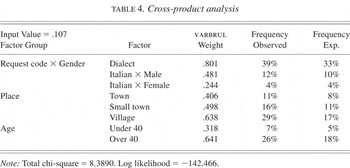
Looking for potential interactions among independent variables, we have found that gender constraints vary in a statistically significant way only in interaction with “Request code.” A new interaction variable “Request code × Gender” is thus added to the model, as shown in Table 4.
Cross-product analysis

The log-likelihood of this second model (−142.466) is significantly smaller than that of the basic model (−144.895) displayed in Table 3 (G2 = 4.858, df = 1, p ≤ .03). In addition, the optimal categorization is achieved by dropping the unnecessary male–female distinction within “Dialect,” thereby resulting in a clearer distinction between dialect (.801), on one side, and Italian on the other.
As can be observed in Table 4, men and women do not behave in the same way if the request for street directions is in the standard language. The first group's relative weight is .481. Being asked in Italian is not so much a disfavoring factor if you are a male speaker, rather it has a nearly null effect. On the contrary, a request in Italian has a strong negative effect (.244) on the use of dialect by female speakers. Rather than orienting themselves towards the standard norm in any situational background, women seem to be more sensitive to contextual factors and mainly to the code used by the interlocutor. Women do not seem to regard code selection as a question of social identity, or as a domain-based choice. Rather, the standard-dialect opposition is something amenable to accommodation, a stylistic variation that is mainly audience-sensitive (cf. Bell, 1984; Giles, Coupland, & Coupland, 1991).6
The interactions between sex of the fieldworker and each of the independent variables are statistically nonsignificant. The lack of significance of the interacting factor “sex of the fieldworker” × “sex of the informant” allows us to exclude for our data set a power issue.
Men and women appear to rely on different rules in choosing which code is better suited to this particular kind of verbal interaction. While women's focus is on the recipient's language, men aim at expressing a social identity, paying less attention to contextual factors. In other terms, men might regard dialect as a social identity marker, while women seem to consider it as a contextual resource to show proximity towards the interlocutor.
Concerning the other two variables, their values are very similar to those that emerged in the first analysis (Table 3). However, a statistically significant interaction between place and request in dialect has been detected. Unfortunately, a model accounting for the complex interaction between “Request code × Gender” on one side, and “Request code × Place” on the other, fails to pass a significance test and has only an exploratory meaning.7
The log-likelihood of this model (−142.810) is slightly bigger than that of the model in Table 4 (−142.466).
“Request code × Place” = −153.533, “Request code × Gender” = −156.177, “Age” = −172.600.
Within the “Request code × Place” variable the factors “Italian × Place types” are collapsed into one single factor “Italian” because this subcategorization is not relevant. Thus, the relative weights are: “Italian” .354, “Dialect × Town” .651, “Dialect × Small Town” .784, “Dialect × Village” .892. These results suggest that a request in dialect has an increasing positive effect if we move from towns to villages, but a request in Italian always has a negative effect wherever we perform it. This leads to the observation that the standard language and the dialect are perceived in different ways in different settlement types. Italian is not correlated to the size of the agglomerate, resulting in a more uniform and shared set of attitudes, norms, and rules. On the other hand, dialect appears more sensitive to this macro sociogeographical feature, revealing the existence of subsets within the dialect-speaking community.
CONCLUSIONS
The aim of this research was to verify empirically the range of variation of code selection from the perspective of one domain of language use within a “dilalic” repertoire in which Italian and dialects overlap in spoken and informal domains. In particular we wanted to investigate the social and contextual dimensions that influence the presence of dialect in potentially ambiguous contexts. Giving street directions to a stranger may concern both the informal and the formal spheres of interaction.
The analysis of 400 anonymous recordings has shown that dialect can actually be used in this kind of interaction, even in a part of Italy where dialect use has been severely reduced. As discussed earlier in detail, the presence of dialect in these short dialogues follows regular patterns that have allowed us to detect different speech communities, namely groups of speakers sharing different sociolinguistic norms and attitudes.
A crucial role in the analysis is played by the code used by the interviewer in his or her request. In a large number of recordings the use of dialect in the request contextualizes an anonymous, semiformal interaction as an in-group chat, allowing the use of dialect in reply. In the following example (6) you can observe a situation that we would have judged totally unusual and sociolinguistically marked at the beginning of this research: after a short hesitation an elderly woman replies in dialect to two unknown (female) students who have approached her in dialect.

However, this interpretation of the interaction as local or nonlocal on the basis of the interlocutor's language choice is not shared by all informants in the corpus. Notably, this seems to be the typical reaction in villages and with respondents older than 40. In larger centers, a modern and more urban lifestyle is more and more imposing, and a request for street direction is interpreted as a nonfamiliar, neutral interaction that requires the default code, Italian.
A similar behavior can be expected from young interlocutors, especially young women, who tend to adopt urban models and attitudes in all sorts of contexts, rural villages included. The following example (7) contrasts sharply with (6). The same pair of female students address in dialect a young shop assistant and obtain a very formal, standard-oriented reply.

Finally, gender-based variation on code selection has revealed an interesting patterning that was not apparent on a first analysis of the data. Two opposite trends emerge in the use of dialect. Other factors being equal, men display a dialect-oriented behavior irrespectively of their interlocutor's language choice. On the contrary, women tend to accommodate more to their interlocutors and use dialect in reply to a request in dialect, whereas a reply in dialect to a request in Italian appears to be a highly unlikely occurrence. In our view, this preference for accommodation in women's code selection is in agreement with the general assumptions of variationist sociolinguistics that women are both norm-oriented and innovative in language change. They import urban communicative norms of code selection (that are typically contextual-sensitive) into rural settings.
In a transforming society—where social and geographical mobility has been increasing for the last fifty years—the accommodation to new forms of speech and sociolinguistic behaviors has probably been more gender-based than it is usually believed, even if the females are not necessarily mobile themselves.
References
REFERENCES
Auer, Peter.
(1998).
Introduction: “Bilingual conversation”
revisited. In
P. Auer (ed.),
Codeswitching in conversation.
London:
Routledge.
1–24.
Bell, Allan.
(1984).
Language style as audience design.
Language in Society
13:145–204.Google Scholar
Berruto, Gaetano.
(1989).
Main topics and findings in Italian sociolinguistics.
International Journal of the Sociology of Language
76:7–30.Google Scholar
Berruto, Gaetano.
(2005).
Hochsprache und Dialekt als kritischer Fall für die
Kontaktlinguistik.
In
E. Eggers,
J. E. Schmidt, &
D. Stellmacher (eds.),
Moderne Dialekte-Neue Dialektologie. Akten des 1. Kongresses der
Internationalen Gesellschaft für Dialektologie des Deutschen
(IGDD).
Stuttgart:
Steiner.
27–52.
Chambers, J. K., &
Trudgill, Peter.
(1998).
Dialectology.
Cambridge:
Cambridge University Press.
Cheshire, Jenny.
(2002).
Sex and gender in variationist research. In
J. K. Chambers,
P. Trudgill, &
N. Schilling-Estes (eds.),
The handbook of language variation and change.
Oxford:
Blackwell.
423–443.
Cheshire, Jenny, &
Gardner-Chloros, Penelope.
(1998).
Code-switching and the sociolinguistic gender pattern.
International Journal of the Sociology of Language
129:5–34.Google Scholar
De Mauro, Tullio.
(1991).
Storia linguistica dell'Italia unita.
Bari:
Laterza.
Gardner-Chloros, Penelope.
(1985).
Language selection and switching among Strasbourg shoppers.
International Journal of the Sociology of Language
54:117–135.Google Scholar
Giles, Howard,
Coupland, Nikolas, &
Coupland, Justine.
(1991).
Accommodation theory: Communication, context and
consequences. In
H. Giles,
N. Coupland, &
J. Coupland (eds.),
Contexts of accommodation: Developments in applied
linguistics.
Cambridge:
Cambridge University Press.
1–68.
Hannerz, Ulf.
(1980).
Exploring the city: Inquiries toward an urban anthropology.
New York:
Columbia University Press.
ISTAT (Istituto Nazionale di Statistica).
(2003).
Letture e linguaggio. Indagine Multiscopo sulle famiglie “I
cittadini e il tempo libero”—Anno 2000. 〈http://www.istat.it/dati/catalogo/20021218_00/〉.
Kloss, Heinz.
(1987).
Abstandsprache und Ausbausprache. In
U. Ammon,
N. Dittmar, &
W. Mattheier (eds.),
Sociolinguistics / Soziolinguistik. Vol. I.
Berlin:
De Gruyter.
302–308.
Labov, William.
(1972).
The social stratification of (r) in New York City Department
Stores. In
W. Labov,
Sociolinguistic patterns.
Philadelphia:
University of Pennsylvania Press.
43–69.
Labov, William.
(1990).
The intersection of sex and social class in the course of linguistic
change.
Language Variation and Change
2:205–254.Google Scholar
Maiden, Martin, &
Parry, Mair (eds.).
(1997).
The dialects of Italy.
London:
Routledge.
Marcato, Gianna.
(1988).
Italienisch: Sprache und Geschlechter. Lingua e sesso. In
G. Holtus,
M. Metzelin, &
C. Schmitt (eds.),
Lexikon der romanistischen Linguistik.
Tübingen:
Niemeyer.
237–246
Milroy, Lesley.
(2002).
Mobility, contact and language change: Working with contemporary
speech communities.
Journal of Sociolinguistics
6:3–15.Google Scholar
Parry, Mair.
(1997).
Piedmont. In
M. Maiden &
M. Parry (eds.),
The dialects of Italy.
London:
Routledge.
237–244.
Robinson, John,
Lawrence, Helen, &
Tagliamonte, Sali.
(2001).
GOLDVARB 2001. A Multivariate Analysis Application for
Windows, 〈http://www.york.ac.uk/depts/lang/webstuff/goldvarb/manual/manualOct2001.html〉.
Sobrero, Alberto A.
(1992).
Il dialetto nella conversazione: Ricerche di dialettologia
pragmatica.
Galatina:
Congedo.
Tagliavini, Carlo.
(1938).
Modificazioni del linguaggio nella parlata delle donne. In
Scritti in onore di Alfredo Trombetti.
Milano:
Hoepli.
87–142.
Terracini, Benvenuto.
(1918/1922).
Il parlare di Usseglio.
Archivio Glottologico Italiano
18:105–186.Google Scholar
Code selection in relation to gender and age
Code selection in relation to situational factors
Basic three-factor model
Cross-product analysis
 You have
Access