Introduction
In Africa, tomato Solanum lycopersicum L. (Solanales: Solanaceae) is ranked high both as a food and as a cash crop; however, numerous biotic factors constrain tomato production, of which arthropod pests (including the red spider mite, African bollworm, leafminers and thrips) are considered among the most important pests (Varela et al., Reference Varela, Seif and Löhr2003). Invasion by the tomato leafminer Tuta absoluta (Meyrick) (Lepidoptera: Gelechiidae) has further compounded the problem. This pest is native to South America and in its transatlantic invasion, was first detected in Spain in 2006 (Desneux et al., Reference Desneux, Wajnberg, Wyckhuys, Burgio, Arpaia, Narváez-Vasquez, Gonzalez-Cabrera, Catalán Ruescas, Tabone, Frandon, Pizzol, Poncet, Cabello and Urbaneja2010). Thereafter, it was detected in several European, Asian and North African countries (Desneux et al., Reference Desneux, Wajnberg, Wyckhuys, Burgio, Arpaia, Narváez-Vasquez, Gonzalez-Cabrera, Catalán Ruescas, Tabone, Frandon, Pizzol, Poncet, Cabello and Urbaneja2010; Reference Desneux, Luna, Guillemaud and Urbaneja2011). In 2013, it was detected in Kenya (S. Mohamed, personal observation). Tuta absoluta is a devastating pest of tomato causing 100% yield losses if left uncontrolled (Desneux et al., Reference Desneux, Wajnberg, Wyckhuys, Burgio, Arpaia, Narváez-Vasquez, Gonzalez-Cabrera, Catalán Ruescas, Tabone, Frandon, Pizzol, Poncet, Cabello and Urbaneja2010; Retta and Berhe, Reference Retta and Berhe2015). Furthermore, the pest has been reported to infest other cultivated and wild Solanaceae, such as pepper Capsicum annuum L., eggplant Solanum melongena L., tobacco Nicotiana tabacum L., potato Solanum tuberosum L. and black nightshade Solanum nigrum (Ferracini et al., Reference Ferracini, Ingegno, Navone, Ferrari, Mosti, Tavella and Alma2012).
This pest was unknown in Uganda until 14 April 2015, when samples of tomato leaves and fruit from a greenhouse at Nabiyagi village, Bulijjo Parish, Kyampisi subcounty, Mukono District were brought to the Mukono Zonal Agricultural Research and Development Institute (MUZARDI) of the National Agricultural Research Organisation (NARO) for advice. The affected farmer recalled that he had noticed this strange pest around early February 2015, and as the symptoms progressed, he responded by intensifying the application of chemical insecticides, but with little benefit. This paper presents the diagnosis performed by the scientists at MUZARDI in collaboration with experts at the International Centre of Insect Physiology and Ecology (icipe), Kenya that identified the pest as T. absoluta.
Materials and methods
Morphological analysis of the samples
Samples were inspected and the leaves were found to have irregular extensive mines with dark frass in them. The fruit had been bored to the point of stalk attachment. Inside the bored fruit were tiny cream-coloured caterpillars with black heads. At the time of reporting, tomatoes growing in a screen house (0.125 acres [0.0506 ha]) had been destroyed, and the second screen house had also been invaded. Based on the samples and other information that the farmer shared, T. absoluta was the chief suspect.
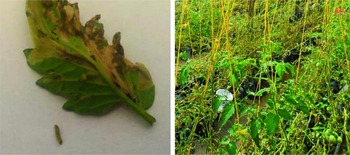
Venansio Tumuhaise and Godfrey Sseruwu, NARO scientists at MUZARDI, visited the affected farm. Tiny larvae ranging in colour from green and cream with black heads were seen feeding indiscriminately on all plant parts (leaves, fruit and tender stems). The young larvae produced thread-like material that facilitated their movement between tomato plants or plant parts. The older larvae were seen mining and feeding inside the leaf tissue under the epidermis, creating small to large irregular galleries, which from a distance, made the affected leaves appear burnt. Dark frass that the caterpillars excreted was seen on the damaged leaves (Fig. 1). Both young and ripened fruit were bored, leaving symptomatic tiny holes (Fig. 2). When the bored fruit was dissected, larvae were found inside the fruit. Several tiny moths were also seen resting on screen house linings. The team preliminarily identified the pest as T. absoluta based on the observed damage symptoms, morphological characteristics of the adult moth and larval specimens as previously described by other researchers (e.g. Miranda et al., Reference Miranda, Picanço, Zanuncio and Guedes1998; Desneux et al., Reference Desneux, Wajnberg, Wyckhuys, Burgio, Arpaia, Narváez-Vasquez, Gonzalez-Cabrera, Catalán Ruescas, Tabone, Frandon, Pizzol, Poncet, Cabello and Urbaneja2010; Retta and Berh, Reference Retta and Berhe2015).
A. Tuta absoluta larva crawls away from leaf. B. Tomato crop damaged by Tuta absoluta.

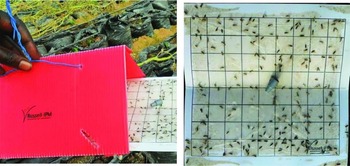
A. Tuta absoluta pheromone trap. B. Tuta absoluta adults captured by the trap.

Trapping of male moths and collection of samples for identification
Delta traps baited with (TUA-Optima® Russell IPM Ltd, UK), obtained from icipe were set up (Figs 2A and 2B). These traps have been reported to be effective in monitoring and mass trapping of T. absoluta males (Witzgall et al., Reference Witzgall, Kirsch and Cork2010), as well as in disrupting mating in greenhouse tomato crops (Cocco et al., Reference Cocco, Deliperi and Delrio2013). Moreover, as soon as the pheromone sachets were opened, several moths responded by aggregating around the pheromone traps. The trapped adult moths were taken to the laboratory for identification. Plant parts, namely fruit, leaves and tender stems were also collected and placed in mesh covered containers, and taken to the laboratory. The plant parts were incubated till larval emergence. Emerging larvae were collected and kept in 95% alcohol and sent to icipe for further morphological and molecular analysis.
Molecular characterization
Five samples were randomly selected, identified and photographed using the Leica LAS EZ4D stereomicroscope at x25 magnification. Photography targeted the dorsal, lateral and ventral parts of the 3rd instar larvae. Thereafter, genomic DNA extraction was done, and voucher specimens deposited at the icipe, Duduville campus, Nairobi, Kenya.
DNA extraction
Each individual photographed sample was surface sterilized using 3% bleach, and rinsed three times with distilled water. Thereafter, genomic DNA was extracted using the Isolate II Genomic DNA Kit (Bioline, UK), following the manufacturer's instructions. The extracted DNA was eluted at a final volume of 40µL and stored at −20°C for further downstream processes. The purity and concentration of the extracted DNA was determined using the Nanodrop 2000/2000c Spectrophotometer (Thermo Scientific, USA).
Amplification of the mitochondrial COI region
Polymerase chain reaction (PCR) was done to amplify the barcode region using universal barcode primers LCO 1490 5′-GGTCAACAAATCATAA- AGATATTGG-3′ and HCO 2198 5′-TAAACTT- CAGGGTGACCAAAAAATCA-3′ (Folmer et al., Reference Folmer, Black, Hoeh, Lutz and Vrijenhoek1994). The PCR was carried out in a total reaction volume of 20 µl containing 5x MyTaq™ Reaction Buffer (5 mm dNTPs, 15 mm MgCl2, stabilizers and enhancers), 10 µmole of each primer, 0.3125 mm MgCl2, 0.25 µl MyTaq™ DNA polymerase and 15ng/µl of DNA template. The reactions were set up in the Arktik thermal cycler. The LCO/HCO cycling conditions were: initial denaturation for 2 min at 95 °C, followed by 35 cycles of 30 sec at 95 °C, 40s at annealing temperature of 50.6 °C and 1 min at 72 °C, then a final elongation step of 10 min at 72 °C. The target gene region was 650−700 base pairs.
Analysis of PCR products and sequencing of the target gene
The amplified PCR products were resolved through a 1% agarose gel with electrophoresis set at 100 volts for 1 hr, followed by visualization of the DNA under ultraviolet (UV) illumination. DNA bands on the gel were analysed and documented using KETA GL imaging system transilluminator (Wealtec Corp., USA). Amplified products were gel excised and purified using Isolate II PCR and Gel Kit (Bioline, UK) following the manufacturer's instructions. The purified products were then sent to Macrogen Europe (The Netherlands) laboratory, for bidirectional sequencing. The successful sequences were assembled and edited using Geneious Version 8. The primer sequences were identified and removed from the consensus sequences generated from both the forward and reverse reads. Homology searches were conducted by querying the consensus sequences via Basic Local Alignment Search Tool (BLAST) at the GenBank database hosted by National Centre of Biotechnology Information (NCBI). BLAST algorithm finds regions of local similarity between sequences, in which consensus sequences are compared to reference sequences in the GenBank database. The sequences have been uploaded to NCBI to be made available in the public domain.
Results and Discussion
Scientists at NARO identified the pest as T. absoluta, which icipe confirmed using morphological and molecular tools. The molecular identification through DNA barcoding and blasting linked the Ugandan samples to T. absoluta samples from India (Accession number KP793741.1), and confirmed that the moths collected are T. absoluta, which implies that this invasive pest found its way into Uganda, thus expanding its geographical distribution.
In Africa, the pest was reported in Tunisia in 2009 (Kılıç, Reference Kılıç2010), Senegal (Pfeiffer et al., Reference Pfeiffer, Muniappan, Sall, Diatta, Diongue and Dieng2013) and Ethiopia in 2012 (Tefera et al., Reference Tefera and Tefera2013; Retta and Berhe, Reference Retta and Berhe2015). Other African countries that T. absoluta has invaded include Algeria, Egypt, Libya, Morocco, Sudan, Senegal and the Canary Islands. Indeed, Tonnang et al. (Reference Tonnang, Mohamed, Khamis and Ekesi2015) using CLIMEX predicted several parts of Europe, Asia, Africa and the USA as suitable for T. absoluta establishment. Kenya is the most recent country in the region where the pest has invaded (IPPC, 2014), and there have been preliminary reports of T. absoluta invasion in Tanzania. Therefore, with this report, Uganda becomes the latest invasion record in the region. This rapid invasion could be a result of a combination of factors such as adult moths flying from infested fields to new fields, infested fruit, leaves and stems being moved from one place to another, and through carrying packaging materials with eggs and pupae of the pest from one place to another (Desneux et al., Reference Desneux, Wajnberg, Wyckhuys, Burgio, Arpaia, Narváez-Vasquez, Gonzalez-Cabrera, Catalán Ruescas, Tabone, Frandon, Pizzol, Poncet, Cabello and Urbaneja2010; Karadjova et al., Reference Karadjova, Ilieva, Krumov, Petrova and Ventsislavov2013; Retta and Berhe, Reference Retta and Berhe2015).
Although tomato is the primary host of T. absoluta, the pest seems to be expanding its host range in addition to its geographical range. This puts several solanaceous indigenous vegetables such as nightshade at risk of invasion, thus threatening the livelihoods of millions of people relying on these indigenous vegetables for both trade and domestic consumption.
Tuta absoluta is a multivoltine pest with up to 12 generations per year, and a single female can lay 250–300 eggs in her lifetime (Desneux et al., Reference Desneux, Wajnberg, Wyckhuys, Burgio, Arpaia, Narváez-Vasquez, Gonzalez-Cabrera, Catalán Ruescas, Tabone, Frandon, Pizzol, Poncet, Cabello and Urbaneja2010; Harizanova et al., Reference Harizanova, Stoeva and Mohamedova2009). These traits contribute to the invasive nature of this pest. In addition to the severe damage that the pest causes through infestation of the various plant parts (leaves, stems, twigs and fruit), the infestation also facilitates secondary infections by pathogens leading to fruit rot (Desneux et al., Reference Desneux, Wajnberg, Wyckhuys, Burgio, Arpaia, Narváez-Vasquez, Gonzalez-Cabrera, Catalán Ruescas, Tabone, Frandon, Pizzol, Poncet, Cabello and Urbaneja2010). Furthermore, the pest is considered a quarantine pest in the USA and other parts of the world where the pest has not yet invaded, and is therefore jeopardizing exports of tomato from its invaded countries.
Tuta absoluta is a difficult pest to control, as the larvae feed while concealed within the leaf tissue. Whenever detected, farmers respond by increasing the frequency of pesticide application with no significant impact on the pest population. This translates into increased production costs in addition to the negative consequences associated with the misuse of pesticides, including the destruction of natural enemy populations, accumulation of insecticide residues on tomato fruits and in the environment, and the development of insecticide resistance (Retta and Berhe, Reference Retta and Berhe2015). In this regard, icipe within the framework of the BMZ-Tuta IPM-funded project is developing an ecofriendly IPM approach based on a biopesticide application that attracts and kills the pests in addition to the release of the coevolved, efficient, natural enemy from the original home of the pest in Peru. Farmers are also encouraged to practice crop rotation and farm sanitation.
Conclusion
No doubt, T. absoluta is expanding its geographic range in sub-Saharan Africa. This pest is a threat to tomato production, one of the key crops for nutritional security and poverty alleviation in Africa (and in Uganda in particular). Therefore, there is a critical need to develop a customized, multifaceted strategy for managing this exotic pest so as to save the tomato industry in Uganda. A countrywide survey should be conducted to establish the extent of the invasion. Additionally, all Ugandans, especially farmers should be sensitized about this pest through organized farmers’ field schools.
Acknowledgement
The authors thank the German Federal Ministry for Economic Cooperation and Development (BMZ), for financial support through the icipe Tuta absoluta IPM project.