1. INTRODUCTION
Interaction of intense laser with plasmas is a major area of experimental and theoretical study due to its relevance to optical harmonic generation (Sprangle & Esarey, Reference Sprangle and Esarey1991; Milchberg et al., Reference Milchberg, Durfee, Iii and Mcllrath1995; Zhou et al., Reference Zhou, Peatross, Murnane, Kapteyn and Christov1996), X-ray generation (Eder et al., Reference Eder, Amendt, Dasilva, London, Macgowan, Matthaws, Penetrante, Rosen, Wilks, Donnelly, Falcone and Strobel1994), inertial confinement fusion (Tabak et al., Reference Tabak, Hammer, Glinisky, Kruer, Wilks, Woodworth, Campbell, Perry and Mason1994; Deutsch et al., Reference Deutsch, Furukaw, Mima, Murakami and Nishihara1996; Hora, Reference Hora2004), and laser driven accelerators and particle beams (Sprangle et al., Reference Sprangle, Esarey, Ting and Joyee1998; Umstadter et al., Reference Umstadter, Chen, Maksimchuk, Mourou and Wagner1996; Mora & Antonsen, Reference Mora and Antonsen1996; Andreev et al., Reference Andreev, Gorbunov, Kirsanov, Nakajima and Ogata1997, Reference Andreev, Gorbunov and Frolov1998; Amiranoff et al., Reference Amiranoff, Baton, Bernard, Cros, Descamps, Derchies, Jaquet, Malka, Marques, Matthieussent, Mine, Modena, Mora, Manillo and Nazmudin1998; Sari et al., Reference Sari, Osman, Doolan, Ghoranneviss, Hora, Hopfl, Benstetter and Hantehzadehi2005; Neff et al., Reference Neff, Knobloch, Hoffmann, Tauschwitz and Yu2006; Zhou et al., Reference Zhou, Yu and He2007; Chen et al., Reference Chen, Unick, Vafaei-Najafabadi, Tsui, Fedosejevs, Naseri, Masson-Laborde and Rozmus2008; Niu et al., Reference Niu, He, Qiao and Zhou2008). So far the main thrust of the theoretical and experimental investigations on self-focusing of a laser beam has been directed toward the study of the propagation characteristics of a Gaussian beam (Akhmanov et al., Reference Akhmanov, Sukhorukov and Khokhlov1968; Hora, Reference Grow, Ishaaya, Vuong, Gaeta, Gavish and Hora1969; Sodha et al., Reference Sodha, Ghatak and Tripathi1974, Reference Sodha, Ghatak and Tripathi1976; Esarey et al., Reference Esarey, Sprangle, Krall and Ting1997; Umstadter, Reference Umstadter2001; Sharma et al., Reference Sharma, Prakash, Verma and Sodha2003, Reference Sharma, Verma and Sodha2004). Nevertheless, a few papers have been published on the self-focusing of cylindrical off modes of beams (Jones et al., Reference Jones, Mead, Coggeshall, Aldrich, Norton, Pollak and Wallace1988), super Gaussian beams (Nayyar, Reference Nayyar1986; Grow et al., 2006; Fibich, Reference Fibich2006), degenerate modes of beams (Karlsson, Reference Karlsson1992), elliptic Gaussian beams (Anderson et al., Reference Anderson, Bonnedal and Lisak1980; Cornolti et al., Reference Cornolti, Lucchesi and Zambon1990; Gill et al., Reference Gill, Saini and Kaul2000, Reference Gill, Saini, Kaul and Singh2004; Saini & Gill Reference Saini and Gill2006), Bessel beams (Johannisson et al., Reference Johannisson, Anderson, Lisak and Marklund2003), cosh-Gaussian beams (Patil et al., Reference Patil, Takale, Navare and Dongare2009), and Hermite-Gaussian beams (Takale et al., Reference Takale, Navare, Patil, Fulari and Dongare2009).
Apart from these, great interest has recently been evinced in paraxial beams family, usually known as Hermite-cosh-Gaussian (HChG) beams (Belafhal & Ibnchaikh, Reference Belafhal and Ibnchaikh2000). In relatively recent studies, the propagation of various HChGs in complex optical systems and turbulent atmosphere, has been investigated in detail (Ibnchaikh et al., Reference Ibnchaikh, Dalil-Essakali, Hricha and Belafhal2001; Wang & Lu, Reference Wang and Lu2001; Ji & Lu, Reference Ji and Lu2002; Lu & Qing, Reference Lu and Qing2001; Luo & Lu, Reference Luo and Lu2002; Yu et al., Reference Yu, Guo, Fu and Hu2002; Gu et al., Reference Gu, Zhao, Mei and Mao2004, Reference Gu, Zhao, Mao and Mei2005; Mei et al., Reference Mei, Zhao, Sun and Gu2004, Reference Mei, Zhao, Gu and Mao2005; Qui et al., Reference Qui, Guo, Chen and Kong2004; Zhao et al., Reference Zhao, Mao, Liu, Wang, Jing and Wei2004, Reference Zhao, Mao, Zheng, Wang, Jing, Wei, Zhu and Liu2005; Zeng et al., Reference Zeng, Peng and Zhu2005, Reference Zeng, Peng and Fan2006; Du & Zhao, Reference Du and Zhao2006, Reference Du and Zhao2007; Tang et al., Reference Tang, Chen, Yu and Hu2006; Bai et al., Reference Bai, Zhao, Pan, Zhang and Chang2009, Reference Bai, Pan, Ma, Zhao and Lu2010; Yang et al., Reference Yang, Zhang, Ji and Lu2009). Recently, we have investigated its propagation in semiconductors (Patil et al., Reference Patil, Takale and Dongare2008a, Reference Patil, Takale, Fulari and Dongare2008b). A review of the literature highlights the fact that the propagation characteristics of HChGs in plasma have not been studied to a significant extent; as an exception, the beam propagation in isotropic plasma has been studied (Patil et al., Reference Patil, Takale, Navare, Fulari and Dongare2007).
Recently, focusing of dark hollow Gaussian electromagnetic beams in plasma has been reported (Sodha et al., Reference Sodha, Mishra and Misra2009a, Reference Sodha, Mishra and Misra2009b; Misra & Mishra, Reference Misra and Mishra2009a). Also, ring formation in electromagnetic beams in a magneto-plasma has been given by Misra and Mishra Reference Misra and Mishra(2009b). Focusing of a ring ripple on Gaussian electromagnetic beams in a magneto-plasma has been exploited (Misra & Mishra, Reference Misra and Mishra2009c). Sodha et al. Reference Sodha, Mishra and Misra(2009c) studied the growth of a ring ripple on a Gaussian electromagnetic beam in plasma with relativistic-ponderomotive nonlinearity. Thanks to such recent development in the paraxial approach. But for the sake of simplicity, we have exploited the self-focusing of cylindrical HChGs in collisionless magneto-plasma under paraxial approach given by Akhmanov et al. (Reference Akhmanov, Sukhorukov and Khokhlov1968) and developed by Sodha et al. Reference Sodha, Ghatak and Tripathi(1974, Reference Sodha, Ghatak and Tripathi1976). To illustrate the nature of focusing/defocusing, the dependence of focusing parameter on the distance of propagation has been given.
2. BASIC FORMULATION
We consider the propagation of HChG laser beams through a magneto-plasma along the z direction, which is also the direction of the static magnetic field. The wave equation is considered to comprise two field configurations, the extraordinary mode and the ordinary mode represented as

where E is the electric vector of the wave, which satisfies the wave equation,

In component form, Eq. (1) becomes


and

We assume the variation of field in the z-direction to be more rapid than in the x-y plane so that the wave field can be considered as transverse in the zero order approximation and hence no space-charge is generated. Then, ∇·E = 0 that gives

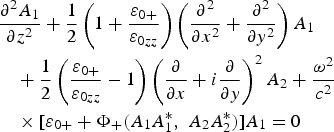
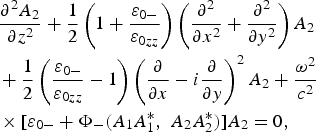
On multiplying Eq. (3) with ±i and adding Eq. (2a) we obtain
and
where

Here
and
with


and
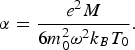
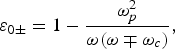
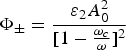
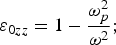
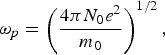
Here ɛ0 and Φ are the linear and nonlinear parts of dielectric constant, respectively, ωp and ωc are the plasma frequency and electron cyclotron frequency, respectively; e, m o, and N o being the magnitude of the electronic charge, rest mass, and electron density, M is the mass of scatterer in the plasma, ω is the frequency of laser used, k B is the Boltzmann's constant, and T 0 is the equilibrium plasma temperature.
Although Eqs. (4) and (5) are coupled with each other, the coupling is not strong. To a good approximation we can assume that one of the two modes is zero and so the behavior of the other mode can be studied. On assuming A 2 ≈ 0, Eq. (4) for A 1 gives
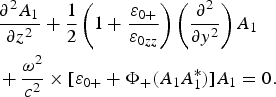
In Wentzel-Kramers-Brillouin approximation, the plane wave solution of Eq. (7) can be written as

where k + = (ω/c)ɛ0+1/2 and A is the complex amplitude.
We substitute Eq. (8) in Eq. (7) and neglect ∂2A/∂z2 to get
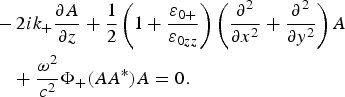
Taking A = A 0(r, z) exp(−ik +S(r, z)), one can express the solution for A 02 and S as
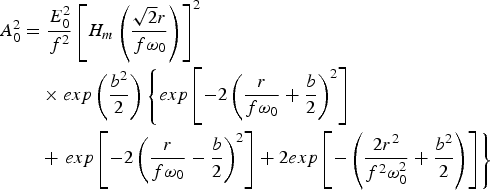
and
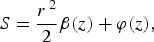
where β(z) = (1/f)(df/dz) and φ(z) are an arbitrary function of z.
Following approach given by Akhmanov et al. (Reference Akhmanov, Sukhorukov and Khokhlov1968) and its extension by Sodha et al. Reference Sodha, Ghatak and Tripathi(1974, Reference Sodha, Ghatak and Tripathi1976), the differential equations for the beam-width parameter of HChG beams in a collisionless magneto-plasma are formulated as below:
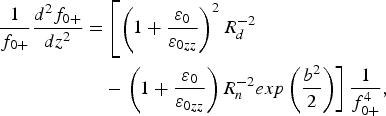
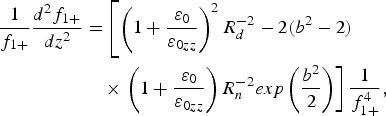
and
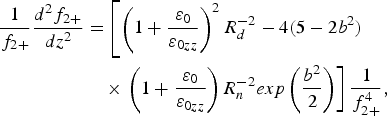
where R d = kω02 is the diffraction length, R n = ω0|1 − (ωc/ω)|(ɛ0/ɛ2)1/2 is the self-focusing length and subscripts 0, 1, and 2 on f represent mode index m with + representing extraordinary mode.
The first terms on the right-hand side of Eqs. (12)–(14) represents spatial dispersion and are responsible for diffraction divergence. On the other hand, second terms, respectively, are nonlinear in nature leading to self-focusing of the beam. Obviously, the self-focusing/defocusing of the beam is possible, when second terms on right-hand side of each expression are negative/positive according to the desirability of decentered parameter values. Usually, diffraction of laser beam is more dominant than it's self-focusing due to the absorption and scattering losses in the nonlinear medium. For the desirability of appreciable self-focusing of the beam, corresponding analytical solutions of Eqs. (12)–(14) obtained under the condition R n < R d are as below:
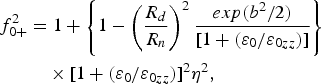
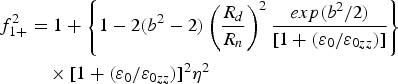
and
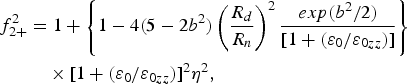
where η = z/R d is the dimensionless distance of propagation. Similar equations can be obtained for the ordinary mode by replacing ωc with −ωc and changing the subscripts from + to − on f in respective expressions.
3. RESULTS AND DISCUSSION
In this section, we will illustrate the self-focusing and defocusing of HChG beams in collisionless magneto-plasma for the first three mode indices. The behavior of beam-width parameters f + and f − for both the modes of collisionless magneto-plasma with the dimensionless distance of propagation η for various decentered parameters (b-values) is examined by numerical estimates. The following typical parameters are chosen for the purpose of numerical calculation:

The results are plotted in the form of graphs.
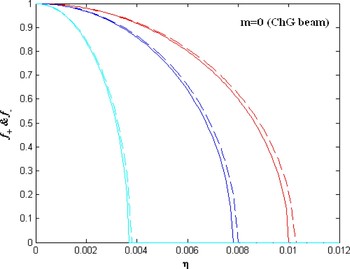
Figure 1 displays the variation of beam-width parameters f + and f − with the dimensionless distance of propagation η for m = 0 with various decentered parameters b = 0, 1, 2. This leads to the self-focusing effect for all b-values and sharp focusing occurs at b ≥ 3, which is not shown in the figure for the sake of clarity. From this figure it is observed that higher the decentered parameter is, the sharper the self-focusing effect is. This shows that the additional self-focusing is observed for higher decentered parameters but ordinary mode of collisionless magneto-plasma is less susceptible for self-focusing than extraordinary mode.
(Color online) Beam width parameters (f + and f −) versus the dimensionless propagation distance (η) of ChG beam (m = 0) in a collisionless magnetoplasma for extraordinary (solid curves) and ordinary (dashed curves) modes. The red, blue and cyan curves are for the decentred parameter values of 0, 1, and 2, respectively.

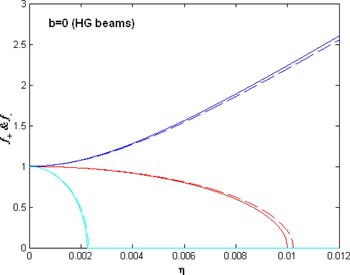
Figure 2 plots the beam-width parameters (f + and f −) with the dimensionless propagation distance η of HG beams (i.e., for b = 0) in collisionless magneto-plasma. It depicts that for extraordinary as well as ordinary modes of magneto-plasma, Hermite Gaussian beams defocuses for m = 1 mode. However, they exhibit self-focusing effect for m = 0 and 2. In this case also, ordinary mode is less prone for self-focusing.
(Color online) Beam width parameters (f + and f −) versus the dimensionless propagation distance (η) of HG beams (b = 0) in a collisionless magnetoplasma for extraordinary (solid curves) and ordinary (dashed curves) modes. The red, blue and cyan curves are for the mode index values of 0, 1, and 2, respectively.

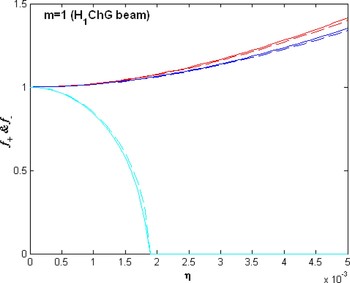
In Figure 3, we have plotted beam width parameters (f + and f −) as a function of dimensionless distance of propagation of H1ChG beam (i.e., for m = 1) in a collisionless magneto-plasma. We see that H1ChG beam gives defocusing for b = 0 and 1, while for b = 2, we obtain self-focusing for both extraordinary and ordinary modes.
(Color online) Beam width parameters (f + and f −) versus the dimensionless propagation distance (η) of H1ChG beam (m = 1) in a collisionless magnetoplasma for extraordinary (solid curves) and ordinary (dashed curves) modes. The red, blue and cyan curves are for the decentred parameter values of 0, 1, and 2, respectively.

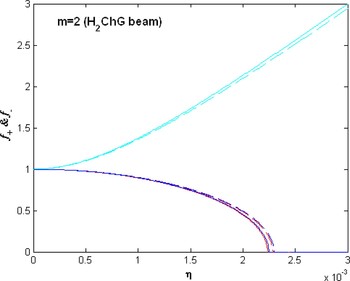
The variation of beam width parameters (f + and f −) with the dimensionless propagation distance η of H2ChG beam (i.e., for m = 2) is displayed in Figure 4. One sees that for both modes of collisionless magneto-plasma, the beam focuses for b = 0 and 1, while it defocuses for b = 2. Note that in all figures, solid curves defines extraordinary mode and dashed curves are for ordinary mode. If we compare all figures, it is found that the self-focusing/defocusing of HChG beams is dependent on the mode index m and decentered parameter b.
(Color online) Beam width parameters (f + and f −) versus the dimensionless propagation distance (η) of H2ChG beam (m = 2) in a collisionless magnetoplasma for extraordinary (solid curves) and ordinary (dashed curves) modes. The red, blue and cyan curves are for the decentred parameter values of 0, 1, and 2, respectively.

4. CONCLUSION
In conclusion, the differential equations for beam-width parameters are established under paraxial approximation by investigating the propagation of Hermite-cosh-Gaussian beams, taking into account the ponderomotive mechanism in a collisionless magneto-plasma. The analytical solutions are obtained for the same. In addition to adopting a general source beam, our formulation also incorporates the additional self-focusing effect in collisionless magneto-plasma by exploiting beam's decentered parameter. Furthermore, the propagation analysis of HChG beams under higher-order nonlinearity and nonparaxiality is quite interesting. The present results should be useful in understanding collisionless heating of the plasma useful for laser fusion.