In this article I revisit a topic on which I published a paper, ‘Genetics, linguistics and prehistory: thinking big and thinking straight’, in Antiquity in 1998.Footnote 1 The Antiquity paper was a critique of what was being hailed as a ‘new synthesis’ of archaeology, population genetics and historical linguistics. By the end of the twentieth century, these three disciplines had each produced vast data sets with some bearing on prehistory. It seemed that they might be combined, especially as two of them, genetics and linguistics, had a superficial similarity. Neither cast much direct light on prehistory; ancient DNA and ancient texts were in short supply and, when available in Eurasia, came from different latitudes, DNA happening to survive better in the colder climates which literacy reached later. Yet genetics and linguistics both worked with ‘family tree’ models by which interesting ancient branches and trunks might be inferred from a comparison of the visible ‘leaves’ of modern data. The branches of genetic trees were reconstructed on the basis of genetic mutations in one branch rather than another, while the language trees were best reconstructed on the basis of shared linguistic innovations. Some geneticists and linguists confidently estimated the rates of the relevant mutations, and if they were right we would be able to date the prehistoric branchings. Linguists, however, remain sceptical about all types of ‘glottochronology’,Footnote 2 and mutation rates even in mitochondrial DNA (mtDNA) are still under discussionFootnote 3 – the Y chromosome is still more problematical.Footnote 4 Certainly, so far, neither discipline has attained anything so precise as radiocarbon dating.Footnote 5
If linguistic and genetic nodes are not securely fixed in time, neither are they easily fixed in space. At one time linguists used to argue that the original locus of a mother language could be deduced from the location of its daughter languages, but this was shown to be fallacious.Footnote 6 A similar sort of problem arises in genetics: while the ancestor or ancestress of a particular patrilinear (Y chromosome) or matrilinear (mtDNA) lineage might be located at the epicentre of his or her most diverse surviving descendants, nevertheless (to quote Bryan Sykes) ‘the mother of a clan which is twenty thousand years old cannot have lived in the north of Scotland, even if that might be where the clan is most varied today, for the very practical reason that Scotland was covered in ice at the time’.Footnote 7 Here is a question that can be tested: how often does the modern genetic data, unaided, point to environmentally and archaeologically credible epicentres?
We all know how the fashion swings between assuming population replacement and population continuity. Only under the latter hypothesis does the use of modern data become attractive. What is badly needed is more ancient DNA (aDNA), problematic and expensive though this may be to analyse.Footnote 8 Even from a thousand years ago, aDNA is worth its weight in gold. For example, analysis of mtDNA from nine skeletons in a Christian cemetery at Kongemarken, in Denmark, has shown that they were not the homogenous little community that might have been expected; in one case the closest modern relatives were mostly in Siberia and India.Footnote 9 This could be exceptional, owing to the proximity to the port of Roskilde, but more such work is needed before such a result can be explained away. In favourable circumstances, isotope analysis could shed light on exogamy in such communities.Footnote 10
More interesting still are the mtDNA analyses of prehistoric remains from the Italian Alps. The sole Mesolithic sequence, from Villabruna (c 14,000 bp), has not been observed in any living person, whereas the two Neolithic sequences (c 6,000 bp, from Mezzocorona and Borgo Nuovo), like that of the famous Tyrolean ‘ice man’ (c 5,300 bp), all resembled modern sequences throughout Europe and were at the same time as diverse among the three of them as any three random modern Europeans.Footnote 11 From Neolithic sites (c 7,500 bp) from slightly further north, the mtDNA of all twenty-four individuals also resembled that of modern Europeans, according to Haak et al.Footnote 12 One Mesolithic sample versus twenty-seven Neolithic ones is not enough to prove a discontinuity between Mesolithic Europe versus Neolithic and modern Europe. Indeed, Haak et al suggest that six of their types have few living parallels because they were swamped by Palaeolithic survivors. But we are at least dealing with solid data here. We just need more of it so as to know whether it is representative or merely anecdotal, a familiar predicament for prehistorians. In August 2008 there was a media frenzy about the successful DNA analysis of forty Bronze Age skeletons of c 3000 bp from the Lichtenstein cave in the Harz Mountains. The media were interested in two local gentlemen who seem to be direct descendants of the cave dwellers; prehistorians may be more interested in contrasting as well as comparing the ancient DNA with that of modern and ancient Europeans. Most recently, analysis of Y-chromosome DNA from Neolithic caves at Treilles near Aveyron (Midi-Pyrénées), France (c 5000 bp), and Avellaner, Cogolls, Catalonia (c 7000 bp), showed more affinities with Neolithic DNA from Germany and the Tyrolean ‘ice man’ than with typical modern European males. The mtDNA, however, resembled typical modern European populations.Footnote 13
Since I wrote the 1998 paper, geneticists have concentrated less on classical population genetics, which presented historically ambiguous composite clines, and more on mtDNA and the Y chromosome, which have the advantage of being passed down exclusively through the female and male lines respectively, offering the hope of unique historical explanations,Footnote 14 possibly involving separate female and male histories (eg indigenous Mesolithic females marrying incoming Neolithic farmers).Footnote 15 Clearly there is plenty of relevant genetic data surviving in modern populations. But if you want to use it to get back to a complete view of prehistory, it has a serious limitation. The mathematical reason was shown by the Revd H W Watson in 1875 in his classic paper ‘On the probability of the extinction of families’.Footnote 16 He dealt in surnames, but the same process applies to Y chromosomes, and mtDNA too.Footnote 17 By what is now known as a ‘power law’,Footnote 18 Watson found that if you start with, say, a million surnames, and (say) one man in three has no sons, one has one, and one has two, even within five generations you expect to lose two-thirds of the surnames. The rate of loss will gradually slow, but eventually you will be left with only a very few popular surnames, as in modern Korea. So if, for the sake of argument, we imagine that Britain was sealed off in the Mesolithic, by now there might be a substantial population, but they might all, or nearly all, descend from a single great-great-great- (etc) grandfather. You could collect his descendants’ Y chromosome genotype as often as you liked, but it would still only go back to the genotype of one person out of hundreds or thousands of his Mesolithic contemporaries, the rest of whom left no issue. It would require an act of faith to believe that the lucky founder was genetically typical of his neighbours, supposing that there was a typical profile among them. Really, of course, Britain has never been sealed off, so the situation is far worse than I am suggesting. There is the further problem that later prolific males can skew an earlier pattern; in Asia this is the ‘Genghis Khan effect’,Footnote 19 while in IrelandFootnote 20 there is supposed to be a ‘Níall of the Nine Hostages effect’,Footnote 21 and in Scotland there is said to be a ‘Somerled effect’.Footnote 22 In these circumstances, prehistorians might prefer ancient DNA to surveys of modern populations.
The basic point I am trying to make is this: ideally the prehistorian wants to know everything about everybody who settled a particular place at a particular time, including their diverse genetic backgrounds; unfortunately, only a tiny and possibly unrepresentative proportion of them can have bequeathed their patrilinear and matrilinear DNA to modern times. This may not matter to the many people who are only interested in their personal ancestry or in the origins of the modern ‘British’, ‘Irish’ or ‘Scottish’, but prehistorians are less egocentric. If ever we could identify a Mesolithic British Adam and Eve genetically, they could be important, and that with hindsight, merely for the modern gene pool.Footnote 23 Without more aDNA we simply cannot say how important extinction has been in obscuring the ancient gene pool. Analysis of aDNA already shows that genetic diversity has been lost in some areas, for example in England in the last millennium,Footnote 24 while in others there is a dramatic discontinuity, for example between the Bronze Age Etruscans and the medieval and modern inhabitants of Tuscany in the same area.Footnote 25
Genetic trees and linguistic trees look similar, but merely superficially so because genes only descend vertically from parent to child, whereas languages also spread horizontally between unrelated persons, displacing the vast majority of earlier mother-tongues. In the 1998 Antiquity paper I therefore maintained that attempts by Cavalli-Sforza and others to compare the two types of tree are invalid in theory as well as in practice, and that coincidences between genes and languages are generally due to geographical common denominators.Footnote 26 There seems to be a growing consensus on this point,Footnote 27 although it remains true that a shared language is a factor favouring interbreeding and hence genetic convergence.Footnote 28 In 2003, Nettle and Harriss attempted a partial rehabilitation of the Cavalli-Sforza thesis, but it is unconvincing. Thus in Europe, for example, they could find no genetic connection between the Finnish and Hungarian speakers of the Uralic language family. Admittedly, they did find genetic connections between Europe's modern Indo-European speakers, that is, between almost all other Europeans. They linked this with the spread of Neolithic agriculture,Footnote 29 apparently forgetting that many Italians, Spaniards, Portuguese and others only became Indo-European speakers when they gave up Etruscan, Raetic, Iberian and other non-Indo-European languages and started speaking Latin and then Romance – long after the Neolithic period! Nettle and Harriss should have compared the modern DNA with the distribution of ancient languages. Such ancient linguistic data is plentiful in some areas. For the Iberian peninsula, for example, there is Javier de Hoz's map of ancient inscriptions.Footnote 30 This shows the main group of Indo-European inscriptions, which are in ‘Celtiberian’ Celtic, concentrated north east of centre, while in the central west there are some inscriptions in Lusitanian, which is also Indo-European, though probably not Celtic.Footnote 31 Everywhere else, non-Indo-European inscriptions dominate before the arrival of the Romans: Iberian in the east and south and, in the south west, so-called ‘Tartessian’, which is also non-Indo-European.Footnote 32 A few years ago a Spanish linguist, J A Correa, suggested that ‘Tartessian’ was Celtic, but his colleagues were unconvinced and he became sceptical himself;Footnote 33 recently Correa's suggestion has been revived by J T Koch, but it remains a minority view.Footnote 34 Only in the north west is the map of indigenous inscriptions blank, and here personal names in Roman inscriptions come to our aid,Footnote 35 showing that Celtic personal names were quite common in Galicia. By the Roman period people may have moved around, of course, but Celtic is still rare in the south.Footnote 36 Ancient place names in Iberia tell a similar story.Footnote 37 So for Nettle and Harriss to treat modern Spanish DNA as in any sense ‘Indo-European’ is absurd.
More usefully, the ancient Hispanic evidence shows us how complicated the linguistic situation may have been in less well-documented areas of Europe, such as the British Isles. Over the years there has been wild speculation about pre-Celtic languages in Ireland,Footnote 38 but the idea is not inherently unlikely that other languages co-existed with Gaelic in the pre-ogam period.Footnote 39 There is nothing un-Celtic about the ogam inscriptions of Ireland or Wales, but Scotland is different. Though it is fashionable for scholars to ignore it,Footnote 40 a non-Indo-European language does seem to be visible in the inscriptions of Pictland, which have never convincingly been interpreted as Celtic.Footnote 41 The presence of such a language is supported by the ancient river names, so long as they are not emended. When Isaac analysed Ptolemy's river names in Britain, he found between thirty-four and forty-one Celtic ones and six non-Indo-European ones, and five of those six rivers turned out to be in north-east Scotland.Footnote 42 This is indeed what one might expect on the far edge of an island on the far edge of Europe.
In saying that, I do not mean that Scotland was peripheral in any non-linguistic sense. Barry Cunliffe has taught us to imagine the Atlantic as ‘linking communities together across very considerable distances’. He explains, however, that ‘this does not necessarily imply that very long journeys were made by sea. A better way to characterize how the systems probably worked is to visualize the Atlantic coast as a continuous corridor from Morocco to Shetland along which large numbers of people were travelling, but always on short-haul journeys’.Footnote 43 Such Atlantic sailors would not need an Indo-European or Celtic lingua franca;Footnote 44 their hypothetical short-haul journeys from Morocco to Shetland could have involved Iberian, ‘Tartessian’, Lusitanian, Celtic, Aquitanian and many other languages, including Pictish. Even with modern languages, 5,000 is the median number of speakers worldwideFootnote 45 and most people are bilingual or multilingual.
The Basques are particularly to blame for the popularity of the language-gene equation: notoriously, they are both genetically distant from most other Europeans and speak an isolated language, related only to ancient Aquitanian.Footnote 46 Could not this be a coincidence? In 1998 I compared, as an object lesson in the language-gene fallacy, the case of the Ladin-speaking minority in the Italian Alps. They, too, are genetically as well as linguistically isolated, but they cannot have spoken their current language in remote antiquity since Ladin derives from Latin and must have replaced some other language.Footnote 47 The analogy is not perfect, but in the same way, the Basques could have acquired Aquitanian at the expense of some other ancestral language or languages.Footnote 48
In 1998 for Ladin-speakers I was using some genetic data which has since turned out to be faulty.Footnote 49 Fortunately, more accurate data published in 2002 by Vernesi et al still shows that Ladin-speakers, at the level of mtDNA, are Europe's most peculiar population, barring the Saami. Moreover, one of their main peculiarities is also found in the Neolithic mtDNA from Mezzocorona nearby.Footnote 50 Yet, since Ladin descends from Latin, Vernesi et al were obliged to conclude: ‘The current language barriers cannot have been established longer than fifteen centuries ago, and so it is necessary to conclude that other isolating mechanisms, presumably related to geographic barriers, contributed to maintaining unusual mitochondrial features in the Eastern Italian Alps.’Footnote 51 The history of the Basques in the Pyrenees may be similarly complicated; their genetic and linguistic peculiarities need not be coeval.Footnote 52
Archaeologists, linguists and geneticists all produce distribution maps and the temptation to correlate them and make them tell a ‘story’ is almost irresistible.Footnote 53 This is how we got the seductive synthesis of the ‘Out of Anatolia’ spread of Neolithic agriculture, Indo-European languages and the First Principal Component of European genes, and the more recent equation between the Second Principal Component and the post-glacial dispersal from the Franco-Cantabrian refuge.Footnote 54 My problem with the maps of classical population geneticsFootnote 55 remains: we cannot be sure that they reflect any particular period other than the present.Footnote 56 Clines like that from Anatolia to Scotland could be the cumulative result of many still undated processes, including back-migration,Footnote 57 rather than a single one such as the spread of farming; Renfrew and Richards et al rightly evoke ‘a palimpsest of processes’.Footnote 58 Moreover, genetic similarities between adjacent areas are frequently open to multiple historical explanations that cancel each other out. If we take Relethford's 2008 maps of body size in Ireland, his First Principal Component shows a clear pattern, with the smaller Irishmen in the east, but what does it mean? His possible explanations range from Neolithic immigrants to Protestant planters, while the small-faced Irish of the Midlands (his Second Principal Component) are tentatively associated with the Vikings.Footnote 59 To give a further problematic example, Weale et al, followed by Thomas et al, but strongly criticized by Richards et al, use the Anglo-Saxon settlement to explain a Y chromosome discontinuity between north Wales on the one hand and a tranche from central England to Frisia on the other;Footnote 60 yet others explain the same genetic situation by hypothesizing migrations up to 10,000 years ago,Footnote 61 as well as migrations in post-Anglo-Saxon times.Footnote 62 People must have crossed and re-crossed the North Sea in many epochs, making it difficult, if not hopeless, to connect modern genetic data with any one migration.Footnote 63 It is obviously unreasonable to suppose, with Winney et al, that the first major population movement since the last ice age was the Anglo-Saxon one, merely because only the latter is documented; more plausibly, O'Dushlaine et al explain the ‘strong east-to-west differentiation’ in Y chromosome variants in Scotland and England as ‘a palimpsest resulting no doubt from multiple immigrations from the east’.Footnote 64 The same problem arises with attempts to explain various continental Y chromosome clines with ‘the expanding Slavic and Franconian spheres of influence … in medieval central Europe’,Footnote 65 or with either ancient Celtic movements into Greece and Anatolia or Greek colonization or European trading and crusading.Footnote 66
In the Antiquity paper I argued that it would be more telling to investigate correlations between non-contiguous areas, which are ‘more likely to lend themselves to unique historical explanations’.Footnote 67 One example was the migration of the Gypsies from AsiaFootnote 68 and another was the admixture in the Canary Islands of male genes from Iberia and indigenous female genes. In the latter case the sordid medieval context is inescapable, and has now been confirmed by the analysis of mtDNA from c 1,000 years ago.Footnote 69 A similar picture has emerged from a complete genetic analysis of the modern islanders of Kosrae, in Micronesia.Footnote 70 In 2007 a brave attempt to test another long-range migration – that of the Cimbri from Denmark to north Italy – failed to find any genetic similarity between the two modern populations.Footnote 71 If it had succeeded, however, it would have been difficult to explain away – unlike the Anglo-Saxon and Franconian theories mentioned just now.
In 1998 my final problem with classical population genetics was the way in which ethnic labels such as ‘Phoenician’ or ‘Celtic’ were harnessed to genetic conditions such as phenylketonuria and cystic fibrosis, merely on the basis of their geographical distribution and hypothetical date of origin.Footnote 72 So far as I can see, a more cautious approach prevails now,Footnote 73 although to some extent it is a matter of substituting non-ethnic labels – for example, the so-called Celtic phenylketonuria mutation has now become Palaeolithic European.Footnote 74 The Phoenicians still get invoked to explain vaguely Phoenician-looking coastal distributions around the Mediterranean.Footnote 75
One reason why the late twentieth-century ‘new synthesis’ was so seductive was the promise that each shaky discipline could prop up the next. If the diffusion of farming from Anatolia was accompanied by demic expansion, this might date and explain both the spread of Proto-Indo-EuropeanFootnote 76 and the north-west/south-east cline of the First Principal ComponentFootnote 77 – and so on. The problem was that the edifice would start to totter if one meddled with the props. If farming was spread by acculturation rather than by migration,Footnote 78 it would leave no clear-cut genetic legacy.Footnote 79 If the conventional dating of the divergence of Proto-Indo-European to c 4000 bc was shaky, as rightly argued by Renfrew,Footnote 80 his own date of c 7000 bc would be equally shaky if the link with farming was removed. Thus Adams and Otte could speculate that Proto-Indo-European could have been spread by hunter-gatherers even earlier, during one of the periods of climatic improvement. They concluded, however, that:
The fact that one can so readily add and interchange alternative hypotheses concerning the spread of the Indo-European languages (and other language groups, all of which have formed in the highly variable world of the Late Quaternary period) should perhaps be seen as a reason for scepticism regarding any prospect of understanding the true nature of the initial spread of the Indo-European languages.Footnote 81
This defeatist attitude is not shared by those who still venture to write books on ‘the Indo-Europeans’; but then most linguists do not dare to write such books. David W Anthony and M L West both favour Proto-Indo-European dispersal after 4000 bc,Footnote 82 which suits a (suspiciously unquantifiable) gut-feeling that the Indo-European languages are too similar for Renfrew's early date to be right, as well as explaining the presence of a shared vocabulary for the parts of a waggon.Footnote 83 They could be right, but they may not take seriously enough the possibility that technical vocabulary for wheels and axles – as well as poetic and mythological phrases – may have spread after the Indo-European dialects had dispersed but before they had diverged far enough phonetically for the words in question to be detectable now as borrowed rather than inherited.Footnote 84 Admittedly, this is a slippery line of argument. The most extreme version ends up with Proto-Indo-European already separating out in Palaeolithic times, so that, for example, ‘Western Europe must of course have always been Celtic … Consequently, the duration of the colonial expansion of the Celts was much longer than thought, and its direction was from West to East’.Footnote 85 This speculation is due to Mario Alinei. To get a feel for the dire position in which we Celtic linguists find ourselves, contrast the sober conclusion of Peter Schrijver that ‘the most probable window for the coming of Celtic to Ireland is as recent as the first century ad’.Footnote 86 There is a disparity of more than 10,000 years here. Similar objections can be made to archaeological speculations about ‘Atlantic Celtic’ linguistic affinities dating back to the Bronze Age.Footnote 87
My own opinion is that ancient linguistic expansions, unless sudden and long range, are unlikely to leave any unambiguous archaeological or genetic traces. Assuming that we were speaking at least one language 60,000 years ago, by now there would be more languages than individuals in the world – on any reasonable rate of splittingFootnote 88 – unless, of course, the vast majority of languages have died out, which is surely what must have happened.Footnote 89 Typically, languages would decline because neighbours became bilingual and then favoured one language rather than another. Eventually some languages would expand and most others would disappear – not because of some innate inferiority, but by the workings of chance.Footnote 90 John Robb demonstrated how this could happen by a computer simulation, showing how languages could spread and retreat by chance. He began with a hypothetical distribution of sixty-four little languages, each occupying a few squares on the map. For example, India had three languages, one shared with southern China. The programme allowed the language of any square to spread by chance to any neighbouring square. After the computer had run for a time many of the languages had disappeared. In the end, when Robb turned his programme off, there were only two languages left, an originally ‘Indian’ one surviving in North Africa and a ‘Chinese’ one dominating the rest of the world.Footnote 91 None of this could have been predicted – any more than the modern dominance of English could have been predicted by the ancient Greeks. If the programme were run again, the results would be quite different. At no stage can you look at the linguistic geography and make a reasonable hypothesis about the previous stage, because the processes involved are random and small scale. In the real world there would be further factors such as climate change, long-range migration and imperialism – but these would hardly make reconstruction easier! Long before Robb's ‘Chinese’ language had dominated the world, it would have divided into new dialects and then languages – although nobody really knows how large a language area could be in prehistoryFootnote 92 – and the whole process of expansion and contraction would start again within the ‘Chinese’ language family.
In 2005, Søren Wichmann asked whether the modern variation in size between a few large families, like Niger-Congo and Indo-European, and a lot of smaller ones needs an explanation:
No. It is an inherent feature of the expected distribution of language family sizes that there will be just a few large families, given the nature of power laws … Intuitively, one might think that the existence of certain very large families is something that cries out for an explanation, while it is actually the case that the ABSENCE of such ‘freak’ families would be unexpected. Now, an explanation for the existence of certain large language families has actually been proposed, namely the theory that such families tend to correlate with early farming … [We] cannot preclude that there were external causes … But … we … do not NECESSARILY need agriculture to explain why, say, Niger-Congo is so big.Footnote 93
Whether or not Niger-Congo is a good example, in its quiet way, does not this deal a statistical deathblow to the Neolithic (and every other) teleological explanation for the triumph of Indo-European?
The Indo-European languages are a well-known group, but, even with them, we cannot turn the clock back and say for certain where most of them were being spoken before 1000 bc, let alone where the parent language had been spoken.Footnote 94 It is even worse than looking at clouds in the sky and deciding where they were five minutes ago. With clouds, we may at least know which way the wind is blowing, but with ancient languages do we really know what vectors were involved? Subconsciously linguists may have been over-influenced by all those textbook maps showing ‘barbarian’ waves moving from east to west. If we know that the vectors go in a certain direction, then we can go back in time; but not if we do not. The whole position is complicated by the usually underestimated probability that the vast majority of ancient languages have disappeared without trace, being replaced by other languages.
Proto-Indo-European
Celtic Italic Germanic Balto-Slavonic Greek Albanian Anatolian Armenian Indo-Iranian Tocharian Celtic
Traditionally and rightly, philologists have drawn up the Indo-European family tree on the basis of generally irreversible sound changes.Footnote 95 The only agreed tree is a shallow one with few nodes. This is useless for linguistic geography. It is true that it is possible to arrange the languages, as I have done here, so that when the lines of the tree are drawn they fall in their modern geographical positions from west to east. But this is a trick. The branches could be arranged in any other way. You could even move Celtic to the far ‘east’ and your tree would still be valid – as a tree. If we could agree on the existence of intermediate families such as ‘Italo-Celtic’, we could make some limited progress, but there is no strong evidence for them and the search for them may prove fruitless.Footnote 96 Karl Horst Schmidt has argued that Celtic, despite relatively recent connections with Italic and Germanic, is basically an ‘eastern’ language, linked especially with Indo-Iranian, Greek and Slavic, and Graham Isaac has tried to use this to disprove the speculation that Celtic evolved in the Atlantic west.Footnote 97 One trouble here is that Schmidt's analysis was disputed from the start,Footnote 98 and another is that the proto-languages being compared such as ‘Slavic’ and ‘Armenian’ do not have known geographical locations either.
I believe that if we want to make progress with ancient linguistic geography we have to do two things. The first is to work backwards in time from the known to the unknown, not trying to go too far too fast. The second is to use ancient linguistic data, and not use modern languages or genetics or archaeological ‘cultures’ as surrogates for it. For Celtic, the most important source – ancient inscriptions in Celtic languages – is disappointing from the geographical point of view. They are concentrated in parts of Spain, north Italy and France.Footnote 99 In the other areas where there were Celtic-speakers, literacy either reached them too late or reached them at a time when Latin and Greek were the prestige languages for inscriptions. There are no early Celtic inscriptions from areas like Scotland, Noricum or Galatia, even though there were Celtic-speakers there.
To get round this problem, one can use personal and place names in classical sources. These take us back about two millennia. The Onomasticon Provinciarum Europae Latinarum contains the names of about 125,000 people from Latin inscriptions from an enormous area of the Roman Empire.Footnote 100 It cannot tell us about areas outside the Empire, like Ireland or Poland, and it does not get as far east as Thrace and Asia Minor, but, within its limits, it should tell us where there are Latin inscriptions naming people with Celtic names in about the first three centuries ad. If we look for Celtic compound names, the easiest type of Celtic personal name to recognize, we find them distributed from the Atlantic up to the Danube in Pannonia; further east (in Dacia and Moesia, as also in Dalmatia) there are fewer such names and many of the people concerned are specifically said to be foreigners from Britain, Germany, Gaul and so on.Footnote 101 This does seem a useful step forward for linguistic geography, although questions of interpretation remain; for example, Noricum (in Austria/Slovenia) has a higher proportion of Celtic compound names than any other province,Footnote 102 but that may say more about the status of Celtic in Noricum than about the amount of Celtic spoken.
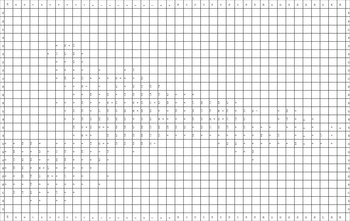
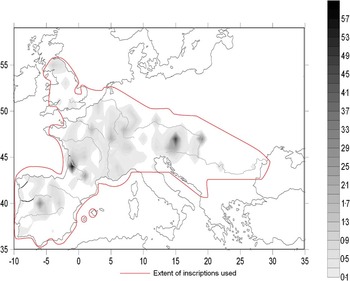
Ideally one would like to know the density of inscriptions with Celtic names relative to ones without them at a more local level than the large ‘provinces’ of the Onomasticon. Extraordinary though it may be, there seem to be no statistics for numbers of Roman inscriptions per one-degree square, but I have made rough estimates on the basis of the end map in Volume I of the Onomasticon Provinciarum Europae Latinarum and used these to create fig 1, a table of the percentage of inscriptions with Celtic compound names.Footnote 103 Professor Stephen Oppenheimer kindly ran this data through a ‘Natural Neighbours’ program to give the map shown in fig 2. The main effect of this is to suggest that, contrary to what might be expected, Celtic personal names were spread fairly evenly through the western part of the Empire in the first to third centuries ad, despite some highs in Celtiberia, around Bordeaux, in Noricum and around Budapest, and some significant lows in southern Spain, the Pyrenees and elsewhere.Footnote 104
Percentage of Latin lapidary inscriptions in the Latin provinces of the Roman Empire containing Celtic compound personal names

Map showing the density of Latin lapidary inscriptions in the Latin provinces of the Roman Empire containing Celtic compound personal names (as a percentage of all Latin lapidary inscriptions): the outline shows the approximate extent of the inscriptions investigated. Data preparation: P Sims-Williams; map preparation: S Oppenheimer

The other massive linguistic source for the ancient world is place names. My Ancient Celtic Place-Names in Europe and Asia Minor investigated more than 20,000 toponyms, mostly non-Celtic of course, in the Barrington Atlas of the Greek and Roman World. Footnote 105 This is a big enough data set to search electronically, and if you ask the right questions, interesting patterns emerge.Footnote 106 When you search for all names containing the string TETRA, only places in the Greek-speaking world come up. Names ending in TIGI are only in southern Iberia. Names ending in DAVA are in Dacia, and place names ending in PARA are Thracian.Footnote 107 If you look for Celtic RITU (‘ford’, with its two distinctive Celtic sound-changes),Footnote 108 there is again a non-random distribution, this time typically Gaulish for the most part, although some occurrences may be coincidences and the shortage of examples in Iberia means that we have to assume that Celtic-speakers there used some other word for ‘ford’ in place names.Footnote 109 By contrast, a Celtic element that was popular in Iberia, in the north west often corresponding to Latin castellum, is Celtic BRIGA (sometimes BRIA or BRIX), cognate with, but phonetically distinct from, Germanic burg. These names are not all Celtic – the BRIA ones in the east probably have Thracian bria (‘city’), an unrelated word – but one can see a real pattern, despite some noise.Footnote 110 If we follow in George Buchanan's footsteps and map DUN (‘enclosure, fort’), we get a different, largely non-Iberian distribution from that of the nearly synonymous BRIG.Footnote 111 This does not necessarily indicate a distinct wave of Celts, despite Rix and Piggott, but perhaps only different fashions in nomenclature in different areas.Footnote 112 Names in -briga, often compounded with non-Celtic elements (Iuliobriga, Conimbriga, etc), were very popular in Hispania, so much so that they probably exaggerate modern impressions of the Celticity of ancient Galicia and Portugal.Footnote 113
After collecting a great number of names containing such Celtic, or at least Celtic-looking, elements it was possible to work out and map percentages of Celticity square by square.Footnote 114 For his book The Origins of the British, Stephen Oppenheimer ran my percentages through his software and came up with a neater looking map that smoothed away the anomalies via a 10 per cent cut-off point (which unfortunately eliminated the limited but bona fide evidence from north Italy).Footnote 115 It is interesting that a traditionally ‘Celtic’ distribution emerged from both our maps, even though the initial data was fairly crude, containing as it did some ‘Celtic-looking’ as well as many more or less certainly Celtic place names.Footnote 116 Compared to the fairly even spread of Celtic personal names, the Celtic/Celtic-looking place names were clustered in Britain, northern Gaul and, to a lesser extent (depending heavily on -briga names), north-west Spain. We may be seeing a Celtic heartland here, whereas the personal names may show a Celtic spread zone.Footnote 117
In these maps of Celtic personal and place names we are only starting to recover the linguistic geography of Iron Age Europe. They are only bits of the jigsaw and much more research will be needed to complete and interpret it, for Celtic and indeed for many other languages, known and unknown. The importance of the linguistic material resides in the fact that ancient Celts can only be defined precisely in terms of their Celtica lingua. As is by now well known, Hallstatt and La Tène material culture cannot be used as a surrogate for linguistic or ethnic data, for it notoriously fails to coincide either with the earliest attested Celtic-speakers – in the Lepontic area (c 575 bc), who instead coincide with the Golasecca culture – or with the Celtic-speakers of Celtiberia, attested four centuries later.Footnote 118 In fact, there is no a priori reason why Celtic-speech should coincide with any single archaeological ‘culture’; hence the search for some alternative to Hallstatt and La Tène – Bell Beakers have often been suggestedFootnote 119 – may well be misguided.
If Celtic-speakers cannot be identified with an archaeological culture, still less are they likely to be identifiable genetically with any one group since, as noted already, language is a cultural trait transmitted horizontally as well as vertically. In short, if we start with solid linguistic data from the Iron Age, we may have some chance of guessing about linguistic geography in the Bronze Age and before. Whether that linguistic geography can, or should, correlate with any archaeological or genetic distribution maps remains an open question.
Acknowledgements
I am grateful to Professors Colin Renfrew, FSA, Stephen Oppenheimer and Martin Richards for helpful comments on this paper, and I also thank Professor Oppenheimer warmly for creating fig 2.