




No CrossRef data available.
Who Influences U.S. Foreign Policy?
Published online by Cambridge University Press: 04 April 2005
Abstract
Research in international relations has identified a variety of actors who appear to influence U.S. foreign policy, including experts and “epistemic communities,” organized interests (especially business and labor), and ordinary citizens or “public opinion.” This research, however, has often focused on a single factor at a time, rather than systematically testing the relative importance of alternative possible influences. Using extensive survey data gathered over three decades we conduct a comparative test, attempting to account for the expressed foreign policy preferences of policy makers by means of the preferences of the general public and those of several distinct sets of elites. The results of cross-sectional and time-lagged analyses suggest that U.S. foreign policy is most heavily and consistently influenced by internationally oriented business leaders, followed by experts (who, however, may themselves be influenced by business). Labor appears to have significant but smaller impacts. The general public seems to have considerably less effect, except under particular conditions. These results generally hold over several different analytical models (including two-observation time series) and different clusters of issues (economic, military, and diplomatic), with some variations across different institutional settings (the U.S. House, Senate, and executive branch).
Information
- Type
- ARTICLES
- Information
- Copyright
- © 2005 by the American Political Science Association
Do organized interest groups seeking narrow benefits for their members drive American foreign policy? Or is policy more influenced by the views of epistemic communities that use their expertise to identify the national interest? Alternatively, do the collective preferences of ordinary citizens shape U.S. foreign policy? Do the wielders of influence vary by issue domain, the level of issue salience, or the particular government institutions involved in policy making?
Such questions touch on the classical “Who governs?” query that has animated much research in American and comparative politics (Dahl 1961). But they are even more central to debates in international relations. They relate to the democratic character of American conduct internationally, the extent to which calculations of national interest do or do not drive U.S. foreign policy, and the general nature of domestic sources of foreign policy. To answer fundamental empirical questions about who influences government officials may help pave the way for developing broader theory regarding the determinants of international behavior.
These questions also have bearing on important normative issues. Democratic theories emphasizing popular sovereignty and electoral accountability argue that government policy ought to reflect the views of ordinary citizens (e.g., Dahl 1989). Adherents of these relatively “populistic” democratic theories would presumably applaud findings of strong public influence on U.S. foreign policy. On the other hand, more elite-oriented theories of democracy (Burke 1949; Sartori 1987; Schumpeter 1976), as well as realist theories of international relations (Kennan 1951; Lippmann 1955; Morgenthau 1973) would sound an alarm. They question the competence of citizens and assert that the quality of foreign policy is likely to suffer if the mass public is allowed to have much direct impact. Evidence that experts and members of “epistemic communities” significantly affect U.S. foreign policy would be applauded by some as holding out the best hope for objectively identifying and advancing the national interest in an increasingly complex global environment (Adler and Haas 1992; Haas 1992; Hall 1989). Alternatively, findings that organized interest groups drive U.S. foreign policy would raise troubling questions about a possible “bias in representation” toward particularistic groups (Moravcsik 1997, 530).
COMPETING VIEWS OF WHO INFLUENCES U.S. FOREIGN POLICY
Three prominent, empirically based views of who influences U.S. foreign policy suggest sharply different predictions.
Neoliberalism and Organized Groups
Many scholars who take a neoliberal approach to international politics emphasize the decisive influence of organized interest groups on foreign policy (e.g., Keohane 1984). In this view, executive and legislative officials with foreign policy authority bargain with domestic groups that use their members' votes, campaign contributions, threatened or actual capital flight, labor strikes, and other tools to affect the electoral benefits and costs to elected officials of choosing alternative policies (e.g., Frieden 1991; Gourevitch 1986; Rogowski 1989). For instance, Keohane and Milner (1996) trace targeted government subsidies and trade protections to the influence of well-organized and financed groups; Snyder (1991) attributes defense policy to logrolling coalitions.
Organized labor and, perhaps even more so, business corporations possess critical resources for pressuring policy makers. Given their mission to protect the jobs and benefits of its members, “[labor] leaders have spoken out often on foreign affairs” (Galenson 1986, 62). In addition to addressing foreign policies that affect its bread and butter interests at home, organized labor in the United States has historically also spoken out on such matters as anticommunism, the Vietnam war, defense spending, and U.S.–Soviet relations, perhaps changing stands as the Cold War ended and the AFL-CIO's blue-collar base was challenged by an influx of civil service and other unions representing white-collar, professional, and service occupations (Lipset 1986). Despite the substantial political resources of U.S. organized labor, however, including its financial contributions, volunteers, and voters in many congressional districts, there is some disagreement about whether it exerts significant policy influence (Gottschalk 2001) or not (Esping-Anderson 1990).
Some neoliberal analysts of international politics have singled out business corporations and business associations as exerting particular influence on American foreign policy because of their effects on the economy and their capacity to prompt voters to punish the incumbent political party (Milner 1997). A number of studies have reported influence by business on specific types of foreign policy: Rogowski (1989) traces economic policies to powerful domestic economic interests; Trubowitz (1998) points to uneven economic growth and struggles for regional economic advantage to explain a variety of foreign policies; and Grossman and Helpman (1994, 1995) link industry lobbying and campaign contributions to international trade relations and, specifically, increased tariffs for politically organized industries. Some argue that pressures on governments to tailor foreign policy to please business have increased over the past three decades with the emergence of an open world economy characterized by rapid international movement of capital and greater exposure to global economic competition (Bates and Lien 1985; Winters 1996).
This line of research suggests that different policy-making institutions may vary in their susceptibility to organized pressures. Executive branch officials, who play a central part in national security and foreign policy, have been said to focus on identifying collective gains in pursuing the “national interest” and therefore to be somewhat resistant to organized pressure (Art 1973; Krasner 1972, 1978; Wildavsky 1991). Organized groups may be particularly influential with Congress, where senators and, especially, Representatives (elected in relatively small districts) may be acutely responsive to demands for concentrated benefits from narrowly based groups of constituents and campaign donors (Milner 1997).
In short, interest group–oriented scholars suggest that labor and, especially, business should exert a strong influence on U.S. foreign policy.
Epistemic Communities and Knowledge-Based Experts
Research on “epistemic communities” indicates that the growing complexity and uncertainty of global problems has “led policy makers to turn to new and different channels of advice” and specifically to new “networks of knowledge-based experts” in the academy, think tanks, and other repositories of technocratic expertise in order to articulate the objective causes of international problems, the “real” stakes or interests of states affected by those problems, and appropriate policy remedies (Haas, 1992, 12; cf. Hall 1989 and Nelkin 1979). In the introduction to an influential special volume of International Organization, Peter Haas (1992) argued that the “epistemic community members' professional training, prestige, and reputation for expertise…accord them access to the political system and…influence over policy debates” through agenda setting and the formulation of policy alternatives in the executive and legislative branches (2–3, 17; Adler and Haas 1992).
Research on epistemic communities has two implications that are important for us. First, it suggests that experts equip government officials to conduct analyses and reach decisions that can be independent of direct pressures from organized groups or citizens. The implication, then, is that business and labor may exert relatively little direct influence on the foreign policy decisions of government officials.
Second, epistemic communities may serve as concrete mechanisms for identifying and addressing the objective interests of states that may ultimately be defined, as classical and structural realists emphasize, by interstate competition and the structure of the international system (Walt 1987; Waltz 1959, 1979; but cf. Rose 1998). Students of epistemic communities argue that realists incorrectly “assume that a state's interests are clear and that the ways in which its interests may be most efficaciously pursued are equally clear” (Adler and Haas 1992, 367–69; Haas 1992, 13–14). Instead, they maintain, technical experts are the vehicle for the interpretation of international structures, the identification of the “imperatives” facing the state, and the articulation of state interests in international politics. In short, research on epistemic communities suggests that conditions of uncertainty produce strong incentives for government officials charged with making foreign policy to respond to experts from think tanks, the academy, and other reservoirs of highly trained specialists and professionals.
Median Voter Theory and the Influence of Public Opinion
Median voter theory predicts that actual or anticipated electoral competition motivates holders of government office to minimize the distance between their policy stands and the policy preferences of voters, thus responding strongly to the public's preferences. (In the case of unidimensional, two-party competition, parties are predicted to converge exactly at the position of the median voter [Downs 1957].) Empirical evidence of public influence on foreign policy has been reported in a large and growing body of research by students of international relations and foreign policy (e.g., Hartley and Russett 1992; Holsti 1996; Nincic 1990; Russett 1990; Sobel 1993, 2001; Wittkopf 1990). Effects of the public have also been found in quantitative analyses by students of public opinion, who have reported, for example, that 62% of U.S. foreign policies changed in the same direction in which public opinion had previously changed (Page and Shapiro 1983, 182) and that congressional district–level public support for military spending was related to Congress members' votes on military spending bills during the presidency of Ronald Reagan (Bartels 1991; see also Monroe 1979, 1998). This and other evidence of influence by the public is now recognized in broader debates about international relations (e.g., Putnam 1988, 432, 436) and national security policy, which Miroslav Nincic (1990) found to be “tethered to domestic electoral calculations,” especially when elections approach (395).
The idea of government responsiveness to public opinion has also informed research on the “democratic peace,” which has found a tendency for individual democratic states and, especially, pairs of democratic states to be more pacific on average than nondemocratic states (Russett and Oneal 2001; cf. Elman, 1997, 10–20). One line of thinking in democratic peace research argues that competitive elections “makes democratic leaders…sensitive to public opinion” because politicians either anticipate electoral punishment or are thrown out of office for being unresponsive: “Citizens in a democratic state can influence governmental policy directly, through public opinion, or indirectly, though their representatives.”1
See Peterson 1995, 10–11, and Russett and Oneal 2001, 274; also cf. Russett 1996, 100. Alternatively, the democratic peace has been attributed to liberal norms that promote nonviolent resolution of conflict, international law and shared membership in intergovernmental organizations, and economic interdependence that puts a premium on stable, ongoing commercial relations (Doyle 1983; Elman 1997; Owen 1994; Russett and Oneal 2001).
Salience may be an important condition affecting the extent of public influence. E. E. Schattschneider's (1960) analysis of the “scope of conflict” indicates that the general public should have its greatest impact on highly salient issues that draw intense attention from the media and voters and thereby pose the most direct threat of electoral punishment for government officials who are unresponsive. In contrast, narrow, well-organized interests may dominate on less visible issues. Some empirical evidence seems to support the prediction of greater public influence when salience is high (e.g., Page and Shapiro 1983, 181).
There are also indications that the characteristics of different government institutions may produce different degrees of influence by the public. For example, members of the House of Representatives, which the Federalist Papers labeled the “people's House” due to their frequent election in small and decentralized districts, were expected to be especially sensitive to public opinion, while officials in the executive branch and Senate were expected to be less responsive due to their insulation from the public by longer terms in office and originally indirect elections.
An ample body of qualitative and quantitative research, then, indicates that U.S. foreign policy and the policy preferences of government officials are substantially influenced by public opinion. Apparently accepting such influence as an empirical fact, a long line of observers including classical realists has urged policy makers not to respond to the preferences of citizens, because of concerns that the general public engages in “simple moralistic and legalistic” thinking, is detached from the reality of international politics, exhibits unstable shifting “moods,” and hungers for “quick results” (Morgenthau 1973, pp. 135, 146–48; cf. Almond 1950 and Kennan 1951). Walter Lippmann (1955) warned that following public opinion would create a “morbid derangement of the true functions of power” and produce policies “deadly to the very survival of the state as a free society” (15, 20, 26–27).
Problems with Past Research
Previous research concerning the impact of organized groups, epistemic communities, and public opinion on U.S. foreign policy has produced an impressive body of results that point in diverse directions regarding who influences government officials. It has not, however, definitely sorted out the relative impact of different factors on U.S. foreign policy. Even excellent case studies that disentangle causal mechanisms and trace processes of policy making usually leave open the issue of how well they generalize beyond those particular cases. Perhaps even more importantly, lack of definitiveness has also resulted from two problems related to the scholarly division of labor: omitted variables and lack of comparative testing. Understandably, each of the three main approaches we have reviewed has tended to focus on a set of variables of particular interest to it, rarely investigating and testing competing explanations at the same time. Most studies of public opinion and government policy, including foreign affairs (some of which were conducted by the present authors [Jacobs and Shapiro 1994; Page and Shapiro 1983; but cf. Jacobs 1992, 1993, 231–33, and Page 2002]), have failed to include any independent variables other than public opinion. However understandable this research strategy may be, it runs the risk that other important influences may be neglected. It may lead each approach to overestimate the importance of its own favorite factors and to offer little or no estimate of the relative impact of different possible influences.
What is now needed, we believe, is comparative analysis, based on a large number of diverse cases, of the relative influence on U.S. foreign policy of several key actors, including organized interest groups (especially business and labor), epistemic communities from think tanks and the academy, and mass public opinion. The present paper attempts to take a first step in that direction.
DATA AND METHODS
We have analyzed a set of data that are uniquely well suited to this purpose, drawn from eight quadrennial pairs of surveys that that were sponsored from 1974 through 2002 by the Chicago Council on Foreign Relations (CCFR) and implemented by the Gallup and Harris organizations.2
The 2002 study was cosponsored by the German Marshall Fund of the United States. Gallup conducted the surveys in 1978, 1982, 1986, 1990, 1994, and 1998, the Harris organization conducted them in 1974, and Harris Interactive did so in 2002. See Rielly (1975 et seq.)
Of less interest to the present analysis, the leadership surveys also included respondents from the media, religious leaders, special interest groups relevant to foreign policy, and (in 1974) leaders of minority groups. As discussed below, we created a single category of “experts” by combining “educators” (i.e., faculty who teach in the area of foreign affairs and presidents and chancellors of major universities), “special foreign policy organizations” (i.e., think tanks), and “private foreign policy groups” (i.e., leaders of major foreign policy organizations), after analyzing each group separately.
These parallel surveys of the mass public and foreign policy leaders have both strengths and limitations. The government officials and other elites were not randomly selected for interviews; they were chosen from institutional positions involving foreign policy responsibilities or expertise.4
Senators and Representatives, for example, were chosen (at least through 1990) from the membership of committees and subcommittees related to foreign policy. Administration officials came from the Department of State and from internationally oriented units of the commerce, treasury, agriculture, and other departments, though rarely from the Department of Defense or the National Security Council. Business respondents were sampled mainly from corporate vice presidents for international affairs, and labor respondents from high-level union officials oriented toward foreign affairs.
The average number interviewed each year was about 76 for government officials, 58 for business, 28 for labor, and 79 for experts. Although the categories of respondents were generally quite stable across surveys, the 1974 survey combined officials from the House, Senate, and administration, added minority groups, and did not survey think tank members. For 1978 through 2002, the average numbers of policy makers interviewed were 19 from the Senate, 36 from the House, and 23 from the administration.
In 2002, 2,862 respondents were interviewed by telephone and 400 were interviewed in person. This made it possible to assess comparability with the previous in-person surveys. We use the combined telephone and in-person data set. Interviews were typically conducted in the fall but in 2002 were carried out in June.
Despite their limitations, the CCFR surveys provide what are, so far as we know, the best available data on comparably measured foreign policy preferences of ordinary citizens, interest groups, epistemic communities, and U.S. government officials. They cover a wide range of foreign policy issues over a lengthy period of time, both during and after the Cold War. Data on large numbers of key policy makers are very difficult to obtain (but cf. Holsti and Rosenau 1984), especially from samples that are comparable over multiple years.7
Holsti and Rosenau (1984) report an outstanding study of a wide range of U.S. decision makers and foreign policy leaders, including high-ranking military officers (unfortunately excluded from the Chicago Council surveys).
A crucial advantage of these survey data is that they permit us to analyze relationships using precise, directly comparable measures of the policy preferences of policy makers and those of the public, members of interest groups, and experts. These measures are based on responses to identical questions asked of the various groups at the same time. Previous researchers have generally lacked such comparable measures and have had to struggle with the question of exactly how close a given policy did or did not come to the wishes of particular actors.
Some of the interpretations we offer for our analyses rest on a key assumption: that the survey-expressed policy preferences of government officials can be used as reasonable indicators of the policies that they enact or pursue. We recognize, of course, that there may well be some slippage between the “private” preferences of individuals and actual foreign policy. We certainly do not suppose that the CCFR data on policy makers' expressed preferences invariably and without exception have corresponded with what the government has actually done. There are reasons to doubt, however, that the dissonance between what officials do and what they say they favor doing would often be allowed to become extreme. We have carefully scrutinized these data and have found that policy makers' aggregate survey responses have usually reflected the positions and actions of the institutions in which they held office. Given the difficulty of obtaining comparable measures for analyzing influences on foreign policy, we conclude that, on balance, the limitations of these data are outweighed by the enormous advantage of being able to obtain precise, comparable, quantitative measures of the positions of government officials, organized groups, experts, and the public.8
Even if the correspondence between actual foreign policy and decision makers' expressed preferences is imperfect, ascertaining the determinants of policy makers' preferences should still be of interest so long as those preferences have any substantial impact at all on policy.
Another possible concern in using these survey data is that some elite respondents undoubtedly delegated answering the CCFR questions to staff members. We believe that subordinates' responses are generally likely to reflect the views of the superiors who hire, promote, and supervise them.
Our dependent variables are measured in a simple fashion: the percentage of policy makers (that is, the percentage of all policy makers or of a subset of policy makers from the administration, the House, or the Senate) who favored or opposed a particular policy alternative in a given survey.9
All items were dichotomized, using a quasi-random dichotomizing scheme to group responses when more than two alternatives were offered. We also alternated the polarity of the responses that were tabulated—i.e., whether we tabulated the percentage in “favor,” the percentage “oppose[d],” or the percentage favoring one extreme combined with those favoring one or more neutral or middle alternatives. The percentage of relevant respondents making the selected response or combination of responses was then recorded as the value of the dependent variable on that issue for that given year.
The quasi-random dichotomization and alternation of polarities mean that the direction of preferences on different issues does not have an intuitive meaning in common. It is not always the case, for example, that higher percentages signal more “liberal” or more “internationalist” responses. But this procedure was necessary in order to ensure substantial variance and to avoid certain statistical biases in the analyses. Dichotomization was essential to ensure that the percentage support measure was uniquely defined.
The precise relationship between (for example) the percentage of respondents favoring an “increase” in foreign aid and the amount of aid increase favored by the average respondent is likely to be complex and related to aspects of survey responses and underlying preferences about which we have little information. Our general point is that the percentage of policy makers “favoring” alternative X is likely to track the amount of X favored by the average respondent, which is more directly applicable to actual policy and of more central interest.
Our independent variables are measured in the same way: percentages of the general public, or of business people, labor leaders, or experts, who favored or opposed the same policy alternative that the policy makers were asked about. Because “Don't know” and “Refuse to answer” responses are generally more common among the general public than among policy makers, we recomputed percentages without them. This gave us comparable measures of the views of those with opinions among elites and the mass public.
The scope and duration of the Chicago Council's parallel studies of elites and the general public enabled us to analyze variations across different institutions (comparing subsets of policy makers from the administration, the House, and the Senate) and variations in levels of issue salience to the public. In addition, we separately examined three broad, exhaustive, and mutually exclusive policy domains: diplomatic policy (e.g., relations with other countries and international organizations), defense policy (including the recruitment and deployment of troops, military aid, and the development, procurement, and transfer to other countries of military hardware), and economic policy (e.g., issues related to trade, tariffs, and the protection and promotion of American jobs and businesses). Diplomatic and defense policy questions were asked most frequently (214 and 209 items, respectively, asked of both the public and elites), followed by economic policy (144 items).
Since our aim is to sort out the independent impact of each factor and to compare them with each other, we relied primarily on multivariate regression analyses. The meaningful and intuitively understandable units of measurement involved (percentage points on the familiar 0 to 100 scale) led us to focus on unstandardized ordinary least squares (OLS) regression coefficients, which can tell us how many percentage points of change in policy makers' support for a policy are typically associated (controlling for all other factors) with a one-percentage-point increase in support by (for instance) business respondents. A coefficient near zero would signal no influence at all on policy makers by business, whereas a coefficient near 1.0 would signal very great influence. We conducted these regression analyses for all years combined (the most stable and reliable set of estimates) and for each separate year, for all policy makers combined and for each separate institutional subgroup of policy makers, for all issues together and for each of the three issue categories separately, and for issues grouped according to varying degrees of salience.
We employed four types of regression models involving distinct analytic approaches. First, in Model 1 we conducted purely cross-sectional analyses, regressing the preferences of policy makers at a given time on those of business people, experts, labor leaders, and ordinary citizens at that same time. These cross-sectional analyses generally used all eight pairs of surveys together, which included a total of 567 in-common items ascertaining preferences about foreign policy: that is, 567 questions about policy preferences that were asked in a given year, with identical wording, of both citizens and elites.11
Questions asked in more than one year are treated as separate cases. The public was asked a number of additional questions not analyzed here. We excluded questions not related to preferences about future government policy, such as those concerning past performance, U.S. “vital interests,” or “feeling thermometer” ratings of countries.
Model 1-style cross-sectional analyses have some usefulness. They may be particularly helpful for capturing quick or near-instantaneous effects: If, for example, prominent experts or business leaders were to gain rapid access to policy makers and influence them at once, with the effects fading as new circumstances arise. But they are less apt to identify slow-acting or delayed effects by other actors. Moreover, cross-sectional analyses—absent simultaneous equation techniques12
We have not been able to specify, with sufficient theoretical confidence, exogenous variables for which it is feasible to obtain good measures over the diverse issue cases and identify reciprocal effects.
Our second type of regression model (Model 2) keeps the basic cross-sectional design for independent variables but addresses the potential for incremental, self-reinforcing dynamics by lagging the dependent variable and studying the effects of foreign policy decision makers' previous preferences. For this purpose we need data on the history of our dependent variables. Fortunately, the CCFR surveys allow us to identify many “two–time period” cases—that is, pairs of identical survey items that were asked of both the mass public and elites in two sequential surveys. We identified 252 sequential pairs, which permit us to conduct regression analyses that lag the dependent variable for one period—using responses to the same policy preference question when it was asked in the survey four years earlier. In such regressions, policy makers' 2002 support for economic foreign aid (for example) is predicted by the policy makers' 1998 views on aid, together with the 2002 preferences of the mass public, business and labor leaders, and experts.
Model 2 analyses allow us to examine the impact on policy makers of contemporaneous preferences of the general public, business and labor leaders, and experts, while taking account of the effects of the past policy preferences of government officials. But there is danger that using the lagged dependent variable may introduce excessive controls for prior influences, particularly quick-acting influences that may already have been incorporated in the prior value of the dependent variable and are then “controlled” away. In addition, Model 2 (like Model 1) remains prey to causal ambiguity.
Statistically disentangling whether public opinion and nongovernmental elites affect policy makers, or whether the reverse happens—policy makers influence the preferences of others—is a daunting challenge. One promising approach is to track temporal sequences (i.e., to see whether changes in hypothesized independent variables actually precede changes in the dependent variable) and to employ the logic of “Granger causality” (i.e., to see whether the history of hypothesized independent variables actually adds explanatory power to that of the history of dependent variables; see Freeman 1983).
Our third type of regression model (Model 3) uses the data from sequential pairs of survey questions to conduct two-observation time series analyses, with lagged values for independent as well as dependent variables. Although the restriction to two time points prevents us from using the full power of time series techniques, we can at least begin to get at the logic of causal time asymmetries and Granger causality. For example, in such a regression the 2002 preferences of policy makers concerning foreign economic aid are predicted by the 1998 preferences concerning aid of the public, experts, labor and business leaders, and policy makers themselves. Since causes generally precede rather than follow effects, this time asymmetry adds to our confidence about causal inference. Incorporating the most recent history of the independent and dependent variables begins to get at Granger causal logic.
The Model 3, two-observation time series analyses take good advantage of the CCFR data but are not without limitations. First, because of the four-year intervals between surveys, the time lags are relatively long. They may not allow us to distinguish the different speeds and durability with which different groups may exercise influence. For instance, major, internationally oriented business leaders or prominent experts might be able to exercise influence especially quickly because they are highly attuned to policy impacts and have privileged access to policy makers. By contrast, labor leaders might tend to have only delayed—but possibly long-lasting—influence due to reliance on building up pressure in congressional districts. Second, we lack a full account of the history of the independent and dependent variables and therefore cannot explore different lags or conduct full Granger tests. We can only lag our variables one period. Finally, the need for identical questions in two sequential surveys decreases the number of cases available for analysis, which reduces the precision of estimates and makes it more difficult for results to attain statistical significance.
The fourth type of regression model (Model 4) pursues the logic of Model 3 one step further: It uses change measures for dependent variables and change measures for the independent variables. In particular, Model 4 examines whether changes in the views of business, experts, labor, and members of the mass public predict changes in the preferences of policy makers. For example, the changes between 1998 and 2002 in policy makers' preferences regarding economic aid are predicted by the 1998 to 2002 changes in the aid preferences of the public, experts, and labor and business leaders. The strength of this model is that it is explicitly dynamic. Model 4 controls automatically for all possible influences on the immediately prior values of dependent and independent variables. It also promises to give leverage on causal ordering; evidence that changes in the independent and dependent variables covary strengthens the basis for inferring causation. On the other hand, the necessary focus on changes in both dependent and independent variables over the same time period may reintroduce problems with reciprocal causation: We cannot generally tell which change actually occurred first.
Each of these four models offers a distinct approach to disentangling complex causal connections, based on the available opportunities and challenges of an unusual data set. Rather than select one or two models for exclusive attention (Models 3 and 4, say), we have pursued a strategy of methodological pluralism. We are particularly interested in exploring patterns across all four models. A convergence of estimates from four distinct models would strengthen our confidence in the results and would be very gratifying. On the other hand, differences among them might help establish boundaries within which the true magnitudes are likely to lie.
ANALYZING INFLUENCES ON FOREIGN POLICY MAKERS
Before turning to the multiple regression models we examined simple bivariate relationships at one point in time between the aggregate preferences of all policy makers taken together and those of the mass public as well as each of the seven distinct clusters of “foreign policy leaders” that the Chicago Council surveys repeatedly interviewed (business, labor, educators, private foreign policy organizations or think tanks, editors and journalists from the media, special interest groups relevant to foreign policy, and religious officials). All these bivariate relationships were positive, quite large, and highly significant at the p<.01 level. The percentage of policy makers preferring a specific policy was most strongly correlated with the percentage preferring the same policy among respondents from the media (r=.94), business (r=.91), foreign policy organizations and think tanks (r=.90), and educators (r=.90). Religious leaders (r=.85) and labor leaders (r=.84) came not far behind, with the general public (r=.77) taking up the rear. The current preferences of policy makers were almost as strongly correlated (and highly significantly so) with the preferences of these same groups measured in the previous time period.
The results for business are consistent with previous research on the role of organized interest groups in U.S. foreign policy, and the findings for think tanks and educators are in line with the analysis of epistemic communities. The relatively low figures for the public are somewhat surprising, however, given previous findings that policy makers are highly responsive to public opinion.
There are reasons to doubt that the high bivariate correlations for religious leaders and the media really reflect major, direct impacts on the making of U.S. foreign policy. Few scholars have asserted that such impacts occur, and in theoretical terms, any such influence would presumably be channeled mostly through the public. It seems possible that the high correlations were spurious or resulted from reciprocal relationships. The media, for example, have not often been identified as a direct influence on policy making, but considerable research does suggest the opposite causal connection—i.e., influence by government officials on media that rely heavily on officials as news sources (e.g., Bennett 1990, 1994; Entman 2004; Hallin 1986; Nacos, Shapiro, and Isernia 2000, part I; Sigal 1973).
Not only did the preferences of all the elite groups surveyed by the Chicago Council correlate highly with the preferences of policy makers; but also they correlated very highly with each other. Contemporaneous correlations tended to fall in the r=.90 to .92 range, and the correlation between educators' and the media's preferences reached the remarkable level of .96. Correlations with preferences at the previous time point were also quite high, though generally about a tenth of a point weaker. (The reduction in the predictive power judged by the R2 statistic is more substantial.) Substantively, this suggests the existence of something like a “foreign policy establishment,” in which policy preferences are largely shared across several different categories of elites engaged in foreign policy, while the general public stands somewhat to the side. (Contemporaneous correlations between the preferences of the public and those of elite groups ranged from .83 [for labor] and .82 [for religious leaders] down to .68 for private foreign policy organizations and think tanks. Correlations with responses from the previous time period were similar, though a bit lower.)
Methodologically, the high intercorrelations among elite groups augur possible trouble with multicollinearity. With such data, sorting out distinct effects in a precise and reliable fashion is a difficult challenge. We now turn to our four multivariate models in order to attempt to estimate the independent impacts of the public and various elite groups on government officials.
Our first step in cross-sectional multivariate analysis (Model 1) was to estimate what could uncharitably be called a “garbage can” model, with policy makers' foreign policy preferences as the dependent variable and with the contemporaneous preferences of the general public and of each of the CCFR's seven distinct clusters of elites as independent variables. This regression produced results already hinted at by the bivariate correlations: rather substantial and highly significant coefficients for business (b=.31) and think tanks (b=.22), but a second-tier status for labor (b=.09; significant at only p<.05) and, especially, the public, which had a near-zero coefficient that was not statistically significant at even the .10 level. (Coefficients are significant at p<.01 unless otherwise indicated; n=567.)
The same “garbage can” approach using our other regression models generally seemed to confirm strong effects by business. Model 2, cross-sectional analysis, except for a lagged dependent variable (policy makers' preferences from the previous survey), showed large and highly significant coefficients for business (b=.29), with the effects of labor and think tanks only about half as strong and the coefficient for the public failing to reach statistical significance. (The estimated effect of the lagged dependent variable was statistically significant but only moderate; b=.18). Model 3, regressing the current preferences of policy makers on the four-year-previous preferences of the public, elite groups, and policy makers, seemed to confirm the influence of business (b=.27) and added new evidence of labor's effects (b=.36)—perhaps indicating a delayed impact over time. The lagged dependent variable remained significant and became substantial (b=.35), but the coefficients for the public, educators, think tanks, the media, and religious groups did not reach statistical significance.
These “garbage can” analyses, however, ran afoul of two serious methodological problems. First, the cohesiveness of the “foreign policy establishment” did indeed produce extremely high levels of multicollinearity, with VIF coefficients of more than 20 for the media and 15 for educators in the cross sectional analysis (a VIF coefficient above 10 is generally considered troubling; see Chatterjee and Price 1991). Second, the theoretical rationale for the causal structure of these analyses is highly questionable. For example, they treated the preferences of media figures as a purely independent variable that directly influences government officials, even though previous research (as noted above) suggests the opposite causal connection. Direct impact by religious leaders also seems questionable.
We refined our subsequent analyses to include only a theoretically solid core of independent variables. We dropped from analysis the media variable (which suffered from high multicollinearity and causal ambiguity), religious leaders (also causally ambiguous), and “special interest groups” (poorly defined and showing little estimated impact). Further, we combined educators with respondents from private foreign policy organizations and think tanks, whose preferences were highly correlated with each other (r=.92, p<.01) and played essentially the same roles in regressions when entered separately. The result was a single variable for the policy preferences of “experts,” which is consistent with research on epistemic communities.
Subsequent regression analyses using this refined, parsimonious set of independent variables yielded results that were considerably more satisfying, both substantively and methodologically.
In our first and most important refined analyses, we used all available issue cases from all surveys. The dependent variables were the foreign policy preferences of all policy makers combined and (separately) the preferences of each of the three clusters of officials: those from the administration, the House of Representatives, and the Senate. These analyses included only the four independent variables needed to test the principal theoretical expectations we have discussed, namely, the preferences of the general public, business, labor, and foreign policy experts.
For the cross-sectional models, each of these independent variables (with the possible exceptions of experts and the mass public) can reasonably be treated as exogenous with respect to government decision makers. The policy preferences of business and labor leaders are arguably rooted in economic interests and in well-developed values; they are not likely to vacillate with the particular officials currently holding office. “Experts,” on the other hand, may be cultivated and even selected by officials. The foreign policy preferences of the mass public may be influenced by government officials as well. This would lend ambiguity to the interpretation of large coefficients for the public, but (as we will see) no such coefficients have been found. Estimates of a lack of influence are largely free of causal ambiguity.
Tables 1 through 4 show that our regression models were rather effective in accounting for the variation in policy makers' preferences. Adjusted R2 values were all high, ranging from .70 to .90 for Models 1–3 and only moderately lower (as would be expected when using change scores) for Model 4. Taken together, the preferences of business, experts, labor and the public can account for the bulk of variation in the foreign policy preferences of policy makers, both contemporaneously and over time. This is particularly true for all policy makers together, but nearly as much so for the separate groups of officials.


Business Influence
The strongest and most consistent results in Table 1 are the coefficients for business, which suggest that internationally oriented business corporations are strongly influential in U.S. foreign policy. According to the Model 1 cross-sectional analysis, when the support among business people for a given foreign policy is higher by 10 percentage points, the support among policy makers (taken together) tends to be higher by about five points. Business preferences were the strongest predictor of officials' preferences within each of the three separate institutional arenas, peaking at a .71 coefficient for administration officials (where it was more than double the only other significant coefficient, that for experts). To the extent that the executive branch dominates foreign policy, extensive influence by business on administration officials would be especially striking. This finding is consistent with the expectations of many international relations scholars who focus on interest groups, but not with the expectations of those who envision an autonomous executive.
Taking account of possible inertial forces in policy making by lagging the dependent variable, Model 2 produces a similar story of relative strong business effects on all groups of policy makers separately or together, especially administration officials (Table 2). The consistently significant and moderately strong coefficients for policy makers' preferences lagged one period indicate that the contemporary views of policy makers are indeed influenced or conditioned by the history of already established perspectives. Business leaders, then, apparently exert some effect on government officials that is quite independent of whatever impact they have also had on past policy that is carried forward through the self-reinforcing quality of previous decisions.
The Model 3 time series analysis in Table 3 provides a stronger test of whether the views of business “cause” changes in the foreign policy preferences of policy makers, according to the logic of Granger models. Regressing the current preferences of all policy makers (as well as each separate group of officials) on the independent and dependent variables from the four-years-previous survey largely confirmed the major impact of business, with one wrinkle. These results suggest that business leaders are most influential on officials in the Senate and, especially, the administration, while possibly not exerting any meaningful effect at all on officials in the House of Representatives.13
Our failure to find an effect that is clearly statistically significant is not, of course, the same as a definite finding of no effect. This is particularly true in a case like the Model 3 estimate of business influence on the House, where the coefficient may be marginally significant (at p<.10 by two-tailed test or p<.05 by one-tailed test).
Model 4 offers a further perspective by using change measures (changes from one survey to the next in percentage support for a given policy) for both the dependent and the independent variables. Table 4 shows that under this model, too, the basic pattern of substantial business influence holds. Business people (along with experts) are estimated to exert the strongest effects on policy makers overall and, especially, on administration officials. It indicates that when business people change their support for a given foreign policy by 10 percentage points, policy makers taken together tend during the same period to change their support by 3.2 points in the same direction, while administration officials alter their views by 4.6 points in a congruent direction. Such an institutional differentiation of business influence is foreseen by some previous research in international relations, which stresses the particular responsiveness to business of administration officials seeking to improve economic conditions and encourage voters to reward (rather than punish) the president as they retrospectively evaluate the incumbent's performance. The lower R2 statistics in Table 4 reflect the greater analytic challenge of explaining changes (Model 4) as opposed to levels (Models 1–3); the variance in both independent and dependent variables is much smaller and a higher proportion of it is random noise, especially for the aggregate preferences of relatively small groups like Senators and administration officials.
A clear message from all four models is that business is a consistently effective influence on policy makers. Its absolute and relative influence does appear to vary, though, based on how the different models treat the passage of time. The contrast between the cross-sectional and the time-lag models suggest that business leaders may exert strong effects quite rapidly, perhaps through phone calls and other direct contacts with officials.
Experts
Experts, judging by some of our models, also appear to be a potent force affecting the views of policy makers. According to cross-sectional Models 1 and 2, experts have the second strongest contemporaneous influence (next to business) on policy makers' preferences (see Tables 1 and 2). This finding, which at least partly fits the expectations of researchers on epistemic communities, applies with nearly equal magnitude to all policy makers taken together and also to those from each of the three institutional settings analyzed separately. But according to the time series analysis of Model 3, experts did not exert any significant influence at all. This suggests either that experts' impact is extremely quick, fully embodied in policy makers' previously measured preferences, or (perhaps more plausibly) that the expressed preferences of experts are largely effects rather than causes of policy makers' stands. That is, the substantial estimated effects in cross-sectional Models 1 and 2 may be inflated by simultaneity bias. The same problem may affect the results of Model 4, which indicates that changes in experts' and policy makers' preferences over the same time period tend to go in the same direction. Since these changes are measured between the same two time points (previous and current surveys), we cannot be sure which change actually preceded or caused the other. Still, we cannot dismiss the possibility that experts and epistemic communities have substantial influence on officials.
The Public
Perhaps the most surprising finding in this whole set of analyses is the apparent weakness of public opinion. Even with these reduced and refined models, the public does not appear to exert substantial, consistent influence on the makers of foreign policy. In none of the 16 regression analyses, applying our four models to four sets of decision makers, was the public opinion coefficient dominant over those of the elite actors. The contemporaneous Model 1 estimate for the effect of public preferences on officials in the House of Representatives was statistically significant but weak (b=.10); the public had no significant effects, even by a one-tailed test or the loose p<.10 standard, in Model 2.14
We are reluctant to rely on the loose p<.10 criterion for statistical significance because, when many tests are performed, it can produce a number of false positives. By the same token, we hesitate to rely on one-tailed tests at the p<.05 level (equivalent to two-tailed tests at p<.10), because we are not sufficiently confident that the possibility of real negatively signed influences can be altogether ruled out theoretically. Still, we must also avoid the possibility of false negatives, e.g., dismissing public opinion as having “no effect” just because its coefficients do not pass our relatively stringent tests. For that reason, all tables include (along with standard errors) information on significance at the p<.10 level by two-tailed test, which readers are free to interpret as they will.
Taken together, these findings hint at partial confirmation of the Founders' expectations about the House of Representatives as “the people's” chamber. More importantly, however, they run against the thrust of much past research that has found substantial impacts of public opinion.
Labor
Labor leaders are estimated by Models 1 and 2 to exert contemporaneous influence on foreign policy decision makers, but only weakly (b=.16 for all policy makers taken together in both Model 1 and Model 2), and mainly on the legislative rather than the executive branch. Research on the role of interest groups in the making of U.S. foreign policy generally anticipates just such a modest role for organized labor. What is surprising, though, is that in the Model 3 time series analysis labor emerges as the second strongest influence (next only to the inertia effect of officials themselves) on policy makers as a whole, with particular impact on officials in the House of Representatives. Model 3, making use of time asymmetries, offers particularly strong evidence regarding causation. Labor, despite its limited contemporaneous influence, is apparently able—perhaps owing to its active presence in states and localities—to apply delayed pressure on government officials, especially House members, who may be particularly sensitive to organized pressure within their decentralized districts. (Another possibility, as we will see, is that labor indirectly impacts the national agenda through experts.) This evidence of delayed effects is consistent with the absence of significant labor coefficients in Model 4, because delayed effects of changes in labor's stands will presumably show up only later, not in simultaneous changes by policy makers.
The analyses in Tables 1 through 4 form the bedrock of our empirical investigation. But we also used the same four regression models to explore possible variations in influence on policy makers during different time periods and across three domains of foreign policy—defense, diplomacy, and economic issues. Separate analyses for each of the eight survey years produced results that generally paralleled those we have displayed for all years combined, with some apparently random variation in coefficients due to the smaller numbers of cases. For the different issue domains, too, the same pattern of findings generally held: substantial business influence, contemporaneous but not lagged effects by experts, and delayed effects by labor, with little impact from the public. In the Economic realm, however, where foreign policy cuts close to home, public opinion did appear to have significant contemporaneous influence on policy makers: a modest coefficient of .17 in Model 1 but a more substantial .36 in Model 2 and a remarkable .93 in same period–change Model 4 (all significant at p<.01). (In the Model 3 time series analysis, however, the public's coefficient did not come close to significance.) With regard to defense policy there were some indications, consistent with previous literature (e.g., Snyder 1991), that business has a particularly strong effect on policy makers. Because of the limited number of cases, interpretation of the issue-specific results requires caution.
Searching for Public Influence on Government Officials
Given the surprisingly weak estimates of influence by public opinion (with the partial exceptions of effects on House members and in economic policy), we were concerned that real public influence might be masked by the inclusion in the analysis of labor leaders, whom we found to have a moderate influence on policy makers and whose preferences were fairly strongly correlated with those of the public (r=.82). In order to provide the best possible opportunity for public opinion to display effects, we dropped the labor variable and regressed the preferences of policy makers only on the preferences of the general public, business, and experts.
The proportion of variance accounted for was virtually the same as in the earlier analyses, indicating that the public and labor can indeed be substituted for each other without losing much predictive power. But even with these rather generous—and somewhat implausible—causal assumptions (namely, that labor leaders have no independent impact on foreign policy at all but merely act as statistical proxies for the general public), the estimated influence of public opinion on the preference of government officials remained, at best, modest.
The Model 1 cross-sectional analysis excluding labor produced coefficients for public influence on all policymakers (b=.11), officials in the House (.21), and Senate officials (.12) that were statistically significant and higher than in the earlier analysis. But they remained smaller than the comparable coefficients for business (.50 for all policy makers, .40 for House officials, and .40 for Senate officials) or experts (.40, .41, and .44, respectively; all significant at p<.01). Much the same thing (though with somewhat higher public coefficients) was true of contemporaneous-change Model 4.15
In the Model 4 analysis excluding labor, coefficients for effects on all policy makers, House members, Senators, and the administration (respectively) were .32**, .37**, .31+, and .25+ for the public; .33**, .29**, .21, and .45** for business; and .41**, .40**, .44**, and .42** for experts.
Parallel labor-excluded analyses across the three policy domains mostly continued to show the public as a minor influence, with less impact than experts or, especially, business, except on economic policies.
Other results hinted at support for the Schattschneider (1960) view that the public has more influence on high-salience than low-salience issues, but estimates of public impact remained modest even for the very highest-salience issues, where—according to all four models—the estimated impact of both business and experts remained substantially greater than that of the public.16
In regressions limited to the most highly salient issue cases (those with 4% or fewer “don't know” responses), coefficients for the public neared or attained statistical significance only under Model 1 (.21**) and Model 4 (.33+). The coefficients for different salience categories are highly unstable because of small Ns.
In short, in spite of generous model specifications, the effect of public opinion on the preferences of foreign policy makers appears to be—at best—modest, when critical competing variables are controlled for. In general, public opinion takes a back seat to business and experts. These results challenge research that has suggested a generally strong public impact on foreign policy.
Still, we are not suggesting that public opinion has no effect at all on U.S. foreign policy. We have noted indications of significant public impact on members of the House of Representatives, on economic policy, and (perhaps) on issues of especially high salience. The public may play a substantial part in highly salient questions of war and peace, such as those analyzed by Sobel (2001). Further, we have not explored possible effects by the public on agenda setting, or on decision makers' anticipation of later, retrospective public opinion, or on the rhetorical packaging of policy choices (Jacobs and Shapiro 2000). (The makers of foreign policy may, for example, work hard to avoid high levels of military casualties that could provoke electoral punishment; see Mueller 1973.) But it is worth emphasizing that our measurements of public opinion, based on large sample surveys, are quite good; any attenuation of coefficients due to measurement error should affect elite groups more than the public. And this sort of result is not likely to result from model misspecification due to causal ambiguities. An erroneous finding of noninfluence by the public is considerably less likely to result from simultaneity bias than is an excessively large estimate of its influence.17
Reciprocal effects of government officials on public opinion, for example, would bias our cross-sectional and contemporaneous-change estimates of the public's influence on officials upward rather than downward.
All in all, the implications of our findings for previous research connecting public opinion and policy making are sobering.
Indirect Business and Labor Influence through Experts?
The substantial influence of experts suggested by our cross-sectional models and the simultaneous-change Model 4, though in line with past research on epistemic communities, is subject to doubt about its causal status. Even if one sets aside the possibility of reciprocal influences by officials on experts that would tend to inflate their apparent impact on officials (a possibility highlighted by the null findings from the Model 3 over-time analyses), there remains the question of whether the preferences of experts are a truly independent variable or whether they function in an intervening role. For example, experts might themselves be influenced by business or labor and, in turn, transmit the preferences of those groups to officials.
Researchers on epistemic communities sometimes assume that policy makers are guided by independent, objective analysis from new “knowledge-based elites”: that experts are not merely vehicles for pressing officials on behalf of organized interests. Yet the widespread funding of think tanks by business—and, to a much lesser extent, by organized labor—suggests that interest groups may sometimes affect who becomes a recognized expert and what such experts say. Thus experts might not be autonomous influences on policy makers but, instead, might—in whole or in part—convey to officials the preferences of others.
Without additional data we cannot hope to definitively untangle these causal complexities. But we already know, from our discussion of a possible “foreign policy establishment,” that the policy preferences of experts are not statistically independent of the preferences of business or labor. They are quite highly correlated. The foreign policy preferences of think tank respondents, for example, were correlated at r=.90 with the contemporaneous preferences of business and r=.80 with those of labor.
If we assume one-way causation from business and labor to experts,18
We consider the assumption of one-way causation from business and labor to experts to be fairly plausible, because the deeply rooted economic interests of business and labor are likely to make them resistant to others' influence on their foreign policy preferences. Still, interest groups may provide financial support for experts in order to get serious advice (not just to persuade other audiences) and may, therefore, sometimes be influenced by them. To the extent that this occurs, our estimates of effects upon experts will be biased upward.

The results in Table 5 suggest that organized groups do influence experts and that this impact is quite substantial. If we set aside the time series findings of no expert effects on policy makers, and accept the cross-sectional estimates of substantial contemporaneous effects, we can go on to estimate indirect effects that business and labor may have on public officials through their influence on experts. For example, if (as the Model 1 cross-sectional analysis in Table 5 indicates) a 1-percentage point increase in business support for some policy generally leads to a .61-percentage point increase in experts' support for that policy, and if (as Table 1 indicates) such a .61-percentage point increase for experts would then lead to a .183 (.30×.61)-percentage point increase in officials' support, business would obtain a small but not irrelevant increment of indirect clout. This estimated indirect impact of .183 can be added to the direct impact of business on policy makers (estimated at .52 points in Table 1), yielding a total business impact of slightly over .70. That is to say, a 10-percentage point increase in business support for a given policy may lead to a 7-point, rather than 5-point, increase in officials' support for that policy.19
By similar calculations, Model 2 (including a lagged dependent variable) produced estimates of a total business impact on policy makers of .56: an indirect impact through experts of .115 (.24×.48) plus a direct impact of .44 (see Tables 2 and 5).
Similar calculations for labor based on Model 1 cross-sectional analyses indicate a .126 indirect effect of labor on officials. Adding that to the estimated direct effect of .16 given in Table 1, the total impact of labor on foreign policy officials is about .29, nearly double the size of the direct effect alone.20
According to Model 2 analyses with a lagged dependent variable, labor has a slightly smaller total impact of .22: a .06 indirect effect through experts (.24 [Table 2]×.27 [Table 5]), combined with a direct effect of .16 (Table 2).
Methodological uncertainties mean that we should not take the magnitudes of these estimates as gospel. Still, they pose a challenge for those who consider the views of experts to be altogether autonomous.
FOREIGN POLICY, THE NATIONAL INTEREST, AND DEMOCRACY
Our analyses using four distinct types of statistical models indicate that internationally oriented business leaders exercise strong, consistent, and perhaps lopsided influence on the makers of U.S. foreign policy. The estimates of strong business influence hold up under different models, for different political and institutional conditions, and for different time periods. They hold for high- as well as low-salience issues, for a variety of substantive issue areas, and with respect to different institutional groups of policy makers (though especially for executive branch and Senate officials). These findings tend to confirm theoretical expectations and empirical research from the organized interest group literature in international relations.
The estimated impacts of experts on policy makers do not generally match those of business, but they, too, are quite substantial, according to three of our four models (though not the Model 3 analyses of impact over time). This lends some credence to claims by analysts of epistemic communities. Our further investigation of who influences experts suggests, however, that organized groups—not just independent, objective evaluations of complex international realities—may color the views of experts. These findings indicate that the direct foreign policy clout of business and labor may be augmented by an indirect influence on policy makers that works through experts.
Labor, even taking into account its possible indirect influence through experts, has less impact on the makers of U.S. foreign policy than business does. This finding, too, fits with some previous work by international relations scholars who focus on organized interest groups. Nonetheless, labor leaders do appear to exert a surprisingly consistent (if secondary) influence on policy makers, especially on members of the House of Representatives and concerning particular types of issues.
The findings from our cross-sectional and simultaneous-change analyses, as contrasted with the time series analyses using lagged independent variables, suggest that the influence of business tends to be fairly quick, while labor's influence tends to be delayed and is exerted over time as labor makes its presence in congressional districts felt. Although labor's effect on foreign policy has been downplayed by some international relations scholars, our evidence of labor's impact is consistent with recent reevaluations of its nested impact on U.S. social welfare policy (Gottschaulk 2001).
To our surprise, public opinion—the aggregate foreign policy preferences of ordinary citizens—was repeatedly estimated by our Models 1–3 to have little or no significant effect on government officials. When effects of public opinion emerged in these models (namely, on economic issues, on members of the House of Representatives, and perhaps on very high-salience issues), the absolute and relative magnitudes of effects were generally modest. These findings of little influence by public opinion are generally immune to issues of model specification and causal ambiguity that may affect some of our other results. On the other hand, the moderately strong estimates of public influence using Model 4 (based on same-period changes) may be inflated by simultaneity bias and should probably be taken as establishing an upper bound on public effects. Even those estimates were generally smaller than for business or experts. These results contradict expectations drawn from a large body of previous research.
If one accepts the survey-measured aggregate policy preferences of foreign policy decision makers as satisfactory indicators of actual policy (and we have argued that it is reasonable to do so), our findings have several important implications for understanding U.S. foreign policy, international affairs, and American democratic governance.
First, these findings underline the continuing importance of moving from monocausal explanations to multi-causal explanations in international relations scholarship (see Keohane 1989 and Putnam 1988). Although recent work in international relations (e.g., Moravcsik 1997; Russett and Oneal 2001; Snyder 1991) has shown substantial progress in this respect, there is still a pressing need for comprehensive examinations of multiple possible determinants of U.S. foreign policy across a range of issues.
Our evidence suggests that business may exert the most consistent influence on government officials but that policy makers' views may also be affected by labor, experts, and, to a lesser extent, public opinion. These results suggest that three of the most prominent lines of analysis of foreign policy—the interest group, epistemic community, and public opinion approaches—each have some merit. But at the same time, research along each of these lines has tended to omit critical alternative variables. It has seldom systematically examined the relative impact of competing influences. This risks artificially inflating estimates of the importance of particular factors of interest.
This hazard seems particularly serious for quantitative analyses of the effect of public opinion, not only on foreign policy (see, however, Hartley and Russett 1992 and Ostrom and Marra 1986, which take steps to be multivariate) but also on U.S. domestic policy. For instance, Erikson, MacKuen, and Stimson's widely discussed Macro Polity (2002) concludes that domestic policy is highly responsive to public opinion, yet it comes to that conclusion without considering the possible impact of organized interests. In our analyses, a very strong bivariate relationship between public opinion and the preferences of policy makers crumbled away almost completely when we included data on organized interests and experts in multivariate regressions. To be sure, foreign policy may be quite different from domestic (Art 1973; Wildavsky 1991), but we cannot be certain of this until comparable research is conducted that includes relevant variables and potentially complex causal dynamics (Bartels 2002; Jacobs and Shapiro 2000; Page 2002; see also Druckman, Jacobs, and Ostermeier 2004 and Jacobs and Burns 2004).
Second, our results have some troubling normative implications. The apparently weak influence of the public will presumably disappoint those adherents of democratic theory (e.g., Dahl 1989) who advocate substantial government responsiveness to the reasoned preferences of citizens (Page and Shapiro 1992). Our findings indicate that the gravitational pull on foreign policy decision makers by the “foreign policy establishment” (especially business leaders and experts) tends to be stronger than the attraction of public opinion. This is consistent with the pattern of extensive and persistent “gaps” that Chicago Council studies have found between the foreign policy preferences of the public and those of policy makers. For example, ordinary Americans, more than policy makers or other elites, have repeatedly expressed stronger support for protecting Americans' jobs, stopping the inflow of illegal drugs, and reducing illegal immigration, as well as for a multilateral, cooperative foreign policy based on bolstering the United Nations, working closely with allies, and participating in international treaties and agreements (Bouton and Page 2002; Jacobs and Page 2003).
Comparatively muted influence by the mass public might initially please classical realist critics of citizen input into foreign affairs, who consider public opinion to be ill-informed and capricious (e.g., Lippmann 1955). Yet those same critics would want to see policy makers rise above the politics of organized interest groups in order to pursue the “national interest,” perhaps as identified by independent, objective experts. Our finding of a substantial impact on foreign policy by business—generally a greater impact than by experts—suggests that purely technocratic calculations do not always predominate in the making of foreign policy. Competing political interests continue to fight over the national interest, and business often wins that competition.
The authors are indebted to Eric Ostermeier and Dukhong Kim for their research assistance. Melanie Burns deserves particular praise for her hard work and commitment to the project. The authors also wish to acknowledge the comments and advice of Jason Barabas, Larry Bartels, Doug Foyle, Ed Greenberg, Ian Hurd, Sandy Jencks, Ron Krebs, Jeff Legro, Dick Price, Kathryn Sikkink, Sidney Verba, and three anonymous reviewers.
References
Adler Emanuel, and
Peter Haas.
1992.
“Conclusion: Epistemic Communities, World Order, and the Creation of a Reflective Research Program.”
International Organization
46
(Winter):
367–
90.Google Scholar
Almond Gabriel.
1950.
The American People and Foreign Policy.
New York:
Harcourt, Brace.
Art Robert.
1973.
“Bureaucratic Politics and American Foreign Policy: A Critique.”
Policy Sciences
4
(December):
467–
90.Google Scholar
Bartels Larry.
1991.
“Constituency Opinion and Congressional Policy Making: The Reagan Defense Buildup.”
American Political Science Review
85
(June):
457–
74.Google Scholar
Bartels Larry M.
2002.
“Economic Inequality and Political Representation.”
Paper presented at the 2002 Annual Meeting of the American Political Science Association, Boston.
Bates Robert, and
Da-Hsiang Lien.
1985.
“A Note on Taxation, Development, and Representative Government.”
Politics and Society
14
(March):
53–
70.Google Scholar
Bennett W. Lance.
1990.
“Toward a Theory of Press-State Relations in the United States.”
Journal of Communications
40
(Spring):
103–
25.Google Scholar
Bennett W. Lance.
1994.
“The Media and the Foreign Policy Process.”
In The New Politics of American Foreign Policy,
ed. D. Deese.
New York:
St. Martin's Press,
168–
88.
Bouton Marshall M., and
Benjamin I. Page,
eds.
2002.
Worldviews 2002: American Public Opinion and Foreign Policy.
Chicago:
Chicago Council on Foreign Relations.
Burke Edmund.
1949.
“Speech to the Electors of Bristol.”
In Burke's Politics; Selected Writings and Speeches,
ed. R. Hoffmann and
P. Levack.
New York:
Alfred Knopf.
Chatterjee Samprit, and
Bertram Price.
1991.
Regression Analysis by Example.
2nd ed.
New York:
John Wiley.
Dahl Robert A.
1961.
Who Governs? Democracy and Power in an American City.
New Haven, CT:
Yale University Press.
Dahl Robert A.
1989.
Democracy and Its Critics.
New Haven, CT:
Yale University Press.
Downs Anthony.
1957.
An Economic Theory of Democracy.
New York:
Harper and Row.
Doyle Michael.
1983.
“Kant, Liberal Legacies, and Foreign Affairs.”
Philosophy and Public Affairs
12
(3):
205–
35;
12 (4): 323–53.Google Scholar
Druckman James N.,
Lawrence R. Jacobs, and
Eric Ostermeier.
2004.
“Candidate Strategies to Prime Issues and Image.”
Journal of Politics.
Forthcoming.Google Scholar
Elman Mariam Fendius.
1997.
“Introduction: The Need for a Qualitative Test of the Democratic Peace Theory.”
In Paths to Peace: Is Democracy the Answer?,
ed. M. F. Elman.
Cambridge, MA:
MIT Press.
Entman Robert M.
2004.
Projections of Power: Framing News, Public Opinion, and U.S. Foreign Policy.
Chicago,
University of Chicago Press.
Erikson Robert S.,
Michael B. Mackuen, and
James A. Stimson.
2002.
The Macro Polity.
New York.
Cambridge University Press.
Esping-Andersen Gøsta.
1990.
The Three Worlds of Welfare Capitalism.
Princeton, NJ:
Princeton University Press.
Freeman John.
1983.
“Granger Causality and the Time Series Analysis of Political Relationships.”
American Journal of Political Science
27
(May):
327–
58.Google Scholar
Frieden Jeffry A.
1991.
“Invested Interests: The Politics of National Economic Policies in a World of Global Finance.”
International Organization
45
(Autumn):
425–
51.Google Scholar
Galenson Walter.
1986.
“The Historical Role of American Trade Unionism.”
In Unions in Transition: Entering the Second Century,
ed. S. M. Lipset.
San Francisco:
Institute for Contemporary Studies.
Gottschalk Marie.
2001.
In the Shadow of the Welfare State.
Ithaca, NY:
Cornell University Press.
Gourevitch Peter.
1986.
Politics in Hard Times.
Ithaca, NY:
Cornell University Press.
Grossman Gene M., and
Elhanan Helpman.
1994.
“Protection for Sale.”
American Economic Review
84
(September):
833–
50.Google Scholar
Grossman Gene M., and
Elhanan Helpman.
1995.
“Trade Wars and Trade Talks.”
Journal of Political Economy
103
(August):
675–
708.Google Scholar
Haas Peter.
1992.
“Introduction: Epistemic Communities and International Policy Coordination.”
International Organization
46
(Winter):
1–
35.Google Scholar
Hall Peter.
1989.
The Political Power of Economic Ideas: Keynesianism across Nations.
Princeton, NJ:
Princeton University Press.
Hallin Daniel C.
1986.
The “Uncensored War”: The Media and Vietnam.
New York:
Oxford University Press.
Hartley Thomas, and
Bruce Russett.
1992.
“Public Opinion and the Common Defense: Who Governs Military Spending in the United States?”
American Political Science Review
86
(December):
905–
15.Google Scholar
Herman Edward, and
Noam Chomsky.
1988.
Manufacturing Consent: The Political Economy of the Mass Media.
New York:
Pantheon Books.
Holsti Oli.
1996.
Public Opinion and American Foreign Policy.
Ann Arbor:
University of Michigan Press.
Holsti Oli, and
James N. Rosenau.
1984.
American Leadership in World Affairs: Vietnam and the Breakdown of Consensus.
London:
Allen and Unwin.
Jacobs Lawrence.
1993.
The Health of Nations: Public Opinion and the Making of Health Policy in the U.S. and Britain.
Ithaca, NY:
Cornell University Press.
Jacobs Lawrence.
1992.
“Institutions and Culture: Health Policy and Public Opinion in the U.S. and Britain.”
World Politics
44
(January):
179–
209.Google Scholar
Jacobs Lawrence, and
Melanie Burns.
2004.
“The Second Face of the Public Presidency: Presidential Polling and the Shift from Policy to Personality Polling.”
Presidential Studies Quarterly
34
(September):
536–
56.Google Scholar
Jacobs Lawrence, and
Benjamin Page.
2003.
“The Disconnect of American Foreign Policy Makers from Public Opinion: International Relations Theory and Practice.”
Paper presented at the 2003 annual meeting of the Midwest Political Science Association.
Jacobs Lawrence, and
Robert Y. Shapiro.
1994.
“Issues, Candidate Image and Priming: The Use of Private Polls in Kennedy's 1960 Presidential Campaign.”
American Political Science Review
88
(September):
527–
40.Google Scholar
Jacobs Lawrence, and
Robert Y. Shapiro.
2000.
Politicians Don't Pander: Political Manipulation and the Loss of Democratic Responsiveness.
Chicago:
University of Chicago Press.
Kennan George.
1951.
American Diplomacy, 1900–1950.
Chicago:
University of Chicago Press.
Keohane Robert.
1984.
After Hegemony: Cooperation and Discord in the World Political Economy.
Princeton, NJ:
Princeton University Press.
Keohane Robert.
1989.
International Institutions and State Power.
Boulder, CO:
Westview Press.
Keohane Robert, and
Helen Milner,
eds.
1996.
Internationalization and Domestic Politics.
Cambridge:
Cambridge University Press.
Krasner Stephen.
1972.
“Are Bureaucracies Important? (or Allison Wonderland).”
Foreign Policy
7
(Summer):
159–
79.Google Scholar
Krasner Stephen.
1978.
In Defense of the National Interest: Raw Materials, Investments, and U.S. Foreign Policy.
Princeton, NJ:
Princeton University Press.
Lippmann Walter.
1955.
Essays in the Public Philosophy.
Boston:
Little, Brown.
Lipset Seymour Martin.
1986.
Unions in Transition: Entering the Second Century.
San Francisco:
Institute for Contemporary Studies.
Milner Helen.
1997.
Interests, Institutions, and Information: Domestic Politics and International Relations.
Princeton, NJ:
Princeton University Press.
Monroe Alan D.
1979.
“Consistency between Public Preferences and National Policy Decisions.”
American Politics Quarterly
7
(January):
3–
19.Google Scholar
Monroe Alan D.
1998.
“American Public Opinion and Public Policy, 1980–1993.”
Public Opinion Quarterly
62
(Spring):
6–
28.Google Scholar
Moravcsik Andy.
1997.
“Taking Preferences Seriously: A Liberal Theory of International Politics.”
International Organization
51
(Autumn):
513–
53.Google Scholar
Morgenthau Hans.
1973.
Politics among Nations.
New York:
Knopf.
Mueller John E.
1973.
War, Presidents and Public Opinion.
New York:
Wiley.
Nacos Brigette,
Robert Shapiro, and
Pierangelo Isernia.
2000.
Decision Making in a Glass House: Mass Media, Public Opinion, and American and European Foreign Policy in the 21st Century.
New York:
Rowan and Littlefield.
Nelkin Dorothy.
1979.
“Scientific Knowledge, Public Policy, and Democracy.”
Knowledge, Creation, Diffusion, Utilization
1
(September):
106–
22.Google Scholar
Nincic Miroslav.
1990.
“U.S. Soviet Policy and the Electoral Connection.”
World Politics
42:
370–
96.Google Scholar
Ostrom Charles W.,
Jr., and
Robin E. Marra.
1986.
“U.S. Defense Spending and the Soviet Estimate.”
American Political Science Review
80
(September):
819–
41.Google Scholar
Owen John.
1994.
“How Liberalism Produces Democratic Peace.”
International Security
19
(Fall):
87–
125.Google Scholar
Page Benjamin.
2002.
“The Semi-Sovereign Public.”
In Navigating Public Opinion: Polls, Policy, and the Future of American Democracy,
ed. Jeff Manza,
Fay Lomax Cook, and
Benjamin Page.
New York:
Oxford University Press.
Page Benjamin I., and
Robert Y. Shapiro.
1983.
“Effects of Public Opinion on Policy.”
American Political Science Review
77
(March):
175–
90.Google Scholar
Page Benjamin I., and
Robert Y. Shapiro.
1992.
The Rational Public: Fifty Years of Trends in Americans' Policy Preferences.
Chicago:
University of Chicago Press.
Peterson Susan.
1995.
“How Democracies Differ: Public Opinion, State Structure, and the Lessons of the Fashoda Crisis.”
Security Studies
5
(Autumn):
3–
37.Google Scholar
Putnam Robert.
1988.
“Diplomacy and Domestic Politics: The Logic of Two-Level Games.”
International Organization
42
(Summer):
427–
60.Google Scholar
Rielly John.
1975.
American Public Opinion and U.S. Foreign Policy, 1975.
Chicago:
Chicago Council on Foreign Relations.
(Corresponding studies published in 1979, 1983, 1987, 1991, 1995, and 1999..
Rogowski Ronald.
1989.
Commerce and Coalitions.
Princeton, NJ:
Princeton University Press.
Rose Gideon.
1998.
“Neoclassical Realism and Theories of Foreign Policy.”
World Politics
51
(October):
144–
72.Google Scholar
Russett Bruce.
1990.
Controlling the Sword: The Democratic Governance of National Security.
Cambridge, MA:
Harvard University Press.
Russett Bruce.
1996.
“Why Democratic Peace?”
In Debating the Democratic Peace,
ed. M. Brown,
S. Lynn-Jones, and
S. Miller.
Cambridge, MA:
MIT Press,
82–
115.
Russett Bruce, and
John Oneal.
2001.
Triangulating Peace: Democracy, Interdependence, and International Organizations.
New York:
W. W. Norton.
Sartori Giovanni.
1987.
The Theory of Democracy Revisited.
Chatham, NJ:
Chatham House.
Schattschneider E. E.
1960.
The Semi-Sovereign People: A Realist's View of Democracy in America.
New York:
Holt, Rinehart and Winston.
Schumpeter Joseph.
1950.
Capitalism, Socialism, and Democracy.
New York:
Harper.
Sigal Leon V.
1973.
Reporters and Officials: The Organization and Politics of Newsmaking.
Lexington, MA:
D. C. Heath.
Snyder Jack.
1991.
Myths of Empire: Domestic Politics and International Ambition.
Ithaca, NY:
Cornell University Press.
Sobel Richard.
2001.
The Impact of Public Opinion on U.S. Foreign Policy since Vietnam.
Ithaca, New York:
Oxford University Press.
Sobel Richard. (ed.).
1993.
Public Opinion in U.S. Foreign Policy: The Controversy Over Contra Aid.
Lanham, MD:
Rowman & Littlefield.
Trubowitz Peter.
1998.
Defining the National Interest: Conflict and Change in American Foreign Policy.
Chicago:
University of Chicago Press.
Walt Stephen M.
1987.
The Origins of Alliances.
Ithaca, NY:
Cornell University Press.
Waltz Kenneth.
1959.
Man, the State, and War: A Theoretical Analysis.
New York:
Columbia University Press.
Waltz Kenneth.
1979.
Theory of International Politics.
Reading, MA:
Addison–Wesley.
Wildavsky Aaron.
1975.
Budgeting: A Comparative Theory of Budgetary Processes.
Boston:
Little, Brown.
Wildavsky Aaron.
1991.
“The Two Presidencies.”
In The Two Presidencies: A Quarter Century Assessment,
ed. S. Shull.
Chicago:
Nelson–Hall,
11–
25.
Winters Jeffrey A.
1996.
Power in Motion.
Ithaca, NY:
Cornell University Press.
Wittkopf E.
1990.
Faces of Internationalism: Public Opinion and American Foreign Policy.
Durham, NC:
Duke University Press.
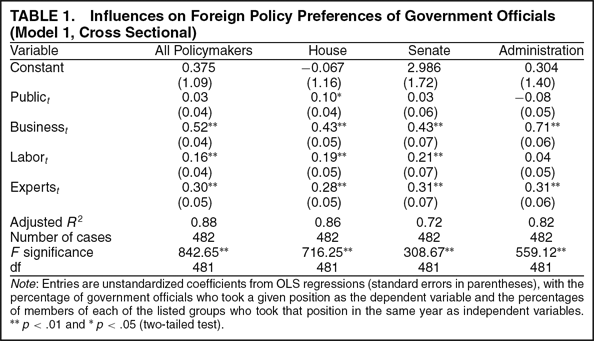
Influences on Foreign Policy Preferences of Government Officials (Model 1, Cross Sectional)
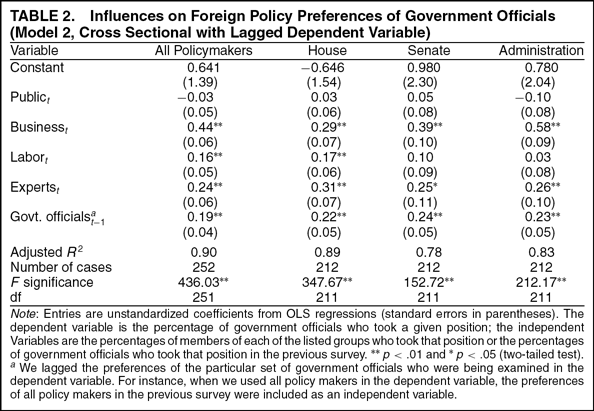
Influences on Foreign Policy Preferences of Government Officials (Model 2, Cross Sectional with Lagged Dependent Variable)

Influences on Foreign Policy Preferences of Government Officials (Model 3, Lagged Independent Variables)

Influences on Foreign Policy Preferences of Government Officials (Model 4, Change Scores for Independent and Dependent Variables)
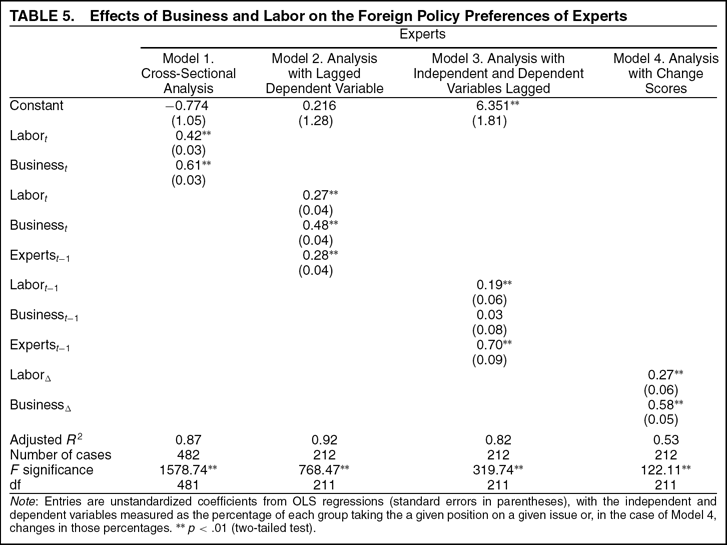
Effects of Business and Labor on the Foreign Policy Preferences of Experts
 You have Access
- 261
- Cited by
Comments
No Comments have been published for this article.