Introduction
Auditory verbal hallucinations (AVH) are not only a characteristic symptom of psychotic disorders; they also occur in the general population with a prevalence of approximately 15% (for a review, see Beavan et al. Reference Beavan, Read and Cartwright2011). This includes individuals who report to hear voices quite regularly as well as individuals who report hearing a voice at least once in their lifetime. Several phenomenological details of AVH, such as location, loudness and personification, are similar in individuals with and without psychosis who hallucinate. However, differences have been found in the emotional valence of the content, which can be quite the opposite in these two groups (Honig et al. Reference Honig, Romme, Ensink, Escher, Pennings and De Vries1998; Daalman et al. Reference Daalman, Boks, Diederen, de Weijer, Blom, Kahn and Sommer2011a): for example, ‘We will get you and then kill you, you cannot escape us’ as opposed to ‘Don't be afraid, I'm always there to watch over you. Nothing will ever happen to you’. Both sentences are examples of AVH; the first is from a patient with a psychotic illness and the second from a non-psychotic individual experiencing frequent AVH.
It has consistently been shown that individuals with hallucinations more frequently experienced traumas during childhood (for a review, see Sansonnet-Hayden et al. Reference Sansonnet-Hayden, Haley, Marriage and Fine1987; Famularo et al. Reference Famularo, Kinscherff and Fenton1992; Ross et al. Reference Ross, Anderson and Clark1994; Read, Reference Read1997). Sometimes the content of voices is directly related to the trauma, for example, when people hear the voice of their former abuser. The relationship between childhood abuse and hallucinations seems strongest for physical abuse and sexual abuse and specifically relates to hallucinated voices (Ensink, Reference Ensink1992; Hammersley et al. Reference Hammersley, Dias, Todd, Bowen-Jones, Reilly and Bentall2003; Janssen et al. Reference Janssen, Krabbendam, Bak, Hanssen, Vollebergh, de Graaf and van Os2004). Individuals who report hearing voices have more frequently experienced childhood traumas. This suggests that there might be a relationship between severity of trauma and an increased risk for a psychotic disorder later in life (Janssen et al. Reference Janssen, Krabbendam, Bak, Hanssen, Vollebergh, de Graaf and van Os2004). Several models have been proposed to explain how trauma during childhood might lead to psychotic symptoms later in life. For instance, the traumagenic neurodevelopmental (TN) model, which combines social, psychological and biological factors (Walker & DiForio, Reference Walker and DiForio1997; Heim et al. Reference Heim, Newport, Heit, Graham, Wilcox, Bonsall, Miller and Nemeroff2000; Read et al. Reference Read, Perry, Boskowitz and Connolly2001), suggests that prolonged exposure to stressors leads to a chronic heightened glucocorticoid release. This could cause permanent changes in the hypothalamic–pituitary–adrenal axis which in turn may induce increased striatal dopamine turnover, rendering a person more vulnerable for positive psychotic symptoms. As an alterative to the TN model, cognitive explanations state that traumatic experiences enhance negative or maladaptive schematic models of the self, of others and the world. This in turn renders a person more vulnerable to negative schemas about social humiliation or subordination, which may influence the content of, or attitude towards, AVH (Birchwood et al. Reference Birchwood, Meaden, Trower, Gilbert and Plaistow2000). A third possibility is that offered by Garety et al. (Reference Garety, Kuipers, Fowler, Freeman and Bebbington2001), who define a central role for cognitive disturbances, leading to external appraisal errors. They hypothesized that childhood trauma affects the appraisal of internal experiences as coming from an external agent. As the above-mentioned theories all describe how psychotic symptoms can arise, it remains unclear whether these are also applicable in non-psychotic individuals who experience AVH.
A previous study (Andrew et al. Reference Andrew, Gray and Snowden2008) showed a high incidence of childhood trauma in both psychiatric (n = 22) and non-psychiatric individuals who experience AVH (n = 21). While the psychiatric individuals with AVH considered their voices predominantly as malevolent and distressing, the non-psychiatric individuals with AVH viewed them as benevolent and hardly stressful. Interestingly, the psychiatric individuals experienced significantly more childhood sexual abuse that the non-psychiatric group.
As specific types of childhood trauma (sexual abuse and physical abuse) are considered to be risk factors for hallucinations, especially AVH, traumatic experiences during childhood may not be related to the presence of AVH themselves, but more to the emotional content of AVH (hearing positive or negative voices). Indeed, the content or theme of hallucinations can often be related to the experienced trauma (Read & Argyle, Reference Read and Argyle1999; Hardy et al. Reference Hardy, Fowler, Freeman, Smith, Steel, Evans, Garety, Kuipers, Bebbington and Dunn2005). Moreover, McCarthy-Jones (Reference McCarthy-Jones2011) suggests in his review that childhood sexual abuse may even be a risk factor for hearing specific types of voices (e.g. command hallucinations). The specific relation to hallucinated voices could imply that experienced traumas are relived during hallucinations. Trauma may therefore colour the content of hallucinations, rather than trigger the phenomenon per se.
In order to investigate this we will compare the prevalence of childhood trauma in individuals with voices with a positive or neutral emotional content (most of them are non-psychotic) and in individuals who experience AVH with a negative emotional content (mainly patients with a psychotic disorder). In addition, we will investigate the association between the childhood traumas that were found to differ between groups and AVH characteristics, such as frequency, location and controllability. We included three groups, each with a substantial number of subjects: non-psychotic individuals who experience frequent AVH (n = 127), patients with a psychotic disorder experiencing frequent AVH (n = 100) as well as healthy control subjects without AVH (n = 124) and assessed five different types of childhood trauma using the Childhood Trauma Questionnaire – Short Form (CTQ-SF). Comparing these three groups will provide information about the association between childhood trauma and AVH: is there a relation between trauma and all sorts of AVH, or is this relation only apparent for voices with an abusive or negative content?
Method
Participants
A total of 100 patients with a psychotic disorder were included, as well as 127 non-psychotic subjects with AVH and 124 healthy control subjects without AVH. The non-psychotic subjects with AVH and healthy controls without AVH did not meet criteria for a Diagnostic and Statistical Manual of Mental Disorders, Fourth Edition (DSM-IV) diagnosis, as assessed with the Comprehensive Assessment of Symptoms and History (CASH) interview (Andreasen et al. Reference Andreasen, Flaum and Arndt1992) and the Structured Clinical Interview for DSM-III-R Personality Disorders (SCID-II; First et al. Reference First, Spitzer, Gibbon and Williams1995). Depressive disorder in complete remission was not an exclusionary criterion. Exclusion criteria for all groups were alcohol abuse and drug abuse. The healthy controls and non-psychotic subjects with AVH were screened for alcohol abuse (more than 20 units per week) and drug abuse (using cannabis more than once per month and/or the use of other illicit substances) by telephone and later with the help of urine samples; a total of 10 individuals in these groups were excluded for this reason. In the patient group, alcohol and drug abuse was screened for by an independent psychiatrist with the help of the CASH interview. No patients were excluded. For the non-psychotic subjects with AVH, the minimum frequency to experience AVH was once per month and the minimum duration since onset of AVH was 1 year. Both the non-psychotic individuals with AVH and the healthy controls were recruited with the help of a Dutch website called ‘Explore your mind’ (http://www.verkenuwgeest.nl). An extended description of the recruitment and selection procedure is provided in prior studies of our group (Daalman et al. Reference Daalman, Boks, Diederen, de Weijer, Blom, Kahn and Sommer2011a; Diederen et al. Reference Diederen, Neggers, Daalman, Blom, Kahn and Sommer2010a, Reference Diederen, De Weijer, Daalman, Blom, Neggers, Kahn and Sommerb; Sommer et al. Reference Sommer, Daalman, Rietkerk, Diederen, Bakker, Wijkstra and Boks2010; van Lutterveld et al. Reference van Lutterveld, Oranje, Kemner, Abramovic, Willems, Boks, Glenthøj, Kahn and Sommer2010; De Weijer et al. Reference De Weijer, Mandl, Diederen, Neggers, Kahn, Hulshoff Pol and Sommer2011).
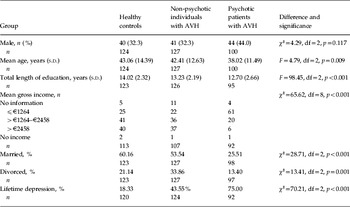
A total of 100 out-patients with a psychotic disorder from the University Medical Center Utrecht were included. These patients visited our clinic for regular treatment of psychosis or as a second opinion for refractory psychosis. In this group, clinical diagnoses were confirmed by an independent psychiatrist using the CASH interview. A total of 59 patients (59%) were diagnosed with paranoid schizophrenia, 14 (14%) with schizo-affective disorder, two (2%) with disorganized schizophrenia, one (1%) with catatonic schizophrenia and 24 (24%) with psychosis not otherwise specified. Demographic details are shown in Table 1; the three groups were matched for gender but differed on age.
Demographic characteristics of the participants: healthy control subjects, non-psychotic individuals with AVH and patients with a psychotic disorder and AVH

AVH, Auditory verbal hallucinations; df, degrees of freedom; s.d., standard deviation.
The study was approved by the Humans Ethics Committee of the University Medical Center Utrecht. After a complete description of the study to the subjects, written informed consent was obtained.
Questionnaires
Childhood trauma was assessed with the help of the CTQ-SF (Bernstein et al. Reference Bernstein, Stein, Newcomb, Walker, Pogge, Ahluvalia, Stokes, Handelsman, Medrano, Desmond and Zule2003). This 25-item version was derived from the original 70-item CTQ (Bernstein & Fink, Reference Bernstein and Fink1998; Bernstein et al. Reference Bernstein, Fink, Handelsman, Foote, Lovejoy, Wenzel, Sapareto and Ruggiero1994). Cut-off scores for ‘moderate to severe’ exposure were used to classify the occurrence (presence or absence) of a specific trauma in the three groups (emotional abuse ⩾13; physical abuse ⩾10; sexual abuse ⩾8; emotional neglect ⩾15; physical neglect ⩾10). Scores above this cut-off score correspond with rating most traumatic experiences of that specific trauma as ‘often true’. The short form of the CTQ demonstrated good criterion-related validity in s subsample of adolescents and appeared to be viable across diverse populations (Bernstein et al. Reference Bernstein, Stein, Newcomb, Walker, Pogge, Ahluvalia, Stokes, Handelsman, Medrano, Desmond and Zule2003).
To establish the phenomenological characteristics of AVH, the Psychotic Symptom Rating Scales (PSYRATS) Auditory Hallucination Rating Scale (AHRS; Haddock et al. Reference Haddock, McCarron, Tarrier and Faragher1999) was administered. This questionnaire consists of 11 items that describe the AVH with the help of a Likert scale (0–4). For the use of this questionnaire in non-psychotic individuals, the range of the frequency scale was extended to 0–6 (also covering options ‘at least every 3 months’ and ‘at least once every month’, as well as ‘at least once per week’, ‘at least once per day’, ‘at least once per hour’ and ‘continuously’, since AVH were experienced less often than once per week (the original minimum score of this item). This questionnaire was administered by trained psychologists. Due to high correlations between several of these items, two new variables were computed: The variable ‘emotional valence of content’ was operationalized as the sum of three items from the AHRS: ‘amount of negative content of voices’, ‘degree of negative content’ and ‘amount of distress’, i.e. an ordinal variable expressing overall burden of voices with negative content. The variable ‘total distress’ was operationalized as the sum of two items from the AHRS: ‘intensity of distress’ and ‘disruption to life caused by voices’. As a result, the following items were used in this study: frequency, duration, location, loudness, beliefs regarding the origin of voices, controllability, emotional valence of content and total distress.
Statistical analyses
First, for an overview of the data, the prevalence of the different childhood traumas was calculated for the three groups and compared with χ2 tests.
To investigate which childhood trauma subtypes were associated with group membership (healthy controls, non-psychotic individuals with AVH, patients with a psychotic disorder and AVH), a stepwise multinomial logistic regression analysis was performed. Predictors were the five types of childhood trauma as measured with the CTQ-SF (emotional abuse, physical abuse, sexual abuse, emotional neglect and physical neglect). The dependent variable was group membership. The choice for a multinomial logistic regression was based on the fact that the three levels of the dependent variable were not necessarily ordered. Age was associated with group membership and with one of the childhood traumas [emotional neglect, χ2(49, 351) = 78.03, p = 0.005] and was therefore entered as a covariate in this analysis. In addition, gender appeared to be associated with sexual abuse [χ2(1, 351) = 7.223, p = 0.007] and emotional neglect [χ2(1, 351) = 3.887, p = 0.049]. Both childhood traumas are found to be more prevalent in women. Therefore, gender was entered as a covariate in the regression analysis.
A logistic regression analysis was performed to investigate which childhood traumas best predict the emotional valence of the voices. Emotional valence of content was used as a dependent variable and the (presence of) childhood traumas as predictor variables. Emotional valence of content was dichotomized using a median split.
To establish whether characteristics of AVH were associated with childhood trauma, correlation coefficients were calculated between the childhood traumas that were found to predict group membership and AVH characteristics from the PSYRATS (frequency, duration, location, loudness, beliefs regarding the origin of voices and controllability, as well as the computed variables ‘emotional valence of content’ and ‘total distress’ of AVH). Since these data were not normally distributed, non-parametric Spearman correlations were used.
Results
Description of AVH characteristics
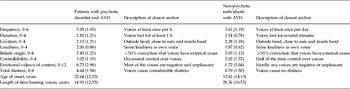
Table 2 illustrates the characteristics of the voices in both AVH groups based on the PSYRATS items. Mean scores are provided as well as a description of each characteristic's closest anchor in the questionnaire.
Characteristics of AVH in 127 non-psychotic individuals with AVH and 100 patients with a psychotic disorder and AVH

AVH, Auditory verbal hallucinations.
Data are given as mean (standard deviation).
Prevalence of childhood trauma
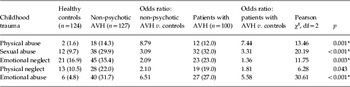
The prevalence of childhood trauma in the three groups was described and compared with the help of χ2 tests (see Table 3). After correcting for multiple testing, childhood physical abuse, sexual abuse and emotional abuse as well as emotional neglect differed significantly between the three groups.
Prevalence of childhood trauma by group

AVH, Auditory verbal hallucinations; df, degrees of freedom.
Data are given as number of subjects (percentage).
* Significant after Bonferroni correction for multiple testing (p < 0.01).
More specifically and after correcting for multiple testing, the two AVH groups did not differ significantly from each other regarding the prevalence of the five childhood traumas. The healthy controls and the non-psychotic individuals differed significantly from each other on physical abuse (U = 6822, z = − 3.685, p < 0.001), sexual abuse (U = 6280, z = − 4.007, p < 0.001), emotional neglect (U = 6417.5, z = − 3.322, p = 0.001) and emotional abuse (U = 5710, z = − 5.479, p < 0.001). The healthy controls and patients with a psychotic disorder differed significantly from each other on physical abuse (U = 5556, z = − 3.186, p = 0.001), sexual abuse (U = 4816, z = − 4.171, p < 0.001) and emotional abuse (U = 4826, z = − 4.642, p < 0.001).
Differences in childhood trauma between the three groups
A stepwise multinomial regression analyses was used to investigate which childhood traumas best predict whether a person belongs to the ‘healthy control’, the ‘non-psychotic individual with AVH’ or the ‘patient with a psychotic disorder and AVH’ group. The indicators of the model were five types of childhood trauma (sexual, emotional and physical abuse, emotional and physical neglect). Covariates were gender and age.
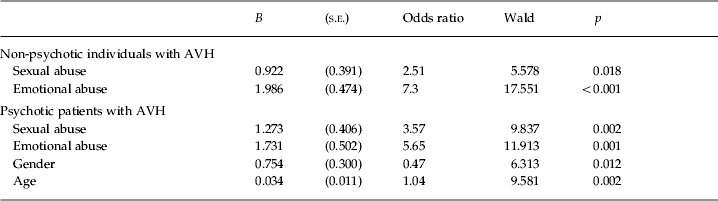
The optimal model included only sexual abuse and emotional abuse as predictors [χ2(2, 351) = 62.39, p < 0.001]. The predictive value of 18.4% of this model can be considered low (The Nagelkerke pseudo R 2 for the regression model was 0.184). Likelihood ratio tests indicate that there is a difference between the three groups regarding sexual abuse [χ2(2, 351) = 10.87, p = 0.004] and emotional abuse [χ2(2, 351) = 24.26, p < 0.001]. Table 4 shows the statistics of the two significant indicators and covariates in the model.
Multinomial regression model: sexual and emotional abuse, with control subjects as the reference category
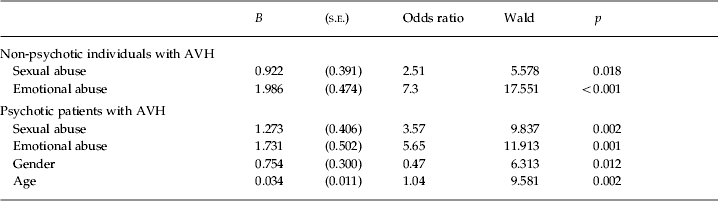
s.e., Standard error; AVH, auditory verbal hallucinations.
Non-psychotic individuals and patients with a psychotic disorder and AVH were compared with healthy control subjects, the reference category. Both AVH groups were significantly more likely to report having experienced sexual and emotional abuse compared with these healthy controls.
Odds ratios are also presented in Table 4. Compared with non-hallucinating controls, both non-psychotic individuals with AVH as well as patients with a psychotic disorder and AVH have a greater chance to have suffered from sexual abuse (2.51 and 3.57, respectively) and emotional abuse (7.3 and 5.65, respectively) during childhood.
Predictors of the emotional valence based on the childhood traumas
A binary logistic regression model was used to investigate which childhood traumas best predict whether a person experiences AVH with a predominantly positive or negative emotional valence. The outcome variable (emotional valence of content) was dichotomized using a median split. The median of emotional valence of content was 4 (content of voices has partly a negative emotional valence). The optimal model had a poor predictive power [Hosmer and Lemeshow test, χ2(5, 351) = 2.998, p = 0.70] and the Nagelkerke approximation of R 2 was relatively low (0.018), indicating that no childhood trauma was able to distinguish between positive or negative emotional valence of the hallucinated voices.
Relation between AVH characteristics and trauma
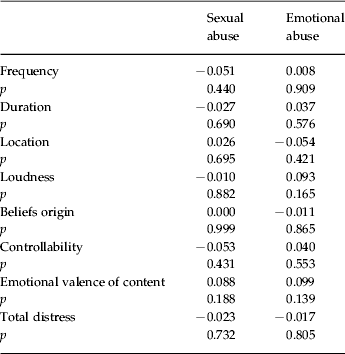
No significant relationships were found between sexual abuse and emotional abuse and AVH characteristics such as frequency, duration, location, loudness, beliefs about their origin, controllability, emotional valence of content and total associated distress (after a Bonferroni correction for multiple testing; p < 0.0028). The Spearman correlation coefficients are presented in Table 5; below each correlation coefficient the significance is given.
Spearman correlation coefficients between sexual and emotional abuse, and AVH characteristics as measured with the PSYRATS
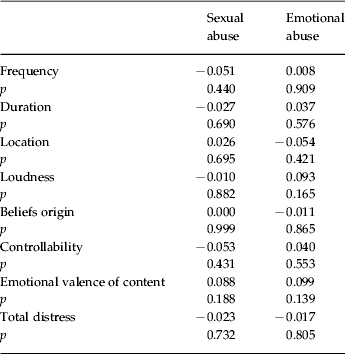
AVH, Auditory verbal hallucinations; PSYRATS, Psychotic Symptom Rating Scales.
Discussion
The aim of this study was to clarify the relation between childhood trauma and AVH: is childhood trauma related to experiencing AVH in relative isolation, or to the presence of predominantly negative AVH as often seen in patients with a psychotic disorder? We found that non-psychotic individuals with AVH and patients with a psychotic disorder and AVH both report having experienced more sexual and emotional abuse during childhood compared with healthy controls. Odd ratios were 2.5 and 3.5 regarding sexual abuse, and 7.3 and 5.7 regarding emotional abuse. Therefore, emotional abuse and sexual abuse in childhood appear to be related to the presence of AVH in general and not to the presence or absence of a psychotic disorder or to the negative emotional content of the voices. No significant difference in the prevalence of childhood traumas was found between the two groups experiencing AVH.
In addition, none of the childhood traumas could provide significant predictive value for the emotional content of voices. Moreover, no correlations were found between sexual and emotional abuse during childhood and specific phenomenological characteristics of AVH. Thus, trauma may be able to trigger both negative and positive voices, either in the absence or in the presence of a psychotic disorder. This suggests that childhood trauma renders the brain vulnerable to experience AVH, rather than just providing the content of these voices.
A cognitive model explaining the influence of childhood trauma on the presence of AVH has been described by Garety et al. (Reference Garety, Kuipers, Fowler, Freeman and Bebbington2001). In this model a central role is defined for cognitive disturbances, leading to external appraisal errors. It is hypothesized that childhood trauma affects the appraisal of internal experiences as arising from an outside agent. Indeed, an external attributional bias was found to be associated with the presence of auditory hallucinations in patients (Morrison & Haddock, Reference Morrison and Haddock1997), but this has not been tested yet in non-psychotic individuals with AVH. In addition, the association between this cognitive bias and presence of trauma has, to our knowledge, not been investigated so far.
As an alternative to this cognitive model a biological mechanism targeting memory-related structures such as the hippocampus and parahippocampal gyrus may be at work. The hippocampus mediates, among others, responses to stress and the return of the brain to pre-stress levels (Read et al. Reference Read, Perry, Boskowitz and Connolly2001). High degrees of stress, however, can permanently reduce the reactivity of the hippocampus (Walker & DiForio, Reference Walker and DiForio1997), leading to a hyperarousal state (Perry, Reference Perry and Murberg1994). As such, distress due to sexual or emotional abuse during childhood will cause the release of stress hormones, such as cortisol. These stress hormones alter connections between the hippocampus and other structures (Leuner et al. Reference Leuner and Gould2010), possibly the parahippocampal gyrus. The parahippocampal gyri integrate and transfer information to the hippocampus (Bauer et al. Reference Bauer, Paz and Paré2007). Speculating, traumatic stress may interfere with the flow of information due to altered connectivity between these two structures. Consequently, information from memory may be activated and generate a hallucinatory experience. Evidence for parahippocampal and hippocampal involvement in hallucinations comes from magnetic resonance imaging studies: pronounced deactivation in the left parahippocampal gyrus has been found to precede AVH in patients with a psychotic disorder (Hoffman et al. Reference Hoffman, Anderson, Varanko, Gore and Hampson2008; Diederen et al. Reference Diederen, De Weijer, Daalman, Blom, Neggers, Kahn and Sommer2010b), and activity in this structure and the hippocampus has also been related to the presence of AVH itself (Jardri et al. Reference Jardri, Pouchet, Pins and Thomas2011). Moreover, during childhood, different brain structures seem to have their own unique sensitive periods in which sexual abuse has a different impact (Andersen et al. Reference Andersen, Tomoda, Vincow, Valente, Polcari and Teicher2008), one of these being the hippocampus. Possibly, trauma during specific periods in childhood might lead to more prominent changes due to these developmental effects. Indeed, the neurocognitive model described above might be further refined when considering these age-specific events.
Hypothesizing on the different models described above, trauma-induced biological changes may lead to cognitive aberrations, which induce anomalous perceptual experiences such as AVH. Indeed, dissociative tendencies were found to be a mediating factor in the relationship between childhood trauma and hallucination proneness (Varese et al. Reference Varese, Barkus and Bentall2011). Although a clear cognitive mechanism from dissociation to hallucinations remains elusive, recent studies suggest that cognitive inhibition is associated with dissociation. This fits well with other evidence that deficits in inhibition are associated with auditory hallucinations in patients (Waters et al. Reference Waters, Badcock, Maybery and Michie2003; Badcock et al. Reference Badcock, Waters, Maybery and Michie2005), and aberrant inhibition that is associated with AVH in non-psychotic individuals (Daalman et al. Reference Daalman, van Zandvoort, Bootsman, Boks, Kahn and Sommer2011b).
Previous studies have proposed pathways as to how trauma during childhood might lead to psychosis later in life, such as the TN model (Walker & DiForio, Reference Walker and DiForio1997; Heim et al. Reference Heim, Newport, Heit, Graham, Wilcox, Bonsall, Miller and Nemeroff2000; Read et al. Reference Read, Perry, Boskowitz and Connolly2001) and a cognitive explanation regarding negative or maladaptive schematic models of the self, of others and the world (Birchwood et al. Reference Birchwood, Meaden, Trower, Gilbert and Plaistow2000). However, these theories are not supported by our data, as we found increased prevalence of childhood trauma also in individuals who experience voices with a positive emotional content, in the absence of psychosis.
Non-psychotic individuals with AVH and individuals with a psychotic disorder and AVH clearly differ on emotional content of AVH (Daalman et al. Reference Daalman, Boks, Diederen, de Weijer, Blom, Kahn and Sommer2011a). However, a possibility is that the theme ‘danger’ may be present in both non-psychotic and psychotic individuals with AVH. The way this theme is expressed differs and might influence associated distress. Non-psychotic individuals frequently hear reassuring and encouraging messages in situations of danger (for instance, ‘he will be okay, don't worry’ or ‘I will warn you if there's danger’), while patients may hear threats (for instance, ‘that man is going to kill you’ or ‘you do not deserve to live’). Indeed, the fact that the emotional content of AVH is apparently not influenced by childhood trauma partly fits the findings of Hardy et al. (Reference Hardy, Fowler, Freeman, Smith, Steel, Evans, Garety, Kuipers, Bebbington and Dunn2005). They found no association between the theme and content of AVH and trauma in 42.5% of the patients in their study. In almost half of the patients (45%), the theme of the hallucinations was influenced by the experienced trauma and only in a small subgroup of patients both the theme and content of the hallucinations were related to trauma (12.5%).
In previous studies, physical abuse during childhood has also been linked to psychosis later in life (for a review, see Read et al. Reference Read, van Os, Morrison and Ross2005). However, in the current study, no predictive value for the presence of AVH was found for childhood physical abuse. In our samples, the prevalence of physical abuse was also higher in the hallucinating groups as compared with the non-hallucinating individuals, but high correlations with a range of 0.32 and 0.50 with the other significant childhood traumas prevented physical abuse to contribute significantly to our model.
Limitations
As with other studies using self-report measures, underreporting remains a possibility since abuse, and in particular sexual abuse, might be susceptible to social desirability: it is denied or kept silent due to shame or feelings of guilt (Graham, Reference Graham1996; Goldman & Padayachi, Reference Goldman and Padayachi2000). Moreover, patients with a psychotic disorder might be more vulnerable to a recall bias, due to other symptoms such as delusions or cognitive impairment. However, two studies demonstrated that patients with psychotic disorders give an accurate history of abuse when interviewed (Read & Fraser, Reference Read and Fraser1998; Read & Argyle, Reference Read and Argyle1999). In addition, patients with schizophrenia are able to accurately report information on their pre-morbid functioning compared with healthy controls (Brill et al. Reference Brill, Reichenberg, Rabinowitz, Harary, Lubin, Davidson and Weiser2007). Furthermore, since age of onset of AVH in the group of non-psychotic individuals is 13.6 years of age, there is a possibility that the childhood trauma might have happened after this age in some individuals, which makes it unlikely that it has been a triggering factor. This limits a causal interference regarding the influence of sexual and emotional childhood trauma to the psychotic group only, since patients were on average 22.6 years of age when they started hearing voices. Information regarding the age at which the abuse took place might have provided the opportunity to correct for this. In addition, traumatic experiences might have age-specific effects during childhood on beliefs about voices (Offen et al. Reference Offen, Waller and Thomas2003) and brain development (Andersen et al. Reference Andersen, Tomoda, Vincow, Valente, Polcari and Teicher2008). Possibly, the non-psychotic individuals with AVH might have experienced abuse in different stages during childhood than patients with a psychotic disorder and AVH, explaining the more malevolent beliefs and/or content in the latter group.
Other factors that might explain the difference in emotional valence of AVH in both groups while prevalence of abuse is similar are the specific circumstances and conditions of the abuse and abuse after childhood. In his review, McCarthy-Jones (Reference McCarthy-Jones2011) suggests that whether individuals are more likely to develop psychiatric symptoms depends not only on the abuse itself but also specific circumstances such as relation to the perpetrator, support from others or punishment for the abuse. In addition, the content of AVH might change from benevolent to malevolent due to trauma, also in adulthood (Jones, Reference Jones2010). Patients with a psychotic disorder and AVH may have experienced more traumas after childhood compared with the non-psychotic individuals with AVH.
In conclusion, both non-psychotic individuals with AVH and patients with a psychotic disorder and AVH experienced more childhood sexual and emotional abuse compared with healthy non-hallucinating controls. The presence of these childhood traumas is neither associated with the presence of psychosis nor with the emotional content or other characteristics of AVH. This suggests a direct relationship between childhood trauma and the vulnerability to experience AVH.
Acknowledgements
This work was supported by the Nederlandse Wetenschappelijke Organisatie (Dutch Scientific Research Organization) (grant no. 916.56.172 and 017.106.301). The Nederlandse Wetenschappelijke Organisatie had no further role in study design, in the collection, analysis and interpretation of data, in the writing of the report and in the decision to submit the paper for publication.
Declaration of Interest
None.