

1. GRAMMATICALIZATION AND THEORETICAL PERSPECTIVES ON LANGUAGE CHANGE
Grammaticalization is ‘the change whereby lexical items and constructions come in certain linguistic contexts to serve grammatical functions or grammatical items develop new grammatical functions’ (Traugott Reference Traugott2001:1). Much has been written on the topic and the full story will not be retold here (Heine et al. Reference Heine, Claudi and Hünnemeyer1991, Hopper & Traugott Reference Hopper and Traugott2003, Roberts & Roussou Reference Roberts and Roussou2003). It is important for the present study and following argumentation that the notion of ‘certain linguistic contexts’ in relation to grammaticalization is to be interpreted as ‘language-specific constructions’ (see Section 1.1). Theoretical approaches to language change in general and to grammaticalization in particular, may be divided into two main approaches: functional and formal (Newmeyer Reference Newmeyer1998). Functional approaches are linked by interest in the use of language and by the assumption that semantic–pragmatic change and structural change are closely related and equally important (Croft Reference Croft2000). Additional functional assumptions are that lexical–grammatical change is non-abrupt and rooted in cognitive and usage-based factors like conceptual metaphor and expressivity (Bybee, Perkins & Pagliuca Reference Bybee, Perkins and Pagliuca1994, Haspelmath Reference Haspelmath1999, Croft Reference Croft2000). Formal approaches, often subsumed under the classification ‘Chomskyan approaches’, focus on structural change, whereas semantic–pragmatic changes are considered as separate, extra-lingual, and less germane to the study of language per se.Footnote 1 The most central aspects of grammaticalization from this perspective are that lexical units and constructions come to merge higher up in the syntactic structure, associated with different functional heads, rather than being moved up to check some features (Roberts & Roussou Reference Roberts and Roussou2003, van Gelderen Reference van Gelderen2004). A principal of structural economy in the language acquisition process is the motivating factor for reanalysis and the rise of new grammatical markers.
One usage-based approach recently emphasized in the context of grammaticalization is Construction Grammar (Hilpert Reference Hilpert2013, Hoffman & Trousdale Reference Hoffman and Trousdale2013, Traugott & Trousdale Reference Traugott and Trousdale2013). Main assumptions from this perspective are that form and meaning are paired as equals; semantic structure is mapped directly onto syntactic structure rather than being interpreted from syntax (Hilpert Reference Hilpert2008, Traugott Reference Traugott2008) and language structure is shaped by language use (Traugott & Trousdale Reference Traugott and Trousdale2013:3). No one level of grammar is autonomous, or ‘core’ (see Fried & Östman Reference Fried, Östman, Fried and Östman2004:24). Rather, constructions include all dimensions of language architecture; for example, form covers syntax as well as phonological aspects, while meaning covers semantics as well as discourse meaning. These assumptions have also been used to put forward the advantages of a constructional view on grammaticalization because the perceived degree of gradualness, which is accentuated within Grammaticalization Theory, can be described as incremental steps in various dimensions of a structure (Traugott Reference Traugott2008, Traugott & Trousdale Reference Traugott and Trousdale2013). Moreover, many grammaticalization scholars have emphasized entire constructions (in the non-technical sense) as the source of grammatical meaning (Bybee et al. Reference Bybee, Perkins and Pagliuca1994:11; Heine & Kuteva Reference Heine and Kuteva2002; Lehmann, Reference Lehmann2004). The case study in this paper is based on a Construction Grammar approach to grammaticalization with the assumption that a concessive inference is conventionalized in particular constructions due to a resolved mismatch between features of form and features of meaning.
1.1 Theoretical point of departure
The case study in this paper represents a typical example of grammaticalization, the development of a content word or ‘contentful construction’, including the adjective/adverb fast, ‘steady’, ‘strongly’, and the particle än, ‘than’, into a function word, or grammatical/procedural construction fast(än) ‘even though’, ‘although’. The use of a specific construction, or clause type, known as a generaliserande bisats (universal concessive clause) in Swedish, [wh AP (NP) än VP], hur mycket han än ville ‘how much he ever wanted’, seems to be the main locus of this development. It corresponds to the subclause part of universal concessive conditionals, henceforth UCC constructions as described by Haspelmath & König (Reference Haspelmath, König and van der Auwera1998). Hence, I will take a constructional view on grammatical change, even though the focus is on the lexical dimension of constructions and how a remapping between form and function creates new grammatical material. It would also be interesting to study the interaction between different instances of concessive constructions and how they relate to and interact with other (similar) constructions at a more abstract clause level. For example, studying relations between different concessive subclauses and concessive predicative phrases is the aim of future work (see Hilpert Reference Hilpert2013). Functionalist work on grammaticalization has been relatively divided without a common theoretical ground. As such, Construction Grammar is a promising approach. Diewald (Reference Diewald and Schönefeld2006) points out some aspects of Construction Grammar particularly suited for grammaticalization research. Firstly, it sees idiomatic structures and irregular language phenomenon as central. This is important in grammaticalization, whose initial stage often begins with irregular innovative patterns (Diewald Reference Diewald and Schönefeld2006:8). Secondly, in Construction Grammar the notion of mismatch (Michaelis Reference Michaelis, Cuyckens, Dirven and Taylor2003, Traugott & Trousdale Reference Traugott and Trousdale2013) is about resolving conflicts of semantic compatibility in a construction by the reinterpretation of certain lexical items in terms of their fit for the constructional meaning. The theoretical notion of mismatch will be central throughout this paper. I follow Traugott & Trousdale (Reference Traugott and Trousdale2013:19) in linking mismatch to compositionality:
From a constructional point of view, compositionality is best thought of in terms of match or mismatch between aspects of form and aspects of meaning . . . If a construct is semantically compositional, then as long as the speaker has produced a conventional sequence syntactically, and the hearer understands the meaning of each individual item, the hearer will be able to decode the meaning of the whole. If it is not compositional, there will be mismatch between the meaning of individual elements and the meaning of the whole.
Moreover, Traugott & Trousdale distinguish between constructional change, ‘change affecting one internal dimension of a construction’ and constructionalization, ‘the creation of formNew–meaningNew (combinations of) signs’ (Traugott & Trousdale Reference Traugott and Trousdale2013). They exemplify constructionalization with the development of English binominal partitives ‘a part/share of NP’ like a lot/bit/shred/of an N into grammatical quantifiers. In Old English lot referred to an object like a piece of wood and by metonymy to a share/unit of something, lot of land (for sale), Traugott & Trousdale (Reference Traugott and Trousdale2013:23). In later stages of English we begin to find uses in contexts giving rise to the pragmatic inference from a unit (for sale) to large quantities of that unit. In the process, lot loses in content and becomes procedural (grammatical) both in meaning as a quantifier and in structure, going from head in a lot (parcel) of land (for sale) to modifier in a lot of land, ‘a large quantity of land’. During the process there was a mismatch between form and meaning because the syntactic head was that of the partitive (NP1), while the semantic head was that of the modifier (NP2). Traugott & Trousdale (Reference Traugott and Trousdale2013) emphasize that constructionalization cannot be identified until both morpho-syntactic and semantic changes appear in the textual record.
1.1.1 Clarification of terminology
1.1.1.1 Construction and context
The term construction refers, from a Construction Grammar approach, to the abstract instances that license well-formed (actually occurring) linguistic expressions called constructs (Bergs & Diewald Reference Bergs and Diewald2008, Traugott Reference Traugott2008). Early work restricts the notion of construction to form–meaning pairings with a partially non-compositional meaning (Goldberg Reference Goldberg1995). Croft suggests that constructions ‘can be thought of as the same theoretical type of representation object as lexical items, albeit syntactically complex and at least partially schematic’ (Croft Reference Croft2001:16). The concept of construction has been expanded to compositional strings, which ‘are stored as constructions even if they are fully predictable, as long as they occur with sufficient frequency’ (Goldberg Reference Goldberg2006:5). It is the latter view that is adopted in this paper. A few points must be stressed in relation to the terms discussed. Firstly, an important distinction is that between syntactic context and pragmatic context. Context is used here as the equivalent of the linguistic environment of a given item, not necessarily delimited to single constructions or clauses. Pragmatic context thus refers to external factors such as communicative situation, genre, speaker strategies, and so on. This may seem a trivial point, but it will clarify the following discussion.
In recognizing micro-changes or stages of development, Heine (Reference Heine, Wischer and Diewald2002) and Diewald (Reference Diewald, Diewald and Wischer2002, Reference Diewald and Schönefeld2006) focus on the role of different contexts in grammaticalization. These contexts in turn consist of different constructions, more or less fixed patterns or idioms corresponding to different degrees of a grammaticalization process. In Heine (Reference Heine, Wischer and Diewald2002) the first stage is defined as unrestricted context, associated with a source meaning, similar to Diewald's (Reference Diewald, Diewald and Wischer2002) untypical context, which I here regard as a better term because elements involved in a grammaticalization process often start out in new contexts that function as prerequisites for further change. In the next and most important stage they identify a context termed either critical (Diewald) or bridging (Heine Reference Heine, Wischer and Diewald2002). In this stage a new (grammatical) meaning is foregrounded as an inference due to the use of an item in a particular environment. Diewald (Reference Diewald, Diewald and Wischer2002) describes this context as ‘characterized by multiple structural and semantic ambiguity, inviting different interpretations, including the target meaning.’ In some cases the grammaticalization process may reach a stage called switch context (Heine Reference Heine, Wischer and Diewald2002) or isolating context (Diewald), in which the target meaning ‘is isolated as a separate meaning from the older, more lexical meaning’ (Heine Reference Heine, Wischer and Diewald2002:85), with ‘specific linguistic contexts that favor one reading to the exclusion of the other’ (Diewald Reference Diewald and Schönefeld2006:5). In the last conventionalization stage, the item may be used in the new grammatical meaning without support of the context that gives rise to it. Diewald (Reference Diewald and Schönefeld2006) concludes that central concepts of Construction Grammar may help sharpen context types in grammaticalization, for example in their analysis as different constructional idioms. In this paper I will argue that the constructions including fast(än) may be described using the context stages detailed above (see further Section 2 below). I will use Diewald's definitions of contexts: untypical, critical, and isolating.
1.1.1.2 Logical relations: Concessive and conditional
Finally, it is necessary to define conditionals and concessives, which are the logical relations or clause types in focus for the present discussion. Conditional, concessive and adversative relations are closely connected in respect of causality, factuality, and temporality. Conditionals are non-factual relations where the subordinated clause antecedent constitutes a sufficient condition for the main clause, descendent, to be true, if x, then y (if Sara goes, I will go), hence there exists a causal relation between a condition in clause 1 and a consequence in clause 2. A concessive relation, on the other hand, expresses counter-expectation, incompatibility, and an unfulfilled causal relation between the two clauses, even if (irrespective of) x, then y (even if Sara goes, I will stay home). The antecedent, factual or not, semantically represents an insufficient barrier in relation to the assumption in the descendent. Adversatives are closely related to concessives in terms of incompatibility but constitute clauses on the same level. Adversative relations express that it is remarkable that two propositions are simultaneously valid, Sara will go there, but I would not (Haspelmath & König Reference Haspelmath, König and van der Auwera1998, SAG Reference Hellberg and Andersson1999). The universal concessive conditional or UCC construction is a subclause referring to an indefinite set of referents, which all hold that the main proposition is true: whoever you are, I cannot help you. The antecedent in a UCC construction usually consists of an interrogative pronoun and an adversative adverb (usually än but also så) in Swedish, sometimes with an adverbial of degree or a relative phrase som helst, corresponding to most of the examples SAG defines as generaliserande bisats, as follows in A–C:
A.

B.
C.
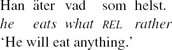

The pattern in C is the most important one for the present paper.
1.1.2 Motivations and mechanisms of transfer
There has been a debate about how to best describe and explain the locus of grammaticalization changes: in terms of metaphorical extensions (Sweetser Reference Sweetser1990, Heine et al. Reference Heine, Claudi and Hünnemeyer1991, Andersson Reference Andersson, Zlatev, Andren, Falck and Lundmark2009), or pragmatic inferences (Traugott & Dasher Reference Traugott and Dasher2002). Recently, Traugott & Trousdale (Reference Traugott and Trousdale2013) have clarified the view on motivations and mechanisms involved in grammatical and constructional change. Small-scale changes originate from what they call neoanalysis, an updated term for the reinterpretation of invited inferences. When interpreting an utterance, the listener creates an alternative mental representation in trying to link nodes in the network following the principle of best fit. When no direct link is available (semantically or syntactically), ‘the hearer will attempt to make the best fit with an extant node or feature of a node, resulting in partial sanction. This is an innovation by the hearer’ (Traugott & Trousdale Reference Traugott and Trousdale2013:52). They argue that neoanalysis is a more plausible term than the more common term reanalysis, in that speakers do not always reinterpret something that they have stored but rather make implicatures ‘on the fly.’ Neoanalysis often results in mismatch or non-compositional meaning, a kind of incongruence between the form and meaning features of a construction. Mismatches reflect intermediate stages of change in which different interpretations of a construction are possible. When they become resolved and spread to more speakers in the community, it may lead to changes in both form and meaning and new constructions arise. As to motivations for grammatical change, earlier approaches refer to expressivity as a main motivation for change; that is, innovative ways of expressing oneself due to some social purpose (Haspelmath Reference Haspelmath1999). Traugott & Trousdale (Reference Traugott and Trousdale2013) seem to define motivations from a more hearer-oriented perspective in terms of parsing or analogical thinking respectively. Of course, it is not easy to determine which is the chicken and which is the egg in these explanations. The use of innovative and novel expressions might be (and probably is) rooted in or determined by analogical thinking, as might be the (re)interpretations of such expressions. Either way, all mechanisms referred to are usage-based and it follows that the notion of constructions may be the main locus for neoanalysis because the remapping of form and function ‘occurs in the production or perception of constructs’ (concrete instances of constructions) (Traugott Reference Traugott2008:36).
1.1.3 Semantic implication (bleaching, generalization)
Semantic change or implication is commonly emphasized in usage-based approaches to grammaticalization. In terms of bleaching, generalization, and weakening, semantic change as the loss of propositional content has been seen as prior to morpho-syntactic and phonological change in many works on grammaticalization (Bybee et al. Reference Bybee, Perkins and Pagliuca1994, Heine & Kuteva Reference Heine and Kuteva2002). In other works, semantic grammaticalization has been studied as a separate dimension, for example in van der Auwera & Plungian's (Reference van der Auwera and Plungian1998) work on modality maps or Traugott & Dasher's (Reference Traugott and Dasher2002) work on universal semantic paths. It seems to me however that grammaticalization always involves a remapping between form and function; that is, both semantic and structural changes are involved in the process. A constructional approach has the advantage of not assuming that change in one dimension, such as semantics, has to simultaneously correlate with change in another, such as syntax, compare. how bleaching is described in formal approaches, analyzed as a direct consequence of structural change (Roberts Reference Roberts2010).
2. METHOD AND CORPORA
There are several historical resources available at the Swedish Language Bank, University of Gothenburg, both corpora and lexica.Footnote 2 Three digitalized historical dictionaries from Old Swedish to Modern Swedish are integrated in the infrastructure including the extensive Old Swedish Dictionary edited by Söderwall (1884–1953), which is an important work for all scholars interested in Old Swedish. The object of study, the construction fast(än), was identified in an experiment on tracking change semi-automatically in linking historical lexical resources (Andersson & Ahlberg Reference Andersson and Ahlberg2013). The experiment was based on tracing identical forms over time, but forms with differences in part-of-speech information. Examples of both known and unknown (potential) grammaticalization changes were discovered, such as the development of the preposition mot ‘to(wards)’, from the Old Swedish noun mot ‘meeting’, the prepositional use of hos ‘at’, and vid ‘by’, in Present-Day Swedish from their earlier adverbial use. Likewise, some Old Swedish adverbs and adjectives have developed subordinating counterparts in Modern and Present-Day Swedish. Examples are innan ‘inside, during’, and the object of study in this paper, fast ‘steady’, ‘robust’, with the corresponding later uses of innan ‘before’, and fast(än) ‘although’. They are not noted as conjunctions/subjunctions in Old Swedish dictionaries (Söderwall) and empirical data support a diachronic development from adverbial to subordinating functions.
A generous estimation of the size of all the historical corpora in the Swedish Language Bank amounts to about 960 million tokens. However, the bulk of this material consists of the KubHist Corpus of about 877 million tokens, a large corpus of historical newspapers (1750 –1927) with several OCR errors that have not been manually corrected and proofread. The remaining part of about 100 million tokens consists of novels and letters from the 19th century and up to Present-Day Swedish (late 20th century). The primary data in this study were however derived from a proofread corpus from Old Swedish (1225–1526) and Early Modern Swedish (c. 1526–1732) of about five million tokens from the most relevant period in time for tracing the development of fast(än). The corpus was originally compiled and proofread in Lund by Lars-Olof Delsing and associates.Footnote 3 At the Swedish Language Bank, this corpus is extended with Old Swedish legal documents (charters) by one million tokens. Old Swedish texts exist mainly in the form of provincial laws, legal documents, and religious texts (Bible texts and legends), some of which were translations from Latin. The Early Modern Swedish period traditionally begins with the new Bible translation in 1526, and later with what is known as the Gustav Vasa Bible in 1541. Corpora from this period are comprised of Bibles, legal documents, chronicles, novels, personal letters and anecdotes. In the Modern Swedish period, the language moves towards a simpler inflectional system, going from four to two cases, to a modern two-gender system, and to the lack of numeral verb inflection. Also, syntactic notions are more established in Modern Swedish with the fixation of VO order and subject requirement.
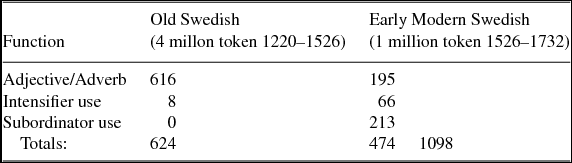
As the first step, all attestations of the lemma fast(än)Footnote 4 were excerpted in Old and Early Modern Swedish, then manually inspected and divided into three main groups based mainly on their syntactic function and likely meaning.Footnote 5 I will not present any fine-grained semantic analysis within the different groups and will only highlight the most important distinctions for the main purpose of analyzing the development of fast(än). The first group includes constructions including fast as an adjective/adverb in the meaning ‘steady’, ‘robust’, ‘strongly’, or ‘quickly’ (Section 3, example (1)). The second group includes constructions including fast as an intensifier, modifying other adjectives and adverbs, in the meaning ‘much’, ‘very’ (Section 3, example (2)). The third group includes constructions including fast(än) as a concessive marker or subordinator ‘even if’, ‘although’ (Section 3, examples (7)–(10)), but also the attestations that presumably show a stage of remapping between form and function (Section 3, examples (3)–(5)). Searches were performed using the KORP search interface, a tool developed at the Swedish Language Bank in Gothenburg with additional information on statistics and trend diagrams (Borin, Forsberg & Roxendal 2012). The search interface enables searches for fast in different positions, such as the initial clause position, and in different collocations. It makes manual syntactic and semantic disambiguation more efficient. For example, I searched for collocations with fast and än, with an additional condition of up to three random words in between, which picked up variants of the UCC construction. The corpus used is not yet tagged for parts of speech, but work on the annotation of the historical corpora has been initiated (Adesam, Ahlberg & Bouma Reference Adesam, Ahlberg, Bouma and Jancsary2012, Adesam et al. Reference Adesam, Ahlberg, Andersson, Bouma, Forsberg, Måns, Calzolari, Choukri, Declerck, Loftsson, Maegaard, Mariani, Moreno, Odijk and Piperidis2014). Table 1 shows all attestations of fast and fast(än) in the corpus, divided into the three groups discussed. Spelling variants were not present.
Instances of the lemma fast(än) in the corpus.
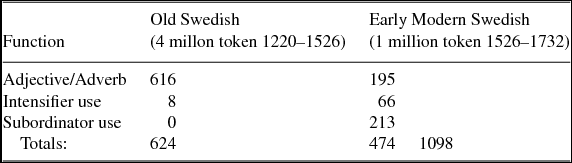
The total number of fast attestations in the corpus is 1,098 tokens. Considering the balance between Old Swedish and Modern Swedish corpora, the use of fast(än) clearly increases in Early Modern Swedish. The majority of fast attestations in Old Swedish are, not surprisingly, adjectives in the meaning ‘steady’. Many of those attestations may be traced to an idiom or construction found in Old Swedish laws, fast oc fult ‘entirely’. Other attestations refer to fast as an adverb of manner meaning ‘strongly’ or ‘quickly’ (see further Section 3.1 below). We can only identify eight clear examples of an intensifier use in Old Swedish in which fast modifies other adverbs or adjectives, hence with a more abstract, intensifier meaning. Those examples are exclusively found in the late Old Swedish period, for example from the tale of King Didrik of Bern, ‘Sigiord war fast trötter’ ‘Sigiord was very tired’ (Didrik of Bern, c. 1500).
In Early Modern Swedish (1526–1732), the use of fast as an intensifier increases, especially in the 16th century (see Section 3.2 below). However, the attestations of a subordinating use in this period are rather few and will be further discussed in Sections 3.3–3.4. Clear uses of fast(än) as a conventionalized concessive subordinator are primarily linked to two sources in the 18th century: that is, Runius’ prose from 1710 and the extensive Corpus of Dalin, Then Swänska Argus. The latter is a collection of Dalin's moral-satirical weekly magazine published between 1732 and 1734, in the beginning of late Modern Swedish. As many as 236 attestations of fast(än) are found in this material, many of them with a subordinating function (see Section 3.5 below). The most pertinent question for this study however is what happened during the evolution of its status as an intensifier to that of a subordinator. In trying to answer this question, I also include the excerpts from the extensive historical dictionary SAOB in this study. SAOB has an extensive archive of excerpts from the 16th century up to Present-Day Swedish and notes fast together with other subordinating elements, in a couple of attestations described as ‘concessive coloring of fast’ (see further Section 3). Most of these excerpts may in fact be related to the UCC construction introduced in Section 1.1 above.
The attestations identified are further considered in relation to the different types of contexts described above. I will argue that the context stages correlate with different types of constructions.
3. THE DEVELOPMENT OF FAST(ÄN)
To my knowledge, the development of fast(än) has not previously been studied in any detail. As mentioned in Section 1.1 above, the initial stage of development may be traced to a critical context or construction in Early Modern Swedish, which I here define as a UCC construction (universal concessive conditional) following Haspelmath & König (Reference Haspelmath, König and van der Auwera1998). Particular constructs of this pattern in the 16th century seem to pave the way for the rise of concessive fast(än) due to pragmatic reinterpretation following the principle of best fit to a subordinating construction.
3.1 Old Swedish fast and its Germanic cognates
Like the cognates in English, German, and Danish, Old Swedish fast is mainly used as an adjective with continuing productive meanings such as ‘steady’, ‘robust’, and ‘secure’. Alongside this original meaning, adverbs (of manner) appear during the medieval age, such as the English modern meaning ‘fast’, ‘quickly’ and Swedish ‘strongly’. Later uses include the use as an intensifier, modifying another adjective or adverb, in the meaning ‘very’ or ‘much’, which begins to increase in frequency during early Modern Swedish (16th century). I will argue that the latter use forms the starting point of a development towards a concessive marker because of the high frequency in 16th century and the attestations in adversative and concessive contexts (see further Section 3.2). Examples (1a–c) summarize the adjectival and adverbial uses in Old Swedish.Footnote 6
(1)
Different readings such as ‘steady, ‘strongly’ and ‘quickly’ are of course closely related. Whether we interpret them as adjectives, ‘steady’, adverbs, ‘strongly’ or ‘quickly’, depends on the context. To imagine warriors rushing quickly forward, as in example (1b), implies a strong and violent manner of rushing or vice versa (compare the second instance in example (1b)). In Modern English the meaning of ‘quickness’ has taken over and in German the meaning ‘almost’ is the productive one. Söderwall (1884–1953) also notes this meaning in Old Swedish, but it seems to be very rare and it has not developed into Modern and Present-Day Swedish.
From its primary syntactic function, the adverb comes to be used as an intensifier, adverbial of degree, in the meaning ‘very’, ‘much’, as in fast bättre ‘much better’ and fast mer ‘much more’. It is the use as an intensifier that constitutes the starting point of further development.
3.2 Stage 1. Untypical context: Fast as an intensifier ‘much’, ‘very’
In the initial stage, fast is used as an intensifier, strengthening abstract notions represented by adjectives or adverbs such as proficiency, sharpness, and cruelty. In the use as an intensifier, fast no longer qualifies verb actions but modifies an adjective or adverb as an adverbial of degree. We may correlate this new function with a more bleached meaning. Furthermore, as early as the late Old Swedish period, we begin to see fast in adversative or concessive contexts with the function of emphasizing or strengthening an incompatible relation between two propositions.
(2)
Example (2b) shows an explicit adversative relation linked by the conjunction men ‘but’, hence two opposing propositions. Fast acts as an intensifier emphasizing the opposing clause and the adverbial phrase ‘different’. In (2c) fast strengthens the concessive clause, initiated with the Old Swedish concessive subordinator än thå at ‘even if’. Note that the complex subordinator än thå at sustains the concessive meaning, and fast still only strengthens the second proposition and the main action ‘the promises made’. I am inclined to call all instances in (2) untypical in the sense of Diewald (Reference Diewald and Schönefeld2006), because fast is used in a new context as an intensifier, strengthening some state of affairs instead of modifying the main verb action as an adjunct.
3.3 Critical contexts: UCC constructions
In the critical context stage, the lemma fast is used in clause initial position with support of question markers and the adverb än. The abstract constructional pattern [wh AP (NP) än] corresponds to the notion of UCC constructions, which here are to be interpreted as ‘hur mycket (NP) än (VP)’ (‘how much NP, than VP’), ‘no matter how much’. The construction refers to the indefinite and unrestricted value of referents expressed in an antecedent, ‘no matter if x, y, or z, still q’. The paraphrase, hur mycket än ‘however much’ is common in the extensive Swedish historical dictionary SAOB.Footnote 7 Constructs with fast in combinations with the adverb än or så, and subordinating elementsFootnote 8 expressing manner (hur), condition (om), or place (var), are shown in (3a–d).
(3)
All four attestations in (3) include the paraphrase, hur mycket än ‘however much’ or även om ‘even if’ in SAOB and are explicitly commented as concessive coloring of fast. It is however impossible to interpret the meaning of single elements in those examples, such as the specific meaning of the adverb än. In Old Swedish än may refer to such disparate notions as a generalized point in time (once, henceforth, ever), adversative, conditional and comparative relations, or as a general intensifier stressing such relations (Söderwall Reference Söderwall1884–1918. A plausible interpretation seems to be that the function in (3) is to strengthen the incompatible relation between the antecedent S1 and the descendent S2, with the function of an adversative and generalizing adverb (‘though’). This analysis is equivalent to the definition in modern Swedish grammars for än in similar constructions (SAG Reference Hellberg and Andersson1999). Wessén (Reference Wessén1965) describes the particle ä (e) in similar constructions in Old Swedish, even though usually placed in initial position as a non-stressed particle (etymologically ‘always’), later functioning only as a generalized comparative marker (‘ever’); see further Section 4. In (3c–d), fast and än is explicitly combined with the marker um/om ‘if’ expressing conditional relations. The meaning of fast may still be interpreted to be that of an intensifier ‘much’. However, I will argue that the semantics of the UCC constructions in (3) are non-compositional. If a hearer who interpreted constructions like [whfast än] with concessive meaning, such an interpretation in the words of Traugott & Trousdale (Reference Traugott and Trousdale2013:52), would be ‘an innovation at the level of the construct or token, specifically a neoanalysis at the meaning level resulting in mismatch between pragmatics and syntax’; in this case, between a concessive inference at the meaning level and an interrogative adverbial of degree at the level of form.
In informal Finno-Swedish texts the explicit combination of fast and the interrogative hur(u) is identified (5a–b), even though (5b) is from the 20th century.
(4)
In (4), an interrogative adverb huru ‘how’ occurs together with fast. It seems to be the combination of the intensifier fast and the interrogative adverb how that makes the concessive meaning foregrounded in those examples, with support of the conditional constructions in which they appear, including om and än. These examples may also be defined as UCC constructions semantically, even though the structure is different from the main pattern [wh AP NP än VP]. Note especially that fast precedes the interrogative huru in those examples.
3.4 Stage 3. Isolating context: CC constructions
Heine (Reference Heine, Wischer and Diewald2002) points out that in order to become a part of the lexical meaning of a particular linguistic item, it is necessary to reach a stage of isolating context or switch context: ‘This stage is characterized by an interaction of context and conceptualization, leading to the rise of new grammatical meanings’ (Heine Reference Heine, Wischer and Diewald2002:83). In this stage, fast is placed clause-initially in the antecedent (S1), usually followed by a subject and the particle än. The examples in (5a–b) are the earliest attestations of this construction and will be central for the following argumentation. I would like to define those examples as CC constructions similar to the examples in (3)–(4), even though they lack the support of other subordinating elements (wh-markers):
(5)
The placement of fast in initial clause position without support of wh-elements strongly favors a concessive reading, ‘even if’.Footnote 9 The intensifier reading is backgrounded due to the quantificational phrases already expressed in the main clause, better spisadt ‘better fed’, in (5a), and aldrig så köön ‘never so skillful’, in (5b). The content of the antecedent no longer refers to indefinite referents, ‘even if the food had been x, y, or z’, but rather to one specific barrier, ‘even if the food had been x, still q’. Altogether, the universal concessive construction is reinterpreted as a concessive conditional construction without marking for indefiniteness or quantificational meaning [Sub NP än VP], in which fast is reinterpreted to fit the new construction, filling the subordinator slot. In this case the mismatch can be said to have been ‘resolved’ through the principle of best-fit to existing constructions in the network. The result is a new pairing of form and meaning, a concessive relation at the meaning level is matched with the status as a subordinator at the syntactic level.
During the remapping, fast loses semantic properties as a consequence of resolving the mismatch between lexical meaning and constructional meaning. Furthermore, the function of the particle än is still somewhat mysterious, probably doing the ‘adversative work’ in those constructions as well, and combined with fast comes to carry the concessive meaning as a complex subordinator in the new construction [fast NP än VP].
A more general point in relation to the lack of wh-elements in (5) is that interrogative clauses seem to lack the wh-element rather frequently as early as in Old Swedish, as seen in (6a–b) and Modern Swedish (6c).Footnote 10 Example (6d) shows a UCC construction with hur(u) and än in Old Swedish, as noted by Söderwall.
(6)
The attestations in example (6a–c) show constructions without wh-elements before different gradable adjectives, länge ‘long’, manga ‘many’ and stor ‘big’. All of these instances constitute arguments for the possibility of leaving out interrogatives even in UCC constructions with gradable adjectives. To conclude, taking examples (3)–(6) altogether, I once again stress the necessity of analyzing the entire construction as the unit of analysis. The complex phrases om än fast, fast hur, så fast än, etc. are non-compositional constructions that leave us with a concessive inference in larger conditional constructions, thus resulting in a mismatch between features of form and features of meaning.
In addition, I have found an almost identical isolating context in which fast lacks the support of än. The concessive reading becomes even more obvious in this example, identified in the very interesting Chronicles of Peder Swart in 1560, compare example (5a) above.Footnote 11
(7)
In example (7), fast initiates a hypothetical condition without the support of wh-elements and än. The antecedent, ‘if the priests would have read it’, refers to an insufficient and remarkable barrier in relation to the truth value of the main clause, ‘common people would have listened and put faith in it’ (descendent). It would have been expected that common people during this time would heed the words of the priests and believe in what they say. In this case, fast alone seems to be the carrier of the concessive meaning, ‘even if’, but it still needs the support of a similar context that gave rise to it, hence a conditional construction. Moreover, the main clause includes the adversative adverb naplika ‘hardly’, strengthening the inconsistency. The intensifier reading ‘much’ does not make much sense in a paraphrase equivalent to the UCC constructions in examples (3)–(4), given in (8).
(8) And no matter how much they would have read the letter, common people would still not have put any faith in it.
Following Heine (Reference Heine, Wischer and Diewald2002) and Diewald (Reference Diewald, Diewald and Wischer2002, Reference Diewald and Schönefeld2006), the context in (7) may be defined as an isolating context. However, the concessive inference of the lexical item fast is then not yet fully conventionalized. It would also be possible to consider example (7) as a proper conditional with fast, meaning ‘if’, but I have argued that an insufficient barrier is present and not only a causal relation between the two propositions.
3.5 Stage 4. Conventionalization of implicatures: Concessives proper
In the last stage it is certainly easier to talk about a conventionalization of concessive meaning ‘even if’, ‘although’. The construction fast(än) does not need the support of other subordinating elements or conditional contexts. The examples in (9) show two instances with fast and än, as two words, in (9a), and fused, in (9b).
(9)
In Dalin's Argus, towards the end of the early Swedish Period (1732), we see a great many examples of fast and än both represented by two words and as one word. The earliest instance attested including fastän as a single item is found in the late 17th century in Samuel Columbus's tale of friends and colleagues Mål-Roo or Roo-mål.Footnote 12 Furthermore, examples, in (10b–c), show the earliest attested instances of fast as a proper concessive without the support of än and conditional contexts (see (7) above). This means that fast(än) as a subordinator fits the pure concessive construction [Sub NP VP] without a following descendent:
(10)
In Present-Day Swedish, fast sometimes corresponds to the adversative ‘but’ and fastän always to the factual concessive ‘although’. The distribution and restrictions between the distributional Present-Day functions of fast and fastän must however be the subject for another paper. Given fastän as a single concessive item, we may talk about univerbation, a term commonly used for the fusion of two words into one, a process coinciding with the loss of semantic properties and/or phonetic reduction. This is also a natural cause for the reinterpretation to fit a new concessive construction. Furthermore, concessive clauses with fastän express a factual proposition and a given truth value corresponding to the meaning ‘although’ in Present-Day Swedish; that is, the causal condition between the clauses is fulfilled. The grammaticalization of fast(än) as a concessive subordinator continues in the 17th and 18th centuries, being increasingly frequent in the corpora used. Why then, does fast reach a stage of conventionalization only in Swedish, and not in other Germanic languages? Heine gives a general explanation:
Most context-induced inferences remain what they are: they are confined to bridging contexts, they are what has variously been described as ‘contextual meanings’ or ‘pragmatic meanings’. But some of them, i.e. those acquiring switch contexts, may develop some frequency of use, they no longer need to be supported by context, and they turn into ‘normal’ or ‘inherent’ or ‘usual’ or ‘semantic’ meanings. (Heine Reference Heine, Wischer and Diewald2002:85)
In the other Germanic languages, fast obviously does not reach a stage of concessive subordinator, probably due to the lack or infrequency of use in concessive contexts together with adversative adverbs, such as än or so in Swedish. Considering the end stage of development, I would also like to mention Lehmann's (Reference Lehmann1982/2002) well-known parameters of grammaticalization. They may be used synchronically as criteria to determine the degree of grammaticalization of a linguistic unit. The criteria concern the autonomy of a linguistic sign. Some of them are more pertinent than others in relation to this study. During the conventionalization stage, however, fast is bound to and eventually fuses with the particle/adverb än (bondedness). As an intensifier, fast already shows scope extension and even more so as a subordinator, taking scope over whole constructions. As to syntagmatic variability, it is more fixed in the subordinator position in the isolating and conventionalization stage; in the critical stage, fast may be rather freely shifted around in the UCC construction. The parameters correlate with different context stages.
4. DISCUSSION
Given the fact that fast necessarily combines with other subordinating elements in the critical context stage, resulting in irregular phrases with non-compositional meaning, the story of its evolution is well-suited for a constructional approach to grammaticalization. It is thus questionable to discuss the conventionalization of inferences in relation to single linguistic items. In modern Swedish it is apparently true that fast(än) expresses a conventionalized concessive (or adversative) meaning, but in stages during the development we have to consider larger patterns such as the UCC construction [wh AP (NP) än VP] to identify the concessive meaning. In the critical contexts it is ambiguous whether UCC constructions, including fast and än, have a universal quantificational or a concessive meaning. Without the support of wh-elements (var, hur) referring to an indefinite number of referents (barriers) or explicitly emphasizing the conditional meaning (um/om), constructs with fast and än are reinterpreted as purely concessive constructions [Sub NP än VP], and later univerbated into more fixed concessives [Sub NP VP]. During the remapping, the mismatch between a concessive (conditional) meaning and syntactic status as an (interrogative) adverbial of degree is resolved. The textual record is however too poor to establish a diachronic relation between critical and isolating contexts; that is, a diachronic path from UCC constructions to CC constructions, but the earliest attested UCC constructions in 1536 and 1543 precede the first attestations with fast in initial clause position (1560). Moreover, the marginal use of UCC constructions including fast and än after the 17th century certainly indicates such a relation.
Figure 1 subsumes and illustrates the development through unification of context stages and different constructions.
The diachronic development of fast(än).

The development from the critical context stage to the isolating stage shows an increased degree of grammaticalization or rather constructionalization. We may actually interpret the development as grammatical change both of particular lexical items, fast + än, and of a rather abstract UCC construction [wh AP (NP) än VP] into a concessive construction [Sub NP VP]. In the critical context stage, we may consider the pattern a stylistic innovation for hearers and readers to reinterpret and choose the suitable meaning for themselves (Diewald Reference Diewald and Schönefeld2006). The mismatch between semantics and syntax can be said to have been ‘resolved’ by negotiations between speaker and addressee resulting in a new pairing that provides a more transparent reading: concessive meaning is matched with subordination at the syntactic level. It is interesting to note that at least one other concessive subordinator seems to have an almost identical history as fast(än). The rise of the concessive marker ehuru, ‘even if’, may in fact also be traced to UCC constructions in combination with the intensifier hart, ‘much’, and the non-stressed particle ä(e) emphasizing adverbs of degree or time (ehuru, enär). Wessén (Reference Wessén1965) points out that the only function of the particle ä(e) in later stages is to generalize a certain proposition (compare English equivalents whenever, however, whoever). SAOB notes the particle e with concessive meaning in combination with interrogatives, later enclitically attached, etymologically referring to the truth value of main clauses in conditionals and concessives (Wessén Reference Wessén1965:296ff., SAOB, e). Note that än is placed together with thå ‘though’, in the main clause performing the adversative work:
(11)
Given similar interpretations of the constructs ee huru hart and (wh) fast än, ‘however much’, we may refer to the mechanisms of analogy and analogical thinking as described by Traugott & Trousdale (Reference Traugott and Trousdale2013). Analogical thinking may also be the motivation behind the principle of best fit in storing fast(än) as a subordinating construction in the network. Related concessive constructions may have been the forerunner of this development. A more detailed study of other UCC constructions would be needed to say more on this matter.
As to the order of changes in form and meaning, it seems that changes at the level of meaning precede changes at the level of form. From a constructional point of view however, both semantic-pragmatic and morpho-syntactic features are by definition included in the construction as a whole, which means that there are no theory-based reasons for assuming a certain order or linking rules of different features, a problem that has not been satisfactorily explained in earlier approaches to grammaticalization. Another advantage of a constructional approach is that it does not assume simultaneity of changes in form and meaning. As to the question of motivating factors (Section 1.1), we may be left without an answer. It is extremely difficult to establish a link between the critical and isolating contexts and language-external factors. It is interesting to note, however, that most examples from the critical context stage are found in rather formal letters and chronicles, many of which trace back to King Gustaf Eriksson, better known as Gustav Vasa. His chronicle was written by Bishop Peder Swart, but likely dictated by the king himself, and the collection of Gustavian letters written during the 16th century are highly interesting as linguistic sources (Almquist Reference Almquist1861–1916, Eden, Reference Eden1912). Gustav Vasa is often mentioned as a powerful and skilled rhetorician (Larsson Reference Larsson2002). Communicative purposes such as extravagance and expressivity are, of course, hard to link to concrete language changes, but the link is still interesting when interpreted loosely, to use the words of Haspelmath (Reference Haspelmath1999). In the present context, the notion of genre or text type is more relevant. It may be that striving for explicit expressions in rather formal correspondence facilitated the fixation of fast(än) in the initial syntactic position. More detailed studies of different types of texts are needed, as well as more corpora from the relevant period in the 16th (and 17th) century. In addition, further work on the development of related concessive constructions and their members is necessary. An important aspect of such work would be to study the UCC construction in detail and the frequency of its variants. Furthermore, the relation between (U)CC constructions and other concessive constructions, both in terms of frequency and constructional properties, is an important question for further work. The main conclusion in this paper is that the development of the subordinator fast(än) is best described as constructionalization; that is, as changes both in meaning and form features of a construction. The development of the lexical items (fast + än) is interrelated and probably determined by change at the constructional clause level. Through the use of context stages correlating with different constructions, the small-scale steps can be analyzed in terms of mismatch and resolved mismatch and further as conventionalization and entrenchment in the network storage of constructions.
ACKNOWLEDGEMENTS
I am grateful to Kersti Börjars, Benjamin Lyngfelt, Joel Olofsson, and two anonymous Nordic Journal of Linguistics referees for valuable comments on an earlier version of this paper.