


Introduction
Betel quid chewing (BQC), primarily involving the seed of Areca catechu, is one of the most widely consumed psychoactive habits worldwide, ranking after caffeine, nicotine and alcohol in global prevalence (Nelson and Heischober, Reference Nelson and Heischober1999; Gupta and Ray, Reference Gupta and Ray2004). It is estimated that over 600 million individuals use areca-containing products regularly, particularly in South and Southeast Asia, India, the Pacific Islands and Taiwan (Boucher and Mannan, Reference Boucher and Mannan2002; Gupta and Ray, Reference Gupta and Ray2004). In Taiwan, BQC remains highly prevalent among adult men and is closely associated with occupational and sociocultural contexts (Ko et al., Reference Ko, Chiang, Chang and Hsieh1992). Although the carcinogenicity of betel quid – particularly its strong association with oral and upper aerodigestive tract cancers – is well established, its psychiatric correlates and long-term mental health consequences remain less understood.
The psychoactive properties of betel quid are largely attributed to arecoline, a muscarinic and nicotinic receptor agonist capable of crossing the blood–brain barrier and modulating central cholinergic neurotransmission (Sullivan et al., Reference Sullivan, Allen, Otto, Tiobech and Nero2000; Chu, Reference Chu2001). Acute consumption produces tachycardia, heightened alertness, warmth, sweating and subjective euphoria (Chu, Reference Chu2001). Neurophysiological studies demonstrate cortical desynchronization on electroencephalography and elevations in plasma norepinephrine and epinephrine following chewing, indicating activation of both central and autonomic nervous systems (Chu, Reference Chu2001, Reference Chu2002). In addition to direct cholinergic stimulation, hydrolysis products of arecoline, including arecaidine and guvacine, inhibit γ-aminobutyric acid (GABA) uptake, potentially altering inhibitory neurotransmission (Johnston et al., Reference Johnston, Krogsgaard-larsen and Stephanson1975). These pharmacological properties provide biological plausibility for mood, anxiety and psychosis-related effects.
Experimental studies present a complex picture. In rodent models, chronic arecoline exposure has demonstrated anxiolytic- and antidepressant-like effects, including attenuation of inflammatory pain-related depressive behaviours and inhibition of excitatory transmission in the anterior cingulate cortex (Chen et al., Reference Chen, Zhang, Ma and Zhuo2024). Ethanol extracts and aqueous fractions of Areca catechu have also been shown to elevate hippocampal serotonin and noradrenaline concentrations and reduce immobility in forced swim paradigms (Abbas et al., Reference Abbas, Naqvi, Erum, Ahmed, Atta Ur and Dar2013). Complementary metabolomic and network pharmacology analyses have identified multiple flavonoids, alkaloids and phenolic compounds within betel nut that may target depression-related molecular pathways (Yang et al., Reference Yang, Huang, Cui, Chu and Du2021). These findings suggest potential monoaminergic and glutamatergic modulation.
However, clinical and epidemiological observations raise concern regarding adverse psychiatric associations. A large inpatient study in India reported that 24% of psychiatric patients used areca nut, with 10% meeting criteria suggestive of severe or dependent use; bipolar disorder diagnosis and tobacco use were independent correlates (Chandra et al., Reference Chandra, Carey, Carey and Jairam2003). Severe betel use was associated with older age, female gender and nicotine dependence (Chandra et al., Reference Chandra, Carey, Carey and Jairam2003). Case reports and clinical descriptions have documented habituation, addiction, withdrawal symptoms and toxic psychosis associated with chronic exposure (Sullivan et al., Reference Sullivan, Allen, Otto, Tiobech and Nero2000; Bales et al., Reference Bales, Peterson, Ojha, Upadhaya, Adhikari and Barrett2009; Huang and Chuang, Reference Huang and Chuang2023; Li et al., Reference Li, Li, Chen, Wang, Ou, Huang and Li2024). Furthermore, research of 4,477 Taiwanese community residents suggests associations between areca use and common mental disorders, including depressive and anxiety symptoms (Lin et al., Reference Lin, Chang and Hsu2018b). One recent cross-sectional study from the Taiwan Biobank (TWB) reported that BQC is associated with self-reported depression (Lee et al., Reference Lee, Geng, Chen, Lee and Ko2026). Together, these findings suggest that, while acute neurochemical effects of BQC may temporarily improve mood or alertness, persistent exposure may increase mental susceptibility. Several mechanisms may underlie this apparent paradox. Chronic cholinergic overstimulation may disrupt dopaminergic signalling within mesolimbic pathways, potentially influencing psychosis risk (Raedler et al., Reference Raedler, Bymaster, Tandon, Copolov and Dean2007). Monoaminergic alterations may initially elevate serotonin and norepinephrine but subsequently induce compensatory neuroadaptations contributing to mood instability (Post, Reference Post2007). Betel’s sympathomimetic activation can worsen anxiety or panic in vulnerable individuals. Moreover, betel quid is frequently co-used with tobacco and alcohol (Chandra et al., Reference Chandra, Carey, Carey and Jairam2003), raising the possibility of synergistic neurobiological effects and confounding in observational studies.
Despite these concerns, robust population-level evidence regarding specific psychiatric diagnoses remains limited. Most existing studies have been cross-sectional or hospital-based. From a psychiatric epidemiological standpoint, it remains uncertain whether BQC is associated with the presence of specific mental disorders in population-based data. Clarifying these associations is clinically relevant given the high prevalence of BQC in several Asian populations.
Taiwan provides a unique opportunity to address these knowledge gaps. The TWB holds thorough lifestyle, behavioural and biomarker information, including BQC status (Lin et al., Reference Lin, Chen, Hsiao, Fan and Ko2019, Reference Lin, Yan, Chen, Yang, Kuo and Tsai2025). The National Health Insurance Research Database (NHIRD) provides complete, physician-diagnosed psychiatric outcomes using the International Classification of Diseases (ICD) coding, with nearly universal coverage (Hsu et al., Reference Hsu, Kao, Tsai, Bai, Su, Chen, Liang and Chen2024; Lin et al., Reference Lin, Warren-gash, Smeeth and Chen2018a). Linking TWB data with NHIRD claims enables an association analysis between BQC assessed at enrolment and psychiatric diagnoses recorded in claims data, while recurrent claims or hospitalization criteria can improve diagnostic specificity. However, because diagnoses may predate or follow the enrolment-based BQC assessment, this linkage does not establish temporal sequence or permit incident-disease inference. The availability of covariate information from TWB enables adjustment for sociodemographic characteristics, cigarette smoking and alcohol drinking.
In the present study, we therefore examined associations between BQC assessed at TWB enrolment and a spectrum of major psychiatric disorders – including schizophrenic disorders, major depressive disorder (MDD), depressive disorders, bipolar disorder, panic disorder, obsessive-compulsive disorder (OCD), generalized anxiety disorders (GADs), attention-deficit/hyperactivity disorder (ADHD) and dementia – identified in linked NHIRD claims data. We hypothesized that BQC would be associated with a greater likelihood of mood and anxiety disorders after controlling for tobacco and alcohol use and that associations might differ across diagnostic categories.
Methods
The TWB, which collected data from 2008 to 2021, is a nationwide prospective resource that enrolled community-dwelling adults aged 20 years and older across Taiwan. It collected comprehensive information on demographics, lifestyle behaviours, anthropometric measurements and health history via standardized questionnaires and physical examinations (Lin et al., Reference Lin, Chen, Hsiao, Fan and Ko2019). Participants enrolled in the TWB with successful linkage to NHIRD records (data spanning from 2008 to 2021) were eligible for inclusion. The present analysis used a single enrolment-based assessment of BQC and diagnoses recorded in linked claims data; it was not an incidence analysis. As the prevalence of BQC among female participants in the TWB is very low (approximately 0.3%), the analysis was restricted to male participants to improve statistical stability. Participants were excluded if they had missing information on BQC or key covariates, including age, educational attainment, smoking status, alcohol drinking or urbanization level.
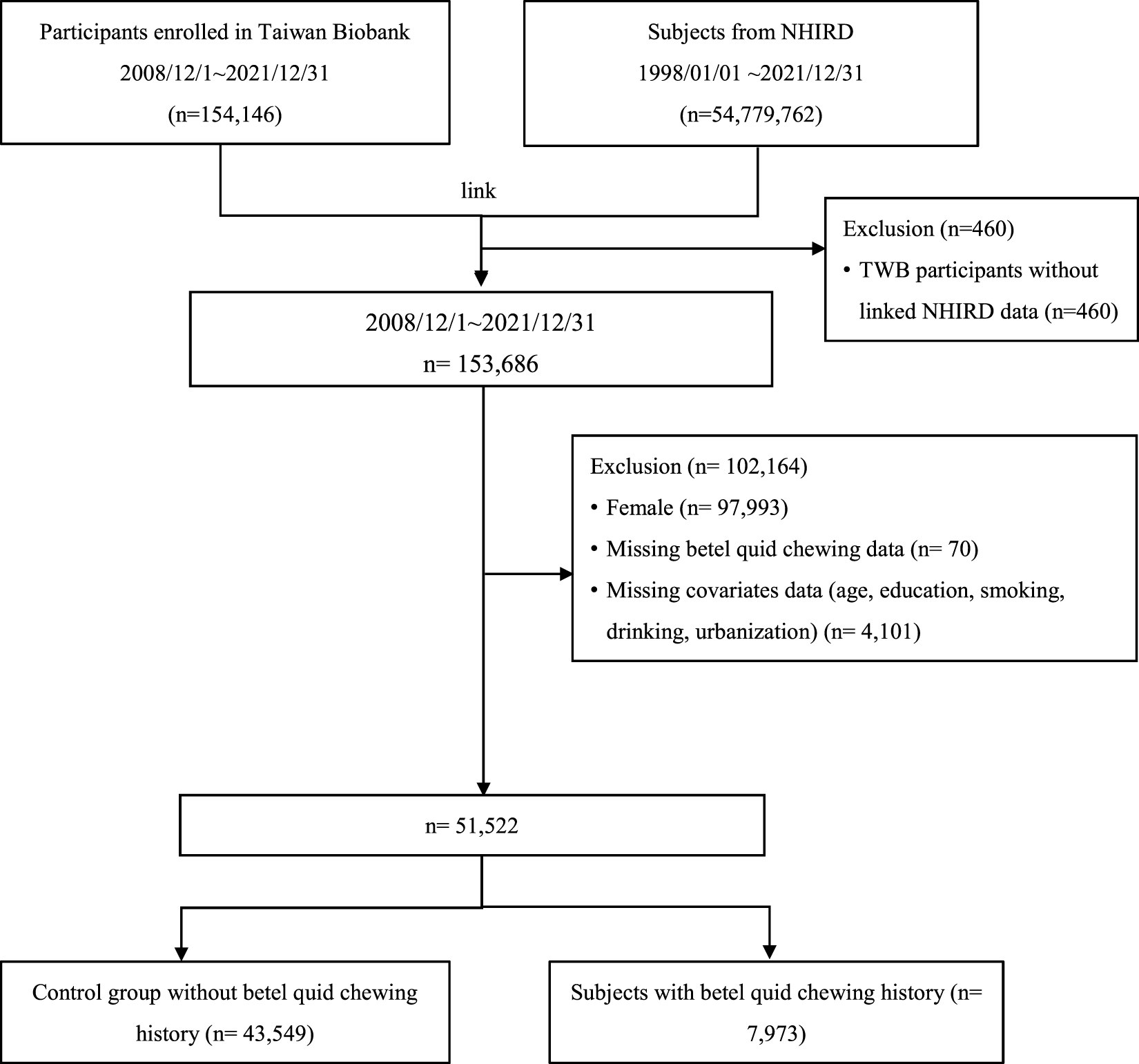
BQC was evaluated during TWB enrolment by standardized self-reported questionnaires administered by trained study professionals. Participants were asked whether they had ever chewed betel quid. Individuals who reported either current or past chewing were classified as ever users (BQC group), whereas those who reported no history of chewing were classified as non-users (non-BQC group). Information on cigarette smoking and alcohol drinking was collected simultaneously and included as lifestyle covariates in subsequent analyses. After applying these criteria, 51,522 male participants remained in the analytic sample, including 7,973 betel quid users and 43,549 non-users (Fig. 1).
Participant selection flow diagram for the association analysis.

Figure 1 Long description
The flowchart begins with two groups: participants enrolled in Taiwan Biobank from December 1, 2008, to December 31, 2021, totaling 154,146 individuals and subjects from NHIRD from January 1, 1998, to December 31, 2021, totaling 54,779,762 individuals. These groups are linked, resulting in a combined total of 153,686 participants. Exclusions are applied: 460 TWB participants without linked NHIRD data are removed. Further exclusions include 102,164 individuals: 97,993 females, 70 missing betel quid chewing data and 4,101 missing covariates data such as age, education, smoking, drinking and urbanization. The remaining sample consists of 51,522 participants, divided into two groups: a control group without betel quid chewing history, consisting of 43,549 individuals and subjects with betel quid chewing history, consisting of 7,973 individuals.
Psychiatric disorders were ascertained from available NHIRD claims records using ICD-9-CM and ICD-10-CM diagnostic codes recorded in outpatient visits or hospitalizations. The disorders examined included schizophrenic disorders, MDD, depressive disorders, bipolar disorder, panic disorder, OCD, GAD, ADHD and dementia. Detailed diagnostic codes are shown in Supplementary Table S1. BQC status was assessed once at TWB enrolment, whereas diagnoses in the linked claims data could have been recorded before or after enrolment. Thus, the analysis evaluated associations between enrolment-based BQC status and recorded psychiatric diagnoses and was not designed to estimate incident disorders. The claims-record ascertainment period represented the duration of available NHIRD information used to identify diagnoses and was included as a covariate to account for unequal opportunities for diagnostic ascertainment; it should not be interpreted as prospective follow-up beginning at BQC assessment. Potential confounders were selected a priori based on epidemiological relevance and previous literature and included age, educational attainment, urbanization level of residence, cigarette smoking and alcohol drinking. Educational attainment and urbanization were included as proxy indicators of socioeconomic and environmental context, because lower socioeconomic circumstances are associated with both BQC and mental health vulnerability in Taiwan (Lin et al., Reference Lin, Tamí-maury, Ma, Lam, Tsai, Lin, Li, Liu, Li, Chiu, Lu and Gritz2017, Reference Lin, Chang and Hsu2018b). Education was categorized as elementary school or less, middle to high school and college or higher. Urbanization was classified into four categories, from the most urbanized to the most rural.
Baseline characteristics of participants with and without BQC were summarized using means with standard deviations for continuous variables and counts with percentages for categorical variables. Differences between groups were assessed using Student’s t tests for continuous variables and chi-square tests for categorical variables. Associations between BQC and psychiatric disorders were evaluated using multivariable logistic regression, with results reported as odds ratios (ORs) and 95% confidence intervals (CIs). Four models were constructed with sequential covariate adjustment: Model 1 adjusted for age; Model 2 adjusted for age and claims-record ascertainment period; Model 3 further adjusted for education and urbanization and Model 4 additionally adjusted for cigarette smoking and alcohol drinking. Nine psychiatric outcomes were examined. No formal correction for multiple testing was applied; therefore, the reported P values and CIs are nominal, and borderline estimates should be considered exploratory and interpreted cautiously. All tests were two-sided, and a nominal P value < 0.05 was used. Analyses were conducted using SAS version 9.4 (SAS Institute Inc., Cary, NC, USA).
Results
Participant characteristics
A total of 51,522 male participants from the TWB with successful linkage to the NHIRD were included in the analysis. Among them, 7,973 reported ever using betel quid and 43,549 reported never using betel quid (Fig. 1). Baseline characteristics are presented in Table 1. BQC participants were slightly older than non-BQC participants (mean age 51.2 ± 9.9 vs. 48.7 ± 11.8 years, P < 0.001) and had lower educational attainment; only 37.85% had a college education compared with 73.80% of never-users (P < 0.001). Urbanization also differed significantly, with BQC participants more likely to reside in less urbanized areas. Alcohol drinking (29.98% vs. 9.94%) and cigarette smoking (94.92% vs. 49.18%) were markedly more prevalent among BQC participants (both P < 0.001). The median claims-record ascertainment period was 5 years (IQR: 3–7) among BQC participants and 4 years (IQR: 2–6) among non-BQC participants (P < 0.001).
Baseline characteristics of participants according to betel quid chewing status in the Taiwan Biobank–NHIRD linked data

Table 1 Long description
Baseline characteristics are compared between participants without betel quid chewing history (43,549) and those with a chewing history (7,973), with p values for group differences. Mean age was higher among chewers (51.2 years) than non-chewers (48.7 years), and the difference was statistically significant. Education differed: chewers more often had elementary school or less (5.77 percent vs 2.09 percent) and less often had college education or higher (37.85 percent vs 73.80 percent). Urbanization level also differed, with chewers less concentrated in the most urbanized areas (58.79 percent vs 66.07 percent) and more in level 2 and level 3 areas. Drinking was more common among chewers (29.98 percent) than non-chewers (9.94 percent), and smoking was much more common among chewers (94.92 percent) than non-chewers (49.18 percent). The claims-record ascertainment period was longer for chewers, with a median of 5 years compared with 4 years for non-chewers. All listed comparisons report p values below 0.001, indicating statistically significant differences, but these are descriptive baseline contrasts and do not establish causation.
Association between BQC and psychiatric disorders
The associations between BQC and psychiatric disorders are shown in Table 2. In crude analyses, BQC was associated with increased odds of several psychiatric conditions, including schizophrenia (OR: 1.41, 95% CI: 1.10–1.82), bipolar disorder (OR: 1.38, 95% CI: 1.12–1.70), MDD (OR: 1.27, 95% CI: 1.13–1.43), depressive disorders (OR: 1.35, 95% CI: 1.24–1.47) and panic disorder (OR: 1.35, 95% CI: 1.11–1.66). In contrast, lower odds were observed for OCD (OR: 0.53, 95% CI: 0.35–0.80) and ADHD (OR: 0.38, 95% CI: 0.20–0.71).
Association between betel quid chewing and specific psychiatric disorders in the TWB–NHIRD linked data
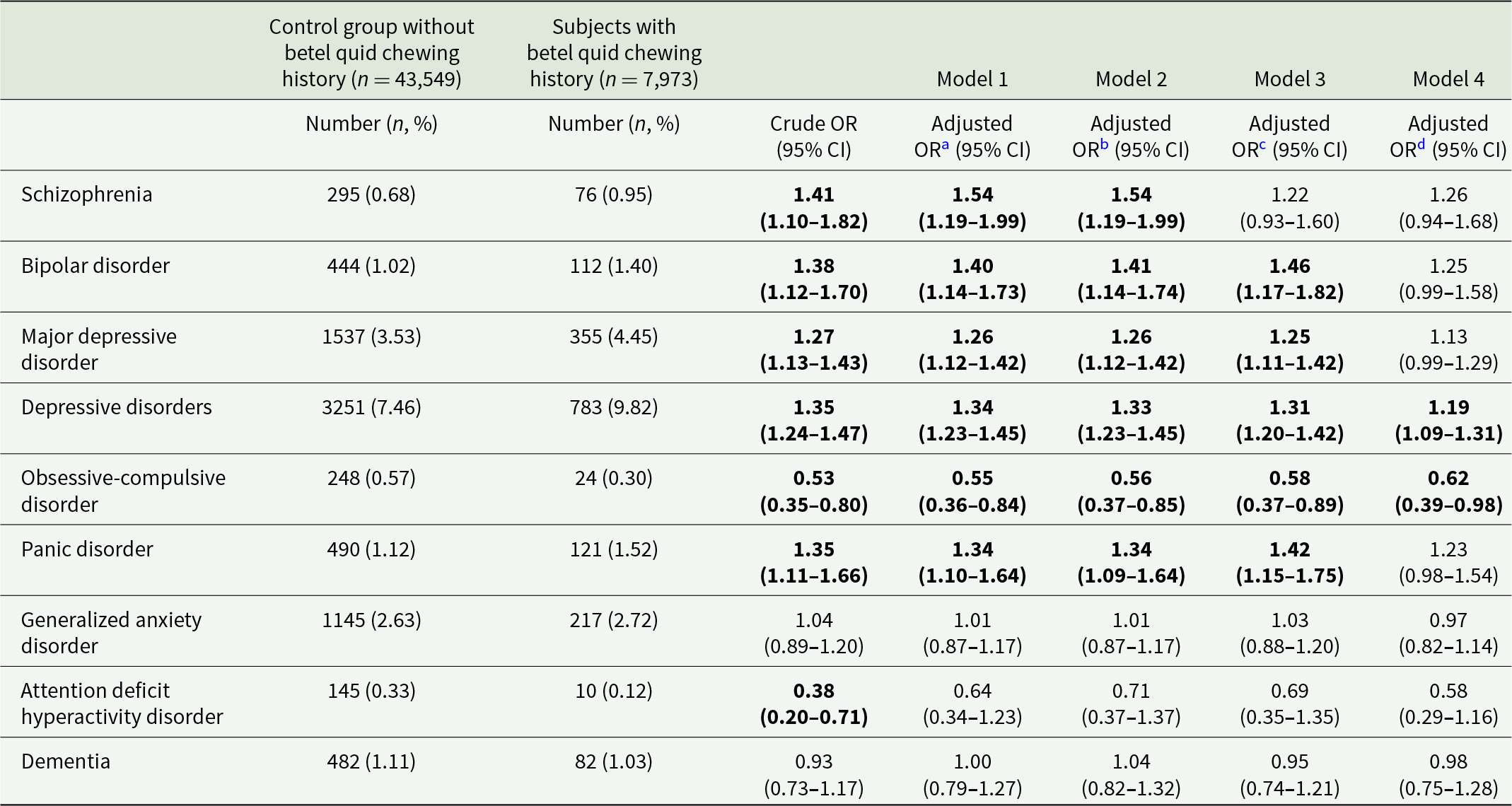
Table 2 Long description
Psychiatric disorder prevalence is compared between people without betel quid chewing history (43,549) and those with a chewing history (7,973), with crude and progressively adjusted odds ratios across four models. Depressive disorders are more common among chewers (9.82 percent) than non-chewers (7.46 percent), and remain elevated after full adjustment (about 1.19). Major depressive disorder is also higher in chewers (4.45 percent versus 3.53 percent), but the fully adjusted association is weaker and not clearly different from no association (about 1.13). Schizophrenia and bipolar disorder show higher crude odds in chewers, but the fully adjusted estimates are closer to no association (about 1.26 for schizophrenia and about 1.25 for bipolar disorder). Panic disorder shows higher crude odds, with the fully adjusted estimate near no association (about 1.23). Obsessive-compulsive disorder is less common in chewers (0.30 percent versus 0.57 percent) and remains lower after full adjustment (about 0.62). Generalized anxiety disorder, attention deficit hyperactivity disorder, and dementia show no clear association after full adjustment, with estimates near no association and confidence intervals spanning it. Statistical significance is indicated in the source by bolding, and results are nominal because multiple outcomes were tested without a multiple-testing correction.
Note: Bold type indicates statistical significance.
No correction for multiple testing was applied across the nine psychiatric outcomes; all P values and confidence intervals are nominal.
a Model 1 adjusted for age.
b Model 2 adjusted for age and claims-record ascertainment period.
c Model 3 adjusted for age, claims-record ascertainment period, education, and urbanization.
d Model 4 adjusted for age, claims-record ascertainment period, education, urbanization, smoking, and drinking.
After adjustment for age, claims-record ascertainment period, education, urbanization, smoking and alcohol drinking (Model 4), most estimates were attenuated. BQC remained modestly associated with depressive disorders (adjusted OR: 1.19, 95% CI: 1.09–1.31). Estimates for schizophrenia (adjusted OR: 1.26, 95% CI: 0.94–1.68), bipolar disorder (adjusted OR: 1.25, 95% CI: 0.99–1.58), MDD (adjusted OR: 1.13, 95% CI: 0.99–1.29) and panic disorder (adjusted OR: 1.23, 95% CI: 0.98–1.54) included the null value. An exploratory inverse estimate was observed for OCD (adjusted OR: 0.62, 95% CI: 0.39–0.98), but it was based on only 24 exposed cases and was statistically unstable. Estimates for GAD (adjusted OR: 0.97, 95% CI: 0.82–1.14), ADHD (adjusted OR: 0.58, 95% CI: 0.29–1.16) and dementia (adjusted OR: 0.98, 95% CI: 0.75–1.28) also included the null value.
No correction for multiple testing was applied across the nine psychiatric outcomes. Accordingly, all estimates and P values are nominal. The exploratory OCD estimate and the borderline estimates for bipolar disorder, MDD and panic disorder should be interpreted cautiously and should not be regarded as confirmatory findings.
Discussion
In this large population-based analysis using TWB participants linked to the NHIRD, we examined associations between BQC assessed at enrolment and a spectrum of psychiatric diagnoses recorded in claims data. Betel quid users had higher crude prevalence of several psychiatric conditions, including schizophrenia, bipolar disorder, MDD, depressive disorders and panic disorder. After adjustment for demographic and lifestyle factors – particularly cigarette smoking and alcohol drinking – most estimates were attenuated. The most consistent fully adjusted association was observed for depressive disorders. The inverse OCD estimate was exploratory and statistically unstable.
Among the psychiatric disorders examined, depressive disorders showed the most consistent association with BQC. After adjustment for age, claims-record ascertainment period, education and urbanization (Model 3), estimates remained elevated for bipolar disorder, MDD, depressive disorders and panic disorder, whereas the estimate for OCD was inverse (Table 2). After full adjustment for smoking and alcohol drinking (Model 4), BQC was associated with a modest increase in the odds of depressive disorders. Our findings are consistent with previous studies suggesting that BQC may be linked to mood disturbances (Lee et al., Reference Lee, Geng, Chen, Lee and Ko2026; Lin et al., Reference Lin, Chang and Hsu2018b). Several biopsychosocial mechanisms may contribute to this association. First, arecoline, the major psychoactive alkaloid in areca nut, acts as a muscarinic acetylcholine receptor agonist and can influence dopaminergic, serotonergic and noradrenergic pathways. Chronic exposure may lead to neuroadaptations affecting mood regulation (Molinengo et al., Reference Molinengo, Cassone and Orsetti1986; Chu, Reference Chu2001). In addition, hydrolysis products of arecoline, including arecaidine and guvacine, inhibit GABA uptake and may disrupt inhibitory neurotransmission (Johnston et al., Reference Johnston, Krogsgaard-larsen and Stephanson1975). Second, a large population-based study in Taiwan found that polygenic liability for major depression was associated with betel nut use (Lee et al., Reference Lee, Geng, Chen, Lee and Ko2026), suggesting that shared genetic and behavioural vulnerability may partly contribute. Third, preclinical studies have reported anxiolytic- and antidepressant-like effects of arecoline and Areca catechu extracts (Chen et al., Reference Chen, Zhang, Ma and Zhuo2024). Ethanol extracts and aqueous fractions of Areca catechu have been demonstrated to increase hippocampus serotonin and noradrenaline levels while decreasing immobility in forced swim tests (Abbas et al., Reference Abbas, Naqvi, Erum, Ahmed, Atta Ur and Dar2013). Such short-term mood-elevating or calming effects may make BQC attractive to individuals with depressive symptoms, consistent with a self-medication explanation. Finally, BQC is associated with occupational stress, lower socioeconomic status and clustering of other health-risk behaviours (Lin et al., Reference Lin, Tamí-maury, Ma, Lam, Tsai, Lin, Li, Liu, Li, Chiu, Lu and Gritz2017). These factors themselves are known to increase vulnerability to depression. In this study, only 37.85% of BQC had a college degree, compared to 73.80% of non-BQC, and BQC were more likely to live in less urbanized areas (Table 1). Although our models adjusted for education, smoking and alcohol use, residual confounding by socioeconomic and lifestyle factors may still exist, which could affect the overall findings and interpretations of the study.
The apparent inverse association between BQC and OCD should be considered exploratory. Only 24 participants with BQC had an OCD diagnosis, the fully adjusted CI approached the null value (adjusted OR: 0.62, 95% CI: 0.39–0.98), and no correction was applied for testing nine psychiatric outcomes. The estimate is therefore statistically unstable and may reflect sampling variability or multiple testing. No substantive protective interpretation should be drawn, and independent replication is required.
An earlier Indian study involving 988 adult psychiatric inpatients revealed that 24% of these inpatients reported recent consumption of areca nuts (Chandra et al., Reference Chandra, Carey, Carey and Jairam2003). In the present analysis, substantial attenuation of several crude estimates after adjustment for smoking and alcohol drinking suggests that behavioural clustering may explain an important part of the observed relationships. In the fully adjusted model, depressive disorders showed the most consistent association with BQC, whereas the estimates for schizophrenia, bipolar disorder, MDD and panic disorder were attenuated, and their CIs included the null value. The exploratory OCD estimate should not be regarded as confirmatory. BQC strongly co-occurs with cigarette smoking and alcohol drinking in Taiwan and other regions (Wen et al., Reference Wen, Tsai, Cheng, Chen, Levy, Yang and Eriksen2005; Guo et al., Reference Guo, Huang, Huang, Lin, Hong, Chang and Chen2013). In our data, BQC participants had higher prevalence of cigarette smoking (94.92% vs. 49.18%) and alcohol use (29.98% vs. 9.94%) than non-BQC participants (both P < 0.001; Table 1). Both behaviours are independently associated with psychiatric disorders and may confound associations between BQC and mental disorders (Lasser et al., Reference Lasser, Boyd, Woolhandler, Himmelstein, McCormick and Bor2000; Castillo-Carniglia et al., Reference Castillo-Carniglia, Keyes, Hasin and Cerdá2019).
Subjects with ADHD are significantly more likely to develop substance use disorders than those without ADHD (Zulauf et al., Reference Zulauf, Sprich, Safren and Wilens2014). In preliminary analyses, BQC was inversely associated with ADHD; however, this estimate became imprecise after covariate adjustment, possibly because of the limited number of cases. Prior studies have associated betel use with cognitive impairment and neurotoxic effects of arecoline (Sariah et al., Reference Sariah, Liu, Pu, Liu, Xue and Huang2019), but BQC was not associated with recorded dementia in the present analysis (Table 2). Because the temporal sequence between BQC assessment and diagnoses was not established, this result should not be interpreted as an analysis of incident dementia or later neurocognitive decline.
BQC is highly prevalent in several Asian countries and has already been recognized as a major carcinogenic risk factor. Our findings suggest that its potential impact may extend beyond physical health to mental health, particularly depressive disorders. Given the high comorbidity between depression and other chronic diseases, integrating mental health screening into programs for quitting betel quid may have clinical benefits. Moreover, public health strategies targeting BQC may contribute not only to cancer prevention but also to broader improvements in psychological well-being.
This study has several strengths. First, the large sample size and population-based data source enhance the generalizability of the findings. Second, linkage of TWB data with the NHIRD enabled comprehensive ascertainment of recorded psychiatric diagnoses. Third, detailed adjustment for demographic and lifestyle factors allowed evaluation of potential confounding. Nevertheless, several limitations should be considered. BQC status was based on self-report at TWB enrolment, and complete information on duration, intensity and cumulative exposure was unavailable; therefore, dose–response relationships and exposure misclassification could not be fully assessed. More importantly, this study is an association analysis rather than a causal or longitudinal incidence study. BQC was assessed once at enrolment, whereas diagnoses identified from claims data could have been recorded before or after that assessment. The temporal sequence between BQC and psychiatric disorders therefore cannot be established. The study cannot distinguish whether BQC contributes to depressive disorders, whether individuals with depressive symptoms initiate or continue BQC as self-medication, or whether bidirectional mechanisms exist. Reverse causality remains possible, and the observed association should not be interpreted as evidence that BQC causes depressive disorders. In addition, nine psychiatric outcomes were examined without correction for multiple comparisons. This increases the possibility of chance findings, particularly for estimates near the conventional significance threshold; the exploratory OCD estimate and the borderline estimates for bipolar disorder, MDD and panic disorder, therefore, require independent replication. Finally, although the models adjusted for age, claims-record ascertainment period, education, urbanization, smoking and alcohol drinking, residual confounding from socioeconomic circumstances, occupational factors or other substance use cannot be excluded.
Conclusion
BQC was modestly associated with a higher likelihood of depressive disorders in these linked Taiwanese data, whereas most associations with other psychiatric conditions were attenuated after adjustment for demographic and lifestyle factors. Because BQC was assessed at a single time point and recorded psychiatric diagnoses could predate or follow that assessment, the findings do not establish temporal sequence or causality. Further studies with clearly defined prospective exposure assessment, multiplicity-adjusted analyses and independent replication are needed.
Supplementary material
The supplementary material for this article can be found at https://doi.org/10.1017/S2045796026100936.
Availability of data and materials
The data that support the findings of this study are available from the Taiwan Biobank Institutional Dataset. To gain access, interested individuals should contact ‘biobank@gate.sinica.edu.tw’. The NHIRD was released and audited by the Department of Health and Bureau of the NHI Program for the purpose of scientific research (https://www.apre.mohw.gov.tw/). NHIRD can be obtained through the formal application that is regulated by Department of Health and Bureau of the NHI Program. Further details and other data that support the findings of our study are available from the corresponding author upon request.
Acknowledgements
During the preparation of this work, the authors used ChatGPT, a generative AI tool developed by OpenAI, to assist with language editing, wording refinement and improvement of clarity and readability. The tool was not used to generate original scientific content, analyse data, create results, interpret findings or draw conclusions. After using this tool, the authors carefully reviewed and edited the content as needed and take full responsibility for the final content of the manuscript.
Author contributions
P.H.K. and S.J.T. designed the study. M.N.L. and S.J.T. wrote the draft; M.N.L., M.H.C. and S.J.T. performed literature review and revised the manuscript; K.C.C. performed the statistical analysis; all authors reviewed the final manuscript and agreed in its publication. Dr. Po-Hsiu Kuo can also be contacted for correspondence phkuo@ntu.edu.tw. Mu-N Liu and Kan-Chih Chen contributed equally as first authors.
Financial support
This work was partly supported by the National Science and Technology Council of Taiwan (grant numbers: NSTC 112-2314-B-075-013-MY3, NSTC 114-2321-B-A49-003 and NSTC 113-2314-B-002-168-MY3) and Taipei Veterans General Hospital, Taiwan (grant numbers: V114C-007 and V114D81-004-MY2-1).
Competing interests
There is none.
Ethical standards
Ethical approval for the study was obtained from the Institutional Review Board of Taipei Veterans General Hospital (approval number: 2023-04-007CC#1). All Taiwan Biobank participants provided written informed consent at enrolment. Written informed consent was waived because all subjects are anonymous in the registry-based database. The present study used de-identified secondary data and was conducted in accordance with the Declaration of Helsinki and applicable data protection regulations.


 Open access

