Introduction
Garden pea (Pisum sativum L.), a member of Fabaceae family, is a very nutritious vegetable grown in the winter season throughout the world. It is an important source of proteins (Burstin et al., Reference Burstin, Salloignon, Chabert-Martinello, Magnin-Robert, Siol, Jacquin, Chauveau, Pont, Aubert, Delaitre, Truntzer and Duc2015) with an estimated content of 22% (Bheri et al., Reference Bheri, Fareeda and Makandar2016). In adddition, it provides an exceptionally diverse nutrient profile of health-building substances like vitamins, minerals and also lysine, a limiting essential amino acid in cereals. Antibacterial, antidiabetic, antifungal, antiinflammatory, antihypercholesterolemia, antioxidant activities and anticancerous properties further support its dietary benefits (Rungruangmaitree and Jiraungkoorskul, Reference Rungruangmaitree and Jiraungkoorskul2017). Pea as a legume crop helps in fixing the atmospheric nitrogen and reduce the cost of production (Anjum et al., Reference Anjum, Qasim, Ahmad and Hussain2015) by providing the advantage of low input and sustainable organic farming.
The favourable agroclimatic conditions in the northwestern Himalayan region of India pave the way to cultivate garden pea throughout the year as an off-season crop during the summer season. These conditions provide lucrative monetary returns to the growers. High yield, specific pod characteristics (e.g. proper filling, long, dark green, sweet) and resistance to pests and diseases are the main criteria opted by the breeders for garden pea improvement. The focus on these specific traits has led to narrowing garden pea genetic basis. Moreover, the preference of growers for few old cultivars resulted in genetic drift and development of new pathogen races. This has led to low/stagnant yield and a major impediment in pea improvement.
Genetic variability in germplasm determines the level of success in the improvement of such germplasm through selection (Eze and Nwofia, Reference Eze and Nwofia2016). Hybridization is the commonly opted method which not only generates variability in existing germplasm but also provides a possibility to exploit heterosis. Heterosis has been predicted in pea long back; however, cleistogamous nature of flower and non-availability of genetic mechanisms like male sterility limit the exploitation of heterosis. Even so, potential crosses likely to produce transgressive segregants could be achieved simply through the selection of superior individual progenies from a range of existing possibilities (Guindon et al., Reference Guindon, Martin, Cravero and Cointry2018). The success of breeding programme depends on the initial population used or the parents involved to create such populations. Molecular markers have helped the breeders in judicious selection of diverse parents to generate original breeding populations (Acquaah, Reference Acquaah2012) that ultimately broadens the genetic basis of population. Simple sequence repeat (SSR) markers have been utilized in pea for the identification of diverse parents (Baranger et al., Reference Baranger, Aubert, Arnau, Lainé, Deniot, Potier, Weinachter, Lejeune-Henaut, Lallemand and Burstin2004; Smykal et al., Reference Smykal, Hybl, Corander, Jarkovsky, Flavell and Griga2008). The parents involved in hybridization were selected based on diverse phenological traits such as pod length, seeds per pod, pod colour and resistance to powdery mildew disease. Herein, 36 F7 progenies were isolated from three intervarietal crosses by following pedigree method and evaluated under field conditions.
Materials and Methods
Initial plant material
Four parents, namely, ‘Palam Sumool’, ‘Palam Priya’, ‘Pb-89’ and ‘Azad P-1’ having contrasting phenological traits were initially involved in the breeding programme. Among these, ‘Palam Sumool’ has very long pods and medium maturing duration and is resistant to powdery mildew disease, while ‘Palam Priya’ has yellowish green, medium-sized pods and medium maturing duration and is slow mildewing. The most popular check variety ‘Pb-89’ is medium maturing with long, slender, well-filled and bright-green pods and has slow mildewing character. Although ‘Azad P-1’ is highly susceptible to powdery mildew, it shows desirable pod characteristics like medium, long, lush-green and slightly curved pods. These cultivars were then subjected to molecular characterization using SSR markers to assess the divergence. ’Palam Sumool’ was incorporated as the female parent, and the other three parents were used as male in hybridization programme.
Molecular characterization
Genomic DNA of the parents ‘Palam Sumool’, ‘Palam Priya’, ‘Pb-89’ and ‘Azad P-1’ was isolated by the CTAB (Cetyl Trimethyl Ammonium Bromide) method (Doyle and Doyle, Reference Doyle and Doyle1990). The DNA quantity as well as quality was checked using Nanodrop (mySPEC Scientific GmbH, Altmannsdorfer Str., Wien, Austria). It was diluted to a final concentration of 25 ng μL–1 to set polymerase chain reaction (PCR). Eighteen genomic SSRs (Supplementary Material Table S1 available online at https://doi.org/10.1017/S0014479719000115) were selected based on high polymorphism, as in Pisum (Loridon et al., Reference Loridon, Mcphee, Morin, Dubreuil, Pilet-Nayel, Aubert, Rameau, Baranger, Coyne, Lejeune-Hènaut and Burstin2005). PCR amplification was carried out in 96 well Universal Gradient Thermal Cycler (PEQLAB, Deutschland and Osterrtich, UK) in a 25 µL reaction mixture. The reaction mixture contained 5 µM of each forward and reverse primers, 1.5 U of Taq polymerase, 2.5 µL of 10× PCR buffer with MgCl2, 10 mM of each dNTP (dTTPs, dGTPs, dCTPs, dATPs). Amplifications were performed at 94°C for 5 min followed by 35 cycles of 94°C for 1 min, 50–-60°C for 1 min, 72°C for 30 s, with a final extension of 72°C for 5 min. PCR products were mixed with 6× loading dye (Thermo scientific # R0611) (2–3 µL), resolved on 3.5% agarose gel and were visualized using gel documentation system [DNR Bio Imaging System (Minilumi), Israel]. The clear and reproducible alleles amplified by each SSR were scored manually according to their fragment size (bp) corresponding to the 100 bp molecular weight marker. Clear and unambiguous bands of various molecular weight sizes generated by SSR markers were scored for the presence (1) and absence (0) of the corresponding band among the genotypes in the form of a binary matrix, and the data matrix was subjected to further analysis using NTSYS-pc version 2.11W (Rohlf, Reference Rohlf1997). DARwin (Perrier and Jacquemoud-Collet, Reference Perrier and Jacquemoud-Collet2006) was used to construct neighbour-joining (N-J) tree. Jaccard’s similarity coefficients were calculated using SIMQUAL programme. The resulting similarity matrix was used for unweighted pair-group method with arithmetic mean (UPGMA)-based dendrogram construction. Polymorphism information content (PIC) for SSR markers was calculated using the following equation:
 $${\rm{PlC}}i = 1 - \sum Pij2$$
where PICi is the PIC of marker i; Pij is the frequency of the j th pattern for marker i, and the summation extends over n patterns.
Development of breeding lines
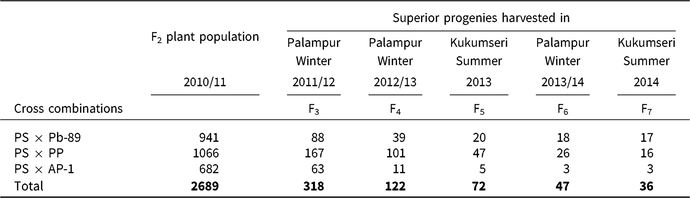
Based on morphological and molecular characterization of parents (Supplementary Material Figure S1), a hybridization programme was planned involving four parents in 2009/10 by formulating three intervarietal crosses: ‘Palam Sumool’ × ‘Palam Priya’; ‘Palam Sumool’ × ‘Pb-89’; and ‘Palam Sumool’ × ‘Azad P-1’. Selection for desirable plants was carried out following classical pedigree method (Allard, Reference Allard1960; Poisson, Reference Poisson, Bonacic, Royo, Ibalo, Sosa and Peterlin2005). The selections for desirable plants were initiated in F2 generation during 2011/12, and single plant progenies (F3) showing desirable traits were harvested separately (Table 1; Supplementary Material Figure S2). The main objective of selection was to isolate progenies with lush-green, well-filled, long pods (having pod length ≥10 cm, Makashewa, Reference Makasheva1983) along with resistance to powdery mildew disease. Plant-to-row progenies of selected individual plants were raised in the subsequent generations in the following years by taking advantage of raising two crops in a year by shuttle breeding programme, that is, raising off-season crop during summer at Kukumseri and winter crop at Palampur (Table 1). Each generation was screened for powdery mildew disease by raising border rows of susceptible parent ‘Azad P-1’. The seeds of homozygous lines in the F6 generation with desirable pod characteristics were bulked to carry out replicated evaluation trials in the following years. Finally, seeds of 36 homozygous F7 superior progenies for pod characteristics and disease resistance were harvested in summer 2014.
Selection for desirable progenies in different generations: Palam Sumool (PS); Palam Priya (PP); Azad P-1 (AP-1)

Evaluation trials
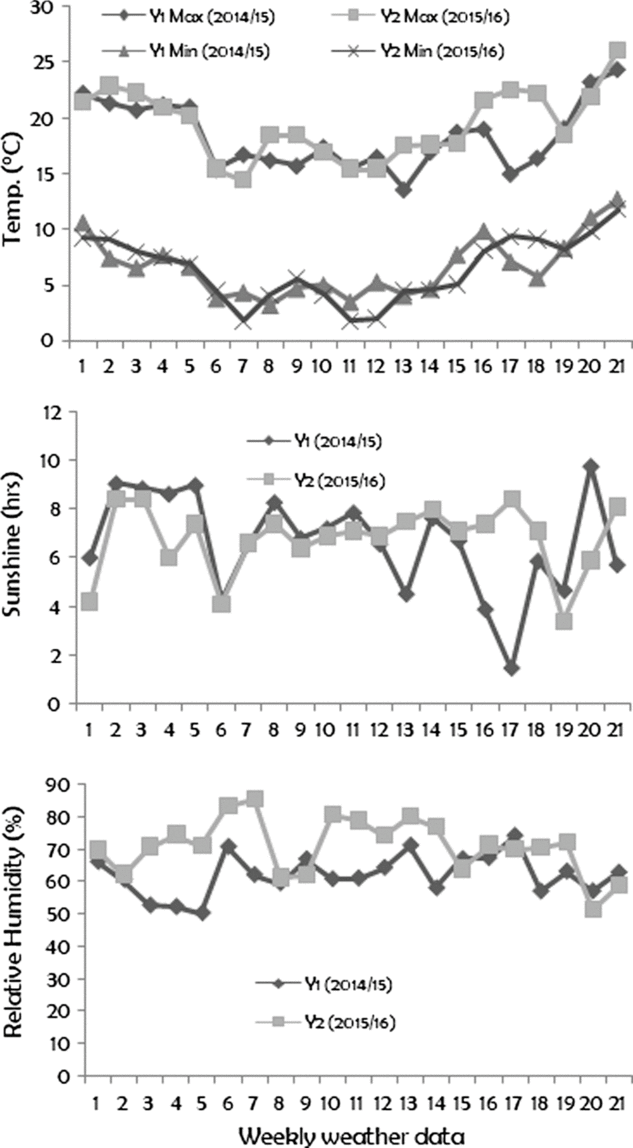
Thirty-six homozygous advanced breeding lines along with four recommended varieties as standard checks ‘Palam Sumool’, ‘Palam Priya’, ‘Azad P-1’ and ‘Pb-89’ were evaluated for two consecutive years during winter 2014/15 and 2015/16 in Palampur, India (32°6′N; 76°3′E; 290.8 m a.s.l.). Weekly weather data of two consecutive years was collected from the online portal of http://www.cropweatheroutlook.in/ and is presented in Figure 1. Low temperature was recorded during the first year during pod formation stage. The soil is classified as Alfisols typic Hapludalf clay having soil reaction of 5.7. The breeding material was sown in randomized complete block design with three replications on 5 and 6 November in 2014 and 2015. Each genotype was planted in two rows (2.5 m length) in each replication with 45 cm between rows and 10 cm between plants within rows. The harvesting of green pods was carried out manually at 10-day intervals between late February and early April, depending on the maturity period of genotypes.
Mean weekly weather conditions during 2014/15 and 2015/16. Y1: Year 1; Y2: Year 2; Max: Maximum; Min: Minimum and Temp.: Temperature.

Phenotypic data
Measurements were taken on randomly selected 10 plants of each genotype over the replications for the first flower node (FFN); days to flowering measured as the number of days taken from sowing to the date when 50% of plants in each entry had at least one open flower (DTF); days to the first picking (DTFP); plant height (PH); pod length (PL); seeds/pod (S/P); shelling (SH, in %); pods/plant (P/P); pod yield/plant (PY/P); and average pod weight (APW). PL and APW were measured at the time of the second picking. In addition, quality attributes were estimated: total soluble solids (TSS), using a hand refractometer; and ascorbic acid (AA), following the method suggested by Rangana (Reference Ranganna1979). Powdery mildew disease severity was recorded at its peak stage prior to seed maturity. Each plant of the respective genotypes was scored for disease reaction (Table 2) as done by Mains and Dietz (Reference Mains and Dietz1930).
Scoring scale in relation to powdery mildew disease severity

Statistical analysis
The analysis of variance (ANOVA) was performed for the individual years for each trait as per Gomez and Gomez (Reference Gomez and Gomez1983) for randomized complete block design, while pooled ANOVA for 2 years was computed following the procedure given by Verma et al. (Reference Verma, Gill and Virk1987). The significance of mean sum of squares for each trait was tested using F-test at 5% level. The test for comparison of means was done through critical difference (CD) using t-test and also Duncan’s multiple range test (Duncan, Reference Duncan1955). The test of homogeneity (F-test) was done to test the significance whether error variances over years are homogeneous or not.
Results
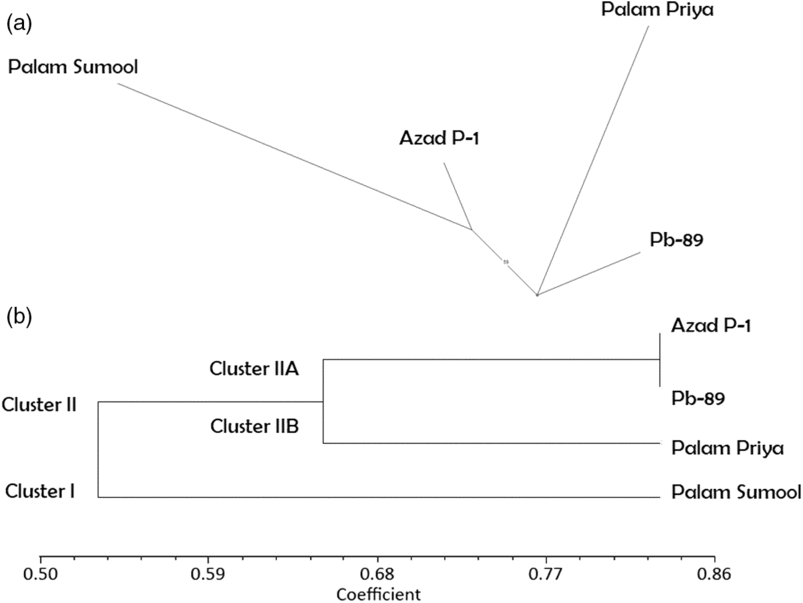
Molecular characterization of parents was undertaken using 18 genomic SSRs, with 12 SSRs showing reproducible and polymorphic patterns. Polymorphic information content (PIC) value, a parameter associated with the discriminating power, ranged from 0.195 to 0.582 with an average of 0.343 per primer (Supplementary Material Table S2). Gel images obtained from SSR banding profile of primers AA103, AB45, AA335 and AA374 are presented in Supplementary Material Figure S1. DARwin tree also separated these genotypes into two groups (Figure 2a). Based on the polymorphism exhibited by SSR markers, dendrograms were constructed using Jaccard’s similarity coefficient using UPGMA method of NTSYS – PC package (version 2.02) and the genotypes were grouped into main two clusters (Figure 2b). Cluster I was composed of one genotype (‘Palam Sumool’), whereas the remaining parents were placed in cluster II. Cluster II was further differentiated into two subclusters, IIA and IIB, with two (‘Azad P-1’ and ‘Palam Priya’) and one (‘Pb-89’) genotypes, respectively.
DARwin N-J tree indicating the diversity in parents (a) and dendrogram depicting genetic relationships among the pea parents (b).

The Jaccard’s similarity coefficient ranged from 0.50 to 0.69 (Supplementary Material Table S3). Pea genotype pair ‘Azad P-1’ and ‘Palam Priya’ revealed the maximum similarity of 0.69, followed by ‘Pb-89’ and ‘Palam Priya’ (0.67), and ‘Pb-89’ and ‘Palam Sumool’ (0.61). Genotype pair ‘Palam Sumool’ and ‘Palam Priya’ showed the least genetic similarity of 0.50, followed by ‘Azad P-1’ and ‘Pb-89’ (0.52), and ‘Azad P-1’ and ‘Palam Sumool’ (0.53). Herein, ‘Palam Sumool’ was found to be the most diverse (as reflected by the lowest average similarity coefficient of 0.546; Supplementary Material Table S3) among the four parents, and hence it was used as female parent for developing three cross combinations in the hybridization programme. Finally, 36 homozygous superior progenies in F7 generation were isolated from these three cross combinations and evaluated over the years. There were differences in weather conditions during this study. Air temperature was low during the first year at peak flowering and pod formation stages in February (Figure 1). Further, hailstorm on 26 February 2015 adversely affected the crop growth, especially pod formation. This resulted in yield losses to the extent of 50–60% in comparison to the second year wherein air temperature was quite favourable at flowering and pod formation stages. Then, variation in phenotypic data for two consecutive years was due to environmental conditions, which is hypothesized to increase under stress conditions (Hoffman and Merilla, Reference Hoffman and Merilä1999).
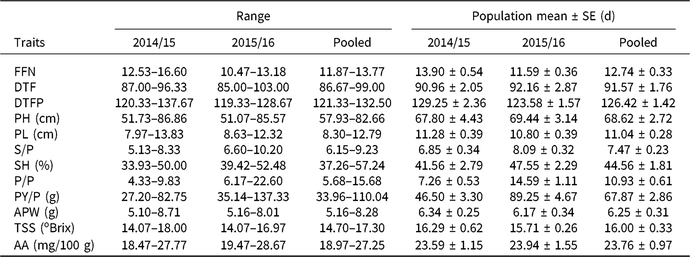
The ANOVA revealed the significance of mean squares due to genotypes for all the traits during both years 2014/15 and 2015/16 and also pooled over years, indicating the presence of sufficient genetic variability in the breeding material developed (Supplementary Material Table S4). DMRT analysis was further done to adjudge the mean differences after performing ANOVA. The G × E interactions were also significant for all the traits that revealed the differential response of genotypes in different environments. The F-test of homogeneity revealed differences for majority of traits except PL and S/P over years (Supplementary Material Table S4). Range and population means of evaluated genotypes during 2014/15, 2015/16 and pooled over years are given in Table 3.
Estimates of range and population mean for different traits in garden pea

FFN: First flower node; DTF: days to flowering; DTFP: days to the first picking; PH: plant height; PL: pod length; S/P: seeds/pod; SH: shelling; P/P: pods/plant; PY/P: pod yield/plant; APW: average pod weight; TSS: total soluble solids; AA: ascorbic acid
For the phenological traits depicting earliness and maturity, the variation in genetic material was in the range of 11–16 days for FFN, 85–-103 days for DTF and 119–138 days for DTFP on the basis of respective years and pooled year data. This indicated a lot of variation in the new breeding lines in comparison to the parental lines (Supplementary Material Table S5). The majority of the new lines belonged to mid-group based on these three characters. Lines ‘DPP-SP-7’, ‘DPP-SP-22’, ‘DPP-SP-6’, ‘DPP-SP-24’ and ‘DPP-SN-16’ had the appearance of the first flower at the lower node and were ranked among top 10 genotypes over the years, statistically at par with the best check variety ‘Pb-89’. Of the 23 lines which were statistically at par with best check Pb-89 for DTF, ‘DPP-SP-3’, ‘DPP-SN-6’, ‘DPP-SP-22’, ‘DPP-SP-7’, ‘DPP-SP-24’ and ‘DPP-SP-6’ were the top-ranking genotypes in 2014/15, 2015/16 and pooled years. However, the trends for DTFP were different, and only eight new lines ‘DPP-SP-22’, ‘DPP-SP-6’, ‘DPP-SP-20’, ‘DPP-SP-3’, ‘DPP-SP-17’, ‘DPP-SP-15’, ‘DPP-SP-24’ and ‘DPP-SN-6’ were statistically similar to Pb-89 (Supplementary Material Table S7).
Among growth traits, the breeding lines performed differently for PH. Dwarf growth habit is the most desirable trait, and ‘DPP-SN-10’, ‘DPP-SP-20’, ‘DPP-SP-32’, ’DPP-SP-33’, ‘DPP-SP-24’, ‘DPP-SN-2’, ‘DPP-SN-13’, ‘DPP-SN-16’, ‘DPP-SP-22’ and ‘DPP-SP-6’ were the top-ranking 10 genotypes over the years having PH at par with ‘Pb-89’ (Supplementary Material Table S5), which was also confirmed through DMRT as these genotypes were placed in ‘Group m-q’ over pooled years.
Long, well-filled pods with high SH percentage determine the pod quality in garden pea. The genotype ‘DPP-SN-7’ had the highest PL and significantly outperformed all the genotypes including check ‘Palam Sumool’, with the longest pod in 2014/15 and pooled years (Supplementary Material Tables S6 and S8). Of the 30 genotypes with significant higher PL over the most popular check variety ‘Pb-89’, ‘DPP-SN-10-1’, ‘DPP-SN-8-1’, ‘DPP-SN-13’, ‘DPP-SP-22’, ‘DPP-SP-6’, ‘DPP-SN-8’, ‘DPP-SP-24’, ‘DPP-SP-23’ and ‘DPP-SN-9’ were placed among top 10 in pooled over years. For S/P, ‘DPP-SP-6’ significantly outperformed all the genotypes in 2015/16 and pooled years and was placed in ‘Group a’ (Supplementary Material Table S8). The variation for S/P between years was due to the hailstorm at pod-filling stage in 2014/15. This effect is quite evident as only 12 genotypes performed at par with ‘Pb-89’ in 2014/15 as compared to 16 genotypes with superior/similar number of seeds in 2015/16. However, ‘DPP-SP-6’, ‘DPP-SP-24’, ‘DPP-SP-22’, ‘DPP-SN-4’, ‘DPP-SP-3’ and ‘DPP-SP-16’ maintained their positions among the top-ranking genotypes, irrespective of years and pooled years. The highest SH was recorded in ‘DPP-SP-6’ followed by ‘DPP-SP-22’, ‘DPP-SP-3’, ‘DPP-SP-24’, ‘DPP-SP-7’, ‘DPP-SA-1’ and ‘DPP-SP-17’, which were similar to ‘Pb-89’. DMRT further confirmed this finding, and ‘DPP-SP-6’ was placed in ‘Group a’ (Supplementary Material Table S9). For APW, ‘DPP-SP-6’, ‘DPP-SP-22’, ‘DPP-SN-2’, ‘DPP-SP-7’ and ‘DPP-SN-7’ had similar performance irrespective of years having their ranks among the top five.
‘DPP-SP-6’ recorded the highest PY/P in 2014/15, 2015/16 and pooled years (Supplementary Material Tables S6 and S10). In addition, ‘DPP-SP-22’, ‘DPP-SP-24’, ‘DPP-SP-7’ and ‘DPP-SP-17’ had higher PY/P than ‘Pb-89’ during 2014/15 while they performed at par with ‘Pb-89’ during 2015/16 and pooled years. P/P was also significantly higher in ‘DPP-SP-6’ over all genotypes, including checks (Supplementary Material Tables S6 and S10). Further, ‘DPP-SP-3’, ‘DPP-SP-17’ and ‘DPP-SN-11’ had similar P/P as that of the best-performing checks ‘Azad P-1’ and ‘Pb-89’.
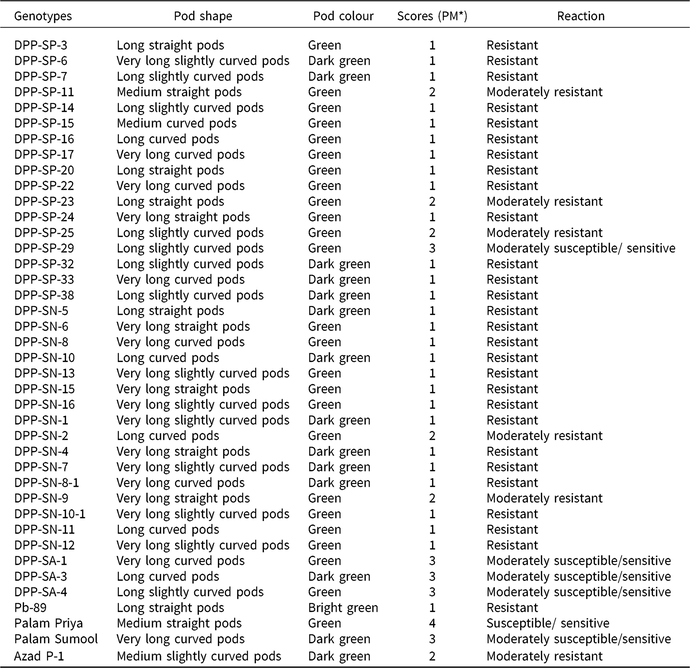
Genotypes were also classified according to the variation in pod size, pod shape and pod colour. For pod size, 18, 16 and 2 new genotypes were found to have very long, long and medium-sized pods, respectively (Table 4). Besides, 12, 14 and 10 new lines acquired curved, slightly curved and straight pod shape, respectively, and 12 and 24 new genotypes were found to have dark-green and green coloured pods, respectively. The superior performing genotypes ‘DPP-SP-22’, ‘DPP-SP-17’, ‘DPP-SP-24’ and ‘DPP-SP-6’ had very long pods, while ‘DPP-SP-7’ had long pods. ‘DPP-SP-6’ and ‘DPP-SP-7’ had dark-green coloured pods, while the pod colour of ‘DPP-SP-22’, ‘DPP-SP-17’ and ‘DPP-SP-24’ was green. Among quality traits, the best-performing genotypes for pod yield also contained TSS and AA similar to the best checks ‘Palam Sumool’ and ‘Pb-89’ (Supplementary Material Table S6). However, ‘DPP-SP-38’ had the highest AA in comparison to all the genotypes, including checks in 2015/16 and pooled years. Powdery mildew disease reaction revealed that 27 new breeding lines were categorized as resistant (Scale 1), while 5 were moderately resistant and 4 moderately sensitive (Table 4). The high-yielding genotypes ‘DPP-SP-6’, ‘DPP-SP-7’, ‘DPP-SP-17’ and ‘DPP-SP-22’ showed resistance to powdery mildew disease.
Variability for pod shape and pod colour and powdery mildew disease reaction in 40 genotypes of garden pea

*PM: Powdery mildew disease reaction under field conditions at the final pod harvest stage.
Discussion
The genetic characterization of germplasm using morphological and molecular markers is essential in breeding programmes in order to broaden the genetic base of populations. This helps in identifying the parents to isolate superior lines from the segregating population in hybridization programmes. SSRs help in the selection of suitable parents (Zhou et al., Reference Zhou, Zhang, Tuvesson, Dayteg and Gertsson2006) by allowing the characterization of the genetic variation in germplasm collection while eliminating duplicates (Lund et al., Reference Lund, Ortiz, Skovgaard, Waugh and Andersen2003). Accordingly, 18 genomic SSRs were used to reveal the genetic differences among parents. Out of these 12 SSRs displayed reproducible and polymorphic patterns. Based on the polymorphism exhibited by SSR markers, dendrogram was constructed using Jaccard’s similarity coefficient, and the genotypes were grouped into two main clusters. DARwin tree also separated the genotypes into two groups (Figure 2a). Similar studies were conducted by Kumari et al. (Reference Kumari, Basal, Singh, Rai, Srivastava and Singh2013) wherein they analysed genetic diversity among 28 pea genotypes using 32 SSRs and observed the PIC ranging from 0.657 to 0.309 with an average of 0.493. Similar to our study, they also performed Jaccard’s similarity coefficient using UPGMA method and observed two clusters, where Cluster II was again differentiated into two subclusters. Taking into account this basic information, hybridization programme involving four parents was initiated. Selections were carried out in the segregating generations of three intervarietal crosses to isolate progenies with desirable pod and quality traits as well as powdery mildew resistance. Finally, 36 (F7) homozygous superior progenies were isolated.
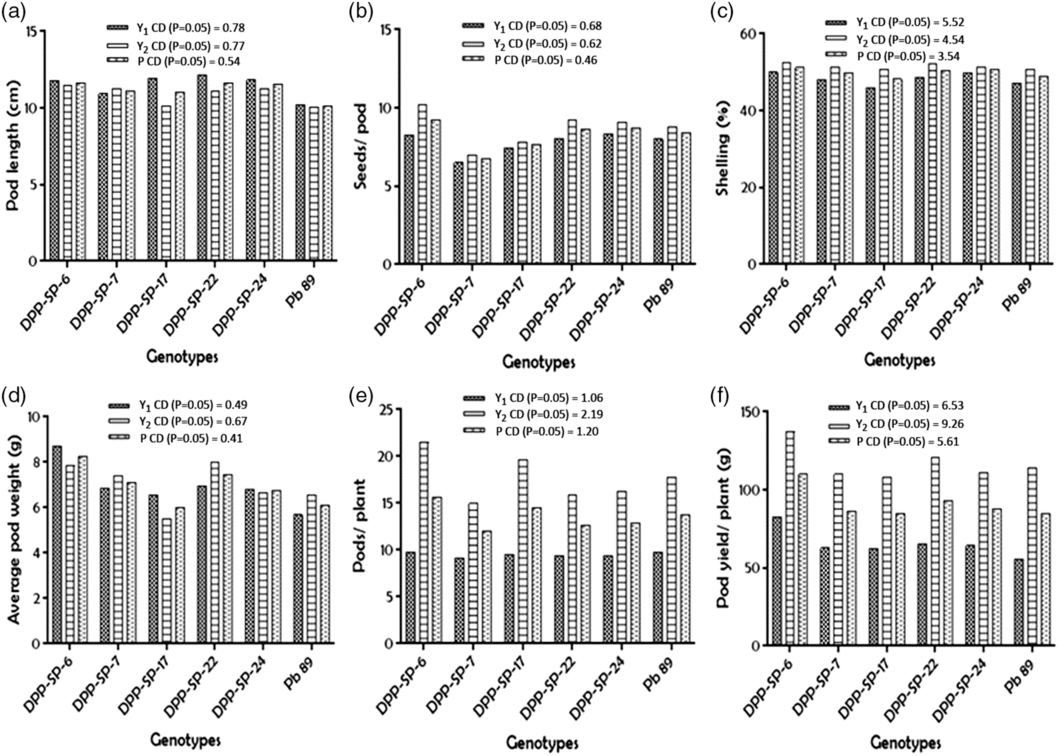
High yield is the basic objective of all crop breeding programmes, and the development of genotypes with potential to surpass commercially adopted/adapted cultivar(s) is essential; otherwise the genotype will be of no significance even if it has excellent performance for other traits. In such context, ‘DPP-SP-6’ outperformed all genotypes for PY/P with an increase of 48 and 30% over the best check ‘Pb-89’ in both years (Figure 3). In addition, ‘DPP-SP-3’ and ‘DPP-SP-22’ also produced significantly high PY/P in comparison to the best-performing check ‘Pb-89’. Further, ‘DPP-SP-6’ also produced the highest P/P, indicating that P/P determines the total productivity of garden pea crop as found by Katoch et al. (Reference Katoch, Singh, Devi, Sharma, Sharma and Sharma2016). The other top-yielding genotypes showed similar P/P to that of ‘Pb-89’ (Supplementary Material Table S6).
Performance of top-ranking five genotypes for PL (a), S/P (b), SH (%) (c), APW (d), P/P (e) and PY/P (f) in comparison to best check Pb-89 during 2014/15, 2015/16 and pooled over years. Y1: Year 1; Y2: Year 2; P: Pooled; CD: Critical difference.

The availability of early pea grains in the market fetches better prices due to less supply and high demand. Then, ‘Pb-89’ was the most desirable genotype for early maturity among the other recommended varieties. In general, the superior genotypes ‘DPP-SP-6’, ‘DPP-SP-22’ and ‘DPP-SP-24’ performed at par to ‘Pb-89’ for earliness, which was categorized based on FFN, DTF and DTFP. Well-filled, long-sized pods having high SH are the desired yielding factors in garden pea cultivars, which vary greatly for S/P, pod size and shape (Amjad and Anjum, Reference Amjad and Anjum2002). In view of that, ‘DPP-SN-7’ had the highest PL and ‘DPP-SP-22’ and ‘DPP-SP-6’ also outperformed ‘Pb-89’. ‘DPP-SP-6’ also showed the highest S/P and APW (Figure 2a). SH is another very important trait in fresh green pea production, directly influencing the total yield besides its importance in processing industry. All the top-ranking genotypes for PY/P had around 50% SH, being similar to ‘Pb-89’. For improving garden pea, wide variations for PL, S/P, SH, P/P and PY/P are needed as well as superior lines in hybridization programme (Katoch et al., Reference Katoch, Singh, Devi, Sharma, Sharma and Sharma2016).
The interaction of many traits establishes the yield, and hence yield is called a quantitative trait (Guindon et al., Reference Guindon, Martin, Cravero and Cointry2018). While optimum vegetative growth during crop establishment is required to achieve the maximum yield potential, the desirable plant type in garden pea is the one that has dwarf growth habit and does not need support. This ultimately results in the reduction of lodging losses and thereby saves resources and enhances yield. ‘DPP-SN-10’ and’DPP-SP-38’ were found to be the shortest plants in both years, and the best-yielding genotypes ‘DPP-SP-22’, ‘DPP-SP-6’ and ‘DPP-SP-17’ showed PH similar to ‘Pb-89’ (Figure 3).
Yield, the traditional first priority for breeders, is still a major goal, though most breeders now pay more attention to quality and other parameters. TSS and AA are important indices for fresh pea quality, and ‘DPP-SP-6’, ‘DPP-SP-22’, ‘DPP-SP-17’ and ‘Pb-89’ showed similar TSS and AA (Figure 3). In our genetic material, wide variability (14.1 to 20.0°Brix) for TSS was observed, which could be explored for obtaining genotypes with good processing and eating qualities. A wide range of AA content (18.0 to 28.7 mg100g–1) in the new genetic material also indicates that nutritional quality could be further explored for developing varieties with high level of antioxidants such as AA.
Pea powdery mildew is particularly prevalent in climates with warm dry days and cool nights (Fondevilla and Rubiales, Reference Fondevilla and Rubiales2012), causing reduction in total biomass, number of P/P, number of S/P, PH and number of nodes. Also, the disease spoils the quality of processing pea with stained and bitter seeds (Fondevilla and Rubiales, Reference Fondevilla and Rubiales2012). Breeding for resistance is a proficient, economic and environment friendly approach to manage the disease. On this line, majority of the new breeding lines showed disease reaction in the range of resistant to moderately sensitive. The best-performing lines ‘DPP-SP-6’, ‘DPP-SP-7, ‘DPP-SP-17’ and ‘DPP-SP-22’ for majority of economic traits also showed resistance to powdery mildew disease. The morphological characterization revealed that these genotypes had long to very long pods with slightly curved to curved characteristics and green to dark-green colour. These promising genotypes for pod yield and majority of economic traits, ‘DPP-SP-6’ being the most promising, could be recommended for cultivation as an alternative to existing varieties, in north western Himalayan region after extensive testing of their performance over other environments.
Author ORCIDs
Bhallan Singh Sekhon 0000-0002-4000-9152
Supplementary material
For supplementary material for this article, please visit https://doi.org/10.1017/S0014479719000115.
Acknowledgements
We gratefully acknowledge the financial assistance provided under ’Central Sector Scheme Technology Mission for Integrated development of Horticulture in Himachal Pradesh’ for the research work reported in this manuscript.
Financial support
None.