INTRODUCTION
Executive functioning (EF) refers to the end result of a coordinated sequence of cognitive processes aimed at achieving a particular goal in a flexible manner. The prefrontal cortex is essential for these processes (Funahashi, Reference Funahashi2001; Fuster, Reference Fuster1997; Stuss & Benson, Reference Stuss and Benson1986), and several neurological (Cummings, Reference Cummings1993; Graham, Bak, & Hodges, Reference Graham, Bak and Hodges2003; Williams-Gray, Foltynie, & Brayne, Reference Williams-Gray, Foltynie and Brayne2007; Zakzanis, Leach, & Freedman, Reference Zakzanis, Leach and Freedman1998) and psychiatric disorders (Reichenberg et al., Reference Reichenberg, Harvey, Bowie, Mojtabai, Rabinowitz and Heaton2008; Roth & Saykin, Reference Roth and Saykin2004) are characterized by deficits in EF. However, it is now well established that different pathologies typically classified within the same umbrella, such as various types of dementia, are not equally impaired in this domain. For example, it is known that patients who develop the behavioral variant of frontotemporal dementia (bvFTD) have early and prominent impairments in executive functions due to early changes in frontal lobe structure (for review, see Hodges & Miller, Reference Hodges and Miller2001a, Reference Hodges and Miller2001b). On the contrary, patients with Alzheimer’s disease (AD), can present very mild executive dysfunction but are not characterized, at least during the early stages, by prominent executive problems. Rather, they tend to present deficits in episodic memory due to early changes in medial temporal lobe structures (for review, see Nestor, Scheltens, & Hodges, 2004). While an accurate evaluation of executive functions is critical for accurate differential diagnosis of a range of conditions, the detection of a dysexecutive syndrome typically requires an extensive neuropsychological battery. A brief screening tool which is easy to administer, yet shows high sensitivity, specificity, and predictive value would be of great importance to clinicians. Several cognitive screening tools have desirable diagnostic and statistical properties (Cullen, O’Neill, Evans, Coen, & Lawlor, Reference Cullen, O’Neill, Evans, Coen and Lawlor2007), but few have been designed to specifically assess executive functioning. As evidence of the intrinsic difficulties that arise with the development of such tools, various screening batteries that have attempted to measure executive dysfunction, fail to exhibit reasonable psychometric properties. For instance, Rothlind and Brandt (Reference Rothlind and Brandt1993) proposed a brief screening test for detecting frontal and subcortical dysfunction, however, patients with AD showed worse performance on this test than patients with frontal dysfunction showing low specificity of the tool. Royall, Mahurin, and Gray (Reference Royall, Mahurin and Gray1992) developed an executive functioning interview reflecting a similar problem, being sensitive also to nonexecutive dysfunction. Ettlin and Kischka developed the Frontal Lobe Score, but administration of this tool requires at least 40 min (Ettlin & Kischka, 1999).
The Frontal Assessment Battery (FAB; Dubois, Slachevsky, Litvan, & Pillon, Reference Dubois, Slachevsky, Litvan and Pillon2000) is an executive screening test that, over the last years, has become widely used in neurological research (Guedj et al., Reference Guedj, Allali, Goetz, Le Ber, Volteau and Lacomblez2008; Lima, Meireles, Fonseca, Castro, & Garrett, Reference Lima, Meireles, Fonseca, Castro and Garrett2008; Oguro et al., Reference Oguro, Yamaguchi, Abe, Ishida, Bokura and Kobayashi2006; Santangelo et al., Reference Santangelo, Vitale, Trojano, Verde, Grossi and Barone2009; Yoshida et al., Reference Yoshida, Terada, Sato, Kishimoto, Ata and Ohshima2009). It consists of six subtests assessing conceptualization, cognitive flexibility, motor programming, sensitivity to interference, motor inhibitory control, and prehension behavior. The authors of the FAB have proposed this test for the evaluation of different kinds of frontal dysfunction, and also to distinguish between neurological pathologies such bvFTD and AD (Slachevsky et al., Reference Slachevsky, Villalpando, Sarazin, Hahn-Barma, Pillon and Dubois2004). They report correlations with executive measures such as the Wisconsin Card Sorting Test (WCST) and measures of general cognitive functioning (Mattis Dementia Scale), while highlighting the lack of correlation with the Mini Mental State Examination (MMSE). The original authors conclude that the FAB is an easy-to-administer battery, sensitive to frontal dysfunction. By contrast, other studies have cast doubts on the sensitivity and specificity of the FAB, and in particular, its ability to actually differentiate types of dementia, such as AD and FTD (Castiglioni et al., Reference Castiglioni, Pelati, Zuffi, Somalvico, Marino and Tentorio2006; Lipton et al., Reference Lipton, Ohman, Womack, Hynan, Ninman and Lacritz2005) in the early stages. Moreover, although the original study by Dubois et al. (Reference Dubois, Slachevsky, Litvan and Pillon2000) showed no correlation between the FAB and general cognitive measures, subsequent studies failed to replicate these findings suggesting that performance on the FAB does not reflect frontal function exclusively (Castiglioni et al., Reference Castiglioni, Pelati, Zuffi, Somalvico, Marino and Tentorio2006; Lipton et al., Reference Lipton, Ohman, Womack, Hynan, Ninman and Lacritz2005).
Given the aforementioned difficulties and based on our previous research studies on executive tests (Clark, Manes, Antoun, Sahakian, & Robbins, Reference Clark, Manes, Antoun, Sahakian and Robbins2003; Clark & Manes, Reference Clark and Manes2004; Manes et al., Reference Manes, Sahakian, Clark, Rogers, Antoun and Aitken2002; Torralva et al., Reference Torralva, Kipps, Hodges, Clark, Bekinschtein and Roca2007), we designed a tool aimed at detecting executive dysfunction: the INECO Frontal Screening (IFS). This screening test was designed to provide health professionals with a sensitive and specific executive screening test to determine frontal dysfunction in patients with dementia. We incorporated some of the FAB subtests which showed the highest sensitivity in our everyday clinical experience: motor programming, conflicting instructions, and inhibitory control. For various clinical and practical reasons, we refrained from including the following subtests of the FAB: verbal fluency, because it is usually administered in general cognitive screening batteries; similarities, as we included a more complex subtest of conceptualization; and prehension behavior, which would be better regarded as a neurological sign of disinhibition (“grasping sign”) than as an index of neuropsychological impairment and is only affected in patients with extremely severe frontal dysfunction (Iavarone et al., Reference Iavarone, Ronga, Pellegrino, Loré, Vitaliano and Galeone2004). Of the FAB subtests included in the IFS, motor programming has been shown to have the highest sensitivity in a study by Lipton et al. (Reference Lipton, Ohman, Womack, Hynan, Ninman and Lacritz2005) while conflicting instructions and inhibitory control are, in our experience, two subtests that usually pose difficulties to our frontal patients. To design a more sensitive and specific tool, we also included new subtests that have been shown to be sensitive to executive dysfunction: numerical working memory (backward digit span), verbal working memory (months backward), spatial working memory (modified Corsi tapping test), conceptualization (proverbs), and verbal inhibitory control (modified Hayling test; Burgess & Shallice, 1997a).
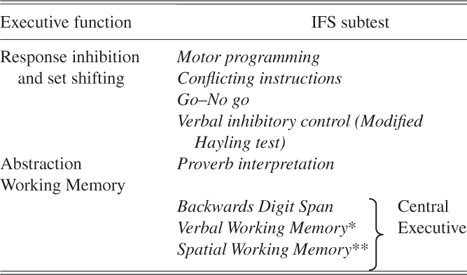
The executive domain encompasses several different functions and the IFS was designed to incorporate a few measures that could tap, in a brief way, as many of these functions as possible. Considering this, the inclusion of the subtests of the IFS was based on the model presented in Table 1. The design of the IFS was primarily conceived as representing three groups of tasks, as follows: (a) response inhibition and set shifting – evaluates the ability to shift from one cognitive set to another and to inhibit inappropriate response in a verbal and motor way; (b) capacity of abstraction – obtained from proverb interpretation, with concrete interpretation being typical of frontal lobe damage patients; (c) working memory – referring to a brain system that provides temporary storage and manipulation of the information necessary for other complex cognitive tasks, one of the most well known models, proposed by Baddeley and Hitch (Reference Baddeley, Hitch and Bower1974), has a three component structure including a Central Executive, which is involved in the control and regulation of the Working Memory System, and two “slave systems”, one responsible for holding verbal information for short periods (phonological loop) and the other for holding information in visual and spatial form (visuo-spatial sketchpad).
Subtests grouped into the different executive functions tapped by the IFS

Note
IFS = INECO Frontal Screening
* Predominantly verbal (Phonological Loop).
** Predominantly visual (visuo-spatial sketchpad).
Overall, the goal of this study was to evaluate a new, easy-to-administer, brief (approximately 10 min), sensitive, and specific tool for the assessment of executive functioning. We also investigated whether the IFS could discriminate executive functioning between bvFTD and AD. We hypothesized that a screening tool specifically designed to measure executive functioning may differentiate the executive deficits characteristic of frontal damage (bvFTD) from the subtle executive deficits of the early AD, a condition which mainly involves medial temporal lobe structures at early stages. Specifically, we propose that, because of the early and prominent executive impairment of bvFTD, these patients would perform worse than the AD group on said screening tool.
METHODS
Participants
A total of 73 participants were included in this study, 26 of which were healthy controls, and 47 of which were diagnosed with dementia. Within the dementia group, 22 patients presented with the bvFTD and 25 with a diagnosis of probable AD. Healthy controls were examined with a comprehensive neuropsychological and neuropsychiatry evaluation, and had no history of either neurological or psychiatric disorder. All patients with AD diagnosis fulfilled NINCDS-ADRDA criteria (Varma et al., Reference Varma, Snowden, Lloyd, Talbot, Mann and Neary1999), while all patients in the bvFTD group fulfilled Lund and Manchester criteria (Neary et al., Reference Neary, Snowden, Gustafson, Passant, Stuss and Black1998). All patients underwent a standard examination battery including neurological, neuropsychiatric, and neuropsychological examinations and a MRI-SPECT. bvFTD patients showed frontal atrophy on MRI, and frontal hypoperfusion on SPECT, when available. Patients with a Clinical Dementia Rating (CDR) Scale of two points or higher were excluded from this study (Hughes, Berg, Danzinger, Coben, & Martin, Reference Hughes, Berg, Danzinger, Coben and Martin1982). However, to avoid circularity, specialists determining diagnoses of patients included in the analysis were blind to their performance on the tool introduced in this study, the INECO Frontal Screening (IFS).
Procedure
The study was initially approved by the ethics committee at the Institute of Cognitive Neurology (INECO) following international regulations established for human research subjects. All participants were evaluated with an extensive neuropsychological battery. Data for this study were obtained from the following tests: the IFS, the Addenbrooke’s Cognitive Examination (ACE; Mathuranath, Nestor, Berrios, Rakowicz, & Hodges, Reference Mathuranath, Nestor, Berrios, Rakowicz and Hodges2000) which also incorporates the MMSE (Folstein, Folstein, & McHugh, Reference Folstein, Folstein and McHugh1975), and classical executive measures, including the verbal phonological fluency (Lezak, Reference Lezak1995), Trail Making Test – Part B (Partington & Leiter, Reference Partington and Leiter1949), and the WCST (Nelson, Reference Nelson1976). IFS content, instructions, and scoring for each of the subtests are included as an appendix to this article. Total IFS score is calculated as the sum of each of the eight subtest scores. Overall average administration time is approximately 10 min.
IFS Subtests
1. Motor Programming (3 points) (Dubois et al., Reference Dubois, Slachevsky, Litvan and Pillon2000; Luria, Reference Luria1966). This subtest asks the patient to perform the Luria series, “fist, edge, palm” by initially copying the administrator, and by subsequently doing the series on his or her own then by repeating the series six times alone. Depending on the extent of frontal lesion or degeneration, some patients may not be able to complete the series in the correct order on their own, and others may not even be capable of copying it. If subjects achieved six consecutive series by themselves, the score was 3, if they achieved at least three consecutive series on their own, the score was 2; if they failed at achieving at least three consecutive series alone, but achieved three when copying the examiner, the score was 1; otherwise the score was 0.
2. Conflicting Instructions (3 points) (Dubois et al., Reference Dubois, Slachevsky, Litvan and Pillon2000). Interference (Dubois et al., Reference Dubois, Slachevsky, Litvan and Pillon2000). Subjects were asked to hit the table once when the administrator hit it twice, or to hit the table twice when the administrator hit it only once. To ensure the subject had clearly understood the task, a practice trial was performed in which the administrator first hit the table once, three times in succession, and then twice, three more times. After the practice trial, the examiner completed the following series: 1-1-2-1-2-2-2-1-1-2. If subjects made no errors, the score was 3; if they made one or two errors, the score was 2; for more than two errors, the score was 1, unless the subject copied the examiner at least four consecutive times, in which case the score was 0. Patients with frontal lesions tend to imitate the examiner’s movements, ignoring the verbal instruction.
3. Go–No Go (3 points) (Dubois et al., Reference Dubois, Slachevsky, Litvan and Pillon2000). This task was administered immediately after test 2. Subjects were told that now, when the test administrator hit the table once, they should hit it once as well, but when the examiner hit twice, they should do nothing. To ensure the subject had clearly understood the task, a practice trial was performed in which the administrator hit the table once, three times in succession, and then twice, three more times. After the practice trial the examiner completed the following series: 1-1-2-1-2-2-2-1-1-2. If subjects made no errors, the score was 3; for one or two errors the score was 2; for more than two errors the score was 1, unless the subject copied the examiner at least four consecutive times, in which case the score was 0.
4. Backward Digit Span (6 points) (Hodges, Reference Hodges1994). For this task, subjects were asked to repeat a progressively lengthening string of digits in the reverse order. Two trials were given at each successive list length, beginning at two and continuing to a maximum of seven. If subjects passed either trial at a given list length, then the next length was administered. The score was the number of lengths at which the subject passed either trial, maximum 6.
5. Verbal Working Memory (2 points) (Hodges, Reference Hodges1994). The patient was asked to list the months of the year backward, starting with December. If subjects made no errors, the score was 2; for one error, the score was 1; otherwise the score was 0. This task evaluates the same function as the previous subtest but with a slightly different load because the series is highly overlearned for most individuals.
6. Spatial Working Memory (4 points) (Wechsler, Reference Wechsler1987). In this task, the examiner presented the subject with four cubes and pointed at them in a given sequence. The subject was asked to repeat the sequence in reverse order. There were four trials, with sequences of two, three, four, and five cubes respectively. Score was number of correctly completed sequences.
7. Abstraction Capacity (Proverb interpretation) (3 points) (Hodges, Reference Hodges1994). Patients with frontal lesions show difficulties in abstract reasoning tasks. Reasoning is most frequently clinically assessed in one of two ways, namely, with either similarities or proverb interpretation tasks. The latter was chosen for this screening test, because patients with frontal lesions usually have difficulties in stepping away from the concrete facts to find their abstract meaning. In this task, three proverbs were read to the subjects and they were asked to explain their meaning. For each proverb a score of 1 was given when the subject gave an adequate explanation, and a score of 0.5 for a correct example. Otherwise the score was 0. The three proverbs were chosen specifically for this demographic population based on their high frequency in oral speech.
8. Verbal Inhibitory Control (6 points) (Burgess & Shallice, 1997b). This task, inspired by the Hayling test, measures a subject’s capacity to inhibit an expected response. Materials were six sentences, each missing the last word and constructed to strongly constrain what it should be. In the first part (three sentences), subjects were read each sentence and asked to complete it correctly, as quickly as possible. In the second part (remaining three sentences), subjects were asked for a completion that was syntactically correct but unrelated to the sentence in meaning. Only the second part was scored. For each sentence, a score of 2 was given for a word unrelated to the sentence, a score of 1 for a word semantically related to the expected completion, and a score of 0 for the expected word itself. Example: “An eye for an eye, a tooth for a ...(table)…” By presenting an identical structure during both phases, this subtest is potentially capable of efficiently evaluating two executive function components (initiation and inhibition) in relation to a unique symbolic verbal form (Abusamra, Miranda, & Ferreres, 2007).
Statistical Analysis
Internal consistency was determined with Cronbach’s alpha coefficient. To analyze concurrent validity with other tasks shown to be sensitive to damage to the prefrontal cortex, the IFS total score was correlated with the Clinical Dementia Rating (CDR) Scale; the ACE total score; the MMSE; the number of items produced on the phonological fluency task, the number of categories abstracted, and perseverative errors on the WCST; and latency to complete Part B of the Trail Making Test (TMT-B).
The ability of the IFS to discriminate healthy controls from patients diagnosed with either form of dementia included in our study (AD or bvFTD) was determined using a receiver operating characteristic (ROC) curve analysis. Demographic and clinical information, as well as neuropsychological test performance were compared between the groups using one-way analyses of variance with Bonferroni post hoc analyses when appropriate. When data were not normally distributed, Mann-Whitney U tests were used to compare two groups at a time. When analyzing categorical variables (e.g., gender), the Freeman-Halton extension of the Fisher exact probability test for 2 × 3 contingency tables was used. Inter-rater reliability was determined using Cohen’s kappa coefficient by two independent raters (T.T. & M.R.). All statistical analyses were performed using the SPSS 15.0 software package.
RESULTS
Clinical and Cognitive Profile
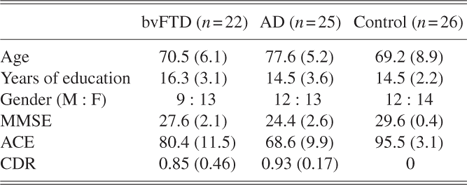
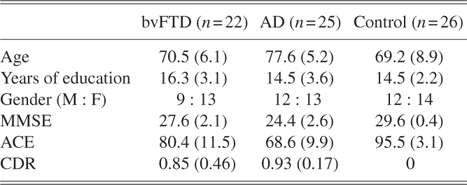
Demographic profile and total scores on tests of general cognitive status are summarized in Table 2. A significant difference was found for age (F 2,72 = 10.4; p < .001), with AD patients differing from both controls (p < .001) and bvFTD patients (p < .01). Nonetheless, neither years of formal education (F 2,72 = 2.63; p = .082) nor gender (χ2 = 0.25; p = .88) differed significantly between the groups. As expected, significant differences were found for the CDR (F2,72 = 91.7; p < .001), with controls scoring significantly lower than the dementia groups (both, p < .001), but no differences between AD and FTD (p = .91). The MMSE (F2,72 = 60.5; p < .001) and the ACE (F2,72 = 48.3; p < .001) differed across the groups (all comparisons, p < .01).
Demographic and general cognitive status information
Note
Values are expressed as Mean (SD). bvFTD = behavioral variant frontotemporal dementia; AD = Alzheimer’s disease; MMSE = Mini Mental State Examination; ACE = Addenbrooke’s Cognitive Examination; CDR = Clinical Dementia Rating Scale.
Psychometric Properties
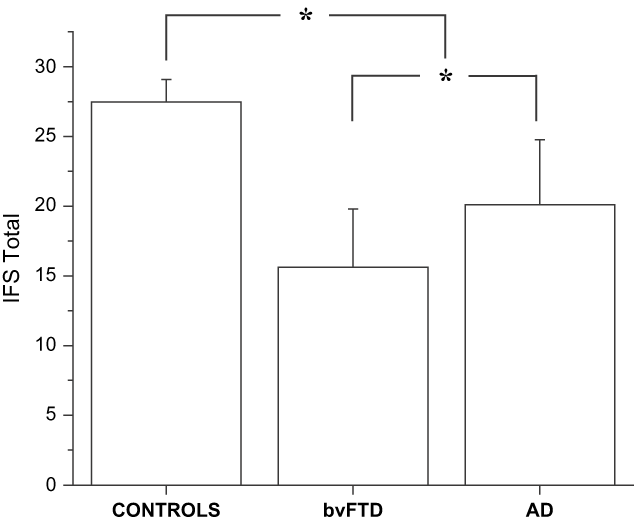
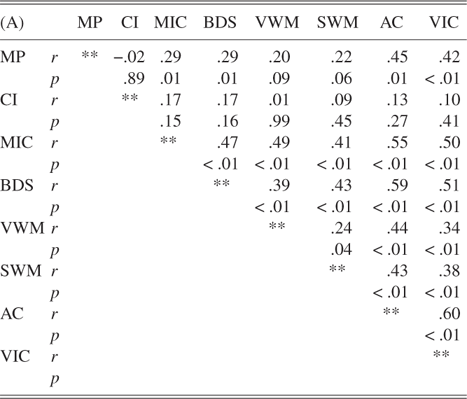
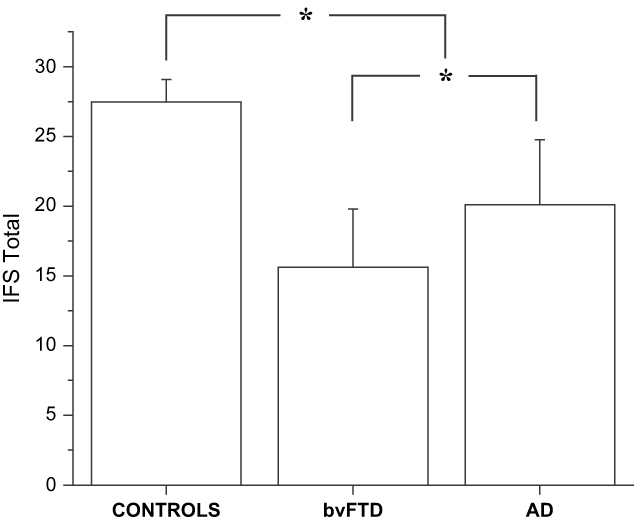
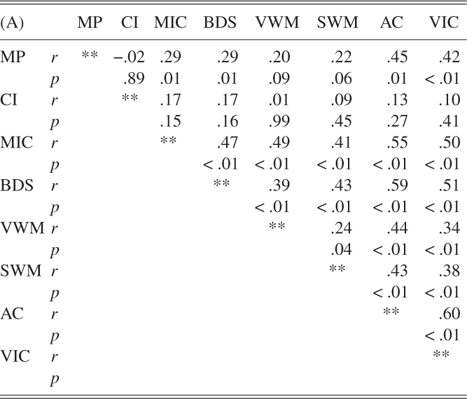
Internal consistency of the IFS was very good (Cronbach’s alpha = 0.80), and most subtests correlated significantly between themselves (Table 3). Inter-rater reliability was very good (Cohen’s kappa = 0.87). IFS total score was 27.4 (SD = 1.6) for controls, 15.6 (SD = 4.2) for bvFTD, and 20.1 (SD = 4.7) for AD. A significant difference was found between the groups on the IFS total score (F 2,72 = 63.7; p < .001), as controls performed significantly better than both bvFTD (p < .001) and AD (p < .001) patients. Moreover, both dementia groups differed significantly between themselves on the IFS total score (p < .001), as shown by Figure 1.
Mean (SD) scores for Controls, Alzheimer’s disease (AD), and behavioral variant frontotemporal dementia (bvFTD) groups on the INECO Frontal Screening (IFS).
Inter-subscale correlation matrix
Note
MP = Motor Programming; CI = Conflicting Instructions; MIC = Motor Inhibitory Control; BDS = Backwards Digit Span; VWM = Visual Working Memory; SWM = Spatial Working Memory; AC = Abstraction Capacity; VIC = Verbal Inhibitory Control.
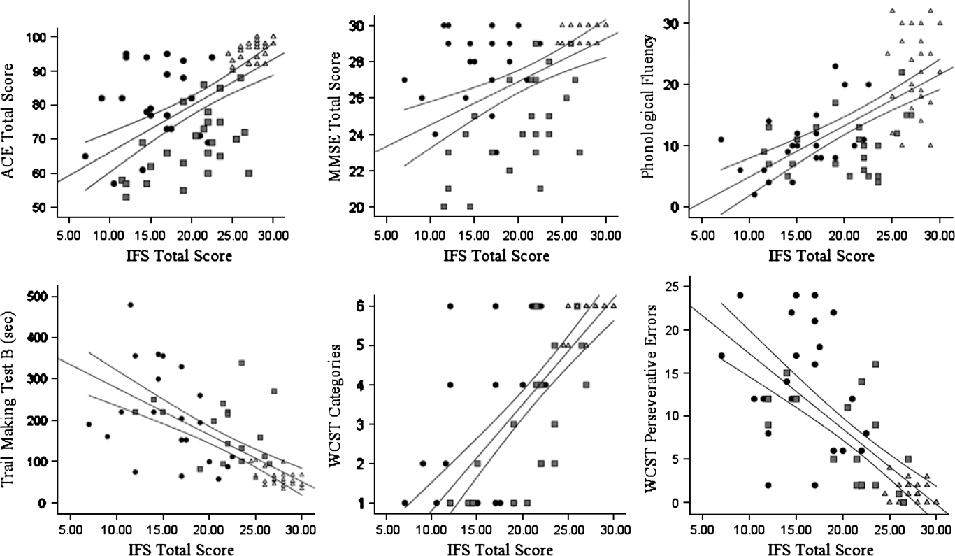
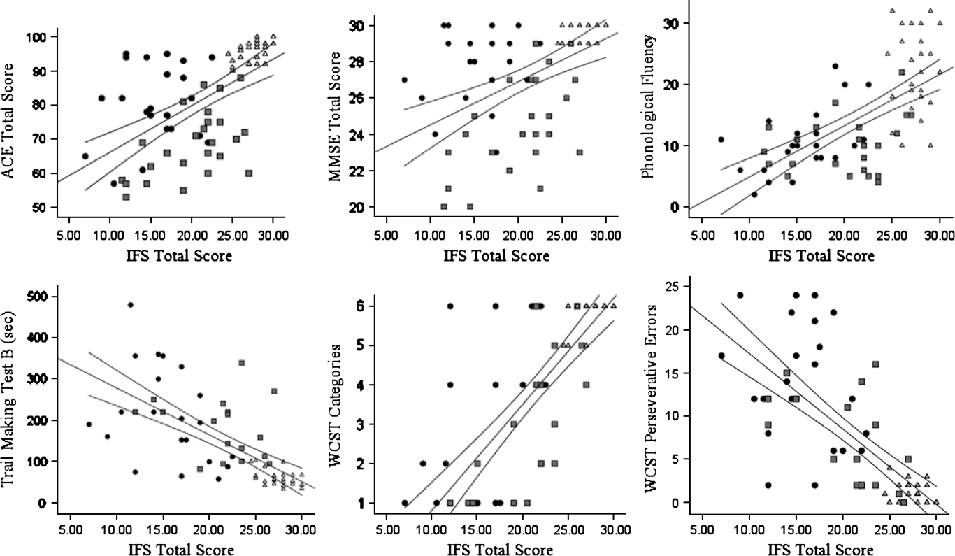
The IFS total score also correlated (Figure 2) with classical executive tests: the number of items produced on the phonological fluency task (r = 0.67, p < .001), the total number of categories abstracted (r = 0.77; p < .001) and perseverative errors (r = −0.77; p < .001) on the WCST, and time to complete the TMT-B (r = −0.75; p < .001). Interestingly, when correlations were calculated exclusively within the bvFTD group, no significance was found between the IFS total score and the MMSE (r = .17; p = .45), ACE (r = .09; p = .67), or the CDR (r = −.16; p = .50), as shown by the black-filled dots on Figure 2 correlation graphs. However, when correlations were calculated exclusively within the AD group, significant correlations were found between the IFS total score and the MMSE (r = .57; p < .01), ACE (r = .55; p < .01). A similar profile was observed within the control group (MMSE: r = .40; p = .04; ACE: r = .55; p < .01).
Correlations between the INECO Frontal Screening (IFS) total score and the Mini Mental State Examination (MMSE), the Addenbrooke’s Cognitive Examination (ACE) total score, phonological fluency task, latency to complete Trail Making Test-Part B (TMT-B), and Wisconsin Card Sorting Test (WCST, categories and perseverations). Data points represent behavioral variant frontotemporal dementia (bvFTD, ●), Alzheimer’s disease (AD, ■), and controls (▲). Linear fit lines are presented with mean confidence intervals.
To demonstrate the specificity of IFS to executive functioning, further correlations were conducted within the bvFTD group between IFS total score and the subscores of the ACE domains. While a significant correlation was found with the attention domain (r = .59; p < .05) as expected, no significant correlations were found with orientation (r = .04; p = .87), memory (r = .05; p = .84), fluency (r = .40; p = .09), language (r = .18; p = .43), or visuo-construction (r = .38; p = .09).
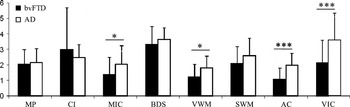
A detailed comparison of AD versus bvFTD performance on each of the eight IFS subtests (Figure 3) revealed that the groups differed significantly on the motor inhibitory control, Go–No Go task (U = 182.0; p = .038), the verbal working memory task (U = 174.5; p = .014), the abstraction capacity task (U = 113.5; p < .001), and the verbal inhibitory control Hayling test (U = 144.0; p < .001).
Mean (SD) scores for Alzheimer’s disease (AD) and behavioral variant frontotemporal dementia (bvFTD) groups on each subtests of the INECO Frontal Screening (IFS). *p < .05, ***p < .001.

A ROC curve analysis on the IFS total score between healthy controls and patients (AD and bvFTD) generated a cutoff score of 25 points with sensitivity of 96.2% and specificity of 91.5% (Figure 4). Area under the ROC curve was .98 (CI: .95 –1.04; p < .001). Furthermore, when patient groups were separated based on their form of dementia, a ROC curve analysis between both groups generated a cutoff score of 19 points, with a sensitivity of 72.0% and a specificity of 81.3%, with a smaller, yet significant (p < .01) area under the curve of .776 (CI: .62–.90). With an IFS cutoff score of 26, 100% of the bvFTD patients were detected as bearing the executive deficits expected for frontotemporal dementia versus 12% of controls. In contrast, the 88-point cutoff score set by the ACE detected 63.4% of the bvFTD patients and the 23 cutoff score set by the MMSE detected only 4.6% of the bvFTD patients. To further analyze the superior sensitivity of the IFS in differentiating bvFTD patients from AD, the area under the curve (AuC) of the classical executive tasks was compared with the AuC of the IFS. While, as previously stated, the latter was significant (p < .001), the executive tasks had poor discrimination accuracy (Phonological fluency: AuC = .487, p = .89; WCST: AuC = .618, p = .36; TMT-B: AuC = .464, p = .71).
Receiver operating characteristic (ROC) curve analyses for dementia versus controls (left) and between dementia groups (right).

DISCUSSION
In our study, the IFS has demonstrated good psychometric properties: very good internal consistency; excellent concurrent validity, as shown by its significant correlation with classical measures of frontal functioning (phonological verbal fluency, WCST categories and perseverative errors, and TMT-B); and good discriminant validity, as revealed by the capability of the IFS to significantly differentiate healthy controls from demented patients, and, furthermore, patients with AD from patients with bvFTD.
One of the most reliable findings of the utility of the IFS is the concurrent validity demonstrated between this test and some of the most classical executive tests available. Several studies have shown the close association between neuropsychological tasks such as the WCST, verbal fluency tasks, and Trail Making Test B, and functioning of the prefrontal cortex. Stuss and Levine (Reference Stuss and Levine2002) reported a series of studies where the inclusion of the WCST as a “frontal measure” in neuropsychological batteries was strongly justified, describing frontal activation during the execution of this task. In this same way, the phonological verbal fluency task is traditionally considered to be capable of reflecting left frontal functioning in particular (Milner, Reference Milner1971), and the time performance of the Trail Making Test–Part B is sensitive to frontal pathology (Stuss et al., Reference Stuss, Bisschop, Alexander, Levine, Katz and Izukawa2001). The excellent correlations found between these well-established frontal tests and the IFS demonstrate a close association between the total IFS score and executive dysfunction in our groups of patients. Moreover, the weak correlations found between the IFS total score and all subdomains of the ACE (except attention), shows that the concurrent validity of the IFS is highly specific for executive functions. The correlations were, as expected, moderate for the fluency and visuo-spatial domains, because of the relatively strong executive component inherent to these tasks of the ACE (phonological fluency, cube copying, and clock drawing). The high specificity for executive functions demonstrated by the IFS is further supported by the larger accuracy in differentiating AD from bvFTD, as revealed by the analysis of the areas under the curve. In fact, the global IFS score was able to differentiate between bvFTD and AD patients, as well as between both pathological groups and healthy controls. More specifically, bvFTD patients exhibited a more severe executive dysfunction, represented by their lower overall IFS scores compared with patients with AD. This difference becomes especially important when considering that the FAB’s initially reported discriminant ability failed to be replicated by other research groups (Castiglioni et al., Reference Castiglioni, Pelati, Zuffi, Somalvico, Marino and Tentorio2006; Lipton et al., Reference Lipton, Ohman, Womack, Hynan, Ninman and Lacritz2005). The more severe executive dysfunction observed in patients with the bvFTD is consistent with the etiological properties of this condition: predominant frontal atrophy and executive disorders since the early stages (Hodges, Reference Hodges2001).
In analyzing each IFS subtest independently, significant differences were found between AD and bvFTD patients on four particular tasks: Go–No Go, Verbal Working Memory, Proverbs, and the Hayling test. In addition, all subtests (except the conflicting instructions task) showed a clear trend toward a similar profile. The different profile observed for the conflicting instruction task, for which AD patients showed a worse performance than the bvFTD group requires further exploration, as it may be resulting from high variability within the group, differences in the clinical profiles, or differential performance on other cognitive domains, such as attention.
There are some limitations to this study. First, a significant difference was found between AD and both bvFTD and controls for their mean age. While this is important because of the potential effect of ageing on executive performance, two findings present evidence against this. On one hand, there were no significant differences on the levels of education between the groups, a variable that could have even a stronger effect than age on executive dysfunction. On the other hand, AD patients outperformed bvFTD on all except one subtest of the IFS, showing that, even though the former group was older, IFS still captured the dysexecution of a younger yet selectively impaired bvFTD group. In fact, the differences on age between the groups results from earlier onset of bvFTD in comparison to AD, and highlights the inclusion of early-stage patients in the present study. Another limitation has to do with the relatively small sample sizes used in this study. Naturally, future studies should replicate the present work to strengthen the generalizability of the results.
The ACE is a screening tool that has demonstrated to have excellent specificity and sensitivity for patients with dementia, especially for Alzheimer disease (Mathuranath et al., Reference Mathuranath, Nestor, Berrios, Rakowicz and Hodges2000). One of the most remarkable limitations of the ACE, acknowledged even by its original authors, is its poor capability for the detection of executive dysfunction. We suggest that the administration of both IFS and ACE in the detection of dementia will help overcome this limitation. In this respect, while significant correlations were found on the whole sample (patients and controls) between the IFS total score and general cognitive measures such as the MMSE and the ACE, those correlations were not observed when we split the sample based on their type of dementia. As it can be observed in Figure 2, within the bvFTD group, no significant correlations were found between the IFS total score and global cognitive measures. It is unlikely that this lack of correlation stems from ceiling effects. Unlike controls, most bvFTD patients exhibit high performance on the ACE but poor performance on the IFS. This is especially important because it highlights the fact that the IFS may be specifically capturing executive domains, otherwise undetected by general cognitive tests. In contrast, when correlations were calculated exclusively within the AD group, significant correlations were indeed found between the IFS total score and the MMSE and the ACE. This could be explained by the fact that, as one could expect, the general cognitive status has a direct impact on IFS performance. In fact, to perform within normal ranges on the IFS, preserved cognitive functioning is needed. It is likely that some patients fail to exhibit high performance on a domain-specific task (IFS) if cognitive areas such as comprehension, language, visuo-spatial abilities, and attention, all of which are captured by ACE, are not minimally spared. Moreover, when looking at the individual performances on ACE and IFS within the bvFTD group, patients with low general cognitive functioning (lower scores on ACE) also perform more poorly on the IFS, supporting the idea that minimal general functioning is needed for proper performance on this battery. The lack of correlations found between the IFS and both the MMSE and ACE within the control group may be due to ceiling effects, as revealed by Figure 2. Further studies are needed to explore the different profiles within various types of dementia and control populations.
As previously described, we believe that a combination of the ACE and the IFS will maximize the power of early detection of pathologies involving frontal circuitry in highly demanding clinical settings, where a complete neuropsychological evaluation may not be possible, or when assessment time is limited. Further research is needed to determine the assumption that a combination of the ACE and the IFS will increase the efficiency in differentiating types of dementia, and to determine the utility of the IFS in other neurological and psychiatric diseases. Moreover, future research should also explore behavioral observations during assessment of the IFS as alternative and complimentary tools to differentiate AD from bvFTD patients (e.g., time to complete tasks, latency to respond, etc.)
In summary, although the complexity of executive functions makes it impossible to think of a single test capable of evaluating this cognitive process in its entirety, the present study indicates that the IFS is a solid, brief, and easy-to-administer diagnostic tool for the assessment of executive functions in bvFTD and AD.
ACKNOWLEDGMENTS
We would like to thank Lucía Crivelli for her valuable contributions to the discussion of the test design. We would also like to thank Catalina Raimondi and Ana Bonifacio for their assistance in this study, as well as Sandra Weintraub for her helpful comments. This study was funded by a FINECO grant and a Fundación LyD grant.
APPENDIX
The following is a translated version of the original Spanish language screening tool used on the patients included in this study.
Motor Series (Programming)
“Look carefully at what I’m doing”. The examiner repeats Luria’s series “fist, side, palm” three times. “Now you make the same with your right hand, first with me, then by yourself.” The examiner repeats the series 3 times with the patient and then says “Now, do it all by yourself”.
Scoring: 6 consecutives series alone: 3 / At least 3 consecutive series alone: 2 / Patient fails at 1 but achieves 3 consecutive series with examiner: 1 / Patient does not achieve 3 series with examiner: 0

Conflicting instructions (Interference sensitivity)
“Hit the desk twice when I hit it once”. To ensure the patient has clearly understood the task, hit once on the table, repeat three times: 1-1-1. “Hit the desk once when I hit it twice”. To ensure the patient has clearly understood the task, hit twice on the table, repeat three times: 2-2-2. The examiner completes this series: 1-1-2-1-2-2-2-1-1-2.
Scoring: No errors: 3 / One or two errors: 2 / More than two errors: 1 / Patient hits like examiner 4 consecutive times: 0
Go-No Go (Inhibitory Control)
“Hit the desk once when I hit it once”. To ensure the patient has clearly understood the task, hit once on the table, repeat three times: 1-1-1. “Do not hit the desk when I hit it twice”. To ensure the patient has clearly understood the task, hit twice on the table, repeat three times: 2-2-2. The examiner completes this series: 1-1-2-1-2-2-2-1-1-2.
Scoring: No errors: 3 / One or two errors: 2 / More than two errors: 1 / Patient hits like examiner 4 consecutive times: 0

Digits backward
Read each series of numbers out load, at a speed of one word/second. Ask the patient to repeat the series in the reverse order. Move on to the next task when the patient gets both items on the line wrong.
Scoring: Line is considered correct when the patient gets one or both items correct. Score is the last line achieved correctly.
Material from the Wechsler Memory Scale-Revised was included under the heading ‘Digits backward’ in the Appendix of this paper without attribution to the owner of the material. The Editor wishes to apologise for this oversight and to confirm that the said material is an original work of authorship created by Dr David Wechsler and the copyright is owned by NCS Pearson, Inc.
Verbal working memory
Months backwards: (errors are considered if: wrong order, omissions, inconclusive task)
Instruction: Say the months of the year backwards, starting with the last month of the year
Dec - Nov - Oct - Sep - Aug - Jul - Jun - May - April - March - Feb - Jan.
(0 errors = 2, 1 error = 1, > 2 errors = 0)
Spatial Working Memory
“I will point at the squares in a given order. I want you to point them in the reverse order”; patient must copy the sequence in the reverse order. Do it slowly; patient chooses hand of preference.
a. 1-2
b. 2-4-3
c. 3-4-2-1
d. 1-4-2-3-4


Proverbs: Example: .5 points. Correct explanation: 1 Point
1. “One swallow does not make a summer”
2. “Still waters run deep”
3. “A bird in the hand is worth two in the bush”
Hayling Test (Abbreviated)
Phase 1: Initiation: “Listen carefully to these sentences and as soon as I am done reading them, you must tell me, as quickly as possible, what word completes the sentence”.
I put my shoes on, and I tie my ... (laces)
It was raining cats and ... (dogs)
Phase 2: Inhibition. Different word: 2 / Semantic Relation: 1 / Exact word: 0 point.
“This time, I want you to tell me a word that makes no sense whatsoever in the context of the sentence, and it must not be related to the word that actually completes the sentence.”
“For example: Daniel hit the nail with a...rain”.
1. John bought candy at the ......
2. An eye for an eye, a tooth for a ......
3. I washed my clothes with water and ......