Introduction
Generalized anxiety disorder (GAD) and social anxiety disorder (SAD) are two frequently co-morbid conditions (Craske et al. Reference Craske, Rauch, Ursano, Prenoveau, Pine and Zinbarg2009). GAD involves excessive worry, whereas SAD involves anxiety to social situations. Some work finds similar neural correlates in the two disorders (e.g. Martin et al. Reference Martin, Ressler, Binder and Nemeroff2010) including similarly reduced capacity for engaging emotion-regulation networks (Blair et al. Reference Blair, Geraci, Smith, Hollon, Devido, Otero, Blair and Pine2012b ). Moreover, other studies fail to distinguish the two disorders, combining them into one mixed anxiety group (Krain et al. Reference Krain, Gotimer, Hefton, Ernst, Castellanos, Pine and Milham2008; Campbell-Sills et al. Reference Campbell-Sills, Simmons, Lovero, Rochlin, Paulus and Stein2011; Britton et al. Reference Britton, Grillon, Lissek, Norcross, Szuhayny, Chen, Ernst, Nelson, Leibenluft, Shechner and Pine2013). However, different clinical presentations and possible disorder-specific treatments suggest the need to further evaluate possible disorder-specific neural underpinnings. Pathological worry is the defining feature of GAD. Thus, in this paper we consider whether neural disruptions during worry-related processing may be specific to GAD, and not SAD.
Few studies map the neurocognitive correlates of worry, complicating attempts to delineate the specific neural dysfunctions in GAD. However, work has mapped the neurocomputational correlates of processes that might arguably be viewed as the counterpoint to worry: optimism and optimistic bias (OB) (Sharot et al. Reference Sharot, Riccardi, Raio and Phelps2007, Reference Sharot, Korn and Dolan2011; Blair et al. Reference Blair, Otero, Teng, Jacobs, Odenheimer, Pine and Blair2013). OB is the belief that negative events are less likely, and positive events more likely, to happen to oneself than to others (Weinstein, Reference Weinstein1980). Healthy adults typically exhibit this bias, but it is reduced in patients with depression (Strunk et al. Reference Strunk, Lopez and DeRubeis2006) and anxiety (Helweg-Larsen & Shepperd, Reference Helweg-Larsen and Shepperd2001). Nevertheless, no prior study contrasts OB in different types of anxiety. Given that enhanced worry and reduced OB both relate to perturbed processing of future events, it seems plausible that GAD involves a reduced OB relative to healthy individuals and individuals with SAD.
Studies of the neural systems mediating OB reveal three important components, each of which might be dysfunctional in GAD (Sharot et al. Reference Sharot, Riccardi, Raio and Phelps2007, Reference Sharot, Korn and Dolan2011, Reference Sharot, Kanai, Marston, Korn, Rees and Dolan2012; Blair et al. Reference Blair, Otero, Teng, Jacobs, Odenheimer, Pine and Blair2013). First, the rostral medial prefrontal cortex (rmPFC) tracks the perceived positive difference between the probability of the event occurring to the self v. others (Sharot et al. Reference Sharot, Korn and Dolan2011; Blair et al. Reference Blair, Otero, Teng, Jacobs, Odenheimer, Pine and Blair2013). Second, the inferior frontal gyrus (IFG)/insula tracks perceived negative difference between the probability of the event occurring to the self v. others (Sharot et al. Reference Sharot, Korn and Dolan2011, Reference Sharot, Kanai, Marston, Korn, Rees and Dolan2012; Blair et al. Reference Blair, Otero, Teng, Jacobs, Odenheimer, Pine and Blair2013). Third, the ventromedial prefrontal cortex (vmPFC) represents the subjective value of the future event; the more positive an event's subjective value, the greater the activity in this region (Sharot et al. Reference Sharot, Riccardi, Raio and Phelps2007; Blair et al. Reference Blair, Otero, Teng, Jacobs, Odenheimer, Pine and Blair2013). Previous work has implicated these areas in GAD, with medial prefrontal cortex (mPFC) dysfunction shown during processes related to attention (Etkin et al. Reference Etkin, Prater, Hoeft, Menon and Schatzberg2010; Blair et al. Reference Blair, Geraci, Hollon, DeVido, Otero, Blair and Pine2012a ), worry (Paulesu et al. Reference Paulesu, Sambugaro, Torti, Danelli, Ferri, Scialfa, Sberna, Ruggiero, Bottini and Sassaroli2010) and anticipation (Whalen et al. Reference Whalen, Johnstone, Somerville, Nitschke, Polis, Alexander, Davidson and Kalin2008; Nitschke et al. Reference Nitschke, Sarinopoulos, Oathes, Johnstone, Whalen, Davidson and Kalin2009). Similarly, heightened responses in the IFG/insula manifest in response to emotional stimuli in pediatric anxiety-disorder patients, relative to healthy peers (Monk et al. Reference Monk, Nelson, McClure, Mogg, Bradley, Leibenluft, Blair, Chen, Charney, Ernst and Pine2006; McClure et al. Reference McClure, Monk, Nelson, Parrish, Adler, Blair, Fromm, Charney, Leibenluft, Ernst and Pine2007). Finally, vmPFC dysfunction is observed in GAD in the context of emotional conflict adaptation (Etkin et al. Reference Etkin, Prater, Hoeft, Menon and Schatzberg2010; Etkin & Schatzberg, Reference Etkin and Schatzberg2011) and passive avoidance learning where there is a reduced correlation between reinforcement prediction error and activity within the vmPFC (White et al. Reference White, Geraci, Lewis, Leshin, Teng, Averbeck, Meffert, Ernst, Blair, Grillon and Blair2017).
This supports three specific hypotheses for GAD on our task indexing OB-related processing. Data from two comparison groups were collected: healthy individuals and patients with SAD. Patients with SAD were chosen as a high-level comparison because although they show high levels of (social) anxiety, there are no clear indications that they show a reduced OB or increased worry. Moreover, they show comparable levels of depression symptomatology as patients with GAD. As such the inclusion of this population serves to either support, or refute, claims of specificity in any observed dysfunction. Relative to these groups, healthy individuals and patients with SAD, patients with GAD were hypothesized to show: (i) decreased modulation of the rmPFC as a function of OB to positive events; (ii) decreased modulation of the insula/IFG as a function of decreased OB to negative events; and (iii) reduced responses within the vmPFC to positive future events. In addition, it is hypothesized that relative to the comparison groups, patients with GAD could show a particularly increased response to events considered to have low (e.g. getting sunburn) relative to high (e.g. having a heart attack) impact given the preoccupation with everyday worries in that population. The current study tests these predictions.
Method
Subjects
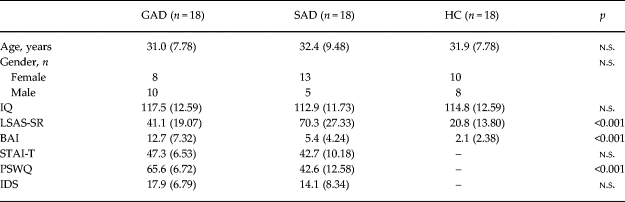
Three different patient groups participated: patients with GAD only (n = 18), patients with generalized SAD only (n = 18) and healthy comparison (HC) individuals (n = 18). Data from this last group were a subset of subjects included in another study (Blair et al. Reference Blair, Otero, Teng, Jacobs, Odenheimer, Pine and Blair2013). Subjects were matched group-wise on age, gender and intelligence quotient (Table 1).
Subject characteristics

Data are given as mean (standard deviation) unless otherwise indicated.
GAD, Generalized anxiety disorder; SAD, social anxiety disorder; HC, healthy comparison; n.s., non-significant; IQ, intelligence quotient; LSAS, Liebowitz Social Anxiety Scale-Self Rated; BAI, Beck's Anxiety Inventory; STAI-T, Spielberger Trait-State Inventory–Trait Part; PSWQ, Penn State Worry Questionnaire; IDS, Inventory of Depressive Symptomatology.
We explicitly recruited subjects who suffered from two specific types of anxiety to facilitate direct comparisons among groups. Accordingly, patients with GAD could only meet criteria for GAD, and patients with SAD could only meet criteria for SAD, based on the Structural Clinical Interview for DSM-IV Axis I disorders (SCID-I) (First et al. Reference First, Spitzer, Gibbon and Williams1997) and a confirmatory clinical interview by a board-certified psychiatrist (D.S.P.). All were medication-free for at least 6 months. Given the association with depression and both GAD and OB, patients with current major depressive disorder were excluded from the study. HCs also received the SCID to ensure they had no psychiatric illness. All subjects were in good physical health.
OB task (Blair et al. Reference Blair, Otero, Teng, Jacobs, Odenheimer, Pine and Blair2013)
The stimuli consisted of 160 possible future events involving different levels (high v. low) of impact on an individual's life. Events consisted of 40 high-impact negative (e.g. having a heart attack), 40 low-impact negative (e.g. getting sunburn), 40 high-impact positive (e.g. winning the lottery) and 40 low-impact positive (e.g. getting a hug) events. The stimuli were selected from a larger set of stimuli rated according to pleasantness/unpleasantness by a different group of 35 healthy adults. The high-impact negative and positive events and low-impact negative and positive events were matched according to their relative valence. In addition, the four different event types were matched on number of letters and words.
Subjects read different possible future events and rated the likely probability of the event happening to them across their lifetime, compared with other people of the same gender and age. They rated their likelihood according to a four-point scale where 1 = much below average; 2 = below average; 3 = above average; or 4 = much above average, using the second and third digit of both hands. Each event was presented for 5500 ms following a 500 ms fixation point. In addition, for each experimental run, forty-eight 3000 ms fixation points were presented (eight at the beginning and end of the run and 40 presented randomly throughout to be used as an implicit baseline). The functional magnetic resonance imaging (fMRI) scan acquisition followed an event-related design, and consisted of four runs with 40 trials per run.
MRI parameters and imaging data preprocessing
Whole-brain blood oxygen level-dependent (BOLD) fMRI data were acquired using a 1.5 Tesla GE MRI scanner. Following sagittal localization, functional T2* weighted images were acquired using an echo-planar single-shot gradient echo pulse sequence [matrix = 64 × 64 mm3, repetition time (TR) = 3000 ms, echo time (TE) = 30 ms, field of view (FOV) = 240 mm3, 3.75 × 3.75 × 4 mm3 voxels]. Images were acquired in 31 contiguous 4 mm axial slices per brain volume, with each run lasting 6 min 24 s. In the same session, a high-resolution T1-weighed anatomical image was acquired to aid with spatial normalization [three-dimensional spoiled gradient-recalled acquisition in the steady state (GRASS); TR = 8.1 ms; TE = 3.2 ms, flip angle = 20°, FOV = 240 mm3, 124 axial slices, thickness = 1.0 mm, 256 × 256 acquisition matrix].
Data were analysed within the framework of the general linear model using Analysis of Functional Neuroimages (AFNI) (Cox, Reference Cox1996). Both individual- and group-level analyses were conducted. The first four volumes in each scan series, collected before equilibrium magnetization was reached, were discarded. Motion correction was performed by registering all volumes in the echo-planar imaging (EPI) dataset to a volume collected close to acquisition of the high-resolution anatomical dataset.
The EPI datasets for each subject were spatially smoothed (isotropic 6 mm3 kernel) to reduce variability among individuals and generate group maps. Next, the time series data were normalized by dividing the signal intensity of a voxel at each time point by the mean signal intensity of that voxel for each run and multiplying the result by 100, producing regression coefficients representing percentage signal change.
Two sets of regressors were then generated. Set 1 involved indicator functions for high-impact negative, low-impact negative, high-impact positive and low-impact positive events multiplied by each subject's rating of each event likelihood. These regressors were created by convolving the train of stimulus events with a γ-variate hemodynamic response function to account for the slow hemodynamic response. Set 2 involved indicator functions for high-impact negative, low-impact negative, high-impact positive and low-impact positive events. In other terms, the first set regressors modeled the deviation from the average response explained by the subject's rating of event likelihood (modulated); i.e. these regressors identified regions showing greater activity as a function of how likely the participant thought they would experience the specific event. The second set modeled (unmodulated) average response to each of the four event categories. Linear regression modeling was performed using the eight regressors described above plus six head motion regressors. This produced an unmodulated and modulated β coefficient and associated t statistic for each voxel and regressor. There was no significant collinearity between the regressors as detected by AFNI. Voxel-wise group analyses involved transforming single-subject β coefficients into standard coordinate space (Talairach & Tournoux, Reference Talairach and Tournoux1988).
fMRI and behavioral data analysis
Following Blair et al. (Reference Blair, Otero, Teng, Jacobs, Odenheimer, Pine and Blair2013), three analyses were performed on the regression coefficients from the individual subject analyses. The first and second analyses used the subject-specific modulated regressors for positive and negative events, respectively. Thus, the first analysis examined group differences in the averaged response to positive future events modulated by the subject's estimate of each individual event's likelihood and involved a one-way (group: GAD, SAD, HC) analysis of variance (ANOVA). Conversely, the second analysis examined group differences in the averaged response to negative future events modulated by the subject's estimate of each individual event's likelihood and involved a one-way (group: GAD, SAD, HC) ANOVA.
The third analysis examined BOLD responses to the unmodulated regressors and involved a 3 (group: GAD, SAD, HC) by 2 (emotion: negative, positive) by 2 (impact: high, low) three-way ANOVA. This same model was also used to analyse the behavioral data. The aim of this third analysis was to determine whether patients with GAD would show reduced responses to positive events, irrespective of the subject's ratings of probability of these events, within the vmPFC. A secondary goal was to determine whether the different levels of impact might differentially modulate the groups’ neural responses.
Statistical maps were created for each analysis by thresholding at a single-voxel p value of p < 0.005. To correct for multiple comparisons, we performed a spatial clustering operation using ClustSim with 1000 Monte Carlo simulations taking into account the EPI matrix covering the entire brain. This procedure yielded a minimum cluster size of 952 mm3 (16.92 voxels) with a map-wise false-positive probability of p < 0.05, corrected for multiple comparisons.
After observing hypothesized group differences, post-hoc analyses were performed to determine the source of significant interactions. For these analyses, average percentage signal change was taken from all voxels within each region of interest generated from the functional mask, and appropriate t tests carried out within SPSS to pinpoint the nature of interaction effects.
Results
Behavioral results
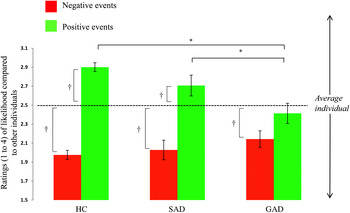
The results from the 3 (group: GAD, SAD, HC) by 2 (emotion: negative, positive) by 2 (impact: high, low) three-way ANOVA revealed a significant group × emotion interaction (F = 7.69, p < 0.001; Fig. 1). The three groups rated their likelihood of experiencing negative events similarly low (F = 1.07, n.s.). However, they differed significantly in their ratings of the likelihood of positive events happening in the future (F = 7.11, p < 0.005), with the GAD group rating their likelihood of experiencing positive events significantly lower than both the HC and SAD groups (GAD v. HC, GAD v. SAD, F = 3.75 and 2.26, p < 0.001 and 0.05, respectively) who did not differ significantly (SAD v. HC, F = 1.49, n.s.). In line with this, a follow-up t test using the 2.5 midpoint on our four-point likelihood rating scale as reference point showed that all three groups showed OB for negative events (HC: t 17 = 10.91, p < 0.001; SAD: t 17 = 4.59, p < 0.001;GAD: t 17 = 4.11, p < 0.001). However, only HCs and patients with SAD (albeit at trend levels) showed an OB for positive events (HC: t 17 = 8.66, p < 0.001; SAD: t 17 = 1.89, p < 0.10; GAD: t 17 = 0.82, n.s.).
Behavioral ratings. All patient groups showed significant optimistic bias (OB) for negative events; however, only the social anxiety disorder (SAD) and healthy comparison (HC) groups showed significant OB for positive events. Values are means, with standard errors represented by vertical bars. * Significant group difference (p < 0.05). † Significant difference in rating relative to the 2.5 rating of the average individual (p < 0.05). GAD, Generalized anxiety disorder. For a color figure, see the online version of the paper.

The multi-factorial ANOVA also showed main effects of emotion and impact (F = 79.48 and 152.42, p < 0.001); subjects thought they were more likely to experience positive and low-impact, relative to negative and high-impact, events. No other interactions were significant.
The reaction time data showed no significant main effect of group or significant interactions. There was, however, a significant main effect of emotion; subjects took longer rating likelihoods of negative, relative to positive, events (F = 33.40, p < 0.001).
fMRI results
Modulated data (BOLD responses modulated by OB)
The initial analyses identified brain regions where there were group differences in the variation of activity as a function of subjects’ estimation that they would experience the events. Following Blair et al. (Reference Blair, Otero, Teng, Jacobs, Odenheimer, Pine and Blair2013), we considered the modulated regressors for the positive and negative events separately. Our goals in these analyses were to determine whether the GAD group would show, relative to the HC and SAD comparison groups: (i) reduced rmPFC recruitment as a function of OB for potential future positive events; and/or (ii) decreased IFG/insula recruitment as a function of OB for potential future negative events.
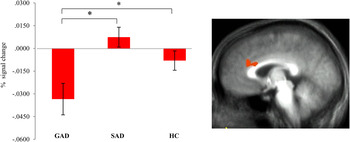
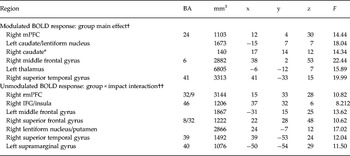
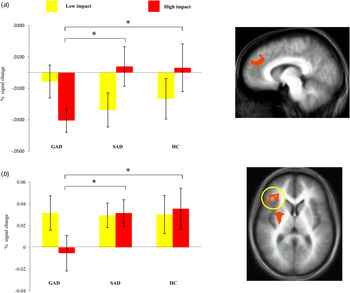
As can be seen in Table 2, there were significant group differences in the correlation of activity within regions including anterior and more posterior regions of the medial frontal cortex and bilateral caudate and subjects’ estimates of their relative likelihood of experiencing specific positive events. In all regions and shown for mPFC in Fig. 2, the GAD group showed significantly greater inverse modulation by their probability estimates for positive events than both the HC (F range = 3.49–11.46, p < 0.01–0.001) and SAD (F range = 17.26–34.71, p < 0.001) groups. In other words, in patients with GAD, activity in these regions increased as likelihood ratings decreased. No area survived correction for multiple comparisons in the analysis involving negative events.
Modulated blood oxygen level-dependent response. There was reduced modulation by optimistic bias in the patients with generalized anxiety disorder (GAD) for potential future positive events in the right medial prefrontal cortex (12, 4, 30). Values are means, with standard errors represented by vertical bars. * Significant group difference (p < 0.05). SAD, Social anxiety disorder; HC, healthy comparison.

Significant areas of activation from the analyses involving the modulated BOLD responses according to the individual subject probability estimates for positive events, and the unmodulated BOLD responses
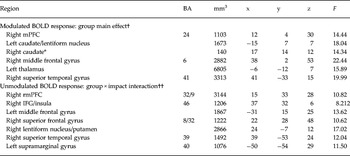
BOLD, Blood oxygen-level dependent; BA, Brodmann's area; mPFC, medial prefrontal cortex; rmPFC, rostral medial prefrontal cortex; IFG, inferior frontal gyrus.
* Significant at p < 0.05, corrected for small volume.
Activations are effects observed in whole-brain analyses, significant at †p < 0.001 and ††p < 0.005, corrected for multiple comparisons (significant at p < 0.05).
Unmodulated data
Following this initial analysis on the modulated BOLD responses, a whole-brain 3 (group: GAD, SAD, HC) by 2 (emotion: negative, positive) by 2 (impact: high, low) three-way ANOVA was conducted on the subjects’ BOLD responses to the events (unmodulated by their probability estimates). The purpose of this analysis was to determine whether patients with GAD would show reduced responses to positive events within the vmPFC. However, there was no significant group × emotion (or group × emotion × impact) interaction within the vmPFC. In contrast, there was a highly significant main effect of emotion: all three groups showed greater responses to positive relative to negative events within the vmPFC and posterior cingulate cortex.
Several regions including the rmPFC showed significant group × impact interactions, however (Table 2 and Fig. 3). In all regions, the GAD group showed significantly increased activation when processing low- relative to high-impact events compared with the HC (F range = 13.98–29.07, p < 0.001 for all) and SAD (F range = 5.01–27.44, p range = 0.05–0.001) groups. Moreover, within the right rmPFC and IFG (Fig. 3), the GAD group showed significantly reduced responses to high-impact events relative to the SAD and HC groups (t = 2.35–2.07, p < 0.05).
Unmodulated group × impact interaction. There were increased blood oxygen level-dependent responses to low-impact events in patients with generalized anxiety disorder (GAD) in (a) the right rostral medial prefrontal cortex (15, 33, 28) and (b) the right inferior frontal gyrus (37, 32, 6). Values are means, with standard errors represented by vertical bars. * Significant group difference (p < 0.05). SAD, Social anxiety disorder; HC, healthy comparison.

Discussion
The goal of the current study was to determine whether patients with GAD show reduced OB, and, if so, identify the associated neural correlates. There were three main findings: First, behaviorally, patients with GAD failed to show OB to positive events, although they showed OB to negative events. Second, patients with GAD showed reduced mPFC activity in response to future positive events as a function of participants’ estimations of the relative probability that these would be experienced. However, there were no significant group differences in the response to future negative events as a function of participants’ estimations of the relative probability that these would be experienced. Third, patients with GAD showed significantly reduced rmPFC activity relative to the HC and SAD groups when processing high-impact events.
Previous work has reported reduced OB in patients with depression (Strunk et al. Reference Strunk, Lopez and DeRubeis2006) and in healthy individuals with raised anxiety (Helweg-Larsen & Shepperd, Reference Helweg-Larsen and Shepperd2001). Here, while all three groups showed comparable OB for negative events, the patients with GAD showed a significantly reduced OB for positive events relative to the SAD and HC groups. Critically, this is the first study to directly examine the neural basis of OB in patients with GAD and SAD. On the basis of previous work involving optimism/OB (Sharot et al. Reference Sharot, Riccardi, Raio and Phelps2007, Reference Sharot, Korn and Dolan2011, Reference Sharot, Kanai, Marston, Korn, Rees and Dolan2012; Blair et al. Reference Blair, Otero, Teng, Jacobs, Odenheimer, Pine and Blair2013), we hypothesized that up to three potential computational processes might be disrupted in patients with GAD.
First, we hypothesized that patients with GAD might show decreased modulation of the rmPFC as a function of OB to positive events. Partially in line with predictions there were significant group differences in the mPFC. Previous studies involving GAD have reported impaired functioning within the mPFC (Etkin et al. Reference Etkin, Prater, Hoeft, Menon and Schatzberg2010; Paulesu et al. Reference Paulesu, Sambugaro, Torti, Danelli, Ferri, Scialfa, Sberna, Ruggiero, Bottini and Sassaroli2010; Blair et al. Reference Blair, Geraci, Hollon, DeVido, Otero, Blair and Pine2012a ) and that poorer responsiveness there predicts a poorer treatment response (Whalen et al. Reference Whalen, Johnstone, Somerville, Nitschke, Polis, Alexander, Davidson and Kalin2008; Nitschke et al. Reference Nitschke, Sarinopoulos, Oathes, Johnstone, Whalen, Davidson and Kalin2009). In previous work with the current task, involving many of the healthy individuals reported here, a proximal region of the rmPFC showed increased activity as perceived likelihood of a positive event increased (Blair et al. Reference Blair, Otero, Teng, Jacobs, Odenheimer, Pine and Blair2013). Indeed, within this region patients with SAD, but not patients with GAD, also showed significantly increased activity when thinking the event was more likely to occur to themselves than to others (data not shown here). However, it is worth noting that: (i) there were group differences in modulation as a function of OB in regions other than the mPFC including the bilateral caudate and thalamus; (ii) in all regions, including the mPFC, the group differences were driven by the GAD patients showing increasing activity as perceived likelihood decreased (i.e. decreasing activity as they thought that positive events were more likely to occur to themselves than others); (iii) in all regions, apart from the temporal cortex, healthy individuals showed no significant modulation. These findings were unpredicted. As such, they are difficult to interpret. However, it does appear that patients with GAD process the likelihood that positive events will occur to themselves in the future fundamentally differently from comparison individuals.
Second, we hypothesized that patients with GAD might show reduced optimism for negative events (i.e. a reduced bias to consider negative events as less likely to occur to the self than others) and corresponding atypical activity within the IFG/insula. However, the patients with GAD showed no impairment in this regard. The IFG/insula and dmPFC respond similarly to estimates of increasing likelihood that a negative event will happen to the self relative to others, in patients with GAD, HC individuals and patients with SAD.
Third, we hypothesized that patients with GAD might show reduced differentiation of positive relative to negative events within the vmPFC. However, the current study did not find evidence of such impairment. Prior research implicates this region in the representation of subjective value of stimuli (e.g. Blair et al. Reference Blair, Marsh, Morton, Vythilingham, Jones, Mondillo, Pine, Drevets and Blair2006; Ballard & Knutson, Reference Ballard and Knutson2009; Levy & Glimcher, Reference Levy and Glimcher2011). This may indicate preserved vmPFC function in GAD, at least with respect to the representation of the subjective value of future events.
We also hypothesized that relative to the comparison groups, the GAD group would show a particularly increased response to events considered to have low (e.g. getting sunburn) relative to high (e.g. having a heart attack) impact given this population's preoccupation with everyday worries. Partly in line with predictions, there were group × impact interactions within the bilateral rmPFC, right IFG/anterior insula cortex, bilateral lateral frontal cortex and a large region of the basal ganglia. In all these regions, patients with GAD were showing significantly greater increase in activity for low- relative to high- positive and negative impact events than the comparison groups.
In short, the current study revealed not only notably different responding in patients with GAD relative to comparison groups relating to estimates of the difference between the subject's probability estimate for a positive event occurring to the self-relative to another individual in the mPFC but also notably different responding of a proximal region of the rmPFC in response to low-impact future events. Previous studies have also reported pathophysiology within this region in patients with GAD (Whalen et al. Reference Whalen, Johnstone, Somerville, Nitschke, Polis, Alexander, Davidson and Kalin2008; Nitschke et al. Reference Nitschke, Sarinopoulos, Oathes, Johnstone, Whalen, Davidson and Kalin2009; Etkin et al. Reference Etkin, Prater, Hoeft, Menon and Schatzberg2010; Paulesu et al. Reference Paulesu, Sambugaro, Torti, Danelli, Ferri, Scialfa, Sberna, Ruggiero, Bottini and Sassaroli2010; Blair et al. Reference Blair, Geraci, Hollon, DeVido, Otero, Blair and Pine2012a ). From a functional perspective, the mPFC has been implicated in responding to conflict (e.g. Kerns et al. Reference Kerns, Cohen, MacDonald, Cho, Stenger and Carter2004) and increased choice availability (Alexander & Brown, Reference Alexander and Brown2011). In addition, the rmPFC has been implicated in self-referential processing (Blair et al. Reference Blair, Geraci, Hollon, Otero, DeVido, Majestic, Jacobs, Blair and Pine2010, Reference Blair, Geraci, Otero, Majestic, Odenheimer, Jacobs, Blair and Pine2011). As such, it can be speculated that the increased activity in the rmPFC might represent the greater relevance of low-impact items to these individuals given their presentation of preoccupation with everyday worries. While the computational specifics of the observed dysfunction remain unclear, it does appear that patients with GAD process low- relative to high-impact items fundamentally differently from comparison individuals.
Six caveats should be noted in relation to the current study. First, while comparable with many other studies involving GAD and in line with our power analysis, our sample sizes (n = 18 per group) were only moderate. Second, the four-point scale used here prevented ratings of ‘average’. Instead, the participants rated each event's likelihood as either ‘below’ (slightly or much) or ‘above’ (slightly or much) average. This manipulation was designed to minimize the potential for disengagement through overuse of neutral ‘average’ answers. However, it probably sometimes forced a ‘below’ or ‘above’ decision where the likelihood truly was believed to be ‘average’. Third, patients were excluded if, in addition to their disorder, they presented with common co-morbidities, including other anxiety disorders, substance use disorders, or depression. Our goal was to determine the pathophysiology of GAD and the comparison anxiety disorder SAD, in a dataset where results could not be attributed to the presence of co-morbid conditions. However, this means that the patients studied were atypical of many anxiety patients presenting clinically and future research may want to determine the extent to which the current findings apply to patients with significant co-morbidity. Fourth, it could be argued that the SAD patients were less anxious than the GAD patients. They did report less anxiety on the Beck's Anxiety Inventory and the Penn State Worry Questionnaire. However, they reported significantly more anxiety on the Liebowitz Social Anxiety Scale and there were no group differences on either the Spielberger Trait-State Inventory or the Inventory of Depressive Symptomatology. As such, we would argue that they were not less anxious but, consistent with diagnosis, differentially anxious. Moreover, importantly, the lack of significant group differences on the Inventory of Depressive Symptomatology indicates that the results reported here could not primarily relate to differences in depression level. Fifth, it is worth noting that the current stimuli set were developed to examine OB generally rather than with respect to specific concerns for specific patient groups. It is possible that the behavioral effects might have been stronger if they had been more directly related to symptom domains.
In conclusion, the current study identifies two atypical neural responses in patients with GAD when: (i) representing the likelihood of a positive event occurring to the self-relative to others (implicating the mPFC and bilateral caudate); and (ii) responding to low- relative to high-impact events (implicating the bilateral rmPFC, right IFG/anterior insula cortex and bilateral lateral frontal cortex). In contrast, two neural responses that were not atypical concerned: (i) representing the subjective value of positive relative to negative events (implicating the vmPFC); and (ii) representing the likelihood of a negative event occurring to the self-relative to others (implicating the dmPFC and IFG/insula). Notably, these findings were specific for GAD. Patients with SAD showed no significant differences in behavioral or neural responses relative to healthy adults. As such, the current data indicate at least some disorder-specificity for the rmPFC dysfunction shown by patients with GAD during the contemplation of potential future events.
Acknowledgements
This research was supported by the Intramural Research Program of the National Institutes of Health, National Institute of Mental Health. Further, the authors assert that all procedures contributing to this work comply with the ethical standards of the relevant national and institutional committees on human experimentation and with the Helsinki Declaration of 1975, as revised in 2008.
Declaration of Interest
None.