Introduction
The main goal of supportive and palliative care for patients living with or affected by cancer is to improve their quality of life (WHO, 2002), which implies a clear obligation to ensure optimal symptom management (Hui, Reference Hui2014). Patients with advanced cancer generally report a range of somatic symptoms that, for most patients, increase in intensity with disease progression (Maltoni, Reference Maltoni2005). The negative impact of these symptoms on patients’ functional status and quality of life is well known (Ferreira et al., Reference Ferreira, Kimura and Teixeira2008), yet there is evidence that many symptoms are left unrecognized (Greco et al., Reference Greco, Roberto and Corli2014).
Depression in patients with advanced cancer is relatively common, with average prevalence rate estimates around 15% using structured clinical interviews or patient-reported measures that include the diagnostic criteria of a depressive disorder (Lie et al., Reference Lie, Hjermstad and Fayers2015; Mitchell et al., Reference Mitchell, Chan and Bhatti2011). Nevertheless, depression in patients with advanced cancer is often not detected in the clinic, hampering adequate treatment (Kadan-Lottick et al., Reference Kadan-Lottick, Vanderwerker and Block2005; Sanjida et al., 2015). Depression is associated with reduced functional status, lower treatment compliance, prolonged hospitalizations, and desire for hastened death (Brown et al., Reference Brown, Theobald, Wu and Tu2010; Lloyd-Williams et al., Reference Lloyd Williams, Shiels, Taylor and Dennis2009). In clinical practice, it is often assumed that depression affects both the presence and intensity of somatic symptoms (Ciaramella & Poli, Reference Ciaramella and Poli2001), and that patients who are depressed may have physical symptoms that are difficult to manage (Chochinov et al., Reference Chochinov, Wilson, Enns and Lander1997).
A symptom is defined as any subjective evidence of disease or unusual state, and accordingly can only be perceived by the individual affected (Dodd et al., Reference Dodd, Janson and Facione2001). Recent research from non-cancer medical populations suggests that an interaction between medical and psychological factors contributes to the experience and reporting of somatic symptoms (Kroenke & Rosmalen, Reference Kroenke and Rosmalen2006). In line with this, numerous studies also from non-cancer populations consistently report associations between depression and increased levels of somatic symptoms (Katon et al., Reference Katon, Lin and Kroenke2007), albeit sparsely studied in cancer settings (Novy et al., Reference Novy, Berry and Palmer2005). Most studies in cancer settings to date have explored this in mixed populations, focusing on specific somatic symptoms, primarily pain and fatigue (Brown & Kroenke, Reference Brown and Kroenke2009; O'Connor et al., Reference O'Connor, Weir and Butcher2012). Indeed, depressive symptoms are found to co-occur with pain and fatigue among cancer patients with mixed diagnoses (Brown & Kroenke, Reference Brown and Kroenke2009; Zaza & Baine, Reference Zaza and Baine2002). It could be that psychological factors play a role in the experience and reporting of a range of somatic symptoms, not only pain and fatigue (Kroenke & Rosmalen, Reference Kroenke and Rosmalen2006). Besides, the relationship between depression and somatic symptoms may vary through the disease trajectory. A handful of small-sized studies on patients with advanced cancer have explored the relationship between depression and a number of symptoms. The findings are equivocal because studies both support (Fitzgerald et al., Reference Fitzgerald, Li and Gagliese2013), reject (Teunissen et al., Reference Teunissen, de Graeff, Voest and de Haes2007), or report mixed findings (Delgado-Guay et al., Reference Delgado-Guay, Parsons and Li2009) regarding such a relationship. Despite consistent reports that poor prognosis is related to both increased somatic symptom burden (Maltoni, Reference Maltoni2005) and depression (Lo et al., Reference Lo, Zimmermann and Rydall2010), the potential effect of disease-related factors on symptom burden was considered in only one of these studies (Fitzgerald et al., Reference Fitzgerald, Li and Gagliese2013). Finally, assessment of depression in cancer populations is challenging, primarily because of the overlap of depressive symptoms and cancer- and treatment-related symptoms and of functional impairments and depression (Wasteson et al., Reference Wasteson, Brenne and Higginson2009). Studies of depression in patients with advanced cancer have used a range of different assessment instruments (Wasteson et al, Reference Wasteson, Brenne and Higginson2009), and few differentiate between depressive symptoms and an established depressive disorder, as defined by diagnostic criteria and recommended by American Society of Clinical Oncology (Andersen et al., Reference Andersen, DeRubeis and Berman2014). Given these methodological issues, the inconsistent results of the few studies to date are perhaps not surprising (Fitzgerald et al., Reference Fitzgerald, Li and Gagliese2013; Lloyd Williams et al., Reference Lloyd Williams, Dennis and Taylor2004; Zaza & Baine, Reference Zaza and Baine2002). Hence, it remains unclear whether depression is associated with, and thus may contribute to, increased somatic symptom burden among patients with advanced cancer irrespective of prognostic factors.
Therefore, the aim of the present study was to compare the intensity of somatic symptoms as reported by patients meeting the criteria for depressive disorder with that of patients not meeting these criteria. Based on clinical experience, we hypothesized that patients with depression report a higher symptom burden than those without. Results in support of this hypothesis serve as a strong incentive to increase the focus on detecting and treating comorbid depression in the clinic also as a means to improve symptom management. Moreover, we wanted to explore the relative contribution of demographic, medical, and prognostic factors; medication use; and depression to increased symptom burden.
Methods
Study design and patients
Data were collected through a large international cross-sectional study from the EU-funded European Palliative Care Research Collaborative project (Kaasa et al., Reference Kaasa, Loge and Fayers2008). From 2008 to 2009, 1,051 patients with advanced cancer were recruited from 17 centers in eight countries, including in- and out-patient units, hospices/inpatient palliative care beds, and general oncology and medical wards. Inclusion criteria were: incurable metastatic or locally advanced cancers and age 18 years or above (Hjermstad, Reference Brændengen, Tveit and Hjermstad2012). Of the 1,051 patients, 969 completed the symptom (Edmonton Symptom Assessment Scale [ESAS]) and depression (Patient Health Questionnaire-9 [PHQ-9]) assessments. Of these, patients with a likely moderate or severe cognitive impairment (sum-score <18, Mini-Mental State Exam (MMSE), n = 12) (Folstein et al., Reference Folstein, Folstein and McHugh1975) or those with missing MMSE-scores (n = 22) were excluded, leaving a final sample of n = 935 in this paper.
Study measurements
Sociodemographic and medical data were collected by healthcare providers, whereas participants completed a range of patient-reported instruments directly on touch-sensitive tablet computers (Brændengen et al., Reference Brændengen, Tveit and Hjermstad2012).
Medical status
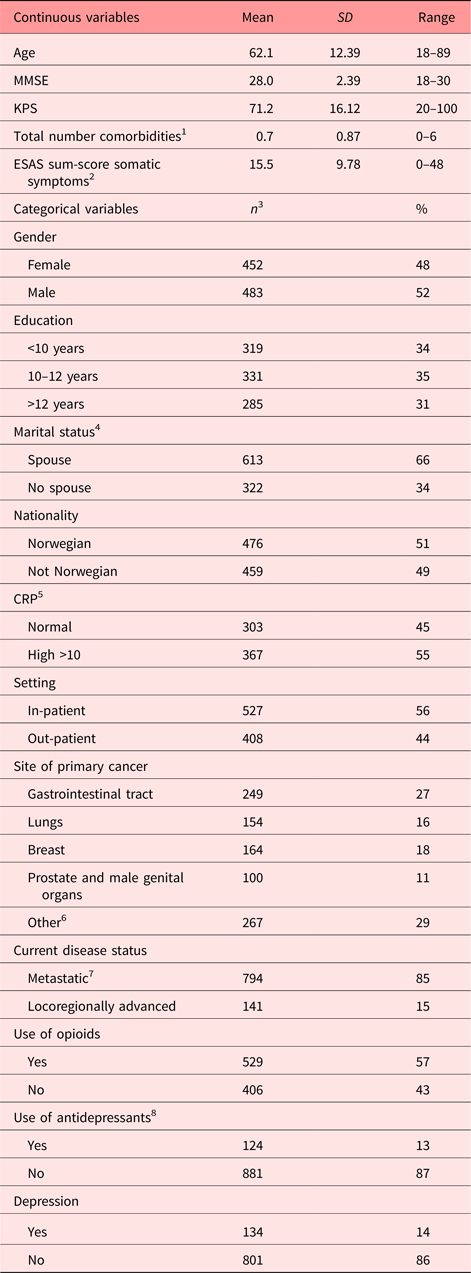
Medical status included the primary cancer diagnosis and current disease status: locoregionally advanced or metastatic (Table 1).
Characteristics of the 935 patients included in the analysis

CRP, C-reactive protein; ESAS, Edmonton Symptom Assessment Scale; KPS, Karnofsky Performance Status score, where 100 = normal functioning and 0 = dead; MMSE = Mini Mental State Examination; SD, standard deviation.
1 Comorbidities: heart disease, arthritis, chronic obstructive pulmonary disease, renal and liver disease, and other.
2 Sum-score of the six somatic symptoms on the ESAS, excluding depression, anxiety, and feeling of well-being. Possible range: 0–60, where a higher score indicates higher symptom burden.
3 Number of patients for each variable may not add up to 935 because of missing cases.
4 Spouse denotes cohabiting with a partner, married or unmarried.
5 CRP: normal = CRP ≤10 mg/L, high = CRP >10 mg/L.
6 Other cancers include: urinary tract (5.6%), skin including malignant melanomas (4.0%), leukemia/lymphoma (4.6%), secondary/ill-defined malignant tumors (2.6%), malignant connective/soft tissue tumors (3.3%), head and neck (3.0%), gynecological (2.6%), tumors of the central nervous system (1.5%), malignant endocrine tumors (0.7%), multiple primary cancers (0.4%).
7 Metastatic disease includes one or more metastases in the following locations; bone, brain, liver, lungs, lymph nodes, or other.
8 Antidepressants not taken as an adjuvant for pain.
Prognostic factors
Medical information was retrieved from patient records and healthcare provider registrations, including Karnofsky Performance Status scores (Karnofsky, Reference Karnofsky1948); dichotomous registration of comorbidities (heart disease, arthritis, chronic obstructive pulmonary disease, renal disease, liver disease, and “other”) and C-reactive protein (CRP) values if obtained within 3 days of study inclusion. High CRP was defined as CRP >10 mg/L. Weight change past 6 months was calculated as self-reported weight in kilograms 6 months ago minus current self-reported weight.
Medication use
Current use of opioids and antidepressants not as adjuvant for pain was dichotomized (use vs. not use).
Depression
Depression was assessed using the PHQ-9, a self-report questionnaire commonly used in medically ill samples, including patients with cancer (Johns et al., Reference Johns, Kroenke and Krebs2013; Lie et al., Reference Lie, Hjermstad and Fayers2015). The PHQ-9 items correspond to the Diagnostic and Statistical Manual of Mental Disorder-5 diagnostic criteria for major depressive disorder (MDD) and assess the frequency at which the corresponding symptoms have been bothersome during the past 2 weeks: 0 = not at all, 1 = several days, 2 = more than half the days, and 3 = nearly every day. To avoid artificially inflating potential relationships between depression and symptom burden in this paper, we used an exclusive scoring method based on the Diagnostic and Statistical Manual of Mental Disorder-5 scoring algorithm (Lie et al., Reference Lie, Hjermstad and Fayers2015). This scoring method excludes four somatic symptoms likely to reflect the cancer disease (sleep problems, fatigue, change of weight or appetite, and psychomotor retardation/agitation) and requires three of the remaining five criteria to be present, including anhedonia or depressed mood (Zimmermann et al., Reference Zimmerman, Emmert-Aronson and Brown2011). Although the PHQ-9 is not a diagnostic tool, patients meeting the criteria for exclusive DD were categorized as depressed in this study.
Symptom burden
Symptom burden was measured using the original Edmonton Symptom Assessment Scale (ESAS) (Bruera, Reference Bruera1991) scored on 11-point numerical rating scales with 0 as “no symptom at all” and 10 as “worst possible symptom.” In the multivariate model, the sum-score of the six somatic ESAS symptoms was calculated, excluding depression, anxiety, and feeling of well-being due to content overlap with depression. A higher sum-score (range 0–60) indicates higher symptom burden.
Statistical methods
Variables to be included in the multivariate models were determined using bivariate regression models with statistical significance set at p < 0.10. Candidate variables were: medical status variables; prognostic factors; medication use; and DD. Demographic variables were controlled for in the multivariate models. Multivariate, hierarchical regression was used to explore the relationships between the above-mentioned variables and the sum-score of the somatic ESAS symptoms. This method allowed us to estimate the unique variance in the ESAS sum-score accounted for by the groups of variables. P values < 0.05 were considered statistically significant. Statistical analyses were done using IBM-SPSS 22 (Armonk, NY: IBM Corp.).
Ethical considerations
The study was performed according to the Helsinki declaration. Ethical approval was obtained at each site before study start. All participants gave written informed consent.
Results
Sample characteristics
Characteristics of the sample are provided in Table 1. In brief, the sample consisted of 48% female patients and the mean age was 62.1 years. The most common site of the primary cancer was the gastrointestinal tract (27%) and 85% had metastatic disease. Of the 935 patients, 801 (85.7%) were not depressed and 134 (14.3%) scored at or above the cutoff for being depressed.) Anti-depressants not as an adjuvant to pain medication were used by 92 (11.5%) patients in the non-depressed group and by 32 (23.9%) patients in the depressed group.
Group domparisons of individual ESAS symptoms
For the purpose of exploring symptom load in terms of individual somatic ESAS symptoms for those depressed or not, we divided the sample into four groups: (1) not depressed and not taking ADs (n = 709), (2) not depressed and taking ADs (n = 92), (3) depressed and not taking ADs (n = 102), and (4) depressed and taking ADs (n = 32). Non-parametric Mann-Whitney U tests showed no significant differences between the two non-depressed groups not using or using ADs, or between the two depressed groups not using or using ADs. For the purpose of further analyses we therefore collapsed the four groups into two: not-depressed (n = 801) and depressed (n = 144). The depressed patients scored significantly higher on all somatic ESAS symptoms compared to the non-depressed (p < 0.001 for all).
Determinants of ESAS sum-score
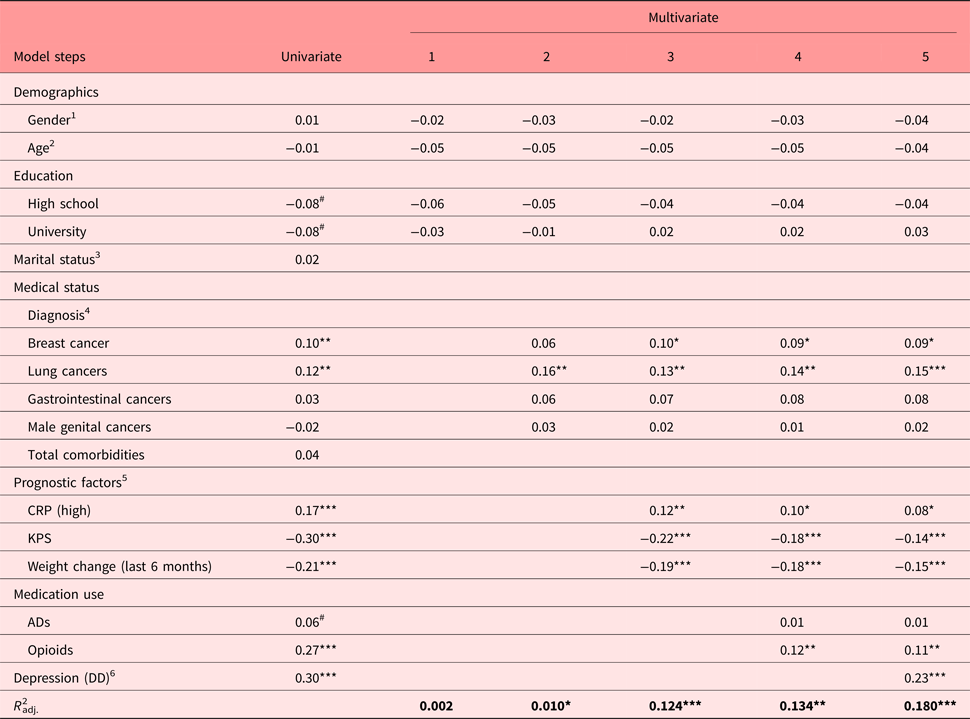
The univariate and multivariate models predicting sum-score of the ESAS somatic symptoms are presented in Table 2. The following variables were significantly associated with a higher sum-score in the univariate analysis; diagnosed with breast cancer (β = 0.10, p = 0.006) or lung cancer (β = 0.12, p = 0.002), prognostic factors including high CRP (β = 0.17, p < 0.001), lower Karnofsky performance score (β = −0.30, p < 0.001) and greater self-reported weight loss the past 6 months (β = −0.21, p < 0.001); taking opioids (β = 0.27, p < 0.001) and meeting the criteria for MDD (β = −0.30, p < 0.001). The multivariate model accounted for 18% of the variance in the ESAS sum scores. Of this, step 1, the demographic variables accounted for 0.2%; step 2, medical status 9.8%; step 3, prognostic factors 2.4%; step 4, medication use 1%; and step 5, DD 4.6% of the variance over and above the variance accounted for by the previous steps in the model. In the fifth and final step of the model, higher symptom burden was associated most strongly with depression (β = −0.23, p < 0.001) after controlling for the effects of all other variables, followed by greater weight loss over the past 6 months (β = −0.15, p < .001), being diagnosed with lung cancer (β = 0.15, p <0 .001), lower performance status (β = −0.14, p <0 .001), and taking opioids (β = −0.11, p < 0.001).
Univariate and hierarchical multivariate regression models predicting the sum-scores of the ESAS somatic symptoms

Univariate predictors with p < 0.10 were included in the multivariate regression model. Standardized beta values are shown.
AD, antidepressant; CRP, C-reactive protein; DD, depression disorder; ESAS, Edmonton Symptom Assessment Scale; KPS, Karnofsky Performance Status.
In step 5: N = 623. Significance levels indicated by: #<0.10, * < 0.05, ** < 0.01, *** < 0.001.
1 Male (vs. female).
2 Age categorized in decades: 18–27, 28–37, 38–47, 48–57, 58–67, 68–77, 78–87, 88–100.
3 Married/de facto vs. not married/divorced/single.
4 Diagnoses: Reference category = all other diagnoses.
5 CRP: reference category = normal = CRP ≤10 mg/L, KPS, weight change: (self-reported weight 6 months ago) – (current self-reported weight).
6 Reference category = no DD. DD, meeting the criteria for a depression disorder using the Diagnostic and Statistical Manual of Mental Disorder-5 scoring algorithm excluding the somatic symptoms.
Discussion
To the best of our knowledge, the present study is the first to examine the relationship between depression according to diagnostic criteria, and self-reported somatic symptom burden in a large sample of patients with advanced cancer while also considering disease-related factors. In line with our main hypothesis, being categorized as depressed was significantly associated with higher somatic symptom burden.
It is known that depressed individuals’ negative and pessimistic way of thinking promotes a negative view of their health and results in heightened awareness of unpleasant experiences (Howren & Suls, Reference Howren and Suls2011). Although these mechanisms primarily have been suggested to play a role in illnesses characterized by medically unexplained symptoms (Kroenke & Rosmalen, Reference Kroenke and Rosmalen2006), recent research has proposed that disease specific symptoms (e.g., dyspnea in pulmonary disorders or chest pain in cardiac disease) may be partly accounted for by comorbid depression, which adds to the physical severity of the underlying medical disorder (Katon et al., Reference Katon, Lin and Kroenke2007). Similarly, it is likely that medical and psychological factors interplay in the experience and reporting of physical symptoms of cancer disease and treatment as well. Our finding that depression is independently associated with a range of somatic symptoms, rather than just a few specific ones, is consistent with this assertion. Longitudinal studies, however, are needed to clarify the potential reciprocity in the interplay between medical and psychological factors. Somatic disease may indeed have an etiological role in the genesis of depression, supported by studies that have identified physical distress as a risk factor for the development of depression (Lo et al., Reference Lo, Zimmermann and Rydall2010).
The emotional, interpersonal, and health economical costs of depression are considerable (Brown et al., Reference Brown, Theobald, Wu and Tu2010; Lloyd Williams et al., Reference Lloyd Williams, Shiels, Taylor and Dennis2009). Even though pharmacological and psychosocial interventions are documented to effectively reduce depression in patients with advanced cancer (Rayner et al., Reference Rayner, Price, Hotopf and Higginson2011), nurses and doctors frequently fail to detect it. Many healthcare personnel believe they do not have the skills to assess and recognize depression (McCabe et al., Reference McCabe, Mellor and Davison2012). Complicating this further is the common misconception among patients and healthcare personnel that the other party should initiate discussions about psychological issues (Detmar, Reference Detmar2000). Consequently, a considerable undertreatment in this patient group has been documented (Kadan-Lottick et al., Reference Kadan-Lottick, Vanderwerker and Block2005; Sanjida et al., Reference Sanjida, Janda and Kissane2016).
One limitation of the present study is its cross-sectional design, which prohibits us from drawing conclusions on directionality. Thus, answering the question of possible bidirectional effects between depression and symptoms necessitates longitudinal investigations. In addition, the use of self-report to measure both depression and symptom severity may have caused conflated associations between variables (i.e., common method variance). We believe, however, that this problem was reduced by excluding the somatic symptoms from our depression measure and including objectively assessed indicators of prognosis such as Karnofsky Performance Status and CRP measures. We lack information about patients who were not invited or declined participation; however, the most severely affected patients are not likely to have been included because of gate-keeping by the recruiting healthcare workers. Also of note is the use of self-report to assess depression rather than the gold standard (i.e., a structured psychiatric interview). Nevertheless, the PHQ-9 corresponds to the criteria used in the Structured Clinical Interview for DSM-MDD interview (Spitzer et al., Reference Spitzer, Kroenke and Williams1999), hence the main difference is the mode of administration, not the content. Indeed, the PHQ-9 is the screening tool recommended for assessment of depression by American Society of Clinical Oncology (Andersen et al., Reference Andersen, DeRubeis and Berman2014).
The main strength of this study is the large, international sample of patients with advanced cancer characterized on a broad range of symptoms, functioning, and medical status. Further, we not only controlled for disease- and treatment-related factors, but also for objective measures of prognosis.
Conclusions and implications
In this large and well-characterized sample of patients with advanced cancer, depression was associated with an increased somatic symptom burden when controlled for disease, treatment status, and prognosis. Our findings are in line with the suggestion that psychological as well as organic factors affect the experience of somatic symptoms in patients with advanced cancer. Future research should investigate prospectively whether improvement of depression, assessed by validated means, results in reduction of somatic symptom burden. When clinicians are assessing and managing symptoms among patients for whom cure is no longer feasible and the aim of care is best possible quality of life, they should consider the potential for a comorbid depression. Given that depression in patients can be treated effectively even in the last few weeks of life (Walker et al., Reference Walker, Hansen and Martin2014), patients presenting with a high intensity across a wide array of symptoms should make clinicians especially attentive to such comorbidity.
Conclusively, the results of the present study clearly support the argument in the Institute of Medicine's report, namely that cancer care can be improved by attending not only to the patient's biomedical needs, but to all aspects of the patient's situation (Young, Reference Young2007).
Acknowledgments
The European Palliative Care Research Collaborative was funded by the European Commission's Sixth Framework Programme (contract no LSHC-CT-2006-037777) with the overall aim to improve treatment of pain, depression and fatigue through translation research. Core scientific group/work package leaders: Stein Kaasa (project coordinator), Frank Skorpen, Marianne Jensen Hjermstad, and Jon Håvard Loge, Norwegian University of Science and Technology (NTNU); Geoffrey Hanks, University of Bristol; Augusto Caraceni and Franco De Conno, Fondazione IRCCS Istituto Nazionale dei Tumori, Milan; Irene Higginson, King's College London; Florian Strasser, Cantonal Hospital St. Gallen; Lukas Radbruch, RWTH Aachen University; Kenneth Fearon, University of Edinburgh; Hellmut Samonigg, Medical University of Graz; Ketil Bø, Trollhetta AS, Norway; Irene Rech-Weichselbraun, Bender MedSystems GmbH, Austria; Odd Erik Gundersen, Verdande Technology AS, Norway. Scientific advisory group: Neil Aaronson, The Netherlands Cancer Institute; Vickie Baracos and Robin Fainsinger, University of Alberta; Patrick C. Stone, St. George's University of London; and Mari Lloyd-Williams, University of Liverpool. Project management: Stein Kaasa, Ola Dale, and Dagny F. Haugen, NTNU, Norway.
Conflicts of interest
None.
Role of funding source
The study was supported by grant LSHC-CT-2006-037777 by the European Commission's Sixth Framework Programme (EPCRC) and a grant by the Norwegian Cancer society, project no. 171874 - PR-2009-0319. The University of Oslo provided material support for the current report. The sponsors provided financial support for the study only. They had no role in the design and conduct of the study: the collection, management, analysis, and interpretations of the data; or in the preparation, review or approval of the manuscript.