


Introduction
In recent years, there has been a growing concern about cardiovascular health in the paediatric population, as the prevalence of obesity, type 2 diabetes mellitus, high blood pressure (BP) and other cardiovascular risk factors increase in children and adolescents. Understanding the mechanisms underlying these conditions is crucial for developing effective prevention and intervention strategies(1–Reference Lee and Yoon3).
Excess body adiposity is characterised by chronic low-grade inflammation, in which adipocytes themselves function as endocrine organs and serve as sources of adipokines associated with inflammation, such as interleukin 6 (IL-6), tumour necrosis factor alpha (TNF-α), and leptin. In addition, adipose tissue infiltration by macrophages and T cells plays a significant role in the inflammatory response within adipose tissue(Reference Uti, Atangwho and Omang4). Excess fat accumulation, particularly in the abdominal region, leads to the release of pro-inflammatory factors involved in the pathogenesis of insulin resistance (IR). This occurs through modifications in insulin signalling, reducing the sensitivity of insulin receptors on cell membranes, thereby exacerbating IR(Reference Uti, Atangwho and Omang4–Reference Hildebrandt, Ibrahim and Peltzer6).
The greater the amount of adipose tissue, the greater the secretion of inflammatory adipokines and the greater the degree of IR, which, in turn, is also associated with the development of hypertension and other risk factors for cardiovascular diseases. Moreover, evidence suggests that the elevation of cytokines with pro-inflammatory activity appears to be a common underlying mechanism in the pathophysiology of both obesity and hypertension(Reference Uti, Atangwho and Omang4,Reference Varra, Varras and Varra5) . In hypertension, low-grade inflammation may contribute to oxidative stress and endothelial dysfunction, leading to a reduction in nitric oxide production and an increase in the production of vasoconstrictors, such as endothelin-1, ultimately resulting in vascular stiffness and elevated BP(Reference Jin, Huang and Hong7–Reference Dixon, Wohlford and Abbate9).
During childhood and adolescence, the development of subclinical chronic inflammation and the consequent increase in the prevalence of cardiovascular risk factors, such as excess weight and hypertension, are particularly associated with environmental factors(Reference Wójcik, Alvarez-Pitti and Kozioł-Kozakowska10–Reference Wärnberg, Nova and Romeo12), including inadequate dietary patterns, sedentary behaviour, family and social influences, sleep deprivation and psychosocial stress. Excessive consumption of ultra-processed foods rich in sugar, fat and sodium, combined with reduced physical activity due to increased screen time and lack of encouragement for sports participation, contributes to a positive energy balance, fat accumulation and metabolic dysfunction(Reference Wójcik, Alvarez-Pitti and Kozioł-Kozakowska10–Reference McPhee, Singh and Morrison13). In addition, sleep deprivation and chronic stress elevate cortisol levels and impair BP regulation(Reference McPhee, Singh and Morrison13,Reference Duraccio, Krietsch and Chardon14) .
Among the environmental variables involved in modulating the inflammatory process, diet plays a key role through the intake of nutrients and bioactive compounds that influence inflammatory and oxidative pathways. Foods can either promote or reduce systemic inflammation, thereby impacting metabolic and cardiovascular health(Reference Bujtor, Turner and Torres15–Reference Suhett, Hermsdorff and Cota17). Evidence suggests that specific dietary patterns may contribute to a chronic state of inflammation, predisposing individuals to cardiovascular diseases from an early age(Reference Saghafi-Asl, Mirmajidi and Asghari Jafarabadi18–Reference Meneguelli, Hinkelmann and Novaes20).
The dietary pattern during childhood and adolescence is quite distinctive, characterised by habits associated with excessive sugar intake, including sweets, soft drinks and other sugar-sweetened beverages; frequent consumption of fast food, which is also high in fats and sodium; and low intake of fruits, vegetables, whole grains and dairy products(Reference Abizari and Ali21–Reference Cunha, Costa and de Oliveira23). These unhealthy dietary patterns have been associated with elevated levels of inflammation(Reference Bujtor, Turner and Torres15–Reference Suhett, Hermsdorff and Cota17,Reference Wang, Armijos and Weigel24) .
In this context, the dietary inflammatory index (DII) has emerged as a promising tool to assess the inflammatory potential of the diet. Briefly, this tool was developed to quantify the inflammatory potential of the diet by considering the intake of various nutrients and bioactive compounds. It classifies dietary patterns as pro-inflammatory or anti-inflammatory on the basis of scientific literature. Diets with a higher DII (more pro-inflammatory) are associated with an increased risk of chronic diseases, such as obesity, hypertension and other cardiovascular risk factors(Reference Shivappa, Steck and Hurley25). In 2018, recognising the need to adjust the index for other populations, researchers developed a children’s version of the DII, called the CDII(Reference Khan, Wirth and Ortaglia26).
Although studies in adults have linked a higher DII to a greater risk of cardiovascular disease and obesity(Reference Liu, Liu and Gong27–Reference Aslani, Sadeghi and Heidari-Beni30), the relationship between the DII and indicators of body adiposity and BP in children and adolescents has not yet been fully elucidated(Reference Bujtor, Turner and Torres15,Reference Suhett, Hermsdorff and Cota17,Reference Tosi, Montanari and Bona31) . A previous systematic review only assessed the association with adiposity and inflammatory markers, failed to gather enough studies that provided conclusive evidence, and did not conduct a quantitative synthesis of this relationship in the paediatric population(Reference Suhett, Hermsdorff and Cota17). Therefore, a more comprehensive systematic review and meta-analysis of the available studies is needed to investigate this association and to provide a complete synthesis of the existing evidence.
It is particularly relevant to clarify this knowledge gap given the importance of establishing healthy eating habits from childhood for the prevention of chronic diseases in adulthood. A rigorous synthesis of the available evidence should contribute to a better understanding of the role of dietary inflammation in the cardiovascular health of children and adolescents and to guide future research and clinical interventions in this critical area of public health. Therefore, the objective of this systematic review and meta-analysis was to synthesise observational studies that evaluated the association between the DII and indicators of body adiposity and BP in children and adolescents.
Methods
This systematic review and meta-analysis evaluated observational studies on the association between the DII and cardiometabolic risk in children and adolescents, including indicators of body adiposity and BP. The protocol was submitted to the International Prospective Register of Systematic Reviews (PROSPERO) and registered under number CRD42022323267. This review was conducted by following the methodological recommendations proposed by the Cochrane Center(Reference Higgins, Thomas and Chandler32) and the writing recommendations proposed by the Preferred Reporting Items for Systematic reviews and Meta-Analyses (PRISMA) guidelines(Reference Page, McKenzie and Bossuyt33) (see the PRISMA checklist in the supplementary material).
Inclusion and exclusion criteria
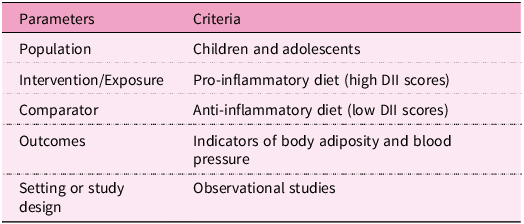
The PICOS framework was used to determine the inclusion and exclusion criteria (Table 1).
-
1. Population: children and adolescents (from 2 years of age).
-
2. Intervention/exposure: pro- and anti-inflammatory diet, based on the DII or CDII.
-
• DII: this tool is an algorithm-based score derived from an extensive review of the literature published between 1950 and 2010, linking 1943 articles to a total of forty-five dietary parameters, including various macro- and micronutrients, flavonoids and specific foods. The DII is widely used to capture both pro- and anti-inflammatory dietary patterns, with the overall dietary score ranging from maximally pro-inflammatory (+8 points) to maximally anti-inflammatory (−8 points)(Reference Shivappa, Steck and Hurley25).
-
• CDII: researchers identified the need to adjust the DII for other age groups and created the CDII, a ‘world’ standard database of food parameters that could be used to calculate the DII for children. As noted in the Introduction there are differences between the diet of children and adults. A difference between the DII and the CDII is that the CDII only includes twenty-five food parameters, compared with the forty-five for the DII. The following food parameters present in DII for adults are not used in the CDII: caffeine, eugenol, garlic, ginger, green/black tea, n–3 fatty acids, n–6 fatty acids, onion, saffron, turmeric, trans fat, flavan-3-ol, flavones, flavonols, flavonones, anthocyanidins, isoflavones, pepper, thyme/oregano and rosemary(Reference Khan, Wirth and Ortaglia26).
-
3. Outcomes: related to cardiometabolic risk factors (indicators of body adiposity and BP).
-
• Body mass index (BMI) is a widely used measure to assess an individual’s nutritional status based on the relationship between their weight and height. Although BMI has limitations, such as the inability to differentiate between lean mass and body fat, it remains an essential tool associated with the risk of several health conditions(34). The World Health Organization growth curves are used as a reference for individuals aged 5–19 years; these curves consider sex and age(Reference Onis, Onyango and Borghi35).
-
• Waist circumference (WC) is an anthropometric measurement used to assess central adiposity and the risk of metabolic complications in children and adolescents. However, there are no universally standardised cut-offs for this population, which limits its clinical use(Reference McCarthy, Jarrett and Crawley36). Owing to the absence of standardised criteria, some studies propose specific cut-off points, such as the 80th(Reference Taylor, Jones and Williams37) or 90th(Reference Freedman, Serdula and Srinivasan38) percentile of the sample. In addition, specific cut-offs have been suggested according to pubertal staging(Reference Hirschler, Molinari and Maccallini39).
-
• The waist-to-height ratio (WHtR) is an anthropometric indicator used to assess body fat distribution and the risk of cardiovascular disease in children and adolescents. It is calculated by dividing WC by height, both measured in the same units. A WHtR ≥ 0·50 indicates an increased risk of central adiposity and is associated with a higher risk of metabolic complications, regardless of age and sex. Unlike other anthropometric indicators, the WHtR uses a single cut-off (0·50) to identify the risk of central adiposity; this cut-off is applicable to different ages, sexes and ethnicities(Reference Ashwell and Hsieh40).
-
• Other indicators of body adiposity including the waist-to-hip ratio (WHR) and neck circumference (NC) are also used, as well as percent of total fat mass (TFM%), fat mass (FM), fat-free mass (FFM), skin folds, the fat mass index (FMI), the fat-free mass index (FFMI) and visceral fat area(Reference Wells and Fewtrell41–Reference Magalhães, Sant’Ana and Priore43).
-
• Regular BP assessment in children and adolescents is crucial for early detection of hypertension, which may be asymptomatic but increases future cardiovascular and renal risks. BP classification is based on percentiles adjusted for age, sex and height. The categories include normal, with a systolic blood pressure/diastolic blood pressure (SBP/DBP) <90th percentile; elevated, with SBP/DBP between the 90th and 95th percentile or ≥120/80 mmHg (whichever is lower); and hypertension, with SBP/DBP ≥ the 95th percentile and up to 12 mmHg, or between 130/80 and 139/89 mmHg (whichever is lower). For adolescents ≥13 years, adult criteria apply(Reference Flynn, Kaelber and Baker-Smith44).
-
4. Setting or study design: observational studies.
PICOS inclusion and exclusion criteria for studies

DII, dietary inflammation index.
In addition, the publications had to provide at least relative risks (RRs), prevalence ratios (PRs) or odds ratios (ORs) with their confidence intervals (CIs) for categorical risk estimates or mean values and standard deviations, beta coefficients or correlation coefficients with respective p-values for continuous variables(Reference Higgins, Thomas and Chandler32,45) .
The following publications were excluded: studies with adults, pregnant women or those in which individuals were selected by groups of chronic or high-risk diseases and using medications that could alter BP; interventionist research; clinical trials; in vitro studies; reviews and/or case reports; book sections; encyclopaedias; editorials; monographs; theses; dissertations; publications whose texts were not fully available; duplicates; and studies that did not evaluate the exposures, outcomes and associations between factors relevant to this review(Reference Higgins, Thomas and Chandler32,45) .
Search strategy
A comprehensive search was conducted across the following electronic databases: CINAHL, Embase, Latin American and Caribbean Health Sciences Literature (LILACS), PubMed/MEDLINE, Scopus, Web of Science and Google Scholar (for grey literature). The aim was to identify observational studies relevant to the topic. In addition, reference lists of included studies and relevant reviews were manually screened to identify potentially eligible studies not retrieved through the initial database searches. When necessary, study authors were contacted to obtain additional data or clarifications(Reference Higgins, Thomas and Chandler32).
The search strategy incorporated descriptors related to the exposure (the DII) and the target population (children and adolescents), along with their corresponding synonyms. The Boolean operators ‘AND’ and ‘OR’ were used to combine search terms. No restrictions were applied regarding language or publication date(45).
The PubMed/MEDLINE, CINAHL, Scopus, Web of Science and Google Scholar searches were conducted using controlled vocabulary terms sourced from the Medical Subject Headings (MeSH) database. To increase sensitivity, relevant uncontrolled terms (entry terms) were also included. For LILACS, descriptors were selected from the Descriptors in Health Sciences (DeCS) of the Virtual Health Library. For Embase, searches were conducted using Emtree terms, the controlled vocabulary specific to that database. Boolean combinations were customised for each database according to its indexing system(Reference Higgins, Thomas and Chandler32,45) . The full search strategy for each database is available in the supplementary material.
Data selection
The selection of studies was conducted independently by two reviewers, who screened the titles and abstracts retrieved from the databases on the basis of the predefined eligibility criteria for this systematic review. Studies that clearly failed to meet the inclusion criteria were excluded at this stage. The full texts of potentially relevant articles were reviewed to confirm their eligibility. For each excluded study, the primary reason for exclusion was documented using a standardised form to support the construction of the study selection flowchart(Reference Higgins, Thomas and Chandler32).
As relevant articles were identified, their reference lists were also examined to identify additional publications that might meet the inclusion criteria. Any discrepancies between reviewers were resolved by consultation with a third reviewer during a consensus meeting. Final decisions regarding study inclusion for data extraction and synthesis were made collaboratively by the research team(Reference Higgins, Thomas and Chandler32,45) .
Data extraction and quality assessment
Three independent authors extracted data from each eligible study, including first author, year of publication, country and study design. The study population was characterised by the sample size, sex and age group. In addition, detailed information was gathered regarding the instruments used, the indicators assessed and the methods applied to identify both exposures and outcomes. The statistical methods employed and the main findings were also documented. Associations between exposures and outcomes were evaluated by analysing the number of individuals with increased prevalence or risk of cardiometabolic factors – specifically body adiposity and BP – using association measures such as ORs, PRs or β regression coefficients(Reference Higgins, Thomas and Chandler32,45) .
The Newcastle–Ottawa scale (NOS) was used to assess the methodological quality of the included studies. This tool evaluates studies on the basis of three domains: participant selection, comparability of study groups and outcome or exposure assessment. Cohort and case-control studies could score up to nine stars, with scores between six and eight indicating moderate quality, and scores of five or below indicating low quality(Reference Wells, Shea and O’Connell46). For cross-sectional studies, a modified version of the NOS with seven items was applied, yielding a maximum score of seven stars. In this version, moderate quality was defined as a score between four and six stars, while studies scoring three or fewer were rated as low quality(Reference Patra, Bhatia and Suraweera47).
Furthermore, the Grading of Recommendations Assessment, Development and Evaluation (GRADE) approach was applied to evaluate the certainty of the evidence. This system classifies evidence into four levels – high, moderate, low or very low – on the basis of criteria including study limitations, indirectness, inconsistency, imprecision and potential publication bias. GRADE also supports the development of recommendations by guiding the assessment of the direction and strength of the evidence-based conclusions(Reference Balshem, Helfand and Schünemann48,Reference Guyatt, Schunemann and Andrews49) .
Data synthesis and analysis
Quantitative synthesis was conducted through meta-analysis for outcomes with data deemed sufficiently comparable across studies(Reference Deeks, Higgins, Altman, Higgins, Thomas and Chandler50). Specifically, meta-analyses were performed to evaluate the association between the DII or CDII and the following indicators: BMI, WC, the WHtR, SBP, DBP, hypertension and high BP. For other outcomes, no set of studies met the criteria for quantitative pooling; thus, a narrative synthesis was applied(Reference Deeks, Higgins, Altman, Higgins, Thomas and Chandler50).
The heterogeneity among the included studies was assessed with Cochran’s Q test, along with the I² statistic to quantify inconsistency. A p-value <0·10 was considered indicative of significant heterogeneity. The interpretation of I² values followed standard guidelines: values near 0% suggested no heterogeneity, around 25% indicated low heterogeneity, over 50% indicated moderate heterogeneity and over 75% indicated high heterogeneity(Reference Deeks, Higgins, Altman, Higgins, Thomas and Chandler50).
Given that the original studies applied different statistical models to evaluate the association between the DII or CDII and adiposity or BP indicators, separate meta-analyses were conducted according to exposure (the DII or CDII), outcome (BMI, WC, the WHtR, SBP, DBP, hypertension or high BP) and type of association measure (ORs or β regression coefficients). The meta-analysis results are presented with forest plots(Reference Deeks, Higgins, Altman, Higgins, Thomas and Chandler50).
Two types of meta-analyses were conducted: one using ORs from logistic regression models and their CIs – converted into standard errors – and another using β coefficients from linear regression models. These values were log-transformed to stabilise variance and to normalise distributions(Reference Deeks, Higgins, Altman, Higgins, Thomas and Chandler50). The metan command in STATA was used, specifying the effect estimate and standard error as variables. The eform option was applied to back-transform the summary effect estimates into the original scale for interpretability. For analyses with moderate-to-high heterogeneity, random-effects models were fitted using the restricted maximum likelihood (REML) method. Even in cases of low heterogeneity, REML models were applied, as results from fixed- and random-effects models are equivalent under such conditions.
Owing to the limited number of studies included in each meta-analysis, it was not possible to explore sources of heterogeneity through subgroup analysis or meta-regression, except for the meta-analyses between the CDII and BMI or WC, but no differences were identified in the subgroup analyses by age group. In addition, publication bias was not assessed using funnel plots or Egger’s test(Reference Deeks, Higgins, Altman, Higgins, Thomas and Chandler50).
All statistical analyses were performed using STATA for Mac, version 16.0 (StataCorp LP, College Station, TX, USA).
Results
Literature search
Fig. 1 presents the detailed study search and selection steps performed from April to June 2022 and updated in March 2025(Reference Page, McKenzie and Bossuyt33). After applying the search strategy, a total of 2641 potentially relevant publications were identified in Scopus, 930 in MEDLINE via PubMed, 735 in EMBASE, 583 in Web of Science, 550 in CINAHL, 300 in Google Scholar (grey literature) and 3 in LILACS, totalling 5742 publications. The abstracts from the databases were grouped and imported into the free online version of Endnote Reference Management. The program identified 1239 duplicates. Afterwards, a total of 4503 publications were imported into the Rayyan software, with another 418 duplicates being identified, resulting in a total of 1657 discarded duplicates and 4085 records for which the titles and abstracts were read. After reading the titles and abstracts, a total of 4046 records were excluded because they did not meet the inclusion criteria. The remaining thirty-nine publications were read in full. After reading, eighteen of them were excluded and twenty-one were selected according to the eligibility criteria.
Search and selection flowchart according to PRISMA(Reference Page, McKenzie and Bossuyt33).

In March 2025, after updating the search in the databases, thirteen records were added that also met the inclusion criteria and three records from manual search. Thus, thirty-seven records were included(Reference Yilmaz and Açık16,Reference Wang, Armijos and Weigel24,Reference Shivappa, Hebert and Marcos51–Reference Vingrys, Hébert and Chen85) , thirty-five scientific articles and two abstracts from conference proceedings. There are two studies each by the Iranian group Shipava et al.(Reference Shivappa, Hebert and Rashidkhani52,Reference Shivappa, Hebert and Neshatbini Tehrani53) and the Brazilian group Suhett et al.(Reference Suhett, Hermsdorff and Ribeiro67,Reference Suhett, Vieira Ribeiro and Hermsdorff68) included in this review. The participants in both studies from each group come from the same sample. Furthermore, Navarro et al.(Reference Navarro, Shivappa and Hébert60,Reference Navarro, Shivappa and Hébert61) and Barragán-Vázquez et al.(Reference Barragán-Vázquez, Ariza and Pedraza62,Reference Barragán-Vázquez, Ariza and Ramírez Silva63) each have two publications included in this review; for each group, one publication is an article and one publication is a conference abstract. For the study by Vingrys et al.(Reference Vingrys, Hébert and Chen85), we evaluated individual data from participants in five cohorts(Reference Boyd, Golding and Macleod86–Reference Hofman, Jaddoe and Mackenbach90). However, according to Cochrane(Reference Higgins, Thomas and Chandler32), the unit of interest for data interpretation is the studies that served as the origin for these articles and summaries, thus we included thirty-three studies(Reference Yilmaz and Açık16,Reference Wang, Armijos and Weigel24,Reference Shivappa, Hebert and Marcos51–Reference Vingrys, Hébert and Chen85) in the qualitative synthesis and eighteen studies(Reference Yilmaz and Açık16,Reference Correa-Rodríguez, González-Jiménez and Rueda-Medina54,Reference Aslani, Qorbani and Hébert58,Reference Barragán-Vázquez, Ariza and Pedraza62–Reference Aljahdali, Peterson and Cantoral69,Reference Costello, Goodrich and Patterson71,Reference Jia, Wu and Su75–Reference Blaudt, de Souza Lopes and de Moura Souza79,Reference Zhang, Peng and Wang81,Reference Du, Hao and Yu83,Reference Vingrys, Hébert and Chen85) in the quantitative synthesis (meta-analysis).
Study characteristics
We extracted data from thirty-three studies(Reference Yilmaz and Açık16,Reference Wang, Armijos and Weigel24,Reference Shivappa, Hebert and Marcos51–Reference Vingrys, Hébert and Chen85) – published between 2017 and 2025 – on the association between the DII and indicators of body adiposity and BP in children and adolescents (Table 2). The studies were mostly from Asia (n = 11)(Reference Yilmaz and Açık16,Reference Shivappa, Hebert and Rashidkhani52,Reference Shivappa, Hebert and Neshatbini Tehrani53,Reference Karera, Witjaksono and Khusun55,Reference Aslani, Qorbani and Hébert58,Reference Aslani, Qorbani and Hébert58,Reference Kurklu, Torun and Kucukcetin64,Reference Dehghan, Nejati and Vahid72,Reference Gholamalizadeh, Ahmadzadeh and BourBour74,Reference Li, Li and Wang76,Reference Kanısoy and Kabaran80,Reference Şahin, Yardımcı and Açık84) , followed by the USA (n = 9)(Reference Shivappa, Hebert and Marcos51,Reference Khan, Wirth and Ortaglia56,Reference Sen, Rifas-Shiman and Shivappa57,Reference Sethna, Alanko and Wirth66,Reference Costello, Goodrich and Patterson71,Reference Ducharme-Smith, Brady and Vizthum73,Reference Jia, Wu and Su75,Reference Zhang, Peng and Wang81,Reference Du, Hao and Yu83) , Latin America (n = 7)(Reference Wang, Armijos and Weigel24,Reference Shivappa, Hebert and Rashidkhani52,Reference Barragán-Vázquez, Ariza and Ramírez Silva63,Reference Suhett, Hermsdorff and Ribeiro67–Reference Aljahdali, Peterson and Cantoral69,Reference Todendi, Salla and Shivappa78,Reference Blaudt, de Souza Lopes and de Moura Souza79,Reference Cota, Filgueiras and Pereira82) and Europe (n = 5)(Reference Correa-Rodríguez, González-Jiménez and Rueda-Medina54,Reference Navarro, Shivappa and Hébert60,Reference Navarro, Shivappa and Hébert61,Reference Buckland, Northstone and Emmett70,Reference Mora-Urda, Martín-Almena and Montero López77,Reference Vingrys, Hébert and Chen85) . One study involved several European countries as well as Oceania(Reference Davis, Liu and Kerr59).
Characteristics of the studies included in this systematic review

(–), no information; *multicountry (UK, Ireland, Poland and the Netherlands); ALSPAC, The Avon Longitudinal Study of Parents and Children; SWS, Southampton Women’s Survey; Lifeways, the Lifeways cross-generation cohort study; REPRO_PL, The Polish Mother and Child Cohort; GEN R,the Generation R study. BMI, body mass index; BIA, bioelectrical impedance analysis; BP, blood pressure; CDII, children’s dietary inflammatory index; DBP, diastolic blood pressure; DEXA, dual-energy X-ray absorptiometry; DII, dietary inflammatory index; FFM, fat free mass (kg); FM, fat mass (kg); FMI, fat mass index (fat mass (kg)/height (m)2); FFMI, fat free mass index (fat free mass (kg)/height (m)2); HBP, hypertensive blood pressure; MAP, mean arterial pressure; NC, neck circumference; OR, odds ratio; PR, prevalence ratios; SBP, systolic blood pressure; VAT, visceral adipose tissue; VFA, visceral fat area; WC, waist circumference; WHR, waist hip ratio; WHtR, waist-to-height ratio; 95% CI, 95% confidence interval; %TFM, total fat mass (%).
a WHO (1998) – BMI (kg/m2): Category I under or normal weight (i.e. <25 kg/m2); Category II overweight (i.e., ≥25 kg/m2 and <30 kg/m2); Category III obese (i.e., ≥30 kg/m2).
b Hypertension and metabolic syndrome were identified according to the IDF criteria.
c The DII (squared) was analyzed both as a continuous variable and a dichotomous variable, categorised on the basis of the median value of the DII for the controls (0·02).
d Hypertensive BP defined as BP ≥130 mmHg systolic or ≥80 mmHg diastolic for adolescents ≥13 years and BP ≥95th percentile for age, sex and height for adolescents that were 12 years old. Elevated blood pressure defined as BP 120/<80 to 129/<80 mmHg for adolescents ≥13 years and BP ≥90th percentile to <95th percentile for age, sex and height for adolescents that were 12 years old(Reference Flynn, Kaelber and Baker-Smith44).
e Blood pressure index was calculated as raw, mean blood pressure divided by the age, sex and height specific blood pressure at the 95th percentile (%tile) for all participants (95%tile measures at 17 years of age were used for those >17 years). Height and weight measurements were used to calculate age and sex standardised body mass index (BMI) z-scores (BMIz) using the CDC 2000 growth reference population in participants ≤18 years with weight status classified as ‘underweight’ <5th %tile, ‘normal’ 5th to <85th %tile, ‘overweight’ 85th to <95th %tile or ‘obese’ ≥95th %tile. BMI was calculated as weight (kg) over squared height (m2) in participants 19–21 years with weight status classified as ‘underweight’ <18.5 kg/m2, ‘normal’ 18.5–24.9 kg/m2, ‘overweight’ 25–29.9 kg/m2 or ‘obese’ ≥30 kg/m2. Waist circumference measurements were used to calculate age and sex standardised WC z-scores (z-WC) based on NHANES III data.
f Average CDII scores were broken into groups on the basis of the median intake of the sample. Range of scores: pro-inflammatory diet (above median: 0·05–1·22), anti-inflammatory diet (below median: −2·14 to −0·04) (lower score/quantile = more anti-inflammatory diet).
g DII was analyzed as both dichotomous (categorised on the basis of the median value of the DII) and continuous variables. Criteria developed age- and sex-specific cut-points for WC and BP: NHANES III 1988–1994 and the 1999–2000 and 2001–2002 NHANES surveys.
h According to the Working Group on Obesity in China, obesity was defined as a BMI of at least 28 kg/m2 and overweight was defined as 24 kg/m2 ≤ BMI < 28 kg/m2. A person with 18.5 kg/m2 ≤ BMI < 24 kg/m2 was normal weight and <18.5 kg/m2 constituted thinness.
i High blood pressure: ≥95th percentile of the National High Blood Pressure Education Program.
Most of the included studies were cross-sectional (n = 23)(Reference Yilmaz and Açık16,Reference Wang, Armijos and Weigel24,Reference Shivappa, Hebert and Marcos51–Reference Khan, Wirth and Ortaglia56,Reference Aslani, Qorbani and Hébert58,Reference Davis, Liu and Kerr59,Reference Kurklu, Torun and Kucukcetin64,Reference Sethna, Alanko and Wirth66–Reference Suhett, Vieira Ribeiro and Hermsdorff68,Reference Dehghan, Nejati and Vahid72–Reference Gholamalizadeh, Ahmadzadeh and BourBour74,Reference Li, Li and Wang76–Reference Kanısoy and Kabaran80,Reference Cota, Filgueiras and Pereira82–Reference Şahin, Yardımcı and Açık84) ; nine studies(Reference Sen, Rifas-Shiman and Shivappa57,Reference Navarro, Shivappa and Hébert60–Reference Barragán-Vázquez, Ariza and Ramírez Silva63,Reference Aljahdali, Peterson and Cantoral69–Reference Costello, Goodrich and Patterson71,Reference Jia, Wu and Su75,Reference Zhang, Peng and Wang81,Reference Şahin, Yardımcı and Açık84) were prospective (cohort) and one study was case-control(Reference Vahid, Bourbour and Gholamalizadeh65). The number of individuals included in the study samples ranged from 90 to 71 740. Regarding gender, in fourteen studies(Reference Yilmaz and Açık16,Reference Wang, Armijos and Weigel24,Reference Correa-Rodríguez, González-Jiménez and Rueda-Medina54,Reference Navarro, Shivappa and Hébert60,Reference Navarro, Shivappa and Hébert61,Reference Kurklu, Torun and Kucukcetin64,Reference Sethna, Alanko and Wirth66–Reference Aljahdali, Peterson and Cantoral69,Reference Costello, Goodrich and Patterson71,Reference Li, Li and Wang76,Reference Todendi, Salla and Shivappa78,Reference Blaudt, de Souza Lopes and de Moura Souza79,Reference Cota, Filgueiras and Pereira82,Reference Şahin, Yardımcı and Açık84) there were more women than men, two studies(Reference Shivappa, Hebert and Rashidkhani52,Reference Shivappa, Hebert and Neshatbini Tehrani53,Reference Dehghan, Nejati and Vahid72) included only girls, one study(Reference Gholamalizadeh, Ahmadzadeh and BourBour74) included only boys, two studies(Reference Buckland, Northstone and Emmett70,Reference Du, Hao and Yu83) showed an equal gender distribution and six studies(Reference Shivappa, Hebert and Marcos51–Reference Karera, Witjaksono and Khusun55,Reference Vahid, Bourbour and Gholamalizadeh65,Reference Vingrys, Hébert and Chen85) did not provide this information. The minimum age was 2·8 years in the study by Sen et al.(Reference Page, McKenzie and Bossuyt33) and the maximum was 22 years in the studies by Costello et al.(Reference Balshem, Helfand and Schünemann48) and Li et al.(Reference Shivappa, Hebert and Neshatbini Tehrani53). The age group classifications (children and adolescents) according to the country were respected in these two studies.
Most of the included studies evaluated the DII proposed by Shippava et al.(Reference Shivappa, Steck and Hurley25) (n = 20)(Reference Wang, Armijos and Weigel24,Reference Shivappa, Hebert and Marcos51–Reference Karera, Witjaksono and Khusun55,Reference Sen, Rifas-Shiman and Shivappa57,Reference Aslani, Qorbani and Hébert58,Reference Navarro, Shivappa and Hébert60,Reference Navarro, Shivappa and Hébert61,Reference Kurklu, Torun and Kucukcetin64,Reference Vahid, Bourbour and Gholamalizadeh65,Reference Costello, Goodrich and Patterson71,Reference Dehghan, Nejati and Vahid72,Reference Gholamalizadeh, Ahmadzadeh and BourBour74–Reference Blaudt, de Souza Lopes and de Moura Souza79,Reference Zhang, Peng and Wang81,Reference Du, Hao and Yu83) to indicate a pro-inflammatory diet as an exposure variable. Ten studies(Reference Yilmaz and Açık16,Reference Khan, Wirth and Ortaglia56,Reference Barragán-Vázquez, Ariza and Pedraza62,Reference Barragán-Vázquez, Ariza and Ramírez Silva63,Reference Sethna, Alanko and Wirth66–Reference Aljahdali, Peterson and Cantoral69,Reference Ducharme-Smith, Brady and Vizthum73,Reference Kanısoy and Kabaran80,Reference Cota, Filgueiras and Pereira82,Reference Vingrys, Hébert and Chen85) used the CDII(Reference Khan, Wirth and Ortaglia26), while two studies(Reference Davis, Liu and Kerr59,Reference Buckland, Northstone and Emmett70) created their own tool or adapted the DII(Reference Shivappa, Steck and Hurley25) or CDII(Reference Khan, Wirth and Ortaglia26). One study used both the CDII and DII(Reference Du, Hao and Yu83). There was variation in the number of dietary parameters used in the DII or CDII. For the studies that used the DII, the number of parameters ranged from twenty-five to forty-five; two studies did not report the quantity(Reference Sen, Rifas-Shiman and Shivappa57,Reference Li, Li and Wang76) , and two studies(Reference Karera, Witjaksono and Khusun55,Reference Şahin, Yardımcı and Açık84) used the forty-five dietary parameters described in the original DII publication(Reference Shivappa, Steck and Hurley25). In the studies that evaluated the CDII, the number of parameters varied from sixteen(Reference Yilmaz and Açık16,Reference Cota, Filgueiras and Pereira82) to twenty-five(Reference Khan, Wirth and Ortaglia56,Reference Barragán-Vázquez, Ariza and Pedraza62,Reference Barragán-Vázquez, Ariza and Ramírez Silva63,Reference Sethna, Alanko and Wirth66,Reference Aljahdali, Peterson and Cantoral69,Reference Kanısoy and Kabaran80,Reference Şahin, Yardımcı and Açık84) , the number of parameters described in the original CDII publication(Reference Khan, Wirth and Ortaglia26).
BMI was used as an outcome in all included studies except one(Reference Du, Hao and Yu83). Most of the studies used WC as a parameter for abdominal obesity(Reference Yilmaz and Açık16,Reference Wang, Armijos and Weigel24,Reference Correa-Rodríguez, González-Jiménez and Rueda-Medina54,Reference Sen, Rifas-Shiman and Shivappa57,Reference Aslani, Qorbani and Hébert58,Reference Navarro, Shivappa and Hébert60–Reference Kurklu, Torun and Kucukcetin64.Reference Sethna, Alanko and Wirth66,Reference Aljahdali, Peterson and Cantoral69,Reference Ducharme-Smith, Brady and Vizthum73,Reference Jia, Wu and Su75,Reference Mora-Urda, Martín-Almena and Montero López77,Reference Blaudt, de Souza Lopes and de Moura Souza79,Reference Zhang, Peng and Wang81,Reference Şahin, Yardımcı and Açık84,Reference Vingrys, Hébert and Chen85) , while some also assessed the WHtR(Reference Wang, Armijos and Weigel24,Reference Correa-Rodríguez, González-Jiménez and Rueda-Medina54,Reference Aslani, Qorbani and Hébert58,Reference Mora-Urda, Martín-Almena and Montero López77,Reference Blaudt, de Souza Lopes and de Moura Souza79,Reference Zhang, Peng and Wang81,Reference Şahin, Yardımcı and Açık84) , the WHR(Reference Correa-Rodríguez, González-Jiménez and Rueda-Medina54,Reference Aslani, Qorbani and Hébert58) and NC(Reference Aslani, Qorbani and Hébert58). BP was also evaluated as an outcome variable, based on SBP and DBP(Reference Yilmaz and Açık16,Reference Wang, Armijos and Weigel24,Reference Correa-Rodríguez, González-Jiménez and Rueda-Medina54,Reference Sethna, Alanko and Wirth66,Reference Aljahdali, Peterson and Cantoral69,Reference Buckland, Northstone and Emmett70,Reference Ducharme-Smith, Brady and Vizthum73,Reference Mora-Urda, Martín-Almena and Montero López77) , mean arterial pressure(Reference Davis, Liu and Kerr59,Reference Buckland, Northstone and Emmett70,Reference Mora-Urda, Martín-Almena and Montero López77) , high BP(Reference Jia, Wu and Su75,Reference Todendi, Salla and Shivappa78) , the diagnosis of hypertension(Reference Kurklu, Torun and Kucukcetin64,Reference Sethna, Alanko and Wirth66,Reference Mora-Urda, Martín-Almena and Montero López77,Reference Du, Hao and Yu83) or even as a continuous variable(Reference Sen, Rifas-Shiman and Shivappa57,Reference Kurklu, Torun and Kucukcetin64,Reference Sethna, Alanko and Wirth66) . Finally, indicators of body adiposity such as TFM%, FM, FFM, skin folds, the FMI, the FFMI and the visceral fat area were evaluated in some studies(Reference Correa-Rodríguez, González-Jiménez and Rueda-Medina54,Reference Sen, Rifas-Shiman and Shivappa57,Reference Barragán-Vázquez, Ariza and Pedraza62,Reference Barragán-Vázquez, Ariza and Ramírez Silva63,Reference Sethna, Alanko and Wirth66–Reference Suhett, Vieira Ribeiro and Hermsdorff68,Reference Buckland, Northstone and Emmett70,Reference Costello, Goodrich and Patterson71,Reference Gholamalizadeh, Ahmadzadeh and BourBour74,Reference Li, Li and Wang76,Reference Mora-Urda, Martín-Almena and Montero López77,Reference Vingrys, Hébert and Chen85) . However, owing to heterogeneity among the studies, it was not possible to carry out a quantitative synthesis of these data.
Risk of bias and assessment of methodological quality
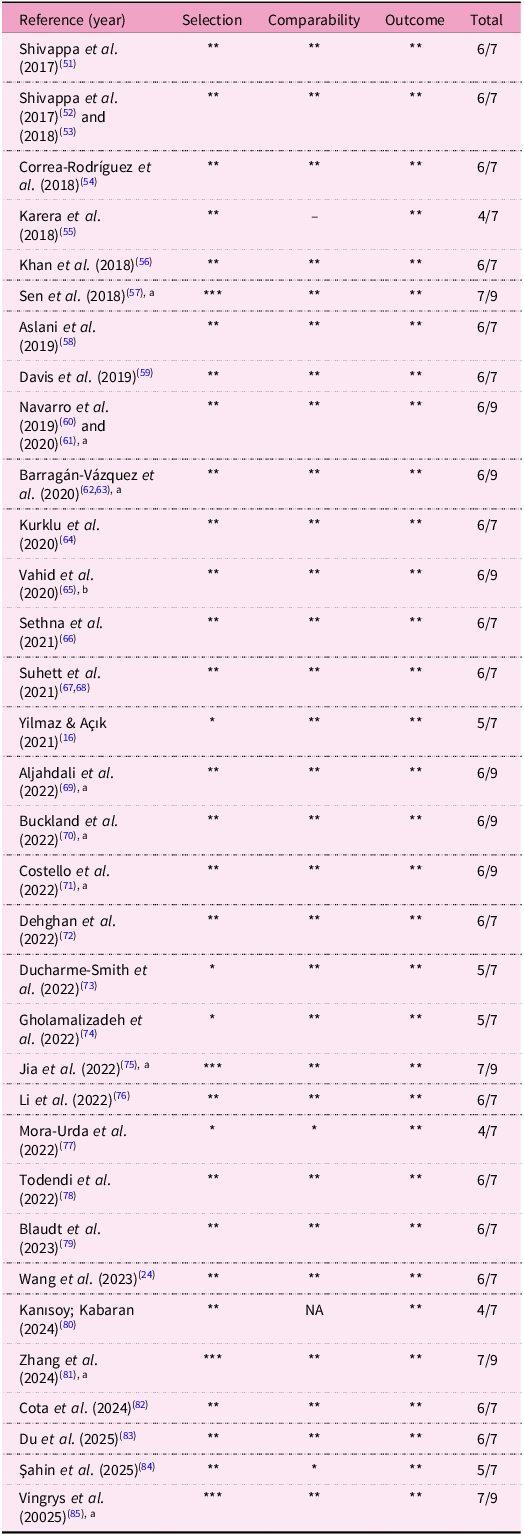
On the basis of the NOS, the included publications presented moderate quality, with scores ranging from four to six stars for cross-sectional studies and from six to eight stars for cohort and case-control studies (Table 3)(Reference Wells, Shea and O’Connell46,Reference Patra, Bhatia and Suraweera47) .
Results of the methodological quality assessment of the studies included in the systematic review according to the Newcastle–Ottawa scale(Reference Wells, Shea and O’Connell46,Reference Patra, Bhatia and Suraweera47)

–, undetermined; NA, not applicable. Cross-sectional studies: maximum score of seven asterisks (or stars). Moderate quality: 4–6 stars, low quality: ≤3 stars.
a Cohort
b Case-control studies: maximum score of nine asterisks (or stars). Moderate quality: 6–8 stars, low quality: ≤5 stars
Association between the DII and cardiometabolic risk factors
DII and BMI
The results of the meta-analyses on pro-inflammatory diet and BMI from analyses involving linear and logistic regression models are presented in Figs. 2 and 3, respectively. In studies that used linear regression, there was a small but significant association between the DII and BMI in the evaluated sample. In other words, in children and adolescents, each unit of the DII was associated with a 0·06 kg/m2 higher mean BMI (β = 0.06; 95% CI 0·03–0·06) (Fig. 2). However, in studies that used logistic regression, adolescents with a higher DII (quartile four or above the median, depending on the study) had a 62% greater chance of developing excess weight compared with those with a lower DII (quartile one or below the median; OR = 1·62, 95% CI 1·38–1·86; Fig. 3).
Meta-analysis to quantify the association between DII and BMI levels in children and adolescents (linear regression). DII, dietary inflammatory index; F, females; M, males; 95% CI, 95% confidence interval.

Meta-analysis to quantify the association between pro-inflammatory diet (higher DII scores) and overweight (BMI) in adolescents (logistic regression). DII, dietary inflammatory index; F, females; M, males; 95% CI, 95% confidence interval.

DII and abdominal obesity
Figs. 4 and 5 show the association between the DII and abdominal obesity, based on WC and the WHtR, respectively. Adolescents with a higher DII (quartile four) were 45% more likely to have abdominal obesity, according to WC, compared with those with a lower DII (quartile one) (OR = 1·45, 95% CI 1·10–1·81; Fig. 4). Similarly, adolescents with a higher DII (quartile four) were 76% more likely to have abdominal obesity, according to the WHtR, compared with individuals with a lower DII (quartile one) (OR = 1·76, 95% CI 1·38–2·14; Fig. 5).
Meta-analysis to quantify the association between pro-inflammatory diet (higher DII scores) and abdominal obesity (WC) in adolescents (logistic regression). DII, dietary inflammatory index; F, females; M, males; 95% CI, 95% confidence interval.

Meta-analysis to quantify the association between pro-inflammatory diet (higher DII scores) and abdominal obesity (WHtR) in adolescents (logistic regression). DII, dietary inflammatory index; F, females; M, males; 95% confidence interval.

DII and high BP
The meta-analysis of studies that used logistic regression identified that children and adolescents with a higher DII (quartile four or above the median, depending on the study) had a 14% greater chance of having high BP compared with those with a lower DII (quartile 1 or below the median, depending on the study); however, this difference was not statistically significant (OR = 1·14, 95% CI 0·56–1·72; Fig. S1).
DII and hypertension
The meta-analysis of studies that used logistic regression identified that children and adolescents with a higher DII (quartile four or tercile three or above the median, depending on the study) had a 42% greater chance of having hypertension compared with those with a lower DII (quartile one or below the median, depending on the study); however, this difference was not statistically significant (OR = 1·42, 95% CI 0·94–2·14; Fig. S2).
Association between the CDII and cardiometabolic risk factors
There were no statistically significant associations between the CDII and cardiometabolic risk factors. Specifically, there was no association between the CDII and BMI (β = 0·01; 95% CI −0·01 to 0·03; Fig. S3). Similarly, linear regression analyses revealed no significant associations between a pro-inflammatory dietary profile and abdominal obesity (Figs. S4 and S5). In addition, there were no associations between the CDII and SBP (Fig. S6) or DBP (Fig. S7).
Grade
The certainty of the evidence for the outcomes (body adiposity indicators and BP) was downgraded from low to very low due to the inconsistency and methodological quality of the included publications. The level of evidence was not downgraded owing to imprecision, indirect evidence or publication bias. Therefore, the development of more robust studies is necessary to increase confidence in the results reported in this systematic review and meta-analysis.
Discussion
This systematic review and meta-analysis synthesised evidence from observational studies assessing the association between the inflammatory potential of the diet (based on the DII or CDII) and indicators of body adiposity and BP in children and adolescents. Overall, the findings suggest that a pro-inflammatory dietary profile, denoted by a higher DII, is positively associated with increased body adiposity (based on BMI, WC and the WHtR), particularly in adolescents. When considering children and adolescents, the DII is also associated with BMI, but with a small effect. There are no significant associations between the CDII and cardiometabolic risk factors, or between the DII or CDII and BP.
The results of this systematic review and meta-analysis suggest that a diet with a greater inflammatory potential, as indicated by the DII and CDII, may be associated with higher levels of body adiposity in children and adolescents. The interpretation of these findings should consider that dietary habits have cumulative and gradual effects on the body’s inflammatory status, even during childhood. A diet rich in ultra-processed foods, added sugars, saturated fats and food additives can trigger low-grade inflammatory responses, modulate immunometabolic function and promote adipose tissue accumulation, particularly in central regions of the body(Reference Minihane, Vinoy and Russell91,Reference Méndez López, González Llerena and Vázquez Rodríguez92) .
However, the strength and direction of the associations with body adiposity varied between the indices. There were more consistent and clinically relevant findings observed for the DII – especially among adolescents – for both general indicators (such as BMI) and central adiposity markers (such as WC and the WHtR), while the CDII did not show significant associations with cardiometabolic risk factors. The findings related to the CDII were more heterogeneous and showed unexpected directions, which may reflect limitations in adapting the CDII to paediatric populations, both in how the index is constructed – consideration of nutrients not always suited to children’s needs – and in how dietary data are collected and reported in studies involving children(Reference Suhett, Hermsdorff and Cota17,Reference Sethna, Alanko and Wirth66) .
Moreover, the smaller number of studies using the CDII, combined with methodological variability, may have contributed to unstable and inconsistent estimates. This underscores the need for greater standardisation in the application of the CDII and for validation across specific age groups and pubertal stages. This endeavour would ensure that the CDII accurately reflects the inflammatory potential of the diet in different contexts of child development.
It is also noteworthy that the association between the DII and adiposity indicators was more evident among adolescents, which may reflect not only hormonal and behavioural changes characteristic of this developmental stage but also greater stability in dietary patterns compared with younger children(Reference Burrows, Whatnall and Patterson93). Although the effect sizes observed in samples comprising children and adolescents were generally small, the consistency of the associations across different outcomes and age groups of children suggests a potentially meaningful trend from the clinical and epidemiological perspectives(Reference Shivappa, Godos and Hebert94,Reference Larruy-García, Mahmood and Miguel-Berges95) .
Our findings are consistent with published evidence in adult populations: there is a clear association between a higher DII and increased adiposity and metabolic disorders(Reference Aslani, Sadeghi and Bagheri96–Reference Bakhshimoghaddam, Bagheri and Daneshzad98). However, in paediatric populations, the evidence has been less consistent and is limited by methodological heterogeneity. In their review, Suhett et al.(Reference Suhett, Hermsdorff and Cota17) reported associations with adiposity, but their analyses were more limited in scope, and they did not perform quantitative data synthesis. Our review has built on this foundation by incorporating more recent studies, including those using the CDII, and providing quantitative estimates of effect. Furthermore, it stands out for examining the differences between the DII and CDII, demonstrating that associations observed for the DII are more consistent than those for the CDII.
In contrast, outcomes related to BP were less consistent and not significant for either the DII or CDII. This may suggest that the inflammatory effects of diet on haemodynamic parameters are not yet detectable in younger populations or are influenced by other external factors such as physical activity levels, sleep quality, stress or genetic predisposition(Reference Flynn, Kaelber and Baker-Smith44,Reference Kelishadi, Bahreynian and Qorbani99) . It is also possible that variability in BP measurement methods, cut-offs and statistical adjustments may have hampered the detection of more robust associations.
Some limitations of this systematic review and meta-analysis should be acknowledged. Most of the included studies were cross-sectional, which limits causal inference. Although we observed associations, we could not confirm causality. Pro-inflammatory diets may contribute to weight gain, but it is equally plausible that individuals with excess weight adopt less healthy eating patterns, emphasising the need for longitudinal studies to clarify the direction and temporality of these associations(Reference Suhett, Hermsdorff and Cota17,Reference Ji, Hong and Chen100) . In addition, we noted substantial heterogeneity in the dietary assessment methods, outcome definitions and statistical models used. This heterogeneity, combined with the moderate-to-low methodological quality of many studies, led us to downgrade the certainty of evidence according to the GRADE approach. Subgroup analyses and meta-regressions were not feasible owing to the small number of comparable studies per outcome. Publication bias could not be formally assessed.
Despite these limitations, this review has several strengths. We followed a pre-registered protocol in PROSPERO, adhered to the PRISMA reporting guidelines(Reference Page, McKenzie and Bossuyt33) and applied rigorous methodological tools such as the NOS and the GRADE framework to evaluate the quality and certainty of the evidence. The search strategy was comprehensive, with no language or publication date restrictions, and included both the DII and CDII as dietary exposures.
These findings reinforce the importance of promoting anti-inflammatory dietary patterns from early life as a preventive strategy against overweight and cardiometabolic risk. Public health policies that aim to reduce the consumption of ultra-processed and pro-inflammatory foods, while encouraging balanced and nutrient-rich diets, may contribute to long-term cardiovascular health.
Future studies should prioritise longitudinal designs, standardised definitions of exposures and outcomes, and adequately powered samples. In addition, the CDII should be further validated and standardised in paediatric populations to improve comparability across studies. The development of standardised cut-off points and harmonised analytical approaches will also contribute to more robust and generalisable evidence in this field.
Conclusions
In this systematic review with meta-analysis, we found that in adolescents, a pro-inflammatory diet, based on the DII, is associated with body adiposity based on different indicators (BMI, WC and the WHtR). In children and adolescents, the CDII and DII are also associated with BMI, but the effect is small. We did not identify an association between the CDII and cardiometabolic risk factors. Regarding BP, the findings, although important, are inconclusive. Additional robust longitudinal studies are needed to better identify these associations, especially with the relatively new CDII. Our findings highlight the importance of encouraging dietary strategies that promote more anti-inflammatory dietary patterns as a preventive and therapeutic approach against obesity and other cardiovascular risk factors at early ages.
Supplementary material
The supplementary material for this article can be found at https://doi.org/10.1017/S0954422425100164
Authorship
L.O.L. and P.R.F.C. designed the study, drafted and revised the manuscript and provided a critical review of the manuscript. L.O.L and C.R.N.L. conducted the literature search and analysed the quality of the included studies. L.O.L, P.R.F.C. and J.C.D.P. analysed the data and critically reviewed the manuscript. All authors read and approved the final version of the manuscript.
Financial support
This review received no funding.
Competing interests
The authors have no relevant interests to declare.
Supporting information
The following supporting information is available through the online version of this article at the publisher’s website.