Introduction
Rice (Oryza sativa L.) is the primary food crop in China, accounting for one-third of the total grain output, and is a staple food for more than half of the population in China (Deng et al., Reference Deng, Grassini, Yang, Huang, Cassman and Peng2019). The world's total annual production of paddy rice exceeds 700 million tonnes. In 2020, rice production in China reached 211.86 million tons, accounting for nearly 30% of the global rice supply. When rice is in plentiful supply, the demand for better quality rice has prompted researchers to study how to increase the production of high-quality japonica varieties (Jiang et al., Reference Jiang, Du, Tian, Wang, Xiong, Xu, Yan and Ding2016). Alongside agricultural development and progress, China has continuously promoted structural reform of the agricultural supply side, which has become a strategic policy in the new era to accelerate the production of high-quality japonica rice (Wang et al., Reference Wang, Zhang, Zhu, Chen, Zhao, Zhong, Yang, Yao, Zhou, Zhao and Li2017a). In the past, a high yield was a priority for rice cultivation in China; however, the comprehensive goal of high yield, high quality, high efficiency, ecology and safety has become a new direction for rice cultivation (Peng et al., Reference Peng, Tang and Zou2009; Zhao et al., Reference Zhao, Huang, Qian, Jiang, Liu, Xu, Hu, Dai and Huo2021).
Nitrogen is the primary nutrient necessary for rice growth and, therefore, plays an important role in rice production (Eleonora et al., Reference Eleonora, Barbara, Francesca, Daniele, Gianluca, Marco and Dario2018; Emran et al., Reference Emran, Krupnik, Kumar, Ali and Pittelkow2019). The rational application of N fertilizer is a key measure to regulate rice growth, and it has become a conventional method for maintaining crop yield (Rehman et al., Reference Rehman, Basra and Wahid2013; Tang et al., Reference Tang, Zhang, Liu, Dou, Zhou, Chen, Wang and Ding2019). To maximize grain yield, China has invested a large amount of N fertilizer in rice production, accounting for 37% of all N fertilizers applied to rice worldwide. However, owing to excessive fertilization and unreasonable fertilization timing, these measures have not accelerated the increase in rice yield, but have degraded rice quality (Peng et al., Reference Peng, Huang, Zhoung, Yang, Wang, Zou, Zhang, Zhu, Roland and Christian2002; Lian et al., Reference Lian, Ouyang, Hao, Liu, Hao, Lin and He2018). The reasonable N application rate for large-scale production was 150–250 kg ha−1. The N application rate for japonica rice in Jiangsu Province is up to 270–330 kg ha−1, but the nitrogen recovery efficiency is only 30–35% (Peng et al., Reference Peng, Buresh, Huang, Yang, Zou, Zhong, Wang and Zhang2006; Zhu et al., Reference Zhu, Zhang, Guo, Xu, Dai, Wei, Gao, Hu, Cui and Huo2017; Tang et al., Reference Tang, Xu and Chen2017b). Therefore, a key question in modern rice production is to improve the nitrogen use efficiency and quality of rice while ensuring high yield through reasonable N supply. Taking advantage of the nitrogen deficiency and compensation effect of crops may be one of the ways to solve this question.
The deficit compensation effect is a common phenomenon in the biological world, which refers to the ability of crops to be beneficial to crop growth and yield formation at the structural and physiological levels after the stress within the threshold (Zhao et al., Reference Zhao, Li, Zhang, Dong and Wang2006). Its most representative application in crops is the theory and technology of crop water shortage compensation and water conservation (Chu et al., Reference Chu, Chen, Wang, Yang and Zhang2014; Zhang et al., Reference Zhang, Liu, Huang, Xu, Cheng, Wang, Zhu and Yang2020). Crop fertilizer requirements can be divided into specific stages: a critical period of N demand (such as the tillering and jointing stages (JI)), a sensitive period of deficit (the late tillering to booting stages) and an effective period for N compensation (Chen et al., Reference Chen, Huang, Zhong, Huang and He2015a). Nitrogen deficiency can reduce the content of cytokinin in rice and promote the proliferation and elongation of root meristem cells, which is conducive to the deep rooting of rice roots and obtaining more soil space and nitrogen resources (Wang et al., Reference Wang, Zhu, Zou, Li, Zhang, Kang, Li, Yin and Lin2020). Therefore, it is theoretically possible to reduce N loss and improve N use efficiency in rice by promoting the use of its regulation and compensation mechanism, which is caused by applying appropriate N deficit stress during a sensitive phase, and then compensating for N in the key period of efficacy. Indeed, we previously studied N demand in japonica rice varieties and proposed the theory and technology of suitable N fertilizer management and precise postponement of N application, namely 40 or 50% of the total nitrogen were used for panicle topdressing, which was adjusted to 30% under the condition of straw that was returned (Zhang et al., Reference Zhang, Wu, Dai, Huo, Xu, Gao, Wei, Lv, Wan and Huang2011; Hu et al., Reference Hu, Zhu, Xing, Gong, Zhang, Dai, Huo, Xu, Wei and Guo2015, Reference Hu, Xia, Zhang, Cao, Guo, Wei, Chen and Han2017). However, no in-depth study has been conducted on the optimal timing of N compensation in the middle stage of japonica rice with a good tasting quality. In high-yield rice cultivation, the precise quantitative application of N is usually divided into three stages: basal application, early tillering topdressing and panicle topdressing (Wang et al., Reference Wang, Xu, Yan, Zhang, Chen, Chauhan, Wang and Zhang2017b). According to the growth period of rice, the topdressing of panicle fertilizer was generally in the mid-stage of rice growth. During the specific period, from a few days after tillering N topdressing to panicle N topdressing, rice is in a stage of relative N deficiency after the tillering fertilizer effect is over. Therefore, panicle N topdressing in the mid-stage is also a kind of compensation for the relative N deficiency of rice. The compensation effect is worth studying to identify the optimal stage for effective N compensation.
It has been shown that the sensitive stage of N deficiency in double-cropping hybrid rice is the tillering stage and the effective compensation stage is the young panicle differentiation stage (Tang et al., Reference Tang, Xiong, Zhong, Chen, Zhu, Peng and He2017a). N deficiency stress during the early tillering stage can be effectively alleviated by adjusting the fertilization time and amount in the late panicle stage (Chen et al., Reference Chen, Huang, Zhong, Huang, Zhu, Peng, He, Fu, Ouyang, Bian, Hu and He2015b). N compensation before panicle differentiation not only increases the number of spikelets per panicle but also helps to improve grain filling rate and shorten filling time, thus improving grain weight and yield (Ding et al., Reference Ding, You, Chen, Wang and Ding2014). N compensation during grain filling or before full heading can prevent premature senescence, maintain the root activity and photosynthetic capacity of leaves, improve the photosynthetic rate of leaves, promote material transport and improve grain weight and plumpness (Yang et al., Reference Yang, Wang, Dong, Gu, Huang, Zhu, Yang, Liu and Han2007). In addition, increasing N compensation via fertilizer application in the panicle differentiation and heading stages (HD) can increase the activity of proteolytic enzymes in functional leaves in the later growth stages of rice. This results in more complete protein degradation and increases the amount of N transferred to the grain after heading, thus significantly increasing protein content (PC) (Pan et al., Reference Pan, Zhai, Cao, Cai, Wang, Huang and Li2010). N compensation at the HD can effectively reduce the starch particle size and amylopectin chain length and change the crystal structure of rice starch (Tang et al., Reference Tang, Zhang, Liu, Dou, Zhou, Chen, Wang and Ding2019).
Although there has been some prior research in this area, as described above, those studies used hybrid rice or conventional japonica, and most of the research was limited to the separate effects on yield or quality. Until now there have been no reports on the synergistic compensation effect of yield and quality under different mid-stage N compensation timings for japonica rice with a good tasting quality, especially in the rice-wheat rotation region of the lower reaches of the Yangtze River. Therefore, we hypothesized that appropriate nitrogen compensation timing may promote the synergy of high yield and high quality of japonica rice with a good tasting quality. Field experiments were conducted to investigate the influence of mid-stage N compensation timing on specific agronomic and physiological traits associated with rice grain yield and grain quality, aiming to further clarify the characteristics of N demand for high quality and yield of japonica rice with a good tasting quality. Our study may provide a theoretical basis for the improvement of N management and efficient use of N in japonica rice. This may be significant for the design of rice slow-controlled release fertilizer treatments and may be an important supplement to the theory of rice N deficiency and compensation.
Materials and methods
Plant materials and growth conditions
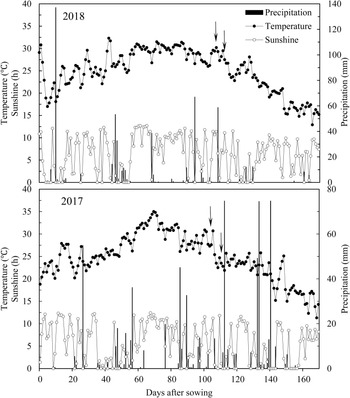
Two japonica rice cultivars with a good tasting quality, ‘Nangeng 9108’ (NG9108) and ‘Nangeng 5055’ (NG5055), which are widely cultivated in the lower reaches of Yangtze River, were used for these experiments. In 2017 and 2018, field experiments were carried out at Yazhou Town, Hai'an City, Jiangsu Province, China (32°43′N, 120°32′E, 5 m altitude). The station is located in the north subtropical humid climatic zone, with an annual mean temperature of 14.6°C, annual mean precipitation of 1021.9 mm and annual mean sunshine duration of 2052.6 h. The previous crop at the experimental field was wheat, which had a yield of ~6.7 t hm−2. The soil type of the field is high sandy soil with 21.6 g kg−1 organic matter, 1.4 g kg−1 total N, 16.8 mg kg−1 available P and 78 mg kg−1 available K. The average daily temperature, sunshine hours and precipitation during the rice growing seasons of 2017 and 2018 were collected from a weather station situated close to the experimental field (Fig. 1).
Mean daily temperature, sunshine hours and precipitation during rice growth seasons of 2017 and 2018 at the experimental field in Hai'an City, Jiangsu Province, China. Arrows indicate the heading time for Nangeng 9108 and Nangeng 5055, respectively.

Experimental design
A split-plot design was adopted in this experiment. The two rice cultivars were the main plot factor and eight timings of mid-stage N compensation were the within-plot factor. Treatment design and mid-stage N compensation timings are shown in Table 1. Briefly, there were eight types of N application: one-time N compensation at 7 weeks before heading (N1), 6 weeks before heading (N2), 5 weeks before heading (N3), 4 weeks before heading (N4), 3 weeks before heading (N5) or 2 weeks before heading (N6); and split N compensation at 5 and 3 weeks before heading (N7) and at 4 and 2 weeks before heading (N8). The control treatment (CK) had no subsequent N compensation, but with 189 kg ha−1 N applied in the early stage. Rice seeds were sown in nursery trays containing local conventional soil on May 15 in 2017 and 2018, and their resultant seedlings were transplanted into the field on June 18 in 2017 and 2018. Hill spacing was fixed at 30 cm × 12.4 cm, with four seedlings planted per hill (107.52 × 10⁴ seedlings per ha). The within-plot sowing design was repeated three times for each treatment, resulting in a total of 54 plots of 18 m2 each (6 m × 3 m). The total N applied per year was equivalent to 270 kg ha−1 for the eight N compensation treatments and 189 kg ha−1 for CK. Of the total N used, 40% was applied during the transplanting period, 30% was used at tillering seven days after transplanting, and 30% was applied as the compensated N according to the eight treatment group schedules. The source of N applied was urea. Other practices implemented in the experiment such as water management and control of disease, insects and weeds were the same and conformed to local recommendations from government agencies.
Nitrogen treatment under different mid-stage nitrogen compensation timing

Sampling and measurements
Agronomic characteristics
A series of 20 plants on consecutive hills in the middle of each plot were marked with tags to count the number of tillers during four stages: mid-tillering stage (MT), JI, HD and maturity (MA). Leaf area index (LAI) and dry matter were determined at JI, HD and MA stages. Plants from five representative hills were sampled from each plot. All samples were separated into green leaf and stem + sheath at MT and JI, with panicles, additionally separated at HD and MA. The green leaf area was measured with a leaf area meter (LI-3100, LI-COR, NE, USA). The effective LAI was expressed as the leaf area of effective tillers per unit area, and the highly effective leaf area was defined as the leaf area of the top three leaves. Samples of each plant part were then dried separately and weighed to determine the total aboveground biomass per unit area per plot. Components of the rice plants were oven-dried separately at 105°C for 30 min and then at 80°C in brown paper bags to a constant weight. All rice plants in area of 8 m2 in the middle of each plot were hand-harvested at MA and the grain yield was weighed. The actual weight of paddy rice for each plot was firstly weighed out and then converted into the final yield of 14% moisture content according to the actual moisture content of each plot.
Rice quality
Approximately 500 g of grains harvested from each plot were dried at 35°C until the moisture content was 14%. The grains were then stored at 4°C for 3 months. Rice quality analysis was performed according to China's National Standards (SAMR 2017). Chalkiness rate (CR), chalkiness size (CS) and chalkiness degree (CD) were all measured with a rice appearance scanner (ScanMaker i800, Microtek, Shanghai, China). PC was measured with a grain analyser (Infratec TM 1241, Foss, Denmark). Cooking/eating quality was measured by Taste Analyzer RCTA11A (Satake Co., Hiroshima, Japan).
The pasting viscosity of rice flour samples was evaluated with a Rapid Visco-Analyzer (RVA-3D, Newport Scientific, Warriewood, Australia). Starch suspensions (70 g kg−1; w/w) were heated using a programmed heating and cooling cycle with the following settings: heating from 50 to 95°C at a rate of 12°C min−1; holding at 95°C for 2.5 min; cooling to 50°C at 12°C min−1 and finally holding for 2 min. A constant rotating speed was used for the paddle. Values of peak viscosity (PV), trough viscosity (TV), final viscosity (FV), breakdown viscosity (BD), setback viscosity (SB) and pasting temperature (Ptemp) were all obtained from the viscograms. PV is the maximum viscosity recorded during the heating and holding cycles, which usually occurs soon after the heating cycle reaches 95°. TV is the minimum viscosity after the peak. FV is the viscosity at the end of the test. BD is the difference between peak and TV and is related to stability of the starch under heat and shear stress. SB is the difference between final and PV and is an indication of the starch to retrogradation. Ptemp is the temperature of the initial viscosity increase. All the rice quality indexes were determined with three repetitions.
Computational formulas
Percentage of productive tiller (%) = Number of panicles at MA/Number of tillers at JI × 100%
Decreasing rate of leaf area (LAI d−1) = (LAIMA–LAIHD)/Days from HD to MA
Chalkiness rate (%) = Number of chalky kernels/100 milled grains × 100
Chalkiness size (%) = Area of chalkiness/Total area of rice kernel × 100
Statistical analysis
Multifactorial analyses of variance were conducted to determine the effects of the year, cultivar and treatment (as independent variables), as well as their interaction effects on the determined agronomic and rice quality traits of rice, at a significance level of 5%. Pairwise comparisons (using the Duncan test at a significance level of 5%) were also performed to compare the determined agronomic and rice quality traits of rice. Analysis of variance (ANOVA) was performed using SPSS 20.0. Means were tested by the least significant difference at P = 0.05 (LSD 0.05). Graphs were prepared in Excel 2013.
Results
Grain yield
Different mid-stage N compensation treatments had significant effects on rice yield (Fig. 2). In 2017, the total grain yield was 7.4–10.4 t ha−1 for NG9108 and 7.5–10.9 t ha−1 for NG5055. In 2018, the yield was 7.5–10.3 t ha−1 for NG9108 and 8.0–11.1 t ha−1 for NG5055. Treatment N7 produced the highest average grain yield for both cultivars in both years (P < 0.05). Compared to the control group (CK), the grain yield in treatment N7 was 40.0 and 37.2% higher for cultivar NG9108 and 45.5 and 38.5% higher for cultivar NG5055 in 2017 and 2018, respectively. In addition, mid-stage N compensation significantly increased yield. Grain yield showed a parabolic trend among one-time N compensation treatments, and reached the maximum with N3, with NG9108 and NG5055 showing grain yields of 10.0 and 10.4 t ha−1 in 2017 and 9.9 and 10.6 t ha−1 in 2018, respectively. The yield of the N7 treatment group was higher than that of the N3 treatment group by 4.4 and 4.8% (2017) and 4.3 and 4.5% (2018) for NG9108 and NG5055, respectively.
Yield and Harvest index of japonica rice under different mid-stage nitrogen compensation timing in 2017 and 2018. NG9108, Nangeng 9108; NG5055, Nangeng 5055. N1–N6, one-time mid-stage nitrogen compensation at 7~2 weeks before heading, respectively; N7, N8, split mid-stage nitrogen compensation at 5 and 3 weeks before heading, 4 and 2 weeks before heading, respectively; CK, no mid-stage nitrogen compensation. Different letters indicate statistical significance at the 0.05 probability level. Bars mean standard error (n = 3).

Yield components and specific time of critical period
Compared with CK, mid-stage N compensation also significantly increased the total number of spikelets per hectare and filled-grain percentage. Among the one-time N compensation treatments, the total spikelet quantity for both cultivars first increased and then decreased with the postponement of N compensation. As with the yield, the N3 treatment showed the largest increase. Among the split N compensation treatments, the N7 treatment exhibited the highest total spikelet quantity, which was significantly greater than that in the N3 treatment. The filled grain percentage and 1000-grain weight increased with the postponement of N compensation, and the late compensation treatment groups were significantly higher than the earlier compensation treatment groups.
Further analysis of the components of total spikelets showed that there was no significant difference in the number of panicles per unit area between the N6 treatment and the CK, but the number was significantly higher in the other N compensation treatments than in the CK. In the one-time N compensation treatments, the panicle number of both cultivars decreased gradually with delayed compensation; the N1 treatment had the highest panicle number. In the same treatments, grain number per panicle showed the same trend with yield and spikelet number, that is, first increasing, peaking in the N3 treatment group and then decreasing. Among all treatments and for both cultivars, the split N compensation N7 treatment exhibited the maximum effectiveness in increasing grain number per panicle. The jointing time of all fertilization treatments and CK is consistent (Table 2). The dates of heading and MA under treatments N6 and CK were earlier by 1 day and 2 days when compared with those under other treatments. The growth stage date of NG5055 was 5–7 days later than that of NG9108.
Yield components and specific time of the critical reproductive period of japonica rice under different mid-stage nitrogen compensation timing

JI, jointing stage; HD, heading stage; MA, maturity.
a NG9108, Nangeng 9108; NG5055, Nangeng 5055.
b N1–N6, one-time mid-stage nitrogen compensation at 7~2 weeks before heading, respectively; N7, N8, split mid-stage nitrogen compensation at 5 and 3 weeks before heading, 4 and 2 weeks before heading, respectively; CK, no mid-stage nitrogen compensation. ANOVA, analysis of variance.
Note. Within columns, means followed by the same letter are not significantly different according to LSD (0.05).
*Significant at the 0.05 probability level. **Significant at the 0.01 probability level. NS, nonsignificant.
Tillering dynamics and productive tiller rate
The effects of mid-stage N compensation timing on rice tillers at different stages are shown in Table 3. Tillers appeared rapidly under N1 treatment after N compensation and in higher numbers compared to the CK at the JI, with an average increase of 18.9 and 19.1% within 2 years for NG9108 and NG5055, respectively. After reaching the maximum number of tillers, ineffective tillers disappeared faster in the earlier N compensation treatment groups. Finally, the number of panicles per unit area at MA gradually decreased with postponed mid-stage N compensation.
Tillering dynamics and productive tiller rate of japonica rice under different mid-stage nitrogen compensation timing

JI, jointing stage; HD, heading stage; MA, maturity.
a NG9108, Nangeng 9108; NG5055, Nangeng 5055.
b N1–N6, one-time mid-stage nitrogen compensation at 7~2 weeks before heading, respectively; N7, N8, split mid-stage nitrogen compensation at 5 and 3 weeks before heading, 4 and 2 weeks before heading, respectively; CK, no mid-stage nitrogen compensation. ANOVA, analysis of variance.
Note. Within columns, means followed by the same letter are not significantly different according to LSD (0.05).
*Significant at the 0.05 probability level. **Significant at the 0.01 probability level. NS, nonsignificant.
The productive tiller rate tended to increase with a postponement of compensation timing among the one-time N compensation treatments, but there was no significant change between treatments N4, N5 and N6. In particular, the productive tiller rate in the N1 treatment was significantly lower than that in the CK, with an average decrease of 9.2 and 7.6% within 2 years for NG9108 and NG5055, respectively. Additionally, compared with NG9108, NG5055 showed more peak seedlings and a lower productive tiller rate, an effect that was also observed in 2018 when compared with 2017.
Leaf area index
With the postponement of compensation timing among one-time N compensation treatments, the LAI decreased gradually at JI. The difference between the first three treatments, but not between the last three treatments, was significant (Table 4). The LAI of the mid-stage N compensation treatments in the HD and MA was significantly higher than that of CK. There was a parabolic trend among the one-time N compensation treatments, peaking at treatment N3. Across all treatments, the highest LAI value was observed in N7, which showed an increase of 23.9 and 19.6% (2017) and 26.2 and 24.2% (2018) compared to the CK for NG9108 and NG5055 at HD, respectively. The high effective LAI and percentage of highly effective leaf area at HD showed the same trend among treatments as LAI at HD and MA.
Leaf area index (LAI) of japonica rice under different mid-stage nitrogen compensation timing

T, mid-tillering stage; JI, jointing stage; HD, heading stage; MA, maturity. LAI, Leaf area index.
a NG9108, Nangeng 9108; NG5055, Nangeng 5055.
b N1–N6, one-time mid-stage nitrogen compensation at 7~2 weeks before heading, respectively; N7, N8, split mid-stage nitrogen compensation at 5 and 3 weeks before heading, 4 and 2 weeks before heading, respectively; CK, no mid-stage nitrogen compensation. ANOVA, analysis of variance.
Note. Within columns, means followed by the same letter are not significantly different according to LSD (0.05).
*Significant at the 0.05 probability level. **Significant at the 0.01 probability level. NS, nonsignificant.
The LAI in each treatment group began to decline after HD, and those treated with the earlier mid-stage N compensation decreased faster. The decreasing rate of leaf area in mid-stage N compensation treatments (except for N6) was higher than that in the CK, and showed a decreasing trend with a postponement of compensation timing; in particular, the decreasing rate in N1 and N2 treatments was faster, which contributed to the low LAI at MA.
Dry matter accumulation and harvest index
Dry matter accumulation was strongly affected by the timing of mid-stage N compensation during the main rice growth stages (Fig. 3). Before JI, dry matter accumulation was higher in the earlier N compensation treatment groups, but no significant differences were found in other treatments. All N compensation treatments significantly increased dry matter accumulation in HD and MA relative to CK. Among the one-time N compensation treatments, dry matter accumulation after JI and total accumulation showed parabolic trends, with the highest levels in the N3 treatment group. Among the split compensation treatments, dry matter accumulation after JI and total accumulation were the largest in N7, which had significantly higher values than N3. Compared to CK, the total dry matter accumulation of N7 at MA increased on average over the two years by 33.4% for NG9108 and by 34.0% for NG5055; compared to the N3 treatment, it was 3.9% for NG9108 and 4.3% for NG5055.
Dry matter accumulation of japonica rice under different mid-stage nitrogen compensation timing in 2017 and 2018. NG9108, Nangeng 9108; NG5055, Nangeng 5055. N1–N6, one-time mid-stage nitrogen compensation at 7~2 weeks before heading, respectively; N7, N8, split mid-stage nitrogen compensation at 5 and 3 weeks before heading, 4 and 2 weeks before heading, respectively; CK, no mid-stage nitrogen compensation. Different letters indicate statistical significance at the 0.05 probability level. Bars mean standard error (n = 3).

The effect of mid-stage N compensation timing on the harvest index (HI) was also significant (Fig. 2); the results showed an increasing trend in HI with a postponement of compensation among one-time N treatments. In addition, HI in the N compensation treatments was higher than that in the CK, increasing by 1.9–7.5% and 2.8–10.1% in 2017 and by 1.5–5.5% and 1.0–6.6% in 2018 for NG9108 and NG5055, respectively.
Processing and appearance quality
The grain processing quality was also significantly affected by mid-stage N compensation timing (Table 5). The brown rice rate (BRR), milled rice rate (MRR) and head milled rice rate (HMRR) of mid-stage N compensation treatment groups were all significantly higher than those of the CK. Moreover, all index values increased gradually with the postponement of N compensation, indicating that postponing N compensation timing could improve the processing quality of japonica rice. The values of HMRR for both cultivars were greater than those of BRR and MRR, demonstrating that mid-stage N compensation timing had the greatest effect on HMRR among the three processing indexes.
Processing and appearance quality of japonica rice under different mid-stage nitrogen compensation timing

BRR, brown rice rate; MRR, milled rice rate; HMRR, head milled rice rate; CR, chalkiness rate; CS, chalkiness size; CD, chalkiness degree.
a NG9108, Nangeng 9108; NG5055, Nangeng 5055.
b N1–N6, one-time mid-stage nitrogen compensation at 7~2 weeks before heading, respectively; N7, N8, split mid-stage nitrogen compensation at 5 and 3 weeks before heading, 4 and 2 weeks before heading, respectively; CK, no mid-stage nitrogen compensation. ANOVA, analysis of variance.
Note. Within columns, means followed by the same letter are not significantly different according to LSD (0.05).
*Significant at the 0.05 probability level. **Significant at the 0.01 probability level. NS, nonsignificant.
In the N compensation treatment groups, the CR, CS and CD were lower than those in CK except for treatments N5 and N6 of NG9108 in 2017 (Table 5). However, the appearance quality gradually decreased with the postponement of N compensation. This shows that N compensation could improve the appearance quality of japonica rice, but the effect decreased with a delay in N compensation timing. Table 5 also showed that NG5055 had a better appearance quality than NG9108, because of the diminished CR, CS and CD values.
Nutrition and cooking/eating quality
In terms of nutrition and cooking quality, compared with the CK, the N compensation treatment groups showed a significant decrease in amylose content (AC), as well as a significant increase in PC and gel consistency (GC) (Table 6). AC showed a decreasing trend with the postponement of N compensation for both cultivars, but the effect was reversed in PC and GC. AC was lower in the N compensation treatment groups than in the CK by 1.5–20.8% and 1.1–21.7% (2017) and 4.8–19.6% and 2.0–26.5% (2018) for NG9108 and NG5055, respectively. In contrast, PC was higher in the N compensation treatments by 3.3–20.7% and 6.9–25.7% (2017) and 4.2–20.3% and 4.6–22.9% (2018) for NG9108 and NG5055, respectively. Additionally, AC was higher in NG9108 than in NG5055, whereas PC and GC were lower.
Nutrition and cooking/eating quality of japonica rice under different mid-stage nitrogen compensation timing

PC, protein content; AC, amylose content; GC, gel consistency.
a NG9108, Nangeng 9108; NG5055, Nangeng 5055.
b N1–N6, one-time mid-stage nitrogen compensation at 7~2 weeks before heading, respectively; N7, N8, split mid-stage nitrogen compensation at 5 and 3 weeks before heading, 4 and 2 weeks before heading, respectively; CK, no mid-stage nitrogen compensation. ANOVA, analysis of variance.
Note. Within columns, means followed by the same letter are not significantly different according to LSD (0.05).
*Significant at the 0.05 probability level. **Significant at the 0.01 probability level. NS, nonsignificant.
Eating quality was also significantly affected by mid-stage N compensation timing in both cultivars (Table 6). Compared with the CK, the N compensation treatment groups had a higher hardness value, but lower appearance, viscosity, degree of balance and taste value. Additionally, hardness values increased with the postponement of N compensation, but the other indices showed a decreasing trend. NG9108 had a higher taste value than NG5055 in both years, and the taste quality in 2018 was better than that in 2017.
Pasting properties of rice starch
The values of PV, TV, FV, BD and SB of rice flour for both cultivars under mid-stage N compensation treatments were all significantly lower than those in the CK and decreased gradually with a postponement of N compensation (Table 7). The Ptemp remained relatively stable between treatments. Among all treatments, the lowest values of PV, TV, FV, BD and SB were observed in N6; compared to those in the CK, these values decreased on average within 2 years by 8.8, 9.4, 17.5, 8.2 and 25.3% for NG9108 and by 11.1, 10.4, 20.7, 12.0 and 34.0% for NG5055, respectively. Compared with other indices, SB showed the largest variation between treatments in both cultivars, indicating that among pasting properties, the SB index had the greatest response to mid-stage N compensation. Between treatments, the variation in pasting index values was higher in NG5055 than in NG9108.
Pasting properties of japonica rice under different mid-stage nitrogen compensation timing

PV, peak viscosity; TV, trough viscosity; FV, final viscosity; BD, breakdown viscosity; SB, setback viscosity; Ptemp, pasting temperature.
a NG9108, Nangeng 9108; NG5055, Nangeng 5055.
b N1–N6, one-time mid-stage nitrogen compensation at 7~2 weeks before heading, respectively; N7, N8, split mid-stage nitrogen compensation at 5 and 3 weeks before heading, 4 and 2 weeks before heading, respectively; CK, no mid-stage nitrogen compensation. ANOVA, analysis of variance.
Note. Within columns, means followed by the same letter are not significantly different according to LSD (0.05).
*Significant at the 0.05 probability level. **Significant at the 0.01 probability level. NS, nonsignificant.
Discussion
Effects of mid-stage nitrogen compensation timing on growth and grain yield of japonica rice
The panicle number per unit area, grain number per panicle, filled grain percentage and 1000-grain weight were the rice yield parameters measured in this study. Panicle number per unit area and grain number per panicle constitute the total population of spikelets, which is key to high yield in rice (Li et al., Reference Li, Xue, Gu, Yang, Wang, Ling, Qin and Ding2009). Our results showed that N compensation split at 5 and 3 weeks before heading led to the highest rice yield and total spikelets. This may be because if mid-stage N was compensated at approximately 5 weeks before heading, cytokinin content and the ratio of cytokinin to auxin in the panicle were significantly increased during panicle development, especially during the spikelet differentiation stage, which promotes spikelet differentiation and thus increases the total number of spikelets (Wang et al., Reference Wang, Wang, Li, Wang, Liu, Yu and Ding2008). A previous study showed that the number of spikelets increased when N was compensated at the panicle differentiation stage (30 days before heading), and the number of degraded spikelets decreased when N was compensated at the spikelet formation stage (20 days before heading) (Fukushima, Reference Fukushima2007). The number of grains per panicle in our study first increased then decreased, peaking when N was compensated at 5 weeks before heading (Table 2), consistent with earlier results (Fukushima, Reference Fukushima2007). Previous studies on the mechanism of large panicle formation in rice also showed that N compensation at 31 days before heading had the greatest effect on the promotion of spikelet differentiation; the number of degraded spikelets and the rate of spikelet degradation were also decreased by compensating for N treatment at 16–21 days before heading, which is the key reason why the highest spikelet quantity was observed when the N compensation treatment was split at 5 and 3 weeks before heading (Kamiji et al., Reference Kamiji, Yoshida, Palta, Sakuratani and Shiraiwa2011). We hypothesize that this is also because that compensating N at appropriate times improved pollen development and anther dehiscence (Fahad et al., Reference Fahad, Hussain, Saud, Tanveer, Bajwa, Hassan, Shah, Ullah, Wu, Khan, Shah, Ullah, Chen and Huang2015). As early as the 1980s, it was found that when N was applied in the early or middle tillering period, the number of panicles increased significantly, and when N was compensated in the reproductive growth period or grain filling period, the number of grains per panicle and filled-grain percentage would be greatly affected (De Datta, Reference De Datta, De Datta and Patrick1986). Similarly, the filled grain percentage and 1000-grain weight in our study increased with the postponement of N compensation timing. This may be because the N compensation timing was not too early, which was conducive to controlling the occurrence of ineffective tillers and delaying leaf senescence at a later stage, ensuring that the grain filling was full; thus, the filled grain percentage and 1000-grain weight were high (Chen et al., Reference Chen, Peng, Wang, Fu, Hou, Zhang, Fahad, Peng, Cui, Nie and Huang2015c).
Photosynthesis is the physiological basis of rice growth, development and yield formation, and its products are important sources of rice grain-filling materials (Deng et al., Reference Deng, Wang, Ren, Mei and Li2015; Yin and Struik, Reference Yin and Struik2017). We found that the number of tillers decreased with a postponement of N compensation and the productive tiller rate increased. The highest peak seedlings were treated with N compensation 7 weeks before heading, but the productive tiller rate was the lowest (Table 3). We hypothesize that this is because the timing of N compensation happens to be at the critical period of effective tillers, which leads to rapid tiller proliferation, resulting in more peak seedlings. However, premature N compensation causes a large number of ineffective tillers, resulting in a lower productive tiller rate. According to the coextension relationship between leaves and tillers in rice, when spikelet-promoting N was applied at 5 weeks before heading (the reciprocal fourth leaf age), the flag leaf and the top-second-leaf were in the stage of leaf primordium differentiation and formation and were therefore greatly affected by N compensation. This means that the upper three functional leaves could maintain a larger leaf area, and the efficient leaf area rate of rice significantly increased (Qin et al., Reference Qin, Yang, Sun, Xu, Lv, Dai, Zheng, Jiang and Ma2017). Maintaining nitrogen supply during the filling period can prevent premature aging of rice, thereby reducing the decline in leaf area. The later the N compensation, the more sufficient the N supply during the filling stage. It was also previously reported that with N compensation at the young panicle differentiation stage, the photosynthetic rate significantly increased and was maintained at a high level until the late stage of compensation (Xiong et al., Reference Xiong, Tang, Zhong, He and Chen2018). Moreover, an increase in photosynthesis with N compensation at appropriate times might also be ascribed to the improvement of the activity of Rubisco enzyme and the integrity of the photosystems, such as an increase in chlorophyll pigments and leaf nitrogen contents, and currency of PSII reaction centre and electron flow (Fahad et al., Reference Fahad, Hussain, Saud, Hassan, Tanveer, Ihsan, Shah, Ullah, Nasrullah, Ullah, Alharby, Nasim, Wu and Huang2016).
Dry matter production is the result of the accumulation and distribution of photosynthates in different organs of rice and is significantly affected by nitrogen. Previous studies have shown that rice yield depends on the photosynthetic capacity and dry matter accumulation after heading (Sui et al., Reference Sui, Feng, Tian, Hu, Shen and Guo2013; Xing et al., Reference Xing, Hu, Qian, Cao, Guo, Wei, Xu, Huo, Zhou, Dai and Zhang2017). Here, we showed that dry matter accumulation after JI and total accumulation showed the highest value at split N compensation treatment N7, followed by one-time N compensation treatment N3 (Fig. 3). This is mainly attributed to the higher LAI at HD and MA, which caused a stronger photosynthetic response in japonica rice during the middle and later growth periods (Hu et al., Reference Hu, Jiang, Qiu, Xing, Hu, Guo, Liu, Gao, Zhang and Wei2020). Another study reported the maintenance of a high ratio of pro-growth hormones as an explanatory theory for the improvement of photosynthates and yield under N compensation at the young panicle differentiation stage (Xiong et al., Reference Xiong, Tang, Zhong, He and Chen2018). Therefore, further research should be undertaken to investigate endogenous hormone dynamics in response to different N compensation timings. Based on our results, after experiencing a period of relative nitrogen deficiency, N compensation should be performed at 5 weeks before heading (i.e., the differentiation stage of young panicles) during japonica rice cultivation. It should be also noted that these results may apply only to small and medium panicle-type cultivars. Whether the N compensation timing has a different effect on large panicle-type cultivars awaits further investigation.
Effects of mid-stage nitrogen compensation timing on grain quality of japonica rice
As the main processing quality indexes of rice, BRR, MRR and HMRR are directly related to the adaptability of rice processing. Our results showed that BRR, MRR and HMRR increased with a postponement of N compensation compared to the control rice, the processing quality of which was the worst (Table 5). This is essentially consistent with the results of previous studies, which may be explained by the fact that the delay in N compensation resulted in sufficient N in the rice grain filling period, increasing PC and protein components in the grain. Studies have shown that gliadin content in rice is significantly positively correlated with BRR, MRR and HMRR, which may be because an increase in gliadin content enhances the wear resistance of rice, thus improving the processing quality (Ding et al., Reference Ding, Zhao, Wang, Wang and Huang2003; Zhu et al., Reference Zhu, Zhang, Guo, Xu, Dai, Wei, Gao, Hu, Cui and Huo2017). The opaque part of the rice endosperm is generally characterized by chalkiness, which is an optical characteristic caused by aeration of the gaps in loose filling between amyloid and protein particles. Our results showed that the CR, CS and CD increased with a postponement of N compensation (Table 5). This outcome is contrary to that of Wu et al. (Reference Wu, Zhang, Wu, Wang, Dai, Huo, Xu and Wei2010), who found that both CR and CD gradually decreased with a postponement of N compensation, improving appearance quality. This gradual improvement may be caused by the fast and short filling process in late N compensation treatments, whereas early N compensation treatment results in a gentle filling rate that can compact the starch in the endosperm and reduce clearance and chalkiness (Qiao et al., Reference Qiao, Liu, Deng, Ning, Yang, Lin, Li, Wang, Wang and Ding2011; Bian et al., Reference Bian, Xu, Han, Qiu, Ge, Xu, Zhang and Wei2018). Other studies have pointed out that accelerated grain filling leads to an undesirable distribution of substances in grains, enlarged cell pores and increased white opacity and chalkiness due to light refraction (Gong et al., Reference Gong, Zhang, Hu, Long, Chang, Wang, Xing and Huo2013; Tsukaguchi and Iida, Reference Tsukaguchi and Iida2015). Considering these findings, our results suggest that japonica rice treated with delayed N compensation could have improved processing quality, but inferior appearance quality.
As an ideal plant protein, rice protein is easily absorbed by humans and is the main indicator of the nutritional quality of rice. In this study, significantly increased PC was observed with postponement of N compensation (Table 6), consistent with previous reports. For example, at the end of the last century, Perez et al. (Reference Perez, Juliano, Liboon, Alcantara and Cassman1996) showed that N compensation at the flowering stage could increase PC by 16% and protein yield of head milled rice by 33% compared to the control. Such consistent results may be because delaying N compensation keeps leaves vigorous during the late growth stage of rice, increasing the proteolytic enzyme activity of the functional leaves. This could result in more thorough protein degradation, significantly increasing N transport to the grains after heading (Luo et al., Reference Luo, Zheng, Liao, Nie, Xie and Xiang2007).
Cooking/eating quality is the core feature that determines consumer’ preference for rice, and AC is considered to be the key factor contributing to this quality. We found that AC decreased with postponement of N compensation (Table 6). This is consistent with our previous study, which demonstrated that delaying N compensation caused fewer large starch granules with higher AC, which have a greater proportion of long-chain highly branched amylopectin molecules and would therefore show a lower AC when using the iodine adsorption method (Hu et al., Reference Hu, Liu, Jiang, Qiu, Wei, Zhang, Liu, Xing, Hu, Guo and Gao2021). However, the endosperm contains A- and B-type starch granules, and A-type starch granules contain higher AC than B-type starch granules. Previous studies have indicated that N compensation can decrease the proportion of A-type starch granules (Gu et al., Reference Gu, Chen, Chen, Wang, Zhang and Yang2015). We hypothesized that this is another important reason for the low AC under delayed N compensation in our experiment.
According to the rice taste analyser, in addition to increasing hardness with the postponement of N compensation, the values of appearance, viscosity, degree of balance and taste all showed a decreasing trend (Table 6). Although it is generally believed that lower AC contributes to improved cooking/eating quality, the contrasting effects of higher PC outweigh the amylose effects on cooked rice (Gu et al., Reference Gu, Chen, Chen, Wang, Zhang and Yang2015). High PC in the early stage of cooking affects water absorption and hinders the hydration of rice grains, resulting in poor texture (Yang et al., Reference Yang, Wang, Dong, Gu, Huang, Zhu, Yang, Liu and Han2007). This may be responsible for the poor cooking/eating quality observed under delayed N compensation treatments. Moreover, in our study, the peak, trough and final viscosities of rice flour decreased with a delay in N compensation (Table 7). This may be primarily due to the high PC content, which causes starch granules to be surrounded by higher levels of protein and thus inhibits water uptake, resulting in incomplete gelatinization and deterioration of cooking/eating quality (Wei et al., Reference Wei, Zhu, Qiu, Han, Hu, Xu, Zhou, Xing, Hu, Cui, Dai and Zhang2018).
Conclusion
We found in this study that different mid-stage N compensation timings have an appreciable effect on the growth, yield and quality of japonica rice. Delaying N compensation improved the processing quality and nutritional quality of rice, but deteriorated the appearance quality and cooking/eating quality. In summary, from the perspective of achieving relative coordination between high yield and high quality, the optimal N compensation should be divided equally at 5 and 3 weeks before heading. However, considering that palatability, rather than just the yield of japonica rice is important to consumers, late N compensation should be avoided. Therefore, a one-time N compensation at 5 weeks before heading can be implemented in actual production.
Author contributions
Qun Hu: Data curation; Formal analysis; Investigation; Writing-original draft; Writing-review & editing. Haibin Zhu: Investigation; Formal analysis; Writing-review & editing. Xizhan Lu: Investigation; Formal analysis; Writing-review & editing. Weiqin Jiang: Data curation; Investigation. Hui Gao: Supervision. Hongcheng Zhang: Conceptualization. Haiyan Wei: Project administration; Methodology; Supervision.
Financial support
The research was funded by the National Natural Science Foundation of China (grant number 31971841); Jiangsu Agricultural Science and Technology Innovation Fund, China (grant number CX (20)1012); Jiangsu Modern Agricultural Machinery Equipment and Technology Demonstration and Promotion Project, China (grant number NJ2020-58); The Natural Science Foundation of the Jiangsu Higher Education Institutions of China (grant number 22KJB210004); Research initiation project for high-level talents of Yangzhou University (grant number 137012081). The work was also funded by the Priority Academic Program Development of Jiangsu Higher Education Institutions, China.
Conflict of interest
The authors declare there are no conflicts of interest.
Ethical standards
Not applicable