On Friday, October 2, 2015, the weather forecast predicted a potential downpour of 20 or more inches of rain over 3 days in and around Columbia, South Carolina (SC), resulting in the event being described as a 1000-Year Flood. By Sunday, October 4, 2015, it was reported that over 5.8 trillion gallons of rainfall occurred across SC. 1 , 2 The resulting floods caused 17 deaths and more than $12 billion in damages to SC, putting the 2-day storm’s impact on par with that of Hurricane Hugo in 1989. Over 300 roads and 166 bridges were damaged during the storm, 18 dams were breached, and over 160,000 homes affected. Over 20 counties in SC received a federal disaster declaration and more than 50,000 survivors registered for federal assistance. 3 , 4
The Columbia metropolitan area was devastated by damage to roadways, dam failures, power outages, and major breaches of the public water supply. Palmetto Health Richland is the tertiary care facility providing regional trauma, child, neonatal, cardiac, and stroke care for 17 counties in the middle of the state. We are a 649-bed facility with ~5500 employees and 900 medical staff. Structural damage, staff shortages, and a contaminated water supply were some of the challenges experienced by our hospital.
Recovery of Surgical Services
Palmetto Health’s emergency management response quickly stabilized the crisis and met the emergent needs of our region. An area of emphasis was the recovery of our surgical capabilities. We perform ~18,500 surgical procedures annually. Because of breaches in the public water supply and an area-wide boil water advisory, we were not able to sterilize our surgical equipment. We could process the limited surgical equipment needed for emergencies at hospitals outside of the boil water advisory area. However, the limited resources required us to cancel elective surgery for multiple days. Initial steps to recovery required us to create solutions for carrying out sterile processing.
Sterile processing of surgical equipment is physically separated into 2 major areas—decontamination and assembly/sterilization. Contaminated instruments are received from the Operating Room into the decontamination area. In decontamination, all the blood and tissue debris are removed from the instruments by mechanical washing, ultrasonic cleaning, and, finally, by processing in an automated washer-sterilizer. Instruments must be totally clean with no residual bioburden on the surface in order to undergo sterilization, as the sterilization process is not effective with any bioburden on the instruments. The decontamination process requires a clean, uncontaminated water supply for the mechanical wash, ultrasonic process, and the washer-sterilizer cycle. Manual cleaning in the sinks employs 120° tap water with a concentrated presoak and cleaner. Ultrasonic units use 145° tap water with a concentrated presoak and cleaner. Washer-sterilizers run an automated cycle much like a dishwasher with 180° tap water in a closed watertight chamber automatically injected with an ultra-concentrated enzymatic cleaner, neutral detergent, and a concentrated lubricant. At the end of the washer-sterilizer cycle, the instrument sets automatically move into the assembly/sterilization area via a conveyor belt. Instruments coming out of the clean side of the washer-sterilizers are sent for inspection and then to wrapping tables in the assembly/sterilization area. The instruments are arranged in the set trays. Sets are loaded onto a large mobile rack that slides into steam autoclaves for sterilization. Upstream, our boiler facility generates steam from public water and feeds it to the steam sterilizers (autoclaves). Steam at 270° with 15 pounds of chamber pressure is used as the sterilant for all but heat-sensitive equipment and instruments. This requires a 4-minute steam exposure time and a 20-minute drying cycle after sterilizing parameters are reached within the chamber. Sets are then removed, allowed to cool, and distributed to either the end user or stored in storage racks.
A boil water advisory is a challenge, but this situation was unique. This was a boil water advisory issued because of floodwater breaching the public water system. We reached out to our state health regulatory agency and the Centers for Disease Control and Prevention (CDC) for guidance. They advised us that floodwater carries an increased risk for Gram-negative bacteria. This type of bacteria is known to contain endotoxins. The challenge was that endotoxins are very heat stable. Although the bacteria are destroyed at high temperatures, the toxin remains functional. In addition, endotoxins are not removed by reverse-osmosis water purification.
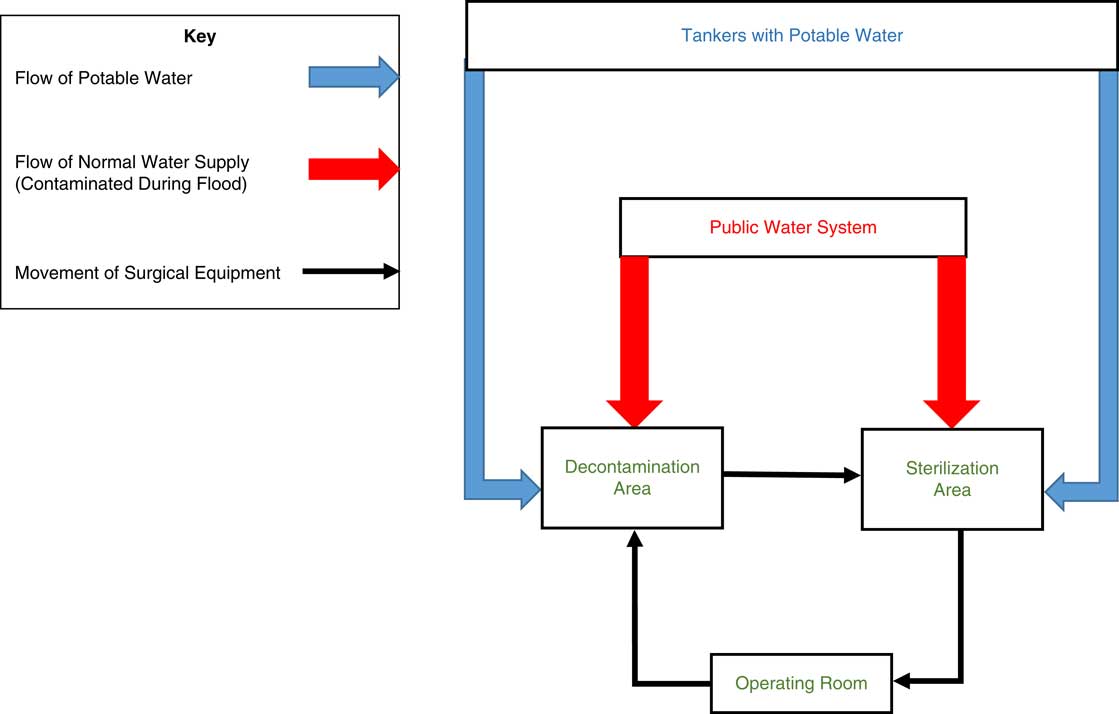
Comparing the sources of water used to supply the decontamination and sterilization areas of the operating rooms during normal operations (red) as compared with during the flood (blue).

Solutions
With a floodwater-contaminated public water supply, we required potable water for both sterile processing steps. A vendor was contracted to provide 6000 gallon tankers of potable water. However, our facility water use was over 200,000 gallons per day; therefore, the tankers could not meet our hospital-wide needs. Our solution required engineering to isolate the water supply for sterile processing of surgical equipment. Hot and cold water pipes were installed from the water tanker located in a loading dock for sterile processing. Water pumps and heaters were provided by the water vendor. The clean pipes were connected to the sinks, ultrasonic units, and the washer-sterilizer. The washers were flushed with potable water and bleach before placing them in service. Between 3000 and 4000 gallons of potable water were used per day for the decontamination phase of sterile processing for the surgical equipment. For the sterilization phase of equipment processing, the water vendor provided an additional tanker and pump to deliver potable water to our steam boiler that sends steam to the equipment sterilizers. Engineering also plumbed clean pipes from the steam boiler to the equipment sterilizers (Figure 1). These modifications allowed us to resume sterile processing of our surgical equipment and to tackle our elective surgical case load while still under the floodwater boil advisory. There were no surgical complications identified because of the sterile processing of surgical equipment under the boil water advisory following the flood, which lasted for 7 more days.
We are fortunate to have full-time plumbers in our engineering department who could efficiently isolate the sterile processing water supply and connect it to the water vendor’s potable water tankers. Mitigation requires a reliable source of potable water. Our solution is an annual contract with the tanker-transported potable water vendor in case we experience a similar event. In addition, we are establishing a well to provide water in the event that the public water supply cannot meet our needs.
Discussion
Water plays a significant role for operations in any hospital or health-care facility. The epidemiological importance and impact of contaminated water in health-care settings seen in nosocomial infections such as those caused by Gram-negative pathogens, fungi, and non-tuberculous mycobacteria, as well as Legionnaires’ disease have been extensively documented.Reference Breathnach, Cubbon and Karunaharan 5 - Reference Decker and Palmore 7
Patients are vulnerable to such agents and hospital infection control must conduct aggressive surveillance to prevent, identify, and promptly recover from any outbreak. Sterile processing of surgical equipment is an area of focus as the equipment could serve as a vector for transmitting hospital-acquired infections. Thus, heat-based methods such as convectional autoclaving are typically used for sterilizing surgical equipment.Reference Lipscomb, Sihota and Keevil 8 , Reference Marshall, Walker and Foster 9 However, Gram-negative bacteria and endotoxins pose an unusual challenge to typical sterilization procedures, especially in the event of floodwater contamination.Reference Marshall, Walker and Foster 9 - Reference Wenqiong and Ding 11
Endotoxins, first described in the 19th century, consist of molecules in the outer membrane of all Gram-negative bacteria. They play a major role in the pathophysiology of Gram-negative infections.Reference Wenqiong and Ding 11 Endotoxins are released in small amounts during cell growth and division, but are released in much larger amounts upon cell death, particularly with the destruction of the cell wall by antibiotics, the host immune system, or by equipment sterilization.Reference Lieder, Petersen and Sigurjónsson 12 A single Escherichia Coli bacterium contains ~2 million endotoxin molecules per cell.Reference Gorbet and Michael 10 When endotoxins are released, they activate the synthesis of cytokines and other inflammatory mediators leading to the systemic inflammatory response responsible for sepsis and other clinically significant biological effects.Reference Gorbet and Michael 10 These heat-stable endotoxins require treatment at 180°C for at least 3 hours or at 250°C for 30 minutes to be destroyed, making surgical equipment sterilization more challenging.Reference Marshall, Walker and Foster 9 , Reference Gorbet and Michael 10 In addition, endotoxins, because of their hydrophobicity, readily adsorb to hydrophobic materials, making them viable to remain on sterilized surgical equipment for long periods of time after routine sterilization.Reference Gorbet and Michael 10 , Reference Moesby, Hansen and Christensen 13 , Reference Casey, Balk and Bone 14
A potable water source is critical to daily hospital operations. The CDC and American Water Works Association have created a guide titled Emergency Water Supply Planning Guide for Hospitals and Health Care Facilities. 15 It provides a list of potential water sources such as tanker-transported water, wells, storage tanks, portable treatment units, and surface water (lakes, ponds). During the flood, we utilized all of these sources to maintain our facility. Because of the endotoxin risk under the boil water advisory following the flood, the tanker-transported potable water was our only acceptable source for sterile processing of surgical equipment.
Conclusion
A hospital or health-care facility with a contaminated water supply arising from a flood must be aware of and responsive to dealing with the threat of endotoxins before resuming routine sterile processing of surgical equipment. Plans should include a potable water source and method to connect it to the required location.