Inconsistency is a defining feature of the Trump administration’s foreign policy. Trump wasn’t going to strike Syria, then he was;Footnote 1 Trump was going to pull U.S. troops out of Syria, then he wasn’t;Footnote 2 he declared NATO obsolete, then declared it wasn’t;Footnote 3 he threatened North Korea with complete annihilation, then suddenly agreed to meet with its dictator, Kim Jong-un, praised his leadership and strength, and granted him strategic concessions.Footnote 4 Many scholars fear that Trump’s foreign policy inconsistency is damaging America’s international reputation, at least in the short term.Footnote 5 But to what extent does the American public care? Does President Trump face any domestic costs for inconsistent behavior on the international stage?
Previous scholarship on audience costs demonstrates that individuals generally act prudently when evaluating foreign policy: despite their partisan differences, voters disapprove of leaders who behave inconsistently in foreign affairs.Footnote 6 This is because national populations—along with leaders and political elites—are deeply concerned with their country’s reputation for credibility and resolve.Footnote 7 Yet the public’s prudency regarding foreign policy may no longer hold in the Trump era. Kenneth Schultz, for instance, concludes that severe partisan polarization has made it “harder for the United States to conduct foreign policy.”Footnote 8 Others conclude that partisan polarization is unravelling the “bipartisan liberal internationalist consensus” that long characterized U.S. foreign policy, such that a growing segment of the population is questioning the importance of maintaining U.S. leadership and commitments abroad.Footnote 9
Some scholars have specifically begun to speculate whether past findings on audience costs and reputation costs still apply to a president who could allegedly “stand in the middle of Fifth Avenue and shoot somebody” without losing voters.Footnote 10 Daniel Drezner, most notably, argues that current levels of partisan polarization ought to dilute the effect of audience costs—that is, the magnitude of public disapproval that leaders incur for backing down on international threats.Footnote 11 A 2017 study by Sara Croco and Jared McDonald lends support to this position, finding that only individuals who were predisposed to dislike President Trump viewed his reversal on Syrian intervention negatively.Footnote 12
Our study revisits the experimental tradition on domestic audience costs in the Trump era to investigate whether—and to what extent—existing theories of domestic accountability in foreign policy continue to apply to Donald Trump.Footnote 13 We ask: Will co-partisans and opposition-partisans equally disapprove of Donald Trump for backing down in a crisis and jeopardizing America’s reputation on the international stage?
We argue that past scholarship on audience costs continues to apply to the Trump presidency. Although President Trump’s foreign policy appears uniquely impulsive, incoherent, and partisan-charged, the public’s disapproval of foreign policy inconsistency remains stable. We posit that partisan polarization becomes less impactful in determining how the mass public evaluates its leaders when the issues in question deal with foreign policy crises.Footnote 14 As a result, Republicans and Democrats should equally disapprove of Donald Trump for backing down in a crisis, but they should also equally reduce the extent of this disapproval if President Trump provides a justification for doing so.Footnote 15
In testing this argument, we leverage results from a unique audience costs experiment fielded during the 2016 presidential transition from Barack Obama to Donald Trump. To better assess whether—and to what extent—Donald Trump might be more insulated from audience costs than his predecessors, we refine the design of typical audience costs experiments to include leader-specific information. We do this by varying the identity of the president involved in the crisis scenario between Donald Trump, Barak Obama, and “The President” (i.e., the generic unnamed leader used in most audience costs survey vignettes).Footnote 16 Our results are, of course, specific to the 2016 presidential transition period; it will be important to continue to reassess our findings as Donald Trump’s presidency progresses.
We make four main contributions to scholarship on leader-level attributes, partisan cues, leader-specific reputations, and the importance of statistically insignificant effects. First, by investigating whether Donald Trump incurs different levels of audience costs than Barack Obama and a generic, unnamed leader (“The President”), we test whether Fearon’s logic of audience costs applies differently to different leaders with different attributes.Footnote 17 Second, in contribution to research on partisan cues, we suggest that even in periods of high polarization, partisan signaling plays a minimal role in shaping public opinion of foreign policy crises, at least in the short term.Footnote 18 Third, we extend recent work on leader-specific reputations in international politics by assessing the extent to which domestic audiences in the United States—despite variation in initial attitudes toward Donald Trump and perceptions of his personal credibility and resolve—punish President Trump for jeopardizing the country’s reputation for resolve by backing down in a crisis.Footnote 19 Finally, we demonstrate that statistically insignificant effects can contribute to knowledge in a way that is both theoretically interesting and substantively important.
Reinvestigating audience costs in the Trump era also has a practical significance. Policymakers and practitioners need to know whether the public evaluates Donald Trump differently than past presidents to form expectations about how much latitude he has in a crisis and how credible his threats are to other states. We currently lack information showing whether voters—particularly Republicans—will disapprove of President Trump for inconsistent foreign policy behavior.Footnote 20 Such information is particularly important given Donald Trump’s inclination to issue impulsive threats, as well as his tendency to actively make foreign policy partisan.Footnote 21
We proceed as follows. In the first section, we make the case that despite the atypical nature of the Trump presidency—and the severe partisan polarization surrounding it—Republicans and Democrats should still impose equal levels of audience costs on Donald Trump. We outline our experimental design in the second section, and the third section presents and assesses our findings, as well as the limitations of our study. We conclude with a discussion of the importance of our findings for scholarship on audience costs, reputation costs and partisan cues, the value of null results in political science, and the future of the Trump presidency.
Defending Audience Costs in the Trump Era
Scholars widely agree that citizens care about their country’s international reputation.Footnote 22 Research on audience costs and reputation costs consistently observes that the public disapproves of leaders who act inconsistently in foreign affairs specifically because it views inconsistency as damaging the country’s reputation for credibility and resolve.Footnote 23 A longstanding insight from the “cottage industry” of scholarship on audience costs is that democratic leaders’ sensitivity to public opinion ought to deter them from backing down on international threats, since voters see these threats as putting the country’s reputation on the line.Footnote 24 Of course, the public’s concern for national “credibility, face, and honor” has impacts that extend far beyond the audience costs literature,Footnote 25 underpinning theories of credibility in crisis bargaining;Footnote 26 the democratic peace;Footnote 27 effectiveness in fighting wars;Footnote 28 peaceful conflict resolution;Footnote 29 crisis escalation;Footnote 30 the reliability of allies;Footnote 31 use-of-force decisions;Footnote 32 and the perpetuation of international rivalries.Footnote 33
Yet many observers are calling for further testing into whether existing theories of public opinion in foreign policy continue to apply to the Trump presidency.Footnote 34 When it comes to domestic costs for foreign policy inconsistency, the main reason for this doubt is partisan polarization. In the current political environment, Americans are sorted into more homogenous parties and less likely to take positions at odds with their own party.Footnote 35 Rising levels of “negative partisanship”—general disdain for members of the opposing party—further reinforce partisan tribalism among the public.Footnote 36 A number of past studies suggest that partisan polarization can unravel the “bipartisan liberal internationalist consensus” in U.S. foreign policy.Footnote 37 And some scholars specifically view partisan polarization as a moderator of audience costs, as these costs may be harder to generate when “citizens are biased for or against the incumbent relative to the opposition.”Footnote 38 As Daniel Drezner posits, the current degree of polarization in the United States could “shrink the audience that might change its mind about the President if he backs down in a crisis.”Footnote 39 If Donald Trump is indeed the most polarizing leader in American history,Footnote 40 then it is reasonable to presume that he is less capable of generating audience costs.Footnote 41
Severe partisan polarization is also speculated to impede the ability of individuals to learn from—and react to—foreign policy failures, such as the issuance of non-credible threats.Footnote 42 This is because partisanship influences how people acquire, interpret, and use factual information when evaluating leaders and their foreign policy decisions.Footnote 43 Research on public opinion in the Iraq War shows just how powerful this effect can be: Republicans clung to false beliefs that Iraq had weapons of mass destruction, while Democrats were resistant to information showing that the 2007 surge helped reduce violence in Iraq.Footnote 44 When applied to the logic of reputation and audience costs, these findings suggest that if “Trump’s base will swallow whatever he tells them about foreign policy” while his detractors will unconditionally reject it, the costs of foreign policy inconsistency should be minimal—washed out by individuals’ preexisting attitudes toward the president.Footnote 45
We do not doubt that the atypical nature of the Trump administration and the severity of partisan polarization in the Trump era profoundly affect the conduct of U.S. foreign policy in general. Nevertheless, we argue that the partisan polarization surrounding Donald Trump’s presidency should not affect the magnitude of audience costs that President Trump incurs—nor his ability to deflect audience costs. The empirical implications of our argument are twofold: (1) Republicans and Democrats will equally disapprove of Donald Trump if he backs down in a crisis; and (2) Republicans and Democrats will equally accept Donald Trump’s justifications for backing down in a crisis.
First, President Trump should incur equal levels of audience costs among Republicans and Democrats because the cleavage between the views of Democrats and Republicans on foreign policy issues may not be as extreme as is often characterized.Footnote 46 Chaudoin, Milner, and Tingley observe that contrary to critics' fears, bipartisanship in U.S. foreign policy has remained strong since the 1970s, even as partisan divisions have increased domestically.Footnote 47 Kertzer, Brooks, and Brooks argue that this is because partisan affiliation has little effect on how individuals evaluate foreign policy issues, and that people do not view the foreign policy positions associated with Democrats much differently from those of Republicans. Supporting that position, Milner and Tingley show that the “contrasts across the ideologies” of Democrats and Republicans “seem more muted” on use of force decisions: “At certain times practically everyone will support maintaining military might and favor military intervention.”Footnote 48 Much of the international relations literature suggests that the American public has regular features when it comes to the use of force: it values international reputation,Footnote 49 and will support military force when it is likely to succeed, is multilateral, fits with their values, and expected casualties are low.Footnote 50 Although some evidence shows that conservatives care more about the reputational consequences of inconsistency, and liberals more about the reputational consequences of belligerency, both care about their country’s reputation and will disapprove of leaders they perceive as damaging it; the gap between the two views is not substantial enough to impact the magnitude of audience costs.Footnote 51 As Michael Levendusky and Matthew Horowitz have noted, “voters are inclined to see audience costs style scenarios in terms of national interests, rather than partisan ones.”Footnote 52 This leads to our first hypothesis:
H1 : Partisanship does not significantly affect the magnitude of audience costs that individuals impose on Donald Trump (i.e., the magnitude of the net audience costs should be the same for Republicans and Democrats).
Second, we expect that President Trump is equally capable of deflecting audience costs from Democrats and Republicans because the general public tends to be “rationally ignorant” in foreign affairs, largely deferring to the president in crisis situations.Footnote 53 While the public cares about credibility and resolve, the information asymmetry between leaders and populations limits its ability to independently assess the merits of leaders’ crisis decisions. By virtue of their unique access to intel and foreign policy expertise, presidents are able to mold the public’s reaction in the immediate aftermath of a crisis-decision—when citizens lack alternative sources of information, partisan lines have yet to be drawn, and public opinion is most malleable.Footnote 54 In this period, the information contained in the message itself should outweigh the identity of the messenger.Footnote 55 Levendusky and Horowitz, for instance, show that presidents are capable of reducing audience costs from co-partisans and opposition-partisans if they justify backing down as being in the “national interest.”Footnote 56 Given the information asymmetry favoring the president in foreign policy, mass publics may accept the executive’s justifications, or at least give them the benefit of the doubt if the logic of the justification seems plausible, before alternative sources of information on that issue become available.Footnote 57 Consequently, we don’t just expect Republicans to accept a reasonable justification he offers for backing down in a crisis; we expect Democrats to do so as well—at least in the short term. This gives rise to our second hypothesis:
H2 : Partisanship does not significantly affect Donald Trump’s ability to deflect audience costs by justifying his decision to back down in a crisis (i.e., Republicans and Democrats will equally reduce the magnitude of audience costs they impose on President Trump if he provides a justification for backing down).
While our hypotheses are strongly supported by past findings in the audience costs literature, we believe that this literature must be revisited as it is ill suited to the Trump era. Because prior audience cost experiments prime respondents with unnamed, hypothetical leaders (“The President”, but sometimes the “Republican President” or “Democratic President”), they provide us with little guidance when it comes to specific leaders—especially those as unique and individually divisive as Donald Trump.Footnote 58 Moreover, because domestic audience costs underpin many of our theories on international conflict and cooperation, as well as the domestic accountability of leaders,Footnote 59 it is worth revisiting whether the logic of audience costs still holds in the Trump era.
One final point is warranted before moving on. The dominant trend in political science is to hypothesize statistically significant effects. In contrast, each of our hypotheses is deliberately framed in terms of the null. We expect our main findings to be null results, with partisanship failing to achieve statistical significance as a moderator of audience costs for Donald Trump. We firmly believe that statistically insignificant results can be both theoretically interesting and substantively important.Footnote 60 This is especially true when it comes to research on the uniqueness of the Trump presidency, as scholars must be open to—and aware of—the possibility that in some areas of policy, Donald Trump is not significantly different than his predecessors. This is a point that we return to in the conclusion.
Experimental Design
To test our theories, we turn to an online experiment in which we recruited 1,991 individuals through Amazon’s Mechanical Turk in January 2017—after the election of Donald Trump but before he took office.Footnote 61 Of these, approximately 15% (292) did not pass the manipulation checks, failing to correctly identify the identity or actions of the president in the treatments to which they were assigned.Footnote 62 We omit these individuals from the analysis, but all results are robust to their inclusion.Footnote 63
Because MTurk samples often include more women, are more liberal, younger, whiter and more educated, we collected information on the respondents’ gender, age, race, education, and partisanship.Footnote 64 While MTurk samples may not be representative of the general population, the differences can be reduced when controlling for measurable sample features and “MTurk respondents do not appear to differ fundamentally from population-based respondents in unmeasurable ways.”Footnote 65 While many have reservations about the generalizability of crowd workers to the general population, MTurk studies are perfectly valid and are “no worse than convenience samples used by other researchers in political science.”Footnote 66 Most importantly for our study, “liberals and conservatives in our MTurk sample closely mirror the psychological divisions of liberals and conservatives in the mass public.”Footnote 67 We include demographic information about the sample in online appendix A.
In our survey, all respondents received the following vignette at the introduction:
A country sent its military to take over a neighboring country. The attacking country invaded to get more power and resources. The attacking country had a strong military, so it would have taken a major effort for the United States to help push them out.
This vignette is derived from existing audience costs experiments, which enables us to firmly situate our results within the literature.Footnote 68 We deliberately refrained from identifying specific countries in the vignette because, as Levendusky and Horowitz observe, specifying the countries involved in the crisis runs the risk of introducing country-specific confounding.Footnote 69 We did, however, ask respondents which specific countries they believed were involved in the scenario to assess whether our results change if respondents were thinking of any particular crisis.Footnote 70
After reading the vignette, respondents were randomly assigned information about the partisanship of the president and the president’s actions towards the conflict, producing a 3x3 factorial design. To realistically manipulate the identity and partisanship of the president, we told respondents that the leader was either “The President,” “President Barack Obama,” or “President Donald Trump.” Then, respondents were told that this president: (1) decided not to take any action; (2) promised to intervene and then backed down; or (3) promised to intervene and backed down, but justified his decision to back down on the basis of new information indicating that involvement was not in America’s interests.Footnote 71 For the full wording of the vignettes, refer to online appendix E.
For the main outcome of interest, we asked respondents whether they approved of the president’s handling of the situation in the vignette on a scale ranging from 1 (strongly disapprove) to 5 (strongly approve). We collected information about respondents’ partisanship based on a 7-point scale which we condense to three groups (Democrat, Independent, and Republican).Footnote 72 Our main analysis excludes independents to specifically assess how partisans (including leaners) impose audience costs, leaving us 1,454 Democrats and Republicans. However, the results are robust to the inclusion of independents and a continuous measure of partisanship.Footnote 73 We also asked respondents who they voted for in the 2012 and 2016 presidential election to examine whether there are any leader-specific (as opposed to party-specific) effects, which recent work on leader-specific reputation in international relations suggest as a possibility.Footnote 74 This question further allows us to assess whether the results change when excluding non-voters.Footnote 75 Finally, we included a series of foreign policy knowledge questions, adopted from Chen, to assess whether—and how—political awareness might condition audience costs.Footnote 76 Previous research has argued that people may need a certain level of political awareness to impose audience costs on presidents who back down during crises.Footnote 77
This experimental design is tailored to address how Donald Trump’s foreign policy behavior is evaluated compared to past presidents. We focused our attention on audience costs because voters’ disapproval for leaders who renege on military threats is one of the most consistent findings on public attitudes towards foreign policy, and therefore, an ideal place to test whether Donald Trump is unique from past presidents.
Our design complements and improves upon existing studies in a number of ways. In traditional audience costs studies, an unnamed U.S. president (“The President”) takes one of two actions: (1) he stays out of the conflict or (2) he issues a threat but subsequently backs down.Footnote 78 By their nature, the presidents included in these vignettes are never specified, which prevents researchers from knowing with certainty whether respondents are thinking of the current president, a past president, or are genuinely entertaining the hypothetical and not thinking of a specific president at all. Moreover, the public image and reputation of these hypothetical leaders is never filtered through—and shaped by—the gauntlet of partisan elites, the media, election campaigns, and the mass public, as would certainly happen in practice. If, in the real world, partisanship affects the way in which citizens perceive and react to leaders’ policy decisions, experiments that exclude contextual information on partisan cues might artificially amplify the effect of audience costs.Footnote 79
Our design enhances the external-validity of the treatment (varying the partisanship of the president) in two key ways. First, by using the names of presidents, we more closely approximate the American context in which presidents are viewed simultaneously as individuals and partisans. In our experiment, we specifically used the names of presidents Barack Obama and Donald Trump because, in the United States, presidents vary in the extent to which they are perceived as representatives of a party, as well as in the extent to which they personally evoke partisan polarization among the public.
Second, the timing of our experiment allows us to vary the president’s identity and partisanship without introducing an implicit confounding treatment: real versus hypothetical—or current versus former—presidents. In 2012, Levendusky and Horowitz varied partisanship in their survey vignette by saying either “the Democratic President” or “the Republican President” issued a threat. But at the time of their survey, one of those treatments was factual, while the other was nonfactual and it is possible that respondents evaluate factual and nonfactual crisis scenarios differently.Footnote 80 By fielding our experiment during the 2016 presidential transition—after Donald Trump won the election but before he took office—we take a modest step toward disentangling the effect of partisanship from the effect of factual versus nonfactual information. Because respondents could feasibly imagine either Barack Obama or Donald Trump as the incumbent president at the time, we maximize the real-world plausibility of priming respondents with the names of two polarizing presidents, from two different parties.
We should, however, note that a few experiments do include leader-specific information in their treatments, bringing in former presidents or past foreign policy crises.Footnote 81 Yet the results of these experiments may be confounded by the influence of partisan media or historical memory. Incumbent presidents are polarizing figures,Footnote 82 but research shows that past presidents tend to fade from the memory of U.S. citizens—this holds even for relatively recent presidents.Footnote 83 For instance, the percentage of Democrats who have a favorable view of former President George W. Bush jumped from 10% in 2009 to 54% in 2017.Footnote 84 Comparing Donald Trump to a former president, such as George W. Bush, could lead us to overestimate his uniqueness. The two presidents may share similar titles, but they aren’t necessarily comparable. Consequently, using contextual information that is specific to past events or presidents cannot tell us if Donald Trump’s current behavior is actually being evaluated differently from the way past presidents were evaluated while they were still in office.Footnote 85
Results
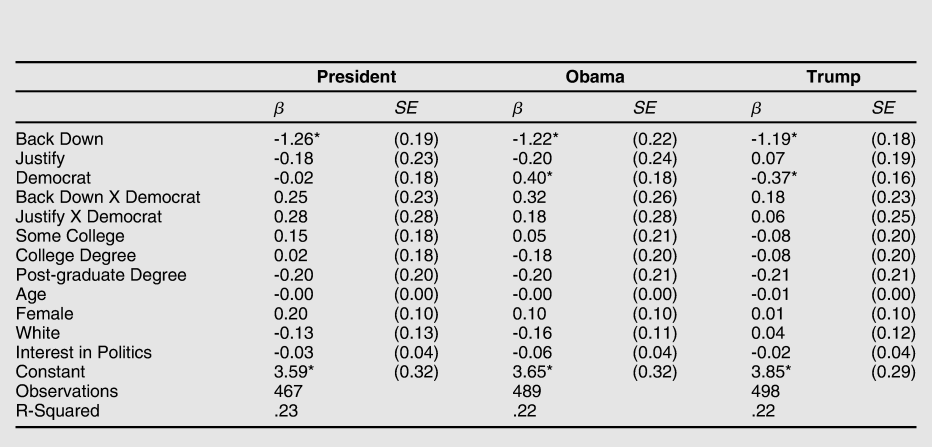
If partisan affiliation moderates the magnitude of audience costs, we should see that when President Trump backs down on a military threat, he takes a significantly lower approval hit among Republicans than Democrats. The inverse should also hold for Barack Obama. Table 1 presents the regression results, indicating that partisans punish in-party presidents for backing down to the same extent that they punish out-party presidents.
Influence of backing down and justification across presidents

Robust standard errors in parentheses. * p < 0.05
Note: Sample only includes individuals who passed reading checks to ensure proper treatment. Results robust to no controls. Interaction effects demonstrate that the Democrats and Republicans do not punish co-partisans differently than Presidents from their own party.
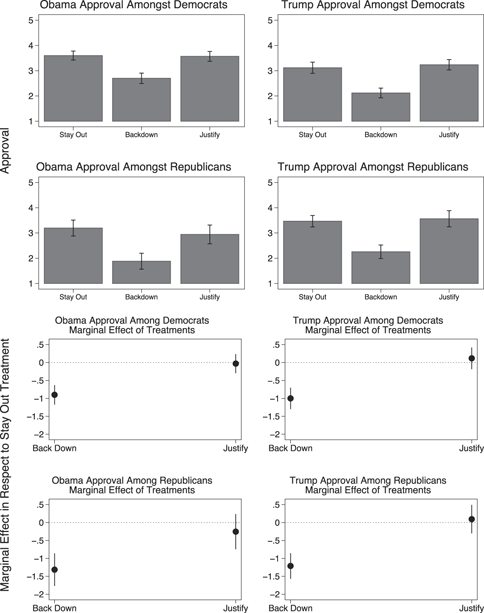
Figure 1 displays the mean approval rates for the Obama and Trump treatments, as well as the marginal effect of the treatments with respect to the stay-out condition. We find no significant difference in the magnitude of audience costs that Presidents Trump and Obama incur among co-partisans versus opposition-partisans. For instance, President Obama suffers a 1.22 drop in approval from Republicans (40% drop) when he backs down in a crisis without justification, while Trump takes a comparable 1.19 drop (34% drop) in approval on a 5-point scale. This is nearly a three times larger effect than the partisanship of the respondent. These results support Hypothesis 1, showing that there is no partisan division in the imposition of audience costs on Donald Trump or Barack Obama. It appears that even in times of high political polarization, partisan affiliation and party cues do not moderate the magnitude of audience costs.
Presidential approval across treatments

Strikingly, figure 1 shows that even presidents as polarizing as Donald Trump can still avoid audience costs among members of the opposition party as well as their own party if they simply provide a justification for backing down. In support of Hypothesis 2, when President Trump justifies his decision to back down as being “in America’s interest,” he no longer incurs an approval hit among Democrats or Republicans, who each apparently perceive this justification as credible. Average approval for Donald Trump among Democrats in the stay-out condition is 3.12 versus 3.23 in the “Justification” group.
The same pattern holds for Barack Obama, who figure 1 shows is equally capable of deflecting audience costs among Republicans and Democrats by justifying his decisions to back down. Our finding on presidential justifications is substantively important. It shows that even when presidents are highly polarizing figures domestically and have a reputation for dishonesty, opposition-partisans still appear to defer to their authority in crisis situations, accepting their reasoning for reneging on a threat.
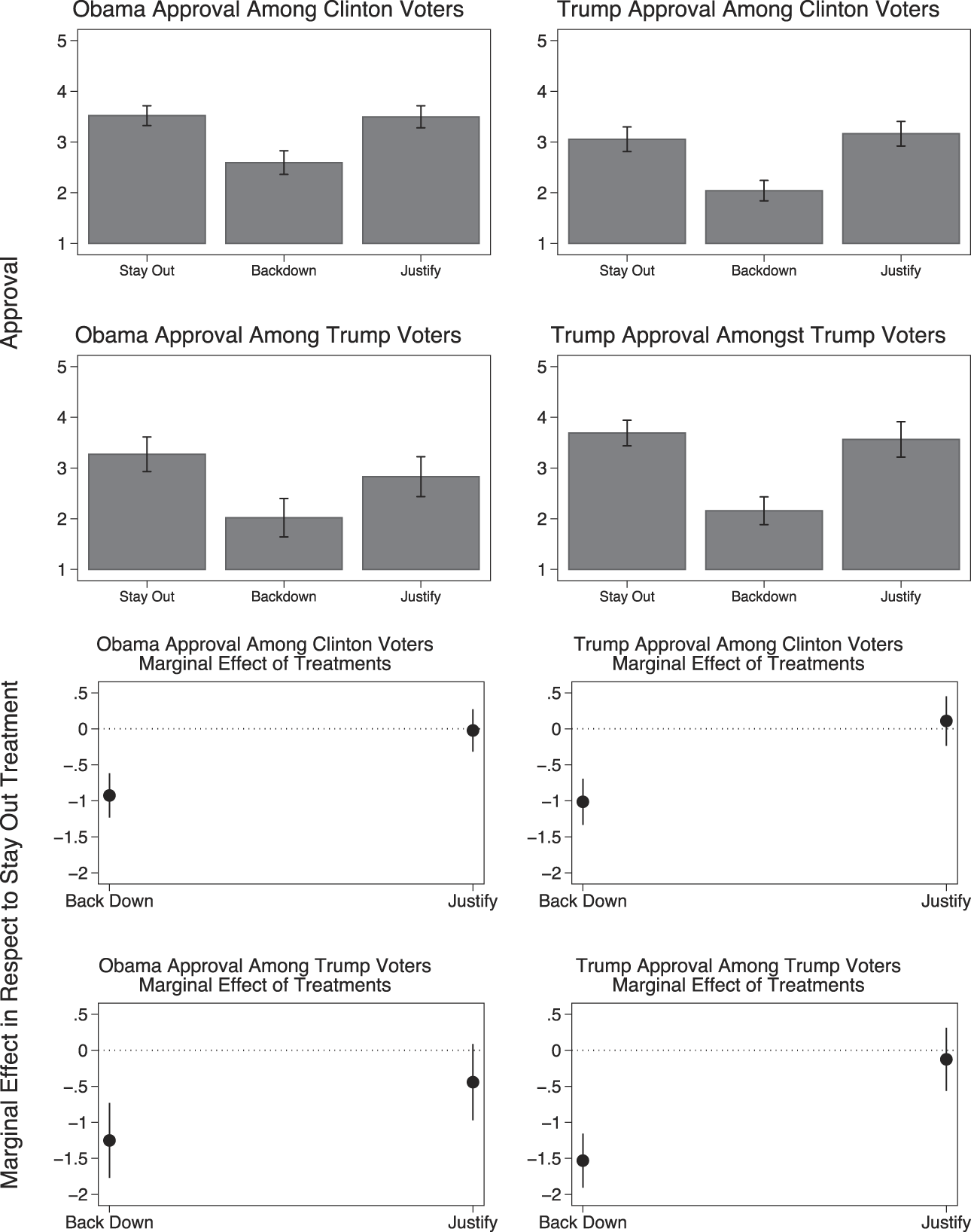
Importantly, we find similar support for Hypothesis 1 and Hypothesis 2 when the models are specific to Trump and Clinton supporters—as opposed to Republicans and Democrats more generally (refer to figure 2). These results suggest that even Donald Trump’s core supporters will still impose audience costs if he reneges on an international threat without justification. While Trump’s voters certainly begin with more positive initial perceptions of his reputation for credibility and resolve than Clinton voters,Footnote 86 we find that both groups exhibit similar levels of disapproval when Donald Trump takes actions in a crisis scenario that jeopardize the country’s reputation on the international stage.Footnote 87 These results also demonstrate the robustness of our findings to different operationalizations of partisan identity.
Presidential approval across treatments (Clinton/Trump voters)

Our results also raise important questions about which kinds of citizens impose audience costs. We find that to be in a position to impose audience costs, Democrats and Republicans may need to have a certain level of political knowledge of their party’s stance on foreign intervention, as well as the political ramifications of leaders reneging on military threats.Footnote 88 As others have noted, “education and other sophistication-related variables facilitate people’s ability to match their ideological outlooks with the corresponding issue preferences.”Footnote 89
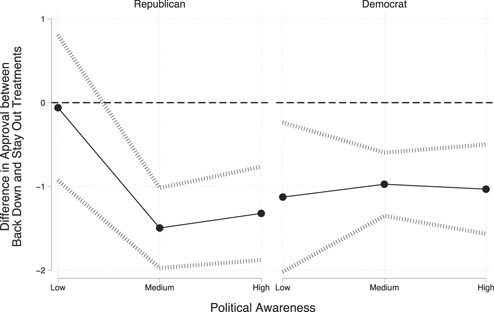
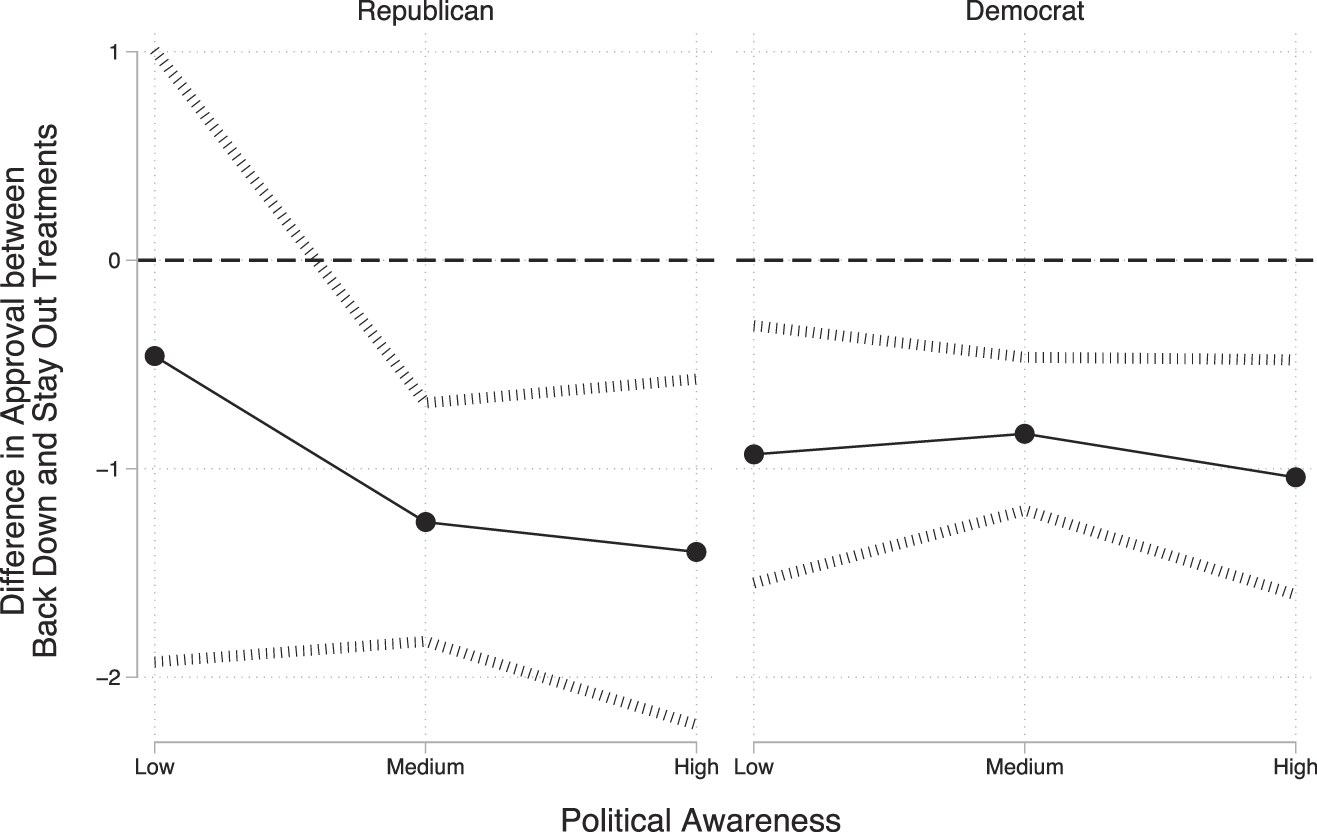
Figure 3 suggests that political awareness may moderate the relationship between partisanship and audience costs. For Republicans and Trump supporters, we find that audience costs are primarily imposed by citizens who are more politically aware. In other words, Republicans with low levels of political awareness do not have statistically different levels of approval toward Donald Trump when he backs down and stays out of conflicts.
Trump treatments: Effect of backing down across political awareness

Figure 4 shows a similar pattern for Barack Obama, with Republicans who have low political awareness imposing the lowest levels of audience costs. These results reinforce the notion that citizens with less knowledge of foreign affairs—who tend be some of Trump’s core supporters—may continue to approve of the president regardless of his actions.Footnote 90 Nevertheless, Donald Trump’s insulation from audience costs among citizens who are less politically aware may not be as beneficial to him as it seems, considering that politically engaged citizens—those who impose the greatest levels of audience costs—are more likely to turn out to vote and have a greater potential to shape government policy.Footnote 91
Obama treatments: Effect of backing down across political awareness

Discussion, Limitations, and Future Research
In support of our hypotheses, these results underscore that individuals’ partisan identity does not moderate the magnitude of audience costs in the Trump era. Republican and Trump voters punish Donald Trump and Barack Obama relatively equally for backing down in a foreign policy crisis when they do not provide a justification for doing so. The findings provide support for the notion that voters are inclined to evaluate audience costs scenarios in terms of national rather than partisan issues, and that even atypical leaders like Donald Trump are not immune from censure from their supporters.Footnote 92 Our results extend recent findings in the international reputation literature, which show that leaders develop reputations for resolve on their own, and that leaders who fail to back up assertive statements of resolve incur reputation costs among international audiences.Footnote 93 We find evidence of a similar effect among domestic audiences when it comes to the issuance of an international threat, whether by Donald Trump, Barack Obama, or a generic president.
We also demonstrate that presidents can decrease the magnitude of audience costs by justifying their decisions to back down in a crisis, and that individuals with low levels of political awareness may approve of the president regardless of inconsistencies in foreign policy behavior. These findings support the conclusion by Michael Tomz that the political fallout from making empty threats is concentrated among the most politically active—and arguably the most influential—segments of the population.Footnote 94 What this means, more concretely, is that Trump’s impulsive foreign policy behavior has the potential to hurt his approval among some of his base.
Still, our study is not without limits. The believability of our partisan treatments varying whether Donald Trump or Barack Obama was president in the scenario—required us to field this experiment during the 2016 presidential transition, before Trump had taken office and dealt with a real crisis. As a result, our experimental scenario was not grounded in any particular crisis, which raises concerns of external validity since the public may evaluate President Trump differently during genuine crisis situations. To address this concern, albeit imperfectly, Table 8 of online appendix D restricts our analysis to the 66% (n=975) of respondents who thought Russia was the attacking country in the scenario, as the vignette text largely resembles Russia’s annexation of Crimea from Ukraine. Our results are robust even when models are restricted to the subsample of respondents who specifically thought about Russia and the Crimea crisis. This post hoc check for heterogenous treatment effects reduces concerns that crisis-specific confounding may be biasing our results. Yet future research would make a valuable contribution to the literature by specifically tailoring the framing and timing of audience costs experiments to investigate whether respondents treat real (versus hypothetical) and ongoing (versus former) crisis scenarios differently.
A second limitation of our research design concerns the comparability of President Obama and President Trump. At the time of our experiment, Donald Trump had yet to assume the Oval Office. While Barack Obama had a clear record of foreign policy behavior and an established reputation on the basis of that behavior, Donald Trump did not. This was a necessary byproduct of our decision to field the experiment during the presidential transition when respondents could feasibly imagine either Donald Trump or Barack Obama as the president, maximizing the plausibility of our partisan treatments. It is, however, possible that the public updates the way in which it evaluates foreign policy decisions in light of leaders’ past behavior in international affairs. If this is the case, our finding that the public does not evaluate Donald Trump differently than Barack Obama would be specific to the period in which President Trump was a new leader, without an established reputation and track record in foreign affairs.Footnote 95 Still, we do not expect this research design limitation to affect our conclusion that partisanship fails to moderate audience costs for Donald Trump (a unique and new leader), Barack Obama (an incumbent), or “The President” (a generic leader). But we acknowledge the possibility that, over time and in reaction to Trump’s behavior on the international stage, partisan polarization could grow to have a greater effect on how the public evaluates President Trump’s foreign policy. Accordingly, it will be important for scholars to continue to question and reinvestigate our findings as Donald Trump’s presidency progresses.
Critics might also wonder whether partisanship is the only cue, or even the dominant one, that respondents receive from the “President Trump” treatment condition. Donald Trump’s populist appeal may affect individuals’ approval for him in ways unrelated to partisanship. President Trump’s rhetoric of identity politics, anti-elitism, and pro-nationalism clearly resonates with his supporters.Footnote 96 If anything, Trump’s brand of populism suggests that identity politics—abstract notions of who or what Donald Trump represents—should matter more to his supporters than his substantive foreign policy behavior, diluting the extent audiences costs he faces for backing down.Footnote 97 Yet our finding that Republicans, Democrats, Clinton voters, and Trump voters equally disapprove of Donald Trump for backing down in a crisis suggests that Trump’s populist appeal does not shield him from audience costs. We do, however, acknowledge that populism may condition the effectiveness of Donald Trump justifying his decisions to back down in a crisis. In our experimental design, the justification that Donald Trump provided appeared relatively plausible. Trump’s populist appeal, however, may mean that his supporters are more willing to accept patently implausible justifications for foreign policy inconsistency, and this possibility is an important consideration for the design of future audience costs experiments.Footnote 98
Donald Trump’s authoritarian tendencies may also be a strong cue baked into the “President Trump” treatment.Footnote 99 Such tendencies manifest in Trump’s projection of a strong-man personality, fearmongering, demonization of the opposition, and attacks on the media.Footnote 100 While our design does not enable us to isolate this effect from that of partisanship, we posit that Donald Trump’s fearmongering and strong-man style of leadership should actually make him more sensitive to audience costs than other leaders because backing down and lacking resolve undermines these narratives. Moreover, Trump’s demonization of political opponents ought to increase the partisan division in audience costs imposed upon him by further polarizing the public. Our results, however, show Donald Trump is not more sensitive to audience costs, and that there is no in-party versus out-party (or Trump supporter versus Clinton supporter) difference in the magnitude of audience costs imposed on him. Hence, we do not expect that these dimensions of Donald Trump’s authoritarian style of leadership is confounding our partisan treatment effects.
At the same time, Donald Trump’s inclination to disparage the media and discredit unfavorable coverage does pose concerns of external validity. In the real world, the public’s information on crisis situations is filtered through the media, and it is likely that Donald Trump’s supporters are less willing to receive—or trust—news that depicts him as behaving inconsistently or irresolutely. Introducing a mediating role for media sources in audience costs experiments thus would be particularly enlightening given President Trump’s general hostility to the press.
Another limitation of our experiment is that it excludes counter-rhetoric from opposing partisan elites, potentially overstating Donald Trump’s ability to deflect audience costs by providing a justification for backing down. Levendusky and Horowitz, for instance, suggest that “if the President can get elites to support his actions, then the mass public will follow suit,” implying that elite opposition could potentially increase the magnitude or durability of audience costs imposed by the public.Footnote 101 Counter-rhetoric challenging justifications for backing down could hold leaders’ feet to the fire, reducing their ability to deflect audience costs. While our experiment only included one piece of rhetoric—the president’s own justification—we expect that conflicting rhetoric from in-party and out-party elites plays an important role in real-world crisis scenarios, and thus, warrants further investigation.Footnote 102
It is also possible that Republicans and Democrats are imposing audience costs for different reasons, even if the aggregate magnitude of audience costs between the two groups is equivalent. Kertzer and Brutger find that conservatives impose audience costs due to concerns with the reputational consequences for inconsistency, while liberals do so because of the negative reputational consequences of both inconsistency and belligerency.Footnote 103 We acknowledge that our experimental design cannot neatly disentangle the effect of belligerence from that of inconsistency, though in figure 10 of online appendix C, we use causal mediation analysis to partially subtract out the mediating effect of belligerence costs from the total audience costs that Republicans and Democrats impose on each leader.Footnote 104 Most important for our study, both the main results and this robustness check indicate that there is no partisan divide in the total magnitude of audience costs that President Trump incurs for backing down in a crisis. Neither Republicans nor Democrats will let Donald Trump off the hook for backing down in a crisis, unless he provides a justification for doing so. Based on previous research, we expect that the negative reputational consequences of inconsistency play a larger role in driving the results among conservative Republicans. Nevertheless, we save this for future research to address in greater detail.
Conclusions
We tackled a pressing question of the Trump presidency: in a hyper-partisan political environment, will the public impose costs on Donald Trump for acting inconsistently on the international stage and jeopardizing America’s reputation for credibility and resolve? We sought to address this question by revisiting a longstanding experimental tradition on domestic audience costs in the Trump era. While some scholars are concerned that hyper-partisanship reduces the magnitude of audience costs that leaders incur for backing down on threats, we demonstrate that the logic of audience costs persists in the Trump era. For both Donald Trump and Barack Obama, our experimental results show that partisan affiliation fails to moderate the magnitude of audience costs—indicating that party loyalty does not overwhelm individuals’ concern with the substantive content of the president’s foreign policy behavior. These results suggest that in the Trump era, partisan polarization still has a limited effect on how the public evaluates leaders’ crisis behavior, and that the general public still will defer to the president in international crises, at least in the immediate aftermath of a crisis-decision.
These findings fit well with existing scholarship on public opinion and foreign policy.Footnote 105 Bolstering prior research on audience costs, our results suggest that partisan affiliation and party cues have a limited effect on how voters evaluate their leaders’ handling of foreign policy crises. Interestingly, for Trump supporters, we find that political awareness is likely a moderator of audience costs. Individuals seem to require a certain level of political knowledge before they will actually punish presidents for backing down. These findings suggest a fruitful avenue for further exploration on the types of citizens who actually impose audience costs on their leaders.
Our findings matter for our understanding of partisan cues, leader-level attributes, leader-specific reputations, and the value of null findings in political science. First, our experimental results suggest issue-specific limits on the extent to which partisanship affects public opinion. This aligns with Alexandra Guisinger and Elizabeth Saunders finding that the effect of partisan cues on an issue is conditional on the degree to which people are already polarized along party lines. Individuals are more likely to resist information endorsed by experts when that information conflicts with their party’s stance on highly polarizing issues, like taking military action toward Iran.Footnote 106 Our findings suggest that the American public is not as polarized as it may seem when it comes to crisis decision-making. This, of course, conflicts with the finding of Croco and McDonald that only individuals who were predisposed to dislike President Trump viewed his reversal on Syrian intervention negatively.Footnote 107 One reason for this difference may be the experimental design. Our experiment included a hypothetical scenario whereas theirs was situated in an actual crisis. Consequently, our experiment better mimics the early stage of a crisis, where the public opinion is more elastic and open to Trump’s justifications for backing down, whereas Croco and McDonald’s experiment better mimics the later stage of a crisis, where individual’s opinions of a crisis have been solidified by media, partisan elites, and social peers. This gap suggests that the effect of partisanship on crisis decision-making may be conditional on time.Footnote 108
Second, by probing the extent of audience costs imposed on Donald Trump relative to Barack Obama and a generic leader (“The President”), we assess whether Fearon’s logic of audience costs applies differently to different leaders.Footnote 109 An extensive literature shows that leaders vary in their personal attributes,Footnote 110 and more recent work shows that these attributes can affect their ability to generate audience costs.Footnote 111 Although our study does not specifically address these attributes, we suggest that domestic audiences may not evaluate individual leaders differently based on their attributes when it comes to crisis decision-making. There was no significant difference in the magnitude of the audience costs imposed on President Obama, President Trump, or the generic president (whether by Republicans or Democrats).Footnote 112 Still, leader-specific effects may work through different channels. Further research should continue to assess how leader-level attributes affect how the public evaluates crisis decision-making.
Third, we extend research on leader-specific reputation by examining the extent to which domestic audiences punish Donald Trump for threating the country’s reputation by backing down in a crisis. Recent work on international reputation encourages a focus on individual leaders as central units of analysis in international politics, showing that presidents develop leader-specific reputations for resolve that are distinct from the country’s reputation for resolve.Footnote 113 Our results raise questions on when initial leader-specific reputations matter—and are either malleable or sticky—in the eyes of domestic audiences. Co-partisans and opposition-partisans—and certainly Trump voters and Clinton voters—vary in both preexisting attitudes toward President Trump and initial perceptions of his personal reputation for resolve and credibility.Footnote 114 Yet our finding that Donald Trump generates equal levels of audience costs among Republicans, Democrats, Trump voters, and Clinton voters suggests that pre-existing attitudes toward individual leaders do not condition the public’s concern with preserving the country’s international reputation. At the same time, we find that Democrats and Republicans—despite differences in their views on Donald Trump’s reputation for credibility—are equally willing to accept his justifications for backing down in a crisis. Future research should explore the conditions under which leader-specific reputations are more likely to affect how the domestic public evaluates foreign policy decisions.
Fourth, we demonstrate that statistically insignificant effects can contribute to knowledge in a way that is both theoretically interesting and substantively important. There are good theoretical reasons to suspect that severe partisan polarization ought to reduce the capacity for leaders to generate audience costs.Footnote 115 Additionally, scholars and policymakers alike have begun to wonder whether Donald Trump is a unique breed of president, for whom old tools and rubrics for analyzing foreign policy no longer apply.Footnote 116 In this context, our statistically insignificant results are quite informative, suggesting to scholars that partisan polarization is not a strong moderator of audience costs, and to policymakers and practitioners that—at least in the realm of foreign policy—the public may not evaluate Donald Trump much differently than his predecessors.Footnote 117 While political scientists typically test their theories with the aim of rejecting a null hypothesis, we firmly believe that theorizing about null effects, and failing to reject null hypotheses after empirical testing, can be equally valuable to our understanding of international relations.
Finally, our findings matter for practical expectations on whether Donald Trump will face domestic costs for acting inconsistently on the international stage. President Trump is clearly willing to make bold foreign policy threats, notably stating that he would not “rule out a military option in Venezuela,”Footnote 118 threatening North Korea with “fire and fury the likes of which the world has never seen,”Footnote 119 and similarly threatening Iran with “consequences the likes of which few throughout history have ever suffered before.”Footnote 120 But we find no evidence that American citizens—whether Democrats or Republicans—evaluate Donald Trump’s threats any differently than those of past presidents. The wealth of research on audience costs suggests that leaders who make military threats flippantly, with no intention of following through, will face public disapproval. In reaffirmation of these findings, our study indicates that the logic of audience costs still applies to Donald Trump. If President Trump backs down on his threats without justifying his decision to do so, he will incur political punishment from Democrats and Republicans alike. While President Trump is arguably more willing to make military threats that are less credible than his predecessors, this does not imply that those threats are any less costly.
President Trump may not care about his reputation among international audiences, but he likely cares about his public image. So long as Donald Trump believes that his foreign policy behavior affects public approval for him, which is a separate subject of debate, America’s international reputation may yet be salvaged.
Supplemental Materials
Appendix A. Sample Characteristics
Appendix B. Balance across Treatments
Appendix C. Robustness Checks
Appendix D. Hypothetical Vignette Check
Appendix E.: Survey
To view supplementary material for this article, please visit https://doi.org/10.1017/S1537592718003390