1. Introduction
In 1268–1269 Spalding Priory created for its manor in nearby Weston a document unlike any other: a list of male serfs (nativi), along with the names and whereabouts of their offspring.Footnote 1 A few dozen ‘serf lists’ survive for medieval England, including two for other Spalding manors, but Weston's list is the fullest and richest of them all. It has allowed medievalists to investigate matters usually hidden from our view, especially the size of peasant families and the frequency of marriage among them. But it has also generated more debate than consensus – and a fair amount of confusion too. This article provides, for the first time, an extended study of the Weston list, offering readers access to a document that is both wonderfully simple and devilishly complex. It also explores how Weston's cohort of offspring in 1268–1269 included many people, women as well as men, who left home before marriage, supported themselves without marriage, and in some cases, might have never married at all.
2. The text
Weston lies in the Lincolnshire fenland, about an hour's walk west to Spalding and about a day's walk east to the bustling port of Lynn. In 1268–1269 a small part of Weston was held by the descendants of the soldier and justice Sir Thomas de Moulton (d. 1240), but Spalding Priory controlled most of the village and its people, and much of the surrounding area as well. Weston lay within a sprawling priory estate that also included manors in Spalding itself, Pinchbeck, Moulton, Whaplode, Sutton, and beyond. The priory was an assiduous and demanding landlord, eager to take all profits to which it was entitled. It was also an acquisitive neighbour, adding during the tenure of Prior John the Almoner (1253–1274) some 700 additional acres, most of it arable purchased from local knights and their families.Footnote 2 It was during Prior John's administration that Spalding began to produce one of England's earliest archives of manorial management. These records include court proceedings (of which only extracts survive today), surveys of lands and tenants, and several inventories of serfs and their offspring, including the exceptionally informative list for Weston.Footnote 3 A translation of this list appears below in the appendix, with each entry assigned a case number for ease of reference.
Weston's inventory looks deceptively simple – a straightforward tally of servile fathers and the whereabouts of their offspring. The original list does not survive, but we have a copy in a register compiled at Spalding Priory in the early 1330s.Footnote 4 This copy is itself very old, but it was made more than a half-century after the original, when almost all the individuals named in it were dead, and indeed, most were long dead. The copy looks complete, and the head-fathers (that is, the fathers named at the start of each entry) match closely but imperfectly what we know from elsewhere about the servile tenants of the manor (about which, more later). Nothing at all is reported, of course, about the offspring of Weston's two dozen or so free tenants, so the list is doubly incomplete, ignoring children born of the priory's free tenants as well as those born on the small manor of Thomas de Moulton. Worse yet, its actual content is befuddling. The first entry (case 1 in the appendix) provides a good example:
Willelmus filius Ranulphi habuit iiij filios videlicet Walterum Hugonem Ranulphum et Alricum et viij filias videlicet Emecinam Isabellam Elenam Alvinam Luce Bete et Emmam de filiis Walterus et Alricus [ms Alicus] fuerunt monachi et Hugo habuit unum filium Willelmus nomine qui abiit transmarinus et unam filiam Elena nomine que est vacabundus. Ranulphus habuit duos filios de quibus Ricardus est clericus ordinatus et Thomas est in Holbech cum matre sua. De filiabus Emma est desponsata in Spalding, Isabella est desponsata in Spalding, Alicia et Bete sunt desponsate in Quappelode, Elena est desponsata in Multon, et Emma et Lucia sunt desponsate in Weston.
William son of Ranulf had four sons Walter, Hugh, Ranulf, and Elfric; and eight daughters Emcine [Emma below], Isabel, Helen, Alvine [Alice below], Lucy, Betty, and Emma [only seven of eight daughters named]. Of the sons, Walter and Elfric were monks; Hugh had one son William who went overseas and one daughter Helen who is a vagabond; Ranulf had two sons of whom Richard is an ordained clerk and Thomas is in Holbeach with his mother. Of the daughters, Emma is married in Spalding; Isabel is married in Spalding; Alice and Betty are married in Whaplode; Helen is married in Moulton; and Emma and Lucy are married in Weston.
This entry adduces eight daughters but names only seven; describes a female (Helen) with a male-gendered term (vacabundus); twice muddles the names of daughters (Emcine/Emma and Alvine/Alice); reports on the sons of Ranulf but not his three daughters (they appear in the next entry); and switches without apparent reason between past and present tenses.Footnote 5 The Latin is rudimentary.
The Weston serf list, in short, not only reports incompletely on the village's offspring but also supplies confused (and confusing) information about those actually surveyed. Yet for all these flaws, it provides meticulous detail about the sons and daughters of the servile population: who was still a child, who was older but still living at home, who held land, who was married, who was employed at what occupations, who lived away from home in Weston or elsewhere, and who was deemed a vagabond. It is this detail, provided for all but a handful of servile offspring, that makes Weston's list unique, and historians have long used it to measure demographic benchmarks for the thirteenth century. In 1958, H. E. Hallam brought the Weston list (and two less detailed lists for Spalding and Moulton) to the attention of historians, estimating from them a critical figure for demographic history: the average number of persons resident within peasant households.Footnote 6 Because medieval sources allow us to count households more readily than people, population estimates for the era usually rely on a persons-per-household multiplier. Hallam came up with a new multiplier of 4.68 persons per household, a calculation that far exceeded the 3.5 multiplier established by the earlier work of Josiah Cox Russell.Footnote 7 Russell responded with a critique of Hallam's argument and a defence of his 3.5 average; Hallam then replied with a critique of Russell's response and a defence of his higher average.Footnote 8 Their exchange reads today as ill-tempered, excessively detailed, and, despite the weight of detail, poorly researched. Hallam injudiciously assumed that many head-fathers were dead, and Russell injudiciously assumed that many wives were dead.Footnote 9 Both provided descriptions or transcriptions that were poor, misleading, and unreliable.Footnote 10 Neither author is persuasive, and neither figure commands authority today. Some demographers circumvent the debate by adducing a range of 3.5 to 5.0 or more persons per household; others emphasise the variability of household size, with better-off households accommodating more people.Footnote 11
For about two decades, the Weston list languished unused, until 1983 when Richard Smith argued that it was a genealogy rather than a census – that is, that it contained dead as well as living kin – and was therefore useless for estimating household size. Instead, he used the list (and Moulton's list too) to address a different demographic issue: when the European Marriage Pattern (late marriage and high proportions of never-married adults) first developed in England. Smith estimated that about 40 per cent of Weston's not-young population was married, a proportion that matched seventeenth-century English populations known to have practised late marriage (26 years for females and 29 years for males).Footnote 12 His arguments were countered in 1995 by E. D. Jones (Hallam's successor at the University of Western Australia) who vigorously defended the lists as censuses not genealogies and argued that Smith's numbers were based on ‘far too much hypothesis, supposition, and conjecture’.Footnote 13 Jones offered trenchant criticisms of Smith's assumptions and accuracy, but his purpose was more destructive than constructive: he aimed to show that Smith's statistics had suffered, as he put it, ‘death by document’. Smith never replied in print, but Jones's article was itself not free of poor judgment and imperfect numbers.Footnote 14
The Weston list has sat at this unhappy juncture for more than another two decades – recognised as an unusual document, acknowledged as difficult, and scarred by controversy. Historians are accustomed to arguing about assumptions and analyses, and even to admitting error or changing our minds. But we are rightly proud of reporting our facts correctly, especially if, as in demographic history, we are offering firm figures and precise results calculated to one or more decimal points. Russell said Hallam's work with the Spalding lists was sloppy; Hallam replied that Russell was sloppier still. Jones said Smith's transcriptions were filled with errors; and Jones's transcriptions were not, in fact, error-free. These were hard-hitting and even unpleasant exchanges. They were also difficult to assess. Because all the documents have remained unedited, the ‘right’ in these debates could only be ascertained by consulting the originals in the British Library, as well as ancillary materials in the Myntling Register held by the Spalding Gentlemen's Society. The appendix to this article provides a new basis from which to examine what this remarkable document reveals about how a generation of serfs in thirteenth-century England settled themselves into adult roles.
3. Questions
This appendix resolves challenges of access and accuracy, but other basic questions still remain. How does Weston's list compare to serf lists produced on other manors? Why did Spalding's clerks produce it? What was the list meant to record? How accurately does it report on the servile population?
First, Weston's list compared to other serf lists. The three serf lists made by Spalding Priory in the 1250s and 1260s fit awkwardly within the history of manorial record-keeping. In the early thirteenth century, when lords and ladies moved to more active management of manorial demesnes and tenants, they relied on managers and clerks who, in turn, produced copious records of their estate management. These officers undertook land surveys, compiled rentals, enrolled the proceedings of manor courts, and reckoned annual accounts of manorial outgoings and incomings. Surveys, rentals, courts, accounts – these were worth the cost of parchment and ink, the wages of clerks, and the purchase of chests for storage. Compiling lists of serfs and their offspring was a lesser order of business. Only a few dozen of these lists survive, and except for the Spalding lists from the mid-thirteenth century, all were composed a century or more later – the earliest in the 1370s and the last in the 1530s.
None of these later serf lists offers the fulsome detail of the Weston list, and they all have, in any case, a distinct history rooted in the specific circumstances of English manorialism after 1350. As unfree tenures declined after the Black Death, some estates began to keep closer track of peasants who were personally unfree by virtue of birth – that is, those who were nativi (neifs) or even more explicitly, nativi de sanguine (neifs by blood). The distinction between unfree tenures and unfree people was not new after 1350, but it newly mattered at a time when manors were less able to extract labour services and other servile incidents. In response, some estates compiled lists of neifs and their offspring. In 1378, when the first extant list of the post-plague era was compiled, this was already a ‘rearguard action’ and a ‘conscious attempt to maintain an increasingly outmoded social structure’. The last surviving list was made in 1538.Footnote 15
Spalding Priory has its own special place in the historiography of these late medieval lists of serfs and progeny. The priory tracked its neifs carefully in the mid-fifteenth century, making detailed lists of those who swore fealty (fidelitas) in 1454–1456 and again in 1474–1475.Footnote 16 By this latter date, the priory's librarian Laurence Myntling was reaching into the distant past to create an entirely new version of the genre: he tried to reconstruct the patrilineal pedigrees of living serfs (that is, their enserfed grandfathers, great-grandfathers, and so on), and he also drew his results in graphic form rather than in simple lists. One family per page; one servile male (nativus) named at the top to start the family; then, the names of his sons and daughters (each inscribed in its own circle); and then, generation by generation, the names of later progeny in male lines, continuing, if possible (but it often was not) to contemporary nativi.Footnote 17 The Myntling genealogies have been described and debated elsewhere.Footnote 18 They are remarkable, beguiling, and utterly unreliable. I have attempted to reconstruct Myntling's reconstructions, and the result is a messy muddle.Footnote 19 Also, because Myntling was primarily interested in the patrilineal descent of servility, he did not track the progeny of daughters and manumitted sons, and he seldom reported the names of in-marrying wives. His genealogies provide an interesting example of how a fifteenth-century historian tried to reconstitute families from as far back as the thirteenth century, but a twenty-first-century historian can do a better job. Myntling's pedigrees have no value as demographic data.Footnote 20
Second, the purpose of the Weston list. In distinct contrast to late medieval serf lists, the lists of serfs and progeny in Spalding (1253–1259), Weston (1268–1269) and Moulton (1268–1269) were compiled in the heyday of serfdom, not during its decline. They surely respond, in part, to contemporary developments in the common law that were relegating the unfree to manorial justice, excluded from the protection of the king's courts.Footnote 21 Yet the Spalding Priory lists were also integral to the particular circumstances of that estate in the mid-thirteenth century. The priory then had a strong and long-lived leader in John the Almoner who, in addition to adding hundreds of acres to the priory estate, administered it with exceptional and sustained rigour. Working in the early days of manorial record-keeping, he and his men undertook assiduously detailed surveys of the priory's home manors, including Spalding, Moulton, and Weston. These surveys measure land (sometimes down to the inch); they report on how it was used (for example, arable or turbary); they describe the terms under which it was held (for example, free or unfree); and they sometimes even indicate a parcel's history (for example, obtained from another lordship or through reclamation). They also name tenants and their personal statuses, detailing their obligations of rent, labour, fees, fines, and compulsory gifts.Footnote 22 The obligations of the unfree are especially long and detailed in these surveys, and as Jones has persuasively argued, they indicate that Prior John exploited his serfs with uncommon success to ‘profit more, and in more ways, than other landlords’.Footnote 23 Spalding Priory's lists of serfs and their offspring were created as part and parcel of this robust administration: they are exceptional records created for an estate whose precocious record-keeping aimed to improve management and increase revenue.
Third, content of the Weston list. We know from the titles of the Weston and Moulton lists that they were compiled by inquest: local men were assembled and sworn to speak truly; a priory officer directed questions at them; a clerk took notes on their responses; and those notes were later written up in final form. But we do not know which men were assembled and what questions were put to them. They clearly did not report on the composition of households, because many of the listed offspring were living away from their parents. They also were not asked to report, as Smith once argued, on genealogies of serf families, living and dead, for they spoke seldom about the mothers whose in-marrying bloodlines (and land claims) were at the very heart of peasant family trees.Footnote 24 And they seem not to have been tasked, as Hallam, Russell, and Jones once supposed, with compiling censuses of serfs, for a census would surely have counted these missing mothers.Footnote 25
Instead, Weston's jury of local men seems to have been charged to help the priory construct an inventory of its human assets. The priory was, as Jones once memorably put it, ‘taking stock of its stock’.Footnote 26 We can surmise this stock-taking from the exploitative practices of Prior John's administration, as well as the bureaucratic record-keeping that facilitated it. But we also can see it in the lists themselves. They report not on humans, not even on servile humans, but instead on a select group of servile humans – those whose lives brought revenue to the priory. The lists have two main gaps, both explained by their purpose as inventories of assets. They trace only patrilineal descent, sometimes tracing the children of sons but never the children of daughters. In the opening Weston entry transcribed above, for example, the children of Hugh and Ranulf are named, but not those of their sisters. Only these patrilines mattered to the priory as sources of servile income, presumably because servile personal status in Weston – as was common elsewhere on English manors – passed through fathers.Footnote 27 Daughters’ offspring were extraneous to purpose (if they married outside Weston manor) or traced through their fathers (if they married within).Footnote 28 These lists also mostly ignore mothers (who were also wives or widows) because they were outside the priory's calculus of revenue-to-be-made-from-servile-women. Servile status did not pass through them; they were not required (as on some other estates) to work at harvest boons; and as wives, they were positioned beyond the charges levied on servile women for pre-marital sexual activity (leyrwite) and marriage-making (merchet).Footnote 29 In all other matters in which the priory could take income from servile wives – by taxing their brewing, for example, or by levying fines in the manor court – husbands were answerable for their wives. Fathers owed all sorts of labours and duties and fees; servile sons paid, from age 15, an annual frankpledge penny and annual chevage, if they left the manor; servile daughters were liable for leyrwite, merchet, and chevage; but because there was no revenue to be had directly from servile mothers, wives, and widows, they did not need to be counted or named.Footnote 30 As inventories of servile property, these early Spalding lists share a common purpose with serf lists compiled from the later fourteenth century: all were stock-takings of a manorial asset, presumably compiled so as to manage it more effectively. What was cutting-edge administration in the 1260s had become by the 1380s a doomed defensive strategy, but the intent was the same: to tally (and thereby protect) the revenues made from personal servility.
Fourth, reliability of the Weston list. Many of the serf lists produced after 1350 are too cursory to inspire confidence, but the Weston inventory is much more substantial. The male:female ratio of its offspring is low (90:100) but in line with what early modern parish registers report for later English populations.Footnote 31 The rough distribution of offspring by age also falls within reasonable limits. The inventory does not give ages, and we have, in any case, no points of contemporary comparison, but the rough generational distribution – about 10 per cent ‘young'; another 35 per cent still living with parents; and 55 per cent having left home – suggests that although the very young were under-reported (a common problem in medieval records), older children and adult offspring were more thoroughly covered.Footnote 32
Although these measures of sex ratio and age distribution can be no more than suggestive, nominative linkages – tracing persons named in the inventory to other documentation about Weston's serfs – allows fuller confidence in the inventory's coverage. These linkages are shown in the appendix, and my rules for making them were simple: as is conventional, I linked individuals with matching forenames and surnames; and because, at this early date, many individuals were identified solely by forenames, I linked those who were identified either (a) by a forename combination unique in the inventory (for example, Reynold son of Margaret, in case 31) or (b) by three or more forenames (for example, Maud daughter of Nigel son of Hubert, in case 9).
The first document for nominative linkage is a list, begun in 1255, of fines – most of them merchets or leyrwites – paid by the priory's serfs (this list was likely made from court rolls and copied by Myntling in his register in the 1470s).Footnote 33 Merchets and leyrwites were levied on many thirteenth- and fourteenth-century manors, mostly directed at serf daughters, occasionally also widows and rarely wives. Not all servile daughters paid these fines (merchet was more common among the better-off; leyrwite more common among the poor; and some daughters never paid either fine), so we cannot expect to find all daughters named in the inventory also named in Myntling's extracts. But we can reasonably expect the inverse – that is, to find that most of the women who paid merchet or leyrwite were also named as servile offspring in the inventory. That is the case: of the 44 daughters for whom merchets or leyrwites were paid between 1255 and 1280, 34 also appear in the 1268–1269 inventory. Of the ten failed links, four are explained, at least in part, by inadequate names and a fifth by the bride's status as a stepdaughter.Footnote 34 Linkages between fines and inventory continue strongly after 1280, but slowly taper off, just as one would expect for a generation of girls who were slowly aging out of pre-marital sex and first marriage.
A Weston survey of lands and tenants compiled c. 1275 also converges neatly with the fathers and sons found in the 1268–1269 inventory. The survey describes a complex tenurial landscape of almost 150 units of land: extensive reclaimed lands, many identified by dead tenants (presumably, the original assarters); a handful of free tenures on the sub-manor held by Sir Thomas de Moulton; many individuals holding multiple properties; and many properties held by multiple individuals. Spalding Priory had three sorts of tenants in Weston: free tenants; unfree socage tenants (socage was usually a free tenure, but not so at Weston); and land held by tenants called operarii (or werkmen) – this was a locally specific term for villeins (that is, unfree customary tenants), and for convenience and clarity, I shall use the more general term. Because it reports only on tenants who held land directly from the priory, the survey entirely ignores a secondary level of landholders – those who leased land from head tenants. I merged the inventory's 55 entries into 46 family groups, searched for them in the survey, and confidently linked 34 families (74 per cent).Footnote 35 Of the unlinked families, almost all are readily explained by either inadequate naming (for example, no surnames) or expiring patrilines (for example, fathers reported as having only daughters). Only one family – Ralph Bele, his sons William and Gilbert, and their children (cases 26–28) – is inexplicably absent from the survey. Unlike many other adult sons, William and Gilbert are not named as landholders in the inventory. Because servile status was not necessarily tenurial, the Beles might have been personally unfree without holding land directly of the priory. If so, they supported themselves elsewhere, perhaps leasing priory land from head tenants, or holding land elsewhere on the priory estate or in other lordships, or relying on wage-labour and communal rights.Footnote 36
The reverse view – tracking unfree tenants in the survey back into the inventory – confirms the strong coverage of the inventory. Of the 37 socage tenancies in the survey, 26 were held, in whole or part, by persons named in the inventory. Of the rest, five were small and insignificant tenancies bunched together, almost as an afterthought, at the end of the section; three tenants were inadequately named; and only three – John son of Peter Kitoun (the surname appears in the inventory, but neither John nor Peter), Gilbert Edrich, and John Robert – fail to appear in the earlier inventory. Of 12 operarii tenancies in the survey, all but two – Nicholas son of Gilbert (difficult to link) and William Rass – can be traced to persons reported as servile in 1268–1269. Some of these servile tenants probably had no living children at the time of the inventory in 1268–1269, perhaps others were rare instances of personally free men who held bond land, and perhaps, of course, the jurors and clerks who jointly compiled the list overlooked a few serf families (especially poor ones).Footnote 37
The overlap of personnel across these three contemporary reports on Weston's serfs – inventory in 1268–1269, fines paid between 1255 and 1280, and survey c. 1275 – is remarkable. Name linkages are never entirely successful, even across twenty-first-century records, and the slippages here are minimal, especially for a period as remote as the thirteenth century. Even though many peasants then lacked stable surnames, we can find, for example, Walter son of Robert in the inventory of 1268–1269 (case 47) with five sons and a daughter Lucy, all still living at home, and then discover Levine widow of Walter son of Robert paying a merchet for Lucy's marriage a decade later.Footnote 38 Some Weston serfs are untraceable across the records because their reported forenames are too common – for example, Helen daughter of Emcine who paid a merchet for herself in 1255–1256, or Alan son of Emma who held less than two acres of socage land c. 1275.Footnote 39 Only a few represent genuine gaps in the inventory. There is, in my view, no need to stretch for connections or even to correct for presumed clerical error, as E. D. Jones did when he silently assumed that Emcine the daughter of Richard Smith in the inventory was, in fact, Margaret the daughter of Richard Smith for whom a merchet was paid in 1279 (case 44). The name linkages made across these documents are secure, and they tell us that, although the inventory underreports young children and land-poor tenants, skims over wives, and ignores the descendants of daughters, it otherwise offers a robust overview of the servile offspring of Weston in 1268–1269.
4. Generation W
The Weston inventory methodically reports on what nearly 250 servile offspring in the village were doing in 1268–1269. Their circumstances in that year were, of course, personal and specific, but their collective diversity of experience provides a guide for rethinking how – and how successfully – young people in pre-plague England negotiated the distance between childhood and adulthood. The inventory provides no ages. Some children were identified as ‘young’ (parvulus/a);Footnote 40 others were described as still living at home, although not among those singled out as ‘young’. Others lived away from home, likely in ad hoc circumstances that changed with opportunity and employment, and still others are reported as fully grown, some even with children of their own. The filii servorum enumerated in this inventory were only loosely a generation, but all were Weston-born and all came of age in the mid-thirteenth century: let us call them Generation W (for Weston).
The girls, women, boys and men in Generation W were fortunate, compared to most youngsters and young adults, for their parents were unusually well-off and able to provide for them. Medieval Weston was a large village with more than 3,000 cultivated acres, much of it reclaimed from sea (to the north) and fen (to the south). Most land was organised in discretely held tofts, but what Weston lacked in common fields it made up in common rights to pasture and common responsibilities for ditches and dykes. Weston's peasants pastured cattle and sheep in the sea marsh to their north and harvested salt from its edges, they dug turves in the fen to their south, and they grew mostly wheat and flax on the high, dry siltland between the two. Blessed with some of the best soil in Europe, they ploughed most of it, likely using a two-course rotation, with other acreage given over to pastures, meadows, or turbary. Although animal husbandry was more extensive in fenland settlements to the south and west of Weston, arable was the backbone of Weston's economy. Its livelihood, as suggested by a tithe account compiled in 1287, relied on a regime of mixed farming that would have been familiar on many midland manors: wheat and other grains but also flax, hemp, and hay; cheese; pigs; cockerels and geese; and beeswax. Not visible in these tithes, but surely also important, were the resources of sea and fen, from which tenants could take fish, eels, salt, and seabirds, either to consume themselves or to sell.Footnote 41
Weston was resource-rich, and even more importantly, most of its serfs were land-rich, at least compared to peasants elsewhere. At the time, a family of five (two parents, three children) needed at least 15–18 acres to pay their rents, maintain their stocks, and supply themselves with adequate food, clothes, and housing.Footnote 42 Most peasants, free and unfree, held far less than this. Smallholders of five acres and less predominated, and they must have survived by common rights (especially to pasture) and by such makeshifts as wage-earning, ale-selling, charity, theft, and even prostitution.Footnote 43 Land-poor peasants were especially thick on the ground in South Lincolnshire; in Spalding itself, 72 per cent of tenants held five acres or less. But not so in Weston where only 28 per cent of tenants were smallholders – and most of these were free tenants, not serfs.Footnote 44 Almost every father in the serf inventory who can be matched to a tenancy held at least 15 acres, and most held 25 acres or more.Footnote 45 Unfree tenants in Weston (and especially villein tenants) owed exceptionally heavy labour services to the priory, but they could hope to prosper, thanks to good soil, large holdings, and the extra resources provided by sea and fen.Footnote 46 Some prospered so much that, as we shall see, they were able to advance their sons into ecclesiastical careers.Footnote 47
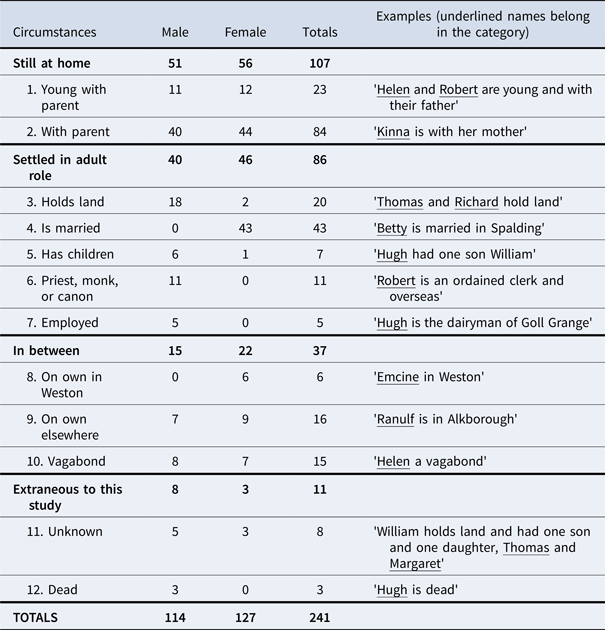
Inheritance customs constrained how these well-off parents could settle their children into adult roles. English customs always favoured sons over daughters, but they distributed land to sons in various ways – usually either impartibly to one son (usually the oldest, sometimes the youngest) or partibly among all sons. Weston's unfree did both: villein tenants passed their tenancies to only one son, and socage tenancies were either divided among heirs or held by them in common. These rules look more determinative than they were. In tenancies that went to a single heir, non-inheriting children were not cut off; they could hope for gifts from their parents (goods, stock, cash, and even purchased land) and many could also claim ongoing support (lodging, cash, land) from their inheriting brother. Similarly, partible tenancies were not always divided, as some brothers were bought off, ineligible, or uninterested.Footnote 48 Probably the most important custom governing the fate of Generation W was unwritten and unenforceable – that is, the simple expectation that parents would help all their children get settled, somehow and somewhere. All these rules, in any case, ran up against parents who were impecunious or uncaring, and children who were impatient or footloose. Table 1 shows how matters sorted out in reality: some children got land or married into it; some were placed in professions or employments; some lived with their parents; and quite a few went off on their own. For Generation W, marriage was not achieved young and universally; it was often, in fact, delayed and contingent.
Generation W in 1268–1269

Table 1 includes all reported offspring, even those listed as grandchildren of the head-father (see, for example, the different reporting of such instances in case 1 and cases 26–28). It also includes two individuals reported in an atypically phrased entry (case 56). Like all categorisations, Table 1 has neatened up a messy reality, with each person placed in a single category (indicated by superscript numbers in the appendix) that most fully describes their adult status. For example, categories 8 and 9 count only those Weston offspring for whom the inventory states their location and nothing more. Many other members of Generation W are also described as living in Weston or away from Weston, but since they are also reported as married, in holy orders, or employed, they are counted in categories 4, 6, and 7. Case 1 offers a good example of how some individuals fall into category 9 (William son of Hugh) and others, although living away from Weston, did not (his cousin Thomas and some of his aunts). Similarly, category 5 tabulates exclusively the few people about whom the inventory notes their children and nothing more; many men in category 3, for example, were reported to be fathers as well as landholders. Putting aside the few offspring who are reported as dead or without any stated circumstances, Table 1 sorts Generation W into three main groups: those still at home (categories 1 and 2: 47 per cent); those already settled into adult lives (categories 3–7: 37 per cent); and those somewhere in between (categories 8–10: 16 per cent).
Just under half of the members of Generation W were still living with their parents in 1268–1269. A few of these are described as young (parvulus/a), but this term is frustratingly obscure. It is used so rarely in the inventory that it surely does not identify all children under, say, five years in Weston.Footnote 49 And it is applied so broadly that some children so identified had to be in their late teens or older.Footnote 50 Taken together, the first two categories in Table 1 show Weston parents keeping their unwed sons as close as their unwed daughters: 51 boys living at home and 56 girls.
How long did the longest-staying children remain at home? Biological maturation varied widely among individuals, but like modern children, Weston's children probably began their pubertal growth spurts at around 10–12 years and matured relatively slowly thereafter, with menarche at around 15 years and full skeletal maturation by about 20 years.Footnote 51 At least some Weston offspring stayed at home long after reaching physical maturity. Our best information comes indirectly from exceptionally large families with six to nine offspring at home (cases 25, 31, 42, 45, 46, and 47). If child mortality in these families was roughly similar to trends observable from 1550 (about 40 per cent of children dying within their first four years) and if the birth interval for mothers also matched later trends (2.5 years between births), the oldest offspring in these large families of still-at-home children must have ranged between 17 and 25 years of age.Footnote 52 Since parents in large families had extra incentive to send away their older offspring, the upper ages in these cohorts are unlikely to be an artefact of family size. In other words, these large families allow us to glimpse what was common in smaller families too: the unexceptional presence in Weston of young women and men, aged 20 years or more, still living in their natal homes. Biologically mature, they remained socially dependent in the households of their parents – they were still, in a social sense, girls and boys.Footnote 53 Sons in Weston could partially grow out of domestic dependency – they entered peace-keeping tithings at 15 years, and reached legal majority at 20 years.Footnote 54 They also (and their older sisters too) might have sometimes worked beyond the parental household – hiring out their labour, producing food, drink, or goods for sale, and even acquiring, by lease, gift, or purchase, small bits of land of their own.Footnote 55 But no offspring in category 2 was reported as married; none was settled in a household of his or her own; and all lived cum patre or cum matre as dependants in their natal households.
Although Generation W readily divides into dependant offspring at home (categories 1 and 2) and those who were living on their own account (categories 3–10), these groups do not strictly divide by age. The 18 sons noted as tenants had, of course, reached the minimum landholding age of 20 years, but there is no sure way to separate other sons and all daughters into those younger and older than 20. There is slippage at both ends. In category 2, most of the 40 not-parvuli sons at home (category 2) were probably younger than 20 years, but some, as we have just seen, were demonstrably older. In categories 6–10, most of the 31 landless sons reported as living away from their parents (categories 6–10) were likely older than 20 years, but some were probably still in their teens. Let us assume that these slippages roughly balanced out, and if so, about 55 sons in Generation W were 20 years or older, or simply put, ‘grown’ (categories 3–10), and about 68 daughters (categories 3–10).
Most of these grown sons and daughters in 1268–1269 had successfully moved into households or careers of their own (40 sons and 46 daughters in categories 3–7), usually by acquiring land and spouses (categories 3 and 4). This was a conventional transition for which the inventory deployed a distinctive shorthand: it reported that sons ‘hold land’ (tenent terram) and daughters ‘are married’ (desponsate sunt). In practice, land and marriage went together. New wives added goods, cash, and cattle to the conjugal pot, and a few even added land. But land tenure moved mostly through males and to males – and a son who acquired land quickly married. The destination was the same for sons and daughters – both ideally ended up with land and spouse – but the route to that destination conventionally differed by gender. In a handful of other cases, we can presume marriage for individuals in Generation W about whom the inventory reported only that they were parents of legitimate children (category 5).Footnote 56
All told, 24 grown sons in Generation W had married by 1268–1269, but other sons had achieved secure adulthood by different means. Nearly a dozen sons in Generation W had embarked on careers as monks, canons, and priests (category 6). These vocations were hard-won achievements – requiring investment in education and permission from the priory – that propelled these men out of serfdom and promised further upward mobility. Bound by vows of celibacy, clergy could not marry, although some might have formed informal alliances with women.Footnote 57 Five other sons supported themselves without land, working as dairymen, shepherds, or carpenters (category 7). These were skilled employments, but less secure than land tenure; they could support a man, but possibly not a man with wife and children. We do not know whether these men had married, but they lived more by labour than by land.
Daughters had fewer ways to launch themselves into adulthood. A young peasant woman could not become a priest or canon, nor even, realistically, a nun. She was exceedingly unlikely to train for skilled employment. She was also unlikely to acquire land on her own account, either by inheritance or parental gift, and those few who did usually married quickly. Yet a few female tenants did not marry. Two women in Generation W – Emma and Agnes, daughters of Ringolf (case 23) – held land in 1268–1269 and remained unmarried for at least a few years and perhaps for the rest of their lives.Footnote 58 Their circumstances were unusual but not unprecedented. In Brigstock (Northants) a few decades later, Cecilia Penifader similarly supported herself with land and without marriage.Footnote 59 For most young women, however, secure and settled adulthood was best achieved through marriage to a land-holding husband. Women in Generation W behaved accordingly, marrying in large numbers and into nearby villages and towns as well as within Weston itself (category 4). Whether settled by marriage (for daughters) or land and career (for sons), roughly equal numbers of women and men in Generation W had secured adult positions by 1268–1269.
The third group of offspring in Generation W is modest in size but big in significance: home-leavers. Some lived in Weston (category 8); others lived away from Weston but mostly nearby (category 9); and quite a few were vacabundus/a (category 10). The numbers in each category are small, but their differences might still be telling. No sons were reported as living on their own account in Weston, and most of the daughters in Weston were remnants of poor, marginal families; only one was related to a priory tenant, and most had no siblings on the manor (see cases 4, 5, 10, 27, 40, and 56). The sons and daughters who lived away from Weston were a more typical cross-section of the manor's serfs; most had strong familial connections in Weston, and quite a few had landholding brothers, some holding in socage and others in villeinage (cases 19, 21/22, 37, 38, and 49). They also took care to stay in the priory's good graces, paying chevage, an annual fine for permission to leave the manor. It is this fine that distinguishes them from the vagabonds reported in category 10. A ‘vagabond’ broadly denoted any wanderer – saints and pilgrims as well as unemployed soldiers and beggars – but its use in the Weston inventory is specific: these people were ‘vagabonds’ because they lived away from Weston without the priory's permission.Footnote 60 Generation W's vagabonds were not constantly on the move, and their whereabouts were not even unknown. Thomas Agge's daughter Emcine was reported, for example, to be living without the priory's permission in Suffolk (case 32) and Kinna daughter of Robert son of Uwin was known to be living in nearby Whaplode (case 4). What defined vagabonds in Weston was that they had left the manor irregularly, without the priory's permission and without acknowledging that permission with annual chevage. Women were as likely as men to depart the manor in this way.
Jones concluded from his examination of the vagabonds in the Weston and Moulton inventories that women ‘thought less of land’ than men.Footnote 61 This is not quite right: no matter how fervently women might have sought land, they were less able to get it.Footnote 62 In Weston, all the men reported as vagabonds were sons of villeins whose tenancies, by Weston custom, had to pass intact to one son only. They were extraneous sons who presumably left without maintaining good relations with the priory because, even if they might hope for some support from their inheriting brothers, they had no hope getting part of their father's tenancy (see examples in cases 14, 18, 19, and 29/30). Not a single son of a tenant in socage – that is, a son who could expect to divide his father's tenancy with his brothers – was reported as a vagabond in Weston. The daughters reported as vagabonds were sometimes from families with only loose connections to Weston (cases 1 and 4) and more often from families who held socage tenancies. Their brothers did not leave Weston, but these young women did. To judge from vagabondage, it was not uncommon among socage families to settle their sons on the land, to marry off a daughter or two, and to encourage other daughters to move out and on (cases 13, 32, 44, and 53). These female vagabonds were not, as Jones would have it, young women who because of ‘personal unhappiness or dissatisfaction’ threw away their ‘better future prospects’ at home.Footnote 63 They were, instead, extraneous daughters of socage tenants whose options in Weston were so poor that they, like non-inheriting sons of villeins, had few reasons to maintain good standing with the priory. They did not necessarily leave forever, and some eventually returned to put themselves back under the authority of the priory (see Helen Wiseman in case 13). But in the year 1268–1269, the vagabonds of Generation W had cut ties with the manor because, for a time at least, the manor had nothing to offer them.
All those enumerated in categories 8, 9, and 10 were named without reference to marriage, spouses, or children – or to their means of self-support. Most likely worked as live-in servants or day-labourers. Perhaps a few also sub-let cottages or plots from head-tenants. We cannot know details about their work or sub-leases, however, as these activities are not recorded in Weston's extant records. If Generation W followed patterns observed in the exceptional sub-leasing records for the Buckinghamshire manor of Ivinghoe (from 1276–1301), most sub-lessees were landless men, either incomers to the manor or sons of local families; only a few singlewomen took sub-leases on their own; and both men and women sub-let tiny properties (a cottage, a plot, a half-acre) insufficient to fully support even one person.Footnote 64 Sub-leasing was allowed in Weston if properly done (case 38), but since no home-leaving sons stayed on the manor (category 8), opportunities to sub-lease might have been rare.
When home-leavers in Generation W could not find local employment and local land, they took to the road, joining other landless labourers in search of whatever work and housing might be found. Footloose people were thick on the ground in the thirteenth-century countryside, and women might have predominated among them. A clerk of Ely in 1277 described this underclass as ‘innumerable, sometimes waxing in number and sometimes waning’, and historians have since agreed that a ‘submerged and pullulating throng’ of unsettled people moved about the country.Footnote 65 They were known as ‘selfodes’ in the north; as ‘anilepimen’ and ‘anilepiwomen’ (literally, singlemen and singlewomen) in East Anglia; and as garciones (lads or boys) in the south-west. Some stayed near their home villages, moving in and out as necessary; others left forever, seeking their fortunes elsewhere. They were seldom married; they sometimes had children; they survived by their labour, wits, and charity; and they were often unwelcomed – sometimes even forcibly expelled – by the communities on whose fringes they lived.Footnote 66
We do not know the precise ages of home-leavers in Generation W, and some were surely still in their teens when they first left. For some home-leaving sons who reached legal maturity at age 20, it was an irrelevant marker of adulthood and perhaps bitterly so; they were old enough to hold land but had none. About one in three grown sons in Generation W lacked tenure, career, or employment in 1268–1269 (that is, 15 of roughly 55 grown sons, or 27 per cent). Daughters fared about the same (22 of roughly 68 grown daughters, or 32 per cent).
Although slight, the difference between home-leaving sons and daughters might reflect the tougher challenges of daughters who had to live by their own hand. Church careers were de facto available to men only; so, too, were most skilled crafts and employments; so, too, the soldiering that would occupy so many young men in the reign of Edward I. If a servant, a young woman was at greater risk of sexual abuse and earned less reward; if a day-labourer, she found less work and earned about three quarters the wages of men.Footnote 67 She was also at high risk of never improving her circumstances by marriage. I have been able to track the later marriages of 17 of the 56 daughters in Generation W who were living at home in 1269, but only one of the 22 daughters who were then living away from their parents.Footnote 68 Some of these home-leaving daughters surely married, even if we cannot trace their marriages today, but rather more might have ended up like Helen Wiseman. In 1269, she was the least fortunate of the four children of John Wiseman, an unfree sokeman. Her two brothers held land; her sister was married; and she was a vagabond in the eyes of the priory (case 13). She was still unmarried nine years later but back in Weston; in that year, she paid a fine for having sex outside of marriage.Footnote 69 Helen Wiseman was, by then, in her mid-20s at least and all her siblings were well-settled in marital homes, but she, with neither land nor husband, was likely very poor.
4. Conclusion
Weston's inventory of serfs in 1268–1269 lacks the grandeur of the Domesday Book or the Magna Carta, but it is, like them, a singular, complex, and telling document. It has here received its due: we now better understand the inventory's context, purpose, and content, and we have an accessible version, enhanced by name linkages to contemporary land records and servile fines. Historians will surely continue to debate the meanings of the Weston inventory, but we can now argue from a common base of evidence and knowledge.
Weston was not England, much less Europe, but its unique inventory tells us, very precisely in most cases, how the offspring of Weston's serfs were living in 1268–1269. The daughters and sons of Generation W moved readily within a 20-mile radius of the village, and many settled, briefly or forever, in nearby towns and villages where they found employment or spouses. Some went farther afield: one to Alkborough (case 4); another somewhere in Norfolk (case 5); another to London (case 54); four more overseas (cases 1, 4, 19, and 36); and of course, the 11 sons who became monks, priests, or canons necessarily travelled for training and profession. Generation W settled itself almost as much within England as within Weston, and although their parents were, compared to peasants elsewhere in England, relatively well-off in 1268–1269, they too were venturing into an economy that, after two centuries of steady growth and prosperity, was beginning to stutter and break down. Real wages were falling; land was in short supply; harvests were less reliable, and in 1258, famine struck, the first hard famine in a long time. Generation W gives us a snapshot of the results for one group of parents and their offspring. Some grown children acquired land (mostly sons) or husbands with land (daughters). Many others had to make a living without tenure of land. Sons became monks and priests, or found skilled employment, or lived by their own hand as servants and wage-labourers. Daughters, too, often lived apart from parents in Weston or beyond, but they were unable to support themselves in clerical and skilled careers; most likely lived by service or day-wages. More adult sons in Generation W in 1268–1269 were living by their labour than held land; and of every four grown daughters, only three were married and the fourth supported herself in some fashion away from her parental home. In mid-thirteenth-century Weston, many young people married, but some married late or not at all.
Acknowledgements
For their extensive and incisive comments, I thank Sandy Bardsley, Chris Briggs, Bruce Campbell, Cynthia Herrup, Maryanne Kowaleski, Sheilagh Ogilvie, Christopher Whittick, and the four anonymous readers for Continuity and Change. I also thank the Spalding Gentlemen's Society for facilitating my work with the Myntling Register.
Appendix
The inventory of Weston serfs and their children in 1268–1269Footnote 70
Judith M. Bennett and Christopher WhittickFootnote 71
Titled ‘Inquisition of the neifs of lord Prior J[ohn] in his 16th year in Weston’, this list also has a running head that reads ‘Names of the children of the serfs of the prior of Spalding in Weston’.Footnote 72 We have added punctuation and case numbers as well as superscripts that indicate the classifications used in Table 1, and we have rendered names Latinised in the manuscript (Elena) in their English forms (Helen). We have otherwise rendered the text as literally as possible. Tenses in the original are muddled (see, for example, case 15), but replicated here. Editorial comments are in square brackets.
Because profits to be made from merchet were a steady source of income from their serfs, Spalding Priory had a particular interest in the marital status of daughters, and its inventory for Weston is exceptionally consistent in this regard. It explicitly notes each marriage for each daughter (see, for example, the careful, repetitious statements in case 1), and it invariably orders daughters by status – married daughters; then daughters not at home; and finally, daughters still at home (see, for examples, cases 37, 40, and 44).Footnote 73 The categorisations here of daughters not at home rely on an implied ‘is’ (see, for example, Emcine and Elizabeth in case 4); for similar constructions in other circumstances, see Helen in case 13, Lambert in case 18, and Lucy in case 50.
The two columns on the right provide brief summaries of linked references found in a survey of Weston, c. 1275 (BL Add Ms 35296, fos. 212–221v) and fines for Weston 1254–1310 listed in the Myntling Register (fos. 212v–224). The spelling of names has been standardised, with the original indicated only for ambiguous cases. Linkages of individuals identified by forenames alone were limited to forenames in unique combination (that is, not found elsewhere in the inventory) or matches of three or more forenames. For the survey of c. 1275, please remember that most newlands were identified by the names of dead men (who were likely the original reclaimers). For the extracted fines, note that the regnal and prioral years by which Myntling dated his extracts do not coincide; since the originals were likely dated by prioral years, they are used here.
Digital images of Weston's serf inventory and land survey have been made available in the Carolina Digital Repository, accessible online at: https://dx.doi.org/10.17615/n29w-9n61. Images of the serf inventories for Moulton (c. 1268–1269) and Spalding (c. 1255) are also deposited in this collection. I am grateful to the British Library for allowing me to take these photographs and make them available online. The British Library Board retains copyright.