INTRODUCTION
Trematodes (Digenea) have complex life cycles usually involving two invertebrates as intermediate hosts, and one vertebrate as the final host. Species of some digenean genera such as Opechona Looss 1907 (Lepocreadiidae) use several hydromedusae, scyphomedusae and ctenophores as secondary hosts, turning these gelatinous organisms into important links in the transmission of these parasites to fish (Køie, Reference Køie1975; Ohtsuka et al., Reference Ohtsuka, Koike, Lindsey, Nishikawa, Myiake, Kawahara, Mulyadi, Mujiono, Hiromi and Komatsu2009; Martell-Hernández et al., Reference Martell-Hernández, Ocaña-Luna and Sánchez-Ramírez2011; Diaz-Briz et al., Reference Diaz-Briz, Martorelli, Genzano and Mianzan2012). Digenean life cycles often involve predator–prey interactions between the hosts (Marcogliese, Reference Marcogliese1995, Reference Marcogliese2002), consequently if medusae are found as intermediate hosts of these fish parasites, trophic interactions between medusae and fish can be indirectly inferred.
For the Brazilian coast there is only sparse information about the issue. It is known that the most common coastal ctenophores and scyphomedusae species may host metacercariae (Morandini et al., Reference Morandini, Matorelli, Marques and Silveira2005). Information on hydromedusae as host is available only from the report of a single parasitized specimen of Aequorea sp. and Liriope tetraphylla (Chamisso & Eysenhardt, 1821) in offshore waters off south Brazil in a study that focused on areas from Argentina (Diaz-Briz et al., Reference Diaz-Briz, Martorelli, Genzano and Mianzan2012). In the present study we intend to expand this knowledge by reporting six new records of hydromedusae as host of metacercariae from the Brazilian coast.
MATERIALS AND METHODS
The hydromedusae were sampled from shallow open waters (8–12 m depth; Figure 1) in front of Guaratuba Bay, Paraná State (south Brazil), between February 2003 and December 2004 with demersal trawls, nets with 1 or 2 cm mesh size in a total of 110 trawls (see Nogueira & Haddad, Reference Nogueira and Haddad2008 for more details on sampling procedures). After the retrieval of the nets, medusae were separated on-board and preserved in 4% formaldehyde solution in seawater. In the laboratory, they were identified, their bell diameter was measured and they were checked for parasites under the stereomicroscope. The metacercariae found were removed from the medusae tissues with the aid of dissecting needles. Then, they were stained with Gill's haematoxylin, dehydrated in an ethanol series, cleared in clove oil and mounted in natural Canada balsam to be identified at the lowest taxonomic level possible. Voucher slides with metacercariae were deposited at the platyhelminthes collection from the Museu de Zoologia da Universidade de São Paulo (MZUSP PL-1182).
Map of Brazil and the coast of Paraná State in detail showing the stations sampled (crosses) between February 2003 and December 2004 (generated using Ocean Data View software; Schlitzer, Reference Schlitzer2012).

Prevalence (P) and intensity of infection (I) were calculated following recommendations of Bush et al. (Reference Bush, Lafferty, Lotz and Shostak1997) and Rózsa et al. (Reference Rózsa, Reiczigel and Majoros2000).
RESULTS
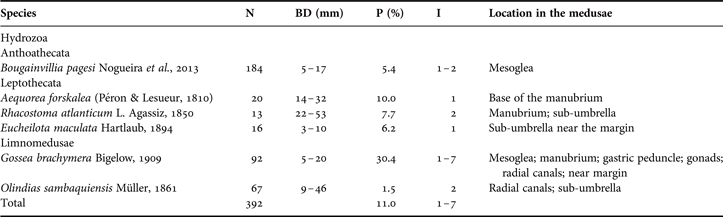
A total of 392 hydromedusae of six species were sampled in this study and 43 of them (~11%) were parasitized by the metacercariae of Opechona sp. (Figure 2). Metacercariae were mostly observed in the mesoglea, gonads, manubrium or radial canals (Table 1). All the metacercariae found were assigned to the genus Opechona, family Lepocreadiidae.
Opechona sp. metacercariae near the margin of the hydromedusa Gossea brachymera (A); microscopic view of acetabulum (B); drawing of Opechona sp. based on five mounted specimens (C); photograph of a microscopic slide of Opechona sp. (D). Scale bars: A, 5 mm; B, 10 µm; C, D, 100 µm.

List of hydromedusae species sampled form Paraná State coast, south Brazil showing the number of specimens examined (N), bell diameter range of medusae (BD), prevalence (P), intensity of infection (I) and location of Opechona sp. metacercariae on the hydromedusae.

Although all the six hydromedusae species sampled harboured at least one Opechona sp. metacercaria, the Limnomedusae Gossea brachymera was the most infested, with P reaching up to 30%, and I up to 7 (averaging 1.8 ± 1.6). The metacercariae were usually in its thick mesoglea, being eventually found also in the manubrium, gastric peduncle, gonads, or near the margin (Table 1; Figure 2A). The other analysed hydromedusae, namely Aequorea forskalea, Bougainvillia pagesi, Eucheilota maculata, Olindias sambaquiensis and Rhacostoma atlanticum, had very low values of P and I (Table 1).
DISCUSSION
All the metacercariae found were assigned to the genus Opechona, family Lepocreadiidae, due to the leftovers of eyespots on each side of the pharynx, I-shaped excretory bladder, spinous integument and presence of uroproct (Bray & Gibson, Reference Bray and Gibson1990). The morphological features of these metacercariae (Figure 2) as well as their measurements were similar to Opechona sp. described by Morandini et al. (Reference Morandini, Matorelli, Marques and Silveira2005). It is not possible to link the present metacercariae to any species of the genus because the complete life cycle of these parasites is not known yet, but high P and I of adults Opechona sp., O. bacillaris, O. chloroscombri and O. orientalis has been repeatedly reported in fish from tropical and subtropical shallow waters of the south-western Atlantic (see review in Kohn et al., Reference Kohn, Fernandes and Cohen2007). Therefore the metaercariae studied very probably belong to one of these species.
The six hydromedusae species sampled were harbouring Opechona sp. Although this metacercaria has already been reported for the area (Morandini et al., Reference Morandini, Matorelli, Marques and Silveira2005) our finding represents new records of hydromedusae used as secondary hosts for this parasite on the Brazilian coast. These results indicate that this parasite–medusae interaction is more common than previously supposed in coastal Brazil. The medusae become infected on contacting the mollusc first intermediate host. The infection, however, does not necessarily need to rely on ingestion since free-living cercariae of the lepodcreadiids, such as Opechona bacillaris, can actively penetrate its intermediate host (Køie, Reference Køie1975). In the south-western Atlantic Ocean, Opechona metacercariae are known to use several species of jellyfish from diverse taxonomic groups as secondary hosts (i.e. hydromedusae, scyphomedusae and ctenophores; Martorelli, Reference Martorelli2001; Morandini et al., Reference Morandini, Matorelli, Marques and Silveira2005; Diaz-Briz et al., Reference Diaz-Briz, Martorelli, Genzano and Mianzan2012; present study). This low specificity concerning the intermediate host is common for most parasites using zooplankton components in their life cycles (Marcogliese, Reference Marcogliese1995).
The P values of metacercariae on medusae may vary considerably depending on several environmental and biological factors (Martell-Hernández et al., Reference Martell-Hernández, Ocaña-Luna and Sánchez-Ramírez2011). The high percentage (30%) of Gossea brachymera medusae infected in the present investigation is amongst the highest values already recorded for Opechona metacercariae on hydromedusae (Martorelli, Reference Martorelli2001; Gómez del Prado-Rosas et al., Reference Gómez del Prado-Rosas, Segura-Puertas, Álvarez-Cadena and Lamothe-Argumedo2000; Martell-Hernández et al., Reference Martell-Hernández, Ocaña-Luna and Sánchez-Ramírez2011; Diaz-Briz et al., Reference Diaz-Briz, Martorelli, Genzano and Mianzan2012). This would suggest that this medusa is a true secondary host of Opechona sp., and therefore an important part of the life cycle of this parasite for the region. The high P observed herein may also suggest that the shallow area sampled, in front of an estuary, offers good opportunities to the parasite life-cycle development, with high chances of encounters amongst the different hosts (i.e. molluscs, jellyfish and fish) (Diaz-Briz et al., Reference Diaz-Briz, Martorelli, Genzano and Mianzan2012).
The parasites use their intermediate hosts as a basis where the following stage develops before infesting the next host (an ecological requirement to ensure the species' auto-perpetuation; Marcogliese, Reference Marcogliese1995). They ensure that their transmission takes advantage of the trophic relationships that occur among the different hosts involved in their complex life cycles (Marcogliese, Reference Marcogliese1995, Reference Marcogliese2002). Thus, the fact that the medusae are commonly used as secondary hosts by digenean parasites of fish indirectly supports the idea that fish predate on these jellyfish, since this trophic interaction is necessary for these parasites to complete their life history. Therefore, we suggest that G. brachymera could have an important role in the transmission of Opechona sp. to the zooplanktivorous fish that inhabit the coastal area surveyed, many of which are known to harbour the adult stages of Opechona spp. (Kohn et al., Reference Kohn, Fernandes and Cohen2007). In this context, parasitology may be an indirect way to evaluate the predation of fish over gelatinous organisms, as already suggested by Mianzan et al. (Reference Mianzan, Mari, Prenski and Sanchez1996), being a complementary tool for the traditional methods used in trophic ecology researches (stomach contents and stable isotopes analysis of fish).
ACKNOWLEDGEMENTS
Gustavo Felipe Milleo kindly made the line drawing (2c). M.N.J. had financial support from the Conselho Nacional do Desenvolvimento Científico e Tecnológico (CNPq; PhD grant No. 140945/2007-5) and from the Fundação de Amparo à Pesquisa do Estado de São Paulo (FAPESP; post-doctoral grant No. 2011/09880-8).