Introduction
Histories of colonial cultural erasure, unsuccessful decolonisation or postcolonialism and rapid modernisation are typically seen as the challenges to sustaining Indigenous traditional musics (Harrison, Reference Harrisonin press). The Indigenous peoples of Canada have experienced colonial assimilationist policies of government and church, including residential schools that took children away from their families and forbade song, dance and language. These policies resulted in musics and even entire cultures being erased. Although there have been recent improvements in Scandinavia, similar kinds of discrimination happened where the traditional Sámi vocal form, joik (in pan-Sámi juoiggas) was long (and in some cases, still is) regarded as sinful, and Sámi children were forbidden to use their mother tongues at school (for example, from about 1850 to 1980 during Norway’s Fornorskning or Norwegianisation policy). In recent years, the Indigenous musics of Canada and the Nordic countries, among others, have reflected, articulated and interpellated sociocultural interrelations and politics (Diamond Reference Diamond2002; Diamond et al. Reference Fjellheim, L’Hirondell, Maniapoto, Marrett, Partridge, Perea, Pirttijärvi, Stålka and Post2018; Harrison Reference Harrison2009; Hilder Reference Hilder2012, Reference Hilder2015; Moisala Reference Moisala2007; Ramnarine Reference Ramnarine2009, Reference Ramnarine, Holt and Kärjä2017), and Indigenous artists have taken action on politicised issues through a range of contemporary and flourishing artistic expressions (Robinson and Martin Reference Robinson and Martin2016).
Focusing on the music of Sámi and Indigenous Canadian theatre, this article examines the aesthetic creation and production processes of music, theatre and sustainability. My analyses and conclusion draw on interviews with theatre directors and performers as well as my ethnographic documentation of live theatre performances across Canada since 2000 and in Norway since 2012. My ethnography is further supported by archival research at Åarjelhsaemien Teatere and Beaivváš Sámi Našunálateáhter in Norway (since 2012), Svenskt visarkiv in Sweden (in 2011), as well as at the Canadian Museum of History archives and the University of Guelph’s L.W. Conolly Theatre Archives (see Harrison Reference Harrison, Hoefnagels and Diamond2012) in Canada. Åarjelhsaemien Teatere and Beaivváš Sámi Našunálateáhter were two of the three professional Sámi theatre companies running in the 2010s, the third being Giron Sámi Teáhter in Sweden, which had operational difficulties during my intensive fieldwork period, which was from 2012 to 2015. Svenskt visarkiv retains historical written documentation of Sámi theatre from the Nordic countries, whereas the two Canadian archives house the country’s main collections of Indigenous Canadian theatre videos. Some of my research collaborators shared their home archive materials with me as well.
My article seeks to contribute new angles to the music sustainability literature through a study of traditional music in Sámi and Indigenous Canadian theatre productions. The productions include formats of the stage play, dance theatre performance and opera. These performances are political expressive acts that address the aftermaths of colonialism, often in ways that emphasise and enact contemporary resilience and the flourishing of Indigenous people and Indigenous cultural expression, including traditional music. Although scholars have observed what they can do about Indigenous music sustainability, with and for Indigenous musicians (Barwick and Turpin Reference Barwick, Turpin, Schippers and Grant2016; Bendrups, Barney and Grant Reference Bendrups, Barney and Grant2013; Campbell Reference Campbell2013; Corn Reference Corn2013; Gillespie Reference Gillespie2013; Treloyn and Emberly Reference Treloyn and Emberly2013), an understudied topic is what Indigenous artists are already doing themselves, within activities that they initiate with their allies, and in their efforts to sustain historical Indigenous musics.
Although Sámi and Indigenous Canadians have distinct histories and present-day statuses, I will observe interesting similarities regarding their contemporary attempts to support and sustain traditional musics. Following policies of cultural erasure of the Sámi and in an area that Sámi call Sápmi (land of the Sámi), which consists of northern Finland, Sweden and Norway plus Russia’s Kola Peninsula, music in Sámi theatre has become a forum for reviving and maintaining traditional music while simultaneously addressing the need to do so, for example, in response to forced cultural assimilation. In both Indigenous Canada and Sápmi, theatre productions convey what it means for Indigenous people to be resilient and to flourish, sometimes within strikingly visual performances that border on spectacle (Glowczewski and Henry Reference Glowczewski and Henry2011). Other productions have hard-hitting plots about challenges and violations unfolding from colonial injustices.
After providing a background on the musical ecosystems in Sámi and Indigenous Canadian theatre, I ask the following questions: In the intersection of music and sustainability, what is sustained of Indigenous musics? By which aesthetic trajectories, and through which mechanisms of resilience is sustainability manifested? This article’s analysis thus focuses on the sustainability of music (not broader cultural sustainability, for sake of space). It extends work on music sustainability that observes musical practices used beyond their original contexts (Howard Reference Howard, Schippers and Grant2016; Wilson Reference Wilson2013), and what can be learned about music sustainability from recontextualisation. It builds on studies about what makes musical cultures sustainable (Schippers and Grant Reference Schippers and Grant2016b; Turino Reference Turino2009), and what cultural advocates can do to keep music sustainable (Bendrups and Schippers Reference Bendrups and Schippers2015; Grant Reference Grant2014; Titon Reference Titon, Pettan and Titon2015).
Indigenous theatre creators and playwrights have been exchanging ideas internationally, for decades, about making theatre based on traditional principles (Darby Reference Darby, Geiogamah and Darby2000:x). In this essay, I will examine four productions or related sets of productions by Indigenous playwrights, performed by Indigenous artists in Sápmi and Indigenous Canada. Although the theatre companies from Norway and Canada discussed here produced the performances, the widespread nature of their musical contents point to a broader geographic relevance of the trends I will examine.
Performance aesthetics which respond to colonial contexts and constructs (Schippers and Grant Reference Schippers, Grant, Schippers and Grant2016a:341) have sustained aspects of Indigenous music from Norway, Sweden, Finland, Russia, Canada, the United States and Panama. Indigenous aesthetics refers to expressions that signify belonging and accountability to Indigenous communities; they are central to expressions of Indigenous worldviews, and are an important part of representations to non-Indigenous publics. For Indigenous arts scholar Steven Leuthold, the term “aesthetics” indexes real aspects of lived experience that have a social dimension. Linking ethics, religion or politics with aesthetics reveals how value systems are embedded in our physical and emotional relationships to the world in which we live (Leuthold Reference Leuthold1998).
The productions or sets of productions studied are: The Unnatural and Accidental Women and Tombs of the Vanishing Indian (produced by Firehall Arts Centre and Native Earth Performing Arts, Canada respectively); Tono (Red Sky Performance, Canada); The Frost Haired and the Dream Seer (Beaivváš Sámi Našunálateáhter, Sápmi/Norway); Gïeje and Gon (Åarjelhsaemien Teatere, Sápmi/Norway) and Chocolate Woman Dreams the Milky Way (Chocolate Woman Collective, Canada). Detailed treatment of Gïeje and Gon will illustrate a specific method for creating theatre through music—symbiosis. I discuss a resonant method in Canada—Native Performance Culture—with illustrations from Chocolate Woman Dreams the Milky Way. Whereas The Unnatural and Accidental Women, Tombs of the Vanishing Indian and Chocolate Woman Dreams the Milky Way can be described as stage plays with music, Tono, Gïeje and Gon are dance theatre works, and The Frost Haired and the Dream Seer is a joik opera.
I selected these productions for study after asking via in-person and email interviews with playwrights, directors, dramaturgs, actors, and musicians—who either worked with key Sámi and Indigenous Canadian theatre companies or held leadership positions in Indigenous theatre instruction and development—whether they considered their artistic productions as a way of “sustaining” Indigenous music. With the exception of The Unnatural and Accidental Women (premiered in 2000) whose creators identified as setting trends to be continued in Tombs of the Vanishing Indian (2011), the theatre artists self-identified to me the other productions listed above as sustaining Indigenous music. At the time of our discussions, they had already created the theatre works. For not one of the productions did the theatre artists set out beforehand to pursue music sustainability as a construct, but, rather, they asked me retroactively in my interviews with them to frame their theatre music as sustaining Indigenous music or elements thereof. As these Sámi and Indigenous Canadian theatre artists embraced an academic frame of sustainability, it enabled me and us to make an intervention in Indigenous sustainability studies by adding Indigenous perspectives. In academic studies thus far, Indigenous perspectives on what is sustained are almost consistently missing across diverse academic disciplines (Siragusa and Virtanen Reference Siragusa and Virtanen2018).
Musical Ecosystems of Indigenous Theatre
What is sustained of traditional Indigenous music and how artists, through theatre, carry out what we call music sustainability unfolds within and contributes to a musical ecosystem (Schippers and Grant Reference Schippers, Grant, Schippers and Grant2016a; Titon Reference Titon2009:121–124, 129). Ethnomusicologist Jeff Todd Titon first conceptualised a musical ecosystem by transposing to musical contexts Arthur Tansley’s idea from early twentieth century ecology of the ecosystem, which consists of a community (formed of organisms and populations) interacting with a habitat to form an ecosystem. Titon summarised a musical habitat as including “both physical and cultural factors of the musical environment such as ideas about music, sound and sound-producing instruments, recording studios, media, venues, musical education and transmission, and the economics of music—indeed music as cultural production and a cultural domain—which relate to the health of musical individuals, populations, and communities” (Titon Reference Titon2009:122–123). Musicologist Huib Schippers proposed five domains that potentially interrelate within the ecosystem of a music culture: systems of learning music; musicians and communities; contexts and constructs; regulations and infrastructure; and media and the music industry (Schippers Reference Schippers, Schippers and Grant2016:12–13). Specifics of infrastructure, learning, education and industry create the aesthetics of music and aesthetics I examine in this essay.
All of the productions discussed are professional theatre. They are, to a great extent, government-funded. In Norway, Sweden and Finland, the Sámi parliaments located within each nation receive funding from their respective national governments. The Sámi parliaments distribute those funds for cultural purposes including support for theatre companies. The two Norwegian Sámi theatre companies discussed most in this article received 94.2% and 64% respectively of their total budgets from the Norwegian Sámi Parliament in 2016 (Jürgensen Reference Jürgensen2017:14, 18–19). A continent away, the Canada Council of the Arts offers Indigenous-focused grants as do provincial and territorial granting agencies. Since the mid-2000s, Indigenous-only government arts grants responded to the situation where Indigenous Canadian theatre companies generally had fewer financial resources and obtained far fewer government grants compared to non-Indigenous theatre companies (Clements Reference Clements2005:23). Indigenous Canadian theatre productions also secure considerable funding from private foundations, corporations, other businesses and individual donations.
Anthropologist Faye Ginsburg referred to the strong government sponsorship of Indigenous forms of expressions as embedded aesthetics, a phrase intended to draw attention to “a system…that refuses separation of…production and circulation from broader arenas of social relations” (Ginsburg Reference Ginsburg1994:368), but yet “is also a product of relations with governing bodies that are responsible for the dire political circumstances” that often motivate the expressions (ibid.:366). Ginsburg’s embedded aesthetics emphasises Indigenous Australian artists’ tendency to evaluate their creative media in terms of social action, and in particular, social responsibility to Indigenous community (e.g., Indigenous kin-based obligations). Even though the infrastructures making such media possible implicitly challenge the exercise of Indigenous self-determination, Indigenous people intend their creative media to be for Indigenous community members (ibid.:368, 371–372, 378). Today’s funding structures for Indigenous theatre in Canada and Sápmi could be extended to late capitalist corporations and businesses that may infringe upon Indigenous rights. For example, Sámi have outstanding conflicts over their traditional land use with mining, green energy (windmill) and railroad (construction) companies. Citing an unwillingness to accommodate the possible influence of private sector interests and grant parameters on Sámi creative processes, theatre artist and consultant Ada Einmo Jürgensen writes that Sámi theatre companies resist business, private individual and foundation sponsorship (ibid.).
All of the productions in my discussion unfold within infrastructures of performing arts companies that are Indigenous-run, or directed by non-Indigenous allies with strong Indigenous community support. The Canadian companies most often work in the national languages of English or French, while Indigenous languages may also be used. Beaivváš Sámi Našunálateáhter typically works in North Sámi for performances and also Norwegian during rehearsals. Åarjelhsaemien Teatere locates in a South Sámi area where Sámi language is less spoken, so Norwegian is the main operating language. Indeed, music sustainability dovetails with language sustainability (Grant Reference Grant2014) especially in the case of North Sámi.
The artistic performances take support from systems of Indigenous cultural transmission in Indigenous communities and state-funded arts education. After the colonial period, Sámi and Indigenous Canadians have worked hard to revive rich community traditions of music, drama, storytelling, ritual and ceremony, which the theatre productions recontextualise. Indigenous art practices feature in school and after-school programmes in Canada and the Nordic countries. In Canada, Indigenous Arts programming at the Banff Centre for Arts and Creativity offers prestigious development opportunities for professional Indigenous artists, including musicians, dancers and actors. The Centre for Indigenous Theatre provides a three-year post-secondary programme in acting while various Indigenous-led performing arts companies offer workshops, training and mentorship programmes. Sámi theatre companies offer relevant workshops and an Academy of Sámi Music exists in northern Finland.
Overall, the theatre productions reach culturally diverse audiences across their home nation states and to countries far beyond. In Norway, the Sámi companies will perform a production first in their home communities, then tour as possible and often extensively—for Beaivváš Sámi Našunálateáhter nationally, across the Nordic countries and worldwide, and for Åarjelhsaemien Teatere, normally within Norway and Sweden. The home community of Beaivváš—Kautokeino, Norway—locates in a culturally vibrant North Sámi area, whereas Åarjelhsaemien situates in the multicultural town of Mo i Rana, Norway. By the time of writing, Red Sky Performance has given 2,253 performances in Canada and four other countries, including the cultural Olympiads in Vancouver and Beijing, where Tono premiered, and the World Expo in Shanghai. Native Earth Performing Arts tours nationally and internationally, and also helped to develop over one hundred new theatre works by emerging and established Indigenous artists from across Canada. In this way, the productions discussed are for both Indigenous and non-Indigenous audiences—often for the artists I interviewed, in that order of priority.
In contrast to the multicultural and international audience base, the theatre companies I write about have mandates clearly focused on Indigenous people. In Canada, Native Earth Performing Arts is “dedicated to developing, producing and presenting professional artistic expressions of the Indigenous experience in Canada” (Native Earth 2019). Red Sky Performance has the mission “to create inspiring experiences of contemporary Indigenous arts and culture that transform society. We create, produce, and disseminate new creations and events that illuminate themes, aesthetics, and values of importance to Indigenous peoples” (Red Sky Performance 2017–2018). Even the non-Indigenous Firehall Arts Centre has it as part of its mission statement “to create opportunities for First Nations” (Firehall Arts Centre 2019). In Norway, Beaivváš Sámi Našunálateáhter aims to “be the national theatre for the Sámi people”; “be an important cultural transmitter and mediator of Sámi history, culture and identity”; “take care of Sámi language [although] most of the theatre’s performances are simultaneously offered in Norwegian or English”; to share Sámi culture with the world; “develop new Sámi drama”; and “be an important arena for joik / music theatre in Sápmi” making it available to “a wide audience throughout the Nordic region, but also develop new Sámi music theatre in various formats” (Beaivváš Sámi Našunálateáhter 2019). Åarjelhsaemien Teatere has the goal to develop specifically South Sámi performing arts in which South Sámi language and culture should be central to the work. It aims to make visible and audible South Sámi language and culture, and to continue collaboration with South Sámi in Sweden while being a theatre for the entire South Sámi area in Norway (Åarjelhsaemien Teatere 2019).
The Indigenous cultural priorities enable the theatre companies to be instruments of resilience for Indigenous traditional musics, including new performance expressions derived from those. The government and other sources of funding make it possible for the companies and productions to enact musical resilience on such a culturally and geographically wide-reaching scale (compared to locally grounded but important work of Indigenous community theatre, see Harrison Reference Harrison, Hoefnagels and Diamond2012:251–255, 260–262).
Indigenous Theatre as an Instrument of Musical Resilience Addressing Indigenous Music Sustainability
Resilience refers here to an ability “to bounce back” when faced with disturbance—such as discouragement and outright prohibitions of Indigenous music during the colonial era—and to reach “the most desirable states whenever possible” regarding musical and artistic expressions (Titon Reference Titon, Pettan and Titon2019:179). Titon, extending ideas from Andrew Zolli and Ann Marie Healy (Reference Zolli and Healy2012:9–13), formulates six overlapping characteristics of resilient systems: “(1) feedback mechanisms to alert a system to an impending change; (2) built-in mechanisms for dynamic reorganization in the face of disturbance; (3) a structure consisting of modular components that can be repaired or replaced individually, thus preventing the necessity to repair or replace the system as a whole; (4) an ability to detach parts and diversify, thus localizing operations and reducing dependencies without undermining the whole;…(5) clustering, or the ability to aggregate under favorable conditions and grow[; and] (6) social capital” (ibid.). Social capital refers to outcomes of trust that emerge as people collaborate (see DeWitt Reference DeWitt2009). Titon also mentions various other aspects of resilient systems such as (7) diversity, and (8) innovation.
On one level, for Titon (Reference Titon2009) as well as Schippers and Grant (Reference Schippers, Grant, Schippers and Grant2016a), musical ecosystems, especially how a community interacts with its habitats (physical and cultural factors of a musical environment) and vice-versa, are what allow music, including its aesthetic and cultural aspects, to exist and thrive (or not). On another level, in his most recent work, Titon (Reference Titon, Pettan and Titon2019) argues that if one approaches music cultures as systems, the principles of resilient systems in particular, so far discussed in academic fields beyond music, could be explored in terms of their relevance to music cultures including their musical sounds and aesthetics. This contributes a fresh view to music sustainability.
I take the opportunity here to explore which aspects of resilient systems can be found in music cultures of Sámi and Indigenous Canadian theatre. I can identify the characteristics of resilient musical systems listed by Titon, and indeed others, that thrive in the aesthetics of the substantively government-sponsored musical ecosystems of theatre, unfolding under a possible “colonizing gaze” (Filewod Reference Filewod, Brask and Morgan1992) of non-Indigenous publics, occurring after suppression of Indigenous traditional musics imposed by settlers, churches and colonial governments, and playing out within contemporary contexts of systemic violence. Insofar as Indigenous theatre is an expression around which Indigenous people have musically reorganised following colonial cultural oppression, the scene itself—its ecosystem and its habitats—evidences the resilience strategy of clustering, or “bringing resources in close proximity with one another…whose hallmark is density and diversity—of talent, resources, tools, models and ideas” (Zolli and Healy Reference Zolli and Healy2012:12). This collaborative art form has the potential to generate social capital as people work together, and to strengthen networks among Indigenous artists and their allies, whom I characterise as being alert to colonial politics and related cultural threats. These political artist networks can be understood as feedback mechanisms that would “alert [the] system [of artists] to impending change” (Titon Reference Titon, Pettan and Titon2019:181).
Important work that Indigenous theatre aesthetics in Sápmi and Canada do, I will argue, involves taking still other resilience approaches that sustain Indigenous traditional music. As I write elsewhere, Indigenous peoples globally share particular struggles when it comes to the sustainability of their traditional musics: “Colonial regimes systematically tried to eradicate Indigenous cultures through prohibition and censorship of music and dance (a ban in Canada from 1884 to 1951; censorship in various African countries); removing Indigenous children from their families to ‘civilizing’ and Christian residential or boarding schools where they were forbidden to speak their Indigenous languages or sing their songs (common, for instance, in Indigenous North America, Scandinavia and Australia); and systematically relocating them from their traditional lands that are central to much music and ceremony, including to racially segregated reserves or reservations” (Harrison, Reference Harrisonin press). Any resilience strategies discussed here therefore hold relevance for Indigenous music sustainability struggles globally.
This line of thinking grounds my examination of what is sustained of Indigenous music in the theatre productions, and through which aesthetic trajectories. The sections that follow focus on: sustaining structures that music shares with other expressions through The Unnatural and Accidental Women and Tombs of the Vanishing Indian; sustaining microtones in Tono; music revival as a sustainability approach in theatre in relation to The Frost Haired and the Dream Seer; sustaining joik structure and embodiment through the theatre creation approach of symbiosis used for Gïeje and Gon; and embodied music sustainability as fugitive aesthetic considered vis-à-vis the theatre creation method of Native Performance Culture.
Sustaining Structures that Music Shares with Other Expressions: The Unnatural and Accidental Women and Tombs of the Vanishing Indian (Canada)
The Unnatural and Accidental Women by Marie Clements (Métis), first produced at Vancouver, British Columbia’s Firehall Arts Centre in 2000, conveys the circumstances, experiences and reasons of violent disappearances of women from the city’s Downtown Eastside—one of Canada’s poorest urban neighbourhoods. The stage play focuses on Gilbert Paul Jordan, an Anglo-Canadian barber who bragged about combing the Downtown Eastside for two hundred women per year (Province, 20 October 1988). In the 1960s and then again from 1980 to 1987, Jordan took the women to seedy hotels, where he had sex with them, physically abused some, and bribed or forced them to drink as much alcohol as they could (Vancouver Sun, 22 October 1988). This play problematises an all-too-frequent targeting of vulnerable Indigenous women by violent predators.
The Unnatural and Accidental Women illustrates a typical aesthetic of Indigenous Canadian theatre: the sustenance of a musical structure that ethnomusicologists Victoria Lindsay Levine and Bruno Nettl identify as asymmetrical repetition. Asymmetrical repetition refers to the alteration of a repeated musical phrase each time it is repeated (Levine and Nettl Reference Levine, Nettl, Tenzer and Roeder2011:289). Through their analysis of four “American Indian” songs from the Arapaho, Kiowa, Yahi Yana and Chickasaw, Levine and Bruno argue that asymmetrical repetition may distinguish Native North American song from other strophic song forms throughout the world.
Actor Sophie Merasty (Cree/Dene)—who played one of the murdered women in the premiere—said about the structure of the entire play, “The feeling…for me, with the Barber killing all of these women [one by one], was like: You know when DJs are [scratching] a record?” Another actor playing a murdered woman, Columpa Bobb (Coast Salish/Thompson), added: “It’s like you’ve got to go back to go forward.” Bobb elaborated that the play’s structure “loops back on itself” in that the play repeats the same event—a woman being murdered by alcohol poisoning—eight times yet somewhat differently each time, with each of the eight women (Bobb and Merasty Reference Bobb and Merasty2000). At the end of the play, the murdered women’s spirits collectively move a living character to slit the Barber’s throat.
Surrounding the barber’s death, the audience heard asymmetrical repetition in song: the form of A A1 A B B1. In the “Calling Song,” composed by Jennifer Kreisberg (Tuscarora, USA), pitches vary to make a different section (A or B), whereas phrase lengths do not change. The song uses one of four types of asymmetrical repetition listed in Levine and Nettl’s study (Reference Levine, Nettl, Tenzer and Roeder2011): the repetition of musical phrases that are parallel in length, but altered in rhythm, pitch or vocal production. The song performance varied between sub-sections as individual actors singing it each made their own slight rhythmic, pitch, and especially timbral variations as the performance progressed. The actors took turns singing the song and parts of it in their own ways, some shifting the pitch microtonally, or loading the timbre with scratchiness, as well as slowing and speeding up the rhythm according to the function of the song and an accompanying dance. The song served to call the dying women over to the other side (death) symbolised within an accompanying Odawa round dance. The round dance also used asymmetrical repetition in which a dance circle slowly broadened to include each of the eight murdered women, one by one. Then the actors sang the song as a (monophonic) chorus.
Historically and today, Indigenous Canadian and Native American songs share asymmetrical repetition with dance and storytelling. Literature scholar Paula Gunn Allen wrote that Native North American storytelling uses “a circular structure, incorporating event within event, piling meaning upon meaning, until the accretion finally results in a story” (Gunn Allen Reference Paula1986). Indigenous theatre artists sometimes identify asymmetrical repetition as circularity—as playwright Yvette Nolan (Algonquin) puts it, “a circularity rarely found in the Western tradition” (Nolan Reference Nolan2008:6). From 2003 to 2010, Nolan worked as the Managing Artistic Director of Native Earth Performing Arts, where she oversaw and directed many productions that used this aesthetic (Nolan Reference Nolan2011). I perceive cyclicality with variation (asymmetrical repetition) and circularity as different things—the first implies change; the second does not; the first is time- and motion-based; the second is visual. In Indigenous theatre, cyclicality is found in music and sound as well as dance and movement. Staging—the stage design, props and lighting—frequently use circles, as does blockingFootnote 1 and choreography.
The premiere of Marie Clements’ stage play Tombs of the Vanishing Indian in 2011 in Toronto, produced by Native Earth Performing Arts and directed by Nolan, illustrates how musical cyclicality and visual circularity are often presented in complementary ways. Tombs of the Vanishing Indian addresses the tragic colonial history of forced sterilisations of Indigenous women in the United States and, as Clements said, “all these thousands of Indian women’s voices, and potential children being lost” (Clements Reference Clements2012). Although set in California, the story resonates strongly with Canadian contexts, where coerced sterilisation of Indigenous women continues to be reported: British Columbia and Alberta have now removed sterilisation legislation (BC in 1979; Alberta in 1972) that impacted Indigenous women.
In this production, the rhetoric of loss in the story mixes with the resilience of cyclicality and circularity via the plot, music and staging, including its visuality and blocking. The cyclicality and circularity are modular components that music shares with other Indigenous artistic expressions that contribute to the resilience and sustainability of a structure of music, dance and storytelling. Various Indigenous visual expressions are circular too, a well-known example being the medicine wheel, a symbol of spirituality and teachings derived from North American’s Plains.
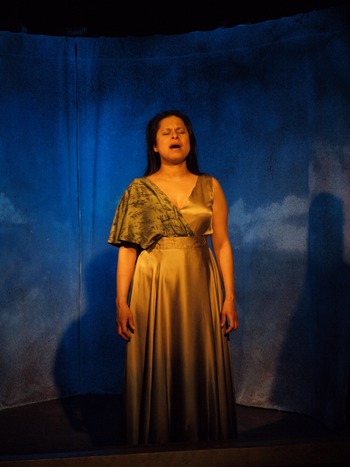
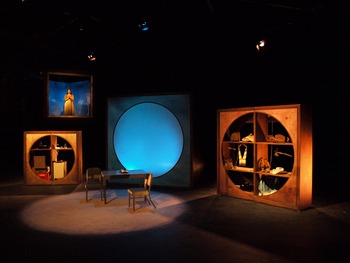
In Tombs of the Vanishing Indian, I will focus on music, blocking and visuals. Music director Jennifer Kreisberg composed three melodies, one melody for each of the three main female characters (Figure 1). Kreisberg said she recorded “decomposing” asymmetrical repetitions of melodies for each character in order to reflect a decomposition of their life situations due to forced sterilisation and other violence (Kreisberg Reference Kreisberg2012). She recorded two versions of one character’s theme, for instance: the first with harmonies and a second, monophonic and much slower when this woman was about to get killed. Regarding blocking, Nolan directed actors, if they needed to physically turn, to move counterclockwise—the traditional ritual direction of the play’s Muskogee Creek characters (Nolan Reference Nolan2011). Visually, a projection screen was set up, consisting of a circular frame covered with white and translucent material, reminiscent of a frame drum. English subtitles of speech in Gavralino, an Indigenous language from the Los Angeles area, was projected on this screen. A circle of fabric was affixed to the floor. Onstage cabinets formed broken circle-shapes; circular and multiple spotlights appeared (Figure 2). A projection of the pan-Indigenous medicine wheel appeared on the floor.
Actor Michelle St. John sings music composed by Jennifer Kreisberg for Tombs of the Vanishing Indian, an Indigenous Canadian stage play by Marie Clements produced by Native Earth Performing Arts. Photo by Nir Baraket, 2012.

The staging of Tombs of the Vanishing Indian incorporates circularity (seen here) whereas the music uses a specific type of cyclicality, asymmetrical repetition. Photo by Nir Baraket, 2012.

Asymmetrical repetition or circularity as a form or structure has functioned historically—and continues to function today—to bring Indigenous people together through songs, dances, rituals and visual symbols. Levine and Nettl argue that the “aspects of [the] form [are] related to larger cultural and social systems. Specifically, it seems possible to connect these similarities to certain underlying concepts of time and place, to widespread intertribal musical performance, and to deep historical connections among geographically distant communities” (Reference Levine, Nettl, Tenzer and Roeder2011:311). About the history of Indigenous music sharing asymmetrical repetition with other Indigenous expressions of movement, dance and storytelling, Sandra Laronde (Teme-Augama-Anishinaabe), Director of Indigenous Arts at the Banff Centre for Arts and Creativity from 2008 to 2017, commented: “our Indigenous theatricality comes out of ceremony where disciplines are not siloed.” In ceremony or ritual, one may hear song, witness dance, hear story and high poetry, and see visual arts that all have social, spiritual and political aspects and occur within a particular kind of architecture. Reflective of ceremony, contemporary theatre performances, including what is sustained of music, do not reflect a silo mentality, and sustain qualities shared by different aspects of ritual expressions (e.g., song, dance, story, poetry, visual art, architecture). Laronde’s perspective suggests that Indigenous theatre artists incorporating structures of music and ceremony shows their ability to detach structures of Indigenous traditional systems, and extend their use to publicly staged theatre. Indigenous theatre artists often motivate such practices by expressing resistance to the staging of entire Indigenous ceremonies or rituals (Laronde Reference Laronde2015): staging ceremonies smacks of the colonial era and too easily allows settler publics to consume, surveil (Vizenor Reference Vizenor2000:25) and misunderstand frequently sacred Indigenous expressions.
The sustainability literature discusses modularity, such as that evident in the structures that music shares with other expressions in The Unnatural and Accidental Women and Tombs of the Vanishing Indian, as essential for absorbing shocks and rapid change (see Walker and Salt Reference Walker and Salt2006:146). The idea is that if one component is disrupted or fails, it may be replaced with another component (Zolli and Healy Reference Zolli and Healy2012:7). The kind of modularity witnessed in Unnnatural and Accidental and Tombs consists of modules of Indigenous song, movement, and visuals adapted from their historical contexts. Zolli and Healy write that a modular structure “ensures that the system can scale up or scale down when the time is right” (ibid.:11). This leads to the question: What is the “system” of Indigenous theatre? Does it include Indigenous arts in various Indigenous contexts, including traditional ones? Yet another characteristic of resilient systems is that they are redundant—not meant in any pejorative sense—but referring to their components and functions being duplicated, which more surely leads to the outcome that they will “bounce back” (ibid.:13). The constantly repeated structures of music, dance and storytelling do not just recur within an individual theatre production, but also between different Indigenous expressions and situations, theatre being a context that scaled up as funding became available.
Sustaining Microtones: Tono (Canada)
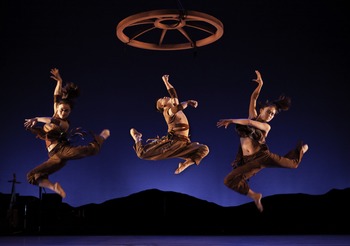
The theatre productions sustain musical sound as well. An example is Tono (Figure 3), a dance theatre work created in Toronto, Ontario in 2010 by a team of five dancers and musicians at Red Sky Performance, directed by Sandra Laronde.
The dance theatre production Tono by Red Sky Performance of Toronto, Canada. Photo by Don Lee, 2010.

Tono explores similarities of Indigenous people of the grasslands (plains) and horse cultures of Canada and Mongolia. It draws inspiration from movements that a person could make to the percussive sounds of a horse’s gait; a Blackfoot story about a human making a pact with a horse to help the human accomplish physical tasks (like pulling wagons—note the circular wagon wheel prop in Figure3); and a dream of Laronde’s about the birth of twins, which led to a danced investigation of Indigenous Canadian vis-à-vis Mongolian shamanisms (Laronde Reference Laronde2015). Tono sustains social (publicly share-able) genres of Canadian Blackfoot singing and drumming, which are not endangered, together with Mongolian urtyn duu long songs (Yoon Reference Yoon2018), which are. The show also incorporates throat singing, folk rock and morin khuur (horse-head fiddle) playing from Mongolia (Marsh Reference Marsh2009) as well as percussion played on malletKAT, a type of electronic marimba.
Laronde began developing Tono while travelling in Mongolia, after hearing a long song following a horse race:
A big cloud of dust is galloping towards the audience and the audience is getting much more excited. There are six or seven eight-year-old boys and some girls, riding full tilt, through the grassland, on a Mongolian saddle which is made out of wood. At the very end of the horse race, there’s a praise song. A singer sings a praise song for the winner, and everybody wants to touch the horse because the sweat is considered good luck.
(Laronde Reference Laronde2015)Laronde auditioned long song singers there and then. The three long song singers whom she ended up working with—one from the Gobi Desert, one from central Mongolia and one from eastern Mongolia—told her that it is rare today for youths to learn to sing long songs. To enjoy that privilege, they should have strong relationships to their traditional lands, which song lyrics address. Many youths are moving to the cities and no longer have a strong land connection.
Laronde points out that Western tonality, particularly equal temperament, “shapes the ear” and frames our listening in a “hegemonic way.” “People are actually no longer hearing microtones” historically found in Indigenous music, for example. She talked to me about how one hears different microtones in nature (e.g., from the land and wind), and how Indigenous people historically created songs based on the harmonic series heard in the natural world. “When you’re hearing all the different tones,” Laronde commented, you “have a multidimensional ear as a result. We need that spectrum of tones to keep ourselves very awake and alive.” She argued that this involves more than listening, with our ears, to microtones and overtones. It is also about how those sounds, heard less nowadays in the music industry, resonate in our bodies, in our guts, in our back ribs, in our nasal cavities and even above. Laronde argues, “We need those tones to keep these parts of ourselves alive. Otherwise, we come to have a very limited range of hearing and of expression” (Laronde Reference Laronde2015).
Indigenous arts scholar Jarrett Martineau calls such musical and aesthetic strategies and arguments “politics of frequency” (Martineau Reference Martineau2015:214). Laronde calls reviving microtonality in music expression and listening a strategy of “decolonial love” (Laronde Reference Laronde2015). She describes Indigenous people producing theatre as a decolonising process of “unraveling” and “trying to help people think differently about themselves” in which “often the process is a much richer experience than the product and presentation” (ibid.). Similar to The Unnatural and Accidental Women and Tombs of the Vanishing Indian, Tono features Indigenous music—Mongolian long songs and Blackfoot social songs—in public and contemporary theatre performances. When considered in relation to Indigenous community traditions, this duplicates the song genres’ presences in yet another context, which is a resilience strategy.
Music Revival as a Sustainability Strategy in Theatre: The Frost Haired and the Dream Seer (Sápmi/Norway)
Sustaining Sámi music in ways that find commonality among the ten Sámi dialect groups, which all have distinct, localised musical practices, is the most common approach to sustaining Sámi musics in Sámi theatre. What has been called new or modern joik—a pan-Sámi musical expression—dominates. Ethnomusicologist Thomas Hilder defines modern joik as “music based on ‘traditional’ [joiks] or ‘traditional’ [joik] practice, which are negotiated to fit with ‘Western’ popular, jazz, and classical musical practices, such as tuning, rhythm, meter, and forms like popular song, as well as incorporating instrumental accompaniment of different kinds” (Hilder Reference Hilder2015:85). In some genre fusions, new joik combines microtonal joiking—the historical way joiking was done—with equal temperament (Fjellheim Reference Fjellheim2015).
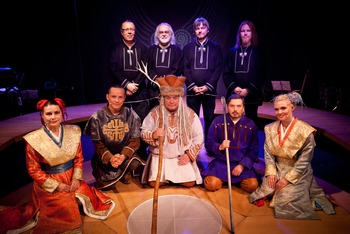
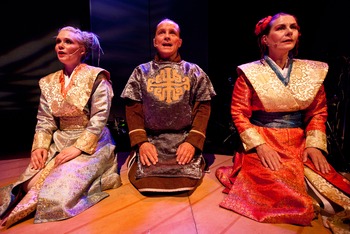
I will focus on The Frost Haired and the Dream Seer (created in 2007, remounted in 2013). Frost Haired combines poetry and music created by Nils Aslak Valkeapää (North Sámi, Finland) with movement and character types from Japanese Noh theatre and costumes inspired by Ainu (Japanese Indigenous) design (Gunnarsson Reference Gunnarsson2014). One of several joik operas so far (Figure 4), this production features almost constant joik-jazz fusions by Valkeapää.
The cast of The Frost Haired and the Dream Seer, produced by Beaivváš Sámi Našunálateáhter of Norway. The production’s instrumental musicians stand in the back row while the joikers and actors sit in front. Photo by Aslak Mikal Mienna, 2013.

Valkeapää, or in Sámi, Áillohaš, was a main progenitor of a Sámi cultural revival that started in the 1970s (see Hilder Reference Hilder2012). He was as a poet, essayist, composer, joik-performer, painter, and Indigenous rights activist. As a composer, Valkeapää’s sound—which has continuously inspired subsequent Sámi musicians working with new joik—took initial inspiration from hearing the free-jazz influence in a popular song by the Finnish band Karelia. In 1977, Valkeapää began to collaborate with Karelia band members Seppo Paakkunainen and Esa Kotilainen when rehearsing for, and then performing in, a radio concert in Helsinki. At this concert, they combined joik with free jazz (Kotilainen Reference Kotilainen2013). Later, they formed a record company, DAT, with which they released Valkeapää’s joik records.
In a promotional booklet, director Haukur Gunnarsson (Icelandic) described Frost Haired as “a dream play—wherein a young reindeer herder is visited in a dream by a sage from ancient times. The sage imparts forgotten wisdom to the young man, and paints a vision of chaos and destruction lest Man forgets that he is but a tiny part of the Universe and that he is subordinate to Nature” (Gunnarsson Reference Gunnarsson2012). Gunnarsson chose to project photographs of the stunning Sápmi nature on stage backdrops. He also projected poems by Valkeapää, and images of Valkeapää with his team of joikers in Japan working towards a theatrical performance of joiks and poems days before his death in 2001. In a postcard, Valkeapää requested that the poetry be combined with his joiks in a theatre production by Beaivváš, which Gunnarsson made happen (Gunnarsson Reference Gunnarsson2014). Valkeapää’s poems—translated from Finnish into North Sámi by literature professor Harald Gaski—were projected on screens behind the actors and musicians, with appropriate translations added for tours in the Nordic countries, Bangladesh and Japan.
The show’s musicians, together with Gunnarsson, selected new joiks and joik arrangements that Valkeapää co-created and recorded in the 1970s. They chose the joiks according to the atmosphere or mood of Valkeapää’s poetry, which provided the narrative. “Sámi Eatnan Duoddariid” [Tundra of Sápmi], for instance, is about a tundra setting that also conveyed by the play’s poetry. A 21-minute-plus recording by Valkeapää titled “Sámi Eatnan Duoddariid” features lyrics in North Sámi about Sápmi’s tundra as well as extended band improvisations on the same melody, within a medley of two other joiks. The play only included the actors vocalising joik’s vocables to band accompaniment and a brief guitar improvisation, at a much slower tempo, totalling just over two minutes. However, the play also featured, on a projected pattern behind the singers, fells—hilly and barren landscape features. Dramatic decisions were intended to suit the overall dramatic goal, Gunnarsson explained: to create a Sámi “form of expression rather than imitating the style and movements of Noh, using Valkeapää’s own music together with [Noh] movements, to comment on and connect the text sequences” (Gunnarsson Reference Gunnarsson2013:2). Actors vocalised the joik melodies (Figure 5) to keyboard, flute and drum accompaniment.
Several actors vocalise modern joiks, by Sámi cultural icon Nils-Aslak Valkeapää, in The Frost Haired and the Dream Seer. Photo by Aslak Mikal Mienna, 2013.

For The Frost Haired and the Dream Seer, musical director Roger Ludvigsen made various musical changes to Valkeapää’s recordings and renditions, while keeping the general melodies and accompanying chords generally similar (Ludvigsen Reference Ludvigsen2013). Another change was not using instrumental accompaniment for what is thought to be Valkeapää’s mother’s joik. Not including instrumentation emphasised the lyrics of the joik: “Let’s be near. Let’s be close. Let’s feel each other.” At this point in Frost Haired, the characters of the reindeer herder and Frost Haired (an elder) bond as mentee and mentor. Sámi viewers who do not know the connection to Valkeapää’s mother often hear that joik as erotic. Allowing the words to be clearly heard in North Sámi together with non-erotic dramatic action supported a non-erotic hearing (Gunnarsson Reference Gunnarsson2014). Here, theatre acted as a mechanism “of dynamic reorganization in the face of disturbance” (Titon Reference Titon, Pettan and Titon2019:181), specifically the loss of Sámi musical history and understanding. Beaivváš’s theatre artists can be interpreted as activating such a reorganisation. That the theatre artists used theatre to contest, and to some extent correct, a historically inaccurate hearing of the joik suggests that their artists’ network includes feedback mechanisms alert to change (ibid.), such as problems with cultural transmission.
Although part of the modern joik repertory, the use of “Sámi Eatnan Duoddariid,” “Johtá Beaivi” (Sun Turns) and “Åldobiellut” (Reindeer Cow Bells), among other joiks in the show, reflect a general trend in Sámi theatre for joik to be used in historically accurate ways. Sámi people joik people, places, animals and happenings. Joiking conveys the feeling, spirit or essence of that presence or moment as experienced by the joiker. For example, “Reindeer Cow Bells” is a polyphonic joik sung by multiple joikers that mimics the sounds of moving bells on reindeers’ necks as they walk in a herd. This is a common sound heard in North Sámi areas. “Davás” (To the North) —which conveys a slow realisation of more and more of what is to the north—slowly builds from a joik melody played on keyboard to sparse instrumental accompaniment of chimes and guitar, to include actor Inga-Máret Gaup Juuso gently singing the melody, as the instrumental accompaniment gradually thickens in texture and Gaup Juuso’s voice grows in volume. The purpose of joik is also sustained.
This Sámi theatre example additionally demonstrates the maintenance of an Indigenous community engaging the habitat of Indigenous theatre aesthetics that sustain musics or aspects thereof. This is a marked quality of Frost Haired, with Valkeapää being a foremost Sámi cultural icon around whom people from different Sámi dialect groups cohere towards pan-Sámi nation-building. Valkeapää is frequently evoked in musical and other artistic performances that bring Sámi from different places together, present shared trends in Sámi expressive culture and celebrate ethnic pride, including modern joiks in which artists may blur regional joik “dialects” (Moisala Reference Moisala2007) while fusing them with at least one other music genre, like Valkeapää did.
The above case study thus shows that music sustainability may happen via revivals of traditional musics including their fusion with different musical genres. As mentioned, the sustainability happens through the resilience mechanism of dynamic reorganisation. Music revival as a sustainability strategy here involves musical melodies as modular components, detached from original contexts and diversified into new arrangements. The modules and diversifications—diversity being another strategy of resilience—are nested and promoted in Indigenous theatre.
Sustaining Joik Structure and Embodiment: Symbiosis in the Dance Theatre Productions GÏeje and Gon (Sápmi)
As in the Indigenous Canadian cases, what is sustained of joik in contemporary Sámi theatre may be, in addition, the sound’s structure. The structure of joiks is most often dynamic. Musical elements constantly vary: pitch, timbre, melody, and—if it is a new joik—harmony. A dynamic joik typically has an identifiable structure, yet parts of the structure may well vary. Less often, the abovementioned joik elements are static (Jouste Reference Jouste and Niemi2009:253). Some theatre performances sustain the variation aspect of a dynamic joik. Ada Einmo Jürgensen (Sea Sámi)—choreographer and director of Åarjelhsaemien Teatere for twenty years—explained the structure as “circular.” It “goes on and on and on, has an open beginning and an open ending” unlike, for instance, a play of Henrik Ibsen that would have a beginning, climax, and ending (Jürgensen and Harrison Reference Jürgensen and Harrison2016).
One dance theatre work, Gïeje (2008), illustrates such constant and structural variability. Gïeje (meaning “Footprints” in South Sámi) together with its sequel, Gon (meaning “And” in South Sámi; 2009), are dance theatre works that Jürgensen directed and choreographed with meaningful creative inputs from her teams of dancers. Dancers Kristin Holand, Simone Grøtte Pedersen, and Johanne Eltoft co-choreographed Gon, for instance, while Nina Erdahl created the costumes. The productions explore experiences of being Sámi in the twentieth and early twenty-first centuries.
The dynamic structure of joik responds to whatever is happening around a joiker. The traditional or historical presentation setting for Sámi joik is outdoors or in a communal living area. Jürgensen observed,
In the joik you can pause wherever you want. You can pause and then you can start again. One day you are out of breath, one place, and another day you are out of breath another place; you have to light a cigarette or something happens around you, and then you can continue.
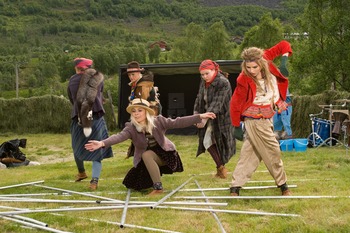
(Jürgensen Reference Jürgensen2014)In Gïeje, shifts in narrative phrasing reflect life experiences interpolating a joik performance. Jürgensen chose to reflect variability via new episodes that start from the insertion of something new into what is currently being performed. For example, Gïeje (as performed at the Riddu Riđđu festival in Norway in 2008) starts as five female characters enter a performance space. They dance as if finding a place to camp. After a male actor enters—a new stimulus—they immediately play with three-meter-long metal rods as if in a gigantic Japanese mikado game (Figure 6). The performance by Kristin Holand, Johanne Eltoft, Simone Grøtte Pedersen, Marianne Kjærsund, Elle Sofe Henriksen and Herman Rundberg includes many sudden shifts, which set it in a new direction, reflecting the improvisatory structure of joik. Jürgensen commented, “If there is an interruption, big or small, everything can take a different direction and then you can go back to what you are doing” (Jürgensen and Harrison Reference Jürgensen and Harrison2016).
Sámi performers move among giant mikado sticks in Gïeje, the first show of a two-part dance theatre series, the second being Gon. Ada Einmo Jürgensen choreographed and directed, while Åarjelhsaemien Teatere produced the works. Photo by Ravn Steinsvik, 2008.

In Sámi dance theatre, joik is also sustained as a way of being, particularly as an experience in the body. One bodily experience of making and performing joik is that of sensing, and then expressing, the feeling, spirit or essence of a person, place, animal or happening. This sensing is at the creative root of joiking and what allows for joik’s purpose—the sonic conveyance of said feeling, spirit or essence. In Sámi dance, the bodily experience and sensing can be expressed through movement rather than musical sound. Jürgensen developed the dance approach, coining it symbiosis.
Symbiosis aims at dancing the essence of a person, place or thing in the same spirit one would joik. In this way, symbiosis differs from dancing to joik or other sound. Jürgensen explained:
When you joik somebody, you don’t joik about it. I asked a joik teacher, “How do you explain that to children when you’re in the schools?” She said, “That’s easy. A teacher doesn’t say to a child, ‘Draw about the house,’ he says, ‘Draw a house.’ That’s the same with joiking. …When I work with joik, I don’t do the dance to the joik, or what the joik is about, I do the joik.
(Jürgensen Reference Jürgensen2014)Jürgensen created symbiosis in dialogue with South Sámi composer, keyboardist and joiker Frode Fjellheim and after interviewing many Sámi elders about joiking practices. Many elders said that they were inspired to create a joik when they were moving, for instance walking in nature or driving a car. Jürgensen recalled, “I asked renowned joikers, ‘How does a joik start?’ They all said it’s when they do something, when they work or when they travel—so, it’s movement” (ibid.).
In theatre, sometimes danced symbiosis is done at the same time joik is heard. In Gon, for example, pewter thread is both joiked through musical sound and joiked through dance. Sámi use pewter thread to make traditional jewellery and fibre arts—types of handicraft or duodji. The “Pewter Thread Joik” has two sonic parts, the first consisting of recorded vocalisations by Simon Grøtte Pedersen (a North Sámi choreographer) and the second of electronically manipulated sound by Herman Runberg (North Sámi). The first part joiks the sensation a pewter thread could have when thinned in a traditional way—being passed through smaller and smaller holes. It consists of high-pitched vocal squeaks that repeat, getting higher and higher in pitch each time, and more constrained-sounding. A second part is a repeated, electronic “whooshing” sound, with brief pauses between repetitions. This represents the process for making pewter embroidery thread, which involves wrapping thinned pewter thread around a cotton thread.
In the dance that goes together with part one, Simon Grøtte Pedersen twists and twirls her body, circling and swaying her knees and arms, sometimes tightening her arm muscles at a 90-degree angle forcefully, and coiling and uncoiling her torso. Each time she stops making a dance movement, she keeps herself in a tall and very straight posture. Pedersen tightens her muscles more and more when the joik rises in pitch (towards the end of each squeak), and flings her arms outwards as if a pewter thread expressing relief at no longer being pulled through a too-tiny hole. During the sonic joik’s second part, about pewter circling cotton thread, Pedersen moves her hips in circles—as if using a hula hoop. Her whole body undulates, then her right arm and leg. Two other dancers, Kristin Holand and Johanne Eltoft, join Pedersen in various undulating movements (Figure 7). The three then convey, with their bodies, pewter thread embroidering a pattern and therefore creating duodji.
Symbiosis or danced joik done to sounded joik in Gon’s “Pewter Thread Joik.” Photo by Håvard Nystad, 2009.

In symbiosis, joiks may also be danced silently. Examples of silently danced joiks are bear and moose joik-dances in Gïeje. To create these dances, Jürgensen explained,
I played for the dancers a bear joik and a moose joik. I did tell them what kind of joiks these were. I let them play with the movement that came out of the joik, to dance the joik not to the joik. We took the joik away and we just kept the movements in a body joik. Then we put a dramatic setting to put them together—the bear attacking the wolf. The dancers all the time had to keep in the feeling of the joik. They couldn’t just change and be a bear, for example. Very often when we were doing the routine for the bear and the moose, they would have to go back and listen to the joiks to get the right feeling in the body. (ibid.)
Symbiosis in Gïeje began with Jürgensen and five dancers listening to animal joiks from old records and wax cylinder recordings. They danced joiks to the recordings. The dancers listened, and listened again to the joiks in order to maintain the feelings of the joiks when dancing silently.
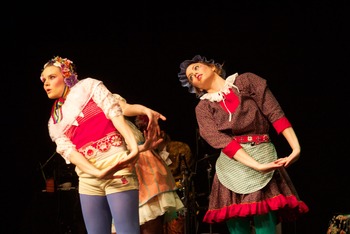
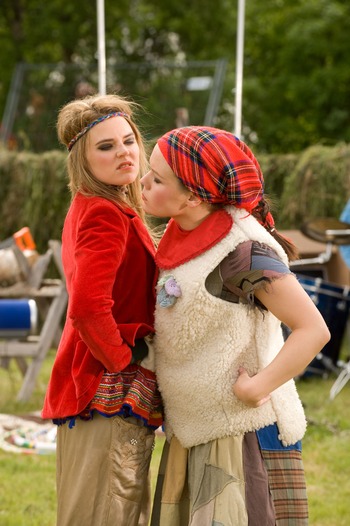
Vocalised joik may be alternated, over time, with symbiosis and dance (instead of occurring at the same time). In Gïeje, two women meet, then as one sees in Figure 8, Jürgensen explained, “turn to animal behavior, sniffing each other and in rivalry over beauty and protecting their space. Their movements go into fox joiks, one from the South Sámi and one from the North [Sámi]” (Jürgensen Reference Jürgensen2019). The two women have a kind of “joik battle,” then end “in almost an intimate situation, in their own playful game” (ibid.).
Dancers alternate symbiosis and dance (seen here) with vocalised joiks of foxes in Gïeje. Photo by Ravn Steinsvik, 2008; all Åarjelhsaemien Teatere photos courtesy Ada Einmo Jürgensen personal archives.

In other parts of Gïeje and other dance performances created by Jürgensen, joiking and dancing are symbiotic in that they are used to create one another—live—onstage. This is seen and heard in cases where joiking sounds inspire dancing live and onstage, and vice-versa. For example, in Eatnemen Vuelieh (“Songs from the Earth” in South Sámi, 2007)—a multi-media production with video projections, a dancer, joikers and a live band—both joiking and dance were improvised onstage in response to one another.
Jürgensen’s artistic concept of joik having a symbiotic relationship with dance has spread throughout Sápmi. Over fifteen years after Jürgensen developed symbiosis, Beaivváš Sámi Našunálateáhter pursued the idea to blend joik, narrative and movement in a 2009 performance called Joik. The concept for this 50-minute show is credited to Anne Katrine Haugen, Mikkel Gaup, Marit Hætta Øverli and Kåre Disputas; however, Gaup worked earlier at Åarjelhsaemien Teatere, where Jürgensen established her model. In 2013, Beaivváš organised a one-week-long symposium Yoikmovement featuring twenty-seven Sámi joikers, dancers, choreographers, actors and percussionists including dancer and choreographer Elle Sofe Henriksen who had performed in several dance theatre productions choreographed and directed by Ada Einmo Jürgensen at Åarjelhsaemien Theatre, including Gon and Gïeje.
The Sámi did not historically have dance. Jürgensen’s method created a line of flight (Parr Reference Parr and Parr2012:149–151) for working in a new direction. Symbiosis also stretches how we might think about resilience mechanisms of music sustainability. Her approach sustains a modular component, detached from its original context (Titon Reference Titon, Pettan and Titon2019:181,183), but this is not a musical sound or product. Rather, this is an embodied Indigenous experience at the creative origins of producing musical expression, that then becomes the origin of dance. In Canada, the Native Performance Culture method of creating theatre also has musical embodiment at its core. In that these methods detach and diversify experiences at the roots of musical creation and performance, symbiosis and Native Performance Culture incorporate that strategy of resilience (ibid.). The two creative approaches share the resilience characteristics of modularity and diversification.
Embodied Music Sustainability as Fugitive Aesthetic: Native Performance Culture (Canada) in Chocolate Woman Dreams the Milky Way
In Canada, Indigenous artists have created theatre from embodied experiences of historical Indigenous song since the mid-1970s. As founding director of the premiere Indigenous acting school in Canada, the Centre for Indigenous Theatre, James Buller articulated such an approach, as did Sadie Buck for her opera Bones (2001) and Floyd Favel Starr for stage plays and dramaturgy (Buck Reference Buck2010). The focus on embodiment steers creative processes away from “intellectualization of the visceral,” which some Indigenous theatre artists resist as a Western approach to art-making knowledge and know-how (Miguel Reference Miguel2000).
I will focus here on Favel’s approach of Native Performance Culture (Favel Starr Reference Starr2012), within which is its philosophy of movement, Waskawewin—a Cree word that can be interpreted as someone undergoing action or becoming (see also Moisala et al. Reference Moisala, Leppänen, Tiainen and Väätäinen2017:8–9), or the movement of the body. Favel disseminated his approach in the 1990s as the director of the Centre for Indigenous Theatre. Besides generating writings and hosting workshops on his philosophy, Favel has worked extensively as a dramaturg, director and playwright who penned All My Relatives (1990), Lady of Silences (1998), Governor of the Dew (1999) and The Sleeping Land (2004).
Favel describes Native Performance Culture as a methodology based on the “performance practices of our ancestors” (Favel Reference Favel1997:83). The process “reduces Native songs and dances to bare essentials, a process that links to, and leads us from, the sources of this country, our life, and the ancestors” as follows:
Through this process of reductionism we are able to isolate the basic building blocks of the song and dance, and these become the starting points for a creative and vital action.
This does not differ in principle from other performance traditions; the main difference is that the reference points are from Native cultures and originate in this land. The artistic source is not transplanted and colonial, and from a Greco-Roman source.
This way of working with dances and songs through reducing them to their skeleton, is exemplified for me when one learns how to play the hand drum in a Plains Cree Round Dance style. The rhythm of the dancing and singing was explained to me in the image/action of “a duck bobbing in the lake water.” This image, I understand now, is the basic DNA of the dance step, the voice, the drumming. This image is the technical and spiritual core of the dance and song.
Let’s say we used the Round Dance spirit; we can also call it, the soul of the dance. This is revealed in the image of a duck bobbing in the lake water.
Through practice one searches for this rhythm, this Round Dance spirit. The spirit of the dance and singing is actually contained in the spaces between the waves of the water and the movement of the duck, between the drum beats and steps, between the dancers. (ibid.:83)
What can be sustained in processes of theatre creation is the sensation and the (what Starr sometimes calls “spiritual”) experience for an Indigenous person to make his or her traditional or historical music and dance. This is a personal experience—highly valued in many Indigenous North American cultures—and is not intended for communications to cultural outsiders, although aspects of it could be readily perceived by Indigenous culture bearers.
Over the past twenty years, Favel has created guidelines and processes for implementing his vision in any Indigenous culture. For instance, in 2007 he guided the creation of, and directed, the stage play Chocolate Woman Dreams the Milky Way by multi-Indigenous Monique Mojica (Kuna, Panama and Rappahannock, USA). Mojica’s project, produced by Chocolate Woman Collective, demonstrates how Favel’s method works across Indigenous groups. Explaining Mojica’s implementation of Favel’s ideas, theatre practitioner Jill Carter writes that in the Kuna tradition in Panama,
a ritual-apprentice will first learn a medicine chant by rote, precisely incorporating its specific language, repetitions, rhythms, and tonal shifts into mind and body…. After memorizing by ear, the pupil begins to copy the pictographic notation of the chant, investing more of the physical instrument in the task and thereby organically rooting the information in his/her being. Only then, will the apprentice be ready to analyze the inscribed text and to ask questions around specific points and deeper meanings (Severi 252). The investigative process for Chocolate Woman Dreams the Milky Way followed Kuna protocol in that rehearsals began with tellings and retellings of traditional stories and chants by…Mojica, who began to more deeply explore these and her relationships therewith….
(Carter Reference Carter2008:174)In her one-woman show, Mojica tells the Kuna myth of Olonadili, the youngest daughter of the stars, when drawing its personal relevance to her experiences growing up as an Indigenous person in the United States, especially a sense of self-fragmentation. Her creative process, and storytelling, closely followed the learning protocols for, and aesthetics of, Kuna medicine chants. Mojica developed her performance through a script consisting of pictographs, which served as a touchstone when deeply integrating Kuna (medicine chant) influences. Kuna cultural advisor Oswaldo DéLeon collaborated with Favel and Mojica in a Native Performance Culture process for creating Chocolate Woman Dreams the Milky Way, rooted in Mojica’s experiences relating to medicine chants.
Because the aesthetic logics of Native Performance Culture, symbiosis or even asymmetrical repetition are difficult for a cultural outsider to discern without explanation, one may wonder when and whether such approaches use what Jarrett Martineau and educator Eric Ritskes call a fugitive aesthetic. The fugitive aesthetic concept differs from the embedded aesthetic idea in that it focuses on what is not communicated to whom, in addition to what is communicated to whom and how (Ginsburg Reference Ginsburg1994). On purpose, an Indigenous fugitive aesthetic cannot be readily understood by cultural outsiders and is intended for cultural insiders—Indigenous groups or individuals. It is “illegible to power, incommensurable with colonialism, and opaque to appropriation, commodification and cultural theft.” It is further “a strategic motion of refusal: to evade capture, resist cooptation, and renew Indigenous life-ways through the creative negation of reductive colonial demarcations of being and sensing” (Martineau and Ritskes Reference Martineau and Ritskes2014:v). For Martineau, a fugitive aesthetic emerges from “strategic disengagement from the possession and property modality of colonial subjection and capitalist consumption, a drive toward other ways of seeing, hearing, making and being” (Martineau Reference Martineau2015:236). A fugitive aesthetic can result from many of the resilience mechanisms already discussed, for example, a modular component such as the felt experience of producing musical expression that inspires symbiosis. Or of theatre artists detaching a felt experience that normally engages musical sound, from the musical sound itself, when diversifying that feeling into non-musical theatrical expressions of dance, speech and so on.
If cultural outsiders cannot understand the meanings of an Indigenous theatre work, this may be interpreted as a way that Indigenous artists respond to duress, especially a continued worry about systemic violence affecting Indigenous people today that follows on the heels of forced cultural assimilation and colonisation. As Zolli and Healy write,
many resilient systems…flock or swarm like starlings when the time is right and break into islands when under duress. These are the very features that make things like cloud computing possible—in which groups of linked, redundant servers swarm together, scaling up and scaling down to complete a given task, then disband. Similarly coordinated approaches to resilience are found in realms as seemingly disparate as bacteria and the battlefield. (Reference Zolli and Healy2012:12)
When Indigenous artists pursue sustainability through a flock or swarm response of resilience—perhaps coming together to create and understand an Indigenous-only fugitive aesthetic—this suggests continued perceptions of duress. Flocking and swarming happen as Indigenous people gather together to create Indigenous theatre and share its meanings amongst themselves, within theatre productions for the general public. Yet Favel and Jürgensen are very clear that they intend to most powerfully address their productions to Indigenous people’s internal processes and discussions (and, for Jürgensen, Sámi people’s). They direct key knowledge about sustaining Indigenous musical knowledge to “islands” (ibid.) of understanding, in other words, the most appropriate (Indigenous) people to sustain Indigenous music.
Precisely how the musical knowledge is sustained is largely not for cultural outsiders to know, although the reader has a glimpse here of what can be shared publicly. According to my discussions with Favel and Jürgensen, symbiosis and Native Performance Culture also fit how Martineau and Ritskes characterise a fugitive aesthetic (see also Jürgensen and Harrison Reference Jürgensen and Harrison2016). The aesthetic should be one that breaks down and breaks open categories and binaries of colonialism, that “confounds colonial ‘common sense’” and is “irrecuperable to colonial logics,” finding freedom “in movement not simply away from colonialism, but away from any standpoint where colonialism makes sense” (Martineau and Ritskes Reference Martineau and Ritskes2014:iv, italics in original). Indigenous experiences of song and dance at the creative root of these artistic methods remain in, or strongly target, Indigenous experiential realms only, when continuing pre-colonial traditions of thought and music within cosmopolitan art forms for general publics.
Conclusion
In Indigenous theatre of Canada and Sámi, Indigenous artists sustain aspects of music in ways associated with bringing Indigenous people together even though the theatre productions are performed for mixed Indigenous, settler, and even international publics. Various musical elements are most readily perceived by Indigenous audience members who access ritual, ceremonial and revived traditional musics outside a theatre production—and may not be easily understood by audiences unfamiliar with such musics. These can be called fugitive aesthetics.
What is sustained of Indigenous traditional music in Sámi and Indigenous Canadian theatre productions includes: musical structures or forms sometimes shared with other Indigenous expressions; historically relevant musical sounds, for instance microtonality; Indigenous traditional musical sounds, some of which have been revived through genre fusions, for instance, with popular music; and embodied experiences of making (creating, performing) Indigenous song and dance. These approaches to music sustainability can be found in different manifestations across stage plays, dance theatre and opera productions created by Sámi and Indigenous Canadians. Methods for creating theatre, based on historical vocal expressions or dance, like for examples symbiosis (Sápmi) and Native Performance Culture (Canada), are used towards sustainability by different Indigenous groups (respectively across Sámi dialect groups and by any Indigenous people at all).
Indigenous theatre artists often motivate how they sustain music with discourses of what is sometimes been called “decolonial love” (Laronde Reference Laronde2015)—particularly the importance of sustaining Indigenous musical qualities, epistemologies and ontologies existing before cultural colonisation. In Canada and the traditional territories of the Sámi spanning Norway, Sweden, Finland and Russia, Indigenous music, dance and ritual were banned and suppressed by governments, churches and settlers.
Even though the theatre productions operate within infrastructures associated with sometimes ongoing suppressions of Indigenous people, they use and sustain ancient Indigenous traditions as creative inspirations for creating new kinds of interdisciplinary performing arts. Such aesthetics that unfold within this uneasy context but are directed at Indigenous communities may be called “embedded” (Ginsburg Reference Ginsburg1994). Work that the productions have done to sustain elements of Indigenous musics through recontextualising them in theatre are music sustainability efforts by and for Indigenous people. Fugitive aesthetics describes those parts of the productions meant to decolonise Indigenous witnesses and participants.
Recontextualisation of music in interdisciplinary and even intercultural performing arts is thus one way of sustaining music. I have viewed this recontextualisation as making use of mechanisms of resilient systems that, for audiences and performers, tie contemporary performance formats to historical, and different living, Indigenous musical cultures. Therefore, the characteristics of resilience that I identified in this article on Indigenous music theatre have relevance to the sustainability and resilience of Indigenous musics broadly and globally.
In theatre productions by Sámi and Indigenous Canadians, mechanisms of resilient systems in use include the creation of theatre aesthetics from modular components of music, which can be structures of historical Indigenous musics, or embodied experiences by Indigenous groups or individuals of historical musics. This implies another quality of a resilient system, “an ability to detach parts and diversify…thus reducing dependencies without undermining the whole,” presumably, a music culture normally existing outside of theatre but whose sustainability contemporary theatre promotes (Titon Reference Titon, Pettan and Titon2019). I also identified a variety of other sustainability strategies at play in musical aspects of various Indigenous theatre productions, notably redundancy or duplication of parts of a musical system.
Overall, Indigenous theatre productions in Sápmi and Canada make use of various characteristics of resilient systems. These additionally include “dynamic reorganization in the face of disturbance” (ibid.) that addresses colonisation as a destructive cultural force, but in ways that enact and promote musical resilience. Reorganisation happens through the clustering of talent and resources (Zolli and Healy Reference Zolli and Healy2012), particularly artist-networks used to create Indigenous stage plays, dance theatre performances and operas that also may be identified as a feedback mechanism (Titon Reference Titon, Pettan and Titon2019) alert to further or continued threats to Indigenous music.
Acknowledgements
This research is an outcome of a fellowship that I held at the Helsinki Collegium of Advanced Studies, University of Helsinki from 2012–2015 on Indigenous music, theatre and sustainability. Arctic Indigenous music also focuses of my current research funded by the Academy of Finland (grant decision numbers 294769 and 306767).