The importance of anticipating and managing adverse emotional, mental, and behavioral reactions to disasters is increasingly being recognized as a priority for public health emergency preparedness.Reference Davidson and McFarlane 1 – Reference North and Pfefferbaum 5 Mental and behavioral health surge accompanies all major hazards, including natural incidents,Reference Chou, Huang and Lee 6 – Reference Raviola, Eustache, Oswald and Belkin 8 accidental events,Reference Bromet, Parkinson and Dunn 9 , Reference Palinkas, Downs, Petterson and Russell 10 and willful acts such as terrorism and mass shootings.Reference Ohbu, Yamashina and Takasu 11 – Reference North, McCutcheon, Spitznagel and Smith 14 Depending on the type, magnitude, and duration of the occurrence, psychological casualties can outnumber physical injuries by substantial ratios and often overwhelm existing clinical resources,Reference Ohbu, Yamashina and Takasu 11 particularly in low-resource settings.Reference Raviola, Eustache, Oswald and Belkin 8
Individual risk factors for severe and prolonged reactions, including post-traumatic stress disorder (PTSD), include young age,Reference Drury, Scheeringa and Zeahnah 15 , Reference Kar 16 female gender,Reference Ranasinghe and Levy 17 , Reference Corrarino 18 race/ethnicity,Reference Lee, Shen and Tran 19 – Reference Adams and Boscarino 21 lower socioeconomic level,Reference Lima, Pai, Santacruz and Lozano 22 , Reference Breslau, Davis, Andreski and Peterson 23 limited social support,Reference Weems, Watts and Marsee 24 , Reference Bonnano, Galea, Bucciarelli and Vlahov 25 and active psychiatric status.Reference Kessler, Galea and Gruber 26 , Reference Kar 27 Collectively, these observations represent a societal imperative to develop interventions to ensure the psychological resilience of at-risk individuals and communities before, during, and after major public health emergencies.
Among the prominent obstacles to meeting the challenge of mental and behavioral health surge are 1) the undersupply of prospective responders with disaster mental health expertise, 2) the limited number of communities with formal disaster preparedness plans, 3) the shortage of readily-accessible linkages through which public health professionals might engage citizens for training in crisis response and community disaster planning, and 4) the lack of evidence-supported, competency-based interventions.
The Johns Hopkins Logic Model for Disaster Mental Health Research
To organize our research initiatives in surge mitigation, we developed an enhanced logic model.Reference Frechtling 28 Figure 1 depicts the key stages and components of the model, including: 1) environmental considerations and resources brought to bear on the project (context and inputs), 2) actions undertaken to effect project aims (activities), 3) near- and intermediate-term numeric results and targeted accomplishments (outputs and outcomes), and 4) longer-term goals and desirable changes in the public health emergency preparedness system (impacts).
Project Logic Model. Abbreviations: AHC, academic health center; CDC, Centers for Disease Control and Prevention; EOP, emergency operations plan; FBO, faith-based organization; GPP, guided preparedness planning; KSAs, knowledge, skills, and attitudes; LHD, local health department; MRC, Medical Reserve Corps; PFA, psychological first aid.

The remainder of this report illustrates how the elements of the logic model may be cross-walked with, and helped guide, traditional research activities.
Background (Context and Inputs)
A nation is resilient when it is made up of resilient communities. Private-public collaboration is a key step for building such resilience. 29
Our research efforts at the Johns Hopkins Preparedness and Response Research Center (JH-PERRC) have included a focus on the potential of public-private coalitions to expand the capacity of community preparedness planning and response. The approach is predicated on the assumption that, just as a nation is resilient when made up of resilient communities, a community is resilient when it is made up of resilient individuals,Reference Kaminsky, McCabe, Langlieb and Everly 30 particularly when the individuals are members of cohesive social networks, cf, “social capital.”Reference Aldrich 31 , Reference Morton and Lurie 32 A second premise of our work is the belief that community preparedness and resilience are most likely to be achieved by unifying the strengths of communities with those of emergency public health agencies in coherent and sustainable collaborative relationships through which evidence-supported interventions may be applied to achieve disaster resilience goals.
Our approach to operationalizing these assumptions involves an academic health center (AHC) supporting local health departments (LHDs) and faith-based organizations (FBOs) in the development and validation of a set of complementary interventions: psychological first aid (PFA) training for lay individuals and guided preparedness planning (GPP) for small teams representing their congregations and communities. PFA training is intended to develop paraprofessional, disaster mental health extenders and to galvanize general interest in disaster preparedness. GPP, using FBOs as connectors, is designed to establish a framework for grassroots participation and leadership in preparedness planning.
The interventions were refined over 3 phases of study. Phase 1 consisted of AHC-FBO pilot investigations with urban populations to assess the feasibility and acceptability of jointly designed, PFA training curricula.Reference McCabe, Mosley and Gwon 33 , Reference McCabe, Lating and Everly 34 Phase 2 consisted of an AHC-FBO-LHD collaborative study of PFA and an early-version of GPP with rural populations.Reference McCabe, Perry and Azur 35 , Reference McCabe, Perry and Azur 36 Phase 3 entailed multi-state field validations of iteratively refined versions of PFA and GPP, the focus of this report.
Methods (Activities)
Study Partners and Participants
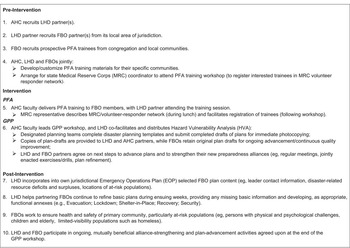
The AHC partner entity comprised members of numerous offices, departments, and centers within the Johns Hopkins Bloomberg School of Public Health, the Johns Hopkins School of Medicine, and the Johns Hopkins Hospital and Health System. There were 2 types of non-AHC partners: public health emergency planners of LHDs and clergy and lay leaders of FBOs. Figure 2 outlines the mutually developed partner roles, implementation sequence, and essential elements of the program model.
Flow Diagram of Evidence-Based Action Steps for Model Replication, by Partner Responsibilities. Abbreviations: AHC, academic health center; FBO, faith-based organization; GPP, guided preparedness planning; LHD, local health department; PFA, psychological first aid.

Individual participant trainees were adult leaders and members of congregations and local communities, who were recruited primarily by FBO partners to receive the PFA and GPP interventions. Following PFA training, teams of 2 to 4 appropriately qualified persons were selected by their FBOs to participate in GPP and to serve as designated planners for the organization and communities.
Interventions and Procedures
The PFA intervention was a 1-day training workshop, incorporating a Microsoft PowerPoint (Microsoft Corp, Redmond, WA) slide-based lecture, discussion, and small-group practice of PFA techniques. Curricular content was organized in 3 sections: 1) Introduction to Disaster Mental Health, 2) Psychological First Aid (an adaptation of the Johns Hopkins RAPID PFA model); and 3) Ensuring You Are Ready, Willing, and Able to Be a Competent Responder, the latter including the module Self-Care for the Caregiver. The components of the RAPID acronym are rapport-building (through reflective listening, expressive empathy), assessment (emphasizing screening for functional incapacity), prioritization (of assessed functional needs), intervention (stress management or cognitive techniques, once physical and medical needs are addressed), and disposition (eg, referral and possible advocacy and liaison efforts). [More detailed descriptions of the original RAPID PFA training curriculum are available elsewhere.Reference Everly, Barnett and Links 37 , Reference Everly, McCabe, Semon, Thompson and Links 38 ] PFA workshops were led by AHC-based, doctoral-level faculty with LHD partners in attendance.
The GPP workshop used slides, discussion, and technical assistance with planning team members, whose charge was to complete and submit a draft of a basic disaster plan for their FBO and relevant community by the end of the day. Participants were guided through a workbook-based, 25-step planning protocol requiring input of information unique to each participant’s organization and community. Planning assumptions were as follows: 1) the need to adopt an “all-hazards” orientation, 2) a priority focus on mental and behavioral health surge, 3) special attention to at-risk subpopulations, and 4) appreciation for the importance of FBOs forming partnerships with leaders of their LHD during and following the project. Workshop session content was aligned with modules of the planning template organized under the following headings: 1) Background and Assumptions, 2) Description of the Planning Organization and Target Community, 3) Core Incident Command System (ICS) Leadership Roles and Responsibilities, 4) Disaster-Related Community SWOT Analysis (whereby participants identified their community’s disaster-related strengths, weaknesses, opportunities, and threats), 5) Communications, 6) Plan Sustainability and Evaluation, and (7) Preparedness Tools and Resources. Pauses were built into the slide presentation to permit planning teams to populate blanks in the corresponding modules of the workbook.
Workshops were led by AHC faculty and were co-facilitated by LHD representatives. At the beginning of the first (PFA) workshop, participants were provided a Disaster Mental Health Resource-Tool Kit, which was composed of a binder with materials to support both the PFA and GPP trainings. The tool kit content included a meeting agenda and slide handouts for both workshops, elaborations of the RAPID PFA principles and practices, relevant journal articles, the GPP planning template, and numerous disaster preparedness resources (eg, websites, publications, frequently asked questions).
Research Design
We used a mixed-methods research approach employing quantitative and qualitative strategies. To measure near-term training effects of PFA and GPP, we applied a multicohort, pre-test/post-test, quasi-experimental design. We triangulated methods to evaluate intervention effects by using participant self-reports, objective testing, and behavioral indexes or real-world observations. The specific aims, associated hypotheses, and the tools for measuring their confirmation (assessing outcomes and impacts) were as follows:
Aim 1: Evaluate the effectiveness of the PFA intervention. PFA was hypothesized to 1) increase the knowledge, skills, and attitudes (KSAs) required to be competent, paraprofessional providers of PFA, and 2) motivate FBO leaders and community members to participate in formal community disaster planning activities. The following instruments were administered before and immediately following PFA training:
-
• The PFA Knowledge, Skills, and Attitudes Survey Form: A self-report, 5-point Likert scale composed of 25 items, organized by knowledge (10 items), skills (7 items), and attitudes (8 items).
-
• The Disaster Mental Health Knowledge Test: An objective test composed of 14 items organized as true/false (9 items) and multiple choice (5 items) questions, intended to confirm participant acquisition of representative curricular content.
-
• The PFA Training Follow-up Questionnaire: An 11-item survey distributed to rural cohorts in Maryland 1 year after training to determine the frequency (use) and effectiveness (usefulness) of PFA applied to persons who incurred trauma during a disaster event or other personal crisis.
Aim 2: Evaluate the effectiveness of the GPP intervention. GPP was hypothesized to 1) increase KSAs supportive of disaster planning and 2) promote the crafting of basic disaster plans by the end of the training day. Pre- and postintervention evaluations of GPP involved the following assessment tools:
-
• The GPP Knowledge, Skills, and Attitudes Survey Form: A self-report, 5-point Likert-scale composed of 18 items, organized by knowledge (7 items), skills (7 items), and attitudes (4 items) facilitative of competent disaster planning.
-
• The Community Disaster Preparedness Planning Test: An objective test composed of true/false (10 items) and multiple choice (5 items) questions to confirm participants’ understanding of general disaster preparedness planning principles.
Additionally, GPP effectiveness was evaluated by using two behavioral indexes: 1) the percentage of FBO planning teams submitting plan drafts by the end of the workshop day and 2) scores of plan draft comprehensiveness. The proxy for a “plan draft” was a completed plan template titled The Johns Hopkins Community Disaster Plan Template. The template was a planning tool comprising 25 blank items with instructions and tips for providing core disaster plan content. The template was available as either a hard-copy workbook or an e-copy for use on a laptop computer. The tool used to quantify the comprehensiveness of plan drafts was the Johns Hopkins Checklist for Disaster Plan Comprehensiveness (CDPC). This was an instrument incorporating brief descriptions of the required items in the plan template, with options to be checked as “completed,” “partially completed,” or “no information.” Using an item-weighting algorithm for scoring, we derived an index of community “planfulness.” A fully completed template earned a planfulness score of 100.
Aim 3: Explore methods of promoting sustainability, translational impact, and scalability of the overall model. Our hypothesis was that we would be able to generate the following:
-
• Actionable ideas and examples for establishing enduring, postproject LHD-FBO preparedness alliances (sustainability);
-
• Observed changes in policy or practice at selected levels of the public health emergency preparedness system (translational impact); and
-
• Program-portability materials to facilitate dissemination and uptake of the model in areas of the country beyond our institutional base (scalability).
Pursuing this compound aim relied heavily on qualitative research strategies, including the systematic collection of inputs from interviews, surveys, focus groups, and meetings with members of our project-specific and JH-PERRC advisory committees, the latter composed of representatives of numerous academic institutions, health organizations, faith communities, and local and state government agencies.
Data Analysis
Participant characteristics by cohort were summarized with descriptive statistics. Responses from before and after PFA and GPP administration were summarized as the percentage agreement for self-reports or as the percentage correct for individual items and mean total correct, with 95% confidence intervals, for objective tests. Changes between pre- and post-training administrations were evaluated with general linear model analyses accounting for the within-cohort correlation of responses. Identical analyses were performed within rural and urban cohorts. Descriptive statistics were used to quantify both the results of the follow-up survey with PFA trainees and the effectiveness of GPP on plan development and plan comprehensiveness.
Results (Outputs, Outcomes, and Impacts)
Settings and Participant Characteristics
We conducted field trials with 3 rural and 4 urban cohorts, encompassing partnerships with 21 LHDs and 76 faith organizations in Maryland, Illinois, and Iowa.
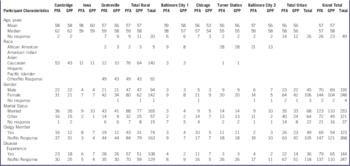
The characteristics of the individual participants (training recipients), who were predominantly females in their late 50s, are described in Table 1 . The majority (70%) of the rural participants were married, in contrast with 44% of urban participants. Approximately one-third of the participants were African American, clustering mainly but not exclusively in urban settings. Lay community participants, versus clergy members, constituted 69% of the sample. Most (63%) participants reported no prior experience with disasters. (Note: Only trainees who submitted fully completed evaluation forms were counted as final project participants, which explains the difference between the number (n) of participants in Table 1 and those cited in Tables 2–6 summarizing PFA and GPP intervention effectiveness.)
Summary of Participant Characteristics, by CohortFootnote a

a PFA indicates psychological first aid; GPP, guided preparedness planning.
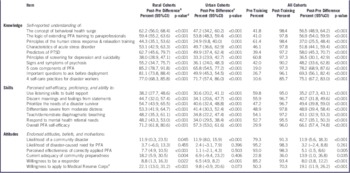
Comparison of Percent Agreement on Psychological First Aid (PFA) Evaluation between Pre- and Post-Training Administrations for Rural, Urban, and All CohortsFootnote a

a Percent agreement includes endorsement of “strong agreement” and “agreement” options. CI indicates confidence interval; PTSD, post-traumatic stress disorder.
b Number of respondents for rural cohorts pre-training ranged from 103 to 116, and post-training ranged from 77 to 114 across these statements.
c Number of respondents for urban cohorts pre-training ranged from 60 to 75, and post-training ranged from 59 to 70 across these statements.
d p-values are based on two-sample (administration) tests, since responses were not matched for all cohorts.
e Number of respondents for urban cohorts post-training was 24 for this statement.
Comparison of Total Correct Responses on Psychological First Aid (PFA) Knowledge Tests between Pre- and Post-Training Administrations for Rural, Urban, and All CohortsFootnote a

a Test comprised 14 questions. CI indicates confidence interval.
b Number of respondents for rural cohorts: PFA-pre=112, PFA-post=111.
c Number of respondents for urban cohorts: PFA-pre=76, PFA-post=69.
d Because responses were not matched for all cohorts, p-values are based on two-sample (administration) tests.
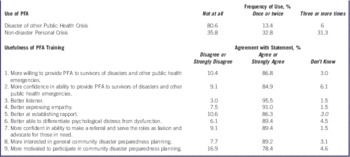
One-Year Follow-up Survey of Psychological First Aid (PFA) Use and Usefulness in Real-World ContextsFootnote a

a n=67.
Comparison of Percent Agreement on Guided Preparedness Planning Evaluation Between Pre- and Post-Training Administrations for Rural, Urban, and All CohortsFootnote a

a Percent agreement includes “strong agreement” and “agreement” categories. CI indicates confidence interval.
b Number of respondents for rural cohorts pre-training ranged from 72 to 91 and post-training ranged from 79 to 91 across these statements.
c Number of respondents for urban cohorts pre-training ranged from 61 to 70 and post-training ranged from 60 to 65 across these statements.
d p-values are based on two-sample (administration) tests, because responses were not matched for all cohorts.
e Number of respondents for urban cohorts pre-training was 21 and post-training was 30 for this statement.
Comparison of Total Correct Responses on Guided Preparedness Planning (GPP) Knowledge Tests Between Pre- and Post-Training Administrations for Rural, Urban, and All CohortsFootnote a

a Test comprised 15 questions. CI indicates confidence interval.
b Number of respondents for rural cohorts: Pre=109, Post=101.
c Number of respondents for urban cohorts: Pre=71, Post=66.
d Because responses were not matched for all cohorts, p-values are based on two-sample (administration) tests.
Validation of PFA Effectiveness
Self-Reports
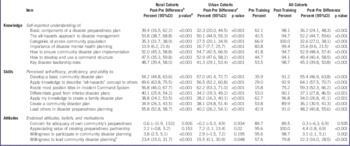
Reports of KSAs successfully imparted by PFA training are summarized in Table 2 . All 17 PFA knowledge and skill variables showed significant (p≤0.001) pre-post improvements. Observed improvements in perceived self-efficacy with the component skills of PFA were particularly encouraging, because self-efficacy (essentially, an affirmation of one’s capability) has been shown repeatedly to be a behavioral analogue predictive of actual performance.Reference Bandura 39 Changes in 5 of the 8 attitude items were also significant, including positive changes in willingness to be a responder (p≤0.001) and willingness to apply to the state Medical Reserve Corps (MRC) (p≤0.001).
For these self-report data, rural participants demonstrated statistically significant changes in perceived effectiveness of correctly applied PFA, current adequacy of community preparedness, and willingness to apply to the MRC, whereas urban participants did not show significant changes. Compared with urban participants, rural participants showed statistically significantly higher levels of change for the 5 core components of PFA, important questions to ask before deployment, responding to mental health needs, overall PFA self-efficacy, and perceived effectiveness of correctly applied PFA (Table 2).
Objective Tests
The results of tests to objectively corroborate self-reported improvements in general disaster mental health literacy and KSAs supporting PFA proficiency are summarized in Table 3 . The mean total correct pre- and post-training scores were 7.4 and 10.3, respectively, denoting a significant improvement (p≤0.001). Of the 14 items, 11 showed statistically significant improvements (data not shown).
With respect to the individual items of the PFA Knowledge Test, only the rural participants demonstrated statistically significant changes in (learning information related to) willingness of public health workers to respond, value of relational and technical factors in helping, burnout prevention principles, core components of PFA, and definition of “normalization” in PFA. Only urban participants demonstrated a statistically significant change for (understanding) bad versus good stress. There did not seem to be a statistically significant difference in the changes between the cohorts when both demonstrated a significant change (Table 3).
Behavioral Indexes: Real-World Application of PFA
The 1-year follow-up survey data on the effectiveness of PFA applied under real-life circumstances are summarized in Table 4 . Approximately 1 in 5 (19.4%) of the 67 respondents indicated that they had provided PFA to a disaster survivor at least once during the prior year (in all cases, aiding persons traumatized by the 2013 Super Storm Sandy), and 83.5% reported providing PFA to someone experiencing an emotional crisis in a nondisaster context (eg, helping an individual manage trauma caused by violence, serious illness, or the death of a loved one).
Given the real-life context of their PFA application, it is noteworthy that a large proportion of respondents indicated that the 1-day training enabled them to be more confident in their ability to provide PFA (84.9%), better at expressing empathy (91%), better at differentiating psychological distress and dysfunction (89.4%), and more confident in their ability to make a referral and serve as a liaison and advocate for those in need (89.4%). The majority of participants also confirmed two important hypotheses: that PFA training makes one more interested in community disaster preparedness planning (89.2%) and more motivated to participate in community disaster preparedness planning (78.4%).
Validation of GPP Effectiveness
Self-Reports
A summary of planning-relevant KSAs reportedly acquired by GPP participants is provided in Table 5 . Improvements were documented in all 14 knowledge and skill variables and in 3 of the 4 attitude variables, with the greatest percentage changes observed for understanding the concept of all-hazards planning (52.2%; p≤0.001), knowing how to ensure plan implementation (52.9%; p≤0.001), and understanding how to develop and use a command structure (49.4%; p≤0.001). Substantial improvements (in percentage) were shown in applying knowledge by describing the all-hazards concept to others (64.1%; p≤0.001), ability to recite most of the positions in the ICS (59.3%; p≤0.001), and proficiency in developing a basic community disaster plan (55.4%; p≤0.001). Significant changes (57.6% to 79.8%; p≤0.001) were also observed in willingness to lead disaster planning, a finding indicating that GPP further buttresses the motivation-to-plan factor initiated by PFA training.
For these self-report data, only rural participants demonstrated a statistically significant change in willingness to participate in community disaster planning, and only urban participants showed a statistically significant change in appreciating the value of creating preparedness partnerships. Compared with urban participants, rural participants showed a statistically higher change only for applying knowledge to describe the all-hazards concept to others (Table 5).
Objective Tests
Objective test results are shown in Table 6 . On average, significant improvements were made in total correct pre-post scores for all cohorts. The mean pre- and post-training test scores were 8.6 and 10.2, respectively (p≤0.001).
Learning effects were objectively confirmed for 8 of the 15 items, with the most substantial improvement (41.8%) observed for “knows name of emergency planner in LHD” (data not shown). With respect to the GPP Knowledge Test, only rural participants demonstrated statistically significant changes in learning related to the types of at-risk citizens, conducting drills and evaluations of disaster plans, important prospective disaster planning partners, and examples of preparedness SWOT analysis. Only urban participants demonstrated statistically significant changes for the basic phases of public health emergencies and the responsibilities of the operations chief in the ICS. There did not seem to be a statistically significant difference in the changes between the cohorts when both demonstrated a significant change (Table 6).
Behavioral Indexes: Submission of Plan Drafts
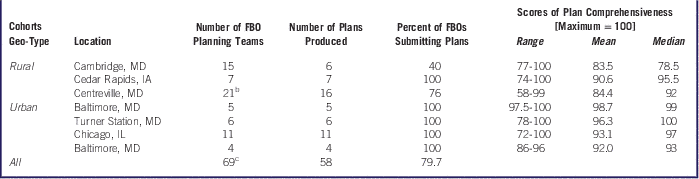
The key GPP behavioral outcomes are summarized in Table 7 . Of the 69 planning teams deployed by FBOs to GPP workshops, 58 (81%) submitted same-day drafts of basic disaster plans for their respective organizations and communities.
Summary of Selected Process and Outcome Evaluation Data for Guided Preparedness Planning (GPP) Intervention, by CohortFootnote a

a FBO indicates faith-based organization.
b This figure is lower than that cited in Table 1,because 3 planning teams received planning templates with missing pages. Scoring these plans was not considered appropriate; therefore, these teams were eliminated from the category of “Planning Teams” and from the denominator used to calculate “Percent of FBOs Submitting Plans.”
c This figure is lower than that cited for all FBO partners in Table 1 because some FBOs participated in psychological first aid (PFA) training but not GPP.
The comparatively low percentage of plans submitted by the Cambridge, MD, participants is attributable to our early policy of permitting plans to be submitted up to 6 months after the GPP, a momentum-destroying strategy we quickly discarded. Since changing to a same-day plan submission policy, we recorded a 91% rate of plan submission for all cohorts. Recent scores of plan comprehensiveness have averaged over 90%.
Sustainability: Strengthening Private-Public Partnerships
LHD representatives were successful in generating ideas to sustain and advance their preparedness relationships with FBOs beyond the term of the study. A complete list of these sustainability initiatives has been published elsewhere.Reference McCabe, Perry and Azur 36 Examples include 1) co-conducting exercises and drills to evaluate the viability of plans, 2) linking FBO partners with leaders in other public emergency preparedness agencies, and 3) providing mini-grants with monetary awards (in the range of $500 and $1500) to FBOs proposing innovative ideas for continuing their preparedness activities with LHDs. These ideas have recently been codified into a 10-item checklist tool that is completed by the LHD representative, photocopied, and given to the FBO partner immediately after the GPP workshop. The document serves as an informal memorandum-of-understanding, embodying the mutual commitments to perpetuate the LHD-FBO alliance.
Translational Impact and Model Scalability: Early Multi-Level Illustrations
FBOs and Communities
The 58 disaster plans produced across 36 jurisdictions (Table 7) represent a new continuity of operations plans for partnering FBOs, exemplifying the increased readiness, willingness, and presumed ability of the organizations to respond to and recover from disasters. The results also signify an expansion of surge capacity for the participating congregations, neighborhoods, townships, and nearby health care facilities. The network of newly deployable PFA providers possesses special value for emergency medical departments by being a diversion mechanism for the potential cascade of persons psychologically affected but not physically injured by disasters who would likely present at such facilities and consume clinical resources needed for real medical emergencies.
Although much of our data on the translational impact of the model are qualitative and anecdotal, we believe such observations signal a robust potential of the approach. Two examples are shared here.
Describing the impact of the project on his congregations, the Bishop of the Episcopal Diocese of Easton, Maryland, offered the following remarks in a recent letter to the project director:
Our jurisdiction spans the entire Eastern Shore of Maryland, representing approximately one-third of the State of Maryland. Our location between the Chesapeake Bay and the Atlantic Ocean exposes many communities and our parishes to natural and manmade disasters. [The JH-PERRC project] prepared many of the 38 parishes, the 10,000 worshipping parishioners, and 70 clergy….However, the process of training was only one step. I have established a committee of committed volunteers working diligently to institutionalize the work begun with our Johns Hopkins partners and local health department agencies.
As an ecumenical outreach initiative, the Episcopal Diocese of Easton has also developed a compelling videotape, encouraging faith organizations of all denominations to develop disaster plans. 40
Another testament to the prospective viability of the model is an e-mail message sent by an FBO leader to his LHD partner (co-author CJP) the day Sandy made landfall on the eastern shore area of Maryland:
Chestertown will activate its emergency response program at 7:30 AM today. The activation does not require that team members report to the command post at this time. We will be issuing a mass-communication to our parish members beginning at 8:30 AM notifying them of the latest update on the storm and advising them of the SHELTER resource in Worton. We will respond to requests for support or resources, as needed, and will escalate team response, if necessary. Please note that the CHURCH HALL is available for any transitional shelter needs and is prepared as a POD [Point-of-Dispensing], or for triage for longer-term shelter needs.
Local Health Departments
Numerous instances of LHD practice- and policy-enhancing changes have been attributed to the study, including LHDs incorporating FBO plan content into their own emergency operations plan, eg, contact information for persons serving key ICS leadership positions in the FBO, a list of asset surpluses available to other communities during emergencies, and the locations of special subpopulations at risk during disasters. Some illustrations of mutually beneficial outcomes associated with one LHD partner (co-author CJP) are as follows:
-
• Formation of a faith-based advisory committee that meets quarterly;
-
• New relationships and lines of communication established between FBOs and emergency management agencies;
-
• New avenues of communication for public health messaging via bulletins and announcements from the LHD to individuals and families;
-
• Tours of the Emergency Operations Center (EOC) for FBO leaders, with subsequent designation of FBO representatives to the EOC; and
-
• Utilization of FBO facilities as points of dispensing for health interventions and information. (More than 500 H1N1 vaccinations were provided through 22 FBO points of dispensing in one county.)
State Health Department
A significant result of the project has been the Maryland state government no longer limiting MRC membership to board-licensed health professionals. Known as MD Responds, the MRC now accepts our PFA-trained lay persons into a new paraprofessional category of mental health responders eligible for Workers’ Compensation and general liability coverage when deployed during disasters. To facilitate network registration, the state sends an MRC representative to our training sites where participants register for membership online with state-supplied laptop computers. Since implementing the onsite-online registration approach, approximately two-thirds of attending PFA trainees have submitted applications for MRC membership, doubling the 31.5% yield from paper-based network applications recorded during early phases of the study.Reference McCabe, Perry and Azur 35
National Initiatives
We developed a portfolio of resources to foster dissemination and uptake of our model. In addition to the peer-reviewed publications describing our work, the resources include the logic model schematic (Figure 1), program marketing brochures, frequently asked questions, partner role descriptions, participation agreements, and (for GPP) training slides, speakers notes, workshop handouts, planning templates, a plan evaluation checklist, tool kit, and training evaluation forms.
We validated the effectiveness of the marketing materials and the companion interventions in field tests throughout Maryland and in Cedar Rapids, Iowa, and Chicago, Illinois. An independent evaluation of the Chicago trainings (conducted by second-generation trainers) was performed by the University of Illinois Preparedness and Emergency Response Learning Center (IL-PERLC). Representative findings from the evaluation (using a 5-point Likert scale) with PFA participants were as follows: enhanced knowledge of subject (4.83), recommend to others (4.96), and overall program satisfaction (4.87). GPP evaluation scores on the same criteria were 4.27, 4.55, and 4.64, respectively.
More recently, our PFA training approach has informed, and been enhanced by, a Centers for Disease Control and Prevention/Association of Schools and Programs of Public Health-supported multi-PERLC collaboration to develop the first national curriculum for competency-based PFA training.Reference McCabe, Everly and Brown 41 Designated PFA Competency Set 1.0, this training framework is being disseminated throughout the United States for stakeholder review and feedback and appears to be a promising foundation for a curriculum to improve future training of both professional and paraprofessional PFA providers.
Discussion
Ensuring the Effectiveness of Interventions
As measured by participant self-reports, objective testing, and behavioral performance, our relatively brief interventions appear to enhance the capacity of individual trainees to deliver competent PFA and of small groups to develop basic-level community disaster plans. Training with a broad cross-section of citizens has provided us with numerous lessons for optimizing workshop effectiveness.
For example, one lesson we learned concerning PFA is the importance of allowing adequate time for participants to practice PFA techniques. An especially effective format was the 3-person group, where a disaster scenario is described and each person is given an opportunity to play the role of PFA provider, recipient, and observer. It is also important to supplement technical content with practical information about functioning as a volunteer responder in the field, eg, underscoring the importance of waiting to be deployed, rather than just showing up; knowing what items to include in a Go-Kit; and learning what support and referral resources are available at the disaster site. Overall, our results appear to support the increasing popularity of numerous organizations conducting PFA training for different populations.Reference Brown, Framm, Hyer and Gibson 42 – 46
Given the brevity of the planning workshop, GPP offers a relatively efficient strategy to foster capacity-building in community preparedness and resilience, a goal increasingly recognized as vital to ensuring overall societal resilience during public health emergencies. 29 , Reference Aldrich 31 , Reference Morton and Lurie 32 We learned that plan drafts were more likely to be completed by the end of the workshop if we 1) disseminated the plan template to registrants at least 1 week before the workshop, 2) required that at least one member of each planning team have sufficient knowledge of FBO leaders and members to enable completion of the “leadership roles” section of the planning template, and 3) provided intraworkshop evaluations of, and immediate feedback on, plan drafts. It is also important to advise small-membership FBOs that one person can serve multiple leadership roles in the ICS.
Fostering Sustainability, Impact, and Scalability of the Model
Our research supports the assertions of others who have emphasized the potential value of LHD-FBO partnershipsReference Zahner and Corrado 47 , Reference Barnes and Curtis 48 and of local public health system partnerships, in general, to promote community health.Reference Zahner 49 Using the program logic model as a strategic roadmap, and applying the portability materials to support operational execution, a robust potential would appear to exist for replication of the model elsewhere. To enhance the scalability of the approach, CDC is funding us to develop a web-based version of GPP training that will be available to the public through the Johns Hopkins Training Management System (TRAMS, http://www.jhsph.edu/preparedness/training/online/mentalhealth_trainings). Many of the GPP support tools (eg, slides, workbooks, and coaching guides) will be accessible through TRAMS, and technical assistance will be available if needed.
The success of this participatory model, involving the collaboration of stakeholders from diverse organizational cultures, was attributable to each partner adhering to several principles and practices: 1) embracing an overarching philosophy of mutual respect, joint decision making, and shared credit; 2) supporting the goals, values, and norms of the other partners; and 3) endeavoring to understand the language and idioms used by the other collaborators in their communications. An important element in the collaboration between FBO leaders and academia and local government in disaster planning was the FBO leaders realizing that the project objectives were compatible with their everyday missions, eg, being of service to others in times of need. Often, it was a project champion in the FBO, other than the formal FBO leader, who was instrumental in securing ultimate organizational buy-in. That said, we noted that little more was required to have a good turnout for training of African American faith members in urban locales than to have the pastor request it.
Limitations
Internal Validity
We did not use a true experimental design in the study, raising the possibility of confounding due to maturational and historical factors.Reference Campbell and Stanley 50 Given the 6- to 7-hour length of each intervention, however, the likelihood that outcomes were due to changes in the participants themselves (maturation), or in the environment (history), or both, rather than due to our interventions, would appear to be minimal. Further, because none of the participating FBOs possessed formal disaster plans before the GPP workshops, coincidental explanations for plan development not related to the intervention seem implausible.
External Validity
We used convenience sampling methods that limit the generalizability of our findings to other LHDs and FBOs in the United States. Although our cohorts were not derived from random sampling methods, we derive some comfort about breadth of model relevance knowing our data were collected in multiple geographic areas of the United States, in varied residential locales, and with several ethno-racial groups. Moreover, although the findings were derived exclusively from members of Christian denominations, the outcomes are comparable to those we observed with Jewish, Muslim, and (other) Christian populations in our Phase 1 and 2 studies.Reference McCabe, Mosley and Gwon 33 , Reference McCabe, Lating and Everly 34 , Reference McCabe, Marum and Gwon 51 , Reference McCabe, Marum and Semon 52
Scope of Plan Drafts
Because there are inherent limitations to what can be accomplished during a 6- to 7-hour workshop, the GPP product should be considered a basic disaster plan draft. Although this level of plan will have identified such important preparedness elements as knowing the community’s disaster-related resource assets and deficits, and the persons (and their backups) to occupy roles in the 15-position ICS, a cardinal principle of the model is that the LHD partner will continue to encourage and support an ongoing improvement in the FBO plan. A logical linkage through which that goal may be accomplished is the planning leader, newly identified in the planning process. Important objectives for subsequent plan and relationship advancement are as follows: 1) jointly conducted drills and plan refinements, 2) the development of functional annexes (eg, for evacuation, lockdown, shelter-in-place, recovery, security), and 3) ongoing identification of, and specialized planning to safeguard, at-risk subpopulations in the covered community.
Conclusions
We believe our findings and products constitute a promising foundation of a model of capacity building for public health preparedness and resilience at multiple levels of the public health emergency preparedness system. The project is consistent with calls for systems-based research to build an evidence base for public health policy and practice,Reference Mays, Halverson and Scuthfield 53 – Reference Lenaway, Halverson and Sotnikov 55 particularly to apply systems research to the field of emergency preparedness.Reference Acosta, Nelson and Beckjord 56
Our approach also aligns with the aims of numerous federal mandates, directives, and standards, examples of which include:
-
• The Medical Surge Capacity and Capability Management System.Reference Knebel and Trabert 57 The multi-tiered coordination and integration objectives of the Medical Surge Capacity and Capability Management System are supported in several ways by our approach, eg, by fostering information sharing and asset coordination between coalitions within a jurisdiction (tier 2), enabling multiple response entities to assume incident management responsibility (tier 3), and promoting response across a range of response capacities and geographic areas (tier 4).
-
• The National Health Security Strategy. 58 In keeping with the National Health Security Strategy emphasis on building societal resilience, our LHD-FBO preparedness alliances, that generate, test, and update community disaster plans, are intended to foster informed, empowered individuals and communities (objective 1). Further, by enabling the distribution of urgent information about impending disease outbreaks and providing vaccinations at FBO facilities, the model also supports situational awareness (objective 3); timely, effective communication (objective 5); effective countermeasures (objective 6); and mitigation of environmental threats to health (objective 7). The PFA training (designed, in part, to prevent PTSD) and GPP intervention support goals of incorporating post-incident health recovery into planning and response (objective 8). The field validations of our interventions, combined with our consensus-derived PFA curriculum,Reference Zahner and Corrado 47 help to ensure that systems that support health security are based on the best available knowledge (objective 10).
-
• Department of Homeland Security (Presidential Policy Directive/PPD8). 59 Our model also maps well with PPD8’s orientation to PHP capabilities (Cp) and national standards for state and local planning by developing individual and community capabilities that support standards relating to community preparedness (Cp 1), community recovery (Cp 2), emergency operations coordination (Cp 3), medical surge (Cp 10), and nonpharmacological interventions (Cp 11).
-
• Institute of Medicine. Our investigations exemplify the Institute’s recommendation (#3) to conduct research to create and maintain sustainable preparedness systems, 60 as well as the Institute’s more recent appeal to leverage benefits inherent in public-private collaborations to enhance community disaster resilience. 29
For those who might consider adopting the approach in their own locales, we emphasize that, although the Johns Hopkins AHC partner coordinated the program and provided intellectual content in the model prototype described, nonacademic entities (eg, LHDs, FBOs, or health care organizations) could serve in the same role. Presumably, the likelihood of success of such an effort would be increased if the blueprint provided in our logic model were followed with a reasonable degree of fidelity and the requisite expertise for delivering the interventions could be built, bought, or borrowed.
Acknowledgments
Early pilot projects were supported by grants from the Office of Preparedness and Response, Maryland Department of Health and Mental Hygiene, with funding from the Bioterrorism Hospital Preparedness Program of the Health Resources and Services Administration (HRSA). The research and development efforts on the core model were supported by the Centers for Disease Control and Prevention (CDC) through grants U90TP324236 and 1P01TP000288. We are appreciative of the help provided to us by Howard Gwon, MS, of the Johns Hopkins Health System, and by Johns Hopkins staff members Felicity Marum, Katurah Bland, and Melanie Byrd. We are also grateful for the support of CDC program officials from the Office of Public Health Preparedness and Response (OPHPR) Extramural Research Program, particularly Mary R. Leinhos, PhD, MS. Lastly, we gratefully acknowledge our many academic, faith, and government collaborators, collectively numbering more than 1000 persons, whose contributions enabled us to develop the final model described in this report.