

For many archaeological sites, in situ preservation and the adequate curation of physical collections and digital data simply make it possible for public benefits to be delivered someday, somehow, by someone [McManamon et al. Reference McManamon, Doershuk, Lipe, McCulloch, Polglase, Schlanger, Sebastian and Sullivan2016].
The value archaeology provides the American public cannot be overstated, for it is uniquely placed to share the past. Museums and repositories house the objects and associated records and data that serve as a source of collective memory of our myriad histories and our nation’s heritage. Through artifacts, and the sites from which they come, archaeologists educate and collaborate with interested audiences, offering a variety of public archaeology and community engagement programs, products, activities, and approaches (Little Reference Little2002; Merriman Reference Merriman2004; Minnis et al. Reference Minnis, Sabloff, Chandler, Gangloff, Joseph, Little and McAnany2017). When archaeology can tangibly and authentically connect people in the present with people in the past by making artifacts accessible, the educational and informational value of collections is genuinely enhanced. That value justifies the time, money, and collaboration needed to make archaeological collections available for use and reuse in perpetuity (Chandler Reference Chandler, Sebastian and Lipe2009; McCormack and Stackelbeck Reference McCormack and Stackelbeck2020; Tull Reference Tull2020).
In this article, we argue that more consciously integrating collections assessment, rehabilitation, research, and public interpretation into a project conducted in compliance with Section 106 of the National Historic Preservation Act 1966 (Advisory Council on Historic Preservation [ACHP] 2026a) is a responsible and public-serving approach to preserving our nation’s archaeological heritage. Section 106 requires federal agencies to take into account the effects of their applicable undertakings (generally some type of development on federal land, federal funding, or permit issuance) on places listed in or determined eligible for listing in the National Register of Historic Places (National Register). These listed or eligible places are defined in the law as “historic properties” and include precontact and historic archaeological sites, buildings, structures, objects, and traditional cultural places.
To better understand how to integrate the reuse of existing collections in cultural resource management (CRM) projects at the federal level, we briefly describe the legal framework of archaeological mitigation and the decisions made by the government in consultation with other parties. The steps in the Section 106 process begin with the identification of historic properties within the area of potential effects (APE) and an assessment of project effects. If a project will adversely impact historic properties, the federal agency must resolve the adverse effect. If a resolution by avoidance or minimization is not possible or appropriate, then the federal agency mitigates it. The lead federal agency carries out each of these Section 106 steps in consultation with the State Historic Preservation Office (SHPO), Tribal Historic Preservation Office (THPO), federally recognized Tribes, other descendant communities, local governments, members of the public, and other consulting parties, including private-sector project proponents applying for federal funding, licenses, or permits. Measures to resolve an adverse effect—whether avoidance, minimization, or mitigation—are generally codified in a formal agreement (usually a Memorandum of Agreement [MOA] but sometimes a Programmatic Agreement [PA])Footnote 1 among the federal agency, SHPO/THPO, other consulting parties, and sometimes the Advisory Council on Historic Preservation (ACHP). The ACHP is the federal agency that developed the Section 106 regulations and oversees compliance with the statute.
As evident in the above paragraphs and below, our language in this article is largely used by federal agencies and CRM practitioners, in part because they are the primary entities implementing Section 106 compliance across the United States, and in part because engagement with Section 106 consulting parties is a core element of compliance. At the same time, we stress that our vision for this work extends to the historic preservation compliance frameworks of states and municipalities as well, whose practices derive from the federal contexts, and to Tribal historic preservation laws. The approach presented here, as a result, can be broadly applied.
Mitigation of adverse effects on archaeological sites typically involves archaeological data recovery, or what Sebastian (Reference Sebastian2020) calls the 3Ds: Dig, Document, and Destroy. In common parlance, many archaeologists, project proponents, and even agency reviewers equate mitigation with excavation, treating these efforts as one and the same. However, the law allows more flexibility than this typical approach, and the ACHP (2009) allows for mitigation that more broadly considers the needs of archaeological resources, the federal project (e.g., scheduling and costs), and benefits to the public. The incorporation of preserved archaeological collectionsFootnote 2 can serve as an important nondestructive form of mitigation that meets ACHP guidelines.
Curated archaeological collections, including artifacts and associated records and data, are more enduring resources than the fragile features in the path of a project. But they are an underutilized and underresourced part of resolving adverse effects on significant archaeological sites within an APE. The reuse of existing collections, as we describe in this article, in a mitigation framework benefits both archaeologists and the public and provides a source of funding for rehousing, rehabilitation, cataloging, and analysis of existing collections that is not usually considered during mitigation project planning. What constitutes mitigation of adverse effects to a historic property is decided by the federal agency in collaboration with consulting parties who may not think to include work on existing collections in lieu of or in tandem with archaeological excavations. A well-curated collection can and should be reused in a multitude of ways by government archaeologists and federal decision-makers, CRM consultants hired to assist agencies comply with Section 106, private-sector project proponents, descendant communities, educators, researchers, and the public.
Descendant community preference, public benefit, and contributions to scientific research are valid and important reasons to consider collections work as a mitigation tool. Curated collections foster research by archaeologists who were not involved in the initial data recovery or perhaps even born when the data were initially recovered. These subsequent researchers can ask their own questions of the curated data, analyze the collections using modern methods, and invite collaboration with descendant communities. The goal is to better understand past lives, our shared heritage, and the human condition. This research, in turn, provides the foundation for developing public archaeology programs and engagement with descendant and local communities. When mitigation is used as an opportunity to improve the condition of an existing collection or collections, the well-curated assemblage that results offers avenues for education and opportunities for authentic engagement with archaeological methods and interpretation, an essential aspect of modern ethical archaeological practice (Principle No. 4; Society for American Archaeology 2024). Answering questions posed by researchers, descendant communities, or the public can reveal previously unknown facts that can be shared as blogs, websites, booklets and books for the public and professional audiences, documentaries, museum exhibits, educational materials (both lesson plans and essays), and radio programs, and across various social media platforms.
The intent of this article is to demonstrate the value of collections-based work to all parties involved in the Section 106 process, especially agencies and private-sector project proponents who fund and contract for archaeological investigations mandated by Section 106. Collections-based work can be an efficient and effective element of compliance, at the federal, state, Tribal, and local levels. Collections work should be considered in the development of project agreement documents and scopes and be included as a component of archaeological treatment plans specifying steps for mitigating adverse effects on historic properties. Effective consultation and engagement can also generate recommendations on the use of collections, in addition to educational tools and approaches, that will benefit descendant and local communities and the general public (Dongoske Reference Dongoske2020; Tull Reference Tull2020).
We recognize that the 3Ds are strongly embedded in current practice and so, often, are predictable in terms of the allocation of resources and compliance outcomes (Chandler Reference Chandler, Sebastian and Lipe2009; Sebastian Reference Sebastian2020). Fewer people have experience in planning collections work mitigation contexts. Our goal in this article is to help people see the possibilities for collections work as an integral element of Section 106-mandated investigations and compliance, even though the infrastructure for collections work as mitigation is less developed than that for the 3Ds.
In the sections that follow, we demonstrate the value of collections-based mitigation with case studies of successful historic preservation compliance projects. These examples illustrate a range of implementation approaches and funding models. We then offer practical guidance on three key decisions: determining whether collections work is appropriate for a project, locating relevant collections (which can pose significant challenges), and conducting the due diligence necessary to deliver realistic project outcomes.
Defining Collections
Archaeological collections consist of the material remains excavated or removed during archaeological investigations and the associated digital or paper records that provide spatial and locational data and document stratigraphic contexts of artifacts. Here, we distinguish two types of collections: new collections and existing collections. A new collection consists of an archaeological assemblage generated through recent archaeological fieldwork. Collections recovered in recent CRM contexts are inventoried, sampled, and analyzed as part of the project. If adequately budgeted for and curated, the resulting collections tend to adhere to modern curatorial standards and archival requirements using methods and materials that are specified in the project work plans and repository agreements.
Existing collections exhibit considerable variation in their organization, completeness, and adherence to modern curation and physical and digital archival standards, as well as ongoing curatorial support. Some existing collections meet current curation standards and can be readily integrated into current research and interpretation due to their curatorial support. Other existing collections, however, may be considered either orphan or legacy collections (Olson and Cathcart Reference Olson, Cathcart, Childs and Warner2019). An orphan collection is one that has lost curatorial support, has been “abandoned” by the original owner or designated custodian, or is missing key parts of the assemblage, such as the associated records. A legacy collection is typically an older existing collection whose condition and management may reflect outdated methodologies, objectives, packaging standards, or institutional protocols, resulting in significant issues in preservation, organization, and documentation quality (King Reference King2016). These types of collections can be expensive to rehabilitate and so, often, they are not. However, with proper curatorial support and rehabilitation funding, they can become valuable archaeological resources that fulfill mitigation obligations.
Alternatives to Dig, Document, Destroy
Mitigation in archaeology under the rubric of “creative,” “alternative,” or “nonstandard,” is about incorporating approaches to the resolution of adverse effects that are less common. These can be collaborative, flexible, cost-effective, culturally sensitive, and beneficial to the public. Some of this work is achievable when enacted through landscape-scale, rather than project-specific, approaches (McCormack and Stackelbeck Reference McCormack and Stackelbeck2020; McManamon et al. Reference McManamon, Doershuk, Lipe, McCulloch, Polglase, Schlanger, Sebastian and Sullivan2016). Legally, all this work can be a valid form of mitigation. Its intent is to transform unavoidable site losses into lasting contributions for preserving our nation’s archaeological heritage. Outcomes of these projects include regional studies, syntheses of existing data, stewardship programs, partnerships with Tribes, education programs, and centralized databases for archaeological data.
Collections-based work can be an important element of mitigation along with other forms of archaeological data recovery. Here, we want to convince agencies, CRM firms, and consulting parties that the reuse of existing collections is a valid, preservation-oriented approach, and even a solution, in many more common mitigation scenarios, and that it should be considered within a nonexclusive methodological tool kit of data recovery approaches. Because the rehabilitation, reuse, and (re)analysis of existing collections yield important information from archaeological resources, collections work should be included in mitigation planning. The public’s appreciation of the past and the public’s willingness to support archaeological preservation goals underscore the value of existing collections as impactful ways to meet project and historic preservation objectives and outcomes.
Excavation is a well-established mitigation method with a largely predictable, field-oriented data recovery workflow. Work plans may depart from the 3Ds (Sebastian Reference Sebastian2020) when site locations are unsafe to access because of modern land use or prior site burial, or when emergency conditions threaten archaeological resources and time does not allow for salvage efforts. In these and other instances, approaches other than excavation can meet the requirements for mitigation. Alternatives or supplements to fieldwork include reusing existing collections, working with descendant and local communities to include ethnography and traditional knowledge, planning substantial public outreach and teaching components, and developing new archaeological methodologies (Douglass and Manney Reference Douglass and Manney2020; Stottman Reference Stottman2010).
Lack of education about the research potential, usability, and accessibility of existing collections results in their underutilization and their relegation to obscurity in gray literature and repositories. Locating existing collections that fit the research goals of a particular project is hindered by perceived levels of effort or an unfamiliarity with planning and budgeting other types of mitigation plans. The following case studies show collections rehabilitation and reuse for research as both a starting point and a successful result of mitigation when the potential contribution of existing collections is recognized.
Case Studies of Mitigation Using Collections
Our advocacy for mitigation that actively, ethically, and strategically uses existing collections stems from direct experience with four case studies we used to evaluate the effectiveness and efficiency of such an approach. Our case studies come from CRM contexts in Arizona, Georgia, Rhode Island, and Virginia. Our overall discussion is also informed by a literature search that spans the United States, and we include a well-documented case study from the Permian Basin in New Mexico.
The case studies described here occurred in response to different types of adverse effects on archaeological and other types of cultural resources. These projects included highway ramp construction that impacted contaminated and deeply buried sites in an urban environment (I-95 Providence Cove Lands Project), interchange improvements that impacted a historic period rice plantation and unmarked burials (Sidon-Ceylon Plantations), a rural road-widening that impacted precontact and historic period sites (State Route 77-Snowflake Passing Lanes), transmission-lines construction that impacted a significant historic viewshed (Surry-Skiffes Creek Transmission Lines), and oil and gas development in the Permian Basin of New Mexico (Table 1).
Summary of Case Studies.

Table 1 Long description
Five case studies are summarized by scale, case study name, lead federal agency, agreement type, and tribes consulted. Federal Highway Administration leads three projects, each using a memorandum of agreement, with consultation ranging from no formal consultation for Sidon-Ceylon Plantations to five tribes for the State Route 77 Snowflake Passing Lanes. US Army Corps of Engineers, Norfolk District leads the Surry Skiffes Creek Transmission Lines landscape case under a memorandum of agreement and consulted three tribes. Bureau of Land Management leads the Permian Basin case under a programmatic agreement and consulted the Mescalero Tribe. .
a MOA (Memorandum of Agreement), Pa (Programmatic Agreement)
The projects described in these case studies were initiated years ago. The rehabilitation and reanalysis of existing collections described here were worthwhile mitigation solutions because there were abundant existing artifacts, records, and data from related site types. In these cases, mitigation decision-making initially prioritized excavations. But when fieldwork was deemed unsafe, unnecessary, or when newly excavated materials offered less research value than existing collections, the decision was made to work with previously collected materials.
We identify two different approaches to incentivizing existing collections research in projects: the integration of collections into landscape-scale agreements about resolution of adverse effects; and the creation of project-specific agreements that identify or permit collections-based work. In our case studies, these happen to correlate with the types of proposed projects, as described further below. We also discuss the relative costs and values of the collections work for each project to give a sense of the investment needed.
At the landscape scale, we provide examples from two energy-based projects whose development siting is rural. When working at the scale of landscapes, cultural resources can be more holistically managed (Altschul Reference Altschul2016; Doelle et al. Reference Doelle, Barker, Cushman, Heilen, Herhahn and Rieth2016; McManamon et al. Reference McManamon, Doershuk, Lipe, McCulloch, Polglase, Schlanger, Sebastian and Sullivan2016; Wilshusen et al. Reference Wilshusen, Heilen, Catts, de Dufour and Jones2016), as can be seen in case studies from the Surry-Skiffes Creek Transmission Lines projects (Kostro and Gary Reference Kostro and Gary2026) and the Permian Basin (Larralde et al. Reference Larralde, Stein and Schlanger2016; Schlanger et al. Reference Schlanger, MacDonell, Larralde and Stein2013, Reference Schlanger, Larralde and Stein2020).
Project-scale opportunities are more common. Our examples of project-scale collections work come from transportation projects whose impacts tend to be on long, linear corridors and intersections. These projects impact complex urban settings as well as rural areas. Transportation-related projects are a model for singular projects and can be easily adapted into other sectors as well. State Departments of Transportation (DOTs) in the United States, which work under authority delegated from the Federal Highway Administration (FHWA), have a history of robust standards for Section 106 compliance work. Sidon-Ceylon Plantations (Matternes and Windham Reference Matternes and Windham2014), the I-95 Providence Cove Lands Project (Elquist et al. Reference Elquist, Olson, Cathcart, Waller and Forrest2019), and State Route 77-Snowflake Passing Lanes (Herr Reference Herr2016) are the project-scale case studies.
Landscape-Scale Case Studies
Surry-Skiffes Creek Transmission Lines, Virginia
When the US Environmental Protection Agency issued new air-quality rules in 2011, Dominion Energy (Dominion) considered whether to invest $1 billion to keep the plants that served power to hundreds of thousands of people in the Hampton Roads region in southeastern Virginia online or decommission them entirely. Dominion chose the latter.
That decision necessitated building new infrastructure in the James River viewshed—an important cultural landscape that served as the home territory of several Virginia Indian Nations for thousands of years and was the gateway to the English colonization of North America. The proposed solution was the construction of a new switching station and tens of miles of new transmission lines that would carry power from a different facility. The Scope of Work (SOW) for mitigation stipulated in a MOA—between Dominion, a coalition of Tribal Nations, and cultural heritage groups—provided funding for a variety of measures to mitigate the potential impacts on 56 terrestrial archaeological sites (encompassed by eight historic properties) and 76 submerged anomalies within the project area. The signatories successfully lobbied that a portion of mitigation funding should be allocated to support work on existing collections because that would produce a collective benefit of larger scope to descendant communities and the public.
Grant funding from Dominion was set up through the MOA and allocated in two phases. The first phase of grants totaled $260,000 and were awarded to 11 research, education, and historical institutions and specialists for two-year projects. The Conservation Fund—a national nonprofit dedicated to providing community-focused environmental solutions—served as the managing organization and pass-through entity for the funding. Funded organizations received 50% upfront, submitted a report to receive a further 25%, and then submitted documentation of a publication on the results to receive the last 25%. The first grant phase of funding ranged from \$15,000 to \$25,000 per project. The second grant phase offered \$300,000 total, divided among three projects. The goal of the grants was to help further research and expand current knowledge of artifact collections from the previously excavated historic districts of Jamestown, Martin’s Hundred, and Carter’s Grove, Kingsmill (which encompass a variety of individual archaeological sites), and other locations in the Chesapeake region to better understand and interpret the colony’s first settlers and their response to the local environment and climate (Kostro and Gary Reference Kostro and Gary2026).
The first round of the Surry-Skiffes Creek Transmission Lines grant applications were awarded in 2020 and the second round in 2024. The projects produced curation outcomes (Table 2) and narrative documents and site reports, contributed research insights, and created educational materials. A forthcoming edited volume (Kostro and Gary Reference Kostro and Gary2026) will provide overviews of the Phase 1 projects and their research outcomes.
Potential Outcomes of Collections Work.

Table 2 Long description
Potential outcomes are grouped into six areas: curation outcomes, summary narratives and site reports, research activities, management and preservation opportunities, educational materials, and social outcomes. Curation outcomes emphasize improving physical care and documentation, such as rehousing, rehabilitating, updating databases with culturally appropriate terminology, reuniting split assemblages, digitizing records, recovering older digital data, and expanding access for descendant communities. Summary narratives and site reports focus on producing inventories, writing excavation and artifact narratives with condition and repository location, disseminating unfinished reports, and updating site-file records. Research activities include detailed and comparative analyses, new syntheses and reinterpretations, selective sampling for dating and isotopic work, and identifying collaborative research with descendant communities. Management and preservation opportunities highlight nondestructive mitigation and establishing formal collaborative collections management with descendant communities. Educational materials span interpretive signage, exhibits, media and publications, teaching kits, online catalogs, videos, workshops, and public presentations, and social outcomes include employment and job training for transitional populations.
Permian Basin Work, New Mexico
In 2008, the Bureau of Land Management (BLM) Carlsbad Office prepared a Section 106 Pa for the Permian Basin to manage the impacts of oil and gas development on archaeological resources within the basin. One critical intent of the Pa was to move away from previous site-by-site, piecemeal approaches to site identification, evaluation, and treatment that often resulted in repetitive work on the same site. The goal instead was to implement a more effective and efficient landscape approach to Section 106 compliance. Because of the ways that compliance work was managed prior to the PA, oil and gas developers were paying for investigations that had little value for increasing local and regional archaeological knowledge that benefited descendant communities, the public, and scientific archaeological research (Larralde et al. Reference Larralde, Stein and Schlanger2016; Schlanger et al. Reference Schlanger, MacDonell, Larralde and Stein2013, Reference Schlanger, Larralde and Stein2020). Under the PA, to be renewed in 2026, funding from oil and gas companies is spent on activities identified and prioritized by a work group that are intended to result in mitigation and management that more meaningfully serves local, scientific, and business values.
The Pa places a high value on information sharing and public-facing reports. Funded programs include the reinvestigation of such sites as the Merchant site (LA 43414; Miller et al. Reference Miller, Graves and Leslie2016, Reference Miller, Graves, Frederick, Willis, Speth, Dering and Smith2021). The Lea County Archaeological Society had previously excavated the Merchant site, but additional work was needed to allow integration of the past work with newer studies and to provide substantive research results. PA-funded efforts at these previously investigated sites can include supplemental fieldwork, but also additional archival and documentary research. Work with existing collections has, to date, been selective, including obsidian sourcing and analysis of botanical samples and charred material for radiocarbon dating (Larralde et al. Reference Larralde, Stein and Schlanger2016:153, Tables 1 and 2). But the objectives and structure of the Pa allow for more generous existing collections work, should such projects be identified by grant applicants.
Project-Scale Case Studies
Sidon-Ceylon Plantations, Georgia
An interchange improvement project along I-95 by the Georgia Department of Transportation (GDOT) provided the opportunity to salvage an existing collection and contribute to increased public awareness of the historic resources at the antebellum Sidon and Ceylon Plantations, within the Cathead Creek Historic District (Pomfret Reference Pomfret2009). This GDOT project was notably designed largely to mitigate indirect effects resulting from expanded access to and commercial development around the interchange. It involved a series of mitigation efforts. These consisted of site excavation, oral histories, a cemetery preservation plan, and cemetery surveys, in addition to the analysis of existing plantation collections described below (Matternes Reference Matternes2013; Matternes and Windham Reference Matternes and Windham2014).
The Cathead Creek Historic District is located at the confluence of Catfish Creek with the Altamaha and Darrien Rivers on the southeastern coast of Georgia. It includes seven historic rice plantations, in addition to the Sidon and Ceylon Plantations. The original construction of I-95 took place prior to the passage of the NHPa and did not include archaeological investigations.
In the 1990s, the construction of the Magnolia Bluffs Factory Outlet Mall drew the interest of the Golden Isles Archaeological Society (GIAS), a group of professional and avocational archaeologists. With the permission of landowner Ben Cart, GIAS and Armstrong Atlantic University conducted an 18-month excavation of the 17 ha parcel, which included portions of the Sidon and Ceylon Plantations. It resulted in the recovery of 21,181 artifacts, representing the Archaic period (3000–1000 BC) and eighteenth- and nineteenth-century occupations.
Except for the materials associated with the overseer’s cabin and slave quarters that were analyzed for a master’s thesis (Weidlich Reference Weidlich1996), the collections were largely unanalyzed and were stored in the home of a GIAS member. Subsequent shovel test surveys completed in 2000 and 2004, conducted by GDOT in advance of proposed I-95 interchange improvements, recovered additional cultural deposits associated with the two plantations in previously undisturbed and unexcavated areas, and identified areas with unmarked burials.
The research conducted by GDOT archaeologists for the Phase I and Testing in 2007 at 9MC372 revealed the existing collection from the 1993 GIAS excavations (Pomfret Reference Pomfret2008). The I-95 interchange expansion project opened the door to additional research of the plantations and associated cemeteries. In 2012, a project funded by GDOT as part of a multipronged investigation and cultural awareness project resulted in the comprehensive reanalysis and curation of the cultural material recovered from the 1993 excavations. The significant research potential of the existing collection, the local interest in the rice plantation history of the Cathead Creek Historic District, the acknowledgment that the majority of the archaeological sites had been destroyed by previous I-95 construction, and the enthusiasm of the GDOT archaeologists created an alternative for mitigation of the interchange improvement project that included collections-based work.
GDOT contracted with New South Associates Inc., a local private consulting firm, to complete reanalysis of the entire 1993 collection, curate the collection according to federal standards (36 CFR 79), transfer it to a repository meeting federal criteria (36 CFR 79.4j), and augment the work with oral histories (unpublished). The collections work, including analysis and curation, required approximately 40% of the overall project labor budget, according to internal New South accounts. Upon completion in 2014, 52 boxes of artifacts and two boxes of associated documents were accepted by the Antonio J. Waring Jr. Center for Public Archaeology, University of West Georgia, for permanent storage and continued use in the research of eighteenth- and nineteenth-century rice plantations, as well as the research of Native American occupations dating to the late Archaic period (3000–1000 BC). The use of the existing collection allowed for a comprehensive interpretation while preserving remaining portions of the site. The completed project included a report on the artifact assemblage, a report on the cemeteries’ history and boundaries, oral histories (unpublished), GDOT interpretive panels, and a stabilized collection that is a continued resource for the study of precontact and historic occupations in the Cathead Creek Historic District (Matternes Reference Matternes2013; Matternes and Windham Reference Matternes and Windham2014).
I-95 Providence Cove Lands Archaeological District Project (RI 935), Rhode Island
The I-95 Providence Cove Lands project was conducted between 2013 and 2019 by the Public Archaeology Laboratory Inc. (PAL) for the Rhode Island Department of Transportation (RIDOT). The work supported planned upgrades to another section of I-95, in this case the highway ramps located within the Providence Cove Lands Archaeological District (RI 935, National Register Determination of Eligibility in 1982), a downtown area first investigated in 1981–1982 by De Leuw, Cather/Parsons (DCP; Artemel et al. Reference Artemel, Flanagan, Crowell and Akerson1984). DCP identified the Carpenter’s Point (RI 935A) and North Shore (RI 935B) sites, resulting in a collection of 180 boxes of precontact Native American and postcontact urban material culture dating from the Middle Archaic period through the nineteenth century. The Rhode Island Historic Preservation and Heritage Commission (RIHPHC) served as the long-term repository until 2013, when PAL gained temporary custody of the boxes and project documents to complete recuration tasks.
A 1999 MOA for the highway ramp project called for a data recovery plan, public education efforts, or other measures to mitigate impacts to the District. RIDOT determined that intact archaeological deposits, if present, would lie 1.8–4.5 m below ground surface in potentially contaminated flood-prone soils and that new excavations would not provide better-quality information beyond what was already known within the District. As a result, FHWA and RIDOT chose to rehabilitate the 1980s artifact assemblage generated by DCP housed at the RIHPHC, undertake supplemental analyses, and expand previous interpretations. The agencies funded the large-scale rehabilitation effort that required more than 6,000 hours from PAL staff.
PAL’s initial conditions assessment revealed disorganization, missing artifacts, poor photocopies of field records, and a lack of laboratory records. During the initial project, DCP had cataloged only about 20% of the roughly 148,000 artifacts, leaving more than 100,000 unanalyzed and uncataloged. Rehabilitation ultimately required nearly 10,000 work hours over six years, producing a reorganized assemblage of 189 boxes and a comprehensive dataset documenting 5,000 years of human occupation in the greater Providence region (Elquist et al. Reference Elquist, Olson, Cathcart, Waller and Forrest2019). Despite challenges, the rehabilitation project generated significant scholarly and public benefits, both in terms of public engagement and contributions to the fields of history and archaeology.
New analyses—including X-ray fluorescence spectrometry, lithic use-wear analysis, pottery residue testing, new radiocarbon testing, and a complete artifact catalog—broadened understanding of precontact settlement in the greater Providence region. Reanalysis of postcontact materials provided new insights into working-class life in an ethnically diverse sector of Providence during a politically turbulent period of the nineteenth century (Elquist et al. Reference Elquist, Olson, Cathcart, Waller and Forrest2019). The archaeological collection is now stable and well-organized, with a dataset showcasing long-term Native American occupation and an intensive nineteenth-century urban occupation of an industrial New England city.
Today, PAL serves as the state-designated repository and manager of the rehabilitated collection, drawing strong interest from researchers and the public. Since 2018, it has inspired numerous conference presentations, media coverage, a podcast, collection tours, and collaborations with local universities. Public education initiatives continue more than a decade after the project began (e.g., Catalano Reference Catalano2021; Muñoz Reference Muñoz2024; Snowtown Project 2026).
State Route 77-Snowflake Passing Lanes Project, Arizona
Testing and data recovery excavations were conducted at seven precontact and historic sites in advance of the construction of passing lanes and culverts as part of the State Route 77-Snowflake Passing Lanes Project, a rural corridor in northeastern Arizona (Herr Reference Herr2016). On this project, existing collections work supplemented excavations to meaningfully address the questions posed in the mitigation research design and plan of work approved by FHWA, the Arizona DOT (ADOT), the Arizona SHPO, and other Section 106 consulting parties.
In this region, many of the archaeological sites occupied after AD 1050 are visible on the surface, allowing some comparison between excavations and survey data. But earlier Native American pithouse sites are more reliably documented through excavation. To address questions about the transition to village life in the region, Desert Archaeology (Desert), contracted by ADOT to conduct the archaeological work associated with this transportation project, turned to the existing collections from pithouse period sites in the area. The 1973 Vernon Field School of the Southwestern Archaeological Expedition, led by Paul Martin of the Field Museum of Natural History, and the University of Arizona 1974 Snowflake Field School (Thompson and Longacre Reference Thompson and Longacre1977) were conducted on private land, and the collections are now housed at the Arizona State Museum (ASM). Snowflake, Arizona, was once at the epicenter of the methodological and theoretical innovations of New Archaeology in the United States. The archives and collections from two meticulously documented but as yet unpublished sites—the Connie (AZ Q:5:2 [ASM]) and Webb Tank (AZ Q:5:36 [ASM]) sites—investigated during the field school were processed, analyzed, and reported with the assistance of the original excavator, A. E. Rogge (Rogge Reference Rogge1974).
In December 2012, ASM loaned Desert the collections to assess, inventory, and analyze. Most of the flotation samples, tree-ring samples, and a portion of the shell had been processed or analyzed, but the bulk collections of ceramics, flaked stone, faunal material, and most ground stone had not been washed or analyzed. Desert updated the collections housing and more fully inventoried and summarized the collections, maps, and notes.
Working together with Rogge, Desert staff created a technical report of the excavations as one chapter within the Snowflake Passing Lanes report and included information from the Connie and Webb Tank sites in the chapter on regional chronology. Whenever possible, the project analysts integrated the artifacts from the field school into the project results (Rogge et al. Reference Rogge, Herr, Diehl, Adams, Heidke, Sliva and Herr2016). Additional archaeological project notes and photographs from Rogge’s files were delivered to the museum, and staff, together with external authors, wrote small articles for a guest-edited issue of Archaeology Southwest Magazine to share the work with the public (Herr Reference Herr2013).
The inventory, analysis, reporting, and collections preparation portions of the work were conducted as part of the mitigation of the impacts for the Snowflake Passing Lanes project. Additional costs for this work included the time and resources of the ASM archivists and curators, who provided access to the field school records and allowed the replication of maps and fieldnotes, and the assistance of Rogge, the original site director. Funding for the publicly oriented magazine came in part from the mitigation project and from the operational funds of the preservation and educational nonprofit, Archaeology Southwest. Authors volunteered their time to offer short articles.
The Cost and Value of Collections Work
Each of these case studies featured an existing collections rehabilitation component, addressed local and regional research questions, and ultimately had a public benefit greater than that of a typical mitigation project centered on the 3Ds. These case studies demonstrate some of the numerous potential outcomes of utilizing existing collections (Table 2) in mitigation projects. Existing collections can enable analyses that inspire new research questions, generate new data, and support innovative interpretations. They showcase how sharing that work with both public and professional audiences is essential to keeping archaeology relevant and vibrant, as well as ensuring responsible use of federal funding. Work on existing collections makes past archaeological work more findable, accessible, reusable, and interoperable, thereby making current work more synthetic and consequential (Carroll et al. Reference Carroll, Garba, Figueroa-Rodríguez, Holbrook, Lovett, Materechera and Parsons2020; Wilkinson et al. Reference Wilkinson, Dumontier, Aalbersberg, Appleton, Axton, Baak and Blomberg2016). Furthermore, the low impact of this form of data recovery may be attractive to some descendant communities. We suggest that, in fact, mitigation conducted without the consideration and integration of existing collections may not be in keeping with the spirit of the regulations.
The costs of these case studies varied widely, from the 14 Surry-Skiffes Creek Transmission Lines mitigation projects funded by small grants to the I-95 Providence Cove Lands Archaeological District that required 10,000 hours of work to complete. The grant money for Surry-Skiffes Creek was allocated in smaller amounts and distributed to smaller-scale projects with the intent of “sharing the wealth” with multiple organizations. However, that model required some organizations to supplement their work with additional funds because of the expense of collections rehousing supplies and allocated staff time. The State Route 77-Snowflake Passing Lanes project also relied on CRM company resources and partnerships.
Our argument here is that work on existing collections should be selected not because it may be a cost-saving methodology (e.g., Chandler Reference Chandler, Sebastian and Lipe2009). It should be selected because working with existing collections may better meet the mandates of publicly funded archaeology, making it a worthwhile investment that brings substantial value to mitigation projects and local communities. Section 106-mandated archaeological projects have budgets that enable the project proponent to comply with cultural and environmental regulations. Work with existing collections for those purposes is an appropriate use of funds.
What may also be attractive to development project proponents is that research with existing collections is part of an approved mitigation plan that occurs outside the site being impacted, so development and associated maintenance activities may be implemented with fewer scheduling issues. The archaeological work may be removed from the critical path. We demonstrate the possibilities for this kind of work in CRM investigations below.
Incentivizing Existing Collections Research in Landscape-Scale and Project-Scale CRM
Planning for a collections-based project can be challenging if it is not familiar terrain. That terrain will be dictated, in part, by the nature of the federal agency’s mitigation measures and associated Section 106 agreements that lay out the process for mitigation. The “who” and “how” of the decision-making that permits existing collections-based research varies significantly in the landscape-scale and project-scale case studies.
The Surry-Skiffes Creek and Permian Basin landscape-scale case studies resulted from organizations that pooled funding and identified and implemented research and resource management priorities through the evaluation of proposals. These programs created opportunities to move away from the primacy of excavation as the standard form of archaeological mitigation toward new management structures and local collaboration to ensure high-quality work with impactful results. Individual government agencies and CRM firms form the front lines in campaigning for existing collections mitigation work, but organizations such as archaeological councils and professional societies with diverse networks and resources are critical advocacy partners. They can fundraise, promote collections-related messaging, and encourage members to engage in such work.
The Permian Basin example is one approach to landscape-scale management of an area subject to active development (Altschul Reference Altschul2016; Doelle et al. Reference Doelle, Barker, Cushman, Heilen, Herhahn and Rieth2016). The potential for existing collections research is embedded in the mission of the BLM (Bureau of Land Management 2026) archaeological program. BLM staff manages and periodically evaluates the Permian Basin PA, operationalized through a series of on-call contracts and a working group. The BLM provides staffing for Pa activities, and over time the funding model allows for an increased percentage of the collected fees from gas and oil companies to be used for operational support of the program. The Permian Basin Group publishes a regular newsletter and website to provide information about the program (Southern NM Heritage 2025).
In contrast, the Surry-Skiffes Creek project employs a coalition of organizations, rather than a single government agency, that prioritizes collections/curation as part of their mission to make the case for allotting money to existing collections work, in addition to supporting excavation and monitoring as mitigation strategies. Ultimately, the volunteer-led state professional organization, the Council of Virginia Archaeologists (COVA), plays a key role in organizing and leading the efforts to secure support for the collections-based component of the work. The program is organized through an MOA, with funding from Dominion Energy held and managed by the nonprofit Conservation Fund with substantial COVA involvement. The results of the first round of grant-funded projects were disseminated in two edited volumes, one from the University of Florida Press (Kostro and Gary Reference Kostro and Gary2026) and one from the International Journal of Historical Archaeology (Johnson and Striker Reference Johnson and Leah2024). All archaeological projects submitted final reports of their work. To date, the plan to archive and make these reports publicly available is still in progress.
COVA has had difficulty finding people to organize and develop the public-facing part of the organization’s website that is intended to present information about the projects. This illustrates how reliance on volunteer-run organizations, which experience high rates of leadership turnover, can make it challenging to build and sustain new public engagement projects. If the commitment to public engagement is to be successful for any CRM project, it is important to allocate funding for the project and to identify enduring commitments, such as the allocation of paid staff time, from those who will develop the structures and policies that carry the work forward. In this example, it is critical to remember to provide money for sustaining digital engagement projects after they are built.
In project-based scenarios, work with existing collections as part of a mitigation plan can be a valuable tool for agencies to meet their Section 106 compliance responsibilities. For example, transportation projects are particularly appropriate for existing collections work. In some cases, work along roadways, bridges, railroads, and trails is often narrow and affects linear fragments of sites. Areas slated for impact also may be inaccessible because of traffic considerations. They may have been disturbed by prior construction work and subsequent road maintenance, or dissected by buried utility trenches. In such circumstances, it can be difficult to produce meaningful information by relying on excavations alone. Working with an existing collection can provide informative and beneficial preservation outcomes.
Work on existing collections can be included in a Request for Proposals (RFP) for contracting mitigation efforts. This was the approach taken by GDOT and RIDOT, and thus is a mitigation requirement and deliverable. Or this work can be offered by CRM firms in response to a standard data recovery request, as in the Arizona case study.
When Is an Existing Collections Approach the Right Approach?
The potential of every data recovery project to provide consistent research results varies because of the ways that areas to be impacted intersect with the material remains of past landscapes. How do the shapes of highways, dams, mines, public housing, and wind farms, for example, overlay landscapes of past hunters or farmers and urban or rural communities? The role of CRM engaged in Section 106 compliance is to assist government agencies and project proponents through the regulatory process, and to do so in a manner that protects significant cultural resources for the benefit of communities and the public. Archaeologists working in CRM consider how to elicit new insights about the past from publicly funded projects that range from relatively small or confined impact areas—a highway being widened with an additional lane, utilities laid in a confined or preexisting corridor, a water retention basin being cleaned or deepened, or a piece of infrastructure being repaired—to broader impact boundaries in advance of residential or commercial developments, mining, or large-scale water or energy projects.
Since the inception of CRM as prompted by the passage of the NHPa (1966) and subsequent state-level laws, fieldwork has been oriented to conserve (per Lipe Reference Lipe1974) and preserve. When excavation is required, the approach is often one of sampling, rather than total recovery. As such, responsible approaches to data recovery already consider how to maximize research potential with available knowledge and resources. We argue that one approach to sampling is to incorporate existing collections from a repository in addition to, or in lieu of, generating additional collections from new fieldwork.
So, when is working with existing collections a good strategy for a mitigation project? This question needs to be considered in a holistic approach to project planning and developed in a project SOW that is based on the outcome of the Section 106 consultation process. The existing collections approach works well when collections from previously investigated archaeological sites in the project area are housed in a repository and are curated according to current standards. Then, it is a straightforward case to ensure that the proposed work will provide immediate research results and public benefit. The case may also be made that work with orphaned or legacy collections requiring rehabilitation is also an appropriate form of data recovery, since the resulting collection will be enhanced for future use (MacFarland and Vokes Reference MacFarland and Vokes2016).
Evaluating the most valuable and appropriate approach to archaeological mitigation will come after background research and exploratory fieldwork. The incorporation of existing collections into a mitigation strategy can be in part or in full. The proposed work is developed into project-planning documents (such as MOAs, treatment plans, and research designs) that are authored or reviewed by agencies and consulted upon with Tribes and descendant communities. In this way, work with existing collections, like all project methodologies, is reviewed, commented on, and approved prior to implementation.
In areas where the affected sites are likely to be precontact, alternative mitigation may not be a good solution when the project area was a heavily occupied residential settlement, when there is insufficient prior knowledge of site structure, or when substantial new information may be gained by excavation. When impacts to human remains are likely, excavation can be a responsible mitigation solution—at least for that portion of the project area.
Our case studies demonstrate that tasks often viewed as “alternatives” to the 3Ds in federal mitigation projects can, in fact, be a solution. Section 106 is more flexible than commonly applied. An aversion to the risks of not excavating has shaped our work to the extent that excavation is often the sole accepted choice. Here we want agencies and CRM practitioners to think about multiple modes of work that may include fieldwork, existing collections work, other mitigations, and archaeological monitoring to draw out the full potential for information recovery in Section 106 projects. Ultimately, mitigation supports the federal government in meeting its obligations to consider project impacts and mitigate effects. But, we argue, the typical 3D approach meets a minimum bar for compliance, not a higher bar for public, scientific, or community considerations.
Additionally, a number of environmental and preservation laws similarly mandate mitigation of adverse effects on local and state-recognized historic properties. The alternative approaches we suggest should be considered under these laws as well. We acknowledge that this will require some additional skill building and training on the part of federal agencies and firms, because our data recovery prioritizes fieldwork rather than collections-oriented work. In the sections below, we offer some practical tips for enacting collections-based methods.
Getting Started
Projects conducted under Section 106 agreements are opportunities to implement data recovery programs with existing collections (McManamon Reference McManamon2018) involving steps that align with each stage of an investigation (Figure 1). The location of existing collections associated with sites in the project area can be identified during a literature or desk review investigation. Any review of past work is not comprehensive at this stage without consideration of the existing collections. Analysis of the condition of an existing collection can occur as part of or as a substitute for traditional archaeological testing (Elquist et al. Reference Elquist, Olson, Cathcart, Waller and Forrest2019). The collection is then used as an important element in a comprehensive interpretation and understanding of an archaeological resource.
Incorporating existing collections into the mitigation workflow. Graphic by Elizabeth Bollwerk.

Collections-Related Fields in State Site Forms
The use of existing collections in mitigation work requires that the artifacts and associated field records be findable and accessible. In the case studies above, federal archaeologists and CRM firm staff knew where the relevant collections were located. For example, the GDOT archaeologists learned of the Sidon and Ceylon Plantations collections through their connections to local and state archaeological societies. We aspire to a more comprehensive identification and integrated use of existing collections, which led us to think about where collections information might be available nationwide. The only source we knew that might be both systematic and informative was state archaeological site files. State site files are a primary resource for most archaeological project-planning efforts, so we put some concerted effort into determining their utility.
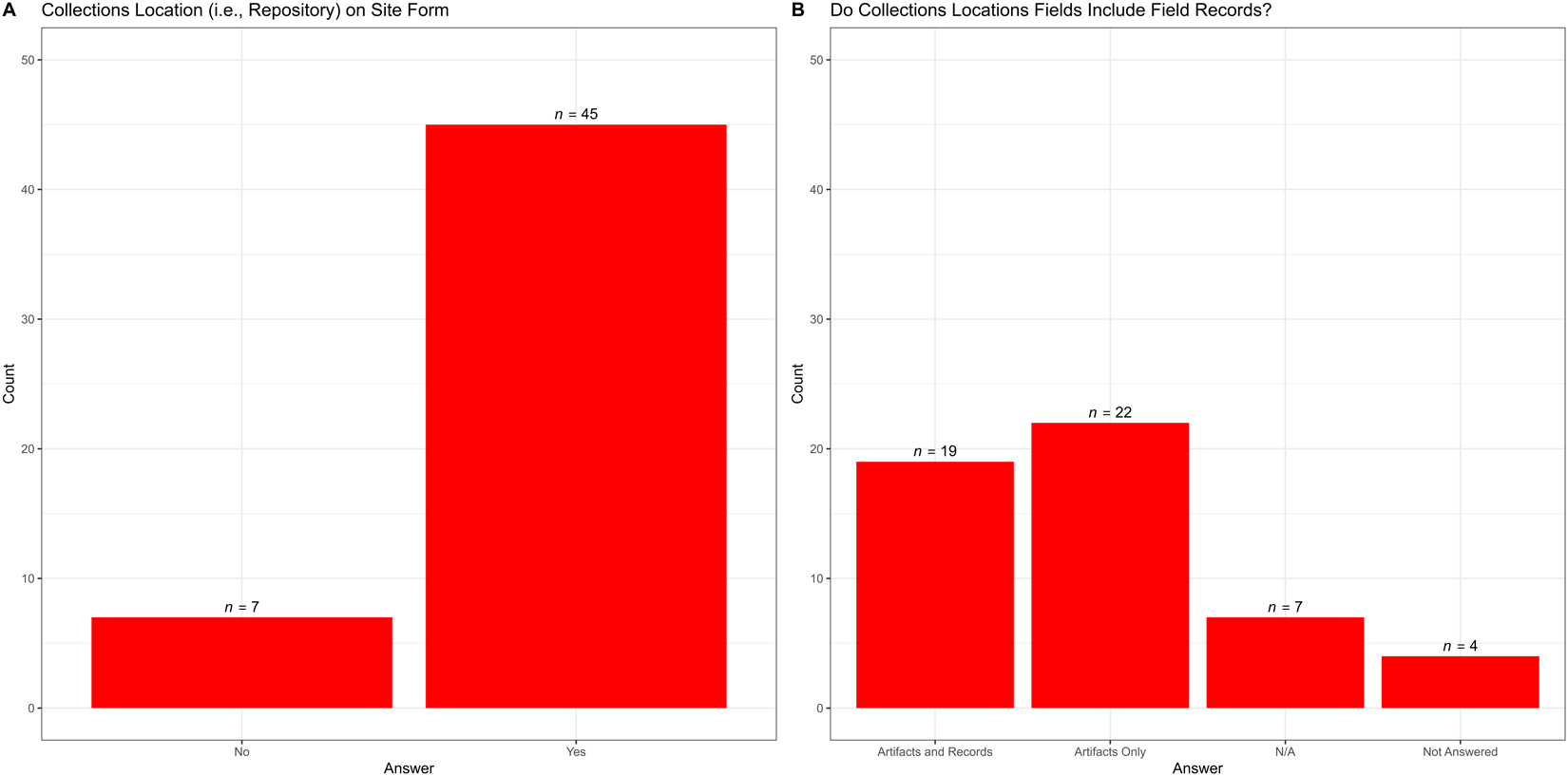
In the summer of 2025, we researched information captured in the site files of all 50 states, Washington, DC, and Puerto Rico by contacting the state site file manager and examining the site form itself. Our results show that only three states do not have any fields that provide descriptions of artifacts or associated records related to the site on the form. Most states ask for the name of the repository that houses a collection from the site but do not ask explicitly about where the associated records are located (Figure 2A). In fact, sometimes we had to infer whether fields referring to location of collections encompassed both artifacts and records based on the terminology used on the site forms. When it was ambiguous or completely unclear, we used “Not Answered” in Figure 2B.
Summary results from survey of state site files managers. Graphic by Elizabeth Bollwerk.

It is worth noting that what is encompassed in the term “records” can vary. Some states require photos of the site but expect the photos to be incorporated into the site form rather than the photographic collections. We were also interested in whether any states asked about the condition of the collection—that is, if it was cleaned, bagged, boxed, and/or cataloged or if it met repository standards for preservation and access. No states require respondents to include that information, and only one state manager noted that the form has a field called “Description” where a respondent could fill in that information. Otherwise, we found that most site forms had open text boxes for more information.
Some important caveats in our results include the fact that the artifact summaries in state site files may describe observations in the field, especially from noncollection surveys. Typical information includes the surface or excavation method(s) used, whether artifacts were collected, the artifact classes and counts, and identification of diagnostics with descriptions. These fields were most often on the site forms that also asked for the repository name. Seven states—Arkansas, Delaware, Florida, Minnesota, North Carolina, Ohio, and Oregon—collected information about accession numbers at the identified repository.
Many site forms are filled out to document sites identified and evaluated by pedestrian survey, and not all sites have an associated collection. Artifact data on a site form might be preliminary or not applicable, but collection-related fields should still be available for updating. Also, several site file managers noted discrepancies between the data recorded at the time the site form is filled out and the disposition of artifacts, if collected. Others mentioned that collections information, such as repository name, are in the site report, on a permit, or in the state’s database, and so do not necessarily need to be on the site form. We further observed that some states have updated their site forms over time, so there is a possibility that collection-related fields have changed, even since we conducted our survey. Also, sites discovered on federal property may only live in federal site databases and are not shared with states. Finally, the site files and the archaeological collections for several states, such as Arkansas, Arizona, Ohio, Iowa, Kentucky, Utah, and Wisconsin, are housed in the same or a nearby facility, so the site form does not have information about the collection because it is available through the repository.
The main conclusion from this review is that archaeologists who have access to state site files will not be able to easily use the information from most state forms to find archaeological collections pertinent to a proposed mitigation strategy. Currently, site management information is built to support fieldwork-dominated planning. Archaeologists might be able to learn the name of the repository where a useful collection is curated, but they might not know what kinds of artifacts are in the collection, or vice versa—they may know the artifact types and diagnostics but not where or if they are curated. Currently, state site files do not provide a reliable source of information about existing collections, but 16 of the 40 site files managers we contacted indicated openness to revising the data fields, should both the resources and a need be established. Based on these results, we suggest that in searching for collections information at this time, investigators may need to start by working directly with repositories likely to have pertinent collections instead of state site files. This is not a reason to avoid or delay collections-based work but a recognition that some creativity and resourcefulness may be needed as we develop the information access and infrastructure for the work ahead.
Due Diligence
Numerous existing collections from significant archaeological sites would be invaluable resources if rehabilitated or even easily findable. These resources are likely important educational instruments with high interpretive potential for local or regional histories, but they are of limited broader use until they are reorganized, cataloged, analyzed, and rehoused using current archaeological and curation methods and techniques.
Once potential collections and their records are identified, it is time to do some due diligence. Archaeological firms should always expect the unexpected when working with existing collections. Just as there are inevitable surprises during fieldwork, planning and budgeting for work with existing collections should allow adequate labor and resources to achieve successful completion of a project with room for some unknowns and unanticipated challenges.
Setting a scope, creating a plan, and drafting a budget for review can be challenging. Identifying what is available will need advance planning, as it requires working closely with data managers at state repositories, curators/collections managers, lab managers, SHPOs, THPOs, and Tribes and other descendant communities. It will also be important at this stage to learn about how the repository considers and supports rehabilitation, executes loans, and handles research requests. Most repositories have either searchable archives or databases to identify sites of interest, such as those of similar geographic or temporal positioning.
Next, it will be useful to contact a repository to gain access or plan a visit. The result of doing the initial inventory should be a list of site and/or accession numbers and collection names that can be further explored to assess the presence and condition of field records and artifacts.
Getting a comprehensive view will also require reviewing the records of state and federal agencies, universities and private museums (both smaller institutions and ones national in scope, like the Smithsonian Institution), and local and avocational archaeology or history organizations. This is similar to the work conducted as part of literature review efforts in the early stages of any archaeological project. A condition assessment checklist might include:
• Estimate of assemblage size (number of artifacts or boxes)
• Organizational parameters (context, material type)
• Completeness of the collection
• The degree of processing (cleaned, labeled, inventoried)
• The presence, file format (analog/digital/both), storage medium, and condition of
∘ Original field records
∘ Site maps
∘ Images/photographs
∘ Data analysis records
• Documented repatriation or deaccessioning of a portion of the collection.
This assessment will help provide an overall sense of the amount of work needed to be able to make an existing collection accessible and reusable, and it will be useful for planning the types of rehabilitation and rehousing, if any, that is needed. If the collections are in good shape, it should be possible to move directly to research, collaboration, and public outreach outcomes, such as those described in the case studies.
Budget development for agency review and funding by the agency or a private-sector project proponent will include line items for personnel to bring the collection to modern curation standards and in doing so make the collection ready for research. It should also include funding for analysis, report preparation, outreach, and engagement activities, and ultimately, for the donation or return of the collection to a qualified repository. Creating realistic funding expectations for each of these tasks is an essential component of internal agency budgeting for archaeological mitigation and for CRM firms hired to perform the mitigation.
Conclusions
In this article, we ask readers to consider the reuse of existing collections as a mitigation solution to resolving adverse effects on archaeological sites following a project-scale or landscape-scale framework. We also encourage agency decision-makers and CRM firms to make this kind of work a normal part of a multimodal methodology by recognizing existing collections as a resource in the development of proposals, agreement documents, treatment plans, and research designs. Millions of artifacts, samples, documents, and photographs from CRM projects, academic expeditions, and local archaeological society excavations sit in repositories and storerooms and hold significant untapped potential to answer questions about the past and how we, as individuals and as communities, connect to the past (Childs Reference Childs and Stevenson2022; Kováčik et al. Reference Kováčik, Campbell and Marston2026). As a profession, we are increasingly ready to take this work on. We argue that it is time for a culture shift. We envision a mindset that deemphasizes the 3Ds as the default solution to mitigating adverse effects on historic properties and, instead, invests in collections that better meet the public and research intent of mitigation.
All parties involved in the Section 106 process and other Tribal, state, municipal, or other historic preservation programs should view collections work in mitigation situations as steps in a “collections management cycle” (Childs and Benden Reference Childs and Benden2017; Figure 3). Notably, the transfer of collections to a repository is, at the same time, the responsible end point of an archaeological mitigation and a starting point for a future of mitigation outcomes that directly benefit communities and the public.
Incorporating existing collections use and reuse as an essential part of the collections management life cycle. The cycle repeats itself with every new project. Image adapted from Childs and Benden (Reference Childs and Benden2017). Graphic by Elizabeth Bollwerk.

Our case studies show that the resources are already present for this work in a limited fashion. Graduate students are increasingly incorporating curated artifacts and associated records into their research. Our workforce of the future brings familiarity with collections research. We also seek to systematize the approach by encouraging new decision-making frameworks, developing a data-rich infrastructure, and expanding support for repositories. Project MOAs and agency scoping documents need to set a higher bar for research and outcomes that benefit the public and allow for collections-based mitigation. Current synergies in CRM draw on a desire to build on past work for better CRM, and existing collections work can be part of this agenda.
In 2022, the Society for American Archaeology and the National Park Service identified topics concerning archaeological collections and records as a key area of concern within the broader range of CRM archaeology when developing the Airlie House 2.0 (AH2) initiative. This article is one outcome of that work. Another key area of need is the development of regional or national databases to find archaeological collections, which is another AH2 effort that is underway. The Society for Historical Archaeology also started the OMG This Collection is a Gold Mine survey to assist students and researchers doing collections-based research in historical archaeology. If these finding aids are hosted on a publicly accessible digital platform, it will make a once substantial and time-consuming effort related to collections reuse available to all parties during mitigation project planning. Other priorities include improving training in collections, curation, and digital data management, and continuing to collaborate with descendant communities in collections-related activities (Banks et al. Reference Banks, Childs, Douglass, Hawkins, Jones, Klein and Lindsay2025; Benden Reference Benden, Childs and Warner2019; Childs et al. Reference Childs, Barker, Bollwerk, Herr, Neller, Tomka, Klein, Hawkins and Mudar2027). To increase the use of existing collections, repositories will need the capacity to be partners in all this work, including evaluating scopes of work focused on reusing collections and ensuring appropriate review by their own Tribal or descendant advisory committees.
Established in 2017, the Coalition for Archaeological Synthesis (CfAS; Altschul et al. Reference Altschul, Kintigh, Klein, Doelle, Hays-Gilpin, Herr and Kohler2017; Coalition for Archaeological Synthesis 2025) now oversees two centers for archaeological synthesis: at the University of Colorado in Boulder and at Kiel University in Germany. Their mission is explicitly to support the reuse and integration of CRM-derived data, to make publicly funded work more impactful than can be achieved by any single project, and to address substantial questions about the human experience in the past and present. The most prominent work of CfAS is the development of design workshops that catalyze research through collaborations with diverse scholars. There is substantial unrealized potential in the workshops and outreach of this organization to educate and build capacity for synthesis throughout the implementation of CRM archaeological projects.
Across the country, Tribal nations are constructing, renovating, and staffing Tribal repositories to serve their communities and hold collections derived from past or current CRM projects (Neller Reference Neller, Childs and Warner2019). Their care and management of collections will affect how CRM practitioners use, reuse, manage, and interpret collections (Bryant et al. Reference Bryant, Taylor and Cruz2025; Society of American Archivists 2009). Collaboration with these institutions and Tribal historic preservation and CRM offices will also be critical (Neller Reference Neller, Childs and Warner2019; Thompson et al. Reference Thompson, Thompson, Garland, Butler, deBeaubien, Panther and Hunt2023).
The federal CRM landscape already has policies, programs, and projects that are fundamental to an expansion and transition in archaeological mitigation programs. Incipient systems in agencies and in physical and digital repositories may be able to adjust and expand to accommodate a shift toward mitigation using collections. For example, a report developed by the Transportation Research Board, and currently in review, provides guidance on program alternatives that include collections work (Mead and Hunt 2026). Other places of potential support include the redesign of archaeological site forms by state site files managers, such as recently occurred in Kentucky. Professional organizations are often in a position to advocate for forward-looking CRM practices and will continue to be key partners. Now it is up to us to find the opportunities. We hope this article has provided a robust next step in that direction.
Acknowledgments
This article was an action item identified by the “Archaeological Collections, Including Records” topic group at the Airlie House 2.0 workshop in 2024. We thank the other topic group members for their work to initiate this and a series of other collections-related efforts: Alex Barker, John Doershuk, Jenna Domeischel, Trevor Duke, Mary Beth Fitts, Paul Green, Julie King, Eugene Marino, Elizabeth Moore, Karen Mudar, Angela Neller, James Nyman, and Isaac St John. Authors Lori Thompson and Heather Olson were not in the original topic group but became great partners when asked to help with this article. Thank you to all the state site files managers who responded to our questions. Myles Miller provided guidance on the Permian Basin case study. Terry Klein, Signe Snortland, Ira Beckerman, Joe W. Joseph, and Alex Barker read a draft and helped us clarify and improve our presentation. Sean Morgan provided the Spanish translation. We are grateful to the editor and the four anonymous peer reviewers for their feedback and assistance.
Funding Statement
No funding was provided for this work.
Data Availability Statement
Data from the survey of state site file managers and state site forms and the R-code file used to create the figures is hosted at https://core.tdar.org/collection/89510/incorporating-existing-archaeological-collections-into-cultural-resource-management-mitigation.
Competing Interests
The authors declare none.




 Open access

