




No CrossRef data available.
Article contents
Spelling bilingualism: Script choice in Russian American classified ads and signage
Published online by Cambridge University Press: 17 August 2005
Abstract
This article investigates the role of script choice in bilingual writing, drawing on classified advertisements and other texts written for and by Russian-speaking immigrants in New York City. The study focuses on English-origin items that appear in Russian texts, which are found to be written either in roman or Cyrillic script. Through an investigation of categorical and variable constraints on this variation, it is found that script choice relates to the distinction between lexical borrowing and single-item codeswitching. It is argued that writers may, consciously and on a token-by-token basis, choose the Cyrillic script to mark a word as borrowed or the roman script to mark it as foreign. However, they may also avoid this choice, as hybrid forms attest, especially when the use of characters shared by both alphabets allows ambiguous readings. The findings thus have implications for understanding notions of language boundaries in bilingual language use.Versions of this article were presented at two conferences: “Alphabetics: Interpreting letters” at Harvard University, 26–27 April 2003, and NWAVE 32, Philadelphia, 9–12 October 2003. I thank the audiences for their valuable insights and observations, especially Erika Boeckeler and Daniel Kokin. I also owe thanks to Katya Korsunskaya, Vladislav Rapoport, Doris Stolberg, Mario Geiger, and Tobias Kuhn. I am grateful to John Victor Singler, Mark Sebba, and Jannis K. Androutsopoulos, as well as to Jane H. Hill and to two anonymous reviewers for their valuable comments and suggestions. All errors and omissions remain my own.
Information
- Type
- Research Article
- Information
- Copyright
- © 2005 Cambridge University Press
INTRODUCTION
The attribution of lexical items to particular languages is a crucial issue for research on language contact phenomena, even if it is not always acknowledged as such. In fact, there are many instances where it is difficult, if not impossible, to tell which language a given word belongs to. Bilinguals frequently produce forms that diverge from monolingual norms of either language, as well as other forms that conform to both norms at the same time. The classification of such divergent elements and the question of whether they can be classified at all have been controversial among linguists studying bilingual language use, and this topic has proven to be of great theoretical importance for the advancement of research in this field.
In particular, debates in language contact studies have centered on the classification of single lexical items, most commonly nouns, which are perceived as originating in one language but which occur in structures of another language. Have such words become part of the lexicon of the receiving language (i.e., lexical borrowing), or does their use indicate that a speaker has temporarily switched from one language to another (i.e., single-item codeswitching)? This distinction plays a crucial role in the debate surrounding two conflicting models of codeswitching: on the one hand, those that see codeswitching primarily as an alternation between two grammars (e.g., Poplack 1980), and on the other hand, those that see it as an insertional phenomenon in which elements from one language are inserted into the grammatical structure of another language (e.g., Myers-Scotton 1993). While proponents of both models seek to distinguish between codeswitching and borrowing, they differ markedly in how they attribute tokens to one or the other category. In the alternational view, a word is borrowed if it behaves like a native word with respect to the categorical and variable constraints in the grammar of the recipient language. This is taken to be true even for lexical items that occur only once in a given corpus, known as “nonce-loans” (Sankoff et al. 1990). In the insertional view, by contrast, codeswitches and borrowings differ not on the surface but only in their status in relation to the mental lexicon of the recipient language, because borrowed forms are entered in this mental lexicon but codeswitched forms are not (Myers-Scotton 1993:207). The argument over codeswitching and borrowing is thus very much a question of the attribution of a given lexical item to a particular language and of defining boundaries between the languages in contact. What both models have in common is that they treat lexical items as inherently “belonging” to a given language. They do not see the attribution of lexical items to languages as an active process that speakers may be conscious of and have control over.
Investigations into these and other language contact phenomena have relied almost exclusively on spoken data, as revealed by the title of Muysken's (2000) book Bilingual speech. One reason for this may be that contact phenomena such as codeswitching are generally regarded as characteristic of informal speech styles, which can be observed only in informal settings. From this perspective, written language does not appear to be a suitable site for codeswitching research because it is generally more formal and more standardized than spoken language. For example, Milroy & Milroy (1991:66–67) emphasize that the ideology of “correct” orthography strongly inhibits variation in written language. This also relates to language choice: Sebba 2002 identifies what he calls “the tyranny of written monolingualism,” a norm which dictates that printed texts have to be monolingual. He argues that written language alternation can be found only in unregulated, “peripheral” genres of writing such as graffiti, advertisements, or computer-mediated communication, where the ideology of language standardization is less powerful or is openly opposed. Poetry and fiction represent another exception, since codeswitching may be used intentionally as a literary device.1
Codeswitching in literature has occasionally been the subject of linguistic research. A well-known example is Timm's (1978) study of switching between Russian and French in Tolstoy's War and Peace. However, her study contains no reference to the alternation between the Cyrillic and roman alphabets.
In largely ignoring written data, the field of language contact studies is following a tradition in sociolinguistics that views informal speech as the ideal source for sociolinguistic data. Linguists rarely pay attention to written language use, and if they do, they often don't study it for its own sake, but rather as a substitute for spoken language when speech data are not available. However, in recent years sociolinguists have begun to pay more attention to writing as they have come to recognize variability in orthography as a socially conditioned phenomenon (e.g., Jaffe 2000). One form of variability in writing exists in the possibility of variation between different writing systems. The use of multiple writing systems within the same speech community has been termed digraphia (Zima 1974, Dale 1980, De Francis 1984, Grivelet 2001), by analogy with “diglossia” (Ferguson 1959). Script variation in digraphic contexts has been the subject of some sociolinguistic research, for instance on variability in written Japanese (Smith & Schmidt 1996). However, in allusion to Fishman's (1967) extension of the notion of diglossia, it can be noted that there is also “digraphia with bilingualism,” where language contact involves two languages that are commonly written in different scripts. In fact, this is the case with many instances of language contact throughout the world, but relatively few studies of script variation have been conducted in such contexts – for example, involving English in contact with Hebrew (Lubell 1993), with Chinese (Cheung 1992, Li 2000), or with languages of the Indian subcontinent (Banu & Sussex 2001, LaDousa 2002). In such language contact situations, bilingual texts are produced which include elements from both languages and use both writing systems. Such alternation between writing systems within the same text has so far received little attention from linguists. Gazda (1998:163) uses the term graphical transplantation (grafická transplantace) to describe the occasional occurrence of roman script for foreign words in Russian texts. Examining written data from Bangladesh, Banu & Sussex (2001:54) speak of graphological code-switching.
In such bilingual writing, authors need to negotiate two different standardized orthographies, each one tied to a different writing system, a different visual form in which words may be represented. When authors attempt to integrate elements from both languages within one text, they may either alternate between writing systems, or they may transliterate words from one language into the writing system associated with the other language. In this, script choice parallels the distinction between codeswitching and borrowing. Codeswitching, as defined for example by Poplack & Meechan (1998:129), “should show little or no integration into another language.” In other words, elements from different languages can be combined while maintaining their original form. In writing, this original form is dependent on a particular script that is typically used for a given language. Borrowed forms, in contrast, are nativized, made to fit the form of the recipient language (“‘Borrowing’ is the adaptation of lexical material to the … patterns of the recipient language”; Poplack & Meechan 1995:200). In writing, this adaptation can be achieved by transliterating a word into the writing system of the recipient language, giving it a new form that fits the recipient's orthographic norms. The need to choose a particular writing system thus generally forces bilinguals to attribute a word to a given language, because each language is tied to a particular script and a particular orthography. When there is uncertainty as to which language a lexical item “belongs” to, this orthographic choice may be taken as evidence that the writer attributes a form to a particular language, whether this reflects an unconscious categorization or an intentional choice.
In this article, I investigate the relationship between orthographic choice and language attribution by analyzing script choice in texts produced by and for Russian speakers living in the United States. Russian-English bilingualism provides an example of language contact involving different writing systems, as Russian is written in Cyrillic and English is written in roman script. Where English-origin items are included in texts that are otherwise in Russian, they may be represented in roman script, corresponding to standard English orthography, or they may be represented in Cyrillic script. In order to conduct a quantitative analysis of this script choice, I compiled a data set of 1,263 tokens, mostly from classified advertisements in Russian-American newspapers but also from news articles and advertising brochures. This data set was further supplemented with photographs of Russian-language signage. As I will discuss below, the data prove to be almost evenly divided between the two writing systems but also include a number of mixed forms in which elements of both scripts are combined. To determine the constraints that govern the variation in script choice, I conducted a multivariate analysis in which I identified both variable and categorical constraints. The results suggest that linguistic factors such as morphological integration play an important role in conditioning script choice. At the same time, the variation is also constrained by social factors, indicating that the written representation of linguistic items may be both variable and ideologically contested among members of a linguistic community. This is emphasized in particular by some exceptional cases in which authors avoid a clear choice by using elements from both writing systems within a single word, whether intentionally or unintentionally.
Demonstrating the variable nature of such categorizations in writing, the analysis of script choice thus has implications for bilingual speech as well. The findings of this study pertain to the role of language boundaries in bilingual language use, especially in that they illustrate the theoretical possibility that these boundaries remain variable – that is, that a particular lexical item may be attributed to different languages by different speakers, or even by the same speaker in different contexts. At the same time, the study addresses the differences between bilingual writing and bilingual speech by pointing to the role of standardization in written language in determining the degree to which ambiguity and hybridity are possible and metalinguistic categorization may be avoided.
I will begin with a general discussion of language use and script choice among Russian-speaking New Yorkers, focusing on variation in the written representation of English-origin lexical items. Drawing comparisons between the phenomena of lexical borrowing and transliteration, I will investigate the degree to which script choice can be taken as an indication of language membership. To do so, I will discuss the factors that constrain this variation, beginning with linguistic factors, which may in part be taken to reflect unconscious metalinguistic categorizations, before turning to social factors, which point toward conscious sociolinguistic choice. In the final section, I will discuss hybrid forms which challenge both the cognitive and the ideological bases for the separation of the two languages.
LANGUAGE AND WRITING SYSTEM: ASSOCIATION AND DISJUNCTION
Over the past three decades, the number of Russian speakers in the United States has greatly increased, a result of continuous immigration from various parts of the former Soviet Union (see Gold 1995, Hinkel 2000, Orleck 2001). In the 2000 U.S. Census, approximately 700,000 respondents claimed to speak Russian at home. About one-third of them live in the Greater New York area, making Russian the fourth most commonly spoken language in the city, after English, Spanish, and Chinese.2
Source: U.S. Census Bureau, Census 2000 Summary File 3, Matrix PCT10. (See http://factfinder.census.gov/).

Advertisement on Kings Highway, Brooklyn.

Advertisement in Brighton Beach, Brooklyn
Figures 1 and 2 show bilingual signage for various businesses in Brooklyn. Each sign consists of two parallel monolingual texts, one in English and one in Russian, which are translation equivalents. In each case, the English text is placed above the Russian text, but fonts or script size may make the Russian text more prominent (e.g., in the case of flowers and

cvety).
3In transliterating Cyrillic forms into roman script, I follow the ISO system; see Cubberley (1996:351).

Combinations of languages and scripts (cf. LaDousa 2002: 224)
To examine the distribution of script choice in Russian-American writing, I collected data from Russian-language newspapers published in New York City, as well as from brochures, advertising, and signage written by and for Russian speakers in the United States.4
The newspapers included were the daily

(Novoye Russkoye Slovo) and the weeklies

(Forverts, Russian Forward),

(Russkaya Reklama),

(Russkij Bazar, Russian Bazaar),

(Vecherniy New York),

(Kurier),

(Poleznaya Gazeta) and

(V novom svete).
Of the four possible permutations shown in Figure 3, the use of Russian in Cyrillic script predominates in the data, which is not surprising since all news articles and nearly all advertisements found in Russian-American newspapers are written in Russian. By contrast, transliteration of Russian words into roman script is very rare. It is found with Russian words that are part of proper names, particularly when the intended audience includes non-Russian speakers, for example in signage of Russian-owned businesses or institutions, or in the publishing and pricing information underneath the title of a newspaper. Figures 4 and 5 show uses in signage. In addition, it is found when the use of the Cyrillic alphabet is not available for some pragmatic reason, for example in 1-800 telephone numbers or web addresses (see also Fig. 18).

The Zamore: Sign of co-op apartment building in Brighton Beach, Brooklyn (zamor'e ‘country overseas, abroad’).

Primorski Restaurant in Brighton Beach, Brooklyn (primorskij ‘by the sea’).
The representation of English words in Russian texts is less predictable. As shown in Figure 3, English words or proper names may either be transliterated into Cyrillic script, or they may be maintained in their original spelling in roman script. In my data, there is considerable variation between the two strategies. This is illustrated in X>Figures 6–9, which show instances of the English compound noun food stamp used in Russian sentences, in either Cyrillic or roman script.
All the images include signs that inform customers about a store's policies regarding food stamps.5
Food stamps are coupons which can be used to purchase groceries as part of a federal welfare program administrated by the U.S. Department of Agriculture.
The sign refers to food items prepared in the store, such as roasted chicken or soup.
In his study of bilingual signage in Quebec, Shell (1993:50–51) uses the term “semiotic mediator” to describe elements such as food stamps in Figure 8, which participate in two texts at once and act as a connection between them.

Sign in a store in Brighton Beach, Brooklyn.

Sign in a store on Ditmas Avenue, Brooklyn ( fudstempy).

Sign in a store in Brighton Beach, Brooklyn.

Sign in a store in Brighton Beach, Brooklyn ( fudstempy i kredit karty).
Figures 10 and 11 show similar examples from personal ads placed in Russian-American weekly newspapers. The text in Figure 10 has the English lexical item green card in roman script, and Figure 11 has it in Cyrillic. The two forms occur in virtually identical syntactical environments: In both cases the noun is the direct object of the same participle (vyigravšim/vyigravšej ‘having won+instrumental.m./f.’) and is followed by a prepositional phrase. The ad in Figure 10 can be transliterated as Mne 23 goda, poznakomljus' s parnem, vyigravšim green card v ètom godu ‘I'm 23 years old, looking to meet a guy, who has acquired the green card this year’. The text in Figure 11 reads Poznakomljus' s odinokoj ženščinoj, vyigravšej grinkartu v ètom godu. Biper ‘Looking to meet with a lonely woman, who has acquired the green card this year. Beeper’.

Personal ad in Vecherniy New York, January 24–30, 2003.

Personal ad in Russian Bazaar, January 18, 2002 ( grinkartu).
As mentioned above, the categorization of lexical items like food stamp or green card in the above examples has been the subject of much controversy among researchers studying bilingual speech. While it is a fairly trivial task to identify such items as having an “alien” origin that distinguishes them from the structures in which they appear, linguists differ in their interpretation of the processes that lead to the usage of these lexical items in their given context. Muysken (2000:69), for example, distinguishes between the processes of “inserting alien words or constituents into a clause” and “entering alien elements into a lexicon.”
The question of whether or not a form has been entered into a lexicon has traditionally, though not exclusively, been approached from the perspective of the linguistic community, with forms being uncontroversially classified as “established” borrowings (or loanwords) if they are habitually used by speakers of a given linguistic variety (Myers-Scotton 1993:16, Poplack & Meechan 1995:200). Codeswitching, in contrast, is generally illustrated by examples used by individual speakers in particular contexts, especially when the argument is made that an “alien” word is inserted in order to invoke specific social connotations that are associated with the word's language of origin (see, e.g., Auer 1998:7). The fact that these related phenomena are most easily approached from contrasting perspectives points to the interplay between the community norms concerning the metalinguistic categorization of lexical items on one hand, and the attribution of social values to particular usages on the other. It suggests that the social significance of individual usage is more salient if it contrasts with community expectations – that is, if a lexical item is used in a way that differs from the way in which it is used most commonly by other bilingual speakers of the same varieties. However, this should not preclude the theoretical possibility of widespread, repeated codeswitching, or isolated instances of (“nonce”) borrowing.
As hypothesized above, script choice can provide a new perspective on such questions owing to the association between languages and writing systems. Community norms are particularly relevant to written language use, yet script choice also provides individual authors with a highly salient tool for identifying the language to which they choose to attribute a given lexical item, regardless of whether this choice contrasts with community norms. In order to investigate the relationship between script choice and language attribution, I set out to conduct a statistical analysis of script choice for English-origin items in Russian texts. I collected examples of English lexical items which appeared in Russian sentences, mostly from classified advertisements in Russian-American newspapers. Altogether, I compiled a data set of 1,263 tokens representing 282 different lexical items. These items were almost exclusively nouns or noun phrases.8
The data contain 26 tokens that are not nouns or noun phrases. All are content morphemes with an adjectival character, e.g. forms qualifying types of employment such as part-time, full-time, or long-distance. All tokens are written in roman script except for one:

part-tajm rabotu, ‘part time work+ACC.’ in an ad in Vecherniy New York.
Script choice for English-origin items in Russian texts.

In the following section, I will discuss a number of different criteria that have been described in the codeswitching literature as characteristic of borrowing (see Muysken 2000:60–85). I will show how they relate to the data with respect to script choice, beginning with a characteristic that is at the heart of the codeswitching debate: the question of morphological adaptation of foreign-origin items.
MORPHOLOGICAL ADAPTATION AND SCRIPT CHOICE
As Table 1 shows, English-origin items in Russian texts occur frequently in either script. However, when we classify the tokens according to certain linguistic characteristics, clear preferences for one or the other script emerge. In particular, case marking constrains alphabet choice in a powerful way. Like all other Slavic languages, Russian has a rich nominal inflectional system in which noun phrases are marked for case, gender, and number, and there is agreement between nouns, adjectives, and demonstratives, but also between the NP and its associated participles or relative pronouns. In a study of Ukrainian-English bilingual speech, Budzhak-Jones 1998 notes that English-origin nouns frequently, but not always, receive overt Ukrainian morphology. Gregor (2002:72) makes a similar observation for Russian-English bilingual speech. The same is true for the written data under consideration here: When an English noun is used in a Russian sentence, it may or may not receive a Russian case ending. However, variation between these two alternatives strongly correlates with script choice. In those environments where Russian syntax requires overt case marking, it never shows up on English nouns that are written in roman script (0/225), but it is almost always present on those written in Cyrillic script (367/379), as shown in Table 2.
Case marking and script choice of English-origin NPs in Russian texts.

This finding can be illustrated by comparing Figures 12 and 13, both classified ads containing the English word housekeeper. Figure 12 reads Opyt, rekomendazii, rabotu housekeeper ‘experience, recommendations, work as housekeeper’. The text in Figure 13 can be transcribed Ol'ga iz Sankt-Peterburga iščet rabotu xauskipera ili pomošč' na domu ‘Olga from Saint Petersburg seeks work as a housekeeper or help in the house’ Both instances of the English-origin noun housekeeper appear in the same syntactic construction, as complements of the noun

rabotu ‘work+acc.,’ for which the genitive case is required. However, while the Cyrillic form

xauskipera (Fig. 13) receives the genitive case ending -a, the roman form in Figure 12 does not. The same can be observed with green card and

grinkartu in Figures 10 and 11, or with food stamps and

fudstempy in Figures 8 and 9. Again, the contrasting forms occur in the same syntactic environment, but only the transliterated forms receive Russian case marking. This finding is clearly reminiscent of the so-called Free-Morpheme Constraint proposed by Poplack 1980, in which she posits that codeswitching cannot occur between a root and a bound morpheme, as illustrated in ex. (1):


Classified ad in Russkaya Reklama, January 24–30, 2003.

Classified ad in Russian Bazaar, April 10-16, 2003 ( khauskipera).
In a similar way, the findings of this study suggest that alternation between scripts cannot occur between a root and a bound morpheme, as illustrated by the contrast between (2a) and (2b). Of the 604 English-origin NPs for which Russian requires overt case marking, 367 (61%) follow the pattern in (2a): the case-marking suffix is present and both the root and the suffix are in Cyrillic. The data set includes no instances of the pattern in (2b) – a root in roman script and a case-marking suffix in Cyrillic.
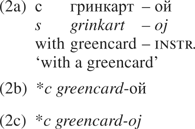
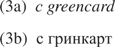
However, this constraint is not just directed at alternating scripts, since forms like (2c), with the case morpheme transliterated, are not found either. Clearly, the presence of Russian morphology in a Russian text requires the use of the Cyrillic script. If an English NP occurs in the roman alphabet, it is never case-marked. An example is given in (3a), which is representative of 37% of those tokens for which case marking is required by Russian syntax. By contrast, forms in Cyrillic where overt case marking is absent – as in (3b) – are rare. Only 12 of the 604 NPs in the data set (2%) fit this pattern.
Although numerous authors have reported counterexamples to the Free-Morpheme Constraint in bilingual speech (e.g. Eliasson 1990; Bentahila & Davies 1991; Myers-Scotton 1993:30–34), the categorical absence of overt case marking on roman script forms points toward an important difference between writing and speech. This suggests that bilingual writing is more constrained than bilingual speech when it comes to combining elements from two languages within one word, a finding that clearly corresponds to observations on the limits of variability in writing (Milroy & Milroy 1991, Sebba 2002). At the same time, the discreteness of the two languages is arguably more salient in bilingual writing than it is in speech because standard orthography (and in the biscriptal case, the association with a particular writing system) marks words as belonging to a given language. This in turn suggests that the proposed Free-Morpheme Constraint has explanatory relevance after all, despite being “violable” in spoken language use. Instead, its validity may be taken to depend on the degree to which the discreteness of the languages is contextually salient.
In Poplack's analysis, the morphological adaptation of foreign-origin lexical items is taken as evidence that such items are borrowed. Likewise, Budzhak-Jones 1998 concludes for her data that English nouns with Ukrainian case marking must be examples of lexical borrowing because they display all properties of Ukrainian-origin nouns. In my data set, inflected English nouns like green card in (2a) share an additional property with Russian-origin nouns: script choice. Following this line of analysis, the data thus suggest that writers use script choice to mark a lexical item as belonging to a given language; that is, they use the Cyrillic alphabet to mark a word as borrowed.
Figures 14 and 15 are included to illustrate instances where case marking is absent after prepositions that require a specific case. Figure 14, a personal ad, contains the following text: Prijatnyj mužčina 49 let, 10 let v SšA, xočet dlja long or short term relationship moloduju, privlekatel'nuju ženščinu na [sic] starše 35 let ‘pleasant man, 49 years old, 10 years in the US, wants a young, attractive woman, not older than 35, for a long or short term relationship’.9
The text contains an apparent typographical error, with na ‘on’ instead of ne ‘not.’

Personal ad in Russian Bazaar, April 10–16, 2003.

Help wanted ad in Russkaya Reklama, January 24–30, 2003.
Figure 15 contains a help-wanted ad which can be transliterated and translated as follows: Bruklin. Oficianty, 18–35, s opytom, rabota v prestižnom catering hall, večerom, na vyxodnye ‘Brooklyn. Waiters, 18–35, with experience, work in prestigious catering hall, evenings, on weekends’. Here the English compound catering hall is not overtly case-marked for the prepositional case, but the adjective prestižnom is. However, the suffix -om expresses not only prepositional case but also masculine or neuter gender, which it receives from the noun. Thus, even though catering hall is not morphologically adapted itself, it appears to have an inherent Russian gender that the adjective prestižnyj can agree with.10
This may well be a case of gender marking by default, since the adjective cannot be case-marked without also being gender-marked, and no bare (i.e., suffixless) form of the adjective is available.
Forms such as catering hall (Figure 15), which lack system morphemes required by the recipient language, have been termed bare forms in the codeswitching literature, but their classification as borrowing or codeswitching has been subject to debate. Myers-Scotton (1993:192), for example, states that “it may be that, while both B [borrowing] and CS [codeswitching] forms may be bare forms, there are significantly more such forms under CS [codeswitching].” Poplack & Meechan (1995:222) suggest that bare nouns are best classified as belonging to that language which shows a higher frequency of bare nouns in unmixed speech (which would surely be English here, given Russian case-marking). Again, if we take script choice as a marker of language attribution, both suggestions are supported here, since bare forms occur overwhelmingly in roman script (95%), as shown in Table 2. At the same time, the fact that such bare forms can participate in agreement phenomena shows that the distinction between codeswitching and borrowing has to be viewed as gradual rather than categorical.
Exx. (4) and (5) show apparent counterexamples to the generalization made in (2b), where Russian case marking was found only on roots written in Cyrillic. In these cases, quoted from Gazda (1998:164), a foreign-origin lexical item is rendered in roman script but receives a Russian case-marking suffix in Cyrillic. In these and all other examples given by him, the suffix is separated from the root by an apostrophe, orthographically marking the transition between the two scripts.

Gazda's examples come from newspapers published in Russia, as well as from Russian literature, in this case from Chekhov. These are texts produced for a monolingual Russian audience, albeit one with some knowledge of a socially prestigious second language. The different treatment of such forms in the bilingual Russian-American media as opposed to examples (4) and (5) thus hints at a difference between bilingual and monolingual texts. In particular, it suggests that the absence of case marking is less acceptable in monolingual language use than it is in bilingual language use, where the availability of a second grammar (here English) facilitates the temporary suspension of the structural constraints of Russian morphology.
However, both examples also point to the social meaning of script choice. The choice of roman script allows the author to invoke the prestige of English in the computer age (4) or the prestige of French in tsarist Russia (5), while defining the reader as one who shares specialized knowledge of prestige culture. Representing these words in Cyrillic arguably would not have the same effect. This raises the question: To what degree do authors make conscious use of script choice to mark words as Russian or as foreign? On the one hand, the categorical absence of case marking on roman forms in the data set suggests that script choice is to some degree a function of unconscious categorization. On the other hand, the attested variation between uninflected roman forms and inflected Cyrillic forms (e.g., food stamp, green card, or housekeeper in the examples above) shows that the metalinguistic categorization of these lexical items is nevertheless variable on the community level, and it suggests that authors may consciously choose a script to achieve a particular effect. In the following section, I will investigate variable constraints on script choice in order to assess the factors that lead authors to choose a particular written form.11
Script choice for borrowings or single-item codeswitches can also be a concern for linguists studying bilingual speech. While Andrews 1998 and Budzhak-Jones 1998 avoid the issue by transliterating all Russian or Ukrainian forms into roman script, Gregor (2002:20–22) specifically discusses the merits of script alternation and transliteration, opting to write in Cyrillic those English-origin words that she classifies as borrowed, and in roman script those that she classifies as codeswitched. She bases the distinction between the two on criteria of morphological and phonological adaptation, leading her to use the Cyrillic script for all English-origin items that are marked with Russian inflectional affixes. Her usage thus mirrors that of the Russian-American press.
VARIABLE CONSTRAINTS ON SCRIPT CHOICE
Case marking thus constrains alphabet choice, but as indicated in Table 2, overt case marking is not always required by Russian syntax. This is often true when English nouns occur as subject or direct object, or in an apposition. In these instances, the same lexical form could be represented in either alphabet. In order to examine script choice in these environments, I removed all examples where case marking was required, as well as invariant frequent types. A data set of 514 examples remained.12
In addition to forms that require case endings, I also removed all tokens of lexical items that occur frequently but always in the same alphabet. For example, as a lone lexical item, office is one of the most frequent words in the data set, with 127 occurrences, but it is always written in Cyrillic (

). A majority of the other frequent invariant forms were also always in Cyrillic, namely

vèn ‘van’ (30 occurrences),

lajsens ‘(driver's) license’ (20),

status ‘immigration status’ (20),

mini-vèn ‘minivan’ (11),

menedžer ‘manager’ (13), and

šitrok ‘sheetrock’ (13). The following forms were always written in roman script: salesperson/salesman/sales people (20), medical assistant (10), dental assistant (10), and receptionist (13).
Goldvarb results, use of the Cyrillic script for English lexical items in Russian texts in environments where variation was unconstrained by morphology.The factor groups were identified as significant in the following order: (1) constituency, (2) source, (3) frequency, (4) type of advertisement.

Two linguistic factor groups were identified by Goldvarb as statistically significant: the syntactic constituency of a lexical item, and the frequency with which it appears in the data. Both factors have also been proposed as diagnostic criteria for borrowing (cf. Muysken 2000:73). As can be seen in Table 3, the use of the Cyrillic alphabet is clearly favored for single nouns compared to compound nouns or multiword expressions.14
These categories were defined orthographically. If a given English noun was spelled as one word at least part of the time, it counted as a single noun.
In addition to the criteria discussed so far, a number of further diagnostic criteria for borrowing have been proposed in the literature, including semantic change, synonym replacement, culture specificity, and phonological adaptation. They could not be tested on a quantitative basis, but I will briefly address them here. Weinreich 1968 noted early on that a borrowed word may undergo semantic change compared to its meaning in the donor language, typically involving a specialization of meaning. The data contain several examples where this may be the case. For example, status is used to refer to immigration status and occurs exclusively in Cyrillic in the data set (20/20), again suggesting a patterning of transliteration with borrowing.15
Another potential example is sponsor, which is used to refer to an “immigration sponsor” but which occurs only once in the data set, albeit in Cyrillic.
This usage is illustrated by two ads, both from Russian Bazaar (April 10–16, 2003, p. 71A).

, Nadežen. Xorošee znanie anglijskogo i komp'yutera. Išču sootvetstvuyuščuyu rabotu na keš ili ček ‘Reliable. Good knowledge of English and computers. I seek suitable work for cash or check’.

cash, p/t, Programmist-èlektronščik, rabotu možno na ček ili cash, p/t, ‘Programmer-electrician, work, may be for check or cash, part time’.
Furthermore, it is often argued that borrowing has occurred if native synonyms have been replaced (cf. Sankoff & Poplack 1984:129). I did not code tokens for this category because I did not investigate systematically the native Russian vocabulary used in the newspapers. However, the advertisements provided some evidence for cases where synonym replacement appears not to have occurred – for example, housekeeper, which occurs in both scripts but more often in roman (34/46).17
See in Figure 13 the form

pomošč’ na domu ‘help in the house’ which is used alongside housekeeper, arguably its equivalent.
Compare the uses of

opyt ‘experience’ in Figure 12, and

oficianty ‘waiters’ in Figure 15. Instead of salesman, saleswoman, or salesperson,

prodavec ‘salesman’ and

prodavščica ‘saleswoman’ are used frequently.
A related phenomenon is the borrowing of culture-specific terms for which the recipient language does not have an equivalent, or so-called cultural borrowing (Myers-Scotton 1993:169). I did not code tokens for this category either, because the question of whether a Russian equivalent exists appeared often less than clearcut. For example, Andrews (1998:71–72) claims that Russian njanja is not “an appropriate equivalent” of bebisiter ‘babysitter’ because of the different connotations that it evokes. However, most English nouns are likely to have different connotations from their Russian counterparts, making the question of their equivalence one of degree, not one that can always be answered categorically.19
In any case, the majority of the English lexical items that occur in the data do not appear to be culture-specific, including such frequent forms as

ofis ‘office,’

trak ‘truck,’

van ‘van,’ or

lajsens ‘license.’
A metro card is a ticket for New York City's public transport system.
Finally, another criterion that is regularly mentioned as characteristic of borrowed forms is phonological adaptation, though it may be found in codeswitching as well (cf. Sankoff & Poplack 1984; Myers-Scotton 1993:176). In writing, phonological adaptation appears to be an almost inevitable consequence of transliteration, since Cyrillic forms are pronounced according to the Russian pronunciation of the Cyrillic alphabet.21
Transliteration is mostly phonetic, intended to approximate the pronunciation of a given word in American English. In some instances, transliteration may also be based on orthography, for example in the spelling

kolledža ‘college+gen,’ with Cyrillic double

corresponding to roman double L. Describing cases like these, Banu & Sussex (2001:53) speak of letter-by-letter transliteration, i.e. transliteration based on equivalence between characters. Transliteration may also be based purely on graphic similarities between letters. Androutsopoulos 2002 cites examples from Greek computer-mediated communication in which Greek letters are transliterated by graphically similar numbers (ξ as 3, θ as 8).
English h [h] is typically transliterated as x [x] in Russian (see

khauskipera ‘housekeeper+gen’ in Figure 11). Transliteration is also not uniform. For example, the data contain four alternate spellings of babysitter:

bebisiter,

bèbisiter,

bebisitor, and

bèbisitor.
For example, a classified ad in Russkaya Reklama (January 24–30, 2003) contains the spelling countertabs for countertops. This spelling may be taken to reflect Russian phonology both in the misinterpretation of the final, unstressed vowel and in the choice of b instead of p, possibly resulting from hypercorrection that assumes an underlying voiced labial stop and attributes the surface voicelessness to Russian final devoicing.
In summary, while the findings are not equally conclusive for all of the factor groups discussed in the previous section, a number of linguistic criteria have been identified that favor or appear to favor the use of the Cyrillic alphabet for English-origin lexical items. Table 4 gives a summary and schematic overview of the factors discussed in this section.
Characteristics of borrowing and codeswitching and their patterning with alphabet choice.

With the possible exception of cultural borrowing, it can be observed that the criteria found to be characteristic of transliteration are precisely those that have been described in the codeswitching literature as diagnostic for borrowing. Thus, it seems reasonable to conclude that the association between languages and writing systems extends to the distinction between borrowing and codeswitching. The findings suggest that a word is treated as Russian (i.e., as borrowed) if it is written in Cyrillic, and as English (i.e., codeswitched) if it is written in roman characters. In bilingual writing, alphabet choice may thus function as an indicator of metalinguistic categorization for a given lexical item.
This generalization has important implications for the interpretation of codeswitching in the data, as well as for language contact studies in general. First of all, we can note that the data set contains no instances of word-internal codeswitching, and that English-origin nouns with Russian case marking represent cases of borrowing. As mentioned above, this can be taken as evidence in support of Poplack's (1980) Free-Morpheme Constraint and of subsequent analyses by her and her associates. However, contrary to claims made, for example, by Poplack & Meechan (1998:135) that “most lone other-language items are borrowings,” there are in fact many instances of single-item codeswitching. In the restricted data set used for the Goldvarb analysis, 60% of single nouns are written in roman script; that is, they can be considered to be codeswitched, not borrowed.
Most important, though, the generalization forces us to explain why some lexical items occur in both scripts. As mentioned above, the topic of lexical borrowing has traditionally been approached from the perspective of the speech community, and linguists have generally categorized lexical entries across the board.
24For example, in their study of English-origin borrowing in the French of Ottawa and Hull, Poplack et al. (1988:54) state that “all occurrences of a given English-origin word were considered tokens of the same lexical type.”

xauskiper (Fig. 13) or as a code-switched (English) form housekeeper (Fig. 12). All in all, of the 282 different lexical items in the data set, 34 (12%) appear in both scripts. Also, several of the lexical items identified by Andrews 1998 as established loanwords in Russian émigré speech appear in both scripts in the data.
25They include

keš ‘cash’ (Andrews 1998:10) with 23 occurrences in Cyrillic and 10 in roman script,

bebisiter/bèbisiter/bebisitor/bèbisitor ‘babysitter’ (p. 71; 59 Cyrillic, 126 roman),

trak ‘truck’ (p. 77, 15 Cyrillic, 3 roman), and

uik-ènd ‘weekend’ (p. 28), with one occurrence in each script, as well as

fudstemp ‘food stamp,’ as evidenced by signage shown in Figures 6–9.
This finding should not be surprising. If Russian-English bilinguals have borrowed the word housekeeper into Russian, this does not mean that the word ceases to be part of their English lexicon. Instead, it is now part of both mental lexicons, as noted by Muysken (2000:69): “Bilinguals dispose of two grammars and lexicons, and the lexicons can be viewed as one large collection that consists of several subsets. Thus lexical borrowing could be termed lexical sharing.” Borrowed items thus remain available for codeswitching, and bilingual authors and speakers are able to choose between borrowing and codeswitching. As discussed above, this choice is constrained by a variety of factors and may be quite predictable. In fact, more often than not it may not be a conscious choice at all, since most factors described in the previous section can be assumed to constrain alphabet choice in a way that operates below the level of metalinguistic awareness. But no matter how well established a borrowed form is, the possibility remains for the bilingual speaker to treat it as foreign, and the bilingual author can do so through script choice.26
The possibility for bilingual speakers to treat borrowed forms as codeswitches has been pointed out previously by Hill & Hill (1986:356) and Heath (1989:24). The choice between borrowing and codeswitching may become apparent to any bilingual who speaks two languages that have exchanged loanwords, for example a French-English bilingual using the expression déjà vu in an English sentence, or a word like weekend in a French sentence. In either case, the borrowed form and the codeswitched form are marked by clear differences in pronunciation. Compare also Thomason's (2001:134) discussion of the pronunciation of the name Bach in English.
SOCIAL EVALUATION OF SCRIPT CHOICE
In recent years, sociolinguists have increasingly come to view variation in writing as socially meaningful. Jaffe (2000:499), for example, writes that “orthographic choices and their interpretation are read as meta-linguistic, socially conditioned phenomena which shed light on people's attitudes towards both specific language varieties and social identities and on the relationship between linguistic form and the social world in general.” With regard to multilingualism, LaDousa 2002 identifies the indexical nature of the language/script combinations Hindi/Devanagari and English/Roman in India. In keeping with such observations, this study finds variation in alphabet choice to be constrained by social factors as well as by linguistic ones. In the Goldvarb analysis shown in Table 3, both the source (the type of newspaper) and the genre of the text were found to be statistically significant factors. Transliteration into Cyrillic was favored by “quality” newspapers with low advertising content, while alphabet-switching was most frequent in newspapers with high advertising content and little original editorial content. Transliteration was also favored by personal ads as opposed to work-related ads, and it was categorical in local news articles, though too few tokens remain in the reduced data set.27
In the total data set, all 17 English-origin lexical items in local news articles occur in Cyrillic. The tokens are primarily from two newspapers, the weekly Russkaja Reklama and the daily Novoe Russkoe Slovo. In its articles, the latter has the tendency to place transliterated English-origin lexical items in quotation marks, a phenomenon not found in any of the other publications (see note 32).
As mentioned above, Sebba 2002 notes that certain genres of writing are less regulated than others and therefore allow deviance from standard conventions, including language alternation, in contrast to regulated genres where such deviance is not permitted. He includes journalistic texts under the most highly regulated genres and advertisements under the less highly regulated genres of writing. His predictions are borne out in the data. Moreover, advertising in general may be seen as seeking to appeal to a specific group of potential addressees by invoking a common social, cultural, and linguistic identity. As such, it is perhaps more capable of reflecting nuanced identities than other forms of written language are.
It remains to ask just how unregulated advertisement writing is. The striking differences among some of the newspapers suggest that script choice may sometimes be a newspaper editor's decision rather than that of the individual placing the ad. However, there is also variation within newspapers: The same English-origin word may be found in both scripts on the pages of the same newspaper. But what might be the social motivation for writers or editorial boards to choose one alphabet over the other? Research on codeswitching has often shown that in multilingual societies languages are tied to social categories, and that the choices that individuals make between languages can be understood only in the context of these social categories. It can be assumed that the same holds true for lexical choices between borrowing and codeswitching, as well as for choices between scripts.
A recurrent theme in the ethnographic literature about Russian-speaking immigrants to the United States is the observation that they are on average highly educated, many of them being physicians, musicians, lawyers, or Ph.D.s (Levkov 1984:110; Gold 1995:48; Andrews 1998:54; Hinkel 2000:358; Orleck 2001:120). Having received their higher education in Russian, these immigrants can be expected to have prescriptivist attitudes toward language contact phenomena, and in fact, Andrews (1998:56) observes that “there are some very vocal purists … who decry the intermixture of English into their native Russian.”28
While most of the Russian-speaking immigrants are Jewish, according to Birman (1979:49) they “had been fully acculturated into the Russian tradition … hav[ing] embraced Russian culture, literature and even history as their own” (quoted by Andrews 1998:44).
After immigration to the United States, many Soviet immigrants were unable to maintain the socioeconomic status that they had had in their homeland (Levkov 1984:142; Orleck 2001:120). According to Levkov 1984, many immigrants who arrived in the 1970s and 1980s considered their social and cultural status in the United States lower than it had been in the Soviet Union. Thus it can be presumed that for people who are “highly literate in Russian” (Hinkel 2000:356), the Russian language is tied to the social status that they had achieved in the Soviet Union by means of higher education. Maintaining Russian, and maintaining unmixed Russian in particular, may thus be a way for immigrants to hold on to the social status that they have lost. The relevance of pre-emigration professions and socioeconomic standing is also illustrated by a personal ad found in the newspaper Kurier, January 24, 2003, page 67A, in which a woman is identified as a doctor, followed by the word

zdes' ‘here’ in parentheses:

! 32/166,

… Ona prosto superženščina! 32/166, doktor (zdes'), krasotka na zaglyaden'e, s gustymi zolotistymi volosami, ‘She's simply a superwoman! 32/166, doctor (here), a beauty to look at, with thick golden hair’.
In addition to these considerations, Gazda 1998 contends that alphabet-switching impedes readability.
Under the heading for “Citations and forms of emphasis,” it is stated that “[n]ormally, the Latin alphabet is to be used.” Cf. http://assets.cambridge.org/LSY/lsy_ifc.pdf
In an ideology that rejects both transliteration and alphabet-switching, avoidance of foreign elements thus seems to be the only viable alternative. In fact, those “quality” newspapers that show a lower rate of alphabet-switching (i.e., use of roman script) also appear to use fewer English words in general. Furthermore, in the daily Novoye Russkoye Slovo, transliterated English nouns are sometimes placed in quotation marks, as if the author were apologizing for their use.32
For example, an article in Novoye Russkoye Slovo of January 27, 2003, p. 8, includes in quotation marks the words

tolly ‘tolls’,

toll-plazy ‘toll-plazas’, and

i-zi passov ‘E-Z Passes+gen.’ All terms refer to a computerized form of toll payment used on some U.S. highways. Gazda (1998:165) reports the use of quotation marks for foreign names rendered in roman script in monolingual Russian texts, often followed by a translation and “explanation” in Russian. In both cases, the quotation marks can be seen as a flagging, as a marker of an unexpected element which is quoted, i.e. attributed to the voice of another.
Acronyms represent a similar case (cf. Gazda 1998:166). The letters of acronyms are abbreviations for words, and as such they no longer directly represent speech sounds but are in a sense logographic symbols. Because transliteration between roman and Cyrillic does not generally establish an equivalence between letters but rather between speech sounds, it is not an option for acronyms here. They must thus either be translated, or they are maintained in the original language and alphabet, which is in fact what we find in many cases in the Russian-American print media. Conversely, many roman-script readers are no doubt familiar with both the Cyrillic original and the roman-script translations of Soviet-era acronyms such as CCCP and USSR. A third option employed occasionally in the Russian-American print media is to spell out the pronunciation of a roman acronym in an effort to familiarize readers with it. For example, in a front-page article of March 24, 2003, the daily Novoye Russkoye Slovo introduces the name of a British television station in quotation marks as

Aj-ti-èn. From then on, the roman letters ITN are used exclusively throughout the article. The practice of spelling out acronyms is also reported by LaDousa (2002:224) for Hindi/English texts.
HYBRIDITY IN LANGUAGE AND SCRIPT CHOICE
In the previous sections, I have largely presented the choice between the two scripts, and by extension the choice between codeswitching and borrowing, as a binary one. However, as shown in Table 1, a few tokens were found to be orthographically mixed, and in the discussion of bare forms I pointed out that even an uninflected roman form like catering hall in Figure 15 can take on some characteristics of nativized (i.e., borrowed) forms, such as inherent grammatical gender. In the following section, I will discuss the importance of such ambiguous categorizations in the data set and its implication for the analysis of language contact phenomena in general.
Woolard 1999 has noted that bilingualism research has too often treated two languages as in opposition to each other, as discrete entities which are juxtaposed. Instead, as she demonstrates with examples from Catalan-Spanish bilingualism, individual speakers may use language in a way that is not easily attributable to a specific code. Woolard (1999:17) identifies codeswitching as one such strategy. For her, codeswitching can have a sequential or a simultaneous interpretation, with speakers either juxtaposing two languages and two social identities as different from each other, or simultaneously invoking both languages and both social identities. An example of such “simultaneity-simulating codeswitching” can be found in Figure 16, a personal ad placed in the newspaper Russian Bazaar.

Personal ad in Russian Bazaar, January 18–24, 2002.
The text reads prijatnaja ženščina, 50/162/115, evrejskoj nacional'nosti s rabotoj, kvartiroj i graždanstvom, no bèz mužčiny, v poiskax mužčiny, vozrast 52–58, with similar qualities. Brooklyn resident, please ‘nice woman, 50/162/115 [age/height/weight], of Jewish ethnicity, with employment, apartment, and citizenship, but without a man, in search of a man, age 52 to 58, with similar qualities. Brooklyn resident, please’. Along the lines of Woolard's (1999:3) analysis, it can be argued that the author of this personal ad makes a “simultaneous claim to more than one social identity.” Not only does she characterize herself as a bilingual, but she is also looking for a partner “with similar qualities” – that is, someone who reads both Russian and English and is comfortable with their alternating usage.
In her discussion of language contact phenomena, Woolard draws on Bakhtin's (1981:358) notion of hybridization, by which he describes the “mixing of two languages within the boundaries of a single utterance,” a mixture “between two different linguistic consciousnesses.” While Woolard takes codeswitching to exemplify hybridity on the discourse level, it can also be identified on the level of the word. In his book Discourse in the novel, Bakhtin (1981:305) writes:
It frequently happens that even one and the same word will belong simultaneously to two languages, two belief systems that intersect in a hybrid construction – and, consequently, the word has two contradictory meanings, two accents.
Woolard (1999:7) uses the term “bivalency” to describe “the use by a bilingual of words or segments that could ‘belong’ equally, descriptively or even prescriptively, to both codes.” Similarly, Muysken (2000:3–8) speaks of “congruent lexicalization” to describe cases of bilingual language use in which a given structure is shared by both languages. Although such bivalent or shared forms may be particularly frequent in the usage of bilinguals who speak closely related languages such as Castilian Spanish and Catalan, it is nevertheless relevant here as well, particularly in the treatment of loanwords. Arguably, hybridity manifests itself also in forms that do not fully belong to either language, but partially belong to both.
This can also be observed in a small number of compound nouns in the data set that are alphabetically mixed. Figure 17 includes the compound noun barber shop, with barber in Cyrillic and shop in roman script. This compound noun is a hybrid, with its hybridity manifested in orthography. This form is half Cyrillic and half roman; it doesn't wholly “belong” to either writing system.34
Gazda (1998:164) reports similar examples from monolingual Russian texts. However, all the examples quoted by him use roman script for the first element and Cyrillic script for the second element, which is often a more general term, e.g. WEB-

WEB-server, health-

HEALTH-klub.

Help wanted ad in Russian Bazaar, April 10–16, 2003. ( “barber”)
ROMAN-CYRILLIC GRAPHEMIC BIVALENCY
The previous examples have illustrated ways in which hybridity prevents the unambiguous attribution of a text or word to one particular language or writing system. But hybridity in writing can be even more detailed, as shown in Figure 18. Here we find the two alphabets mixed within a single lexical item. This advertisement includes a phone number that is spelled out as 1-800-A-D-B-O-K-A-T.
35On American telephones, each number is associated with a group of letters of the roman alphabet, allowing words to represent a telephone number. For example, A, B, and C correspond to the number 2, D, E, and F to 3, and so on. The word ADBOKAT thus represents the phone number 232-6528. As can be seen in Figure 18, the numbers are indicated in the ad in smaller print, presumably as a “translation” for immigrants who are not yet familiar with the letter format. So-called 1-800 numbers are phone numbers that can be called free of charge (as are numbers beginning with 1-888, 1-866 or 1-877).

, and it shares all characters with the roman form except for the roman letter V. The third letter of the 1-800 number thus represents a bivalent element that has two alphabetic interpretations at once: In Cyrillic script it refers to the speech sound [v] as part of the word advokat, and in roman script it refers to the letter B and its correspondence to the number 2 on the keypad of American touch-tone phones.
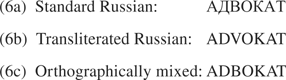
I set out to identify further examples of Russian 1-800-numbers, which are given in (7). Most were transliterated into roman script, but one other, 1-800-DOKTOP-4, was orthographically mixed, and one number managed to recreate a standard Cyrillic spelling using only characters that also exist in the roman alphabet, 1-877-KPACOTA.

Although these forms are clearly produced intentionally, it is important to remember that they depend on the availability of a given “underlying” phone number. Perhaps the number corresponding to 1-800-ADVOKAT was already in use, forcing the advertising law firm to be more creative in its search for a memorable number.36
This phone number is currently in use.

Advertisement for a law firm, at a bus stop in Brighton Beach, Brooklyn.
The mixed roman and Cyrillic forms are possible because of the overlap between the graphic inventories of the two alphabets, a consequence of their common origin in the Greek alphabet.37
However, the combination of different writing systems is possible in other cases as well; see Lubell 1993 for the use of Hebrew vowel points with roman characters, and Smith & Schmidt 1996 for uses of the roman alphabet with Japanese characters. Banu & Sussex (2001:57) report an example in which the apostrophe separating an English genitive s from the noun occurs with an English phrase that has been transliterated into Bengali script.

The letters of the roman alphabet, as used for Modern English, and the Cyrillic alphabet, as used for Modern Russian. (The diagram includes only capitals. The distribution of shared letters is different with lower case letters as well as in cursive writing) (cf. Feldman & Barac-Cikoja, 1996).
The phenomenon of shared characters has received some attention, both from linguists and non-linguists, and it has at times been the object of social and political contention. At the beginning of the 18th century, Tsar Peter the Great introduced an orthography reform as part of his drive to westernize Russia. One aim of the reform was to eliminate homographs from the Old Russian Cyrillic alphabet. As Spraul (1999:81) notes, Tsar Peter preferred the use of those letters that resemble characters of the roman alphabet and advocated the use of I instead of

(both pronounced [i]), as well as of S instead of C (both pronounced [s]). However, these westernizing efforts met resistance, and not all parts of the orthography reform were accepted in the long run. The characters resembling roman I and S are no longer used in Russian, though they are still used in other Cyrillic alphabets.
38Other versions of the Cyrillic alphabet contain additional characters which are shared with the roman alphabet, owing either to common origin or to borrowing; see Cubberley 1996 and Comrie (1996:700–1).

The shared characters have also been identified as a source of psycholinguistic confusion. Experimental research by Feldman and associates has shown that biscriptal Serbo-Croatian speakers have delayed word recognition for words consisting only of shared letters when they are presented with such words in isolation (cf. Feldman & Barac-Cikoja 1996). Marian & Kaushanskaya 2004 achieved similar results in experiments with Russian-English bilinguals.39
Marian & Kaushanskaya 2004 conducted experiments in the Picture-Word Interference paradigm in which participants were shown a picture and a word. The task was to identify in English the object on the picture while ignoring the word. Compared to English monolinguals, Russian-English bilinguals were shown to be distracted more by words that consisted of characters shared between both alphabets.
The Spanish part of the sign contains a nonstandard spelling of necesita ‘(he, she, it) needs’.
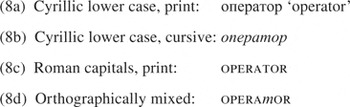
In Figure 20, the letter that looks like a lower-case roman m is actually a Cyrillic lower-case t, but in cursive rather than in type, the lower-case t being one of several characters for which Russian cursive script diverges from type (see 8b).
41Other discrepancies between cursive and type are:

. Note that several of the cursive characters are shared with the roman alphabet.

, but also from the Cyrillic p in

). Nevertheless, despite the graphemic confusion, the mixing remained initially undetected by me, and presumably also by many other readers of the sign. In contrast to ambiguous spellings used in psycholinguistic experiments, the forms in Figures 18 and 20 occur not in isolation but in a context that prevents them from being misinterpreted.

Handwritten sign in a store window on Kings Highway, Brooklyn.
In earlier models of bilingual language use, the mixing of scripts found in Figure 20 would have been characterized as interference (cf. Weinreich 1968), or as triggered by common elements such as the shared letters O, E, and A (Clyne 1967).42
Clyne (1994:959) defines the term “trigger word” as referring to any element that is “identical or nearly identical in the two languages, (it) brings about a linguistic disorientation in the speaker.”
These examples show that there are aspects of bilingual language use that go beyond a mere combination of two monolingual patterns.43
They also show that word-internal alphabet-switch is theoretically possible, but only in a way that dissolves and denies the distinction between the two scripts, along with the distinction between the two languages and the one between codeswitching and borrowing.

Figure 3′: Distribution of languages and scripts.
CONCLUSION
In conclusion, this article has documented the existence of hybridity in Russian-American writing on several levels: on the level of the text, in the codeswitching of Figure 16; on the level of the word, in the mixing of alphabets in compound nouns (Fig. 17); and on the level of the grapheme, in the intentional or unintentional use of characters that are ambiguous in the two alphabets (Figs. 18 and 20). However, these hybrid aspects are clearly exceptional in the written data examined here. For the data set as a whole, my analysis has demonstrated that Russian-American bilingual authors show a strong tendency to categorize lexical items as either Russian or English, even as they mix elements from both languages in the same text. This study thus points to the validity of the distinction between borrowing and codeswitching by showing that lexical items behave differently depending on their attribution to a particular language, and by suggesting that in biscriptal, bilingual writing, authors use script choice to attribute a lexical item to a particular language. Through script choice, authors can – intentionally or unintentionally – mark lexical items in one of three ways: (i) through transliteration into Cyrillic, a word may be marked as Russian, i.e. borrowed; (ii) through the use of the roman script, a word may be marked as English, i.e. codeswitched; and (iii) through the mixing of the Cyrillic and roman alphabets, a word may be marked as ambiguous with regard to language membership.
The findings of this study thus pertain to the role that written data can play in studies of language contact, particularly when it involves the use of multiple writing systems. Where different writing systems exist in the same community, written data can be drawn upon to illuminate questions of language boundaries from the perspective of the bilingual individual or of the linguistic community as a whole. Furthermore, the findings suggest that speakers have a choice between treating a given lexical item as borrowed or switched. Even after a word has been borrowed, it is still available for codeswitching. This theoretical possibility has too often been ignored because most bilingualism researchers have tended to classify all instantiations of a given lexical item alike.
The attribution of linguistic forms to a particular language has been a central issue in the debate about codeswitching and borrowing, but also in language contact studies in general. Focusing primarily on bilingual speech, Gardner-Chloros 1995, Woolard 1999, and others have challenged the notion of the discreteness of linguistic systems, arguing that it may be introduced by researchers in ways that are not meaningful to community members. Along similar lines, Auer 1999 argues for a typological distinction between types of bilingual speech where codes are meaningfully juxtaposed (codeswitching) and where they are not (mixing). These and other studies have relied primarily if not exclusively on bilingual speech. In written data, the distinction between languages is ideologically emphasized through the standardization of written language (Milroy & Milroy 1991, Sebba 2002). Standard orthography provides a norm that not only defines a “correct” representation of a given lexical item but also serves to attribute that item to a particular standard language. As a consequence, the discreteness of linguistic systems is an inherent aspect of bilingual writing, even if it may not be present in bilingual speech. Arguably, this is what motivates the categorical adherence to the Free-Morpheme Constraint that was found in the present data.
Nevertheless, occasional hybrid forms exist, facilitated here by the overlap between the two alphabets. The three observed patterns of script choice thus mirror the three basic processes identified by Muysken 2000 as active in bilingual language use – insertion, alternation, and congruent lexicalization. Bilingual authors, like bilingual speakers, may integrate elements from one language into structures of the other, they may alternate between languages, or they may create hybrid forms that are wholly or partially shared by both languages. Thus, while bilingual writing is clearly different from bilingual speech in important ways, the two share underlying principles, and both are available to linguists who seek to identify what these principles are.
References
REFERENCES
Andrews, David R.
(1998).
Sociocultural perspectives on language change in diaspora: Soviet
immigrants in the United States.
Amsterdam & Philadelphia:
Benjamins.
Androutsopoulos, Jannis
(2002).
Greek on the Internet: Recent findings and research
perspectives.
Paper presented at Institut für Deutsche Sprache Mannheim,
Research Group “Sprachvariation,” November 2002.
Auer, Peter
(1998).
Introduction: Bilingual Conversation revisited. In
Peter Auer (ed.),
Code-switching in conversation: Language, interaction and
identity,
1–24.
London:
Routledge.
Auer, Peter
(1999).
From codeswitching via language mixing to fused lects: Toward a
dynamic typology of bilingual speech.
International Journal of Bilingualism
3:309–32.Google Scholar
Bakhtin, Mikhail M.
(1981 [1934-35]).
Discourse in the novel. In
Michael Holmquist (ed.),
The Dialogic Imagination. Four Essays by M. M. Bakhtin,
259–422.
Austin:
University of Texas Press.
Banu, Rahela, &
Sussex, Roland
(2001).
Code-switching in Bangladesh.
English Today
17:51–61.Google Scholar
Bentahila, Abdelâli, &
Davies, Eirlys E.
(1991).
Constraints on code-switching: A look beyond grammar. In
ESF Network on Codeswitching and Language Contact. Papers for the
Symposium on Codeswitching in Bilingual Studies: Theory, Significance and
Perspectives, Barcelona, March 1991,
369–403.
Strasbourg:
European Science Foundation.
Birman, Igor
(1979).
Jewish immigration from the U.S.S.R.: Some observations.
Soviet Jewish Affairs
9(2):46–63.Google Scholar
Budzhak-Jones, Svitlana
(1998).
Against word-internal codeswitching: Evidence from Ukrainian-English
bilingualism.
International Journal of Bilingualism
2:161–82.Google Scholar
Cheung, Yat-Shing
(1992).
The form and meaning of digraphia: The case of Chinese. In
Kingsley Bolton &
Helen Kwok (eds.),
Sociolinguistics today: International perspectives,
207–17.
London:
Routledge, Chapman & Hall.
Clyne, Michael
(1967).
Transference and triggering: Observations on the language
assimilation of postwar German-speaking migrants in Australia.
The Hague:
Nijhoff.
Clyne, Michael
(1994).
Discourse in cross-linguistic and cross-cultural contexts.
In
R.E. Asher &
J.M.Y. Simpson (eds.),
Encyclopedia of language and linguistics, 2:
958–64.
Oxford:
Pergamon.
Comrie, Bernard
(1996).
Adaptations of the Cyrillic alphabet. In
Daniels &
Bright,
700–26.
Cubberley, Paul
(1996).
The Slavic alphabets. In
Daniels &
Bright,
346–55.
Dale, Ian
(1980).
Digraphia.
International Journal of the Sociology of Language
26:5–13.Google Scholar
Daniels, Peter, &
Bright, William (eds.)
(1996).
The world's writing systems.
New York:
Oxford University Press.
Eliasson, Stig
(1990).
Models and constraints in code-switching theory. In
ESF Network on Codeswitching and Language Contact. Papers for the
Workshop on Constraints, Conditions and Models, London, September
1990,
17–50.
Strasbourg:
European Science Foundation.
Feldman, Laura Beth, &
Barac-Cikoja, Dragana
(1996).
Serbo-Croatian: A biscriptal language. In
Daniels &
Bright,
769–72.
Fishman, Joshua A.
(1967).
Bilingualism with and without diglossia: Diglossia with and without
bilingualism.
Journal of Social Issues
23:29–38.Google Scholar
Gardner-Chloros, Penelope
(1995).
Code-switching in community, regional and national repertoires: The
myth of the discreteness of linguistic systems. In
Lesley Milroy &
Pieter Muysken (eds.),
One speaker, two languages: Cross-disciplinary perspectives on
code-switching,
68–89.
Cambridge:
Cambridge University Press.
Gazda, Jiří
(1998).
K otázce konkurence grafických kódů v
ruském publicistickém textu. [The issue of script
competition in Russian journalistic texts.]
Sborník Prací Filozofické Fakulty
Brněnské Univerzity, Řada Jazykovědná
A46,
161–68.
Gold, Steven J.
(1995).
From the workers' state to the golden state: Jews from the
former Soviet Union in California.
Boston:
Allyn & Bacon.
Gregor, Esma
(2002).
Russian-English code-switching in New York City.
Dissertation,
Humboldt Universität zu Berlin.
Grivelet, Stéphane
(2001).
Introduction.
International Journal of the Sociology of Language
150 (Special Issue: Digraphia: Writing systems and
society): 1–10.Google Scholar
Heath, Jeffrey
(1989).
From code-switching to borrowing: foreign and diglossic mixing in
Moroccan Arabic.
London & York:
Kegan Paul.
Hill, Jane H., &
Hill, Kenneth C.
(1986).
Speaking Mexicano: Dynamics of syncretic language in Central
Mexico.
Tucson:
University of Arizona Press.
Hinkel, Eli
(2000).
Soviet immigrants in the United States: Issues in
adjustment. In
Sandra Lee McKay &
Sau-Ling Cynthia Wong (eds.),
New immigrants in the United States: Readings for second language
educators,
352–68.
Cambridge:
Cambridge University Press.
Jaffe, Alexandra
(2000).
Introduction: Non-standard orthography and non-standard
speech.
Journal of Sociolinguistics
4:497–513.Google Scholar
Johnson, Sally
(2000).
The cultural politics of the 1998 reform of German
orthography.
German Life and Letters
53:106–25.Google Scholar
Kress, Gunther
(2000).
Early spelling: Between convention and creativity.
London:
Routledge.
LaDousa, Chaise
(2002).
Advertising in the periphery: Languages and schools in a North
Indian city.
Language in Society
31:213–42.Google Scholar
Levkov, Ilya
(1984).
Adaptation and acculturation of Soviet Jews in the United States: A
preliminary analysis. In
Robert O. Freedman (ed.),
Soviet Jewry in the decisive decade, 1971–80,
109–43.
Durham:
Duke University Press.
Li, David C. S.
(2000).
Phonetic borrowing: Key to the vitality of written Cantonese in Hong
Kong.
Written Language and Literacy
3:199–233.Google Scholar
Magner, Thomas F.
(2001).
Digraphia in the territories of the Croats and Serbs.
International Journal of the Sociology of Language
150:11–26.Google Scholar
Marian, Viorica, &
Kaushanskaya, Margarita
(2004).
Mapping written input onto orthographic representations: The case of
bilinguals with partially overlapping orthographies.
Poster presented at the 26th Annual Meeting of the Cognitive
Science Society, Chicago, August 5–7, 2004.
Milroy, James, &
Milroy, Lesley
(1991).
Authority in language: Investigating language prescription and
standardisation.
London:
Routledge & Kegan Paul.
Muysken, Pieter
(2000).
Bilingual speech.
Cambridge:
Cambridge University Press.
Myers-Scotton, Carol
(1993).
Duelling languages: Grammatical structure in codeswitching.
Oxford & New York:
Clarendon Press.
Orleck, Annelise
(2001).
Soviet Jews: The city's newest immigrants transform New York
Jewish life. In
Nancy Foner (ed.),
New immigrants in New York,
111–40. Rev. ed.,
New York:
Columbia University Press.
Piller, Ingrid
(2003).
Advertising as a site of language contact.
Annual Review of Applied Linguistics
23:170–83.Google Scholar
Poplack, Shana
(1980).
Sometimes I'll start a sentence in Spanish y termino en
español: Toward a typology of code-switching.
Linguistics
18:581–618.Google Scholar
Poplack, Shana, &
Meechan, Marjory
(1998).
Introduction: How languages fit together in codemixing.
International Journal of Bilingualism
2:127–38.Google Scholar
Poplack, Shana, &
Meechan, Marjory
(1995).
Patterns of language mixture: Nominal structure in Wolof-French and
Fongbe-French bilingual discourse. In
Lesley Milroy &
Pieter Muysken (eds.),
One speaker, two languages: Cross-disciplinary perspectives on
code-switching,
199–232.
Cambridge:
Cambridge University Press.
Poplack, Shana;
Sankoff, David; &
Miller, Christopher
(1988).
The social correlates and linguistic processes of lexical borrowing
and assimilation.
Linguistics
26:47–104.Google Scholar
Rand, David, &
Sankoff, David
(1990).
Goldvarb, version 2: A variable rule application for the
Macintosh. Montreal.
Université de Montréal, Centre de recherches
mathématiques.
Sankoff, David, &
Poplack, Shana
(1984).
Borrowing: the synchrony of integration.
Linguistics
22:99–136.Google Scholar
Sankoff, David;
Poplack, Shana; &
Vanniarajan, Swathi
(1990).
The case of the nonce loan in Tamil.
Language Variation and Change
2:71–101.Google Scholar
Sebba, Mark
(2002).
Regulated spaces: Language alternation in writing.
Paper presented at the 2nd International Symposium on
Bilingualism, Vigo, October 23–26, 2002.
Sebba, Mark
(2003).
Ideology and alphabets in the former USSR.
Center for Language in Social Life, Working Paper No.
123.
Lancaster University, Department of English and Modern English
Language.
Shell, Marc
(1993).
Children of the earth: Literature, politics and nationhood.
New York:
Oxford University Press.
Smith, Janet S. [Shibamoto]
(1996).
Japanese writing. In
Daniels &
Bright,
209–17.
Smith, Janet S. [Shibamoto],
&
Schmidt, David L.
(1996).
Variability in written Japanese: Towards a sociolinguistics of
script choice.
Visible Language
30:46–71.Google Scholar
Spraul, Hildegard
(1999).
Graphemik. In
Helmut Jachnow (ed.),
Handbuch der Sprachwissenschaftlichen Russistik und ihrer
Grenzdisziplinen,
66–86.
Wiesbaden:
Harrassowitz.
Thomason, Sarah Grey
(2001).
Language contact.
Washington, DC:
Georgetown University Press.
Timm, L.A.
(1978).
Code switching in War and Peace. In
M. Paradis (ed.),
Aspects of bilingualism,
302–15.
Columbia:
Hornbeam.
Weinreich, Uriel
(1968 [1953]).
Languages in contact: Findings and problems.
The Hague:
Mouton.
Woolard, Kathryn A.
(1999).
Simultaneity and bivalency as strategies in bilingualism.
Journal of Linguistic Anthropology
8:3–29.Google Scholar
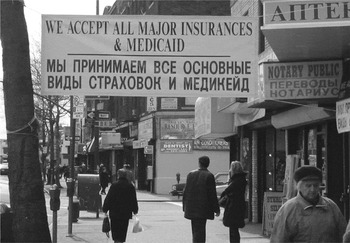
Advertisement on Kings Highway, Brooklyn.
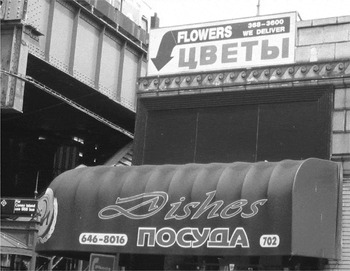
Advertisement in Brighton Beach, Brooklyn
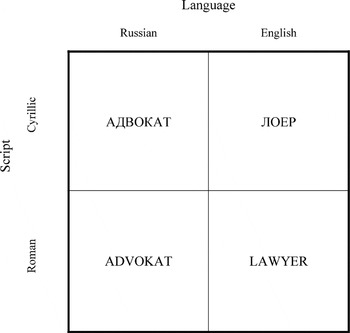
Combinations of languages and scripts (cf. LaDousa 2002: 224)

The Zamore: Sign of co-op apartment building in Brighton Beach, Brooklyn (zamor'e ‘country overseas, abroad’).

Primorski Restaurant in Brighton Beach, Brooklyn (primorskij ‘by the sea’).
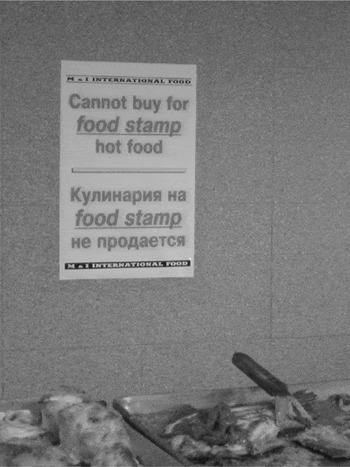
Sign in a store in Brighton Beach, Brooklyn.
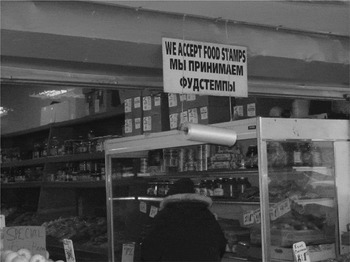
Sign in a store on Ditmas Avenue, Brooklyn ( fudstempy).

Sign in a store in Brighton Beach, Brooklyn.

Sign in a store in Brighton Beach, Brooklyn ( fudstempy i kredit karty).
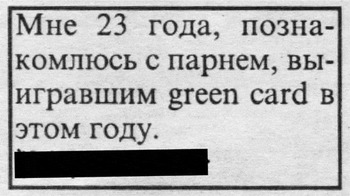
Personal ad in Vecherniy New York, January 24–30, 2003.
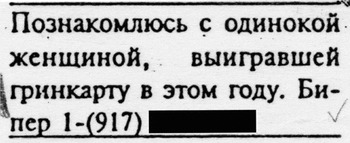
Personal ad in Russian Bazaar, January 18, 2002 ( grinkartu).
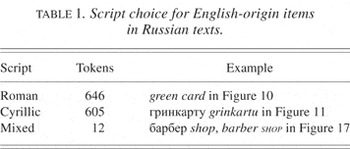
Script choice for English-origin items in Russian texts.
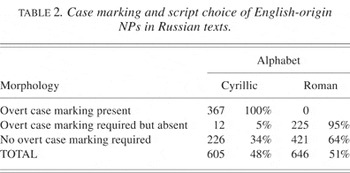
Case marking and script choice of English-origin NPs in Russian texts.
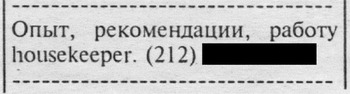
Classified ad in Russkaya Reklama, January 24–30, 2003.
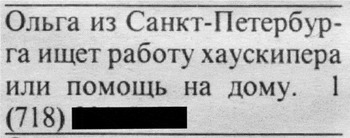
Classified ad in Russian Bazaar, April 10-16, 2003 ( khauskipera).
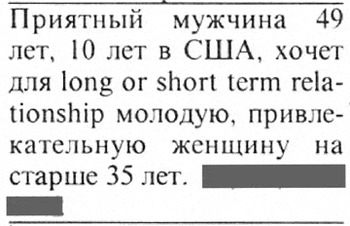
Personal ad in Russian Bazaar, April 10–16, 2003.
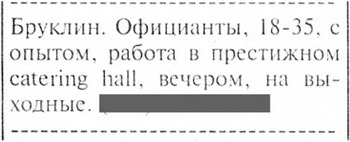
Help wanted ad in Russkaya Reklama, January 24–30, 2003.
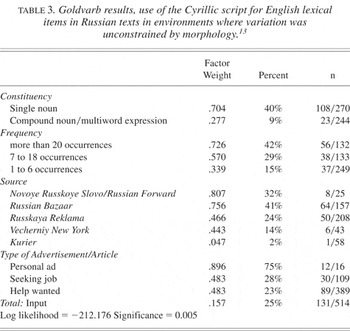
Goldvarb results, use of the Cyrillic script for English lexical items in Russian texts in environments where variation was unconstrained by morphology.The factor groups were identified as significant in the following order: (1) constituency, (2) source, (3) frequency, (4) type of advertisement.
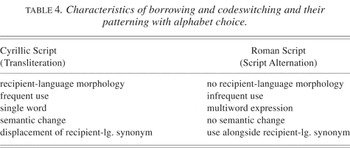
Characteristics of borrowing and codeswitching and their patterning with alphabet choice.
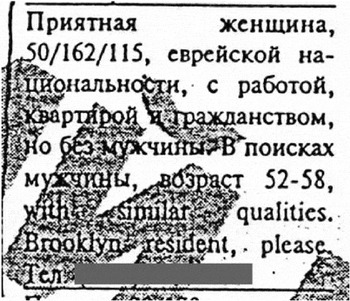
Personal ad in Russian Bazaar, January 18–24, 2002.
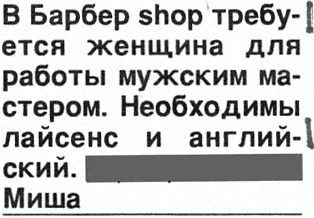
Help wanted ad in Russian Bazaar, April 10–16, 2003. ( “barber”)
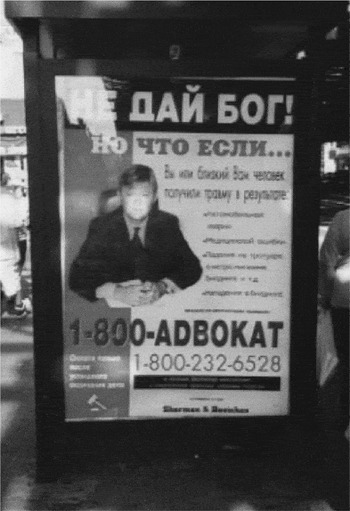
Advertisement for a law firm, at a bus stop in Brighton Beach, Brooklyn.
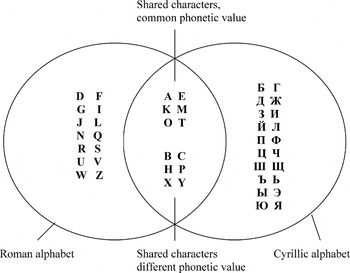
The letters of the roman alphabet, as used for Modern English, and the Cyrillic alphabet, as used for Modern Russian. (The diagram includes only capitals. The distribution of shared letters is different with lower case letters as well as in cursive writing) (cf. Feldman & Barac-Cikoja, 1996).

Handwritten sign in a store window on Kings Highway, Brooklyn.
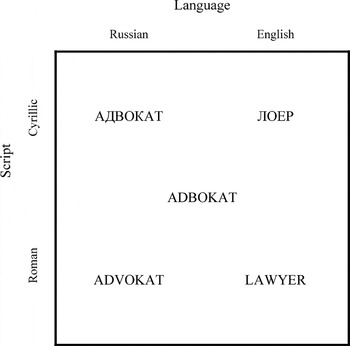
Figure 3′: Distribution of languages and scripts.
 You have
Access
- 26
- Cited by