INTRODUCTION
The dogwhelk Nucella lapillus (Linnaeus, 1758) is a common species of the intertidal zone on both sides of the North Atlantic, and the Portuguese coast is its southern distribution limit in Europe (Hughes, Reference Hughes1972; Crothers, Reference Crothers1985). This carnivorous gastropod lives on rocky shores alongside mussels and barnacles, which are its main preys (Crothers, Reference Crothers1985). Populations of N. lapillus suffered a great decline in some places due to imposex and female sterility caused by tributyltin (TBT) contamination, but populations are recovering after the ban of TBT-containing antifouling paints (Morton, Reference Morton2009; Galante-Oliveira et al., Reference Galante-Oliveira, Oliveira, Ferreira, Santos, Pacheco and Barroso2011). This species has been intensively investigated to evaluate the effects of TBT on the female reproductive system of caenogastropods (Følsvik et al., Reference Følsvik, Berge, Brevik and Walday1999; Santos et al., Reference Santos, Castro, Vieira, Micael, Morabito, Massanisso and Reis-Henriques2005; Plejdrup et al., Reference Plejdrup, Simonsen, Pertoldi, Schøyen and Bayley2006), but can also be valuable as a model in other studies about marine gastropods.
Molluscs are influenced by numerous environmental factors such as temperature, food availability and pollutants, which can induce variations in metabolism and nutrient reserves (Da Silva & Zancan, Reference Da Silva and Zancan1994; Leung & Furness, Reference Leung and Furness2001; Pazos et al., Reference Pazos, Sánchez, Román, Pérez-Parallé and Abad2003). Lipid and glycogen reserves can be accumulated in the digestive gland when food is abundant and consumed to sustain the animal during periods of food shortage or hibernation (Dimitriadis & Hondros, Reference Dimitriadis and Hondros1992) and to supply energy and nutrients required for reproduction and growth (Barber & Blake, Reference Barber, Blake and Shumway1991; Le Pennec et al., Reference Le Pennec, Le Pennec and Beninger2001; Litaay & De Silva, Reference Litaay and De Silva2003).
The digestive gland of gastropods is a major organ of the digestive system, formed by a vast number of blind ending digestive tubules. It is involved in extracellular and intracellular digestion of food material, absorption of nutrients, storage of lipids, glycogen and minerals, and also plays a major role in detoxification (Voltzow, Reference Voltzow, Harrison and Kohn1994). The epithelium of digestive tubules is formed by digestive and basophilic cells, although additional minor cell types have been reported in N. lapillus (Dimitriatis & Andrews, Reference Dimitriadis and Andrews2000) and some other gastropod species (Franchini & Ottaviani, Reference Franchini and Ottaviani1993; Kress et al., Reference Kress, Schmekel and Nott1994).
The basophilic cells are typical protein secreting cells. These pyramidal shaped cells contain large amounts of rough endoplasmic reticulum, a well-developed Golgi complex and accumulate secretory vesicles. They seem to be responsible for the secretion of digestive enzymes that undertake the extracellular digestion of food. The digestive cells have a columnar shape and are the most abundant. These cells carry out an intense endocytic activity and contain a large number of heterolysosomes, in which the digestion of food materials is completed. Lipid droplets and glycogen granules were found in the cytoplasm of digestive cells, but smaller amounts of these reserve substances can also be present in basophilic cells (Lobo-da-Cunha, Reference Lobo-da-Cunha1999, Reference Lobo-da-Cunha2000; Dimitriatis & Andrews, Reference Dimitriadis and Andrews2000).
Seasonal variations of lipids were studied in a few species of gastropods (Da Silva & Zancan, Reference Da Silva and Zancan1994; Litaay & De Silva, Reference Litaay and De Silva2003; Morais et al., Reference Morais, Boaventura, Narciso, Ré and Hawkins2003), but quantitative seasonal studies of lipid reserves in the digestive gland of marine carnivorous gastropods are lacking. Thus, the present work was conceived to investigate changes in the lipid reserves of the digestive gland of N. lapillus throughout the year in males and females. Gonad development was also assessed to detect any relationship between variations of lipid content and the reproductive cycle. To evaluate the use of lipid reserves as an energy source in N. lapillus, the consumption of digestive gland lipids was followed during a starvation experiment.
MATERIALS AND METHODS
Animal collection and body parameters
Male and female specimens of Nucella lapillus with a mean shell height of 2.35 cm (standard deviation (SD) 0.14) and 2.56 cm (SD 0.15), respectively, were collected in March, June, September and December during low tides in Cortegaça (Portugal) 40°56′24″N 8°39′40″W. Animals were processed in the laboratory shortly after collection. Imposex was not detected in the females used in this study. The gonadosomatic index (GSI), digestive gland index and digestive gland volume were calculated in animals collected in these seasons. All indices were based on body weight without shell (on average, shell weight corresponds approximately to 70% of the total weight of the animals used in this study). The shell was carefully removed and the soft body of each animal was weighted; afterwards the gonad–digestive gland complex was detached and weighted. The gonad (which could not be extracted as a single piece) was carefully removed from the digestive gland under a stereoscopic microscope and the isolated digestive gland weighted. Gonad weight was determined by subtracting the weight of the isolated digestive gland from the weight of the gonad–digestive gland complex, and used to calculate the GSI. The weight of the digestive gland was used to calculate the digestive gland index (DGI).
 $$\eqalign{\hbox{GSI} \lpar \percnt\rpar &={\hbox{gonad weight} \over \hbox{body weight without shell}} \times 100 \cr \quad \hbox{DGI} \lpar \percnt\rpar &={\hbox{digestive gland weight}\over \hbox{body weight without shell}} \times 100}$$
The volume of the digestive gland was estimated by the Scherle method (Scherle, Reference Scherle1970). For this purpose, the isolated organ was suspended by a thin string inside a beaker with a 0.9% NaCl solution on a precision scale. The volume of the organ was then calculated based on the weight of the displaced 0.9% NaCl solution (1.0048 g · ml−1).
Sample processing for microscopy
Pieces of digestive gland and gonad were fixed for 2 hours with 2.5% glutaraldehyde, diluted in 0.2M cacodylate buffer pH 7.4 with 5% sucrose. After washing in the same buffer, fragments were post-fixed with 2% OsO4 buffered with cacodylate, dehydrated in ethanol and embedded in Epon. For light microscopy, semithin sections (2 µm thick) were stained with methylene blue and azure II. Unstained semithin sections of the digestive gland were used for determination of lipid droplets volume density (VV) in each season and in both genders. Semithin sections of testis and ovary were used to assess gonad development stage.
Histochemistry and cytochemistry
Light microscopy techniques for the detection of polysaccharides (PAS) and lipids (Sudan black), based on the procedures described by Ganter & Jollès (Reference Ganter and Jollès1970), were applied to semithin sections (2 µm thick) of digestive gland fragments fixed and embedded in Epon as described above. The embedding medium was not removed from the sections before staining.
PAS REACTION
Semithin sections were treated with 1% periodic acid for 15 minutes, washed with ultrapure water, stained with Schiff reagent for 30 minutes, washed with ultrapure water and mounted with DPX.
SUDAN BLACK
Semithin sections were treated with 0.04% hydrogen peroxide for 10 minutes to remove OsO4, washed with ultrapure water and stained with a saturated solution of Sudan black in 70% ethanol for 3 minutes. After washing in 70% ethanol and in ultrapure water, sections were mounted with Epon.
DETECTION OF POLYSACCHARIDES BY ELECTRON MICROSCOPY
Ultrathin sections collected on gold grids were treated with 1% periodic acid for 30 minutes, washed in ultrapure water and treated for 2 hours with a solution of 0.2% thiosemicarbazide in 20% acetic acid. After being washed in 10% acetic acid and in water, the sections were treated with a 1% silver proteinate solution for 30 minutes and finally washed in water (Thiéry, Reference Thiery1967). Ultrathin sections were observed in a JEOL 100CXII transmission electron microscope, operated at 60 kV.
Stereology
In each season, the VV of lipid droplets in the digestive gland (percentage of the gland volume occupied by lipid droplets) was estimated in 5 males and 5 females. For each animal, 5 digestive gland fragments were randomly selected and a semithin section was obtained from each one. On average, 7 systematically randomly selected fields were photographed in each section with a light microscope using the 100 × objective. For each animal, lipid droplets' VV was estimated by point counting using an acetate sheet with a printed grid over the photographs (Royet, Reference Royet1991):
 $$\eqalign{\hbox{V}_{\rm v} \lpar \percnt\rpar ={\hbox{number of points on lipid droplets} \over \hbox{total number of points over the digestive gland}} \times 100}$$
Starvation experiment
A group of animals collected in June were kept in a 50 l seawater aquarium (35‰ salinity) with an average temperature of 20°C. Animals were analysed after 30 and 45 days of starvation. Volume density of lipids in the digestive gland, digestive gland index and volume were evaluated as reported for the seasonal study. Data obtained with animals freshly collected in June for the seasonal study were considered as corresponding to zero days of starvation. For this experiment only females were considered.
Statistics and calculations
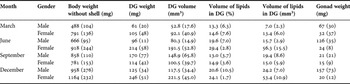
Each value is the mean of 5 animals and the SD was calculated with STATISTICA 9.0. Averages and SD of the parameters used to obtain the indices for the seasonal and starvation studies are given in Tables 1 and 2, respectively. For each season and gender, the mean value of lipid droplets VV and the digestive gland volume (DGV) were used to estimate the total volume of lipids in the digestive gland (VL):
 $$\hbox{VL} \lpar \hbox{mm}^3\rpar ={\hbox{DGV} \times \hbox{V}_{\rm v} \over 100}$$
Since the animals were not all of the same size and weight, for comparative purposes, this value was divided by the animal weight without shell, giving the volume of lipid droplets in the digestive gland per gram of body (mm3.g−1).
Parameters used to obtain the indices for the seasonal study. Each value is an average of 5 animals and the standard deviation is given in parentheses. DG, digestive gland.

Parameters used to obtain the indices for the starvation study. Each value is an average of 5 females and the standard deviation is given in parentheses. DG, digestive gland.

Normality of distribution and homogeneity of variance was confirmed for all data using STATISTICA 9.0. Bifactorial and one-way analyses of variance (ANOVAs) were applied to the different sets of data, and the Tukey honestly significant difference (HSD) test was applied when necessary.
RESULTS
Seasonal study
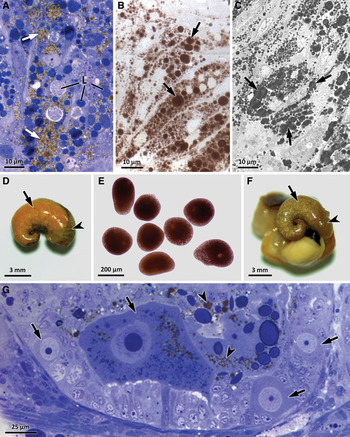
Lipid droplets were very abundant in the digestive gland of N. lapillus and could be seen in semithin sections as brown spots because they were strongly osmiophilic (Figure 1A), and could also be visualized using Sudan black staining (Figure 1B). However, Sudan black staining of lipid droplets in semithin sections was only possible after treatment with hydrogen peroxide to remove the attached osmium tetroxide that prevents the linkage between dye and lipids. Nevertheless, the stereological study of lipid droplets was made with unstained semithin section, because in the black and white images used for this purpose the osmiophilic lipid droplets were very conspicuous (Figure 1C). Lipids were by far the major reserve substance in the digestive gland of N. lapillus. Glycogen reserves did not seem to be important in this case, because the digestive gland cells were not stained by PAS reaction and just a few sparse glycogen granules were observed by transmission electron microscopy after a cytochemical reaction that stains polysaccharides.
Digestive gland and ovary of Nucella lapillus: (A) semithin section of the digestive gland stained with methylene blue and azure II, showing many osmiophilic lipid droplets (arrows) and lysosomes (L) in digestive cells; (B) lipid droplets stained by Sudan black (arrows) in a semithin section of the digestive gland; (C) the osmiophilic lipid droplets (arrows) are conspicuous in unstained semithin sections of the digestive gland; (D) mature ovary (arrow) attached to the digestive gland (arrowhead); (E) eggs at advanced vitellogenesis; (F) immature ovary (arrow) attached to the digestive gland (arrowhead); (G) semithin section of an immature ovary containing oocytes at different development stages (arrows). Some osmiophilic lipid droplets are visible in oocytes that have started to accumulate reserves (arrowheads).

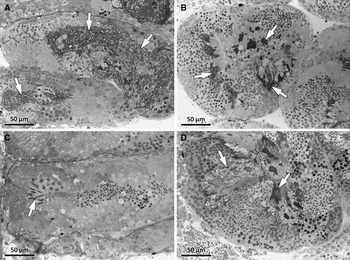
To detect an eventual relationship between lipid storage in the digestive gland and reproductive status, a brief study of the gonads was carried out using semithin sections. Since imposex was not visible in females, the results of this study seem not to be affected by TBT contamination. Females with a matured orange colour ovary containing a large number of eggs in advanced vitellogenesis were captured only in March (Figure 1D, E). However, other females also collected in March were extremely immature with a very reduced and pale ovary (Figure 1F). In the other seasons, all of the collected females presented an immature ovary with oocytes in early stages of development containing reduced amounts of lipid reserves (Figure 1G). Light microscopy observation of testes (Figure 2A–D) showed that in September the male gonad is in a state of rest with very few spermatozoa present in the seminiferous tubules (Figure 2C), contrasting with the large number of spermatozoa during the rest of the year, especially in March (Figure 2A).
Semithin sections of testes of male Nucella lapillus collected in March (A), June (B), September (C) and December (D). Spermatozoa (arrows) are most abundant in March and very scarce in September.

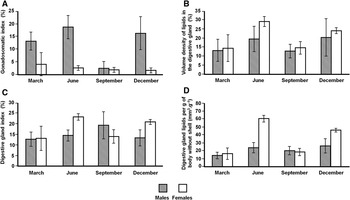
For a quantitative evaluation of the reproductive status the GSI was assessed (Figure 3A). Using a bifactorial ANOVA, significant differences were obtained between males and females of the same seasons (F = 8.99, P < 0.001). It was evident that for most of the year the GSI was significantly higher in males than in females (P < 0.01), except in September when the GSI was at its lowest value for males (Figure 3A), being significantly different (P < 0.01) from the GSI of males in the other seasons. The most mature females had a GSI around 10% and were collected in March, but others also collected in March were very immature with a GSI of 1% or even less. In the other seasons, female GSI was low (Figure 3A), but due to the large variability in March seasonal GSI differences were not significant for females (P > 0.05). The values of GSI were well correlated with gamete maturation. Oocytes in advanced vitellogenesis were only found in females with the higher GSI, and males with low GSI contained very few sperm cells.
Seasonal and sexual variations of the gonadosomatic index (A), volume density of lipid droplets in the digestive gland (B), digestive gland index (C) and volume of digestive gland lipid droplets per gram of body without shell (D). Standard deviation is represented by vertical lines above and below mean values.

In the seasonal study, the volume density (VV) of lipid droplets ranged from a minimum average of 13.0% of the digestive gland volume in males collected in September to a maximum of 29.4% in females collected in June (Table 1; Figure 3B). However, according to bifactorial ANOVA there were no significant differences in lipid droplets' VV between males and females of the same seasons (F = 1.04, P > 0.05). In males there were no significant seasonal variations of lipid droplets' VV in the digestive gland (P > 0.05). However, one-way ANOVA showed that in females there were significant seasonal differences regarding lipid droplets' VV (F = 12.84, P < 0.001), and according to the Tukey HSD test, the significant differences occurred between consecutive seasons (P < 0.05). Moreover, according to a one-way ANOVA, a seasonal variation was detected in the female digestive gland index (F = 10.79, P < 0.001) (Figure 3C), signifying that the weight of this organ in regard to total body weight without shell is significantly higher in June and December than in March and September (P < 0.05). In males, significant seasonal differences were not detected in the digestive gland index (P > 0.05). Between genders, using a bifactorial ANOVA (F = 6.89, P < 0.01), significant differences were detected only in June (P < 0.05), when the digestive gland index had the highest values for females (Figure 3C).
For females, the percentage of digestive gland volume occupied by lipid droplets (VV) was higher in June and December, coinciding with the highest values of digestive gland volume (Table 1). Due to the conjugation of these two factors, in June and December the total lipid content of the females digestive gland, expressed in mm3, was substantially increased (Table 1). In order to compare animals with differences in body weight, the total volume of lipid droplets in the digestive gland was divided by the weight without shell (Figure 3D). The values obtained by this calculation are more relevant, because the variations in lipid droplets' VV and the changes in the volume of the digestive gland are both considered. With this approach, the seasonal differences among females attained a higher magnitude (Figure 3D) and a stronger statistical significance according to a bifactorial ANOVA (F = 22.90, P < 0.001), with very significant differences between consecutive sampling seasons according to the Tukey HSD test (P < 0.001). In addition, significant differences between sexes emerge in June (P < 0.001) and December (P < 0.001), when lipid storage in the digestive gland reached the highest values for females (Figure 3D). However, even with this approach, in males the seasonal variations remained non-significant (P > 0.05).
Starvation experiment
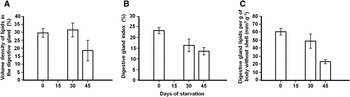
Prolonged starvation induced alterations in the digestive gland, and significant differences in lipid droplets' VV were detected using a one-way ANOVA (F = 10.74, P < 0.01). During the first 30 days the VV of lipid droplets did not change significantly (P > 0.05), but 45 days of starvation substantially reduced the VV of lipids in the digestive gland (P < 0.01) (Figure 4A). On the other hand, the digestive gland index decreased in a linear fashion from day 0 to day 45 (Figure 4B) presenting a significant variation according to one-way ANOVA (F = 19.77, P < 0.001), meaning that the digestive gland is continuously shrinking during starvation. Moreover, if the percentage of digestive gland volume occupied by lipid droplets (VV), the total volume of this organ and body weight are taken into account (Table 2), it becomes clear that some digestive gland lipids were consumed during the first 30 days of starvation (Figure 4C). After 45 days of starvation, the lipid droplets in the digestive gland were reduced to almost 1/3 of the initial value (Figure 4C).
Effects of starvation on volume density of lipid droplets in the digestive gland (A), digestive gland index (B) and volume of digestive gland lipid droplets per gram of body without shell (C). Standard deviation is represented by vertical lines above and below mean values.

DISCUSSION
The quantitative morphological analysis of lipid droplets demonstrated that these are a major component of the digestive gland in N. lapillus. For males, the results clearly showed that the digestive gland and its lipid reserves are quite stable without significant variations throughout the year. On the other hand, a significant seasonal variation was detected in the digestive gland of females, in which lipids droplets are accumulated during spring (from March to June), consumed during summer (from June to September) and accumulated again during the autumn (from September to December). However, in both males and females a relationship between the development status of the gonad and the lipid reserves of the digestive gland was not evident. For females, in March, the low amount of lipid reserves coincide with the maximum development of the ovary, while in September a low value of lipid reserves coincided with a low GSI value. For males, the substantial reduction of the GSI in September was not followed by any significant variation of lipid reserves in the digestive gland.
For N. lapillus, spring has been considered the main spawning season on the coast of England (Feare, Reference Feare1970; Crothers, Reference Crothers1985). However, the laying of egg capsules can occur almost all year (Morton, Reference Morton2009). Nevertheless, at a collection site on the south coast of England, the number of egg capsules laid each month from May 2004 to September 2008 attained a maximum in March and minimum numbers were recorded from August to October (Morton, Reference Morton2009). These results match well with our own data. Mature females were collected only in March and the most mature males were also collected in March, suggesting that on the Portuguese coast, spring is also the main spawning season. The GSI of males remained high most of the year and a large number of spermatozoa were found in testes except in September, suggesting that they can fertilize females with the exception of late summer and early autumn. However, we did not find fertile females except in March, but if mature females are much less frequent during the rest of the year they could have been missed in the small samples of the population used in this study.
Among molluscs, seasonal variations of lipid, protein and glycogen reserves have been studied mainly in species with commercial value, like abalone and scallops. These reserves are accumulated when food intake exceeds metabolic requirements and can be consumed in variable amounts to allow energy demanding processes (Barber & Blake, Reference Barber, Blake and Shumway1991). In molluscs, energetic resources can be stored in the digestive gland, muscle and specialized connective tissue cells (Robinson et al., Reference Robinson, Wehling, Morse and McLeod1981; Da Silva & Zancan, Reference Da Silva and Zancan1994; Lobo-da-Cunha et al., Reference Lobo-da-Cunha, Kádár and Serrão Santos2006). Development of gonads consumes significant amount of resources, depending on recently ingested food and mobilization of stored reserves. In scallops, digestive gland lipids are consumed during gametogenesis, but glycogen stored in the adductor muscle has been considered the primary energy source in this case (Barber & Blake, Reference Barber, Blake and Shumway1991; Le Pennec et al., Reference Le Pennec, Le Pennec and Beninger2001).
Organ indices can be useful to evaluate accumulation or consumption of reserves. In the scallop Placopecten magellanicus, for males and females, the digestive gland index and the lipid reserves of this organ are low in winter and both increase during spring due to food abundance. The digestive gland index and lipid reserves decrease towards late spring and summer as the gonads reach maturity. Following spawning, a slight recovery of digestive gland lipids and index was detected (Robinson et al., Reference Robinson, Wehling, Morse and McLeod1981). In N. lapillus females, the digestive gland index is lower in early spring (March) coinciding with ovary maturation and increases subsequently to reach a peak at late spring/early summer (June). However, during the summer the digestive gland index falls reaching in September a value that is identical to March. This cannot be justified by a transfer of reserves to the ovary, because in late summer/early autumn oocytes are immature, laying of egg capsules is basically absent in this period (Morton, Reference Morton2009) and even the male gonad is at a resting stage. Digestive gland index of the female increases again during autumn and only a decline in late winter/early spring could be justified by the transfer of lipids to the developing ovary. The fluctuation of the digestive gland index matches with the variation of the VV of lipid droplets, suggesting that weight gains and losses in the digestive gland are, at least in part, due to the accumulation or consumption of lipid reserves, respectively. In June and December, females accumulate more fat in the digestive gland than males, pointing to a sex related difference in lipid metabolism.
In the abalone, Haliotis rubra, the GSI of females is inversely correlated to the digestive gland index, pointing to a translocation of energy from the digestive gland to the ovary. In this species the digestive gland was considered the main provider of reserves during ovary maturation, and these reserves are provided mainly in the form of lipids (Litaay & De Silva, Reference Litaay and De Silva2003). Seasonal variations of the lipid content were also studied in the land pulmonate gastropod Megalobulimus oblongus. In this species, the variation pattern was very different; lipid content of the digestive gland reaches a maximum value during spring coinciding with oocyte maturation and the highest amounts of lipids in the gonad (Da Silva & Zancan, Reference Da Silva and Zancan1994). These discrepancies between species are probably related to habitat, food source and physiological differences. For bivalves feeding on phytoplankton, fluctuations in lipid content were correlated to food concentration and the reproductive cycle (Pazos et al., Reference Pazos, Ruíz, García-Martin, Abad and Sánchez1996; Le Pennec et al., Reference Le Pennec, Le Pennec and Beninger2001). For N. lapillus, feeding on mussels and barnacles (Crothers, Reference Crothers1985), prey are available all year and food shortage seems unlikely in normal conditions. Nevertheless, feeding activity is temperature dependent in N. lapillus and during winter a reduction in prey consumption is expected (Largen, Reference Largen1967).
Starvation experiments revealed the usefulness of digestive gland lipids as an energetic reserve. As in N. lapillus, in the digestive gland of Helix lucorum the amount of lipid droplets decreases substantially after 40 days of starvation (Dimitriadis & Hondros, Reference Dimitriadis and Hondros1992). But, in the starvation experiment with N. lapillus it is interesting to analyse the variation pattern of the different parameters used to evaluate lipid consumption. Volume density alone did not show a reduction in lipid reserves during the first 30 days of starvation. However, the volume of the digestive gland itself was reduced during the first 30 days of starvation. These results imply an actual reduction of lipid droplets volume, but in proportion to the volume reduction of the whole organ. After 30 days of starvation both the volume density of lipid droplets and digestive gland volume decreased. In this phase lipid consumption was significantly accelerated, probably because other reserves like glycogen in muscle tissue were already depleted.
ACKNOWLEDGEMENTS
The authors thank Professor Manuel Lemos for his text revision. This work was financed by ICBAS-UP and CIIMAR.