


INTRODUCTION
For many observers, one of the most baffling features of certain styles of Islamic activism is the fight against, or on behalf of, images, things, and words. The sheer otherness of certain styles of religiosity (and not just Islamic ones) is displayed by what seems to be the excessive seriousness with which adherents take mere signs, responses that can seem to outsiders weirdly out of proportion to that which instigates them. From the taking up of headscarves by urbane women in Cairo to the outrage over (“mere”) cartoons in an obscure newspaper in Denmark, to say nothing of the iconoclastic violence of certain extremist groups, many Euro-American images of Islam center on the apparent otherness of their semiotic ideology, just how they construe the connections between signs and the world (Keane Reference Keane2018). These connections are potently manifested in the Qur'an, around which arise some of the most passionate conflicts. For instance, in 2017, the hitherto popular governor of Jakarta, Indonesia, a Christian named Basuki “Ahok” Tjahaja Purnama was convicted for making an offhand quip about the Qur'an during an election campaign (Puspitasari Reference Puspitasari2017). Now this case, somewhat unusual for Indonesia, was surely prompted more by calculations of this-worldly political gain than any serious religious concerns. The laws under which he was charged have historically been seldom invoked (although that might be changing as politics takes a more sectarian religious tone). But for even the most manipulative political strategies to be effective, they must strike some chord with the public to which they are directed. In order to grasp that public response, we cannot rely only on the commonsense assumptions about images and words that inform most accounts in Western media, but need to probe the distinctive semiotic ideologies in play.
Clashing assumptions about the powers and effects of words, images, and other signs can manifest profound, if unspoken, differences in people's ethical values and ontological commitments (Keane Reference Keane2007). By bringing those differences to bear on palpable materials like books, pictures, clothing, statues, buildings, and so forth, clashes of semiotic ideologies can draw those underlying values and ontologies into the public arena of politics. For while thoroughly entangled with the political, they are not necessarily reducible to it, but instead may shed light on some of the motives and ultimate stakes in more mundane power struggles. They may also show that those who take signs “too seriously” may perceive something that adherents of “freedom of expression” often find hard to recognize.Footnote 1
Questions about the nature of signs are compounded by disputes about local identities, cultures, and languages in light of the divine idiom of the Qur'an. Revelation may summon a global community of the faithful (Arabic umma) but that community is cross-cut by national borders. Even native speakers of Arabic have to wrestle with the tension between sacred and mundane language, revelation and nation (Haeri Reference Haeri2003). The tension is compounded in the non-Arab world, where most Muslims find themselves. Under Atatürk, for instance, the promotion of Turkish for the call to prayer, ritual, and scripture itself “was central to the attempt to cultivate a national Muslim community that had little connection to the transnational Islamic community” (Wilson Reference Wilson2014: 11). But is not that national community a contradiction of the universality of divine truth, as well as a threat to the unity of the global umma?Footnote 2 Conversely, does not use of a national language to render scripture risk slipping backward toward those sacred idioms that Benedict Anderson (Reference Anderson1983) says that nationalism had supplanted?
Sometimes the glare and smoke of current events can make things hard to see clearly. This article turns to a debate that has receded into the recent past and whose consequences for the participants were never, in the end, terribly grave. But it concerns a persistent and widespread set of questions in this local form: Can there be an “Indonesian Islam?” Can there be an “Indonesian Qur'an”?Footnote 3 The questions provoked a small melodrama that played out in two acts among a mostly elite circle of religious and literary figures in Indonesia—far from Mecca, to be sure, but at present home to the largest number of Muslims of any country in the world. On one side were allies of a self-consciously modern cosmopolitanism, ardent defenders of freedom of expression, striving to foster a literary culture that would speak to and for a national public. On the other, a variety of religious traditionalists and reformers, united in their commitment to the distinctiveness of prophetic revelation, its textual transmission, and the transnational community of the faithful that revelation addresses. It looks like a familiar story of progress and its blinkered opponents. But does the emancipatory narrative fully grasp what is at stake for the participants on either side?
SCANDALOUS WRITING
In the early 1990s, the senior Indonesian critic and editor H. B. Jassin (1917–2000), whose role as a cultural powerbroker had earned him the epithet “Pope of Indonesian Literature” (Paus Sastra Indonesia),Footnote 4 was at work on a new version of the Qur'an. He had set out to alter its layout on the page so it would look like poetry instead of blocks of prose, asking, “Why is the Qur'an that circulates in Indonesia and elsewhere not written in poetic form (susunan puisi)? Why is the Qur'an whose language and contents are so beautiful not also written in a beautiful shape (perwajahannya)? (Reference Jassin1995: vii).”
Jassin took the precaution of consulting with religious authorities representing various positions, and often conflicting stances toward Islam, including the head of the Council of Indonesian Scholars (Majelis Ulama Indonesia), the chairman of the mass organization Nahdlatul Ulama, and the state's own Minister of Religious Affairs.Footnote 5 Ali Hasjmy, an austere reformist who had held numerous high political and religious positions, assured him that as long as the number and sequence of verses remained the same, there was nothing wrong with the project. B. J. Habibie, a pious technocrat and Chairman of ICMI, a state-sponsored group of Muslim intellectuals (and later President Suharto's last vice-president and eventually his successor), even kicked in some personal funding.
Finding nothing in their responses to prevent him, Jassin commissioned Didi Sirojuddin, chair of the Department of Calligraphy at the State Islamic Institute College of Jakarta, to produce the script. The work was completed in 1993 and delivered for approval to the Committee for the Certification of Qur'anic Text (Lajnah Pentashih Mushaf al-Qur'an) of the Ministry of Religion. By this point, however, the project had received considerable coverage in the press and objections were being voiced in various quarters. In response, the Minister of Religious Affairs nervously declared in 1995 that publishing the Qur'an in poetic form posed “more risks than benefits” (Jassin Reference Jassin1995: 24) and ruled that the book could be archived, but not distributed to the public at large.
What was all this fuss about? And why this curiously limited prohibition? As we will see, the reaction to Jassins’ project was over-determined, and involved worries about everything from the rise of secular aesthetics to the ignorance of the public, from the material mediations of divinity to embodied emotional responses, and tensions between the idea of religious community (Indonesian umat, from Arabic umma) and that of the nation, of organic sociality and of mass mediated publics. Involved were both a great deal of local politics and some perennial problems in theological semiotics. Jassin was a self-declared modern humanist and a newly pious Muslim. Embodying as he did some key conflicts in contemporary Indonesian society—indeed, in any self-consciously modern nation that is struggling toward a modus vivendi with its strongest religious traditions—perhaps he could not but help stir up trouble on a regular basis. The Poetic Qur'an affair was the third religious scandal his semiotic transgressions had provoked. The first resulted from the publication in 1968 of “The Darkening Sky” (Langit Makin Mendung), a politically satirical short story in a literary magazine he edited (Deakin Reference Deakin1976). The story featured Allah and the Prophet Muhammad as characters, and depicted the Prophet's steed Buraq colliding with the Soviet's Sputnik. Refusing to reveal the identity of the pseudonymous author, Jassin received a suspended one-year sentence for insult to religion. The second scandal arose in response to his translation of the Qur'an, The Glorious Qur'an, A Noble Reading (Al-Qur'anul Karim Bacaan Mulia, hereafter “Noble Reading”) published in 1978 (Jassin Reference Jassin1978; see also Reference Jassin2000). As we will see, critics objected to both errors in scholarship and the page layout, which was meant to evoke poetry (Syamsu Reference Syamsu1978; ‘Abbas Reference Abbas1979; Bakry and Jassin Reference Bakry and Jassin1979). Jassin responded with a corrected edition, but did not renounce his overall project of conveying the aesthetic power of the scripture. Now he planned to do the same with the original Arabic, for a volume titled The Qur'an in Poetic Form (Al-Qur'an Berwajah Puisi, hereafter “Poetic Qur'an”; Jassin Reference Jassin1997).
Interestingly, after each of these three cases, Jassin produced an edited edition of the documents for and against him. These collections are not only valuable resources in their own right, but they also exemplify a distinctively reflexive stance toward the public life of the word, and the place of argumentation in that life. In fact, it would seem that Jassin's interest in recording all sides of the resulting polemics themselves manifests a mode of rationalism that underlies his propensity for semiotic transgression in the first place. This article explores the religious controversies to which his ventures gave rise in order to gain some insight into the mediation of piety and the variety of coexisting publics.
We should not assume in advance what is trivial and what is not. Some of the objections to Jassin's projects may strike the outsider as arcane. But consider a reflection by the literary critic and queer theorist Michael Warner on his own Pentecostal childhood in the American South. In an essay originally published in the Village Voice, Warner addresses an audience of highly sophisticated intellectuals, cultural radicals, and urbane political activists, precisely those sorts of people most likely to look on rural religiosity with condescension, if not contempt. He tells them, however, that no intellectual debate in the academy has ever matched those of his religious childhood for the sheer intensity and scholarly seriousness with which they examined texts, for, “In that world, the subdenomination you belong to is bound for heaven; the one down the road is bound for hell. You need arguments to show why. And in that profoundly hermeneutic culture, your arguments have to be readings: ways of showing how the church down the road misreads a key text. Where I come from, people lose sleep over the meanings of certain Greek and Hebrew words” (Reference Warner, Comstock and Henking1999: 224).
Of course the Protestant tradition Warner is writing about has many differences from Islam. In particular, even the most literalist Bible reader is usually aware the scripture did not start out in English—the fact of translation as such (as opposed to particular instances of it) has not been a serious problem for Protestants since the Reformation (Sheehan Reference Sheehan2005; Simpson Reference Simpson2007). Even literalist Bible believers cannot in practice find the identity of the Bible in precise linguistic forms (Malley Reference Malley2004). By contrast, the dominant position on the Qur'an is that it only exists in Arabic, the language of its original transmission by the archangel Gabriel (Abdul-Raof Reference Abdul-Raof2001; Madigan Reference Madigan2001; Tibawi Reference Tibawi1962; Wild Reference Wild2010). The divine content is inseparable from the semiotic forms it takes, and, as Haeri observes of Egyptian Muslims, even lay people take the relation of words to reality to be non-arbitrary (Reference Haeri2003: 12). Moreover, this relation is deeply consequential. Prefacing his book-length criticism of Jassin's original translation, Siradjuddin ‘Abbas, a senior cleric and Sukarno era cabinet minister from Perti, an Islamist party, wrote that the Qur'an is the source of “all the laws related to the well-being of humanity in this world and the next. For this reason, the Quran must be absolutely pure, both in pronunciation as well as in meaning, it may not be defiled and may not be incorrect, even by just a single letter. The smallest error could bring humanity to a deadly fate, an eternal disaster in this world and the next” (‘Abbas Reference Abbas1979: 12). Thus, for example, he objects to Jassin's use of various Indonesian synonyms to translate the same Arabic word at different points in the text, rather than using the same gloss in each instance.
Widespread convention holds that renderings of the scripture into other tongues are only “interpretations” (Arabic tafsīr) not “translations” (Arabic tarjama) (Abdul-Raof Reference Abdul-Raof2001) or use locutions such as “The Meaning” of the Qur'an (Lawrence Reference Lawrence2017: 60).Footnote 6 And yet the objections to Jassin were not to the act of translation as such. For speakers of Malay and Indonesian must take seriously the paradox that the Qur'an “cannot be translated, but must be translated” (Wild Reference Wild2010). Renderings of the Qur'an into Malay appear by the seventeenth century (Departemen Agama 1985–1986: 37; see also Feener Reference Feener1998; Ichwan Reference Ichwan2001; Johns Reference Johns and Saeed2005; Nurtawab Reference Nurtawab, Daneshgar, Riddell and Rippin2016; Riddell Reference Riddell and Chambert-Loir2009). The extensive prefatory materials to the Ministry of Religion's Indonesian version, Al Quräan dan Terjemahanya (The Qur'an and its translation) (Departemen Agama 1985–1986) nowhere raise any questions about the permissibility of Quranic translation, and refers to itself with the word terjemahan, “translation” (although the title uses the conjunction “and” to keep that separate from the actual “Qur'an”). So let us first hear Jassin's own story, then consider his critics.
LANGUAGES NATIONAL AND DIVINE
Indonesia has the largest population of Muslims of any country, but aside from being overwhelmingly Sunni, its hundreds of ethno-linguistic groups have been far from homogenous, and religious authorities have been neither unified institutionally nor in agreement theologically.Footnote 7 The nation's Constitution is carefully non-sectarian. Although religious factionalism played a role in the mass killings that destroyed the Communist Party and ended Sukarno's presidency in 1965–1966, and Islamic separatist movements have appeared at various times and places, proposals for an Islamic state have gained little traction. Suharto's authoritarian New Order regime (1966–1998), having suppressed Islamic political parties, gradually shifted its stance toward Islam from suspicion to cooptation. But Islam had by then also become a medium of resistance to the regime. Study groups, some modeled on the Muslim Brotherhood, took root on campuses in the 1970s. The rapid rise in literacy rates and growth of an urban middle class also fostered a new interest in pious orthodoxy. By the end of the New Order, some artists were turning away from Western models (George Reference George1998; Reference George2009), more women were covering their heads (Brenner Reference Brenner1996; Smith-Hefner Reference Smith-Hefner2007), Qur'anic recitation contests were soaring in popularity (Gade Reference Gade2004; Rasmussen Reference Rasmussen2010), piety was influencing pop songs and movies (Heryanto Reference Heryanto2014; Weintraub Reference Weintraub2011), and televangelist preachers lacking traditional credentials were gaining huge followings (Hoesterey Reference Hoesterey2016; Rudnyckyj Reference Rudnyckyj2010). In light of these developments, the controversy over Jassin's translation may seem to be a sideshow. But it anticipates the shifting sources of religious authority these later developments display. And it reveals fundamental and persistent tensions between religious and national communities and the forms of mediation that address them.Footnote 8
Jassin came out of an earlier milieu in which religion was a muted presence. Educated in Dutch colonial schools in the 1920s and 1930s, in 1940 he joined the state publishing house under Sutan Takdir Alisjahbana, a modernizer and language reformer (Keane Reference Keane2003; Alisjahbana Reference Alisjahbana1957). He went on to teach at the University of Indonesia, spending a year from 1958–1959 studying literature at Yale. In his cosmopolitan outlook translation played a key role. He sought to bring European and Asian writing to Indonesian readers, for, “Every encounter with another culture gives a new stimulus that prevents the original culture from becoming frozen” (Reference Jassin1983a: 8–9). In 1964, during the bitterly polarized close of the Sukarno regime, he joined a group of self-proclaimed humanists to oppose efforts by the then-powerful Communist-affiliated cultural organization LEKRA to impose a party line socialist realism. For this so-called Cultural Manifesto affair (Manikebu), he was expelled from his academic post (Foulcher Reference Foulcher1969; Mohamad Reference Mohamad2002). But his major historical role centered on his work as an editor of literary journals and promoter of Indonesian writers. He earned the title “Pope of Indonesian Literature” from his role in the formative years of a modern national literature based on the European genres of lyric poem, short story, and novel. He held that “by way of literature … we enter the world of national experience, of nations in history and their societies, diving into what they have thought and felt” (Reference Jassin1983a: 4). By this rather Herderian cosmopolitanism—each nation is the same insofar as it is defined by a distinctive experience, which is expressed in its arts—Indonesia should strive to become a citizen (warga) of world literature.
The language of this literature was not to be taken for granted, nor, for that matter, was the idea of citizenship. Indonesian, a variant of Malay, was dubbed bahasa Indonesia (literally “the language of Indonesia”) by the nationalist youth congress in 1928. It was a performative summoning of community at a time when no legally recognized entity by the name “Indonesia” yet existed. Although Malay had been the lingua franca of the archipelago for a millennium, it was the mother tongue of a small minority (Drewes Reference Drewes1948; Collins Reference Collins1998). Yet self-consciously modern writers chose to write in Indonesian, even though it was a first language for virtually none of them (Pramoedya Reference Pramoedya1963; Maier Reference Maier1993). Many came from populous language communities, like the Javanese, that possessed long-standing high literary traditions of their own, so this rejection of the mother tongue was significant—these writers had other options. To write in Indonesian would be to address even the linguistic majority not as Javanese but as members of the nation. To do so in the genres of novel and lyric poem, rather than familiar forms like hikayat, tembang, or syair would be to interpellate them as moderns. Jassin's role as editor and publicist was crucial not just to the forging of a literary culture, but to the fostering of the language itself. He was committed to the national project of language engineering and standardization, intended to produce an idiom that would serve the needs of a modern nation and help constitute its citizenry (Anderson Reference Anderson, Lev and McVey1996; Errington Reference Errington and Kroskrity2000; Halim Reference Halim1984; Heryanto Reference Heryanto1995; Keane Reference Keane2003). In Jassin's hands, rationality and the instrumental needs of a nation-state were mingled with the aestheticism of literary high culture—a vision in which religion did not figure prominently.
In this context, Jassin's translation of the Qur'an, and even his subsequent rendering of the Arabic, were not merely pious projects, they were also nationalist ones. As Sirojuddin, the calligrapher, said, “We should be proud of this way of writing, because Indonesia has its own distinctive [written] form (susunan yang khas)” (Jassin Reference Jassin1995: 30).Footnote 9 These words capture the sense of local particularity and historical progress he and Jassin brought into their encounter with the universal and timeless truth of scripture. For the relationship of scripture to this temporal world is an old problem. The defeat of Mu'tazila rationalism as heterodoxy in the early centuries of Islam helped establish as orthodox the position that the Qur'an is uncreated. Yet Jassin and Sirojuddin's words provoke the question again: how can a scripture that reaches us from outside time become a text of and for a modern nation?Footnote 10 This question prompts two others. If the Qur'an's Arabic summons forth a religious community, the umat, can Indonesian, the language that addresses the citizenry of a nation, do the same? And what else might have to change in order for the formal properties of art to convey the powers of revelation?
A HUMANIST'S PIETY
Jassin was also seeking to inspire a pious reader. The project of forging a national literature and language does not necessarily converge with that of drawing people closer to the Qur'an.Footnote 11 In this context, we could start with the very basic problem of the language itself. Indonesia is not a nation of Arabic speakers. Traditionally, children had learned to sound out the Qur'an's Arabic text, and to recite the prayers, but only serious students of religion were expected to acquire a greater command of the sacred language (Federspiel Reference Federspiel1994; Gade Reference Gade2004). Although the late twentieth century has seen fast growth of both formal education and popular piety, along with a increasing interest in learning Arabic, most people still need some help in reading or reciting the scripture. Jassin himself, whose education included Dutch, English, and French, had only a rudimentary training in Arabic. He had been inspired to his original project by reading the English translation of the Qur'an by Abdullah Yusuf Ali (Jassin Reference Jassin1983b: 222); his own translation drew on others in Indonesian, French, Dutch, and German. So here we have a man educated in secular, Western-oriented schools, a Sunni Indonesian reading an English translation of an Arabic text produced by a South Asian of Shiite origin, setting out to bring a fresh version of the Qur'an to Indonesian readers. What was he thinking? And is this best understood as a mundane story of globalization or a divine one of universal truth?
Jassin recounts his story for an interviewer from Republika, a newspaper oriented to an educated, reformist, Islamic readership:
The religious awareness he experiences now, as he acknowledges, is truly a hidayah, divine guidance from the Omnipotent. He remembers his past which had been a confused mess. He admits that when he was young, he did not know the world of the religious schools, was reluctant to face the ulama, and had even resented the people who were always yelling (that is, giving sermons) in the mosque…. His education was indeed “secular” (Jassin Reference Jassin1995: 39).
At this point the reporter quotes him directly:
I never obtained an education specifically to read the Qur'an. Only, when I was small I heard my grandfather often reading the Qur'an. So the sounds of the Qur'an were intimate to my ears. Later I had the opportunity to study Arabic, because it was required in the UI [University of Indonesia] Literature Faculty. There I also had to study translations of the Qur'an…. And I was taught how to look things up in the dictionary. But at that time, religious awareness had not yet arisen in me (ibid.: 39–40).
A limited grasp of Qur'anic Arabic was normal for all but the most learned Muslims of that era, and is quite common even now (Gade Reference Gade2004: 10). But Jassin provides a redemptive narrative for a pious readership. Asked when his religious awareness began he recalls:
It started when my first wife died (1963). For seven nights in a row the Qur'an was read aloud in the house. I thought, how come I can't read it myself as an offering (sedekah) for my wife? I would be able to read just like I listened to my grandfather read those verses. After that, not a day passed that I did not read the Qur'an. It was a comfort, because I read with thought (pikiran). I communicated with God. And understanding the meaning, I became richer, understanding many things that I hadn't known. I felt the comfort of reading the verses of the Qur'an. The sounds ta, tha, dla, are very beautiful to my hearing. So I began to read the first line, the second line, and so on. But I wasn't satisfied, because I did not understand it word by word. So then, I first used translations. I still wasn't satisfied. Then I looked up the meaning word by word, line by word, up to 30 juz.Footnote 12 Then I returned to the start and repeated it the same way. Since then I feel my religious awareness (kesadaran beragama) has become increasingly firm (Jassin Reference Jassin1995: 40).
He became determined to capture the moving power of the words in his translation. But his first efforts were mere “brain translation” (terjemahan otak) (ibid.: 41). He became more assiduous in his daily prayers. In one interview his voice became so full of spirit that it startled people and shook the office walls. The reporter comments “Jassin is sincere in the testimony of his inner self. Transparent. Like a prism that can instinctively and with nuance reflect various rays of light” (ibid.: 103).
The first edition of the Noble Reading came out in 1978. The goal was to convey to non-Arabic readers the aesthetic experience that had worked in Jassin. He used multiple synonyms for the same Arabic words, aiming for varied sounds and rhythms, and when possible, rhymes. In justifying his decisions, he exhibited just that association of art and “spirituality” (a word he takes from English) that Peter van der Veer (Reference van der Veer2014) identifies as distinctively modern: “[The language of] the Qur'an is poetic, like a poem; therefore it seems that if it were written in verse format it would be more beautiful and more enjoyable…. from a spiritual viewpoint (dari segi spiritual), its beautiful language can be more easily grasped and read [when] full of rhythm (Jassin Reference Jassin1995: 9–10; see Rahman Reference Rahman and Saeed2005: 93).”
Conventionally both the Arabic original and the rendering into Indonesian had been blocks of text (see figure 1a). For a revised edition, Jassin arranged the translation as lines of verse, varying in length, in order “to inspire the reader; the eyes won't become too weary, since the sentences are arranged line by line, they're not monotonous” (Reference Jassin1995: 6; see figure 1b). Here, for example, is Q. 12:3 (from Rahman Reference Rahman and Saeed2005: 89–90):
Opening verses of the Qur'an in Arabic with Indonesian translation: Left, Ministry of Religion edition, Right, Jassin's “Noble Reading.”
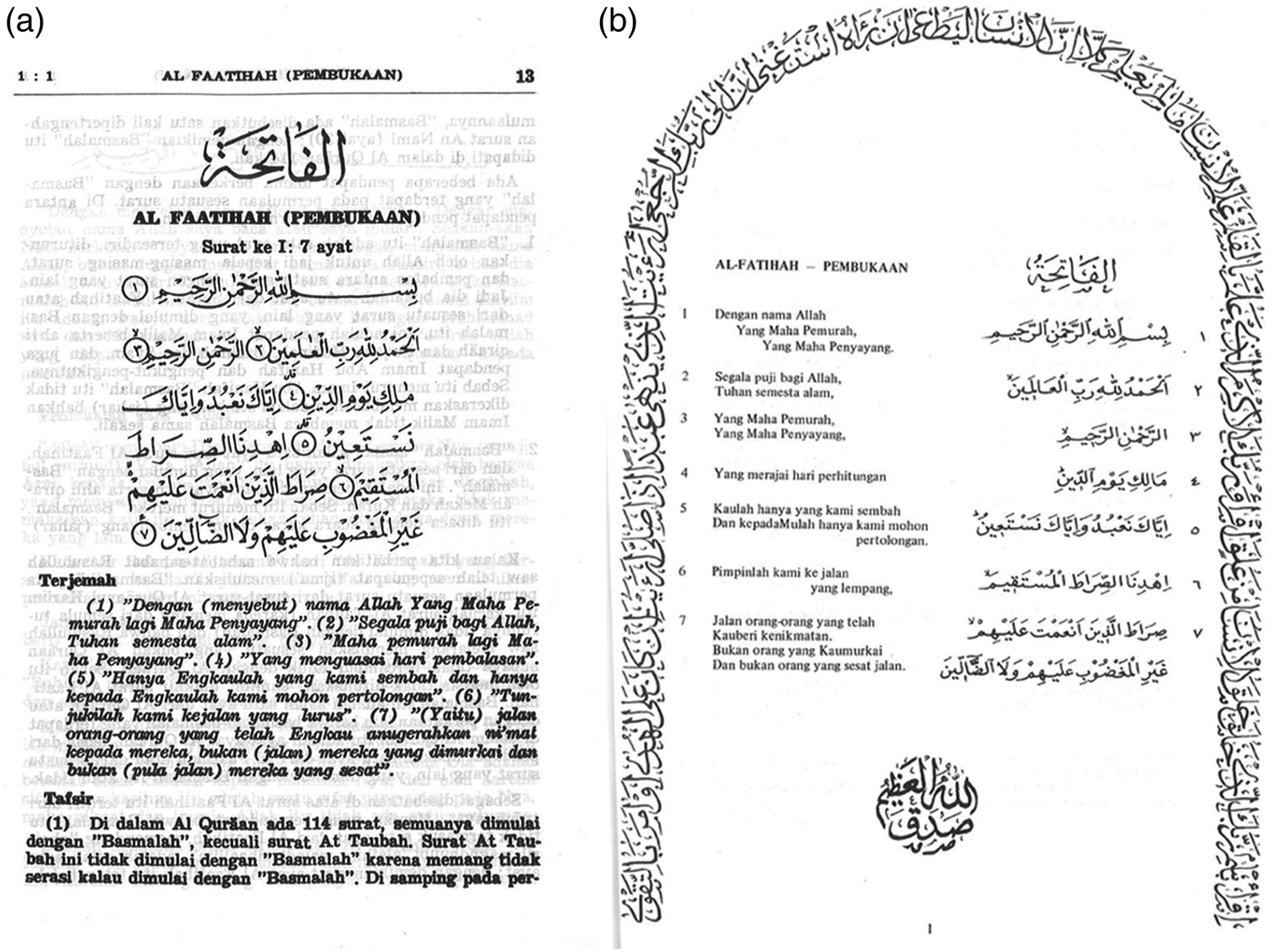
In the new arrangement, he claimed, “You feel it while you're reading. Meaning, we reflect, and only then move on to the second line, then the third, and so on. So this empty space isn't excessive, because this is a place for you to draw your breath, to digest the contents of what you've just read. You read with feeling, with thought” (Jassin Reference Jassin1995: 33). Finally, the Poetic Qur'an simply presents the Arabic in a new lay-out, with no translation. Each of his projects drew objections, which fall into four kinds. First are ad hominem doubts about Jassin's piety. A second concerns the category of “poetry” as applied to the Qur'an.Footnote 13 Third are questions of deviation from precedence and innovation (bid'ah). The fourth concerns possible social consequences.
AUTHORSHIP AND AUTHORITY
Some of the criticisms of Jassin's work resemble the philological quarrels, like those among Evangelical Christians to which Warner refers, that any scriptural translation might face. They take on greater force, however, because of questions about his authority to undertake the task at all. One of the most pointed personal attacks came from Darmawan Sepriyossa, a student activist. Claiming to speak on behalf of the umat as a whole, and recalling the “Darkening Sky” affair mentioned above, he wrote,
the Muslim umat does not yet entirely believe in the credibility and commitment of Jassin's Islamic faith. The umat is still doubtful, how a person who cannot speak Arabic, who is altogether unacquainted with the world of the religious school and who acknowledges that he has felt resentful hearing the sermons (Jassin's expression at that time was “yelling”) in the mosque, could translate the Qur'an, whereas the tradition teaches ‘Whoever speaks about the Qur'an with only thinking alone (pikirannya semata) and not knowledge (ilmu) must prepare his place in hell’” (ibid.: 83).
Although this is certainly a personal attack on Jassin's credentials as a pious Muslim (even while drawing on the Republika interview quoted above), it also invokes a more general principle, that one should not attempt to interpret the scripture on one's own. Oemar Bakry, an activist associated with Islamist party politics and the reformist mass organization Muhammadiyah (see note 5), quoted a hadith: “If matters are handed down to those who are not experts, just wait for the time” (of judgement) (Rahman Reference Rahman and Saeed2005: 95). Failing to draw on existing commentaries, Jassin approached the text without mediation, as if he were operating on the Lutheran principle of “sola scriptura.” This individual encounter with scripture, hubris to his critics, places his translation within a larger historical narrative of progress that he shared with some Muslim intellectuals elsewhere (Wilson Reference Wilson2014; see also Gürçağlar Reference Gürçağlar2008; Hirschkind Reference Hirschkind1996; Mahmood Reference Mahmood2006).
To be sure, the critical ulama were responding to competition from new sources of religious authority that were emerging across the Muslim world, from elite but non-clerical Islamic intellectuals to the popular proselytizers of mass media (Eickelman and Anderson Reference Eickelman and Anderson2003; Hirschkind Reference Hirschkind2006; Hoesterey Reference Hoesterey2016; Moll Reference Moll2013; Rudnyckyj Reference Rudnyckyj2010). But to reduce their objections to political competition or blinkered conservatism trivializes ethical and ontological premises they share with much of the umat. On the one hand, for Jassin and his defenders, the traditionalists’ insistence on precedence is just another case of the restriction of artistic and religious freedom. Jassin boldly agreed with critics who accused him of innovation (bid'ah), but, he added, it is a virtuous innovation (Arabic bid'ah hasanah) (Reference Jassin1995: 34).Footnote 14 One literary figure, Edy A. Effendi, concluded that the controversy shows that the nation is not yet ready to become more creative (ibid.: 139). On the other hand, the critics’ position is both ethical and epistemological. The ethical point is that to follow precedence displays respect for what Talal Asad (Reference Asad1986) called “discursive tradition,” a community's way of life formed around founding texts. As epistemology, adherence to precedence wards off individual subjectivism. After the Prophet, there is no further revelation, so all we are left with is that original transmission to connect us to its transcendental sources.Footnote 15 But the text alone is not necessarily a sufficient guarantee that we will grasp its intentions. The Qur'an itself distinguishes between verses that are clear (muḥkamāt) and those that are obscure or ambiguous (mutashābihāt) (Q. 3:4–8). One implication is that individuals should not face the text unaided (Departemen Agama 1985–1986: 113–14; Sonn Reference Sonn and Rippin2006: 14).
The received Qur'an is a representation of a prior, and more original, oral transmission: Gabriel's speech to Muhammad. In the absence of any other direct link between this temporal existence and eternal divinity, it is this oral transmission that spans the ontological gap. This transmission is grounded in the actual speech acts of the Prophet. Because he is the “seal of prophecy” (Q. 33:40), these speech acts are in principle the final word. Most traditions hold that after his death the direct channel to the other world is closed (Buck Reference Buck and Rippin2006: 28; Michot Reference Michot and Winter2008: 193). The reliability of transmission is one response to a recurrent problem faced by any religious effort to make contact with a world beyond immediate experience (see Keane Reference Keane2007; Reference Keane2013). According to Brinkley Messick (Reference Messick1997), Islamic oral tradition exhibits a certain wariness about relying on written texts alone, in the absence of direct bonds between human speakers.Footnote 16 Given the unreliability of writing, then, the best guarantee of one's scriptural interpretations is to demonstrate that they are based on prior interpretations that can be traced back to the original moment of revelation. Validity is ultimately secured by links to someone whose “knowledge is not derived from himself, but from the source of all knowledge, from God” (Stelzer Reference Stelzer and Winter2008: 161). Reliable transmission of revelation thus requires a particular kind of community with a particular history.
Jassin, however, is not even pretending to work within a lineage, as his citations show. His original translation cites thirty-two works, of which twenty are by Western authors and several of the others by Indonesians, and most are from the twentieth century. By contrast, the scholars who were called in to review the text overwhelmingly favor texts in Arabic, mostly from the early centuries (Federspiel Reference Federspiel1994: 124). In working with multiple contemporary authorities, Jassin is implicitly making decisions on his own—what K. H. Siradjuddin ‘Abbas criticizes as “the product of his own brain and opinion” (Reference Abbas1979: 35). The need for prophecy in Islam is not due to original sin, but to forgetfulness, which is why prophets, including Abraham, Moses, Jesus, and Muhammad, brought reminders seriatim (Rahman Reference Rahman1989: 2; Sells Reference Sells2007). In turn, forgetting leads to disunity of interpretations and thus conflicts within the umat (Stelzer Reference Stelzer and Winter2008: 164). We will return to the question of disunity below. Here I want to stress the multiplicity of reasons for worry about Jassin's approach to translation.
Jassin and his supporters speak of innovation, creativity, and renewal (pembaruan) (Jassin Reference Jassin1995: 34). Viewed from the perspective of the critics, however, his innovations manifest the pride of Iblis (Satan), who recognized Adam but still refused to bow down to him. Few of his critics object to scriptural translation as such, but the status of Arabic is a nagging problem for an Indonesian public. The entry of a universal revelation into the mundane world thus threatens to be paradoxical: it must take the specific and local form of a language. What, then, is the relationship between that form and the universal and timeless truth it conveys? Quraish Shihab (Rector of the State Islamic Institute College of Jakarta and later Minister of Religious Affairs) observes that authorities differ on how essential it is that the Qur'an comes to us in Arabic. He says that Ibn Khaldun held it to be mere happenstance that the Qur'an was transmitted to speakers of Arabic. Rejecting the secular time implicit in that view, others argue that God knew what He was doing when He chose Arabic as the scriptural language. On these grounds, some classical writers argued that Arabic was linguistically superior to other languages (Michot Reference Michot and Winter2008: 188). Shihab seems to support a compromise position, that preserving the original language and written forms “manifests respect for the ancestors, and who knows maybe it is true there is a secret to it” (Jassin Reference Jassin1995: 51–52). What then of the language of the nation? Whom does it address, and with what authority?
Jassin takes a distinctly modernist view, which seems to presuppose a version of the doctrine of the arbitrariness of the sign.Footnote 17 In contrast to the tradition that treats the sound of the Qur'an to be an essential component of the total revelation, and in apparent contradiction of his own sonic experience of the scripture, Jassin tends to distinguish form and meaning.Footnote 18 He defends his translation and layout decisions by drawing a sharp contrast between form and content, similar to structuralism's model of signifier and signified: “The material form of the Qur'anic verses is a vehicle (wahana). It is in the form of language, words, sentences, color, and rhythm, but its core (inti) is Revelation, Divine Spirit” (ibid.: 255; see Rahman Reference Rahman and Saeed2005: 96); he repeats the point elsewhere, adding that this vehicle is “only the transportation (kendaraanya). The content, the spirit (isinya, jiwanya) are still intact” (ibid.: 35). This sharp distinction would seem to be at odds with some widely accepted views of Qur'anic language. Since the Qur'an was dictated verbally by the archangel, its very sound has divine sources, and recitation can be taken as the voice of God (Buck Reference Buck and Rippin2006: 26). Like Muslims elsewhere, for many Indonesians “Quranic recitation is best understood not as an oral performance based on a text, but as participation in a divine revelation whose primary medium is voice” (Gade Reference Gade2004: 23–25). The point is not merely a theological quibble, since the sound of the Qur'an is part of its moral power (Sells Reference Sells2007). The Qur'an itself refers to its effects on listeners:
When the verses of the Compassionate are recited to them, they fall down in prostrate adoration, weeping (Q. 19:58).
God has sent down the most beautiful speech as a Scripture … whereat the skins of those in awe of their Lord shiver, and then their skins and their hearts soften to God's remembrance (Q. 39:23; both renderings from Michot Reference Michot and Winter2008: 189).
Even Jassin, despite his modernist tendency to treat linguistic signs as arbitrary conveyers of immaterial meanings, responds to the materiality of this text. Like ordinary listeners and reciters, his emotional response to those sounds is part of the overall meaning of the text. Describing his awakening, he says, “Every morning I read God's words, capturing the vibrations of air that were produced by the throat, cultivated to become understanding by reason and thought and penetrating the heart that is alert to receive it” (Reference Jassin1983b: 220–21). Moreover, that emotional response is supposed to have moral consequences. It plays a crucial role in the construction of a pious and virtuous subject. Drawing on the Qur'an's distinctive self-reflexive nature, Anna Gade observes that it “provides numerous descriptions of embodied, emotive responses to itself that lead to a permanent change of moral state. Its recitation causes the sense of the faithful to react, for example, with ‘shivering’ skin and a ‘trembling’ heart” (Reference Gade2004: 41). As Charles Hirschkind (Reference Hirschkind2006) has argued, since there is ethical power in embodied responses to the very sound of the Qur'an, piety involves distinctive aural and somatic sensibilities. In this light, Qur'anic language is hardly an arbitrary sign of a content that transcends form. Although Jassin's own account of his emotional response is consistent with this tradition, his translation practice tends to treat the text's aesthetics much like any other literary effect—different from other literary effects, to be sure, but perhaps only in degree rather than in kind.
THE QUARREL WITH THE POETS
What would it mean to treat the Qur'an as a source of literary effects? Several critics objected to the title of The Qur'an in Poetic Form. K. H. Hasan Basri, chair of the Majelis Ulama Indonesia and member of Muhammadiyah, focused on this when he issued his prohibition on the publication of the Poetic Qur'an:
[T]he Qur'an is not like other books of poetry. The Qur'an is more than merely poetry or syair. The private satisfaction of someone regarding a certain shape of writing of the Qur'an should not reach the point of changing the standard law which is already normative. We fear that writing like Jassin's will diminish the Qur'an's Divinity. Because it is not impossible that we might feel about it the same as we do on seeing other books of poetry (Jassin Reference Jassin1995: 47).Footnote 19
Jassin defended himself by insisting he had never claimed the Qur'an was poetry, merely that it was like poetry. But the charge was so fraught that this defense had little persuasive effect on the critics. A concurring opinion came from an official in the rival Nahdlatul Ulama, K. H. Makruf Amin, who said that none of the great poets ever considered rendering it in poetic form: “So let's not allow the Qur'an to become too thrust into the field of entertainment (bidang hiburannya)”Footnote 20 (ibid.: 48). Poetry, in these views, is both mere entertainment—not serious text—and a private pleasure not grounded in a community. Moreover, poetry is bound by human conventions.Footnote 21 Combining these criticisms, ‘Abbas had said of the earlier effort that verse “is bound to the norms and laws of poetic composition, and also it has its sources in norms or the feelings, imagination, and fantasy of the poet” (Abbas Reference Abbas1979: 50). Therefore, he concludes, a “poetic” Qur'an will end up transgressing either the norms of the Divine word or the standards of poetry.
Shihab writes, “The Qur'an refuses to be called poetry more than once, so it is not ethical, according to some ulama, to call it ‘In Poetic Form’” (Jassin Reference Jassin1995: 53). Why should this be a distinctly “ethical” matter, rather than just one of theological or philological error? The roots lie in the Prophet's quarrel with the poets of his time. The Qur'an appeared as a rival to the poets’ moral leadership. Moreover, whereas poetry is a human creation, the Qur'an insists that its qualities surpass anything a human could have composed (Abdul-Raof Reference Abdul-Raof2001: 37–40). Muhammad himself never claimed divinity, which in light of the centrality of the “oneness of God” (Arabic tawḥīd) to Islam, is an important difference from Christianity, with its divine Christ. The prophet Muhammad did not perform miracles—the Qur'an was sufficiently miraculous in itself. But to call the Qur'an poetry would be to treat it as just one instance of a genre that also contains others. This directly challenges the doctrine of uniqueness and inimitability (Arabic i'jāz al-Qur’ān). By rendering the scripture in poetic form, Jassin intends to convey its aesthetic power. But the aesthetic power is the material manifestation of its inimitability, and it is registered in emotional and moral effects that themselves are supposed to be distinct from any response to other aesthetic experiences. Since Jassin's career has been devoted to the elicitation of aesthetic responses to literary forms, his hubris lies in at least appearing to put aesthetic response to the scripture on the same plane as that to other works of literature. Ironically, it is as if his very respect for words turns on treating them as mere words.
VARIETIES OF DISORDER
Of course Jassin would agree that the Qur'an is not mere words. Yet he and his critics differ dramatically in their understanding of what follows from that. As noted above, for ‘Abbas the smallest error threatens eternal disaster. Other worries are less metaphysical in scope. Shihab points to the danger of line breaks, since a verse read in isolation can seem to mean the opposite of what is intended. For example, the Surat Al Maa'uun, Ayat 4 reads: “Woe to those who pray.” Readers might take this to be criticizing prayer itself, Shihab says, unless they continue on to the next verse, which completes the statement with the words “(that is) people who are inattentive during their prayers” (Jassin Reference Jassin1995: 75). Line breaks matter. And, as noted above, misreadings are more than simple errors; they threaten the unity of the umat.
The consequences critics feared went beyond misconstruing the import of a text. Problems in reading could become social problems. The Committee for the Certification of Qur'anic Text had been set up in 1957 in response to demonstrations prompted by fears that the markings in the text had confused people about the correct way to recite it (Rahman Reference Rahman and Saeed2005: 102 n44). So it was certainly not out of the question that disagreements about correct visual form, aural sound, and conceptual meaning all might have troubling social consequences. If those worries were not ungrounded, the way they were expressed often manifested elitist fears of popular religiosity.Footnote 22 But who make up this populace, and in what form should they be understood? The umat? The people (rakyat)? The public (publik)? The nation (bangsa)?
A traditionalist at the Institute of Qur'anic Science Jakarta, K. H. Ali Yafie, said there is no problem rendering the Qur'an in poetic form “as long as it is only for internal use. But it is a different matter if it were to face the reaction of the umat” (Jassin Reference Jassin1995: 47). In this view, the problem is not one of blasphemy or any other kind of transgression. Rather, it lies somewhere else, in the dynamics of an unpredictable world of the crowd. In ruling that the Poetic Qur'an could be completed and archived, but not circulated, the Minister of Religious Affairs, H. Munawir Sjadzali held that not all of the Muslim umat had yet reached an “adult level” (taraf dewasa). He said, “There are still many in the umat who will be upset by things like this. I am sure if this Qur'an is spread around there will arise lengthy polemics, that will weaken our unity. The essence of the Qur'an and the interests of the umat should not be sacrificed for art” (ibid.: 72–73).Footnote 23 Now Sjadzali, a career diplomat with a master's degree from Georgetown University, was no religious expert (Federspiel Reference Federspiel1992: 24): his concern is clearly for political disorder rather than theological niceties. But the political worry turns on those who do take seriously the religious—and semiotic—scruple. The student activist, Darmawan Sepriyossa, took the threat of a split in the umat quite seriously:
This issue really is a very complicated and crucial issue for the Muslim umat. The possibility that the umat will split is very great, minimally into two parties diametrically opposed to each other. This matter is made quite possible because the Islamic figures who are leaders of the umat themselves are divided into two parties; pro and contra toward what Jassin has done. And because paternalism is still quite strongly planted in the traditions of the Indonesian Muslim umat, it is quite logical that this wild dance that Jassin is performing will produce a phenomenon of splitting (Jassin Reference Jassin1995: 81–82).
So the theological problems become political ones. Yet the value of a unified umat is not simply political. As noted above, the consensus (Arabic ijmā) of the community is one means of assuring a correct understanding of the revelation. The fundamental ethical injunction (Cook Reference Cook2000) to do good and abjure evil (Arabic al-amr bi'l-ma'rûf), by stressing the duty to correct others, brings out the extent to which ethics is located in a community and not just individual interiority. It seems that this is why Shihab said the trouble with Jassin's versions of the Qur'an is not really a question of law, but rather of ethics, involving “taking into account the condition of the umat Islam itself’” (Jassin Reference Jassin1995: 77–78). That is, incorrect translation is an ethical violation to the extent that it threatens the calm and unity of the community, which in turn is the foundation for sustained and trustworthy relation to the moment of revelation. The alternative, dissension, would lead not only to civil unrest, as imagined in the standard views of the origins of religious freedom, but to fitna, the dissension that threatens an entire community with rupture from divinity and the state of forgetfulness that the revelation was meant to overcome.
What is Jassin's community? Although he is a public figure, he draws his authority, both aesthetic and pious, from the inner experience of a reader. In this respect, his religious activity starts not far from the high modernism of his literary work. When he faces outward from his subjectivity, as it were, it is a mass-mediated public he sees, not the umat with whom his critics are so concerned. Jassin and his defenders stress his piety. But if we turn to the introduction to Noble Reading another dimension appears, as Jassin recalls the political turmoil ending Sukarno's era:
Even in this tense period, I still felt my heart was peaceful and at rest, aware of a higher power that would not permit tyranny to run rampant. [After reading the Qur'an each morning] I would leave for the office. On Kramat Senen I would drop by the newsstand [and read the latest attacks on me and others]…. But what was the meaning of insinuations, accusations, attacks, filthy vulgar, and false slanders, compared with the words of God that had just entered my spirit? Indeed, I just smiled, I felt nothing of any angry passion rising and I felt no need to answer. I began each task with In the name of God (bismillah) and ended it with Praise be to God (alhamdulillah). I left the house with “In the name of God” and saying “Praise be to God” arrived at the office. I got into the pedicab with “In the name of God” and got out of the pedicab with “Praise be to God.” … Test after test struck, I was even accused of being an apostate and brought before the judge on charges of having insulted God, insulted the religion of Islam, Prophet and Saints, [the state ideology] Pancasila and the Constitution of 45. But I received all this as instigation to dive more deeply into the essence of the truth and I considered it to be a gift from The Only God. What made me even more devoted to diving in were experiences that I had never experienced before, that is over and over I suddenly was surrounded by the fragrant smell of incense which was gentle and soothing, which made me happy all day (Jassin Reference Jassin1983b: 220–22).
Piety here appears in a markedly local political context, and Jassin strikes a pose at odds with his image as the pugilistic instigator of scandals. The scriptural text becomes an instrument for the cultivation of a subject extracted from his social context. Unsurprisingly, for Jassin, this inward-looking self-cultivation takes a distinctly literary form, perhaps not very different from the aestheticism of early twentieth-century European modernists.
The debates over each of his Qur'ans took place long after the turmoil to which he refers above. Sukarno had fallen, the left had been decimated, and the nation was controlled by Suharto's authoritarian state. Now the metaphysical sense of threat expressed by people like ‘Abbas was compounded by the general anxiety about any imaginable disturbance to social order that was one of the hallmarks of the regime. Here, I think, we see evidence of an underlying tension between two different social visions, of the Muslim umat, on one hand, and the national public on the other. The Indonesian Constitution, and the doctrine of Pancasila, give explicit, if qualified, support to religious freedom. But the state tended to see religion as a special source of danger as well. Of course this view is hardly confined to Indonesia. It underlies many of the ways states try to handle religion. Formal institutions of religious freedom commonly presuppose a deep connection between religion (or at least some kinds of religion) and violence (or at least some kinds of violence), such that religion requires specific forms of juridical intervention or state neutrality (Hurd Reference Hurd, Sullivan, Hurd, Mahmood and Danchin2015; Sullivan Reference Sullivan2005).Footnote 24 Freedom of religion is seen to pose problems quite different, and potentially more dangerous, than those of, say, journalistic information, artistic expression, or sexuality (see Keane Reference Keane2009). The question of religion's distinctive character haunts juridical and legislative efforts to deal with it. In particular, to posit an essential link between religion and violence is to assume that religion is defined by special emotions and deep, even primordial commitments that separate it from the forms of instrumental rationality supposed to underlie other forms of violence such as electoral strife, class conflict, or simple criminality.
Linked to this is the idea that religion is both irrational and taps into ultimate values. An offshoot of secular reframings of religion (e.g., Taylor Reference Taylor2007) is the tendency to define religion in terms of people's central moral commitments. This harbors the unintended implication that religion is most authentic when it is most dogmatic (Laborde Reference Laborde, Sullivan, Hurd, Mahmood and Dachin2015). It may be that freedom of belief is most easily accepted if one takes it to refer primarily to theological claims of no particular immediate and practical consequence, a view famously expressed by Thomas Jefferson (Reference Jefferson and Peden1955) in the words, “It does me no injury for my neighbour to say there are twenty gods, or no god. It neither picks my pocket nor breaks my leg.” If, on the other hand, religion is above all a matter of moralities, it is easier to imagine dire social and political consequences that might be incurred through the mishandling of the relevant freedoms. Viewed in this way, to the extent religion centers on deep moral commitments, differences of religion can also be taken as threats to public order and thereby require state intervention. They are no longer about differing truth claims or ontologies, matters about which people may, at least at times, agree to disagree with few direct consequences. Rather, in this view, religion is a crucial factor in what motivates and directs the impact people have upon one another. For reasons like this, freedom to manifest religion—even in those European states that have emphasized the principle—has always been limited on the grounds that neutrality toward religion is merely an exception to the state's prior responsibility for public order (Bhuta Reference Bhuta2014). But in either case, whether one emphasizes religion-as-belief or religion-as-morality, what makes religious freedom a special case, requiring special protections, institutions, and interventions, is predicated on what one takes religion ultimately to be.
CONCLUSION
With this, let us return to the problem of attacks on images and other kinds of “expression.” Iconoclasm broadly understood treats material things and other forms of semiotic mediation, including language, as sources of some kind of danger. Although that danger is commonly explained in terms of fetishism or idol worship or rote habits of ritualism, there can be other stakes as well. In the case we have reviewed here, for instance, questions of form are taken to have implications for social order. Whereas Jassin's own account of his piety focuses on subjective states and a personal affective response, his critics focus on either the materializations of piety in the text or on social consequences. Assuming the arbitrariness of the sign, Jassin is led to a kind of literalism that works in tension with his emotional aesthetics. More than that, however, is the effect of modernist rationalism. For those arbitrary signs are anchored in meanings that in principle should be clear, and therefore can be established with finality by reasoning humans. In setting the line breaks and so forth, he is determining the correct readings of the text. Doing so, he plays (perhaps unwittingly) into a long-standing argument between Indonesian traditionalists and reformists. Many traditionalists hold that since external form is distinct from intention, the scriptural text is ambiguous, at least in places. This is why you need a community to interpret the text, guided by the discursive tradition. In this light, translation may lead to potentially idiosyncratic interpretations (Bowen Reference Bowen1993: 23–25). The reformists often treat the text as clear and susceptible to a final, determinate reading. Jassin's formal decisions reflect that approach.Footnote 25 It is in this expectation of an authoritative final reading that Jassin displays the hubris of the challenge not just to stubborn authorities, but to the ongoing work of negotiation that often defines the nature of the community he aims to address.
For Jassin's critics, the very materiality of the Qur'an makes it a public concern. It is as a material entity, which necessarily takes particular semiotic forms, that Jassin's vision of the Qur'an becomes available to others. But this materiality is also inseparable from some very long-standing religious problems (see Suit Reference Suit2010). To the faithful on all sides of the debate, of course, the basic ontological question, the existence of Allah and the authority of His revelation, are not in question. But the problem of materiality is. Theologically, the problem of materiality is inseparable from the assurance that this world has a secure connection to divinity. Viewed from that perspective, form matters a great deal. But Jassin's position on materiality seems rather detached from this onto-epistemological question. When he says that the words of the Qur'an are merely the container for divine contents, he seems to be expressing an aspect of what I have called the moral narrative of modernity (Keane Reference Keane2007). One feature of this narrative is the view that historical progress includes the emancipation of the individual subject from its mistaken adherence to the materiality of ritual and rhetoric, in favor of immaterial conscience and disembodied thought. And the value of a unified umat is muted to the extent that the true measure of faith is internal, subjective states. Jassin is relatively insensitive to this particular worry on the part of his critics, just as they are deaf to his concerns about creative freedom. The sense of possible threat is reinforced by the convergence between two distinct aesthetics, that of religious piety and that of modern art. Both stress the transformation of persons through the emotional effects of semiotic form. This is one reason why a challenge to those signs might turn out to be a threat to public order.
And then there is the clash of cosmopolitanisms. Jassin's pious turn does not eliminate his deeply felt cosmopolitan modernism. True to the faith of literary art, it seems he cannot but treat the scripture as a text like any other—superior, even unique, no doubt, but so, in their own ways, are other great works in the global ecumene. The act of translation, in this context, is also a nationalist project, placing nations and their defining languages on the same plane. Each nation defines itself within a global framework, set by the terms of literary self-expression. But Jassin's critics maintain their own vision of a translocal community, an umat that transcends national boundaries and even the confines of historical time. From that perspective, literary modernism can seem quite parochial.
For all his protestations to the contrary, Jassin's translation strategies treat Arabic as one language among many and Qur'anic verses as poetry commensurate with other verses. This is implicit in the very semiotic ideology that guides his work. The scripture should be available in any language at all, and the linguistic meanings made available through his translation should be available to any reader of Indonesian, regardless of their religious lineages or personal capacities—or lack thereof. And Indonesian, as the language of the nation, should in principle be open to any member of the public, each of whom is invited to speak it, arrayed, as they are, across a potentially even national landscape. The scripture it translates, on the other hand, summons its listeners into a community through its distinctive mode of address from above. Addressed by an inimitable voice arising at a distant and singular point of origin, the membership of the faithful in that community turns on the nature of their response to that voice. The act of translation exposes the tension between two modes of social being and, if not their very conditions of possibility, then at least the ontologies they presuppose and the media that help constitute them. At stake in the struggle over the words and images can be the plausibility of people's lives together.



