INTRODUCTION
The extraordinary population declines that have occurred under fishing pressure (such as for sharks, cods, and seahorses listed in Appendix 2 of the Convention on International Trade in Endangered Species of Fauna and Flora) are almost certainly leading to local extinctions in a manner that can be predicted from intrinsic biological characteristics (Reynolds et al., Reference Reynolds, Dulvy, Goodwin and Hutchings2005). A better understanding of extrinsic threats and intrinsic life history traits will lead to an enhanced ability to assess the status of marine fish and to set priorities for conservation action (Reynolds et al., Reference Reynolds, Dulvy, Goodwin and Hutchings2005).
Life history traits determining fitness in fish populations are growth rate, age and size at first maturity, life span and fecundity (Smith et al., Reference Smith, Williams and Fisher1997).
The understanding of life-history traits has immediate management value as a guide for data input in assessment models (Hoenig & Gruber, Reference Hoenig and Gruber1990), while analysis and synthesis of life-history data can be useful to identify and compare functional groups that may respond favourably to particular management regimes (Farnsworth, Reference Farnsworth2007), as well as to support the construction of alternative management scenarios for a particular species.
Seahorses (Hippocampus spp.) are threatened throughout their distribution range as a result of habitat loss and over-fishing. They are among the many genera whose life histories (e.g. sparse distribution, low mobility, small home ranges, low fecundity and lengthy parental care) might render them vulnerable to overfishing or other disruptions such as habitat damage (Foster & Vincent, Reference Foster and Vincent2004).
The knowledge of parameters such as mortality, growth, reproduction and recruitment rates is central to plan for long-term persistence and recovery of depleted seahorse populations and studies focusing on those aspects have become particularly important now that the entire genus Hippocampus has been added to the Appendix II of the Convention on International Trade in Endangered Species of Wild Fauna and Flora (CITES, 2004), a listing that requires signatory nations to manage international trade to enable the persistence of wild populations. Nevertheless, studies on the life-history and ecology are lacking for most species of Hippocampus, including some which are heavily-exploited (see Foster & Vincent, Reference Foster and Vincent2004).
This paper focuses on Hippocampus reidi Ginsburg, 1993, commonly known as the Brazilian seahorse or longsnout seahorse, one of the most sought after seahorse species in the aquarium trade and currently listed as ‘Data Deficient' by the International Union for Conservation of Nature (IUCN, 2010). Published data on growth, mortality and longevity of H. reidi are limited to a few ex situ studies (e.g. Olivotto et al., Reference Olivotto, Avella, Sampaolesi, Piccinetti, Navarro and Carnevali2008; Hora & Joyeux, Reference Hora and Joyeux2009), and virtually nothing is known about these population characteristics in the wild. In that context, our overall goal was to provide in situ data which can be used to assist in conservation and management of a heavily exploited seahorse species, specially, growth, maturity and mortality parameters were estimated. Field work was conducted in Brazil, one of the main exporters of seahorses for the aquarium trade, the major consumer of live specimens in Latin America, and a trader of seahorses in dried form (Baum & Vincent, Reference Baum and Vincent2005; Rosa et al., Reference Rosa, Alves, Bonifácio, Mourão, Osório, Oliveira and Nottingham2005, Reference Rosa, Oliveira, Castro, Moraes, Xavier, Nottingham, Dias, Bruto-Costa, Araújo, Birolo, Mai and Monteiro-Neto2007; Mai & Loebmann, Reference Mai and Loebmann2009; Mai & Rosa, Reference Mai and Rosa2009).
MATERIALS AND METHODS
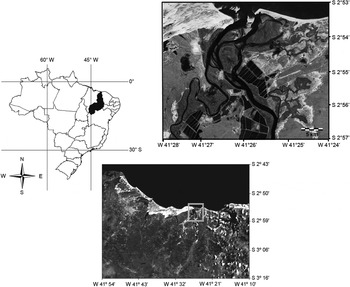
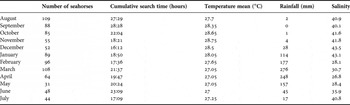
Data were gathered from August 2006 to July 2007. Underwater censuses during the diurnal period were conducted six times per month and each one was ~4 hours long (Table 1). Data were collected at the Delta do Parnaíba Environmental Protection Area, State of Piauí, north-eastern Brazil, specifically at the Camurupim/Cardoso estuarine complex (02°53′S–02°58′S 41°24′W–41°28′W) (Figure 1).
Study area. Satellite image of the coastal zone of the State of Piauí, Brazil, showing the Camurupim/Cardoso estuarine complex. Map provided by Intituto Chico Mendas.

Number of Hippocampus reidi found (including individuals re-sighted), the number of hours underwater dives carried out, temperature, rainfall and salinity in each month.

Data for temperature and salinity were measured with an alcohol thermometer and a portable refractometer, respectively. Rainfall data were obtained from the meteorological station of Empresa Brasileira de Pesquisa Agropecuária (Embrapa), Parnaíba municipality, State of Piauí (Table 1).
Specimens of Hippocampus reidi sighted in this study were carefully hand-picked and kept underwater throughout data collection. For each examined specimen, the following data were recorded on a PVC slate: height (cm), sex (male, female and undetermined), location of sighting point (using GPS) and reproductive stage (male: immature, full mature pouch, non-prominent pouch; female: immature, prominent ovipositor). Underwater photographs of specimens and of their microhabitats were used as an additional data source. Following data collection, specimens were returned to the same place where they were originally found.
Quantification of residency time, estimation of life span and height increment were done through a mark–recapture study in which individuals with body height ≥7 cm were marked and monitored monthly. Marks consisted of a combination of differently-coloured capped wire (0.3 mm diameter) and elastic bracket bands placed around the base of the tail of each sighted specimen. At the end of the study, an extensive sampling effort was performed in order to remove the marks.
Considering that in situ measurements of seahorses can present low precision when individuals exhibit trunk and tail curvature, all marked individuals were photographed to adjust height data obtained underwater. Height measurements followed Curtis & Vincent (Reference Curtis and Vincent2006) and photographs were analysed using the free software Image Tools for Windows v. 3.0 (available at http://ddsdx.uthscsa.edu/dig/itdesc.html).
Minimum residence time was estimated as the time between the first and last sighting of an individual at a specific sampling point, acknowledging that some individuals were present before and after the sampling period (Curtis & Vincent, Reference Curtis and Vincent2006). Difference between male and female minimum residence times was assessed using Student's t-tests.
To determine size at birth and brood size, three males with a fully-developed pouch were caged in situ until release of offspring, and height was measured on 30 newborns. The cage was set up inside a 30 × 30 × 45 cm net (mesh: 0.5 mm), supplied with holdfasts (Mai & Loebmann, Reference Mai and Loebmann2009).
Growth parameters were estimated based on mark–recapture data with intervals ≥30 days. Asymptotic height (L ∞) was calculated using maximum observed height (L max) using Taylor's equation L ∞ = L max/0.95 (Taylor, Reference Taylor1958, Reference Taylor1960; Sparre et al., Reference Sparre, Ursin and Venema1989; Velasco & Oddone, Reference Velasco and Oddone2004). Then fixing the L ∞ value, the parameter K was calculated by Munro's (Reference Munro1982) method, calculated as K = [log(L ∞−L i)−log(L ∞−L f)]/(tf−ti), where L i is height upon marking (initial reading), L f is height at recapture, and ti and tf are the corresponding dates, and by Appeldoorn's (Reference Appeldoorn1987) method, which uses size increment data to estimate growth parameters accounting for seasonal oscillations in the traditional von Bertalanffy growth function (vBGF; Gayanilo et al., Reference Gayanilo, Sparre and Pauly2005).
The estimates are obtained when using the Marquardt algorithm for non-linear regression:

where St = (CK/2π) . sin (2π(t-ts))
St+t = (CK/2π) . sin (2π((t-ts))
ts = 0.5 + WP (fish age at the beginning of growth oscillation).
This method allows us to estimate L ∞; K, and the oscillation amplitude C, and point of oscillation, or winter point WP with their respective standard errors. The latter two can be ignored, and then the model predicted is the traditional vBGF, more comparable across different studies.
The growth curve was constructed following the vBGF, where L t = L ∞{1–exp[-K(t-to)]} (Sparre et al., Reference Sparre, Ursin and Venema1989), using the computational package FAO–ICLARM Stock Assessment Tools—FISAT II (version 1.2.2) (Gayanilo et al., Reference Gayanilo, Sparre and Pauly2005), available at http://www.fao.org/fi/statist/fisoft/fisat/index.htm. The value zero was attributed to the t 0 parameter, considering that the mark–recapture method does not allow its calculation.
As a means to validate the theoretical growth curve obtained in this study, data on height (mean ± SD = 13 ± 0.6 cm) of 10 months old individuals (10 males and 10 females) kept in aquaria at the Universidade Federal da Paraíba, were plotted along with the von Bertalanffy curve, to analyse the fitting of this independent data.
Temporal variation of maturity stages of males was used to define the reproductive period of the species, considering that they are more appropriate when the classification is performed macroscopically, in the field (Foster & Vincent, Reference Foster and Vincent2004). Sexual maturity was visually inferred from the developmental stage of the brood pouch, as follows: (1) pouch not formed; (2) pouch developed; (3) pouch distended and full; and (4) pouch flattened and flaccid. Males in stages 2, 3 and 4 were considered mature, while those in stages 3 and 4 were considered as reproductively active. The use of the developed brood pouch to infer sexual maturity has been thoroughly analysed by Vincent et al. (Reference Vincent, Marsden, Evans and Sadler2004), who pointed out some limitations of the method, but have also remarked that ‘conservation concern and pragmatism will dictate that the presence of a fully developed pouch is a key index of sexual maturity’.
Mean height of first maturity (L mat) was calculated as the height-class where 50% of males were mature, using a logistical model applied to the proportion of mature individuals in each 0.5 cm height-class, described as: PL = 1/{1 + exp[−r*(C−Lmat)]}, where PL is the proportion of mature individuals in height-class L, L mat is the height-class where 50% of individuals are mature, r is a constant which increases with inclination and C is the mean point of the height-class (King, Reference King1995). A logistic curve was adjusted to the data described above, through the least squares method. In this manner, the best pair of parameters L mat and r was estimated, generating a curve with the lowest deviation in relation to the observed points.
Mean age at first maturity, t mat, was estimated based on L mat employing the von Bertalanffy inverse model (Sparre et al., Reference Sparre, Ursin and Venema1989; Velasco et al., Reference Velasco, Reis and Vieira2007), where:

For calculation of mean height and weight of first reproduction, the same method was employed, with L rep being the value where 50% of males were reproductively active (i.e. not immature).
Mortality was estimated using: (1) the empirical model proposed by Pauly (Reference Pauly1980), which calculates the instantaneous rate of natural mortality (M), through the equation logM= –0.0066–0.279*logL ∞ + 0.6543*logK + 0.4634*logT, where L ∞ and K are two of the growth parameters of the von Bertalanffy equation and T the mean annual water temperature of the fish's habitat; and (2) the model proposed by Rikhter & Efanov (Reference Rikhter and Efanov1976), whose equation is based on the relation between natural mortality (M) and the mean age at first gonadal maturity as M = 1.521/(t rep0.72)–0.155 year−1. In this study the first gonadal maturity was substituted by the mean age at first reproduction (t rep) due to the fact that at this age males effectively receive eggs from females. The annual survival rate, S, expressed in percentage, was calculated for both models as: S = 100*e−M (Curtis & Vincent, Reference Curtis and Vincent2006).
Life span, defined as the time an individual takes to reach 95% of asymptotic height, was estimated based on the equation proposed by Taylor (Reference Taylor1958, Reference Taylor1959, Reference Taylor1960). The model can be described as: A 0.95= t o + 2.996/K, where t o and K are the parameters of the von Bertalanffy equation, 2.996 results from –LN(1 – p), with p = 0.95 (proportion which represents L max in relation to L ∞) (Taylor, Reference Taylor1958, Reference Taylor1959, Reference Taylor1960; Velasco, Reference Velasco1998).
RESULTS
During the sampling period mean water temperature was 28.5 ± 0.9oC SD, while mean salinity value was 38 ± 6.9 SD. Mean horizontal water transparency (recorded using a Secchi disc) was 0.33 ± 0.163 m (Mai & Rosa, Reference Mai and Rosa2009). Local tide variation was 3.3 m.
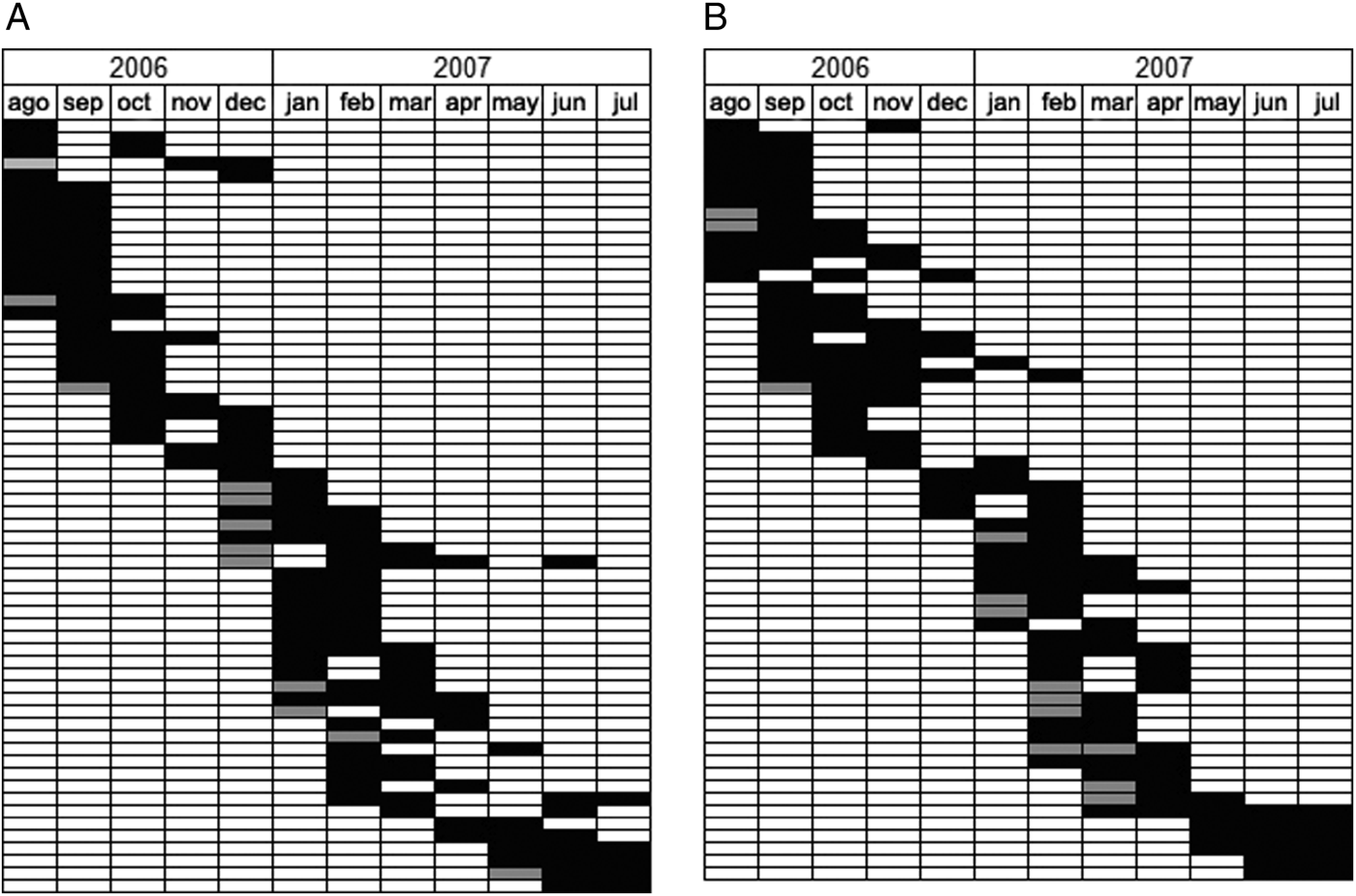
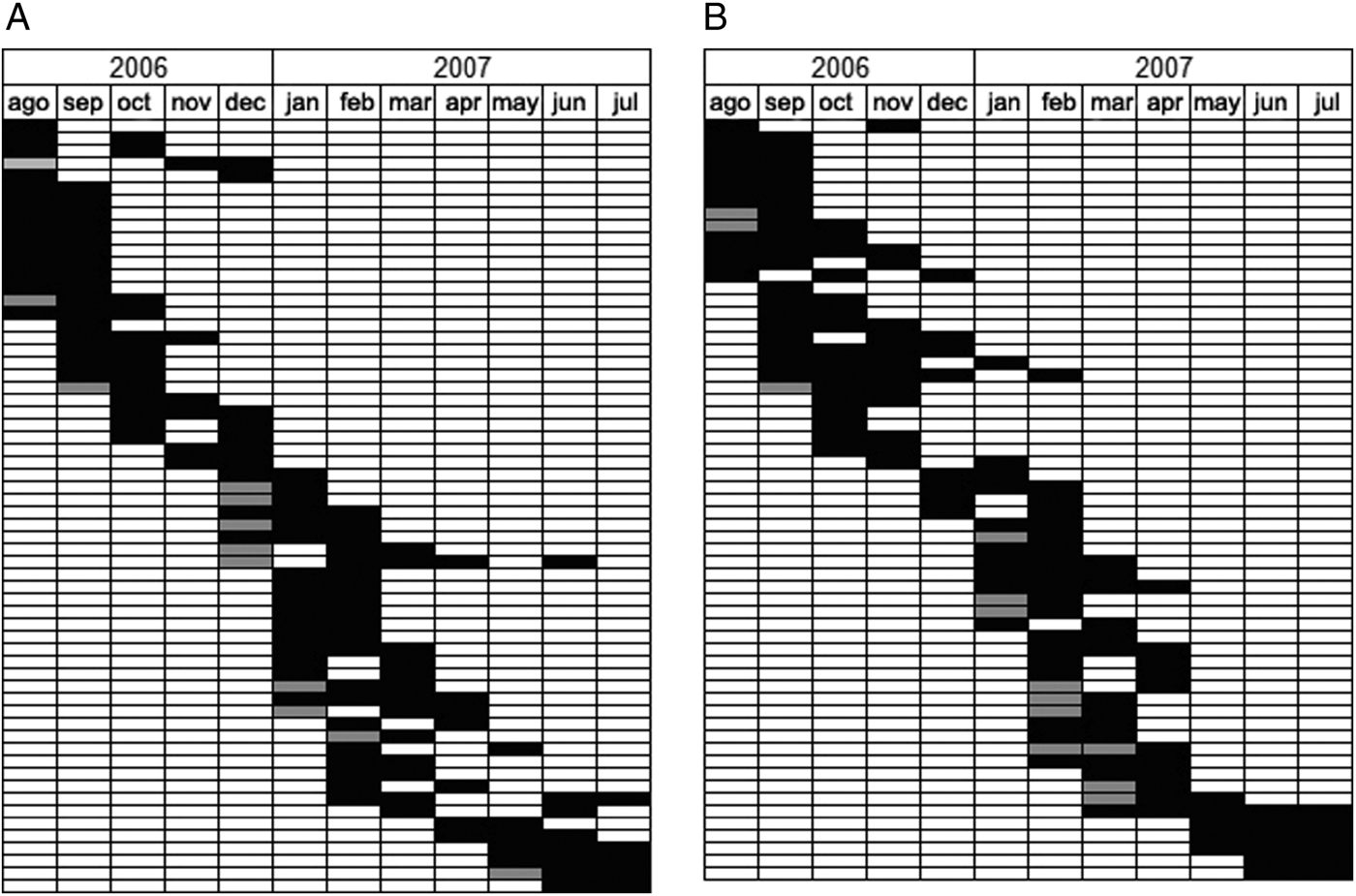
Throughout the study, 647 specimens of Hippocampus reidi were sighted. From these, 591 were marked and 141 (24%) were re-sighted at least once (maximum re-sighting: five times). Re-sighted individuals corresponded to 67 males and 66 females, and eight individuals of undetermined sex, grouped as juveniles.
Data on captures and re-captures are summarized on Figure 2A, B. Minimum residence time of males, females and juveniles was respectively 49.3 ± 30.5, 50.0 ± 31.8, and 30.5 ± 9.1 days. No significant difference was observed between male and female minimum residence times (df = 132, P = 0.89).
Data on recaptures of Hippocampus reidi in the Camurupim/Cardoso estuary, Piauí, north-eastern Brazil: (A) males; (B) females.  , represents sexually-differentiated individuals. Each line corresponds to one specimen.
The smallest male with a brood pouch and the smallest male with a fully mature pouch measured 9 and 9.5 cm (height), respectively, while the smallest mature female measured 8.8 cm. Height of the smallest settled individual was 2.6 cm (undetermined sex), while the largest sighted individuals (three females and one male) measured 19 cm.
Asymptotic height (L ∞) was calculated as 20 cm for males and females. The calculated growth curve for the species (both sexes grouped) (Figure 3) resulted from a K = 1.195 year−1, with L ∞ fixed at 20 cm. Considering both sexes separately, the females K was 1.068 year−1, N = 30 and males K = 1.217 year−1, N = 36, with the same fixed L ∞.
Growth curve of Hippocampus reidi.  represents age and actual height of captive specimens.

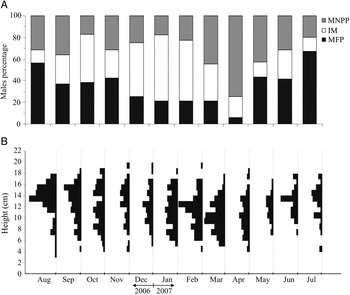
Appropriate reproductive individuals were found throughout the study; however, a higher concentration of males with fully developed pouches was found from May to November (Figure 4A). Frequency of males with full mature pouches (reproductive period) presented negative correlation with pluviosity (–0.69) and a weak correlation with salinity (0.45).
The analysis of the distribution of the number of individuals per height-class showed that larger individuals (over 18 cm) were found mainly in November, December and February, and that the recruitment of new individuals to the population occurred nearly all year round, with the exception of May and June, when individuals smaller than 7 cm were not found (Figure 4B). A considerable increase in the number of males with a fully developed pouch occurred in May, after five months of low percentages, a fact reflected in the absence of recruits in May and June, and in the height-class frequency distribution. The reappearance of recruits in July suggests that such individuals were born in May (Figure 4A, B).
In situ reproductive data on Hippocampus reidi, obtained from August 2006 to July 2007: (A) percentage of males at each reproductive stage, where MNPP = males with non-prominent pouch, IM = immature males and MFP = males with fully mature pouch; (B) distribution of frequency per height-class (1 cm).

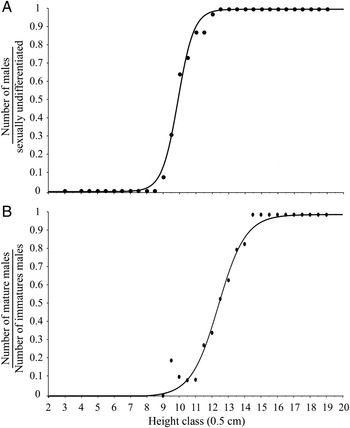
Mean height at first maturity (L mat) was estimated as 9.9 ± 0.07 cm (Figure 5A), with the following non-linear relationship: PL = 1/{1 + exp[−2.053*(C−9.9)]}; while mean height at first reproduction (L rep) was estimated as 12.4 ± 0.2 cm (Figure 5B), following the non-linear regression equation PL = 1/{1 + exp[−1.2*(C−12.4)]}. Mean age at first maturity (t mat) was estimated as 205 days, and mean age at first reproduction (t rep) as 295 days, corresponding to approximately ten months.
L50% determination for Hippocampus reidi at the Camurupim/Cardoso estuary, Piauí: (A) mean height of first maturity; (B) mean height of first reproduction.

In the field, evidences of natural mortality by predation (five individuals with cut tails, corresponding to 0.8% of the total) and by diseases (one individual wounded in the torso and one wounded in the tail) were observed. Mortality by direct and indirect fishing was also observed.
Estimated instantaneous rate of natural mortality resulted in the following values: 1.43 and 1.58 year−1 (Rikhter & Efanov, Reference Rikhter and Efanov1976; Pauly, Reference Pauly1980) from which values survival rates were calculated as 21 and 24% per year. The estimated life span for the species was 30 months.
DISCUSSION
Our results suggest that reproduction of H. reidi takes place year-round with a reproductive peak from May to November, months that correspond to the end of the rainy season and the beginning of the windy season at the study site. This period of higher reproductive activity may be associated with a higher potential for dispersal, considering that newborn H. reidi are planktonic.
Nevertheless, data on the reproductive period of H. reidi collected at Brazilian localities eastward of our study site revealed reproductive peaks in different periods of the year (Rosa et al., Reference Rosa, Oliveira, Castro, Moraes, Xavier, Nottingham, Dias, Bruto-Costa, Araújo, Birolo, Mai and Monteiro-Neto2007) which suggests the influence of local environmental conditions on the reproductive timing of the species. As pointed out by Vincent & Giles (Reference Vincent and Giles2003), the reproductive output of seahorses may be influenced by environmental constraints that affect embryo growth and development. Re-sighting of three pairs in our study is suggestive of a monogamous reproductive pattern of the species, as previously discussed in the literature (Rosa et al., Reference Rosa, Oliveira, Castro, Moraes, Xavier, Nottingham, Dias, Bruto-Costa, Araújo, Birolo, Mai and Monteiro-Neto2007), and generally found in other species of the genus Hippocampus (see Foster & Vincent, Reference Foster and Vincent2004).
Given the current methodological limitations to following the fate of seahorse' offspring in the wild, alternative indicators of the duration of the planktonic phase remain very useful to both in situ and ex situ studies. In our study, we estimated that newborn H. reidi spend approximately two months in the plankton before settlement, while for H. guttulatus, a species with similar maximum height, the estimated planktonic period was three months (Boisseau, Reference Boisseau1967; Curtis & Vincent, Reference Curtis and Vincent2006). This difference could be related to the higher latitude and lower temperature in the localities where H. guttulatus was studied, considering that lower temperatures may lead to slower growth in seahorses (see Foster & Vincent, Reference Foster and Vincent2004).
Males and females of H. reidi examined in this study exhibited equivalent minimum residence times, a result in line with those obtained for H. comes (Perante et al., Reference Perante, Pajaro, Meeuwig and Vincent2002) and H. guttulatus (Curtis & Vincent, Reference Curtis and Vincent2006), and that reflects some aspects of the biology of seahorses, particularly pair-bonding and monogamy (see Foster & Vincent, Reference Foster and Vincent2004). Furthermore, as discussed by Vincent (Reference Vincent1990) and Vincent & Sadler (Reference Vincent and Sadler1995), elaborate greeting and mating rituals between partners may also play a role in maintaining pair bonds and increasing synchrony of reproduction. It should be noted, however, that a lengthier minimum residence time (264 days) has been estimated for H. reidi in another Brazilian locality (Rosa et al., Reference Rosa, Oliveira, Castro, Moraes, Xavier, Nottingham, Dias, Bruto-Costa, Araújo, Birolo, Mai and Monteiro-Neto2007), a discrepancy that should be further investigated in relation to local environmental conditions.
Based on the relationship between age at first maturity and maximum size attained by other marine teleosts, Foster & Vincent (Reference Foster and Vincent2005) estimated the height at first maturity for several species of the genus Hippocampus, with H. reidi presenting an estimated maturity height close to 10 cm, a value higher than the one proposed by Vari (Reference Vari1982), who inferred the maturity height as 8 cm based on the smallest male with a brood pouch. In our study site, however, less than 50% of the individuals of H. reidi had achieved sexual maturity at 10 cm, an aspect that should be evaluated in future conservation and management measures.
Mean age at first maturity and size at birth estimated in our study markedly differed from that found in a recent ex situ study (Hora & Joyeux, Reference Hora and Joyeux2009); although these discrepancies may reflect local population characteristics (see Rosa et al., Reference Rosa, Oliveira, Castro, Moraes, Xavier, Nottingham, Dias, Bruto-Costa, Araújo, Birolo, Mai and Monteiro-Neto2007), the influence of parameters such as water temperature in aquaria, photoperiod or provision of food should also be considered.
The fast growth and the potential to reproduce year-round exhibited by H. reidi result in a high intrinsic growth rate for the species, however, aspects such as fishing pressure, natural mortality and habitat degradation act as negative impacts on their populations.
The lifespan and the parameters that affect them remain unknown for most seahorse species, particularly in situ. Information on natural and fishery-induced mortality in seahorses is rare. Nonetheless, predation by crabs (Baum et al., Reference Baum, Meeuwig and Vincent2003; Rosa et al., Reference Rosa, Oliveira, Castro, Moraes, Xavier, Nottingham, Dias, Bruto-Costa, Araújo, Birolo, Mai and Monteiro-Neto2007), as well as by fish, turtles, dolphins and sea birds (Foster & Vincent, Reference Foster and Vincent2004) has been recorded, and these trophic relations need to be further investigated in our geographical region.
Inferred longevity in the genus Hippocampus ranges from about one year in the very small H. zosterae to an average of three to five years in larger species (Foster & Vincent, Reference Foster and Vincent2004). In captivity the life span of H. reidi approaches five years (Silveira, Reference Silveira2005), while in our in situ study we estimated a life span of 2.5 years.
A direct comparison of these two results is not appropriate due to the uncertainties as to how comparable ex situ or cohort analysis is to the actual life span of seahorses (Vincent et al., Reference Vincent, Marsden, Evans and Sadler2004). Nevertheless, the influence of the latitude at our study site (approximately 3o south), and its corresponding high temperature value, in the lifespan of H. reidi should be considered. According to the literature (e.g. Pauly, Reference Pauly1980; Velasco & Oddone, Reference Velasco and Oddone2004; Velasco et al., Reference Velasco, Reis and Vieira2007), higher temperatures may lead to faster growth and higher natural mortality.
The biology and ecology of H. reidi and of many other seahorse species have hardly been studied in situ. The information on life-history characteristics recorded here can thus be useful to conservation and management initiatives directed to H. reidi, as well contribute to increase our understanding of life-history traits in the genus Hippocampus.
It should be pointed out, however, that considerable knowledge gaps persist and that ongoing monitoring of wild populations of H. reidi should be conducted. Among other topics, more information is needed on juvenile dispersal and settlement, population genetics, trophic relations, growth, longevity and mortality.
ACKNOWLEDGEMENTS
We thank the Instituto Chico Mendes for providing a research permit and for working in partnership with us. Many thanks are due to Dra IML Rosa, Dr JP Castello, MSc D Loebmann, E.R. Dourado, M. Cazuza, D. Soares and G. Fezer for their assistance in different phases of our study.
We thank the PADI Foundation (123-2007) and Programa de Pós-Graduação em Ciências Biológicas Universidade Federal da Paraíba for financial support; and CAPES (Coordenação de Aperfeiçoamento de Pessoal de Nível Superior) for providing a MSc scholarship to A.C.G. Mai.