Introduction
The current review focuses on computer-mediated interventions for people with dementia (PWD) and/or their carers, delivered using touchscreen devices. The aims were to explore the impact on psychological well-being of touchscreen-based interventions for PWD and/or their carers, identifying relevant theories and key aspects of these interventions. The benefits and drawbacks of the various intervention approaches are presented, concluding with recommendations for further research and a discussion of implications for mental health practitioners.
Dementia
As life expectancies increase, support for PWD and the people who care for them is becoming increasingly important. There are an estimated 850,000 people living with dementia in the UK with the overall annual cost about £26 billion including the cost of 670,000 people acting as primary informal carers (ICs), which the latter is estimated to save the national health budget £11 billion pounds (Alzheimer's Society, 2014). “Dementia” encompasses a range of subtypes, including Alzheimer's disease, vascular dementia, dementia with Lewy bodies, and frontotemporal dementia. These subtypes can occur independently or simultaneously in those affected. Dementia is a progressive condition and currently there is no known cure, so interventions that can support well-being for PWD and ICs can potentially make substantial improvements to people's lives and can have positive financial implications for healthcare delivery.
Well-being
The concept of well-being has proved difficult to define (Camic, Hulbert and Kimmel, Reference Camic, Hulbert and Kimmel2017). Subjective well-being (Diener, Reference Diener2006) denotes experience of positive emotion, low levels of negative emotions, and high life satisfaction. Quality of life (QoL), defined as “An individual's perception of their position in life, in the context of the culture and value systems in which they live, and in relation to their goals, expectations, standards, and concerns” (World Health Organization QoL Group, 1995, p. 1404) has been described as synonymous with subjective well-being (Camfield and Skevington, Reference Camfield and Skevington2008). Huber et al. (Reference Huber2011) proposed a definition of well-being that takes chronic disease into account, by defining health and well-being through ability to adapt to changing physical, emotional and spiritual challenges, and to self-manage. This shift in conceptualization is reflected in the World Health Organization's 2011 definition of mental health as, “a positive state of well-being, one which allows individuals to fully engage with others, cope with the stresses of life and realise their abilities” (p. 1). Deci and Ryan's (Reference Deci and Ryan2000) self-determination theory linked well-being with three related psychological needs: autonomy, competence, and relatedness. This was the key in developing the concept of well-being by linking it to intrinsic goals such as improving society, cultivating close relationships and personal development rather than extrinsic materialist goals.
Bowling et al. (Reference Bowling2015) reviewed 16 dementia-specific QoL measures. Their theoretical bases ranged from being poorly defined to being more well-elaborated. The level of involvement of PWD in the development and completion of the measures was limited, with many scores based on proxy assessments. The authors concluded that the wider applicability of all of the measures had not been satisfactorily established, nor had their predictive validity. They recommended the development of a more all-encompassing and robustly tested measure, which reflects the perspectives and requirements of PWD. Furthermore, they acknowledged the necessity of pragmatic compromise between the information provided by a comprehensive measure compared with the reduction in respondent and researcher burden posed by briefer measures.
Technological interventions
If the UK's and other countries aging population continues to grow as predicted (Alzheimer's Society, 2014), it is anticipated that the burden posed by dementia on carers, social services, and healthcare will increase (Lewis and Torgersen, Reference Lewis and Torgerson2017). A range of types of non-pharmacological interventions have been trialed with PWD and their carers. Technological approaches present a possible solution to this issue, as they can allow people to live independently for longer through the use of smart technology to monitor potentially dangerous situations in the home, or more contentiously (White and Montgomery, Reference White and Montgomery2014), electronic tagging, to monitor “wandering.”
Astell (Reference Astell2006) reviewed various types of technological interventions (e.g. electronic tagging, assistive technologies, and psychosocial interventions) and found they “run a particularly high risk of crossing the line into doing things to PWD, rather than with them” (p. 15), possibly diminishing their personhood. Earlier, Kitwood (Reference Kitwood1997) had defined Personhood as, “a standing or status that is bestowed upon one human being, by others, in the context of relationship and social being. It implies recognition, respect, and trust.” One recommendation from the review suggested that maintenance and enhancement of personhood should be central to the design of technological interventions, and that to this end they should be developed in partnership between those with dementia and caregivers. According to Astell, future developments should “put the needs of PWD first and make explicit how the technology will both enable them and maintain them as human beings” (p. 23).
In a review of technological interventions for PWD and their carers, Topo (Reference Topo2009) described that whilst published research was mainly trialed in care-home settings with people with moderate to severe dementias, 15 of the studies involved PWD as users, leaving the author to conclude that technology could be used to support people at various stages of dementia, but stressed the importance of individually tailoring the applications and support for users: they were not to be provided as a replacement for personal support and follow-up. This suggests that whilst some have recommended caution that technology might undermine personhood, others have argued there might also be ways in which technological innovations could be implemented to maintain personhood. Smith and Mountain (Reference Smith and Mountain2012) suggested that touchscreen technologies had “far reaching implications for [people living with dementia and those that care for them]” and recommended research by various disciplines including psychology.
McKechnie et al. (Reference McKechnie, Barker and Stott2014) reviewed the outcomes of computer-mediated interventions for carers of PWD and found that higher quality studies reported greater beneficial impacts on carer burden and mood, supporting the value of computer-based interventions for carers. They suggested subsequent investigations into computer-based support might benefit from mixed-methods approaches. Godwin et al. (Reference Godwin, Mills, Anderson and Kunik2013) reviewed eight studies from four randomized controlled trials (RCTs), which covered three interventions, looking at the psychosocial effects of technology-driven interventions for carers of PWD. They concluded that whilst the studies all reported beneficial outcomes, the delivery of the interventions was inconsistent, as was outcome measurement.
Joddrell and Astell (Reference Joddrell and Astell2016) reviewed touchscreen interventions for PWD, exploring the intended usage, reasons for using touchscreens, hardware, and software specifications and whether PWD independently operated them. The interventions included assessment tools, assistive and cognitive rehabilitation tools, and leisure activities. They concluded that since the usability of touchscreen technology by PWD had been established, further effort could be made to use touchscreens to deliver independent activities that led to enjoyment, fun, and meaningful purposes “to improve lives in many different contexts” (p. 7).
In summary, reviews have explored various aspects of technology-based interventions for PWD and their caregivers. To date, there has not been a review that we are aware of, which focuses on the well-being impact of touchscreen interventions for PWD. The present review sought to examine this aspect of touchscreen use for those with dementia and caregivers.
Methodology
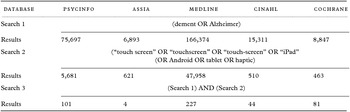
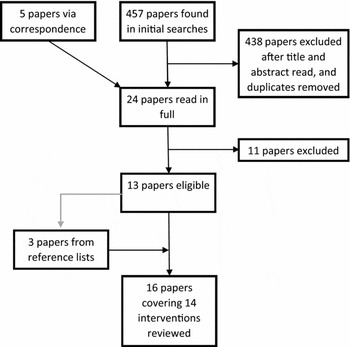
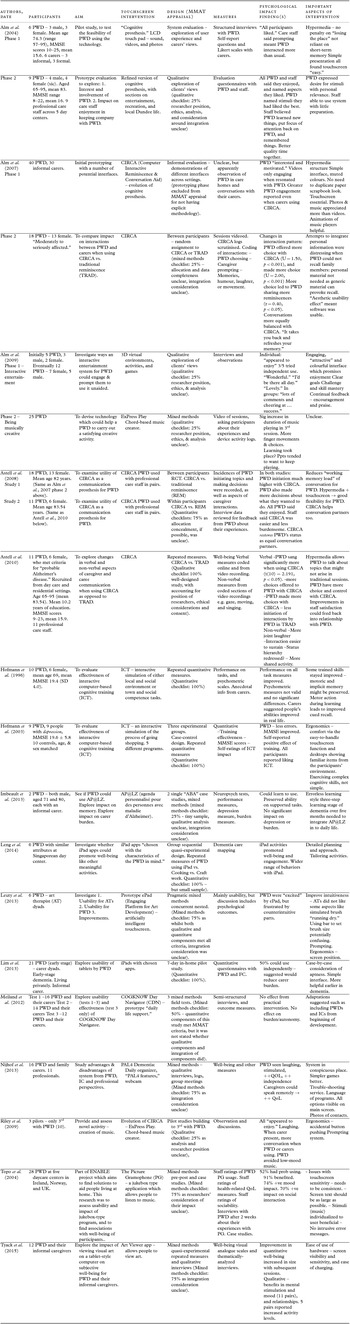
In order to explore existing research into the use of touchscreen-based technology with PWD and their carers, a systematic review (Grant and Booth, Reference Grant and Booth2009) was carried out. Initial searches were conducted in relation to technology-based interventions with PWD and their carers. Correspondence with colleagues also yielded additional papers, which guided our thinking and search patterns. For the main literature search, PsycInfo, ASSIA, Medline, Cinahl, and Cochrane databases were searched; only peer-reviewed journal articles were included. The search terms used and the results from each database are shown in Table 1. In order to capture as many relevant papers as possible, and since touchscreen technology itself is a relatively recent development, no date constraints were used. Inclusion and exclusion criteria can be seen in the section below. Reference lists from the papers that were read and included were checked for other potentially eligible papers. A flow chart of the search process can be seen in Figure 1. Since much of the research uses mixed-methods or qualitative approaches and small sample-sizes, it was decided that a systematic review with narrative and tabular synthesis of findings would be the best way to combine the research evidence with views of service users and practitioners. Quality of papers was appraised by reviewing designs and methodologies. The Mixed Methods Appraisal Tool (MMAT) checklist (Pluye and Hong, Reference Pluye and Hong2014) was used as a guide for appraisal. This tool was selected as it allows concomitant appraisal and scoring of mixed methods, qualitative, and quantitative designs, is designed for use in reviews, has been pilot tested for reliability and content validated with feedback from experts and workshops. Where papers reported quantitative measures related to psychological outcomes, these were reported (Table 2). Outcomes were grouped into domains for review in the narrative section. Findings reported by researchers in relation to aspects of the interventions they believed to be important were grouped into domains and reported in a narrative style. Both authors independently assesed all of the articles included for selection in this review.
Search terms and results from databases (search completed)

Flow diagram of article selection process.

Study characteristics

Inclusion and exclusion criteria
-
1. At least part of the intervention was delivered via touchscreen, operated by people with a diagnosis of any type of dementia.
-
2. Psychological well-being outcomes were reported for PWD or their ICs. “Psychological outcomes” was kept to a broad definition, including related outcomes such as carer burden and independence of PWD.
-
3. Studies must have described an intervention. Studies without an intervention component (e.g. only assessment use) were excluded.
-
4. Studies without explicit methodology were excluded.
-
5. Limited to articles published in English.
Results
Interventions
There was a wide range of interventions that employed touchscreen technology to engage PWD. These will be briefly described in chronological order; the range and affordability of touchscreen devices has increased since their inception. The earliest reported intervention was interactive computer-based cognitive training (ICT) (Hofmann et al., Reference Hofmann, Hock, Kühler and Müller-Spahn1996, Reference Hofmann2003), running on a computer connected to a 21-inch touchscreen. ICT simulates various activities of daily living, such as shopping, and encourages the user to make decisions in relation to navigation, or answering questions. The simulations are tailored to each individual, via actual photographs of each person's social and local environments. The Picture Gramophone (Topo et al., Reference Topo2004), which ran on computers connected to touchscreens, was designed as a pleasant pastime; it facilitates selection of artists, genres, or themes of music to listen to, displays images and lyrics as the music plays, then facilitates further music selections.
A prototype “cognitive prosthesis” (Cole, Reference Cole1999) was developed by Alm et al. (Reference Alm, Astell, Ellis, Dye, Gowans and Campbell2004) in order to support conversation. The initial version ran on a computer connected to 20-inch touchscreen displaying a multimedia reminiscence package, which allowed people to view photos and videos, and listen to songs and music related to their local area, recreation, and entertainment. The prototype was eventually developed into the computer interactive reminiscence and conversation aid (CIRCA) (Alm et al., Reference Alm, Dye, Gowans, Campbell, Astell and Ellis2007; Astell et al., Reference Astell, Alm, Gowans, Ellis, Dye, Campbell, Mihailidis, Boger, Kautz and Normie2008; Alm et al., Reference Alm2009; Astell et al., Reference Astell2010). CIRCA runs on a computer connected to a 20-inch touchscreen monitor. The interface is designed to be “error-free” in that there are no wrong responses or dead-ends in possible decision trees. As a prosthesis, CIRCA is designed to augment the working memory of the user thereby supporting their conversations with others. A spinoff from the CIRCA project is ExPress Play (Alm et al., Reference Alm2009; Riley et al., Reference Riley, Alm and Newell2009). ExPress Play is a touchscreen interface that allows the user to generate chord-based music by touching the display, and to choose the emotional tone of the music output. ExPress Play aimed to build on evidence showing that PWD can maintain and also develop their creative skills; it also built on Hanneman's (Reference Hannemann2006) theory that in this population, “art and creativity offer a path of opening up the windows to people's emotional interiors.” A related project was “interactive entertainment” activities (Alm et al., Reference Alm2009). This comprised virtual environments such as botanical gardens, and virtual activities like football penalty shootouts that people could interact with via touchscreen interfaces.
Meiland et al. (Reference Meiland2012) evaluated the prototype COGKNOW Day Navigator (CDN), an “integrated digital prosthetic” designed to support PWD with daily activities. The system comprised a stationary touchscreen in the home and a mobile device. These devices were connected to various sensors around the home. The system offered support in the areas of memory, social contacts, daily activities, and safety. Nijhof et al. (Reference Nijhof, van Gemert-Pijnen, Burns and Seydel2013) evaluated PAL4-dementia, a similar touchscreen system installed in the home designed to act as a daily organizer, memory game console, diary keeper, information source, “life album,” and video link with family or professional caregivers. Imbeault et al. (Reference Imbeault2013) developed and evaluated an electronic organizer for PWD (agenda personnalisé pour des personnes avec maladie d'Alzheimer (AP@LZ)). AP@LZ is smartphone-based, and provides the user with information about current time and appointments, appointment scheduling, personal information, medical information, contact information, and a notepad function.
The engaging platform for art development (ePAD) was developed and trialed by Leuty et al. (Reference Leuty, Boger, Young, Hoey and Mihailidis2013). This consists of a multi-touch display mounted on a wooden easel that can be used to create visual art via the client interface, and modified to meet specific clients’ needs by art therapists on a separate interface. Artificial intelligence is employed by ePAD to evaluate the level of user engagement. Lim et al. (Reference Lim, Wallace, Luszcz and Reynolds2013) assessed the usability of Apple iPads by PWD, both with their ICs and independently. The 11 applications used were classified as “creative (art or music)” such as musical instrument simulators, “simple interactive games” such as spot-the-difference and “relaxation” such as a peaceful music and visual image player. Leng et al. (Reference Leng, Yeo, George and Barr2014) also looked at iPad applications, but used to facilitate group activities. Applications were “chosen with the characteristics of the participants in mind.” As a well-being intervention, Tyack et al. (Reference Tyack, Camic, Heron and Hulbert2015) developed an Android tablet-based “art viewing” app, designed for PWD and their informal caregivers view together.
Study designs
Table 2 gives information about the design of each study, a MMAT (Pluye and Hong, Reference Pluye and Hong2014) score and the checklist applied. MMAT scores are provided with a brief explanation of why the study received its score. The score is a rough appraisal of a study's methodological quality, but does not measure reporting quality. For qualitative and quantitative studies, the percentage of criteria met is stated. For mixed-methods studies, the overall score cannot exceed the lowest score of a component, so if one part received 100% but the other 25%, the overall score would be 25%. This means it would be possible for a study to have a strong quantitative section and a weaker qualitative section, or vice-versa, but the overall score would be low, suggesting the study might be less valuable. The MMAT is still under development and is necessarily reductive, making it unable to capture study nuances. It was used for this review because it can be applied to the full range of study types and give comparable ratings for each.
Alm et al. (Reference Alm2009) reviewed three interventions (including CIRCA, comprehensively reviewed in Astell et al., Reference Astell2010, and thus not included here). It is worth noting that both Alm et al., studies included research also written up by Astell et al., (Reference Astell2006; Reference Astell2010) for different journals, apparently aimed at different groups of readers, which scored more highly on the MMAT.
Outcomes – people with dementia
Mood and mental health (including behavioral evidence of mood changes)
Table 2 contains psychological impact findings, and some are explored in more depth in this section. Alm et al. (Reference Alm2009) measured significant increases in the amount of time PWD spent using ExPress Play between the first and third sessions (t(M = 25, df = 24) = −2.89, p = 0.008), in the number of finger movements made during subsequent sessions, and in the range of musical moods selected to play. This was interpreted as evidence that learning had occurred. In addition, 21 out of the 25 users said they enjoyed their first session, rising to 24 in the final session and after the final session, 22 indicated they would like to use it again.
In a study using the Picture Gramophone, Topo et al. (Reference Topo2004) found a significant positive correlation (rs = 0.46, p < 0.05) between age and impact on mood, suggesting older users more often benefited from PG than younger ones. One case example in the paper concerns a woman who was described as depressed and staff reported that she had “cheered up with PG use.” Another user reported, “It is inspiring and takes my depression away.”
Hofmann et al. (Reference Hofmann, Hock, Kühler and Müller-Spahn1996) found no significant impact on depressive symptoms as measured by the Montgomery–Åsberg Depression Rating Scale (Montgomery and Åsberg, Reference Montgomery and Asberg1979) or on QoL, measured by the interview for deterioration in daily living activities in dementia (Teunisse and Derix, Reference Teunisse and Derix1991, as cited in Hofmann et al., Reference Hofmann, Hock, Kühler and Müller-Spahn1996, p. 494). The decision to use the trainers to administer the scales, however, raises the risk of unintended bias. One participant was able to find their way to a location with ICT training, but unable to find their way back, which was part of the training protocol. Another participant reported that ICT was, “Quite different from the feeling of getting worse in every other aspect of life” (p. 500). In a later study, Hofmann et al. (Reference Hofmann2003) found that the training seemed to lead to an average one point improvement on the Mini-Mental State Examination (MMSE; Folstein et al., Reference Folstein, Folstein and McHugh1975), which was significant (F(2,23) = 8.47, p < 0.008). It was also reported that PWD expressed the highest level of liking the training of the three groups who trialed ICT.
Mood and engagement scores were highest for iPad activities, compared with traditional ones (Leng et al., Reference Leng, Yeo, George and Barr2014). The mood and engagement scores for cooking were significantly less than for both iPad sessions, suggesting that iPad-based activities were more beneficial for mood and engagement than cooking. A wider range of behaviors (six compared to two) were recorded with iPads use compared to cooking and craft work. It is worth noting that categories such as “reminiscence life review” and “being engaged (watching)” were only reported for iPad activities; perhaps different recipes or craft activities could have prompted these behaviors. Nevertheless, with a wider range of observed behaviors, perhaps there are more possible ways to become engaged with iPad activities, and greater engagement could mean more chances for improvement in mood.
Whilst art therapists were unsure if they or their clients were satisfied with ePAD, PWD reported high levels of satisfaction with the intervention and its novelty (Leuty et al., Reference Leuty, Boger, Young, Hoey and Mihailidis2013). Some users were reported to engage in reminiscence as a result of using ePAD: an unexpected finding. Median responses from PWD suggested that they were happy with ePAD, enjoyed using it, were satisfied with the art created and that creating art was fun. One user stated, “It's miles ahead of anything I've ever seen to give you an ability to do something.”
Although AP@LZ was not found to have a significant impact on the mood measures used by Imbeault et al. (Reference Imbeault2013), one of the participants’ carers observed that his ability to perform the tasks supported by AP@LZ improved, as opposed to his functioning in other areas which continued to deteriorate. This suggests that AP@LZ may be able to help maintain user independence and engagement in daily activities.
One study (Tyack et al., Reference Tyack, Camic, Heron and Hulbert2015) found that user-reported well-being tended to increase at the end of art-viewing sessions, and that the well-being benefits seemed to increase as people completed more sessions. This raises the issue about the optimal length of time, within sessions and longitudentally, for tablet-related activities.
Social life and quality of interaction
Alm et al. (Reference Alm, Astell, Ellis, Dye, Gowans and Campbell2004; Reference Alm, Dye, Gowans, Campbell, Astell and Ellis2007; Reference Alm2009) observed, that the balance of conversations seemed to be more equal when using their prototype cognitive prosthesis and its successor CIRCA: facilitators did not predominate. One IC stated, “I have never had such a good reaction from Jim before.” These shifts sound beneficial for the PWD. When using CIRCA, Astell et al., (Reference Astell, Alm, Gowans, Ellis, Dye, Campbell, Mihailidis, Boger, Kautz and Normie2008) also noted shifts in behavior, with PWD initiating significantly more interactions (RCT phase p < 0.0005; within subjects phase p < 0.05) and making significantly more decisions (RCT phase p < 0.001; within subjects phase p < 0.005), suggesting more engagement and stimulation. Engagement benefits of CIRCA (Astell et al., Reference Astell2010) included significantly more choices being offered to PWD by caregivers (t(10) = 5.9, p < 0.0005) and their subsequently making more choices (t(10) = 3.617, p < 0.005) than during TRAD. More joint laughter was recorded when people were using CIRCA.
It was suggested that laughing together was a sign of enjoyment, whereas separate laughter indicated discomfort. This was corroborated by observations that solitary laughter tended to occur when the person with dementia was lost for words, perhaps in an effort to manage uncomfortable feelings. Astell et al. (Reference Astell2010) analyzed eye gaze and found that gaze patterns were significantly altered with CIRCA compared to TRAD, with a lot more attention being paid to the stimuli during CIRCA by both PWD and ICs during CIRCA sessions. They suggested that since eye gaze is thought to be a reflection of engagement and comfort, dyads were better at establishing joint attention during CIRCA sessions, facilitating more equal interactions. Carers were also observed to point a lot more during CIRCA sessions, and parallels could be drawn with research showing that mothers tend to point to cue their infants into attending to a point of shared focus to scaffold interactions (Pratt et al.,Reference Pratt, Kerig, Cowan and Cowan1988), suggesting higher quality of interaction was taking place. A systematic review of attachment in PWD and their caregivers (Nelis et al., Reference Nelis, Clare and Whitaker2013) found that insecure attachment styles link with neuropsychiatric difficulties, and that attachment security also impacts on caregiver health. Interventions that promote attachment-enhancing behavior are thus of great potential benefit within care dyads.
Tablet use, with interesting and engaging apps, can lift an individual's mood along with the people around them. For example, a user with dementia expressed, “enthusiasm about the Picture Gramophone [which spread] to the others. They all had a good time.” (Topo et al., Reference Topo2004). Likewise, Tyack et al. (Reference Tyack, Camic, Heron and Hulbert2015) found that art-viewing sessions had changed the way family members spent time together, with some reporting improvements in their relationships and wider social impacts, such as PWD enthusiastically showing the tablet's app to others. Participants who sought and received support from family members, such as grandchildren, said that highly valuable interactions ensued (Lim et al., Reference Lim, Wallace, Luszcz and Reynolds2013). This suggests that well designed and intuitive touchscreens can be learned by relative novices, increasing the possibility of bringing people from different generations closer together by providing mutually enjoyable shared activities.
Sense of mastery
Some studies reported on participants’ engagement with and mastery of the intervention. Imbeault et al. (Reference Imbeault2013) reported that one of their participants was “proud” to use AP@LZ, and that his wife noticed that he seemed to feel more empowered by it. As participants gained experience, their usage frequency of the devices tended to increase. Tyack et al. (Reference Tyack, Camic, Heron and Hulbert2015) found that one pair reported feeling “proud” to have the app, another participant reported feeling good to be able to use the app, and a person with dementia reported that using the app increased their confidence in their cognitive abilities. Two pairs relayed success stories in relation to overcoming difficulties using the app. Hofmann et al. (Reference Hofmann, Hock, Kühler and Müller-Spahn1996) found that following training, participants’ performance on ICT improved, with fewer mistakes, less time needed, and less advice needed. This pattern was also observed by Hofmann et al. (Reference Hofmann2003), as well as an increase in the rate of correct answers. The group with dementias was also found to improve significantly more than the other groups in their level of mistakes (F(4,15) = 2.95, p < 0.044). Lim et al. (Reference Lim, Wallace, Luszcz and Reynolds2013) reported that 48% of PWD said the iPad was moderately or extremely intuitive to use, despite under 10% initially saying that they were confident using computers and technology. Topo et al. (Reference Topo2004) reported that one client initially said she would be unable to use the PG, but she spontaneously started touching the screen and interacting with the device. At a social event, PWD used the PG independently to choose songs to dance to.
Outcomes – informal carers
Burden
Various studies reported an impact on the stress or burden of ICs. Imbeault et al. (Reference Imbeault2013) reported that AP@LZ reduced IC stress as carers felt reassured that the people they cared for would be able to contact them if necessary. The Carer Burden Inventory (Hébert at el., Reference Hébert, Bravo and Girouard1993) indicated a trend towards increased burden over time in both cases, but without controls it is not possible to discern whether this increase might have been altered by AP@LZ. One carer indicated she felt less burdened in relation to medication, as the reminder system prompted her spouse.
Carers reportedly enjoyed access to the video facility in PAL4-dementia (Nijhof et al., Reference Nijhof, van Gemert-Pijnen, Burns and Seydel2013), and whilst the intervention did not reduce carer burden, it was suggested that it might over a longer timeframe. Since Lim et al. (Reference Lim, Wallace, Luszcz and Reynolds2013) reported that 90% of participants with dementia could use iPads independently, this might provide activities they could do whilst ICs did other things, potentially reducing burden. Meiland et al. (Reference Meiland2012) found no impact of CDN on carer burden, but the system was unstable and carers found this frustrating. They suggested that with more development the CDN might be more beneficial for users.
Other areas
Other impacts included carers finding out new information about those they cared for (Alm et al., Reference Alm, Astell, Ellis, Dye, Gowans and Campbell2004) which might enrich their relationship and provide new conversation topics or activities. Astell et al. (Reference Astell2010) observed that carers sang (z = 2.33, p < 0.05) and moved to music more (t(10) = 2.39, p < 0.05) during CIRCA sessions. Thus, touchscreen-based interventions can have impacts on both members of care dyads, which could support both members’ well-being. Tyack et al. (Reference Tyack, Camic, Heron and Hulbert2015) described one caregiver describing her spouse being more able to express his feelings following art-viewing, and this making her feel more able to support him.
Important aspects of interventions
User interface
Interface factors relate to the “aesthetic-usability” effect (Norman, Reference Norman2002), which can be neatly summed up in his phrase, “aesthetics matter: attractive things work better.” Alm (Reference Alm, Dye, Gowans, Campbell, Astell and Ellis2007) elaborated that the aesthetic-usability effect related to how an appealing application interface seemed to invite users to engage with their intervention, whereas less aesthetically-pleasing designs might not have done. They concluded that aesthetic design is therefore a crucial feature of their system. Several studies underlined the importance of simple interfaces. Table 2 contains details aspects of the interfaces reported to be important.
A system of guidance built into the interface was recommended. Leuty et al. (Reference Leuty, Boger, Young, Hoey and Mihailidis2013) and Riley et al. (Reference Riley, Alm and Newell2009) suggested prompting users was important, although Riley et al. cautioned that written prompts needed to be clear, otherwise they could be confusing. Alm et al. (Reference Alm2009) found continual feedback was important, which comprised encouragement when people experienced difficulty, and praise of successes. They also found that making the next step as obvious as possible was key, via interface behavior or targeted prompts.
An error-free experience seems to be beneficial. Alm et al. (Reference Alm, Astell, Ellis, Dye, Gowans and Campbell2004; Reference Alm, Dye, Gowans, Campbell, Astell and Ellis2007) and Astell et al. (Reference Astell, Alm, Gowans, Ellis, Dye, Campbell, Mihailidis, Boger, Kautz and Normie2008; Reference Astell2010) based their error-free interface on the “hypermedia effect” (McKerlie and Preece, Reference McKerlie, Preece and Gornostaev1992). This is a structure similar to the world-wide-web, where items are interconnected, without dead-ends, so that wherever the user may find themselves is fine, and it does not matter if they lose track of where they are. It also facilitates the interlinking of different media types, allowing the user to jump between them easily, hopefully enlivening the experience. Further information on user interface priorities, including strategies for prompting has been reported in detail by Joddrell and Astell, (Reference Joddrell and Astell2016).
Hardware
Users with little prior experience of computer-use tended to adapt to their touchscreen interface more easily Nijhof et al. (Reference Nijhof, van Gemert-Pijnen, Burns and Seydel2013), whilst those with prior computer experience tended to request keyboards and mice to facilitate their interactions. This phenomenon was linked with the “technology generation” theory (Docampo Rama et al., Reference Docampo Rama, Ridder and Bouma2001) which suggests that experiences with technology in the first 25 years of life are more persistent than later ones. Leuty et al. (Reference Leuty, Boger, Young, Hoey and Mihailidis2013) discovered adjustability of the easel-mounted screen was important, only discovering this after they had been forced to fix the screen in place. Topo et al. (Reference Topo2004) found that ensuring uniformity of touchscreen sensitivity across devices was crucial, as there were noticeable differences between devices that sometimes compromised usability.
Content and personalization
CIRCA's photo and music content were generally appreciated more than videos (Alm et al., Reference Alm, Dye, Gowans, Campbell, Astell and Ellis2007). Incorporating personalized reminiscence media, such as family photographs, was trialed. Unfortunately, this could lead to distress, “often to the point of tears.” PWD and ICs found failures to remember events or people upsetting and this feature was abandoned. The researchers instead focused on accumulating sufficient generic information that could be randomized, so that potentially upsetting personal details were unnecessary. With this approach, the presented material led some people to engage in reminiscences that even their ICs did not know about.
Other researchers found personalization in different, less intimate ways to be helpful. Topo et al. (Reference Topo2004) found individualizing music to users’ preferences beneficial. Leng et al. (Reference Leng, Yeo, George and Barr2014) and Lim et al. (Reference Lim, Wallace, Luszcz and Reynolds2013) both suggested tailoring iPad activities to individual preferences was helpful, but did not elaborate on how this was achieved. Tyack et al. (Reference Tyack, Camic, Heron and Hulbert2015) found that 10 participant interviews contained suggested improvements, including having more images, recording favorite images, and a zoom facility. Nijhof et al. (Reference Nijhof, van Gemert-Pijnen, Burns and Seydel2013) found the practical step of ensuring the ringtone of the system was different to users’ own ringtones was important.
The importance of elements of challenge or skill-mastery was raised by Alm et al. (Reference Alm2009) and Hofmann et al. (Reference Hofmann2003). Alm et al. identified that there should be a goal to games, otherwise people tend not to engage. Hofmann et al. suggested that it is more beneficial for PWD to try and exercise complex cognitive skills as opposed to basic ones, suggesting that specifically targeted interventions had limited subjective well-being benefits.
Procedural
Hofmann et al. (Reference Hofmann, Hock, Kühler and Müller-Spahn1996; Reference Hofmann2003) suggested that touchscreen interventions automatically enhance the learning stage as motor action is necessary as well as mental effort. Motor and implicit procedural memory systems tend to be relatively preserved as dementia progresses (Eslinger and Damasio, Reference Eslinger and Damasio1986), and motor action during learning has been shown to have a positive impact on recall for PWD (Karlsson et al., Reference Karlsson, Bäckman, Herlitz, Nilsson, Winblad and Österlind1989). Imbeault et al., (Reference Imbeault2013) employed an “errorless learning” method for their intervention (Laffan et al., Reference Laffan, Metzler-Baddeley, Walker and Jones2010). This approach limits the possibility of experiencing making errors, and is thus thought to enhance the learning process. This was augmented by a phase dedicated to “teaching transfer,” where the learned skills were consolidated via their employment in day-to-day events in line with a “three stage approach” to learning (Sohlberg and Mateer, Reference Sohlberg and Mateer1989). Imbeault et al. found that it took about five months for participants to integrate AP@LZ into their daily lives.
Including potential users from the start of the development process was found to be useful by Meiland et al. (Reference Meiland2012) and Tyack et al. (Reference Tyack, Camic, Heron and Hulbert2015). Nijhof et al. (Reference Nijhof, van Gemert-Pijnen, Burns and Seydel2013) stated that they did not do this, and that this may have contributed to the lack of user-friendliness of their system, with no users describing it as “intuitive.” They did provide support with their intervention, and this was adopted by users and reported to be helpful. Alm et al. (Reference Alm, Astell, Ellis, Dye, Gowans and Campbell2004) found that the cognitive prosthesis could be employed with little preparation on the part of the staff, which seemed to increase the chance of its being used.
Progression of dementia
Various studies found the stage of dementia progression to be an important factor. Imbeault et al. (Reference Imbeault2013) found that of their two participants, the one at an earlier stage of dementia learned much faster. Lim et al. (Reference Lim, Wallace, Luszcz and Reynolds2013) suggested that iPad activities were more helpful for people at earlier stages of dementia, and recommended matching activities to the skill level of each user. Nijhof et al. (Reference Nijhof, van Gemert-Pijnen, Burns and Seydel2013) reported that ICs said they thought that the people they cared for would have learned to use PAL4-dementia more easily earlier in the progression of their dementias. They caution that the introduction of such a device earlier on might have been experienced as upsetting or stigmatizing for PWD.
Discussion
This review has explored the diverse range of touchscreen-based interventions for PWD that have been cited in published research. The diversity of the interventions is complemented by the relative qualities of the published papers. This diversity results from studies by researchers from different professional backgrounds, and in journals targeted at different audiences. The exploratory nature of the research and variety of target readerships often also led to idiosyncratic approaches to research and reporting. The robustness varied, and sample sizes tended to be small, therefore conclusions should be cautiously interpreted. Ethics and consent were often not clearly reported, and this is crucial in an area involving vulnerable people often with limited capacity to consent.
A limitation of this review is the somewhat reductive nature of MMAT (Pluye and Hong, Reference Pluye and Hong2014) used to assess the methodological quality of the studies. Whilst its applicability to both mixed-methods and purely qualitative or quantitative papers is helpfully versatile, its scoring system can give a low score to useful research, particularly so with qualitative studies. This is an issue common to assessment tools, however, and is a drawback of their necessary standardization. Reviewing studies with diverse designs allows facilitates richness of information, but it is difficult to come to definitive conclusions. It is worth noting that with the MMAT it is important to have a second rater in order to increase validity.
Whilst research has looked at the feasibility of touchscreen-based interventions, it is apparent that touchscreens are usable by those with dementia, and when well-designed they can be used with little training, particularly at the earlier stages of dementia. As technology advances, hardware-related issues that arose in early studies such as inconsistent screen sensitivities are likely to diminish. These factors will hopefully allow more consideration to be given to the well-being outcomes of the interventions. According to this review, touchscreen-based interventions can confer a wide range of benefits to the well-being of PWD in relation to their mood and mental health, their social lives, and quality of interaction and their sense of mastery. Touchscreen interventions can also benefit the well-being of ICs in relation to their sense of burden, as well as enhancing the quality of their relationships and time spent with the people they care for. This effect might help to sustain informal caregiving relationships for longer. Touchscreens may therefore be an intervention strategy that could help PWD to be supported by their informal caregivers to remain in their homes for longer, as suggested by Smith and Mountain (Reference Smith and Mountain2012).
McKechnie et al. (Reference McKechnie, Barker and Stott2014) recommended mixed-methods approaches for early-stage explorations of computer-based support in their review, and mixed-methods studies (Topo et al., Reference Topo2004; Alm et al., Reference Alm, Dye, Gowans, Campbell, Astell and Ellis2007; Reference Alm2009; Meiland et al., Reference Meiland2012; Imbeault et al., Reference Imbeault2013; Leuty et al., Reference Leuty, Boger, Young, Hoey and Mihailidis2013; Nijhof et al., Reference Nijhof, van Gemert-Pijnen, Burns and Seydel2013; Tyack et al., Reference Tyack, Camic, Heron and Hulbert2015) have been useful in gathering rich information about user-experience as well as data about the outcomes of the interventions in this review. In line with the findings of Godwin et al. (Reference Godwin, Mills, Anderson and Kunik2013) the studies reviewed here tended to report improvements in their users, but intervention delivery and outcome measurement were inconsistent.
In relation to the potential for interventions to support or undermine the personhood (Kitwood, Reference Kitwood1997) of the users, on balance it seems that when used with appropriate planning and support, touchscreen interventions are able to support the personhood of PWD in various ways. These include the ability to engage in meaningful activities not directly linked to being PWD, sharing social interactions with others, and mastering new skills independently.
Key aspects of the interventions’ interfaces were shown to be related to the interface being simple, intuitive, aesthetically pleasing, error free, and providing guidance to the user. Important procedural aspects included provision of support, including potential users in the development process from the beginning, an errorless learning method for training, requiring motor-action during training and the ability to use the intervention with little preparation. Important aspects of content included tailoring content to the user where appropriate and an element of challenge, which might mean exercising complex cognitive skills rather than simpler ones. It was interesting to note that attempts to include personalized biographical material could prove to be upsetting for users, so this should be avoided in favor of more generic material that could allow people more choice about the focus of their reminiscences. Hardware considerations included ergonomics, screen quality, consistency, and a conspicuous location. The progress of users’ dementia was also highlighted as a key aspect in several studies. Studies tended to report that introduction of interventions earlier in the progress of users’ dementia facilitated uptake. It would be helpful to explore whether interventions could be designed to dynamically adapt to the ability level of the user.
Recommendations for future research
Future research can strengthen and build on the foundation established so far in a range of ways:
-
• In order to improve the evidence base, research should be conducted with larger sample sizes and more rigorous methodological approaches. This could include the establishment of consensus on how well-being is to be measured (Camic et al., Reference Camic, Hulbert and Kimmel2017), and adherence to reporting standards.
-
• Mixed-methods research would allow more in-depth information about the user experience to be collected, especially in exploratory studies. It would be important to pay attention to the process of integration of quantitative and qualitative findings.
-
• Longer-term and longitudinal interventions could explore the effect of stage of dementia on the effectiveness of the interventions.
-
• Standardized hardware platforms such as specific models of tablet could be used in order to allow easy replication of research in other locations. This could also facilitate the exploration of impact across settings, such as at home, in daycare and in residential settings.
-
• Interventions that have been found to be useful in other areas, as Tyack et al. did with previous art-based interventions (e.g. Rhoads, Reference Rhoads2009; Camic et al., Reference Camic, Tischler and Pearman2014; Eekelaar et al., Reference Eekelaar, Camic and Springham2012) could be adapted for delivery via touchscreen devices, and their effectiveness explored.
Clinical implications
A range of clinical implications can be cautiously suggested as a result of this review:
-
• Touchscreen apps should be considered by family members, charity programme staff, and older age clinicians working with PWD and their informal and professional carers, as opportunities to support well-being by providing a platform that allows PWD to be more equal partners in social interactions as well as providing opportunities for new learning and independent pastimes.
-
• In considering touchscreen technologies, clinicians, and others should consider challenging prevailing beliefs that PWD are unable to use touchscreen technologies.
-
• People are more likely to be able to engage with touchscreen technology if they are initially offered them earlier on in the progression of dementia, along with appropriate support as they learn to use them.
-
• Touchscreen-based activities should be considered to help people interact across generations, potentially reducing their sense of isolation and social exclusion.
Conflict of interest:
None.
Descriptions of authors’ roles:
Both authors jointly conceived the review. The first author identified suitable articles and the second author confirmed their eligibility through checking data extraction criteria. Both authors contributed to writing the paper, with the first author completing the first draft.