1. Introduction
Much research on simultaneous bilingual acquisition has shown that the acquisition of two (or more) languages from birth is qualitatively similar to first language (L1) acquisition (e.g., Meisel, Reference Meisel1990, Reference Meisel1994). Under optimal conditions (pertaining to quality and amount of input, among others), children raised bilingually can become adults who perfectly master the two languages, just like monolinguals. Although this is theoretically a possible outcome, it is often the case that one of the two languages does not converge to the target. In this article, we will refer to the language that shows deviances from the target as developed by unbalanced bilingual speakers interchangeably as their weaker or heritage language. Such a language is spoken predominantly in familiar contexts by e.g., speakers who were born and grew up in binational families, and is not the majority language of the environment, which we will interchangeably label as stronger or dominant language. Divergence of the heritage language from the target may be due to one of two major factors: (i) after being completely acquired, the linguistic system suffers some kind of loss, a phenomenon referred to as language attrition, which can be more precisely defined as “the non-pathological decrease in proficiency in a language that had previously been acquired by an individual” (Köpke & Schmid, Reference Köpke, Schmid, Schmid, Köpke, Keijzer and Weilemar2004, p. 5); and (ii) the linguistic system is never completely acquired and stabilizes in an incomplete stage, rendering it an instance of incomplete acquisition. For both outcomes, the dominance of the majority language of the environment as well as the reduction in input in the heritage language play major roles in ultimate knowledge of the heritage language. Recent work in generative grammar suggests that the heritage language may be particularly vulnerable at the level of interfaces (e.g., Montrul, Reference Montrul2002), an idea which has also been supported by studies on early child bilingualism (e.g., Hulk & Müller, Reference Hulk and Müller2000; Müller & Hulk, Reference Müller and Hulk2001). Similarly, research on the effects of attrition on the L1 of adult speakers who have achieved near-native proficiency in their second language has shown that interfaces (e.g., syntax–semantics and syntax–discourse) are more prone to being affected by attrition than structures requiring only syntactic computations (e.g., Sorace, Reference Sorace, Cornips and Corrigan2005; Tsimpli, Sorace, Heycock & Filiaci, Reference Tsimpli, Sorace, Heycock and Filiaci2004). From a minimalist standpoint (Chomsky, Reference Chomsky1995), this means that interpretable features, i.e., features with semantic content, are more vulnerable to language loss than uninterpretable features, i.e., features devoid of semantic content. As for vulnerability affecting the heritage language at the syntax–morphology interface, evidence has suggested that the reduction or simplification of a system (e.g., loss of case morphology or loss of gender marking) may occur in an attrited grammar (Schmid, Reference Schmid2002). In fact, in the last two decades, several studies have reported the effects of attrition and/or incomplete acquisition on inflectional morphology and the gender agreement system of heritage languages (e.g., Anderson, Reference Anderson1999; Au, Knightly, Jun & Oh, Reference Au, Knightly, Jun and Oh2002; Håkansson, Reference Håkansson1995; Montrul, Foote & Perpiñán, Reference Montrul, Foote and Perpiñán2008; Polinsky, Reference Polinsky2008). Furthermore, some research aimed at comparing the mastery of morpho-syntax and gender in the heritage languages of adult bilingual speakers and adult L2 learners has provided evidence that the two populations show some similarities (Au et al., Reference Au, Knightly, Jun and Oh2002; Lipski, Reference Lipski, Roca and Lipski1993; Montrul et al., Reference Montrul, Foote and Perpiñán2008). To our knowledge, most of the studies investigating the mastery of the gender system of heritage languages as well as those comparing adult bilingual speakers and adult L2 learners have investigated heritage speakers and L2 learners whose dominant and native language is English (e.g., Alarcón, Reference Alarcón2011; Montrul et al., Reference Montrul, Foote and Perpiñán2008 for Spanish; Polinsky, Reference Polinsky2008 for Russian), whereas little research has been done in language pairs in which both languages have gender, but differ with respect to their gender systems, such as Italian and German.
The goal of this paper is to investigate the mastery of the gender system of Italian by twenty adult Italian–German bilinguals who have acquired the two languages simultaneously (2L1), and to compare their knowledge of gender assignment and gender agreement with that of fifteen German highly proficient L2 learners (L2ers) of Italian. The following research questions will be investigated:
1. Is early Age of Onset (AoO) a sufficient condition to achieve and maintain native competence or do other factors (e.g., amount of input) play a role in ultimate attainment?
2. Which domains are vulnerable in the heritage language of the 2L1?
3. To what extent does the weaker language of the bilingual speakers resemble the second language of the L2ers?
4. Does the stronger (i.e., dominant) language influence the weaker language of the bilingual speakers?
The paper is organized as follows: Section 2 describes the gender systems of Italian and German, and presents the syntactic background of the Italian and German gender systems we have adopted in this study. Section 3 reviews previous studies on the acquisition of the Italian gender system in monolingual and bilingual children. In the same section, we report some studies on the mastery of the gender system by adult bilingual speakers, in addition to the second language (L2) acquisition of gender both in Italian and in other languages. Section 4 presents our hypotheses and predictions. Section 5 offers a description of our study, and Section 6 provides a quantitative and qualitative analysis of our data. In Section 7, our data are discussed, before the paper concludes with Section 8.
2. Gender in Italian and German
2.1 Gender in Italian
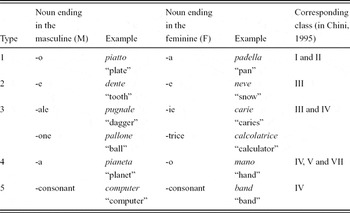
Italian distinguishes between two grammatical genders: masculine and feminine (Chini, Reference Chini1995, Reference Chini and Wegener1998). Gender assignment in Italian follows both semantic and morpho-phonological rules. Generally, nouns of animates bear one of the two genders according to the biological sex of the referent (gatto “the he-cat” – gatta “the she-cat”). Inanimate nouns receive either masculine or feminine gender depending on their belonging to a certain semantic class. For example, names of fruit are typically feminine (mela “apple.f”), while those of trees are generally masculine (melo “apple-tree.m”). Gender assignment of animate and inanimate nouns also follows formal rules. Typically, Italian nouns ending in -o are masculine (piatto “plate.m”) and those ending in -a are feminine (padella “pan.f”). However, there are some exceptions to this rule. Words ending in -o can also be feminine (mano “hand.f”) and those ending in -a can also be masculine (pianeta “planet.m”). As for words ending in -e, gender cannot be easily predicted, as these words can be either masculine (dente “tooth.m”) or feminine (neve “snow.f”). Some suffixes typically marking words ending in -e are associated with one of the two genders. Generally, nouns ending in -zione, -trice and -ie (respirazione “respiration.f”, lavatrice “washing-machine.f”, carie “caries.f”) are feminine, whereas those ending in -tore, -ale and -one (motore “motor.m”, pugnale “dagger.m”, portone “gate.m”) are masculine (Chini, Reference Chini1995). Words ending with a consonant, which are usually loanwords in Italian, are mostly masculine (computer “computer.m”), but there are also some instances of feminine borrowings (band “band.f”).
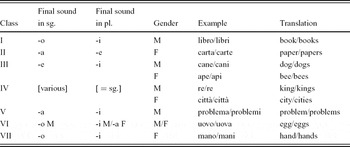
Depending on their inflectional properties and gender, Italian nouns can be divided into seven declension classes (Chini, Reference Chini1995). The first three classes represent the main classes in Italian, while the last four mostly contain exceptions, as shown in Table 1.
Declension classes in Italian (based on Chini, Reference Chini1995, p. 81).

Words in the seven classes differ not only with respect to their inflectional properties but also with respect to the frequency with which they occur in Italian. In particular, words from the first and the second class (i.e., masculine words ending in -o and feminine words ending in -a) occur most frequently in the Italian lexicon, with a frequency of 71.5% (Chini, Reference Chini and Wegener1998). Nouns from the third class (i.e., masculine and feminine words ending in -e) have a frequency of 20.6%, while words from the other four classes occur with a frequency of 5.4% (Chini, Reference Chini and Wegener1998). Given that nouns from the first and second class are the most frequent in Italian and the most transparent in terms of gender, their acquisition should not pose any particular problems for learners, who may otherwise encounter difficulties in assigning gender to words of the other classes, as already observed for monolingual acquisition (Chini, Reference Chini1995), child bilingual acquisition (Cantone, Reference Cantone1999) and adult second language acquisition (Chini, Reference Chini and Wegener1998; Oliphant, Reference Oliphant1998).
In Italian, gender is manifest not only on nouns but also on other elements that agree in gender with the head noun. Definite and indefinite determiners, personal pronouns, attributive and predicative adjectives as well as past participles with the auxiliary essere “be” show gender agreement with the noun. In periphrastic structures with the auxiliary avere “have”, gender agreement on the past participle is obligatory when the object is realized as a clitic pronoun. Since the study we report on in this article deals with the mastery of gender agreement on determiners and past participles, examples of gender agreement on determiners and past participles are provided in (1), (1a–b) for feminine nouns and (1c–d) for masculine nouns.
(1)


As shown in (1a), the feminine determiner la “the.f” agrees in gender with the feminine noun ragazza “girl.f”. In (1b), in which the object noun ragazza “girl.f” has been replaced by a pronominal clitic l(a) “her.f”, the past participle salutata “greet.pstprt.f” agrees in the feminine with the pronominal object referring to ragazza. The fact that the determiner and the past participle in (1a) and (1b) agree with the noun ragazza in the feminine is seen clearly in their ending in -a, which is usually associated with feminine gender in Italian (Chini, Reference Chini1995). The agreement mechanism is identical in the masculine: the determiner il in (1c) and the past participle salutato in (1d) are masculine, as is the head noun ragazzo.
German is also a gendered language and shares some properties with Italian, but also shows some important differences. The major properties of the German gender system are considered in the next subsection.
2.2 Gender in German
German has three genders: masculine, feminine and neuter. In German, gender assignment follows both semantic and formal rules (Heidolph, Fläming & Motsch, Reference Heidolph, Fläming and Motsch1984; Köpcke, Reference Köpcke1982; Köpcke & Zubin, Reference Köpcke and Zubin1983, Reference Köpcke and Zubin1984; MacWhinney, Leinbach, Taraban & McDonald, Reference MacWhinney, Leinbach, Taraban and McDonald1989; Mills, Reference Mills1986). Although some rules have been proposed, assignment regularities in German are still controversial. Generally, gender assignment in German is less transparent than in Italian. While learners of Italian can easily predict that nouns of the first and second class (see Table 1) are very likely masculine and feminine, respectively, such a prediction is not as easy to formulate for learners of German.
Gender agreement in German shows both similarities and differences compared to Italian. Similar to Italian, gender is marked on determiners, pronouns and attributive adjectives. In contrast to Italian, however, it is not evident on past participles within the verbal domain. As shown below in (2a), (2c) and (2e) for the three genders, the determiner agrees in gender with the noun. Indeed, the determiner die “the.f” in (2a) is feminine, as is the noun Frau “woman.f” it refers to. The determiner appears in the masculine den “the.m”, however, when referring to a masculine noun Mann “man.m”, as in (2c), and in the neuter das “the.nt” when referring to a neuter noun as in (2e). In contrast to Italian, past participles in German do not show gender agreement with a preverbal pronominal object. As shown in (2b), (2d), and (2f), the past participle gegrüßt “greet.pstprt” maintains the same morphological form regardless of the gender of the noun and the pronoun referring to it:
(2)

In the next subsection, we will explain the syntactic background of the gender systems we adopt here for Italian and German.
2.3 Syntactic background
We assume that gender is a lexical property of nouns, as does Carroll (Reference Carroll1989). Following Carstens (Reference Carstens2000), we further assume that nouns enter the derivation with an interpretable gender feature [igender]. Determiners and past participles as well as items other than nouns that are marked for gender have an uninterpretable gender feature [ugender] that must be checked and deleted through agreement in the course of the derivation (Carstens, Reference Carstens2000; Chomsky, Reference Chomsky1995).
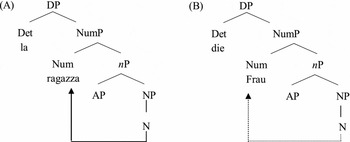
As for gender agreement on the determiner in Italian and German, we adopt the analysis proposed by Carstens (Reference Carstens2000), according to which the Determiner Phrase (DP) contains an agreement projection labeled as Number Phrase (NumP). The noun rises to Num (overtly in Italian and covertly in German) in order to check the uninterpretable gender feature on the determiner. Feature checking between nouns and determiners is realized in a head–head configuration. The relevant structures pertaining to agreement on the determiner of sentences (1a) and (2a) above are illustrated in Figure 1 diagrams for Italian and German, respectively.
Determiner–noun gender agreement mechanism in Italian and German. (A) Italian example Ho visto la ragazza “I saw the girl” (= (1a) in the text); (B) German example Ich habe die Frau gesehen “I saw the woman” (= (2a) in the text).

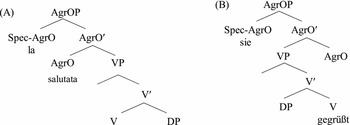
As for agreement on the past participle in Italian, we assume that it is realized in a functional projection that we will label AgrOP in accordance with Chomsky (Reference Chomsky1995). Within AgrOP, an agreement relation is established between the past participle heading the projection and the object clitic. Depending on the analysis adopted, clitics can be moved to AgrOP (Belletti, Reference Belletti, Everaert and van Riemsdijk2006; Sportiche, Reference Sportiche, Rooryck and Zaring1996) or merged directly in the functional projection. The uninterpretable gender feature on the past participle in Italian is checked in a local configuration with the pronominal element within AgrOP. Since German does not show gender agreement on the past participle, we assume that the uninterpretable gender feature on the past participle is not available in German. This means that gender feature checking against the pronominal element does not take place in German. The relevant structures pertaining to agreement on the past participle in sentences (1b) and (2b) above are sketched in the diagrams in Figure 2 for Italian and German, respectively.
Past participle – pronoun/noun agreement mechanism in Italian and German. (A) Italian example L'ho salutata “I greeted her” (= (1b) in the text); (B) German example Ich habe sie sofort gegrüßt “I greeted her” (= (2b) in the text).

2.4 Summary
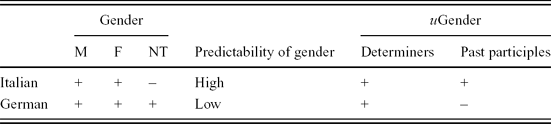
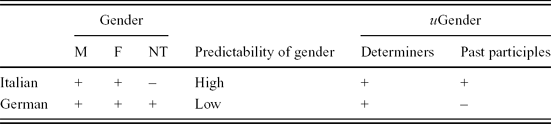
Italian and German are both gendered languages. Their gender systems show both similarities and differences. First, while Italian has only two genders, masculine and feminine, German has also neuter gender. Secondly, assignment in both languages follows semantic as well as formal rules, but gender assignment is more transparent in Italian than in German. Indeed, most Italian nouns ending in -o are masculine and most ending in -a are feminine, even if there are exceptions to this rule. Both Italian and German have a gender agreement system, but gender agreement manifests itself to a different extent in Italian and in German. In particular, gender agreement appears on determiners in both languages, but only Italian shows gender agreement on the past participle, specifically in periphrastic structures with the auxiliary avere “have” and with objects realized as clitic pronouns. German does not show agreement on the past participle for the same structures as in Italian, which we attributed here to an unavailability of the uninterpretable gender feature on past participles in the verbal/functional domain in German. The relevant properties of the two gender systems are illustrated in Table 2.
Gender systems in Italian and German.
Before turning to our hypotheses and predictions, we will review several studies on gender assignment and gender agreement in child monolingual and bilingual language acquisition as well as those concerning knowledge of gender by adult bilingual speakers and adult second language learners.
3. Previous research on the acquisition of gender
3.1 Gender in child monolingual and bilingual acquisition
Studies on the monolingual acquisition of gender in Italian and, on Italian morphology more generally, have shown that children master the gender system of their L1 at a very early age (e.g., Bottari, Cipriani & Chilosi, Reference Bottari, Cipriani and Chilosi1993/1994; Kupisch, Müller & Cantone, Reference Kupisch, Müller and Cantone2002; Pizzuto & Caselli, Reference Pizzuto and Caselli1992). Kupisch et al. (Reference Kupisch, Müller and Cantone2002) analyzed the corpus of an Italian monolingual child (Martina, age span from 1;7,18 to 2;7,15) and found a very low rate of gender assignment errors (1.9%) for the entire period investigated. In her longitudinal study on the acquisition of gender in a child named Agnese, Chini (Reference Chini1995) reported a single error in gender assignment produced at age 2;2,1 and repeated by the child until age four. As for gender agreement, Chini's findings are in line with those of previous studies. Agreement with definite and indefinite determiners posed no particular problems to Agnese (similar to the studies in Caselli, Leonard, Volterra & Campagnoli, Reference Caselli, Leonard, Volterra and Campagnoli1993; Pizzuto & Caselli, Reference Pizzuto and Caselli1992), nor did agreement on modifiers within the DP (similar to the study in Caselli et al. Reference Caselli, Leonard, Volterra and Campagnoli1993, where 100% accuracy in noun–adjective agreement was observed). Concerning agreement on the past participle with a preverbal object clitic, Chini (Reference Chini1995) reported target productions at age 2;11,22, which is in line with findings on the L1 acquisition of past participle agreement (McKee & Emiliani, Reference McKee and Emiliani1992; Schaeffer, Reference Schaeffer2000), reporting native-like accuracy in past participle agreement by age three. These findings were recently questioned by Moscati and Tedeschi (Reference Moscati, Tedeschi, Chandlee, Franchini, Lord and Rheiner2009), who observed a delay in the acquisition of past participle agreement with respect to other types of agreement (e.g., subject–verb and determiner–noun) in monolingual Italian children. Results from their elicited production task showed that past participle agreement errors were still observable at age 4;11.
The acquisition of gender in child bilingualism has been shown to follow a path similar to that observed in monolingual acquisition. Gender is mastered very early by bilingual children, even if some studies have reported a slight delay in its acquisition in comparison to monolingual acquisition. Kupisch et al. (Reference Kupisch, Müller and Cantone2002) reported data on the acquisition of gender assignment in two Italian–German bilingual children (age span 1;7,18–2;7,15). In the two corpora of Carlotta and Lukas, the authors found very few gender assignment errors, with gender accuracies of 97.1% and 97.8% for Carlotta and Lukas, respectively. Since the error rates in the corpora of the two bilinguals were slightly higher than the error rate of the monolingual child they investigated, Kupisch et al. (Reference Kupisch, Müller and Cantone2002) claimed that the acquisition of gender assignment is delayed slightly in simultaneous bilingual acquisition compared to monolingual acquisition. This fact has been corroborated by Montrul and Potowski (Reference Montrul and Potowski2007), who observed a lesser degree of accuracy in Spanish gender agreement in bilingual children than in monolingual children (both groups of children aged 6–11 years). Cantone (Reference Cantone1999) investigated the acquisition of gender in Italian and German in an Italian–German simultaneous bilingual child (Carlotta, 1;8,29–3;1,16) and found that by the end of the observation period, Carlotta performed almost at ceiling on gender agreement in Italian. Furthermore, in her study of an English–Italian simultaneous bilingual child, Serratrice (Reference Serratrice2000) found only one gender agreement error on determiners, as reported by Kupisch et al. (Reference Kupisch, Müller and Cantone2002).
Overall, studies on the monolingual and bilingual acquisition of gender in Italian have provided convergent results concerning the mastery of gender assignment and gender agreement. Gender is mastered very early in the two modalities of acquisition. Indeed, it has been shown to be acquired during early childhood.
3.2 Gender in the case of incomplete acquisition and/or attrition and L2 acquisition
Most of the studies that we are aware of reporting phenomena of attrition in Italian morpho-syntax have been conducted within a sociolinguistic framework (e.g., Bettoni, Reference Bettoni1991). Bettoni (Reference Bettoni1991) reported some loss affecting the Italian gender agreement system in second generation immigrants in Australia, while Scaglione (Reference Scaglione2000) presented data concerning gender assignment errors in the heritage language of Italian second generation immigrants in the San Francisco Bay area.
Within the generative framework, most studies on gender in adult heritage speakers of languages other than Italian have shown that the gender system of the heritage language diverges from that of monolinguals, in terms of both assignment and agreement, as a consequence of incomplete acquisition or attrition. Polinsky (Reference Polinsky2008) provided evidence that the Russian gender system in American-Russian heritage speakers undergoes a thorough reanalysis and results from changes in the assignment rules of the heritage language. Deviances from the target in gender agreement, which resemble those produced by L1 acquirers, were also attested in Polinsky's study. Anderson (Reference Anderson1999) found gender agreement errors in the Spanish of two Spanish–English bilinguals after two years of residence in an Anglophone country. Gender agreement errors within the DP were also found in Spanish in the production of the heritage speakers investigated by Lipski (Reference Lipski, Roca and Lipski1993).
Studies comparing heritage speakers and second language learners have mostly shown similarities between the two types of learners in the morpho-syntactic domain. Montrul et al. (Reference Montrul, Foote and Perpiñán2008) compared gender agreement accuracy within the DP in Spanish heritage speakers and L2 learners of Spanish, and found that gender agreement as well as assignment were affected in both groups to a comparable extent. Au et al. (Reference Au, Knightly, Jun and Oh2002) determined that, while adult heritage speakers of Spanish have advantages compared to adult L2 learners in phonology, they performed similarly in marking gender agreement within the DP. In her study on heritage speakers of Swedish, Håkansson (Reference Håkansson1995) observed that heritage speakers outperformed L2 learners in syntax (e.g., accuracy in V2 structures), but the participants performed similarly in morpho-syntax (i.e., DP-internal and DP-external gender agreement). In particular, she observed that her heritage speakers had a reduced system of agreement suffixes and had the tendency to use the unmarked gender morpheme instead of the target one.
Mastery of gender in adult L2 acquisition has been extensively investigated for both Romance and Germanic languages (e.g., Chini, Reference Chini1995, Reference Chini and Wegener1998; Oliphant, Reference Oliphant1998 for L2 Italian; Dewaele & Véronique, Reference Dewaele and Véronique2001; Granfeldt, Reference Grandfeldt and Dewaele2005; Renaud, Reference Renaud, Bowles, Ionin, Montrul and Tremblay2009 for L2 French; Franceschina, Reference Franceschina2001, Reference Franceschina2005; Hawkins & Franceschina, Reference Hawkins, Franceschina, Prévost and Paradis2004; McCarthy Reference McCarthy2008; Montrul et al., Reference Montrul, Foote and Perpiñán2008; White, Valenzuela, Kozlowska & Leung, Reference White, Valenzuela, Kozlowska-Macgregor and Leung2004 for L2 Spanish; Sabourin, Stowe & de Haan, Reference Sabourin, Stowe and de Haan2006 for L2 Dutch; Matteini, Reference Matteini2010; Spinner & Juffs, Reference Spinner and Juffs2008 for L2 German). In her longitudinal study on the acquisition of gender in Italian by speakers of different L1s, Chini (Reference Chini1995) distinguished a sequence of stages in the acquisition of gender agreement. In particular, she observed that the acquisition of agreement on the past participle is one of the last types of agreements to be acquired by the L2ers, whereas agreement on determiners is one of the first.
Two major hypotheses have been proposed that can account for the variability often observed in the morpho-syntax of adult L2 speakers. According to the failed functional features hypothesis (FFFH; Hawkins & Chan, Reference Hawkins and Chan1997), adult L2ers cannot acquire abstract grammatical features that are not instantiated in their L1. The FFFH predicts that native speakers of non-gendered languages (e.g., English) are unable to acquire the [ugender] feature of a gendered L2 due to a permanent impairment at the level of the grammatical representation of formal features. In their study on the acquisition of gender in French and Spanish by English native speakers, Hawkins and Francheschina (Reference Hawkins, Franceschina, Prévost and Paradis2004) support this representational deficit view and claim that uninterpretable features that are absent from the L1 cannot be acquired after the critical period. On the other hand, the missing surface inflection hypothesis (MSIH; Prévost & White, Reference Prévost and White2000) claims that syntactic representations are not impaired (i.e., the deficit is not representational) and that morphological variability in L2 can rather be attributed to difficulties in production and performance limitations, as supported by White et al. (Reference White, Valenzuela, Kozlowska-Macgregor and Leung2004). The MSIH fundamentally supports the full transfer/full access hypothesis (FT/FA; Schwartz & Sprouse, Reference Schwartz and Sprouse1996), which maintains that access to Universal Grammar (UG) is guaranteed after the critical period.
Overall, studies on attrition/incomplete acquisition and second language acquisition have shown that gender is a vulnerable area in both modalities of acquisition. In the next section, we will formulate several hypotheses and make some predictions regarding the mastery of the gender system of Italian by adult 2L1 and adult L2ers.
4. Hypotheses and predictions
In order to answer our research questions (see Section 1 above), we formulate the following hypotheses and predictions:
(i) If early Age of Onset (AoO) is a sufficient condition to achieve and maintain native competence, we expect the heritage speakers of Italian to perform better than the L2ers, especially with regards to gender agreement on the past participle, as the [ugender] feature on the past participle is not instantiated in German. If early AoO is not sufficient and native-like achievement can be obtained independently, we expect the amount of input to play a major role in bilingual acquisition and L2 acquisition.
(ii) If a degree of vulnerability exists between gender assignment and gender agreement in the heritage language of the 2L1, we expect gender assignment to be more vulnerable than gender agreement because the former implies knowledge of different domains (i.e., morphology, phonology, and semantics) as well as knowledge of the lexicon and noun categorization, whereas the latter requires only syntactic operations.
(iii) If mastery of uninterpretable features is not target-like in Italian as a heritage language, we expect this to occur in production as a consequence of impoverished language use and input. In particular, we expect agreement on the past participle to be more affected than agreement on the determiner, likely because it is one of the last types of agreement to be acquired by children (as shown by Moscati & Tedeschi, Reference Moscati, Tedeschi, Chandlee, Franchini, Lord and Rheiner2009).
(iv) If the dominant language influences the weaker language, we expect gender assignment to be vulnerable to influence from German. If language influence is the only factor responsible for deviances from the target in gender assignment, we expect it to affect words of all classes.
5. Our study
5.1 Participants
The experimental subjects who participated in the study were twenty Italian–German 2L1 and fifteen German L2ers of Italian. All participants completed a three-page background questionnaire and a cloze test both in Italian and in German, and performed the two tasks described below. The 2L1 were living either in Italy or in Germany at the time of testing, and grew up bilingually according to the one-parent–one-language strategy (Romaine, Reference Romaine1995; Ronjat, Reference Ronjat1913). Twelve bilingual speakers were classified as dominant in German (i.e., with Italian as their weaker/heritage language), while the other eight were classified as dominant in Italian (i.e., with Italian as their stronger/dominant language). Language dominance was assessed based on the following two criteria: (i) participant's residence in one of the two countries for more than half of his/her life, and (ii) participant's proficiency in the cloze test. If participants had spent most of their childhood and adolescence in Germany, we classified them as dominant in German. Furthermore, if participants obtained a higher score in the German cloze test than in the Italian test, they were classified as dominant in German. We used both criteria for all participants with the exception of one who had moved to Germany during adulthood. In this case, we used only the cloze test as an indicator of language dominance. In the cloze test, which contained 45 gaps, participants were required to fill in every blank space with any kind of suitable word, either functional or lexical. As for the L2ers, we maintained that their dominant language was their native language, which in most of the cases was also supported by their higher score in the German cloze test.
Figure 3 compares language dominance in the two groups of bilinguals and the L2 learners. The three populations will be labeled as follows: we use the label “2L1_It_strong” for the Italian–German simultaneous bilingual speakers who are dominant in Italian (i.e., Italian is their stronger language), the label “2L1_It_weak” for the Italian–German simultaneous bilingual speakers who are dominant in German (i.e., Italian is their weaker language), and the label “L2_It” for the German learners of Italian as their second language (the same labels will be used throughout the article in figures and tables when referring to these three populations).
Language dominance according to the cloze test.

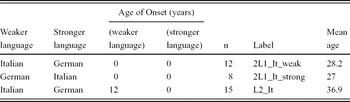
The bilinguals with Italian as their weaker language (six males, six females; mean age: 28.2 years, age range: 19–39 years) had acquired Italian naturalistically at home up until age six. Most of them (58%) had inherited Italian from the father. The Italian parents came from a wide variety of regions in Italy, including Apulia, Campania, Lombardy, Marches, Piedmont, Sicily, and Tuscany. At the time of the data collection, three of the bilingual speakers with Italian as their weaker language were enrolled in Italian courses at their university. Furthermore, two of the participants had spent either seven months or two years in Italy immediately prior to being tested.
Our fifteen L2 learners (three males, twelve females; mean age: 36.9 years, age range: 27–46 years) had started acquiring Italian at age twelve. At the time of data collection, only one was enrolled in Italian courses at a university. Four participants had been living in Italy for at least nine years at the time of testing. Among the eleven L2 learners who resided in Germany at the time of testing, four had lived in Italy for a certain amount of time (up to eight years).
The bilinguals with Italian as their stronger language (six males, two females; mean age: 27 years, age range: 18–38 years) served as a control group. For all but two of them, Italian was the language of the father. The participants came mainly from two different regions in Italy: Latium and Lombardy. Table 3 offers an overview of selected relevant data of our experimental subjects.
Experimental subjects.

5.2 Tasks
In order to test knowledge of gender assignment and agreement in Italian, we ran two tests: a timed acceptability judgment task (henceforth AJT) and an elicited production task (henceforth EPT). Before turning to the description of the two experiments, we provide an overview of the type of target words used in the AJT and the EPT. Target words of the same type were used in both experiments. We grouped target words according to Type rather than class, a choice that was originally driven by the fact that we had interpreted masculine words ending in -o and feminine words ending in -a similarly, i.e., as conforming to the rule, even though they belong to two different classes in Chini (Reference Chini1995). For this reason, our Type1 words include words of both the first and the second class. See Table 4 for the Type of words we included in the experiments and their corresponding class according to the classification proposed by Chini (Reference Chini1995).
Choice of items in the AJT and the EPT.

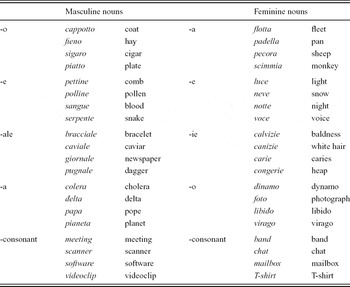
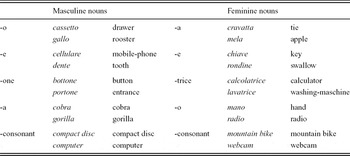
Words ending in -e with a morpho-phonological cue were used in both experiments, but the types of cues differed in the two experiments. In the AJT, words ending in -ale (e.g., pugnale “dagger.m”) were chosen for masculine and words ending in -ie (e.g., carie “caries.f”) for feminine. In the EPT, words ending in -one (e.g., bottone “button.m”) were chosen for masculine and words ending in -trice (e.g., lavatrice “washing-machine.f”) for feminine. A complete list of the words that were used as stimuli in the two experiments is provided in Appendices A and B.
Let us now turn to the description of the two experiments.
The AJT (acceptability judgment task)
In the timed AJT, participants were required to repeat or correct sentences aloud according to their judgments (similar to Bianchi, Reference Bianchi2008). Stimuli were presented both aurally and graphically on a computer screen. The choice of presenting the stimuli in both modalities was made in order to avoid one group of speakers having an advantage over the other in either modality. Thus, Montrul et al. (Reference Montrul, Foote and Perpiñán2008) have shown that bilingual speakers are better than L2 learners in tasks that involve comprehension and oral production, whereas the latter group of speakers usually performs better in tasks involving writing and reading skills. Stimuli had been previously recorded by an Italian native speaker for reasons of uniformity, as suggested by Mackey and Gass (Reference Mackey and Gass2005). Participants were given a limited amount of time to utter their answers. More precisely, they received three times the x-milliseconds the native speaker needed to produce the stimulus. The main reason for using a timed experimental setting was that we wanted to reduce the use of metalinguistic knowledge as much as possible. The experiment was implemented using a program called Presentation. Sentence (3) offers an example of an ungrammatical sentence proposed in the AJT. The expected correction of (3) is provided in (4), in which both the gender of the determiner in the first clause and that of the past participle in the coordinated clause have been changed from feminine to masculine in order to correctly agree with the masculine noun and pronominal object, respectively:
(3)
(4)


Forty items were used in this task. Target words were divided evenly between masculine (n = 20) and feminine (n = 20). The five Types of words listed in Table 4 above were chosen within each gender. Target words were controlled for gender transfer from German. Specifically, 20 of them had the same gender as in German, while the other 20 had a different gender (10 had a non-neuter gender and the other 10 were neuter in German). Half of the items were presented as grammatical and half of them as ungrammatical. Many different types of distractors were included in the task. Since this study is part of a larger project that also aimed to investigate mastery of other phenomena (e.g., use of definite article, position of adjective, auxiliary selection), items pertaining to these other phenomena were used as distractors. Items were presented in a different random order for each run.
The EPT (elicited production task)
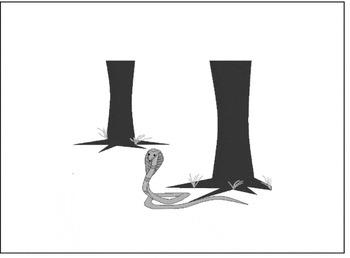
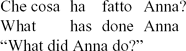
Our EPT is similar to that of McCarthy (Reference McCarthy2008). Participants were asked to describe the two actions performed by a woman named Anna on either an object or an animal by answering the question Che cosa ha fatto Anna? “What did Anna do?”, as in (6) below. In this task, participants were instructed to use an appropriate noun to designate the object or the animal, but to use this noun only once. This instruction aimed on the one hand at eliciting the production of a nominal phrase containing a determiner, and on the other at encouraging the possible use of an object clitic pronoun in the description of the second action, which triggers gender agreement on the past participle in Italian. The two pictures, in which Anna performed the two actions, were preceded by a simple vocabulary task. Here, participants were asked to guess the name of the object or the animal by answering the question L'animale che vede si chiama X or Y? “Is the animal that you see called X or Y?”, as exemplified in (5a) below. The vocabulary task was mainly performed to lead participants to use the target word expected by the experimenter. Examples of the items were provided in the training session. Ten distractors, in which participants were required to describe objects other than the items, were included in this task. Figure 4 (vocabulary task) and Figure 5 (the two actions performed by Anna) together provide an example of an item presented in the experiment. The two questions in (5a) and (6) were asked when Figures 4 and 5 were presented. Sentences (5b) and (7) provide examples of the expected answers in the “guess the name” task and the description of the two actions:
(5)
(6)
(7)


Vocabulary task.

Description task.

Twenty target words were used in this task. They were divided evenly between masculine (n = 10) and feminine (n = 10). The five Types of words listed in Table 4 above were selected. Target words were controlled for transfer from German. In particular, 10 of them had the same gender as in German, while the other 10 had a different gender (six had a non-neuter gender and the other four were neuter in German).
The next section provides a quantitative and qualitative analysis of the data.
6. Analysis of the data
6.1 Criteria for the analysis of the data
In the analysis of the data and in both experiments, we adopted a criterion similar to that in Montrul et al. (Reference Montrul, Foote and Perpiñán2008) to classify deviances from the target (see example (7) above). The main difference between Montrul et al. (Reference Montrul, Foote and Perpiñán2008) and our study is that the former investigated gender agreement within the noun phrase in Spanish, whereas our study addressed gender agreement both within and outside of the noun phrase. Sentences such as (8) below, in which both the determiner of the first clause and the past participle of the coordinated clause do not have the same gender specification as the head noun, were considered to be instances of assignment errors. Sentences such as (9) and (10), in which the determiner of the first clause and the past participle of the second clause do not share the same gender specification, were considered to be instances of agreement errors.
(8)
(9)
(10)


6.2 Overall accuracy
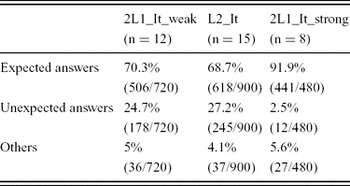
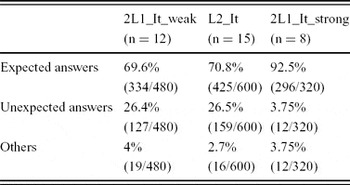
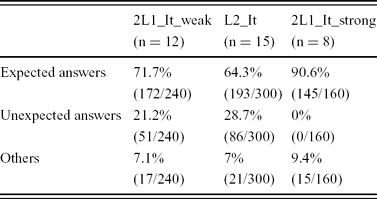
Table 5 provides a general overview of our participants’ accuracy in the two experiments. The category ‘Expected answers’ refers to target judgments and productions (i.e., pertaining to both assignment and agreement) containing two coordinated clauses with the periphrastic structure avere (have) plus a past participle; in the first clause the object was expressed by means of a determiner and a noun and in the second clause by means of a clitic pronoun. The category ‘Unexpected answers’ refers to non-target answers of the same type (i.e., either assignment or agreement is not target-like). Answers in which the determiner was realized as an indefinite (e.g., un cobra “a cobra” vs. il cobra “the cobra”) and answers in which the noun phrase was realized as a prepositional phrase (e.g., al cobra “to.the cobra” vs. il cobra “the cobra”) were also counted. The category ‘Others’ refers to answers that were not given or were incomplete as well as to answers in which the head noun was changed (e.g., change of calvizie “baldness” into calvizia “baldness”).
Overall accuracy in the two experiments combined.

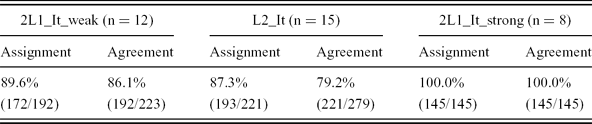
As shown in Table 5, the rates of accuracy of the 2L1 with Italian as their weaker language and the L2 learners in producing target answers were very similar and were lower compared to those of the 2L1 with Italian as stronger language. A chi-square test showed that the bilinguals with Italian as their stronger language performed significantly better than the bilingual speakers with Italian as their weaker language (χ2 = 106.98, p < .01) and the L2ers (χ2 = 125.25, p < .01), whereas the performances of the 2L1 with Italian as weaker language and the L2 learners did not differ significantly.
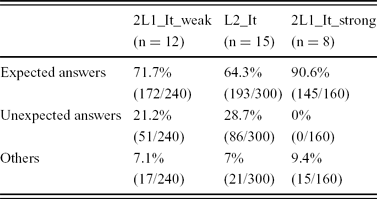
The accuracy scores of the 2L1 with Italian as their weaker language and the L2ers were very similar in both the AJT and the EPT. In fact, the two groups of speakers failed to differ significantly from one another. On the contrary, the accuracy of the bilingual speakers with Italian as the stronger language was very high in both experiments and differed significantly from that of the bilingual speakers with Italian as their weaker language (χ2 = 69.76, p < .01 in the AJT; χ2 = 38.49, p < .01 in the EPT). Data pertaining to our populations’ rates of accuracy in the AJT and EPT are provided in Table 6 and Table 7.
Accuracy in the AJT.

Accuracy in the EPT.
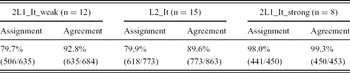
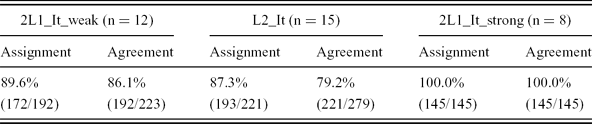
A closer look at the two types of phenomena investigated (i.e., gender assignment and gender agreement) in the two experiments combined reveals that both the 2L1 with Italian as their weaker language and the L2 learners were more accurate in gender agreement than in gender assignment. Here, agreement refers to gender matching between the determiner of the first clause and the past participle of the second clause. A more detailed account of the agreement errors in the two clauses is provided in the next subsection. Words with incorrect assignment were included in the analysis of agreement and counted as correct agreement. Table 8 shows the accuracy scores for gender agreement and gender assignment in the three groups of speakers in the two experiments combined.
Accuracy for gender assignment and agreement in the two experiments combined.

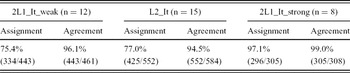
Overall, the rates of accuracy of the bilingual speakers with Italian as their weaker language and those of the L2ers for gender agreement were close to native-like and differed significantly from the rates of accuracy for gender assignment in both groups (χ2 = 48.79, p < .01 for the 2L1; and χ2 = 29.66, p < .01 for the L2ers). Furthermore, a chi-square test showed that the two groups of speakers differed significantly from the bilingual speakers with Italian as their stronger language concerning both gender assignment (χ2 = 79.58, p < .01 for the heritage speakers; and χ2 = 79.82, p < .01 for the L2ers) and gender agreement (χ2 = 26.39, p < .01 for the heritage speakers; and χ2 = 45.14, p < .01 for the L2ers), the latter of whom performed in a native-like manner for both phenomena (98% for assignment and 99.3% for agreement). It is worth pointing out that the accuracy scores of the 2L1 with Italian as their weaker language and the L2ers differed in the two tasks for the two phenomena. As for gender assignment, both populations performed below 95% in each experiment. The opposite was found for gender agreement. In fact, both the 2L1 with Italian as the weaker language and the L2 learners achieved up to 95% accuracy in the AJT for gender agreement, while performing below 90% in the EPT (compare Table 9 and Table 10). A chi-square test revealed that the rates of accuracy for gender agreement in the two tests differed significantly in both groups of speakers (χ2 = 22.58, p < .01 for the heritage speakers; and χ2 = 47.37, p < .01 for the L2ers).
Accuracy for assignment and agreement in the AJT.

Accuracy for assignment and agreement in the EPT.
The next subsection will focus on the analysis of the errors produced by the 2L1 with Italian as their weaker language and the L2 learners of Italian. Since the 2L1 with Italian as their stronger language achieved up to 95% accuracy in gender assignment and gender agreement in both experiments, they will not been taken into account here.
6.3 Error analysis
Assignment errors
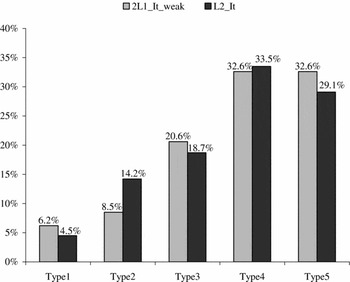
Of the total number of errors made by the 2L1 and the L2ers in the two experiments combined, assignment errors occurred at a rate of 72.5% in the group of the 2L1 (129/178) and at a rate of 63.3% in the group of the L2ers (155/245). As for error type and noun ending, the 2L1 produced errors at comparable rates (32.6%) for Type4 and Type5 words (i.e., feminine words ending in -o, masculine words ending in -a, and words ending in consonant), whereas most of the errors (33.5%) in the group of the L2ers occurred on Type4 words. The class most resistant to assignment errors was that of feminine words ending in -a and masculine words ending in -o (Type1), which includes the most frequent types of words in the Italian lexicon (as reported by Chini, Reference Chini and Wegener1998). Error rates for the five Types of words are provided in Figure 6.
Assignment errors and noun ending.

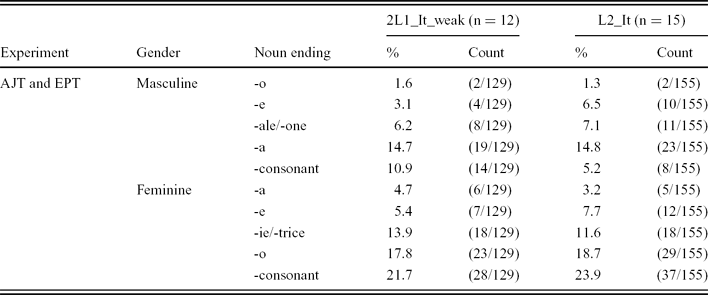
A closer look at the relationship between assignment errors, noun ending, and gender in the two experiments combined reveals that both the 2L1 and the L2ers made the most errors on feminine words ending in consonant (21.7% and 23.9% respectively). As for assignment errors on masculine words, both the 2L1 and the L2ers made the most errors on words ending in -a (14.7% for the 2L1 and 14.8% for the L2ers), as shown in Table 11.
Distribution of assignment errors in the AJT and the EPT combined according to gender and noun ending.
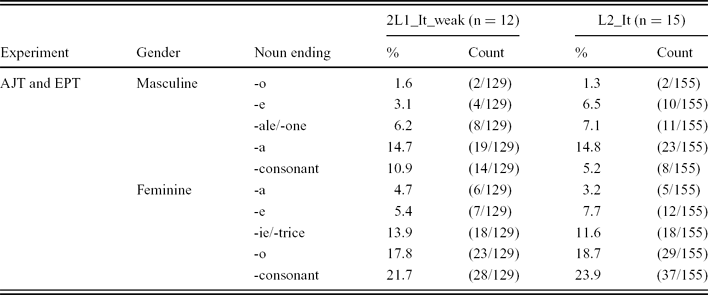
More generally, both groups of speakers were more accurate on masculine words than on feminine words. Indeed, most of the assignment errors made by the 2L1 and the L2ers occurred with feminine words in both experiments (similar to Montrul et al., Reference Montrul, Foote and Perpiñán2008). Both groups of speakers had the tendency to overgeneralize the masculine gender. Accuracy on feminine words and masculine words differed significantly in the two groups (χ2 = 19.41, p < .01 for the 2L1; χ2 = 25.79, p < .01 for the L2ers).
In both experiments, target words in Italian were divided evenly between those that share gender with German and those that do not. Among words that do not share gender between the two languages, we distinguished between words that have a different non-neuter gender in German (e.g., Ge. F. Schlange – It. M. serpente “snake”) and words that are neuter in German and either masculine or feminine in Italian (e.g., Ge. NT. Licht – It. F. luce “light”; Ge. NT. Handy – It. M. cellulare “mobile phone”). A distinction was made between words that share gender in Italian and German and those that have different genders in the two languages in order to verify whether or not gender assignment errors may be attributed to linguistic influence from German.Footnote 1 When counting items that could potentially have been assigned an incorrect gender as the result of linguistic influence from the other language, we excluded those items that are realized as neuter in German. Since there is no overlap between Italian and German as far as the neuter gender is concerned (i.e., Italian does not have neuter gender), no linguistic influence was expected here (the relationship between overlap and cross-linguistic influence is also discussed in Cornips & Hulk, Reference Cornips, Hulk, Lefebvre, White and Jourdan2006). The Italian–German bilinguals and the L2ers of Italian performed similarly with respect to gender assignment and language influence. Overall, both groups of speakers had less success in assigning gender to words with different genders than for words that shared gender. A chi-square test revealed that the accuracy for the two types of words differed significantly in both groups of speakers (χ2 = 12.70, p < .01 for the 2L1; χ2 = 8.77, p < .01 for the L2ers).
However, it is worth pointing out that assignment errors on words of different genders between the two languages occurred predominantly with those Types of words whose gender cannot be predicted by their ending, namely Type2, Type4 and Type5. As for Type1 and Type3 words, the genders of which can be predicted by their ending, most of the errors occurred on words that share gender between the two languages. A chi-square test revealed that accuracy on Type1/3 words and Type2/4/5 words of different genders in the two languages differed significantly in both groups of speakers (χ2 = 43.84, p < .01 for the 2L1; χ2 = 43.57, p < .01 for the L2ers).
Agreement errors
We considered sentences in which the determiner of the first clause and the past participle of the coordinated clause did not share the same gender specification to be instances of agreement errors. The source of an agreement error could be of one of two types: (i) the determiner does not agree with the noun but the past participle does (as in (11a–b)), or (ii) the determiner does agree with the noun but the past participle does not (as in (11c–d)):
(11)

Of the total number of errors made by the 2L1 and the L2ers in the two experiments combined, agreement errors occurred at a rate of 27.5% (49/178) in the group of the 2L1 and at a rate of 36.7% (90/245) in the group of the L2ers. The slightly higher error rate in the group of the L2 learners is due to the fact that the bilingual speakers performed slightly better than the L2ers in the EPT, though the performance of the two groups of speakers did not differ significantly.
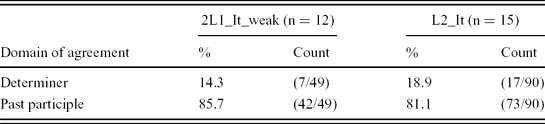
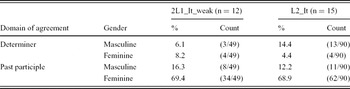
A comparison of the errors in the two domains of agreement reveals that most of the errors occurred on the past participle. Of the total number of 139 agreement errors in the two experiments for the two groups combined, 24 errors (17.3%) were on determiners and 115 (82.7%) on past participles. Error rates for the past participle and the determiner differed significantly for both the 2L1 and the L2ers (χ2 = 50.91, p < .01 for the 2L1; χ2 = 69.69, p < .01 for the L2ers). The relevant data are provided in Table 12.
Distribution of errors by domain of agreement in the two experiments combined.
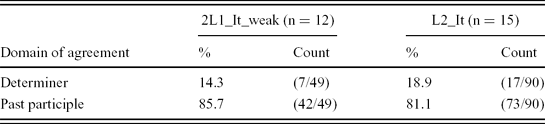
A closer look at the relationship between the domain of agreement and the gender of the words reveals that most of the errors occurred on the past participle with feminine words in both groups of speakers, the most common error being the one shown in (11c) above. Data from the two experiments combined show that the 2L1 made 34 errors of this type (69.4%), while the L2ers made 62 errors (68.9%), as shown in Table 13.
Distribution of errors by domain of agreement and gender.

Most of the agreement errors were made in the EPT and predominantly involved the use of a default masculine agreement on the past participle with feminine nouns, for both the heritage speakers of Italian and the L2ers.
In the next subsection, we will consider the accuracy of our participants with respect to the two phenomena investigated based on the input they received at the time of testing.
6.4 Subgroup variation
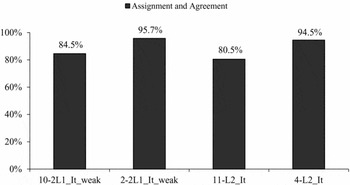
Among our twelve 2L1 with Italian as their weaker language and our fifteen L2ers of Italian, two bilingual speakers had spent either seven months or two years in Italy immediately prior to being tested, while four L2ers had been living in Italy from nine years up to twenty-six years at the time of testing.
If we compare the rates of accuracy of our subgroups of speakers for the two phenomena investigated, we observe that both the two heritage speakers of Italian with intensive exposure to Italian and the four L2ers who had been living in Italy for at least nine years at the time of testing performed very similarly to the eight bilingual speakers with Italian as their stronger language, whose accuracy on both gender assignment and gender agreement was greater than 95%. We conducted a chi-square test to verify whether the two 2L1 with Italian as their weaker language and the four L2ers with intensive exposure to Italian performed like the eight bilingual speakers with Italian as their stronger language. The chi-square test revealed that both the two 2L1 and the four L2ers living in Italy failed to differ significantly from the 2L1 with Italian as their stronger language either in gender assignment or in gender agreement. Figure 7 provides the relevant data for the two phenomena investigated for the four subgroups of speakers.
Gender assignment and agreement in the four subgroups of speakers.

7. Summary and discussion
Our findings have shown that our Italian–German bilinguals with Italian as their weaker language and our L2 learners of Italian performed very similarly to one another and differed from the bilingual speakers with Italian as their stronger language. Taken as a group, both the heritage speakers of Italian and the L2ers deviated from the target both in gender assignment and, to a lesser extent, in gender agreement, whereas the bilingual speakers with Italian as their stronger language performed in a native-like manner for both phenomena investigated. Our data suggest that early AoO (Age of Onset) does not qualify as a sufficient condition to achieve and maintain native competence. If early AoO made a difference in ultimate attainment, we would have expected the heritage speakers of Italian to outperform the L2 learners on the one hand, and the L2ers to perform at a level far below that of the bilingual speakers with Italian as their stronger language on the other. Our data have shown instead that the amount of input in adulthood plays a major role in native-like achievement, regardless of AoO, a fact that is supported by the native-like accuracy, particularly in gender agreement, of the two heritage speakers with intensive exposure to Italian prior to being tested and the four L2ers who had been living in Italy for at least nine years at the time of testing.Footnote 2 Based on data from our subgroups of speakers, we can claim that intensive exposure to the weaker language (either heritage or L2) (re)activates the target-like use of features that may have become inactive due to impoverished language use and input, and allows for the adult L2 acquisition of features not instantiated in the L1, here the [ugender] feature on the past participle (as opposed to the FFFH).
As for domains of vulnerability in the heritage language, our data have shown that gender assignment is more vulnerable than gender agreement. Based on our data, we can claim that noun categorization and the [igender] feature are more prone to being affected in the heritage language of adult bilinguals than the uninterpretable features, a result that resembles that of Tsimpli et al. (Reference Tsimpli, Sorace, Heycock and Filiaci2004) for L1 attrition. The native-like accuracy of our heritage speakers of Italian and our L2ers for gender agreement in the AJT suggests that grammatical representations of uninterpretable features are neither affected in the heritage language nor are they impaired in adult L2 acquisition. Agreement errors occurred mostly in the EPT for both populations and predominantly with respect to agreement on the past participle, a phenomenon that we have attributed to impoverished language input and use. We can claim that deviances from the target in the heritage language of adult bilinguals as well as in the L2 of adult L2ers are confined to performance, which is in line with what has been suggested by the MSIH for L2 acquisition.
As for gender assignment, those Types of words that turned out to be most vulnerable in the heritage language as well as in the L2 are Type4 and Type5 words. These Types of words belong to the classes that are found less frequently in Italian, and thus generally create more problems for children in the monolingual and bilingual acquisition of Italian (see Cantone, Reference Cantone1999; Chini, Reference Chini1995). Additionally, they are among the last Types of words to be consistently categorized by children in comparison to Type1 words, which are assigned target gender at a very early age. If we compare our data on gender assignment with those on gender agreement, we observe an interesting pattern: gender agreement on the past participle, which according to recent research (Moscati & Tedeschi, Reference Moscati, Tedeschi, Chandlee, Franchini, Lord and Rheiner2009) is one of the last types of agreement to be acquired by children, is more affected than agreement on the determiner (see Table 12), which is acquired earlier. Similarly, gender assignment on Type1 words, which are the most transparent in terms of gender and the first that are mastered in a target-like manner by children, is less affected than assignment on Type4 and Type5 words. We can consider a degree of vulnerability: the last phenomena to be acquired or those most problematic during acquisition are simultaneously those most affected in the heritage language of adult bilinguals.Footnote 3 A similar pattern is observable in adult L2 acquisition. Indeed, our L2ers performed more consistently on Type1 words than on Type4 and Type5 words, and were more accurate for gender agreement on the determiner than on the past participle.
Furthermore, both our heritage speakers and our L2ers showed the tendency to use the default masculine form, which is usually considered the default gender in Italian (Riente, Reference Riente2003; White et al. Reference White, Valenzuela, Kozlowska-Macgregor and Leung2004), both in gender assignment and in gender agreement. This phenomenon had been previously observed by other researchers for both L2 acquisition and the bilingual language acquisition of Italian and other languages (Håkansson, Reference Håkansson1995 for L2 and heritage Swedish; McCarthy, Reference McCarthy2008 for L2 Spanish; Montrul et al., Reference Montrul, Foote and Perpiñán2008 for L2 and heritage Spanish; Oliphant, Reference Oliphant1998 for L2 Italian).
Finally, our data have shown that language influence can only partially account for the non-target gender assignment of our heritage speakers and L2ers in Italian. Indeed, it could only explain assignment errors on Type2, Type4, and Type5 words, but could not account for the behaviour of our speakers on Type1 and Type3 words. In fact, in this latter case, both groups of speakers performed better for words that have different genders in the two languages. We believe that language-internal factors such as the predictability of gender based on noun endings plays a major role in successful gender assignment. Only when the noun ending fails to provide a clue for gender assignment do speakers potentially turn to the other language.Footnote 4
8. Conclusion and implications for further research
Our data have shown that instances of incompleteness in Italian as a heritage language and as a second language occurred mostly in noun categorization; the interpretable gender feature on nouns is more prone to being affected in the two modalities of acquisition than the uninterpretable gender features on determiners and past participles. This led us to the conclusion that grammatical representations are not affected in the heritage language of adult early bilinguals, nor are they impaired in adult L2 acquisition. In both modalities of acquisition, deviances from the target in gender agreement, especially on the past participle, were found mostly in production, which we have attributed to language external factors such as impoverished language input and use. Finally, gender was shown to converge to the target when the language offers reliable cues, as is the case for Type1 words. When faced with words for which gender cannot be predicted based on their ending, heritage speakers and L2 learners may rely on the other language for gender assignment.
Words used as stimuli in the AJT

Our study contributes to a better understanding of the mastery of the Italian gender system in adult bilinguals who have acquired two languages simultaneously and its similarities and/or differences with Italian as a second language. We have only considered agreement on determiners and past participles here; we believe that some other areas that involve gender agreement in Italian such as agreement on attributive and predicative adjectives should be investigated to verify whether they are affected in the production of adult bilingual speakers and, if so, whether there is a degree of vulnerability in these domains too. Furthermore, we believe that further experimental research is needed on child bilingual acquisition of Italian to provide a more detailed account of knowledge of gender assignment and gender agreement in the early and late childhood. This could be of help in determining whether deviances from the target in adult bilinguals can be attributed to attrition or incomplete acquisition.
Words used as stimuli in the EPT