Introduction
The motivation of employees is one of the main reasons why companies define declarations of commitment to stakeholders in the forms of credos, beliefs, values or mission statements (David, Reference David1989; Campbell & Yeung, Reference Campbell and Yeung1991; Klemm, Sanderson, & Luffman, Reference Klemm, Sanderson and Luffman1991; Baetz & Bart, Reference Baetz and Bart1996; Anderson, Reference Anderson1997; Bart, Bontis, & Taggar, Reference Bart2001). It is well known in literature, for example, how the credo of Johnson & Johnson, which addresses the company’s commitments to clients, employees, communities and stakeholders, has driven motivation for company employees for decades. These declarations of commitment to stakeholders of business enterprises have a strong ability to awaken a ‘sense of contribution’ in people, which is a source of a special type of motivation (Cardona & Rey, Reference Cardona and Rey2008; Wang, Reference Wang2011). Human motivation has been studied for many years in the fields of social psychology and organizational theory, and different types of motivation that influence organizational behavior have been identified. Those that have consolidated and have had greater theoretical and practical influence are extrinsic (EM), intrinsic (IM) and prosocial motivation. Many studies have analyzed the relationship and influence between certain types of motivation (Deci, Reference Deci1971; Dermer, Reference Dermer1975; Amabile, Reference Amabile1993; Deci, Koestner, & Ryan, Reference Deci and Ryan1999; Ryan & Deci, Reference Ryan and Deci2000; Grant, Reference Grant2008b). However, the three forms of motivation have hardly ever been considered together, nor has it been studied, which motivation is linked to the stakeholders of business companies. The main contribution of this paper is to present a motivation model, which includes EM, IM and pro-stakeholders motivation (PMS), as a type of prosocial motivation related to the satisfaction of the needs of the stakeholders considered in the mission statement. Furthermore, the existence of these three forms of motivation in business operations is empirically validated.
The article is structured as follows: first motivation literature is analyzed and we see that research on motivation at work has identified three main types of motivation: EM, IM and prosocial motivation. However, little attention has been paid to the motivation linked to the stakeholders of business companies. Second, an agent–stakeholder behavior model is proposed, which allows integrating EM, IM and stakeholder motivation as components of the entire motivation of the employees of a company. Third, an empirical study, carried out in 119 companies, is presented, verifying the existence of these three components of motivation in a company. Finally, managerial implications of these findings are discussed.
Mission Statement and Motivation
Although there is a clear relationship between motivation and the contribution to stakeholders, there is a gap in the literature with respect to the origin and nature of this type of motivation, and which factors drive or impede its development in business companies. The study of the motivation of people has been approached from different angles by researchers: in accordance with the hierarchy of human needs (Maslow, Reference Maslow1954), drawing a distinction between hygiene and nonhygiene factors (Herzberg, Reference Herzberg1966) and also in accordance with the intrinsic or extrinsic nature of motivational factors (Mc Gregor, Reference Mc Gregor1960, Reference Mc Gregor1966). The latter perspective has been of great influence, both academically and in practice, thus the concepts ‘EM’ and ‘IM’ form an essential framework in both research and management of organizational behavior. The works of Deci and Ryan (Reference Deci, Koestner and Ryan1985) and Ryan and Deci (Reference Ryan and Deci2000) have played an important role here by reflecting them in the Self-Determination Theory, one of the most accepted and followed motivation models (Gagné & Deci, Reference Gagné and Deci2005; Çınar, Bektaş, & Aslan, Reference Çınar, Bektaş and Aslan2011). In Self-Determination Theory, the most basic distinction is made between IM and EM as a continuum according to the level of autonomy and self-determination of the individual. EM refers to doing something because it leads to a separable outcome, and IM refers to doing something because it is inherently interesting. The Self-Determination Theory has been applied to the study of motivation in various fields, such as sport (Pelletier, Fortier, Vallerand, Tuson, Brière, & Blais, Reference Pelletier, Fortier, Vallerand, Tuson, Brière and Blais1995), the public sector, nonprofit organizations (Park & Word, Reference Park and Word2012) and education (Vallerand, Pelletier, Blais, Brière, Senécal, & Vallières, Reference Vallerand, Pelletier, Blais, Brière, Senécal and Vallières1992; Epstein, Clinton, Gabrovska, & Petrenko, Reference Epstein, Clinton, Gabrovska and Petrenko2013), among others. It is true that some authors have pointed out the ambiguity of the terms ‘extrinsic’ and ‘intrinsic’ (Dyer & Parker, Reference Dyer and Parker1975; Broedling, Reference Broedling1977). The concept of IM has occasionally been used as a Black Box to include all that could not be defined as EM (Broedling, Reference Broedling1977). However, other authors, such as Brief and Aldag (Reference Brief and Aldag1977) and Ryan and Deci (Reference Ryan and Deci2000), have argued that it is possible to reach a definition, covering the main aspects of these two forms of motivation. Accordingly, EM would be the drive that propels agents into action, for what they receive in return. And IM would be the drive that propels agents into action, for the value the action itself has for them (Ryan & Deci, Reference Ryan and Deci2000).
Along with the studies focused on EM and IM there is a line of research that analyzes the relevance of another form of motivation: prosocial motivation (Brief & Motowidlo, Reference Brief and Motowidlo1986; Batson, Reference Batson1987; Batson & Shaw, Reference Batson and Shaw1991; Grant, Reference Grant2008b, Reference Grant2009, Reference Grant2011). The underlying idea of this research is ‘that self-interest is not the only motivation that drives work effort and behavior and that within humans there is ‘the desire to expend an effort to benefit other people’ (Grant, Reference Grant2008b). There are altruistic phenomena in the workplace that exceed the bounds of contract theory (Dodlova & Yudkevich, Reference Dodlova and Yudkevich2009). As Grant (Reference Grant2009) states ‘applied psychologists and organizational researchers have argued that we have underestimated the extent to which many employees hold other-oriented motives and values (Batson & Shaw, Reference Batson and Shaw1991; Meglino & Korsgaard, Reference Meglino and Korsgaard2004). It is relevant to promote social justice and human well-being (Folger & Salvador, Reference Folger and Salvador2008), and also move to serve the public through meaningful work that benefits others.’ Other research in human resource management has also shown that even the violation of formal organizational rules could be motivated by prosocial motives; a desire to assist the organization in meeting its objectives with the primary intention of promoting the welfare of the organization or one of its stakeholders (Vardaman, Gondo, & Allen, Reference Vardaman, Gondo and Allen2014). To these lines of research we can add the work carried out by several authors from an ethical approach to management, which has also emphasized the role of others-oriented motivation in organizational behavior. Using expressions such as ‘transcendent motivation’ (Cardona, Reference Cardona2000; Rosanas, Reference Rosanas2008) or ‘transitive motivation’ (Melé, Reference Melé2003; Guillén, Ferrero, & Hoffman, Reference Guillén, Ferrero and Hoffman2015), they all refer to the motivation to be concerned with the needs of others, which adds a ‘sense of contribution’ to our actions.
Prosocial motivation, at least as a potential energy, is a fairly common drive in humans. This motivation is induced by the effect that the action of a person can have on satisfying the needs of other people. Prosocial motivations are indirectly related to Maslow’s superior motivations and could be considered included in what Herzberg (Reference Herzberg1966) refers to as nonhygiene factors. In many formulations, IM include motives that are prosocial or altruistic (Frey & Meier, Reference Frey and Meier2002; Benz & Frey, 2007). However, as prosocial motivations involve different levels of autonomy and differ from EM and IM in terms of goal directedness and temporal focus, they can be regarded as a different motivation (Grant, Reference Grant2008b).
In the context of an organization, prosocial motivations are also common and can cover different areas, such as helping a colleague at work, satisfying the needs of a client or the interest in meeting certain needs in society. As Brief and Motowidlo (Reference Brief and Motowidlo1986) point out: ‘Prosocial organizational behavior is behavior which is (a) performed by a member of an organization, (b) directed toward an individual, group, or organization with whom he or she interacts while carrying out his or her organizational role, and (c) performed with the intention of promoting the welfare of the individual, group, or organization toward which it is directed.’ In organizational settings of the social field – e.g., university foundations, lifeguards, firefighters, army officials – prosocial motivation plays a significant role in the development of employee motivation (Grant, Dutton, & Rosso, Reference Grant, Campbell, Chen, Cottone, Lee and Lapedis2008; Grant, Reference Grant2008b; Grant & Sonnentag, Reference Grant, Dutton and Rosso2010; Grant & Berry, Reference Grant and Sonnentag2011). However, it is not only within the context of the social field that organizations are able to raise prosocial motivation.
Stakeholders and Motivation. The Motivation Model
There are studies on the effect of prosocial motivation in, for example, enterprises of the public sector (Wright, Reference Wright2007; Naegelen & Mougeot, Reference Naegelen and Mougeot2011; Polidori & Teobaldelli, Reference Polidori and Teobaldelli2013), in the nonprofit sector (Rose-Ackerman, Reference Rose-Ackerman1996; Kirk & Nolan, Reference Kirk and Nolan2010), in caregiving (Finkenauer & Meeus, Reference Finkenauer and Meeus2000), and in a company’s salespeople (Agnihotri, Krush, & Singh, Reference Agnihotri, Krush and Singh2012) and job design (Grant, Reference Grant2007, Reference Grant2008a). There prosocial motivation is considered a big source of motivation that drives employees to expend an effort to benefit other’s needs. However, this kind of motivation could also play a significant role in business companies when it is addressed to the stakeholders considered in their mission statements (Cardona & Rey, Reference Cardona and Rey2008; Wang, Reference Wang2011). The potential of prosocial motivation induced by the mission of a company lies in the fact that most actions performed in an organization – from the top to the bottom of the organization- have an impact on the stakeholders of the company. As it is aimed at satisfying the needs of others, these actions are likely to be performed out of prosocial motivation. This article focuses on this special type of prosocial motivation, which will be called PMS, and, following the definition of prosocial motivation (Batson, Reference Batson1987) we define as the desire of an agent to expend an effort to benefit the stakeholders of the company.
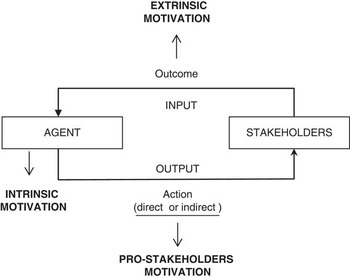
In order to clarify the meaning of PMS, we propose a classification of the different types of motivation. This classification was carried out through the stakeholder’s vision of a company, in line with the approach proposed by Freeman (Freeman & Reed, Reference Freeman and Reed1983; Freeman, Reference Freeman1984; Argandoña, Reference Argandoña2008; Barktus & Glassman, Reference Bart, Bontis and Taggar2008) and the scheme of an interaction system proposed by some authors such as Argandoña (Reference Argandoña2008), Rosanas (Reference Rosanas2008), and Guillén, Ferrero, & Hoffman (Reference Guillén, Ferrero and Hoffman2015), in which motivation can be seen as a combination of extrinsic, intrinsic and prosocial factors. According to this model (see Figure 1), human behavior can be seen as an input-output interaction between an active and a receptive agent, in which the active agent does something – an action (output) – and receives something – an outcome (input) – from the receptive agent. Following Brief and Motowidlo (Reference Brief and Motowidlo1986), we consider here the stakeholders with which the agent interacts directly. However, we will also consider those with which the agent may have indirect interaction, because the company acts as an intermediary in the relationship. As might be the case, for example, in the relationship between back office personnel and the final client, where the agent can be prosocially motivated to contribute to the client, despite not interacting with him directly.
Model of interaction agent-stakeholders

This model can be applied to different types of interaction: employee–client, employee–company, management–shareholders, etc. Here we consider an employee to be the ‘active agent’ and the ‘receptive agents’ are the stakeholders considered in the mission statement, who receive the effects of employee activity (and includes also the other employees) (Freeman & Reed, Reference Freeman and Reed1983; Freeman, Reference Freeman1984). They are the main beneficiaries: those agents who receive profits from the work (Grant, Campbell, Chen, Cottone, Lee, & Lapedis, Reference Grant and Berry2007; Grant Reference Grant2008b). In this perspective, we can identify and integrate the three types of motivation in this behavioral model. EM would be that which moves to act for the value of the input (the outcome), which is what an active agent receives from the interaction with the stakeholders (salary, recognition, etc.). IM would be that which moves to act for the value of the output (the action itself) for the active agent (enjoyment, inherent satisfaction, learning, etc). And PMS would be that which moves to act for the effect (positive or negative) that an action (the output) has on a stakeholder (the contribution to the development and welfare of others).
As many studies show, people are not driven ‘only’ by EM, IM or prosocial motivation, rather the drive can be comprised of different types of motivation that are combined and reinforce each other (Batson & Shaw, Reference Batson and Shaw1991; Ryan & Deci, Reference Ryan and Deci2000; Grant, Reference Grant2008b).
Research Design
Based on these considerations, we propose and test a research model in which the agent’s motivation is comprised of EM, IM and PSM.
Method
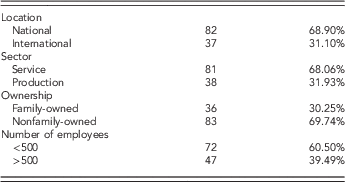
The measurement of the different types of motivation was carried out by means of a questionnaire. Through this questionnaire, we offered companies the opportunity to measure the level of motivation of directors and management. As an incentive for the participating companies in collaborating with our research, they were given a brief report on the results. We invited companies to participate in this study by means of a phone call, on the basis of the list of 5,000 companies featured in a Spanish business magazine called ‘Actualidad Española.’ Over the past 10 years we invited the first 2,000 companies to participate, receiving a positive response from a total of 119 companies (response rate 5.25%). We asked participating companies to facilitate a list of email addresses of executive officers and middle management of the company and they were sent a questionnaire. According to Sidhu (Reference Sidhu2003), managing directors or business unit managers are normally seen as the most competent individuals to provide suitable answers to questions related to organization-level issues. In order to promote participation, prior to sending the questionnaire, a letter was sent by the general directors or board of the company, encouraging them to fill in the questionnaire. Through this procedure we received 5.529 questionnaires with a response rate per participating company of over 70% in all cases. Table 1 shows the composition of our sample of companies, according to location, sector of activity, ownership and size.
Sample structure

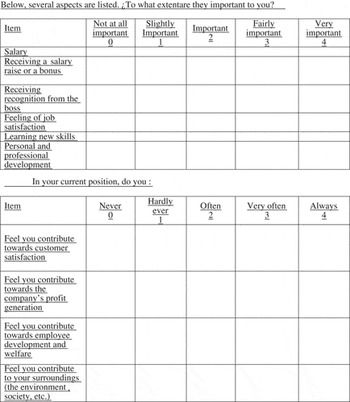
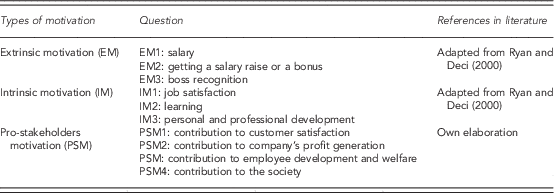
The measurement scales of the different types of motivation were based on the existing literature (Deci & Ryan, Reference Deci, Koestner and Ryan1985; Brief & Motowidlo, Reference Brief and Motowidlo1986; Vallerand et al., Reference Vallerand, Pelletier, Blais, Brière, Senécal and Vallières1992; Ryan & Deci, Reference Ryan and Deci2000; Grant, Reference Grant2008b; Epstein et al., Reference Epstein, Clinton, Gabrovska and Petrenko2013) (see Table 2). In order to measure EM and IM, we took the scale adapted from Ryan and Deci (Reference Ryan and Deci2000) and asked the company’s members how important the following aspects are to them. ‘The salary’ (EM1), ‘getting a salary raise or a bonus’ (EM2) or ‘boss recognition’ (EM3) were used as items to measure EM motivation while ‘job satisfaction’ (IM1), ‘learning’ (IM2) and ‘personal and professional development’ (IM3) were chosen as items to measure IM. As mentioned before, for PMS, we took the point of view of the stakeholders’ theory (Freeman & Reed, Reference Freeman and Reed1983; Freeman, Reference Freeman1984). Stakeholders are any group or individual who may affect or be affected by the obtainment of the company’s goals. Thus we related PMS to the main beneficiaries commonly represented in mission statements. As mission statements focus mainly on customers, employees, shareholders and society (Bart, Reference Barktus and Glassman1997; Biloslavo & Lynn, Reference Biloslavo and Lynn2007; Leuthesser & Kohli, Reference Leuthesser and Kohli1997; Barktus & Glassman, Reference Bart, Bontis and Taggar2008; Williams, Reference Williams2008) we regarded these four stakeholders. This approach is also coherent with the beneficiaries of the 13 specific types of prosocial organizational behavior identified by Brief and Motowidlo (Reference Brief and Motowidlo1986). Thus, PMS was measured by asking employees to which extent, in their current job, they feel they make: ‘a contribution to customer satisfaction’ (PSM1), ‘a contribution to the company’s profit generation’ (PSM2), ‘a contribution to employees’ development and welfare,’ (PSM3) and ‘a contribution to society (PSM4).
Main literature related to the construct

EM and IM were measured using the answers given on a five-point Likert scale from 0 to 4 anchored at ‘not important’ and ‘very important.’ PMS was measured through a five-point Likert scale from 0 to 4, (0=never; 4=always). Finally, we proposed a structural equation model using SPSS 14.0 and AMOS to test the hypotheses.
Results
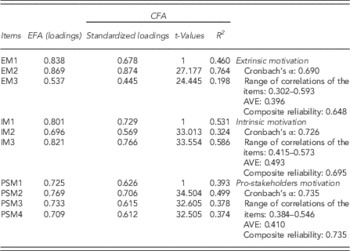
The data were analyzed in two stages: (i) assessment of the reliability, dimensionality and validity of the measurement model; and (ii) analysis of the causal relationships using SEM. Exploratory factor analysis of the items of EM, IM and stakeholder motivation (as listed in Table 3) revealed a Kaiser–Meyer–Olkin value of 0.768 (greater than the recommended value of 0.7). Barlett’s test of sphericity was 13,053,21 (df=45.000) with a significance of 0.000. These results confirmed a linear dependence between the variables and supported the idea that the results were relevant.
Measurement model (reliability and validity of scales)

Note: EFA, exploratory factor analysis; CFA, confirmatory factor analysis; EM, extrinsic motivation; IM, intrinsic motivation; PSM, pro-stakeholders motivation.
The scales were analyzed in accordance with the criteria proposed by Wolfinbarger and Gilly (Reference Wolfinbarger and Gilly2003) to retain items which: (i) load at 0.50 or more on a factor, (ii) do not load at >0.50 in two factors and (iii) have an item to total correlation of >0.40. The first factor is EM, consisting of three items. Second, IM also consists of three items and finally, PSM consisting of four items. Unidimensionality of all three scales was thus established. The reliability was then assessed. Cronbach’s α and composite reliability exceeded the threshold value of 0.6 (Malhotra, Reference Malhotra2004), indicating good internal consistency among the items within each dimension. In addition, the variance extracted for each scale was close to the value of 0.4–0.5. These indices were moderate, but acceptable for all factors (see Table 3).
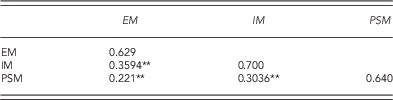
Convergent validity is the degree to which the indicators reflect the construct, that is, whether it measures what it is purposed to measure. Convergent validity was confirmed for all scales where all variables were shown to have significant weighting (t>2.58). Discriminant validity was analyzed by linear correlations or standardized covariances between latent factors by examining whether interfactor correlations were less than the square root of the average variance extracted. Table 4 shows that the square roots of each AVE were greater than the off-diagonal elements (Fornell & Larcker, Reference Fornell and Larcker1981). Discriminant validity was validated.
Correlations matrix of latent constructs

Note: Diagonal elements are the square roots of average extracted (AVE).
EM, extrinsic motivation; IM, intrinsic motivation; PSM, pro-stakeholders motivation.
**All significant at p-value=.01.
In the external model, we used a reflexive model of second order. In fact, motivation is considered to be composed of these independent variables: EM, IM and PMS.
The measurement model was estimated using the robust maximum likelihood method from the asymptotic variance-covariance matrix. The overall validity of the model was evaluated with respect to best-fit indices: χ2 Satorra–Bentler was 386.1003 with 31 df and a p-value of .0000. Both CFI (0.968) surpassing 0.9 and RMSEA (0.046) below 0.08 indicate good fit (Hu & Bentler, Reference Hu and Bentler1998). Taking the significance of the robust χ2 statistic with caution, and considering the above fit indices, the model fit was suggested to be acceptable (Bollen & Long, Reference Bollen and Long1993).
Based on the results obtained, we can confirm the proposed research model. These results show that employee motivation is explained by three variables, which are EM motivation, IM and PMS and have slightly different weights (0.581. 0.807, 0.496). The motivation that holds the most influence on motivation is IM followed by EM and finally PMS. All are needed in order to measure the construct ‘Motivation.’
In addition, the correlations between the different types of motivation (see Table 4) reveal certain evidence about their interrelationship. They show that there is no trade-off between the different types of motivation (see Table 4), as there is no negative correlation among them. Instead, we can conclude from the obtained data that there is a positive relationship between them, which is consistent with previous research findings stating that, in the performance of professional work, there is a positive correlation between EM and IM (Dermer, Reference Dermer1975; Amabile, Reference Amabile1993; Deci, Koestner, & Ryan, Reference Deci and Ryan1999) and between IM and prosocial motivation (Grant, Reference Grant2008b; Grant & Sonnentag, Reference Grant, Dutton and Rosso2010; Grant & Berry, Reference Grant and Sonnentag2011).
Discussion
This paper expands the knowledge on the role of prosocial motivation in companies. We have found that prosocial motivation is not only relevant in social activities, but also in business companies where the motivation of people is, at least, made up of three components: extrinsic factors (such as salary, incentives and job recognition), intrinsic factors (such as job satisfaction and learning), and also prosocial factors related to satisfying the needs of the main stakeholders of an organization. It is an original contribution in the corporate world to integrate a type of motivation that transcends the person and personal gain and focuses on an object that is external; taking the benefit of stakeholders as a source of motivation.
In general, people are not only interested in what benefits themselves, but also in what benefits others. Contributing to something that is good for others motivates, it is also a value, which provides satisfaction through the consequences of actions toward others. Grant (Reference Grant2009, Reference Grant2011) has shown in different studies how serving others motivates. Other research has shown that precisely the perception of doing something good for others is essential for organizational performance (Argandoña, Reference Argandoña2008; Rosanas, Reference Rosanas2008; Kirk & Nolan, Reference Kirk and Nolan2010). This is, for example, what makes car sellers consider the sale of a car, as well as producing an economic incentive, to be a job that satisfies; it is something suitable for the client. Or it is what makes sellers reluctant to sell a product, if they know that it is of poor quality and is bad for the client. PMS is a special form of prosocial motivation, which arises when we can ‘feel’ our contribution to the welfare of others. It expresses the ‘weight’ that the welfare of the stakeholders has in the decisions of an employee.
It must be noted that, from the company’s point of view, there is an important difference between the first two forms of motivation (EM and IM) and PMS. The first two are aimed at benefitting the agent itself (for the extrinsic rewards or for the satisfaction of the work itself) and they do not depend on the good or bad brought upon others. PMS, on the other hand, comes from the interest in others and is what makes us value the mission as long as it represents a true service to the stakeholders (beyond the extrinsic or intrinsic value that it may have). When an organization brings something valuable to others, the mission motivates in a different way and this additional motivation ‘redirects’ motivations. Professors will behave differently when they teach because they enjoy it or when they ‘feel’ that they are contributing to the progress of the community. Therefore, PMS establishes the link between the interests of an agent and the mission that is carried out, and contributes to the person–organization fit (Cha, Chang, & Kim, Reference Cha, Chang and Kim2014). This means that the three forms of motivation are different, but not independent, nor should they necessarily be in conflict or simply overlap. Ultimately, PMS ‘completes’ and ‘guides’ the motivation system toward the fulfillment of the mission. Indeed, the results obtained suggest that, in professional work, there is a positive relationship between the three types of motivation, and PMS can be developed harmoniously alongside other types of motivation. The explanation for this is that in the business environment, contributing to the stakeholders needs (as, e.g., client needs) can be linked to the agent’s expectations of receiving extrinsic compensation from them (more purchases), and cause the intrinsic satisfaction that is generated by a job well done.
This has important implications for the role of managers. It offers them a more complete and integrated picture of motivation. It also specifies the corresponding motivational task, which is further subdivided into three dimensions of motivation on which to act. Managers must simultaneously satisfy the extrinsic needs that people expect in return for their work (salary and incentives), they must ensure their job satisfaction and they have to take into account that people value fulfillment of the needs of the stakeholders.
This study complements other research on motivation carried out previously in other fields such as education and psychology and focuses on the corporate world, where the study of human motivation is a matter of high interest for managers and team leaders. Understanding the underlying origins and components of motivation will greatly help managers to better perform the task of motivating their employees, through more specific and effective actions.
Future Research
This paper also leaves room for future research on unresolved matters. A significant amount of research has been carried out on the interaction between the different types of motivation, focused, so far, on two types (extrinsic–intrinsic and intrinsic–prosocial). This research can be extended by analyzing the interaction between PMS and other forms of motivation. As argued by several authors, different types of motivation can coexist in a single act (Deci, Reference Deci1971; Dermer, Reference Dermer1975; Amabile, Reference Amabile1993; Deci, Koestner, & Ryan, Reference Deci and Ryan1999; Ryan & Deci, Reference Ryan and Deci2000; Grant, Reference Grant2008b). A person can do his job because he expects to be rewarded for it, and at the same time be motivated by the work itself. Similarly, PMS can coexist or be connected to other types of IM and EM. Prosocial motivation to contribute to the welfare of the client can, for example, be connected to the EM that he might buy more often if he treats him well. In this case both motivations (EM and prosocial) occur together.
Also, it is relevant to analyze in further research the influence of the personal characteristics of employees such as sex, education, experience or seniority, in the different forms of motivations. Another future line of research would refer to management tools required for the development of these types of motivation in a company. Business systems and processes have been elaborated for the development of EM and IM: salary, incentives, empowerment, team work, etc. However, what is still to be studied in detail is the design of management systems and processes that specifically develop PMS in business companies (Table 5).
Standardized solutions of the causal model

EM, extrinsic motivation; IM, intrinsic motivation; PSM, pro-stakeholders motivation.
a All significant at p-value=.01.
Acknowledgement
This research was supported by the Chair Management by Missions and Corporate Governance of the International University of Cataloinia. We also thank anonymous reviewers for their comments.
Annex: Research questionnaire