Introduction
The Madras Red sheep is one of the most popular breeds found in southern peninsular region of India (Acharya, Reference Acharya1982). It is a medium-sized breed reared mainly for meat production in the northern regions of Tamil Nadu State in India. It is among the native sheep breeds of India recognized by the Indian Council of Agricultural Research (ICAR). Even though studies have been conducted on the morphological characteristics of the breed (Raman et al., Reference Raman, Sundararaman, Haribhaskar and Ganesakale2003), breeding and performance characters (Devendran, Cauveri and Gajendran, Reference Devendran, Cauveri and Gajendran2009; Sivakumar et al., Reference Sivakumar, Balasubramanyam, Jawahar, Thilak, Gopi and Jaishankar2009; Balasubramanyam, Jaishankar and Sivaselvam Reference Balasubramanyam, Jaishankar and Sivaselvam2010; Balasubramanyam and Kumarasamy, Reference Balasubramanyam and Kumarasamy2011), most of these reports were mainly based on animals maintained on the organized farms or in adopted farmers' flocks. These animals are reared for meat purpose. Information about this breed from its breeding tract is scanty. Therefore the present study was undertaken to characterize and evaluate Madras Red sheep under field conditions for their morphological characteristics and performance parameters.
Materials and methods
Study location
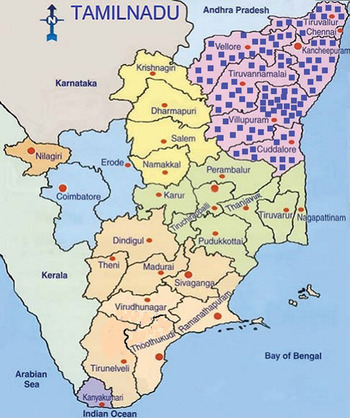
The home tracts of Madras Red sheep are Chennai, Tiruvallur, Kancheepuram, Villupuram districts and adjacent taluks of Vellore, Cuddalore and Thiruvannamalai districts of Tamil Nadu State (Figure 1). The present study was undertaken in 46 villages randomly selected from the above districts.
Breeding tract of Madras Red sheep (shown in blue dots).

Data recording
A total of 652 flocks consisting of 16 173 sheep were covered to collect various information related to current status of the breed during the period from 2006 to 2009. Information on the climate viz. temperature, rainfall, humidity, etc. was collected from the Meteorological Department of the state. The data on various sheep management practices viz. flock size, housing, feeding, breeding, disease, etc. were collected based on personal observation and information provided by the farmers. The morphometric measurements were recorded at the early hours of the day before feeding. The body weight and different body measurements namely horn length, ear length, tail length, height at withers, chest girth, body girth, flank girth, elbow-pin length and poll–tail length were taken according to Singh and Mathur (Reference Singh and Mathur1971) and the data collected from both sexes were analysed statistically (Harvey, Reference Harvey1990). The ages of the animals were determined based on the presence of teeth and information collected from the farmers.
Results and discussion
Native environment
This region is situated between 8°5″ and 13°2″ of northern latitude and 76.15° and 80.22° of eastern longitude. The geographical area of this region is 31 065 km2 equivalent to 24 percent of the state area. These areas have a predominance of red and black soils while alluvial soil is found in some areas of Kancheepuram district. The climate is semi-arid tropical with four distinct seasons. The average temperature ranges between 28.2–38.9 °C (Max) and 19.5–24.8 °C (Min). Maximum humidity (percent) is observed during the period from October to January. Annual rainfall varies from 80 to 140 cm.
Status of breed in its breeding tract
According to the 18th livestock and poultry census carried out by the Department of Animal Husbandry and Dairying, Government of India in 2007, the population of sheep in Tamil Nadu was 7 990 587, their percentage of increase over previous census was 29.90 and density in the state was 43 per km2.
Community responsible for the development of the breed
Naicker and Pillai are the two communities responsible for the development of the breed in the native tract of Kancheepuram and Thiruvallur districts. The Pillai communities are traditional farmers doing sheep farming for many generations in this tract. Most of them own medium-sized flocks and do agriculture and sheep rearing. Both communities belong to most-backward classes. Very few sheep farmers belong to scheduled caste.
Utility
Madras Red sheep is a meat-type breed. The meat is liked by the local people as much goat meat. The milk produced by these animals is just sufficient to maintain their lambs, therefore has no commercial value. The manure has a good value for agricultural purpose. It is a common practice to retain the flocks in the field during the nights for manuring. The skin of an adult sheep fetches Rs. 100–150.
Management practices
Feeding
In Kancheepuram, Thiruvallur, Villlupuram and Thiruvannamalai districts, the animals are mainly reared on extensive grazing as no fodder is cultivated separately for feeding the sheep. Animals are also fed with different fodder tree leaves. Major fodder trees available are Katuvagai (Albizia lebbek), Banyan (Ficus benghalensis), Arasan (Ficus religiosa), Subabul (Leucaena leucocephala), Gliricidia (Gliricidia maculata), Poovarasu (Thespesia populnea), Kalyana Murungai (Erythrina indica) and Kodukapuli (Inga dulce). Non-specific shrubs are found growing wildly. Cyperus L, Eichnocloa L and Para grass are major native grasses and dried ground nut haulms are given as feed to the sheep especially in the villages of Villupuram, Kancheepuram and Tiruvallur districts. For young lambs, suckling along with grazing is followed.
Housing
Housing is provided only at nights in all the villages of Kancheepuram, Thiruvallur, Villupuram and Thiruvannamalai districts. The partition is made with dried thorny bushes and ‘all open’ type housing is seen in the villages of Kancheepuram and Thiruvallur districts. ‘Half open’ type housing made of palm tree leaves is seen in a very few villages in Kancheepuram and Thiruvallur districts. In Villupuram and Thiruvannamalai districts, it is a common practice that the sheep are kept overnight in the fields for manuring purpose. The flock is kept for a week in the field and partition is provided by dried thorns tied with bamboo sticks.
Flock size
The average flock size varies from village to village and from farmer to farmer. The size varies from 20 to 50. Most of the farmers group their animals and rear them as a single flock for convenience in management and grazing. Only a few farmers have single flocks. However, Raman et al. (Reference Raman, Sundararaman, Haribhaskar and Ganesakale2003) reported an average flock size of 85 animals ranging from 9 to 315. The flock consists of mostly breeding ewes (44.2 percent) and breedable replacement females (29 percent). The rams and male lambs are seen only in limited number. Even for 100 breedable ewes only one ram is used. In some of the villages only one ram is used for different flocks. The male lambs are disposed from 6 months onwards. The females are disposed in 60 months of their age. All the young female lambs born are retained every year.
Breeding
The ram is retained in the flock all through the day. Natural service is the only method of mating practiced in all the villages. The breeding season is mainly seen from July to September after the onset of south-west monsoon and the availability of fresh green grass. Mostly 70–80 percent of the animals are covered during this season and the lambing season starts in January and ends in March. The second breeding season is not prominent since the availability of grass and pasture is very limited in this period.
Physical characteristics
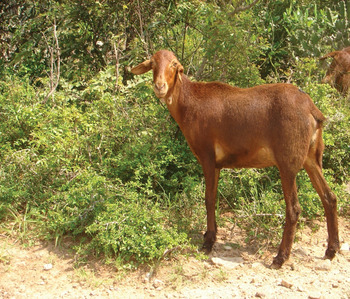
Most of the animals are red in colour. The intensity of colour varies from tan to dark brown. The survey revealed that 69 percent of the animals are in red, 19 percent in medium tan and 12 percent in dark tan. Some of them have white markings on the forehead, inner parts of thigh and lower abdomen. The head is straight in 97 percent of the animals and slightly convex in 3 percent. The rams have corrugated twisted horns. The data also revealed that 62 percent of the males have horns and 4 percent of the females are horned. In rams, the horns are medium sized and 15–25 cm long. In ewes, the horns are small and less than 15 cm. The ears are pendulous and 12–13 cm in length. The pendulous lobules called wattles are seen in 73 percent of the females and 69 percent of the males. The coat is hairy and never shorn. The tail is medium and 7–9 cm in length (Figures 2 and 3). The same was reported by Raman et al. (Reference Raman, Sundararaman, Haribhaskar and Ganesakale2003).
Madras Red ram.

Madras Red ewe.

Body weight
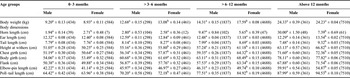
The data of body weights of different age groups are presented in Table 1. In the present study, the sex had a significant (P < 0.05) effect on the body weights of groups at 3–6 and 6–12 months of age; whereas no significant effect was observed for body weights of groups at 0–3 months and above 12 months of age. Raman et al. (Reference Raman, Sundararaman, Haribhaskar and Ganesakale2003) observed that the body weights were higher in males than females at 0–3 and 3–6 months of age, although not significant. However, a significantly higher weight in males than females was detected in animals of 12 months of age (Raman et al., Reference Raman, Sundararaman, Haribhaskar and Ganesakale2003).
Average (±s.e.) body measurements (cm) and body weight (kg) in Madras Red sheep.

The means bearing different superscripts under a particular age group differ significantly (P < 0.05).
Morphometric measurements
The morphometric measurements of Madras Red sheep such as horn length, ear length, tail length, height at withers, chest girth, body girth, flank length, elbow-to-pin length and poll-tail length are presented in Table 1. The sex had a significant (P < 0.05) effect on the horn, ear and tail lengths at above 12 months of age. In general, young lambs (0–3 months) were statistically similar for most of the morphometric traits. Significant differences were observed as the ages of animals advanced, indicating the variation in growth rate between male and female sheep. The body measurements at 0–3 and 3–6 months of age were higher than the values reported by Raman et al. (Reference Raman, Sundararaman, Haribhaskar and Ganesakale2003). The tail length and height at withers at 12 months of age were lower than the values observed by Raman et al. (Reference Raman, Sundararaman, Haribhaskar and Ganesakale2003).
Conclusions
The Madras Red sheep is medium sized, hairy sheep and well adapted to the local environmental conditions such as heat, cold, humidity, water scarcity and seasonal fluctuation in feed availability in terms of both quality and quantity as well as disease outbreaks. It shows excellent feed conversion efficiency under extreme conditions. The Madras Red sheep is preferred to the other breeds by local farmers because of their high dressing percentage (over 50 percent). The results of the present study also revealed that there is a scope for increasing the productivity of this breed.
Specific recommendations
Sheep farming forms a major source of livelihood for the farmers of the study area because of the increased demand for meat and low initial investments when compared with large animals. It attracts other marginal and landless farmers also to start a sheep farm. Even though the Madras Red sheep are generally maintained on grazing alone, their meat yield is as good as that of any other sheep breeds of the country. The non-availability of good quality fodder in the study area was the major constraint in the farming system, hence the farmers need to be educated on the importance of cultivating different fodder varieties for feeding sheep. The farmers are also to be trained on the scientific management practices such as de-worming, vaccination, castration, selection and breeding, etc. to increase the productivity of these sheep. Technical, extension and marketing support should be provided to the farmers so as to make sheep production a profitable enterprise for all sections of society irrespective of caste, creed, land holding, etc.
Acknowledgements
The authors thank ICAR, New Delhi and Project Co-ordinator (SB), Network Project on Sheep Improvement, CSWRI, Avikanagar for providing financial support for the study.