Current evidence from research on peer relations indicates that experiences with peers are implicated in the processes underlying development and psychopathology as risk and protective factors (Parker, Rubin, Erath, Wojslawowicz, & Buskirk, Reference Parker, Rubin, Erath, Wojslawowicz, Buskirk and Cicchetti2006; Rubin, Bukowski, & Parker, Reference Rubin, Bukowski, Parker, Damon and Eisenberg2006). Whereas some factors, such as being rejected or being isolated from peers, are known to be associated with subsequent indicators of maladjustment, such as depressed affect, other factors, such as being involved in a friendship relation, are known to minimize the negative effects associated with risk. Evidence that experiences with peers function as risk and protective factors has been taken typically from two-wave longitudinal studies (Bukowski, Brendgen, & Vitaro, Reference Bukowski, Brendgen, Vitaro, Grusec and Hastings2007). In these studies measures of peer relations at an initial time were used as either predictors or moderators of change in well-being across the one-wave interval. Although these studies have been valuable for providing evidence that peer relations are involved in the development of maladjustment, they have taken a relatively circumscribed approach to actual patterns of change. In the present study we assessed how a set of risk factors, specifically being isolated and excluded from the peer group, and a protective factor, specifically being friended, are associated with changes in levels of depressed affect across multiple time points during early adolescence. The concept of the developmental cascade was used in conjunction with the concepts of risk and protection to examine how different forms of withdrawal function together as antecedents of nonlinear trajectories of depressed affect during preadolescence. Specifically, we assessed whether social withdrawal put children at risk for cascading increases in depressed affect and whether friendship would alter this “snowballing” effect.
Longstanding claims that social withdrawal in childhood does not pose a risk for later adjustment difficulties (Kohlberg, LaCrosse, & Ricks, Reference Kohlberg, LaCrosse, Ricks and Wolman1972) are at odds with contemporary research indicating that withdrawn children are at risk for subsequent internalizing problems (Rubin, Coplan, & Bowker, Reference Rubin, Coplan and Bowker2009). The precise nature of the risks associated with withdrawal remains open to debate because patterns of adjustment and the processes whereby withdrawal influences adjustment trajectories remain unspecified. Direct effects models yield modest results, although effects are somewhat larger when withdrawal is paired with other risk factors (Hoza, Molina, Bukowski, & Sippola, 1996). Withdrawal denotes isolation from the group. Loneliness, sadness, and depressed affect are consequences, not just correlates, of peer group isolation (Rubin, Hymel, & Mills, Reference Rubin, Hymel and Mills1989). Research has recognized that withdrawal comes in two distinct forms (Bowker, Bukowski, Zargarpour, & Hoza 1996; Rubin & Mills, Reference Rubin and Mills1988; Younger & Daniels, Reference Younger and Daniels1992). In one form the child avoids peers, typically because the child is shy, prefers solitude, or is sensitive to negative interactions. In the other form, peers exclude the child, typically because the child is aggressive, immature, or has poor social skills. Several empirical studies using different approaches, including interview studies (Younger & Daniels, Reference Younger and Daniels1992) and confirmatory factor analyses (Bowker et al., 1996), have shown that avoidance and exclusion are distinct but interrelated constructs. Empirical studies have also shown that even at the earliest school-age years individual differences in avoidance and exclusion are stable over time and consistent across contexts (Coplan & Rubin, Reference Coplan and Rubin1998; Rubin, Reference Rubin, Rubin and Asendorf1993; Schneider, Richard, Younger, & Freeman, Reference Schneider, Richard, Younger and Freeman2000; Scheneider, Younger, Smith, & Freeman, Reference Schneider, Younger, Smith and Freeman1998). It is important to recognize that avoidance and exclusion are linked to different individual and social processes. Whereas avoidance derives from process within the individual, exclusion comes from social factors. That is, avoidance, more so than exclusion, comes from person-related factors, whereas exclusion, more so than avoidance, is related to group processes.
There are at least two compelling reasons why avoidance and exclusion need to be studied together as separate indicators of risk. The first reason is technical. In so far as measures of avoidance and withdrawal are correlated with each other, a precise index of the unique effects of each of these measures can be obtained only when the effects of the other have been accounted for in the same model. The second reason is substantive. Although avoidance and exclusion share a common property (i.e., being isolated from the group), they are linked to processes at different levels of social complexity (i.e., the level of the individual for avoidance and the level of the group for exclusion). Presumably each of these experiences presents its own form of risk. A potential for depressed affect is central to the concept of avoidance given the tendency for avoidant children to have a heightened sensitivity to negative experiences (Rubin et al., Reference Rubin, Coplan and Bowker2009). The risk for depressed affect associated with exclusion is likely to come from the lack of emotional provisions that are presumed to result from interactions with others (Baumeister & Leary, Reference Bowker, Bukowski, Zargarpour and Hoza1995; Furman & Robbins, 1984). Accordingly, the effects observed with each of these measures can be interpreted as indicating different underlying processes. Perhaps of more importance, the simultaneous consideration of both forms of isolation is important, as it provides an opportunity to assess the statistical interaction between them. It is reasonable to expect that the effects associated with avoidance will be strongest among children who are also excluded and lack the provisions associated with being a fully function participant in a group. In parallel, one can expect that the effects associated with exclusion will be strongest among children who are especially sensitive to negative experiences with peers.
In this study we apply a cascade model to outcomes associated with avoidance and exclusion. Developmental cascades are commonly used to describe a process whereby problems in one domain of functioning spread to other areas of functioning. Systems theory holds that developmental domains are interconnected in the sense that changes in one domain of functioning lead to changes in other domains of functioning, with cumulative effects that have long-term developmental consequences (Sameroff, Reference Sameroff and Kessen1983; Thelen, Reference Thelen, Gunnar and Thelen1989). The development of antisocial behavior is often used as an example of a cascade. In one model, inept parents have children with social skills deficits; their initial conduct problems spread to the domains of peer relations and school performance; these troubles elicit parental withdrawal, enabling affiliation with deviant peers, who ultimately promote violence and criminality (e.g., Dodge, Greenberg, Malone, & The Conduct Problems Prevention Research Group, Reference Dodge, Greenberg and Malone2008). Spreading cascades that encompass internalizing problems have also been suggested. Some models begin with disruptive behavior, which spreads to social and academic problems, prompting declines in self-esteem and increases in depressed affect (Capaldi, Reference Capaldi1992; Masten et al., Reference Masten, Roisman, Long, Burt, Obradovic and Riley2005).
Other types of cascade models have been proposed. One alternative describes rapid curvilinear increase in problems within a single domain. The snowball effect (Masten, Reference Masten2003) is a form of developmental cascade wherein initially modest adjustment difficulties follow a progressively accelerating trajectory, picking up considerable speed as the degree and extent of maladjustment becomes more pronounced. In much the same was as a snowball rapidly grows as it rolls down a hill, an adjustment problem is thought to amplify as it worsens. A basic feature of a snowballing cascade is the association between an initial characteristic leads to an escalating increase in outcome. In the present study, two forms of withdrawal are used as the predictors, and changes in depressed affect are used as the outcomes. Our goal was to determine whether a snowballing cascade of depressed affect was associated with initial levels of withdrawal.
Although their findings were not cast in terms of snowballing effects, Gazelle and Ladd (Reference Gazelle and Ladd2003) aptly demonstrated this process in a five-wave longitudinal study of internalizing among a group of children followed from kindergarten to Grade 4. Exclusion and avoidance were associated with a heightened depressed affect. The effects of exclusion and avoidance were both additive and interactive. In additive terms, depressive affect rose among children who were initially withdrawn and among children who were initially excluded. In interactive terms, kindergarten children who were both hesitant about associating with peers and actively excluded from the peer group displayed the greatest increases in a depressive affect during the early-grade school years. Many effects were nonlinear such that initial measures of withdrawal were associated with an escalating upward curve in depressed affect across the first 4 years of primary school. The effects snowballed as slight elevations in depressive affect rapidly grew to debilitating levels. Similar findings were seen in a recent study of the heterogeneity of withdrawn early adolescents (Oh, Rubin, Bowker, Booth-LaForce, Rose-Krasnor, & Laursen, 2007). Youth who show a trajectory of increasing withdrawal from Grades 5 through 8 were noteworthy for the frequency of their friendlessness, friendship instability, and peer exclusion.
These findings can be explained in terms of the concept of progressive risk. According to this view, avoidance and exclusion are related to depressed affect through different patterns of association. One presumed association is direct. Avoidance and exclusion foster concurrent and subsequent depressed affect because they deprive children of important experiences, as in the case of avoidance, or because they are forms of insult, as in the case of exclusion. A second presumed association is indirect. Avoidance and exclusion are associated with concurrent risk factors (e.g., friendless) that exacerbate the negative effects of avoidance or exclusion. A third presumed association is time dependent. Initial levels of avoidance and exclusion are associated with subsequent forms of risk that will increase the probability that the initial levels of depressed affect will continue or even increase. As these experiences accumulate the level of depressed affect would be expected to become increasingly higher.
Cascade models are usually tested in a regression or path analysis framework using longitudinal data. Spreading effects are demonstrated by indirect links between a variable measured at one time to another variable measured at subsequent point. For instance, withdrawal at the outset of the study may predict poor peer relations 1 year later, which in turn may predict depression the following year in a model that suggests that (a) shy children develop social problems and (b) children with social problems eventually become depressed. Individual differences are tested through the addition of interaction terms or moderated path models. Although illustrative, these models focus on associations between two consecutive time points; they do not capture trajectories of change over time. In the present study, we use a growth curve modeling approach to demonstrate snowballing effects. Our goal was to replicate and extend the Gazelle and Ladd (Reference Gazelle and Ladd2003) findings by demonstrating that initial avoidance and exclusion have developmental consequences beyond their concurrent and immediately subsequent associations with depressed affect. That is, we expected depressive affect would snowball over the early school years among young children who were initially avoidant of or excluded by their peers.
Unique to our inquiry is the notion that friendship moderates variations in the slopes of depressive affect trajectories, protecting children with friends from snowballing cascades. Our expectations were based on the presumed protective functions of friendship (Bukowski et al., 2006; Bukowski, Motzoi, & Meyer, Reference Bukowski, Motzoi, Meyer, Rubin, Bukowski and Laursen2008; Vitaro, Boivin, & Bukowski, 2008). According to theory (e.g., Sullivan, Reference Sullivan1953), friendship can protect at-risk children from negative affective outcomes. Empirical evidence supports the proposition that friends buffer adverse consequences of poor peer relations. The association between established risk conditions, such as being victimized or rejected by peers, and indices of affective distress has been shown to be weaker for children who are friended that for those who are friendless (Hodges, Boivin, Vitaro, & Bukowski, Reference Hodges, Boivin, Vitaro and Bukowski1999; Laursen, Bukowski, Nurmi, & Aunola, 2007). In the present study friendship was assumed to be a protective factor that enhances resilience in withdrawn children. Accelerating trajectories of depressed affect were expected for avoidant and withdrawn youth who were friendless at the outset of the study and who remained friendless over time. Because friendships provide a buffer against the development of internalizing problems among youth with poor peer relations, increases in sadness were not anticipated among young children with friends. Growth curve analyses will detail snowball effects, documenting unique trajectories of change among youth who are initially at risk for cascading sadness because of early peer difficulties and the failure to establish a close relationship with a friend.
Despite the well-established database regarding the effects of friendship (Vitaro et al., 2008) many basic questions about the effects of friendship on well-being remain unanswered (Bukowski & Sippola, 2005). One important but unanswered question concerns whether friendship is mostly a protective factor whose positive effects are seen only in conjunction with risk, or whether friendlessness constitutes a risk factor on its own. Although there is an abundance of evidence of the protective effects of friendship, less is known about whether friendlessness itself is a form of risk in the absence of other risk conditions. This issue is directly related to the significance of dyadic experience for adjustment. A second unanswered question concerns the longevity or endurance of the effects of friendship. It is not known whether the effects of friendship are seen only at the time when the friendship occurs or if the effect of having friends persists over time. There some evidence already that friendship effects can be longstanding (Hodges et al., Reference Hodges, Boivin, Vitaro and Bukowski1999; Kochenderfer-Ladd & Waldrop, Reference Kochenderfer-Ladd and Wardrop2001).
Two main hypotheses are addressed in this study. The first is that older school-age children who are withdrawn, especially those who are both avoidant and excluded at the outset of the study, are expected to show elevated levels of depressed affect at this time and are expected to show evidence that they are on an upward trajectory of depressed affect across the preadolescent years. In other words, avoidant and excluded school-age children are expected to be at risk for a cascading trajectory of depressed affect. The second hypothesis is that friendship will function as a protective factor that will reduce or eliminate the developmental cascade of depressed affect for avoidant and withdrawn children.
Methods
Participants
The participants were part of a three-wave longitudinal study that spanned 3 years of school. The first assessment took place took place in May near the end of the first school year. At this time the sample consisted of 130 girls and 101 boys in Grades 3, 4, and 5. Time 2 (T2) took place 7 months later, during early December of the second school year when the participants were in Grades 4, 5, and 6. At this time there were 130 girls and 105 boys in the sample, 94% of whom had also participated at T1. Time 3 (T3) took place in May of the third school year, 17 months after T2 and 24 months after T1. At this time there were 126 girls and 105 boys in the sample, 88% of whom had participated at T1 and 89% of whom had participated at T2. At each of the three assessments over 85% of the potential pool of participants took part in the study.
Measures and procedures
At each of the three assessments the participants completed the same two questionnaires that were components of the larger study. One was a sociometric assessment of friendship; the other was a peer assessment measure. In the sociometric questionnaire, the participants were shown a list of their participating same-sex classmates. From this list they chose the two peers whom they regarded as their first and second best friends. At each of the first two assessment times these sociometric data were used to determine whether at least one of the child's two friendship choices had been reciprocated as a first or second choice. These dichotomous indices of reciprocity were used as the T1 and T2 friendship measures. At T1, 67% of the participants were involved in mutual friendships; at T2 this percentage was 71%.
The other questionnaire was the peer assessment procedure known as the Revised Class Play (RCP; Masten, Morison, & Pellegrini, Reference Masten, Morison and Pellegrini1985). With this questionnaire, each participant is given a list of 30 roles in a hypothetical class play and is asked to indicate the participating same-sex peer and the participating other-sex peer in his/her classroom best fit each characteristics the best. Among the 30 items in the RCP, three were used as measures of exclusion (i.e., “Trouble making friends,” “Can't get others to listen,” and “Often left out”) and three were used as measures of avoidance (i.e., “Shy,” “Rather play alone than with others,” and “Feelings get hurt easily”). One item (“Sad”) was used as a measure of depressed affect.
Each child was assigned two scores on each of these seven items. One indicated the number of times he/she had been chosen for the item by his/her participating classroom same-sex peers, and the other indicated how often he/she had been chosen for the item by his/her participating other-sex peers. These scores were then used to create four aggregated scores. Two were measures of exclusion and two were measures of avoidance. Within each set there was a measure derived from the same-sex scores and a measure derived from the other-sex scores. These scores were then used to create cross-sex measures by simply adding the same- and other-sex measures together. With the T1 data, the internal consistency of the cross-sex avoidance and exclusion measures was very high (αs = 0.80 and 0.79, respectively). Considering that the peer assessment scores might be affected by the size of the nominating pool (i.e., higher scores may be more likely in larger classes), the number of participating same- and other-sex classroom peers was calculated. These values were used as covariates in the data analyses.
Plan of analysis
The analysis consisted of three steps, each with its own goal that built upon the previous step. Using the multilevel modeling program known as hierarchical linear modeling (Bryk & Raudenbush, Reference Bryk and Raudenbush1992), a two-level model was assessed. The goal of the Level 1 analyses was to estimate linear and curvilinear growth curves of depressed affect for each participant. These analyses determined whether some participants show a cascading trajectory of depressed affect (i.e., an increasingly rapid, nonlinear increase in sadness). Random (i.e., nonfixed) linear and curvilinear functions were expected. In this phase of the study the number of peers in the nominating pool was used as a covariate. This strategy was used to eliminate variations in the size of the dependent variable that were because of how many peers were available to choose a child for the sadness item in the peer assessment procedures.
The second step of the analysis took place at Level 2. Its goal was to assess whether variations in the linear and curvilinear functions observed at Level 1 were associated with individual differences in the measures of avoidance and exclusion. These analyses addressed the hypothesis that participants with cascading increases in depressed affect would have higher initial levels of avoidance and exclusion than the other participants. Positive associations between the Level 2 measures of avoidance and exclusion and the Level 1 coefficients for the linear and curvilinear effects of time on depressed affect were expected. Avoidant and excluded children were expected to demonstrate higher levels of depressed affect at T1 as indexed by the intercept of the growth curve.
The third step of the analysis addressed the hypothesis that participation in a mutual friendship at T1 and T2 would moderate the Level 2 effects of avoidance and exclusion on the intercept and on the linear and curvilinear components of the growth curves of depressed affect observed at Level 1. This was accomplished by using the T1 and T2 friendship scores as predictors of the random variability in the effects observed at Level 1.
Results
Estimating linear and curvilinear effects of time on depressed affect: Level 1 analyses
The dependent variables in the Level 1 analysis were the same- and other-sex scores on the measure of depressed affect at T1, T2, and T3. There were three predictors. They were the linear and the curvilinear indices of time and the measure of the size of the nominating pool (i.e., the number of same- and other-sex participating classmates). This latter score was used as a covariate; it was designated as a fixed effect. The linear index of time (T1 = 0, T2 = 7 months, and T3 = 24 months) and the curvilinear index of time (T1 = 0, T2 = 49 months, and T3 = 576 months) were entered as random effects.
The first analysis consisted of an unconditional model that included no predictors. It provided estimates of within-person and between-person variance needed to compute an intraclass correlation (ICC) for depressed affect (i.e., τ/[σ2 + τ]). The observed values were 0.833 for τ, 1.05 for σ2 and 0.44 for the ICC. The ICC indicates that 44% of the variance in the measures of depressed affect was between subjects and 56% of the variance in depressed affect was within subjects. The value for the intercept was 0.94.
Next, the covariate (i.e., the number of participating peers) was entered as a fixed effect centered around the grand mean. This measure had a small but statistically significant effect on the dependent variable (B = 0.078), t (1174) = 5.28, p < .001; change in initial σ2 = 2.2%. The value of the intercept observed in this model was .94.
The linear and curvilinear indices of time were then entered into the equation in an uncentered form as random effects. These effects were nonsignificant (ts < 1.4 and ps > .15). Nevertheless, as expected, they were observed to be “random.” That is, tests of whether these effects were fixed showed that they varied significantly across the participants: χ2 (195) = 376.35 for the linear effect and 396.67 for the curvilinear effect (both ps < .001). After these effects were entered into the equation the σ2 value was 0.71, indicating a reduction in unexplained within-person variance of 29%, and the intercept value was 0.89. Tests of randomness for the intercept were statistically significant, χ2 (195) = 953.29, p < .001. These findings suggest a cascading profile of depressed affect for some participants.
Associations between avoidance and exclusion at T1 and variations in the linear and curvilinear effects of time on depressed affect: Level 2 analyses
In the second set of analyses, the measures of avoidance and exclusion at T1 were used as Level 2 predictors of the variance in the linear and curvilinear effects of time on depressed affect observed at Level 1. The measures of avoidance and exclusion were entered as univariate effects and together as an interaction. These analyses assessed whether avoidance and exclusion at T1 predicted the time-related cascading increases in depressed affect.
The effects on the intercept were modeled first. Three significant effects were observed. Variability in the intercept was observed to be positively and significantly associated with the measures of avoidance, t (192) = 6.72, p < .001, and exclusion, t (192) = 4.39, p < .001, and with the interaction between them, t (192) = 3.45, p < .001. The observed coefficients for these effects were .38, .39, and .27, respectively. These findings show that participants who have high scores on avoidance and exclusion at T1 also tended to have high scores on the depressed affect at T1. These Level 2 predictors of the intercept decreased the value of τ (i.e., the between-person variance in the intercept) by more than 75%.
The next analyses assessed whether the measures of avoidance and exclusion and the interaction between them were related to variance in the linear and curvilinear effects of time on depressed affect. Statistically significant effects were observed for the association between the linear slope of time and both avoidance, t (192) = 3.45, p < .02, and exclusion, t (192) = 2.12, p < .03, but not for the interaction between them. Significant and positive associations were also observed between variability in the curvilinear effect and avoidance, t (192) = 3.13, p < .005, and exclusion, t (192) = 1.63, p < .05. The effect for the interaction between avoidance and exclusion was nonsignificant (p > .20).
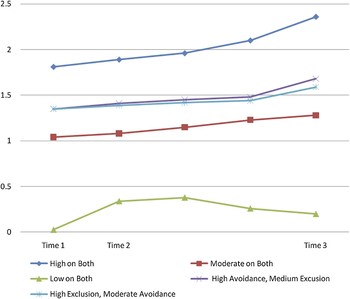
Figure 1 depicts these results for five conditions: children low (1 SD below the mean) on both avoidance and exclusion at T1, children average on both scores at T1, children high in avoidance but average in exclusion, children high in exclusion but average in avoidance, and children high (1 SD above the mean) on both scores. This figure illustrates the increasingly rapid increase in depressed affect for this third group. These findings confirm the hypothesis that avoidance and exclusion are concurrently associated with high levels of depressed affect and that cascading increases in depressed affect are characteristic of children who initially show elevated levels of avoidance and exclusion.
Growth curves on the measure of depressed affect as a function of avoidance and exclusion. [A color version of this figure can be viewed online at journals.cambridge.org/dpp]

Friendship as a moderator of the associations between avoidance and exclusion at T1 and the linear and curvilinear effects of depressed affect
The third set of analyses addressed the hypothesis that friendship status would moderate the Level 2 effects of avoidance and exclusion on the linear and curvilinear effects of depressed affect. These analyses were an extension of the previous phase of the analyses in two ways. First, further variables are added to the Level 2 model started in the previous step, and second, the newly added variables are used as moderators of the measures added previously. Specifically, the T1 and T2 friendship measures were added to the Level 2 model as (a) univariate predictors of the variance in the three Level 1 effects (i.e., the intercept and the linear and curvilinear effects of time on the measure of depressed affect), and (b) as moderators of Level 2 measures of avoidance and exclusion and the interaction between them. T1 friendship was negatively correlated with the Level 1 intercept, t (191) = −1.62, p < .05. Compared with friendless children, friended children at T1 had lower scores on the measure of depressed affect. No other main effects of friendship were observed.
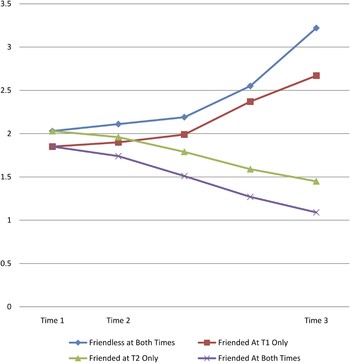
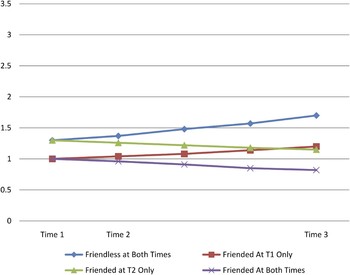
The friendship measures were, however, involved in two interactions. The T1 friendship score was involved in a three-way interaction with avoidance and exclusion as a predictor of the linear effect of time on depressed affect observed at Level 1, t (189) = −2.48, p < .01. The T2 friendship score was involved in a two-way interaction with avoidance as a predictor of the curvilinear effect of time on depressed affect, t (192) = −1.64, p < .05. The pattern of findings underlying these interactions is shown in Figure 2. Given that our main concern is with the participants who showed the strongest evidence of the cascade pattern, this figure shows the growth trajectories when scores on avoidance and exclusion were high (i.e., 1 SD above the mean on both scores). Four trajectories are shown. They are for individuals who were high in both avoidance and exclusion and were friended at both T1 and T2, friendless at both times, friended at T1 and friendless at T2, or friendless at T2 but not at T1. This figure shows that the steepest cascade pattern is show by the participants who were friendless at both times. In contrast, the effects of friendship were substantially smaller for children who had moderate scores on avoidance and exclusion at T1. One can see in Figure 3 that the differences between the friended and unfriended children were much less pronounced in the children who had moderate score on avoidance and exclusion at T1 than among children whose had high scores on these measures at T1 (as illustrated in Figure 2).
Growth curves on the measure of depressed affect as a function of friendship status at Time 1 (T1) and at Time 2 (T2) for participants who had high scores on the measures of avoidance and exclusion at T1. [A color version of this figure can be viewed online at journals.cambridge.org/dpp]

Growth curves on the measure of depressed affect as a function of friendship status at Time 1 (T1) and at Time 2 (T2) for participants who had moderate on the measures of avoidance and exclusion at T1. [A color version of this figure can be viewed online at journals.cambridge.org/dpp]

Discussion
Withdrawal and friendship are two basic features of children's relations with peers that have been associated with depressed affect (Rubin et al., 2006, Reference Rubin, Coplan and Bowker2009). In both theoretical and empirical accounts of the factors related to individual differences in measures of depressed affect there is evidence that friendlessness and forms of withdrawal put children at risk for elevated levels of sadness (Bukowski et al., Reference Bukowski, Brendgen, Vitaro, Grusec and Hastings2007; Parker & Asher, Reference Parker and Asher1987; Parker et al., Reference Parker, Rubin, Erath, Wojslawowicz, Buskirk and Cicchetti2006). Attempts at trying to understand how these constructs are related to outcomes have taken several forms, many of them involving longitudinal data (Bukowski et al., Reference Bukowski, Brendgen, Vitaro, Grusec and Hastings2007). In the current study, we used a variant of the longitudinal model known as the cascade approach to assess how the consequences of being withdrawn from peers unfold over time and of how friendship relations alter these cross-time trajectories. The particular form of the cascade that we studied can be likened to a snowball. We proposed that the level of depressed affect that follows from the experience of being avoidant and excluded from the group would increase over time at an accelerating rate. That is, we expected that the way children who are withdrawn from their peers were regarded as being an at-risk factor for an escalating trajectory of depressed affect. It was also predicted that participation in a friendship would moderate these trajectories. Specifically, we anticipated that snowballing increases in depressed affect would be seen among friendless children who were both excluded and avoidant.
Our findings were consistent with these expectations. Children who were avoidant and excluded during the first year of the study had the highest levels of concurrent depressed affect. These children showed increasingly high levels of depressed affect across the 24 months of the study. The strength and shape of this escalating trajectory, however, was moderated by friendship. Friendless children at T1 showed elevated levels of depressed affect especially if they were avoidant and excluded by peers. Of more importance, friendedness at T1 and at T2 were observed to moderate the trajectories of depressed affect shown by withdrawn children. Children who were friended at T1 showed less evidence of a linear increase in depressed affect associated with being withdrawn, whereas children who were friended at T2 showed less evidence of the curvilinear increase associated with withdrawal. These findings indicate that children who avoid engagement with peers and who are excluded from the peer group are at risk for escalating increases in depressed affect, but that these risks are minimized by participation in a friendship.
These findings point to the fundamental value of using a cascade approach to understand the short- and long-term effects of experiences with peers. In doing so, they extend the results of two prior studies. In particular, they reinforce the value of using an approach that treats the outcome measure as a dynamic process rather than as a static condition. Gazelle and Ladd (Reference Gazelle and Ladd2003) previously used this approach to show the affective repercussions of withdrawal during the early school age years. This use of a process-oriented approach shows clearly that the consequences of peer experiences go beyond their immediate effects. Being withdrawn from peers in the later school-age years appears to have immediate effects on a child's level of sadness and, perhaps of more importance, puts the child on a trajectory of increasingly high levels of depressed affect. This pattern of findings shows that withdrawal can have consequences that extend beyond the near term.
These findings also extend the findings reported by Laursen et al. (Reference Laursen, Bukowski, Nurmi and Aunola2007). They showed that friendship alters developmental trajectories associated with negative experiences. There were cross-time effects for negative peer experiences on internalizing and externalizing among children without friends, but there were no links between peer exclusion and adjustment problems among children with friends. The present findings replicate this pattern using a different set of constructs and an older age group. In the present study, as in the previous study, friendship was observed to moderate a cascade pattern by minimizing the negative trajectories associated with a type of peer experience. These findings show that friendship alters developmental trajectories minimizing the negative consequences arising from being withdrawn from peers. Similar findings indicating that friendship can disrupt trajectories of negative affect have been observed in studies of victimization. Studies conducted by Kochenderfer-Ladd and Waldrop (Reference Kochenderfer-Ladd and Wardrop2001) and by Hodges et al. (Reference Hodges, Boivin, Vitaro and Bukowski1999) have shown that friendship alters the long-term consequences of being victimized by peers. Overall, these findings point to the value of friendship as an experience that disrupts negative developmental trajectories.
Theory about friendship has treated this form of dyadic experience according to three concepts that form the cornerstones of the approach known as development and psychopathology, specifically risk, protection, and resilience (Bukowski et al., 2007; Bukowski & Sippola, Reference Bukowski, Sippola and Jensen2005). The present findings show evidence for each of these functions. In regard to risk, friendless children showed higher levels of depressed affect at T1. This elevated level is indicated by the higher score on the intercept of the growth curve for friendless children. Evidence of the protective effects of friendship is seen in its moderation of the association between avoidance and exclusion and the linear and curvilinear component of the growth curve. Friendship protects at risk children (i.e., in this case, children who are avoidant and excluded) from the negative consequences of their experiences. Expressed in an alternative way, friendship promotes resilience as it helps children depart from a trajectory of increasingly high levels of depressed affect.
A central premise of the study of development and psychopathology is the necessity of taking a dynamic process-oriented approach. These findings show the value of this perspective. Outcomes associated with peer experiences are not static but instead unfold over time. These effects are dynamic in two critical respects. First, the long-term effects of withdrawal become increasingly negative rather than remaining constant or disappearing. The long-term effects are enduringly negative. Second, this enduring pattern is not invariant. It varies as a function of current and subsequent experience. Concurrently, its effects are worsened by friendlessness and mitigated by friendedness. Of much or more importance, the long-term negative consequences of withdrawal are less enduring among children who are friended at a later time. Friendship disrupts the negative long-term dynamics associated with withdrawal. These findings point to the fundamental necessity of examining how types of peer experience function together in dynamic ways to affect outcomes over time.
No study is without limitations, and the present study is no exception. The use of a more comprehensive index of internalizing may yield stronger findings than what we found with our single-item nomination measure of depressed affect. Endogenous factors such as difficult personality characteristics may be confounded with peer experiences eliciting exclusion or promoting withdrawal (Laurse, Hafen, Rubin, Booth-LaForce, & Rose Krasnor, Reference Laursen, Hafen, Rubin, Booth-LaForce and Rose Krasnor2010). The staggered cohort design makes it difficult for variations in developmental timing. Three time points are the minimum needed to identify nonlinear growth curves. An ideal study might include a larger number of assessment times that are scheduled more closely together. Finally, the trajectories may represent the effects of subsequent experiences of avoidance and exclusion. Identifying these effects would promote out understanding of how these variables are associated with trajectories of negative affect.
Conclusion
In conclusion, the concept of the cascade was used to study the effects of avoidance and exclusion among older school-age children. Our findings showed that these children were at risk for a snowball pattern of escalating levels of depressed affect. Over time, avoidant and excluded children showed increasing high levels of sadness. Friendship was shown to be a risk and a protective factor. It was a risk factor in the sense that friendlessness was associated with elevated levels of depressed affect. The protective effect of friendship is seen in the moderating effects of friendedness on the snowballing trajectory of depressed affect for avoidant and withdrawn children. Together these findings point to the value of using a cascade model especially in conjunction with measures of friendship.