The diaphragm is the main muscle used for inspiration in infants and the strongest muscle of the respiratory system. It is responsible for 75% of normal breathing effort.Reference Berne and Levy 1 Unilateral diaphragmatic dysfunction compromises pulmonary function by about 25% in older children.Reference Talwar, Agarwala, Mittal, Choudhary and Airan 2 Bilateral diaphragmatic dysfunction can reduce respiratory function by up to 60%, resulting in failure to wean from ventilatory support and increases the chances of pneumonia, atelectasis, and lung collapse.Reference Talwar, Agarwala, Mittal, Choudhary and Airan 2
Cardiothoracic surgical procedures adjacent to the phrenic nerve are the most common causes of diaphragmatic dysfunction in children with a reported incidence rate ranging from 0.3 to 12.8%.Reference Sanchez de Toledo, Munoz and Landsittel 3 In general, phrenic nerve injury may manifest as a mild, non-significant weakness with no respiratory embarrassment or as complete diaphragm paralysis with paradoxical movement that compromises lung function. Owing to higher dependency on diaphragmatic function for respiration, children, particularly neonates and infants, are affected by diaphragmatic dysfunction more than adults, which results in increased morbidity and mortality related to phrenic nerve injury following paediatric cardiac surgery.Reference Sanchez de Toledo, Munoz and Landsittel 3 – Reference VanOnna, Metz, Jekel, Wooley and van de Wal 5
There are different tools that can help assess and diagnose diaphragmatic dysfunction. These include radiological imaging, fluoroscopic examination, and nerve conduction study.Reference Mok, Ross-Russell, Mulvey, Green and Shinebourne 6 A simple bedside tool that can be used by a trained intensivist is ultrasound assessment using two dimensional and M-mode. Ultrasonography has several advantages such as being simple, quick and safe and it does not expose patients to radiation or need for mobilisation.
The purpose of our retrospective cohort study was to evaluate our centre’s experience in utilising bedside ultrasound assessment of the diaphragm, performed by a paediatric cardiac ICU intensivist, for the diagnosis and management of diaphragmatic dysfunction.
Materials and methods
After obtaining approval from the Institutional Research Board of our hospital, we performed a retrospective analysis of all children admitted during 2013 to the paediatric cardiac ICU after cardiac surgery at King AbdulAziz Medical City, Riyadh, Saudi Arabia.
Inclusion criteria
Ultrasound of the diaphragm was requested for all patients with either one of the following three criteria:
-
∙ Difficulties in weaning from invasive or non-invasive positive pressure ventilation as per clinical symptoms and signs of intolerance, such as diaphoresis or increased respiratory work or presence of ineffective gas exchange reflected on arterial blood gas – decreased SpO2, hypoxaemia, and respiratory acidosis.
-
∙ Any patient needing re-intubation within 24 hours after a trial of extubation after surgery.
-
∙ Abnormal elevation of the diaphragm on serial chest X-rays in the absence of abdominal distension and/or atelectasis.
All the patients had normal diaphragm position preoperatively on chest X-ray, and any patient with previously diagnosed diaphragmatic dysfunction was excluded. The initial diaphragm screening was performed by a trained paediatric cardiac ICU intensivist and subsequently verified by expert radiologists. Diaphragm ultrasound training of a new intensivist or fellow was achieved by attending a 2-day intensive ultrasound course and practical sessions on the basic functions of ultrasound and its role in paediatric and neonatal critical-care medicine. This was followed by performing a minimum of 10 bedside-focussed ultrasound examinations of the diaphragm under supervision of an expert senior intensivist and radiologist technician until achieving satisfactory competency in performing and analysing bedside-focussed ultrasound of the diaphragm in children. All frozen images and loops were analysed and verified independently by expert radiologists in the field through picture archiving and communication system to qualify the intensivist to perform diaphragm ultrasound.
Description of two-dimensional-mode and M-mode ultrasound technique
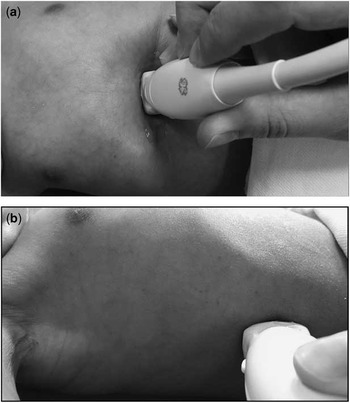
We used a General Electric ultrasound machine (General Electric Healthcare 9900 Innovation Drive Wauwatosa, WI, USA; Model Vivid-q, 2012). As most of the included population comprised of infants, we used a high-frequency transducer (8c) curvilinear probe with a frequency of 8–12 MHz. Depth was adjusted to get optimal image size (5–9 cm) with an average of three respiratory cycles. Patients were scanned in the supine position during quiet spontaneous breathing, and positive pressure respiratory support was temporarily interrupted during the examination (Figs 1–3).
Picture illustrating probe position and orientation in 45-days infant with tetralogy of Fallot and suspected diaphragm dysfunction. ( a ) Sub-xiphoid window with probe marker directed to the 9 o’clock position to obtain comparative imaging. ( b ) Sagittal plane with the probe marker directed to the 12 o’clock position in the mid-axillary line.

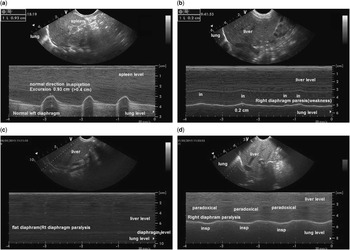
Classification of diaphragm function by M-mode ultrasound with the probe in mid-auxiliary line views: ( a ) Normal left diaphragm movement: upward motion on the M-mode tracing with amplitude more than 4 mm during inspiration. Excursion measurement is taken between the end of expiration and the peak of inspiration. ( b ) Right diaphragm paresis: normal direction towards the transducer, but the excursion is decreased (<4 mm). ( c ) Right diaphragm paralysis: absent motion (flat M-mode tracing). ( d ) Right diaphragm paralysis: paradoxical inspiratory motion.

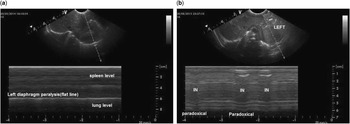
Left diaphragm paralysis, an oblique transverse plane in the sub-xiphoid window. ( a ) Absent motion. ( b ) Paradoxical inspiratory motion.

Standard frozen images and live loops were taken in two main views:
-
∙ An oblique transverse plane in the sub-xiphoid window with the probe marker directed to the 9 o’clock position to obtain comparative imaging between right and left sides simultaneously (Figs 1 and 3).
-
∙ Sagittal plane by placing the transducer perpendicular to the chest wall, with the probe marker directed to the 12 o’clock position in the eighth or ninth intercostal space, between the anterior and mid-axillary linesReference Epelman, Navarro, Daneman and Miller 7 , Reference Urvoas, Pariente, Fausser, Lipsich, Taleb and Devictor 8 (Figs 1 and 2).
During inspiration, the normal diaphragm moves in the two dimensional caudally towards the legs of the patient, resulting in upstroke of the M-mode tracing. We analysed two parameters during screenings – namely, direction of motion and the amplitude of excursion (Figs 2 and 3).
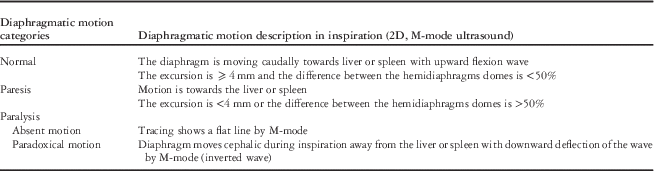
Diaphragmatic dysfunction indicates either paresis or paralysis. Motion of the diaphragm is classified into one of the following descriptions: normal; paresis, decreased or weakness; or paralysis, absent motion or paradoxical motion, as described in Table 1.Reference VanOnna, Metz, Jekel, Wooley and van de Wal 5
Classification of diaphragmatic motion; absent motion and paradoxical motion indicate diaphragmatic paralysis.

2D=two dimensional
Results
Out of 344 patients admitted to the cardiac ICU after paediatric cardiac surgery, 32 cases fulfilled inclusion criteria for bedside ultrasound screening of the diaphragm. Their mean age and weight were 9.7±3.2 months and 5.3±0.7 kg, respectively.
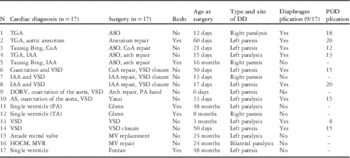
After ultrasound screening of 32 patients, 17 were diagnosed to have diaphragmatic dysfunction with an incidence rate of 4.9% in our postoperative surgical cases. All patients who had diaphragmatic dysfunction were under 4 years of age with an average age and weight of 10.8±3.8 months and 6±1 kg, respectively. Their characteristics and surgical procedures performed are shown in Table 2. In all, 12 cases (70.6%) were after primary sternotomy and five cases (29.4%) were after redo sternotomy. Among these 17 patients, 10 (59%) had diaphragm paresis and seven (41%) had diaphragm paralysis. In the paresis group, three (17.6%) had right and seven (41.2%) had left diaphragm paresis. In the paralysis group, one (5.9%) had bilateral, one (5.9%) had right, and five (29.4%) had left diaphragm paralysis (Table 2). Left-sided diaphragmatic dysfunction was predominant in 12/17 patients (70.5%). The radiologist and the trained intensivist had similar interpretation of the diaphragm function – normal, paresis, or paralysis – in 29/32 cases; however, there were minor disparities in classifying the severity of dysfunction – paresis versus paralysis – in 3/32 cases that affected neither the diagnosis nor the management of diaphragm dysfunction.
The characteristics and surgical procedures for 17 patients with diaphragmatic dysfunction (DD).

ASO = artertial switch operation; AS=aortic stenosis; CoA=coarctation of the aorta; DORV=double-outlet right ventricle; HOCM=hypertrophic obstructive cardiomyopathy; IAA=interrupted aortic arch; MVR=mitral valve regurgitation; N=number; PA=pulmonary atresia; POD=postoperative day; Redo=redo sternotomy; TA=tricuspid atresia; TGA = transposition of great arteries; VSD=ventricular septal defect
From these 17 patients, nine cases (53%) received diaphragm plication with an incidence rate of 2.6% (9/344) in the whole postoperative population. All of them were below the age of 4 months with mean age and weight of 1.8±0.3 months and 3±0.1 kg, respectively. There was a statistically significant difference between these nine cases requiring plication in comparison with the eight cases that did not require plication with regard to their age and weight (p<0.001). The average time for plication operation was 15.1±1.3 days (range 8–20) postoperatively. All plicated patients were weaned from positive pressure ventilation – invasive or non-invasive – with an average of 9.7±3 days. After diaphragm plication, they were discharged with mean paediatric cardiac ICU and hospital stay of 19±3.5 and 42±8 days, respectively.
Discussion
Diaphragmatic dysfunction after cardiac surgery is caused by injury to the phrenic nerve, which could be related to cold liquids injected near the nerve or direct injury related to dissection or cauterisation during cardiac surgery.Reference Epelman, Navarro, Daneman and Miller 7 Diaphragmatic dysfunction can be asymptomatic or symptomatic leading to significant respiratory embarrassment such as atelectasis, recurrent pneumonia, oxygen dependency, or respiratory failure.Reference Joho-Arreola, Bauersfeld, Stauffer, Baenziger and Bernet 4 , Reference Epelman, Navarro, Daneman and Miller 7 Surgical plication of the affected hemidiaphragm, when indicated, can help optimise lung function, reclaim functional residual capacity, and reduce the duration of positive pressure ventilation.Reference Joho-Arreola, Bauersfeld, Stauffer, Baenziger and Bernet 4 , Reference Epelman, Navarro, Daneman and Miller 7
In our retrospective analysis, the 4.9% incidence of symptomatic diaphragmatic dysfunction after paediatric cardiac surgery was similar to other reported retrospective studies that showed an incidence rate of 0.3–5.7%. Some prospective studies reported higher incidence rates, reaching up to 12.8%, indicating the presence of undiagnosed patients or missed diagnosis.Reference Sanchez de Toledo, Munoz and Landsittel 3 , Reference Joho-Arreola, Bauersfeld, Stauffer, Baenziger and Bernet 4 The highest incidence of diaphragm plication in our study was seen after arterial switch operation and aortic arch repair (Table 2) and is in agreement with some previously reported studies.Reference Joho-Arreola, Bauersfeld, Stauffer, Baenziger and Bernet 4 – Reference Mok, Ross-Russell, Mulvey, Green and Shinebourne 6 Others have reported a higher incidence of phrenic nerve injuries after systemic-to-pulmonary shunt or Fontan surgeries.Reference Joho-Arreola, Bauersfeld, Stauffer, Baenziger and Bernet 4 , Reference Kunovsky, Gibson, Pollock, Stejskal, Houston and Jamieson 9 We observed that all patients who had diaphragmatic dysfunction were under 4 years of age, but diaphragm plication was only clinically indicated in infants under 4 months of age and below 4 kg with statistically significant difference in comparison with those who did not receive plication. Our findings are similar to previously published reports.Reference Joho-Arreola, Bauersfeld, Stauffer, Baenziger and Bernet 4 , Reference VanOnna, Metz, Jekel, Wooley and van de Wal 5 This can be explained by the fact that older children have lower diaphragm dome, and thus they can compensate for diaphragmatic dysfunction much better than younger infants and neonates.Reference Sanchez de Toledo, Munoz and Landsittel 3 , Reference Joho-Arreola, Bauersfeld, Stauffer, Baenziger and Bernet 4
In addition, one of the reported risk factors for diaphragmatic dysfunction after paediatric cardiac surgery is redo sternotomy.Reference Joho-Arreola, Bauersfeld, Stauffer, Baenziger and Bernet 4 In our cases, 29.4% of our patients had redo sternotomy, which is comparable with reported results in the literature of 9–49%.Reference Joho-Arreola, Bauersfeld, Stauffer, Baenziger and Bernet 4 It is well known that redo surgeries increase the risk of the phrenic nerve injury during dissection of adhesions related to previous surgery.
Normal chest radiographs cannot rule out or prove diaphragmatic dysfunction and are considered to be poor predictors of abnormal diaphragmatic motion, particularly in intubated patients with positive pressure ventilation.Reference Epelman, Navarro, Daneman and Miller 7 Although a chest radiograph might show elevation of the affected hemidiaphragm, this is not a pathognomonic sign due to the wide normal range of hemidiaphragm position.Reference Chetta, Rehman, Moxham and Denis 10 Epelman et alReference Epelman, Navarro, Daneman and Miller 7 found in their study of 278 children after cardiothoracic intervention that the sensitivity of plain chest X-ray is low at 34.4%, whereas its specificity was 86.3%.
Owing to the increasing use of ultrasound in critical-care settings, bedside diaphragm ultrasound emerges as a simple, practical, non-invasive method for quantifying diaphragmatic movement in a variety of pathological conditions that can be diagnosed effectively by intensivists. It has been demonstrated to be a safe and practical bedside tool that allows visualisation of the diaphragmatic movement and assessment of different parameters such as amplitude, strength, velocity of contraction, special patterns of motion, and changes in diaphragmatic thickness during inspiration.Reference Matamis, Soilemezi and Tsagourias 11
Traditionally, assessment of diaphragmatic motion has relied on fluoroscopic evaluation in many places.Reference Epelman, Navarro, Daneman and Miller 7 Ultrasonography has advantages over traditional fluoroscopy that include portability, lack of ionising radiation, visualisation of thoracic structures, and the ability to quantify diaphragmatic motion.Reference Sanchez de Toledo, Munoz and Landsittel 3 , Reference Epelman, Navarro, Daneman and Miller 7 , Reference Gerscovich, Cronan, McGahan, Jain, Jones and McDonald 12 Several studies have actually demonstrated its diagnostic superiority over fluoroscopy when performed at the bedside.Reference Sanchez de Toledo, Munoz and Landsittel 3 , Reference Epelman, Navarro, Daneman and Miller 7 , Reference Gerscovich, Cronan, McGahan, Jain, Jones and McDonald 12 The use of bedside diaphragm ultrasound was established in our paediatric cardiac ICU in 2009, and since 2012 bedside diaphragm ultrasound has replaced fluoroscopy in diagnosing diaphragmatic dysfunction and for making decisions regarding plication after paediatric cardiac surgery. In terms of establishing diagnosis and grading the severity, the level of agreement between our trained intensivists and radiologists was good with similar interpretation of the diaphragm function – that is, normal, paresis, or paralysis – in 29/32 cases versus minor disparities in classifying the severity of dysfunction – paresis versus paralysis – in 3/32 cases. In these three cases with disparities, intensivists considered a flat line by M-mode, whereas radiologist appreciated excursion of +1 mm, which changed the classification of diaphragm dysfunction from paralysis to paresis but did not affect the diagnosis or the management of diaphragm dysfunction.
The use of M-mode ultrasound allows longitudinal follow-up studies of diaphragmatic excursion, which can help in assessing objectively the strength of the diaphragmatic muscle and the degree of dysfunction or recovery, as well as future prognosis.Reference Epelman, Navarro, Daneman and Miller 7
Surgical plication is the recommended treatment for significant diaphragmatic dysfunction, especially in children under 1 year of age; however, there is still controversy on its best timing. Some authors recommended that plication should be performed as soon as the diagnosis has been established.Reference Talwar, Agarwala, Mittal, Choudhary and Airan 2 Others recommended a waiting period of 1–6 weeks in anticipation of potential spontaneous recovery.Reference Talwar, Agarwala, Mittal, Choudhary and Airan 2 – Reference VanOnna, Metz, Jekel, Wooley and van de Wal 5 The decision-making process to proceed with diaphragmatic plication takes into consideration many factors such as age, weight, type of associated cardiac disease, respiratory muscle strength of the patient, and duration of assisted ventilation.
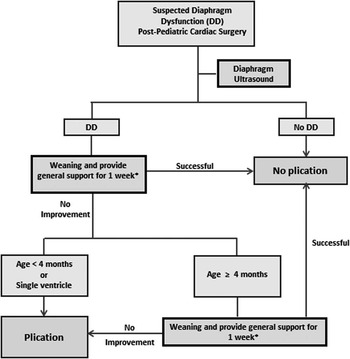
On the basis of our findings regarding age at plication supported by some previous reports, we guided our management with an algorithm to help decision making for such conditions (Fig 4). The decision for plication was reached based on clinical assessment and included cases with paralysis and paresis of the diaphragm.
Algorithm for ultrasound-enhanced management of diaphragmatic dysfunction (DD) after paediatric cardiac surgery. *Diaphragm ultrasound will be repeated at the end of the weekly weaning trial from positive pressure respiratory support to confirm DD.

Our study has several limitations including the possibility that we missed some cases with subclinical diaphragmatic dysfunction. Our study is also limited by the fact that it is a retrospective, single-centre experience that reflects local experience with the need to verify its results by other institutional experiences. It is also confined to the paediatric cardiac surgery population. Nevertheless, the present study highlights the importance and emerging role of bedside ultrasound for intensivist for early diagnosis and management of diaphragmatic dysfunction related to phrenic nerve injury after paediatric cardiac surgery.
Conclusions
Bedside critical-care ultrasound of the diaphragm can be performed by a trained cardiac ICU fellow or attending under the supervision of a radiologist, to diagnose diaphragmatic dysfunction after paediatric cardiac surgery and may guide further clinical and surgical management. The majority of cases with diaphragmatic dysfunction who received diaphragm plication were young infants <4 months of age. Further study of incorporating bedside ultrasound in the proposed decision-making algorithm may help in the management of diaphragmatic dysfunction after paediatric cardiac surgery with potential positive effects such as decreased hospitalisation, morbidity, and improved outcomes.
Acknowledgements
This manuscript describes novel work and is not under consideration for publication/published by any other journal. All the author(s) have approved the manuscript and this submission.
Financial Support
This research received no specific grant from any funding agency or commercial or not-for-profit sectors.
Conflicts of Interest
None.
Ethical Standards
The manuscript was completed according to good clinical practice and approved by Institutional Research Board (IRB).