1. Introduction
Since its initial approval in 1982, isotretinoin (frequently distributed under the name Accutane) has provided a unique ability to treat a variety of acne conditions and reliably prevent their reoccurrence (Goldsmith et al., Reference Goldsmith, Bolognia, Callen, Chen, Feldman, Lim, Lucky, Reed, Siegfried, Thiboutot and Wheeland2004). Isotretinoin has been described as one of ‘the greatest breakthroughs in acne treatment over the last 20 years’ (Meadows, Reference Meadows2001: 19) and a ‘miracle medicine’ (Mobacken et al., Reference Mobacken, Sundström and Vahlquist2014: 93) for those with severe acne. This effectiveness resulted in frequent prescription such that over five million patients used isotretinoin from 1982–2000 (Doshi, Reference Doshi2007).
While potentially very beneficial, isotretinoin can also cause harm to fetal development if a female patient becomes pregnant while using it (Aguilar et al., Reference Aguilar, Louis, Hicks, Zage and Russell2014; Zomerdijk et al., Reference Zomerdijk, Ruiter, Houweling, Herings, Sturkenboom, Strauss and Stricker2014). Fetal exposure to isotretinoin can lead to severe physical birth defects including deformation of the ears and heart, cleft palate, and heart defects (Robertson et al., Reference Robertson, Polifka, Avner, Chambers, Delevan, Koren, Lavigne, Martinez, Martinez, Miller and Carey2005). Exposure is also associated with learning disabilities (Adams and Lammer, Reference Adams and Lammer1991).
Isotretinoin is unique in that it has been both privately and publicly regulated in the US. Since 1987, three risk-management programs have been created to govern the prescription and use of isotretinoin to prevent patients from becoming pregnant and patients using isotretinoin while pregnant.Footnote 1 A risk-management program consists of various rules, policies, or guidelines to mitigate undesirable outcomes of a beneficial, although risky, an action which requires both creation and enforcement from a governing body. These programs in chronological order are the Accutane Pregnancy Prevention Program (1987–1999), the System to Manage Accutane Related Teratogenicity (2001–2004), and iPLEDGE (2006–present).Footnote 2
The first risk-management program for isotretinoin was created and developed by Hoffman–LaRoche which manufactured Accutane from 1982–2010 (Schonfeld et al., Reference Schonfeld, Amoura and Kratochvil2009).Footnote 3 The Accutane Pregnancy Prevention Program occupies a unique position in US medical regulation in that it was ‘the first risk-management program introduced by a pharmaceutical company’ (FDA: 2). Hoffman–LaRoche also enforced its program without the FDA, using only voluntary participation from physicians and patients (Mitchell et al., Reference Mitchell, Van Bennekom and Louik1995). Contrarily, the System to Manage Accutane Related Teratogenicity and iPLEDGE were implemented and designed by the FDA which, in addition to building on the rules implemented under the first risk-management program, increased requirements for physicians to prescribe isotretinoin and for patients to receive and continue treatment.
The medical literature on isotretinoin has focused on the effects of single risk-management programs without comparing them to the other programs regarding how effectively they prevent pregnancies and educated patients.Footnote 4 A comparison between the programs provides a rare opportunity to compare private and public regulation within the pharmaceutical market directly. The economics literature largely uses a comparative-institutional approach when comparing private and public governance (Leeson, Reference Leeson2007, Reference Leeson2011; Leeson and Coyne, Reference Leeson and Coyne2012). Assessing which risk-management program was best able to prevent pregnancies and educate patients extends the comparative-institutional analysis framework into a previously unexamined component of healthcare.
Despite the absence of cross-program comparisons, the medical literature frequently implies because the private program was supplanted it was ‘shown to be ineffective’ (Shin et al., Reference Shin, Cheetham, Wong, Nui, Kass, Yoshinaga, Sorel, McCombs and Sidney2011: 1118). Furthermore, much of the medical literature alleges replacing the private program with a more stringent publically managed program was necessary (Shin et al. Reference Shin, Cheetham, Wong, Nui, Kass, Yoshinaga, Sorel, McCombs and Sidney2011: 1118; Doshi, Reference Doshi2007: 638; Schonfeld et al., Reference Schonfeld, Amoura and Kratochvil2009: 106; Pinheiro et al., Reference Pinhero, Kang, Kim, Governale, Zhou and Hammad2013: 1251). Without establishing a criteria or framework to compare the effectiveness of each program, such assertions are unfounded.
This essay subjects these claims to scrutiny by examining the available evidence from the FDA and medical literature. To do so, I develop a comparative-institutional approach to evaluating risk-management programs using isotretinoin as a case study to evaluate the relative effectiveness of private vs. public risk-management. Before the passage of the 2007 FDA Amendments Act, only 16 drugs were approved with risk-management programs.Footnote 5 Because the Accutane Pregnancy Prevention Program was privately created and enforced without assistance from the FDA, comparisons among the three risk-management programs are comparisons among public and private governing bodies. The clear distinctions among governing bodies in conjunction with both bodies holding identical ends and regulated prescriptions of the same drug provide the consistent language and structure for an impactful case study (Ostrom, Reference Ostrom2005).
Effectively comparing the private and public risk-management programs of isotretinoin requires examining the regulatory structures enacted and enforced by the two governing bodies and the results of actions taken by physicians and patients within these regulatory structures. The case study approach to comparative-institutional analysis allows for a thorough examination of the motives and actions of parties involved in complex social interactions (Boettke and Coyne, Reference Brinker, Trontell and Beitz2005; Boettke et al., Reference Demsetz2013). I do not compare the risk-management programs to an ideal or perfectly efficient program. Instead, I compare their relative effectiveness using their desired ends and imperfections. The case study method provides a solid foundation for making such comparisons (Boettke et al., 2013).
In section 2, I develop an economic approach to assessing the relative effectiveness of risk-minimization programs. In section 3, I examine previous findings on the abilities and limitations of private and public governance in the healthcare field. In section 4, I examine the rules implemented by each risk-management program to prevent pregnancies.Footnote 6 In section 5, I review the evidence presented by the FDA and the medical literature to compare how effective the risk-management programs were in reducing pregnancies and educating patients. Section 6 concludes and considers implications for future research.
2. The economics of risk-management programs
The health economics literature frequently uses an economic-efficiency standard to evaluate governance within a healthcare system (Globerman et al., Reference Globerman, Hodges and Vining2002; Lynk, Reference Lynk1995; Milne and Torsney, Reference Milne and Torsney1997). Medical professionals instead typically adopt a risk-minimization standard when evaluating a program (Leiderman, Reference Leiderman2009; McCormick et al., Reference McCormick, Henningfield, Haddox, Varguhese, Lindholm, Rosen, Wissel, Waxman, Carter, Seeger and Johnson2009; Uhl et al., Reference Uhl, Trontell and Kennedy2007). This standard evaluates a program on how effectively it attains ‘the right balance of reducing risks without possing undo [sic] barriers to patient access’ (McCormick et al., Reference McCormick, Henningfield, Haddox, Varguhese, Lindholm, Rosen, Wissel, Waxman, Carter, Seeger and Johnson2009: 542) rather than assessing relative costs and benefits from prescribing treatment.
In this essay, I adopt the risk-minimization standard. I do so because using an economic-efficiency standard would weaken the comparative-institutional analysis by imposing a normative standard not accepted by medical professionals and policy-makers who create and enforce risk-management programs (Boettke, Reference Brinker, Kornegay and Nourjah2012). Although my argument does not rest on an efficiency standard, it is still necessary to examine the knowledge and incentive structures of those administering the risk-management program and the affected parties.
These programs manage risk through varying levels of regulatory stringency. I define risk as the potential for exposure to negative or undesirable outcomes the program is enacted to avoid. I define regulatory stringency as the difficulty faced by participants in adhering to the rules and guidelines of a risk-management program. In the case of isotretinoin, high regulatory stringency affects the cost of obtaining the pharmaceutical and filters out potential users who would have otherwise used the pharmaceutical.
To explain how economic forces shape the risk of pharmaceuticals, it is helpful to decompose total risk of exposure into two components. The most obvious risk associated with a pharmaceutical is the risk of legal use. The risk of legal use is the potential for undesirable outcomes, including side effects and other harm, from prescribing a pharmaceutical legally and in adherence to its risk-management program. As the degree of regulatory stringency from using the drug legally increases, we expect the risk of exposure to decrease. Stringency increases the cost of legally obtaining the drug, which decreases the number of individuals using it.
The other form of risk which much be accounted for ineffective risk management is the risk of non-compliance. This includes the risks of undesirable outcomes resulting from the governing body's inability to enforce its risk-management program including physicians circumventing the program when writing prescriptions or patients obtaining pharmaceuticals illegally to avoid maintaining adherence to the program. The black market for prescription drugs accounts for an estimated $25 billion a year (Ruke, Reference Ruke2014). When the regulatory stringency of a program increases, the risk of physicians and patients attempting to circumvent it increases. This raises the risk of exposure because the guidelines for reducing the risk of exposure might not be followed. The reverse is true if regulatory stringency decreases.
The risk of legal use in conjunction with the risk of non-compliance yields the total risk of a risk-management program. The ideal program produces the least amount of total risk by accounting for the regulatory stringency of both forms of risk. It provides a regulatory stringency that does not warrant large-scale circumvention from physicians or patients. It also provides a risk of legal use where the program is not overly restrictive to deny patients access but also is not overly permissive to allow for unnecessarily high risk of legal use.
3. Market failure and government failure in risk management
Although the economics literature has not examined the role of market and government failure specifically for risk-management programs, many of its arguments apply (Eggleston, 2011). The most often-cited source of market failure in medicine is the potential for a principal-agent problem between physicians and patients. A patient most likely does not know the most appropriate treatment or the side effects of a treatment better than their physician. The physician, aware of their advantageous position, may not administer what they consider the best treatment option or inform the patient of potential side effects if it benefits them financially.
Arrow (Reference Boettke, Palagashvili and Lemke1963) was among the first to recognize the persistent prevalence of information asymmetry in healthcare markets and concluded these dynamics required non-market influences to correct for market failure. Similarly, Mushkin (Reference Mushkin1958) held government intervention was required when consumers are unknowledgeable about health services. Although the healthcare market differs considerably from the market depicted by Arrow and Mushkin, their view of the necessity for non-market influences, including government, persists today (Bloom, Standing and Lloyd, Reference Boodman2008; Brown and Connelly, Reference Brown and Connelly2005; Pathak and Escovitz, Reference Pathak and Escovitz1996; Savedoff, Reference Savedoff2004; Smith et al., Reference Smith, Stephan, Valdmanis and Verheyen1997).
The government may be better positioned to counter this tendency by increasing regulatory stringency for two reasons (Gray, Reference Gray1986). First, the government (specifically the FDA) may be more effective in creating and enforcing guidelines with higher regulatory stringency because it can remove drugs from the market and prohibit physicians from prescribing pharmaceuticals. Second, because the FDA does not financially benefit from prescribing or selling a pharmaceutical, it does not face an incentive to under provide regulatory stringency.
While private governance faces perverse incentives and limitations, it is critical to compare these to the perverse incentives and limitations of public governance. By using a comparative-institutional analysis rather than a ‘nirvana approach’, we see that both private and public governance yield imperfect outcomes (Demsetz, 1969: 1). The critical question becomes whether private or public regulation can provide comparatively more effective governance.
Although asymmetric information could lead to market failure, the incentives of drug companies and physicians can be aligned through the discipline of continuous dealings (Leeson, Reference Leeson2014a; Smith, Reference Smith1776). Hoffman–LaRoche and other drug companies have an incentive to minimize the risk of their products harming customers by only working with physicians who will prescribe their products responsibly. They also have an incentive to monitor physicians to ensure safe prescribing practices to avoid diminished future revenue, reputational damage, or legal repercussions. The physician also has an incentive to cooperate with the guidelines of a risk-management program to avoid losing the ability to prescribe the pharmaceutical and damaging their reputation. This profit motive serves to incentivize the physician to cooperate with drug manufacturers and adhere to the requirements of the manufacturers’ program.
Private efforts to regulate interactions between parties and foster cooperation in complex interactions have been successful (Leeson, Reference Leeson and Coyne2009, Reference Leeson2014b; Leeson and Boettke, Reference Leeson and Coyne2009; Stringham, Reference Stringham2015). An example of such cooperation in medical practice is off-label prescription of pharmaceuticals which accounts for approximately 25% of all prescriptions in the US (Leibman, Reference Leibman2003) and, with few exceptions, is self-regulated among physicians and pharmaceutical companies (Klein and Tabarrok, Reference Klein and Tabarrok2004; Tabarrok, Reference Tabarrok2000).Footnote 7 This self-regulation extends to isotretinoin where an estimated 90% of prescriptions were for off-label use in 2002 (Honien et al., Reference Honein, Moore and Erickson2004). While this private governance has not eliminated the potential for principal-agent problems, it has served as an effective alternative to public regulation.
Although it is the mission of the FDA to assess both the riskiness and efficacy of pharmaceuticals, as a government agency it does not face the same profit incentive as a private firm (Mises, Reference Mises1944; Tullock, Reference Tullock1965). Because it benefits the FDA to restrict access to potentially dangerous drugs but it does not benefit them (financially) when a pharmaceutical is prescribed, the FDA has an incentive to be overly conservative when approving new pharmaceuticals (Stossel, Reference Stossel2015). Previous literature indicates the FDA provides overly stringent regulation in approving prescription drugs (Miller, Reference Miller1998; Peltzman, Reference Peltzman1973; Ward, Reference Ward1992). As an unintended consequence, the FDA's regulatory actions may harm more people on net than they help from preventing the use of unsafe pharmaceuticals. This must be accounted for when examining the comparative effectiveness of public and private regulation.
Given both private and public governing bodies are subject to market failure in medicine, the question of which governing body is best able to attain the lowest total risk is empirical. To assess the varying degrees of regulatory stringency between programs, I compare the steps required for physicians to write prescriptions and patients to obtain treatment.
4. Evaluating the stringency of risk-management programs
The three risk-management programs implemented different degrees of regulatory stringency. Thus, each provides a different amount of total risk. Before comparing their relative effectiveness, we must examine the steps each program requires for obtaining a prescription. This provides a basis to compare relatively more and less stringent programs.
Stringency of the accutane pregnancy prevention program
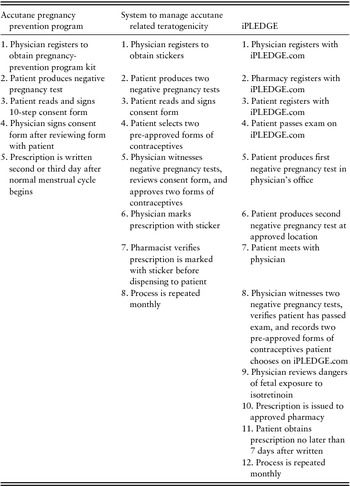
Under the Accutane Pregnancy Prevention Program, Hoffman–LaRoche provided a pregnancy-prevention program kit which provided guidelines for physicians to gauge if patients would use isotretinoin responsibly before prescribing it. These guidelines were part of a qualification checklist which included educational materials and consent forms to help physicians gauge patients’ commitment to using Accutane safely (Mitchell et al., Reference Mitchell, Van Bennekom and Louik1995). These materials also promoted communication between the patient and physician to determine the best course of treatment before a prescription was written.
For a prescription to be filled under this program, the physician must first register with Hoffman–LaRoche to obtain the pregnancy-prevention program kit. Before beginning treatment, the patient was required to show a negative pregnancy test a week before a prescription could be written. The patient must also complete and sign a ten-step written consent form. After reviewing the form with the patient, the physician also signed the form. Before writing the prescription, the physician waited until the second or third day of the patient's next menstrual cycle. The kit also strongly recommended the physician instruct the patient to use two forms of contraceptives beginning one month before treatment and ending one month after treatment and to take monthly pregnancy tests as a precaution. It also advised physicians to only write one-month prescriptions. Hoffman–LaRoche implemented and enforced these requirements.
To monitor whether the tools in the pregnancy-prevention program kit were being used, Hoffman–LaRoche implemented a prescriber tracking survey which served a monitoring and punishment mechanism to enforce physician compliance. The Accutane Prescriber Tracking Survey surveyed 200 primary-care physicians and 110 dermatologists biannually. If Hoffman–LaRoche suspected a physician was negligently prescribing Accutane, they could ban the physician from prescribing. As Accutane was a versatile and effective means to treat acne, losing the ability to prescribe it would greatly affect the quality of care the physician provided. It may also have harmed them financially if they were not able to offer Accutane to their patients while other physicians could.
Stringency of the system to manage accutane related teratogenicity
The System to Manage Accutane Related Teratogenicity also required the physician to register with Hoffman–LaRoche to prescribe Accutane. However, to better monitor whether each pre-prescription step was followed, the physician received stickers which they attached to prescriptions to indicate the patient completed all necessary steps. These stickers were obtained from Hoffman–LaRoche.
Before the patient could begin treatment under the supervision of a physician, she had to produce two consecutive negative pregnancy tests.Footnote 8 She was then required to read and sign an informed-consent agreement explaining the risk of birth defects associated with using isotretinoin. The patient was also required to commit to using two forms of contraceptives from an FDA-approved list for the duration of her treatment. The prescription could only be marked with the approval sticker after the physician witnessed the negative pregnancy tests. The pharmacist could only fill prescriptions with the sticker attached. This process occurred every month until the patient completed treatment.Footnote 9 The FDA enforced these requirements and could ban physicians from prescribing Accutane if the requirements were not adhered to.
Stringency of iPLEDGE
The third risk-management program, iPLEDGE, was managed through the government website iPLEDGE.com. Physicians wishing to prescribe isotretinoin must register through iPLEDGE.com and maintain registration annually to continue prescribing isotretinoin. The same is required for pharmacies to dispense isotretinoin. Physicians can only issue prescriptions to registered pharmacies, and pharmaceutical companies manufacturing isotretinoin can only distribute to registered pharmacies.
Patients must also register with iPLEDGE.com, where female patients must take monthly exams testing their understanding of iPLEDGE's rules and contraceptive requirements. They must also produce two negative pregnancy tests, the first in the physician's office and the second in an approved lab.Footnote 10 Only then can the patient meet with a physician and get a prescription. The patient must have the prescription filled within 7 days or else they will be ‘locked out’ of the program and are unable to receive a prescription for 23 days.Footnote 11 Male patients and female patients who cannot become pregnant must also register but need not re-register monthly.
The physician must report monthly updates to iPLEDGE.com verifying the patient produced the monthly negative pregnancy test, passed their exam, and selected two pre-approved methods of contraceptives. After providing these updates, the physician then must review the contraceptive practices with the patient. Then, another monthly prescription can be written. I compare the requirements to receive a prescription under the three risk-management programs in Table 1.
Requirements to receive a prescription under each risk-management program

As the previous literature predicts, the private risk-management program provided fewer requirements than the public risk-management programs where the patient–physician relationships was the primary mechanism for preventing patient pregnancies. The public risk-management programs increased regulatory stringency by making many of the private program's recommendations mandatory and requiring more steps to administer and obtain treatment. Determining which program provides lower total risk requires examining if these programs effectively reduced pregnancies and educated patients. These comparisons also test if the tendency of a private regulatory body to under provide regulatory stringency provides comparatively more effective governance than the overprovision expected from a public governing body.
5. Evaluating the effectiveness of the risk-management programs
The primary data for evaluating effectiveness come from reports and documents prepared by Hoffman–LaRoche for the FDA to compare the risk-management programs. Both parties agreed on how to measure and report the data before compiling the reports, which also heavily influenced the FDA's decisions regarding effectiveness and the need to supplant programs. When data is unavailable from these reports and documents, I supplement this information with findings from the medical literature.
The most important metrics by which to evaluate the relative effectiveness of the risk management programs are total pregnancies and pregnancy rates under each program. Data on total pregnancies, while not ideal, are more complete than data on pregnancy rates per 1,000 patients. Since data on pregnancy rates are not available for the entire period, I provide a more complete picture by also reporting on the changes in prescriptions to demonstrate changes in regulatory stringency and changes in total risk.
Before making comparisons, there are numerous limitations to the available data which must be addressed. Perhaps, the greatest limitation is the unavailability of prescriptions obtained and pregnancies occurring with illegal use of isotretinoin. While the absence of this data limits risk of non-compliance comparisons between the programs, reports regarding concerns over illegal acquisition of isotretinoin provide evidence for overly stringent regulation through increased risk of non-compliance. Additional non-compliance and underreporting of pregnancies occurring with illegal use bias our comparisons for the public risk-management programs.
There are also data limitations within the FDA reports and documents. Although the first risk-management program was implemented in 1987, reports of pregnancies were not systematically collected before 1989. On account of this limitation, and the fact that it is unclear when pregnancies began from 1987–1988, I do not include them in this analysis. Also, the FDA and Hoffman–LaRoche did not agree on a method to estimate total or new Accutane users before 1991, making estimates for new prescriptions before 1991 unavailable.
Effectiveness of the accutane pregnancy prevention program
Using the guidelines established in the pregnancy-prevention program kit, approximately 15% of female patients were denied Accutane as a result of the guidelines recommended by Hoffman–LaRoche.Footnote 12 Among the most common reasons for denial were refusal to take birth control, lack of understanding of the seriousness of becoming pregnant while on Accutane (as judged by the physician), and failure to complete the consent form. This served as an effective means to reduce the pregnancy rates of new patients as shown in Figure 1.
Pregnancies per 1,000 new female patients under the accutane pregnancy prevention program.

As reported by the FDA, the Accutane Pregnancy Prevention Program reduced the pregnancy rate for newly enrolled female patients by approximately 50% from 1989–1998.Footnote 13
Evidence also indicates while pregnancy rates for newly enrolled female patients decreased, prescriptions for Accutane increased under the Accutane Pregnancy Prevention Program. According to Wysowski et al., (Reference Wysowski, Swann and Vega2002), the annual median number of total Accutane prescriptions increased from approximately 800,000 during the 1983–1992 time period, to approximately two million by 2000. Figure 2 shows estimated female and total new annual prescriptions of Accutane from 1991–1999.
Estimated new prescriptions for accutane from 1991–1999.

Data for this figure were obtained from the FDA's ‘Estimating Accutane Use’.
The concomitant decreases in pregnancy rates for newly enrolled female patients and increases in prescriptions for the duration of the program demonstrates patients effectively received treatment and were not subject to excessive regulatory stringency. Despite the theoretical limitations on a private company implementing and effectively enforcing a risk-management program, the incentives of physicians and Hoffman–LaRoche were clearly aligned to cooperate, provide effective treatment, and adhere to the Accutane Pregnancy Prevention Program.
Private governance of Accutane was also successful in educating patients. Mitchell et al., (Reference Mitchell, Van Bennekom and Louik1995) conducted a survey of women using Accutane from 1989–1993 and found ‘the program encourages communication between physicians and patients regarding the drug's teratogenic risk’ (p. 105). Patient understanding of the dangers of becoming pregnant while taking Accutane was ‘virtually universal’ (p. 105).
Despite success, concerns over underreporting of pregnancies prompted the FDA to become involved with the risk-management program for Accutane (Meadows, Reference Meadows2001). The FDA was also concerned about alleged non-compliance of physicians under the Accutane Pregnancy Prevention Program.Footnote 14 Although the evidence of underreporting pregnancies and non-compliance is debatable, it reflects the theoretical limitations for a private firm to implement a successful risk-management program and attain a lower total risk.
Effectiveness of the system to manage accutane related teratogenicity
The FDA created and implemented the System to Manage Accutane Related Teratogenicity to replace Hoffman–LaRoche's program with a more stringent risk-management program (although it borrowed heavily from its predecessor). The new program was fully initiated in 2002 and was distributed to more than 375,000 healthcare professionals (Medscape, 2002). The System to Manage Accutane Related Teratogenicity was specifically to further reduce the amount of pregnancies occurring while using Accutane.
Physicians found the new requirements listed in Table 1 overly burdensome (Stashower, Reference Stashhower2003), and some elected to no longer prescribe Accutane (Mahoney and Stone, Reference Maloney and Stone2011). By electing to do so, they denied patients a proven treatment option. Consistent with the framework in section 2, additional regulatory stringency increased the incentive for risky behavior from patients. The American Medical Association and the American Academy of Dermatologists warned the FDA their actions may motivate patients to seek alternative ways to acquire Accutane (Woodcock, Reference Woodcock2002). Within the first year of implementing the System to Manage Accutane Related Teratogenicity, the FDA noted several websites where Accutane was available for purchase, ‘either with no prescription, with only an on-line questionnaire, or based on a faxed prescription’ (Woodcock, Reference Woodcock2002: 39).Footnote 15 These efforts to circumvent the legal way of obtaining Accutane increased the dangers of other potential harmful side effects going unnoticed because a medical professional was not involved in administering treatment.
Under the System to Manage Accutane Related Teratogenicity, pregnancies increased and total prescriptions decreased. According to the FDA, reported pregnancies increased from 2002–2003.Footnote 16 These figures do not include pregnancies from illegal purchases. Although it is unknown how much isotretinoin was purchased online and how many pregnancies resulted, increases in regulatory stringency clearly increased the risk of noncompliance. Absence of such information likely biases comparisons in favor of public risk-management programs. During the same period, total prescriptions for isotretinoin decreased by an estimated 23% (Mendelson et al., Reference Mendelson, Governale, Trontell and Seligman2005). Overall, the medical literature indicates the System to Manage Accutane Related Teratogenicity was largely ineffective in preventing pregnancies (Brinker et al., Reference Brinker, Kornegay and Nourjah2005; Lipper, Reference Lipper2007).
The System to Manage Accutane Related Teratogenicity increased total risk through creating additional requirements for physicians and patients to prescribe and attain treatment. The increases in regulatory stringency resulted in an increased risk of non-compliance and ultimately increased pregnancy rates and the likelihood of patients using Accutane irresponsibly. Although the availability of Accutane online may also play a role in incentivizing patients to seek Accutane illegally, increasing the difficulty of acquiring treatment legally is likely to have a similar effect. The program also worked to disrupt the patient–physician relationship by replacing it with patients’ and physicians’ adherence to additional requirements.
The System to Manage Accutane Related Teratogenicity was short lived and was fully replaced by iPLEDGE 3 years after it was fully implemented. With its replacement, the regulatory stringency associated with receiving and distributing isotretinoin increased. Schonfeld et al. (Reference Schonfeld, Amoura and Kratochvil2009) describe iPLEDGE as ‘one of the most rigorous risk-management programs for therapeutic agents ever established’ (p. 104).
The effectiveness of iPLEDGE
The FDA replaced the System to Manage Accutane Related Teratogenicity with iPLEDGE because it failed to meet its objectives. The FDA also wanted to centralize all the risk-management programs to prevent manufacturers of generic Accutane from implementing their own. According to the FDA (2006), ‘the central tenet of the isotretinoin risk-management program is that the one centralized registry, system of clearinghouse be created and that all prescribers, dispensing pharmacies, and patients participate in the risk management program in order to prescribe, dispense or receive the medication’ (p. 7).Footnote 17
There are two important factors to address when examining iPLEDGE. First, the introduction of generic forms of Accutane extends the comparative-institutional analysis to four versions of the same pharmaceutical governed under a single risk-management program. Second, the availability of generic alternatives and ability to purchase isotretinoin online both likely worked to reduce demand for legally obtaining Accutane. Although extending the analysis to include multiple drugs and the potential for black market acquisition of these drugs makes the analysis more complex, the framework developed in section 2 is still useful because iPLEDGE seeks to attain the same ends as its predecessor programs.Footnote 18
Increases in regulatory stringency worked to exacerbate many of the difficulties physicians faced under the previous program. During the first year of iPLEDGE, technical problems with iPLEDGE.com caused frequent delays and increased the difficulties of administering and receiving treatment (Abroms et al., Reference Bloom, Standing and Lloyd2006). According to a 2006 survey conducted on 378 dermatologists registered with iPLEDGE.com, 90% of surveyed dermatologists faced technical difficulties when trying to administer treatment and 52% of patient's treatment plans were delayed (Boodman, Reference Dooren2006). The same survey also found 39% of patients experienced technical problems when trying to register and complete their exams (Boodman, Reference Dooren2006).
As with its predecessor, iPLEDGE's increased regulatory stringency decreased physicians’ and patients’ access to isotretinoin. This regulatory stringency worked to increase the risk of non-compliance by incentivizing patients to continue seeking illegal online purchases. One year after the implementation of iPLEDGE, the FDA created a special webpage warning of the dangers associated with taking isotretinoin without a physician's guidance to reduce online purchases.Footnote 19
Further, in a comparative study of the two FDA programs, Shin et al. (Reference Shin, Cheetham, Wong, Nui, Kass, Yoshinaga, Sorel, McCombs and Sidney2011), concluded iPLEDGE did not decrease the risk of patients becoming pregnant significantly more than the System to Manage Accutane Related Teratogenicity. I show total reported pregnancies for patients using Accutane under each risk-management program in Figure 3.
Total patient pregnancies using accutane from 1989–2008.

Total pregnancies among isotretinoin patients reported from 1989–1999 are provided in the FDA's ‘Estimated Accutane Use’ and pregnancies reported from 2001–2008 are provided from Micheal Fostner of Hoffman–LaRoche's presentation ‘Evaluation of the Effectiveness of Risk Management’. Both use the same data from Hoffman–LaRoche. I use total reported pregnancies to compare these programs instead of pregnancy rates because data on the number of female patients is unavailable. Similarly, I only use pregnancies occurring using Accutane because data on pregnancies occurring with generic Accutane is unavailable. Data were unavailable for the year 2000 after March and 2005 was only measured from April–December. These gaps are likely due to transitions into successor programs. Data on pregnancies post 2008 were also unavailable due to Accutane's discontinuation.
There is a statistically significant difference between the mean number of reported pregnancies under the System to Manage Accutane Related Teratogenicity and the mean number of total pregnancies under the Accutane Pregnancy Prevention Program at the 5% level. There is not a statistically significant difference in the mean number of reported pregnancies between iPLEDGE and the Accutane Pregnancy Prevention Program or between iPLEDGE and the System to Manage Accutane Related Teratogenicity at the 5% level.
According to the medical literature, total prescriptions decreased under iPLEDGE for both Accutane and its generic forms. After the first year iPLEDGE had been implemented, total prescriptions for Accutane decreased by 23% (Shin et al., Reference Shin, Cheetham, Wong, Nui, Kass, Yoshinaga, Sorel, McCombs and Sidney2011). Dooren (2006) reported a 16% decrease in generic Accutane prescriptions in the first six months of 2005. This trend continued a year after iPLEDGE was implemented, wherein 2007 total prescriptions (including Accutane and its generic forms) decreased by an additional 10% (Shin et al., Reference Shin, Cheetham, Wong, Nui, Kass, Yoshinaga, Sorel, McCombs and Sidney2011).
iPLEDGE also failed to provide a more successful educational program than the System to Manage Accutane Related Teratogenicity. Werner et al. (Reference Ward2015) concluded from a survey conducted on 16 women who recently underwent isotretinoin counseling, ‘The iPLEDGE program increases anxiety about isotretinoin more than it helps women feel protected from the teratogenic risks’ (p. 366). This anxiety was not accompanied by increases in recommended contraceptive practices by patients. Pinheiro et al. (Reference Pinhero, Kang, Kim, Governale, Zhou and Hammad2013) examined the 24 month period before and after the implementation of iPLEDGE and found no change in the use of contraceptive practices between the periods.Footnote 20 Although anxiety can provide an incentive to deter uncommitted patients or persuade them to take treatment more seriously, iPLEDGE was not able to use anxiety to promote stronger adherence to its contraceptive requirements.
As with the System to Manage Accutane Related Teratogenicity, iPLEDGE increased total risk by providing overly stringent regulations through increasing the risk of non-compliance. This increased risk of non-compliance continued the trend of illegal use of isotretinoin by patients and restricted physicians’ ability to treat patients. Overall, according to FDA reports and documents as well as findings in the medical literature, iPLEDGE was not more successful than its predecessor in educating patients and reducing pregnancies.
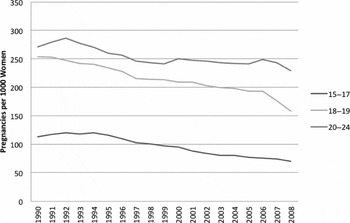
To determine whether fluctuating pregnancy rates and total pregnancies under various programs were a result of trends in the larger US population, I compare the trends in pregnancies examined above to overall pregnancy rates for females between 15–24 years old. According to the medical literature, the majority of female patients using isotretinoin were in their mid-teens to mid-20’s (Mitchell et al., Reference Mitchell, Van Bennekom and Louik1995; Shin et al., Reference Shin, Cheetham, Wong, Nui, Kass, Yoshinaga, Sorel, McCombs and Sidney2011; Wysowski et al., Reference Wysowski, Swann and Vega2002). The total number of pregnancies for females in the 15–17, 18–19, and 20–24 age brackets is provided in Figure 4.Footnote 21
Total pregnancies per 1,000 women in majority patient age groups.

Because data for total pregnancies over the examined age brackets were unavailable for ages 15–24 inclusively, I examine them separately. There was an overall downward trend (between 8%–16% for each age group) for pregnancies per 1,000 females from 1990–2008 in each age bracket. However, this trend was significantly smaller than the decrease under the Accutane Pregnancy Prevention Program. Additionally, pregnancies per 1,000 females in each age bracket continue to decrease past the year 2000, where evidence from the FDA and medical literature suggests pregnancies increased under the FDA risk-management programs. This indicates the pregnancies of female patients undergoing isotretinoin therapy were likely not a result of overall pregnancy rate decreases.Footnote 22
I also examined if changes in contraceptive practices for sexually active women could have affected fluctuations in pregnancies under the various programs. According to the Center for Disease Control's ‘Use of Contraception in the United States: 1982–2008’ the percentage of sexually experienced woman between 15–44 years old using any form of contraceptive increased 4% from 1982–2008. The slight increases in contraceptive practice are unlikely to have significant explanatory power.
6. Conclusion
Isotretinoin's versatile and effective treatment for a variety of acne conditions in conjunction with its ability to harm fetal development has prompted the adoption of three risk-management programs. Isotretinoin is a rare example of a pharmaceutical which was regulated privately by its manufacturer and later publicly by the FDA. By using a comparative-institutional approach, comparing the effectiveness of isotretinoin's risk-management programs provides us with a case study where we can compare the ability of private and public governing bodies to mitigate the potential risks from using a potentially harmful pharmaceutical.
The Accutane Pregnancy Prevention Program, although less stringent than FDA programs designed with the same objectives, successfully reduced pregnancies and educated female patients of the dangers of becoming pregnant while using Accutane. Despite theoretical concerns of private firms not providing an effective amount of enforcement, and potential incentive issues for physicians, evidence indicates the Accutane Pregnancy Prevention Program was able to align incentives and provided effective risk-management.
The System to Manage Accutane Related Teratogenicity and iPLEDGE provided more stringent regulation which worked to decrease patient access to effective treatment. Additionally, the regulation restricted patient and physician access to isotretinoin, which motivated patients to purchase isotretinoin illegally online. This increased the risk of patients using isotretinoin irresponsibly, which, in addition to increasing the total risk of exposure, also increased the risk other side effects of isotretinoin could go unnoticed and cause additional medical problems.
It is also critical to remember the unavailability of data and other factors mentioned above likely bias the results against the case for private risk-management effectiveness. Illegal use of isotretinoin would likely be higher under the more stringent public programs. It is also probable pregnancies occurring with illegal use of isotretinoin are underreported. Although the existing evidence is not conclusive, additional evidence would likely bolster the case for effective private governance.
The evidence in support of the effectiveness of private risk-management programs is further strengthened when we consider the cosmetic and psychological benefits patients receive from using isotretinoin. By adopting a standard of risk minimization, this essay has only looked at the downside of isotretinoin usage. Hoffman–LaRoche's program provided more patients with the benefits of using isotretinoin and provided a lower risk of exposure than the System to Manage Accutane Related Teratogenicity or iPLEDGE. Stashhower (Reference Stashhower2003), a practicing dermatologist, describes his patients using Accutane as ‘very happy young men and women whose lives have been resurrected by this drug’ (p. 1200).
As previously mentioned, this example is limited in its application as we are comparing the risk-management program of a government-granted monopoly to a government-enforced risk-management program that governs several firms. Because the manufacturer of isotretinoin was granted a monopoly, the Accutane Pregnancy Prevention Program did not compete with other risk-management programs. For these reasons, this case study is limited in its implications for private regulation outperforming public regulation in the healthcare market. Additionally, since the FDA governed the risk-management of Accutane and its generic forms under iPLEDGE, a comparison between competing drug manufacturers’ risk-management programs, a private monopolist's program, and the FDA's program is not possible.
Although comparing the risk-management program of a government-granted monopoly limits its universal application, it also provides evidence that a monopolist may still be better able to develop an effective and more efficient risk-management program than the government. Even with the inefficiencies a monopolist provides, it must still provide a valuable product to consumers (or patients). The monopolist has an incentive not to provide overly stringent regulation to manage the risk associated with its products but also to provide sufficient regulatory stringency governing legal use to avoid reputational damage or legal repercussions. This incentive structure may provide a monopolist a stronger ability to effectively mitigate the components of risk management than a public governing body with different incentives.
The findings of this case study provide implications for the FDA's involvement in risk-management. Specifically, this case study demonstrates private interests may provide effective governance when attempting to minimize the risks associated with pharmaceutical prescription. Rather than increased FDA involvement into the risk-management of pharmaceuticals, it may be more effective to delegate control of risk-management to private interests. This case study also opens a path for new research in comparative-institutional analysis in other risk-management programs and the larger healthcare market. New research could also examine if comparatively more FDA involvement in risk-management programs produces fewer undesirable outcomes. Similar analyses could be conducted on comparatively more or less regulated sectors of healthcare. These analyses could also help determine which regulatory and institutional factors in healthcare markets are more likely to produce desired outcomes.