The results of the June 2024 European Union (EU) parliamentary elections marked a new victory for the European radical right parties (RRPs), which have gained significant power over the past two decades.Footnote 1 Once considered a fringe phenomenon, these parties have successfully transitioned into mainstream political players across various European nations, including France and Italy. Their strength is particularly pronounced in Central and Eastern Europe (CEE) in countries like Poland, Hungary, and the Czech Republic, where the electorates are more conservative, more receptive to anti-elitism and nationalist rhetoric, as well as increasingly anti-immigration compared to their Western counterparts (Pop-Eleches Reference Pop-Eleches2010; Stanley Reference Stanley and Kaltwasser2017; Zsolt Reference Zsolt2020). In fact, in some Central and Eastern European countries, such as Croatia and the Czech Republic,Footnote 2 radical right parties have been present in parliaments since the founding elections and have significantly shaped public policy (Bustikova Reference Bustikova2014). Historically, RRPs primarily attracted male working-class voters with traditional values (Bornschier Reference Bornschier and Rydgren2018). However, their recent electoral successes suggest a notable shift. RRPs are now increasingly appealing to female voters, narrowing the gender gap (Allen and Goodman Reference Allen and Goodman2021; Chueri and Damerow Reference Chueri and Damerow2023; Mayer Reference Mayer2015; Snipes and Mudde Reference Snipes and Mudde2020). As these parties gain seats in parliaments and cabinets and actively shape public policy, they can no longer be dismissed as a temporary phenomenon.
In this article, I examine what RRPs and populist parties that come to power mean for women’s political representation in the executive. Existing research demonstrates that radical right populist parties are typically characterized by their defense of traditional family values and promotion of anti-feminist agendas. They often rhetorically challenge aspects of the democratic order that have historically advanced women’s political and social empowerment (Campbell and Erzeel 2018; Grzebalska and Pető Reference Grzebalska and Pető2018; Kantola and Lombardo Reference Kantola and Lombardo2019; Off Reference Off2023). Are their actions matching their anti-gender rhetoric by dismantling the progress made over recent decades, or are they motivated to attract female voters by symbolically enhancing women’s political representation in cabinet appointments? Given the high visibility and symbolic weight of cabinet positions, RRPs and populist parties may strategically appoint women to these posts to soften their exclusionary image and appeal to broader segments of the electorate.
The study of RRPs and populism in CEE is essential for understanding how democratic norms are being challenged, particularly women’s political representation. The region provides a unique context characterized by the legacy of communist rule, post-communist economic and political transformation, and unresolved questions of national identity (Bustikova Reference Bustikova2019). Weak party institutionalization has led to left-right confusion, where radical right parties are left-leaning on the economyFootnote 3 when compared to other parties in their respective political systems (Allen Reference Allen2017). Despite their growing influence, RRPs and populism in CEE remain underexplored, especially in the executive branch. Most existing scholarship examines their electoral performance or parliamentary behavior (Akkerman Reference Akkerman2015; Mudde Reference Mudde2019) but does not assess how participation in government affects women’s access to cabinet positions. In many cases, the executive branch holds more power and policy influence than the legislative branch, making it imperative for us to understand the gender dynamics of cabinets. Focusing on the effect of RRPs and populist parties in the CEE context thus fills an important empirical gap and contributes to our understanding of gender, democracy, and the transformation of European politics.
To explore the effects of RRPs and populist parties on women’s representation in cabinets, I construct an expansive data set covering cabinet appointments from 1992 to 2019 in 12 Central and Eastern European countries. I differentiate between prestigious and less prestigious positions to assess whether RRPs and populist parties are appointing women to less prestigious positions merely as a symbolic gesture. I conceptually distinguish RRPs and populist parties, as well as identify high and low levels of populism in each group to understand the differences in how they govern and how the distribution of their cabinet appointments might differ. Lastly, I examine the impact of RRPs and populist parties on women’s political representation overall. Are countries with highly populist RRPs or populist parties in government generally appointing fewer women to cabinets than those with less populist parties?
The results of this article confirm that radical right populist parties in government significantly reduce the likelihood of appointing women to all cabinet positions, whether they are serving as coalition partners or leading cabinets. This paper demonstrates the interactive effect of populism and radical right parties on women’s cabinet representation. While radical right parties and highly populist parties each independently reduce the share of women in cabinets, their combination has the most pronounced exclusionary effect. Highly populist radical right parties (HPRRP) are associated with substantial reductions in women’s cabinet presence, suggesting not only greater restrictions to entry but also the potential corrosion of “concrete floors” that limit women’s advancement in CEE democracies. This article finds that the degree of populism within RRPs and populist parties alike substantially magnifies women’s exclusion from cabinet-level power. The intensity of populist ideology, rather than the presence of RRPs or populist parties in governments alone, emerges as a key driver of women’s exclusion from the executive branch. The findings indicate that when populism and radicalism grow, their effects could lead to the erosion of the expectation that cabinets should have at least one woman present.
In the next section, I review the existing literature on factors contributing to women’s appointments to cabinets, focusing on institutional, ideological, and contextual factors that shape their cabinet appointments. Second, I use insights from research on the radical right’s rise in Central and Eastern Europe to assess how these parties’ ideologies may affect women’s chances of being appointed to cabinets. I then introduce my original time-series, cross-sectional data set, which captures women’s cabinet appointments, party characteristics, and measures of populism across twelve post-communist countries from 1992 to 2019. Next, I present the results of the various empirical models that examine specific dimensions of women’s cabinet representation: the likelihood of having at least one woman in the cabinet, the proportion of women appointed to ministerial positions, and the probability that women hold high-prestige portfolios. I conclude by reflecting on the broader implications of the findings, both for understanding gendered patterns of political power in Central and Eastern Europe and for assessing how populist and radical right dynamics challenge democratic inclusion in contemporary politics beyond the region.
Women’s Descriptive Representation in Cabinets
Research on women’s appointments to cabinet positions has received brand new attention in the twenty-first century as scholars seek to understand the power dynamics within the executive branch. The executive branch often wields greater authority and policy influence than the legislative branch (Barnes and O’Brien Reference Barnes and O’Brien2025; Huber and Martinez-Gallardo Reference Huber and Martinez-Gallardo2008; O’Brien et al. Reference O’Brien, Mendez, Peterson and Shin2015), making it imperative for us to understand the gender dynamics of cabinets. Historically, women have been excluded from the executive branch, and only in recent decades have they started to regularly occupy these positions of power, often in low numbers and placed in low-prestige portfolios or ministries with feminine characteristics (Davis Reference Davis1997; Escobar-Lemmon and Taylor Robinson Reference Escobar-Lemmon and Taylor-Robinson2009; Krook and O’Brien Reference Krook and O’Brien2012; Liu et al. Reference Liu, Hlatky, Chew, Power and Selsky2025; Studlar and Montcrief Reference Studlar and Moncrief1999). “Parity cabinets” are still a rare phenomenon (Franceschet and Thomas Reference Franceschet and Thomas2015).
Despite various barriers, existing literature indicates that the number of women leading ministries worldwide has steadily increased over time (Annesley, Beckwith, and Franceschet Reference Annesley, Beckwith and Franceschet2019; Bego Reference Bego2014; Escobar-Lemmon and Taylor Robinson Reference Escobar-Lemmon and Taylor-Robinson2009; Ie Reference Ie2021). In the past two decades, extensive research has focused on the conditions under which women are appointed to ministerial roles, examining a range of institutional and social factors that influence gender parity within cabinets. However, the impact of populism on cabinet appointments has only recently begun to attract scholarly attention (Akkerman Reference Akkerman2015; O’Brien Reference O’Brien2018; Weeks et al. Reference Weeks, Meguid, Krook and Coffé2023). How inclusive are RRPs and populist parties when they have a chance to form cabinets or participate in them, whether in symbolic or meaningful ways? This question is particularly relevant in Central and Eastern Europe, where RRPs frequently form cabinets and engage in executive decision-making (Erzeel and Rashkova Reference Erzeel and Rashkova2017). Additionally, due to the prominent visibility of cabinets, they are often utilized for a more immediate symbolic representation effect (Annesley, Beckwith, and Franceschet Reference Annesley, Beckwith and Franceschet2019; Scherpereel and Adams Reference Jacob, Scherpereel and Adams2014) rather than the prolonged process of electoral politics. The existing literature has inadequately addressed how the rise of RRPs and populism in general affects women’s political representation within political institutions. What implications do successful populist messages have for women’s representation?
Beckwith (Reference Beckwith2010) posits that the prime minister’s power to dismiss cabinet ministers at any time may incentivize them to appoint women, as they can later remove them if needed. This flexibility allows the head of government to alter the cabinet’s gender composition without significant political consequences (Scherpereel and Adams Reference Jacob, Scherpereel and Adams2014). Additionally, the fewer veto points in the appointment process and the reduced number of constituencies to which the prime minister must be accountable create greater structural opportunities for cabinet appointments compared to elections to the national legislature. Consequently, cabinet appointments offer low-cost, high-visibility options for RRPs and populist parties looking to broaden their base and legitimize their agendas. Ben-Shitrit, Elad-Strenger, and Hirsch-Hoefler (Reference Ben-Shitrit, Elad-Strenger and Hirsch-Hoefler2022) provide strong evidence in the Israeli context that radical parties strategically leverage women’s political representation and participation to normalize and legitimize their nativist and authoritarian agendas. I anticipate observing similar strategies in the CEE region as RRPs and populist parties aim to expand their constituency.
Current literature predominantly employs a supply and demand model for legislative selection to analyze women’s political representation in cabinets (see Norris and Lovenduski Reference Norris and Lovenduski1995). Two factors have emerged on the supply side, one being party ideology. The “contagion of the left” hypothesis (Darcy and Beckwith Reference Darcy and Beckwith1991; Duverger Reference Duverger1954; Matland and Studlar Reference Matland and Studlar1996) suggests that left-leaning parties are more likely to appoint women to cabinets than their right-leaning counterparts. However, over time, scholars around the world have found diminishing evidence supporting this hypothesis (Bego Reference Bego2014; Davis Reference Davis1997; Krook and O’Brien Reference Krook and O’Brien2012; Stockemer and Sundström Reference Stockemer and Sundström2018), particularly in CEE, where newly established right-leaning parties have often promoted liberal democratic values in emerging democracies (Bego Reference Bego2014). This context raises important questions about how RRPs and populist parties approach women’s appointments to cabinet posts.
Another significant argument put forth by various scholars to explain women’s appointments to cabinets is the effect of time. It has been argued that we should expect the probability of women being appointed to cabinets to increase over time since they have become visible in politics (Bego Reference Bego2014; Escobar-Lemmon and Taylor Robinson Reference Escobar-Lemmon and Taylor-Robinson2005). We can expect that after various successive cabinets are comprised of a solid percentage of women, a cabinet comprised solely of men is no longer an option, considering the possible costly consequences in the next electoral cycle. Thus, the literature posits that there should be at least one woman in the cabinet as time progresses. However, a shift toward RRPs and populist parties may challenge this expectation and potentially lead to a return to all-male cabinets.
More recent research has found that selectors who appoint more women to cabinets are praised by journalists, political commentators, and feminists within their own parties (Annesley, Beckwith, and Franceschet Reference Annesley, Beckwith and Franceschet2019, 251). Rather than facing sanctions, they are commended for their actions, leading to a notable decline in all-male cabinets over time. There has been some evidence of a “see-saw effect,” where increases in women’s representation in cabinets are sometimes followed by declines (Scherpereel, Adams, and Jacob Reference Scherpereel, Adams and Jacob2018). However, the most recent analysis demonstrates that, over time, gains in women’s appointments tend to be sustained, creating what has been termed a “concrete floor” (Annesley, Beckwith, and Franceschet Reference Annesley, Beckwith and Franceschet2019). Once a prime minister or president appoints a woman (or many women) to the cabinet, the subsequent leaders are likely to maintain or even increase these appointments. Therefore, even if RRPs and populist parties are not increasing women’s appointments to cabinets, we should not see a decline if they are indeed willing to symbolically or meaningfully appoint women to executive positions. A decline would indicate signs of a sinking “concrete floor” and a shift away from the mainstream norm of cabinet appointments, potentially signaling a return to “ männerparteien ” and the re-emergence of all-male cabinets.
The effect of time on the increase of women’s cabinet appointments has also been observed through the concept of norm diffusion. Jacob, Scherpereel, and Adams (Reference Jacob, Scherpereel and Adams2014) and Kroeger and Kang (Reference Kroeger and Kang2024) find that the increasing visibility of international commitments to gender-balanced decision-making positively affects women’s representation in cabinets. Similarly, Bego (Reference Bego2014) finds that the desire for EU membership also serves as an incentive for creating more inclusive cabinets. Therefore, we should expect that the desire to join the European Union has also served as an incentive for RRPs and populist parties to appoint women to cabinets, at least during the accession period. However, if the incentive provided by EU membership only symbolically boosts women’s representation during this transitional phase, we may observe a decline in such appointments once countries achieve full EU membership.
Cabinet assignments, however, are not all created equally, as different portfolios vary in power, influence, and visibility (Krook and O’Brien Reference Krook and O’Brien2012). Historically, women have seldom been appointed to positions of significant power within cabinets (Davis Reference Davis1997; Lovenduski Reference Lovenduski1986; O’Brien et al. Reference O’Brien, Mendez, Peterson and Shin2015), and despite some progress, gendered patterns persist (Barnes and O’Brien Reference Barnes and O’Brien2025; Escobar-Lemmon and Taylor-Robinson Reference Escobar-Lemmon and Taylor-Robinson2009). Given the rhetoric and message of RRPs, we should expect that when they do appoint women to cabinet positions, they are likely to do so in less prestigious portfolios, reinforcing traditional gender norms. Additionally, if RRPs aim to mainstream their image without altering their core message, when they appoint women to cabinet positions, they are likely to appoint them as tokens rather than power players.
The Rise of Radical Right Parties in Central and Eastern Europe
One of the proposed explanations for the increasing popularity of RRPs is their increasingly successful efforts to improve the political representation of female voters (Allen and Goodman Reference Allen and Goodman2021; Erzeel and Rashkova Reference Erzeel and Rashkova2017; Mudde Reference Mudde2007). Historically, RRPs have been referred to as Männerparteien , with their supporters and leadership made up mostly of men (Mudde Reference Mudde2007; Mudde and Kaltwasser Reference Mudde and Kaltwasser2015; Spierings and Zaslove Reference Spierings and Zaslove2015; Spierings et al. Reference Spierings, Zaslove, Mügge and de Lange2015). Indeed, Weeks et al. (Reference Weeks, Meguid, Krook and Coffé2023) find that RRPs have the largest overrepresentation of male voters among all European party families. However, as RRPs have grown in popularity, the support base has also started to change, and the existing gender gap is closing. Descriptively, RRPs are selecting female party leaders, making it visible that they support women in leadership roles and “softening” their image to make themselves more acceptable to the public, particularly among women (Ben-Shitrit, Elad-Strenger, and Hirsch-Hoefler Reference Ben-Shitrit, Elad-Strenger and Hirsch-Hoefler2022). Similarly, across Western Europe, RRPs have sought to broaden their voter base by softening their rhetoric and appealing to a more liberal segment of the population (Akkerman Reference Akkerman2015; Mudde and Kaltwasser Reference Mudde and Kaltwasser2015).
In Central and Eastern Europe, most radical right parties emerged in the wake of 1989, and their electoral fortunes have varied greatly across countries and time (Greskovits Reference Greskovits2007; Kopecky and Mudde Reference Kopecky Petr2003; Minkenberg Reference Minkenberg2009; Mudde Reference Mudde2005; Pop-Eleches Reference Pop-Eleches2010; Ramet Reference Ramet1999; Tucker 2005; Vachudova Reference Vachudova2008). The literature on radical right parties in CEE has slowly begun to flourish (Held Reference Held1996; Hockenos Reference Hockenos1993; Lewis Reference Lewis2009; Minkenberg Reference Minkenberg2002; O’Dwyer and Schwartz Reference O’Dwyer and Schwartz2010; Ost Reference Ost2005; Rashkova Reference Rashkova2021; Shafir Reference Shafir2002) and has highlighted the unique characteristics of the RRPs in the region. Eastern European radical right parties support redistribution (Bustikova and Kitschelt Reference Bustikova and Kitschelt2009), they associate ethnic minority policies with democratization, and they coexist with radicalized mainstream parties (Bustikova Reference Bustikova and Rydgren2018). These characteristics have made the region particularly receptive to RRPs and help explain their rise across Central and Eastern Europe. However, limited research has examined how radical right parties engage with women’s political representation. Preliminary evidence shows that women are actively involved in RRPs and that these parties are seeking to increase their participation (Erzeel and Rashkova Reference Erzeel and Rashkova2017). For example, Rashkova and Zankina (Reference Rashkova and Zankina2019) find that although Bulgaria’s RRP parties have very few women on board, the gender gap isn’t as glaring and certainly not the highest in comparison to other new post-communist political parties, providing evidence that perhaps RRPs in CEE are creating opportunities for women’s political representation in leadership. Allen (Reference Allen2017) also finds that radical right parties in Central and Eastern Europe have been particularly effective at mobilizing economic grievances linked to welfare retrenchment during the post-communist transition, enabling them to cultivate a broader support base that increasingly includes women. Building on these initial findings, in this article, I explore whether right-wing populist parties in Central and Eastern Europe are indeed trying to appoint women to cabinet positions, how their patterns of inclusion compare to those of non-populist parties, and whether, when women are appointed, they are disproportionately assigned to less prestigious ministerial posts.
To answer these questions, I develop a series of hypotheses distinguishing among three dimensions of inclusion: whether cabinets include at least one woman (“entry”), the overall proportion of female ministers (“share”), and whether women are appointed to high-prestige portfolios (“prestige”). Across each dimension, I compare cabinets that include or are formed by RRPs and populist parties, and I assess how the intensity of populism affects these relationships. I differentiate between radical right parties and populist parties to capture the core ideology of each. While radical right parties (RRPs) often overlap with populist parties, the two are not synonymous. Populist parties employ a “thin ideology” that focuses on the “people versus the elite,” while radical right parties are based on nativism and authoritarianism (Mudde Reference Mudde2007). While some radical right parties, especially the most recently established ones, are populist, not all of them employ populist rhetoric. Similarly, not all populist parties are radical right parties, as populism can also exist on the left. This distinction is important for the CEE region, as radical right parties have existed since the fall of communism, but recently, populism has exacerbated those radical tendencies. The nuances between these two party groups provide an in-depth understanding of the effects of rising radicalism and populism in the region.
First, I examine whether RRPs and populist parties are more or less likely to appoint all-male cabinets. Given their anti-gender rhetoric and emphasis on nationalism, family values, and cultural restoration, I expect that governments with RRPs (H1) or populist parties (H2) will lower the odds of having at least one woman in cabinet. If the results show no support for these hypotheses, it will be telling that RRP or populist cabinets are attempting to maintain the record of their predecessors and have at least one woman in the cabinet, sustaining the “concrete floor.” Furthermore, I test whether the level of right-wing populism matters for women’s appointments to cabinet positions. I differentiate between RRP parties with low populist scores and those that demonstrate higher populist values. I argue that not all RRPs are created equal. The level of “anti-elitism” and “people-centrism” in party leaders’ rhetoric matters for how they approach liberal democratic values, and additionally, how they affect party competition more generally. We should then expect that RRPs with high populist values will be more likely to eradicate the “concrete floor” than those with lower populist scores (H3).
Next, I test whether cabinets with RRPs and populist parties tend to appoint a higher or lower proportion of women to cabinet positions than those without. Given their messages and their agendas, I expect RRPs (H4) and populist parties (H5) to negatively affect women’s representation in cabinets. However, if they are attempting to appeal to women, they would not significantly decrease female representation in government. This baseline expectation gives us a more contextual understanding of what percentage of women are in cabinets in the countries we examine, and how the type of government affects women’s descriptive representation. Again, I examine whether highly populist RRPs affect the percentage of women in cabinets (H6).
Lastly, I also examine whether RRPs and populist parties appoint women to meaningful, high-prestige cabinet positions or merely fulfill symbolic expectations of gender parity by assigning women to less influential roles. I expect that cabinets comprised of RRPs (H7) and populist parties (H8) would be less likely to appoint women to prestigious positions. Additionally, a higher level of populism should further lower the odds of women’s appointments to prestigious cabinet (H9) posts. Together, these hypotheses capture not only whether women are included in cabinets, but also the depth and quality of their inclusion under populist and radical right party governance.
Data and Methods
In this study, the data were compiled utilizing the U.S. State Department and the Central Intelligence Agency (CIA) Countries of the World and Their Leaders Yearbooks. This is a yearly publication that, until 1995, also provided a midyear supplemental update to ensure the accurate recording of members of national cabinets. Considering the very high turnover of ministers in most countries in Central and Eastern Europe during the phase of democratic consolidation, yearly data are necessary to accurately capture the changes in cabinets. The time frame from 1992 to 2019 captures all cabinet coalitions crafted since the first free election. Twelve countries that were previously under communist rule were included: Albania, Croatia, the Czech Republic, Estonia, Hungary, Latvia, Lithuania, Poland, Romania, Slovakia, and Slovenia. The cases cover most of the post-communist region with some exceptions.Footnote 4 Only members who served for four months or longer were recorded to capture the meaningful appointments of women to cabinet positions. Only individuals with the title of minister were recorded, and ministers without portfolios were excluded from the analysis. For each minister, their portfolio and gender were recorded then further extensive biographical research was conducted, if necessary, to confirm their identity.
Dependent Variables
My dependent variables are at least one woman in the cabinet, the percentage of women ministers, and the presence of at least one woman in a prestigious cabinet position. The first dependent variable in this study is the probability that the cabinet contains at least one woman minister. I use a dichotomous measure coded “1” if a cabinet has at least one woman present in a particular calendar year. However, this variable does not give us any insight in terms of the growth rate of women ministers, and therefore, I utilize the percentage of women ministers in the cabinet to go a step further and capture the patterns of women’s appointments to Central and Eastern European cabinets. I calculate the proportion of women ministers in cabinets to take into consideration the variation in cabinet size.Footnote 5 While the two variables described provide us with some understanding of the entrance of women to ministerial positions as well as the growth rate over time, they do not provide a qualitative aspect of women’s representation in cabinets. In post-communist Europe, women have become increasingly involved in higher-prestige cabinet positions. Unlike women in many post-industrial democracies (Reynolds Reference Reynolds1999), Central and Eastern European women have become much more visible in medium- and high-prestige cabinets in the past decade (Bego Reference Bego2014). Are the RRPs and populist parties contributing to this growth? Druckman and Roberts (Reference Druckman and Roberts2008) conducted expert surveys in 14 Eastern European countries on the subject of portfolio salience over the years 1990–2002 and assigned numerical values of 1 and up if the ministry was considered above average in importance, 0.5–1 if it was average, and below 0.5 if it was below average. While countries differed on the value of each ministry, two ministries scored the highest in all countries examined here: the Ministry of Finance and the Ministry of Foreign Affairs. However, for my measure, I also include the Ministry of Defense and the Ministry of the Interior, as they have been recognized as important and prestigious in most countries on a global scale (Barnes and O’Brien Reference Barnes and O’Brien2018; Escobar-Lemmon and Taylor-Robinson Reference Escobar-Lemmon and Taylor-Robinson2016).
Explanatory Variables
I am interested in the effect of RRPs and populist parties on women’s inclusion in the executive. Various measures of populism and the radical right/far right family have been developed in recent years. In this study, I use the Varieties of Party Identity and Organization (V-Party) data set to compile a list of parties that have a populist index score of 0.5 or above. The data set defines populism as anti-elite rhetoric and people-centric discourse, where party representatives claim to embody the “pure people” against a “corrupt elite” (Lindberg et al. Reference Lindberg, Alizada, Cole, Gastaldi, Grahn, Hellmeier and Hindle2022). Using both the Populism and Political Parties Expert Survey (POPA) (Zaslove, Meijers, and Huber Reference Zaslove, Meijers and Huber2024) and the Chapel Hill Expert Survey Study (CHES) (Jolly et al. Reference Jolly, Bakker, Hooghe, Marks, Polk, Rovny, Steenbergen and Vachudova2022) using the Family variable, I only keep right-leaning parties, eliminating the left populist parties. In addition, I also consult Popu-List (Rooduijn et al. Reference Rooduijn, Andrea, Halikiopoulou, Froio, Van Kessel, De Lange, Mudde and Taggart2024) and an additional data set to complete the list of populist parties in CEE. I then code the variable “Populists in Government” as “1” when the parties served in the government, and “0” when they didn’t. Similarly, I code the variable “Populists Form Governments” as “1” when the parties led cabinet formation, and “0” when they didn’t.
The other independent variable of interest in this study is the effect of radical right parties on women’s representation in the cabinet. Using the Popu-List data set, which identifies far-right parties, I compiled a preliminary list of radical right parties. Far-right parties are “nativist” (which is an ideology that holds that states should be inhabited exclusively by members of the native group and that non-native elements are fundamentally threatening to the homogenous nation-state) and authoritarian (which is the belief that, in a strictly ordered society, infringements of authority are to be punished severely) (Rooduijn et al. Reference Rooduijn, Andrea, Halikiopoulou, Froio, Van Kessel, De Lange, Mudde and Taggart2024, 973). In addition, I consulted CHES and POPA, which include both party ideology and mean populism score, ensuring that parties were categorized as “Radical Right” to triangulate my sources. Additionally, I record each year a cabinet includes an RRP and code it as 1 when it’s present and 0 when it’s not. I also construct an interaction variable comprised of the RRPs in the Government variable and the Populism variable to capture the effect of high and low levels of radical right populism in cabinets.
Based on the existing work on women’s representation in the executive, I also include a number of variables as controls. I utilize the same set of covariates in each of our models: a dummy variable which accounts for EU Membership (EU Member = 1); Higher Education (percentage of adults with a college degree); Labor (percentage of female labor participation); governmental system (0 = parliamentary, 1 = semi-presidential); women’s representation in parliament (percentage each year); the presence of a female head of government (1 = Yes); quality of democracy as measured by the Variety of Democracies (V-Dem) index (liberal democracy index) which incorporates measures of rule of law, checks and balances, and civil liberties along with the concepts measured in the electoral democracy index; to measure party ideology I look at whether the prime minister leading the cabinet belongs to a liberal left-wing party or not, using the Chapel Hill Expert Survey (CHES) data. A dichotomous measure is employed and coded “1” when a left-wing party prime minister is in power; to test for the time effect, I create a dummy variable capturing the first and second halves of my data set’s time span, and I expect that as it gets closer to today, the likelihood of women’s appointment to cabinet improves. For measuring the effect of the overall development and education of societies over time, I utilize the Human Development Index, which provides insights with regard to health, education, and standards of living. I leverage the variable, Populism Score. I leverage the variable, Populism Score, from the Varieties of Party Identity and Organization (V-Party) data set, measured on an interval scale in which 0 = no populist rhetoric, and 1 = complete populist rhetoric.
To test the hypotheses in this study, I draw on Generalized Estimating Equations (GEE) with robust standard errors, a statistical technique used primarily for analyzing correlated data, such as repeated measures or clustered observations. GEE extends the generalized linear model (GLM) to allow for the analysis of repeated measurements or other correlated observations (Hardin and Hilbe Reference Hardin and Hilbe2003; Liang and Zeger Reference Liang and Zeger1986). Instead of Maximum Likelihood Estimates (MLE) or Ordinary Least Squares (OLS), GEE uses Quasi-Likelihood Estimation. This is an appropriate procedure for the panel data used in this analysis as it allows for the correction of serial autocorrelation. To check the robustness of my findings, I ran a regular GLM with clustered standard errors by country, which produced similar results. In addition, I dropped each country one at a time and re-ran the model to see if any one group was driving the results. Lastly, as a robustness check, I estimated bootstrapped standard errors to account for within-country clustering. The resulting standard errors were consistent with those from the GEE model, suggesting that my findings are not sensitive to assumptions about the distribution of residuals or correlation structure.
Results
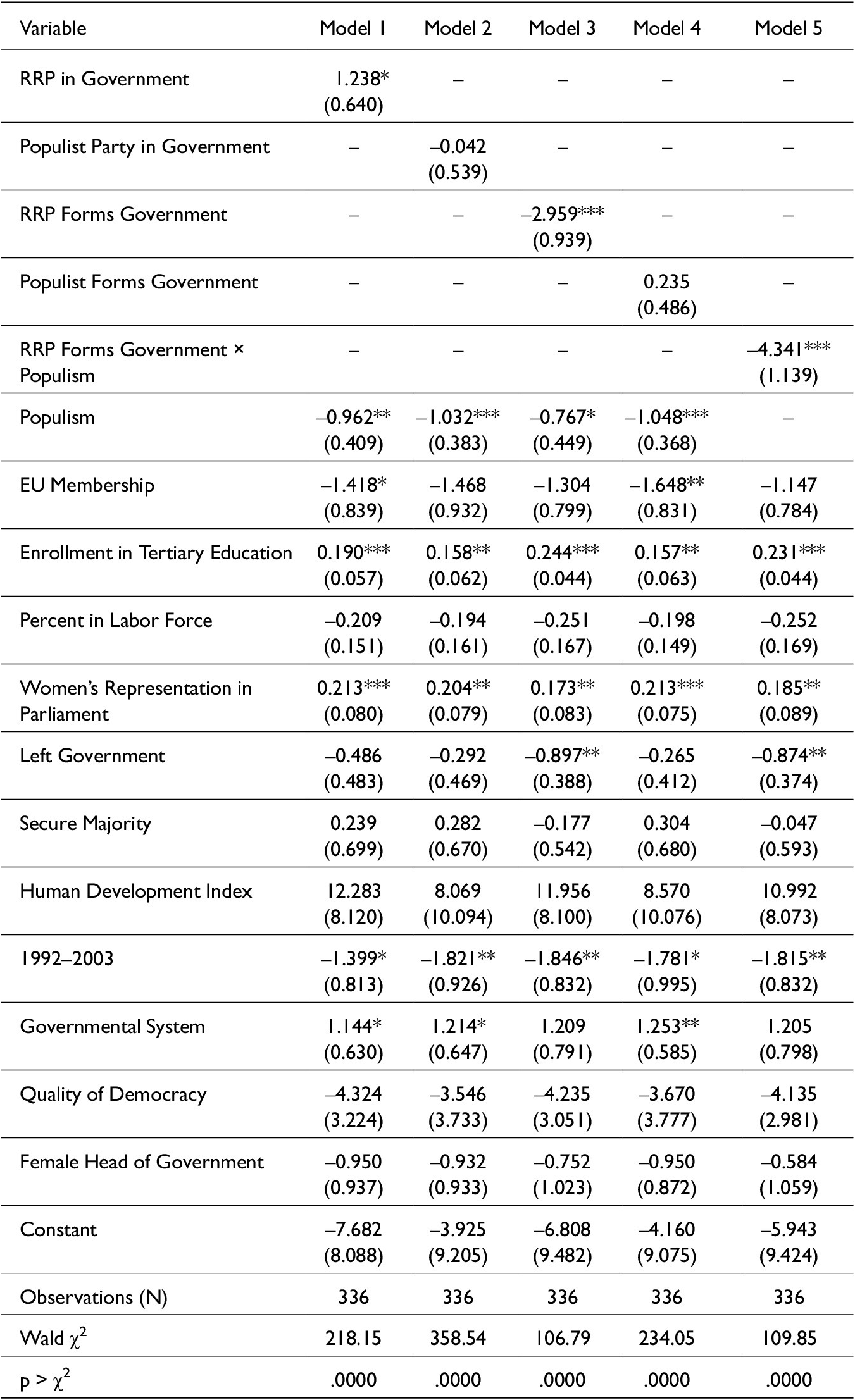
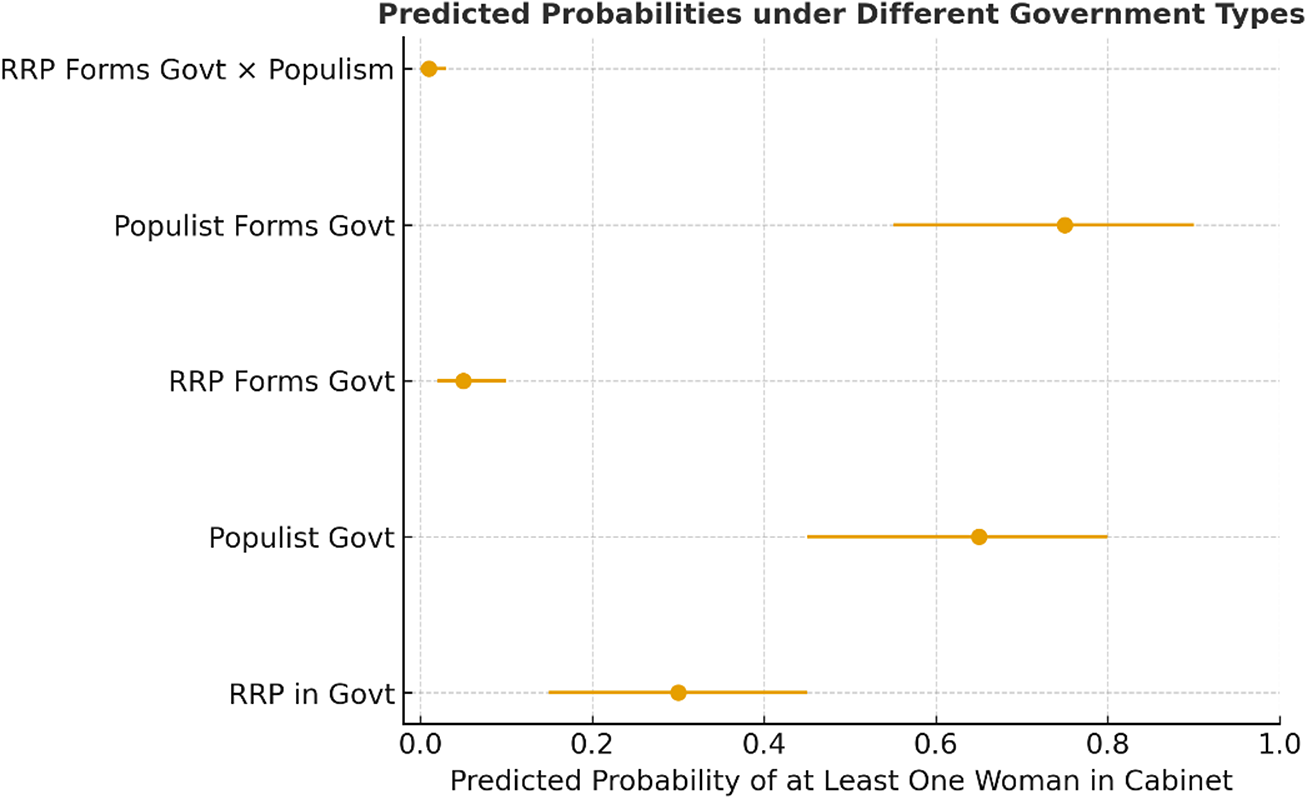
Table 1 summarizes the results for the regression of the various independent variables on the presence of at least one woman in the cabinet. All five models have logistic coefficients with robust standard errors, as the dependent variable follows a binary distribution. In all five models, having an RRP in government has a negative effect on women’s political representation in cabinets, particularly for the return to an all-male cabinet. Holding all other variables constant, the baseline probability of a cabinet including at least one woman is estimated at roughly 0.60–0.70 (60–70%) in contexts without radical right or populist participation. When a radical right populist party joins the government (Model 1), that probability falls to approximately 0.30. When a radical right populist party forms the government (Model 3), the likelihood drops further, to about 0.05, meaning that such cabinets are rarely gender inclusive, supporting Hypothesis H1. By contrast, populist-led governments without a radical right orientation (Model 4) show a small, statistically insignificant increase to roughly 0.75, rejecting Hypothesis H2. Finally, the interaction of radical right governance and populism (Model 5) produces the most pronounced effect: the probability of having even one woman in cabinet declines to just over 1 percent, underscoring the extreme gender exclusivity of radical right populist leadership, supporting Hypothesis H3.
Determinants of at least one woman in the cabinet

Table 1. Long description
Beginning at the top row, the table lists variables in the leftmost column and five models in columns to the right. For ‘R R P in Government’, Model 1 shows minus 1.238 star with standard error 0.640, while other models display a dash. ‘Populist Party in Government’ has a dash in all models except Model 2, which shows minus 0.042 with standard error 0.539. ‘R R P Forms Government’ is significant only in Model 3 with minus 2.959 three stars and standard error 0.939. ‘Populist Forms Government’ is only present in Model 4 with 0.235 and standard error 0.486. The interaction term ‘R R P Forms Government times Populism’ is significant in Model 5 with minus 4.341 three stars and standard error 1.139. ‘Populism’ is negative and significant in Models 1 to 4, ranging from minus 0.962 two stars to minus 1.048 three stars, with standard errors between 0.368 and 0.449. ‘E U Membership’ is negative in all models, significant in Models 1, 4, and 5, with values from minus 1.147 to minus 1.648 and standard errors from 0.784 to 0.932. ‘Enrollment in Tertiary Education’ is positive and significant in all models, ranging from 0.157 two stars to 0.244 three stars, with standard errors from 0.044 to 0.063. ‘Percent in Labor Force’ is negative in all models, with values from minus 0.194 to minus 0.252 and standard errors from 0.149 to 0.169. ‘Women’s Representation in Parliament’ is positive and significant in all models, ranging from 0.173 two stars to 0.213 three stars, with standard errors from 0.075 to 0.089. ‘Left Government’ is negative in all models, significant in Models 3 and 5, with values from minus 0.265 to minus 0.897 two stars and standard errors from 0.374 to 0.483. ‘Secure Majority’ is positive in Models 1, 2, and 4, negative in Models 3 and 5, with values from minus 0.047 to 0.304 and standard errors from 0.542 to 0.699. ‘Human Development Index’ is positive in all models, ranging from 8.069 to 12.283 and standard errors from 8.073 to 10.094. ‘1992–2003’ is negative in all models, significant in Models 1, 2, 3, 4, and 5, with values from minus 1.399 star to minus 1.846 two stars and standard errors from 0.813 to 0.995. ‘Governmental System’ is positive in all models, significant in Models 1, 2, and 4, with values from 1.144 star to 1.253 two stars and standard errors from 0.585 to 0.798. ‘Quality of Democracy’ is negative in all models, with values from minus 3.546 to minus 4.324 and standard errors from 2.981 to 3.777. ‘Female Head of Government’ is negative in all models, with values from minus 0.584 to minus 0.950 and standard errors from 0.872 to 1.059. ‘Constant’ is negative in all models, with values from minus 3.925 to minus 7.682 and standard errors from 8.088 to 9.482. ‘Observations (N)’ is 336 in all models. ‘Wald chi-squared’ ranges from 106.79 to 358.54. ‘p greater than chi-squared’ is .0000 in all models. Footnote at the bottom explains significance: p less than .10, star p less than .05, two stars p less than .01, three stars p less than .001, robust standard errors in parentheses.
^p <.10, *p <.05, **p <.01, ***p <.001; robust standard errors in parentheses.
To visualize these relationships, Figure 1 uses the results from all five models to plot the probability of at least one woman being appointed to a cabinet position. The radical right populist component, not populism per se, is consistently and significantly associated with reduced women’s representation in cabinets. The case of Hungary illustrates this finding. As Fidesz’s populist orientation has intensified over time, successive governments have increasingly excluded women from cabinet posts, culminating in several all-male cabinets.
Predicted probabilities of having at least one woman in cabinet.

Figure 1. Long description
The plot displays five horizontal rows, each representing a government type from top to bottom: R R P Forms Govt times Populism, Populist Forms Govt, R R P Forms Govt, Populist Govt, and R R P in Govt. The x axis is labeled Predicted Probability of at Least One Woman in Cabinet, ranging from 0.0 to 1.0. Each row contains a yellow dot with a horizontal error bar. From top to bottom: R R P Forms Govt times Populism is near 0.0 with a short error bar; Populist Forms Govt is near 0.7 with a long error bar extending from about 0.4 to 1.0; R R P Forms Govt is near 0.1 with a short error bar; Populist Govt is near 0.7 with a long error bar from about 0.4 to 1.0; R R P in Govt is near 0.1 with a short error bar. The highest probabilities are for Populist Forms Govt and Populist Govt, while the lowest are for R R P-related categories.
The results from Table 1 also indicate the continued importance of some structural variables identified by past work. I find support for the claim that higher rates of higher education enrollment, as well as higher representation of women in parliament, correlate strongly with inclusion of women in cabinet. Furthermore, as expected, as time has passed, the odds of having one woman in the cabinet have increased. As CEE countries have become members of the EU, surpassing the accession period, they are less likely to include at least one woman in cabinet, suggesting that potentially EU requirements for inclusion have a temporary effect. Left government has a negative effect, confirming the existing literature, which shows that in the Central and Eastern European context, left-leaning governments may not be consistently more inclusive toward women in cabinet. There is also a significant effect favoring semi-presidential systems as more egalitarian than parliamentary ones. The level of democracy and a female head of government are surprisingly negative, suggesting that higher democracy scores or having a female executive leader do not directly translate into more inclusive cabinets in this sample.
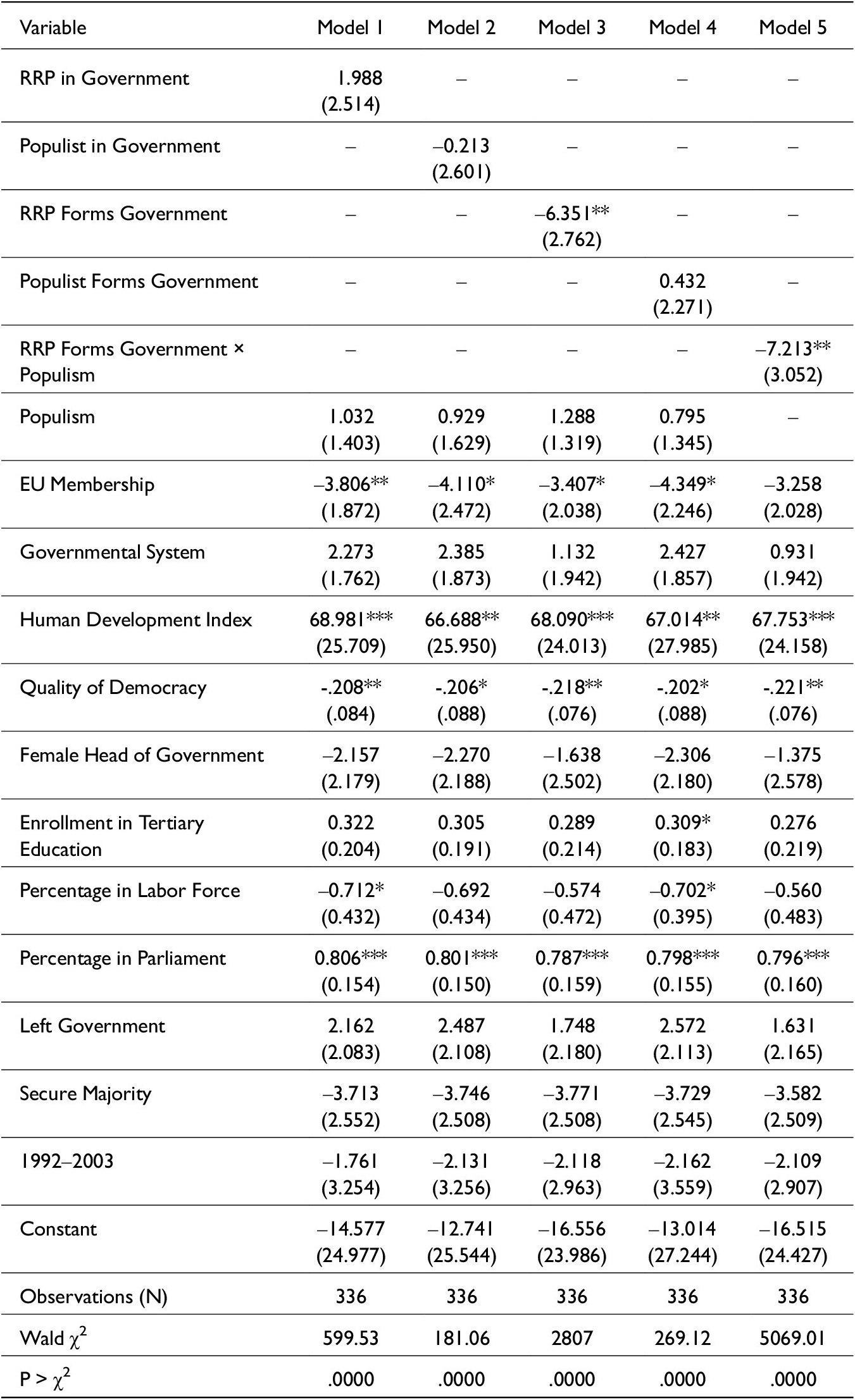
Table 2 presents the results for the regression of the various independent variables on the percentage of women ministers. All five models produce OLS coefficients with a specified Gaussian distribution and identity link. In Model 1, radical-right populist participation in government alone slightly lowers women’s share of cabinet portfolios, but the effect is not statistically significant. However, in Model 3, when RRPs form governments, the share of women in cabinets drops by about 6.4 percentage points, a strong, significant, and substantively large decline. Thus, I find partial support for Hypothesis H4. In Models 2 and 4, populist parties serving in government as well as leading the government do not have an impact on women’s cabinet share, suggesting that populist parties are maintaining the egalitarian norms of their predecessors, rejecting Hypothesis H5. Finally, in Model 5, the interaction term reveals the most pronounced effect: when a highly populist radical-right party governs, the share of women in cabinet portfolios declines by about seven percentage points, controlling for other factors.
Determinants of women’s share of cabinet portfolios

Table 2. Long description
Beginning at the top, the table lists variables in the leftmost column and five models in adjacent columns. For ‘R R P in Government’, Model 1 shows minus 1.988 (2.514), others are dash. ‘Populist in Government’ is dash except Model 2, minus 0.213 (2.601). ‘R R P Forms Government’ is dash except Model 3, minus 6.351 double asterisk (2.762). ‘Populist Forms Government’ is dash except Model 4, 0.432 (2.271). ‘R R P Forms Government times Populism’ is dash except Model 5, minus 7.213 double asterisk (3.052). ‘Populism’ coefficients are positive in Models 1 to 4, ranging from 0.795 (1.345) to 1.288 (1.319), dash in Model 5. ‘E U Membership’ is negative and significant in all models, ranging from minus 3.806 double asterisk (1.872) to minus 4.349 single asterisk (2.246). ‘Governmental System’ coefficients are positive, from 0.931 (1.942) to 2.427 (1.857). ‘Human Development Index’ is strongly positive and significant in all models, from 66.688 double asterisk (25.950) to 68.981 triple asterisk (25.709). ‘Quality of Democracy’ is negative and significant, from minus 0.206 single asterisk (0.088) to minus 0.221 double asterisk (0.076). ‘Female Head of Government’ is negative in all models, from minus 1.375 (2.578) to minus 2.306 (2.180). ‘Enrollment in Tertiary Education’ is positive, from 0.276 (0.219) to 0.322 (0.204), Model 4 is significant. ‘Percentage in Labor Force’ is negative, from minus 0.560 (0.483) to minus 0.712 single asterisk (0.432). ‘Percentage in Parliament’ is positive and highly significant in all models, from 0.796 triple asterisk (0.160) to 0.806 triple asterisk (0.154). ‘Left Government’ is positive, from 1.631 (2.165) to 2.572 (2.113). ‘Secure Majority’ is negative, from minus 3.582 (2.509) to minus 3.771 (2.508). ‘1992–2003’ is negative, from minus 1.761 (3.254) to minus 2.162 (3.559). ‘Constant’ is negative, from minus 12.741 (25.544) to minus 16.556 (23.986). ‘Observations’ is 336 for all models. ‘Wald chi-squared’ ranges from 181.06 to 5069.01. ‘P greater than chi-squared’ is 0.0000 for all models. Footnote: p less than 0.10, single asterisk p less than 0.05, double asterisk p less than 0.01, triple asterisk p less than 0.001; robust standard errors are in parentheses.
^p <.10, *p <.05, **p <.01, ***p <.001; robust standard errors in parentheses.
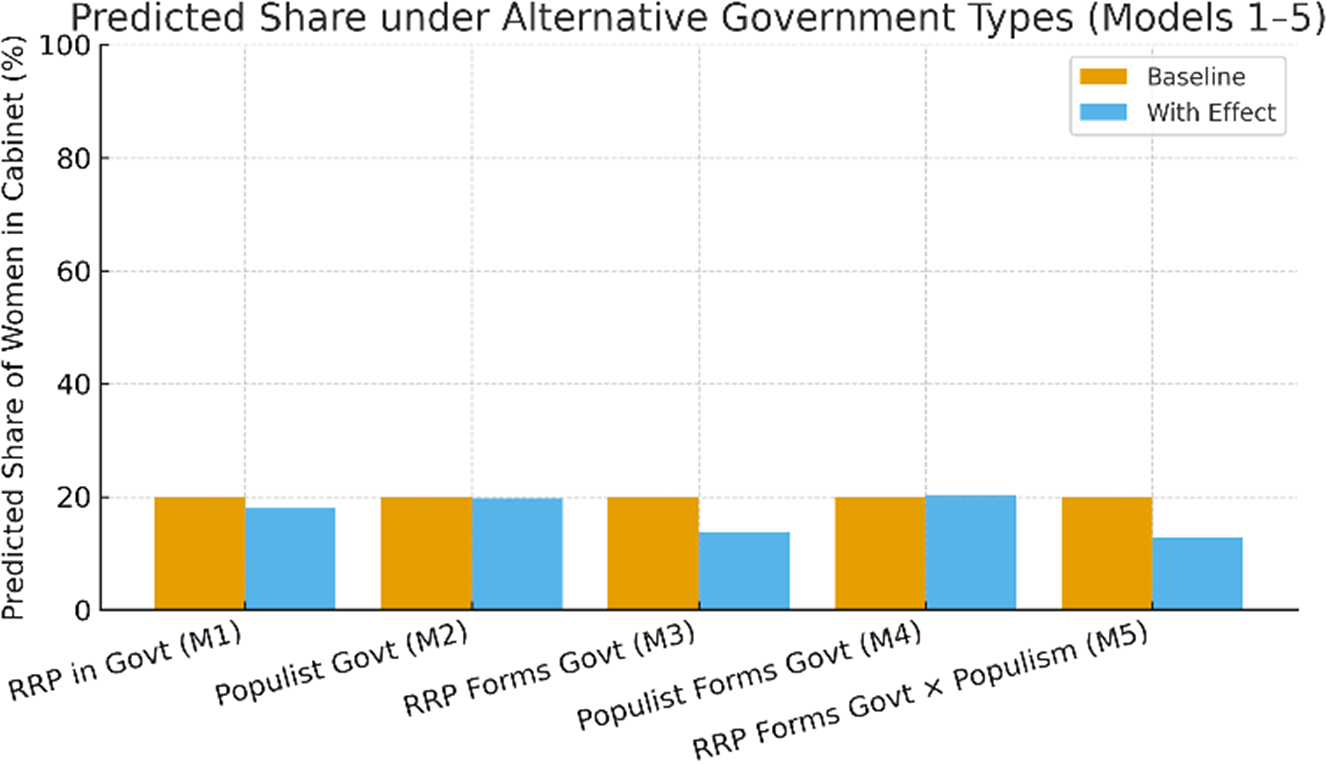
To visually illustrate these effects, Figure 2 shows average predicted shares of women’s cabinet portfolios, holding other covariates at their means, and using 95% confidence intervals. Baseline predictions correspond to non-populist, non-radical-right governments (approximately 20%). Under radical-right populist leadership (Models 3 and 5), the predicted share of women in cabinet portfolios declines by roughly 6–7 percentage points, whereas general populist governments (Models 2 and 4) exhibit no measurable difference from the baseline. Once again, these models demonstrate that radical-right populist leadership exerts the clearest and most consistent negative effect on women’s representation in cabinets.
Predicted share of women in cabinets under RRP and populist governments.

As far as other covariates, both women’s higher education and women’s representation in parliament continue to remain robustly positive and highly significant, as is the human development index, indicating that socio-economic development strongly favors women’s political inclusion. Left government and coalition majority have no consistent effects, and the time variable and governmental system are not statistically significant. The EU variable remains negative and marginally significant, implying that EU integration alone does not guarantee higher female representation at the executive level. The quality of democracy seems to again have an unexpectedly negative and significant effect on women’s representation in the executive. This is potentially explained by the fact that, although countries like the Czech Republic, Hungary, and Poland have experienced a heightened level of populism, their democracy scores have remained higher than those of countries such as Albania or Romania, where populism has been at an all-time low.
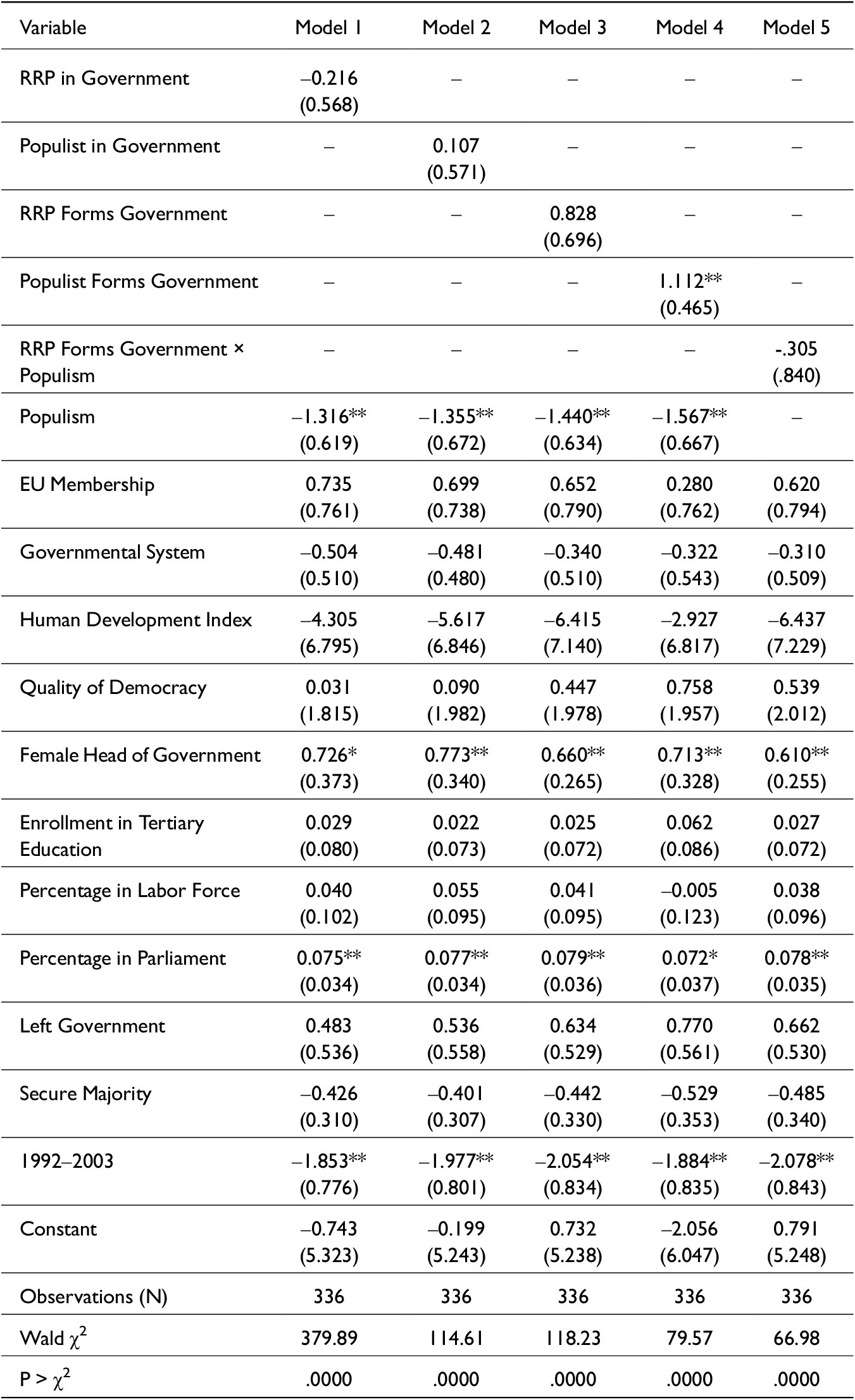
Regarding prestigious positions, Table 3 summarizes the results for the regression of the various independent variables on the appointment of at least one woman to a top cabinet post.
Determinants of women’s control of high-prestige cabinet portfolios

Table 3. Long description
Beginning at the top, the table lists variables in the leftmost column: R R P in Government, Populist in Government, R R P Forms Government, Populist Forms Government, R R P Forms Government times Populism, Populism, E U Membership, Governmental System, Human Development Index, Quality of Democracy, Female Head of Government, Enrollment in Tertiary Education, Percentage in Labor Force, Percentage in Parliament, Left Government, Secure Majority, 1992–2003, Constant, Observations (N), Wald chi-squared, and P greater than chi-squared. Each variable’s coefficient and robust standard error (in parentheses) are presented for Models 1 through 5, moving horizontally. Significant coefficients are marked with one, two, or three asterisks, denoting p less than .05, p less than .01, and p less than .001, respectively. For example, Populism shows negative significant coefficients in Models 1 to 4, ranging from minus 1.316 double asterisk (0.619) to minus 1.567 double asterisk (0.667). Female Head of Government is positive and significant in all models, with coefficients from 0.726 single asterisk (0.373) to 0.610 double asterisk (0.255). Percentage in Parliament is positive and significant in all models, with coefficients from 0.075 double asterisk (0.034) to 0.079 double asterisk (0.036). Populist Forms Government is significant only in Model 4, with 1.112 double asterisk (0.465). Other variables, such as E U Membership, Governmental System, Human Development Index, Quality of Democracy, Enrollment in Tertiary Education, Percentage in Labor Force, Left Government, Secure Majority, and 1992–2003, show varying coefficients and significance across models. The bottom rows report 336 observations for each model, Wald chi-squared values from 379.89 to 66.98, and P greater than chi-squared as .0000 for all models. Robust standard errors are provided in parentheses.
^p <.10, *p <.05, **p <.01, ***p <.001; robust standard errors in parentheses.
RRPs do not significantly affect women’s appointments to top cabinet roles, even when coupled with a high level of populism, thereby rejecting Hypotheses H7 and H9. The only significant finding in this section of the analysis is that when populist parties form governments, the odds of at least one woman being appointed to a prestigious position increase, contrary to Hypothesis H8, which predicted a negative relationship. In fact, when a populist party is responsible for cabinet formation, the odds that a woman occupies a high-prestige cabinet post are about three times higher than when cabinets are formed by non-populist governments. For instance, although Slovakia has consistently had a populist party in government, women have frequently held prestigious portfolios such as Foreign Affairs, Finance, or Defense. This finding supports recent scholarship suggesting that some populist parties strategically include women in visible leadership roles to broaden their electoral appeal and secure their long-term success. Nevertheless, further research is needed to explain why some populist parties adopt inclusive strategies while others pursue exclusionary and radical trajectories.
The coefficient for populism is negative and significant, indicating that as populism rises, it reverses the strategic appointments of mainstream populist parties. Each unit increase in populism decreases the odds of a woman holding a high-prestige cabinet post by nearly 80%. Institutional variables such as EU membership, governmental system, education, participation in the labor force, and human development remain statistically insignificant across all five models, indicating that structural factors do not explain variation in women’s control of high-prestige portfolios, but political ideology and opportunities are more detrimental. The time variable shows negative and significant coefficients, consistent with the gradual improvement in women’s cabinet presence over time.
Women’s representation in parliament remains positive once again, showing that there is a strong pipeline connection between women elected in the legislative branch and those appointed to prestigious executive posts. More research is needed to explore this relationship in CEE, where the weak party institutionalization and the highly centralized nature of executive recruitment have made it difficult to understand the causal mechanisms at play. In addition, when a woman is head of government, the odds that another woman holds a high-prestige cabinet post double compared to when a man is head of government. This finding requires further exploration, given the small number of cases with a female head of government,Footnote 6 but it is nevertheless telling that symbolic representation matters for women’s political inclusion.
Comparing Model 1 to Model 3, it is evident that radical right parties exert a more detrimental effect on women’s entry into the executive office itself and not necessarily on the prestige of the post once inclusion occurs. These results suggest that under highly populist RRP governments, women face the greatest barriers at the point of cabinet entry. While their chances of being appointed to a prestigious post may still be reduced, the degree of exclusion is less severe once they are part of the cabinet.
Conclusions
Although populism and the radical right have gained ground in the CEE region in the last two decades, no study to date has comprehensively assessed how these new political forces are directly affecting women’s political representation in the executive branch. This comprehensive study explores whether RRPs and populist parties in CEE are indeed appointing women to cabinet positions at the same rate as non-RRP and non-populist parties, and whether they are engaging in meaningful, prestigious appointments or symbolic ones. The analysis reveals that RRPs have a detrimental effect on the likelihood of a cabinet including at least one woman minister and on the overall proportion of women appointed. Additionally, higher levels of populism among radical right parties forming governments are significantly associated with a decreased probability that a woman is included in the cabinet at all. The analysis demonstrates that highly populist RRPs in CEE have the potential not only to erode the “concrete floor” that has historically guaranteed women’s minimum presence in cabinets by blocking their initial entry, but also to more generally prevent more women from accessing cabinet positions in the executive branch. Moreover, these parties do not appear to use cabinet appointments strategically to broaden their appeal among female voters. Regardless of the level of populism, RRP governments in Central and Eastern Europe are significantly less likely to include women in any cabinet posts, including high-prestige ministries. Thus far, RRPs have not learned the expectation of equality; on the contrary, they appear to be reversing it across the ideological spectrum, raising the prospect of a return to all-male cabinets, especially when the parties are highly populist.
Populist parties, in general, have not had a significant effect on women’s representation in CEE cabinets. Despite their frequent use of traditionalist or pro-family rhetoric, these parties have not acted as a barrier to women’s entry into executive office. In fact, when mainstream populist parties have had a chance to govern, they have often appointed women to prestigious positions, signaling an effort to broaden their appeal and legitimize their leadership through women’s representation in cabinets. In several cases, mainstream populist parties have even facilitated women’s advancement. For example, Citizens for European Development of Bulgaria appointed a record 43.75% of women to cabinet posts in 2017. Similarly, in Hungary, women occupied prestigious portfolios such as Foreign Affairs prior to Fidesz’s turn to nativism in 2015. The inclusive patterns reverse when populist parties take a radical turn and become highly populist, employing nativist and authoritarianist agendas. In such cases, women’s representation in the executive declines significantly as evidenced by Poland’s Law and Justice party, whose populist score rose from 0.768 in 2001 to 0.974 in 2015, becoming one of the most populist parties in Central and Eastern Europe. This transformation illustrates how populism’s impact on women’s executive representation is contingent upon its ideological trajectory: while moderate populists may use women’s appointments for symbolic or strategic purposes, radical variants often reinforce patriarchal norms and restrict women’s access to power. This difference demonstrates that populism alone is not inherently against women’s political leadership. Its exclusionary actions emerge when populist movements blend their anti-elite discourse with nationalist and authoritarian values.
Future research should unpack the ideological and strategic mechanisms driving variation among populist parties: why some take an exclusionary and radical trajectory while others pursue mainstream or inclusive strategies that offer opportunities for women’s advancement. Furthermore, longitudinal studies could further assess how women’s executive participation evolves as populist movements consolidate power over time, shedding light on whether early inclusion represents a temporary phenomenon or a sustainable strategy that might lead to a political opportunity for women’s political representation.
This study’s findings have implications for future research beyond the CEE region, as radical right parties have gained traction in other parts of the world. Future research should extend this analysis beyond Central and Eastern Europe to examine how populism shapes women’s cabinet appointments in other regional contexts, particularly where party ideologies are more established and norms of gender equality may be more deeply embedded within political systems. Additionally, the effects of COVID-19 may have altered the strategies of how RRPs and populist parties appoint women to cabinets. Existing literature tells us that crises are gendered events, and at times, they may present a political opportunity for women (Armstrong et al. Reference Armstrong, Barnes, O’Brien and Taylor-Robinson2022). Ultimately, future work should build on the results of this study and further examine what a decline in women’s representation in the executive means for the quality of democracy and the long-term consequences of populist and radical governance.