I. INTRODUCTION
It is well known that silkworm produces fibers from an aqueous solution under atmospheric pressure and room temperature.Reference Shao and Vollrath1,Reference Vepari and Kaplan2 The silk fibers have broad applications due to the outstanding mechanical properties and biocompatibility. So the methods to obtain high performance silk fibers from regenerated silk fibroin (RSF) solutions have been investigated with great attentions.Reference Kanekatsu3–Reference Kawahara, Nakayama, Matsumura, Yoshioka and Tsuji5 Wet spinning technology was widely used in producing RSF fibers. However, most of the solvents and coagulation baths used in the wet spinning process were too expensive or toxic.Reference Matsumoto, Uejima, Iwasaki, Sano and Sumino6–Reference Zhou, Shao, Knight, Yan and Chen9 In addition, the wet spinning process is also different from the natural dry spinning process of silkworm without a coagulation bath.
Recently, Zhu et al.Reference Zhu, Zhang, Shao and Hu10 successfully prepared RSF fibers by the dry spinning process from highly concentrated RSF aqueous solutions with the adjustment of the pH value and metal ion (such as Ca2+) concentrations. Wei et al.Reference Wei, Zhang, Shao and Hu11–Reference Wei, Zhang, Zhao, Shao and Hu13 and Sun et al.Reference Sun, Zhang, Zhao, Luo, Shao and Hu14 further studied the effect of the pH value on the properties of dry-spun fibers and developed a posttreatment method to improve the mechanical properties of RSF fibers. However, the process they adopted needs to adjust the pH value of RSF aqueous solution using a buffer reagent. It contains many complex steps that may result in the liquid waste of buffer reagent and the extension of processing time.
In this study, a simplified process without an adjustment of pH value of the solution and with solely adding Ca2+ was proposed to prepare dry spinnable RSF aqueous solution. The solution was used to dry-spin fibers, and the as-spun fibers were then posttreated to improve their mechanical properties. Meantime, the structures and properties of the RSF aqueous solution and the resultant dry-spun fibers were investigated. The goal of the current work was to provide an environmentally friendly and simple dry spinning technology to prepare high performance RSF fibers.
II. EXPERIMENTAL METHODS
A. Simplified preparation of dry spinnable RSF aqueous solution
Bombyx mori cocoons from Zhejiang province, China, were degummed twice in Na2CO3 aqueous solutions (0.5 wt%) at 100 °C for 30 min each and washed with deionized water to remove sericin. After drying, the degummed cocoon silks were dissolved in 9.0 M LiBr aqueous solution with a ratio of 1:10 (w/v) at 40 °C for 2 h. This solution was then diluted, centrifugalized, filtered, and dialyzed in deionized water at 10 °C for 3 days using a cellulose semipermeable membrane (MWCO: 14,000 ± 2000). The 20 wt% RSF aqueous solution was obtained after being condensed by forced airflow at 10 °C, and a 3 mol/L CaCl2 aqueous solution was added into the RSF system to adjust the concentration of Ca2+ to 0.3 M (pH ≈ 7.5). Then the mixture was condensed to a RSF concentration of 40–60 wt% for dry spinning and measurements. We named this kind of dry spinnable RSF aqueous solution as simply prepared RSF aqueous solution (Sim-Sol).
B. Conventional preparation of RSF aqueous solution
The RSF aqueous solution with a pH value of 4.8 and a Ca2+ concentration of 0.3 M was also prepared for comparison. The preparation process was the same as the work reported by Wei et al.Reference Wei, Zhang, Shao and Hu11 previously. We named this kind of dry spinnable RSF aqueous solution as conventionally prepared RSF aqueous solution (Con-Sol).
C. Preparation of dry-spun RSF fiber and its posttreatment process
A capillary spinning equipment was applied to spin RSF fibers from RSF aqueous solution in air. The capillary length, the capillary inner diameter, and the take up speed during spinning were 20 mm, 250 μm, and 30 mm/s, respectively. The 80 vol% ethanol aqueous solution was chosen as the posttreatment agent of the as-spun fibers. All the RSF fibers were drawn with 4× draw ratio in ethanol aqueous solution and then immersed in the same solution under tension for 3 h.
D. Characterization
The rheological measurements of RSF aqueous solutions were performed on a RS150L rheometer (Thermo-Haake, Karlsruhe, Germany) at 25 ± 0.1 °C using a parallel plate configuration with a diameter of 20 mm.
Raman spectra of RSF aqueous solutions and silk fibers were obtained using a LabRam1B microscopy Raman spectrometer (Dilor, Lille, France). A He–Ne laser at 632.8 nm was used to generate an intensity of 6 mW on the samples, and the data were recorded from 900 to 1800 cm−1. The quantitative analysis of the amide I region was conducted under a deconvolution method reported by Zhou et al.Reference Zhou, Chen, Shao, Huang and Knight15 In the amide I region, the following three peaks of silk fibroin are commonly used: 1670 ± 5 cm−1 is attributed to β-sheet conformation, 1655 ± 5 cm−1 to random coil/α-helix conformation, and 1680 ± 5 cm−1 to intermediate conformation between random coil and β-sheet. Additionally, percentage of the peak area of 1615 cm−1 band assigned to the phenyl group of tyrosine residues was used as an invariant internal standard to check the validity of each analysis. In our studies on the Raman spectra, this value was controlled to be about 5% of the total peak area for the above four peaks.
The mean diameters of RSF aggregates in aqueous solution were measured using a BI-200SM dynamic laser light scattering instrument (Brookhaven Instruments Corp., Holtsville, NY) at 25 ± 0.1 °C. The wave length of 532 nm was used as the light source at a scattering angle of 90°. The conventionally prepared and simply prepared RSF aqueous solutions were diluted, respectively, before measurement.
The mechanical properties of the RSF fibers and degummed cocoon silk were investigated using an Instron 5565 material testing instrument (Instron Ltd., High Wycombe, UK) at 25 °C and 65 ± 5% relative humidity. Tensile tests were performed at an extension rate of 2 mm/min, with a gauge length of 15 mm. The diameters of the silk fibers were measured according to the method reported by Sun et al.Reference Sun, Zhang, Zhao, Luo, Shao and Hu14 The results for the diameters and mechanical properties of fibers were the mean of 10 measurements for each sample.
Wide-angle x-ray diffraction (WAXD) experiments for RSF fibers and degummed cocoon silk were performed at BL15U1 beamline in Shanghai Synchrotron Radiation Facility with a spot size of 10 ×10 μm and a wave length of 0.07746 nm. Each monofilament sample was horizontally glued to a cardboard frame and then exposed for 20 s. The detector-to-sample distance was calibrated by lanthanum hexaboride to 119.516 mm. All two-dimensional (2D) detector images were analyzed using FIT2D software to produce one-dimensional (1D) intensity profiles. Reflection profiles were radially or azimuthally integrated with a region of 180° and fitted by Lorenz profiles.Reference Glisovic and Salditt16 The position for amorphous region of the samples in the intensity profile was evaluated to be at the d-spacing of 4.1 Å by using an amorphous RSF film cast from RSF aqueous solution. The crystallinity of the fiber was then determined by peak separation analysis.Reference Sun, Zhang, Zhao, Luo, Shao and Hu14 The crystallite size was calculated according to the Scherrer's equation.Reference Shen, Johnson and Martin17 The azimuthal scan was performed on the 2D WAXD patterns at a d-spacing of 4.3 Å. The crystalline orientation along the fiber axis was estimated by the Herman's orientation factor.Reference Um, Kweon, Lee, Ihm, Lee and Park8
III. RESULTS AND DISCUSSION
A. Characteristics of RSF aqueous solutions
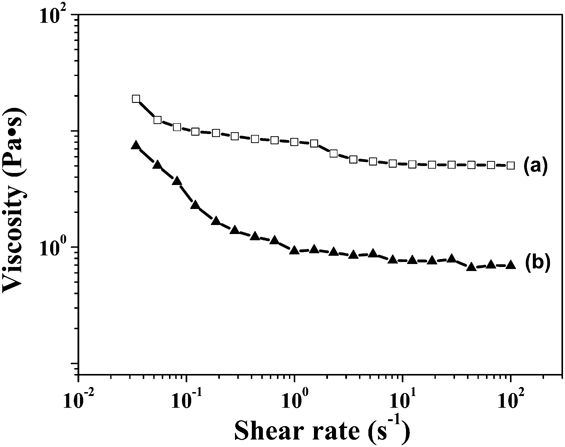
Figure 1 shows the rheological results of the Con-Sol and Sim-Sol. It was found that the rheological characteristics of the two samples were similar. When the shear rate was low, both RSF aqueous solutions exhibited shear thinning behavior. As the shear rate increased, the viscosity of RSF aqueous solutions became stable. However, compared with the Con-Sol, the Sim-Sol showed relatively low viscosity. This is because the pH value of the Con-Sol was adjusted to 4.8, which was close to the isoelectric point of silk fibroin (pI = 4.4–5.0).Reference Foo, Bini, Hensman, Knight, Lewis and Kaplan18 Accordingly, the viscosity of the dope increased due to the closer silk fibroin chains and the consequent enhanced intermolecular interaction of silk fibroin molecules.
Rheological results of RSF aqueous solutions: (a) Con-Sol and (b) Sim-Sol.

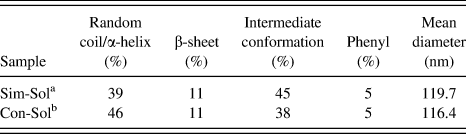
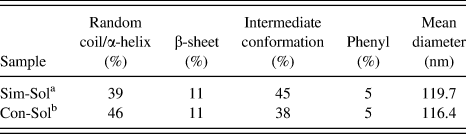
Moreover, it is well known that Raman spectroscopy is a powerful method for the investigation of the conformations of silk protein.Reference Shao, Zheng, Liu and Carr19,Reference Monti, Freddi, Bertoluzza, Kasai and Tsukada20 In this work, a deconvolution method (see Sec. II. D) was further used to conduct the quantitative structural analysis from the amide I region of Raman spectra for the above samples. By using this method, some main components of secondary structure in RSF aqueous solutions were investigated. Meanwhile, the aggregation behavior of RSF in aqueous solutions was also investigated by dynamic laser light scattering. Table I gives the quantitative analysis results of the amide I region in Raman spectra of the above two RSF aqueous solutions and the mean diameter of RSF aggregates in the solutions. It was found that both Sim-Sol and Con-Sol were mainly in random coil/α-helix and intermediate conformation. Not only the mean diameter of RSF aggregates but also the content of β-sheet conformation in both solutions were nearly the same. It has been known that the lower pH value may result in changes in the secondary structure by making the silk fibroin chains closer,Reference Wei, Zhang, Zhao, Shao and Hu13,Reference Foo, Bini, Hensman, Knight, Lewis and Kaplan18 and the divalent Ca2+ contains two positive charges that are helpful in the aggregation of silk fibroin molecules and the formation of β-sheet by means of ionic interactions.Reference Foo, Bini, Hensman, Knight, Lewis and Kaplan18,Reference Zhou, Xie, Deng, Ping, Xun and Feng21,Reference Nagano, Sato, Tanioka, Nakazawa, Knight and Asakura22 Our results indicated that compared with the effect of pH value, the chelation of Ca2+ played a dominant role in inducing the aggregation of RSF and the formation of β-sheet conformation in the solution.
Quantitative analysis results of the amide I region in Raman spectra of RSF aqueous solutions and the mean diameter of RSF aggregates in the solutions.
a Without an adjustment of pH value, pH ≈ 7.5.
b With the adjustment of pH value to 4.8.
B. Mechanical properties of RSF fibers
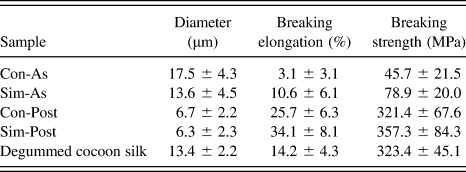
Figure 2 shows the typical stress–strain curves of the dry-spun RSF fibers and degummed cocoon silk. Meanwhile, the mean diameters and mechanical properties for each fiber sample were listed in Table II. It was clear that the simply prepared as-spun (Sim-As) fibers were stronger and more extensible than the conventionally prepared as-spun (Con-As) fibers. However, compared with the degummed cocoon silk, the mechanical properties of the as-spun fibers were still poor. Thus, the posttreatment in the 80 vol% ethanol aqueous solution was carried out on the as-spun fibers to improve their performance (see Sec. II. C). Here, the posttreated Sim-As fibers and Con-As fibers were named as Sim-Post fibers and Con-Post fibers, respectively. As shown in Fig. 2, it was found that the mechanical properties of the RSF fibers were remarkably improved by the posttreatment process in the ethanol aqueous solution. The Sim-Post fibers showed a breaking strength of 357 MPa and an elongation at break of 34%, which were higher than those of the degummed cocoon silk and the Con-Post fibers. These results implied that the high performance RSF fibers could be prepared from RSF aqueous solution without the adjustment of pH value.
Typical stress–strain curves of RSF fibers and degummed cocoon silk: (a) Con-As, (b) Sim-As, (c) Con-Post, (d) Sim-Post, and (e) degummed cocoon silk.
Diameters and mechanical properties of RSF fibers and degummed cocoon silk.
C. Secondary structures of RSF fibers
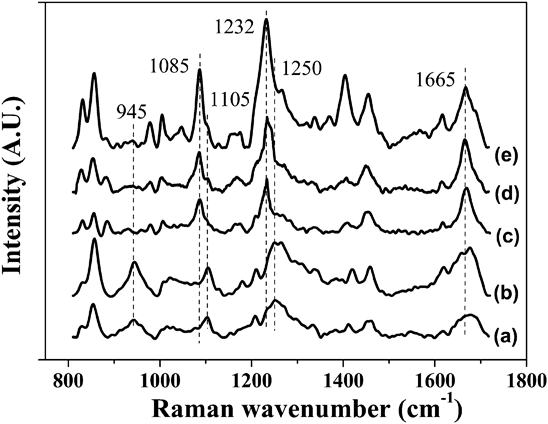
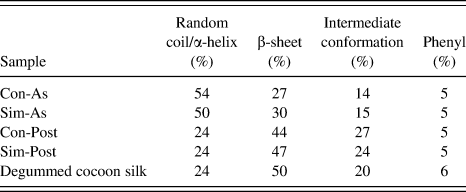
Figure 3 gives the Raman spectra of dry-spun RSF fibers and degummed cocoon silk. It was found that the conformations of both as-spun fibers were mainly α-helix (945, 1105 cm−1) and random coil (1250 cm−1). However, for both posttreated fibers, the characteristic peaks of β-sheet conformation at 1085, 1232, and 1665 cm−1 were observed, whereas the peaks at 945, 1105, and 1250 cm−1 became weak. These results implied that the conformation of the fibers changed from random coil/α-helix to β-sheet after the as-spun fibers were posttreated. Furthermore, some main components of the secondary structures of RSF fibers and degummed cocoon silk were investigated by using the deconvolution method. The results were listed in Table III. It was further found that the β-sheet content of Sim-As fiber was closer to that of Con-As fiber but much lower than that of the degummed cocoon silk. After posttreatment, the β-sheet conformation became to be dominant. The β-sheet content of Sim-Post fiber was increased to 47%, which was a little higher than that of Con-Post fiber and approached that of the degummed cocoon silk. These results also indicated the posttreatment facilitated the conformational transition of RSF fibers to β-sheet, whereas the adjustment of pH value of the RSF aqueous solution had no obvious positive effect on the above conformational transition of RSF fibers. Consequently, the step of adjusting pH value seems to be unnecessary and can be skipped in the process of preparing dry spinnable RSF aqueous solution.
Raman spectra of RSF fibers and degummed cocoon silk: (a) Con-As, (b) Sim-As, (c) Con-Post, (d) Sim-Post, and (e) degummed cocoon silk.
Quantitative analysis results of the amide I region in Raman spectra of RSF fibers and degummed cocoon silk.
D. Crystalline structures of RSF fibers
Figure 4 shows the 2D WAXD patterns of dry-spun RSF fibers and the degummed cocoon silk. It was found that the degummed cocoon silk showed apparent stronger diffraction patterns of some lattice planes [such as (200), (020), (021), and (002), etc.] of the crystallite resulted from the β-sheet structure, indicating that the degummed cocoon silk had higher crystallinity and crystalline orientation. Meanwhile, reflections appeared as rings and arcs in the 2D WAXD patterns of as-spun fibers and posttreated fibers, respectively. This indicated that the posttreatment improved the crystalline orientation of RSF fibers.
2D WAXD patterns of RSF fibers and degummed cocoon silk: (a) Con-As, (b) Sim-As, (c) Con-Post, (d) Sim-Post, and (e) deg ummed cocoon silk.
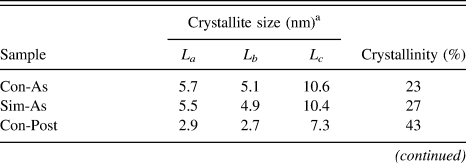
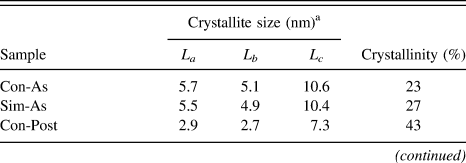
The crystallinity and crystallite size of all samples are given in Table IV. Obviously, the posttreated fibers showed much higher crystallinity and smaller crystallite size than the as-spun fibers, which indicated that the posttreatment process improved the crystallization of RSF fiber. Moreover, the Sim-Post fiber exhibited smaller crystallite size than others and higher crystallinity close to that of the degummed cocoon silk. The fiber with a higher crystallinity and smaller crystallite size had more small crystallites that may serve as physical cross-linked points. This was more favorable for the improvement of the mechanical properties of RSF fiber.
Crystallite size and crystallinity of RSF fibers and degummed cocoon silk.
a The fiber axis is taken as c-axis. The axis along the direction of the hydrogen bonds between the antiparallel chains is placed as a-axis, the b-axis is perpendicular to pleated sheets.
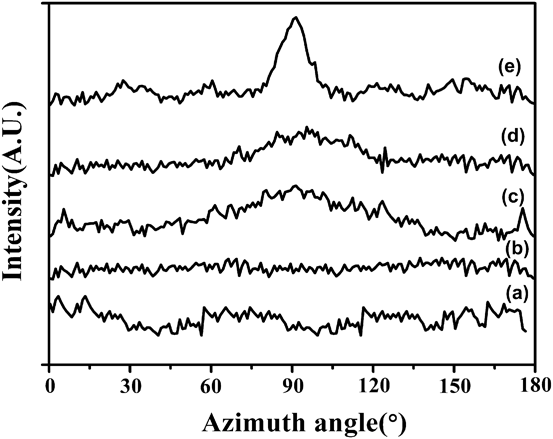
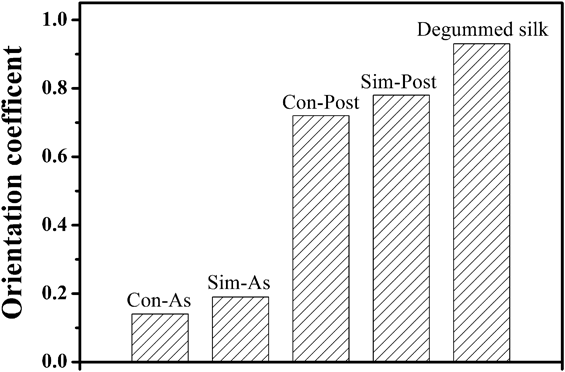
Figure 5 shows the azimuthal scan results of RSF fibers and degummed cocoon silk at the d-spacing of 4.3 Å corresponding to the (200) lattice plane of the crystallite from β-sheet. In Fig. 5, the peak intensity at 90° is attributed to the alignment of interchains in the β-sheet structure and represents the crystalline orientation along the fiber axis.Reference Um, Kweon, Lee, Ihm, Lee and Park8Figure 6 further shows the calculated crystalline orientation coefficients (i.e., Herman's orientation factor)Reference Um, Kweon, Lee, Ihm, Lee and Park8 of RSF fibers and degummed cocoon silk. It was found that both as-spun fibers had lower crystalline orientation (∼0.22), whereas the crystalline orientation coefficients of the posttreated fibers were higher (∼0.78) and close to that of degummed cocoon silk (∼0.93). Combined with the above crystallinity and crystallite size results, it further implied that during the preparation of dry-spun RSF fibers, the adjustment of pH value of the spinning solution had no positive effect on the improvement of crystalline structure of resultant fibers and could be excluded.
Azimuthal scan results of RSF fibers and degummed cocoon silk at the d-spacing of 4.3 Å: (a) Con-As, (b) Sim-As, (c) Con-Post, (d) Sim-Post, and (e) degummed cocoon silk.
Crystalline orientation coefficients of RSF fibers and degummed cocoon silk.
IV. CONCLUSIONS
A simplified process without an adjustment of pH value of the solution and with solely adding Ca2+ was developed to prepare dry spinnable RSF aqueous solution. This process avoided the complicated steps and the liquid waste caused by the adjustment of pH value of the solution in the conventional process. The RSF fiber dry-spun from the simply prepared RSF aqueous solution and posttreated in the ethanol aqueous solution showed higher crystallinity and crystalline orientation, smaller crystallite size, and better mechanical properties. Therefore, it could be concluded that the step of the adjusting pH value seemed to be unnecessary and could be excluded in the process of preparing dry spinnable RSF aqueous solution. By using the simplified preparation process with solely adding Ca2+, an environmentally friendly and simple dry spinning technology to prepare high performance RSF fibers was provided.
ACKNOWLEDGMENTS
This work is supported by the National Natural Science Foundation of China (Grant Nos. 21274018, 50803011, and 81170641), the Specialized Research Fund for the Doctoral Program of Higher Education (Grant No. 200802550001), the Innovation Program of Shanghai Municipal Education Commission (Grant No. 12ZZ065), the Shanghai Rising-Star Program (Grant No. 12QA1400100), and the Fundamental Research Funds for the Central Universities.