Monetary policy is an inherently forward-looking enterprise. Beliefs about the economy’s future course significantly guide the setting of interest rates (Goodhart Reference Goodhart2001, 59). Government policies as diverse as tax, spending, and regulatory policies have important effects on changes in growth, inflation, and unemployment. Further, a government’s party identification can serve as a cue for the types of economic policies that it is likely to pursue during its tenure. A common expectation for the United States is that right-leaning Republicans will pursue policies associated with lower inflation and left-leaning Democrats will pursue policies associated with lower unemployment, but also more inflation (see Hibbs Reference Hibbs1977; Samuelson Reference Samuelson1977). Recent evidence suggests, however, that the real differences in economic policies implemented by the two parties are quite minimal (Bartels Reference Bartels2008). Pursuing monetary policy based on expectations of differences in partisan behavior, as opposed to the reality of their general similarities, could lead to systematic mistakes in the setting of monetary policy. These mistakes could exacerbate fluctuations in the business cycle by allowing output and unemployment to remain too low when inflation expectations are higher than inflation turns out to be, and allowing bubbles to form when inflation expectations are too low. It is therefore important to ask how US Federal Reserve Staff incorporate the government’s partisan composition when forming expectations of future inflation.
We provide strong evidence that Fed internal inflation forecasts—the forecasts on which monetary policy decisions are based (Adolph Reference Adolph2013, 130)—are heavily influenced by an inaccurate presidential partisan rule of thumb or “heuristic.” These forecasts consistently predict that inflation will be lower than it turns out to be under Republican presidencies by about 11 percent on average and that inflation will be higher than it turns out to be under Democratic administrations by about 13 percent. Even accounting for changes in monetary policy and a variety of other economic and political factors, Federal Reserve economists over-shoot inflation forecasts for Democrats and under-shoot for Republicans. We find that previous literature on how partisanship may affect monetary policy outcomes—primarily work done on partisan preferences (Hakes Reference Hakes1988; Tootell Reference Tootell1996; Sieg Reference Sieg1997; Clark and Arel-Bundock Reference Clark and Arel-Bundock2013) and rational monetary policy expectations (Alesina Reference Alesina1987, Reference Alesina1991; Hibbs Reference Hibbs1994)—is not as useful as a partisan heuristic approach for explaining these predictive failures by Fed Staffers.
In this paper we first briefly describe bureaucratic inflation forecasting at the US Federal Reserve, why it is important for monetary policy-making, and previous research on sources of bias in it. As academic scholarship on partisanship and Fed forecasting has largely been non-existent we introduce the presidential partisan heuristic approach to explain prediction errors. We also derive major alternative hypotheses about how partisan control of the presidency might shape inflation forecasts by Federal Reserve Staff from the literature on partisanship and monetary policy-making. We then discuss how to measure inflation forecast errors. Using Fed Staff’s “Greenbook” forecasts we demonstrate that there does appear to be a presidential partisan bias. To understand why these errors exist we test the theories of partisan bias with a series of regression models with data on inflation forecast errors from the 1970s through 2007.Footnote 1 Our findings suggest that even when controlling for a number of important economic and political factors, Greenbook forecasts show a distinct presidential partisan bias across presidential terms, not just in the run-up to elections, as competing theories would suggest. Rather than being caused by Staff and/or monetary policy-makers’ electoral preferences or partisan monetary policy expectations, we find strong evidence supporting our hypothesis that the bias is caused by an incorrect partisan heuristic Fed Staff hold about presidential administrations’ likely effects on inflation. Our finding highlights the interaction between political and psychological aspects of how bureaucrats deal with uncertainty that have previously been ignored by researchers examining monetary policy bureaucracies. In the conclusion we discuss the implications of these findings for monetary policy, election outcomes, and future research directions.
Bureaucratic Inflation Forecasting in the United States
Inflation forecasting is crucial for enabling monetary policy-makers to maintain price stability. The primary instrument of monetary policy—interest rates—“only exert their full effect on… inflation with some considerable delay” (Goodhart Reference Goodhart2001, 59). The US Federal Reserve’s Greenbook forecasts are an important component of how monetary policy-makers predict future inflation in the United States. Before every Federal Open Markets Committee (FOMC) meeting Federal Reserve StaffFootnote 2 create a document called the “Current Economic and Financial Conditions”—affectionately called the Greenbook owing to the color of its cover—that contains information on recent behavior and forecasts of various macroeconomic aggregates assuming no monetary policy change.Footnote 3 Federal Reserve Staff make forecasts of various elements of the United States and global economies so that the FOMC can make policies appropriate to fulfill the Fed’s dual mandate of maintaining maximum employment and price stability.
As Svensson (Reference Svensson2005) notes, the accuracy of forecasts is essential to the effectiveness of monetary policy. The FOMC directly uses these forecasts to determine the appropriate monetary policy to pursue and they, “have a large effect on the interest rate chosen by the Fed” (Adolph Reference Adolph2013, 130). Greenbook forecasts are given to FOMC members one week before each meeting. Staff also present the Greenbook forecasts during FOMC meetings. Expectations, directly influenced by Greenbook forecasts, play a very important part in FOMC decision-making. From FOMC minutes we know that members spend a considerable amount of time discussing prospective economic conditions. In fact, much of the FOMC meeting time is used to discuss what economic conditions are likely to be rather than the relative desirability of various outcomes (Romer and Romer Reference Romer and Romer2008, 230). Greenbook forecasts directly frame these discussions. What members believe will happen in the future directly influences their policy choices. Higher inflationary expectations increase the likelihood of a member supporting raising interest rates in order to slow inflation and an overheating economy; low inflationary expectations increase the likelihood of a preference for lowering interest rates to bolster growth and employment, all else equal. Therefore, Greenbook inflation forecast accuracy is essential for FOMC members choosing optimal monetary policies.
The study of Fed inflation forecasts and their accuracy has been almost exclusively contained within economics, with the main concern being the performance of the Fed’s forecasts relative to market forecasts (e.g., Romer and Romer Reference Romer and Romer2000; Faust and Wright Reference Faust and Wright2007; Gamber and Smith Reference Gamber and Smith2009). While some studies in the economics literature have examined the biases of particular time periods (e.g., Capistrán Reference Capistrán2008) or Fed presidents (e.g., Havrilesky and Gildea Reference Havrilesky and Gildea1995), in our search none considered how government partisanship affects expectations about future inflation at the Federal Reserve.
It is important to note that finalized Greenbook forecasts are “consensus” forecasts combining both econometric models and the professional opinions of forecasters about likely changes in the economy’s trajectory missed in these models (Karamouzis and Lombra Reference Karamouzis and Lombra1989; Reifschneider, Stockton and Wilcox Reference Reifschneider, Stockton and Wilcox1997). Preferences and/or beliefs about government partisanship, rather than just econometric models based on explicit assumptions, could therefore directly shape Greenbook forecasts.Footnote 4
The idea that politicians of different partisan stripes might behave differently in office and that their behavior might have different effects on future economic output and inflation is largely uncontroversial for political scientists.Footnote 5 Scholars have long argued that left- and right-wing politicians pursue policies that have very different effects on inflation and unemployment. The working-class electoral base of left-wing parties leads them to pursue policies that increase employment, while right-wing parties’ dependence on business owners for political support leads them to pursue policies that reduce inflation (e.g., Nordhaus Reference Nordhaus1975; MacRae Reference MacRae1977; Tufte Reference Tufte1980; Schultz Reference Schultz1995). However, political scientists have largely not explored whether or how these differences affect Federal Reserve inflation forecasts. The closest attempt made to explore partisan biases in Fed forecasts that we know of was done by Frendreis and Tatalovich (Reference Frendreis and Tatalovich2000). Using simple frequency tables and yearly data, they examined the accuracy of forecasts by the Congressional Budget Office (CBO), presidential administrations, and Federal Reserve Staff. Though they listed the accuracy of Fed inflation forecasts as measured by absolute mean error for the whole period (1979–1997),Footnote 6 they did not examine partisan biases or any other cause of inaccuracies in Fed forecasts. Their study of partisan biases was entirely confined to a comparison of CBO and administrations’ forecasts.
Possible Explanations of Fed Inflation Forecast Inaccuracy
We begin the first significant investigation of possible partisan biases in Fed Staff’s inflation forecasting errors in this section by introducing our presidential partisan heuristic approach. A theory is useful only to the extent that it explains a phenomenon better than the most plausible alternatives. So, after introducing partisan heuristics, we posit alternative explanations for presidential partisan-based errors in inflation forecasts that build on previous approaches to understanding the relationship between partisanship and monetary policy decisions. We reformulate these for the issue of bureaucratic inflation forecasting. Key difference between each of these theories are assumptions about how accurately forecasters can predict inflation given available information and what they assume motivates forecasters: forecast accuracy, partisan electoral success, and/or maintaining stable prices.
Presidential Partisan Heuristics
Previous research has shown that (a) central bankers use heuristics and similar judgmental “rules of thumb”—such as Okun’s law and the Taylor Rule—to help them understand complex and uncertain economic conditions and (b) that people’s economic expectations are shaped by the government’s partisan orientation. To understand how presidential partisanship may impact inflation forecasting errors we propose combining these two insights into one coherent approach that we call presidential partisan heuristics. Let us look at each part of this theory in turn.
Heuristics and inflation expectations
We begin with the assumption that Fed Staff have an interest and/or incentive (e.g., because of professional socialization, performance reviews, and regular academic analyses that possibly could provoke FOMC or even Congressional scrutiny) to make the most accurate forecasts possible. This is a reasonable assumption given the numerous studies that have found Fed Staff forecasts to be more accurate than private sector and other government agency forecasts (see Frendreis and Tatalovich Reference Frendreis and Tatalovich2000; Romer and Romer Reference Romer and Romer2000; Gamber and Smith Reference Gamber and Smith2009).
However, even if we assume that Fed Staff want to make very accurate predictions there is still considerable uncertainty about future inflation, the effects of monetary policy on inflation owing to the complexity of economic relationships that produce inflation, and the difficulty of adequately observing these relationships (see Schonhardt-Bailey Reference Schonhardt-Bailey2013, 22–4). In fact, Gamber and Smith (Reference Gamber and Smith2009) find that though the overall level of inflation in the United States has decreased since the early 1980s, inflation has actually become more difficult to forecast. They argue that this is because the processes underlying inflation became more unpredictable during the period known as the “Great Moderation” from about the mid-1980s until 2008. Thus, even if Fed Staff want to accurately predict inflation, it is difficult for them to do so. This is precisely the type of situation where we would expect actors to supplement their forecasting models with heuristic judgments in an attempt to create better expectations.
Heuristics are intuitions that reduce the uncertainty associated with making predictions. Considerable psychological and economic research has shown across a wide range of settings, including among expert forecasters, that people reduce the complexity of predicting uncertain values by using simple heuristics (see Kahneman and Tversky Reference Kahneman and Tversky1973; Tversky and Kahneman Reference Tversky and Kahneman1974, Reference Tversky and Kahneman1983; Kahneman and Frederick Reference Kahneman and Frederick2002; Kahneman Reference Kahneman2003); e.g., Gray (Reference Gray2013) notes that there is uncertainty about whether or not an emerging market sovereign will service their debt. To overcome this uncertainty, she finds that foreign investors use international organization membership as a heuristic for whether or not a country is likely to pay them back. Countries that join organizations with reputable members are viewed as less risky and vice versa.
The role of judgment and heuristics to help forecast inflation in light of its complexity and uncertainty has been widely discussed and researched among Federal Reserve Staff members themselves; e.g., McNees (Reference McNees1990) used individual forecasts to examine situations under which forecasters’ judgmental adjustments improved (or did not) economic forecasts. He found that though judgment can add important information to forecasts, forecasters have a tendency to over adjust their models based on their own judgments. Orphanides and Wieland (Reference Orphanides and Wieland2008) found that FOMC members used a Taylor “rule of thumb” with expected economic conditions when making interest rate decisions. Work by Tillmann (Reference Tillmann2010) and Knotek (Reference Knotek2007) has found that FOMC members use Phillip’s Curve and Okun’s Law rules of thumb to predict the relationship between unemployment, inflation, and growth. Overall, the focus in this work has been on rules of thumb based on economic rather than political factors.
Partisan inflation expectations
However, inflation is not a purely economic phenomenon, in the sense that government policies beyond monetary policy—narrowly defined as setting interest rates—do affect future inflation. Partisan theories predict that these policies will vary systematically with government partisanship (Hibbs Reference Hibbs1977; Samuelson Reference Samuelson1977). One of the main assertions of these theories is that left-leaning Democratic politicians will pursue policies that reduce unemployment and increase inflation, while right-leaning politicians will pursue policies that reduce inflation even at the cost of higher unemployment (e.g., Nordhaus Reference Nordhaus1975; MacRae Reference MacRae1977; Tufte Reference Tufte1980; Schultz Reference Schultz1995). The electoral base of the Democratic Party has historically been working-class voters who are most negatively affected by unemployment. They also own fewer assets that depreciate with inflation. The financial interests of the Democratic base produces incentives for Democratic politicians to pursue pro-employment policies, even at the cost of higher inflation. The Republican base historically consists of wealthier individuals and business owners, for whom increased inflation has a significant negative impact on their wealth and production costs; but who are less likely to be directly affected by unemployment (Hibbs Reference Hibbs1987). These voter preferences produce the expectation that right-wing politicians will enact policies aimed at containing inflation (e.g., Chappell and Keech Reference Chappell and Keech1986). Furthermore, these issues are effectively “owned” by the parties, with Democrats considered the caretakers of employment and Republicans the spending and inflation watchdogs, even by those who do not identify as their supporters (cf. Petrocik, Benoit and Hansen Reference Petrocik, Benoit and Hansen2003). Given these common beliefs, it would be reasonable to include information about what policies a government is expected to pursue when forecasting inflation.
To our knowledge, the incorporation of information on government partisanship into monetary bureaucrats’ inflation expectations has not been examined or explicitly discussed by Fed forecasters. However, previous research has found that members of the public do use partisan heuristics to predict future economic conditions, including inflation. Examining survey data of general assessments of economic health, Duch, Palmer and Anderson (Reference Duch, Palmer and Anderson2000) found that people perceived both current and future economic conditions differently based on whether or not they shared a partisan affinity with the government. More pertinent to our discussion here, Snowberg, Wolfers and Zitzewitz (Reference Snowberg, Wolfers and Zitzewitz2007) used data from presidential election prediction markets before the 2004 election to examine how partisan expectations move economic indicators. They found that a number of indicators, such as bond yields and exchange rates, moved in directions consistent with standard partisan expectations of policy changes under Democratic and Republican presidents in situations when it was believed that candidates from these parties would win.Footnote 7 Fowler (Reference Fowler2006) looked specifically at how prediction markets affected futures markets for nominal interest rates. When the probability of a Democrat winning the US Presidency (or Congress) increased, so did interest rate futures. He interprets this finding to suggest that actors expected inflation to increase under a Democratic government. This confirmed a finding using similar methods by Alesina, Roubini and Cohen (Reference Alesina, Roubini and Cohen1997). Berlemann and Elzemann (Reference Berlemann and Elzemann2006) extend evidence for a partisan inflation expectations effect to five other developed countries in addition to the United States.
It is important to note that these pieces of research have found evidence that people expect economic conditions to be different under different presidents, not that it actually is.Footnote 8
Presidential partisan heuristics and inflation forecasting errors
Drawing on the findings that monetary policy-makers use rules of thumb and that presidents from different parties are widely believed to have different impacts on inflation we argue that Fed Staff forecasters are likely to incorporate heuristics about the expected effect of public policies on inflation based on the president’s party identification. If these expectations do not accurately correspond to actual differences, then we will observe systematic forecasting errors across presidential terms.
Why focus on presidents’ party identifications? Incorporating information about expected non-monetary policy actions is particularly difficult in the American context. There are many layers of government—national, state, city—making policies that can impact inflation. Even within the national government there are multiple branches often controlled by different parties that can influence policies. Given this complexity forecasters may intuitively use a heuristic based on the partisan identification of, arguably, the single most influential actor in this system—the president—as a way to simplify the complex relationships between politics and inflation. The research discussed in the previous section substantiates this focus by finding that members of the public’s expectations are affected by the president’s party identification.
Presidential partisanship could be used as a “prototype heuristic” to help forecasters predict inflation in light of uncertainty. Prototype heuristics are a general class of heuristic where people substitute the mean or exemplar attribute—prototype—of a category for what they are trying to determine. Prototypes have been found to impact judgments on problems as diverse as the pricing of goods, the effectiveness of painful medical procedures, and the prediction of floods by professional forecasters (Kahneman Reference Kahneman2003). Presidents’ partisan identifications are easily observable and available on an intuitive level—i.e., they do not require conscious thought to remember. The probable impact of expected public policies on inflation is conversely uncertain. Fed Staff could use prototypical information about presidential party ID, which is intuitive and readily available, as a substitute for more complete, but more difficult to obtain, information about what public policy is likely to be and how it will impact inflation.
As discussed above, the prototypical Democratic president is believed to be less concerned with price stability than the prototypical Republican president. The prototypical Republican president therefore pursues policies that dampen inflation and vice versa for the prototypical Democrat. Forecasters using a presidential partisan prototype heuristic would predict inflation to be higher under a Democratic president and lower under a Republican, all else equal.
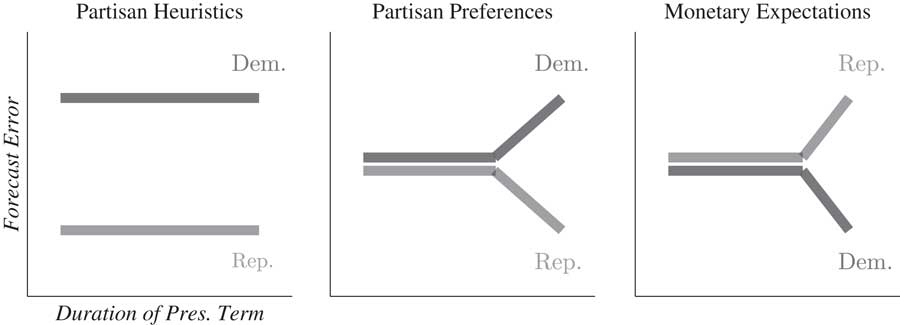
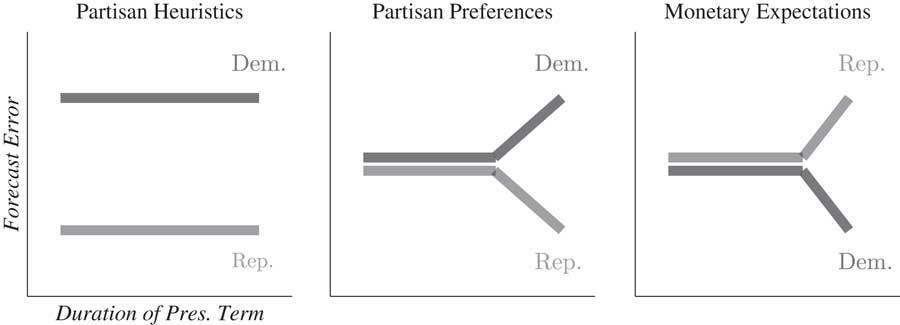
Though heuristics can be useful, “sometimes they lead to severe and systematic errors” (Tversky and Kahneman Reference Tversky and Kahneman1974, 1124). In our theory, economists at the Fed have an intuition that Democrats and Republicans behave differently in government and so formulate inflation expectations with this in mind. If this intuition does not accurately correspond to how presidents act, or how their policies impact inflation, forecasts will be systematically biased: overestimates for Democratic presidents and underestimates for Republicans. Bartels (Reference Bartels2008) finds evidence that Democratic and Republican presidents do not, in fact, have significantly different spending policies, so any expectation that they would pursue policies that would differentially affect inflation in the medium-run would likely be inaccurate.Footnote 9 Biases about partisan effects on inflation should therefore be constant throughout a president’s term. As we will see in the next section, this prediction contrasts with the alternative arguments—partisan preference and monetary expectation theories. Both predict an intensification of biased forecasts as elections approach. Figure 1 shows the anticipated empirical patterns of inflation forecast errors over presidential terms by partisanship in the three theories we set out.
Stylized partisan inflation forecast error predictions
It is important to note that in contrast to typical rational partisan expectations approaches, our model does not require that forecasters be conscious of the heuristic they are using. It can simply work its way subtly into forecasts, particularly in the subjective component of the Greenbook’s “consensus forecast.” If the models do not conform with other expectations about the economy’s current course, based in part on these subtle partisan heuristics, the consensus forecast will be modified accordingly. Further, because this bias would not need to be conscious, the systematic error could easily go unnoticed (as mistakes could occur for any number of idiosyncratic or economic reasons). If the bias goes unnoticed, then it will not be corrected in future inflation predictions.Footnote 10 This differs from the rational partisan expectations theory (e.g., Alesina Reference Alesina1987, Reference Alesina1991; Hibbs Reference Hibbs1994; Alesina, Roubini and Cohen Reference Alesina, Roubini and Cohen1997). First, because these beliefs are not updated to account for a lack of partisan inflation differences they are not “rational.” Second, and relatedly, this theory is based on psychological instead of game theoretic reasoning, which allows for the persistence of sub-optimal strategies in a way that would be less likely in a rational choice model of this same process given the assumption that the goals of the actors are the same in the two models. Because errors arise owing to stochastic processes in addition to the systematic heuristic biases described here, the failure to perfectly predict inflation would not necessarily lead Fed Staff to adjust their expectations or recognize their biases.
Alternative Partisan Explanations
The usefulness of a theory is partially demonstrated by how well it explains outcomes relative to its major competitors. Though no previous studies have examined partisan biases in inflation forecasts, competing theories can be derived from studies that have looked for evidence of partisan preferences manifesting themselves in the FOMC’s monetary policy outcomes. Two key strains in this literature consider partisan effects as either resulting from a preference for one party over another by members of the FOMC (not from inaccurate underlying assumptions about the behavior of partisans) or an expectation that, once in office, the parties will engage in systematically different policies that will influence inflation, leading the FOMC to support more preferred policies and attempt to inhibit less-preferred ones.
The preference arguments about monetary policy-making assume that a conservative central bankerFootnote 11 will prefer the election of politicians who hold more similar inflationary preferences (i.e., those with a stronger preference for low inflation) and enact policies to bolster their preferred candidate’s prospects of being elected. In the United States, this would mean that the FOMC would implement policies that supported the electoral prospects of Republican incumbents and harm the electoral prospects of Democratic incumbents (Hakes Reference Hakes1988; Tootell Reference Tootell1996; Sieg Reference Sieg1997; Clark and Arel-Bundock Reference Clark and Arel-Bundock2013).
Building on this approach, a partisan preference theory of inflation forecast errors assumes that Fed Staff have a preference that more inflation-averse politicians to control the executive and so produce inflation forecasts that would justify the implementation of easy monetary policy under Republican administrations and tight money under Democratic administrations, particularly as presidential elections approach. The FOMC, choosing policy based on these forecasts, would then implement monetary policies to optimize its utility function over low inflation and high employment, which would not need to depend upon presidential partisanship at the level of the FOMC.Footnote 12 However, because Fed Staffers prefer low inflation to high, they would not necessarily want to produce too loose/tight monetary policy over an entire four-year term. Instead, they would want to encourage an economic boost (contraction) near the end of a Republican (Democratic) presidency. This implies that realized average inflation would be higher than forecasted during Republican presidencies and lower than forecasted for Democratic presidencies. However, this relationship would be particularly pronounced in the quarters running-up to elections as Fed Staff attempt to help their favored political party (Beck Reference Beck1987; Grier Reference Grier1987). Further, accounting for actual changes in monetary policy ought to increase the magnitude of partisan effects. This is because predictions of inflation during Republican presidencies, e.g., will be lower than what the Staff actually expects. If looser monetary policy is implemented during electoral periods in response to these low inflation forecasts than would have been chosen under the Staff’s true inflationary expectations, inflation will actually be higher than the Staff’s true beliefs about inflation under no change in monetary policy.
An alternative set of existing theories—the rational partisan expectations literature on monetary policy-making—assumes that central bankers do not have an innate preference for one party over another, but instead accurately expect Democrats and Republicans to behave differently in office (Alesina Reference Alesina1991; Hibbs Reference Hibbs1994). It is these behavioral expectations that would lead to different monetary policies under Democratic and Republican presidencies, with the former expected to engage in more expansionary and inflationary policies than the latter. In order to stave off higher inflation under a Democrat, the Fed would tighten monetary policy; because Republicans are expected to prefer lower inflation, they will pursue policies in support of that goal and so the FOMC can accommodate Republican presidents’ policies without fear of stoking inflation. This argument is again based on the assumed preferences of partisans, but does not require the FOMC to be politically biased as the former does.
Building on the rational partisan expectations literature, what we call the monetary expectations theory is in some ways the reverse of partisan preferences theory described above: it is based on an assumption of partisan bias in the FOMC, but not the Staff. The Staff are assumed to have only a price stability preference. Federal Reserve economists believe members of the FOMC will engage in partisan monetary policy by lowering interest rates under right-leaning administrations in the run-up to elections, and increasing them under left-leaning presidents, as Clark and Arel-Bundock (Reference Clark and Arel-Bundock2013) found. The monetary expectations theory assumes that the FOMC is doing this to manipulate election outcomes. In this formulation, the Fed Staff has no preference for one party over another, but knows that the FOMC does, and so formulates estimates aimed at countering the FOMC’s policies. If Fed economists believe that the FOMC will choose systematically higher-than-called-for interest rates during Democratic presidencies and vice versa for Republicans, then—assuming they are interested in the implementation of optimal monetary policies—they would produce forecasts that are higher than expected during Republican administrations and lower for Democrats in order to produce more optimal policies; the opposite of what is expected in the partisan preference theory. If the FOMC fails to note the compensation made by the Fed Staff, then we would expect that after accounting for implemented policies inflation forecasts would be higher than or equal to realized inflation during Republican terms and lower than or equal to forecasts under Democratic administrations.Footnote 13 If, however, the FOMC anticipated these compensatory biases in Staff forecasts, then the FOMC would discount the Greenbook estimates and continue to implement inflationary policies during Republican administrations and contractionary policies during Democratic ones. If the Staff likewise know that they are not being listened to they may randomize their errors, producing an uninformative signal (Crawford and Sobel Reference Crawford and Sobel1982). This would result in approximately similar inflation forecast errors for both Republicans and Democrats. However, we largely did not observe this (see below). If the Fed Staff believes that the FOMC will engage in partisan pumping only when presidential elections are approaching, then we would expect no partisan differences in forecasts at the beginning of a presidency but increasing divergence as the term wanes.
The monetary expectations theory models Fed Staff forecasts as partially a function of Staff interactions with the FOMC. What if Greenbook forecasts are even more directly influenced by FOMC members in that members’ judgments are directly incorporated into the forecasts? This would have an important substantive implication. All of the partisan theories we have discussed have important policy implications to the extent that they effect FOMC inflation expectations and therefore their interest rate choices. What if this is backward? Why could not we assume that it is the FOMC members’ partisan biases or preferences that are influencing staff forecasts?
It is very difficult to empirically determine if and to what extent informal discussions between Fed Staff and FOMC members influence Greenbook forecasts, because these discussions are not observable. However, the formal forecasting process as well as comparisons between Staff and FOMC members’ forecasts suggests that the bulk of the influence runs from the Staff to the members, rather than the opposite direction.
Greenbook forecasts are presented to FOMC members before FOMC meetings, where expectations are debated at length, and before members make their own biannual formal forecasts.Footnote 14 If Greenbook forecasts were simply parroting FOMC members’ prior expectations then we would expect the two sets of forecasts to be very similar. This has not been the case. Romer and Romer (Reference Romer and Romer2008) found that FOMC members’ forecasts are different from Greenbook forecasts and may in fact be less-accurate predictions of inflation. Given that Greenbook forecasts are presented to members directly before FOMC meetings, forecasts act as a reference point from which FOMC members build their own expectations. If attempts by FOMC members to change Greenbook forecasts tend to result in less-accurate forecasts then it is especially important that the reference point be as accurate as possible.
Forecasting Model Accuracy
Finally, before empirically digging into partisan explanations of forecast errors, which would largely be the result of Federal Reserve Staff judgment, it is worth examining the possibility that forecast inaccuracy is the result of systematic errors in the Staff’s predictive econometric models. Federal Reserve Staff have primarily used two sets of econometric models during the period for which Greenbook data are available.Footnote 15
The first simultaneous equation models of the US and world economies were developed and adopted by the Federal Reserve between 1966 and 1975. These models were based on adaptive expectations and largely extrapolated future behavior of the economy from its recent past behavior. New models of the American and world economies’ near-term trajectories were introduced in the 1990s, fully replacing the older models in 1996. The Federal Reserve Board US model (FRB/US) and its counterpart for the global economy (FRB/Global) explicitly consider the role of economic expectations in economic behavior. The foundational assumption of adaptive expectations in the old models was replaced with rational or model-consistent expectations. In these models prices are sticky and aggregate demand determines short-run output. Furthermore, monetary policy’s effects on the economy are extensively modeled. For a more detailed history, please see the discussion in the Supplementary Materials.
Presumably, the move to rational expectations would improve forecast accuracy relative to the earlier period. The goal of incorporating forward-looking actors into the models was to account for an important source of endogeneity in earlier models that could lead to overestimates of important economic indicators under some circumstances and underestimates of those same indicators under others. None of these over or underestimates, however, ought to have been linked to the party of the president. We would, however, expect that the magnitude of forecast errors shrank after 1996.Footnote 16
Federal Reserve Staff’s Forecast Accuracy
How accurate are Fed Staff forecasts? We focus on Greenbook forecasts of the GNP/GDP price index. We choose this indicator of Federal Reserve forecast accuracy because central bankers are believed to be primarily concerned with inflation (e.g., Cukierman, Webb and Neyapti Reference Cukierman, Webb and Neyapti1992; Mukherjee and Singer Reference Mukherjee and Andrew Singer2008; Tillmann Reference Tillmann2008). It is also the dominant measure of forecast errors used in the economics literature (cf. Romer and Romer Reference Romer and Romer2000).
We measure accuracy by calculating forecast error E as the difference between the Greenbook inflation forecast F for a given quarter q and actual inflation I as a proportion of actual inflation:
 $$E_{q} ={{F_{q} {\minus}I_{q} } \over {I_{q} }}.$$
This is different from the accuracy measure Frendreis and Tatalovich (Reference Frendreis and Tatalovich2000) used in their preliminary examination of forecast errors. They averaged the absolute value of yearly inflation forecast errors over a 19-year periodFootnote 17 to examine Federal Reserve accuracy. Their measure has a number of drawbacks. First, it does not give us any indication of the direction of the forecast error, which is crucial for examining possible partisan biases. In their comparison of CBO and administrations’ forecasts they did use a simple dichotomous directional indicator of accuracy in a given year (i.e., a forecast greater than or less than the actual level). This does not give us a sense of the relative size of the errors and could easily amplify trivial results. Almost any forecast will be above or below the actual inflation level in all but the unusual cases where the forecasts exactly equal the actual inflation level.
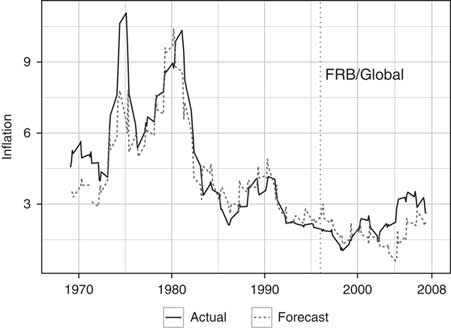
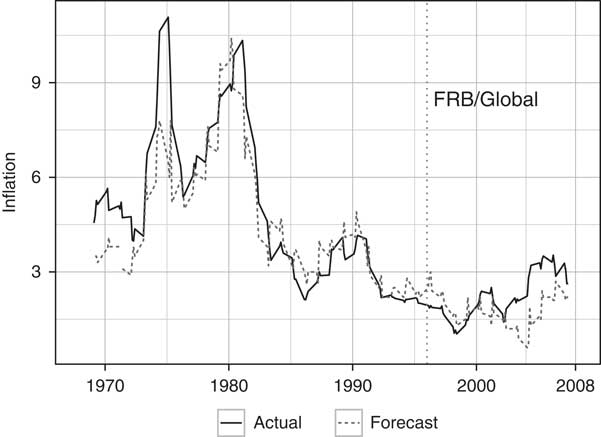
Second, the average of the absolute errors values could be highly skewed by years of unusually large errors, which is more likely in years of higher inflation. This is not a trivial concern because the inflation level varies substantially over time (see Figure 2).Footnote 18 So, we choose to focus on proportional rather than absolute errors by quarter to avoid focusing on a parameter that is highly vulnerable to absolute value outliers. Quarterly proportional errors are also more substantively meaningful for comparing errors across time periods.Footnote 19
Greenbook inflation forecasts made second quarter beforehand and actual quarterly inflation Note: The vertical gray dotted line indicates when the Federal Reserve Board Global (FRB/Global) forecasting model was fully implemented.
Third, using multi-year or even year-level indicators makes it difficult to examine biases in the run-up to an election or any other process that may be observed through variations within years. Using quarterly data—the smallest level available—gives us a much more detailed view of any processes that might influence accuracy.
If the forecasts are unbiased the mean error of the forecasts—using either Frendreis and Tatalovich (Reference Frendreis and Tatalovich2000) or our measure—would be indistinguishable from zero. While Frendreis and Tatalovich (Reference Frendreis and Tatalovich2000) found that Fed errors were low relative to presidential administrations’ on average over a 19-year period and Romer and Romer (Reference Romer and Romer2000) found that the Fed’s internal forecasts meet the requirement for unbiasedness on average over the full history of Greenbook forecasts, such amalgamations disguise long periods of over- or under-predictions of inflation, as noted in Capistrán (Reference Capistrán2008) and illustrated in Figure 2. Within economics the Fed’s forecasts have been examined for evidence of rationality. These studies generally find that the Fed rationally incorporates information into its forecasts, outperforming private forecasts (cf. Gamber and Smith Reference Gamber and Smith2009). These studies, however, have rarely incorporated Fed Staff member’s political beliefs or preferences, because Federal Reserve Staffers are assumed to be politically independent.
Our data set has 169 forecast quarters,Footnote 20 spanning the fourth quarter of 1965 through the end of 2007. Greenbook forecasts correspond to those provided for the FOMC meeting closest to the middle of the quarter. We found actual inflation corresponding to each of these quartersFootnote 21 using data from the Federal Reserve’s FRED website.Footnote 22 We examine errors made by forecasters in the current quarter and all quarters up to five quarters before.Footnote 23 The results are generally the same, regardless of the forecast’s age, e.g., the results were similar for predictions made q−1 quarters before the forecasted quarter q, q−2 quarters before, and so on. In particular, the presidential partisan findings are robust, regardless of forecast age (see Figure 5). For simplicity, the majority of results we show and discuss in detail are from models with forecasts made two quarters beforehand.Footnote 24 Figure 2 compares absolute actual inflation for each quarter and inflation forecasts made two quarters before.
Are there Partisan Forecast Errors?
Unbiased forecasts have a mean error of 0 (Brück and Stephan Reference Brück and Stephan2006, 5). Using this criteria, forecast errors should be the same—ideally with a mean of 0—regardless of the incumbent president’s party identification. This is not the case. From the second quarter of 1969Footnote 25 through 2007 the mean standardized forecast error was −0.04, i.e., forecasters under-predicted inflation by about 4 percent. Our finding of relatively small average error over the entire 35-year period is in line with findings from previous studies. However, this low level of overall bias disguises substantial differences in the mean errors from Republican to Democratic presidencies. Across Republican presidencies the average error was −11 percent. It was +13 percent across Democratic presidencies.Footnote 26 On average, inflation was underestimated in Republican presidencies and overestimated in Democratic ones.
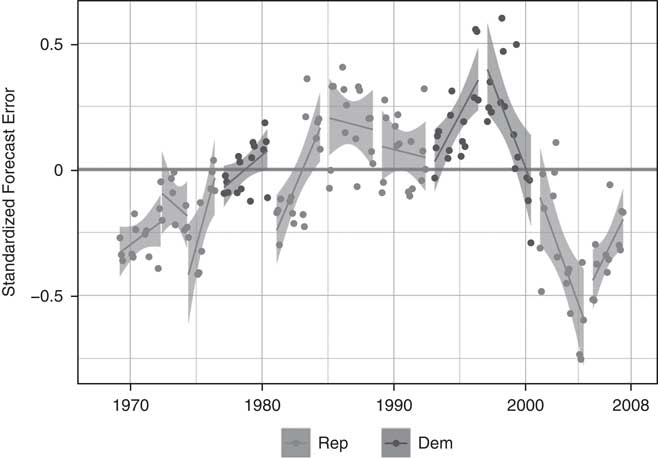
Figure 3 plots forecast errors across our sample separated by presidential term and party. The first thing to note is that inflation was rarely underestimated during the three Democratic presidential terms in our sample, and the underestimates that were made were relatively small. The largest overestimates we see were made during Bill Clinton’s (Democratic) presidency. All of the major inflation underestimates were made during Republican presidencies, particularly during Richard Nixon’s, Gerald Ford’s, and George W. Bush’s presidencies. Inflation was often overestimated during the second part of Reagan’s first term, his second term, and George H. W. Bush’s term. Over this period—often referred to as the Volcker Revolution (Bartels Reference Bartels1985)—inflation was suddenly much lower than before (see Figure 2). It may have taken awhile for forecasters to adjust to this new lower level of inflation, particularly because the Fed’s own models of the economy at the time assumed that money had no real effects on the economy during this period, even while the FOMC was pursuing aggressive anti-inflation policies.
Errors in inflation forecasts made second quarter beforehand (1969–2007) Note: An error of 0 indicates that inflation was perfectly predicted.
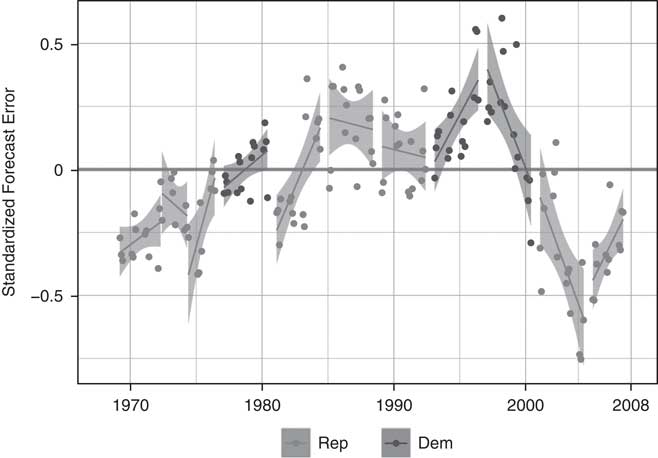
This summary examination of inflation forecast errors suggests that there may be a presidential partisan bias. Above we posited three different theories of how partisanship might affect inflation forecast errors. In the next section we describe how we go about testing these competing hypotheses.
Regression Models and Variables
We used standard regression models to examine the effects of presidential party ID and elections on the continuous inflation forecast error variable.Footnote 27 Our main model type was normal linear regression using maximum likelihood estimation of variance.Footnote 28 To examine if our estimates were dependent on this model type we also ran our analyses with ordinary least squaresFootnote 29 and Bayesian normal linear regression.Footnote 30 Bayesian normal linear regression is particularly useful for our relatively small n sample size as it makes “valid small sample inferences via draws from the exact posterior” (Imai, King and Lau 2013, 38).Footnote 31
As we show below the estimates from all of these model types were very similar in direction, magnitude, and statistical significance. They were almost always substantively identical, especially for our key presidential partisan ID variable.
Variables
In Section 3 we discussed our dependent variable—inflation forecast errors. To examine possible partisan biases we are interested in whether US presidents’ partisan identities and/or the existence of an upcoming presidential elections affect these errors. To do this we created president party identification and election period variables. The president party ID variable is 1 when the president is a Democrat and 0 when he is a Republican. As forecast error data is released on a quarterly basis, we consider a president to be sitting from the first quarter after the election.Footnote 32 We consider quarters to be in the election period either if the presidential election is held in that quarter or in the previous three quarters.Footnote 33 The economic voting literature indicates that it is economic performance in the 6 to 12 months preceding an American presidential election that matter most for the election’s outcome (cf. Gelman and King Reference Gelman and King1993).
To further examine whether or not Federal Reserve Staff were taking into consideration an electoral business cycle either owing to a partisan preference or expected incumbent behavior near an election, we include a variable of the quarters until the presidential election. This simply counts down from the quarter after the previous election.Footnote 34 The quarters that included presidential elections are coded as 0.
The partisan preference and monetary expectations theories both posit that president’s party ID and elections have a non-linear interactive relationship with forecast errors. Both posit that forecast errors across parties will begin to diverge as elections approach. To examine this possibility we include an interaction between the president party ID variable and the square of the quarters until election variable in the analyses.Footnote 35
US presidents do not set the level of government expenditure—a major non-monetary policy source of inflation—by themselves. Instead, presidents are constrained by the two houses of Congress. To examine whether or not Federal Reserve Staff are taking into consideration the partisan composition of Congress as well as presidents’ party identifications, we include a variable measuring Democratic legislators as a proportion of Republican legislators in the House of Representatives and a similar variable for the composition of the Senate.Footnote 36
Because each chamber of Congress acts as a veto player on the main fiscal expenditures, any Congressional effect on errors likely works through an interaction between the partisan IDs of Congress and the presidency. There are two types of interaction effects that can be derived from the literature. The first interaction possibility is that Federal Reserve Staff, using simple rational partisan expectations, presume that a Democratic president would be able to get policies closer to their ideal point when there is a Congress with similar preferences. If a Democratic president faced chambers of Congress controlled by Democrats, presumably Federal Reserve Staff would expect even higher fiscal expenditures and therefore even higher inflation. Conversely, Republican presidents with a Republican-controlled Congress may be even better at cutting spending, leading to even lower inflation.Footnote 37
The second possibility is based largely on Krause’s (Reference Krause2000) work on the effect of partisan divisions on fiscal deficits in the United States. He finds partisan fragmentation can play a role in increasing federal deficits. Higher political conflict, he argues, “results in equilibrium fiscal outcomes that favor greater spending and/or a willingness to lower taxes since politicians will exhibit a greater proclivity in providing voters with program benefits and to delay its payment” (Krause Reference Krause2000, 542). Because of this Federal Reserve Staff may anticipate higher government borrowing when the presidency and houses of Congress are controlled by different parties. We are therefore agnostic about the theoretical direction of this interaction.
If prediction errors are largely the result of systematically biased economic forecasting models we would expect errors to change when the models changed. In particular, we would expect a decrease in the magnitude of errors around 1996 when the FRB’s new US and Global Behavioral Equation Models were introduced. To examine this we include a FRB Model dummy variable. It equals 1 for all quarters from the first quarter of 1996 onward and 0 otherwise.
Greenbook forecasts are based on the assumption that monetary policy will not change between when the prediction is made and the time period it is predicting.Footnote 38 However, as these forecasts are used in the setting of interest rates, this assumption often does not hold and forecast errors may occur if monetary policy changes in the interim. If this is the case monetary policy changes would have a negative relationship with forecast errors. When the FOMC raises interest rates inflation may decline, causing the original forecast to have been too high and vice versa. To control for monetary policy changes we include a variable of standardized changes to the discount rate from the quarter the Greenbook prediction was made to the quarter it is predicting.Footnote 39 The discount rate is one of the Federal Reserve’s main tools for influencing the interest rate, especially the Fed Funds Rate.Footnote 40
We included a number of variables to examine if Federal Reserve inflation forecast errors are affected by incorrect assumptions about how levels of government expenditure impact inflation. These variables are the percentage of current government expenditure to GDP, government debt to GDP,Footnote 41 and deficit to GDP. Expenditure and debt are on a quarterly basis, while federal deficits are measured annually.Footnote 42
To examine how broader economic factors may be related to forecast errors we include variables of the GDP output gap, unemployment rate, and recession. The GDP output gap is the potential GDP as a percentage of real GDP measured in nominal terms. The recession variable is a dummy for whether or not the United States was in a recession. The unemployment rate is the percentage of people without work as a proportion of the number of people employed and/or actively seeking employment.Footnote 43
Finally, we include a series of dummies for the sitting FRB Chair.Footnote 44 Further variables used to examine additional omitted variable bias are discussed in the Supplementary Materials.
Results
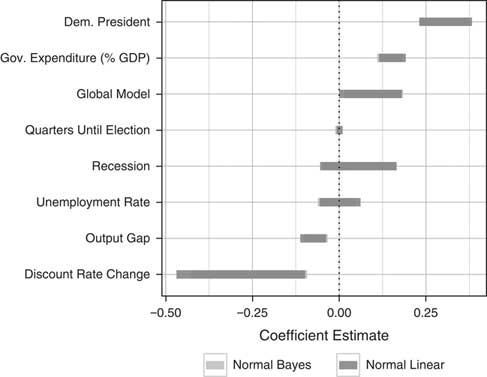
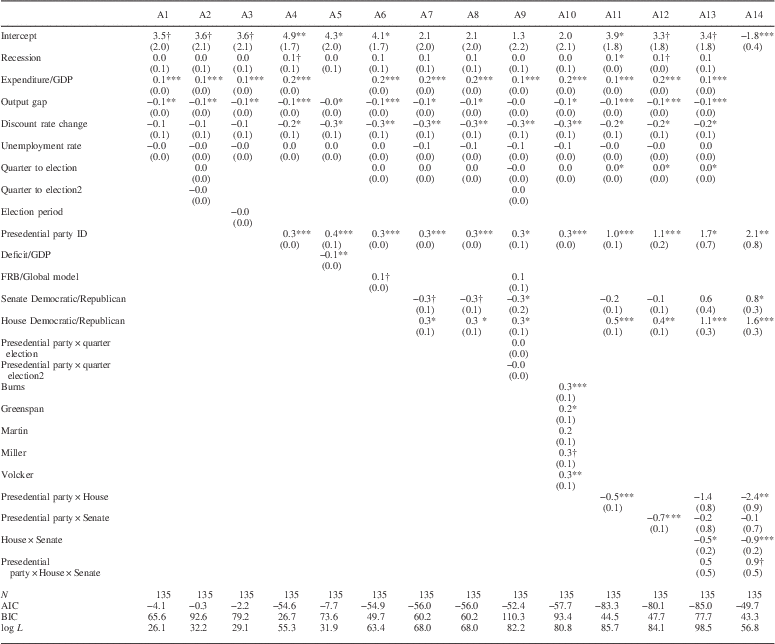
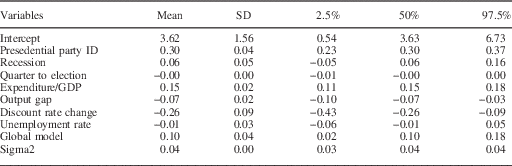
In this section we present results from a number of regression model specifications and discuss our findings. Full coefficient estimate lists can be found in Tables 1 and 2. There is little difference between the coefficients estimated using normal linear and Bayesian linear regression models (see Figure 4).Footnote 45 As the ordinary least squares estimates were essentially identical to the normal linear regression estimates, we do not show them here.
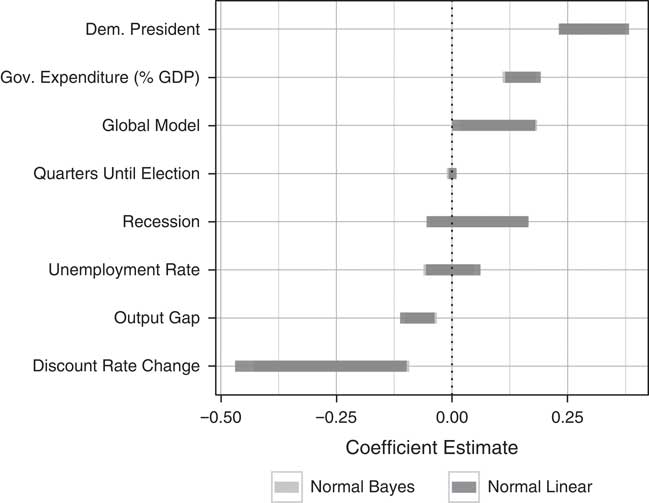
Normal Linear Regression Estimation of Covariate Effects on Second Quarter Inflation Forecast Error

Note: FRB/Global, Federal Reserve Board Global.
Standard errors in parentheses.
Significant at †P<0.10, *P<0.05, **P<0.01, ***P<0.001.
Bayesian Normal Linear Regression Estimation of Covariate Effects on Second Quarter Inflation Forecast Error

We remove quarters from the sample where forecasters would not have known who the president would be because the president had not yet been elected for that quarter. For models where the dependent variable is forecasts, made two quarters beforehand, this means removing the first two quarters of each presidential term.Footnote 46 Results from these restricted data sets are fairly similar to those from the full data set.
Presidential Party Identification
Our main finding is that Democratic party identification had a strong positive association with Federal Reserve Staff inflation forecast errors. Inflation forecast errors are estimated to be higher during Democratic presidencies than Republican ones even when we control for the numerous economic and political variables discussed earlier. This finding is robust across virtually all model specifications. Notably, the estimated effect holds even when we control for actual government expenditure and government deficits. This suggests that Federal Reserve Staff are not simply incorrectly predicting spending—which may be correlated with presidential party ID—and its effect on inflation. Instead, they either additionally have a partisan preference or are using partisan heuristics.Footnote 47 We can further narrow down the likely causes of the bias by looking at an interaction between presidential party ID and election timing. We can see from the statistically insignificant interaction between partisan ID and election timing in Table 1 that the estimated presidential party ID effect remains constant across presidential terms, even as the election nears. This finding is what we would expect if Federal Reserve Staff have a presidential partisan heuristic, but not a partisan preference or an expectation that FOMC policy will change as elections near.
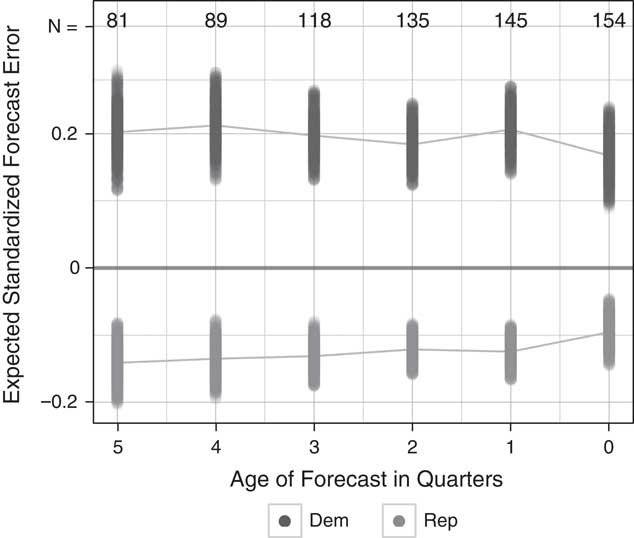
Following King, Tomz and Wittenberg (Reference King, Tomz and Wittenberg2000), we simulated expected standardized forecast errors for Democratic and Republican presidencies, holding the other covariates at their means, to get a sense of approximately how big the presidential partisan bias is when using different forecast lags. Results from these simulations are shown in Figure 5.Footnote 48 There is some variation in the predicted error magnitude depending on how many quarters ago the forecast was made. Nonetheless, it is notable that inflation is always predicted to be higher than it really is in Democratic presidencies and lower than it is in Republican presidencies.
Simulated expected inflation forecast error for Republican and Democratic presidencies Note: Simulated from a normal linear regression. Variables included are generally the same as those in Model A4 from Table 1. The discount rate change variable is adjusted to reflect the change in the discount rate from the quarter when the forecast was made. Discount rate change was not included for the model predicting forecasts made in the present quarter as it is always 0. Each model excludes every quarter when the forecasters would not have known who the president was. Because of this, the number of observations used in each model is noted on the figure. The figure shows 950 simulations per presidential party ID type. They are the middle 95 percent of 1000 simulations per presidential party ID type. The gray lines connect the groups’ means.
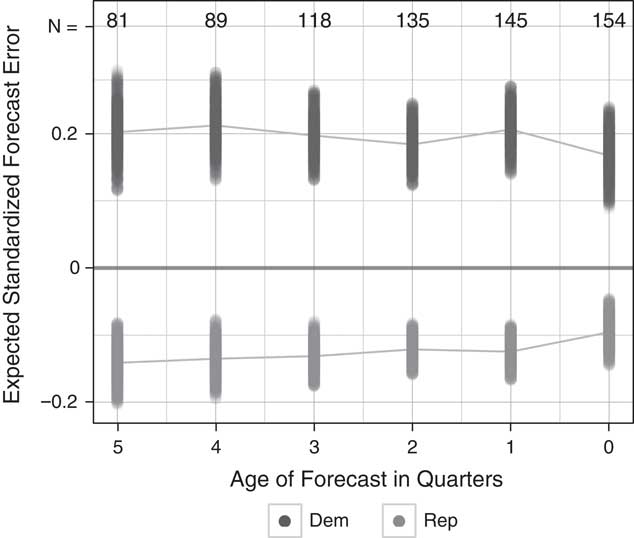
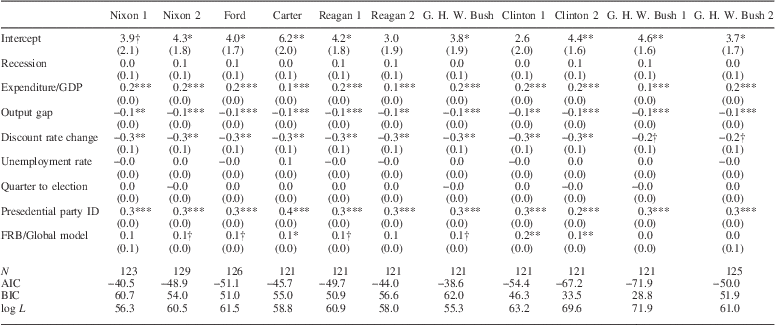
For forecasts made two quarters in advance, we expect that the Fed overestimates inflation by 18 percent during Democratic presidencies, all else equal. We expect the average inflation forecast during Republican presidencies to be approximately −12 percent of actual inflation. Given that the first quantile of the inflation errors is −22 and the third is 13, these estimates indicate that partisan biases are on average a large contributor to the overall magnitude of inflation forecasting errors. These results hold up even when we rerun the models on data where we dropped individual presidential terms (see Table 3) and Fed chairman terms.Footnote 49 This indicates that the results are not being driven by one outlier presidential term or chairmanship. Clearly, at least from the 1970s through 2007, Fed Staff were overly pessimistic about Democratic president’s effect on inflation and overly optimistic about Republican presidents’ effect.
Normal Linear Regression Estimation of Covariate Effects on 2 Qtr. Inflation Forecast Error, Dropping Presidential Terms

Note: FRB/Global, Federal Reserve Board Global.
Standard errors in parentheses.
Significant at †P<0.01, *P<0.05, **P<0.01, ***P<0.001.
Presidential Elections
Do Federal Reserve Staff also take into consideration election timing as the partisan preference and monetary expectations theories predict?
We do not find much, if any, evidence that inflation forecast errors were associated with elections either independent of presidential party ID or in interaction with it. Estimates of the relationship between the quarters until election variable and forecast errorsFootnote 50 also fails to provide any evidence that inflation errors are related to elections.
We examined the monetary policy and partisan preference theories of forecast errors with an interaction between the president’s party ID variable and the square of the time to election variable. We used the square of the time to election variable to try to capture the non-linear predicted effect of elections on errors made by the monetary and partisan preference theories (see center- and right-hand panels of Figure 1). However, when we include the interactions, the coefficient on the president’s party ID variable is robust, whereas neither the election variables nor the interaction terms are statistically significant. This is also true when we use the non-squared version of the time to election variable (please see the Supplementary Material). Thus, we do not find evidence for either the partisan preference or monetary expectations theories.
Fed Staff do not appear to be over-estimating inflation when a Democratic president is running for re-election in an attempt to influence the FOMC to raise interest rates and lower the president’s chances of winning, as hypothesized in the partisan preference theory prediction. These findings have clear implications for how we understand the potential causes of Greenbook partisan inflation forecast biases as well as FOMC interest rate decisions around elections. It seems that FOMC members, not their staff, are driving the increases in the Fed Funds Rate around elections when Democrats are in power that Clark and Arel-Bundock (Reference Clark and Arel-Bundock2013) observe. Interestingly, Staff also do not seem to compensate for FOMC partisan biases in an attempt to moderate FOMC-driven partisan electoral business cycles. Thus, we find no evidence in favor of the monetary expectations theory either.
Partisan Control of Congress
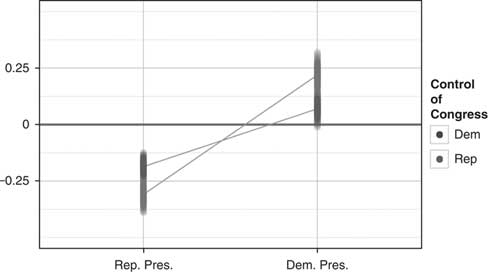
Might Federal Reserve Staff be taking into consideration not only the president’s party identification, but also the partisan composition of Congress? We estimate parametric models with two-way and three-way interactions between presidential and Congressional party identification to look for evidence in favor of either of the two ways we identified that presidential and Congressional partisan ID might be related to forecast errors. All of the partisan interactions are generally statistically significant. To make substantive sense of these estimated interactions we again generate simulations to find expected inflation forecast errors at various levels of the presidential and Congressional party identification variables. Figure 6 shows simulation results with highly contrasting fitted variable values: one party control of the executive and both legislative bodies compared with a situation where one party controls the presidency and the other controls both houses of Congress.Footnote 51
Simulated expected inflation forecast error with interactions between presidential party ID and Congressional party control (second quarter forecasts) Note: Simulated from estimates in Model A14 in Table 1. The figure shows 950 simulations per fitted value. They are the middle 95 percent of 1000 simulations per fitted value. The gray lines connect the groups’ means. Both the House and Senate Democratic/Republican variables were set at 1.2 for Democratic congresses and 0.8 for Republican congresses.
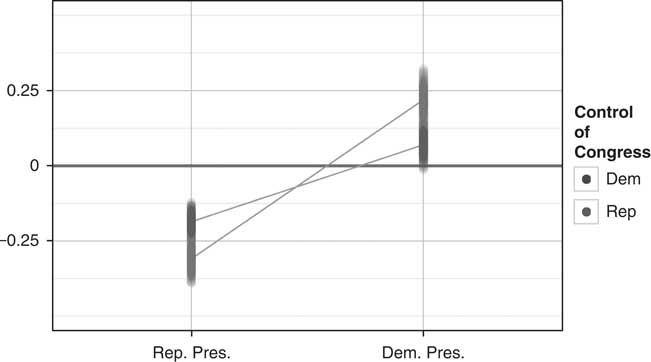
The first thing we should notice in Figure 6 is how presidential partisan identification still seems to be driving the direction of the inflation forecast errors: inflation is underestimated during Republican presidencies and overestimated during Democratic ones, regardless of what party controls Congress. The substantive effect of Congressional control on forecast errors is in the magnitude of the over- or underestimates. In particular, Republican control of Congress seems to exacerbate the differences already noted between Democratic and Republican executives. Inflation is very underestimated for Republican presidencies with Republican congresses and more overestimated for Democratic presidents facing an opposition-controlled legislature. There may be an expectation among Fed Staff that solidly Republican governments will cut expenditure much more than they actually do. Forecast errors are also slightly higher on average with Democratic presidencies and Republican congresses compared with when both are controlled by Democrats. This finding would fit with a story where Fed Staff believe spending will be higher with a divided government.
Despite some evidence for an interaction between Congressional and presidential party identification, it is not clear at this time how these results can be consistently explained across Democratic and Republican presidencies.
Government Expenditure
It seems that Federal Reserve Staff may also overestimate the effect of government expenditure on inflation. This is indicated by a consistently positive and significant coefficient for the government expenditure variable, even when controlling for president’s party ID. Perhaps this is because Fed Staff not only have a presidential partisan heuristic, but also a similar government expenditure heuristic where expenditure is believed to have a larger impact on inflation than it really does. It is plausible that the mechanism for this could be either an informal heuristic that affects the judgmental part of the forecasts or an incorrect assumption built into the formal forecasting models.
Deficits
We avoided including deficits and federal expenditures in the same models, because they are fairly highly correlated.Footnote 52 Deficits as a proportion of GDP had a negative relationship with inflation forecast errors. This is in the same direction as our finding for government expenditure, because a positive deficit to GDP value indicates a surplus, i.e., less spending relative to revenue. However, this estimate was not robust across all models.
FRB Global Forecasting Model
There is ambiguous evidence that the introduction of the FRB/Global behavioral equation forecasting model in 1996 began a new era of reduced inflation forecasting errors. In the model specification shown in Table 1, the estimate was statistically significant at the 10 percent level. However, it was not robust across many model specifications (see Figure 4 and tables in the Supplementary Materials).
Changes to the Discount Rate
As expected, relative changes to the discount rate are often found to be negatively associated with inflation forecast errors. Increasing the discount rate could result in lower inflation than expected and vice versa. Controlling for FOMC policy does not change the estimated relationship between presidential party ID and errors. It should be noted that the discount rate results are not robust across all of the models.Footnote 53
Further Robustness Checks
The Supplementary Materials includes further robustness checks that we used to test the strength of our key findings. In particular, we explore other specifications of the president party ID and time to election interaction, the key variable’s relationships with an orthogonal variable (unemployment forecast errors), the inclusion of economic and political shocks, such as oil price and labor productivity changes, and armed conflicts, as well as parametric models with pre-analysis matched data on presidential party ID and election period.
Discussion: Partisanship and Bureaucratic Inflation Forecast Errors
Do Fed inflation forecasts have a partisan bias? According to the evidence from our research: yes. Federal Reserve Staff seem to have systematically overestimated inflation during Democratic presidencies and underestimated it during Republican ones for at least a 38-year period between 1969 and the end of 2007. This finding is robust across numerous model specifications where a variety of economic, bureaucratic, and other political factors were controlled for.
In the course of our research we also found that Fed Staff tend to overestimate the inflationary effect of government spending and perhaps deficits, independent of the partisanship bias. Conceptually, the bias, nonetheless, runs in the same direction as the presidential partisanship bias. More spending, which Democrats are often expected to prefer, is anticipated to increase inflation more than it actually does.Footnote 54 It is unlikely that Greenbook forecasting models explicitly incorporate the president’s party identification, so we can be reasonably certain that the partisan bias enters as a heuristic in the judgmental side of the forecasting process. Predicted inflationary effects for government spending could very well be incorporated into the formal forecasting models. So, the government expenditure bias that we found could be either the result of incorrect explicit model assumptions or heuristics.
Interestingly, in light of recent research on FOMC policy-making, we found no relationship between inflation forecast errors and elections either independent of presidential party identification or in interaction with it. This suggests that any relationship between monetary policy decisions and US presidential election timing is neither the result of partisan preferences that Fed Staff members may have, nor beliefs that Fed Staff may hold about the FOMC’s presidential election preferences.
Given the consistency of the bias across presidents’ terms, it appears that Fed Staff’s partisan inflation forecast bias may be the result of a partisan heuristic. Like heuristics generally, the partisan heuristic may help Fed Staffers simplify very complex phenomenon, with the negative side effect that it can create systematic prediction errors. These errors may not have been noticed by Staffers because, so far, few if anyone have been looking for them. Indeed, the only piece of research we found examining both Fed forecasting errors and partisan forecasting biases (i.e., Frendreis and Tatalovich Reference Frendreis and Tatalovich2000) did not actually look for partisan biases in Fed forecasts. We find that inflation forecasts are consistently underestimated when Republicans hold the White House and are consistently overestimated during Democratic administrations. This is a new finding that helps us better understand how monetary policy bureaucrats address uncertainty and complexity in the relationship between policy and the economy. Though heuristic rules of thumb have been researched extensively in the behavioral economics literature (e.g., Kahneman and Tversky Reference Kahneman and Tversky1973; Tversky and Kahneman Reference Tversky and Kahneman1974; Kahneman Reference Kahneman2003) and various economically based monetary policy rules of thumb have been discussed by academic researchers and monetary policy-makers themselves (e.g., McNees Reference McNees1990; Orphanides and Wieland Reference Orphanides and Wieland2008), the possibility of political heuristics impacting monetary policy bureaucrats’ expectations has previously been ignored. It also challenges previous assumptions in the literature (see in particular Grauwe Reference Grauwe2011) that actors adapt their heuristics and expectations based on new information. The failure of monetary policy bureaucrats to adjust their behavior may be owing to the existence of multiple error sources that have made identification of any particular source difficult while the efficiency and rationality of their forecasts on average have made incentives to do so small. Further, to the extent that Federal Reserve Staffers subscribe to the norm of political independence, they are unlikely to have looked for this source of bias in their forecasts. Hopefully our findings will give forecasters an impetus to do just that so that they can more accurately forecast inflation.
What has been the monetary policy and electoral impact of Federal Reserve Staff partisan bias? Our research so far cannot definitively answer this, but it does motivate future research and point in a clear direction. It may be that higher inflation forecasts during Democratic presidencies spur the FOMC to raise interest rates and dampen the money supply generally. The opposite could happen during Republican presidencies. If this is the case, the economy would be inadvertently stimulated during Republican presidencies and depressed during Democratic ones, with electoral implications. The economic voting literature has repeatedly found that poor economic performance results in less electoral support for incumbents (e.g., Bloom and Price Reference Bloom and Douglas Price1975; Lewis-Beck Reference Lewis-Beck1988; Powell and Whitten Reference Powell and Whitten1993; Alvarez and Nagler Reference Alvarez and Nagler1998). Thus, if these partisan biases in inflation forecasts are leading to more restrictive monetary policy during Democratic presidencies and more expansive monetary policy during Republican presidencies, the economic voting mechanism may run afoul of important normative concerns about democratic accountability. Determining the extent to which these biases are shaping monetary policy and real economic performance is therefore an important next step in understanding the linkage between Fed inflation forecasts and larger questions of democracy. This is a very important issue that needs further investigation.