When cleaning milking installations on dairy farms or food processing installations in the food industry, it is important that all traces of soil are removed. The surfaces must also be microbiologically clean, i.e. microorganisms must either be removed or killed. Residual spores and bacteria on inadequately cleaned surfaces can quickly form a biofilm that is very difficult to remove by subsequent cleaning (Kumar & Anand, Reference Kumar and Anand1998).
The formation of biofilm is a survival mechanism that protects bacteria and facilitates growth under unfavourable conditions, such as turbulent flow or limited access to nutrients (Davey & O'Toole, Reference Davey and O'Toole2000; Shirtliff et al. Reference Shirtliff, Mader and Camper2002). The cells often produce exopolymeric substances that surround and protect the bacteria (Marshall, Reference Marshall1992; Flint et al. Reference Flint, Palmer, Bloemen, Brooks and Crawford2001; Parkar et al. Reference Parkar, Flint, Palmer and Brooks2001). Microorganisms in a biofilm are therefore generally more resistant than planktonic cells to cleaning chemicals and sanitizers (Carpentier & Cerf, Reference Carpentier and Cerf1993; Flint et al. Reference Flint, Palmer, Bloemen, Brooks and Crawford2001; Parkar et al. Reference Parkar, Flint, Palmer and Brooks2001; Peng et al. Reference Peng, Tsai and Chou2002). The biofilm formed by thermoresistant bacteria in a milk line can rapidly grow to such an extent that the passing milk is contaminated with cells released from the biofilm (Wirtanen et al. Reference Wirtanen, Husmark and Mattila-Sandholm1996).
Biofilm of Bacillus cereus may contain both vegetative bacteria and spores. The majority of cells in Bacillus biofilms are normally in the vegetative form (Ryu & Beuchat, Reference Ryu and Beuchat2005). However, spore formation occurs preferentially when the biofilm is in direct contact with the oxygen in air and a water-saturated atmosphere (Ryu & Beuchat, Reference Ryu and Beuchat2005; Wijman et al. Reference Wijman, de Leeuw, Moezelaar, Zwietering and Abee2007). This corresponds very well to the situation in a milk line. Wijman et al. (Reference Wijman, de Leeuw, Moezelaar, Zwietering and Abee2007) reported that a biofilm with B. cereus exposed to air could consist of up to 90 % spores. Since spores are much more resistant to heat and chemicals, they are much more difficult to eliminate than vegetative bacteria (Ryu & Beuchat, Reference Ryu and Beuchat2005).
Elimination of biofilm and spores is facilitated by a high degree of turbulence of the cleaning solution (Wirtanen et al. Reference Wirtanen, Husmark and Mattila-Sandholm1996) and by the presence of oxidizing substances such as hypochlorite and hydrogen peroxide (Kumar & Anand, Reference Kumar and Anand1998). Chlorine-based detergents can therefore facilitate the removal of biofilm. However, environmental concerns are driving dairy farms towards the use of chlorine-free detergents, although there is uncertainty about their effectiveness and thus it is difficult to judge whether this change can result in increased milk hygiene problems. There is currently no standard method available for evaluating and comparing detergents for use on dairy farms under realistic conditions.
The aim of this study was to establish a knowledge base on the effectiveness of chlorine-free detergents. A method for evaluation of cleaning outcome based on B. cereus spores was developed in an initial stage of the work. This method was subsequently used in a series of cleaning tests to study a number of chlorine-free detergents and to examine the influence of cleaning temperature on cleaning effect. Results from this study have been reported briefly in Swedish (Sundberg et al. Reference Sundberg, Lindahl, Christiansson, Birgersson and Wahlund2009).
Materials and Methods
Test installation
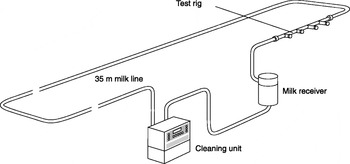
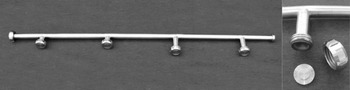
The cleaning tests were carried out in a test system designed to resemble farm conditions as closely as possible. The main components were a 35-m stainless steel, insulated milk line (22 mm internal diameter) fitted with a test rig and a commercial cleaning unit (DeLaval C200, Tumba, Sweden) (Fig. 1). The test rig had four removable sampling plates, attached at the end of T-junctions that protruded either 1·5 or 3-times the milk pipe diameter from the main loop, in order to reflect different degrees of cleaning difficulty (Fig. 2). The sampling plates were made from stainless steel (EN 1.4301) and the sampling area exposed to the cleaning solution was 2·8 cm2.
Schematic design of the test system used in cleaning tests.

Test rig with short and long T-junctions (left) and removable sampling plates (right).

The commercial cleaning unit circulates water in the milk line by flushing pulsation (slug flow). This means that slugs (or plugs) of liquid are built up by cyclical air introduction into the milk line at controlled intervals.
Experimental design
For each cleaning test, B. cereus spores were applied to each of the four sampling plates in the test rig. By comparing the number of spores before and after cleaning, a quantifiable measure of cleaning effectiveness was obtained.
The study examined ten different cleaning solutions, of which six were commercially available chlorine-free, alkaline detergents; three liquid and three powder-based products. To get a better understanding of how the cleaning outcome was affected by different parameters, four additional cleaning solutions were tested; a commercial alkaline detergent with chlorine, NaOH solution, a NaOH/hypochlorite solution and pure water. For each of these cleaning solutions, triplicate cleaning tests were performed in the test rig at temperatures 35, 45, 55 and 65°C, giving a total of 120 cleaning tests.
The temperatures specified refer to the temperature of the cleaning solution at the site of the sampling plates. Corresponding temperatures when the solution left the cleaning unit and started to circulate in the milk line (adjusted water temperature on the unit) were 42, 54, 67 and 79°C respectively. A cleaning cycle consisted of a pre-rinse with water, circulation cleaning with detergent and a post-rinse with cold water. The circulation cleaning phase was performed with 30 l of cleaning solution during 5 min.
The cleaning tests were carried out on 21 occasions (days) during a 3-month period. Six consecutive cleaning tests were usually performed in one day, after which the test installation was sanitized by cleaning at 65°C with a chlorine-based detergent at 1·5-times the normal dosage.
Preparation of spore stock culture
Spores of B. cereus were chosen as a model for soil in the experiments because of their strong ability to adhere to surfaces of many of the materials frequently used in milking installations (Faille et al. Reference Faille, Jullien, Fontaine, Bellon-Fontaine, Slommiany and Benezech2002). The B. cereus spores used were of strain GR 214, which was originally isolated from a bulk milk tank in a Swedish dairy plant (Svensson et al. Reference Svensson, Ekelund, Ogura and Christiansson2004). This strain is psychrotrophic and representative of strains that can grow in refrigerated pasteurized milk.
Before the tests, a sufficient number of B. cereus spores were produced so that a single batch of spores could be used throughout the study. B. cereus GR 214 was grown overnight in tryptone yeast extract broth (LP0042, Oxoid Ltd, Basingstoke, UK) at 30°C. Aliquots of 0·1 ml were then spread on the surface of sporulation agar plates with the following composition: nutrient broth (Difco Laboratories, Detroit MI, USA) 8 g/l; KCl 1 g/l; 1 mm-CaCl2; 10 μm-MnCl2; 1 mm-MgSO4; 10 μm-FeSO4 and 30 g/l Bacto-Agar (Difco Laboratories). These plates were incubated at 30°C for 7 d until sporulation was complete. Spores were harvested from the plates by suspension in sterile 9 g/l physiological saline. The test tube with spore suspension was centrifuged (Beckman Centrifuge J6-HC) at 7500 g for 10 min. The recovered spores were pooled and washed three times by removing the liquid, resuspension of the pellet in physiological saline and centrifugation. The pellet was then resuspended and heated at 72°C for 10 min to inactivate vegetative cells. Finally, a stock spore suspension was prepared and the spore concentration was determined by plate counts as described below. The stock spore culture was kept at refrigeration temperature.
Preparation of sampling plates
The day before the cleaning tests, a spore suspension with the desired concentration was prepared by mixing spores from the stock culture with 50 ml sterile water and 320 mg/l Tween 80. A 40-μl portion of this spore suspension was applied on each sampling plate and carefully distributed over the whole sampling area with an inoculation loop. The target was to add approximately 1 million (106) spores to each plate (as quantified by swabbing with the method described below). The plates were then placed vertically in a fume cupboard to dry overnight.
Two control sampling plates were prepared but were not cleaned in the test installation. Otherwise, the subsequent treatment of these control plates was precisely the same as for the cleaned plates. Average spore counts on the control plates were used as the initial value for all plates cleaned on that day when calculating the spore reduction.
Immediately on completion of each cleaning test, the sampling plates were removed from the test rig and immersed in buffering solution, pH 7·0 (1 g/l sodium thiosulphate, 1 g/l Tween 80) for 30 s to neutralize the pH and remains of detergent and chlorine. Finally, the plates were rinsed with sterile water.
Enumeration of spores on the sampling plates
After drying in a fume cupboard for at least 5 min, the sampling area on each plate was carefully swabbed with two cotton swabs moistened in physiological saline solution. Swabs from each plate were then agitated in physiological saline solution in separate test tubes. A serial dilution from each solution was prepared, followed by pour plating in tryptone glucose extract agar (SVA, National Veterinary Institute, Uppsala, Sweden). Each dilution was plated in duplicate. Plates were incubated for approximately 48 h at 30°C before colonies were counted.
Cleaning solutions
The six commercial chlorine-free, alkaline detergents used in the study originated from three manufacturers, with one liquid and one powder from each manufacturer. All detergents were dosed in accordance with the manufacturers’ recommendations, with consideration given to the hardness of the water used in tests (15–20 dGH).
In the following, the three brands of detergent are denoted A, B and C, and powder and liquid form is specified by the subscript P and L respectively.
The other four cleaning solutions (D–G) included in the study were:
D, NaOH: sodium hydroxide at a concentration of 1 g/l in the cleaning solution. This concentration corresponds to that obtained at normal dosage of alkaline detergents for cleaning dairy farm milking equipment.
E, no detergent: cleaning with water, without any detergent.
F, alkaline and chlorine-based: a well-established commercial alkaline detergent with chlorine.
G, NaOH and sodium hypochlorite: sodium hydroxide and sodium hypochlorite were added to the water tank of the cleaning unit during the heating phase to give a concentration in the cleaning solution of 1 g/l NaOH and 0·5 g/l chlorine respectively. The latter concentration was chosen to correspond to the chlorine concentration obtained at normal dosage of chlorine-based detergents for cleaning dairy farm milking equipment.
Statistical analysis
Statistical analysis of microbiological data was based on common logarithmic values of bacterial counts. The cleaning effect for a cleaning solution was calculated as the reduction in spore count (log value) compared with the control sampling plates prepared on the same day.
Least significant differences (LSD) between means at the 95 % probability level were tested with mixed linear models using the procedure Mixed in the SAS-package (SAS Institute, Cary NC, USA).
Results
The method used to apply spores to the sampling plates proved to give good repeatability in terms of quantity of spores. The mean log-value of number of spores on the control plates was 6·10 with sd 0·16.
In general there were no differences in spore reduction between the sampling plates mounted on the short T-junctions and those mounted on the long T-junctions. Thus, in the following no distinction is made between the four sampling plates per replicate.
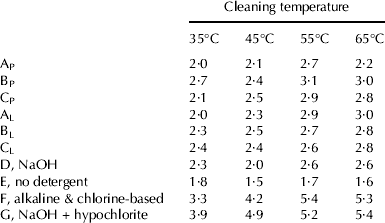
Spore reductions for the individual cleaning solutions at different temperatures are presented in Table 1.
Reduction (log cfu) in Bacillus cereus spores for all individual cleaning solutions (see text for full details of cleaning solutions). Values are means of three replicates, with four sampling plates in each replicate (LSD=0·6)

Statistical comparison of the mean values within each temperature showed that:
Cleaning without detergent (E) gave a significantly worse spore reduction effect than the chlorine-free detergents (A–C) at 45, 55 and 65°C. At 35°C the difference was significant only in relation to detergents BP and CL.
The chlorine-free detergents (A–C) frequently gave a greater reduction in spores than the NaOH solution (D), but these differences were not significant.
The NaOH solution (D) gave a significantly greater reduction in spores than water alone (E) at 55°C and 65°C, while at 35°C and 45°C the differences were not significant.
The two chlorine-based cleaning solutions (F, G) gave a significantly higher spore reduction than all other solutions at all four temperatures.
With only a few exceptions, no significant differences between the chlorine-free detergents (A, B, C) could be established and the liquid form of these detergents gave similar cleaning results to the powder form.
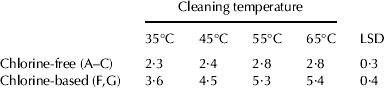
The influence of cleaning temperature on spore reduction is shown in Table 2 for the six chlorine-free detergents as one group and for the two cleaning solutions containing chlorine as another.
Reduction (log cfu) in Bacillus cereus spores at different cleaning temperatures. Values are means for alkaline detergents without chlorine (A–C) and with chlorine (F,G)

For the two chlorine-based solutions the cleaning outcome was significantly improved with increasing temperature up to 55°C, while an additional increase to 65°C did not result in any further improvement. For the six chlorine-free detergents, only the increase in temperature from 45°C to 55°C resulted in a significantly improved cleaning outcome. In Table 1 it can be seen that an increase in temperature from 55°C to 65°C gave no significant improvement in cleaning outcome for any of the ten solutions tested.
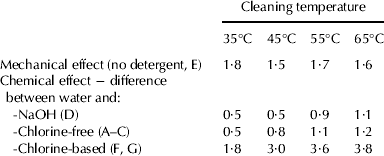
Cleaning with water alone reflects the mechanical cleaning effect brought about by the flow of liquid in the installation. The difference in cleaning effect between water and a detergent reflects the chemical effect from the substances present in the agent. The mechanical effect of water and chemical effects of the NaOH solution, the group of chlorine-free detergents and the two chlorine-based cleaning solutions are shown in Table 3.
Mechanical and chemical cleaning effect on Bacillus cereus spores, reduction in log cfu

Discussion
To our knowledge there is no standardized testing system for evaluating and comparing detergents for use on dairy farms under realistic conditions. Most laboratory procedures do not take into account the mechanical cleaning effect that occurs under practical conditions. In this study we investigated the cleaning effects of various detergents under well-controlled realistic temperature and flow conditions. It should be pointed out that the test equipment and methods used in this study are only to be regarded as a model system used to shed light on current issues. Although the aim was to simulate practical conditions, this was not fully possible. The most important difference was that the ‘soil’ used (dried spore suspension) does not reflect the type of hygiene problems common in practice. In milking equipment on a farm, milk is transported in the milk line on several occasions per day. If cleaning is not efficient enough to remove milk residues in areas prone to fouling, bacteria may start to grow and, as described in the Introduction, eventually a biofilm is formed. There are certain important differences between such a biofilm and the spores used in the present study, for instance their method of attaching to surfaces. However, spores of B. cereus are very resistant to chemicals, adhere strongly to surfaces and are difficult to remove by cleaning (Faille et al. Reference Faille, Jullien, Fontaine, Bellon-Fontaine, Slommiany and Benezech2002). Te Giffel et al. (Reference Te Giffel, Beumer, Van Dam, Slaghuis and Rombouts1995) developed a laboratory surface test for evaluating the efficiency of disinfectants on spores of B. cereus. They emphasised the need for standardized procedures to obtain reproducible results, since a number of factors affect the outcome of the tests, such as adhesion properties of different strains, sporulation conditions and the presence of organic load. Similar considerations applied for our surface cleaning test. For this reason, we opted to use only one strain, all spores were produced in one batch and spores but not soil were applied to the sampling surfaces. Spores were produced essentially as described by Faille et al. (Reference Faille, Jullien, Fontaine, Bellon-Fontaine, Slommiany and Benezech2002), who used this method in several investigations.
Turbulence is an important factor in removing biofilm (Wirtanen et al. Reference Wirtanen, Husmark and Mattila-Sandholm1996) but spores of B. cereus may adhere more strongly to surfaces than biofilm. Spores in B. cereus biofilms are considerably more resistant to disinfectants than vegetative cells (Ryu & Beuchat, Reference Ryu and Beuchat2005) although vegetative cells of B. cereus can be quite resistant when present in a biofilm. Lindsay et al. (Reference Lindsay, Brözel, Mostert and von Holy2002) found that spores survived in a biofilm of B. cereus following treatment with 0·1 g/l chlorine dioxide. Peng et al. (Reference Peng, Tsai and Chou2002) found that to reduce the number of cells by 6 log-units in a biofilm of B. cereus, 15 g/l of an alkaline detergent at a temperature of 70°C was needed. In both those model systems turbulence was minimal. It seems likely that sufficiently high temperature as well as chemicals and turbulence are needed to eliminate biofilm in milking equipment.
In light of this, the results from the present study cannot be directly transferred to practical conditions, as it is not possible to relate the observed cleaning effect to that actually needed in order to maintain acceptable hygiene conditions in a milking system in the long run. Nevertheless, the study yielded new underlying knowledge and understanding of how different types of detergents and chemicals influence the cleaning outcome in milking equipment.
There were no differences in spore reduction between sampling plates mounted on short and long T-junctions. It is generally considered that a dead leg is cleanable provided that the flow is directed into the dead leg and that its length does not exceed twice the diameter of the pipeline (Chisti, Reference Chisti and Robinson1999). In our study the flow was perpendicular to the T-junctions and the longest T-junction was 3-times the diameter, so a difference was expected. However, the mechanical effect of flow in a milking installation is created by slugs of water interspaced by air at a flow rate of 7–10 m/s (Reinemann et al. Reference Reinemann, Wolters, Billon, Lind and Rasmussen2003), compared with full turbulent flow at 1·5–3 m/s in a food plant (Chisti, Reference Chisti and Robinson1999). It seems that the slug flow in our system enhanced the cleanability of the dead legs.
Few previous investigations have specifically studied the mechanical cleaning effect separately from the chemical effect. A higher flow rate improves the removal of spores during cleaning (Faille et al. Reference Faille, Dennin, Belon-Fontaine and Benezech1999; Lelièvre et al. Reference Lelièvre, Antonini, Faille and Bénézech2002). When cleaning pipes that had been soiled with reconstituted milk powder and spores of B. cereus, the mechanical effect of rinsing with water at a flow rate of 2 m/s was smaller than the chemical effect (Lelièvre et al. Reference Lelièvre, Antonini, Faille and Bénézech2002). However, it was concluded that the mechanical effect in combination with the cleaning agent was very important.
In Table 3 it can be seen that the mechanical effect corresponded to a spore reduction of 1·5–1·8 log-units. The chemical effect of NaOH was relatively moderate (0·5–1·1 log-units) and a similar effect was obtained with the chlorine-free detergents. The two chlorine-based solutions had a considerably more powerful chemical effect, with a reduction in the magnitude of 2–4 log-units depending on the temperature. This stronger reduction of spores can be explained by a direct killing effect (Bloomfield & Arthur, Reference Bloomfield and Arthur1994; Kreske et al. Reference Kreske, Ryu and Beuchat2006). However, physical removal probably also occurred (Lelièvre et al. Reference Lelièvre, Antonini, Faille and Bénézech2002). A similar oxidizing effect can be expected to facilitate the removal of biofilm (Kumar & Anand, Reference Kumar and Anand1998). Parkar et al. (Reference Parkar, Flint and Brooks2004) emphasized the necessity of not only killing bacteria in biofilms, but also eliminating them together with the extracellular matrix.
Te Giffel et al. (Reference Te Giffel, Beumer, Van Dam, Slaghuis and Rombouts1995) studied the effect of chlorine in a milking installation following contamination by circulation of a suspension of spores, followed by circulation of disinfectants. During circulation the temperature decreased from 70°C to 30°C. The estimated sporocidal effect (reduction in the number of spores in the installation) was 0·8–1·0 log-units. Owing to differences in methodology, it is difficult to compare their results with ours. The small reduction compared with our results may be partly due to a rapid decrease in temperature and differences in the operation of the milking installation (see Table 3).
Overall, there were no notable differences in cleaning efficiency between the chlorine-free detergents tested and, with only a few exceptions, there were no significant differences within the same temperature. Furthermore, there were no significant differences between the NaOH solution and the chlorine-free detergents. This implies that the additives present in commercial detergents, for instance surface-active agents and enzymes, had no spore-reducing effect. Again, this finding must be considered in light of the fact that the model system used did not fully reflect practical conditions. Our results do not preclude the possibility that chlorine-free detergents may prevent the formation of biofilm, when used under proper conditions in a milking installation.
Conclusions
With the model system used, the most important conclusions from this study were:
Chlorine-free, alkaline detergents gave a considerably smaller reduction in B. cereus spores than cleaning solutions containing chlorine.
All chlorine-free, alkaline detergents gave in general equal cleaning effectiveness and there were no differences in the performance of those in powder form and those in liquid form.
During the cleaning phase, the temperature of the cleaning solution should not be below 55°C.
An increase in cleaning solution temperature from 55°C to 65°C did not improve cleaning effectiveness.
Financial support for this study was provided by the Swedish Farmers' Foundation for Agricultural Research.