The role of psychobiological factors in adult disorders of social attachment has been to date largely unaddressed. Consequently, the influence of antecedent developmental experiences, such as maltreatment, on this relationship in adulthood remains unknown. Borderline personality disorder (BPD) is a prototypical disorder of adult social attachment (Agrawal, Gunderson, Holmes, & Lyons-Ruth, Reference Agrawal, Gunderson, Holmes and Lyons-Ruth2004; Gunderson, Reference Gunderson1996; Levy, Reference Levy2005; Melges & Swartz, Reference Melges and Swartz1989), and is associated with high rates of childhood maltreatment (Zanarini, Reference Zanarini2000). Thus, studying individuals with this disorder may provide insight into how adult attachment disturbance is related to psychobiological factors, and how this relationship may be influenced by childhood experience.
A Dimensional Model of Adult Social Attachment
Phillip Shaver and colleagues (Crowell, Fraley, & Shaver, Reference Crowell, Fraley, Shaver, Cassidy and Shaver1999) have articulated an influential model of adult social attachment, under the guiding principle that attachment theory is a “lifespan developmental theory.” They offer a dimensional perspective on what has traditionally been referred to as attachment style, characterized as “The systematic pattern of relational expectations, emotions, and behavior that results from internalization of a particular history of attachment experiences and consequent reliance on a particular attachment-related strategy of affect regulation” (Mikulincer, Shaver, & Pereg, Reference Mikulincer, Shaver and Pereg2003, p. 79). In this model, neurobehavioral attachment systems activate proximity-seeking behavior to mitigate negative emotional states arising from stressors that can be either physiological (e.g., illness) or psychological (e.g., absence of a parent or mate) in nature (Mikulincer et al., Reference Mikulincer, Shaver and Pereg2003). Romantic relationships are of particular interest because the relationships among adults that exhibit all four defining features of attachment relationships (proximity maintenance, safe haven, secure base, and separation distress) are primarily romantic in nature (Hazan & Diamond, Reference Hazan and Diamond2000), and when queried about important attachment relationships, adults tend to nominate romantic relationships (Fraley & Davis, Reference Fraley and Davis1997). The relationship of adult romantic attachment to early attachment experiences remains unclear, as longitudinal studies are presently unavailable (discussed in Fraley & Shaver, Reference Fraley and Shaver2000). Their two-dimensional measure of adult attachment, the Experiences in Close Relationships Scale (ECR), is derived from factor analysis of the entire corpus of self-report adult attachment measures existing at one point in time (Brennan, Clark, & Shaver, Reference Brennan, Clark, Shaver, Simpson and Rholes1998). One dimension, attachment–anxiety, refers to reactive negative affect that individuals may experience with attachment partners, particularly the fear of rejection and abandonment that are a clinical hallmark of BPD (Gunderson, Reference Gunderson1996). A second, independent dimension, attachment–avoidance, refers to emotional and behavioral strategies for attaining interpersonal “distance” from attachment partners. Along this second dimension, BPD patients appear to “oscillate” between intimacy seeking and relational withdrawal, suggesting a particular form of approach–avoidance conflict within attachment relationships (Melges & Swartz, Reference Melges and Swartz1989). Among nonclinical populations, variation in attachment–avoidance is related to cognitive (Fraley & Shaver, Reference Fraley and Shaver1997) and behavioral (Fraley & Shaver, Reference Fraley and Shaver1998) strategies for managing the negative emotional effects of attachment-related thoughts, or separations. On a neurocognitive level, these observations represent the implementation of control processes to regulate reactivity. In light of this observation, the cyclic relational pattern that is typical of BPD patients may reflect the adoption of a strategy for emotion regulation that cannot be achieved internally (intrapsychically). Fraley and Waller (Reference Fraley, Waller, Simpson and Rholes1998) have argued for the reliability and validity of a dimensional approach to adult social attachment, and suggest that a dimensional approach facilitates the task of addressing underlying mechanisms. This includes potential convergence with the dimensional approach to the psychobiology of personality disorders (Siever & Davis, Reference Siever and Davis1991).
The Functional Neuroanatomy of Attachment
The functional neuroanatomy underlying normal social attachment behavior has been addressed in animal models. The separation distress call, a behavior linked to infant–maternal attachment across mammalian species, has been related to a distributed limbic network that includes the amygdala and situates the anterior cingulate cortex (ACC) at the apex, in both rodent and primate models (Hofer, Reference Hofer1996; MacLean, Reference MacLean1985). Mother–infant attachment in rodents also depends on the development of a preference of each for the other's odors. In this process, the amygdala encodes the salience of sensory stimuli and subsequently exerts influence on memory consolidation effected by the hippocampus (Fleming, O'Day, & Kraemer, Reference Fleming, O'Day and Kraemer1999). In addition, advantageous infant care (occurring naturally) by maternal rats is associated with enhancements in both hippocampal synaptogenesis and related learning and memory performance in the infants (Liu, Diorio, Day, Francis, & Meaney, Reference Liu, Diorio, Day, Francis and Meaney2000). Furthermore, pair bonding in the adult prairie vole requires the presence in the limbic system (including an ACC homolog) of oxytocin receptors in the female, and vasopressin receptors in the male (Insel & Young, Reference Insel and Young2001).
Among nonhuman primates, the ACC, amygdala (Bauman, Lavenex, Mason, Capitonito, & Amaral, Reference Collette, Van der Linden, Delfiore, Degueldre, Luxen and Salmon2004), and dorsolateral prefrontal cortex (dorsolateral PFC; Rilling et al., Reference Rilling, Winslow, O'Brien, Gutman, Hoffman and Kilts2001) mediate infant responses to maternal separation. The hippocampus and orbitofrontal cortex (OFC) have also been implicated in affiliative behavior in primates and appear to be involved in attachment-related behavior in primates as well (Beauregard, Malkova, & Bachevalier, Reference Beauregard, Malkova and Bachevalier1995; Leckman & Herman, Reference Leckman and Herman2002; Raleigh & Steklis, Reference Raleigh and Steklis1981).
Functional neuroimaging studies of healthy adult humans have found activation of the ACC, OFC, and other PFC areas while mothers were exposed to their infant's pictures (Bartels & Zeki, Reference Bartels and Zeki2004; Leibenluft, Gobbini, Harrison, & Haxby, Reference Leibenluft, Gobbini, Harrison and Haxby2004; Nitschke et al., Reference Nitschke, Nelson, Rusch, Fox, Oakes and Davidson2004) or cries (Lorberbaum et al., Reference Lorberbaum, Newman, Horwitz, Dubno, Lydiard and Hamner2002). Deactivation of the amygdala was also observed in the mothers' response to their infant pictures (Bartels & Zeki, Reference Bartels and Zeki2004). Reciprocal activation of the ACC and deactivation of the amygdala is also found when adults view pictures of their romantic partners (Bartels & Zeki, Reference Bartels and Zeki2000). Imaging studies of healthy women who were grieving the death of a first-degree family member (Gundel, O'Connor, Littrell, Fort, & Lane, Reference Gundel, O'Connor, Littrell, Fort and Lane2003) or the breakup of a romantic relationship (Najib, Lorberbaum, Kose, Bohring, & George, Reference Najib, Lorberbaum, Kose, Bohning and George2004) showed changes in activity in a number of brain regions, including the ACC and temporal lobe, while the subjects viewed pictures of the object of grieving. Another study found that when healthy women thought of negative romantic relationship outcomes, activation was observed in the ACC and the related adjacent medial PFC, as well as hippocampus and the pole of the temporal lobe (Gillath, Bunge, Shaver, Wendelken, & Mikulincer, Reference Gillath, Bunge, Shaver, Wendelken and Mikulincer2005). Hippocampal activity was correlated with attachment–anxiety scores from the ECR. In addition, active suppression of these thoughts was also associated with ACC activation, consistent with the ACC roles in regulating emotion (Ochsner & Gross, Reference Ochsner and Gross2005), including the subjective experience of social rejection (Eisenberger, Lieberman, & Williams, Reference Eisenberger, Lieberman and Williams2003), and hormonal responses to stress (Diorio, Viau, & Meaney, Reference Diorio, Viau and Meaney1993).
This literature indicates that a widely distributed corticolimbic network subserves the many behavioral, emotional, and cognitive features of the social attachment system. Activity among these regions may vary in complex patterns, depending in part on the experimental paradigm used to measure attachment. Allan Schore (Schore, Reference Schore1994, Reference Schore2001) has integrated the empirical literature on attachment together with that addressing the development of emotion/motivation, cognition, and behavioral control systems, to propose a model of the functional neuroanatomy that both mediates and is modified by early attachment experiences. In this model, the maturation of the brain proceeds as an experience-dependent process, in the context of the infant's relationship with the primary caregiver. Hierarchical organization of the limbic system is achieved as the later-maturing midline PFC areas (particularly the right OFC and ACC) begin to exert executive control over subcortical limbic areas. Relatively simple appraisals of environmental stimuli attained in subcortical limbic areas are then subject to top-down regulation by the OFC and ACC, which generally integrate social, emotional, and cognitive information to guide complex cognition and behavior (Bush, Luu, & Posner, Reference Bush, Luu and Posner2000; Rolls, Reference Rolls2004). This includes the joint attention, subjective states and representations that are shared between dyads (Decety & Sommerville, Reference Decety and Sommerville2003), and the initiation and guidance of complex behavioral sequences in the interpersonal realm (such as approach-related attachment behavior). As emphasized by Schore (Reference Schore2001), attachment functions may be particularly dependent on nonconscious implicit information processing and associated with nonlanguage-related functions lateralized to the right hemisphere. Furthermore, the midline OFC and ACC areas are ideally situated anatomically and functionally to implement the control system of attachment posited by Bowlby and subserve functions that can also be considered fundamental to defining “personality” (Cavada & Schultz, Reference Cavada and Schultz2000). The effects of adverse early attachment experiences are then understood to be manifest in the disruption of this experience-dependent maturation of these higher order PFC areas (Schore, Reference Schore2002), a process described by Hughlings Jackson as “dissolution” (Meares, Stevenson, & Gordon, Reference Meares, Stevenson and Gordon1999).
Neurocognition and Temperament: A Model for BPD
This distinction between the activity of subcortical limbic areas, versus their descending executive regulation by midline PFC areas, is also fundamental to a neurocognitive model that has particular importance for personality and developmental disorders such as BPD (Rothbart, Ahadi, & Evans, Reference Rothbart, Ahadi and Evans2000; Posner & Rothbart, Reference Posner and Rothbart2000; Posner et al., Reference Posner, Rothbart, Vizueta, Thomas, Levy and Fossella2003). In this model, a Negative Affectivity factor is described that includes negatively valenced and reactive affectivity (Rothbart & Posner, Reference Rothbart and Posner2005). A second factor is Effortful Control, which comprises traits indicating the voluntary and willful regulation of attention and behavior (a third factor, Extraversion/Surgency, is less relevant to the authors' corresponding model of BPD, as outlined below). These authors suggest that the Negative Affectivity factor may have a basis in amygdala activity as well as the OFC modulation of hippocampal function. The Effortful Control factor is translated in the cognitive domain as cognitive control, an executive function that is postulated to have its substrate in the ACC, adjacent medial PFC, and dorsolateral PFC and measured in the laboratory with tasks such as the Stroop (Rothbart & Posner, Reference Rothbart and Posner2005). Effortful control is found to undergo rapid development in early childhood in concert with the development of these brain areas (Posner & Rothbart, Reference Posner and Rothbart2000). Although the construct of temperament is typically understood to have a rather fixed biological basis (typified in the notion of genetic heritability), their theory has been described as having a “structural similarity” to attachment theory (Vaughn & Bost, Reference Vaughn, Bost, Cassidy and Shaver1999), and temperament is identified as “one of several contributions of the individual's state in the development of attachment” (Rothbart & Ahadi, Reference Rothbart and Ahadi1994, p. 58). These investigators emphasize that their model is dynamic and interactive, and very resolvable in the framework of social attachment, and with experience more generally (Rothbart & Ahadi, Reference Rothbart and Ahadi1994). For instance, the development of effortful control and its neural substrate is observed to be dependent on interactions with the caregiver. In addition, with brief training experiences, children are able to improve performance on some laboratory measures of effortful control (Rothbart & Posner, Reference Rothbart and Posner2005).
In this framework of temperament and its neurocognitive basis, BPD is then hypothesized as an adult outcome of a combination of strong negative affectivity and impaired effortful control. This combination of temperamental extremes is proposed to “provide the basis for interpersonal dysfunction, one of the central difficulties in BPD” (Posner et al., Reference Posner, Rothbart, Vizueta, Thomas, Levy and Fossella2003). Negative affectivity is hypothesized to be related to subcortical limbic hyperactivity, whereas impaired effortful control is hypothesized to be because of impaired ACC and dorsolateral PFC function. Although there is an important role for emotion in this model, Posner, Rothbart, and colleagues (2003) indicate that it is advantageous to consider the comprehensive neurocognitive functions of these neurobiological systems, because general deficits may exist in these systems whose impact extends beyond the clinical content areas of difficulty for a given disorder. This perspective suggests that measures of “cold” cognition have potential utility in the assessment of how these systems relate to clinical phenomena that are nonetheless imbued with emotion, such as disturbances of personality and attachment. This two-part model is quite similar to other models of BPD, both neurobiological (Corrigan, Davidson, & Heard, Reference Corrigan, Davidson and Heard2000), and clinical, including an influential formulation of BPD, which posits a basis for social/emotional dysregulation in the combination of a temperamental predisposition to emotional “vulnerability” with an environmentally modulated emotional dyscontrol (Shearin & Linehan, Reference Shearin and Linehan1994).
Neurocognitive and Neuroimaging Studies in BPD
Empirical studies of neurocognition support these hypothesized dysfunctions in BPD patients. Early investigations of neurocognition in BPD found consistent evidence for deficits in working memory and delayed recall (each with both verbal and nonverbal material) and cognitive control measures (such as the Stroop), with mean effect sizes across these studies at >0.60 (see Fertuck, Lenzenweger, Clarkin, Hoermann, & Stanley, Reference Fertuck, Lenzenweger, Clarkin, Hoermann and Stanley2006, for review). More recent studies have confirmed and extended these findings. BPD patients have been found to exhibit deficits in cognitive control tasks such as the Emotional Stroop (Arntz, Appels, & Sieswerda, Reference Arntz, Appels and Sieswerda2000) and the Attention Network Task (Posner et al., Reference Posner, Rothbart, Vizueta, Levy, Evans and Thomas2002). BPD patients also exhibit deficits on simulated gambling tasks (Bazanis et al., Reference Bazanis, Rogers, Dowson, Taylor, Meux, Staley, Nevinson-Andrews, Taylor, Robbins and Sahakian2002; Dowson et al., Reference Dowson, Bazanis, Rogers, Prevost, Taylor and Meux2004) and passive avoidance tasks (Hochhausen, Lorenz, & Newman, Reference Hochhausen, Lorenz and Newman2002), which are both based in the function of an OFC–amygdala circuit. BPD patients also show deficits in planning and problem-solving tasks such as the Wisconsin Card Sort Test (Lenzenweger, Clarkin, Fertuck, & Kernberg, Reference Lenzenweger, Clarkin, Fertuck and Kernberg2004) and the Tower of London (Bazanis et al., Reference Bazanis, Rogers, Dowson, Taylor, Meux, Staley, Nevinson-Andrews, Taylor, Robbins and Sahakian2002), as well as on tasks of working memory (Stevens, Burkhardt, Huntzinger, Schwartz, & Unckel, 2004) and other executive functions (Dinn et al., Reference Dinn, Harris, Aycicegi, Greene, Kirkley and Reilly2004; van Reekum et al., Reference van Reekum, Links, Finlayson, Boyle, Boiago and Ostrander1996). Consistent evidence has also been found for verbal recall and recognition deficits among BPD patients (Dinn et al., Reference Dinn, Harris, Aycicegi, Greene, Kirkley and Reilly2004; Kurtz & Morey, Reference Kurtz and Morey1999; Monarch, Saykin, & Flashman, Reference Monarch, Saykin and Flashman2004), including on a task requiring conscious control over the contents of memory (the directed forgetting paradigm; Korfine & Hooley, Reference Korfine and Hooley2000). Not all studies of BPD patients have found deficits on executive function or delayed recall tasks, however (Kunert, Druecke, Sass, & Herpertz, 2003; Sprock, Rader, Kendall, & Yoder, Reference Sprock, Rader, Kendall and Yoder2000).
Neuroimaging studies of BPD patients demonstrate consistent alterations in structure and/or activity of the brain regions that support these neurocognitive functions (reviewed in Schmahl & Bremner, Reference Schmahl and Bremner2006). In the PFC, volume loss and lower resting metabolism has been found in the ACC (de la Fuente et al., Reference De La Fuente, Goldman, Stanus, Vizuete, Morlan and Bobes1997; Hazlett et al., Reference Hazlett, New, Newmark, Haznedar, Lo, Speiser and Chen2005; Tebartz van Elst et al., Reference Tebartz van Elst, Hesslinger, Thiel, Geiger, Haegele and Lemieux2003) and OFC (Lange et al., Reference Lange, Kracht, Herholz, Sachsse and Irle2005; Soloff et al., Reference Soloff, Meltzer, Becker, Greer, Kelly and Constantine2003; Tebartz van Elst et al., Reference Tebartz van Elst, Hesslinger, Thiel, Geiger, Haegele and Lemieux2003) and decreased N-acetylaspartate, a measure of neuronal integrity, in dorsolateral PFC (Tebartz van Elst et al., Reference Tebartz van Elst, Thiel, Hesslinger, Lieb, Bohus and Hennig2001). Measures of local serotonergic function also show deficits in the ACC (Frankle et al., Reference Frankle, Lombardo, New, Goodman, Talbot and Huang2005; Leyton et al., Reference Leyton, Okazawa, Diksic, Paris, Rosa and Mzengeza2001; New et al., Reference New, Hazlett, Buchsbaum, Goodman, Reynolds and Mitropoulou2002, Reference New, Buchsbaum, Hazlett, Goodman, Koenigsberg and Lo2004; Oquendo et al., Reference Oquendo, Krunic, Parsey, Milak, Malone and Anderson2005; Siever et al., Reference Siever, Buchsbaum, New, Spiegel-Cohen, Wei and Hazlett1999) and OFC (Soloff, Meltzer, Greer, Constantine, & Kelly, Reference Soloff, Meltzer, Greer, Constantine and Kelly2000) of BPD patients. Volume loss and lower resting metabolism has also been found in both hippocampus and amygdala, which are often measured as one contiguous complex (Brambilla et al., Reference Brambilla, Soloff, Sala, Nicoletti, Keshavan and Soares2004; Driessen et al., Reference Driessen, Herrmann, Stahl, Zwaan, Meier and Hill2000; Juengling et al., Reference Juengling, Schmahl, Heflinger, Ebert, Bremner and Gostomzyk2003; Rusch et al., Reference Rusch, van Elst, Ludaescher, Wilke, Huppertz and Thiel2003; Schmahl, Vermetten, Elizinga, & Bremner, Reference Bremner2003; Tebartz van Elst et al., Reference Tebartz van Elst, Hesslinger, Thiel, Geiger, Haegele and Lemieux2003). In addition, hypometabolism in the lateral temporal lobe has been correlated with memory deficits in BPD patients (Lange, Kracht, Herholz, Sachsse, & Irle, Reference Lange, Kracht, Herholz, Sachsse and Irle2005). Functional magnetic resonance imaging studies have shown amygdala hyperresponsivity to social and emotional stimuli in BPD patients (Donegan et al., Reference Donegan, Sanislow, Blumberg, Fulbright, Lacadie and Skudlarski2003; Herpertz et al., Reference Herpertz, Dietrich, Wenning, Krings, Erberich and Willmes2001). BPD patients also exhibit an exaggerated ACC deactivation in response to both recall of traumatic memories and abandonment scripts (Schmahl, Elzinga, et al., Reference Schmahl, Vermetten, Elzinga and Bremner2003; Schmahl, Vermetten, Elzinga, & Bremner, Reference Schmahl, Vermetten, Elzinga and Bremner2004). Taken together, these neuroimaging studies provide a clear indication of pathology in subcortical limbic and midline PFC structures, particularly the hippocampus/amygdala, and ACC/OFC, respectively. These are not only key brain structures implicated in attachment phenomena in the models outlined above, but they also form the putative basis for the functional deficits in both learning and recall, and cognitive control, respectively, that are consistently observed in BPD patients. Although neurocognitive impairment has been hypothesized to be a moderator in the development of BPD, and an influence on the attachment disturbance of BPD patients (Judd, Reference Judd2005), no studies to date have examined the relationship of neurocognitive dysfunction to attachment in this disorder.
Childhood Maltreatment Is Associated With Adult Attachment Disturbances
One issue that is fundamental to any proposed neurobiological model of adult BPD attachment disturbance is the role of early maltreatment in both the clinical phenomena and its neurobiological substrate. Adults with BPD endorse a wide range of early experiences of abuse, neglect, and other adverse events such as witnessing domestic violence (reviewed in Zanarini, Reference Zanarini2000). It is not yet clear how early in development these experiences may occur for BPD patients, because these studies rely on retrospective recall by the patients (either in interview or self-report formats). Nevertheless, the association between maltreatment and adult outcomes such as suicidal and other impulsive behaviors (Brodsky & Stanley, Reference Brodsky and Stanley2001), and diagnoses of mood, anxiety, impulse control, and personality disorders are well recognized (Cohen, Brown, & Smailes, Reference Cohen, Brown and Smailes2001; Kendler et al., Reference Kendler, Bulik, Silberg, Hettema, Myers and Prescott2000). In addition, however, maltreatment appears to be also related to a range of outcomes that are more interpersonal in nature. For instance, among BPD patients, childhood sexual abuse is related to adult victimization (Zanarini et al., Reference Zanarini, Frankenburg, Reich, Marino, Haynes and Gunderson1999) and intolerance of being alone (Silk, Lee, Hill, & Lohr, Reference Silk, Lee, Hill and Lohr1995) and childhood abuse and neglect are related to higher scores on the interpersonal relationships section of the Diagnostic Interview for Borderlines—Revised (Zanarini et al., Reference Zanarini, Yong, Frankenburg, Hennen, Reich and Marino2002). Among heterogeneous clinical or community samples of adults, childhood abuse has been related to symptoms of interpersonal sensitivity (Bryer, Nelson, Miller, & Krol, Reference Bryer, Nelson, Miller and Krol1987), hostility (Bryer et al., Reference Bryer, Nelson, Miller and Krol1987; Roy, Reference Roy2001), antisocial behavior (Burgess, Hartman, & McCormack, Reference Burgess, Hartman and McCormack1987), victimization by rape (Nelson et al., Reference Nelson, Heath, Madden, Cooper, Dinwiddie and Bucholz2002), and sexual, marital and parenting dysfunctions (Nelson et al., Reference Nelson, Heath, Madden, Cooper, Dinwiddie and Bucholz2002; Rodgers et al., Reference Rodgers, Lang, Laffaye, Satz, Dresselhaus and Stein2004; Rumstein-McKean & Hunsley, Reference Rumstein-McKean and Hunsley2001; Ruscio, Reference Ruscio2001), including abuse of the adults' own children (Widom, Reference Widom1989).
These behaviors may reflect the effects of maltreatment on adult attachment (Alexander, Reference Alexander1992), as empirical studies have shown that early adversity is related to insecure attachment measured later in life. Studies of maltreated infants have consistently found elevated rates of insecure attachment (reviewed in Morton & Browne, Reference Morton and Browne1998), although it is presently unknown whether this attachment insecurity persists into adulthood. Childhood exposure to physical or sexual abuse, or alternatively to severe neglect, are each related to both anxious and avoidant adult attachment (Mickelson et al., Reference Mickelson, Kessler and Shaver1997). Insecure attachment may mediate the relationship of childhood maltreatment with adult relationship difficulties (McCarthy & Taylor, Reference McCarthy and Taylor1999) and psychopathology (Muller & Lemieux, Reference Muller and Lemieux2000); however, insecure adult romantic attachment may itself be more strongly related to childhood–parent attachment than to childhood abuse (Styron & Janoff-Bulman, Reference Styron and Janoff-Bulman1997). In addition, a community study of adult incest victims, employing the Shaver adult attachment model, found increased rates of fearful and preoccupied attachment, which were associated with elevations on the Borderline Scale of the Millon Clinical Multiaxial Inventory (Alexander et al., Reference Alexander, Anderson, Brand, Schaeffer, Grelling and Kretz1998). This suggests that childhood sexual abuse is associated with insecure adult attachment characterized by negative affect and in some cases withdrawal.
Childhood Maltreatment Is Associated With Neurobiological and Cognitive Dysfunction
A range of neurobiological changes have been identified in association with early maltreatment and adversity, which may influence the long-term consequences of maltreatment for adult relational dysfunction. Prolonged maternal separation among infant rats leads to persistent cortisol elevations, with deleterious effects (including increased cell death) in the hippocampus, medial PFC (including ACC and OFC homologs) and other limbic regions that mediate attachment phenomena (Sanchez, Ladd, & Plotsky, Reference Sanchez, Ladd and Plotsky2001). Neuroimaging studies of children and adolescents with posttraumatic stress disorder (PTSD) related to childhood abuse have found lower intracranial volumes, which are correlated positively with age of abuse onset and negatively with abuse duration and PTSD symptoms (DeBellis et al., Reference De Bellis, Keshavan, Clark, Casey, Giedd and Boring1999). These patients also exhibit measures of neuronal disruption in the ACC (DeBellis, Keshavan, Spencer, & Hall, Reference De Bellis, Keshavan, Spencer and Hall2000). Decreased hippocampal volume has also been found in adults with PTSD related to childhood abuse (Bremner et al., Reference Bremner, Randall, Vermetten, Staib, Bronen and Mazure1997; Stein, Koverola, Hanna, Torchia, & McCarty, 1997), although not in all studies (reviewed in Teicher et al., Reference Teicher, Andersen, Polcari, Anderson, Navalta and Kim2003). Nevertheless, relative decreases in hippocampal blood flow have been found during a verbal recall task (Bremner et al., Reference Bremner, Narayan, Staib, Southwick, McGlashan and Charney1999), and altered OFC and ACC blood flow changes (Bremner et al., Reference Bremner, Vythilingam, Vermetten, Southwick, McGlashan and Staib2003; Shin et al., Reference Shin, McNally, Kosslyn, Thompson, Rauch and Alpert1999) are found when adults with childhood sexual abuse related PTSD are prompted to recall the abuse. Altered activity in the ACC and amygdala has also been found among child abuse related PTSD patients in a fear-conditioning paradigm (Bremner, Reference Bremner2003).
Impairment of cognitive performance has also been found in children exposed to maltreatment. These studies have generally used measures of global cognitive function, including various intelligence measures, which reveal consistent IQ decrement among abused children compared to demographically matched nonabused children (reviewed in Cahill, Kaminer, & Johnson, Reference Cahill, Kaminer and Johnson1999). This includes a study of 413 adults in their 20s who were subject to court-substantiated abuse and neglect 20 years prior, all before age 11 (Perez & Spatz Widom, Reference Perez and Widom1994). This study found the abused adults as a group to score 1 SD in intelligence (on the Quick Test) below a well-matched control group, and 2 SD below published norms. Exposure to violence in childhood has also been associated with lower IQ (Delaney-Black et al., Reference Delaney-Black, Covington, Ondersma, Nordstrom-Klee, Templin and Ager2002). Although neurocognitive and neuroimaging studies of adults with BPD have frequently included patients with abuse histories, the effects of these experiences on cognitive and neurobiological function have not been directly addressed within the study samples. Among those BPD neurocognition studies cited above where intelligence tests were administered, four found significantly lower intelligence in their patient groups compared to controls (Driessen et al., Reference Driessen, Herrmann, Stahl, Zwaan, Meier and Hill2000; Monarch et al., Reference Monarch, Saykin and Flashman2004; O'Leary, Brouwers, Gardner, & Cowdry, Reference O'Leary, Brouwers, Gardner and Cowdry1991; Swirsky-Sacchetti et al., 1993), four found small, nonsignificant IQ deficits among the patient group (Bazanis et al., Reference Bazanis, Rogers, Dowson, Taylor, Meux, Staley, Nevinson-Andrews, Taylor, Robbins and Sahakian2002; Dowson et al., Reference Dowson, Bazanis, Rogers, Prevost, Taylor and Meux2004; Kunert, Dreucke, Sass, & Herpertz, 2003; Stevens et al., Reference Stevens, Burkhardt, Hautzinger, Schwarz and Unckel2004), and one found no IQ difference among the patient group (Sprock et al., Reference Sprock, Rader, Kendall and Yoder2000). These studies all appear to have utilized convenience samples, and widely differing intelligence measures, typically subtests selected from a given intelligence battery. In addition, intelligence does not appear to have been tested as an a priori hypothesis in these studies. As a result, the presence and role of intelligence deficit in BPD remains to be adequately addressed (see Discussion section).
The domain specificity of cognitive deficits found in the studies of abused individuals in the community remains to be characterized. However, a recent study of children does begin to address the role of maltreatment and specific neurocognitive functions as risk factors for BPD. This study found, among 185 maltreated and 175 nonmaltreated children, that those with high scores on a measure of BPD phenomenological precursors exhibited selective impairments in cognitive control on the Attention Network Task (ANT; Rogosch & Cicchetti, Reference Rogosch and Cicchetti2005). This finding is very consistent with the results of the Posner et al. (Reference Posner, Rothbart, Vizueta, Thomas, Levy and Fossella2003) BPD study, which used the same cognitive control task. In addition, however, Rogosch and Cicchetti found that maltreatment and cognitive control impairment were not related to each other, and that each (but not the interaction of the two) independently predicted the level of BPD precursors. This suggests that cognitive control deficits, and exposure to maltreatment, may exist as independent risk factors for BPD in adulthood. In an analogous manner, we presently test the contributions of cognitive control and abuse history to adult attachment disturbance among adults with BPD (see below).
Hypotheses in the Present Study
In summary, theoretical models and empirical studies of attachment (in animal models and humans), temperament, and BPD pathophysiology, all suggest a distinction between reactivity and control, instantiated in cognitive functions of medial temporal lobe limbic areas and midline PFC areas, respectively. This suggests that disturbances along each adult attachment dimension among BPD patients may have distinct neurocognitive correlates. Established neurocognitive dysfunction in BPD includes verbal and nonverbal memory, and cognitive control functions, which are likely related to the findings of pathology in BPD patients in the medial temporal lobe and midline PFC areas, respectively. Childhood maltreatment is associated with similar changes in brain and cognitive functions in other populations, and adult attachment disturbance as well. As a result, maltreatment may be related to adult neurocognitive dysfunction in BPD, but may also contribute independently to the adult attachment disturbances seen in this disorder.
Thus, we tested the following hypotheses:
1. The BPD group will be impaired on tests of short-term recall, and executive functions that are concerned with cognitive control and decision making.
2. Among the BPD group, short-term recall performance is associated with attachment–anxiety, whereas executive dysfunction in the cognitive control and decision-making domains is associated with attachment–avoidance.
3. Among the BPD group, childhood maltreatment severity is associated with both short-term recall and executive dysfunction.
4. Neurocognitive performance and childhood maltreatment history each make an independent contribution to the degree of adult attachment disturbance.
5. Because of limbic dysregulation in BPD and the role of emotion-regulation in attachment-related behavior, the cognitive deficits hypothesized in Hypothesis 1 are exacerbated by emotionally salient stimuli.
Methods and Materials
Subjects
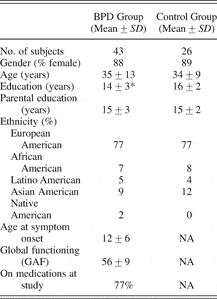
Forty-three individuals with BPD between 18 and 60 years old were recruited from the community, including individuals both in and out of outpatient mental health treatment (Table 1). Recruitment strategies included both direct contact with clinical providers in the community, advertisements placed in public places and on-line, and word of mouth. Exclusion criteria included comorbid diagnoses of schizophrenia, schizoaffective, or bipolar spectrum disorders, or current diagnoses of major depressive disorder, PTSD, or substance dependence; and history of neurological disease. Although PTSD is a common comorbid condition in BPD, we excluded these individuals as PTSD patients exhibit deficits in various neurocognitive functions, including verbal recall and executive functions (such as Stroop performance; Golier & Yehuda, Reference Golier and Yehuda2002), which would therefore confound the results of the present study. All BPD subjects were clinically stable; none were hospitalized in the month prior to study, and none had psychotic or dissociative symptoms at the time of study. The mean (±SD) Global Assessment of Function was 57 (±9). Seventy-five percent were on psychiatric medications at study (Table 1). BPD subjects underwent psychiatric diagnostic evaluation with the Structured Clinical Interview for Axis II (SCID-II) using DSM-IV criteria, after completing the SCID-II screening questionnaire (First, Gibbon, Spitzer, Williams, & Benjamin, Reference First, Gibbon, Spitzer, Williams and Benjamin1997). Axis I disorders were evaluated with the SCID-I (First, Spitzer, Gibbon, Williams, & Benjamin, Reference First, Spitzer, Gibbon, Williams and Benjamin1995). The diagnostic interviews of 21 (53%) BPD subjects were randomly chosen for videotaping, which was reviewed by a second SCID-trained diagnostician (doctoral-level clinical psychologist). Interrater agreement for BPD criteria was high (κ = .81). Comorbid Axis I diagnoses included panic disorder (n = 2), dysthymic disorder (n = 6), bulimia (n = 2), gender identity disorder (n = 1), amphetamine abuse (n = 1), and cannabis abuse (n = 1). Comorbid Axis II diagnoses included paranoid (n = 10), schizoid (n = 3), schizotypal (n = 4), antisocial (n = 5), histrionic (n = 3), narcissistic (n = 5), avoidant (n = 19), dependent (n = 8), and obsessive–compulsive (n = 6).
Demographic and clinical characteristics of subjects

Note: BPD, borderline personality disorder group; SD, standard deviation; GAF, Global Assessment of Function Scale (DSM-IV Axis IV).
* Significant group difference by t test (p < .05).
Control subjects were also recruited from the community. They were similar to the BPD group in age, parental education, and employment (Table 1). Prospective control subjects were screened for personality disorders using the SCID-II screening questionnaire, and for Axis I disorders using a modified version of the SCID-I Nonpatient version. These Axis I diagnoses included schizophrenia, schizoaffective disorder, bipolar affective disorder Type I and II, cyclothymia, major depressive disorder, dysthymic disorder, PTSD, panic disorder, generalized anxiety disorder, substance-related disorders, and intermittent explosive disorder. Exclusion criteria included any past or present psychiatric diagnosis or treatment, or neurological disease. No control subject met more than one DSM-IV criterion for BPD, or neared the screening threshold for any other personality disorders. After complete description of the study to the subjects, written informed consent was obtained. All subjects were paid for participation at a rate of approximately $12/hr.
Self-report measures
Experiences in close relationships (ECR)
This 36-item self-report questionnaire (Brennan et al., Reference Brennan, Clark, Shaver, Simpson and Rholes1998) assesses patterns of social attachment in adult relationships. The 18 items on each subscale were selected from those with the highest loadings on one of two factors that represent the latent dimensions underlying variation in self-reported social attachment. Items are rated on a 7-point Likert scale from “agree strongly” to “disagree strongly,” and examples on each respective dimension include “I worry about being abandoned” and “Just when my partner starts to get close to me I find myself pulling away.” Scores are generated for each of the two underlying dimensions: attachment–anxiety and attachment–avoidance. Dimensional scores can also be converted to attachment categories (represented by quadrants of two-dimensional “space”) for comparison to typological attachment schemes. However, the ECR creators recommend analysis of dimensional scores, which provide greater power and precision in the measurement of attachment (Brennan et al., Reference Brennan, Clark, Shaver, Simpson and Rholes1998). The internal consistency reliability for each dimension is excellent in the present sample (Cronbach α = .93 and .94, respectively). The ECR also appears adequate (and superior to other self-report adult attachment instruments) on psychometric measures derived from item response theory (Fraley, Waller, & Brennan, Reference Fraley, Waller and Brennan2000). Three subjects did not complete the ECR: one who reported no history of romantic relationships, and two who did not complete the study. A recent study of 99 adults with BPD using the ECR found most to be described by preoccupied or fearful attachment types, corresponding to high attachment–anxiety (in both) and low versus high attachment–avoidance, respectively (Levy, Reference Levy2005). Among a sample of inpatients with major depression, ECR attachment–avoidance was modestly positively related to depression scores, and negatively to both marital satisfaction and recalled opposite-gender parental care (using the Parental Bonding Instrument; Difilippo & Overholser, Reference Difilippo and Overholser2002). In a nonclinical sample of students, both ECR dimensional scores were related to alexithymia scores (Picardi, Toni, & Caroppo, Reference Picardi, Toni and Caroppo2005).
Childhood Trauma Questionnaire (CTQ)
This 28-item retrospective self-report (Bernstein & Fink, Reference Bernstein and Fink1998) assesses patterns of maltreatment in childhood and adolescence. It contains five scales: emotional abuse, sexual abuse, physical abuse, emotional neglect, and physical neglect. Total abuse and total neglect are reported as summary scores. Cronbach α values ranges from .66 for physical neglect to .92 for sexual abuse; the 4-month test–retest reliability ranges from .70 to .86 (Bernstein & Fink, Reference Bernstein and Fink1998). The CTQ is also strongly associated with therapist and interviewer ratings of abuse and neglect (Bernstein & Fink, Reference Bernstein and Fink1998).
Recall measures
Verbal Learning Test
We developed a test of verbal recall containing emotionally neutral and emotionally charged words. This test is derived from the Hopkins Verbal Learning Test (HVLT; Benedict, Schretten, Groninger, & Brandt, Reference Benedict, Schretlen, Groninger and Brandt1998). The original HVLT has been found to be a very sensitive index of mild HIV-related cognitive impairment (Carey et al., Reference Carey, Woods, Rippeth, Gonzalez, Moore and Marcotte2004; Woods, Scott, et al., Reference Woods, Rippeth, Conover, Gongvatana, Gonzalez and Carey2005). It can discriminate verbal recall ability between the following groups: Alzheimer disease patients and either Parkinson disease (Grace et al., Reference Grace, Amick, D'Abreu, Festa, Heindel and Ott2005) or depressed patients (Strang, Donnelly, Grohman, & Kleiner, Reference Strang, Donnelly, Grohman and Kleiner2002), mild cognitive impairment patients from both healthy controls and Alzheimer disease patients (De Jager, Hogervorst, Combrinck, & Budge, Reference De Jager, Hogervorst, Combrinck and Budge2003), methamphetamine-dependent adults (Woods, Rippeth et al., Reference Woods, Scott, Dawson, Morgan, Carey and Heaton2005), and mild traumatic brain injury patients (Bruce & Echemendia, Reference Bruce and Echemendia2003) from healthy controls. It has also been used to discriminate subgroups of outpatients with schizophrenia by symptom subtype (Mahurin, Velligan, & Miller, Reference Mahurin, Velligan and Miller1998), and predicts their vocational outcome (Abi-Saab, Fiszdon, Bryson, & Bell, Reference Abi-Saab, Fiszdon, Bryson and Bell2005). It is not sensitive to depression, among outpatients with epilepsy (Letz et al., Reference Letz, DiIorio, Shafer, Yeager, Schomer and Henry2003). We modified the HVLT by including an equal number of “hot” negative-valence words (e.g., murder, pus) and “cold” emotionally neutral words (e.g., table, car), each within three semantic categories, both to evaluate the effect of emotional item content and to reduce the normative ceiling effect on overall performance. Hot words had significantly more emotional content than cold words (p < .0005) by normative ratings (John, Reference John1988); they were not different in average length or frequency in the lexicon by two published norms (Kucera & Francis, Reference Kucera and Francis1967; Thorndike & Lorge, Reference Thorndike and Lorge1944). All stimuli were digitally recorded.
Family pictures
This test from the Wechsler Memory Scale—Third Edition presents pictures of families in social interaction. Subjects view cards depicting complex narrative scenes of family units, each for 10 s, and are asked to describe who is in each picture, where they are located spatially, and what they are doing, both immediately and after a delay of 20 min (Wechsler, Reference Wechsler1997). This test of episodic recall is heavily dependent on associative feature binding, and likely dependent primarily on medial temporal lobe (especially hippocampal) function (discussed in detail in Gold, Poet, Wilke, & Buchanan, 2004). It discriminates schizophrenia patients from healthy controls (Gold et al., Reference Gold, Poet, Wilk and Buchanan2004), as well as right from left temporal lobectomy patients (Doss, Chelune, & Neugle, 2004), supporting its right hemisphere lateralizing value.
Sentence repetition
This test of immediate verbal memory for emotionally neutral sentences (Spreen & Strauss, Reference Spreen and Strauss1998) was administered in sequence with an emotionally charged version constructed for this study. The emotionally charged version contained items of negative valence (e.g., “When cars crash head on, the windows quickly shatter”). This new version maintained the structure of the older version, with increments of syllable length across sentences, which were all declarative in nature. The two versions of this test were digitally recorded and presented in counterbalanced order across subjects. Individual sentences were played one at a time in fixed order (of increasing length) for all subjects, who repeated the sentence exactly as they heard it, immediately thereafter (as they were previously instructed). The older version discriminates the following groups from healthy, matched controls: adults with aphasia, Alzheimer disease, left-hemisphere lesions, and children with dyslexia (Spreen & Strauss, Reference Spreen and Strauss1998). It also discriminates left versus right temporal lobe epilepsy patients (Hermann, Seidenberg, Haltiner, & Wyler, Reference Hermann, Seidenberg, Haltiner and Wyler1992). Among patients with schizophrenia, it discriminates those with auditory hallucinations from those without (Hoffman, Rapaport, Mazure, & Quinlan, Reference Hoffman, Rapaport, Mazure and Quinlan1999), as well as undifferentiated from paranoid schizophrenia subtypes (Seltzer, Conrad, & Cassens, Reference Seltzer, Conrad and Cassens1997); and deficits on this test remain stable (relative to other neurocognitive deficits) across a wide age range (Harvey et al., Reference Harvey, Lombardi, Kincaid, Parrella, White and Powchik1995).
Executive function measures
Stroop Test
A computer-administered version was used to measure both classic and emotional Stroop effects. Subjects were asked to name the color of ink used to print the following five blocks of stimuli (20 items each): color naming (colored Xs), cold words, hot words, color–word congruent, and color–word incongruent. Both the order of blocks and the order of items within each block were randomized. The hot and cold words had the same average letter length and frequency in the lexicon (Kucera & Francis, Reference Kucera and Francis1967). Hot words contained significantly more emotional content than cold words (p < .0005) by normative ratings (John, Reference John1988). Classic Stroop Interference was computed as the ratio of mean response times (RTs) in correct trials of two conditions: color–word incongruent/color naming. Likewise, Emotional Stroop Interference was computed as the ratio of mean RTs in correct trials of two conditions: hot word/cold word. Subjects were instructed to “name the color” of the word despite what the subject saw on screen, and “to go as fast as you can without making mistakes.” Each subject demonstrated an accurate recognition of each color before the test began. Twenty-four practice items (from color-naming and cold word categories) were presented, leading into the experimental trials (40 per block) without interruption. The literature on the classic Stroop is immense (over 400 published papers as of 1991; MacLeod, Reference MacLeod1991), including studies of psychiatric populations such those with schizophrenia (reviewed in Henik & Salo, Reference Henik and Salo2004). Among mood and anxiety disorder patients, it discriminates manic from depressed and remitted bipolar I patients (Dixon, Kravariti, Frith, Murray, & McGuire, Reference Dixon, Kravariti, Frith, Murray and McGuire2004), bipolar from unipolar depressed patients (Borkowska & Rybakowski, Reference Borkowska and Rybakowski2001), psychotic from nonpsychotic major depression patients (Schatzberg et al., Reference Schatzberg, Posener, DeBattista, Kalehazen, Rothschild and Shear2000), and obsessive–compulsive disorder patients from healthy controls (Penades, Catalan, Andres, Salamero, & Gasto, Reference Penades, Catalan, Andres, Salamero and Gasto2005). The emotional Stroop has also been used among psychiatry patients, particularly those with mood and anxiety disorders, who show consistent differences in interference effects compared to control groups; it is interesting that those with PTSD appear to exhibit the greatest interference effects (reviewed in Williams, Mathews, & MacLeod, Reference Williams, Mathews and MacLeod1993). Both the classic and emotional Stroop have shown differences between BPD patients and controls (see introductory section; reviewed in Fertuck et al., Reference Fertuck, Lenzenweger, Clarkin, Hoermann and Stanley2006).
Hayling Sentence Completion Test
The Hayling Test (Burgess & Shallice, Reference Burgess and Shallice1997) is considered to be a test of response selection (Elliot, Dolan, & Frith, Reference Elliot, Dolan and Frith2000) and response inhibition, an aspect of cognitive control (Burgess & Shallice, Reference Burgess and Shallice1996). This test is sensitive to PFC injury (Burgess & Shallice, Reference Burgess and Shallice1996), and in functional brain imaging paradigms activates OFC (Collette et al., Reference Collette, Van der Linden, Delfiore, Degueldre, Luxen and Salmon2001; Elliot et al., Reference Elliot, Dolan and Frith2000), ACC (Nathaniel-James, Fletcher, & Frith, Reference Nathaniel-James, Fletcher and Frith1997), and dorsolateral PFC (Nathaniel-James & Frith, Reference Nathaniel-James and Frith2002). Digitally recorded incomplete sentences were presented in random order for the subject to complete with a single word. In Section 1, subjects were instructed to complete the sentence immediately by saying any single word that “made sense,” as fast as possible without repeating any words. In Section 2, incomplete sentences were presented but the subject was instructed to provide a word “that does not fit, that is completely unrelated to the sentence in any way,” again as fast as possible without repeating words. For this study, we modified Section 2 items to include 16 emotionally hot sentence stems (e.g., “The baby cried and upset her ___”) and 16 emotionally neutral (cold) sentence stems (e.g., “It took a while for the paint to ___”). These were drawn from sentence completion norms (Bloom & Fischler, Reference Bloom and Fischler1980) or created by the first author. Section 2 responses were rated for their semantic relation to the sentence stems according to established criteria (Burgess & Shallice, Reference Burgess and Shallice1996). Directly and indirectly related responses were scored as errors. As in the Stroop, Hayling interference effects were computed as the ratio of RTs in correct trials: Section 2/Section 1, and hot items/cold items. Impairment of cognitive control on the Hayling is associated with both auditory hallucinations (Waters, Badcock, Maybery, & Michie, Reference Waters, Badcock, Maybery and Michie2003) and social dysfunction in schizophrenia (Chan, Chen, Cheung, & Cheung, Reference Chan, Chen, Cheung and Cheung2004), and is found together with attenuated midline PFC activation in alcohol-dependent subjects (Noel et al., Reference Noel, Sferrazza, Van Der Linden, Paternot, Verhas and Hanak2002). Performance on this test also discriminates manic, depressed, and remitted bipolar patients from each other and from healthy controls (Dixon et al., Reference Dixon, Kravariti, Frith, Murray and McGuire2004), and children with attention deficit disorder with hyperactivity from those with oppositional defiant disorder or conduct disorder (Clark, Prior, & Kinsella, Reference Clark, Prior and Kinsella2000).
Gambler's Test
This computer-administered test simulates a card game, and assesses the ability to evaluate the consequences of choices and revise one's choices to optimize rewards (Bechara, Damasio, Damasio, & Anderson, Reference Bechara, Damasio, Damasio and Anderson1994). On screen are four decks of cards with a similar appearance. Subjects are instructed to choose from any deck they please, and permitted to change deck choices at any time, in order to win as much money as possible. Subjects are given $2000 in play money at the outset, and each card choice reveals either a gain or loss of money, or both. The test terminates after 100 choices. Unbeknownst to the subject, these decks vary by frequency and amount of gains and losses associated with choices from them: in two (“bad”) decks gains are more frequent but losses are larger, leading to net loss over time; in the other two (“good”) decks, gains are smaller in individual trials but net gains are larger over time. Subjects are considered to be sensitive to future consequences if their tendency to choose is guided by the large losses, away from the “bad” decks over time; subjects insensitive to future consequences persist in choosing from bad decks despite the adverse consequences. This test is sensitive to OFC injury (Bechara et al., Reference Bechara, Damasio, Damasio and Anderson1994) and amygdala disease (Bechara et al., Reference Bechara, Damasio, Damasio and Lee1999), and has been utilized to demonstrate decision-making impairment in clinical populations related to BPD, such as substance abusers (Bechara, Dolan, & Hindes, Reference Bechara, Dolan and Hindes2002; Grant, Contoreggi, & London, Reference Grant, Contoreggi and London2000; Petry, Bickel, & Arnett, Reference Petry, Bickel and Arnett1998), antisocial alcoholism (Mazas, Finn, & Steinmetz, Reference Mazas, Finn and Steinmetz2000) and intermittent explosive disorder (Best, Williams, & Coccaro, Reference Best, Williams and Coccaro2002), and nonclinical subjects with high psychopathy ratings (Van Honk, Hermans, Putman, Montagne, & Schutter, Reference Van Honk, Hermans, Putman, Montagne and Schutter2002).
Intelligence measures
The Wechsler Abbreviated Scale of Intelligence (WASI; Wechsler, Reference Wechsler1999) comprises vocabulary, similarities, block design, and matrix reasoning subtests. The test provides estimates of verbal (VIQ), performance (PIQ), and full-scale IQs (FSIQ), which are highly correlated with these indices on the full Wechsler Adult Intelligence Scale—Third Edition (Wechsler, Reference Wechsler1999). In this study, we used the WASI as a supplementary measure, to allow comparison of performance on the above tests to more general cognitive abilities.
Results
General statistical analytic strategy
We first computed Z scores for all cognitive measures, based on their means and standard deviations in the CON group (subaverage performance defined as a negative z score). Composite recall and executive indices were obtained from mean z scores of the three recall and three executive measures, respectively. We also computed hot and cold indices from mean z scores of the four hot and four cold conditions (in Verbal Learning, Sentence Repetition, Stroop, and Hayling Tests).
We then conducted a set of preliminary inferential tests as follows. Preliminary tests of significance consisted of (a) a mixed-model analysis of variance to evaluate the effects of hot versus cold condition and (b) canonical correlations to evaluate the relationship of cognitive scores to attachment and maltreatment indices for the BPD group. All correlations between cognition and either attachment or maltreatment are computed for the BPD group only.
We identified significant effects from the preliminary analyses, and then continued to four main inferential tests of hypotheses indicated in the introductory section: (a) comparison of BPD versus CON cognitive scores, as univariate analyses on neurocognitive indices and individual neurocognitive measures; (b) bivariate correlation of cognitive performance with attachment in the BPD group, including a direct statistical comparison (Cohen & Cohen, Reference Cohen and Cohen1983) of the correlations (Pearson r coefficients) of attachment–anxiety with recall versus executive function, and in a parallel comparison, attachment–avoidance with executive function versus recall; (c) bivariate correlation of cognitive performance with maltreatment in the BPD group; and (d) a regression analysis to determine the respective contribution of neurocognitive performance and maltreatment (and their interaction) to attachment scores, also in the BPD group. We also evaluated partial correlations in a post hoc manner, controlling separately for medication status (i.e., presence vs. absence of concurrent psychotropic medication treatment), illness severity (GAF scores), and the presence or absence of comorbid Axis II Cluster C diagnoses on DSM-IV in the BPD group. We report group comparisons on cognitive measures, as well as correlations with attachment and maltreatment, all with and without controlling for intelligence, to allow the reader to compare the corresponding effects. This data is presented to inform the issue of intelligence deficit in BPD, as we believe this to remain an important but largely unaddressed issue in the literature to date (see introductory and Discussion sections). For all tests, the criterion of statistical significance was p < .05, two tailed (except as indicated). However, to permit consideration of possible Type II errors, we also report any trends that approach significance (p < .10).
Results of Preliminary Analyses
Effects of emotion content on cognitive performance
In the total sample, there was a significant main effect of emotion condition, F (1, 59) = 6.78, p = .01. This was accounted for by significantly greater recall of hot items than cold items on the Verbal Learning Test, F (1, 64) = 11.03, p = .001, and Sentence Repetition Test, F (1, 63) = 104.8, p < .0005, as well as significantly greater interference from hot items than cold items on the Emotional Stroop, F (1, 64) = 6.60, p = .01. On the Hayling Test, hot and cold items showed a nonsignificant trend in the same direction, F (1, 60) = 3.00, p = .09. These results confirm that the manipulation of hot versus cold emotional content generally produced the intended experimental effect on these tasks.
There was no significant interaction of Group (BPD, CON) × Condition (hot, cold) in the overall test, F (1, 59) = 1.86, p = .2, nor in separate univariate tests on each cognitive task (all p values > .4). In addition, differences in hot versus cold performance were uncorrelated with the attachment and maltreatment measures (all p > .11). This indicates that adding emotional content to the cognitive tasks had comparable effects in the BPD and CON groups, and that these effects were unrelated to attachment scores or maltreatment history. Consequently, no further analyses of hot versus cold items will be presented. The hot index and cold index were very highly correlated with one another (r = .94, p < .001). Thus, for the remainder of this study, we used the mean of hot and cold scores on the Verbal Learning, Sentence Repetition, and Hayling Tests, and we analyzed classic Stroop (not Emotional Stroop) interference effects.
Canonical correlation between cognitive performance and both attachment scores and childhood maltreatment in the BPD group
In a preliminary test of significance, lower scores on the Recall Index and Executive Index were correlated with attachment–anxiety and attachment–avoidance (canonical R = −.53, p = .006), and in a separate analysis, with abuse and neglect (canonical R = −.57, p = .01).
Main Inferential Test Results
Hypothesis 1: Cognitive performance is impaired among the BPD group
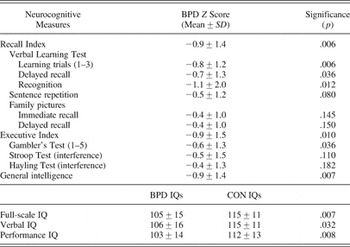
The composite recall and executive indices were significantly correlated with one another in BPD (r = .43, p = .008) and less so in CON (r = .34, p = .11), which means that these indices measure distinct, but not completely independent, cognitive domains. Table 2 summarizes differences between BPD and CON subjects on cognitive measures. On the Recall Index, BPD performed worse than the CON group by nearly 1 SD, F (1, 62) = 8.03, p = .006. This was mainly accounted for by significantly poorer recall on the Verbal Learning Test, F (1, 62) = 7.75, p = .007. Sentence repetition showed a trend in the same direction, but did not attain statistical significance (p = .08). Performance on family pictures was not significantly different between groups (p = .14). On further analysis of the Verbal Learning Test, BPD also performed significantly worse than CON on the delayed recognition trial, F (1, 64) = 6.70, p = .01. This suggests that the BPD group's poorer recall was not simply because of inefficient information retrieval, but reflected reduced learning and retention of new information.
Cognitive performance of borderline group compared to control group
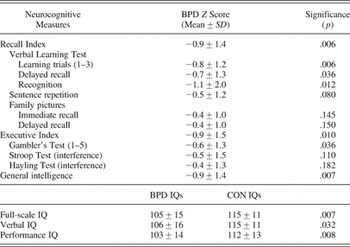
Note: The above z scores are computed from the mean and standard deviation of the control group, with negative z scores indicating below-average performance. In addition, IQ scores from the Wechsler Abbreviated Scale of Intelligence are shown. Statistical significance levels are by analysis of variance (see Results for details).
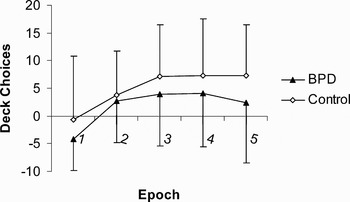
Similarly, on the Executive Index, BPD performed worse than the CON group by nearly 1 SD, F (1, 60) = 7.03, p = .01. This was mainly accounted for by significantly worse performance on the Gambler Test, F (1, 64) = 4.58, p = .04. The Stroop and Hayling interference effects were greater for the BPD group, but these did not attain significance (p = .11 and 0.18, respectively). Figure 1 illustrates each group's performance across epochs on the Gambler Test. There was no significant Group × Epoch interaction on this test, F (4, 63) = .56, p = .5. These results indicate that BPD subjects made fewer advantageous deck choices across trials than CON subjects, but that the shape of the learning curve was similar in the two groups.
Gambler's Test performance. Performance over time by two subject groups (mean ± standard deviation). Each epoch comprises a block of 20 sequential card choices. The Y axis is the number of strategically advantageous choices minus disadvantageous choices (see Methods section). The difference between BPD and control subjects was significant, as was subjects' overall improvement over time; there was no significant Group × Epoch interaction (see Results section for details).

FSIQ was 10 points lower in the BPD group than in the CON group, F (1, 64) = 7.86, p = .007. This difference is approximately two-thirds of 1 SD among the general population (i.e., from published norms), and was apparent in both VIQ, F (1, 64) = 4.84, p = .03, and PIQ, F (1, 64) = 7.50, p = .008. FSIQ was correlated with the recall index (r = .61, p < .0005) and with the executive index (r = .46, p = .004).
Because of the group differences in intelligence, we reassessed the above group comparisons on all cognitive measures by covarying for VIQ (for tests that used verbal content), except for family pictures and the Gambler's Test, where we covaried for PIQ. In this analysis, statistically significant group impairment in the BPD group persisted for the recall index, F (1, 61) = 4.14, p = .046, and Verbal Learning Test, F (1, 62) = 4.10, p = .047, with a trend toward impairment in the BPD group observed on the executive function index, F (1, 58) = 3.75, p = .058. The significant BPD group impairment on the Gambler's Test was abolished upon covarying for PIQ (p = .2), and no other statistically significant group differences were found.
Hypothesis 2: Cognitive performance is related to attachment disturbance in BPD
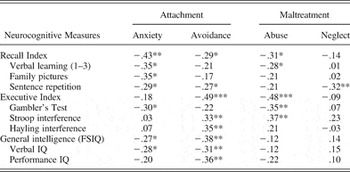
Table 3 lists bivariate Pearson correlations between the cognitive and attachment measures in the BPD group. Attachment–anxiety was associated with lower scores on the recall index (r = −.43, p = .005). This was mainly accounted for by significant correlations of attachment–anxiety with verbal learning and family pictures recall. In a direct comparison, attachment–anxiety was negatively correlated to a significantly greater degree with recall than with executive function (t = −1.784, df = 37, p < .025 one tailed). Conversely, attachment–avoidance was associated with lower scores on the executive index (r = −.49, p = .002). This was mainly accounted for by significant correlations of attachment–avoidance with interference effects on the Stroop and Hayling Tests (r = .33 and r = .35, respectively, p < .04). In a direct comparison, attachment–avoidance was negatively correlated to a significantly greater degree with executive function than with recall (t = −1.655, df = 37, p < .05 one tailed). Attachment scores on both dimensions showed nonsignificant tendencies to be correlated with lower sentence repetition scores, and attachment–anxiety with Gambler's Test performance (p < .10). Controlling for medication, illness severity (GAF), or comorbid Cluster C diagnoses had negligible effect on these correlations (all partial r values were within .07 of the zero-order correlations). Similarly, controlling for IQ (as in the between-group comparisons above) had modest to minimal effect on these correlations: all partial r values remained within .10 of significant zero-order correlations.
Relationship of neurocognition to adult attachment and childhood maltreatment in borderline personality disorder group

Note: FSIQ, full-scale IQ; Pearson correlation coefficients.
* p < .10. **p < .05. ***p < .01. Two-tailed significance.
Hypothesis 3: Cognitive performance is related to childhood maltreatment in BPD
Table 3 lists bivariate Pearson correlations between the cognitive and maltreatment measures in the BPD group. Abuse was significantly correlated with the Executive Function Index (r = −.48, p = .003), including with Gambler's Test (r = −.35, p = .03) and Stroop impairment (r = .37, p = .02). Abuse showed a trend-level correlation with poorer recall (r = −.31, p = .06) and verbal learning (r = −.28, p = .09). Neglect was correlated only with lower sentence repetition (r = −.32, p = .05). Intelligence measures were not correlated with abuse or neglect. Controlling for IQ (as in the between-group comparisons above) had minimal downward effect on these correlations: all partial r values were within .02 of the zero-order correlations. In contrast, partial correlations of neglect with three cognitive measures, controlling for IQ, caused the partial r values to be raised over their corresponding zero-order r values: with the recall index, r changed from −.14 to −.27 (new p = .10); with sentence repetition correlation, r changed from −.32 to −.44 (new p = .006), and with the Stroop, r changed from .23 to .28 (new p = .09). Controlling for medication, illness severity (GAF), or comorbid Cluster C diagnoses had negligible effect on the zero-order correlations of maltreatment with neurocognitive performance (all partial r values remained within .07 of the zero-order correlations).
Hypothesis 4: Neurocognitive dysfunction and maltreatment make independent contributions to adult attachment disturbance in BPD
In regression analysis, attachment–anxiety was significantly predicted by recall index scores (β = −0.89, p < .0005) and abuse (β = 0.64, p < .0005), as well as the interaction between the two (β = 0.71, p = .014; with R 2 for the model = .44).
In a separate analysis, attachment–avoidance was significantly predicted by Executive Function Index scores (β = −0.43, p = .001) and abuse (β = 0.25, p = .05; with R 2 for the model = .36). The interaction between executive function and abuse was not associated with significant variance in attachment–avoidance scores.
Discussion
Attachment–anxiety and impaired recall
Studies addressing attachment-related phenomena and models of temperament (both in normal development and in BPD) have identified variation in these phenomena because of the factor of reactivity. This factor appears to have a basis in subcortical limbic function, particularly the medial temporal lobe structures, the amygdala, and hippocampus. Given the consistent findings in BPD of impaired (verbal and nonverbal) recall, a cognitive function that is primarily dependent on the medial temporal lobe (Squire, Stark, & Clark, Reference Squire, Stark and Clark2004), and which shows altered structure and function in BPD, we hypothesized that a measure of reactivity in attachment settings would be related to recall impairment. Consistent with this hypothesis, attachment–anxiety scores were specifically related to short-term recall deficits. These relationships were unaccounted for by intelligence deficits, nor by clinical factors such as medication status, illness severity, or comorbid Cluster C personality disorders. This association is consistent with the finding by Gillath et al. (Reference Gillath, Bunge, Shaver, Wendelken and Mikulincer2005) that attachment–anxiety is associated with elevated activity in the hippocampus while healthy subjects think of negatively valenced relationship outcomes. This association could reflect a few possible underlying scenarios: that impaired recall (reflecting underlying medial temporal lobe dysfunction) results in attachment-related reactivity; that this reactivity, driven by other causes, leads to impaired recall (e.g., Kim & Diamond, Reference Kim and Diamond2002); or that both the reactivity and the recall impairment are related by a common unidentified mechanism. The consistent evidence for altered medial temporal lobe structure and function in brain imaging studies of BPD (Brambilla et al., Reference Brambilla, Soloff, Sala, Nicoletti, Keshavan and Soares2004; Donegan et al., Reference Donegan, Sanislow, Blumberg, Fulbright, Lacadie and Skudlarski2003; Driessen et al., Reference Driessen, Herrmann, Stahl, Zwaan, Meier and Hill2000; Herpertz et al., Reference Herpertz, Dietrich, Wenning, Krings, Erberich and Willmes2001; Juengling et al., Reference Juengling, Schmahl, Heflinger, Ebert, Bremner and Gostomzyk2003; Rusch et al., Reference Rusch, van Elst, Ludaescher, Wilke, Huppertz and Thiel2003; Schmahl, Vermetten, et al., Reference Schmahl, Vermetten, Elzinga and Bremner2003; Tebartz van Elst et al., Reference Tebartz van Elst, Hesslinger, Thiel, Geiger, Haegele and Lemieux2003) suggests that recall deficits and medial temporal lobe dysfunction in BPD are not merely downstream effects of disturbances in other brain regions. It is certainly possible that other brain areas that mediate responses to environmental stimuli (such as visual association cortices, other subcortical limbic areas, or brainstem monoamine nuclei) may also be dysfunctional in BPD, with either parallel effects on attachment reactivity and recall, or on reactivity which then in turn affects recall adversely. Unfortunately, these other areas have not yet been examined for structural or functional integrity in BPD patients. Of interest, we found that attachment–anxiety was also related to impairment on the Gambler's Test. This test is sensitive to neurological disease affecting both the OFC (Bechara et al., Reference Bechara, Damasio, Damasio and Anderson1994) and the amygdala (Bechara et al., Reference Bechara, Damasio, Damasio and Lee1999), and in addition, impairment on this task is found among several populations characterized by interpersonal dysfunction (see task description in Methods). This finding, then, is consistent with the notion that impairment in neurocognitive function with a basis in OFC–amygdala circuitry is another important feature of interpersonal dysfunction. Ultimately, the relationship of attachment reactivity to more direct measures of neural function will be necessary to determine the neural basis for the relationships observed in the present study.
Attachment–avoidance and executive dysfunction
As hypothesized, elevated attachment–avoidance in BPD was specifically associated with executive dysfunction on tasks of cognitive control. Although the deficit of the BPD group was reduced to a trend level of significance (p = .058) upon covarying for intelligence, the significant correlation (among the BPD group) between attachment–avoidance and the executive index persisted. This suggests that this association is not merely an artifact of subject selection that is biased by intelligence (see below for fuller discussion of the issue of intelligence and maltreatment in BPD). These executive functions have a basis in the function of the midline PFC, including ACC and OFC, which are areas implicated in models of attachment outlined in the introductory section. In these models (e.g., MacLean, Reference MacLean1985; Schore, Reference Schore1994, Reference Schore2001), ACC and OFC serve as the apex of control systems that integrate social and emotional information, with resulting descending regulation of subcortical limbic activity and associated hormonal and physiological output. In addition, the ACC and OFC organize complex behavioral sequences that represent expressions of attachment behavior, such as the separation distress call and other proximity-seeking behaviors that are common across mammalian species (Hofer, Reference Hofer1996; MacLean, Reference MacLean1985). Cognitive control is a cognitive function that has been implicated not only in attachment models, but also in models of temperament that have direct implications for the pathophysiology of BPD (Posner et al., Reference Posner, Rothbart, Vizueta, Thomas, Levy and Fossella2003). In these latter models, cognitive control ability forms the neurocognitive basis for the effortful control factor that is related to social development in children. There is consistent evidence that cognitive control is impaired among adults with BPD (reviewed in the introductory section), and this deficit can be observed among children in association with BPD phenomenological precursors (Rogosch & Cicchetti, Reference Rogosch and Cicchetti2005).
We propose that BPD patients use the emotional and behavioral strategies of attachment–avoidance in part as a compensatory strategy for deficient executive regulation of negative affect states that arise in attachment settings. In this scenario, the impaired ability of the BPD patient's cognitive control processes to both internally mitigate negative affect, and to adaptively engage interpersonal processes to aid in this affect regulation (through expression of normal attachment system activation), leads to overt, cyclic interpersonal distancing strategies to compensate in relational settings. However, other interpretations of this relationship are possible. For example, attachment–avoidance may be a direct manifestation of executive dysfunction, to the extent that cognitive control is necessary to maintain engagement with an attachment “object” (in this case, a romantic partner).
Although the present study does not allow us to distinguish between these alternate interpretations, we note the role of emotion regulation in normative social attachment (Mikulincer et al., Reference Mikulincer, Shaver and Pereg2003), and the active nature of attachment–avoidance as reflected in the manifest content of the attachment measure (ECR). In addition, hallmark features of BPD include emotion dysregulation (Linehan, Reference Linehan1993) and oscillating social attachment (Melges & Swartz, Reference Melges and Swartz1989). Taken together, these observations suggest that attachment–avoidance is an interpersonal strategy employed by BPD patients in a cyclic manner to bring about emotion regulation that cannot be achieved in a more adaptive (executive) manner. This scenario does not diminish the role of experiential factors (e.g., maltreatment), which could hypothetically exert effects on adult attachment either related to executive dysfunction or by some other unidentified mechanism. Indeed, the results of the regression analyses suggest that maltreatment and neurocognitive dysfunction exert both independent and interacting effects on attachment disturbance (discussed below).
The relationship of childhood maltreatment to neurocognitive dysfunction and to adult attachment disturbance
We found significant relationships of childhood abuse history with both neurocognitive dysfunction on one hand, and adult attachment disturbance on the other hand. Animal models indicate deleterious effects of early adversity on both hippocampal and ACC structure and function, which persist into adulthood (Sanchez et al., Reference Sanchez, Ladd and Plotsky2001). Empirical studies of children and adults with abuse histories have similarly shown evidence of altered structure and function of subcortical limbic areas and the midline PFC. The hippocampus and ACC in particular have been strongly implicated here as well. Although these brain areas are also disturbed in BPD, the effects of childhood maltreatment on either neuroanatomy or associated cognitive functions has not yet been directly addressed for BPD patients.
In our sample, we found that a history of child abuse was related to impaired verbal recall. It is interesting that the nonverbal measure of short-term memory (family pictures), which is generally dependent more on right hippocampal function (Doss et al., Reference Doss, Chelune and Naugle2004), did not show a significant group difference and was not associated with maltreatment. This may reflect lateralized effects of abuse, because children and adults with histories of abuse show more consistent deficits in left hippocampal structure and function (Bremner, Reference Bremner2003; Stein et al., Reference Stein, Koverola, Hanna, Torchia and McClarty1997). It also remains possible that preexisting hippocampal atrophy or dysfunction is a risk factor for later vulnerability to adversity, weakening the individual's capacity to “buffer” the effects of maltreatment. A definitive answer to this problem will need to await long-term longitudinal or twin studies of neuroimaging and neurocognition in maltreated or at-risk individuals.
We also found that abuse was related to executive dysfunction. This included performance on a measure of cognitive control (Stroop interference) and a measure of decision making (the Gambler's Test). Although this relationship has also been unexamined to date for BPD patients, a recent study found that ACC-based cognitive control dysfunction is related to the degree of BPD phenomenological precursors in a sample of children (Rogosch & Cicchetti, Reference Rogosch and Cicchetti2005). Of interest, performance on that task (the ANT, which involves response conflict just as the Stroop and Hayling tests do, with a similar basis in ACC function) was not worse for the maltreated group compared to a matched nonmaltreated group. Despite some similarities between that study and the present one, in the study design and research problems addressed, other significant differences are evident, which may account for the divergent findings. In contrast to that study, we analyzed maltreatment as a continuous measure, with the rationale that it would be difficult to dichotomize a sample that is likely to endorse great heterogeneity in the type and severity of childhood maltreatment experiences. Our statistical approach may have conferred greater sensitivity to detect significant associations between maltreatment and cognitive control measures. Conversely, the Rogosch and Cicchetti study evaluated maltreatment more thoroughly, in a more objective manner by structured review of each child's federal Department of Human Services records, and of course, in a time frame much closer to the reported events, in contrast to the present study of adults who provided retrospective self-reports of maltreatment. Furthermore, that study involved a nonclinical sample; in comparison, the present study may be more susceptible to biases in selection and measurement, yet of course remains more directly relevant to the issue of maltreatment effects in BPD. It may be that child abuse is related to cognitive control deficits only among those who progress to a full DSM diagnosis of BPD in adulthood. Just as for the relationship of abuse to memory dysfunction, this scenario could reflect either the effect of abuse on cognitive control (which may emerge only later in development) or cognitive control dysfunction as a preexisting risk factor for vulnerability to the effects of abuse.
In any event, we found that attachment–avoidance was predicted by abuse and executive dysfunction independently, without interacting effects. This finding is very consistent to the findings of the Rogosch and Cicchetti study, where the level of BPD precursors was also related to both maltreatment and cognitive control dysfunction in an independent manner. The present results suggest that clinical heterogeneity in the expression of attachment–avoidance may reflect varying mixtures of cognitive control deficit and maltreatment exposure. For example, the distinction in the Shaver adult attachment model between preoccupied and fearful attachment types is a function of variation along the attachment–avoidance scale, where the preoccupied type is low (approach oriented) and the fearful high (withdrawal oriented; both types being high on attachment–anxiety). Among BPD patients, this distinction may rest on varying mixtures of cognitive control deficit and abuse severity. To obviate the fallacy of Cartesian dualism, some form of physical (i.e., biological) substrate should be implicated in the mediation of experiential effects on future behavior, such as how childhood maltreatment translates into adult relational dysfunction. The present evidence suggests that there exists an unidentified cognitive/biological factor (other than cognitive control dysfunction) that mediates the effect of maltreatment on adult attachment–avoidance.
Of interest, we also found that both recall impairment and abuse were related to attachment–anxiety, in an independent and interacting manner. This suggests that variation across BPD patients in relational reactivity may also be a function of both underlying neurocognitive (medial temporal lobe based) and experiential factors. This would have consequences for the distinction between fearful and dismissing–avoidant types (both high on attachment–avoidance). In contrast to attachment–avoidance, where neurocognition and experience appear to exert parallel (and probably additive) effects, relational reactivity may also exhibit sensitivity to these two factors in interaction. The discovery of biological–environmental interactions is one of the most exciting current topics in the study of adult mental illness (Moffitt, Caspi, & Rutter, Reference Moffitt, Caspi and Rutter2005), and likely to be found widely across adult psychiatric disorders. BPD should serve as a primary target for this type of study, given the established role of both genetic and environmental factors in its emergence (reviewed in Skodol et al., Reference Skodol, Siever, Livesley, Gunderson, Pfohl and Widiger2002).
In contrast to the correlations of abuse with neurocognitive dysfunction, severity of neglect was generally unrelated to neurocognitive performance, with the exception of short-term sentence recall. The role of early neglect in BPD remains obscure. Although a high proportion of adults with BPD endorse various experiences of childhood neglect (Zanarini, Reference Zanarini2000), this experience has been unaddressed in studies of pathophysiology in BPD. This may be because of the challenge of properly conceptualizing and measuring this type of experience (reflected in the relatively lower internal reliability for neglect on the CTQ). The reliable measurement of early neglect may be limited in part by relatively greater difficulty for patients to encode and then recall experiences of neglect decades later, in comparison to experiences of abuse. This is another research area in great need of further development, particularly given that neglect may be much more prevalent than abuse in the community (Allin, Wathen, & Macmillan, Reference Allin, Wathen and MacMillan2005).
Intelligence in BPD
In the present BPD sample, the mean IQ was significantly lower than in the healthy control group, and may be partly responsible for the association of attachment–avoidance with executive dysfunction. The latter finding may not be surprising, given the generally strong loading of executive functions on Spearman's G, which also shows a strong PFC dependence (Kane & Engle, Reference Kane and Engle2002). Nevertheless, inexplicably the role of lower IQ has to date been unaddressed in BPD. This is despite the prevalence of childhood maltreatment in BPD (Zanarini, Reference Zanarini2000), and the strong evidence that child abuse and neglect result in adult intelligence deficits of at least 1 SD on average (reviewed in Cahill et al., Reference Cahill, Kaminer and Johnson1999). This is comparable to the mean IQ decrement observed in our BPD subjects, relative to demographically matched healthy control subjects.
Although IQ was not associated with self-reported childhood maltreatment, the group difference in intelligence appears to be illness related because parental education and socioeconomic status were not different between groups. It is possible that the CTQ may not capture the type of maltreatment that has significant effects on intelligence (because of occurrence at a very early age, for instance), or that there is no simple linear relationship between maltreatment and subsequent intelligence deficit. It is also possible that relatively lower IQ may be a risk factor for BPD, as it is for PTSD (Brewin, Andrews, & Valentine, Reference Brewin, Andrews and Valentine2000) and schizophrenia (David, Malmberg, Brandt, Allebeck, & Lewis, Reference David, Malmberg, Brandt, Allebeck and Lewis1997). Furthermore, reduced general intelligence may predispose BPD patients to lower performance in other cognitive domains, as implied above. In any event, it appears likely that intelligence deficits may be a meaningful measure of cognitive dysfunction in BPD, and investigations that match subject groups on IQ may be vulnerable to the “matching fallacy” emphasized in studies of schizophrenia (Meehl, Reference Meehl, Radner and Winokur1970).
Study Limitations
The following limitations are evident in the present study. First, this study did not include a clinical comparison group with other psychiatric disorders. Therefore, the specificity of these findings to BPD remains uncertain. Studies of community samples indicate that adult attachment disturbances characterized by reactivity or withdrawal are also related to depression vulnerability factors (Bifulco, Moran, Ball, & Lillie, Reference Bifulco, Moran, Ball and Lillie2002), Axis I diagnoses including mood, anxiety, and substance use disorders (Mickelson et al., Reference Mickelson, Kessler and Shaver1997), and the full range of personality disorder symptoms (Brennan & Shaver, Reference Brennan and Shaver1998). Reactive and/or withdrawn attachment is also related to the full range of personality disorder symptoms across mixed samples of psychiatric inpatients (Fossati et al., Reference Fossati, Feeney, Donati, Donini, Novella and Bagnato2003) and personality disordered outpatients (Meyer, Pilkonis, Proietti, Heape, & Egan, Reference Meyer, Pilkonis, Proietti, Heape and Egan2001). It is interesting that a study of outpatients with social anxiety disorder found these patients to exhibit anxious reactivity in attachment relationships, but not relational withdrawal (Eng, Heimberg, Hart, Schneier, & Liebowitz, Reference Eng, Heimberg, Hart, Schneier and Liebowitz2001). None of these studies examined neurocognitive or biological factors. In the present sample, a high rate of Cluster C personality disorder comorbidity was found (particularly avoidant personality disorder, in 43% of the BPD group). These rates are quite consistent with those found in the literature, as several studies using DSM-IV report high rates of Cluster C comorbidity among BPD samples, including 45–59% comorbidity for avoidant personality disorder (Grilo, Miguel Anez, & McGlashan, Reference Grilo, Miguel Anez and McGlashan2002; Grilo, Sanislow, & McGlashan, Reference Grilo, Sanislow and McGlashan2002; McGlashan et al., Reference McGlashan, Grilo, Skodol, Gunderson, Shea and Morey2000; Zanarini et al., Reference Zanarini, Frankenburg, Vujanovic, Hennen, Reich and Silk2004). We did find that controlling for Cluster C diagnoses did not alter our cognitive findings, which indicates a degree of specificity in these effects among the present sample. Nevertheless, measures of reactivity and withdrawal may be somewhat ubiquitous among groups of psychiatric patients, and it remains to be tested whether the relationships of adult attachment disturbance to cognitive dysfunction that we found are more strongly associated with the DSM diagnosis of BPD or alternatively with continuous traits that may be found in this sample. In addition, we excluded prospective subjects who met criteria for various comorbid psychiatric disorders (such as PTSD and bipolar affective disorder) that are also associated with cognitive deficits in the measures employed here (see task descriptions in Methods). These exclusion criteria obviated the confounding effects of these other disorders, yet may limit the ability to generalize these results to the full population of BPD patients in the community, where these disorders are commonly found as comorbid conditions.
Second, adult attachment was evaluated with a self-report measure. Although this measure appears to have good construct validity and reliability (Brennan et al., Reference Brennan, Clark, Shaver, Simpson and Rholes1998), self-report instruments in general can be susceptible to reporting biases, and it is uncertain how self-report attachment measures relate to attachment as assessed with interviews or behavioral observations. Perhaps even more importantly, the relationship of adult attachment to infant–mother attachment remains to be empirically addressed. In this study, we treated adult attachment as an outcome measure, to examine the neurocognitive and developmental experiential correlates that may contribute to this important feature of clinical dysfunction among adults with BPD. The implications of these correlates for early attachment processes remain unknown. This may be addressed in the future by testing the relationship of neurocognition and maltreatment to early attachment in children at risk for BPD.
Third, the measure of childhood adversity was also by self-report, and retrospective. There does appear to be good correspondence between CTQ scores and trauma ratings derived from both research interview and research subjects' treating therapists (Bernstein & Fink, Reference Bernstein and Fink1998). The concordance of responses to interview and questionnaire-based instruments for retrospective assessment of child abuse is also observed for individuals with borderline features (Durrett, Trull, & Silk, Reference Durrett, Trull and Silk2004). Nevertheless, these data are obtained in a remote, retrospective manner, without corroborating evidence of the nature and degree of adversity experienced. In response to these issues, some investigators have emphasized the advantages of prospective design in the study of childhood maltreatment (Widom, Raphael, & DuMont, Reference Widom, Raphael and DuMont2004). However, others have argued that retrospective report of childhood maltreatment may identify a wider sample of individuals, including those who have suffered a greater degree of maltreatment (unreported at the time of exposure) and those who have not had the benefit of a subsequent clinical intervention that may modify the effects of maltreatment (Kendall-Tackett & Becker-Blease, Reference Kendall-Tackett and Becker-Blease2004). In addition, an extensive earlier review of the relevant empirical literature concluded that adults with psychopathology probably remain generally reliable reporters of childhood experiences (Brewin, Andrews, & Gotlib, Reference Brewin, Andrews and Gotlib1993). Nevertheless, approaching a “gold standard” for veridical assessment of childhood adversity may require the involvement of a clinical or legal entity that can conduct a more thorough investigation of maltreatment cases.
Fourth, although multivariate tests found significant impairment of cognition in BPD, which included lower performance on all cognitive measures, several of these univariate differences did not attain statistical significance. This may be because of limited statistical power in our modest sample size. Althnough the sample size in this study is among the largest in the existing BPD/neurocognition literature (see Fertuck et al., Reference Fertuck, Lenzenweger, Clarkin, Hoermann and Stanley2006), subsequent investigations may benefit by including larger samples to better test group differences with relatively small effect sizes.
Fifth, we altered several tests to assess the hypothesis of differential effects of emotionally charged stimuli in BPD subjects, and this differential effect was not confirmed. The psychometric features of these altered tests have not been established, which might raise concerns that they provided inadequate emotional activation to test this hypothesis. However, we obtained a highly significant main effect of emotional content on these tests, which confirmed that this manipulation indeed produced the intended experimental effect. This suggests that BPD patients' deficits on the present cognitive tasks are largely independent of emotional content.
Conclusions
Individuals with BPD exhibit deficits in short-term recall and executive functions, which are related to attachment–anxiety and attachment–avoidance, respectively. These associations are consistent with two-part models of the neurobiology of normal attachment (in animal models and humans), and the neurocognition of temperament as a model for the pathophysiology of BPD. Individuals with BPD may also exhibit lower general intelligence than demographically matched healthy individuals. A history of child abuse is prevalent among BPD patients and is related to some of these neurocognitive and interpersonal disturbances, and appears to contribute to adult attachment disturbance in a manner that is both independent of and interacting with neurocognitive dysfunction. The cognitive deficits may then be expressions of either maltreatment and/or preexisting factors that predispose individuals to the effects of early stressors.
Taken together with the findings from the study of childhood BPD precursors, the present results suggest that early intervention may mitigate the effects of abuse on both neurocognitive function and adult attachment function in adulthood, and possibly risk for BPD. One important psychological factor that confers resilience to the effects of early maltreatment is ego overcontrol (Cicchetti & Rogosch, Reference Cicchetti and Rogosch1997; Cicchetti, Rogosch, Lynch, & Holt, Reference Cicchetti, Rogosch, Lynch and Holt1993), which is likely to be associated at a neurocognitive level with effortful control, one of the cognitive functions found in the present study to relate to adult attachment outcome. Although it remains unknown if ego overcontrol can be improved with clinical intervention, the evidence for cognitive remediation of effortful control (Rothbart & Posner, Reference Rothbart and Posner2005) suggests that approaches that target effortful control may enhance psychological resilience to the effects of maltreatment. This may be an implicit (and potentially explicit) feature of some cognitive–behavioral therapies, which can be reasonably viewed from a neurobiological perspective as involving (in part) enhanced top-down PFC control over subcortical limbic responsiveness, and which presently show good evidence for efficacy in the treatment of abused children (reviewed in Saywitz, Mannarino, Berliner, & Cohen, Reference Saywitz, Mannarino, Berliner and Cohen2000). In addition, however, there is evidence that other modalities, such as attachment theory motivated approaches or psychoeducation (delivered to maltreated infant–mother dyads), may ameliorate the effects of abuse on attachment security (Cicchetti, Reference Cicchetti2004), and thus a worthy target of future investigation would be the possible effects of these treatment modalities on neurocognitive functioning. For those adults with an existing BPD diagnosis, treatment strategies that remediate existing cognitive deficits (which could include interpersonal, cognitive, or biological therapies) may have benefits for the relational dysfunction that is a core feature of BPD. Future investigations should examine how these disturbances in adult social attachment are related to altered functional neuroanatomy, and test Gene × Environment interaction effects to directly evaluate the role of heritable versus environmental factors in this association.