INTRODUCTION
Think tanks and public policy research institutes, like a free press, are generally seen as both symbols and products of pluralist democracy.Footnote 1 In their North American roots, they reflect the structural pluralism that underlay the ‘polyarchy’ that Robert Dahl (Reference Dahl1971) long argued was the best real-existing democracy we could expect to see.Footnote 2 Where government policies are the outcome of political debate and negotiated settlements among organised and competing interests (‘the art of compromise’), and where societal problems are increasingly complex, all negotiators must bring their best information to the table. Think tanks emerged to fulfil that need.
Outside of their ancestral Western soils, think tanks have been transplanted far and wide. They are a noteworthy phenomenon in new democracies and in recent democratic transitions.Footnote 3 A growing number have even sprouted in the challenging environments of ‘competitive authoritarian’ or ‘electoral authoritarian’ regimes – sometimes simply called ‘hybrid regimes’ – that exist in many of the former Soviet republics, including Russia, and throughout the continent of Africa.Footnote 4 Many if not most of these have been the fruit of collaboration between Western donors – governments, international non-government organisations and/or official multilateral aid agencies – and local academic networks.Footnote 5 Most think tanks operating in competitive authoritarian regimes are also implicitly if not explicitly oppositional in the sense that they typically produce information that is unavailable through official sources and that is critical of government policies and elite behaviour. They can be considered a highly specialised form of civil society advocating, directly or indirectly, for greater regime accountability and transparency, and a wider variety of political ideas and interpretations – again, in places where such advocacy is easily interpreted by regime elites as a form of disloyal opposition. In the words of McGann & Sabatini (Reference McGann and Sabatini2011: 6), therefore, think tanks in a given less-than-democratic regime are ‘[a]nalogous to a “canary in the coal mine” … as a key indicator for the state of the civil society in that country. If analysts and critics associated with think tanks are allowed to operate freely, so too can the rest of civil society.’
Explaining the rise and survival of think tanks in such unpropitious soils is not difficult. On the Western donor side, think tanks fit well into the liberal-pluralist democratic governance and accountability agenda that has driven much funding following the post-Cold War wave of democratisation in the early 1990s:
The need for accountability is legitimised in the notion of representation, which in governance terms means that those selected to act in the name of the people are answerable to the people for their successes and failures. Accountability in turn rests on knowledge and information – transparency – and on institutional arrangements that create incentives for public officials to act faithfully, efficiently, and honestly in carrying out the will of the people. The framework highlights contestability in the selection of public officials and the fostering of an ethic of public service as key ingredients in support of accountability. (Fölscher Reference Fölscher and Shah2007: 245)Footnote 6
Donors ultimately hope that investing in information transparency and diversity will translate into, or contribute to, effective checks and balances that will better ensure the long-term political stability of the beneficiary country, thereby enhancing economic prospects in a mutually reinforcing dynamic.Footnote 7 Authoritarianism, in this liberal-pluralist view, too easily slides into spiralling cycles of corruption, inequality, repression, violent ‘civic conflict’ – a legitimacy crisis with a vengeance, and the potential for infiltration by terrorist and/or organised crime networks.Footnote 8
On the side of local academics, university budgets and salaries are rarely sufficient to sustain the research agendas and professional networks to which they might like to be dedicated, or the lifestyles to which many feel entitled. Donors and foreign NGOs have provided supplementary budgets and salaries for a generation or two of those best able to prosper from the competitive bidding processes of a wide range of development projects and studies. Think tanks are a logical component of these processes (McGann Reference McGann2010).
Competitive authoritarian regime elites, in the meantime, have had to accept these think tanks – and civil society organisations, in general – at least in part due to their continued dependence on donor assistance. For example, the ‘donor community’ in Mozambique financed 54% of the country's budget in 2007; in 2012, that figure stood at 53% though it dropped to 36% in 2013.Footnote 9 Where such assistance is unnecessary, the regime's acceptance of critical civil society of any type tends to be limited; oil-rich Russia under Vladimir Putin is a particularly glaring example.Footnote 10
The existing literature reflects the importance of understanding how think tanks in these less-than-democratic countries emerge and survive in the absence of pluralist foundations (i.e. intra-elite rule-bound competition and negotiated cooperation in a context of non-elite electoral participation based, at least in part, on perceptions of a given government's performance). Also discussed in much of the literature is the question of whether or not think tanks operating under such regimes exercise real influence over policy-making processes and/or policy agendas.Footnote 11 While these are important questions, this paper explores a less-asked, but equally important one: does anyone actually read the information such think tanks produce? This question is important because, while the supply side of the equation has been well discussed in the literature (e.g. the ‘unpropitious soil’ of intra-elite politics, the donors' agenda, and local academics' interests), much less is known about the demand side.Footnote 12 If actual policymakers within the regime/state are more the target of such ‘critical research’ than the consumers or clients of that research,Footnote 13 it behoves us to know if anyone in these countries actually uses the information that these think tanks produce.
This question is especially relevant in a country like Mozambique where the adult literacy rate is only 56%,Footnote 14 where just 48·6% of registered voters turned out for the last presidential election in 2014 (reinforcing a longer-term trend of low voter turnout and political disengagement in general),Footnote 15 where less than 5% of the population uses the internet,Footnote 16 and where in the words of the founder of one of Mozambique's popular newspapers, ‘For the price of a newspaper, you can buy eight loaves of bread and each loaf can feed four people for a day.’Footnote 17 The question is also relevant for those who believe that an essential component of a country's independence is its ability to write its own history and its own social scienceFootnote 18 – and, I should add, its ability or willingness to read such writing.
In the work that follows, I ask this demand-side question of two ‘typical case studies’ of high-quality think tanks – the Centro de Integridade Pública (CIP: Center of Public Integrity) and the Instituto de Estudos Sociais e Económicos (IESE: the Institute for Social and Economic Studies) – both carrying out ‘critical research’ in contemporary Mozambique, itself a ‘typical case’ of competitive authoritarianism.Footnote 19 To operationalise this demand side of critical research, in 2015 I analysed the bibliographies of end-of-programme theses of 786 undergraduate students in the political science, public administration, economics and/or sociology departments of two of Mozambique's most important universities: the Universidade Eduardo Mondlane (UEM: founded in 1962) and the Instituto Superior de Relações Internacionais (ISRI: founded in 1986). These are the types of university students who should be consuming/referencing IESE's and CIP's research; in other words, if any university students were reading such critical research, it would be these students. Similarly, I obtained information about IESE's and CIP's websites and Facebook activities – visits, downloaded articles/data, etc. – since this is another important means by which interested users access these organisations' research documents. Finally, I analysed top social science and public policy journals that publish on Africa to see if professional academics working on Mozambique cite or otherwise reference IESE's and CIP's research.Footnote 20
Before looking at the findings of this analysis, a brief description of each of these think tanks follows an equally brief background history of contemporary Mozambican politics.
HISTORICAL BACKGROUND: MOZAMBIQUE
Mozambique's history as a Portuguese colony began in 1498 with the arrival of the first Portuguese explorers.Footnote 21 For centuries, the Portuguese occupation mostly remained confined to a handful of coastal trading enclaves (gold, ivory and, increasingly, human slaves) with periodic military incursions into the interior. The 20th century unfolded with growing levels of colonial occupation and control. The southernmost major city, Lourenço Marques (present-day Maputo), became the colonial capital in 1902. Twentieth century colonial Mozambique increasingly modelled itself on the neighbouring white minority-ruled regimes of South Africa and Rhodesia (present-day Zimbabwe), but firmly within the vision of an overseas empire centred in Portugal.Footnote 22 Following the Second World War, Portuguese settlers flocked to the colony.
Mozambique began its post-colonial path in 1974 following 10 years of armed struggle led by the Mozambique Liberation Front (Frelimo) against Portuguese military and secret police forces. When the Portuguese military mutinied against its own government that year, the reins of independent Mozambique were handed over to the Marxist, Soviet-aligned and fiercely nationalistic Frelimo leadership. The new government proceeded to implement a plan of socialist nation building, based on centralised one-party rule, state ownership and management of the economy, and a ‘high modernist’ ideology (J.C. Scott Reference Scott1999) that interpreted all traditional beliefs and practices to be retrograde and, therefore, unfit for the new nation. A severe lack of administrative capabilities (the Portuguese had seen fit to keep the vast majority of Mozambicans illiterate), Soviet-style economic policies (e.g. rural collectivisation and nationalisation of industries), and a growing discontent in some parts of the country with the government's negative attitudes toward religion and tradition fuelled the flames of an armed insurgency initiated in 1976 by the Mozambique National Resistance (Renamo), largely supplied and financed by Rhodesia and South Africa (Emerson Reference Emerson2014). The resulting 16-year civil war devastated Mozambique's economy, wiped out much of its transportation and communications infrastructure, and either displaced, impoverished or killed millions of Mozambicans.
With the end of white rule in South Africa and Zimbabwe, the winding down of the Cold War and the end of Soviet assistance, the Frelimo leadership ultimately abandoned socialism in favour of open markets and private investment (Pitcher Reference Pitcher2002). ‘Simultaneous to the adoption of market-opening reforms, donors used the opportunity to promote political liberalisation’ and decentralisation (Reaud Reference Reaud2012: 24), ultimately establishing the legal framework for a transition to a multiparty electoral system (1990 Constitution). In 1992, an internationally brokered peace treaty was signed with Renamo. Since then, elections have been held for the presidency and the legislature (1994, 1999, 2004, 2009 and 2014), for a growing number of ‘autonomous’ municipalities (1998, 2003, 2008 and 2013), and more recently for provincial assembly legislators (2009, 2014).
Frelimo has dominated in all these elections, consistently winning the presidency and the national legislative majority as well as an overwhelming majority of municipal executive posts and provincial and municipal legislative majorities.Footnote 23 But electoral fraud, Frelimo's partisanisation of the state (i.e. its virtual monopoly over Mozambique's state institutions, including the electoral machinery), electoral boycotts by Renamo in 1998 and in 2013, and periodic bouts of political violence – from both Renamo and Frelimo, have stained this otherwise promising story of Mozambique's political and economic transformation.Footnote 24 Manning & Malbrough (Reference Manning and Malbrough2012: 2) sum up Mozambique's slide into competitive authoritarianism:
Despite its early successes, Mozambique's democratic credentials have been tarnished by a consistent lack of transparency in election administration, and more recently by the ruling party's growing monopoly on power at all levels. … Civil society organizations have been effectively excluded from participation in important public oversight bodies. Even where their participation is provided by law, representatives to these bodies have normally been handpicked by the Frelimo party.
Throughout the 1980s and 1990s, Mozambique's political development combined with discoveries of vast deposits of mineral wealth (primarily coal and natural gas) to provide fertile ground for an unprecedented influx of Western investments as well as development assistance, both public and private. Western interest was further bolstered following the 1998 bombings of US embassies in Eastern Africa (Kenya and Tanzania), the incidents of 9·11, and the growing lawlessness in and around Somalia and Yemen; all of which made the busy sea lanes along Mozambique's coast and the stability of the regime in Maputo, all the more worthy of concern. By 2007, the donor community in Mozambique financed 54% of the country's budget; in 2012, that figure stood at 40%.Footnote 25 But these and other development funds came with strings attached, one of which obliged the government to implement a series of ‘good governance’ reforms. And while the ambiguity of this term is undeniable, the premise was that Mozambique's Frelimo-dominated state needed to embrace greater degrees of decentralisation, transparency, accountability and pluralistic participation.Footnote 26 In response, reformist elements within the party-state joined growing ranks of college graduates in numerous donor-funded projects throughout the country, including a concerted effort to prepare localities for municipal-level autonomy and elected leadership by 1998.Footnote 27 At the same time, donor-funded civil society organisations (CSOs) sprang up throughout the country, some dedicated to supporting the good governance reforms (e.g. anti-corruption, electoral observation, decentralisation, etc.), others more focused on addressing specific social issues (e.g. HIV/AIDS, women's health, land rights, etc.). These included the Instituto de Estudos Sociais e Económicos (IESE) and the Centro de Integridade Pública (CIP).
THE INSTITUTO DE ESTUDOS SOCIAIS E ECONÓMICOS (IESE)
Following Mozambique's independence in 1975, Mozambique's main national university, the Universidade Eduardo Mondlane (UEM) in Maputo, created the Centro dos Estudos Africanos (CEA: Centre of African Studies) as the university's research centre on historical and social issues.Footnote 28 In 1982, the CEA's director, Ruth First, was assassinated by a letter bomb of South African origin and the CEA fell victim to a combination of poor administration and civil war budget cutbacks. The Ford Foundation and the Swedish government, among others, helped to finance the UEM through the civil war years and into the post-conflict 1990s, including the creation of a social sciences division; but the CEA languished, and funding for faculty research in the social sciences was never sufficient, especially in light of relatively lucrative consultancy fees for any number of donor-funded projects requiring local participation. As a result, the number of UEM-based private consultants doing donor-specified and/or government-specified research multiplied while independent research never got off the ground.
In late 2005, a small group of professors from the Economics and Political Anthropology programmes at the UEM initiated talks with the Swiss Cooperation agency in Mozambique and with the Ministry of Planning and Development (IESE 2010: 9). Two years later, some 30–40 academics, representatives of the state, and foreign donor representatives founded the Associação para a Promoção de Estudos de Desenvolvimento (PROED: Association for the Promotion of Development Studies) as an ‘advance committee’ for the purpose of founding and funding IESE. By the time of IESE's inaugural conference in September 2007, the PROED had ‘raised close to US$450,000 from the official cooperation agencies of the following countries: Denmark, Ireland, Norway, Sweden and Switzerland’ (IESE 2008: 1).Footnote 29 By 2009, the list of IESE's donors grew to include the UK's Department for International Development (DFID) and Finland (IESE 2010: 7).
Since 2010, IESE has published an annual volume, Desafios para Moçambique (Challenges for Mozambique) of research-based economic, political and social analysis of contemporary Mozambique; its hard-copy version is sold to researchers and interested parties, distributed for free to university libraries throughout the country, and ultimately posted online at IESE's website, <http://www.iese.ac.mz/>. Other thematically focused books are similarly produced and distributed as funding allows. A working papers series, entitled ‘Cadernos IESE’, had produced 16 monographs by the end of 2015. A series of shorter ‘summaries and conclusions’ papers, entitled ‘Boletim IDeIAS’, numbered 81 by the end of that same year (90, as of July 2016). All of these can be downloaded for free at IESE's website. At the same time that IESE reports are posted on their website, they are promoted on the organisation's Facebook page and its email list containing dedicated links to the reports and the website itself. IESE sponsors a series of open Forums on specific topics throughout the year in and around Maputo, with attendance sometimes reaching into the hundreds. Visiting foreign graduate students and researchers – upon approval – participate in weekly seminars in which IESE researchers discuss their own and the visitors' ongoing research.
Donors, at least, appear adamant about the quality of IESE's work. ‘It is the only publisher and printer of significant policy-relevant research in Mozambique, and has had a high rate of output’, according to a 2011 Irish Aid assessment (Lister et al. Reference Lister, Batley, Cumbi and Warren-Rodríguez2011: 37). The UK's DFID, in one of its annual assessments, wrote the following:
Between 2008 and 2012, IESE managed to gradually become a research institution of reference at the national and regional levels. They have also established contacts with internationally recognised research institutions in Africa and Europe. … As a result of their reputation, they were invited to present at different fora and their researchers also participated in the production of some international publications.Footnote 30
According to H-Luso-Africa, an affiliate publication of the African Studies Association, ‘IESE has a high reputation inside Mozambique and abroad for the quality of its research and its publications.’Footnote 31 In multiple conversations inside Mozambique over the course of three years, the near-universal assessment among Mozambican social scientists is that IESE is the country's most prestigious research institution in the policy sciences.
The regime, however, can push back. And it did so in 2014 when IESE was evicted from its state-owned offices after seven years of occupancy, and given only 15 days to move (Mulungo Reference Mulungo2014). A more obvious push-back occurred in 2015 when former president Guebuza sued IESE founder/researcher, Carlos Nuno Castel-Branco, for committing a ‘crime against state security’ when Castel-Branco published an open letter strongly critical of Guebuza on his Facebook page in late 2014 (he was subsequently absolved, but not without having to spend a lot of time and money for his defence).Footnote 32
As of 2016, IESE supported 17 permanent researchers (as well as a varying number of associate researchers) and 10 additional full-time support staff. IESE's operating budget was ‘around two million dollars’ coming from a consortium of donors, foremost among them being the governments of Switzerland, Denmark, Ireland, Finland and Sweden, and the Danish NGO, IBIS-Mozambique.Footnote 33
THE CENTRO DE INTEGRIDADE PÚBLICO (CIP)
The 2014 Corruption Perception Index from Germany-based Transparency International (TI) ranks Mozambique number 119 – in the bottom third – out of the 175 countries for which the organisation collected data that year.Footnote 34 According to TI's 2013 Global Corruption Barometer, 74% of Mozambicans surveyed felt that corruption in the public sector is either a ‘problem’ or a ‘serious problem’, and 79% felt that the government's actions in the fight against corruption were either ‘very ineffective’, ‘ineffective’ or ‘neither effective nor ineffective’.Footnote 35 Meanwhile, the TI rates ‘Budget Openness’ in Mozambique as ‘minimal’. In its ‘Country Strategy’ report for 2013–17, the Denmark-based international NGO, IBIS, wrote that ‘Evidence of illicit forms of rent seeking and “grand corruption,” trafficking of influence in the allocation of land concessions for mining, forestry and fisheries, has been produced, among others by IBIS' strategic partner in the Governance Pillar, the Centro de Integridade Público (CIP)’ (IBIS 2012: 12).
The CIP was founded in 2005 by a group of journalists and academics as a non-partisan and non-governmental think tank dedicated to conducting ‘research and advocacy on fiscal transparency and decentralisation and monitor[ing] public-sector procurement, anti-poverty programs, and extractive industries operating in the sub-Saharan African nation’.Footnote 36 According to its website, the CIP initiated its activities in late 2007 following completion of a three-year Strategic Plan supported by a combined contribution of two million dollars from the UK's DFID, the Swiss Agency for Development and Cooperation, and the embassies of Denmark, Holland and Sweden.Footnote 37
‘CIP's mission is to promote integrity in the public sector in Mozambique, through exposure of corruption and irregularities in general and advocacy for public awareness and support of good practices in the management of the common good.’Footnote 38 The CIP divides its research focus into five main categories: anti-corruption, the extractive industry, public-private partnerships, conflicts of interest and public finances. The CIP's researchers produce reports in the style of investigative reporting, ranging in size from book-length monographs to one-page research reports; some are published as hard copy, while all are posted with free access on their website: <http://cipmoz.org/index.php/pt/>. At the same time that CIP reports are posted on their website, they are promoted on the organisation's Facebook page and its email list, with dedicated links to the reports and the website itself. High-impact reports are periodically launched with public presentations of the data in and around Maputo.Footnote 39
The CIP is described by the highly respected independent Mozambican newspaper, Canal de Moçambique, as ‘the most active national civil society organisation in the areas of government oversight, promotion of transparency and the combatting of corruption’ (Nhamirre Reference Nhamirre2012: 2). In a recent report published by the European Commission (Lawson et al. Reference Lawson2014: 132), the CIP was called ‘perhaps the most regular and systematic of the CSOs performing analysis related to public expenditures, including budget monitoring at the district and municipal levels'. Another recent report issued by ‘a group of international NGOs working on governance and aid effectiveness in Mozambique’ described some of the CIP's main research products as follows: ‘Newsletters, distributed free of charge, from the Centre for Public Integrity containing objective, brief and thorough research and analyses on issues like good governance, transparency and integrity, and with a special focus on cases of corruption. The quality of the Newsletters is unique for this type in Mozambique’ (Informal Governance Group and Alliance 2012: 34). Transparency International describes the CIP as ‘Our Chapter’ in Mozambique, an affiliation dating back to 2008 and one that includes a rigorous vetting process.Footnote 40
As of 2015, the CIP maintained a staff of 16, including nine researchers, and operated on an annual budget of ‘about a million dollars’ coming from a consortium of donors consisting of the UK's DFID, the Swiss Agency for Development and Cooperation, the embassies of Norway and Denmark, and Oxfam Novib (a Dutch affiliate of Oxfam International).Footnote 41
FIELD DATA: THE DEMAND FOR CIP'S AND IESE'S CRITICAL RESEARCH
Think tanks such as the CIP and IESE produce policy-relevant research. Perhaps it goes without saying that such research is meant to be read and to contribute to public policy debates and political discourse in general. The research for this article provides evidence – suggestive but by no means definitive or complete – about the demand-side of CIP's and IESE's critical research output within Mozambique and abroad.Footnote 42
University Students in the Policy Sciences: Thesis Citations (two case studies)Footnote 43
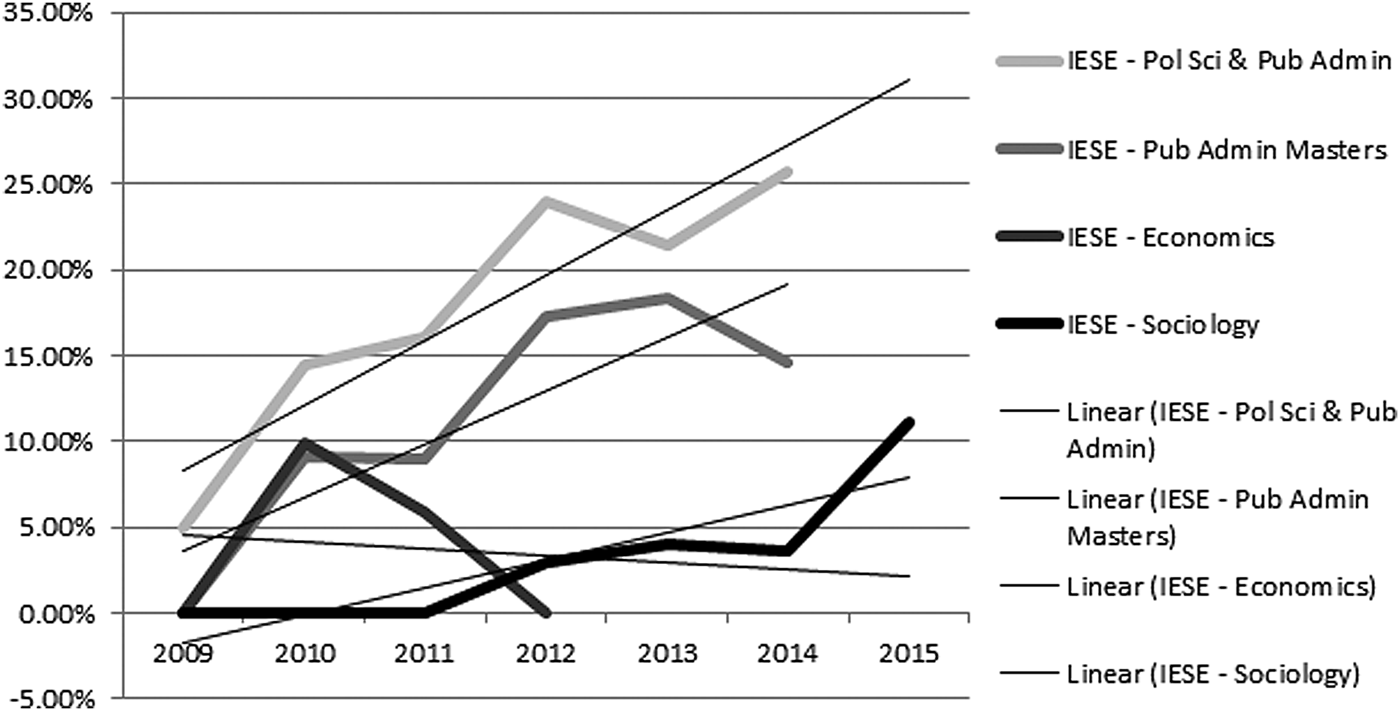
We would expect college students in public policy-relevant fields to take advantage of these think tanks' free and easily accessible information. The graphs showing the percentages of IESE citations relative to all citations (Figure 1) and relative to all citations of Mozambican sources – ‘Mozambican Citations’ (Figure 2) – are drawn from a large sample of senior theses in the departments of Political Science and Public Administration, Economics, and Sociology, and Masters theses in Public Administration, at the national flagship public university in Maputo, the Universidade Eduardo Mondlane (UEM) from 2009 to 2015.Footnote 44
UEM: IESE citations as percentage of total citations, year-to-year (2009–2015).

UEM: IESE citations as percentage of Mozambican citations, year-to-year (2009–2015).

Similarly, percentages of UEM seniors' CIP citations relative to all citations, and those relative to all ‘Mozambican Citations' can be found, respectively, in Figures 3 and 4.
UEM: CIP citations as percentage of total citations, year-to-year (2009–2015).

UEM: CIP citations as percentage of Mozambican citations, year-to-year (2009–2015).

The data show, at the very least, that this sample of college students is accessing both IESE and CIP research, much more the former than the latter, however. With the exception of economics students, trends show their use of IESE research grew over time; that IESE research constituted over 25% of Mozambican citations for the UEM's Political Science and Public Administration seniors by 2014 is especially noteworthy, as is the steady growth among that particular population from only 5% of Mozambican citations just five years earlier. Trends in the CIP data are less obvious, with some trending upwards and others trending downwards.
Turning to our second case, Maputo's Instituto Superior de Relações Internacionais (ISRI), Figures 5 and 6 present the data for senior theses in public administration from 2009 to 2015.Footnote 45 As was the case for UEM students, the data for ISRI public administration seniors show that they are citing both IESE and CIP research, and they are doing so more for the former than for the latter. There is also a perceptible upward trend in both IESE and CIP citations over time.
ISRI – Public administration: IESE citations as percentage of all citations and of Mozambican citations, year-to-year (2009–2015).

ISRI – Public administration: CIP citations as percentage of all citations and of Mozambican citations, year-to-year (2009–2015).

Websites and Facebook Pages
A second means of determining the demand for these two think tanks' critical research is to access information about their websites and Facebook activities – visits, downloaded articles/data, etc. – especially noting, if possible, domestic demand and distinguishing it from demand outside of Mozambique.
Figure 7 shows the evolution of IESE website ‘visits’ (‘sessions’) from January 2011, when data first started being collected, to January 2015.Footnote 46 Out of a total number of almost 109,000 visits (and 274,540 ‘page views’), IESE's website received an average of 1,730 visits per month (roughly 58 visits/day), with clear dips during summer months and periodic and apparently random peaks over 2,000.Footnote 47 Figure 8 shows the top five national origins of IESE's website visitors: 63% were from Mozambique itself, representing 10 times the number of Brazilian visitors (the second national origin location) and almost 10 times the number of Portuguese visitors (the third national origin location). 53·95% of Mozambican visitors were first-time ‘new users’, suggesting a broadening base of users and people learning about IESE.
IESE website audience overview (‘Sessions’).

‘Location’ (or national origin) of IESE website users.

What the data from Figures 7 and 8 cannot show is the degree of ‘engagement’ of website visitors, as measured by the amount of time they spend on the site. According to additional IESE data, fully 64·5% of website visits during this period lasted less than 10 seconds, which means that they were likely wrong turns on the internet highway. Needless to say, that's a lot of not-very-engaged visits. The same data show, however, that the average duration for Mozambican sessions (3:43) was over twice as long as for Brazilian sessions (1:47), which were just a little less than that for Portuguese sessions (2:09), suggesting that Mozambican visitors tended to be more engaged in their visits.
IESE launched its Facebook page on 28 July 2013. From then until 27 July 2015, IESE's page recorded a ‘total reach’ (the number of people who have seen any content associated with the page) of 61,396 (on average, 2,558/month or roughly 84/day). Of these, 7,333 – or 11·9% – were ‘engaged users’ (defined as any ‘click’ on a specific post or any ‘story’ created on or from that post).Footnote 48 Figure 9 shows the evolution of several demand-side indicators over the two years following the page's launching. While the data show the ebb and flow of ‘reach’ and ‘engagement’ based on the periodic release of IESE reports and publications, the overall trend lines – only one of which is reproduced in the figure – are positive, albeit only slightly so.
IESE Facebook audience overview.

Figure 10 shows the evolution of visits to the CIP website each week from August 2013, when data started being collected, to mid-July 2015.Footnote 49 Out of a total number of 158,135 visits during this period of almost two years,Footnote 50 CIP's website received an average of 1,535 visits per week (6,140/month or roughly 219/day). The trend shows a 31% increase over that time: from 1,300 to about 1,700 visits per week. CIP's website data reports do not include the ‘engagement’ measure, so it's impossible to know how many of these visits may have been wrong turns. Additional CIP data do show that 65% of these visits were ‘unique visits’, defined as visitors accessing a single research report only, usually a new report linked to a Facebook post and/or to one of CIP's emails (or, in some cases, mentioned in a newspaper article); 41% of the total were ‘first-time visits’ – as in IESE's similar data, suggesting a broadening base of users and people learning about CIP. Unfortunately, CIP data reports do not track the national origins of visitors. The fact that the content sections of the website – the actual research reports – are exclusively in Portuguese would tend to limit most visits to those from Lusophone countries and a relative handful of specialists.
CIP website audience overview (‘Pageloads').

CIP's website data contain an additional feature that allows the separate tracking of ‘businesses belonging to the Mozambican political elite and holders of public office (such as ministers, legislators, CEO's of public enterprises, etc.)’.Footnote 51 These data give us an important indicator, imperfect though it may be, of the demand side of CIP's output from within the upper echelons of the regime itself. Each week, on average, 183 so-called ‘regime elites’ – or more precisely, people working within these ‘elite’ work sites – accessed the CIP's website between 29 July 2013 and 19 July 2015, for a total of 18,843 visits during this entire two-year period (26 visits each day, on average). 31% of these were ‘unique visits’ and 25% were ‘first-time visits’. Figure 11 shows the evolution of such visits during this period, with the peaks representing report launchings and/or publicity surrounding their findings. The trend line shows a clear increase over time (74%): from 128 to 223 per week.
CIP website ‘regime elite’ audience overview (‘Pageloads’).

CIP launched its Facebook page on 2 September 2014. From that day until 21 July 2015, the page was accessed 132,746 times (1,125/day, on average). In spite of the familiar peaks and valleys and the relatively short time frame (slightly less than 11 months), the ‘daily reach’ trend line (Figure 12) shows an increase from just below 1,000 to about 1,750 per day. During that same period, CIP publications and reports were either accessed and/or downloaded 23,700 times (201/day, on average), and otherwise ‘engaged’ visitors – liking, commenting on and/or sharing content from the page – totalled 4,609 (39/day, on average).
CIP Facebook audience overview.

Academic Literature: Citations
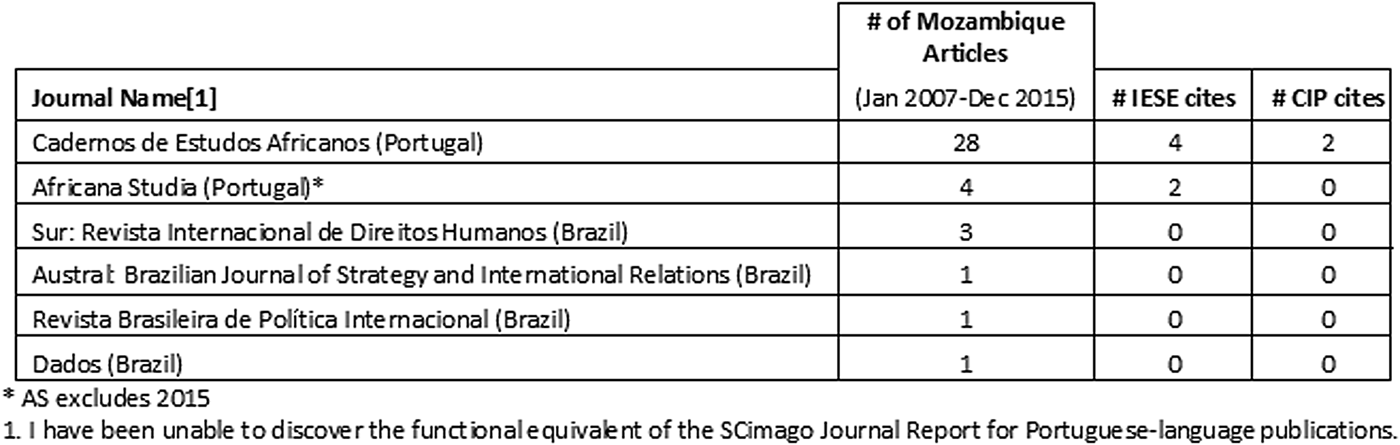
A third way to test the demand for the critical information produced by IESE and CIP in Mozambique is to look at the academic literature on Mozambique since these think tanks began their operations (2008 and 2007, respectively).Footnote 52 Figure 13 shows the number of articles in a sample of English-language academic journals that include policy-relevant research on Africa from January 2007 until the end of 2015. The results appear less-than-impressive, with only the Review of African Political Economy (UK) standing out as a noteworthy exception. Figure 14 shows the results of a similar inquiry into Portuguese-language academic journals that contain social scientific research – at least one article – about Mozambique. Again, the results are less-than-impressive. In both cases, however, the citations of IESE and CIP publications are predominantly found in more recent publications, suggesting a growing familiarity among academic specialists with these organisations' work.
IESE & CIP citations in English-language academic journals (Jan. 2007–Dec. 2015).

IESE & CIP citations in Portuguese-language academic journals (Jan. 2007–Dec. 2015).
SUMMARY, IMPLICATIONS AND CONCLUSIONS
In Mozambique, among those with whom foreign researchers typically become well-acquainted (university professors, foreign and local graduate students, mid-level government officials, and foreigners working in the aid industry), the research produced and disseminated by both the Instituto de Estudos Sociais e Económicos (IESE) and the Centro de Integridade Pública (CIP) is widely understood to be first-rate. Being autonomous from the ruling party/state regime, it is also understood that these think tanks produce research that is either explicitly critical of the government or, at the very least, at odds with the regime's official stories. Both of these think tanks exist to speak fact-based truth to concentrated power. Mozambique's government has been implicated in multiple corruption scandals and incidences of electoral fraud and repression over the years, but also in any number of seemingly ‘public’ policies that turn out upon investigation to be highly partisan and/or clientelist in terms of their actual beneficiaries. Exposing these for what they are – providing critical information – is the bread and butter of both of these think tanks.
As most democratic theory recognises, a pluralist democracy without multiple sources of information is nothing but a hollow shell; by the same token, a competitive authoritarian regime, like Mozambique, with multiple sources of information contains potentially powerful seeds, or foundations, for a pluralist democracy to eventually take root.Footnote 53 In the shorter term, critical information can also shame a government into approximating the ‘good governance’ for which donors and many government opponents advocate. But these outcomes might occur in fact only if people are actually reading and making use of the critical information produced by such think tanks as IESE and CIP in Mozambique.
Are they?
Prior to this article, there has been no answer to that question. Partly, that's because no one seems to have been asking the question. And partly, it's because those in house – at least in the cases of IESE and CIP – have had little time or incentive to answer the question for themselves. This would appear to be the case for other think tanks in comparable countries as well, for I have found no empirical assessments of the demand side of their sometimes considerable output. Without comparative or baseline data, therefore, the results of the research in this article can only be suggestive in terms of their implications.
The data on college students' use of IESE and CIP critical research suggest, overall, that social science undergraduates in Mozambique are increasingly aware of IESE's output (less so, however, for Sociology majors and almost not at all for Economics majors). Citations of IESE research reached over 25% of Mozambican citations for Political Science and Public Administration seniors at the public flagship Universidade Eduardo Mondlane (UEM) by 2014, and 13% of Mozambican citations for Public Administration seniors at the private Instituto Superior de Relações Internacionais (ISRI) by 2015. Students' demand for CIP's research seems similarly positive and growing, albeit at a much lower level, but only for Public Administration seniors (and much more so at UEM than at ISRI); other majors show little and/or declining familiarity with CIP's research. Undoubtedly, the fact that several of IESE's and CIP's founders and researchers also teach at the UEM, and that many others are graduates of the UEM, helps to explain the greater familiarity of UEM students with these organisations' research as compared with those at the ISRI. That many of these students eventually find work in government service allows for the likelihood of a growing number of well-educated consumers of critical research within the regime itself; in other words, at the very least, one can infer a growing awareness among younger state and party functionaries that the official stories and party lines are not the only policy-relevant information out there. The same can also be said for the graduates who eventually find work in civil society organisations, opposition parties and the handful of opposition-led local administrations that periodically slip through the constraints of the regime.
The data on website and Facebook sites for IESE and CIP show considerable usage for both organisations: fluctuating, but with upward trends. IESE's data for its website allow us to see that 63% of users were from Mozambique. Of those, more than half were first-time ‘new users’, suggesting a broadening base of users and people learning about IESE. A sobering point of fact is that slightly more than three-fifths of those accessing IESE's website stay for less than 10 seconds, most likely indicating a mistaken hit on a search for something else. Two years of data regarding IESE's Facebook page reveal daily ebbs and flows of ‘reach’ and ‘engagement’ based on the periodic release of IESE reports and publications; the overall trends, however, are positive. The CIP's website receives, on average, over two and a half times more visits per day than IESE's, and the trend shows a 31% increase over time. Two out of five users of the site are first-time visitors (there are no data on ‘engagement’). CIP data on ‘regime elite’ usage of their site provide a rough indicator of usage or demand from within the upper echelons of the regime itself. Averaging 26 visits per day, the trend of those data shows a 74% increase between 2013 and 2015. This indicates that CIP research is, at the very least, finding its way into Mozambique's opaque party/state. CIP's Facebook data show a similar increase in both ‘reach’ and ‘engagement’, but at a scale of activity more than 13 times that of IESE: daily ‘reach’ averages of 1,125/day compared with IESE's 84/day. CIP's more topical and journalistic reporting, as opposed to IESE's academic social science, likely accounts for the higher numbers visiting CIP's website and Facebook page. That the critical information provided by IESE and CIP are accessed via a social media site should not automatically disqualify its significance. In the USA, at least, ‘Facebook users are much more politically engaged than most people’ (Pew Research Center 2013). There is no reason to believe that the same does not apply to the roughly 5% of the Mozambican population – primarily, the urban elite and upper-middle class – that enjoys regular access to the internet.
The data on academic journal citations of IESE and CIP research show a slow evolution of demand from around the world from specialists on Mozambican contemporary history, society, economics and politics. As one would expect from its nature as a self-consciously academic think tank, IESE fares better in this realm of demand for its research compared with the more explicitly policy-oriented and journalistic CIP. That IESE's website and some of its publications are in both Portuguese and English, and CIP's are only in Portuguese, might also help explain some of these differences.
The final word of any exploratory research is always tentative. Independent think tanks can play an important role in both democracies and competitive authoritarian regimes in allowing alternative and critical information to circulate among the citizenry and affect the political discourse … but only if citizens and influential outsiders actually read it. This case study has shown that two of the most prominent independent think tanks in Mozambique are getting their research to the reading and researching public, and they are doing so at a growing rate. Time and further research will help to determine just how significant these findings are in the medium-to-long term.