INTRODUCTION: THE RISING TIDE OF AMERICAN PREPPING
American interest in “doomsday” prepping expanded significantly in the months leading up to, and the eight years during, Barack Obama's two terms as President of the United States. This article examines the unresearched political dimensions of this growth. Prepping is a coordinated set of activities undertaken by those preparing to independently survive periods of social collapse: medium- to long-term scenarios in which food is not available to buy, electricity and water supply chains are interrupted, and many people may be dead or dying. While taking on a range of forms, the activities of so-called “preppers” tend to be oriented around a set of six core needs: nutrition, hydration, shelter, security, hygiene, and medicine. Prepping therefore frequently involves stockpiling food, water, and medical supplies, alongside the development of numerous “survival skills.” It also often includes keeping firearms for post-collapse personal defence, as well as making plans to retreat from populated areas to remote compounds or survival bunkers. Prepping is thus distinct from ordinary short-term preparedness for hurricanes and other natural emergencies, being distinguished by its application towards man-made disasters as well as natural ones; medium- to long-term survival lasting weeks, months, or even years; and violent social breakdown amidst collapse.
As alluded to above, there has been an intriguing post-2008 growth in American prepping, mostly made evident by a “doom boom” in markets catering to its practitioners’ interests. Accounts of this development include reports that, from 2009 to 2014, sales of preserved food and protective NBC (nuclear, biological, chemical) suits in the prepping industry surged by 700 percent and 300 percent respectively.Footnote 1 These figures tally with the similar expansion of a recently emerging nationwide network of prepping expos. While nonexistent leading up to 2008, dozens of events (including RK Prepper Shows and PrepperCon) now each attract thousands of attendees on a yearly basis. In 2012, for example, one prepping expo company alone (Self-Reliance Expos) had forty thousand total preppers enter five shows across the United States.Footnote 2 Surging demand for prepping products has also led to their arrival in some of the USA's best-known retail stores throughout the last decade. Preppers’ Home Defence (a book-length manual on home-based survival) has been sold in Walmart since 2012. Meanwhile, lines of preserved “survival food” have been stocked by Costco, Kmart and Bed, Bath & Beyond throughout the last five years. These developments have been accompanied by prepping's burgeoning presence online. For instance, on Pinterest – a popular website on which users mark favoured pages on virtual pinboards – prepping-related “pins” and “re-pins” increased by 87 percent and 300 percent respectively in 2014–15.Footnote 3 Altogether, while prepping lacked this vitality and visibility ten years ago – at which point it was an obscure phenomenon lacking the dynamic expos, industry, and online culture it now sustains – it has thus been subject to a recent expansion that marks it out as a topic deserving scholarly attention.
PREPPING UNDER OBAMA: A SURVIVALIST REVIVAL?
Although prepping is practised in small pockets around the world, the USA is the only nation in which it exists as a visibly widespread subculture. Prepping-related interest in the United States is, for instance, unique in sustaining the large national network of expos and conventions mentioned above.Footnote 4 This, of course, raises questions of why prepping exists in the USA on such a distinct scale, and why its popularity has expanded there in the last decade in particular.
Existing attempts to answer these questions suggest that prepping's contemporary popularity emerges both from a longer history of such activity in the USA, and from a recent surge of extremist politics to which prepping is supposedly linked. Within these reflections, it is regularly emphasized that prepping bears considerable comparison to an earlier wave of extreme right-wing “survivalism.”Footnote 5 Survivalism existed as a lifestyle movement centred on preparations for medium- to long-term survival in the United States throughout the 1970s, 1980s, and 1990s. In this time, it also spawned a circuit of expos that closely compares to that which surrounds prepping today.Footnote 6 In the public eye, survivalism's links to extremism were most notably established around a series of high-profile and (quite literally) explosive incidents involving several of its practitioners in the 1990s. These include the deadly shootout between Aryan Nation sympathizer Randy Weaver and FBI agents at Ruby Ridge (Idaho), the failed FBI siege on the apocalyptic Branch Davidian cult near Waco (Texas), and the Oklahoma City bombing by antigovernment terrorist Timothy McVeigh.Footnote 7 Giving rise to descriptions of survivalists as “the woodsman in the tinfoil hat, the hysteric with the hoard of beans, [and] the religious doomsayer,” mass media reflections have since regularly addressed survivalism as an “isolationist, anti-government, and conspiracy-minded” subculture emerging from America's outermost right-wing fringes.Footnote 8
While adding nuance to this sensational rhetoric, detailed analyses elsewhere confirmed survivalism's connections to extreme right-wing politics – suggesting that this phenomenon's late twentieth-century growth had indeed been bound up in a broader expansion of American extremist movements.Footnote 9 These included the Posse Comitatus, the Ku Klux Klan, Christian Identity, and numerous militia groups, each organized around mixtures of overt white supremacism, hostility towards government, and theological views of America as a sacred Christian nation.Footnote 10 Within this landscape, Lamy and Coates's work, for instance, added heft to wider perceptions of survivalism as an extreme-right phenomenon. In doing so, it indicated that survivalist pursuits particularly appealed to those whose antigovernment ideology, religious fanaticism, and racist politics culminated in talk of (and preparations for) Jewish conspiracies to bomb America with nuclear missiles, “takeovers” by the federal government or the United Nations, and other apocalyptic scenarios of fringe fascination.Footnote 11
Today, the history of survivalism weighs heavily over interpretations of the contemporary prepping movement – especially given that this latter phenomenon's growth has occurred alongside a more recent surge of right-wing extremist activity.Footnote 12 Having expanded consistently throughout the late twentieth century, survivalist culture eventually receded from public view in the late 1990s, with some survival companies reporting as much as an 88 percent decline in sales between 1999 and 2000 alone.Footnote 13 This corresponded with a broader 80 percent reduction in “antigoverment patriot” groups between 1996 and 2001, as observed by the Southern Poverty Law Center (SPLC). More recently, however, prepping's post-2008 expansion has occurred simultaneously with “a dramatic resurgence” of America's racist and anti-government extremes.Footnote 14 According to the SPLC, the number of “antigovernment patriot” groups grew over 1,000 percent between 2007 (131) and 2011 (1360), while the total of (mostly right-wing) “hate groups” – having lingered at 458 in 1999 – surged beyond a thousand for the first time in 2010.Footnote 15
Although numerous analysts (including those within the SPLC) have also attributed this growth to a background of broad racial resentments and recent economic crisis, Barack Obama's election to the White House in 2008 has frequently been described as the key catalyst for this surge.Footnote 16 Regularly identified as a focal point for many resurgent movements – in which concerns with “New World Orders” have more recently given way to fear of Obama's supposed admiration of communism, fascism, gun bans, and/or sharia law – the electoral success of an African American Democrat President has thus been (at least partially) credited with galvanizing supporters of extreme right-wing politics into heightened fear, organization, and activity.Footnote 17
Against this backdrop, prepping's rise has (unsurprisingly) often been interpreted as an apocalyptic expression of this extremist anti-Obama surge – and thus as a phenomenon largely consistent with earlier waves of fringe right-wing survivalism. Journalistic explanations of prepping have therefore regularly emphasized that the movement's popularity has, like survivalism before it, been inseparable from wider trajectories of extreme ideology. In this vein, CNN has described some preppers being “overwrought over doomsday scenarios” following Obama's electoral successes.Footnote 18 Mother Jones has elsewhere detailed preppers being wracked with fear of “a borderline tyrannical” President intent on implementing “massive gun confiscation,” as well as highlighting some preppers’ plans to establish “Christian Transition Villages” on the premise that “Obama is expediting the arrival of the Islamic Antichrist.”Footnote 19 With other reports detailing descriptions of Obama as a biblical “augur of doom known as The Leopard,” a common theme in media coverage has therefore been to highlight the connections between prepping and extreme right-wing fears of the forty-fourth President.Footnote 20
Meanwhile, scholarly literature around American prepping has yet to effectively support or challenge this narrative. Although a few credible studies of prepping exist – including Huddleston's ethnography of one localized prepping group – little attention within them has been focussed on the movement's broad political character or guiding ideologies.Footnote 21 That said, this lack of empirical engagement with prepping's politics has not prevented some authors from speculatively linking this movement to extremism. In particular, Foster's passing suggestions that preppers are “eagerly awaiting the coming of the apocalypse” in a “paranoid” mind-set provide vague reinforcements of prominent journalistic narratives.Footnote 22 Nevertheless, Foster's claims not only are brief; they also rely, problematically, upon an analysis of “reality” television documentaries on prepping. Lacking direct engagement with any preppers whatsoever, they thus fail to offer a reliable and robust understanding of this movement's political reality, influences, or significance. The politics undergirding prepping's rise have thus been subject to conjecture, but not focussed empirical research.
This article therefore presents an overdue exploration of prepping's politics under Obama. In particular, I draw on an exploratory ethnography of thirty-nine preppers (located across eighteen states) undertaken between March and November 2014. Fieldwork involved sustained visits (lasting several days) to participants’ homes and local areas, featuring recorded semi-structured interviews, additional unrecorded conversations, tours of preppers’ homes and prepping resources, and participation in aspects of their prepping (including medical training, self-defence training, the use of “survival skills,” and the killing and butchering of livestock).Footnote 23 This activity was used to develop a deep understanding of what political problems respondents identified in the world around them, who (or what) they believed to be responsible for these problems, and where outlooks on politics energized respondents’ fears of disaster and subsequent preparations for collapse. Fieldwork also involved visits to three prepping expos, which produced over a hundred short interviews with exhibitors and attendees, as well observations in thirty “expert-led” prepping workshops. These were Self-Reliance Expos in Houston and Denver (12–13 September and 7–8 November 2014), and PrepperFest near Phoenix (25–26 October 2014). The expo-based fieldwork was used to make sense of the extent to which the views within the ethnographic sample resonated across prepping culture on a broader basis.
Drawing on this research, I argue that existing interpretations of prepping's politics offer a poor fit with much of its reality. The article thus challenges the tendency to situate prepping's growth entirely within a revival of survivalist-like extremism under Obama, and contends that much of prepping's rise reflects shifts and fears within more popular American right-wing politics. In presenting this argument, I will proceed through four sections. Immediately below, I describe the main concerns undergirding preppers’ activities under Obama – shedding light on the ways in which respondents’ disaster-related fears intermingled with outlooks on political problems. The sections following that discussion will then address the parallels (or lack thereof) between these concerns and familiar aspects of survivalist extremism, identify the particular alignment between many preppers’ politics and popular “Tea Party” Republicanism under Obama, and explore the ways in which prepping and the Tea Party movement have each emerged from mainstreamed currents of intense fear-based dualism within prominent spheres of America's right-wing culture. Given this, the article ultimately directs us to make sense of prepping as a phenomenon related to the everyday political world, with it representing an exemplification of wider fearful politics and far-right ideology surging within the right-wing Republican mainstream under (and indeed beyond) Obama's presidency.
PREPPING, POLITICAL PROBLEMS, AND THE PRESIDENT: PREPARING FOR OBAMAGEDDON
interviewer: Let me ask how politics impacts on your prepping. Could you –
maria: Yeah, Obama needs to go! [Moving closer to the recording device and shouting] OBAMA NEEDS TO GO!
Fieldwork indicated that prepping is an overwhelmingly right-wing phenomenon. Indeed, thirty-five of the thirty-nine ethnographic participants situated themselves on the political right – self-describing under a range of labels that included “conservative,” “right-wing Republican,” “libertarian,” and “conserv-atarian.” That said, a minority of two registered Democrats, one “progressive independent,” and one anarchist did regard their politics as being left-wing. At this juncture it is worth stating that, in order to examine the outlooks that broadly circulate within prepping culture, this discussion will only address its large right-wing majority – even though the politics and activities of left-wing preppers remain highly intriguing.
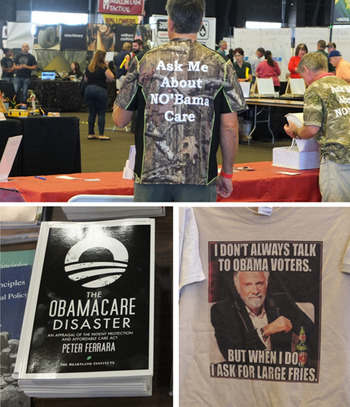
While traversing several themes, the accounts offered by right-wing participants tended to centre on one main focus of political concern. As indicated by visible features of PrepperFest (see Figure 1), and Maria's response to the mere mention of politics when interviewed (quoted above), this focal point was (unsurprisingly) Barack Obama's presidency. Emerging as respondents’ most urgent and frequently referenced subject of political grievance, their prepping was repeatedly described as being (at least partially) a direct response to problems produced by Obama's election and leadership. For instance, Clint – married, in his forties, and living in New Mexico – reflected as follows:
The defining moment, or really what redoubled my efforts and really kinda got me to where I'm really more intense about following politics, and paying attention to the news, and adjusting preparedness off of that, is really the election of President Obama. It's because I knew what he was about, and I knew what he was going to … what his policies were going to direct America toward … There are some things that I feel are good, but for the most part it just never … it's just this person is beginning to steer us in the wrong direction. And because of that I began to redouble my efforts … buying more food than I normally kept, and all these other things that I feel are needed in case the policies result in some catastrophic failure.
Anti-Obama sentiment at PrepperFest: health insurance campaigners instructing attendees to “Ask Me About NO'Bama Care,” books critiquing Obama's policy agenda, and stalls selling T-shirts printed with memes mocking Obama's supporters. Photo credit: the author.

Despite locating Obama's presidency as his chief prepping concern, here Clint offers us only a vague sense of what problems he thought it might produce. To expand beyond these remarks, then, this section will illuminate what he and others identified as being the substantive threats linked to the forty-fourth President's leadership.
There was substantial consistency across the sample's prepping-related criticisms of Obama, which broke down into two main themes. Drawing on an established trope in right-wing assessments of mixed-model politics, the first was a critique of Obama's “big-government” approach to economic affairs – with economic disaster being the only collapse-based scenario the sample universally described as a likelihood in the near future.Footnote 24 Giving an introduction to this area of concern, and an overview of prepping culture from his position as a prominent figure within online prepping media, Patrick explained,
We have a podcast, and when we interview guests we always ask them, “What do you think it is that could tip society over the brink?” Their concern almost always points in the direction of an economic collapse of some sort. Not an elevator falling from the top of the building to crash, but a downward spiral. And, so, this is what, I think, people are most concerned about, and they're starting to put away things.
Adding depth to this picture, other respondents repeatedly framed this issue as a problem shaped specifically by Obama's administrations. Indeed, all of the right-wing preppers in the sample primarily attributed responsibility for future economic crisis to Obama's big-government orientation, often notably marginalizing (or entirely ignoring) the role of deregulation that set the key context for these concerns: the financial crash of 2007.Footnote 25 Respondents’ accounts thus regularly suggested that the cause of America's vulnerability lay in “unsustainable” public spending on welfare and health care reform, as well as overly intrusive regulation of free markets, supposedly taking place under Obama's leadership.
Speaking to this shared interpretation, Oliver (a middle-aged, married father of two living near the Mexican border in Arizona) expressed a view that was typical of the wider sample when focussing this unease on “ridiculous amounts” of national debt. “We're up to seventeen trillion,” he reflected when asked for his reflections on Obama's presidency, adding, “when I was a kid they were talking about not even one trillion dollars of debt like it was the end of the world.” Joe, in his early sixties from Georgia, echoed this perspective:
In my opinion, the Democrat Party is too much … socialist. They buy votes by giving free stuff … that somebody else is having to pay for. The last thing I heard about the debt … it doesn't seem anybody's paying for it, but they're just giving away, giving away … and they're thinking about today, not next week, or ten years from now.
Similarly bemoaning Obama's record on spending and regulation, while suggesting it could result in disastrous consequences, Christopher's account also gave expression to the ways in which these concerns would then frequently culminate in discussions of severe economic crisis:
Oh, I don't think we're gonna see things get better for a long, long time. We're in the throes of … something that rivals, and perhaps exceeds, the Great Depression of the 1930s … Things are in bad shape. Things like Obamacare are tearing things apart. It's hard for businesses and … these are things that are putting such a strain on society at large. It's only gonna get worse … I just … I think we all need to look at things more individualistically and think of how we're going to cope with the way things are going. And, you know, I tell people: “Don't get involved in political things because it's gonna distract you from your preparedness.”
As these remarks suggest, economic concerns tied to Obama's presidency thus had a demonstrable effect on respondents’ preparations, which featured a range of measures intended to mitigate the impact of future economic upheaval. This included storing surplus meat, eggs, and vegetables at home, with such efforts frequently being introduced and framed, principally, as a means to reduce outgoings in the event of job loss or skyrocketing costs of living. In one example, Andrew (in North Carolina) boasted of being able to “go shopping downstairs” among supplies stored in his basement, should prices rise in local stores. Cassie elsewhere explained,
When you have food put by, that's one thing off the table that you don't have to worry about. If your income is cut in half, the money has to stretch further. If you have food put by, then that just gives you a little bit … a little bit of peace of mind.
Up-close engagement with the ways that preppers spoke and went about preparedness – and the value they ascribed to aspects of this activity – thus indicated that (1) interpretations of economic problems impacted upon their prepping and (2) their concerns about these problems were often shaped by anxieties around Obama's presidency.
However, this was not the only way in which particular fears around Obama impacted the sample's prepping. As alluded to earlier, there was second direction in respondents’ shared discontent that emphasized a rather different issue. Indeed, whereas they had bemoaned too much government action in some areas, many elsewhere claimed that there was not enough in others. Particularly, these frustrations targeted supposedly “soft” and “passive” approaches in security-related policy under Obama – being broadly encapsulated in comments from William, a prepper in his fifties working in law enforcement in Colorado:
interviewer: A short while ago, you briefly mentioned that concerns with government shaped your prepping. Could you say more about what those concerns are, and why they're important?
william: It's the seeming inability of the current administration to handle … pretty much any crisis. I sit there and I see a very … a very … I think he [Obama] probably has good intentions, but just a very poorly executed ability. I think that it … I think it opens us up as a nation for people to sit there and to see things happen to us … for other countries to sit there and say “They're not gonna do anything” … I'm not worried about our current administration going rogue, and Homeland Security taking over. What I am afraid of is that there will be a perception of weakness of our nation … and does that mount an invitation for, you know, radical Islamists? I think it does. I think that's another potential scenario.
A further eighteen participants were dissatisfied with “weakness” from the President in the two areas highlighted by William: foreign policy and Islamic terrorism. For example, Anthony (in his forties, from Florida) similarly expressed concern that Obama's “weakness” had opened up the USA to heightened threats from foreign governments – particularly from Russia and Iran:
With our current … [pauses and sighs]… our current presidential administration … [pause] It's just, I believe he's weakened our country immensely. Immensely. And it's just such an embarrassment … It's like, “I can't believe he just said that”… That kills me, so I've been watching a lot lately how they deal with things round the world, which is pretty wimpy. You know, I don't like and that's … that, that could just dump us down the drain.
Pertaining to counterterrorism, it was also often claimed that blasé and permissive approaches to illegal immigration and national security under Obama had rendered the American–Mexican border insecure, allowing foreign terrorist threats to enter the USA. As Doug, an ageing, bearded and denim-clad attendee at the Self-Reliance Expo in Houston put it to me, “America's borders are not secure and the immigration screening methods are not good … People are being let in that are known gang members, drug dealers, murderers, and terrorists.” In particular, here, preppers’ fears tended to centre on the possibility of foreign members of ISIS having entered the USA to commit terrorist attacks:
I don't expect the zombies to come over the hill tomorrow. But with ISIS … threatening the US. I mean, there's no doubt that some of their operatives are already here. So there, that's a potential scenario. (Andrew)
But this ISIS thing, since they are already here, is very concerning. [UK] Prime Minster [David] Cameron … when the beheading [of journalist James Foley in August 2014] happened, he went back to his office … to get the COBRA meeting going. After the beheading, here, the President said, “Oh I'm really sorry,” and went to the golf course. To me, that does not do a lot of confidence. (Gloria)
As with economic concerns, these reflections then carried over into the practicalities of prepping, with respondents regularly making specific preparations for security-related scenarios. These included, for instance, the storing of specialist NBC suits and face masks for protection against nuclear, biological, or chemical attacks.
Ultimately, then, fieldwork indicated that, where it was visibly shaped by intense political anxieties, respondents’ prepping broadly drew inspiration from two main concerns linked to Obama's leadership. Indeed, as the following summary offered by Cassie and Darren (a married couple nearing retirement in Ohio) illustrates, this was a dynamic that many explicitly recognized:
cassie: For me, the last three to four years … the current world events have really impacted why I feel it's important to prep. Mainly because I don't see … I don't see our country getting any better.
darren: Just since we got our current President, I can't really say “Yeah I depend on the administration” like I did under [George] W. Bush … I would just think “Oh he'll take care of stuff in Iraq, or he'll have more competence on certain things” –
cassie: And as our economy's getting worse and worse and all the things that Obama promised haven't … and the health care act, which has turned out to be … economically crippling for so many people … There is no part of the government that is working anymore. We've got Obama golfing, not hitting his security briefings. That is a man with no class. That is a man who proves he is very narcissistic and doesn't give a rat's ass about this country or anybody in it, except for himself. I have never felt this way about a President. I have always respected the office and that includes … Clinton's a close second. But this man, he makes me afraid.
It is worth pointing out that some other prepping concerns had weaker connections to these political fears – with many respondents acknowledging, for instance, that “unavoidable” natural disasters and weather patterns also shaped their interest in prepping to some degree. Meanwhile, respondents’ opposition to Obama's presidency (as discussed later) also touched upon other areas outside the prepping-related themes addressed in this section. Nevertheless, what importantly emerged here was a pattern in which the anxieties articulated above were typically integral to participants’ entries into prepping throughout the last decade, and the ways they practised it at the time of being interviewed. Specifically, respondents’ own words offered clear and consistent indications that many regarded Obama as the key cause of several likely disasters, and had tailored their burgeoning preparations around this impression. Although the relatively small sample featured here renders such conclusions tentative, this suggests that fears around Obama acted as a key catalyst for prepping's expansion after 2008.
“I'VE LEARNED HOW TO WEED OUT THOSE KINDA TOTAL NUT-JOBS … PEOPLE THAT ARE CRAZY”: REJECTIONS OF SURVIVALIST EXTREMISM IN PREPPING CULTURE
So to what extent do the fears and narratives articulated above correspond with prepping's existing reputation? In different regards, fieldwork ultimately revealed that respondents’ accounts both curiously reproduced and departed from aspects of the anti-Obama, extreme right-wing politics with which prepping is frequently associated. Certainly, as evidenced above, many participants expressed intense right-wing concerns around Obama's administration, even self-describing their prepping as a reaction to these anxieties. At the same time, however, this section will highlight how participants’ outlooks were also distinct from forms of extreme survivalist politics that have often been assumed to resonate throughout contemporary prepping culture – politics that, consistent with Berger's, Lipset and Raab's, Hofstadter's, and Mudde's definitions of extremism (among others), promote discrimination and violence against “out-groups” as being necessary to political success (including particular ethnicities, religions, sexual orientations, and government bodies), while adopting a Manichean view of political change as being principally driven by conspiracies and malicious intent.Footnote 26 As a result, this section clarifies that, while preppers’ activities were often centred on fears of Obama, many nevertheless rejected the variants of “extremist” politics with which they are often linked.
That said, it is first worth acknowledging that numerous aspects of established survivalist politics were encountered throughout the research. At Arizona's PrepperFest, for example, exhibitors included Steven Anderson, a Baptist preacher who has praised AIDS for killing homosexuals, and once appeared on a BBC documentary titled America's Hate Preachers. They also included Richard Mack, a self-proclaimed “constitutional sheriff” strongly linked to the extreme antigovernment Oath Keepers network. Anderson was in attendance to distribute free DVDs warning of impending Armageddon (titled After the Tribulation and New World Order), while Mack worked a nearby stall selling his self-authored books. In the environment of the expo hall, it was thus easy to find evidence of overlaps between prepping and extreme ideologies – including antigovernment conspiracy theory and religious identifications of evil in homosexuality.
Moreover, the ethnographic sample testified to their own encounters with right-wing extremism in different areas of prepping culture. In particular, several recalled interactions with “conspiracy nuts,” in Anthony's words, through online prepping forums and face-to-face interactions. On this theme, Daniel – a middle-aged father of two in Florida – reflected on one (unsuccessful) attempt to establish a joint survival plan with another prepper as follows:
I'd be remiss in my duties if I didn't mention this … but I had a friend who was just sort of trying to feed this sense of general paranoia. He was giving me these books on Civil War II … and all this sort of oppressive federal government, tin-foil-hat kind of stuff. After a while, I just had to back away from him … sort of rejected all that. He would call me and say, “Daniel, there's something really important. I need to talk about it with you in person.” So, I drive up there. And his grand idea was to look at a map and formulate alternative routes to each other's houses. I was like, “Really? You could have told me that over the phone. I just drove over two hours for your super-secret antigovernment idea of getting out an atlas and drawing on it with a highlighter?” You know [laughs], there's some of that.
Hannah reflected similarly on her experiences exhibiting at hundreds of prepping expos as a business owner, describing some preppers as “conspiracy theorists” for believing that the Federal Emergency Management Agency (FEMA) intends to use disasters as a pretext to indefinitely intern right-wing Americans in “FEMA camps.” She added, “They have a military background. They're all men in their thirties or forties … And they do have … they come to you at the conferences and I'm like … [sighs, and raises her eyebrows with a sceptical expression]. They're like: ‘Have you seen this website?’ [Laughs]”
However, as the mocking nature of the above reflections suggests, such outlooks did not receive much support within the sample. Although there is no doubt that some preppers act in anticipation of federal takeovers, gun bans, and other subjects of fringe concern, participants were almost unanimous in departing from these familiar extremist narratives.Footnote 27 As Anthony put it, “I've learned how to weed out those kinda total nut-jobs … people that are crazy.” As the last section indicates, rather than embracing such ideas, respondents were thus typically moved by alternative fears concerning possible, unintended, non-apocalyptic (and thus nonbiblical) collapses shaped by failures of government policy under Obama.Footnote 28 “That's kinda the way I look at the political issue,” William explained, adding that it's “not that there's horrible, evil people that want to take care of the world … or a New World Order.” Hannah similarly rejected this Manichean understanding, stating, “We don't believe that they're evil people up there planning this … I believe that they probably feel they're helping their people and communities.” Meanwhile Daniel spoke for his small prepping group's outlook in stating,
We see things going on in the government right now that are completely contrary to our values in what we think this government should stand for … Too many to keep up with almost … We do talk about conspiracies in my group, and what you could think are conspiracies, we think are just incompetency and complacency. On the part of those who are supposed to be in charge … they either don't know what they're doing, or they're too lazy! [Laughs] It's not that they got together to construct this horrible thing. We get that. We really do.
With the sample's outlooks generally consistent with this view, the rejection of survivalist conspiracy theory emerged as one of the most frequently and powerfully expressed themes in respondents’ economy- and security-centred fears.
Respondents’ accounts also departed from numerous extreme positions concerning race – although this area remains rife with complexity. Certainly, prepping is a primarily Caucasian phenomenon. Indeed, all respondents, and the vast majority of expo attendees, were Caucasian. Nevertheless, race did not emerge as an explicit focus in participants’ accounts of why they prepared for disaster in ways that existing commentary suggests it might have done. This was the case in their recorded interviews, and in sustained and more informal ethnographic chatter traversing several areas of political discussion and taking place over several days. For example, respondents’ critiques of Obama did not raise the theme of his race or ethnicity, conspicuously focussing on policy matters instead (including, for instance, the consequences of ballooning national debt). In this sense, the sample's outlooks lacked the rhetorical emphases within the white-supremacist ideologies dominating much of twentieth-century survivalist culture – politics that have centred on identifying threats in, and advocating hostile actions against, nonwhite groups. That said, it is perhaps impossible – even through in-depth ethnography – to fully and reliably assess of the extent to which any individual's worldviews may be shaped by racism. Thus, while the fieldwork suggested a separation between respondents’ racial politics and those within older survivalist culture, this does not at all exclude scope for understanding preppers’ worldviews – and broad trepidation around Obama's leadership – as being shaped by nuanced features of ethnocentrism and racism that permeate various strands of contemporary right-wing thinking (more on this in the next section).Footnote 29
In numerous respects, then, while there is undoubtedly a visible extreme-right presence within prepping culture, numerous incongruences between prepping and its popular reputation emerged. Indeed, even where familiar survivalist politics were most prominent – in prepping expos – they tended to be simultaneously undermined and rejected by many. By the conclusion of PrepperFest, for instance, large stacks of Steven Anderson's free apocalyptic DVDs went unclaimed – that the preacher could not even give them away to attendees offered a somewhat fitting illustration of the disconnect between his ideas and those encountered throughout this ethnography. With the stereotype of the survivalist white supremacist, religious fanatic, and extreme antigovernment ideologue offering a poor fit with many in the expo crowds and ethnographic sample, it thus became evident that existing reflections have failed to capture and engage with the nuances of many preppers’ anti-Obama fears. As a result, the matter of how we properly place prepping within the American political landscape remains unclear. To effectively understand this phenomenon, we are therefore required to explain how much of it has emerged beyond familiar areas of survivalist extremism, and identify its connections to other currents of American political sentiment.
THE PREPPING–TEA PARTY NEXUS
While incongruent with survivalist ideologies, respondents’ outlooks did tend to echo other spheres of contemporary American right-wing politics. The rest of this article therefore examines the ways in which their prepping notably blurred with, and drew inspiration from, those broader political currents. Reflecting further on the fieldwork, here I specifically explore the ways in which many respondents’ prepping maintained particularly close connections with relatively mainstream, far-right, Republican “Tea Party” politics arising in response to Obama's presidency – contending that this relationship ultimately marks prepping out as a phenomenon more closely connected to popular electoral politics than were its survivalist predecessor.
Originally coalescing around a series of 2009 protests against Obama's health care reforms, the Tea Party has since evolved into a significant and sustained wing on the rightward edge of Republican politics.Footnote 30 Populated by a large network of activists and a caucus within the House of Representatives, the Tea Party has thus received vocal support from numerous elite donors, grassroots organizations, and leading Republican politicians (including, for instance, Ted Cruz, Ron Paul, and Marco Rubio). It is also a platform that achieved significant levels of popular favourability as an oppositional stance against Obama's presidency. Under Obama, for instance, the Tea Party consisted of approximately a thousand local grassroots chapters and as many as 350,000 active members.Footnote 31 More widely, from 2009 to 2011, 30 percent of American adults (approximately 71 million people) reported having a favourable impression of the Tea Party. The number of “strong” Tea Party supporters was meanwhile estimated at 46 million.Footnote 32
Evidence of a meaningful nexus between prepping culture and Tea Party politics emerged throughout various stages of the fieldwork. Initial signs included a clear correspondence between respondents’ main political grievances and the Tea Party's focal concerns. Although the Tea Party platform features competing strains within its boundaries (more on this soon), research indicates that antiwelfarism, low taxation, pro-gun politics, and “strong” interventions around immigration and national security have been its highest-priority areas.Footnote 33 Its supporters are thus more likely to oppose increasing taxation, raising the debt ceiling, and mass immigration than are other self-identified conservatives.Footnote 34 Certainly, in such regards, the Tea Party aligns with the pseudo-libertarian and neoconservative outlook expressed by most preppers encountered in this study. As demonstrated earlier, respondents’ main discontentments under Obama centred on several themes of such concern: the national debt, taxation, and welfare spending (including health care reform). This was combined with Tea Party-like stances on foreign policy and national security, where small-state “principles” were cast aside in arguments for bullish diplomacy and intense border policing.Footnote 35
Beyond this, other aspects of respondents’ politics – thus far marginalized in this discussion on the basis that they had little direct relation to collapse-based fears – corresponded with Tea Party sentiment. This included, for example, uncompromising support for the Second Amendment and strident opposition to most forms of gun control.Footnote 36 Much of the sample expressed concerns around Obama's possible intent to implement stricter background checks on gun buyers during his presidency. Likewise, they expressed forceful opposition to new bans on particular firearms, and generally addressed gun rights as a high political priority. However, consistent with their rejection of various Manichean conspiracy theories (addressed earlier), it is worth emphasizing that none discussed “massive gun confiscation” as a likelihood, or regarded conflict with government over this issue as a scenario to “prepare” for – this was meanwhile supported by the reality that their preparations corresponded with a range of other scenarios, including economic collapse, nuclear attacks, natural disasters, and pandemic diseases. Nevertheless, respondents’ reflections on gun control provided additional evidence of significant overlaps between preppers’ politics and the broad characteristic features of the Tea Party platform.
Crucially, evidence of this prepping–Tea Party nexus also emerged through respondents’ own accounts of their politics, in which they regularly expressed support for the Tea Party and its leading figures. For instance, when asked if it was realistic to expect positive change coming from within America's two main political parties, Jonathon focussed his optimism on a prominent Tea Party favourite from his home state of Kentucky – suggesting that Rand Paul was one of very few politicians that offered a “glimmer of hope” for America's future. In California, Bradley directly singled out the Tea Party's broader entry into the Republican fold as offering similar promise:
I hope ultimately for … you know, the Tea Party conservatives, the people like Ted Cruz or Rand Paul. You know, I see people like that, and those are people who are providing a message that are … that resonates with me. So, I hope to see that … to see those types of values and policies get more prominent in the government.
Elsewhere, Stan – semi-retired, in rural east Texas – similarly explained,
I haven't seen one [recent movement] better than the Tea Party. Our Senator here, Cruz, is a Tea Partyer. And he has the idea that big government is the problem, not the solution … and you need to fix the government first before you fix the other issues. Yeah, I'm for the Tea Party.
The convergence between enthusiasm for prepping and support for the Tea Party was likewise evident at Phoenix's PrepperFest, where organizers had erected a “Tea Party Pavilion” filled by the movement's local campaigners. Elsewhere, Oliver had even become an active organiser in the Tea Party's grass roots, having helped stage a rally attended by thousands of supporters in his local area. While the ethnographic sample did not universally self-identify as Tea Party sympathizers – some approved of the platform's economic, limited-government, and anti-immigration rhetoric, while particularly rejecting aspects of its religious social conservatism – praise for it was thus remarkably widespread within the sample. Ultimately, thirty of the thirty-five right-wing preppers explicitly considered themselves supportive of the Tea Party's agenda.
In light of this, fieldwork indicated that these preppers’ politics maintained closer links to the American electoral mainstream (1) than the earlier survivalist movement and (2) than is often recognized in prepping-related commentary describing it as a fringe phenomenon. That said, in making this claim, it is necessary to acknowledge that the Tea Party has been, in many regards, an unconventional mainstream movement – and thus, while prepping converges with “mainstream” thinking more than its predecessor does, it has particularly aligned with a movement amplifying strains of previously more marginal far-right politics. As has elsewhere been argued by MacLean and others, the rise of the Tea Party sits within a wider history in which radical right-wing factions have increasingly established influence over Republican politics throughout the last fifty years.Footnote 37 Consistent with this claim, it is well established that expressions of numerous fringe ideas have been visible throughout Tea Party culture.Footnote 38 These include racist conspiracy theories regarding Obama's birthplace and religion, and a tendency for many Tea Party supporters to draw on explicitly racist logic and discourses in expressing support for racially profiled policing and heightened border security.Footnote 39 Moreover, even in less conspiratorial and overtly racist Tea Party sentiments, it is still widely acknowledged that the movement has a broadly racist basis to its politics – in which support for free-market discourse, anti-immigration and antiwelfare positions, and amorphous opposition to Obama have often been undergirded by degrees of more subtle racism and ethnocentrism.Footnote 40
Yet, as was alluded to earlier in this section, in terms of its size and influence, the Tea Party platform nevertheless represents a major, mainstream force in American politics – one that has received support from a former Speaker of the House (Paul Ryan), two vice presidential nominees (Ryan, Sarah Palin), and the sitting vice president (Mike Pence). It has thus undoubtedly shaped and reflected the Republican Party's contemporary ideological makeup to a significant extent – with many of its positions (including an emphasis on border security and aggressive international posturing) being sustained into the present-day Trump presidency.Footnote 41
In keeping with this reality, a depth of empirical studies also indicate that much of the Tea Party's political substance maintains connections to long-running features of conventional Republican politics and rhetoric. These range across numerous policy themes, including positions on foreign policy, the Second Amendment, immigration, and welfare spending.Footnote 42 They also include aspects of the Tea Party's racial politics. For example, while support for Tea Party has often been animated by reactionary ethnocentrism and racial resentment, even critics have recognized it as a “conservative movement” shaped by racism in relatively nuanced ways. Much of the Tea Party is thus subsequently viewed as having closer associations with mainstream Reaganite Republican traditions (in which racism often sits at a subterranean level) than with extremist “movements that explicitly promote racist ideologies and … goals of violent racial terrorism.”Footnote 43 Through this lens, then, the Tea Party is less a movement that uniformly embraces the “paranoid” and overtly racist style characterizing its own fringe elements, and more a right-wing coalition in which such thinking intermingles with a large body of more conventional limited-government, antiwelfare, and security-centred right-wing messaging.Footnote 44 While it is appropriate to recognize the Tea Party as an umbrella for fringe and more established politics on the Republican movement's rightward edge, the likes of Mudde have thus appropriately recognized it as a “far-right” (rather than familiarly “extreme”) platform capable of significantly integrating into the electoral mainstream.
What is ultimately crucial to grasp here in relation to this study is that respondents’ alignment with the Tea Party therefore demonstrated a connection between their prepping and relatively popular currents of right-wing politics. Indeed, in the significant strains of prepping culture identified here, we are confronted with a manifestation of a larger right-wing phenomenon encompassing the leadership and membership of one of the USA's two major parties – rather than being a wholly separate phenomenon with little connection to the everyday political world. As such, it is clear that much of contemporary anti-Obama prepping has appealed to Americans whose politics broadly align with relatively popular right-wing thinking.
FAR-RIGHT FEAR: PREPPING, THE TEA PARTY, AND FEAR-BASED DUALISM UNDER OBAMA
The alignment between prepping and the Tea Party under Obama confronts us with dynamics that cannot be understood through theories of twentieth-century survivalist activity.Footnote 45 Those perspectives help explain, for instance, how survivalism's growth was previously inculcated through marginal networks and literature, in which permanent collapse (via conspiracy, race war, or some other scenario) was addressed as an imminent certainty to prepare for. However, while similar theories may still explain the activities of some preppers, the above suggests that much prepping under Obama arose from non-apocalyptic and precautionary fears of disaster that were aligned with areas of relatively popular political sentiments – even maintaining close connections to a major movement centred on achieving political reform. What is evidently lacking in literature around prepping and survivalism, therefore, is any sense of how contemporary prepping has been energized from within the right-wing electoral mainstream. Addressing this curious dynamic, this section draws attention to ways in which preppers’ activities under Obama particularly interacted with a prominent politics of (non-apocalyptic) fear resonating around the Tea Party's platform – and the ways in which prepping is thus reflective of shifts that have allowed for more intense expressions of fear towards various supposed crises to be cemented within everyday right-wing politics.
It is well established that fear was a central theme in the Tea Party's ascendance under Obama. As has been noted throughout numerous analyses, much of the Tea Party platform burgeoned around a shared perception of Obama's presidency as a slip towards various serious crises, and suggestions that the scale of these problems was peculiarly acute.Footnote 46 As the following remarks from Ted Cruz and Ron Paul on foreign policy and economic collapse briefly demonstrate, crisis-laden framing around Obama's election has thus hardly been specific to prepping culture. Rather, it has been powerfully, prominently, and regularly expressed by figures at the forefront of the Tea Party:
You know we can't keep going down this road much longer. We're nearing the edge of the cliff … We have only a couple of years to turn this country around or we go off the cliff to oblivion! (Cruz)
The Obama economy is a disaster. Obamacare is a train-wreck. And the Obama–Clinton foreign policy of leading from behind … The whole world's on fire! (Cruz)
It [economic collapse] has to come … The crisis will come … If we continue to do this we're gonna be as stagnant as Japan has been in these last several decades. It's coming! It's coming! (Paul)Footnote 47
With such rhetoric extending beyond these specific comments – and also to themes of religious liberty, immigration, and gun rights – existing analyses indicate that the positioning of Obama's leadership as an ongoing “threat” to American society has been central within the Tea Party's framing of its own emergent place in American politics.Footnote 48 Even where this avoided Manichean/conspiratorial descriptions of Obama deliberately seeking to act against American interests, the narrative that his administration ought to be feared is one thus identified throughout deconstructions of the Tea Party's peculiar position in the mainstream American right. As Berlet puts it, since its origins, the Tea Party has drawn on particularly intense forms of “fear-based dualism” that cast the leadership of Democrat opponents as being so misguided that they present a danger to American stability.Footnote 49 In DiMaggio's words, then, while “paranoid” conspiracy theory is often (but not always) disavowed in public-facing Tea Party politics, intense “fear mongering” over Democrat management of the economy and other political issues has still represented a key part of the movement's attempts to position itself as an important and necessary political force.Footnote 50 As DiMaggio elaborates, this utilization of fear has been essential to the rebranding of widely discredited Republican politics following the George W. Bush administration – establishing a narrative (seemingly sustained through Donald Trump's 2016 campaign) in which the party's platform could be positioned as outsider energy acting on behalf of all Americans against an urgent threat.
Existing research also helps us understand various channels through which this politics of fear has been popularly communicated and established – including an “echo chamber” of mainstream right-wing news media complementary to Tea Party messaging. This spans a range of television (including Fox News), online (the Drudge Report, the Daily Caller), and talk-radio outlets (including shows fronted by Rush Limbaugh, Sean Hannity, and Glenn Beck) credited with moving the boundaries of popular conservative thought and culture towards increasingly fearful discourses over several decades, while also popularizing the Tea Party within mainstream right-wing culture specifically throughout the last ten years.Footnote 51
As Skocpol and Williamson contend, Fox News and its equivalents have been integral to the rapid and sustained popularization of the Tea Party's fear-centred platform. Here, they particularly argue that media framing of Obama's leadership provided a foundation on which the movement's leading advocates have been able to communicate partisan, fear-laden assessments of economic policy, health care reform, and security risks to wide and receptive audiences.Footnote 52 This includes highlighting a succession of speculative risk assessments and (often unsubstantiated) Obama-related scandals in popular right-wing consciousness – ranging across commentary on America's national debt, fears around lax immigration control, and allegations of deceit by Obama and Hillary Clinton following attacks on the American embassy in Benghazi (Libya). Their analysis thus concludes that the growth of the Tea Party “cannot be understood without recognizing the mobilization” provided by this partisan media sphere – suggesting that such outlets have provided “a steady diet of information and misinformation … that keeps Tea Party people in a constant state of anger and fear about the direction of the country and the doings of government officials.”Footnote 53 In this dynamic, the politics of fear recognized as being integral to the Tea Party's political style and successes is one linked to a network of widely consumed right-wing media, in which dualist narratives of crises have consistently been established and expanded within a defence and renarration of Republican ideology.Footnote 54
Returning to the matter of prepping, fieldwork revealed that – consistent with their enthusiasm for the Tea Party – respondents’ interpretations of political and prepping-related problems maintained close connections to fears promoted within this media sphere. As has been broadly illuminated elsewhere, preppers’ perceptions of collapse-related risks tend to be shaped significantly by news media.Footnote 55 As such, news of real and predicted disasters is known to play a key role in shaping many preppers’ entries into this pursuit, as well as their continued involvement. Nevertheless, what has yet to be examined in this literature is the particular news outlets that American preppers tend to consume. What became clear in this study, however, was that participants often exclusively relied on outlets associated with hard-right interpretations of current affairs. Fox News was the most frequently preferred outlet throughout the sample. Others, including the Daily Caller, the Drudge Report and talk-radio shows hosted by Rush Limbaugh and Sean Hannity, were also regularly mentioned as being highly trusted. As one prepping-fiction author – going by the pseudonym Angery American – thus put it in his Self-Reliance Expo workshop on monitoring risks of social collapse, “Fox News will give you most of the truth, CNN won't give you any of it … and no one watches MSNBC.” Reflecting this sentiment, respondents shared corresponding summaries of their (often knowingly) partisan news media preferences. For example, Gloria explained, “I go for Fox News, and I like Sean Hannity ’cause he's pro-Republican,” while most of the sample testified to relying heavily on Fox and other right-wing outlets for information about current affairs. Meanwhile, the consumption of partisan right-wing media also became a recurrent part of my attempts to join respondents’ daily routines – both as a start to the day and in efforts to catch up on news events via primetime evening broadcasts.
Unsurprisingly, then, connections between this news consumption and respondents’ interpretations of prepping-related problems emerged throughout the fieldwork. Indeed, direct references to warnings from Fox, online media, and talk radio concerning economic vulnerability, the detrimental consequences of Obamacare, and new terrorist threats being “ignored” by the White House regularly featured in respondents’ descriptions of ongoing threats. In one example, Gloria expressed fears of an attack by ISIS operatives crossing the US–Mexican border. Here, she offered an account that directly aped a Fox News discussion we had watched together earlier that day, by both chastising Obama's time on the golf course as a threat to national security and twice remarking that ISIS had “already” entered the US via Mexico (an entirely unverified claim). Andrew, another member of the sample to claim that ISIS had “arrived” via Mexico, similarly attested to “keeping track of things on the news” when substantiating such remarks – Andrew's news preferences were heavily oriented around Fox (as well as a talk-radio show hosted by Mark Levin, who has since become a host on the channel). In these instances, among many others, evidence emerged to frequently suggest a direct link between speculative reporting around the management of borders and the scenarios participants actively prepared for.
In making the broader case that Obama had been overly blasé and passive concerning national security, ethnographic participants and expo attendees similarly drew on talking points within such outlets at the time of the fieldwork. These included stories regarding the Bureau of Alcohol, Tobacco, Firearms and Explosives’ “Fast and the Furious” gun-running scandal, as well as speculation that the Obama administration had neglected to take threats against the American Embassy in Benghazi seriously enough before it was attacked by an Islamic militant group in 2012:
I do have mistrust in the current government. Along with everything else that's happened with Benghazi, to down here they were running guns to the Mexican cartels and we've had border control … we had at least one confirmed border patrol agent be killed. And the whole time it's been complacent … nothing but a state of denial, you know. (Oliver)
The current administration shows us over and over again that they don't care what we want or think. Obamacare had a 60 percent disapproval rating when signed in. Scandal after scandal goes unanswered … Fast and Furious, Benghazi, and so on. (Ryan, Expo attendee)Footnote 56
In such cases, prompts for respondents to substantiate their concerns saw them frequently refer me to their most-trusted news sources. This almost universally redirected conversation back towards Fox News, stories found via Drudge Report, and, less frequently, the Daily Caller. In the case of Ryan (quoted above), following up on his concerns meant taking a tour of the bookmarked websites in his iPhone browser: Fox News, Drudge Report, and half a dozen websites dedicated to offering prepping-related advice (including, for example, guidance on the application of first-aid skills). Encounters such as this throughout the fieldwork thus revealed a pattern in which respondents’ prepping-based fears were demonstrably informed by news provided within lynchpins of contemporary right-wing culture – rather than niche survivalist networks.
Complementing the insights gained from the fieldwork, evidence of a connection between prepping and such outlets has elsewhere emerged from the promotion of prepping throughout this news media sphere itself. Within this, participants featured in National Geographic's documentary series Doomsday Preppers (2011–14) appeared multiple times on Fox News for lighthearted interviews.Footnote 57 Meanwhile, numerous prepping companies (including Food Insurance) have gone so far as to target advertising space on Fox News, while also seeking endorsements from prominent figures in this media sphere (including Sean Hannity and Glenn Beck).Footnote 58 Elsewhere, other right-wing media personalities including Ben Shapiro – former editor of Breitbart and founder of the Daily Wire – continue to dedicate spaces in their broadcasts and written media to promoting prepping food products.Footnote 59 Such a relationship suggests that the prepping industry is aware of a reality that this research has likewise confronted: that the sentiments permeating many preppers’ anxieties – and thus their sense of what might need to be prepared for – have tended to be informed and updated by prominent (and often corporate) right-wing media.
It would be a vast oversimplification to claim that preppers’ politics and fears were shaped entirely by Fox and other such outlets’ promotion of intense fear-based dualism under Obama's presidency. Nevertheless, the findings do above give us at least a partial sense of how preppers’ activities have curiously emerged from within relatively popular right-wing politics throughout the last decade. As mentioned earlier, it appears that many preppers’ fears have been detached from familiar survivalist networks and ideas. Meanwhile, the above indicates that their trepidation instead maintains links to Tea Party-aligned media's dualist defence of Republicanism, which notably gave momentum to (1) the framing of Obama's presidency as an ongoing crisis permeated with various scandals and (2) daily (often speculative and misleading) coverage suggesting that this crisis was becoming ever more urgent and multifaceted. In many instances here, we thus see how reporting in this sphere frequently energized preppers’ concerns regarding the economy and international relations, while also introducing emergent themes into their anxieties (for example, the new ISIS threat being discussed at the time of the fieldwork). Therefore, while this media and political sphere can hardly be deemed a sole cause of preppers’ fears, the research signals that such outlets, at the very least, served to reinforce and amplify particular concerns about Obama's administration that subsequently underpinned respondents’ prepping.
This study therefore indicates that, at least in part, significant areas of contemporary prepping's growth have been meaningfully tied to wider shifts within American's mainstream right-wing politics – although the size of the sample featured in this research means that this argument ought to be made tentatively. In particular, it indicates that the heightened fear-based dualism that emerged around the Tea Party's reconfiguration of Republicanism under Obama's presidency played a notable role in energizing the fears of many American preppers. It is appropriate to acknowledge, meanwhile, that this dualism sits within a longer history in which a radical right-wing ideology – and its concomitant politics of fear – has achieved a greater influence over mainstream Republican politics throughout the past fifty years.Footnote 60 Nevertheless, as acknowledged earlier, the particularly acute crisis-laden framing of the transition between the George W. Bush and Obama administrations is already recognized as undergirding the broad rise of the Tea Party and its popular support. What we see here, however, is not only that such fear has contributed to the rise of this vociferous, fear-based political movement. Rather, the growth of prepping as a revival of American survivalist interest here clearly emerges as an overspill of these same developments. Acknowledging this ultimately helps us grasp prepping's wider significance in American life – not as a reflection and resurrection of established survivalist fears, but as a reaction to shifting concerns and discourses given prominence in popular American politics under Obama.
CONCLUSIONS
This article provides a marker in mapping prepping's previously unresearched place within American culture and, more specifically, its relation to a more widely burgeoning politics of fear in the American electoral (Tea Party) mainstream during Obama's presidency. Drawing on ethnography, this paper has presented the first empirically supported and focussed interrogation of the politics underlying the recently burgeoning American prepping movement. In doing so, it has argued for a new understanding of prepping as a political phenomenon – calling for the replacement of survivalist stereotypes with an analysis that engages with the nuances of prepping culture and its interrelation with the more widely shifting nature of popular right-wing politics over the past several decades. While, in its focus on prepping, the article does not offer a detailed interrogation of the complex causes of the Tea Party's rise within a longer-running normalization of free-market, reactionary, and far-right ideology in American right-wing politics, it does therefore shed important light on their previously unacknowledged consequences with regard to prepping.Footnote 61
However, to be clear, this discussion alone does not offer a full exploration of prepping culture's many features and influences. Around such an under-researched phenomenon, there are clearly various avenues for future research and clarification that would continue to shed light on prepping and the wider dynamics that surround it. Among them, as alluded to earlier, would be a more detailed examination of the ways in which race may animate preppers’ worldviews, and prepping-related fears in ways that diverge from survivalist white supremacism. However, going forward, prepping's trajectory following the exit of Obama from the White House also emerges as a subject of interest around this area. Specifically, whether Obama's replacement by Donald Trump has diminished preppers’ grievances, and undercut their fears, is unknown. Similarly, we are not yet able to understand whether the politics of fear utilized throughout Trump's ascent (in the wake of the Tea Party's own emergence) may have sustained preppers’ fears around the US–Mexican border and Democrat opponents – thus maintaining right-wing interest in prepping that now focusses on “threats” outside the White House.Footnote 62 Regardless of these uncertainties, what remains clear is that research into prepping that avoids the mere regurgitation of established “wisdom” would continue offer valuable insights into this phenomenon – and the wider shifts that appear to shape it.