

1. INTRODUCTION: SUCCESS-DEPENDENT VERSUS SUCCESS-INDEPENDENT METHODS OF SOCIAL LEARNING IN CULTURAL EVOLUTION
The topic of this paper is the evolution of culturally acquired (as opposed to genetically determined) belief, starting from an initial state that is dominated by ignorance or irrationality (e.g. superstition). The focus is on the epistemic evolution (i.e. decisions what to believe), but all that will be said applies equally to practical knowledge (i.e. decisions how to act). The paper takes the position of a minimally realistic social epistemology (cf. Goldman Reference Goldman1999), as opposed to relativistic or constructivistic positions: it is assumed that there exists an independent reality, and the epistemic goal is to attain true beliefs about this reality.
The cultural evolution of beliefs is a social process that is based on (A) social learning in the broad sense of imitation and mutual exchange of belief, and (B) a cognitive division of labor, in which some members of the given society become specialists in delivering certain kinds of ‘purported’ information. Since I assume an initial state of dominating ignorance I do not require these culture-immanent specialists to be ‘true’ experts with high reliability − they may even be witch doctors, priests or other kinds of culturally accepted epistemic authorities. As an example, think of the development of successful healing practices in early human cultures and their discrimination from initially dominating practices that were based on magic or superstition.
It is obvious that in such a society, indicators of the reliability of the purported informants are of utmost importance, both for the success of the individuals and of the entire society. Thereby, the reliability of an informant is its long-run epistemic success frequency (in the simplest case, truth-frequency). The notion of an indicator is understood in the sense of Craig (Reference Craig1990), as a property of an informant that correlates with reliability and is cognitively accessible to the hearers even if the truth-value of the (purported) information is not directly accessible to them.Footnote 1
Indicators of reliability should be based − not on prejudice or dogma but − on induction over the available records of epistemic successes that the competing informants or methods have achieved in the past. In earlier papers this method has been called meta-induction (the ‘meta’ indicates that induction is not applied at the level of events but of methods). We also speak of meta-inductive learning, which is the family of social learning methods that are based on induction over the success rates of other population members.
Two major problems have to be solved in order to demonstrate the superiority of meta-inductive learning methods, be it as a normative recommendation, or as an explanation of their factual success (more on this relation cf. Schurz Reference Schurz2011).
Problem 1: justification of global meta-induction
Meta-inductive learning presupposes that the success records of alternative informants, or methods, are available to the individual. If the success rates of all informants or methods in a society are accessible to every one of its members, I speak of global meta-induction. Even if one achieves the idealization of globally accessible success records, the problem of justifying meta-induction as a superior social learning method needs to be solved. According to Hume's skeptical challenge, a non-circular justification of induction is impossible. But a non-circular argument in favor of meta-induction would be highly important in view of the fact that belief systems of different cultures are backed up by competing world-views, and many (e.g. religious or mystical) world-views do not adhere to the scientific method of induction. One area in which this problem becomes urgent is the recent debate on creationism and intelligent design. Goldman (Reference Goldman2006) has argued that a reasonable demarcation criterion between science and pseudo-science must not presuppose the assumptions of naturalistic metaphysics that are inherent to the scientific world-view, but should be based on world-view-neutral criteria. In the same sense, one should be able to show without presupposing a particular world-view that induction from past success records is superior to superstition or blind faith in testimonies. In section 2 we present a partial solution to this problem (i.e. Hume's problem) that has been developed in Schurz (Reference Schurz2008, Reference Schurz2009a, Reference Schurz, Glymour, Wang and Westerståhl2009c) and lays down the foundations for the following sections.
Problem 2: success records are locally (but not globally) accessible
In earlier work I have investigated meta-induction under the assumption of globally accessible success records. In the epistemology of testimony, this assumption is typically made by so-called reductionists, because it allows the justification of testimonial beliefs to be reduced to the justification by induction from individual experience (about the track record of the informant). In recent decades, reductionistic assumptions have been severely criticized (cf. Coady Reference Coady1992). Especially in epistemically specialized societies, success records are often hardly accessible − laymen cannot estimate the reliability and truth-success of experts; only experts of the same area of competence can do that.
Some epistemologists have claimed that testimony is an irreducible source of knowledge that operates on the presumption that humans are prima facie trustworthy (Insole Reference Insole2000: 46). In my view, this position doesn't have a strong standing. It may be justified in the domain of perceptual testimoniesFootnote 2 in which the error rates of humans are normally small (due to genetically determined skills). But it is unjustified in domains that are in the focus of this paper − e.g. weather forecasting or healing methods − in which error rates of untrained humans are typically large, their judgments typically biased by wishful thinking, and where critical tests based on success records are essential for making progress. In these domains one needs positive reasons or indicators that justify the reliability of a purported informant (cf. Lackey Reference Lackey2006).
In order to avoid a circle or infinite regress, the indicators of reliability must be at least partly independent from the assumed reliability of other experts. Goldman (Reference Goldman2001: 93; Reference Goldman2006: 16–17) distinguishes five ways by which laymen can try to discriminate experts from pseudo-experts: (a) arguments presented by the putative experts, (b) agreement by additional experts, (c) appraisals by meta-experts, (d) evidence of the expert's interests and biases, and finally (e) evidence of the expert's past track records. Concerning (a), experts' arguments are often not comprehensible to laymen, and concerning (b), agreement between informants only increases reliability if the informants are mutually independent and possess some positive initial reliability. Criteria (c) and (d) don't work if the experts and meta-experts are committed to the same common world-view or ideology: as an example, think of creationist meta-experts evaluating the achievements and biases of creationist experts. Only criterion (e), induction from success records, remains robust under these skeptical assumptions.
In conclusion, the second problem consists in the following question: how can reliable beliefs spread in an epistemically specialized society in which most persons don't have access to track records that could discriminate experts from pseudo-experts? Fortunately, between the extreme positions of global accessibility and global inaccessibility of track records there exists the more reasonable intermediate position of merely locally accessible track records (which is an instance of ‘local reductionism’ after Fricker Reference Fricker2002). This position assumes that every individual X has access to the past success rates of those society members with which X has enduring communicative contact − I call them X's epistemic neighbors. Epistemic neighbors (e.g. friend, teachers) need not be spatially close, but may be far-distant internet partners instead.
If meta-induction is restricted to the success rates of one's neighbors, I speak of local meta-induction. Sections 3–6 of this paper will investigate the success of local meta-induction, based on computer simulations and logical proof. The neighborhoods of different individuals are assumed to overlap each other; so they form an epistemic network. Reliable information may nevertheless spread in such a network. The two major questions of sections 3–6 will be as follows. To which extent can local meta-induction achieve the social spread of reliable belief and truth-success in an epistemic network that starts from an initial state of dominating ignorance? Moreover, how does local meta-induction compare with the performance of success-independent methods of social learning that have been proposed by social epistemologists, such as
– peer imitation, in which one takes the members of one's epistemic neighborhood as having equal epistemic weight and believes an average of their opinions, and
– authority imitation, in which one trusts some authority that is approved in one's society?
2. THE OPTIMALITY OF GLOBAL META-INDUCTION
How can we justify that social learning by meta-induction over past success rates is superior to success-independent social learning methods such as religious faith, without presupposing world-view-dependent metaphysical assumptions? This is nothing but Hume's problem of justifying induction in socio-epistemological clothing. Thereby, an inductive inference is understood in the narrow sense as the transfer of an observed regularity from the past to the future, or from the observed to the unobserved.Footnote 3 In a meta-inductive inference one transfers the success rates of competing methods from the past to the future.
The problem of justifying induction is one of the most difficult philosophical problems. David Hume showed that all standard methods of justification fail when applied to the task of justifying induction. In particular, the reliability of the inductive method cannot be justified by induction, by arguing that induction has been successful in the past, whence − by induction − it will be successful in the future. For this argument is circular, and circular arguments are without any justificatory value (cf. Salmon Reference Salmon1957: 46; Schurz Reference Schurz2009b: §3.2).
Today most epistemologists are skeptical concerning the possibility of a direct solution of Hume's problem. In Schurz (2008a, Reference Schurz, Glymour, Wang and Westerståhl2009c) an approach to Hume's problem has been developed that is based on meta-induction. This approach is compatible with Hume's diagnosis that no non-circular argument can establish the reliability of induction. What the approach claims to show is that meta-induction is an epistemically optimal prediction method, in the sense that its predictive success is maximal among all methods of prediction methods that are accessible to the given agent. Epistemic optimality arguments are a game-theoretical generalization of Reichenbach's best-alternative account (Reichenbach Reference Reichenbach1949: §91). Even in radically skeptical scenarios in which meta-induction is unreliable, it can still be optimal in the sense of ‘being the best of a bad lot’. Moreover, the mathematical (or ‘a priori’) justification of meta-induction proposed in Schurz (2008a) establishes at the same time a non-circular a posteriori justification of object-induction (i.e. induction applied to events), by the following argument: we know by experience that so far object-inductive prediction methods have been more successful than non-inductive ones, whence it is meta-inductively justified to favor object-inductivistic methods also in the future.
Many philosophers and cognitive scientists are skeptical concerning the possibility of universal optimality arguments (cf. Norton Reference Norton2003; Gigerenzer et al. Reference Gigerenzer and Todd1999). However, the arguments of these authors are concerned with methods at the object level, not at the meta-level. The crucial difference is that meta-methods take the results of other methods as their input and may learn from them. The optimality of meta-induction is restricted to those methods whose output is accessible to the given agent(s). Of course, there might be methods (or forecasters) that do not give away their predictions, but keep them secret. What the optimality theorems show is only that, among all accessible prediction methods, meta-inductivistic strategies are the best choice. This restriction is not a drawback, because methods whose output is not accessible are irrelevant for the epistemic decision problem.
To demonstrate the optimality of meta-induction, Schurz (2008a, Reference Schurz, Glymour, Wang and Westerståhl2009c) introduces the notion of a prediction game. It consists of:
(1) An infinite sequence (e) := (e1, e2,…) of events (e.g. daily weather conditions or stock values) that are coded by elements of the unit interval: en ∈ [0,1]. Each discrete time n constitutes a round of the game.
(2) A finite set of players Π, whose task in each round is to predict the next event. pn(P) ∈ [0,1] denotes the prediction of player P for time n, which is delivered at time n − 1 (admissible predictions must be elements of [0,1]). The players in Π include: (2.1) one or several meta-inductivists ‘xMI’ of a certain type ‘x’ (see below), and (2.2) a finite set of other players P1,…,Pm − so-called non-MI-players − who may either be ordinary inductivists (scientists) or alternative players (e.g. God-guided future-tellers). In paranormal worlds the alternative players may have any success rate that one wants.
I assume cognitively finite agents who can simultaneously access only finitely many methods; and the player set is assumed to be finite. All non-MI-players, or their respective methods, are assumed to be accessible to the meta-inductivists of the considered type xMI. This means that the xMI-meta-inductivists may place their predictions after all the other (non-MI) players have placed them. In section 3 we will relax this assumption.
Further notation: The deviation of a prediction pn from the event en is measured by a normalized loss function l(pn,en) ∈ [0,1]. The natural loss-function is the absolute difference |pn − en|. However, the optimality theorems are not restricted to natural loss functions: theorem 1 holds for all monotonic and theorem 2 for all convex loss-functions. The score obtained in round n is defined as s(pn,en) := 1 − l(pn,en). The absolute success an(P) achieved by player P until time n is P's sum of scores until time n (Σ1≤i≤n s(pi(P),ei)). The success rate sucn(P) of player P at time n is defined as sucn(P) := an(P)/n. Finally, maxsucn is the maximal success rate of the non-MI-players at time n. A special case are binary prediction games, in which events and predictions are elements of {0,1}. Here, sucn(P) coincides with the relative frequency of P's correct predictions until time n.
The simplest type of meta-inductivist method is called Imitate-the-Best, abbreviated as bMI. In each round, bMI predicts what the non-MI-player with the so-far highest success rate predicts. bMI changes his favorite player as soon as another player becomes strictly better (if there are several best players, bMI chooses the first best player in an assumed ordering). The central result about bMI is theorem 1:
Theorem 1: For each prediction game ((e), {P1,…,Pm, bMI}) that contains a best non-MI-player B after winning time nB (i.e., sucn(B) > sucn(Pi) for all n ≥ nB and Pi ≠ B), the following holds:
(1.1) Short run: For all rounds n, sucn(bMI) ≥ maxsucn − (nB/n), i.e., bMI's short-run loss compared to the best non-MI-player is never greater than (nB/n).
(1.2) Long run: bMI's success rate approximates the maximal success of the non-MI-players for n → ∞.
The possible short-run loss of the meta-inductive strategy bMI follows from the fact that whenever bMI recognizes that her present favorite P has earned a loss compared to some new best player P*, then bMI has also earned this loss, before bMI decides to switch from P to P*. These losses may accumulate. The assumption of theorem 1 excludes the possibility that bMI can have more than finitely many losses due to switching favorites, because when the winning time nB is reached, bMI sticks to the best player B forever. The assumption of theorem 1 is violated whenever the success rates of two or more leading non-MI-players oscillate endlessly around each other. The worst case of endlessly oscillating success rates is produced by so-called systematic deceivers, who act as if they have clairvoyance powers, and (by definition) deliver a maximally wrong prediction whenever the meta-inductivist chooses them as their favorite, and deliver a maximally correct prediction otherwise. Systematic deceivers will not only cause the breakdown of the simple bMI, but of all kinds of so-called one-favorite meta-inductive methods (such as ‘ɛMI’; cf. Schurz 2008a: 288) that base their predictions in each round on only one favored player or method. When a one-favorite method plays against k systematic deceivers, her success rate converges to zero, while maxsucn of the deceivers is never smaller than 1/k. Theorems and computer simulations are found in Schurz (2008a: §§4–6; Reference Schurz2009a: §§4–6).
In conclusion, the optimality of bMI and other one-favorite meta-inductivists is very general, but not universal: their long-run optimality is restricted to prediction games with a best player (or finite set of ‘ɛ-best’ players; cf. Schurz 2008a: th. 2), and their short-run behavior is only good if the winning time occurs not too late.
For finding a solution to Hume's problem it is crucial to ask: does a meta-inductive strategy exist which can even handle systematic deceivers and, hence, is universally optimal? Such a method does indeed exist: weighted meta-induction, abbreviated as wMI. This method is based on results in machine learning theory (cf. Cesa-Bianchi and Lugosi Reference Cesa-Bianchi and Lugosi2006). It predicts a weighted average of the predictions of the so-far ‘most attractive’ players. The attractivity atn(P) of player P at time n is P's surplus success rate compared to wMI's success: atn(P) = sucn(P) – sucn(wMI), provided sucn(P) > sucn(wMI), otherwise atn(P) = 0. Now, wMI's predictions are defined as follows:

In words: wMI's prediction for the next round is the attractiveness-weighted average of the attractive players' predictions for the next round (if no player has positive attractivity, wMI makes a random guess).
Theorem 2 establishes wMI's universal long-run optimality:
Theorem 2: For every real-valued prediction game ((e), {P1,…,Pm,wMI}) whose loss-function l(pn,en) is convex in the argument pn, the following holds:
(2.1) (Short run:) (∀n ≥ 1:)  .
(2.2) (Long-run:) sucn(wMI) approximates the non-MI-players' maximal success for n → ∞.
In the application of wMI, predictively equivalent non-MI players can be identified (without undermining the validity of theorem 2). Under this assumption, wMI has a small worst-case short-run loss ( ) if the number n of rounds of the prediction game is large compared to the number of competing prediction methods, which is effectively equivalent with m.
Theorem 2 does not directly apply to binary (or more generally: discrete) prediction games, because wMI's predictions − being weighted averages − are not binary, but are real values between 0 and 1. Theorem 2 can nevertheless be transferred to binary (or discrete) predictions, by means of assuming a population of sufficiently many, say k, meta-inductivists, who imitate the predictions of each attractive non-MI-player Pi with a population share that is approximately equal to P's attractivity (at the given time). I have called this strategy collective wMI, abbreviated as cwMI. The mean success rate of a population of cwMIs will approximate the maximal success rate of the other players, with an additional maximal short-run loss of (1/2·k). For theorems and computer simulations cf. Schurz (2008a: §§7–8; Reference Schurz2009a: §7; Reference Schurz, Glymour, Wang and Westerståhl2009c: §5).
Under the assumption that the cwMIs share their success, the strategy cwMI is also a universally optimal strategy for each individual agent. Without this cooperation assumption, theorem 2 can be applied to a single agent in a binary or discrete prediction game by assuming that the single wMI imitates the predictions of each attractive non-MI-player Pi with a probability that is equal to P's attractivity (at the given time). However, this probabilistic setting works only under the restriction that the environment is not ‘demonic’, i.e. the future event en+1 does not react to wMI's imitation-choice for the given round n.
All the explained results about prediction games apply equally to action games: here, the partition of possible predictions is replaced by possible actions; at each time n each action a has a certain payoff pn(a) (that may change over time), and the score of an action in round n is computed by a loss function loss l(an(P),maxn), where ‘maxn’ is the maximal payoff of the accessible actions at time n (details of this generalization are found in Schurz Reference Schurz, Jäger and Löffler2012).Footnote 4
3. LOCAL META-INDUCTION IN EPISTEMIC NEIGHBORHOOD STRUCTURES
The optimality result of theorem 2 seems to be strong enough to show that a non-circular justification of meta-induction is possible. However, the major topic of this paper is not the application of meta-induction to general epistemology, but to social epistemology within the perspective of cultural (i.e. non-genetic) evolution theory. In this perspective, meta-induction is a strategy of social learning, i.e. learning from the performance of other successful individuals of one's population. The optimality results of section 2 can be seen as a general argument for the advantage of social learning mechanisms that are based on meta-induction, rather than on success-independent imitation methods or purely individualistic learning methods.Footnote 5 But this argument is gappy. For the optimality results in section 2 are based on the assumption of globally available success records. As we have pointed out in section 1, success records are typically not globally, but only locally available, in the form of epistemic neighborhood or network structures. In the epistemology of testimony this is seen as a reason why humans have also developed success-independent social learning methods. For example, human tend to imitate authorities, or imitate their peers, without having access to their success records.
In the remaining sections we investigate the performance of local meta-induction in epistemic networks (or neighborhood structures). Here meta-inductive learning is restricted to one's neighbors, because individuals only have access to the success rates of their neighbors. But since the neighborhoods are overlapping, reliable predictions and success rates may nevertheless spread in the network. Our central question is whether and to what extent local meta-induction can improve the success rate of the beliefs of the epistemic collective over and above individualistic learning methods or success-independent social learning methods such as peer- and authority-imitation.
Local meta-induction can be performed by applying a one-favorite meta-induction method such as bMI (imitate-the-best), or the refined method wMI. The advantage of wMI over bMI is only present in ‘demonic’ possible worlds with endlessly oscillating success rates, whose treatment is important for a solution of Hume's skeptical challenge. In ‘normal’ worlds, in which the players' success rates don't oscillate endlessly around each other, but converge against frequency limits, wMI converges to the same prediction strategy as bMI (because after some time only the so-far-best player remains to be attractive for wMI). The investigation of local meta-induction in the next sections will, as a first step, be restricted to the method bMI, under the assumption of converging success rates. For in the application of meta-induction to social epistemology, the basic challenge is to show how locally restricted meta-induction can be successful at all. To answer this challenge, we focus on the performance of local bMI in comparison with success-independent social learning methods in environments with converging success rates. The investigation of the performance of local wMI under permanently oscillating success rates is important for answering more refined challenges (see below) and remains an important task for the future.
The next sections investigate local meta-induction by means of computer simulations (programmed in Visual Basic) and mathematical theorems. The presented results are based on several simplifications that will be relaxed in future work. Our simulations were based on the following ingredients:
(1) A quadratic grid consisting of 100 × 100 = 10,000 quadratic cells; each cell corresponds to one individual or player. We assume a so-called Moore-neighborhood, i.e. the neighborhood of each cell consists of the cell itself plus the eight immediate surrounding cells.
(2) The events sequence is a binary random sequence with converging event frequency. Each player has a predefined so-called independent reliability, which is her hypothetical success rate in the long run if she would base her predictions solely on her own abilities, without any form of social learning from others. In other words, these independent success rates are assumed to converge. In addition to their independent (prediction) abilities, players may (but need not) apply the following strategies of social learning to their neighbors:
(a) bMI-meta-inductivists predict what the so-far best player in their neighborhood predicts (in the first round, or when they are themselves so-far-best, they predict by independent means);Footnote 6
(b) peer-imitators predict the arithmetical mean of the members of their neighborhood, and
(c) authority-imitators predict the prediction of some constant but arbitrarily chosen authority in their neighborhood.
(3) Again the game consists of rounds, but now in addition each round consists of successive cycles, in which predictions are updated by learning from the predictions of one's neighbors. Compared to the theorems in section 2 on global meta-induction, the local meta-induction scenario allows the more complicated situation in which mutual imitations between meta-inductivists or other social learners are allowed. Since a player can imitate a neighbor only after this neighbor has placed a prediction, the imitation process has now to be modeled in the form of successive update cycles, in which every player imitates the predictions which her favorite neighbors have delivered in the previous cycle.
In the first cycle of each round, each player delivers a prediction based on her independent method (which in case of pure imitators is an ignorant guess). In all following cycles:
– independent players repeat their initial prediction (which is programmed to converge to the player's predefined independent success rate), while
– each imitating player applies her social learning method to the predictions of her neighbors in the previous cycle.
This continues until the cycles reach an equilibrium state (i.e. a state that is not changed by further updating), or until a chosen deadline, i.e. a maximal number of cycles, is reached. The predictions in the last cycle of a round are called the final predictions of that round. Then the next round begins, which starts with the event taking place. After that, the scores of the final predictions of the last round are calculated, the actual success rates of each cell are updated and the cycles of predictions begin again, as explained.
In recent decades, the effect of social learning methods in epistemic networks has been investigated by researchers in philosophy, economics and social science.Footnote 7 Typically these studies contain investigations that are based on only one initial opinion (e.g. prediction) per each individual in the network, which is then successively revised by social learning processes in the form of update cycles. Compared to these studies, our simulations contain the additional dimension of repeated predictions with environmental feedback in the form of rounds. In each round a cycling process takes place that is comparable to that of the mentioned studies − except that we make the realistic assumption of a deadline that may cut off the cycling process before it converges to an equilibrium (if it converges at all). In contrast, what goes on between the rounds of our simulations concerns information about success rates based on the feedback of the environment, and is relevant for success-based social learning methods. The main results of our investigation are presented in the next three sections.
4. ACHIEVEMENTS OF LOCAL META-INDUCTION: SPREAD OF RELIABLE INFORMATION
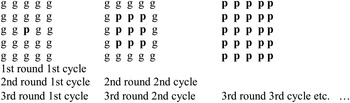
It turns out that even a small fraction of experts is sufficient for local meta-induction with a sufficiently long deadline to make expert information spread all over the epistemic network. In the result, the success rates of laymen converges to that of the experts. To understand what goes on, consider Figure 1, in which a single perfect expert is surrounded by bMIs. In the first cycle of the first round the expert in the center makes a perfect prediction (with maximal score 1) and the surrounding bMIs make a random guess g. In the next cycle nothing changes, so round 1 immediately converges to equilibrium. The first cycle of the second round begins as before. But in the second cycle of this second round the expert has already a slightly higher success rate, so the bMIs in the first neighborhood layer imitate the expert's prediction of the first cycle. In the third cycles of the second round nothing further changes. In the third round, the first layer of bMIs around the experts have an increased success rate (compared to the bMIs more distant from the expert), and so, the bMIs in the second neighborhood layer imitate the bMIs in the first neighborhood layer, whence in the third cycle of the third round, the expert's prediction is imitated by the bMIs in the second neighborhood layer (etc.). In conclusion it takes n rounds with n cycles for an expert's prediction to spread to n − 1 iterated layers of neighborhood.
Spread of an expert-prediction through cycles and rounds. Center cell = expert, p = experts' prediction, neighboring cells = initially ignorant bMIs, g = bMIs' independent guess.

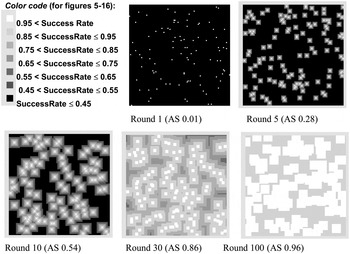
The simulation results of the spread of reliable information by local meta-induction over the 100 × 100 Moore neighborhood are presented in Figure 2. Success rates are visualized by grey shades, ranging from black for a reliability below 0.45 to successively brighter grey-shades until white for a success rate > 0.95. To simplify the picture, we assumed the laymen to be initially completely ignorant, with an independent reliability of zero (e.g. because of large systematic errors). Figure 2 shows that already a fraction of only 1 percent experts with perfect reliability of 1 is sufficient to spread expert-information and expert-success all over the place, provided the chosen deadline is somewhat higher than 10 cycles. This ‘critical deadline’ resulted from the fact that in the beginning of each simulation the 100 experts were randomly distributed over the 10,000 cells, so that the shortest distance between a laymen and an expert was rarely greater than 11 or 12 neighborhood layers.
Local meta-induction spreads reliable information and predictive success from 1% perfect experts (the white spots in round 1) among 99% initially ignorant meta-inductivistic laymen (the black area in round 1) within 100 rounds and 13 cycles per round. Independent reliabilities of experts were set to 1 and of laymen to 0. ‘AS’ stands for ‘average success rate’ of the players. AS grows from 0.01 to 0.96 after 100 rounds; in round 200 everything has become white.

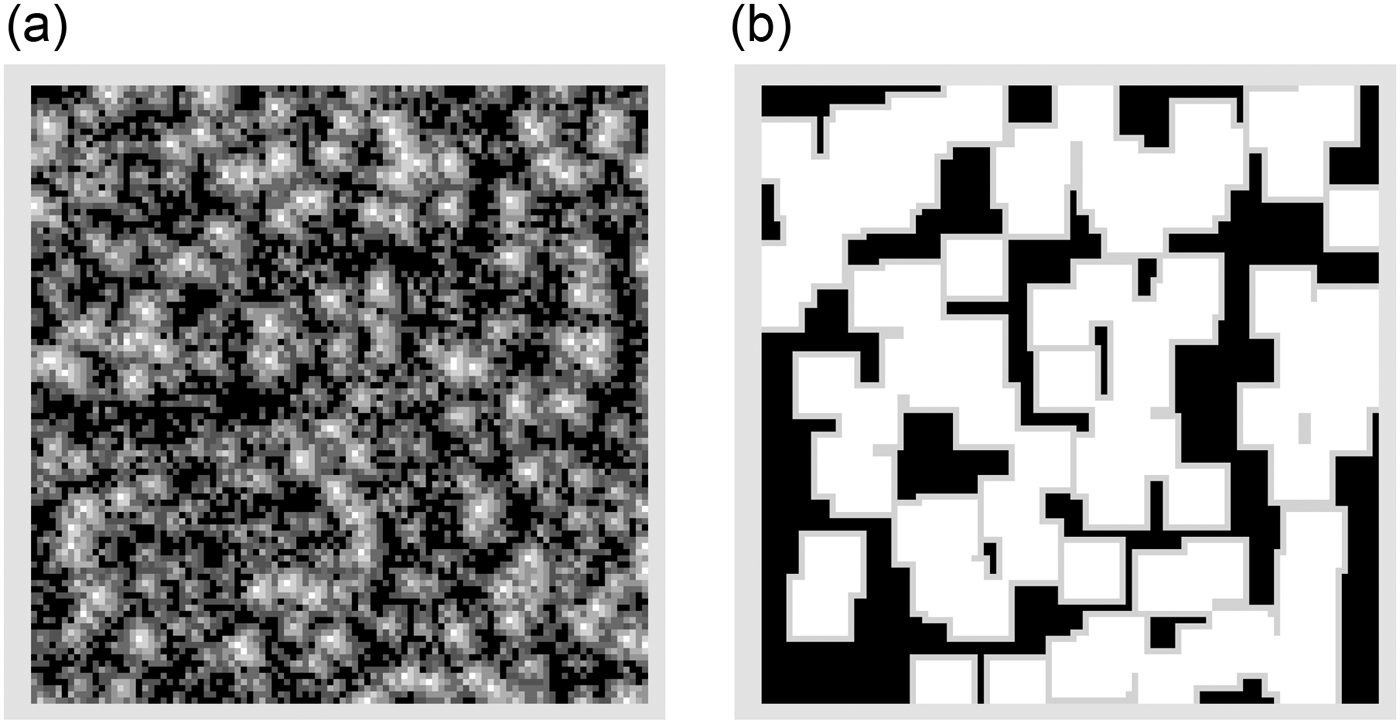
The advantage of assuming the laymen's independent success rate to be zero is that experts' success spreads in the form of sharply contoured spreading clusters, which make spreading better visible. If the laymen's success rate is assumed to be, say 0.5, the spreading still works, but the random success produces permanent fluctuations with blurred outlines of spreading clusters − a simulation of this sort is shown in Figure 3(a).
(a) Scenario of fig. 2, but laymen (bMIs) have independent reliability of 0.5 Simulation result of round 10. Expanding success-clusters don't have sharp outlines because laymen have random successes. (b) Scenario of fig. 2, but with deadline of merely 6 cycles per round. Simulation result of round 100. Because of short deadline expert-success cannot spread all over the place. AS is 0.71 after 100 rounds and stabilizes at 0.72.
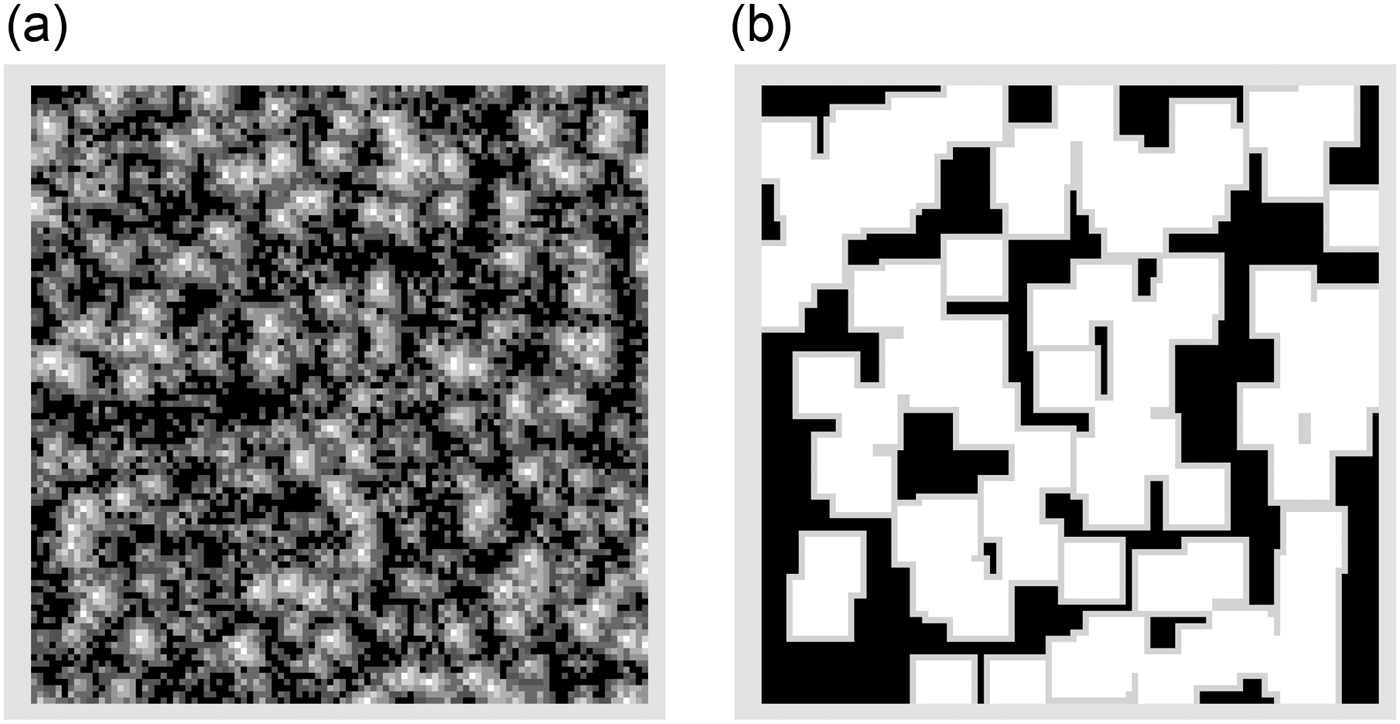
If the deadline is significantly shorter than the mean shortest path between expert and laymen, the spreading of experts' information stops before it reaches all laymen. Figure 3(b) contains a simulation with a deadline of merely six cycles, with the result that reliable information can spread only along five layers of neighborhoods; only where these layers of fifth degree overlap by luck, the spreading proceeds, elsewhere it stops.
In our simulations it doesn't make a difference whether the perfect experts predict independently or apply in addition meta-induction, because their track record is always maximal, whence they will always favor themselves. This changes when experts are not perfect and have different independent reliabilities. Also if the experts' independent reliabilities are not constant, but are allowed to change over time, results may be different, because each change of success record needs m + 1 rounds to be propagated to neighborhood layers of degree m. So if the experts' success rates change too rapidly, the spread of the predictions of the actually best experts may get undermined by information delays. Moreover, if success records oscillate around each other, the preferred meta-inductive learning method is wMI instead of bMI. Simulations of these and other realistic complications are left to future studies.
It is possible to prove a mathematical theorem that expresses the essence of the explained simulation result. For this purpose we slightly generalize the (topological) concept of neighborhood into the (graph-theoretical) concept of an epistemic network (this concept also underlies the studies mentioned in n. 7). A symmetric network is defined as a graph (Π,N) consisting of a finite set of players Π and a set N ⊆ Π2 of symmetric edges that represent direct neighborhood; we write ‘x − y’ iff (x,y) ∈ N (symmetry entails x − y ⇔ y − x). A network is called connected if every pair of players x, y ∈ Π is connected by an N-path, i.e. a finite sequence of adjacent nodes x − z1 − …− zn − y. Prediction games over such networks are defined as explained above. A player M ∈ Π is called an expert-neighbor of degree m iff the shortest path connecting M with an expert E ∈ Π has length m.
Theorem 3
For every prediction game with deadline d ∈ ω over a connected symmetric network (Π,N), in which Π consists of an (arbitrarily small) subset Π1 of perfect experts (Ei ∈ Π1) with independent reliability 1 and a Π1-disjoint remainder set Π0 of initially ignorant laymen that are local bMI-meta-inductivists (Mj ∈ Π0) with independent reliability 0, the following holds:
The success rate of all laymen converges to the independent reliabilities of the experts (with increasing number of rounds) if and only if every laymen is an expert-neighbor of degree ≤ d.
The proof of this theorem is contained in the Appendix. Theorem 3 is just a first step. I conjecture that it can be generalized to experts with variable reliability >0.5 and laymen with reliability <0.5. However, this case is much more difficult, because it has to include the possibility of (finite but arbitrarily long) random fluctuations of success rates; so the round after which every layman is an expert-imitator of degree ≤ d may occur arbitrary late. Generalizations of theorem 3 are left to future work.
5. PEER-IMITATION WITHOUT SUCCESS-INFORMATION: CONSENSUS-FORMATION WITHOUT SPREAD OF RELIABLE INFORMATION
We now turn to opinion dynamics that are based on success-independent imitation methods such as peer-imitation or (blind) authority-imitation. Such imitation methods are applied in social situations in which the success rate of one's neighbors are either unknown or hidden or deliberately ignored.
We first concentrate on peer-imitation. The resulting opinion dynamics is strikingly different from the results of meta-induction in two respects:
(1) Peer-imitation − and more generally, every kind of success-independent opinion dynamics − depends only on the update cycles of the first round. Nothing changes in the next rounds (except from random fluctuations) because the players' predictions are independent from success-feedback by the environment.
(2) If all players learn by peer-imitation, then with increasing number of cycles their opinions converge to the average of their initial predictions (based on their independent reliabilities), and their success rates converge to the average of their independent reliabilities.
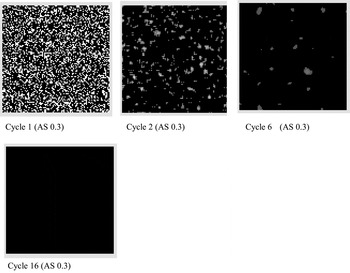
Figure 4 illustrates a simulation of a network of peer imitators consisting of 30 percent perfectly reliable experts and 70 percent initially completely ignorant laymen (for reasons that have already been explained the simulation is confined to the cycles of one round). Both experts and laymen apply the method of peer-imitation, because we assume that no population member knows who the ‘true’ experts are. In other words, no one possesses or utilizes information about the independent reliabilities of his neighbors. The result for the spread of reliable information is disastrous: expert-information gets lost in such a society after a few cycles of updating by peer imitation, and the collective belief converges to a consensus in which all individuals agree on the same unreliable beliefs, with a constant average success rate of 0.3 that equals the arithmetical mean of the independent reliabilities.
Peer-Imitation between 30% perfect experts (who are themselves peer-imitators) and 70% initially ignorant laymen. Simulation shows one round with 16 cycles (spread of success is independent from rounds). Differences in success rates wash out because of opinion averaging in successive update cycles. Average success remains at approximately 0.30.

The result of Figure 4 is best understood as a special case of some more general results that have been established on weighted opinion averaging (cf. DeGroot Reference DeGroot1974; Lehrer and Wagner Reference Lehrer and Wagner1981): here each player in the network assigns (possibly non-equal) weights to her neighbors that sum up to one, and the players update their opinions (which are coded by real numbers) by believing the weighted average of their neighbors' opinions. An important result asserts that under the weak condition that at least one player assigns a positive weight to herself, weighted opinion averaging of all players of a symmetric network is guaranteed to converge to a consensus in which all players believe the same weighted average of their initial opinions.Footnote 8 Peer-imitation is a special case of weighted opinion averaging, in which every individual attaches the same weight to her neighbors. This scenario has been investigated more closely by DeMarzo et al. (Reference DeMarzo, Vayanos and Zwiebel2003) and Hartmann et al. (Reference Hartmann, Martini and Sprenger2009: 116–17), with the result that the weight of the initial opinion of a player P in the final consensus of peer imitators is proportional to the number of P's neighbors. So, if every peer-imitator has the same number of neighbors, the limit consensus is the simple arithmetical mean of the initial opinions − which is result of the simulation of Figure 4.
The negative result of Figure 4 is apparently rather different from the well-known results on the wisdom the crowd, that tell us that the consensus achieved by the members of a network of peer-imitators can increase the closeness to the truth and, thus, the success rate of their opinions (cf. Douven and Rieger Reference Douven and Rieger2010; Golub and Jackson Reference Golub and Jackson2010). The explanation of this difference is not difficult. Wisdom-of-crowd scenarios assume that the members of the network are not initial ignorants, but have a truth-bias. More precisely, their initial opinion is given by a signal that distributes symmetrically around the truth according to a Gaussian random error function. Since each player receives one signal, the arithmetical mean of the players' signals converges to the truth with increasing numbers of players and with probability 1 − this is a simple consequence of the law of large numbers (cf. Golub and Jackson Reference Golub and Jackson2010: §III.A, B).Footnote 9 In contrast, in our present setting we assume that laymen are initially completely ignorant − compared to the wisdom-of-crowds setting we have to imagine their independent guesses to be randomly distributed around a value that is far distant from the truth. In such a situation, reliable information does not spread but gets lost by success-independent peer-imitation.
We briefly report that if one applies the same simulation to authority-imitators instead of peer-imitators, the average success rate of the entire population again neither increases nor decreases. However, since every player imitates now only one (arbitrarily chosen) authority in his neighborhood, the opinions of the players do not always converge in this scenario, but may fluctuate around in form of a random walk.
In conclusion, it seems that in a situation of initially dominating ignorance, only social learning that is based on success-information can improve the average reliability of the network. In the next section we will see that even partial information about success records − namely information restricted to experts − is sufficient for enabling the spread of reliable information.
6. PEER-IMITATION WITH SUCCESS-INFORMATION RESTRICTED TO EXPERTS: SLOW SPREAD OF RELIABLE KNOWLEDGE
We now assume that the experts have the following partial success-information: they know that they are experts. Therefore, the experts are never imitating laymen, they either stick to their independent predictions, or apply meta-induction to their neighborhood, and thus imitate experts. Only the laymen imitate their neighbors in a success-independent way.
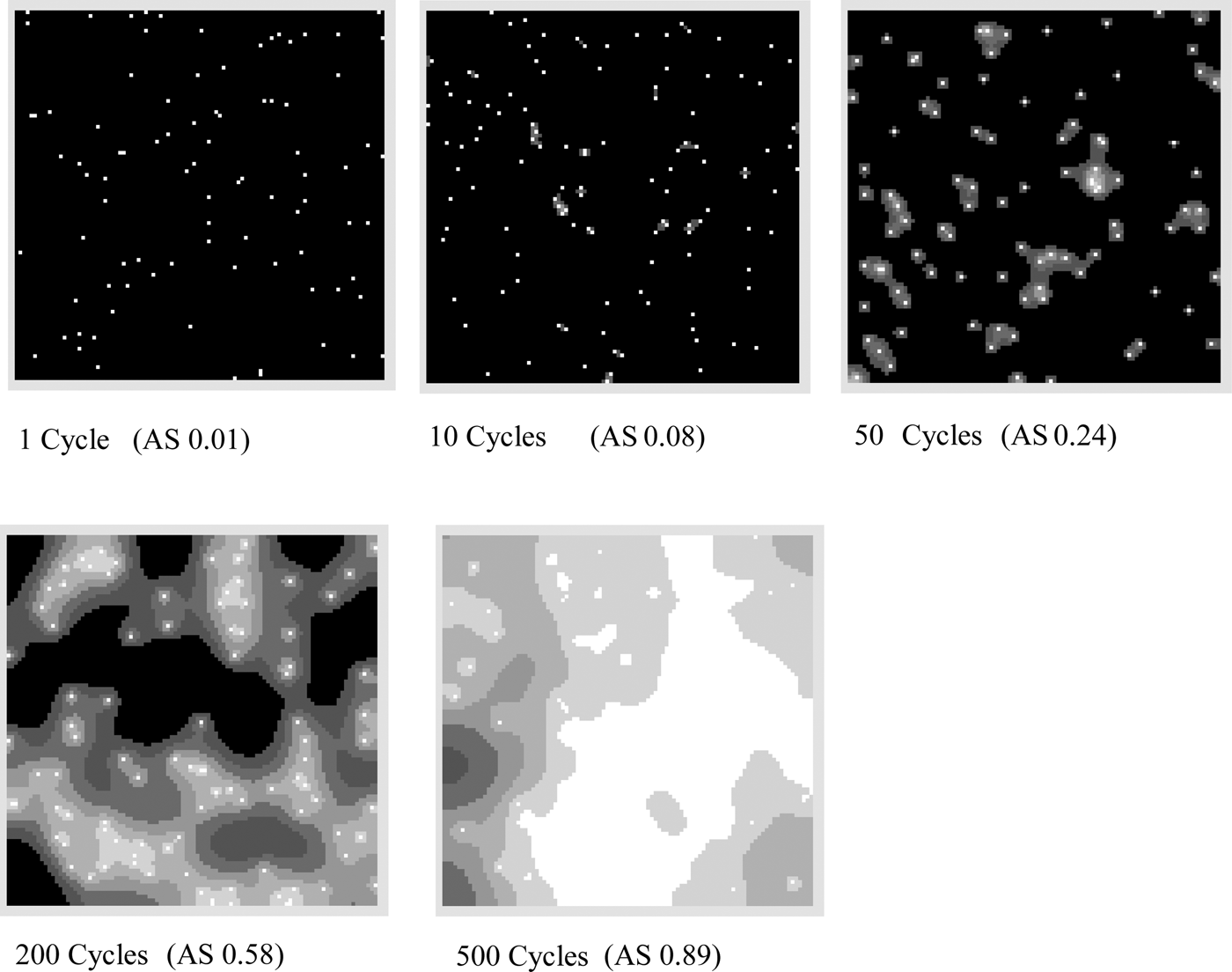
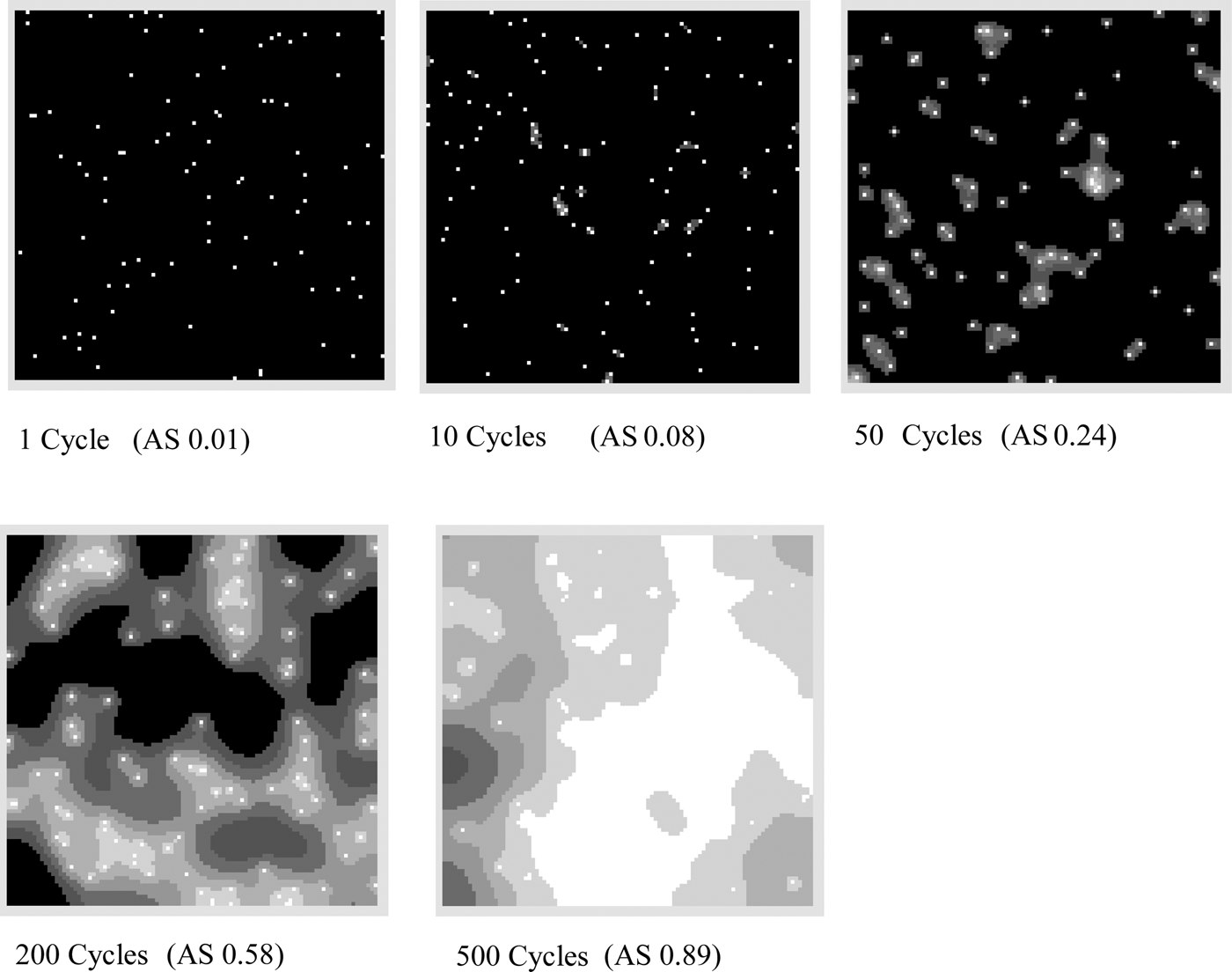
Since we assume that the experts have the same perfect success rate of 1, the result does again not depend on rounds, but only on cycles. But now, expert-information spreads from experts to laymen, because the experts' predictions are no longer made worse by averaging with laymen, and in each update cycle of the peer-imitating laymen the perfect expert predictions achieve an increased weight in the updated predictions of the laymen. In the result, the laymen converge slowly to the experts' prediction, even if the percentage of experts is very small. The simulation result is shown in Figure 5. Compared to meta-induction (Figure 2), the spread of reliable information and success is now based on cycles instead on rounds. Moreover, the spread is much slower: for the effects of 30 rounds of meta-induction (compare Figure 2) one needs 500 cycles of peer-imitation.
Peer-imitation among 99% initially complete ignorants, with 1% perfect experts who are themselves not peer-imitators. Reliable information spreads but rather slowly (one round). Average success grows from 0.01 to 0.62 after 200 cycles and to 0.85 after 500 cycles.
The obtained result resembles a result of Hegselmann and Krause (Reference Hegselmann and Krause2005, Reference Hegselmann and Krause2009). Hegselmann and Krause assume a confidence interval around one's opinion. Population members whose opinion lies in one's confidence interval (i.e. is sufficiently close to one's own opinion) count as one's epistemic neighbors. Epistemic networks without confidence intervals, as in this paper, behave like Hegselmann-Krause networks with large confidence intervals. What is important in our context: in their later work Hegselmann and Krause introduce an additional truth-bias. More precisely, in each cycle each player predicts a weighted average of the average opinion of his neighborhood and the truth (cf. 2009: 134ff.). In each cycle, the weight of the truth (that remains stable) becomes stronger in the updated opinions of all players; so the truth-bias in Hegselmann-Krause's model plays the same role as the perfect experts in the simulation of Figure 5. Hegselmann and Krause show that in their model the opinions converge to a consensus on the truth, even if not all individuals are truth-biased, but only sufficiently many individuals that are sufficiently connected with the rest.
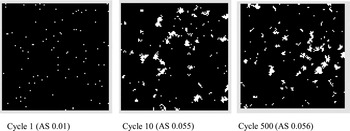
If we replace in the simulation of Figure 5 the 99 percent peer-imitators with authority-imitators, the spread of reliable information vanishes almost completely. This result is shown in Figure 6: average success increases from 0.01 to only 0.056. The reason is that authorities are chosen randomly; so only a few laymen get (indirectly) connected with experts; the others take other laymen as purported authorities and, thus, remain completely ignorant.
Authority-imitation by 99% initially complete ignorants, with 1% perfect experts who are not imitators. Authorities are picked up randomly (single round). Reliable information spreads just a little bit: average success grows from 0.01 to 0.056 and stabilizes there after 19 cycles.

The result of Figure 6 gives us another important insight: in the quite realistic scenario in which experts are competing with pseudo-experts, but only the experts can discriminate experts from pseudo-experts, averaging one's opinion over all of one's epistemic neighbors has a significant advantage over blindly choosing an authority in one's neighborhood in which one puts all of one's trust.
7. CONCLUSION
Our comparative investigation of social learning processes has shown that if epistemic networks start from a situation in which ignorance dominates, spread of reliable information and truth-success is only possible if it is based on some knowledge about the success record of those persons from which one learns. In the absence of other information, such knowledge has to be learned from meta-induction over the track record of one's epistemic neighbors. Even if one's epistemic neighbors make up only a tiny fraction of the total community, and the reliable informants are rare and far outside of one's epistemic neighborhood, meta-induction applied by all members of the community may spread reliable information over the entire population. The spreading persists, though in a much slower fashion, if success-information is restricted to experts, while laymen apply some other kind of opinion-averaging (e.g. peer-imitation) to their neighbors. But if social learning methods are applied totally independently from records of truth-success, the spreading process breaks down completely. In such a situation reliable information gets lost, because individuals cannot discriminate between reliable and unreliable informants, and so reliable individuals will predominantly learn from unreliable individuals.
Last but not least, these results point to some obvious limitations of the method of peer-imitation. Peer-imitation has some much-debated advantages in populations whose individuals can be assumed to have a truth-bias, or to possess some pre-established knowledge − as, for example, in peer-imitation among experts or in the explained wisdom-of-crowd-scenarios. But in societies whose members are either initially ignorant or biased towards error, peer-imitation does not work in favor of progress towards truth. This observation may shed light on some recent debates on suitable criteria for distinguishing science from pseudo-science. In the 2004 (Kitzmiller vs. Dover) case concerning ‘Intelligent Design’ (a variant of creationism), Judge Jones decided against the teaching of creationism in the Dover Area School District. His decision was partly based on methodological demarcation criteria between science and religious belief. There is, however, no consensus about this problem in philosophy of science: some philosophers of science argued that, instead of methodological demarcation criteria (such as empirical testability), one should use social criteria, such as peer-reviewing. In this regard, Pennock (Reference Pennock2011: 193ff.) reports that Judge Jones has suggested the application of peer-review methods as a demarcation criterion: he pointed to the fact that most writings of creationists haven't been peer-reviewed, as is usual in proper scientific journals. The reaction of Behe, a prominent intelligent design defender, was to promote peer-reviews within the creationist camp. Behe pointed to a couple of creationist writers who indeed had been peer-reviewed − not by naturalistic scientists, but by other intellectual creationists. It is rather doubtful whether the consent that a creationist writing earns from other creationists is an indication of its scientific character, i.e. its truth-conduciveness, and the results of section 6 validate these doubts.
8. APPENDIX: PROOF OF THEOREM 3
Proof of direction ⇒
In section 3 it was informally argued that the increased success rate due to the indirect imitation of an expert spreads one degree of neighborhood per cycle and round. We prove this now by formal induction. Recall the definitions of Π1, Π0, and of an expert-neighbor M ∈ Π0 of degree m (see the paragraph preceding theorem 3). We define M ∈ Π0 to be a potential expert-imitator of degree m, in a given round n, iff there is a imitation-chain E − M1 − …− Mm−2 − Mm−1 of length m in round n such that Mm−1 = M and (a) M1 has E and each Mi (1 ≤ i ≤ m − 1) has Mi−1 as its favorite, and (b) the imitation-chain is success-decreasing, i.e. sucn(M1) < sucn(E) and sucn(Mi) < sucn(Mi−1).
Lemma
For each deadline d' and 1 ≤ m ≤ d': after the mth cycle of the mth round, (a) every meta-inductivist that is an expert-neighbor of degree k ≤ m is a potential expert-imitator of degree k, and (b) no expert-neighbor of degree k* > m is a potential expert-imitator of degree k*.
Proof of the lemma
Induction start: For the first round, m = 1, the claim is obvious.
Induction step: Assume that in the end of some round m < d', some laymen M is an expert-neighbor of degree m + 1, and not a potential expert-imitator of some degree ≤ m. We prove that in the end of round m + 1, M is a potential expert-imitator of degree m + 1.
By our assumption M is a direct neighbor of one or several expert-neighbors M* of degree m, who are by the induction hypothesis potential expert-imitators of degree m (‘M*’ is a variable referring to these M-neighboring potential expert-imitators of degree m). M's success rate is zero, because M has independent reliability 0 and was by induction hypothesis (b) so far never a potential expert-imitator. In the beginning of round m + 1, the success records are updated. Since (for every M*), every member of the imitation chain E − M1 − …− Mm−2 − M* predicts event em+1 with maximal score, no meta-inductivist in this chain switches his favorite in the beginning of round m + 1, and the chain remains to be success-decreasing. Hence the imitation chains connecting the M*'s to their experts remain stable. After m cycles of round m + 1, the experts' constant and perfect prediction of event em+2 is imitated by the M*s. So in cycle m + 1 of round m + 1 (which exists because m < d'), M imitates the prediction of some first-best M* in his neighborhood. Since sucm+1(M*) > sucm+1(M) = 0, this implies claim (a), namely that M is an expert-imitator of degree m + 1 in cycle m + 1 of round m + 1.
Claim (b) holds for round m + 1, because the success rate of all expert-neighbors M+ of degree m + 1 is still zero in round m + 1 (it climbs only in the beginning of round m + 2, when event em+2 is revealed). So, no expert-neighbor of degree m + 2 will choose some of these M+'s as her favorite, but will rather predict by her independent reliability. End of proof of the lemma.
The lemma implies that after d rounds and d cycles (of d rounds), every layman is a potential expert-imitator of degree ≤ d, with an expert-imitation chain that remains stable for all further rounds. So after round d all laymen predict what the experts predict (who make all the same perfect prediction), and the laymen's success rates converge to the limit success rate of the experts, i.e. to the experts' independent reliability. End of proof of direction ⇒.
Proof of direction ⇐
Assume M is an expert-neighbor of degree m > d. Then even if M is a potential expert-imitator of degree m with imitation chain E − M1 − …− Mm−2 − M, the predictions of E are never actually imitated by M, because their propagation from E to M needs more than d cycles (in other words, what M imitates in his final prediction in cycle d, namely the prediction of Mm−2 in cycle d − 1, is a zero-score prediction). So M's success rate remains zero. Q.E.D.
ACKNOWLEDGEMENTS
Work on this paper was supported by the DFG-financed EuroCores LogiCCC project ‘The Logic of Causal and Probabilistic Reasoning in Uncertain Environments’, and by the DFE-grant 1566/9-1 as part of the priority program ‘New Frameworks of Rationality’ (SP1516). Computer programmings for sections 3–6 were done by Paul Thorn. For helpful comments and discussion I am grateful to Stephan Hartmann, Igor Douven, Rainer Hegselmann, Paul Thorn, Kevin Zollmann, Simon Hutteger, Alvin Goldman, Horacio Arló-Costa, Kevin Kelly, Hanti Li, Brian Skyrms, Teddy Seidenfels, Rohit Parikh and Christian List.