Introduction
Of course, these savages are posthumous: frozen, cryogenized, sterilized, protected to death, they have become referential simulacra …
Baudrillard, The Precession of Simulacra (Reference Baudrillard1994, p. 8)Much like the imminent death of rock music, the portrayal of boeremusiek as forever vanishing has become an integral part of the discourses surrounding this genre of predominantly white folk music in South Africa. An early example is a letter by an anonymous reader published in Dagbreek en Sondagnuus, a (now defunct) Afrikaans Sunday newspaper, on 20 February 1955:
The objection against traditional Boeremusiek is often raised: that it is too monotonous and repetitive. The answer to this is simple: listen to something else, but do not try to remodel the original. After all, Boeremusiek has a true heritage and answered to some goal, namely, to provide entertainment throughout the night. When all the other instruments have already floundered, the concertina infuses new life into the party.
If the new generation wants a new kind of music, give it to them, but do not contaminate [verbaster] our traditional Boeremusiek. If it must become a museum piece, let it at least be a true one. Some of us actually like spending the odd hour in the museum to draw from the past the joys that are absent in the present.Footnote 1
Calling boeremusiek a ‘museum piece’ suggests, quite extraordinarily for its time, that true boeremusiek could only be salvaged by simulating the past and not by acting in the present. The author implies that liveness poses a threat to authenticity. As he sees it, ‘real’ boeremusiek exists primarily in nostalgic simulations of the past – whether accessed through historical recordings or live performances executed within an aesthetic of simulation. Drawing from the past the joys that are absent in the present (a classic formulation of nostalgia), is likened to spending time in a museum – a place where original specimens that have disappeared from real life are exhibited and protected. This is not an unusual position in folk music scholarship. According to Simon J. Bronner, Francis James Childs was, for example, greatly influenced by the brothers Grimm and viewed his collection of folk songs as belonging to a now-vanished past: ‘remnants of ancient types rather than examples of living performances’ (Mitchell Reference Mitchell2007, p. 28).
I have encountered the imminent death of boeremusiek not only discursively, but also ethnographically when participating in boeremusiek events. Rereading my fieldnotes, I am struck by the number of times I commented on the inauthenticity I experienced at these events. At first I attributed this recurring theme to the ‘vanishing savage’ trope so often posited as the rationale behind ethnographic adventures. It is important to document a way of life, so the argument goes, before it disappears. Renato Rosaldo (Reference Rosaldo1989, p. 107), for example, regards the search for ‘true’ or ‘uncontaminated’ natives as a form of imperialist nostalgia: the longing felt by ‘agents of colonialism’ for the colonised culture as it was ‘traditionally’. This pose of ‘innocent yearning’ for what has been lost as a result of colonialism is used to conceal complicity with ‘often brutal domination’, argues Rosaldo (Reference Rosaldo1989, p. 108). Similarly, James Clifford (Reference Clifford, Clifford and Marcus1986) contends that ‘salvage’ ethnographies, aimed at saving the vanishing savage by means of the text or ‘bringing a culture into writing’, legitimate the power of the ethnographer to represent the other.
I have, however, become convinced that my experiences of irreality at boeremusiek events can be attributed to the prevalence of the type of museum thinking set out above. My argument in this paper is that museum thinking and rhetorical gestures of nostalgia, authenticity and salvage force participants to experience liveness subjunctively – as a possibility rather than an actuality. Although theoretical explorations of nostalgia (cf. Stewart Reference Stewart1988) and the literature on how it is articulated and represented in music inform my argument throughout (cf. Middleton Reference Middleton2007; Plastino Reference Plastino2007), I am primarily interested not in why people turn to nostalgia, but in what happens when they do. The model of subjunctivity I propose here departs from theories that view nostalgia as the ritual re-enactment of so-called ‘ideal communities’ aimed at strengthening feelings of group solidarity (cf. Cassia Reference Cassia2000; Bruinders Reference Bruinders2006). I focus, instead, on the effects of retrospective idealism on participants' immediate experience of liveness. My aim, therefore, is not solely to explore the representation of white nostalgia in boeremusiek but, more importantly, to consider the work this rhetoric of the past and its loss is doing in the present.
Although the subjunctive is rather weak in modern English, it is a verb mood commonly found in Romance, Germanic and Semitic languages. The subjunctive mood is typically used to express various states of irreality or non-facts, such as wish, emotion, possibility, judgment, opinion, necessity, or action that has not yet occurred, as in: ‘Had we taken the other route, we would be there by now’, ‘I wish this day were over’ or ‘If I were a bird, I would be able to fly’. If one extends the notion of subjunctivity beyond grammar, one might think of it as ‘a virtual zone where we envisage and entertain possibilities’ that may later be realised, but often are not. ‘It is where we … say to each other: “Suppose …”’ (Hedtke and Winslade Reference Hedtke and Winslade2005).
Although the verb form might be dying out, the subjunctive mood in this expanded sense proliferates in modern life, as Mikhail Epstein notes. It fuels insurance and investment industries and is evident in various kinds of ‘virtual thinking’ (Epstein Reference Epstein2001). Hours of news reporting are spent on possible outcomes of trials, future economic trends and election polls (Hedtke and Winslade Reference Hedtke and Winslade2005). The subjunctive, in Epstein's view, is also a prerequisite for historical thinking because the ascription of meaning to historical events ‘is only valid when alternative possibilities for these events are taken into account’ (Epstein Reference Epstein2001). In this sense, the subjunctive indicates the discursive space of the possible – often with an impending sense of doom and loss.Footnote 2
There are also occasions when the loss associated with the subjunctive can assume a therapeutic function. Lorraine Hedkte and John Winslade (Reference Hedtke and Winslade2004) show how, when people are talking about the dead, they often do so in the subjunctive: ‘She would have enjoyed this gathering tonight’, or ‘He would have been proud of you today’. They argue that the resulting temporary connection between the dead and the living is an important way of coming to terms with grief. As such, the subjunctive is often used to mourn unfulfilled possibilities.
Jerome Bruner (Reference Bruner1986) has argued that the ‘subjunctivising of reality’ is characteristic of all narratives, in the sense that narratives open up worlds of possibility, as opposed to simply pointing towards, or indicating, real events, characters and plots.
I propose to extend the modality of the subjunctive beyond the linguistic and narrative space to a discursive and social one. In other words, I propose that social worlds, too, can be lived in different moods or modalities. I seek to understand how and why certain types of human behaviour and experience – in this case music making and dancing – are subjunctivised. In addition, I ask how, through this process, the potential meanings of boeremusiek – nostalgically defined in terms of the past – override meanings located in more material contexts.
Like the verb form, the subjunctivising of reality exposes the inadequacies of the present, even while considering a utopian future or past. The subjunctive reality of boeremusiek events turns them into anti-rituals, or even simulations of rituals. Although they exist in a mode outside real life similar to Victor Turner's liminal moment (Turner Reference Turner1969), boeremusiek events do not anticipate future possibilities, but mourn the lost possibilities of the past. It is like speaking of the dead, while imagining that they are still present. Stephanus Muller (Reference Muller2001, p. 153) has suggested, in the context of art music in Afrikaner society, that the emulation of Western musical models historically functioned as a ‘protective mask’, both shielding and giving shape to ‘the vulnerable settler extension of the metropolis’. The protective mask has been superseded by the death mask in postcolonial white aesthetics, I would argue. Boeremusiek, like other relics of white cultural production, hovers uneasily between representing and commemorating a lost past. Boeremusiek occupies a musical present devoid of liveness.
In the first part of this paper I trace the conditions enabling the preference for possibility over actuality in the history of boeremusiek discourse since 1938. The mechanisms and meanings of subjunctive reality in the discourses and practices of the largest boeremusiek organisation in South Africa, the Boeremusiekgilde (Boeremusiek Guild or BMG), is the focus of the second part.
Liveness and its discontents
The deep dissatisfaction with live performance that lies at the heart of claims to the imminent death of boeremusiek, follows a long historical trajectory. Throughout the 20th century, the death of boeremusiek was predicted not in answer to the waning of a musical practice, but in response to the marginalisation of the genre by the Afrikaner intelligentsia and middle classes.
Boeremusiek is, contrary to the common usage of the word in English-speaking South Africa, not a catchall term for all Afrikaans music.Footnote 3 As a definitional point of departure, one might venture the following: a widely ridiculed form of mostly instrumental folk music, closely associated with the concertina, predominantly (but not exclusively) practised by Afrikaans-speaking whites (so-called Afrikaners) and primarily intended to accompany informal social dancing. As such, it is a relatively distinct genre within the constellation of Afrikaans music. Although certain overlaps in repertory inevitably exist, boeremusiek is not synonymous with the Afrikaans folk song tradition nor with the folk dance tradition of volkspele – both regular features of Afrikaner nationalistic pomp and circumstance in the 20th century. Neither does a simplistic identification of the genre with the use of the concertina hold true. Although the concertina is often used in popular Afrikaans vocal music as a marker of nostalgia, such songs do not pass as boeremusiek.Footnote 4 Boeremusiek also does not refer to music about Boers, like Bok van Blerk's much hyped song De la Rey (2006).
Boeremusiek is associated with concertinists like Manie Bodenstein, Nico van Rensburg and Silver de Lange and groups such as Die Vier Transvalers, Die Penkoppe and Die Kaapse Affodille. At its core, the discursive context of boeremusiek is that of a domestic music outside the political public eye. In the historical imagination boeremusiek occurs around camp fires – where the mood is one of jolly melancholy – or at dances accompanying birthday parties, New Year celebrations or wedding receptions.
Despite its domestic historical context (or because of it), boeremusiek is today commonly associated with right-wing Afrikaans conservatism. The boer in boeremusiek means ‘farmer’, ‘Afrikaner’, ‘white male’ or ‘supporter of apartheid’, depending on one's perspective. Regardless of this ambiguity, however, the presence of boer in boeremusiek situates the music within a history of white oppression and Afrikaner nationalist ideology that has led to the stigmatisation of the genre. In reality, Afrikaners have always been deeply divided on the issue of boeremusiek. This division among Afrikaners is reflected in debates on boeremusiek that centred on the related issues of race, class and morality in which the genre was implicated for the largest part of the 20th century.
The letter columns of the nationalist newspaper Die Transvaler of 1938 bear evidence of the charges that were routinely made against the genre.Footnote 5 One category of complaints centred on moral-political concerns about dancing fuelled by Christian nationalist sentiments. A certain C. Kriel, for example, expressed his disgust at the increasingly common practice, especially within the youth branches of the National Party, of hosting fundraising dance parties in a letter of 11 August 1938. ‘If we want to go by the name of a Christian volk, and expect the Lord's grace on our great volk struggle’, he wrote, ‘these things are wholly undesirable.’Footnote 6 Arguments that dancing ‘weakens you in the fight against the devil of adultery’ and therefore had no role to play in Christian nationalist politics – a common objection at the time – were met with counterarguments that sexual indiscretion was not reserved for the dance floor.Footnote 7 As it was not uncommon for the musical programme at such parties to consist entirely of boeremusiek, this style became shorthand, at least in the mind of ideologues, for the moral degeneration of the Afrikaner people.
A second category of complaints centred on the musical merits of the genre and its capacity to represent the volkslewe (the national life) of the Afrikaner. In these reproaches, issues of race and class took centre stage. The exchange between P.F. Swanepoel and S. Buys, published during November 1938, is exemplary. In a letter entitled ‘Boeremusiek: Radio rapped over the knuckles’, Swanepoel rejected boeremusiek on both moral-aesthetic and ideological grounds. He contended that boeremusiek was not ‘Afrikaans’, as he had heard ‘this sort of music and musical instruments, the so-called “skrammelorkes”’, from black farm labourers since his childhood.Footnote 8 ‘I don't know any well-educated Afrikaans family,’ he continued, ‘who do not listen to this music with embarrassment and abhorrence … There are hundreds and thousands of Afrikaners who are far superior to this “vastrap” group and who constantly have to suffer the humiliation of having to bow down to that distasteful level. Why can't the underprivileged group (if in fact they are Afrikaners) not gradually be educated to appreciate higher things?’ The question remained, responded Buys, why these ‘skrammel-orkeste’ remained so popular. When he listened to Suikerbossie (Sugarbush), he involuntarily started to move to the rhythm of the music.Footnote 9 ‘There can be only one reason, and that is because boeremusiek gives expression to the soul [of the Afrikaner].’Footnote 10 Then comes Swanepoel's incensed response:
A great musician once said that noble music makes an appeal to the top half of the human body (i.e. to the heart and the mind, feeling and reason) and cheap music to the bottom half! I don't know to which part of the body ‘Suikerbossie’ made an appeal on you.
Here one sees evidenced the growing rift between the idealism of Christian Afrikaner nationalism and the materiality of boeremusiek. Swanepoel's protest, representative of the ideologically-minded Afrikaner middle and upper classes, reveals a Calvinist – and colonialist – discomfort with the materiality of the body that runs deeper than merely the association between boeremusiek, dancing and adultery. The allusion made here to boeremusiek's hybrid nature quite clearly references the myth of the innate musicality of the black native. Swanepoel posits a primitive connection between music and the body – a connection that is able to trump reason and that plays into the instinctual nature of the primitive mind situated, as it were, in the ‘lower half’ of the body. According to this logic, boeremusiek cannot be considered music, because a person driven forward by these primitive musical instincts does not qualify as a human being. Boeremusiek is described as ‘banal’, ‘lascivious’ and even an act of rape; it could make one do strange things and disregard rational argument. The preference from the side of Afrikaner high culture was clear: the dogmatic over the material, culture over nature, reason over the embarrassments of the body. Boeremusiek not only resisted the nationalist image of the Afrikaner, but also its segregationist politics.
A new era of reception
One can listen to music in one of two ways. First, with the purpose of enjoying the piece and appreciating it as music. Second, with the purpose of dancing when you are unable to appreciate it. In my opinion it all depends on the individual's behaviour towards the music, if he considers it to be frivolous or serious.Footnote 11
Letter to the editor, Die Transvaler, 25 October 1938In many ways recording technology could defuse these debates by reifying boeremusiek and making the connection with the material body seem capricious. With the increasing availability of records and the airtime it evidently enjoyed on Afrikaans radio, a new era of reception was inaugurated for vastrapmusiek, as it was also called. Alongside the live music of the dance scene, boeremusiek emerged as a listening culture. This move away from dancing created the possibility for a boeremusiek free of adulterous connotations and scandalous appeals to the material body and, therefore, more in line with Afrikaner Christian nationalist principles. Removed from the sinful context of the dance party, it could become a private affair, enjoyed within the home as a listening experience. Out of the public eye, one could entertain a secret passion for the music and commit one's enjoyment to a suitable time and place, where and when it did not interfere with the solemnity of religious and volks-political affairs.
Concomitant with the growing rift between the reception of live and recorded music, new musical categories emerged. Anton Hartman, writing in Reference Hartman1955, stated that ‘traditional boeremusiek’ had been eroded from two sides.Footnote 12 In the absence of tradition, practitioners either turned to jazz as a musical model or sold out to commercial concerns.Footnote 13 ‘In place of [our traditional boeremusiek] we have a flourishing “Tin Pan Alley” which spins out “Afrikaans” tangos and rumbas in a furious struggle to make money from something that goes by the name of “boeremusiek”, and which, for that reason, enjoys a measure of support from the public’ (Hartman Reference Hartman1955).
Four years earlier, in 1951, the South African Broadcasting Corporation (SABC) launched an extensive campaign to source old boeremusiek tunes from its listeners (Van den Berg Reference Van den Berg1976, p. 192). The biggest response came from Mrs Jo Fourie, who sent in about 300 tunes.Footnote 14 Some of these, performed by the orchestras of Hendrik Susan and Hansie van Loggerenberg for the SABC's transcription service, were included in a programme series called Uit die jaar vroeg (From years of yore), aired in 1952. Interpreted in light of Hartman's statement above, Uit die jaar vroeg represented an intervention on the part of the SABC to endorse ‘traditional’ boeremusiek as opposed to an ‘Afrikaans Tin Pan Alley’. Not only was it made clear in the opening programme of the series that old-fashioned boeremusiek was a vanishing phenomenon, but also that it was nearly impossible to recreate its sound and performance style because ‘modern Boereorkeste had veered so far from the old ways of playing, that they found it difficult to return to the old paths’.Footnote 15 A transcription of the first programme in the series set out the parameters of ‘real traditional’ boeremusiek in unequivocal terms: ‘Real’ boeremusiek never makes use of syncopation; the rhythm is derived from the melody and not arbitrarily provided by a rhythm section; it only makes use of primary chords, even when modulating; although virtuosity exists, ornamentation always occurs within these set boundaries. Manie Bodenstein (Reference Bodenstein2010), legendary concertina player, remembers the disdain the members of Hendrik Susan's orchestra felt for this imposed style of ‘old-time’ playing: ‘We thought it was musical nonsense – infantile.’ The items broadcasted by the SABC as ‘traditional boeremusiek’ were far removed from the live musical practice of the time.
In the letter column of Die Transvaler of 1955 there also emerges some evidence that the disdain with which certain segments of Afrikaner society viewed contemporary boeremusiek, increasingly going by the name of ligte Afrikaanse musiek (light Afrikaans music), fuelled a reappraisal of the vastrap recordings of the 1930s.Footnote 16 The 1955 debates in Die Transvaler centred on claims by S. Hylton Edwards, an English-speaking South African school teacher. In a lecture given in London he stated that ‘boeremusiek was inferior to the music of the bantu’.Footnote 17 Several letters accused Edwards of confusing boeremusiek with contaminated [verbasterde lit. bastardised] so-called ‘urban Afrikaner entertainment music’: music featuring ‘an American and British whining with Nigger and South American rhythms’, as one correspondent put it.Footnote 18 ‘Boeremusiek’, another letter continued, ‘is an art few modern orchestras can master. No-one plays like oom Jan Visser and Die Vier Transvalers anymore. Unfortunately boeremusiek is degenerating. Tangos and sambas have no place in boeremusiek.’Footnote 19
The contemporary music which, in a commercial endeavour, was ‘dished up as boeremusiek’, was not to be considered ‘real old-fashioned boeremusiek’. This would suggest that by the 1950s the ideal type of traditional boeremusiek was no longer rooted in live performances, or in ‘the way the old people played’, but in a set of historical sound recordings and a tradition reconstructed by Bosman de Kock and Anton Hartman and recorded for the SABC's transcription service.
Rescued from its unsavoury connotations, the historical recording – and, indeed, traditional boeremusiek as a construct – became increasingly disconnected from live musical performance. Liveness not only threatened musical authenticity, but also the racial ideology that could classify certain forms of musical behaviour as ‘non-white’ and, on the flipside, demanded a reductive adherence to notions of civilisation and whiteness.Footnote 20 Despite objections in public forums, ‘modern’ manifestations of boeremusiek lived on as if in a parallel universe: largely unregulated, unruly and unthinking of official Afrikaner ideology.
Strategies of subjunctive framing
The 1955 argument for retreating into the boeremusiek museum, quoted at the beginning of this paper, has remained remarkably consistent in contemporary boeremusiek reception. I have argued here that, since at least the 1930s, boeremusiek posed an embarrassment to certain groups of white Afrikaners for reasons of morality, religion, racial politics and class. Such an important part of popular culture, although it could be ignored in official discourse, could not be completely suppressed. Gradually, boeremusiek was sanitised into a listening culture, freed from the embarrassing materiality of the body, and reinvented as ‘traditional’ – a category that, as I have shown, harbours a deep suspicion for liveness.
It is in this context that the activities of the BMG needs to be understood. The BMG, founded in 1989, comprises two regional offices – one coordinating events in the northern part of the country and the other in the south. The regional offices are in turn subdivided into several branches covering smaller geographical areas or single towns. Events hosted by individual branches usually take place at a venue like a school hall or community centre, while larger events spanning an entire weekend and attended by members of several branches take place at holiday resorts. At the latter type of event, Friday evenings are typically dedicated to informal music making around a camp fire, while the main event is held on Saturdays when several bands are invited to play and dedicated dancers keep going for several hours. The morning programmes are often punctuated by speeches by the chairman or invited guests. Saturday evenings are reserved for dancing. A ‘thanksgiving church service’ is held on Sunday mornings when a sermon is delivered and hymns are sung to accompaniment of a concertina. The annual national competition is the highlight of the BMG's calendar. It usually takes place at the Voortrekker Monument in Pretoria when hosted by the northern region, or at a wine estate in the Cape Winelands when hosted by the south.
The idea of boeremusiek as museum culture might seem questionable considering the vibrancy of BMG events and the fact that, for the most part, the organisation values musical innovation and places particular emphasis on a concertinist's ability to develop a personal style (Cf. Du Plessis Reference Du Plessis2009; Roodt & Roodt Reference Roodt and Roodt2009). Far from shunning all notions of authenticity, however, the BMG locates ‘real’ boeremusiek in nostalgic simulations of a long-lost sociality.
Allan Moore (Reference Moore1998, p. 11) draws a distinction between an ‘authenticity of the old’, comparable to Philip Bohlman's definition of authenticity as the ‘consistent representation of the origins of a … style’ or ‘uncontamination of practice’, and an ‘authenticity of the new’, concerned with an ‘honesty to experience’, in Lawrence Grossberg's words. Moore typifies an ‘authenticity of the new’ as ‘defined by its ability to articulate … a place of belonging’ or a sense of ‘centredness’. This, for Moore, is in line with Grossberg's suggestion that authenticity requires the ‘ability to articulate private but common desires, feelings and experiences into a shared public language’ (Moore Reference Moore1998, p. 8).
At the contemporary BMG event there is an overlap between these two meanings of authenticity, as is evident from the following consideration of the relationship between boeremusiek and the individual (Boeremusiekgilde 2004, p. 6):
The Boeremusiekgilde concerns itself in the first instance with the advancement of Boeremusiek. It is logical that the individual will come up when talking about Boeremusiek, because it is impossible to make music without the individual! The focus is nevertheless on MUSIC when it comes to development, and then the individual should stand back to prevent the music from being overshadowed. MUSIC always comes first and then the person, without disdaining the person or the individual. The individual will enjoy admiration without looking for it whenever outstanding music is made! The Boeremusiekgilde exists as a sounding board for musicians and to help them find opportunities to showcase their talent and expose them to healthy rivalry, all for the sake of MUSIC.
In addition it should be made clear that the Boeremusiekgilde does not favour certain musicians above others. Every member and musician is treated the same way. The Boeremusiekgilde has about 500 musicians under its umbrella and serves these members in the first instance. The goal of the Boeremusiekgilde is to unite these musicians and to encourage them to give joint expression to the aim of letting Boeremusiek resound joyously for all to hear and to inspire young musicians to respect, conserve and practice the traditions that helped Boeremusiek endure for more than a century.
For this reason it is so upsetting when someone breaks away from organised Boeremusiek to form his own group. This only divides the Afrikaner and his unique folk music [volksmusiek].Footnote 21
Performing boeremusiek within the organised sphere of the BMG is more than merely a practical consideration; it is a form of enculturation, of learning one's place in society. The ‘authenticity of the old’ discernible in this discussion is of the social and not the musical kind. It is rooted in an historically informed ‘honesty to experience’. What should be respected, preserved and practised is, contrary to the opening statement, not boeremusiek in the first instance, but the traditions on which it relies. Put differently, the survival of the music is contingent on the survival of the traditions of sociality in which it is embedded. The social norm most apparent here is the precedence of group values over individual ideals. Read in this way, the BMG's main priority is not the advancement of boeremusiek in the first instance, but the advancement of a unified Afrikaner cultural history.
For the BMG the ‘consistent representation of the origins of a style’ is rooted in the social values constructed around the musical practice of the boeredans (boer dance), which became so popular in the second half of the 19th century in farming communities around the country. The structural representation of the boeredans in late 20th-century Afrikaans literature and iconography holds some clues to understanding live boeremusiek events in the present. Inevitably, these representations make use of framing techniques, usually activating a memory, thereby situating the boeredans in a nostalgic reconstruction of the past.
Die Misvloernuwejaar (The Dung Floor New Year) by Theuns Kotzé (Reference Kotzé1987) is a prose example of how the pleasures associated with the boeredans are subjunctivised in narratives on the topic. Written in the dialect of Namaqua Afrikaans, the story has a frame structure. A young man visits his grandfather, overcome by the beauty of the Karoo landscape in the fresh early morning breeze. For the young man the dawn landscape is a source of inspiration, an indication of future possibilities. For the old man the scene inspires only melancholy, a reminder of what has been lost: ‘Rain seasons. Blossoming years. Youth’ (Kotzé Reference Kotzé1987, p. 44).Footnote 22 Overwhelmed by sadness, the old man recalls the pleasurable dance parties of his youth.
The ambivalence of dancing in Afrikaner culture is highlighted at the beginning of his recollection, which forms the inner frame of the story. The host, old Kolie Kortkruisband, started to host an annual dance party when his daughters entered adolescence. Because this was not fitting for an elder in the church, the old man rationalised this ritual by contending that his daughters would not go out in search of company if they could find it at home (Kotzé Reference Kotzé1987, p. 45).Footnote 23 It is within this mildly illicit context that the social values of the boeredans are recreated:
‘Drink, yes, in tenfold abundance. The bottles packed out in sheets. Ginger and orange syrup. The gingerbeer's stoppers tightly secured with shop-bought rope.’
‘How about something to eat, you ask. Now look, old tan’Miemie believed a dancer should eat his fill in the early evening. Otherwise the dance floor will put him in his place.’ …
And then, Mister, just when the sun is about to set, then old Jankel Naairiem takes his boer concertina from its leather bag. And he settles on his field chair in the corner. With his head at an angle, like a pig listening to thunder, he reverently starts feeling the keys. …
Uncle Kolie and aunty Miemie then opens the dance floor. And after about the second turn, the young ones crowd the floor like flies on the date crate in old Rachman's shop. …
After the first waltz old Kolie says his word of welcome. He tells us to make ourselves at home, and he speaks of ginger ale and orange syrup. And of flannel cake and jam tart. ‘There is more than enough of everything, friends. It's all there for you. Don't let anyone say that someone had to go home hungry. Or that someone got a stone when he asked for cake. Welcome again, friends. The evening now belongs to you.’ …
At a New Year's revel there are no entitlements. You have to dance with young and old. You have, after all, been invited to dance. Indiscriminately. The man who becomes picky is soon put in his place by the women. …
Shortly after midnight the grownups start to flake off to bed. It is then when the young ones raise the roof. Now there is time to stand to one side with a girl. But not for long, because your absence is soon noticed. Then they start looking for you.'Footnote 24
The Afrikaners of the boeredans are portrayed as jolly, hospitable people. In the historical imagination, dance parties, accompanied by the ‘convivial sound’ of boeremusiek, often lasted through the night and were complemented by copious amounts of drink and an overabundance of food, a setting where young and old could use the public display of ‘innocent fun’ as a smokescreen for less than innocent activities (cf. Ferreira Reference Ferreira1995, p. 1). However, by placing the action in a nostalgic past, the author casts doubt on the verity of the recollection. Not only is the unreliability of the narrator highlighted by casting him as a character in the frame, but the pleasurable activities of the dance are subjunctivised by his conscious anxieties (Kotzé Reference Kotzé1987, p. 53): ‘You wish that you could hold on to the newness of the new year. And you wonder whether the elation with which you dance the polka doesn't perhaps make you look silly from a distance.’Footnote 25 The narrator is alienated from experiencing pleasure by drawing attention to himself dancing and becoming conscious of his desire to hang on to the sensation. It is in the subjunctive mood – framed by more realistic perspectives on the hardships of life – that the social values of the boeredans are formed: familiality, hospitality and jollification, egalitarianism, epicurism and paternalism of the behind-every-successful-man-stands-a-strong-woman variety. A world of sexual innuendo, courtship and youthfulness, of saint in public and sin in secret.Footnote 26
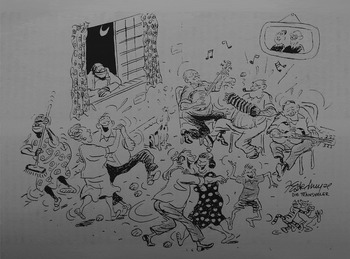
A similar subjunctivising of reality is found in a cartoon by Frans Esterhuyse, first published in Die Transvaler and reproduced in a TBK newsletter of 1992 (see Figure 1). As in Kotzé's short story, this cartoon presents a fictional present framed within a nostalgic past. The visual equivalent for a narrative frame structure is, in this case, achieved by the presence of the ancestral portrait on the wall. The portrait of grandparents smiling down at the dancers and musicians in approval situates the fictional present spatially.Footnote 27 It indicates that the party is taking place in the voorkamer – the front room of a traditional Cape Dutch homestead – where one usually encounters such portraits. At the same time, the portrait frames present enjoyment in terms of the demands made by tradition. It is as if the portrait is saying: ‘If our grandparents were here, they would have approved of our merrymaking.’ The party is thereby transformed from a spontaneous expression of fun to a performance of fun speaking to the demands of tradition. Put differently, the past and its preservation are at stake here and not the immediate experience of pleasure. As a result, the pleasure of the fictional present is a subjunctive pleasure; the musical experience is enjoyed ‘as if’ – as a performance instrumental to preserving a tradition that has ceased to exist of its own accord.
Cartoon by Frans Esterhuyse, Opskommel, August 1992, p. 12.

Boeremusiek performance as ritual of mourning
The museum, instead of being circumscribed as a geometric site, is everywhere now, like a dimension of life.
Jean Baudrillard, The Precession of Simulacra (Reference Baudrillard1994, p. 8)Pleasure at contemporary boeremusiek events is framed by discourses of duty in a similar fashion. Much of the self-reflexive discourses of the genre hinge on trying to carve out a space for the sensuous pleasures afforded by this type of music within the set boundaries of Afrikaner nationalist ideology – even if this is a discredited political position in contemporary South Africa.
The BMG's code of conduct illustrates this objective. It stipulates that ‘in accordance with the moral standards of our Afrikaner volk’ every event shall be opened with prayer, that members shall refrain from any conduct that can bring the organisation into disrepute, and that ‘drunkenness, debauchery, foul language’ and ‘any deed harmful to the reputation of the Boeremusiekgilde’ will not be tolerated. Members who fail to adhere to these measures face termination of their membership (Boeremusiekgilde 2004, p. 122). In reality, these measures are less stringent than they might seem. To my knowledge no-one has ever been expelled from the BMG for contravening the code, which seems to function as a rhetorical subservience to Afrikaner nationalist politics.
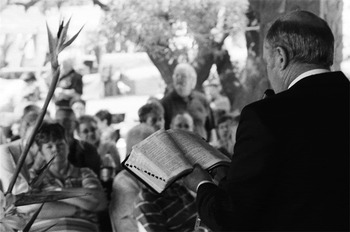
Opening events with a reading from the Bible and prayer is another contemporary example of framing pleasure with discourses of duty (see Figure 2). The passages chosen are inevitably either Psalm 150, a call to praise the Lord with music and dancing, or ‘A time for Everything’ from Ecclesiastes 3: ‘There is a time for everything, and a season for every activity under the heavens: … a time to weep and a time to laugh, a time to mourn and a time to dance …’ (New International Version). This extraction of pleasure from theological discourses often goes hand in hand with subconscious feelings of guilt, as is evident in jokes involving dominees (church ministers), dancing and sex and unsolicited justifications for dancing made from the stage. Nevertheless, ‘opening’ the event with religious reflection, should be seen as an attempt to provide a theological justification for the less stern Afrikaner social world that boeremusiek is thought to embody.
A typical Boeremusiekgilde event is opened with a reading from the Bible and prayer. Photograph by Niklas Zimmer.

This strategy might have been successful, were it not for the stark contrast between the event space and the harsh realities of life in contemporary South Africa. The BMG explicitly and continuously affirms its apolitical character as a strategy of uniting competing factions among its members and, after 1994, as a survival strategy within a political context inimical to white minorities. Yet the very negation of the contemporary political reality sets up these spaces as otherworldly – especially considering the fact that Afrikaners habitually engage in political talk, almost as a leisure activity, and that Afrikaans media are awash with political discourse. Enjoying oneself in the sole company of other whites is one of the privileges afforded by the entrance ticket. Black presence is always at the periphery, as in the Esterhuyse cartoon: selling goods, cleaning up. The freedom for children to run around without an anxious parent on the lookout for danger is turned into a commodity. One can buy the hospitality of a freshly baked pancake and other delicacies of the Afrikaner fête – kerrie en rys, vetkoek, spookasem – and pretend that the gathering has come about spontaneously.Footnote 28 The event, however, is about more than mere political escapism. The fact that politics are kept outside of these events creates a simulation of a lost set of social relations, a performance of colonial nostalgia. It suggests a time before South African democracy, and even before apartheid, when whiteness in South Africa seemed ‘natural’ and without anxiety, when patterns of oppression were so ingrained in the fabric of a society that it went unnoticed, deserved no comment, and entertained the fiction of innocence. This is the dilemma of postcolonial whiteness in South Africa: that it has become impossible to locate retrospectively such spaces of innocence.
The obvious dislocation of real life and performance space, a result of the knowledge that the reality of the event is in very distinct ways a prepared one, triggers a desire for authenticity, a desire to come close again to the nostalgic reconstructions of the past. ‘The desire for authenticity’, as Janelle Wilson (Reference Wilson2005, p. 58) has noted, ‘stems from a process of fragmentation and a feeling of distance or loss. We seek the authentic because we want to regain something lost; we wish to make our own existence more credible.’ Ironically, the nostalgic discursive move of casting boeremusiek as forever vanishing, a move that creates the conditions for the perception of the contemporary boeremusiek as unreal in the first place, becomes a necessary stratagem for maintaining the credibility of the contemporary. In the face of a loss of authenticity a process is set in motion that Baudrillard calls the ‘the panic-stricken production of the real’. A second strategy of salvage, rather ironically, therefore involves a reinjection of the pleasures of the folk into discourses of duty. In his history of the first five years of the BMG, I.L. Ferreira (Reference Ferreira1995, p. 6), for example, states that when it comes to the advancement of boeremusiek, it is not merely a matter of longing for sensuous pleasure, but about advancing the volkseie (perhaps best translated as ‘national character of the volk’).Footnote 29 The organisation's concern with youth development should be understood in this context. Preserving the folk nature of boeremusiek practices by actively participating in pleasure becomes a moral imperative in a cultural nationalist project.
An example of this process can be found in a rhetorical question I have often heard from the stage at boeremusiek events: ‘Who said boeremusiek can't be fun?!’, when, at least as far as the participants are concerned, no-one had suggested it in the first place. This question achieves several things at once. Firstly, it subjunctivises the reality of the participants who had, in fact, been having fun. Secondly, it is an example of how pleasure is reinjected into a revised discourse of duty. Far from a casual enquiry, it creates crisis: you are obliged to have fun for the greater cause of preserving boeremusiek. Finally, having created the conditions for experiencing a loss of authenticity, the future of the genre is depicted as balancing precariously on the existence of the organisation; it starts depending on this discourse of crisis for its continued existence. Pronouncing the death of fun therefore serves, simultaneously, in creating a simulated reality and in portraying the ideals of the organisation as the primary means of overcoming the resulting lack of authenticity.
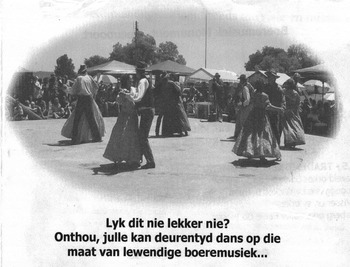
A similar strategy is evident in Figure 3, a photograph taken from the programme of the BMG's 21st anniversary festival in 2010. The caption reads: ‘Doesn't that look like fun? Remember, you can dance to the beat of lively boeremusiek at any time …’. ‘Doesn't that look like fun?’ is a defensive rhetorical gesture. Positing this image as model for present enjoyment – situated as it is in a defunct conception of fun visible both in terms of dress and the constructed ‘oldness’ of the image – takes away from the spontaneity of dancing. Instead, one is subtly reminded that pleasure has become a form of duty. What might have served as representations of pleasure are overturned by discourses of duty into commemorations of pleasure.
Photograph and caption in the programme of the Boeremusiekgilde's 21st anniversary festival, 8–9 October, 2010.

Conclusions
Since the earliest public considerations of the genre, boeremusiek has been forever vanishing. Suppressed by the Afrikaner establishment as an undesirable form of white popular culture, boeremusiek and public institutions have attempted to remove the stigma associated with the genre by trying to align it with Afrikaner nationalist discourses. Nonetheless the ambivalence of the genre remained, celebrating the materiality of the body despite Calvinist preferences for ideality, and racial hybridity despite a political ideology of separate development. Rather than challenging the status quo openly, boeremusiek has been practised in the virtual zone of subjunctivity. By constructing the pleasures of boeremusiek as a simulatory performance of an extinct social or musical practice, it became possible to enjoy the music within a system opposed to it. Contemporary boeremusiek events are embedded with discourses relating to these historical antecedents. Yet the subjunctive pleasure of contemporary boeremusiek can also be understood from the perspective of the present. In an unfortunate turn of events, the genre, despite its complex relationship with Afrikaner nationalism, is today considered to be in clear alignment with South Africa's history of white oppression. If a certain measure of white redemption were possible in a musical sphere negligent of an unjust ideology, this is no longer the case. It has become impossible in the current political climate to play innocently at the historical social and political reality of the boeredans.
The contemporary boeremusiek event mourns the end of Afrikaner innocence. It is a simulation of a utopian historical, social and political reality and, by the same token, a monument to what has been lost: musically, politically, socially and above all personally. It mourns the loss of spaces of white innocence in the intimate settings of the household, the loving nature of intergenerational relationships, a mother putting her child to bed with the reassuring sounds of boeremusiek, the uninhibited movement of the body in dance. Concertina music carries with it all the pain of a personal cultural heritage fundamentally tainted by political transgression. It points to the initial success and inevitable demise of whiteness in Africa. It speaks of vulnerability, of frustration at unrealised potential, of work that has been in vain. It carries the burden of history, the attempts of people trying to live authentically despite this burden, the becoming unwanted on a continent one has called one's home. The concertina echoes the melancholy of the loss of power, of a way of life, of innocence, of freedom – a nostalgia that cannot hide one's own cultural complicity in this sorry state of affairs. Boeremusiek cannot exist in contemporary South Africa: it can only exist in the subjunctive.
Acknowledgements
The author wishes to thank Stephanus Muller, Marianne Dircksen, Janet Topp Fargion, Christine Lucia and Roger Parker for helping develop the ideas contained in this paper. This research was funded by the National Research Foundation, the South African Music Rights Organisation and Stellenbosch University.