On the evening of March 23, 2010, more than forty Tea Partiers filled to overflowing a room in a small café on Main Street in the gritty town of Brockton, Massachusetts. It was only hours after President Barack Obama had signed into law the Affordable Care and Patient Protection Act. This blueprint for comprehensive health insurance reform had been fiercely opposed by Tea Partiers across the nation—and not least in Massachusetts, where grassroots conservative enthusiasm had been one of the key ingredients in the victory of Republican Scott Brown in the January 19 special election to fill the seat of the late Democratic Senator Ted Kennedy.
By all rights, the Massachusetts Tea Party supporters assembled in Brockton that March evening should have been demoralized. But their enthusiasm seemed undampened. Health reform needed to be repealed, agreed these generally older, white middle-class Tea Partiers; yet the assembled group also maintained a determined focus on local endeavors. Amidst talk of an upcoming Tax Day rally planned for the Boston Common, Tea Partiers displayed sophisticated political awareness, sharing tips on how to build a contact list for registered Republicans in each district, and brainstorming about how to convince Tea Party members to run in neglected legislative races. Just as Tea Partiers in the Bay State had mobilized to elect Scott Brown, months later they still felt themselves energized and on the offensive for the rest of 2010.
The Tea Party Emerges
Only fifteen months before that gathering in Brockton, the national ideological tide seemed to be running against conservatism. Not only did the November 2008 elections mark the triumph of an African-American Democratic presidential candidate proposing an ambitious and progressive agenda, voters also sent formidable Democratic majorities to the House and Senate. Outgoing President George W. Bush was extremely unpopular, and the failed McCain campaign left Republicans without a clear leader.Footnote 1 High-ranking Republicans were far from united behind the new Republican Party chair, Michael Steele.Footnote 2 Pundits debated whether the Republican Party might be in long-term decline.Footnote 3
To be sure, rank-and-file Republicans remained strongly opposed to the new president and his policy initiatives.Footnote 4 Hostility to the Obama economic agenda was already evident in the first weeks of the new administration. In conservative circles, the phrase “Porkulus” quickly became the derisive shorthand for the American Recovery and Reinvestment Act, commonly known as the Stimulus. But how could any effective counter-movement crystallize with the Republican Party in such disarray and disfavor?
In mid-February, an opportunity presented itself. From the floor of the Chicago Mercantile Exchange, CNBC reporter Rick Santelli burst into a tirade against the Obama Administration's nascent mortgage plan: “The government is rewarding bad behavior!” Santelli shouted. To protest giving public help to “subsidize the losers' mortgages,” Santelli invited America's “capitalists” to a “Chicago Tea Party.” Across the country, web-savvy conservative activists recognized rhetorical gold when they saw it. Operating at first through the social-networking site Twitter, conservative bloggers and Republican campaign veterans took the opportunity offered by the Santelli rant to plan protests under the newly minted “Tea Party” name.Footnote 5 As seasoned activists organized local rallies, the video of Santelli quickly scaled the media pyramid, headlining the popular conservative website, The Drudge Report; being widely re-televised; and receiving public comment within 24 hours from White House Press Secretary, Robert Gibbs.
Initial protests on February 27 drew small crowds in dozens of cities across the country. In the weeks and months that followed, larger events were held, featuring protesters waving incendiary signs and dressed up like Revolutionary-era patriots. Conservative news outlets amplified the public attention Tea Party groups were receiving, and other outlets were also transfixed by the spectacle. Local groups began holding events between protests, and national rallies grew larger, peaking in April's Tax Day protests, and again in September, when tens of thousands of Tea Party protesters marched on Washington. By 2010, self-declared Tea Party activists and supporters were exercising significant clout in dozens of electoral races nationwide—first in Republican primaries, and then in the general election contests of November. These and other key milestones in the evolution of the Tea Party are detailed in the timeline we offer in Appendix A.
The Explanatory Challenge
How did the Tea Party revitalize right-wing activism in the lead-up to the 2010 midterm elections, and what can this tell us about the trajectory of US conservatism? To date, these questions have been left largely unanswered. In its early stages, the Tea Party was widely mischaracterized as a populist revolt or a movement of political independents. In April 2010, more than a year after the Tea Party's emergence on the national stage, the St. Petersburg Times described Tea Party members as “largely Ross Perot-style libertarians,” while the LA Times reported that “Tea Party members are average Americans, 41 percent are Democrats, independents.”Footnote 6 Over time, media reporting on the basic demographics and political leanings of Tea Partiers became more accurate and detailed. And scholars have started debating the historical resonances of Tea Party ideas.Footnote 7 But there has been little in-depth social science scholarship on the development and organizational characteristics of Tea Party activism; little probing of the nuanced beliefs of members and supporters; and little consideration of the possible political effects of this new variant of right-wing activism. By offering an empirical analysis rather than normative commentary, our article aims to help fill this void.
Our Argument
We find that the Tea Party is a new incarnation of longstanding strands in US conservatism. The anger of grassroots Tea Partiers about new federal social programs such as the Affordable Care Act coexists with considerable acceptance, even warmth, toward long-standing federal social programs like Social Security and Medicare, to which Tea Partiers feel legitimately entitled. Opposition is concentrated on resentment of perceived federal government “handouts” to “undeserving” groups, the definition of which seems heavily influenced by racial and ethnic stereotypes. More broadly, Tea Party concerns exist within the context of anxieties about racial, ethnic, and generational changes in American society. Previous scholars, including Martin Gilens, have noted connections between racial stereotyping and opposition to parts of US social provision, particularly “welfare” for poor mothers.Footnote 8 Additionally, Theda Skocpol has written about generational fault-lines in the post-World War II history of US social policy.Footnote 9 We explain how Tea Party reactions and attitudes fit into this picture.
Despite continuities with past conservative efforts, the Tea Party has some innovative organizational features. A small set of nationally operating Republican elites, many of whom have been promoting a low-tax, anti-regulation agenda since the 1970s, have played a key role in local and regional Tea Party efforts.Footnote 10 These elites have long since developed a policymaking infrastructure in Washington, but had previously achieved only limited success in directly connecting themselves to an activist grassroots base.Footnote 11 Previous grassroots conservatives have been embedded in social networks linked to churches and devoted to an agenda somewhat distinct from free-market absolutism. In this iteration of conservative mobilization, Republican elites have been able to rely on powerful conservative media sources, led by Fox News. As Kathleen Hall Jamieson and Joseph Cappella describe it, the right-wing media “echo chamber” serves not only to mobilize conservatives, but to define their insular community.Footnote 12 We agree with their assessment but go a step farther, suggesting that the best way to understand Fox News' role is as a national advocacy organization actively fostering a social protest identity, along the lines previously studied by sociologist Debra Minkoff.Footnote 13 Although Tea Party activists themselves are often socially conservative and may be conservative Christians, the infrastructure of the Tea Party should be distinguished from the church-linked networks prominent in grassroots conservative mobilizations of recent decades.
Research Strategy
Our research probes the organizational characteristics of Tea Party efforts within the overall US political system, and looks closely at the activities and views of grassroots activists. We examine both macroscopic and micro trends, synthesizing several sources of evidence—including data from national surveys of the demographic and attitudinal characteristics of Tea Party activists and sympathizers; publicly available data on national funding and advocacy organizations; and information on activism and ideology from various local and regional Tea Party websites. We enrich the nation-wide data with fieldwork observations and personal interviews conducted with the Greater Boston Tea Party by two of the authors during the first half of 2010, plus an e-mail questionnaire distributed to Massachusetts activists.Footnote 14 All participants in the questionnaire and interviews volunteered their responses to researchers who clearly explained their scholarly purposes. Talking with actual Tea Party participants helps us to learn more about how people create and sustain Tea Party efforts regionally, and how grassroots undertakings relate to the Republican Party and to national organizations claiming to further Tea Party efforts. Interviews and ethnographic observations are also crucial for understanding what people's survey responses really mean, moving beyond crude characterizations of Tea Partiers as “angry,” “anti-government,” or “racist.”
To be sure, the collection of ethnographic data in Massachusetts was a matter of reaching out to people and observing events happening close to the researchers' home base. Quick, repeated access was important if we were to learn about early Tea Party mobilization in real time. Massachusetts Tea Party efforts achieved an early national impact through the surprise victory of Scott Brown in that state's special Senate election of January 2010. What is more, examination of the ideas and modus operandi of conservative activists operating in an unusually liberal state allows us to probe for distinctive as well as nationally similar patterns. To situate Massachusetts Tea Partiers in relation to their counterparts from other regions, we compare all our local findings to national representative surveys, and discuss what the similarities and differences tell us about the Tea Party overall.
Who Are the Tea Partiers?
Though the top-line results of some national surveys have suggested otherwise, Tea Party participants are a small minority of Americans. In many polls, more people say they are unsure about or unfamiliar with the Tea Party than say they support it. Seemingly minor differences in question wording have a significant impact on conclusions about the breadth of Tea Party affiliation, and poll questions asking broadly about “support” for the Tea Party vastly overestimate the phenomenon's reach.Footnote 15 The CBS News/New York Times poll completed in April 2010—one of the most comprehensive national polls to date on Tea Party activism—finds that only one in five of those who claimed to be Tea Party supporters had actually attended an event or donated money.Footnote 16 Particularly given that people typically overstate their political activity, the number of people who have actually participated in Tea Party events is likely smaller than even this measure suggests.Footnote 17 As we discuss later, there are perhaps a few hundred active Tea Party groups nationally, and only a small fraction of those groups have memberships over five hundred people.
Despite showing varying measures of levels of support, nationwide surveys produce a consistent picture of Tea Party supporters, a depiction that jibes with firsthand accounts of meetings and protests.Footnote 18 Older, white, and middle class is the typical profile of a Tea Party participant. Between 55 and 60 percent of supporters are men; 80–90 percent are white; and 70–75 percent are over 45 years old. Given the disproportionate number of older white males, it is little surprise that Tea Party supporters are usually found to have somewhat higher incomes than typical Americans.
Attitudes and political loyalties are more important than simple demography. The vast majority of Tea Party participants are conservative Republicans, many of whom have been politically active in the past. A few polls have suggested that the Tea Party draws heavily from independent voters, but those studies neglected to add the standard follow-up question about whether respondents lean towards one party or another.Footnote 19 “Leaners” typically behave like party faithful, so polls omitting this question are likely overstating their respondents' party independence.Footnote 20 Polls conducted by Quinnipiac and Greenberg Quinlan Rosner, among a few others, include the relevant follow-up question, and find that three quarters or more of Tea Party supporters are Republicans or lean Republican.Footnote 21 Tea Partiers do not see themselves as moderates, either. In June 2010, Gallup found that 62 percent of Tea Partiers deemed themselves to be conservative Republicans.Footnote 22 Moreover, many Tea Partiers have been active in politics in the past. The CBS News/New York Times survey found that 43 percent of Tea Party supporters nationwide claimed previously to have worked actively for a candidate or given money in a campaign. While some may be new to political activism, seasoned hands seem to be more common in Tea Party ranks than in the US citizenry as a whole.Footnote 23
How Is the Nationwide Tea Party Organized?
Though their ranks are predominantly made up of committed conservatives, the Tea Parties are not operating under the guidance of official GOP institutions. The Republican National Committee is not in charge, and neither are state party organs. Instead, a mix of local networks, resource-deploying national organizations, and conservative media outlets constitute Tea Partyism and give it a great deal of dynamism and flexibility at a pivotal juncture in US politics.
Grassroots Networks
At the grassroots level, Tea Parties are small, loosely interrelated networks, assembled at the initiative of local and regional organizers, who often use online organizing tools. The website MeetUp, which helps people with given interests identify one another and arrange face-to-face meetings, has been very widely used by Tea Partiers and can give us some sense of the phenomenon's breadth and depth. As of July 2010, sixteen Tea Party groups listed on MeetUp had more than 500 members; seven of these groups were in Florida and four were in Texas. About 250 other Tea Party MeetUp groups had more than 100 members, and there were several hundred other, smaller Tea Party groups. On a typical day, MeetUp lists about twenty Tea Party events nationwide—including rallies, seminars, candidate fundraisers, and casual events such as barbeques or book club meetings. These results from MeetUp are in keeping with an October 2010 Washington Post investigation, which found a total of about 650 Tea Parties, many of which were not very active.Footnote 24 Thus the grassroots Tea Party phenomenon is real, but perhaps smaller than the level of media attention might lead one to believe. To understand how these small groups have made such a large impact on the political scene, we must understand the network of well-funded national advocacy organizations promoting the Tea Party brand.
National Advocates and Funders
At the national level there is no unified, official Tea Party organization, but many would-be leaders and organizations have tried to stoke and capitalize on Tea Party fervor. National orchestrators draw their resources from a small number of very conservative business elites, whose policy concerns primarily involve reducing government oversight and regulation and shrinking or radically restructuring broad social entitlements in the United States.
Two advocacy organizations are most closely associated with the Tea Party name: the Tea Party Express and Tea Party Patriots.Footnote 25 The Tea Party Express (TPE) is a project of the Republican-run political action committee “Our Country Deserves Better,” which has provided hundreds of thousands of dollars in support to conservative candidates like Senator Scott Brown in Massachusetts and Sharron Angle in Nevada. The TPE also channeled big money into Republican primaries.Footnote 26 Beyond these electoral activities, the TPE has sponsored bus tours that travel the country and coincide with other Tea Party events. Tea Party Patriots (TPP), whose website was up and running within days of the original Santelli rant, has been more closely associated with grassroots activism than TPE. Many Tea Party groups have registered on the TPP website, and, according to TPP national coordinator Jenny Beth Martin, the organization employs nine national coordinators to help guide and coordinate these local groups' actions.Footnote 27
TPP rhetoric and the group's homespun website gives the impression of an entirely grassroots, volunteer-run organization. Jenny Beth Martin derides the Tea Party Express as “five people on a bus,” and her TPP dubs itself the “official grassroots American movement.” As of October 2010, the Tea Party Patriots website offered the visitor no information regarding their national leadership and no listing of the Board of Directors or staff.
Nonetheless, TPP is very closely intertwined with FreedomWorks, a multimillion-dollar conservative nonprofit led by former House Majority Leader Dick Armey (R-TX). Tea Party Patriots operates under the motto “Fiscal Responsibility, Limited Government, Free Market,” similar to the FreedomWorks slogan of “Lower Taxes, Less Government, More Freedom.” As Jenny Beth Martin acknowledges, FreedomWorks was crucial to the group's original launch and was a primary funder for their national rallies. Martin also reports that operational funding for Tea Party Patriots was scant well into 2010, limiting the capacity of the group to take independent action.Footnote 28 Leaked emails have suggested that, at least in early months, FreedomWorks retained control over significant aspects of TPP messaging.Footnote 29
Tea Party Express, Tea Party Patriots, and FreedomWorks are not the only Tea Party-linked conservative groups, however. Other national advocacy organizations fishing in these waters include Americans for Prosperity, an advocacy group that, like FreedomWorks, is a spin-off of the 1980s free-market industry-funded think tank Citizens for a Sound Economy; Newt Gingrich's American Solutions for Winning the Future; and the American Liberty Alliance, an organization run by the conservative campaign veteran Eric Odom. Several of these organizations, along with right-wing think tanks like the Heritage Foundation and the Cato Institute, have been bankrolled by a small number of far-right businessmen, most notably the libertarian Koch brothers, sons of Fred Koch, a founding member of the John Birch Society.Footnote 30 Thus the national organizations promoting the Tea Party are most closely tied to pro-business conservatism, rather than church-linked social conservatism.
It is not clear how much grassroots Tea Partiers know about the national advocacy and funding organizations promoting and trying to capitalize on their efforts. Most Tea Party activists we interviewed knew little or nothing about FreedomWorks or the other national free-market organizations promoting the Tea Party brand. Nationally, at least some local Tea Party groups have sought to distance themselves from FreedomWorks.Footnote 31 Though these pro-business elites have been crucial to the funding of the Tea Party phenomenon at the national level, they do not seem to be central to the identity-building and mobilization of Tea Partiers at the local level.
Links between national advocacy organizations and local Tea Parties do not seem terribly strong, and are certainly not formal or simply hierarchical. But the phenomenon as a whole benefits strategically from the looseness of these ties. Because there is no one center or obvious source of authority and resources, the fate of Tea Party enthusiasm is not inextricably linked to the political fortunes of any one candidate or entity. Grassroots engagement is not undercut when particular candidates are defeated or particular organizations are discredited. For instance, when Mark Williams, a leader of the Tea Party Express, was forced out of the organization for racist comments he posted on his blog, a Houston Texas Tea Party group responded with a blog post entitled “Who Is Mark Williams?”, which declared that Williams was perhaps a left-wing plant intended to make the Tea Party appear racist. Other groups ignored the controversy entirely. But with only weak ties binding local groups to national advocates, we must look elsewhere to find the Tea Party's identity-building and mobilization mechanisms.
Conservative Media Inspire a Shared Identity
The conservative media have played a crucial role in forging the shared beliefs and the collective identity around which Tea Partiers have united. This community-building effort has been lead by Fox News, with a strong assist from talk radio and the conservative blogosphere. Fox is the primary source of political information for Tea Party activists. According to the CBS/New York Times national poll, 63 percent of Tea Party supporters watch Fox News, compared to 11 percent of all respondents. Only 11 percent of Tea Party supporters report getting their news from one of the Big Three networks, while among all US respondents, more than a quarter reported watching network news.Footnote 32
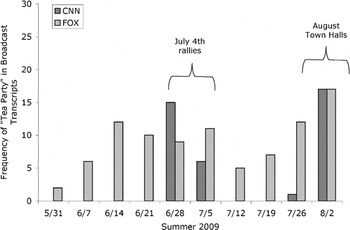
Fox is more than a source of information, however. This key outlet, echoed by other conservative outlets, helped to create and sustain the Tea Party mobilization in the first place. Consider figure 1, which juxtaposes trends in Tea Party coverage by Fox News and CNN over the first months of the Tea Party phenomenon.Footnote 33 CNN's coverage spikes at the major national event in April 2009, and drops to near zero before and after this event. In telling contrast, Fox News shows significant and growing coverage in the lead-up to the April rallies. And although coverage declines somewhat after the highly visible events of April 15, the Tea Party remains a significant presence on Fox News even in periods where actual political happenings are not occurring. In the phenomenon's infancy, the Tea Party idea is kept steadily available to Fox viewers.
Week-by-week coverage of the Tea Party on Fox News and CNN, February 15 through May 24, 2009

Week-by-week coverage of the Tea Party on Fox News and CNN, May 31 through August 2, 2009

Figure 2 documents a similar pattern in the weeks before the July 4 protests and before the Tea Party involvement in Congressional town halls during August 2009 (though both of these events received a far lower level of coverage than the April 15 rallies). CNN's coverage is largely reactive, but Fox coverage anticipates Tea Party events in the early months of the Tea Party's activity, and maintains coverage between peak events.
It may be, moreover, that CNN's level of coverage is itself an effect of Fox News coverage. Many scholars have identified ways in which conservative media influence the coverage provided by more mainstream outlets.Footnote 34 Thus the anticipatory coverage on Fox may also be driving up the large spikes in coverage received by the Tea Party on channels like CNN.
It is not only in the quantity of Fox News coverage that we can see the media organization's role as an organizer of this community, because the quality of coverage the Tea Party has received on Fox is fundamentally different from the coverage on other major networks. Fox News has explicitly mobilized its viewers by connecting the Tea Party to their own brand identity. In early 2009, Fox News dubbed the upcoming Tea Party events as “FNC [Fox News Channel] Tea Parties.”Footnote 35 Fox hosts Glenn Beck, Sean Hannity, Greta Van Susteren, and Neil Cavuto have broadcasted their shows from Tea Party events. The largest Tea Party event to date, the September 12, 2009 rally in Washington, was cosponsored by Glenn Beck's “912 Project.” At least 115 Tea Parties registered on the Tea Party Patriots website have a name including some variation of 9/12, such as the “Wyoming 912 Coalition” or “Daytona 912.” In summer 2010, FreedomWorks, the organization behind Tea Party Patriots, ran a membership drive featuring a picture of Glenn Beck and a “special offer for Glenn Beck listeners,” a partnership formalizing long-time ties between the pro-business lobby and the conservative media's grassroots mobilization efforts. Overall, it is hard to avoid the conclusion that Fox News provides much of what the loosely interconnected Tea Party organizations otherwise lack in terms of a unified membership and communications infrastructure.
A number of scholars have identified ways in which Fox News and other conservative media outlets have reshaped mainstream public debate and helped echo and strengthen conservative viewpoints.Footnote 36 We would go a step further. Rather than serving a journalistic, or even a propagandistic function, Fox News in effect acts as a “national social movement organization,” as described by sociologist Debra Minkoff in studies of liberal identity movements. For a scattered set of people who might feel isolated or marginalized (like gays and lesbians, in Minkoff's original example), a resourceful national organization can help to provide “an infrastructure for collective action” by promoting “the diffusion of collective identities” and fostering “at least a minimal degree of solidarity and integration.”Footnote 37 Fox News did these things for the Tea Party undertaking, promoting the label and providing a venue for the leading voices, articulating a sense of pride and power among conservatives discouraged after November 2008, and spreading information about how people could get involved in national occasions to display solidarity and collective voice. All of these are invaluable aids to collective action among dispersed, not previously interconnected people.
With the assistance of the conservative media's social coordination of willing local activists and participants, the anti-regulation big-business lobby could harness new grassroots networks to accompany their already powerful DC presence. By mid-2010, the Tea Party—though never more than a small minority of all Americans—could mount spectacular regional and national protests and attract the attention of mainstream media and the political class in Washington. It was also poised to intervene dramatically in many GOP primaries. To see how this political impact could be effected, we must look at the ground-level interactions between these national forces, and at the ideological underpinnings that inspire Tea Party activism.
The Greater Boston Tea Party
To examine Tea Party institutions and ideology in greater depth, the development of the Greater Boston Tea Party provides an illuminating case study that reveals the crucial roles of seasoned local activists, conservative media, and national funders in the rise of local activism. Our interviews and fieldwork with Massachusetts activists also shed light on the ideological motivations that stirred campaigners to action.
How Distinctive Are Massachusetts Activists?
Before delving into our analysis of Tea Party efforts in the Bay State, it is important to identify the ways in which the Greater Boston Tea Party (GBTP) resembles and differs from kindred groups elsewhere. Given the unusually liberal environment in which the eastern Massachusetts Tea Partiers are operating, we expected to find significant differences between the GBTP and other Tea Party people across the nation.
To help place the Greater Boston Tea Party in context, we sent out an email survey to the group's email list. In response to the broadcast e-mail, 89 people responded to the questions listed in Appendix B at the end of this article. In the summary statistics below, we include only the 79 respondents who had participated in at least one Tea Party event. We also conducted follow-up phone interviews with 12 of the 89 respondents. Though the volunteered responses are not necessarily representative even for the Tea Party in Massachusetts, they jibed with our firsthand experience at Tea Party meetings and are largely consistent with those found for Tea Party supporters in national surveys.
Like their fellow Tea Partiers across the United States, those in Massachusetts are older, white, and predominately male: 97 percent are white; 57 percent are males; and 83 percent are over forty-six years old (with more than half older than age fifty-six). In addition, Bay State Tea Party activists envelop themselves with the same conservative news sources used by other Tea Party participants. When we asked Massachusetts Tea Party activists an open-ended question about their preferred news sources, 51 out of 69 respondents to this question reported being Fox News watchers. As has also been found in national studies, few Massachusetts Tea Partiers are seeking out neutral or left-leaning sources of information. Only 11 respondents claim to read the Boston Globe, and only 7 Massachusetts Tea Party activists report getting their news from ABC, NBC or CBS News. Like Tea Partiers nationally, many in Massachusetts are campaign veterans. In our Boston sample, 37 out of 79 respondents claimed to have previously volunteered on behalf of a candidate or political organization.
Attitudinally, Massachusetts Tea Partiers are also similar to their fellow Tea Party activists in other states. In Massachusetts, as in the nation as a whole, the primary concern is the size of the government, and particularly the amount of government spending.Footnote 38 Nearly nine in ten Greater Boston Tea Partiers rated “Deficits and Spending” a very important issue for the group to address. Our results also confirm a widely-reported difference between Tea Partiers and previous generations of conservative activists: most Tea Party members do not see social issues like abortion or gay marriage as central to their current political activism. In our local survey, when we asked respondents to rate the importance of a range of issues, abortion ranked at the bottom.Footnote 39 Nationally, 78% of Tea Partiers think economic issues should take precedence over social issues.Footnote 40 Though they are currently focused on economic concerns, the Tea Partiers we met were quick to define themselves as “socially conservative,” a trait they share with Tea Partiers in other states.Footnote 41
In sum, Tea Party participants in Boston are more similar to the national Tea Party than we originally expected—a fact that reinforces our argument about the role of national media in fostering shared identity and attitudes. As we discuss the Greater Boston case in more detail, however, we will identify ways in which Massachusetts activists might be distinctive in their emphases and rhetoric.
The Greater Boston Tea Party in Action
The formation of Tea Party efforts in Massachusetts, most of which are concentrated in the eastern half of the state, provides a window into how various forces —local activists, the conservative media, and national organizations funded by business elites—interacted to create local and regional political mobilization. It was the involvement of national media and organizations that brought a small group of Massachusetts conservatives together, raised their work to national prominence, and helped convert their mobilization into electoral success. The local grassroots network of Tea Partiers relies heavily on a small group of committed conservative activists, though some members are wary of Republican institutions and candidates.
In Massachusetts, 39-year-old Christen Varley, the president of the Greater Boston Tea Party, was the critical founding Tea Partier. Varley currently works for a social-conservative organization, Coalition for Marriage and Family, has blogged under the name “GOPMom,” and is the chair of her town's Republican Party committee. Working with a small group of fellow conservatives starting early in 2009, Varley writes e-mail alerts, convenes protests, and speaks on behalf of the group to local media. Although a handful of other members take some roles in event planning, Christen Varley remains by far the most visible source of organizing power. In interviews, many Boston Tea Party members considered Varley to be their primary or sole tie to the organization. At the meetings we observed, most attendees reported that they did not know any other attendees well—or indeed at all. One interviewee, Janet, says the Tea Party includes “lots of friendly people,” but no one she would describe as a close friend. Another described fellow Tea Partiers as “acquaintances with the same goals.” Although the group has been meeting regularly for over a year, the GBTP does not seem, so far, to be building social capital as understood by Robert Putnam.Footnote 42 The tenacity and commitment of the experienced central organizer and her chief lieutenants remain crucial to the group's continued activity.
In addition to the hard work of the lead organizers, the Greater Boston Tea Party is united by reliance on shared sources of political information. At Tea Party meetings, Fox News stories are a common currency; activists share stories reported on the network and quote the opinions of Fox News commentators. Fox News personality Glenn Beck is an especially frequent source of political opinion and historical perspective. According to interviewee Krislyn, “We're history buffs … and [thanks to Beck] our knowledge has gone through the roof. A lot of people dismiss him as a kook, but I think he challenges you to question the status quo.” In addition to Fox News programs, most other sources of political information cited by Tea Party activists are conservative. After Fox News, conservative radio programs (such as Rush Limbaugh and Laura Ingraham), and conservative websites (such as The Drudge Report and Red State) topped the list of Tea Party news sources. Several Boston-area Tea Party participants said that it was through watching Glenn Beck's show that they found out about the Tea Party in the first place.
Despite the efforts of local activists, nascent Tea Party mobilization in Massachusetts began to wane in the fall of 2009, as national media attention declined after the widespread attention to the August town halls and the September 12 rally in Washington, DC. The Greater Boston Tea Party had made some efforts to organize itself more formally, creating a Board of Directors and holding organizational meetings. According to one early activist, Elizabeth, these early organizing meetings were well attended; “There were a hundred of us, and then we split into groups, and we decided who would set up the computer thing, who would handle recruiting, who would be organizing protests.” But that early initiative did not yield immediate results, according to Elizabeth: “After that we haven't had any formal meetings. It sort of dissolved.” Judging from the group's online calendar of events, meetings in late fall 2009 were relatively few and far between.
At the moment when the GBTP's momentum seemed to have stalled, the group benefited from the fortuitous timing of the Massachusetts special US Senate election, which brought national organizing power to the local Tea Party. State Senator Scott Brown drew the support of the national Tea Party Express, which spent almost $350,000 in support of his campaign, and simultaneously aroused local activists. The local Tea Party hosted a question-and-answer session at a local hotel conference room with then-candidate Brown in early January 2010. Successful mobilization in a relatively low-turnout election gave Scott Brown the victory and the local Tea Party a shot in the arm. “Thank God he won,” Varley says of Brown, “or I'm not sure we'd still be operational.” Today, the Greater Boston Tea Party is a relatively large Tea Party group. As measured by MeetUp membership, only 32 Tea Parties nationwide have a larger online community.
Since the jumpstart provided by the special election, the Boston group has benefited from links to multiple national organizations, and these loose ties have been very effective. Boston activists have worked with the Tea Party Express, which brought its road show to the Boston Common for their 2010 Tax Day protest. The appearance of Sarah Palin helped bring dozens of news media outlets to the event, despite the relatively small crowd of perhaps 5,000 people.Footnote 43 The Greater Boston Tea Party also has ties to other organizations funded by anti-regulation business elites. At several Boston meetings, Tea Party regulars encouraged newer members to participate in trainings held by the Koch-funded organization, American Majority, and discussed bringing experts from the Heritage Foundation or the Cato Institute to speak to their group.Footnote 44 The Greater Boston Tea Party is also registered on the Tea Party Patriots website, although Varley says she does not regularly participate in TPP conference calls.
The Greater Boston Tea Party's ties to the network of conservative advocacy groups do not imply that all Massachusetts Tea Partiers have warm feelings towards the official Republican Party or leading Republican candidates, however. For instance, at an event in Reading, Massachusetts, the mention of Sarah Palin brought grimaces to the face of a number of Tea Party activists—even as other activists at a Brockton gathering expressed hope that by volunteering at the Tax Day rally, they might get to meet Palin in person. Clearly aware of her audiences' diverse views about the 2008 GOP Vice Presidential candidate, Varley regularly prefaced comments about the upcoming Tea Party Express rally with the phrase, “Sarah Palin, love her or hate her.”
In the Boston example, we see that local organizers play a crucial role in building and sustaining Tea Party activism between national events. But they still owe a considerable amount of their success to the involvement of national conservative media and advocacy organizations.
A Closer Look at Tea Party Ideology
To learn more about what motivates local Tea Partiers to action, we supplement our structural and institutional findings with an analysis of the ideological underpinnings of the Tea Party phenomenon, using the results of our fieldwork and long-form interviews. Specifically, we can learn what hostility toward “big government” consists of—and what it does not include. There can be little doubt that Tea Partiers in general, including those in Massachusetts, resent taxes and government regulation of business. But when it comes to federal social programs and spending, the nuances of Tea Party views are more complex than meets the eye in top-line national survey results. Our findings help us situate the Tea Party in the history of American conservatism.
Work and Deservingness
Commentators have sometimes noted the irony that these same Tea Partiers who oppose “government spending” are themselves recipients of Social Security, Medicare, or disability payments. Don't they know these are “big government” programs? Rather than assume ignorance, we should recognize that what appear to be contradictory or uninformed views of federal government programs make better sense once we understand how Tea Party activists view themselves in relation to other groups in society. Tea Party activists in Massachusetts, as well as nationally, define themselves as workers, in opposition to categories of non-workers they perceive as undeserving of government assistance. Concerns about freeloading underlie Tea Party opposition to government spending.
The “revolutionary” rhetoric of the Tea Party has led some commentators to pigeonhole it as reflexively anti-government, but the concerns of grassroots Tea Partiers about representation should not be confused with blanket opposition to all federal social programs. Tea Party activists hold positive views about the government entitlement programs from which they personally benefit—including Social Security and Medicare, and also other entitlement programs they have used. For example, Massachusetts respondent Charles, a retired police officer, mentioned that he had been “brought up on welfare, and had to work [his] way out.” Others referred to having relied on unemployment insurance after losing their jobs, or expecting to rely on Social Security in the future. These results are in accordance with the CBS News/New York Times poll of Tea Party activists, which found that about half of Tea Partiers say someone in their household receives Medicare or Social Security benefits, and that most Tea Party supporters believe these programs are “worth the costs … for taxpayers.”Footnote 45 As Massachusetts respondent Nancy puts it: “I've been working since I was 16 years old, and I do feel like I should some day reap the benefit. I'm not looking for a handout, I'm looking for a pay out for what I've paid into.”
The affection of grassroots Tea Partiers for major programs like Social Security is at odds with the policies pushed by many of the elite national organizations that fund their protests. For example, FreedomWorks (a major funder of Tea Party Patriots) was active in President Bush's campaign to privatize Social Security, and FreedomWorks Chairman Dick Armey has referred to Social Security as “generational theft.”Footnote 46 At a grassroots level, however, Tea Partiers judge entitlement programs not in terms of abstract free-market orthodoxy, but according to the perceived deservingness of recipients.
The distinction between “workers” and “people who don't work” is fundamental to Tea Party ideology on the ground. First and foremost, Tea Party activists identify themselves as productive citizens. We began our Massachusetts interviews with an open-ended question about what brought interviewees to the Tea Party. A striking percentage of Tea Party activists responded by talking about themselves as workers. Emmy says, “I'm almost 66 years old and I'm still working.” Krislyn calls herself and her husband “blue-collar working-class people” who have “had to work very hard.” This self-definition is posed in opposition to nonworkers seen as profiting from government support for whom Tea Party adherents see themselves as footing the bill. As Charles put it, “people no longer have to work for what they earn.” Robert says, “We shouldn't be paying for other people that don't work.” A typical sign at the April 14 rally on the Boston Common read, “Redistribute My Work Ethic,” and similar signs have appeared at rallies across the country. Tea Party anger is stoked by perceived redistributions—and the threat of future redistributions—from the deserving to the undeserving. Government programs are not intrinsically objectionable in the minds of Tea Party activists, and certainly not when they go to help them. Rather, government spending is seen as corrupted by creating benefits for people who do not contribute, who take handouts at the expense of hard-working Americans.
Though the opposition between working and nonworking people is fundamental to Tea Party ideology, the empirical dividing line between these categories is not immediately clear. For instance, the distinction between workers and nonworkers is not necessarily linked to actually holding a job. In Massachusetts, a third of Tea Party members we surveyed were students, unemployed people, or retirees. (The New York Times found a similar result: 32 percent of Tea Party supporters surveyed were retirees.)Footnote 47 Thus, the definition of “working” is an implicit cultural category rather than a straightforward definition.
Even more nebulous are the contours of the “nonworking” or “freeloading” population. Asked by the interviewers about who is receiving government aid unfairly, Tea Partiers tend to respond with anecdotes—including stories about their own black-sheep relatives. Nancy, for instance, tells the story of a nephew who had “been on welfare his whole life.” Indeed, in the stories Tea Party members tell, there are only two groups of people unambiguously included in the “nonworking” population: young people and unauthorized immigrants. In interviews, many Tea Party activists describe the young as less responsible than earlier generations. Charles says, “My grandson, he's fourteen and he asked me: ‘Why should I work, why can't I just get free money?’” An April 2009 blog on the Greater Boston Tea Party website entitled “Oh SNAP! Foodstamps for College Kids?” begins “Call me crazy, but when I needed money for college, I got a job.” After telling the story of her nephew, Nancy concludes, “I think that a lot of [young] people … they just feel like they are entitled.”
Unauthorized immigrants are also explicitly included in the “nonworking” population who may try to freeload at the expense of hardworking American taxpayers. In general, Tea Partiers do not explain their opposition to unauthorized immigration in terms of a job threat. Of all those we spoke to, only one Tea Party member, Janet, expressed concern that “these people are going to be coming in and take our jobs.” Most Tea Party activists couch their opposition to unauthorized immigration in terms of immigrants receiving undue government support, a concern that bleeds into a broader concern about representation. One commonly expressed fear among Tea Partiers, not only in Massachusetts but on Tea Party blogs from Arizona to Michigan, is that President Obama intends to grant amnesty to all illegal immigrants in order to develop a new bloc of potential voters. The support of these new voters, Tea Partiers argue, would allow the Obama administration to continue to ignore the interests of current American citizens.
We find this concern about immigration to be central to Tea Party ideology. When we polled Massachusetts Tea Partiers about the issues they thought were most important for the Tea Party to address, 62 out of 79, or 78 percent of respondents, thought that “Immigration and Border Security” was “very important.” In fact, immigration and border security came in a close second to the Boston Tea Partiers' top-ranked concern about “Deficits and Spending” (rated very important by 69 of the 79 respondents). Moreover, discussions of immigration seemed to provoke an especially emotional response. One Boston member spoke of wanting to “stand on the border with a gun,” while another complained about the “free-for-all south of the border.” The prominence of immigration as a Tea Party issue in Massachusetts is especially noteworthy given that this state has relatively low levels of unauthorized immigration, and the Greater Boston Tea Partiers were surveyed well before the controversy over Arizona's new immigration law reached a fever pitch in the national headlines. But the Tea Party concern with immigration and possible immigrant misuse of resources is not unique to Massachusetts. Nationally, 80 percent of Tea Party activists see illegal immigration as a very serious problem, compared to 60 percent of Americans overall.Footnote 48
Underlying many specific Tea Party worries is distrust of politicians, the sense that the political class is not responsive or accountable to “average Americans.” Of the politicians in Washington, Beverly says, “They just didn't seem to care about the regular working person any more.” Others make little distinction between the nonworking class and the current administration. Charles, the retired police officer, worries that “the people I was looking for back when I was a cop are now running the government.” In sum, Tea Party activists remain deeply concerned about this nonworking and perhaps criminal class of people, typified by young people and unauthorized immigrants, who have unduly profited from government programs wrested control of the government from hardworking average Americans. It is this belief, rather than any absolutist commitment to free-market principles, that underlies Tea Party opposition to government programs.
Racial, Ethnic, and Generational Resentment
Many Americans link a person's deservingness to the effort the person puts forth; hard work is, after all, a cornerstone of the American Dream.Footnote 49 But the Tea Party dichotomy of the “freeloader” versus the “hardworking taxpayer” has racial undertones that distinguish it from a simple reiteration of the longstanding American creed. Racial resentment stokes Tea Party fears about generational societal change, and fuels the Tea Party's strong opposition to President Obama.
In this respect, it is telling that immigration worries Tea Party activists almost as much as the avowed flagship issue, deficits and spending. As Brader et al. have shown, fears of immigration are closely linked to the ethnic identity of the immigrants in question.Footnote 50 In interviews, Tea Partiers who talk about immigration control regularly mention the security of the US border with Mexico, suggesting that their primary concern is with Latino immigration. What is more, the younger people that many older Tea Partiers associate with undeservingness are a part of the US population steadily becoming more racially and ethnically diverse.
Are Tea Partiers, therefore, simply racists? Only one national survey has attempted a careful measurement of racial resentment among Tea Partiers compared to politically similar Americans. Christopher Parker and his associates find that “support for the Tea Party remains a valid predictor of racial resentment,” even after accounting for ideology and partisanship.Footnote 51 That is to say, though many opponents of the social safety net tend to hold negative views of racial minorities, Tea Partiers espouse views more extreme than those offered by other conservative Republicans. For instance, Tea Partiers are more likely than other conservatives to agree with statements such as “If blacks would only try harder they could be just as well off as whites,” and are more likely to disagree with statements like “Generations of slavery and discrimination have created conditions that make it difficult for blacks to work their way out of the lower class.”
It is important, however, to note that we found strong opposition to explicit racism in the Greater Boston Tea Party. When avowedly racist messages suddenly appeared on the Boston Tea Party MeetUp site, Massachusetts Tea Party members let the newcomer know he was not welcome. Andrea posted: “This country is made up of people from all countries, that's what made us what we are…. I wouldn't want it any other way.” When it came to public events, moreover, Greater Boston Tea Party members expressed concern that outsiders might bring inappropriate or racist signs to protests, and wanted to ensure there was a plan to remove those people. No such signs were present at any Boston Tea Party event attended by the researchers. In short, explicitly racist appeals violate norms of equality held by Massachusetts Tea Partiers.Footnote 52
The vigilance of Massachusetts Tea Partiers against explicit racism may not be typical of Tea Partiers in all regions, however. At least some Tea Party activists outside Massachusetts have complained on their private web pages about “censorship” of their MeetUp page by MeetUp staff, who have disqualified Tea Party activists for inappropriate postings. Explicitly racist signs have appeared at Tea Party rallies nationally.Footnote 53
Rather than conscious, deliberate, and publicly expressed racism, these racial resentments form part of a nebulous fear about generational societal change—fears that are crystallized in Tea Party opposition to President Obama. As we've seen, many Tea Partiers are deeply concerned that the country they live in is not the country of their youth—and that they themselves are no longer represented by the US government. It is no coincidence that the Tea Party emerged only weeks into the new president's term; in Greenberg Quinlan Rosner's study, only five percent of Tea Party supporters report having voted for Obama in 2008.Footnote 54 The nation's first black president, a man with a foreign father, Obama is so widely perceived as “other” that 42 percent of Americans and 59 percent of Tea Partiers doubt his nationality.Footnote 55 Moreover, Obama ran on an explicit platform of change, in a campaign that appealed to the young and reached out to racial and ethnic minorities. For Tea Partiers, as for many Americans, the election of Barack Obama symbolized the culmination of generations of societal change. For his supporters, this is a matter of hope and pride; for many Tea Partiers, the change Obama represents provokes deep anxiety.
At public gatherings, Tea Party rhetoric seems to take a page from Hofstadter's “paranoid style of American politics,” decrying the president as a threat to American democracy, in ways that seem far out of proportion to any actual political or policy happenings.Footnote 56 Some Boston-area Tea Partiers describe Obama as a “socialist” or “Marxist,” while another declares simply that Obama “just does not like America.” Away from public protests, however, Tea Partiers can find themselves at a loss for words. After struggling to convey his views of the President, one man we spoke to paused and said with simple honesty, “I just can't relate to him.” At a fundamental level, Obama's policies and his person are not within the Tea Party conception of America, so his election seems like a threat to what they understand as their country.
The Tea Party and US Conservatism
The ideology of grassroots Tea Party adherents fits with long-standing, well-documented connections between opposition to federal entitlement programs and espousal of racial stereotypes. This helps us situate this variant of populist mobilization in the broader history of post-1960s US conservatism. Various social scientists, including Martin Gilens, Alberto Alesina, and Erzo Luttmer, have linked opposition to government spending to the perception that such spending benefits racial and ethnic minorities.Footnote 57 Even more broadly, since the Civil Rights era of the 1960s, the Republican Party and popular conservative mobilization have expressed opposition to strong federal government interventions in social and economic life, often viewing such interventions as intended to force racial integration and provide special help to people of color.
Not surprisingly, therefore, many Tea Partiers express a connection to previous generations of conservative opposition to the US federal government. At a casual evening event in Boston, one of the few college-aged Tea Partiers was wearing a T-shirt bearing a picture of Goldwater over the “AuH2O” slogan from his 1964 campaign; at another event, a man told one of the researchers that he had not felt this politically engaged since Goldwater. This feeling of deep connection to Goldwater conservatism is not unique to Massachusetts; Kentucky Tea Party candidate Rand Paul has reiterated Goldwater's criticisms of the Civil Rights Act.Footnote 58
Another way to situate the Tea Party variant of longstanding conservative resentments is to recognize the age-based gaps in US social provision. Social Security and Medicare are universal entitlements available to the elderly, but for working-aged Americans and their children, federal supports have spotty or non-existent since the 1960s.Footnote 59 The Obama administration's drive to enact comprehensive health reform began at the very time when millions of older Americans had seen the value of their homes and pensions plummet amidst the Great Recession of 2008–09.Footnote 60 Health care reform was portrayed by GOP leaders as a threat to Medicare and an expensive new entitlement that would force hardworking and hard-pressed citizens and businesses to pay higher taxes to provide health insurance to younger, less well-to-do, and often “undeserving” people—including illegal immigrants, it was claimed. The false specter of “death panels” was also invoked to scare older Americans. Given what we have learned about the social characteristics and preexisting attitudes of Tea Party adherents, it is not surprising that they angrily opposed health reform—and that they remain determined to force the GOP to repeal the Affordable Care Act of 2010.
The Future of the Tea Party
During President Obama's first years in office, the Tea Party rubric has enabled conservatives to rebrand their ideology and mobilize their grassroots in new ways. In essence, the Tea Party allowed for the rebranding of conservative Republicanism and gave activists an unsullied standard to mobilize behind. The vaguely “revolutionary” tone struck a chord with many Americans in a time of economic turmoil, while the language of the Constitution still seemed familiar and comforting. Although the Tea Party remains more a talisman of intense opposition to the Obama administration than a coherent political movement, this shared symbolism has allowed free-market advocates and conservative media to mobilize grassroots conservatives and help block a progressive policy agenda.
Following upon the Democratic wave elections of 2006 and 2008, the midterm election of 2010 was unusually favorable terrain for the Tea Party, and Tea Party activists and funders had an undeniable impact on the election results. Fewer than half of eligible US adults vote in midterms, and turnout is skewed toward older, richer, whiter people—exactly those potentially most attracted to Tea Party activism and rhetoric. The Tea Party has also benefited electorally from the terrible economic conditions, which disproportionately impact and demoralize Democratic-leaning constituencies. Economic sluggishness and high levels of unemployment might persist and thus keep the pot boiling, going forward. But Tea Party mobilization may have contributed to the GOP gains in the House, above and beyond those that might have been expected based on economic conditions and normal cyclical trends. Exit polls suggest that elderly 2010 midterm voters skewed especially Republican this year.Footnote 61
Tea Party favorability, 2010

The Tea Party's impact was clearer within the Republican Party. Tea Party mobilizations enabled insurgent primary candidates to overtake and defeat a number of officially endorsed GOP candidates, including incumbents. Many mainstream Republicans, including Bob Bennett in Utah, Charlie Crist in Florida, Lisa Murkowski in Alaska, Sue Lowdon in Nevada, and Mike Castle in Delaware, lost their primaries to Tea Party candidates. Some Tea Party insurgent candidates went on to prevail in the general 2010 election, but this holds true primarily in strongly Republican states. In more competitive environments like Nevada, Colorado and Delaware, Democrats benefitted from the Tea Party candidates' extreme ideology or less experienced campaigns. Given that the GOP fell three Senate seats short of a tie—a tie that might have allowed them to woo Independent Senator Joe Lieberman of Connecticut to join their caucus—we can surmise that Tea Party activism both helped and hurt the GOP in 2010. Activism turned out more voters, no doubt, but the unguided nature of Tea Party voting and fundraising may have prevented the GOP from sweeping both chambers of Congress.
More broadly, what worked to mobilize conservatives in 2009 and 2010 might soon reach its limits and create dilemmas for the Republican Party. Poll trends suggest that the Tea Party may have little room left for growth. Despite all the media attention, one-third of Americans were still unfamiliar with the Tea Party in late 2010, and to the extent that people are familiar with the phenomenon, the Tea Party's popularity has stagnated or declined.Footnote 62 If the Tea Party is nearing its capacity to appeal to more voters, the 2010 midterm elections may prove an electoral high-water mark. Under any circumstances, the 2012 electorate will have more Democrats and non-Tea Party independents and moderate conservatives.
Given its considerable popularity among avowed conservative Republicans, combined with limited appeal to the broader American public, the Tea Party is a risky partner for GOP office holders as well as would-be presidential challengers to Obama in 2012. Grassroots Tea Party activism in the 2010 primaries, magnified by infusions of conservative cash, helped to defeat Republican officeholders and candidates who were even slightly centrist or inclined to work with Democrats. Republicans in the 112th Congress will know that any compromises with Obama or the Democrats might hurt their chances in future GOP primaries. In addition, many Tea Party-endorsed candidates who won seats in 2010 owe little allegiance to the institutional GOP and may not be amenable to party management going forward. Furthermore, as GOP presidential aspirants vie to attract or propitiate Tea Party activists and funders in the 2012 primaries, they will certainly continue to push national debates toward the right. Extreme rhetoric and refusal to compromise will likely be the order of the day for the GOP in 2011 and 2012. But will all the catering to a distinct minority help GOP leaders appeal to the general public during policy debates, or situate Republican presidential contenders to outmaneuver Obama in the general election of 2012?
As Tea Party Republicans take some role in governance, their compromises may dishearten their grassroots base. For example, Massachusetts Senator Scott Brown incurred the anger of many of his Tea Party supporters only six months after his election. In July 2010, the Greater Boston Tea Party, “greatly disappointed” by Massachusetts Senator Scott Brown's decision to vote in favor of financial reform, held a protest to remind the Senator that “there are consequences when the Constitution is disregarded.”Footnote 63 But the comparatively moderate Senator Brown is not the typical Tea Party candidate—and Brown is unlikely to suffer in Massachusetts elections simply by putting some distance between himself and the Greater Boston Tea Party. In dozens of other states—and in the GOP-led House during 2011 and 2012—the dynamics could be quite different.
Another possibility suggested by our research is that policy differences between elite Tea Party funders and grassroots activists may come to the fore. This could happen, for example, if Congressional Republicans or GOP presidential contenders move toward calling for the radical restructuring Social Security or Medicare. When cuts in “government spending” become specific, or if GOP officeholders cooperate with Obama and Democrats on fiscal restructurings, Tea Party activists at the grassroots level may find little to like about the candidates they helped elect.
The most likely near-term dynamic, however, is that the presence of newly-elected Tea Party representatives will only reinforce the 2009–10 Republican strategy of total opposition to the Obama agenda. The loose construction of Tea Party activism is more likely to produce political theater among competing agitators than to foster reasoned compromise within the GOP or between Republicans and Democrats in Washington. The multiple and lengthy investigations of the executive branch that followed the Republican resurgence in 1994 may provide a playbook for the greatly expanded, Tea Party-infused Republican caucus in the House during the 112th Congress. Hearings are often a tactic that Congressional representatives use to keep base supporters attentive and angry—especially when they cannot or will not actually change policies.
How such alternative possibilities play out remains to be seen. But the findings in this article suggest that we should regard the Tea Party as a new variant of conservative mobilization and intra-Republican party factionalism, a dynamic, loosely-knit, and not easily controlled formation of activists, funders, and media personalities that draws upon and refocuses longstanding social attitudes about federal social programs, spending, and taxation. The post-2008 economic context is newly dire, and generational and racial-ethnic tensions are manifested in fresh ways in an era of high immigration and shrinking economic opportunities for the young. But racially resonant conflicts over the shape and scope of US domestic government are nothing new.
Fashioned at a moment of challenge for conservatives in and around the GOP, when the “Republican” label was tarnished, the Tea Party has helped to sharpen and refocus conservative activism in our time. The Tea Party managed to blunt the 2006 and 2008 Democratic wave and reinforce the backbone of GOP obstruction—long enough to position Republicans to make big gains in 2010. Having done its rebranding work, Tea Party symbolism may fall out of fashion; or it may remain dynamic for a few more years. But the reverberations of the sudden and intense Tea Party mobilization at a pivotal moment in US politics will surely resound through public debates and raucous, deadlocked politics for years to come. The era of Obama will always be linked with the eruption of Tea Party reaction.
Appendix A: Timeline
2009
- January 20
Inauguration of President Obama.
- January 28
Rush Limbaugh coined the term “Porkulus” to describe the upcoming stimulus package. By February 8, the word appears on the New York Times' “Idea of the Day” blog.
- February 16
In Seattle, an anti-Stimulus protest drew dozens of supporters after being promoted by commentator Michelle Malkin and Americans for Prosperity. Follow-up protests of several hundred people are held in Denver, CO, where Obama signed the stimulus bill, and Mesa, AZ, where Obama unveiled his mortgage plan.
- February 19
CNBC commentator Rick Santelli launched into an on-air diatribe against the president's plan to address the housing crisis:
The government is promoting bad behavior…. This is America. How many of you people want to pay for your neighbor's mortgage, that has an extra bathroom, and can't pay their bills? Raise their hand! President Obama, are you listening? … we're thinking of having a Chicago Tea Party in July. All you capitalists that want to show up to Lake Michigan, I'm going to start organizing.
Reporting from the floor of Chicago Mercantile Exchange, Santelli was met with cheers and applause from the stockbrokers surrounding him. By the next day, the story was widespread enough that White House press secretary Robert Gibbs responded to it at the daily briefing.Footnote 64
- February 27
The first “Tea Party” protests were held in dozens of towns and cities. Most protests drew a few hundred people, or in some cases, only a few dozen.
- April 15
Hundreds of protests are held nationwide, with protestors often numbering in the hundreds or low thousands. Poll analyst Nate Silver estimates the total number of Tea Party participants at more than 300,000 people.Footnote 65
- April 21
Tea Party Nation officially registered in Tennessee as a for-profit organization.
- June 1
Tea Party Patriots officially registered in Georgia as a nonprofit organization.
- August
Coordinated by Americans for Prosperity and FreedomWorks, protestors disrupt Congressional town hall meetings, including those held by Senator Claire McCaskill, Representative Patrick Murphy, Representative John Dingell, and Senator Arlen Specter.
The Tea Party Express, a bus tour run by the conservative PAC Our Country Deserves Better, visits dozens of cities and is greeted by crowds varying in size between about one hundred people and a few thousand.
- September 12
The Taxpayers' March on Washington brings tens of thousands of protestors to the Washington Mall. The march is organized by FreedomWorks, Tea Party Patriots, and the 9/12 Project, among others.
- November 3
In New York's 23rd Congressional District, Democrat Bill Owens barely beats out Doug Hoffman, Conservative Party candidate with the support of Club for Growth and other far-right PACs. Losing in the polls, moderate Republican candidate Dede Scozzafava had suspended her campaign in the days before the election and threw her support to the Democrat.
2010
- January 19
With funding from Our Country Deserves Better PAC and the support of many Boston-area Tea Party activists, Scott Brown beat Martha Coakley to take the seat of the late Edward Kennedy and become the junior senator from Massachusetts.
- February 4–6
Tea Party Nation, a for-profit organization, holds the National Tea Party Convention.
- March 20
Thousands of protestors arrive in Washington to oppose the final passage of health care reform. Democratic lawmakers at the Capitol report being heckled with racial and homophobic slurs.
- March 27
The Tea Party Express begins a new bus tour in Searchlight, NV, the hometown of Senate Majority Leader Harry Reid, and culminating in Washington, DC on April 15.
- April 15
Hundreds of Tax Day protests are again held in cities across the country, including a protest of 5,000 to 10,000 people in Washington, DC.
- April 28
Florida's Republican Governor Charlie Crist, running behind Tea Party favorite Marco Rubio for Republican nomination for Senate, announces he will run instead as an Independent.
- May 10
Led by Tea Party activists, the Maine Republican Party replaces a moderate platform with one that describes global warming as a myth, raises concerns about the threat of “one world government,” and calls for the abolition of the Department of Education and the Federal Reserve.
- May 18
Rand Paul, son of Representative Ron Paul of Texas, wins the Republican nomination to succeed the retiring Senator Jim Bunning in Kentucky. His opposition to the Civil Rights Act draws national attention.
- June 8
Far-right candidate Sharron Angle beats out GOP frontrunner Sue Lowden for the Republican nomination for Senate. She has called for the privatization of Social Security and the complete repeal of the new health care legislation.
- August 28
On the 47th anniversary of Dr. Martin Luther King's “I Have a Dream” speech, former Governor Sarah Palin and Fox News anchor Glenn Beck hold a rally on the steps of the Lincoln Memorial.
- August 31
Alaska Senator Lisa Murkowski is defeated in the Republican primary by Tea Party-backed Joe Miller.
- September 12
FreedomWorks, Tea Party Patriots, and other Tea Party groups hold another “Taxpayer March on Washington.”
- November 2
Tea Party-linked candidates win 39 of 129 races for the United States House of Representatives. Five of nine Tea Party-linked candidates win election to the Senate.
Appendix B: Survey Questions
1. How many Tea Party events have you ever attended?
(0, 1, 2, 3, 4, 5–10, More than 10.)
2. What brought you to your first Tea Party event?
(Check ALL that apply: I had seen the Tea Parties on television; I looked the Tea Parties up on the Internet; A friend told me about the Tea Parties; A friend brought me to a Tea Party event; Other.)
3. How many people have you met at any Tea Party event that you now consider personal friends?
(0, 1, 2, 3, 4, 5–10, More than 10.)
4. Have you ever personally recommended to someone else that they should attend a Tea Party?
(Yes, No.)
5. Other than Tea Party events, how many times in the past 12 months have you attended any public meeting in which there was a discussion of town or school affairs?
(0, 1, 2, 3, 4, 5–10, More than 10.)
6. Before joining the Tea Party, in which political activities did you take part?
(Check ALL that apply: I did not participate in political activities; Voting; Volunteering for a political cause or issue; Volunteering for a candidate or political organization; Running for local, state, or national office.)
7. How often do you attend religious services?
(Several times a week; Every week; Nearly every week; 2–3 times a month; About once a month; Several times a year; About once or twice a year; Less than once a year; Never.)
8. Which print, radio, television and Internet sources do you use to find out about news or current events?
(Open response.)
9. When President Obama took office, he said he was determined to address the roots of the financial crisis so that another meltdown would not happen. Do you believe the government ahs taken enough action to fix what was wrong in the financial industry, has taken too little action, or do you think the government has gone too far and taken action that will be harmful down the road?
(Taken enough action; Taken too little action; Gone too far and taken action that will be harmful down the road; Not sure/no opinion.)
10. What about the Wall Street bankers themselves? Do you think banks have taken enough action to change what they do to avoid a future meltdown, have taken too little action, or do you think they've gone too far and made changes that will be harmful down the road?
(Taken enough action; Taken too little action; Gone too far and taken action that will be harmful down the road; Not sure/no opinion.)
11. Do you think it will be best for the future of this country if we take an active part in world affairs, or if we stay out of world affairs?
(Take an active part in world affairs; Stay out of world affairs; Don't know/no opinion.)
12. Regarding abortion, which one of these opinions best corresponds to your view?
(By law, abortion should never be permitted; The law should permit abortion only in cases of rape, incest, or when the woman's life is in danger; The law should permit abortion only in cases of rape, incest, or when the woman's life is in danger, but only after the need for the abortion has been clearly established; By law, a woman should always be able to obtain an abortion as a matter of personal choice; Don't know/No opinion.)
13. There are many issues that people care about as individuals. Here, though, we would like to know which issues you feel are important for the Tea Party as an organization to address in the next six months.
(Abortion; Border Security/Immigration; Deficits and Spending; Energy Policy/Cap and Trade; Fighting Terrorism; Gun Owners' Rights; Health Care Reform; Reducing Unemployment; Regulating Wall Street)
14. In the big picture, where do you hope the Tea Party will be in 5 years?
(Open response)
15. Gender
(Male, Female)
16. Age
(Under 18; 18–25; 26–35; 36–45; 46–55; 56–65; 65+)
17. Race
(White non-Hispanic; American Indian; Asian or Pacific Islander; Hispanic/Latino; Black non-Hispanic)
18. Employment Status
(Employed full-time; Employed part-time; Self-employed; Retired; Homemaker; Student; Temporarily Unemployed; Other)
19. Marital status
(Single, Married; Living with partner; Divorce or Separated; Widowed)
20. Education
(High school or less; Some college; 4-year college graduate; Some post-graduate)
21. Party affiliation.
(Democrat, Republican, Independent)