INTRODUCTION
Estuarine benthic invertebrates dwell in environments in which the water column undergoes constant changes due to both regular (e.g. tidal and seasonal) and unpredictable stochastic events (e.g. rain and wind). Thus, the different properties of the water column (e.g. temperature, seston and salinity) experienced strong shifts. Salinity is one of the most obvious environmental factors in estuarine systems. In fact, salinity is so important in estuaries that it has come to be considered an ‘ecological master factor’ (Kinne, Reference Kinne1966), playing a fundamental role in population dynamics and distribution (Kinne, Reference Kinne1971; Davenport et al., Reference Davenport, Gruffydd and Beaumont1975; Bayne et al., Reference Bayne, Bayne, Carefoot and Thompson1976; Guerin & Stickle, Reference Guerin and Stickle1997a,Reference Guerin and Stickleb) and modulating reproductive (Cunha et al., Reference Cunha, Sorve and Moreira1999) and behavioural (Spicer & Strömberg, Reference Spicer and Strömberg2003) as well as many physio-energetic processes (Navarro & Gonzalez, Reference Navarro and Gonzalez1998; Shuhong, Reference Shuhong2006). The model of energy balance postulates equilibrium between energy input and energy leaving the organism, considering a positive difference as the energy available for growth and/or reproduction (defined as scope for growth (SFG), when expressed per time units). This balance is affected by amount and quality of food, temperature, light, dissolved gases, salinity and other environmental factors (Willmer et al., Reference Willmer, Stone and Johnston2000). The physiological processes involved in the energy balance of an organism (ingestion (C), assimilation (A), respiration (R), excretion (U), growth and/or gamete production (P)) are functionally interdependent and any change in one of them affects the whole energy balance (Wieser, Reference Wieser1986).
The fractured coast of southern Chile gives rise to numerous highly productive fjords and estuaries. The literature reports considerable changes in the extreme salinity values of the water column ranging, in some local estuaries, from 7 to 30 psu (Queule Estuary; Quijón et al., Reference Quijón, Jaramillo and Pino1996), 13 to 29.9 psu (Quempillén Estuary; Toro & Winter, Reference Toro and Winter1983), and 7 to 30 psu (Maullín Estuary; Westermeier et al., Reference Westermeier, Gomez and Rivera1993). The euryhaline crab Hemigrapsus crenulatus is one of the most abundant species in these environments (e.g. Chile and New Zealand; Retamal, Reference Retamal1981). This species is able to regulate the volume and osmolarity of its body fluids, a physiological condition that allows it to live in estuaries (Taylor & Seneviratna, Reference Taylor and Seneviratna2005). In crustaceans, such regulation involves an energy cost that can generate changes in the animal's oxygen consumption and excretion rates, both response variables of the energy balance model. Exposure to low salinities can also alter ingestion, another physiological aspect associated with the behavioural response. In Chile, no physiological studies have been done on H. crenulatus that allow us to understand its strategic use of energy or helping us to explain the success of the species in estuarine environments.
Therefore, this research contributes to the understanding of the physio-energetic behaviour of H. crenulatus when exposed to different salinity levels, identifying its responses through the energy balance, an index that relates an organism's physiological condition with the environment in which it dwells.
MATERIALS AND METHODS
Experimental animals and acclimation
Individual adults of the crustacean H. crenulatus were collected in the intertidal and subtidal areas of the estuary of Río Cariquilda, southern Chile (41°37′38″S 73°35′48″W). The specimens were immediately taken to the laboratory where 20 individuals were selected, for study. Their average wet weight was 19.1±4.04 g and their average cephalothorax width was 34.2±2.39 mm. No significant differences were found in the weights or cephalothorax widths of the animal groups assigned to each treatment (F3, 19 = 0.46, P = 0.714; F3, 19 = 0.171, P = 0.915). The selected individuals were in the intermoult period and none of the specimens corresponded to ovigerous females. No differences between sexes have been considered. No mortalities were recorded during the acclimation or experimentation periods.
Considering the estuary's oscillations in salinity (7–30 psu, Westermeier et al., Reference Westermeier, Gomez and Rivera1993), we used four experimental levels: 5, 13, 21 and 30 psu. These were obtained by diluting seawater with distilled water and verified with a portable conductivity meter YSI, model 30/10 FT. Five 5-l aquaria (replicates) with one individual each were used for each salinity level. Aquaria had a grid acting as double bottom to avoid contact and manipulation of faeces by experimental animals. The temperature of all the aquaria was held constant at 12°C for the 12 days of acclimatization. The animals were kept under a 12:12 light:dark photoperiod and fed at night with homogeneous bits (in size and weight) of salmon (Salmo salar) muscle to satiety. The food bits were always taken from the same section of the salmon filet.
The water in the aquaria was changed daily in the morning; the aquaria were cleaned and the excess food and animal faeces were collected at this time.
Physiological variables
The different physiological rates and efficiencies making up the energy balance were quantified in the experimental specimens of H. crenulatus under the acclimatization conditions. Ingestion, faecal production, excretion and oxygen consumption rates were measured under routine metabolism (Willmer et al., Reference Willmer, Stone and Johnston2000). All the physiological rates were expressed per individual and per day for each of the different experimental salinity conditions.
Linear regression analyses were done between the salinity and the respective response variables after normality (Kolmogorov–Smirnov) and homogeneity of variance (Levene) tests were carried out (Sokal & Rohlf, Reference Sokal and Rohlf1995).
INGESTION RATE
The ingestion rate of each experimental specimen was obtained using the difference between weight of the food offered and the food remaining after 12 hours of experimentation. The food provided the animal always exceeded the food eaten (observations during the acclimatization) in order to avoid underestimating consumption due to a food scarcity. All the uneaten food was collected from each aquarium and washed quickly with distilled water, eliminating the salt from the seawater adhered to the surface of the excess food bits. All the excess material was placed on pre-weighed and numbered aluminium plates and then dried in a furnace for 48 hours at 60°C until obtaining the dry weight of the material.
The equivalent dry weight of the wet food offered at the beginning of the experiments was estimated by calculating the percentage of humidity of the food offered the crabs. This was done by placing bits of food like those used in the treatments on 40 numbered and pre-weighed aluminium plates. The plates with food were dried (48 hours, 60°C) and then weighed. The percentage of humidity of the food offered was estimated by differences of weights.
To estimate the organic and inorganic matter, the plates with dry food (offered, excess) were combusted in a muffle furnace at 450°C for 6 hours and then weighed. The difference between the dry weight and the weight of the ashes allowed us to estimate the organic matter of the offered and excess food.
Preliminary assays showed that the inorganic content of the uneaten food decreased inversely along the salinity gradient; this was attributed to the leaching or dissolution processes that are facilitated in hypotonic media. To avoid overestimating the ingestion rate at low salinities, the grams of excess food were corrected at 21, 13 and 5 psu based on the percentage of inorganic matter present in the excess food at 30 psu, assuming that this salinity corresponds to an isotonic average for the food. The corrections were done according to the following equation:

where:
TIM as = theoretical inorganic matter of the excess food (g),
DW as = dry weight of the excess food,
DWI as = dry weight of the inorganic matter in the excess food, and
%I as30 psu = percentage of inorganic matter in the excess food at 30 psu.
This information was used to estimate the organic ingestion rate for each of the animals at its respective experimental salinity.
EFFICIENCY AND ASSIMILATION RATE
The assimilation efficiency (AE) (sensu Wieser, Reference Wieser1986) was determined following the Conover method (Reference Conover1966):

where:
FF = ash-free dry weight of the food/total dry weight of the food, and
E = ash-free dry weight of the faeces/total dry weight of the faeces.
The assimilation rate was estimated as the product of the organic ingestion rate and the AE of the experimental animals.
To obtain the organic content of the faeces, these were collected after each ingestion experiment (12 hours) with a Pasteur pipette and deposited in pre-weighed borosilicate fibre filters (MFS GC5024MM). The faeces were compact and easy to recognize and manipulate. The filters were washed quickly with distilled water in order to eliminate the salt from the seawater. The filters were then dried in a furnace for 48 hours at 60°C, cooled in a dehydrator, and weighed. The samples were then combusted in a muffle furnace for 6 hours at 450°C, cooled, and weighed. The organic content was calculated by subtracting both weights (total and ash).
EXCRETION RATE
Each of the five animals acclimatized to each salinity was placed in 200 ml of water of the respective experimental salinities. The water was kept at 12°C and had been previously filtered at 0.45 µm and UV-sterilized. In all cases, the incubation time was 2.5 hours. Three aquaria containing only filtered water (without animals) were used as controls for each of the salinity treatments. The ammonium excretion rate was determined spectrophotometrically using the indophenol method (Koroleff & Grasshoff, Reference Koroleff, Grasshoff, Grasshoff, Ehrhardt and Kremling1983) and was expressed as µg NH4-N day−1 individual−1.
OXYGEN CONSUMPTION RATE
Oxygen consumption was quantified by the Winkler method, locating each experimental crab in hermetic recipients of approximately 1 l. The chambers were filled with water at the corresponding salinity. The water was previously filtered (0.45 µm), UV-sterilized, and saturated with oxygen through active bubbling. During the experiments, the chambers were maintained in a controlled-temperature bath at 12°C. The chambers with animals were sealed for 2.5 hours, the length of the incubation. For each salinity treatment, three chambers without animals were used as controls.
O:N RATIO
The respired oxygen:excreted nitrogen ratio was calculated in atomic equivalents according to the procedure described by Widdows (Reference Widdows, Bayne, Brown, Burns, Ivanovici, Livingstone, Lowe, Moore, Steabbing and Widdows1985).
SCOPE FOR GROWTH (SFG)
The values of all the physiological rates were transformed into energy units (joule). These were used to estimate the distribution of the energy in H. crenulatus, following the equation proposed by Wieser (Reference Wieser1986):

where:
C = energy coming from the food ingested by the animal,
F = energy eliminated in the form of faeces,
U = energy lost in excretion,
R = energy lost in association with oxygen consumption, and
P = energy available for growth and reproduction.
For estimating the growth potential, energy lost through oxygen consumption and excretion (R+U) was subtracted from the assimilated energy (A = (C–F)): SFG = A–(R+U).
The energy transformations were done with the following conversion factors: 1 mg O2 = 14.06 J (Gnaiger, Reference Gnaiger, Gnaiger and Forstner1983) and 1 mg NH4–N = 24.87 J (Elliot & Davison, Reference Elliot and Davison1975). The energy contributed by the food was calculated based on the proximal composition of the salmon, 21% protein and 13.9% lipids, based on the wet weight (FAO, 1998) and using the following conversion factors: 1 g protein = 23.5 KJ and 1 g lipids = 39.37 KJ (Paine, Reference Paine1971).
RESULTS
The respiration, excretion, ingestion and assimilation rates of H. crenulatus specimens increased at low salinities.
Energy ingested and assimilated
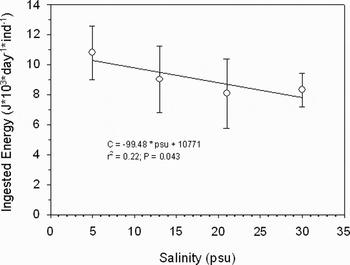
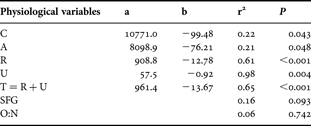
The ingestion rate (C) was related inversely and linearly with salinity (r2 = 0.22; P = 0.043). The individuals kept at 30 psu ingested an average of 22% less salmon meat daily (8318±1127 J) than the individuals kept at 5 psu (10800±1793 J) (Figure 1). Of the ingested energy, approximately 20% was eliminated as faeces (F), regardless of the experimental salinity (Table 1).
Hemigrapsus crenulatus: ingested energy (C) (joule day−1 individual−1) in relation to the experimental salinities. Average values±standard deviation. r2, coefficient of determination; P, probability.

Hemigrapsus crenulatus: effect of the salinity on the physiological variables and energy budget, expressed as J day−1 individual−1. Regressions of the ingestion rates (C), assimilation (A), respiration (R), excretion (U), losses (T = R+U), growth potential (SFG), and oxygen:nitrogen ratio (O:N) at different salinities. a, intercept; b, slope; r2, coefficient of determination; P, probability.
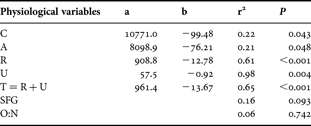
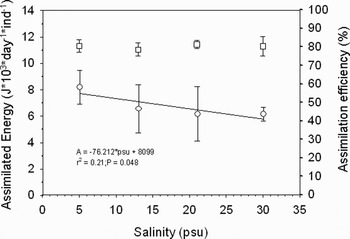
The assimilation efficiency (AE) did not depend on the salinity, averaging 78.5±7% of the daily intake (Figure 2). The assimilated energy had an inverse and linear relationship with salinity (r2 = 0.21; P = 0.048), as was the case of ingestion. Therefore, the assimilated energy at 5 psu (8188±1266 J) was greater than that at 30 psu (6161±515 J).
Hemigrapsus crenulatus: assimilated energy (A: circles) (joule day−1 individual−1) and assimilation efficiency (AE: squares) (per cent) in relation to the experimental salinities. Average values±standard deviation.

Energy losses
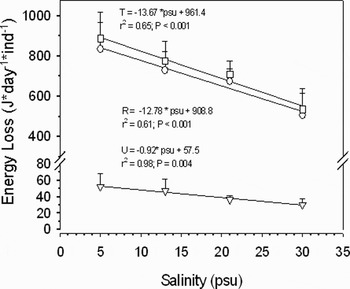
The oxygen consumption (R; r2 = 0.61; P < 0.001) and excretion (U; r2 = 0.98; P = 0.004) rates were inversely related to salinity. Energy losses (T = R+U) were greater at low salinities (r2 = 0.65; P < 0.001). For example, the losses at 5 psu were on average 66% greater than at 30 psu. Most of these losses (94% of the total) were due to respiration (Figure 3; Table 1).
Hemigrapsus crenulatus: relationship between energy losses (squares: T, total; circles: R, respiration; triangles: U, excretion) (joule day−1 individual−1) and experimental salinities. Average values+standard deviation.

Growth potential (SFG)
The growth potential presented positive values throughout the entire salinity gradient. On average, the energy losses with respect to the assimilated energy were 11%. No significant relationship was found between the growth potential and salinity (P = 0.093). An individual kept in a salinity range of 5 to 30 psu and fed to satiety with salmon had an average of 6071±1538 J available per day for growth and reproduction (Figure 4).
Hemigrapsus crenulatus: schemes of the energetic losses and the scope for growth (SFG) (joule day−1 individual−1) for each of the tested salinities, expressed as percentage of the assimilated energy.

O:N ratio
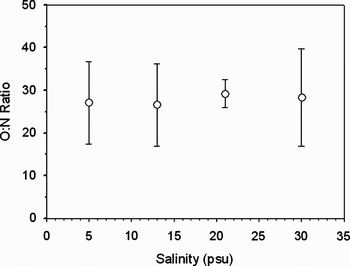
The O:N ratio remained constant along the studied salinity gradient (P = 0.742), with an average value of 27.8±1.2 (Figure 5).
Hemigrapsus crenulatus: O:N ratio at the four experimental salinities (5, 10, 20 and 30 psu). Average values±standard deviation.

DISCUSSION
Temperate estuarine environments undergo large fluctuations, mainly in salinity, on different temporal scales (tidal and seasonal). In general, the species that inhabit these places have developed several adaptive strategies that allow them to survive in such environments.
The crab H. crenulatus is one of the most frequent and abundant organisms in the estuaries of southern Chile. Studies done in New Zealand have concluded that this species is an osmoregulator (Taylor & Seneviratna, Reference Taylor and Seneviratna2005), implying modifications mainly in its respiration and excretion rates. The present work, carried out in southern Chile, shows that low salinity conditions cause increased physiological rates in H. crenulatus, principally in respiration, excretion and ingestion.
The quantified ingestion rates are near those obtained for the same species in previous studies (Grandjean, Reference Grandjean1985; 12°C, 30 psu). Guerin & Stickle (Reference Guerin and Stickle1997a) found a similar tendency for Callinectes similis in terms of increased ingestion rates with decreased salinity.
The assimilation efficiency of H. crenulatus was not affected by the salinity. The average in this study (78.4%) was slightly lower than that found for the same species fed with mussel meat (Mytilus chilensis) (85–92%; Grandjean, Reference Grandjean1985). High assimilation efficiencies are common in crustaceans such as Palaemonetes pugio (88.2 and 81.4%; Morgan, Reference Morgan1980) and Palaemon serratus fed with fish (90.5 and 83.2%; Forster & Gabbott, Reference Forster and Gabbott1971). Given that the assimilation efficiency was independent of the salinity, the energy input in H. crenulatus at the different salinities was regulated mainly by the characteristics of the ingested ration, both in quality as well as in quantity, a situation that agrees with that proposed by Winter (Reference Winter1978). Nonetheless, in this study, the differences can only be due to the quantity of food ingested (i.e. the observed ingestion rate) since the food quality did not vary at the different salinities.
Other Varunidae were described as omnivorous (Neohelice granulata, Iribarne et al., Reference Iribarne, Bortolus and Botto1997; Hemigrapsus sanguineus, Ledesma & O'Connor, Reference Ledesma and O'Connor2001; Lohrer & Whitlatch, Reference Lohrer and Whitlatch2002; Bourdeau & O'Connor, Reference Bourdeau and O'Connor2003) including food of vegetable origin. The ingestion of vegetables may alter the energy balance by reducing the allowable energy due to the proximal composition, i.e. reducing the assimilation efficiency, and/or due to its lower energy content. On the other hand, a potential reduction of assimilated energy content caused by incorporation of detritus and vegetables may enhance the ingestion rate as compensatory mechanism to allow a balanced metabolism.
In the energetic physiology of invertebrates, the excretion costs represent only a small portion of an organism's energy losses. In H. crenulatus, these costs are also low along the entire studied salinity gradient. Excretion values are highly dependent on salinity, with higher energy costs at lower experimental salinities. This suggests that the excretion rate is a mechanism for regulating the quantity of water and salts in the animal, which excretes more at lower salinities, presumably by the liberation of cellular amino acids to the haemolymph where the activity of deaminase enzymes increases the ammonia concentration. The haemolymphatic ammonia is exchanged by sodium ions from the brackish water (by e.g. proline oxidase), increasing blood sodium and enhancing ammonia excretion at lower salinities, described as a general model for estuarine animals by Willmer et al. (Reference Willmer, Stone and Johnston2000). During ebbing tides and/or in periods of high precipitations or melting, when the estuarine zones of southern Chile receive high fresh water discharges, the organisms are faced with a hypotonic medium. On the other hand, during rising and/or high tide or dry periods, the individuals are in an isotonic or possibly a hypertonic medium, and thereby could decrease their excretion rates in order to avoid excessive water loss, as described for several other estuarine species including crustaceans (Stickle & Bayne, Reference Stickle and Bayne1987; Guerin & Stickle, Reference Guerin and Stickle1997b; Novo et al., Reference Novo, Miranda and Bianchini2005), molluscs (Livingstone et al., Reference Livingstone, Widdows and Fieth1979; Navarro, Reference Navarro1988), and fish (Dutil et al., Reference Dutil, Lambert and Boucher1997).
In H. crenulatus, the respiration under routine metabolism depends heavily on salinity. The increased respiratory rate at low salinities may be a response to a greater demand for ATP produced by the increased activity of the branchial Na+/K+-ATPase and other enzymes, which actively helps maintain the osmotic balance by pumping ions against a concentration gradient. On the contrary, as the salinity increases, the activity of the Na+/K+-ATPase decreases, since the difference between the osmolarity of the animal and that of the medium drops, as has been described for other euryhaline crustaceans (e.g. H. nudus, Coroto & Holiday, Reference Coroto and Holiday1996; C. similis, Guerin & Stickle, Reference Guerin and Stickle1997a; Homarus gammarus, Homarus americanus, Charmantier et al., Reference Charmantier, Haond, Lignot and Charmantier2001; Chasmagnathus granulata, Charmantier et al., Reference Charmantier, Gimenez, Charmantier-Daures and Anger2002). Likewise, H. crenulatus is known to have great osmoregulatory capacity. This process is assisted by the activity of the Na+/K+-ATPase, a function that begins in the early (embryonic) stages of development (Taylor & Seneviratna, Reference Taylor and Seneviratna2005).
The energy substrates used by the animals can be identified through the respired oxygen: excreted nitrogen (O:N) ratio (Mayzaud & Conover, Reference Mayzaud and Conover1988). This index can vary depending on the diet, reproductive processes, and stress suffered by the organisms. In H. crenulatus, the O:N ratio had very similar values among salinities (average 27.8±1.2) suggesting that the animals were using a mixed energy substrate, composed mainly of proteins and a smaller proportion of lipids. This composition is similar to the biochemical composition of the ingested food (salmon meat: 21% protein, 13.9% lipid). On the other hand, the independence of the value of this ratio with respect to salinity indicates that the animals were not stressed by either the salinity or other experimental conditions, as reflected in the parallel increase in the respiratory and excretion rates with the decrease in salinity.
By integrating the quantified physiological variables, we found that H. crenulatus presents a positive energy balance along the studied salinity gradient. This allows us to reject the possibility that the growth potential (SFG) was negative at low salinities due to the increased energy losses associated with the osmoregulation processes. The positive SFG along the studied salinity range allowed H. crenulatus to maintain its activity during the entire tidal cycle so that it is not restricted to specific periods. We propose that the increased ingestion rate at low salinities is a compensatory mechanism for confronting increased energy costs from excretion and respiration caused by osmoregulatory activity, which contributes to the success of H. crenulatus in a dynamic habitat like that of the estuaries.
ACKNOWLEDGEMENTS
The authors thank Erwin Barría for support given during the development of the experiments, and two anonymous referees for helpful comments. This work was financed by the DID–Universidad Austral de Chile (200159, 2003-45) and FONDEF (D99I1087).