Implications
This study tested the hypothesis that grain fermentability and particle size (PS) of alfalfa hay have the potential to modify rumen conditions, digestion and performance of mid-lactation dairy cows. Indeed, the results showed an improved rumen environment and nutrient digestibility in cows fed a diet containing corn grain and long forage PS, respectively.
Introduction
Forage particle size (PS) is considered as one of the key determinants of the physical effectiveness of diets in dairy cows, as it promotes stratification of digesta in the reticulorumen, which positively affects eating and rumination activities, as well as rumen buffering (Allen, Reference Allen1997; Mertens, Reference Mertens1997; Zebeli et al., Reference Zebeli, Tafaj, Weber, Dijkstra, Steingass and Drochner2007). All these processes are critical to maintain proper rumen function, optimize digestion, feed intake and nutrient utilization (National Research Council (NRC), 2001; Tafaj et al., Reference Tafaj, Zebeli, Baes, Steingass and Drochner2007).
Despite the documented physiological importance of dietary PS, research has shown that the effects of forage PS are also dependent on the degradation characteristics of the diet (Krause et al., Reference Krause, Combs and Beauchemin2002a and Reference Krause, Combs and Beauchemin2002b; Silveira et al., Reference Silveira, Oba, Beauchemin and Helm2007). Several lines of evidence indicate that for the same forage PS in the diet, the physiological responses obtained are different when these diets are based on barley v. corn (Allen, Reference Allen1997; Beauchemin and Rode, Reference Beauchemin and Rode1997; Lechartier and Peyraud, Reference Lechartier and Peyraud2010). Compared with corn, barley grain is a cereal characterized by a more rapid fermentation in the rumen (Offner et al., Reference Offner, Bach and Sauvant2003), and this increases the requirements for long forage PS in the diet to prevent rumen disorders (Mertens, Reference Mertens1997; Zebeli et al., Reference Zebeli, Mansmann, Steingass and Ametaj2010).
Although effects of forage PS on digestive processes in dairy cows have been extensively investigated (e.g. Grant et al., Reference Grant, Colenbrander and Mertens1990a and Reference Grant, Colenbrander and Albright1990b; Beauchemin and Yang, Reference Beauchemin and Yang2005), most of the studies used single forages in the diet, mainly silages with a relatively low dietary fiber content (23% to 32% NDF on dry matter (DM) basis). In a meta-analysis, Tafaj et al. (Reference Tafaj, Zebeli, Baes, Steingass and Drochner2007) concluded that digestive effects of PS should be considered in relation with particularly forage NDF in the diet. We hypothesized that in spite of a high concentrate level in the diet (60% on DM basis), partial replacement of barley by corn and/or the increase of PS of alfalfa hay (AH) may still exert positive effects on ruminal digestion, chewing activity and passage rate of digesta in lactating dairy cows.
Therefore, the objective of this study was to determine the effects of, and interactions between, marginal increasing of AH PS and source of grain in diets of mid-lactation dairy cows on feed intake, nutrient digestion, ruminal fermentation characteristics, chewing activity and passage rate of digesta.
Material and methods
Cows, forages and diets
A total of eight multiparous lactating Holstein dairy cows (671.1 ± 67.3 kg BW; mean ± s.d.) averaging 175.3 ± 21 days in milk (DIM) and producing 39.2 ± 0.98 kg milk/day with 33.9 ± 1.3 g fat and 33.1 ± 0.5 g protein per kg milk were used. Cows were paired and randomly assigned in a replicated 4 × 4 Latin square design with a 2 × 2 factorial arrangement of dietary treatments to one of the four diets: (1) FB = finely chopped AH and ground barley, (2) LB = long AH and ground barley, (3) FBC = finely chopped AH and ground barley and corn in a 50 : 50 ratio and (4) LBC = long AH and ground barley and corn in a 50 : 50 ratio. Experimental periods were 21 days in duration, with 14 days for diet adaptation followed by 7 days for data collection. The experiment was conducted at the dairy facilities of the Lavark Research Station (Isfahan University of Technology, Isfahan, Iran). Animal care was provided according to the guidelines of the Iranian Council of Animal Care (1995) and the experiment was approved by the Institutional Animal Care Committee for Animals Use in Research.
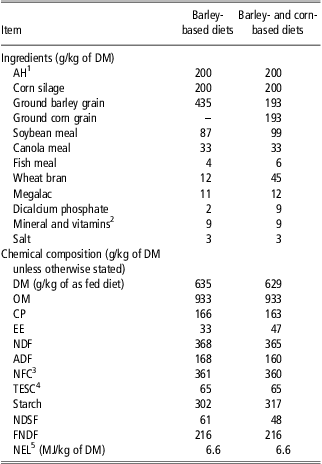
A second-cut AH at 50% flowering, provided by a local farm, was chopped using a harvesting machine with screen size regulator (Golchin Trasher Hay Co., Isfahan, Iran). The fine PS of AH was obtained using a theoretical chop length of 15 mm, whereas the long PS was obtained using a theoretical chop length of 30 mm. The corn silage was chopped using a pool type chopper (Model 965, Claas, Omaha, NE, USA) set to produce particles with an average theoretical chop length of 25 to 30 mm. Corn and barley grain and soybean meal were ground using a hammer mill with 8 mm screen size (model 5543 GEN, Isfahan Dasht, Isfahan, Iran). All diets were formulated to meet the requirements of a 671 kg multiparous cow producing 39 kg of milk/day using the Cornell Net Carbohydrate and Protein System version 5.0 (Fox et al., Reference Fox, Tylutki, Czymmek, Rasmussen and Durbal2000; Table 1). Cows were housed in individual boxes (4 × 4 m) located in a roofed area with open sides and were allowed 30 min of daily exercise before each milking. Diets were fed as total mixed ration (TMR) for an ad libitum intake allowing 10% refusals, and cows had free access to water. TMR were offered twice daily at 0730 and 1530 h in equal portions.
Composition and nutrients content of dietary treatments

DM = dry matter; AH = alfalfa hay; OM = organic matter; NFC = non-fiber carbohydrates; TESC = total ethanol-soluble carbohydrates; NDSF = neutral detergent-soluble fiber; FNDF = forage NDF; NEL = net energy of lactation; EE = ether extracts; CNCPS = cornell net carbohydrate and protein system.
1NDF content of AH and corn silage was 488 and 580 g/kg of DM, respectively.
2Contained 196, 96, 71, 19, 3, 0.3, 2, 3, 0.1, 0.1, 0.001 and 3 g/kg of calcium, phosphorus, sodium, magnesium, iron, copper, manganese, zinc, cobalt, iodine, selenium antioxidant, respectively, and contained vitamin A (500 000 IU/kg), vitamin D (100 000 IU/kg) and vitamin E (100 mg).
3NFC calculated as 1000 − (g/kg NDF + g/kg CP + g/kg EE + g/kg ash).
4Total ethanol (0.8 ml/ml) soluble carbohydrates.
5Based on tabular values (CNCPS; Fox et al., Reference Fox, Tylutki, Czymmek, Rasmussen and Durbal2000).
Cows were weighed on day 19, shortly after the morning milking. The dry matter intake (DMI) was determined daily for each cow. The TMR, orts and fecal grab samples (collected directly from the rectum), were taken on the last 5 consecutive days of each period. Milk production was recorded during the last 5 consecutive days of each period, were sampled three times daily for 3 days in pre-labeled plastic vials and preserved using potassium dichromate. Milk samples were analyzed for fat and protein content (134 BN Foss Electric, Hillerød, Denmark).
Determination of PS and sorting activity
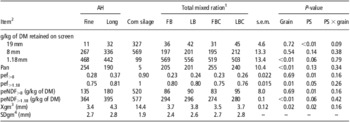
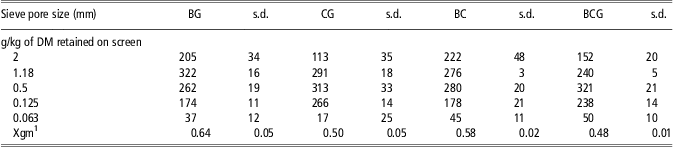
Geometric mean PS of TMR, AH, corn silage and orts was measured using the Penn State Particle Separator (PSPS; Table 2). The physically effective factor (pef) values were determined as the proportion of DM retained on 2 and 3 sieves of the original (pef>8; Lammers et al., Reference Lammers, Buckmaster and Heinrichs1996) and latest version of the PSPS (pef>1.18; Kononoff, Reference Kononoff2002), respectively (Table 2). The physically effective NDF of 2 (peNDF>8) and 3 sieves (peNDF>1.18) were calculated by multiplying the fraction on pef>8 and pef>1.18 with the NDF content, respectively. Geometric mean of ground grains and concentrates’ PS was measured by dry sieving using an automatic sieve shaker (Sieve shaker, M. 120, Techno Khak, Khavaran, Tehran, Iran) with 2, 1.18, 0.5, 0.125 and 0.065 mm diameter screens (Table 3). Approximately 200 g of sample was placed on the top screen and the stack of sieves was shaken until the distribution of materials did not change (∼10 min).
Physical characteristics of forages and dietary treatments

AH = alfalfa hay; PS = particle size; DM = dry matter; pef = physically effective factor; peNDF = physically effective NDF; PSPS = Penn State Particle Separator.
1FB = finely chopped AH and ground barley grain, LB = long AH and ground barley grain, FBC = finely chopped AH and ground barley and ground corn in a ratio of 50 : 50, LAGBC = long AH and ground barley and ground corn in a ratio of 50 : 50 (n = 5).
2pef > 8 and pef > 1.18 = physical effectiveness factor determined as the DM proportion of particles retained on two sieves of the original version of PSPS (Lammers et al., Reference Lammers, Buckmaster and Heinrichs1996) and on three sieves of the most recent version of PSPS (Kononoff, Reference Kononoff2002), respectively; peNDF > 8, peNDF > 1.18 = physically effective NDF calculated as ration NDF multiplied by cumulative proportion of particles retained on two sieves (Lammers et al., Reference Lammers, Buckmaster and Heinrichs1996) and three sieves (Kononoff, Reference Kononoff2002) of PSPS, respectively.
3Geometric mean PS as calculated by the American National Standards Institute (ASAE, 1995; method S424.1).
4Geometric standard deviation of PS as calculated by ASAE (1995; method S424.1).
Grains and concentrates PS distribution

PS = particle size; BG = barley grain; s.d. = standard deviation; CG = corn grain; BC = barley grain-based concentrate; BCG = barley- and corn grain-based concentrate.
1Geometric mean PS as calculated by ASAE (1995; method S424.1).
Sorting activity for peNDF was calculated as the actual intake of each fraction expressed as a percentage of the predicted intake of that fraction (Leonardi and Armentano, Reference Leonardi and Armentano2003). Values equal to 100% indicate no sorting, <100% indicate selective refusals (sorting against) and >100% indicate preferential consumption (sorting for).
Chemical analyses
Samples from TMR, orts and feces were dried at 65°C using a convection oven for 48 h and ground to pass through a 1-mm screen using a Wiley mill (Arthur H. Thomas Co., Philadelphia, PA, USA). All TMR and fecal samples were analyzed in duplicate for CP with Kjeldahl nitrogen (method 988.05; Association of Official Analytical Chemists (AOAC), 2002). The NDF and ADF were analyzed (Van Soest et al., Reference Van Soest, Robertson and Lewis1991) with heat stable alpha-amylase (Sigma A3306; Sigma–Aldrich, Steinheim, Germany) and sodium sulfite used in the NDF procedure. The ash content of samples was determined at 620°C over 8 h. The fractionation method of Hall et al. (Reference Hall, William, Jennings and Webster1999) was followed to determine neutral detergent (ND)-soluble carbohydrates of TMR with the modification that ethanol-insoluble residue and ND residue were not corrected for ash content (Table 1). After extraction in 0.8 ml/ml ethanol solution, the concentration of total ethanol-soluble carbohydrates (TESC) was determined according to the phenol–sulfuric method of Dubois et al. (Reference Dubois, Gilles, Hamilton, Rebers and Smith1956) using an equal molar proportion of sucrose and glucose as standards. Starch was determined as described by Hall et al. (Reference Hall, William, Jennings and Webster1999) with a modification that, after hydrolysis of starch with heat stable alpha-amylase (Sigma A3306; Sigma–Aldrich), glucose was determined colorimetrically using an oxidase–peroxidase (GOPOD) enzymatic procedure instead of ferricyanide method. Corn starch (purity = 85 g/100 g) was used as the control sample. Acid detergent-insoluble ash was used as an internal marker to determine apparent total tract nutrient digestibility (Van Keulen and Young, Reference Van Keulen and Young1977; Nikkhah et al., Reference Nikkhah, Alikhani and Amanlou2004).
Chewing activity
On day 19 of each period, chewing activity parameters were monitored visually for each cow in the treatments over a 24-h period. Eating and ruminating activities were noted at 5-min intervals, and each activity was assumed to persist for the entire 5-min interval. A period of rumination was defined as at least 5 min of rumination occurring after at least 5 min without rumination (Krause et al., Reference Krause, Combs and Beauchemin2002b). A meal or period of eating was defined as at least one observation of eating activity occurring after at least 20 min without eating activity (Krause et al., Reference Krause, Combs and Beauchemin2002b). Total time spent chewing was calculated as the total time spent eating and ruminating. The time spent eating, ruminating and total chewing activity per kg intake of DM, NDF, peNDF>8 and peNDF>1.18 were also calculated.
Ruminal fermentation profile
Samples of ruminal fluid were taken on days 20 and 21 of each experimental period at 3 and 6 h after feeding, respectively, using a stomach probe. Approximately the first 100 ml of fluid was discarded and pH of the second sampling was immediately determined using a portable digital pH meter (HI 8318, Hanna Instruments, Cluj-Napoca, Romania) calibrated at pH 4 and 7. Subsequently, 50 ml of samples was strained through one layer of cheesecloth, acidified with 10 ml H2SO4 10% and stored at −10°C until volatile fatty acid (VFA) analyses using gas chromatography was carried out (0.25 × 0.32, 0.3 μm i.d. fused silica capillary, model no. CP-9002 Vulcanusweg 259 a.m., Chrompack, Delft, the Netherlands) as outlined by Kowsar et al. (Reference Kowsar, Ghorbani, Alikhani, Khorvash and Nikkhah2008). Measuring of passage rate was carried out in one square. Chromium-mordanted wheat straw (50 g Cr/kg marker) was prepared as described by Uden et al. (Reference Uden, Colucci and Van Soest1980), ground to pass through a 6-mm screen using a Wiley mill (Arthur H. Thomas Co.) and used as a single-dose marker for solid passage rate measurement (200 g of Cr-enriched wheat straw per cow). On day 15 of each experimental period, the marker was fed to cows at the morning feeding time. Fecal grab samples were taken at 0, 6, 10, 12, 14, 18, 22, 26, 30, 36, 42, 48, 54, 60, 72, 84, 96, 120 and 144 h after dosing to determine the rumen passage rate (k 1), rumen mean retention time (RMRT) and total mean retention time (TMRT) of the marker. Samples were prepared as described by Aikman et al. (Reference Aikman, Reynolds and Beever2008) and analyzed using the flame photometry method (GBC Integra EXL ICP, Melbourne, Australia). Fecal Cr excretion curves were fitted to the following double-compartment model represented by two exponential constants and a time delay (Grovum and Williams, Reference Grovum and Williams1973):

where Y is the marker concentration (ppb); A the scale parameter; k 1 theruminal rate of passage (%/h); k 2 the lower digestive tract rate of passage (%/h); t the sampling time post dosing (h); and TT the transit time or time delay of marker. The TMRT was calculated as the sum of RMRT (1/k 1) and in the lower digestive tract as mean retention time (1/k 2) plus the transit time (TT). Data were estimated by NLIN regression using the PROC NLIN (iterative Marquardt method) procedure of SAS (1998).
Measuring potential DM degradability
An in situ study was conducted to determine feed and fecal potential degradability. Fecal and feed (TMR) samples were dried at 60°C for 48 h and ground to pass through a 2-mm screen of a Wiley mill (Arthur H. Thomas Co.). Five-gram samples of feeds and feces were weighed, transferred into Dacron polyester bags (10 × 20 cm) with a pore size of 52 ± 5 μm (mean ± s.d.) and incubated for 48 h in the rumen of one non-lactating Holstein dairy cow that consumed a diet based on forage. After removal from the rumen, the bags were washed under cold, running tap water, machine-washed for 20 min, and then dried at 55°C for 48 h for the recovery of residue.
Statistical analyses
Data were analyzed using the PROC MIXED in SAS (SAS, 1998). Period, source of grain, PS of AH and their two-way interactions were considered as fixed effects in the model. The random statement included square and cow within square. The model used for intake and production variables, digestibility, chewing activity, fecal degradability and ruminal characteristics data is shown below:

where μ is the overall mean; Si the random effect of square (i = 1 to 2); Cj ( i ) the random effect of cow within square (j = 1 to 4); Pk the fixed effect of period (k = 1 to 4); Ml the fixed effect of source of grain (l = 1 to 2); Fm the fixed effect of AH PS (m = 1 to 2); (M × F) lm the fixed effect of interaction of Ml and Fm ; and eijklm is the random residual error, assumed to be normally distributed. Significance was declared at P ⩽ 0.05. A trend was considered to exist if 0.05 < P ⩽ 0.10. All reported values are least square means. Only for ruminal kinetic parameters, data from one square were analyzed.
The feed PS data were analyzed as a completely randomized block design (effect of period as block) with five samples in each treatment (n = 5) using the PROC MIXED of SAS (1998). Mean separation was determined using the Bonferroni procedure and significance was declared at P ⩽ 0.05.
Results and discussion
PS distribution
Data of PS distribution of AH, corn silage and TMR indicated that reducing the PS of AH marginally changed the feed's physical characteristics (Table 2). The DM proportion retained on the 19-mm sieve was higher in long AH-based diets compared with fine AH-based diets (P < 0.01), resulting in greater physical characteristics of the former diets, as indicated by greater pef>8, pef>1.18 and peNDF>8 (P ⩽ 0.05) and tended to greater peNDF>1.18 (P = 0.06).
Although milling conditions were similar in this study, the reduction of grain PS was not similar among diets (Table 3). The pef>1.18 and peNDF>1.18 of diets containing barley grain were greater than those containing both barley and corn grains (P < 0.01; Table 2). Differences in grain PS during grinding might have been caused by differences in physical texture and density, reported previously for cereal grains (Beauchemin and Rode, Reference Beauchemin and Rode1997; Yang et al., Reference Yang, Beauchemin, Farr and Rode1997; Giger-Reverdin, Reference Giger-Reverdin2000). However, as shown below, the coarseness of the PS of barley grain in this study was not associated with notable improvements in chewing activity of the cows, contrary to the effects of forage PS that affected the latter response variable.
DM and nutrient intake and digestibility
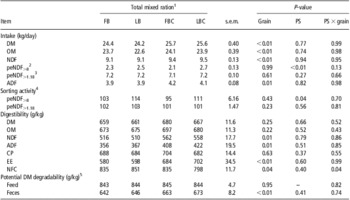
There were no interactions between grain source and AH PS on DMI and nutrient intake (Table 4). However, the ANOVA of main effects showed that cows fed diets based on barley alone consumed less DM, organic matter, NDF and ADF than those based on both barley and corn, independent of AH PS (Table 4). The lowering effect of barley grain on feed and nutrient intake may be because of more rapid starch degradation in the rumen, resulting in greater rumen acid load, which is known to induce hypophagia in lactating dairy cows (Allen, Reference Allen2000). Moreover, it is postulated that a low ruminal pH may reduce ruminal NDF turnover, which also may result in lower DMI.
Effects of grain source and PS of AH on the intake, sorting activity and digestibility

PS = particle size; AH = alfalfa hay; DM = dry matter; OM = organic matter; peNDF = physically effective NDF; pef = physically effective factor; PSPS = Penn State Particle Separator; NDF = neutral detergent fibre; ADF = acid detergent fibre; CP = crude protein; EE = ether extracts; NFC = non-fibre carbohydrates.
1FB = finely chopped AH and ground barley grain, LB = long AH and ground barley grain, FBC = finely chopped AH and ground barley and ground corn in a ratio of 50 : 50, LBC = long AH and ground barley and ground corn in a ratio of 50 : 50.
2peNDF> 8 = physically effective NDF determined as the proportion of DM retained on sieves of the original version of PSPS (Lammers et al., Reference Lammers, Buckmaster and Heinrichs1996).
3peNDF> 1.18 = physically effective NDF determined as the proportion of DM retained on sieves of the most recent version of PSPS (Kononoff, Reference Kononoff2002).
4Sorting was calculated as the actual intake of each fraction expressed as a percentage of the predicted intake (Leonardi and Armentano, Reference Leonardi and Armentano2003); values equal to 100% indicate no sorting, <100% indicate selective refusals (sorting against) and >100% indicate preferential consumption (sorting for).
5Measured after 48 h of rumen incubation in nylon bags.
PS of AH did not affect DMI in this study, although feeding long PS is reported to lower DMI because of its physical filling effect in the reticulorumen (Tafaj et al., Reference Tafaj, Zebeli, Baes, Steingass and Drochner2007). The lack of an effect of forage PS on DMI can be explained by the late lactation stage of cows in this study. Accordingly, Allen et al. (Reference Allen, Bradford and Oba2009) reported that physical fill could limit feed intake in cows in early lactation, which are more sensible to filling effects because of their higher demand for energy and nutrients.
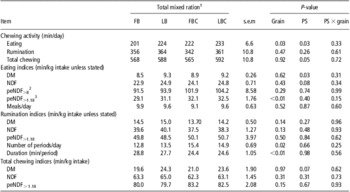
The non-fiber carbohydrates (NFC) digestibility was increased by feeding long AH when diets were based on barley grain alone, and was decreased by the replacement of barley by corn grain in the diet (Table 4). The difference in NFC digestibility is attributed to differences in starch degradation per se and to differences in other digestive processes such as chewing activity. Total time spent chewing per unit of DMI was greater for long v. fine AH (Table 5). It is postulated that increasing chewing time might have caused a decrease in dietary grain PS, and hence greater barley starch digestion. This assumption is supported by data of Yang et al. (Reference Yang, Beauchemin, Farr and Rode1997) who observed that differences in the disappearance of starch between corn and barley grain in the rumen were greater with decreasing grain PS. Overall, our results suggest that feeding of long AH is beneficial in improving NFC digestibility in diets based on barley grain.
Effects of grain source and AH PS on chewing behavior

AH = alfalfa hay; PS = particle size; DM = dry matter; peNDF = physically effective NDF; PSPS = Penn State Particle Separator.
1FB = finely chopped AH and ground barley grain, LB = long AH and ground barley grain, FBC = finely chopped AH and ground barley and ground corn in a ratio of 50 : 50, LBC = long AH and ground barley and ground corn in a ratio of 50 : 50.
2peNDF>8 = physically effective NDF determined as the proportion of DM retained on sieves of the original version of PSPS (Lammers et al., Reference Lammers, Buckmaster and Heinrichs1996).
3peNDF>1.18 = physically effective NDF determined as the proportion of DM retained on sieves of the most recent version of PSPS (Kononoff, Reference Kononoff2002).
The reason for a lower NFC digestibility of corn-based diets in this study can be related to its starch. In contrast to barley, more starch from corn escapes from rumen fermentation, resulting in a higher intestinal starch flow (Offner et al., Reference Offner, Bach and Sauvant2003). A limited amylolytic activity in the small intestine of dairy cows (Matthe et al., Reference Matthe, Lebzien, Hric, Flachowsky and Sommer2001), combined with a limited microbial fermentation of starch in the large intestine (Harmon et al., Reference Harmon, Yamka and Elam2004), may attribute to the increased fecal excretion of corn starch. This assumption is supported by in situ data, whereby cows fed diets containing corn grain had higher fecal potential degradability in situ compared with barley grain alone (Table 4), indicating the presence of higher amounts of potentially degradable substrate, most probably undigested starch, in the feces of cows fed diets consisting of corn and barley grain than in those fed barley grain alone. It can also be assumed that microbiota in the large intestine were not able to utilize this by-pass starch or, at least, the utilization was not great enough to balance these treatment differences.
Cows fed the barley- and corn-based diets had higher NDF and ADF digestibility than cows fed diets based only on barley grain (Table 4). Enhanced fiber digestibility when barley was replaced with corn in the diet is explained by greater activity of fibrolytic microbiota because of an improved nutrient availability brought about by feeding of the latter diets. For example, because corn-based diets also contained wheat bran (Table 1), a non-forage fiber source with high fiber digestibility but with low retention time (Grant, Reference Grant1997), and soymeal, the differences in the fiber digestibility observed in this study can also be attributed to the differences in these dietary components.
Chewing activity
Contrary to our hypothesis, there was no interaction between AH PS and grain source regarding their effects on chewing activity in this study. However, daily eating time was greater for diets based on barley and corn grain v. barley grain alone (Table 5). Because eating time per unit of DMI was not affected by the source of grain, greater daily eating time of cows fed diets based on barley and corn grain can be attributed to higher DMI.
As expected, our data showed that cows fed long AH-based diets spent more time eating per kg DMI (Table 5). Moreover, total daily chewing activity was greater and chewing time per kg DMI tended to increase with increasing AH PS in the diet (Table 5).
The fact that changes in the PS were not reflected with changes in the rumination activity is not clear. We speculate that an intensive particle breakdown during eating might have leveled out the differences in the PS of digesta particles, resulting in similar stimuli for rumination.
Ruminal fermentation
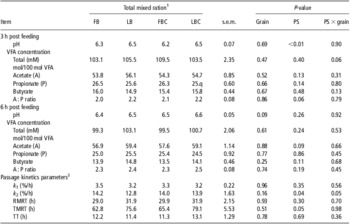
Our data indicated that, although ruminal pH was affected differently, at 3 v. 6 h post feeding, by forage PS and source of grain, there was no interaction between AH PS and grain source on ruminal fermentation data (Table 6). The results suggest that the roles of forage PS and starch degradability on maintaining ruminal pH change with time after the morning feeding. At 3 h after feeding, cows fed the long AH had higher ruminal pH than their counterparts fed the finely chopped AH diets (6.46 v. 6.26; P < 0.01; Table 6). At 6 h post feeding, forage PS did not affect ruminal pH, whereas the feeding of corn-based and barley grain-based diets resulted in a tendency to a higher ruminal pH compared with feeding barley grain alone.
Effects of source of grain and AH PS on ruminal fermentation

AH = alfalfa hay; PS = particle size; VFA = volatile fatty acids.
1FB = finely chopped and ground barley grain, LB = long AH and ground barley grain, FBC = finely chopped AH and ground barley and ground corn in a ratio of 50 : 50, LBC = long AH and ground barley and ground corn in a ratio of 50 : 50.
3 k 1 = passage rate out of the reticulorumen; k 2 = passage rate of the lower compartment; RMRT = rumen mean retention time; TMRT = total mean retention time (calculated as 1/k 1 + 1/k 2 + transit time).
The effect of forage PS on ruminal pH shortly after the morning feeding can be explained by greater amounts of peNDF>8 in the diet and its intake, which resulted in positive effects on eating time (Table 5) and saliva flow needed for neutralization of fermentation acids early after feeding (Allen, Reference Allen1997). In addition, the slightly increasing effect of corn grain on ruminal pH late after the morning feeding may be attributed to the slower accumulation of fermentation acids by degradation of corn starch in the diet (Yang et al., Reference Yang, Beauchemin, Farr and Rode1997).
Concentration of VFA was only slightly affected by the factor AH PS or grain source (Table 6). The acetate-to-propionate ratio, at 3 h post feeding, and acetate concentration at 6 h post feeding tended to be higher in cows fed diets based on long AH.
Data of digesta kinetics showed that cows fed long AH had higher TMRT than cows fed the finely chopped AH (Table 6). Because RMRT was not affected by treatment, higher TMRT in long AH diet is attributed to longer retention time in the lower digestive tract. This observation indicates that the marginal change in the PS of AH was associated with changes in the functional specific gravity of potentially escapable particles. Our observation that a reduction of AH PS increased passage rate through the lower digestive tract on the diet based on barley alone supports the conclusion of Kaske and Engelhardt (Reference Kaske and Engelhardt1990) that functional specific gravity of feed particles affect mean retention time in the lower compartment.
Conclusions
Overall, data showed that partial replacement of barley grain with corn (50%) increased DMI and apparent digestibility of fiber fractions. Feeding long AH improved the apparent NFC digestibility, particularly in cows fed diets based on barley grain. In addition, feeding long AH and consequently increasing the intake of coarse particles (peNDF>8) resulted in more daily chewing and higher rumen pH at 3 h post feeding. In conclusion, results suggest that feeding of long AH is more important in diets with rapidly degradable starch, like in barley grain, than in diets with gradually degradable starch. Partial (50%) replacement of barley grain by corn improves rumen conditions, and consequently improves feed intake and fiber digestion in mid-lactation dairy cows.
Acknowledgments
The authors are thankful to the staff of dairy research and teaching unit at the Isfahan University of Technology for the technical assistance. We also thank Dr Hamid Reza Rahmani (Isfahan University of Technology, Iran), Dr Patricia C. Aikman (University of Reading, Reading, UK), Dr Mehdi Ganjkhanlou (University of Tehran, Iran), Ebrahim Ghasemi, Mohsen Sharafi and Shahryar Kargar (Isfahan University of Technology, Iran) for their technical assistance in this research.