Disturbances in affect regulation play a central role in vulnerability models of depression (Watson, Clark, et al., Reference Watson, Clark, Weber, Assenheimer, Strauss and McCormick1995; Watson & Naragon-Gainey, Reference Watson and Naragon-Gainey2010). Affective reactivity, defined as the degree of change in affect in response to daily stressors, has recently been investigated as a contributing factor in the development of depressive symptoms (Charles, Piazza, Mogle, Sliwinski, & Almeida, Reference Charles, Piazza, Mogle, Sliwinski and Almeida2013; Cohen, Gunthert, Butler, O'Neill, & Tolpin, Reference Cohen, Gunthert, Butler, O'Neill and Tolpin2005; Parrish, Cohen, & Laurenceau, Reference Parrish, Cohen and Laurenceau2011). To date, research in this area has focused primarily on generic daily stressors, without attention to the role of daily racial discrimination as a specific context for assessing naturalistic emotional processes. A growing body of research indicates that adjustment difficulties to racial discrimination may be especially pronounced because of the distinctively harmful ways in which repeated exposure to unfair treatment may disrupt quality of life, derailing goal pursuit, undermining psychological well-being, and contributing to increased morbidity and mortality (Krieger, Reference Krieger1999; Lewis, Cogburn, & Williams, Reference Lewis, Cogburn and Williams2015; Schmitt, Branscombe, Postmes, & Garcia, Reference Schmitt, Branscombe, Postmes and Garcia2014; Williams & Mohammed, Reference Williams and Mohammed2009). In addition, studies of affective reactivity as a vulnerability factor have largely focused on negative affect. However, daily stressors elicit decreases in positive affect as well as increases in negative affect (Ong, Bergeman, Bisconti, & Wallace, Reference Ong, Bergeman, Bisconti and Wallace2006; Zautra, Affleck, Tennen, Reich, & Davis, Reference Zautra, Affleck, Tennen, Reich and Davis2005).
In the present study, we use a daily process approach to investigative positive and negative affect reactivity in the context of daily racial discrimination. Our focus is on African American graduate and postgraduate students who, despite upward socioeconomic mobility, report more frequent encounters of racial discrimination and unfair treatment (Borrell, Kiefe, Williams, Diez-Roux, & Gordon-Larsen, Reference Borrell, Kiefe, Williams, Diez-Roux and Gordon-Larsen2006; Kessler, Mickelson, & Williams, Reference Kessler, Mickelson and Williams1999; Krieger, Kosheleva, Waterman, Chen, & Koenen, Reference Krieger, Kosheleva, Waterman, Chen and Koenen2011) and evidence more pronounced associations between racial discrimination and worsening health outcomes (Fuller-Rowell, Doan, & Eccles, Reference Fuller-Rowell, Doan and Eccles2012; Hudson et al., Reference Hudson, Bullard, Neighbors, Geronimus, Yang and Jackson2012; Hudson, Puterman, Bibbins-Domingo, Matthews, & Adler, Reference Hudson, Puterman, Bibbins-Domingo, Matthews and Adler2013) compared with their lower socioeconomic status counterparts.
Until recently, the research literature on racial discrimination has been dominated by nomothetic (between-person) approaches that seek to address questions concerning the relations among variables across individuals (e.g., Do people who report more racial discrimination also have higher negative affect?). The cross-sectional nature of such data, however, limits the inferences that can be made about affective processes during high versus low racial discrimination periods, an inherently within-person question (e.g., To what degree does negative affect also increase on days when individuals encounter racial discrimination?). In contrast to traditional between-person approaches, several recent studies have employed daily process designs to directly assess within-person relations between daily racial discrimination and affect (e.g., Burrow & Ong, Reference Burrow and Ong2010; Ong, Burrow, Fuller-Rowell, Ja, & Sue, Reference Ong, Burrow, Fuller-Rowell, Ja and Sue2013; Ong, Fuller-Rowell, & Burrow, Reference Ong, Fuller-Rowell and Burrow2009; Swim, Hyers, Cohen, Fitzgerald, & Bylsma, Reference Swim, Hyers, Cohen, Fitzgerald and Bylsma2003). Beyond bringing researchers closer to the real world of individuals’ everyday lives, daily process studies increase the precision with which rapidly changing processes are characterized, minimize retrospection bias, and offer insights into temporal associations that cannot be obtained through traditional cross-sectional methodologies (Affleck, Zautra, Tennen, & Armeli, Reference Affleck, Zautra, Tennen and Armeli1999; West & Hepworth, Reference West and Hepworth1991). Moreover, daily process designs allow researchers to simultaneously take account of both within- and between-person sources of variation in person-observation data sets (Ong & Burrow, Reference Ong and Burrow2017; Zautra et al., Reference Zautra, Affleck, Tennen, Reich and Davis2005).
More recently, researchers have utilized daily process designs to develop idiographic (within-person) indices of affect regulation in the context of naturally occurring stressful events. This work addresses individual differences in people's affective responses to daily stressors. Bolger and Zuckerman (Reference Bolger and Zuckerman1995) defined affective reactivity with respect to individuals’ unique or within-person relationship between stressful events and mood. Thus, a highly reactive individual would have a strong positive within-person relationship between daily stress and negative affect. Empirical work suggests that heightened negative affect reactivity to daily stressors is a unique vulnerability factor for later depressive symptoms. For example, O'Neill, Cohen, Tolpin, and Gunthert (Reference O'Neill, Cohen, Tolpin and Gunthert2004) tested the predictive role of college students’ affective reactivity to daily interpersonal stressors in the development of depressive symptoms. Specifically, individuals whose negative affect increased strongly in response to daily interpersonal stressors showed a greater increase in subsequent depressive symptoms 2 months later. Gunthert, Cohen, Butler, and Beck (Reference Gunthert, Cohen, Butler and Beck2005) likewise evaluated the predictive role of adult outpatients’ negative affect reactivity in cognitive therapy (depression reduction). Patients who began cognitive therapy with lower negative affect reactivity showed a greater reduction in depressive symptoms over the course of the treatment than patients who began therapy with greater negative affect reactivity. Using experience sampling methodology, Wichers et al. (Reference Wichers, Geschwind, Jacobs, Kenis, Peeters, Derom and van Os2009) found that increased negative affect reactivity to stressors was associated with genetic risk for depression and predicted new depressive symptomatology 1 year later. Finally, Charles et al. (Reference Charles, Piazza, Mogle, Sliwinski and Almeida2013) found that heightened stressor-related negative affect reactivity predicted increased likelihood of reporting a depressive disorder 10 years later in a large, national community sample of adults.
Although much of the existing depression vulnerability literature has focused on negative affect reactivity to daily stressors, research suggests that positive affect reactivity to everyday stressors may also account for important individual differences in the development of health, broadly defined. For instance, greater reductions in positive affect in response to daily stress have been linked with future depressive symptoms (O'Neill et al., Reference O'Neill, Cohen, Tolpin and Gunthert2004), higher levels of inflammatory markers (Sin, Graham-Engeland, Ong, & Almeida, Reference Sin, Graham-Engeland, Ong and Almeida2015), lower sleep quality and efficiency (Ong, Exner-Cortens, et al., Reference Ong, Exner-Cortens, Riffin, Steptoe, Zautra and Almeida2013), and even greater mortality risk (Chiang, Turiano, Mroczek, & Miller, Reference Chiang, Turiano, Mroczek and Miller2018; Mroczek et al., Reference Mroczek, Stawski, Turiano, Almeida, Neupert and Spiro2012). Taken together, the existing data indicate that affective reactivity (either greater increases in negative affect or greater decreases in positive affect) may represent an underlying psychological mechanism through which depression vulnerability is expressed.
Present Study
The current research aims to broaden understanding of the relationship between affective reactivity and depressive symptoms in four key ways. First, it extends the study of affective reactivity to include race-based stressors, such as day-to-day experiences of unfair treatment and discrimination (Ong et al., Reference Ong, Fuller-Rowell and Burrow2009; Swim et al., Reference Swim, Hyers, Cohen, Fitzgerald and Bylsma2003). Second, the study adopts a daily process approach to evaluate the contribution of positive affect in naturalistic stress processes. The inability to sustain positive affect in the face of stressors may reflect a unique vulnerability factor for depressive symptoms (cf. O'Neill et al., Reference O'Neill, Cohen, Tolpin and Gunthert2004; Ong & Edwards, Reference Ong and Edwards2008). Moreover, because an overall deficit in positive affect regulation is strongly linked to depression (Watson & Naragon-Gainey, Reference Watson and Naragon-Gainey2010; Watson, Weber, et al., Reference Watson, Weber, Assenheimer, Clark, Strauss and McCormick1995), it is important to assess the unique effects of positive affect reactivity to daily events as a separate vulnerability factor for the development of depressive symptoms (Cohen et al., Reference Cohen, Gunthert, Butler, O'Neill and Tolpin2005; Gunthert, Cohen, & Armeli, Reference Gunthert, Cohen and Armeli2002; Peeters, Nicolson, Berkhof, Delespaul, & deVries, Reference Peeters, Nicolson, Berkhof, Delespaul and deVries2003). Third, the study considers the role of negative emotionality traits as potential confounders (for a discussion, see Lilienfeld, Reference Lilienfeld2017) in the association between affective reactivity and depressive symptoms. Several studies have documented the role of stigma consciousness, or the extent to which one expects to be stereotyped by others (Pinel, Reference Pinel1999), and stressor frequency as factors that may be strongly collinear with reports of depressive symptomatology and racial discrimination (Charles et al., Reference Charles, Piazza, Mogle, Sliwinski and Almeida2013; Major & O'Brien, Reference Major and O'Brien2005; Parrish et al., Reference Parrish, Cohen and Laurenceau2011). Thus, we sought to control for the effects of daily stressor frequency and stigma consciousness when evaluating the predictive role of affective reactivity in future depressive symptoms. Fourth and finally, the study has the potential to shed light on the experience of African American graduate and postgraduate students, an understudied population who experience heightened vulnerability due to their differential exposure to acute and chronic discrimination (Colen, Ramey, Cooksey, & Williams, Reference Colen, Ramey, Cooksey and Williams2018; Kessler et al., Reference Kessler, Mickelson and Williams1999).
Hypotheses
Our major hypothesis was that among African American graduate and postgraduate students, greater affective reactivity to daily racial discrimination would predict subsequent depressive symptoms. Specifically, we expected that participants who evidenced greater negative affect reactivity (increases in negative affect in response to daily racial discrimination) at the beginning of the study, compared to less reactive participants, would report more depressive symptoms when assessed 1 year later (Hypothesis 1). We also examined whether negative affect and positive affect reactivity indices were independently related to later depressive symptoms. On the basis of prior research (Chiang et al., Reference Chiang, Turiano, Mroczek and Miller2018; Mroczek et al., Reference Mroczek, Stawski, Turiano, Almeida, Neupert and Spiro2012; Sin et al., Reference Sin, Graham-Engeland, Ong and Almeida2015), we hypothesized that positive affect reactivity (decreases in positive affect in response to daily racial discrimination) would uniquely predict elevated depressive symptoms 1 year later, above and beyond the effects of negative affect reactivity (Hypothesis 2).
Method
Participants
Participants were African American doctoral students and graduates from over 70 different US colleges and universities. Participants were recruited from national academic fellowship programs, associations, and organizations supporting African American doctoral students and recent graduates (e.g., minority fellowship programs and Black graduate student listservs). All data were collected via a secure website designed for electronic survey administration (i.e., Surveymonkey.com). One hundred and seventy-four participants (142 women, 32 men) completed a baseline questionnaire that included an initial measure of depressive symptoms (Time 1). Because participants were recruited via listservs and message board postings that were viewed by an unknown number of people, an overall response rate could not be established. However, a total of 260 individuals opened our survey link and consented to participating. Thus, 67% (174 / 260) of those who began the study finished the initial survey. Immediately after completing the initial assessment, all participants began a 14-day diary study. Of these, 106 participants (90 women, 16 men) completed a follow-up measure of depressive symptoms (Time 2), 1 year later. The sample was predominantly female (76%) and ranged in age from 22 to 52 years (M = 30.44, SD = 7.05). With respect to participants’ graduate status, 32% had earned their doctorate degree and 68% were still matriculating; a majority of those matriculating (68%) were in their first 3 years of doctoral training.
Procedure
Participants completed an initial measure of depressive symptoms, along with other measures related to a larger study. Beginning the evening of the initial assessment, and each evening for the next 13 days, participants completed a daily measure of affect and a checklist of racial discrimination. Participants received an e-mail message each day reminding them to access the diary measures. To minimize variation in reporting times, participants could only log on to the website between the hours of 7:00 p.m. and midnight. Participants were compensated up to $25 for their time: $1 dollar for each diary completed, with an $11 bonus if they completed all 14 diaries. The median number of days a participant contributed data was 12 (M = 10.3 days, SD = 4.2), with 81% completing at least 7 daily diaries. Approximately 1 year after completing the Time 1 questionnaire and daily diaries, participants were recontacted and invited to complete follow-up measures that included the Time 2 depressive symptom questionnaire. For the current analyses, missing data were imputed using the expectation-maximization algorithm in SPSS 25. Data collection for this study was approved by the institutional review board at the University of Notre Dame.
Measures
Depressive symptoms
Time 1 and Time 2 depressive symptoms were assessed with the Center for Epidemiological Studies Depression Questionnaire (Radloff, Reference Radloff1977), a 20-item measure of depressive symptomatology. Participants were asked to indicate the frequency with which they felt each item during the past week. Sample items include, “I felt that everything I did was an effort” and “I thought that my life had been a failure.” Responses are based on a 4-point Likert-like scale (0 = rarely or none of the time and 3 = most or all of the time). In the current sample, Cronbach's α was 0.90 at both Time 1 and Time 2.
Daily racial discrimination
Everyday experiences of racial discrimination were assessed with a modified version of the daily life experience subscale of the Racism and Life Experience Scale (Harrell, Reference Harrell1994). The self-report measure assesses the frequency and impact of experiencing 20 different types of racial discrimination (see Utsey, Reference Utsey1998, for a review of scale properties). The instructions for the checklist were modified to refer to whether each of the 20 events had occurred that day (e.g., “Today, I was ignored, overlooked, or not given service” and “Today, I was mistaken for someone else of my same race”). A respondent was given a score of 1 if he or she had experienced a racial discrimination event on a particular day and a score of 0 if he or she had not. This approach to measuring daily racial discrimination is consistent with research that distinguishes daily events from ongoing activities by defining them as changes from day-to-day occurrences (for a discussion, see Eckenrode & Bolger, Reference Eckenrode, Bolger, Kessler and Cohen1997). To estimate reliability, test–retest correlations were computed across weeks, yielding a week-to-week correlation of .61. Internal consistency reliability of the daily racial discrimination items was not computed because the experience of one event does not necessarily increase the likelihood of another (see Bollen & Lennox, Reference Bollen and Lennox1991).
Daily positive and negative affect
Daily positive affect and negative affect was measured by asking participants to rate how they felt during the day using a circumplex model (Feldman Barrett & Russell, Reference Feldman Barrett and Russell1998) as a basis for these ratings. For negative affect, participants rated how “guilty,” “nervous,” “afraid,” “angry,” “ashamed,” “embarrassed,” “upset,” “disgusted,” “sluggish,” “sad,” “tired,” and “bored” they felt. For positive affect, participants rated how “active,” “relaxed,” “enthusiastic,” “alert,” “proud,” “interested,” “energetic,” happy,” “at rest,” “calm,” “satisfied,” and “joyful” they felt. Participants responded using a 5-point Likert-type scale, ranging from 1 (very slightly or not at all) to 5 (extremely). Within-person estimates of reliability were computed using three-level models in which items were nested within days, which were nested within participants (Bryk & Raudenbush, Reference Bryk and Raudenbush1992, pp. 191–196). Using this procedure, the estimated day-level reliability was .74 for the positive affect scale and .71 for the negative affect scale, respectively.
Covariates
To ensure that the results of the current investigation were not due to confounding correlates of depressive symptomatology, we included a number of demographic (i.e., age, gender, parental education, and graduate status) covariates. Parental education was assessed at baseline, based on participants' reports of the highest level of education obtained by their mother and father, respectively. Participants responded using a 6-point scale, ranging from 1 (less than high school) to 6 (post-college degree). Graduate status was assessed with a dichotomous variable representing whether participants had earned their doctorate degree (0 = no, 1= yes). Following prior work (Charles et al., Reference Charles, Piazza, Mogle, Sliwinski and Almeida2013; Sin et al., Reference Sin, Graham-Engeland, Ong and Almeida2015) we controlled for affect on non-racial discrimination days to distinguish between the effects of affective reactivity to daily racial discrimination and typical experiences of affect. The average number of racial discrimination experiences reported across the study period was included in all analyses to adjust for individual differences in racial discrimination frequency (Mroczek et al., Reference Mroczek, Stawski, Turiano, Almeida, Neupert and Spiro2012; Piazza, Charles, Sliwinski, Mogle, & Almeida, Reference Piazza, Charles, Sliwinski, Mogle and Almeida2013). Finally, because stigma consciousness has been shown to be an important correlate of racial discrimination and depressive symptoms (Chan & Mendoza-Denton, Reference Chan and Mendoza-Denton2008; Mendoza-Denton, Downey, Purdie, Davis, & Pietrzak, Reference Mendoza-Denton, Downey, Purdie, Davis and Pietrzak2002), we controlled for it using the Stigma Consciousness Questionnaire for Race/Ethnicity (Pinel, Reference Pinel1999). Responses to the 10-item measure are based on a 7-point scale (1 = strongly disagree and 7 = strongly agree). Sample items include “When interacting with Whites, I feel like they interpret all my behaviors in terms of the fact that I am Black” and ‘Most Whites have a problem viewing Blacks as equals.” Chronbach's α for the current sample was 0.84.
Overview of analyses
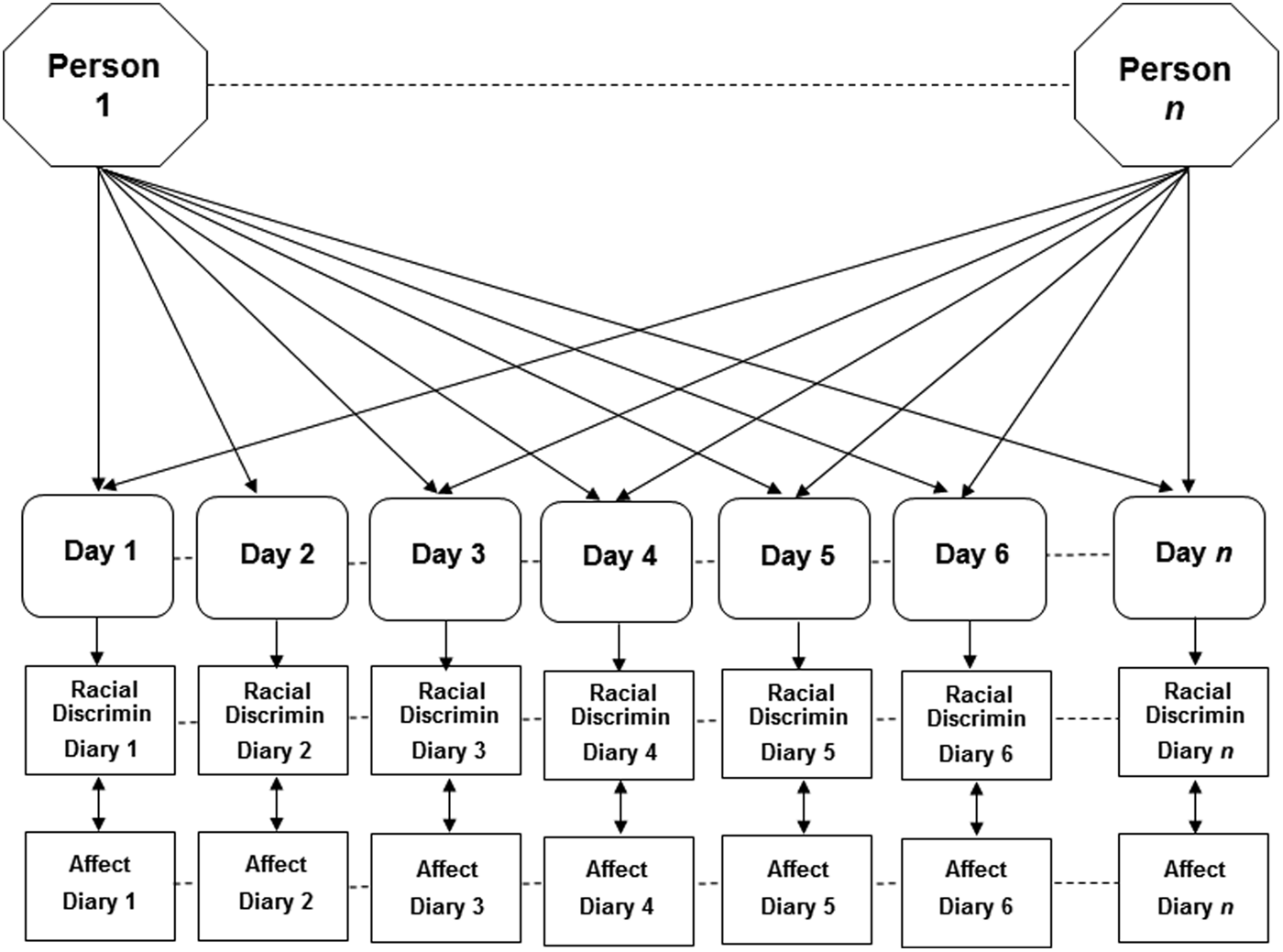
Our hypotheses were tested using multilevel modeling because the data have a hierarchical structure with up to 14 daily observations nested within each of 174 participants. As depicted in Figure 1, data for the current study can be organized into a two-level hierarchy. On the first level, we estimated the relationship between daily racial discrimination and affect. On the second level, we estimated individual differences in the intercepts and slopes. Prior to conducting the primary analyses, standardized residuals were plotted against adjusted predicted values for Time 2 depressive symptoms scores to ensure there were no violations of normality, linearity, or homoscedasticity of residuals. Multivariate outliers were checked using Cook's distance (Reference Cook1977). All values fell below the recommended maximum of 1. In addition, inspection of the scatter plots of standardized residuals and normal probability plots indicated no clear pattern of data spread, and the residuals were normally distributed about the predicted score (clustering close to the diagonal in the normal P-P plot).
Two-level data structure. Leve1 1 (daily level) consists of repeated measures of racial discrimination and affect (positive and negative) nested within individuals (Level 2).

Following procedures established in other daily stress research (Charles et al., Reference Charles, Piazza, Mogle, Sliwinski and Almeida2013; O'Neill et al., Reference O'Neill, Cohen, Tolpin and Gunthert2004; Piazza et al., Reference Piazza, Charles, Sliwinski, Mogle and Almeida2013), we employed a two-stage approach to evaluate the predictive role of affective reactivity in the development of depressive symptoms at Time 2. In the first stage, we used multilevel modeling to compute daily negative affect and positive affect reactivity coefficients. Empirical Bayes estimates of affective reactivity for each person were computed using the following equation:
 $$\eqalign{\hbox{Level}\; 1 & :\; \hbox{Affec}\hbox{t}_{ij} \cr & = a_{0j} + a_{1j}\;\lpar {\hbox{Racial Discrimination Day}} \rpar _{ij} + r_{ij}}$$
 $$\hbox{Level 2}:\; a_{0j} = \beta _{00} + u_{0j}$$
 $$\quad\quad\quad\enspace\quad a_{1j} = \beta _{10} + u_{1j}.$$
At Level 1, the value a 0j is a regression intercept and reflects the mean level of daily affect on days in which the predictor, the dichotomous racial discrimination variable, is zero; a 1j is a regression slope (reactivity coefficient) representing the difference in affect between days when a racial discrimination event was and was not endorsed; and the residual parameter (r ij) indexes the day-to-day variability in affect for each individual. At Level 2, β 00 and β 10 represent the sample average level of affect and reactivity effect, respectively. In addition, u 0j and u 1j are variances reflecting individual differences or deviations from the sample average level of affect and reactivity estimates, respectively. Each person therefore has unique regression parameters, representing his or her own relationship between discrimination and affect. For some people, reactivity coefficients will be larger and for others smaller, or even near zero. As an example, a person with a negative affect reactivity coefficient of 0.19 (the sample mean) had an increase of 0.19 (on a 1–5 scale) in negative affect on racial discrimination days compared with non-racial discrimination days. Models were estimated by means of restricted maximum likelihood. Under this estimation procedure, estimates for missing data at Level 1 are obtained via the expectation-maximization algorithm (Raudenbush & Bryk, Reference Raudenbush and Bryk2002).
In the second stage of modeling, the slopes were outputted as predictors of depressive symptoms in linear regression models for the primary analyses (Piazza et al., Reference Piazza, Charles, Sliwinski, Mogle and Almeida2013; Sin et al., Reference Sin, Graham-Engeland, Ong and Almeida2015). Specifically, linear regression analyses were conducted using the Bayesian-based (person-level) affective reactivity slopes as predictors of Time 2 depressive symptoms, controlling for Time 1 depressive symptoms and all covariates. Multiple imputation procedures were used to impute missing values (Graham, Reference Graham2009; Royston, Reference Royston2005) on Time 1 covariates and Time 2 depressive symptoms. To aid in interpretability, we multiplied the positive affect reactivity slopes by –1 to reflect higher levels of depressive symptoms as a function of stressor-related decreases in positive affect. Predictor variables in all regression models were standardized so that each coefficient reflects differences in the outcome per unit of change in the independent variable.
Results
Descriptive analyses
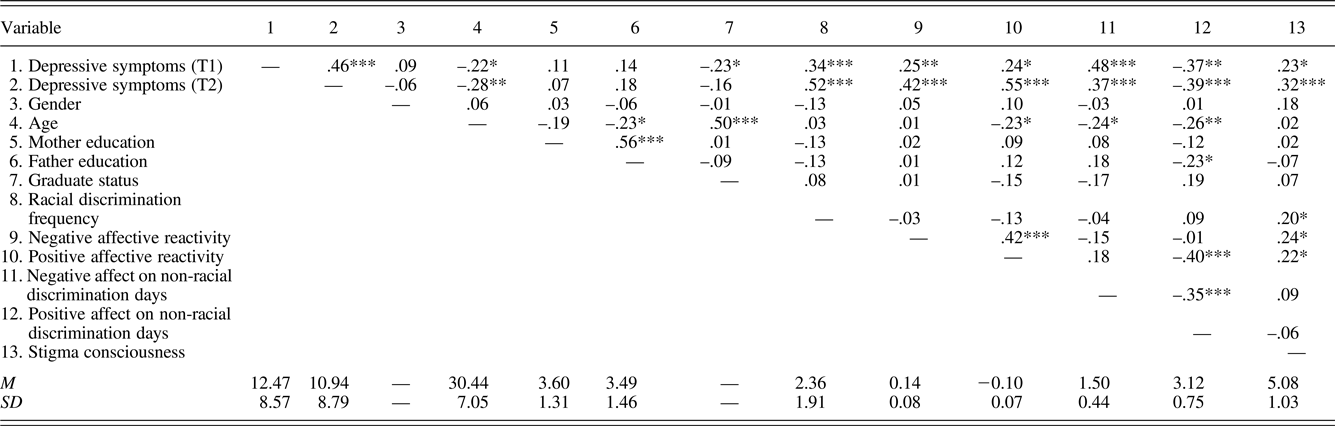
Descriptive statistics and bivariate correlations of study variables are presented in Table 1. Participants reported an average of 2.36 racial discrimination events across the 14 days. People who experienced more frequent racial discrimination tended to have higher Time 1 depressive symptoms (r = .34, p = .0003) and stigma consciousness (r = .20, p = .03). On average, the primary outcome of interest (Time 2 depressive symptoms) was positive associated with racial discrimination frequency (r = .52, p = .00000001), negative affect on non-racial discrimination days (r = .37, p = .00009), stigma consciousness (r = .32, p = .0008), and Time 1 depressive symptoms (r = .46, p = .0000007), respectively. In addition, Time 2 depressive symptoms were correlated with affective reactivity, such that people who had higher depressive symptoms at follow-up tended to experience relatively greater increases in negative affect (r = .42, p = .000007) and decreases in positive affect (r = .55, p =.00000001) on racial discrimination days. Finally, Time 2 depressive symptoms were negatively associated with age and positive affect on non-racial discrimination days, such that people who reported more depressive symptoms at follow-up tended to be younger (r = –.28, p = .003) and have lower positive affect (r = –.39, p = .00004).
Descriptive statistics and correlations of study variables
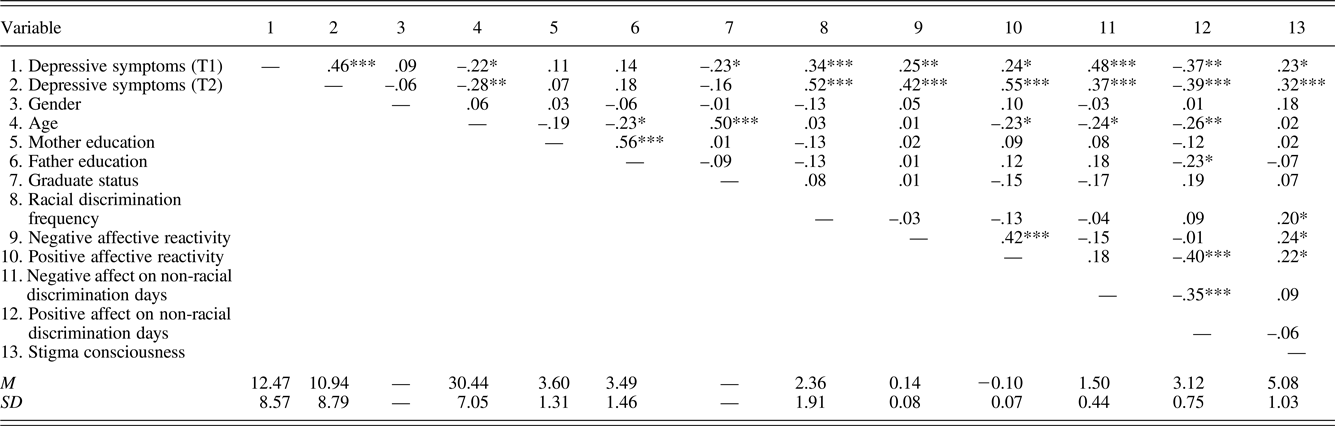
Note: T, time. Racial discrimination frequency, the mean number of racial discrimination reports across the 14 days. Positive affect reactivity was a negative value indicating decreases in positive affect on stressor days. To aid in interpretability, correlation coefficients were multiplied by –1. *p < .05. **p < .01. ***p < .001.
Hypothesis 1: Heightened negative affect reactivity predicts later depressive symptoms
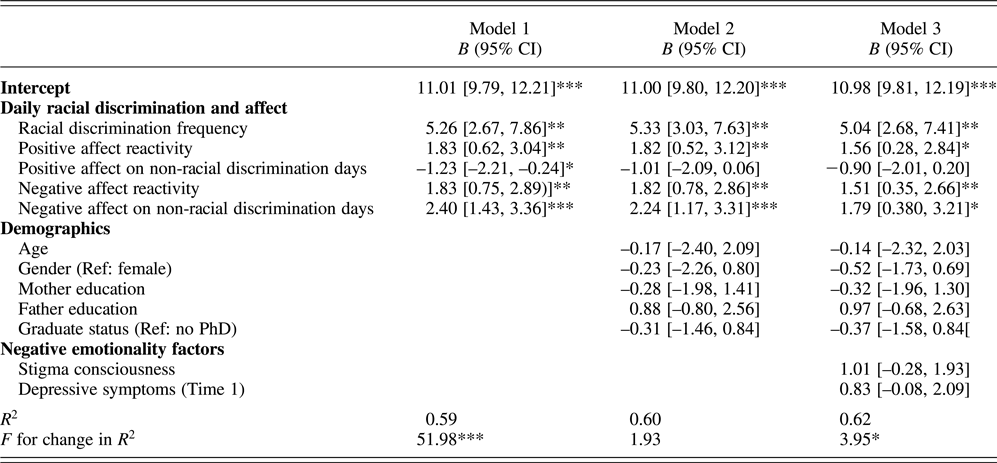
We hypothesized that greater negative affect reactivity to daily racial discrimination would prospectively predict depressive symptoms 1 year later. Table 2 shows the regression results for the relationship between negative affect reactivity and depressive symptoms at follow-up (Model 1). Negative affect reactivity was associated with elevated depressive symptoms at Time 2 (B = 1.83, 95% confidence level; CI [0.75, 2.89], p = .001), controlling for racial discrimination frequency, positive affect reactivity, and mean positive affect and mean negative affect on non-racial discrimination days. Inclusion of demographic characteristics (Model 2) did not attenuate the association between negative affect reactivity and Time 2 depressive symptoms (B = 1.82, 95% CI [0.78, 2.86], p = .001), suggesting that demographic variables were unlikely to have a mediating role. Finally, in the fully adjusted model, the effect of negative affect reactivity (B = 1.51, 95% CI [0.35, 2.66], p = .011) on Time 2 depressive symptoms remained significant even when controlling for Time 1 depressive symptoms and stigma consciousness (Model 3), suggesting that associations between negative affective reactivity and depressive symptoms may not simply be due to initial levels of depressive symptomatology or perceived racial stigma.
Predicting depressive symptoms (Time 2)
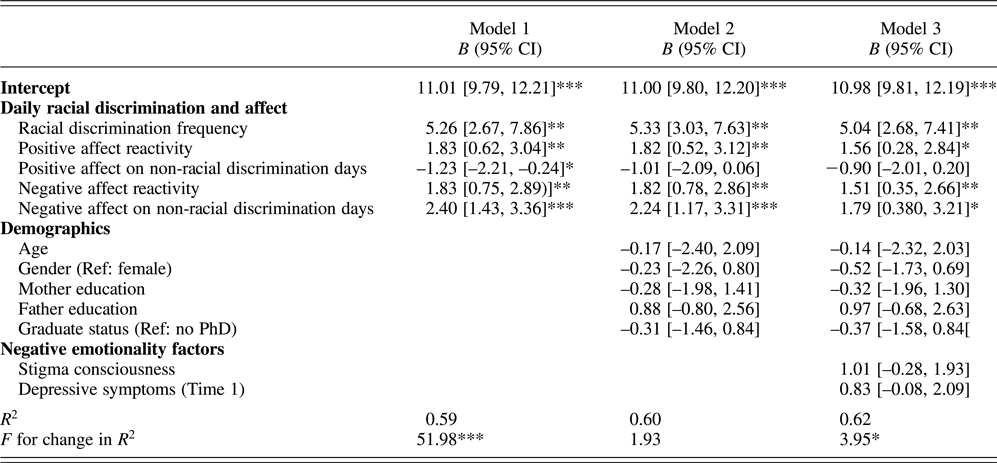
Note: CI, confidence interval. Model parameters are based on pooled estimates from multiple imputation. PA reactivity was a negative value indicating decreases in positive affect on stressor days. To aid in interpretability, correlation coefficients were multiplied by –1. *p < .05. **p < .01. ***p < .001.
Hypothesis 2: Heightened positive affect reactivity uniquely predicts later depressive symptoms
Our second hypothesis evaluated the unique role of positive affect reactivity in the prediction of Time 2 depressive symptoms. As predicted, positive affect reactivity was related to elevated levels of depressive symptoms at Time 2 (B = 1.83, 95% CI [0.62, 3.04], p = .003), independent of racial discrimination frequency, negative affect reactivity, and mean positive affect and mean negative affect on non-racial discrimination days. In other words, individuals who showed marked decreases in positive affect in response to daily racial discrimination had more depressive symptoms at follow-up. This association remained significant even when controlling for demographics (B = 1.82, 95% CI [0.52, 3.12], p = .007) and baseline levels of depressive symptoms and stigma consciousness (B = 1.56, 95% CI [0.28, 2.84], p = .01).
Supplemental analyses
Exploratory analyses tested interactions between affective reactivity and demographic variables as predictors of Time 2 depressive symptoms. Positive and negative affect reactivity variables did not interact with demographic characteristics (i.e., age, gender, and graduate status). We also explored whether the effect of affective reactivity varied as a function of Time 1 depressive symptoms or stigma consciousness. None of the interactions approached statistical significance, suggesting that affective reactivity to daily racial discrimination is predictive of later depressive symptoms regardless of initial levels of depressive symptoms or stigma consciousness.
Discussion
Extensive empirical evidence indicates that exposure and reactivity to racial discrimination is consequential for mental health, particularly among African Americans (for reviews, see Lewis et al., Reference Lewis, Cogburn and Williams2015; Mays, Cochran, & Barnes, Reference Mays, Cochran and Barnes2007; Williams & Williams Morris, Reference Williams and Williams Morris2000). Much of this existing research has utilized single-administration questionnaires. This study was unique in that it employed a novel, dynamic measure of affective reactivity that took into account the covariation between daily racial discrimination and affect. Consistent with prior research (e.g., Bolger & Zuckerman, Reference Bolger and Zuckerman1995; Mroczek et al., Reference Mroczek, Stawski, Turiano, Almeida, Neupert and Spiro2012), we conceptualized affective reactivity as the degree of change in affect in response to daily racial discrimination. Based on recent studies that have directly linked greater reactivity to generic daily stressors with future affective distress (Charles et al., Reference Charles, Piazza, Mogle, Sliwinski and Almeida2013; Cohen et al., Reference Cohen, Gunthert, Butler, O'Neill and Tolpin2005; Parrish et al., Reference Parrish, Cohen and Laurenceau2011), we predicted that individuals with greater negative affect and positive affect reactivity to daily racial discrimination would be vulnerable to the development of depressive symptoms.
As predicted, increased negative affect and positive affect reactivity to daily racial discrimination each independently predicted elevated depressive symptoms 1 year later. Moreover, associations between affective reactivity and later depressive symptoms were independent of daily stressor (discrimination) frequency, typical levels of daily negative affect and positive affect, and individual differences in stigma consciousness, all factors that have been found to be important correlates of depressive symptomatology and racial discrimination in prior studies (Charles et al., Reference Charles, Piazza, Mogle, Sliwinski and Almeida2013; Major & O'Brien, Reference Major and O'Brien2005; Parrish et al., Reference Parrish, Cohen and Laurenceau2011).
Our findings highlight the unique contribution of positive affect reactivity as a prospective predictor of depressive symptoms. The theoretical significance of positive affect in the stress process is well documented (Folkman & Moskowitz, Reference Folkman and Moskowitz2000; Fredrickson, Reference Fredrickson, Plant and Devine2013; Ong, Reference Ong2010; Pressman & Cohen, Reference Pressman and Cohen2005), yet little attention has been paid to how these processes operate in racial and ethnic minority groups (Ong & Edwards, Reference Ong and Edwards2008). Our findings demonstrating that pronounced decreases in positive affect in response to racial daily discrimination is predictive of subsequent depressive symptoms is consistent with recent empirical evidence suggesting that failure to maintain positive affect in the face of daily stressors may be a unique underlying health vulnerability (Mroczek et al., Reference Mroczek, Stawski, Turiano, Almeida, Neupert and Spiro2012; Ong, Exner-Cortens, et al., Reference Ong, Exner-Cortens, Riffin, Steptoe, Zautra and Almeida2013; Sin et al., Reference Sin, Graham-Engeland, Ong and Almeida2015).
Implications for theory and research
Results of the present study have implications for the measurement of discrimination processes in daily experience. To date, daily process studies of racial discrimination have conceptualized affective reactivity as a criterion variable that is moderated by individual differences and contextual factors, such as racial/ethnic identity (Burrow & Ong, Reference Burrow and Ong2010; Torres & Ong, Reference Torres and Ong2010), cultural socialization (Huynh & Fuligni, Reference Huynh and Fuligni2010), and institutional diversity (Seaton & Douglass, Reference Seaton and Douglass2014). In contrast, in the current study, we conceptualized affective reactivity as a traitlike indicator of how individuals characteristically respond to everyday encounters of racial discrimination. Our study builds on previous work linking greater reactivity to generic daily stressors with subsequent depressive symptomatology (Charles et al., Reference Charles, Piazza, Mogle, Sliwinski and Almeida2013; Cohen et al., Reference Cohen, Gunthert, Butler, O'Neill and Tolpin2005; Parrish et al., Reference Parrish, Cohen and Laurenceau2011). Here we demonstrate that value of daily process methodology to measure and test within-person processes (individuals’ affective reactivity to racial discrimination) as theoretical predictors (i.e., vulnerability factors) of later depressive symptoms.
Our findings also have implications for the burgeoning literature on microaggressions and minority mental health. Lilienfeld (Reference Lilienfeld2017) recently called for more systematic research on the potential contaminating influence of stressor exposure and negative emotionality traits (e.g., perceived victimization) in studies of microaggressions or everyday discrimination. Our estimates of within-person slopes for daily racial discrimination and affect appear to be novel measures of affective reactivity that have potential to generate new insights into the dynamic processes that confer depression vulnerability. More generally, to the extent that within-person analysis mitigates potential sources of across-person confounding by using respondents as their own controls (Tennen, Affleck, Armeli, & Carney, Reference Tennen, Affleck, Armeli and Carney2000), the daily process paradigm may provide researchers with new methodological tools for advancing the scientific status of microaggressions research (Ong & Burrow, Reference Ong and Burrow2017).
Implications for prevention and intervention
Understanding how affect regulation in the context of daily racial discrimination shapes vulnerability to depression would also have implications for informing intervention and prevention strategies, especially for African Americans, among whom the accrual of daily experiences of discrimination may accentuate vulnerability to stress-related disease (Fuller-Rowell et al., Reference Fuller-Rowell, Doan and Eccles2012; Hudson et al., Reference Hudson, Bullard, Neighbors, Geronimus, Yang and Jackson2012, 2013). Preventive intervention programs that have been shown to ameliorate risk and bolster protective processes for African Americans provide a unique opportunity to test hypotheses concerning differential responsivity to intervention and prevention programming. For example, in a recent systematic review of data involving psychosocial prevention and interventions for African American youth, Jones and Neblett (Reference Jones and Neblett2016) found evidence for several racial–ethnic protective factors (i.e., racial/ethnic identity and cultural socialization/racial pride) as mechanisms of program effects. Empirical tests of the Strong African American Families Program (Brody et al., Reference Brody, Murry, Gerrard, Gibbons, Molgaard, McNair and Neubaum-Carlan2004), a preventive intervention for rural African American mothers and their children, have documented longitudinal programming effects on parenting practices such as racial socialization, as well as youths’ reports of racial pride (Murry, Berkel, Brody, Gerrard, & Gibbons, Reference Murry, Berkel, Brody, Gerrard and Gibbons2007; Murry et al., Reference Murry, Brody, McNair, Luo, Gibbons, Gerrard and Wills2005; Wills et al., Reference Wills, Murry, Brody, Gibbons, Gerrard and Walker2007). To the extent that idiographic indices of affect regulation capture unique dynamic processes, findings from the current study may also presage a new wave of prevention studies that turn to daily process designs to identify “vantage sensitivity” (Pluess & Belsky, Reference Pluess and Belsky2013) factors that confer disproportionate susceptibility to the benefits of prevention programs.
In terms of clinical work with African Americans students enrolled in graduate degree-granting institutions of higher education, findings from the current study illustrate the necessity for greater awareness concerning the frequency and impact of everyday discrimination. Given that instances of racial discrimination occur in the daily lives of many African Americans (Ong, Williams, Ujuonu, & Gruenewald, Reference Ong, Williams, Ujuonu and Gruenewald2017; Torres, Driscoll, & Burrow, Reference Torres, Driscoll and Burrow2010), they are also likely to occur in the transactions between African American clients and their helping professionals. Therapists and mental health practitioners should recognize that racial discrimination is a lifelong reality in the lives of Africans Americans. Accordingly, efforts to address African American students’ mental health outcomes (e.g., depressive symptomatology) might focus on cognitive and behavioral coping strategies (e.g., seeking social support or religiosity/spirituality) that presumptively lower affective reactivity to racial discrimination. In addition, identifying moderators or cultural protective factors is critical to tracing for whom affective reactivity confers risk for psychopathology (Causadias, Reference Causadias2013). Prior research suggests a number of candidate protective factors that may contribute to stress resilience. These include racial/ethnic identity (Burrow & Ong, Reference Burrow and Ong2010), cultural pride and a sense of purpose (Gaylord-Harden, Burrow, & Cunningham, Reference Gaylord-Harden, Burrow and Cunningham2012), social belonging (Walton & Cohen, Reference Walton and Cohen2011), and religiosity (Utsey, Giesbrecht, Hook, & Stanard, Reference Utsey, Giesbrecht, Hook and Stanard2008). These hypothesized moderators have yet to be empirically investigated in the context of individual differences in affective reactivity to daily racial discrimination.
Limitation and future directions
The current findings should be considered in light of several limitations. Generalizability is limited by the sample on which the daily diary study was conducted. Specifically, our study was restricted to a relatively small sample of highly educated African American doctoral students and recent graduates. Thus, we have suggested that the present sample faces conditions similar to those faced by other African American college students. This assertion has yet to be tested, as does the assumption that the results would be similar in other settings with similar conditions. Although our data cannot tell us the underlying reasons why African Americans with higher levels of educational attainment report more instances of racial discrimination, several possibilities seem plausible. One possibility is that African Americans who have attended college might have a greater awareness of issues of discrimination and racism (Hudson et al., Reference Hudson, Bullard, Neighbors, Geronimus, Yang and Jackson2012). Another possibility is that African Americans with higher levels of educational attainment are more likely than those with less education to attend majority-white institutions where they may encounter more racial prejudice and discrimination (Kessler et al., Reference Kessler, Mickelson and Williams1999; Krieger et al., Reference Krieger, Kosheleva, Waterman, Chen and Koenen2011). For many, such encounters may embody a form of cultural discontinuity (Causadias, Reference Causadias2013; Tyler et al., Reference Tyler, Uqdah, Dillihunt, Beatty-Hazelbaker, Conner, Gadson and Stevens2008), wherein their values, knowledge, and experiences may not be reflected in mainstream educational settings. More research is clearly needed to understand the specific mechanisms underlying discontinuities in cultural processes and their impact on trajectories of adaptive and maladaptive behavior (Causadias, Telzer, & Gonzales, Reference Causadias, Telzer, Gonzales, Causadias, Telzer and Gonzales2018).
In addition, although we conceptualized affective reactivity as a vulnerability marker for subsequent depressive symptoms, in the absence of longitudinal data, it is possible that a reverse association exists whereby high levels of depressive symptoms contribute to increased affective reactivity. Thus, prospective, longitudinal studies with multiple-wave assessments of daily racial discrimination and affect and depressive symptoms are needed to understand the directionality and time course of these relationships (Parrish et al., Reference Parrish, Cohen and Laurenceau2011). Finally, our study relied on participants’ self-reports of racial discrimination and affect that were completed at the end of the day. It is well established the affect varies within and across days (Clark, Watson, & Leeka, Reference Clark, Watson and Leeka1989; Watson, Wiese, Vaidya, & Tellegen, Reference Watson, Wiese, Vaidya and Tellegen1999). Thus, future research should include ecological momentary assessment approaches (Steptoe & Wardle, Reference Steptoe and Wardle2011) that allow for modeling of diurnal and circadian effects of affective processes over time. Likewise, because the occurrence of any life change requires some type of readjustment (Monroe & McQuaid, Reference Monroe, McQuaid, Gotlib and Avison1994), studies that go beyond consideration of subjective reactions to everyday discrimination to include coverage of physiological responses and behavioral measures remain a high priority for future research (Lau & Williams, Reference Lau, Williams and Sue2010; Ong & Williams, Reference Ong and Williamsin press; Ong et al., Reference Ong, Williams, Ujuonu and Gruenewald2017).
Our study used a unidimensional measure of daily racial discrimination. Williams and Williams Morris (Reference Williams and Williams Morris2000) called for more systematical research characterizing the multiple dimensions of racism (e.g., residential segregation and institutional discrimination). Similarly, Sue's (Reference Sue, Capodilupo, Torino, Bucceri, Holder, Nadal and Esquilin2007) taxonomy of racial microaggressions has potential implications for education and training. Recent qualitative work suggests that microaggressions involving assumptions of criminality status (belief a group is more prone to crime), intellectual inferiority (assigning low intelligence on the basis of race), and second-class citizenship (treating others as lesser beings) are common themes that emerged in studies with African American graduate students (Sue, Capodilupo, & Holder, Reference Sue, Capodilupo and Holder2008; Sue, Nadal, et al., Reference Sue, Nadal, Capodilupo, Lin, Torino and Rivera2008). Future studies should, therefore, employ more detailed, multidimensional assessments of daily racial discrimination in an effort to probe their potential unique underlying processes. Similarly, specific affective responses to daily stressors do not emerge in isolation from historical context. For African Americans, heighted affective reactivity to daily encounters of discrimination may reflect an embedded history of stressor exposure (Mays et al., Reference Mays, Cochran and Barnes2007; Williams & Mohammed, Reference Williams and Mohammed2009). Personal histories of stressor exposure may occur at different points across the life course (early life traumas, cumulative stressor exposure during adulthood, and current chronic stressors). Crucially needed are studies that integrate personal histories of stress exposure and daily stress processes to better understand how racial discrimination impacts long-term health and well-being.
Finally, although the results of the present study indicate that heighted affective reactivity to daily racial discrimination may be one mechanism by which depression vulnerability is expressed, it may also be slow or prolonged recovery from daily discrimination that portends risk. The larger literature on stress and cardiovascular risk indicates that the rate of cardiovascular recovery following laboratory stress is as important as the magnitude of cardiovascular reactivity in signaling vulnerability to disease (Chida & Steptoe, Reference Chida and Steptoe2010; Steptoe & Marmot, Reference Steptoe and Marmot2006). A recent study of affective responses to naturally occurring daily stressful events suggests that higher levels of lingering negative affect that result from daily stressors (delayed recovery) were associated with increases in chronic conditions and functional limitations nearly 10 years later (Leger, Charles, & Almeida, Reference Leger, Charles and Almeida2018). Future daily process studies building on this work are needed to confirm the extent to which individual differences in delayed affective recovery from daily racial discrimination uniquely influences minority mental and physical health, independent of affective reactivity and amount of daily stressor exposure.
Conclusion
Findings from the present study are among the first to demonstrate associations between affective reactivity to racial discrimination in daily life and future depressive symptoms in African American graduate and postgraduate students. The results extend prior between-person research by providing ecologically valid evidence of within-person contingencies between affective reactivity and the development of depressive symptoms. Our findings indicate unique relationships between depressive symptoms and positive affect and negative affect reactivity, suggesting that these two factors might represent distinct dynamic processes that may confer increased vulnerability to depression. Overall, replication of these relationships using larger, demographically diverse samples would provide greater confidence in the generalizability of the findings.