Introduction
Recently, the study of the genus Micarea has again attracted the attention of lichenologists. This is because the production of molecular sequences and phylogenetic reconstructions has revealed greater diversity in Micarea, including in Europe and Macaronesia (Czarnota & Guzow-Krzemińska Reference Czarnota and Guzow-Krzemińska2010; van den Boom & Ertz Reference van den Boom and Ertz2014; Guzow-Krzemińska et al. Reference Guzow-Krzemińska, Czarnota, Łubek and Kukwa2016), and because a significant number of new species continue to be described from all parts of the world (van den Boom Reference van den Boom2010; Sérusiaux et al. Reference Sérusiaux, Brand, Motiejunaite, Orange and Coppins2010; Svensson & Thor Reference Svensson and Thor2011; Câceres et al. Reference Cáceres, Mota, de Jesus and Aptroot2013; Aptroot & Câceres Reference Aptroot and Cáceres2014; Brand et al. Reference Brand, van den Boom and Sérusiaux2014; Córdova-Chávez et al. Reference Córdova-Chávez, Aptroot, Castillo-Camposa, Cáceres and Pérez-Pérez2014; McCarthy & Elix Reference McCarthy and Elix2016). In Europe, the genus was investigated in a major revision (Coppins Reference Coppins1983) and was further studied at a smaller scale by Coppins (Reference Coppins2009) for Great Britain and Ireland, and Czarnota (Reference Czarnota2007) for Poland.
The M. prasina group is known to be very variable and was suspected of containing additional species (Coppins Reference Coppins1983). Several studies dealing with collections within Europe (Czarnota & Guzow-Krzemińska Reference Czarnota and Guzow-Krzemińska2010; Guzow-Krzemińska et al. Reference Guzow-Krzemińska, Czarnota, Łubek and Kukwa2016) and outside Europe (Barton & Lendemer Reference Barton and Lendemer2014; Brand et al. Reference Brand, van den Boom and Sérusiaux2014) have shown that it represents a complex assemblage of species that is yet to be properly disentangled. Based on morphological, anatomical, chemical and molecular evidence, our study of the material belonging to that group available to us from Europe yielded evidence of two undescribed species. They are formally described in this paper.
Material and Methods
The material examined was collected by the authors in Belgium, France, Germany, the Netherlands, Portugal, Romania and Spain (Canary Islands, Tenerife). Anatomical measurements were made on material mounted in dilute KOH for conidia and paraphysis width, and in water for all other characters. In each collection, c. 10 well-developed ascospores representing the size and shape variation detected, conidia and paraphyses were measured with a precision of 0·1 µm using camera lucida drawings. For thallus description, we refer to Coppins (Reference Coppins1983) for the use of areolate- and goniocyst-type, the latter being “a finely granular thallus, composed of discrete, ± globular structures, mostly c. 12–40 µm diam., these ecorticate granules consist of clustered algal cells intertwined and surrounded by short-celled hyphae, and never protected by an amorphous covering layer”.
Chemical compounds were studied using several methods: response to UV light, melting point determination, microcrystallization and thin-layer chromatography (TLC) using solvent system A (toluene/1,4-dioxane/acetic acid 180:45:5) for all collections and C (toluene/acetic acid 170:30) when gyrophoric acid was suspected (Huneck & Yoshimura Reference Huneck and Yoshimura1996; Orange et al. Reference Orange, James and White2010), in both cases visualization of spots was achieved with sulphuric acid sprayed over the plates, followed by heating at 110 °C for c. 5 min.
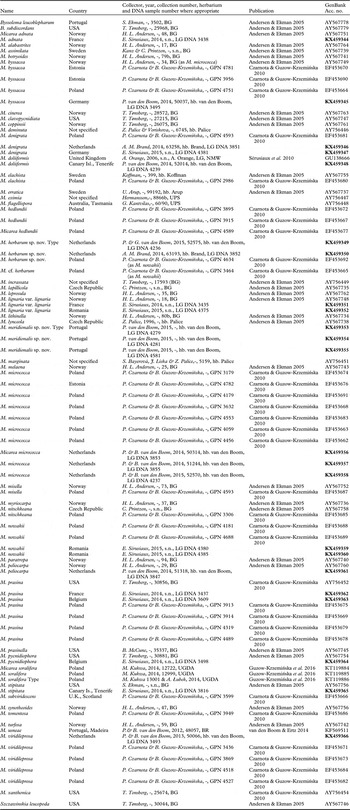
Well-preserved specimens lacking any visible symptoms of fungal infection were selected for DNA isolation. Extraction of DNA and PCR amplification were performed following the protocol of Cubero et al. (Reference Cubero, Crespo, Fatehi and Bridge1999). We used the primers mrSSU1 and mrSSU3R (Zoller et al. Reference Zoller, Scheidegger and Sperisen1999) for the production of mtSSU sequences. Amplicons were sequenced by Macrogen®. Sequence fragments were assembled with Sequencher version 5.2.3 (Gene Codes Corporation, Ann Arbor, Michigan). Sequences were then subjected to MEGABLAST searches to detect potential contamination. They were included in a single matrix together with data extracted from GenBank, published in Andersen & Ekman (Reference Andersen and Ekman2005), Czarnota & Guzow-Krzemińska (Reference Czarnota and Guzow-Krzemińska2010), Guzow-Krzemińska et al. (Reference Guzow-Krzemińska, Czarnota, Łubek and Kukwa2016) and van den Boom & Ertz (Reference van den Boom and Ertz2014). We chose Byssoloma leucoblepharum and B. subdiscordans as outgroup following the topology obtained for the Pilocarpaceae by Miadlikowska et al. (Reference Miadlikowska, Kauff, Högnabba, Oliver, Molnár, Fraker, Gaya, Hafellner, Hofstetter and Gueidan2014). Accession data are included in Table 1. Sequences were aligned manually using MacClade version 4.08 (Maddison & Maddison Reference Maddison and Maddison2005) and alignment was checked with the MAFTT software (Katoh & Standley Reference Katoh and Standley2013). Ambiguous regions were delimited using the online version of Gblocks v0.91b (Castresana Reference Castresana2000) at http://molevol.cmima.csic.es/castresana/Gblocks.html, allowing for gap positions within the final blocks, and carefully checked manually. The aligned matrix is available from the corresponding author on request. We inferred the maximum likelihood tree and bootstrap support values based on 1000 pseudoreplicates in the same run using RAxML HPC2 version 7.2.8 (Stamatakis Reference Stamatakis2006; Stamatakis et al. Reference Stamatakis, Hoover and Rougemont2008) with the GTRCAT model and the default settings as implemented on the CIPRES portal (Miller et al. Reference Miller, Pfeiffer and Schwartz2010). Phylogenetic trees were visualized using FigTree v1.2.3 (Rambaut Reference Rambaut2009). Branch support values were considered significant when ML bootstrap (BS)>70%. We included in our accessions for molecular inferences other specimens besides those belonging to the two species described here as new, for the following reasons: 1) we wished to assess the only phylogenetic tree available for the genus with further data (Andersen & Ekman Reference Andersen and Ekman2005); 2) we suspect that Micarea is more complex in other groups than the prasina group and we wished to test this hypothesis.
Specimens and GenBank Accession numbers used in this study with their respective voucher information. New sequences in bold

Results
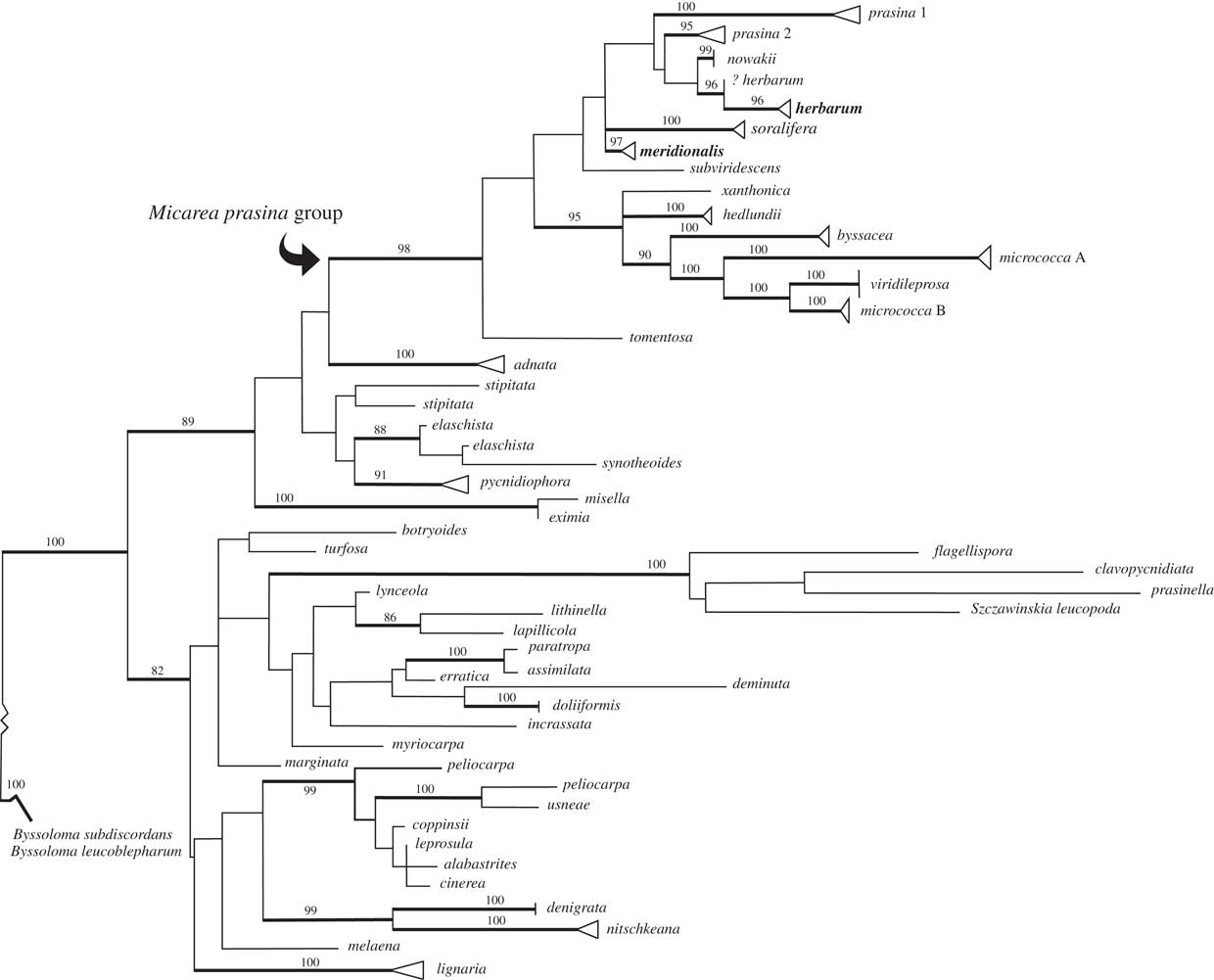
The data matrix includes 21 mtSSU sequences newly produced for the following species: M. adnata, M. byssacea, M. denigrata, M. doliiformis, M. herbarum, M. lignaria var. lignaria, M. meridionalis, M. nowakii, M. micrococca, M. prasina, M. pycnidiophora, M. stipitata and M. viridileprosa. The single most-likely tree (Fig. 1) resolves two strongly supported clades within Micarea. Both species newly described in this paper are resolved within a single clade and more precisely within a strongly supported (BS=98) subclade including all accessions of the M. prasina group (Coppins Reference Coppins1983, Reference Coppins2009; Czarnota Reference Czarnota2007; Czarnota & Guzow-Krzemińska Reference Czarnota and Guzow-Krzemińska2010; Guzow-Krzemińska et al. Reference Guzow-Krzemińska, Czarnota, Łubek and Kukwa2016). Within that subclade the resolution is poor, except for a strongly supported group comprising M. byssacea, M. hedlundii, M. micrococca A and B (sensu Czarnota & Guzow-Krzemińska Reference Czarnota and Guzow-Krzemińska2010), M. viridileprosa and M. xanthonica.
Most-likely phylogenetic tree for species of Micarea obtained from mtSSU sequences. Branches in bold are those that obtained ML bootstrap support >70% and are indicated above branches. New species are in bold.
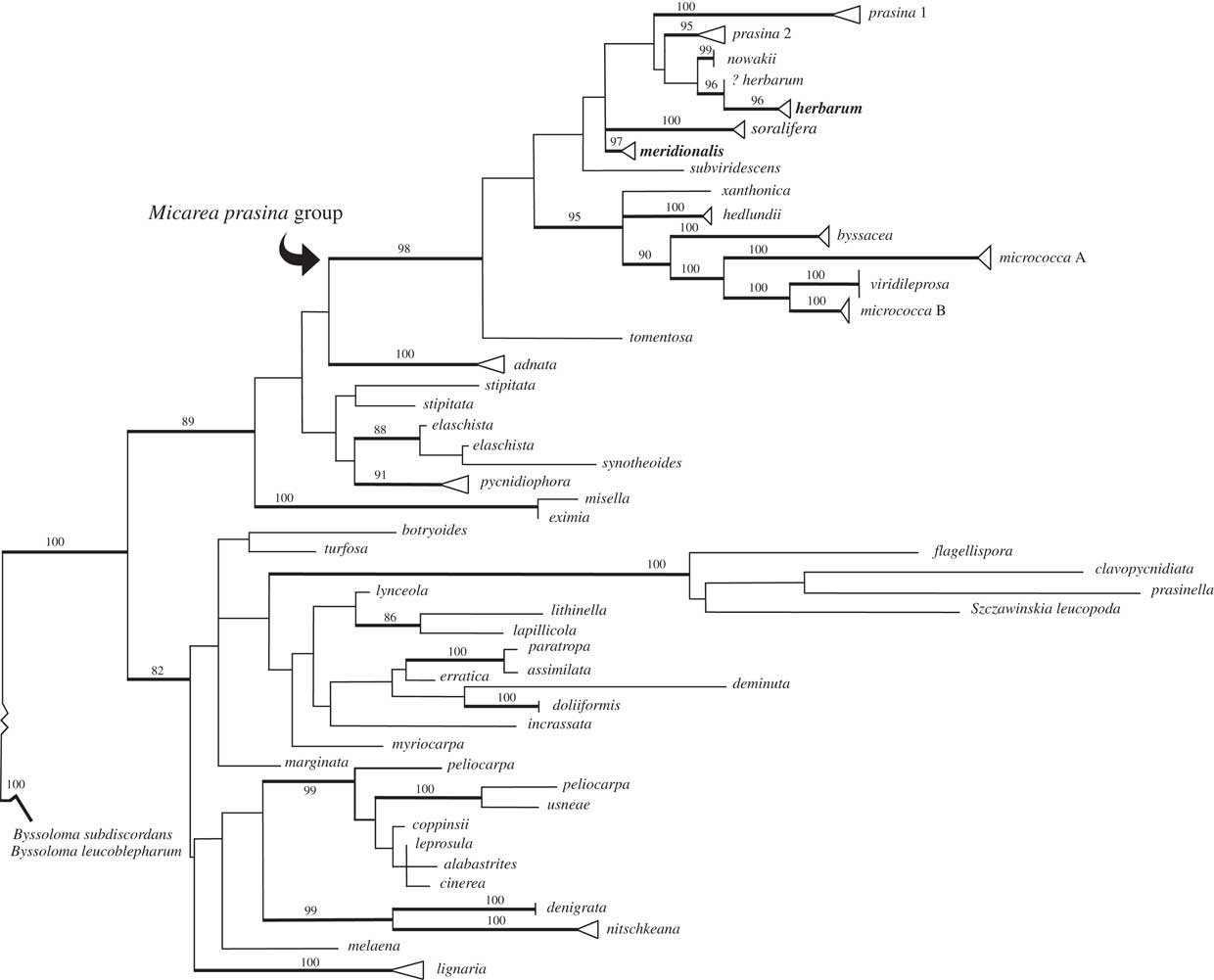
Our new accessions of M. nowakii from Romania are identical to two accessions of the same species from Poland (Czarnota & Guzow-Krzemińska Reference Czarnota and Guzow-Krzemińska2010). In two further accessions of the same species, also from Poland, one is resolved as nearly identical to M. herbarum sp. nov., and the other as sister to accessions of the same species.
All accessions of M. prasina from Poland (Czarnota & Guzow-Krzemińska Reference Czarnota and Guzow-Krzemińska2010) are resolved as a lineage (as ‘prasina 1’ in Fig. 1) separate to those from Belgium, France and the USA (as ‘prasina 2’ in Fig. 2); thus two cryptic species might be involved and require further study. Within the M. prasina group, our sequence of M. byssacea is nearly identical to those referred to that species by Czarnota & Guzow-Krzemińska (Reference Czarnota and Guzow-Krzemińska2010), our sequence of M. viridileprosa is identical to those of Czarnota & Guzow-Krzemińska (Reference Czarnota and Guzow-Krzemińska2010) and finally, our sequences of M. micrococca belong to M. micrococca “A” of Czarnota & Krzemińska (Reference Czarnota and Guzow-Krzemińska2010). While our sequences of M. adnata, M. denigrata, M. doliiformis, M. lignaria var. lignaria, M. nitschkeana and M. pycnidiophora are almost identical to those retrieved from GenBank, this is not the case for M. peliocarpa and M. stipitata. Indeed, our accession of M. peliocarpa from the Netherlands is resolved with strong support as closely related to the recently described M. usneae from Madeira (van den Boom & Ertz Reference van den Boom and Ertz2014) while the sequence from Norway (Andersen & Ekman Reference Andersen and Ekman2005) is quite different (26 substitutions for the mtSSU sequence). The same applies to our sequences for M. stipitata from Tenerife (Canary Islands) which differ by 22 substitutions from the sequence from the USA retrieved from GenBank (Andersen & Ekman Reference Andersen and Ekman2005). Thus, our limited sampling illuminates the rather poorly known diversity within Micarea.
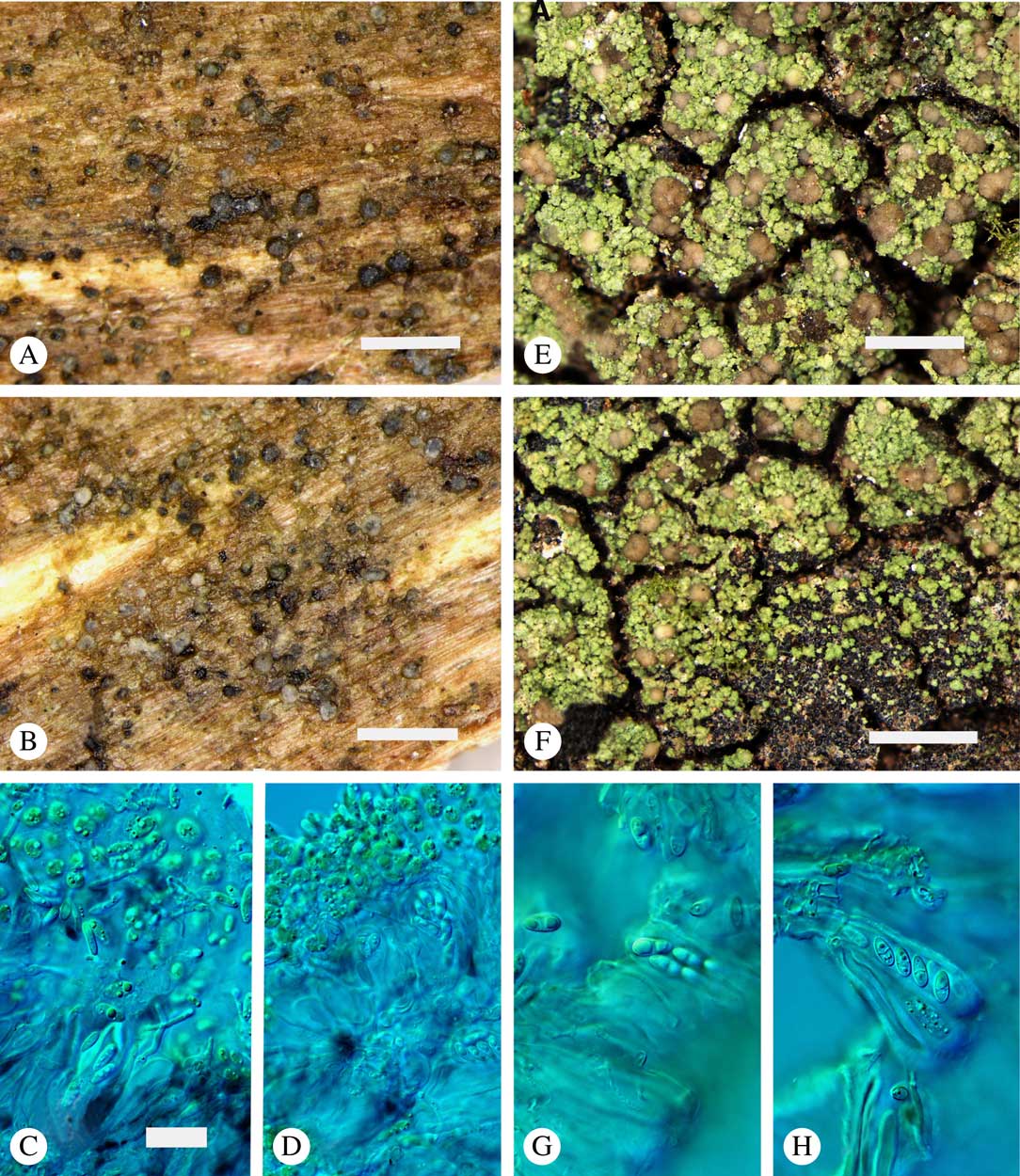
Micarea herbarum and M. meridionalis. A–D, Micarea herbarum (holotype); A & B, habitus; C & D, ascospores with green algal cells growing over the hymenium. E–H, Micarea meridionalis (holotype); E & F, habitus; G & H, ascospores. Scales: A, B, E & F=0·5 mm; C, D, G & H=20 µm. In colour online.
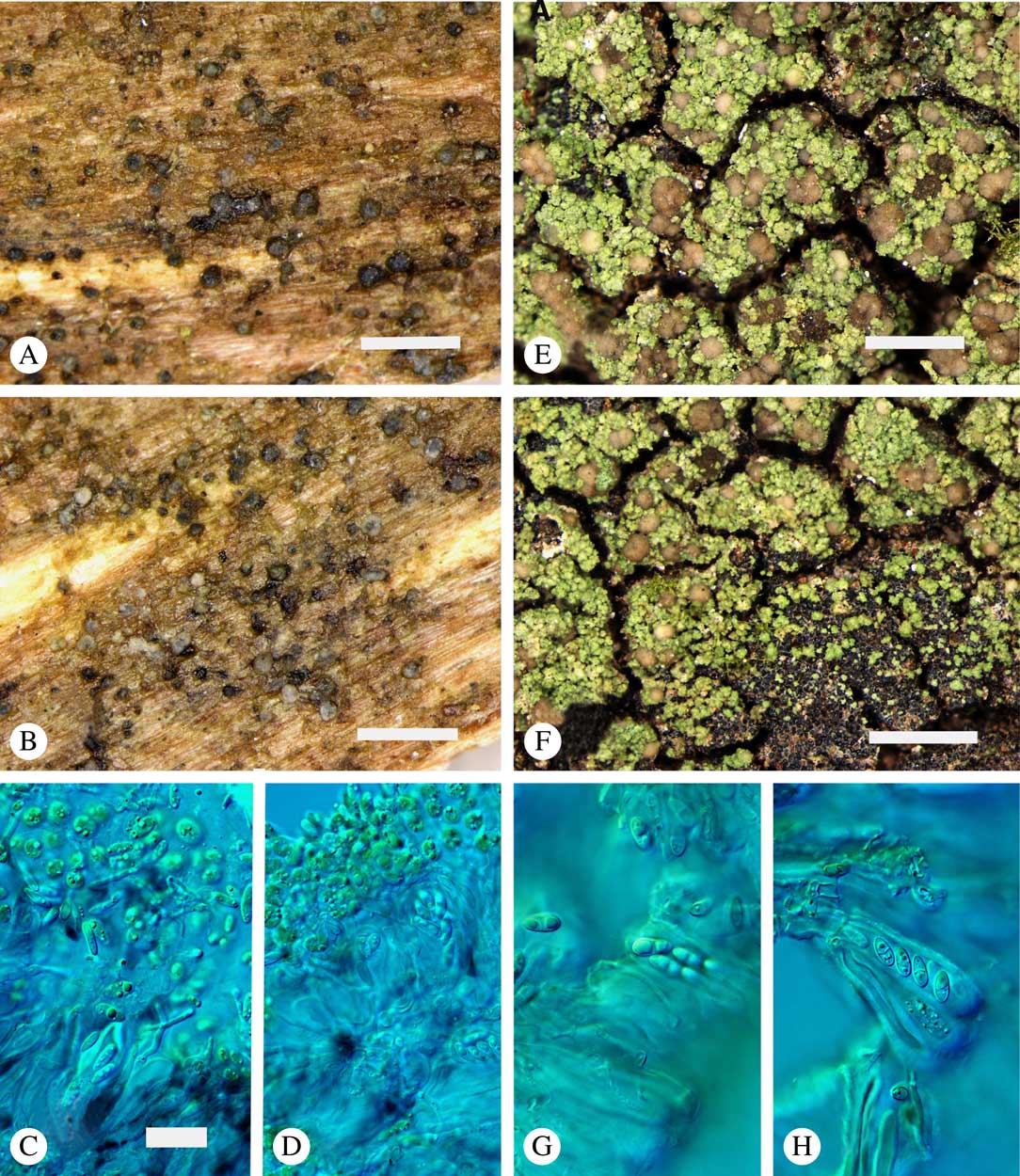
Morphological, anatomical and chemical results are included in the description of both new species.
Taxonomy
Micarea herbarum Brand, Coppins, Sérus. & van den Boom sp. nov.
MycoBank No.: MB 811051
Species inconspicuous, with a very thin thallus comprised of small greenish, flattened or slightly convex areoles, and often covered by a thin film of gelatinous green algal cells. Apothecia abundant, dark brown to black, 0·15–0·25 mm diam., immarginate. Ascospores ellipsoid, 6·5–9·7×2·0–2·6 µm, (0–)1-septate. Pigment Sedifolia-grey, K+ violet. Mesopycnidia often abundant; mesoconidia shortly bacilliform, 3·8–6·1×1·0–1·2(–1·3) µm. No secondary compounds detected.
Type: the Netherlands, Noord-Brabant, S of Oirschot, S rim of Oirschotse Heide, Pinus-Quercus forest with many fallen trunks of Quercus, on wood of fallen trunk, TDN grid ref. 51.33.42, 22 January 2015, P. & B. van den Boom 52575 (LG—holotype; hb. v.d. Boom–isotype).
(Fig. 2A–D)
Thallus very thin, consisting of small greenish, flattened or slightly convex areoles, less than 0·1 mm diam., with crystals, often partly coated by a thin gelatinous film of green algal cells. Photobiont micareoid, 6–8 µm diam., thin-walled, clustered in compact masses.
Apothecia abundant, subglobose, immarginate, 0·15 to 0·25 mm diam., dark brown to black. Hymenium c. 30–40 µm high; epihymenium with dark green-brown (K+ violet) spots; paraphyses sparse, branched, c. 1·2–1·4 µm wide. Hypothecium hyaline. Asci 20–28×7–12 µm. Ascospores ellipsoid, 6·5–9·7×2·0–2·6 µm, (0–)1-septate.
Mesopycnidia often abundant, c. 40–80 µm, top dark greenish grey (K+ violet), formed inside a thallus granule, or outside of the lichenized thallus in the gelatinous matrix of free algal cells. Mesoconidia shortly bacilliform, rarely obovoid, 3·8–6·1×1·0–1·2(–1·3) µm, non-septate.
Chemistry. No chemical compounds; pigment Sedifolia-grey (Meyer & Printzen Reference Meyer and Printzen2000), K+ violet.
Etymology. The epithet chosen for this species refers to a quite unusual habitat (decaying herbs) on which it has been found several times.
Habitat and distribution. On soft and decaying wood, on standing dead trunks, on dead and wet stems of herbaceous plants, or directly on soil. In the Netherlands, accompanying species on decaying wood include Absconditella sp., Micarea micrococca and Placynthiella dasaea, and on soil Absconditella fossarum and Thelocarpon lichenicola. It is distributed throughout the Netherlands, and has been detected in one collection from Poland, filed under the recently described M. nowakii (Czarnota Reference Czarnota2007). In the latter collection, it grows on decorticated wood with M. denigrata and M. misella. The species is very inconspicuous, and can be easily overlooked because it is frequently covered with gelatinous algal cells. No doubt it will be found in other European countries.
Notes. In the monograph and revisions of the genus in Europe (Coppins Reference Coppins1983, Reference Coppins2009; Czarnota Reference Czarnota2007), this new species would key out as Micarea denigrata if no chemical test for gyrophoric acid is performed. Indeed, it looks like a small or depauperate M. denigrata, a common and highly polymorphic species, but clearly differs by the lack of gyrophoric acid and the shorter mesoconidia in M. denigrata (3·0–4·2(–5·0)×1·4–1·8(–2·0) µm, fide Czarnota Reference Czarnota2007). We interpret the conidia produced by our new species as mesoconidia as they originate in rather large pycnidia and they are regularly bacilliform (rarely obovoid) in shape, and thus akin to the mesoconidia produced by M. denigrata. No validly published epithet reduced into synonymy with this species in Coppins (Reference Coppins1983) can be assigned to the new species. Micarea misella might also be confused with this species and differs mainly by its simple ascospores. In addition, M. denigrata and M. misella are resolved outside the M. prasina clade in which M. herbarum is nested with strong support. Phylogenetic inferences from mtSSU sequences position M. herbarum in an unsupported clade within the strongly supported M. prasina group, together with both lineages referred to as M. prasina and M. nowakii, a species described from Poland (Czarnota Reference Czarnota2007). M. nowakii was segregated from M. denigrata and M. misella based on the production of micareic acid (vs gyrophoric acid or no substances for the other two, respectively). Compared with M. herbarum, M. nowakii has slightly smaller ascospores (0(–1)-septate, 6·0–8·0(–8·5)×2·0–3·0(–3·2) µm fide Czarnota Reference Czarnota2007) and shorter and wider mesoconidia (3·5–4·0×1·5–1·8 µm fide Czarnota Reference Czarnota2007).
The position of the two accessions of M. herbarum in our phylogenetic tree points to a relationship between M. herbarum and M. nowakii, or even that M. herbarum cannot be distinguished from M. nowakii. Among the mtSSU sequences published by Czarnota & Guzow-Krzemińska (Reference Czarnota and Guzow-Krzemińska2010) for M. nowakii, one accession (Poland, P. Czarnota 4634, GPN) is resolved with strong support as closely related to M. herbarum. We found that this collection represents M. herbarum (no micareic acid detected by TLC); a further collection (Poland, P. Czarnota 3464, GPN) might represent either a further species in that group, or a variant of M. herbarum. In fact, this collection does not have apothecia but only pycnidia; no crystals of any lichen substance could be detected by microcrystallization and the phylogenetic tree resolved it as sister with all accessions referred to M. herbarum.
Micarea melanobola (Nyl.) Coppins is a species so far known only from the type collection in Finland, collected in 1866 (Coppins Reference Coppins1983). Although it has been reduced into synonymy with M. prasina by Czarnota (Reference Czarnota2007), we suspect this species to be close to M. nowakii and thus to M. herbarum. Indeed, M. melanobola has paraphyses with “apices thickened with greenish (K+ violet) pigment and up to 1·7 µm wide overtopping the tops of asci” (Coppins Reference Coppins1983), a typical feature that seems to be quite similar to the paraphyses of M. nowakii described with “apices, thickened to 2–2·5 µm and dull olive pigment”, said to react K+ violet (legend to fig. 46 in Czarnota Reference Czarnota2007). The chemistry of the type of M. melanobola could not be studied for lack of material (Coppins Reference Coppins1983). The genuine identity of the type material of M. melanobola should therefore be re-evaluated.
It is worth mentioning that M. herbarum is the first species within the prasina group that does not produce any secondary compounds other than the pigment present in apothecia.
The biology of M. herbarum sp. nov. is remarkable, as it very often grows over or within a gelatinous film of green algal cells. Hyphae connected with the apothecia and pycnidia penetrate into this layer. Furthermore, these unknown algae can penetrate into the subhymenium of the Micarea apothecia.
Specimens examined. The Netherlands: Groningen: 1·8 km N van Sellingen, E bank of Ruiten Aa, N of bridge near Rijsdam, 52°57·8'N, 7°8·6'E, open area, loamy soil recently scraped, 1999, M. Brand 39768 (hb. Brand). Overijssel: Hardenberg, Rheezerveen, Klimberg, 52°34·8'N, 6°32·9'E, dead wood in forest, 2010, M. Brand 61133 (hb. Brand). Noord-Holland: Santpoort, Duin en Kruidberg, tank ditch between Argus and Westerveld, 52°26·6'N, 4°37·4'E, open forest in dune area, wood of Populus alba branches, 2014, M. Brand 63193 (hb. Brand). Zuid-Holland: Zoetermeer, Sprinterpad, N of Westerpark, 52°3·6'N, 4°26·7'E, rotting wood of dead Populus trunks, 2010, M. Brand 60950 (hb. Brand). Gelderland: Vierhouten, Elspeetsche Heide, W of bicycle trail, 52°18·6'N, 5°48·5'E, rotting wood in heathland, 1999, M. Brand 39206 (hb. Brand); Heerde, Sprengen, 52°23·9'N, 6°0·2'E, wood of bridge in forest, 1973, M. Brand 3254 (hb. Brand); Garderen, Speulderbos, 14 m E of Dodenweg, 52°14·65'N, 5°41·53'E, dead wood of fallen Fagus in forest, 1998, M. Brand 37726 (hb. Brand). Zeeland: Tholen, recently reclaimed area between Slaakdam and Haaftenpolder, S side, 51°36·3'N, 4°10·8'E, twigs in open grass vegetation, 1983, M. Brand 33842 (hb. Brand). Noord-Brabant: E of Oirschot, Oirschotse Heide, N side of secondary road to Oirschot, Pinus forest and edge of Calluna heathland with some Quercus robur trees, 51°30'N, 5°21'E, wood of fallen trunk, 2014, P. & B. van den Boom 52533 (hb. v.d. Boom). Limburg: Weert, Kolenhofweg, 1 km NE of Mildert, 51°14·6'N, 5°48·3'E, rotting wood of trunk in young Pinus plantation, 2000, M. Brand 41201 (hb. Brand); Swalmen, 2 km NE, Boschheide, 51°14·4'N, 6°3·7'E, recently partly scraped Calluna heathland, 1992, M. Brand 29016 (hb. Brand); E of Wanssum, NE of Wellerlooi, De Hamert, open Pinus forest with Calluna heathland, a few scattered Pinus strobus trees and fallen trunks, 51°32·7'N, 6°08·6'E, dead wood of fallen P. strobus, 2015, P. & B. van den Boom 53197 (hb. v.d. Boom).—Poland: Pojezierze Lubuskie Lakeland, S of Motski Village, 52°14'42''N, 15°22'14''E, on wooden fence in well-lit place near the edge of pine forest, 2005, P. Czarnota 4634 (GPN).
Micarea meridionalis van den Boom, Brand, Coppins & Sérus. sp. nov.
MycoBank No.: MB 811050
Thallus areolate, areoles subglobose to irregularly flattened, 40–100 µm diam., pale to medium greenish, or greenish grey to pale brownish; apothecia abundant, 0·10–0·30(–0·35) mm diam., pale to dark brownish grey; ascospores ellipsoid, 1(–3)-septate, 8·0–9·4×3·4–4·0 µm; mesopycnidia often present, 50–70 µm diam.; mesoconidia 5·8–6·7×1·0–1·2 µm, bacilliform to fusiform. Thallus and apothecia with micareic acid.
Type: Portugal, Alentejo, ESE of Odemira, c. 4 km E of Santa Clara-a-Velha, near storage lake (W side), Pinus forest, 37°30·90'N, 8°26·66'W, 150 m, 16 February 2015, on Pinus, P. & B. van den Boom 52904 (LG—holotype; hb. Brand, hb. v.d. Boom—isotypes).
(Fig. 2E–H)
Thallus ± effuse, up to 4 cm wide, appearing granular, with ecorticate areoles, 40–100 µm diam., subglobose to irregularly flattened, coalescing and forming a continuous crust or scattered patches; upper surface usually smooth, pale to medium greenish, or greenish grey to brownish grey to pale brown, matt to slightly shiny, up to 20 µm thick, mostly thinly coated by gelatinous algae, fine crystals present; rarely forming soredioid structures consisting of loose goniocysts 10–14 µm in diam. Photobiont micareoid, algal cells globose, 4–6 µm diam., thin-walled, clustered in compact masses.
Apothecia 0·10–0·30(–0·35) mm diam., abundant, scattered, sometimes tuberculate, immersed to semi-immersed in thallus granules and thus seemingly marginate, because of thallus parts present on the edge of apothecium, eventually becoming immarginate; disc beige or pale to dark brownish grey, never black, slightly to moderately convex, a few crystals sometimes seen in apothecium section. Hymenium hyaline, 40–50 µm high, with spots pale greyish brown, K+ violet, N+ reddish; excipulum in young apothecia hardly distinct, up to 10 µm wide; paraphyses abundantly branched, c. 1·2 µm wide, tips not or sometimes slightly widened, up to 1·5 µm, not pigmented; epithecium olive-greenish, K+ violet, N+ reddish; hypothecium hyaline. Asci slightly clavate, 35–40×8–10 µm, 8-spored. Ascospores ellipsoid, 1(–3)-septate, 8·0–9·4×3·4–4·0 µm.
Macropycnidia very rare, c. 50 µm diam., hyaline but top greyish; macroconidia 15–17×1·1–1·3 µm, 1-septate, slightly curved. Mesopycnidia often present, immersed, 50–70 µm diam., hyaline; mesoconidia bacilliform to fusiform, 5·8–6·7×1·0–1·2 µm.
Chemistry. Thallus and apothecia K−, C−, KC−, P−; micareic acid detected by TLC in thallus and apothecia; pigment Sedifolia-grey (Meyer & Printzen Reference Meyer and Printzen2000), K+ violet.
Etymology. The epithet chosen for this species refers to its southern distribution in Europe.
Habitat and distribution. Micarea meridionalis is known from several localities in western Portugal, in lowland and maritime areas, in the Alentejo, Estremadura and Lisboa provinces, between 39°40'N and 37°30'N. In these localities it is a corticolous species, in ruderal and even dusty environments including parklands and roadsides; it has been found on indigenous or planted tree species such as Acacia longifolia, Eucalyptus, Pinus, Morus, Nerium oleander and Thuja. On Acacia longifolia, accompanying species include Arthonia pruinata, Cliostomum griffithii, Coenogonium tavaresiana, Hyperphyscia adglutinata, Lecania naegelii and Lecanora lividocinerea. Diploicia canescens, Waynea stoechadeana, Candelariella reflexa and Physconia grisea are further associated species found growing together. Two further collections have also been found from Calabria/Italy: here the species grows on Pinus trees at sea level in unknown ecological conditions. Further north it is known from the Botanical Garden of Rome in the city centre on Acanthosyris spinescens and Quercus pubescens, and within the urban area of Rome on Quercus suber in a small remnant of semi-natural forest.
Notes. Micarea meridionalis is resolved within the M. prasina clade with strong support but its relationships within it are unclear. It is easily distinguished by its granular thallus and the production of micareic acid. The only other Micarea species that produce micareic acid are M. nowakii, M. prasina s. str. and M. soralifera (Czarnota Reference Czarnota2007; Czarnota & Guzow-Krzemińska Reference Czarnota and Guzow-Krzemińska2010; Guzow-Krzemińska et al. Reference Guzow-Krzemińska, Czarnota, Łubek and Kukwa2016). In addition to the typical granular thallus, M. meridionalis can be distinguished from M. nowakii by its longer mesoconidia (3·5–4·0×1·5–1·8 µm for M. nowakii, fide Czarnota (Reference Czarnota2007)) and from M. prasina s. str. by its shorter ascospores ((6–)8–12(–14)×(2·5–)3·0–4·0(–5·5) µm for M. prasina s. str., fide Czarnota (Reference Czarnota2007)). Micarea soralifera has similar granular areoles to M. meridionalis, but is distinguished by its distinct, mostly discrete soralia. Furthermore, the ecology of M. meridionalis is much more ruderal and eutrophic than M. nowakii, M. prasina s. str. and M. soralifera, all of which prefer more acidic and nutrient-poor substrata.
No validly published epithet reduced into synonymy with M. prasina in the monograph and revisions of the genus in Europe (Coppins Reference Coppins1983, Reference Coppins2009; Czarnota Reference Czarnota2007) can be assigned to the new species.
Specimens examined. Portugal: Estremadura: E of Caldas da Rainha, road to Santa Catarina, between Cabeça Alta and Portela, Pinus forest along road, on Pinus, 2001, P. & B. van den Boom 27727, 27731, 27736 (hb. v.d. Boom). Beira: Nazaré, NE of town, Pinus forest, on Pinus, 2003, M. Brand 49616 (hb. Brand). Setubal: Serra da Arrábida, 2 km SW of Aldeia, near gate of former chapel, on old Morus, 2003, M. Brand 49832 (hb. Brand); ibid., on Nerium oleander, M. Brand 49839 (hb. Brand). Alentejo: NE of Cercal, road N261 from Alvalade to São Domingo, mature Quercus suber trees along field, on Q. suber, 37°55·91'N, 8°27·93'W, 2015, P. & B. van den Boom 53059 (hb. v.d. Boom); WNW of Cercal, N of Vila Nova de Milfontes, Praia da Ilha, coastal outcrops with shrubs, including Acacia longifolia, on Acacia, 37°49·79'N, 8°47·48'W, 2015, P. & B. van den Boom 52966 (hb. v.d. Boom); ENE of Cercal, c. 1 km E of the city, along road N262, rows of mature Eucalyptus globulus trees, on Eucalyptus, 37°48·36'N, 8°38·32'W, 2015, P. & B. van den Boom 53089 (hb. v.d. Boom); WNW of Odemira, E of Almograve, Longueira, roadside Acacia longifolia shrubs, on Acacia, 37°39·41'N, 8°46·17'W, 2015, P. & B. van den Boom 52664 (hb. v.d. Boom); WNW of Odemira, Cabo Sardão, Acacia longifolia shrubs in coastal area, near lighthouse, on Acacia, 37°35·95'N, 8°48·95'W, 2015, P. & B. van den Boom 52690 (hb. v.d. Boom); SW of Odemira, Boavista dos Pinheiros, botanical garden ‘Parque das Águas’, mixed trees, including Salix and Mimosaceae, on a stump, 37°34·97'N, 8°39·62'W, 2015, P. & B. van den Boom 52920 (hb. v.d. Boom); SW of Odemira, just S of Zambujeira, 37°31·18'N, 8°47·11'W, coastal dune area with Acacia longifolia, on Acacia, 2015, P. & B. van den Boom 53032 (hb. v.d. Boom). Lisboa: Sintra, park, on trunk of Thuja, 2015, P. & B. van den Boom 53940 (hb. v.d. Boom).—Italy: Calabria: Nicotera, on Pinus bark, 2000, D. Puntillo (E). Lazio: Rome, Orto Botanico di Roma, alt. 50 m, on Acanthosyris spinescens, 1999, S. Ravera 3228 (RO); ibid., alt. 60 m, on Quercus pubescens, 1999, G. Brezzi [Ravera 3229] (RO); Rome, Parco di Monte Mario, alt. 137 m, on Quercus suber, 2000, G. Brezzi [Ravera 3231] (RO).
We warmly thank Ido Cremasco and Laurent Gohy for technical assistance in the molecular laboratory and herbarium at the University of Liège, and Paweł Czarnota, Beta Guzow-Krzemińska, Domenico Puntillo and Sonia Ravera for the loan of material and/or providing us with interesting data.